


Introduction
The effects of unmitigated and unadapted-to climate change challenge the foundational assumptions on which international relations theory broadly, and ontological security studies specifically, are based, in part reflected by the long-held ‘marginalization of global environmental politics in international relations’.Footnote 1 Indeed, ‘although climate change has become enormously salient, numerous environmental problems exist – even at the level of planetary, systemic threats to human well-being – all of which involve complicated political issues that should be of concern to IR scholars’.Footnote 2 What these discussions share is a broader understanding that ‘it is no longer sustainable that the answer to the crises of the Anthropocene is more of the same approaches to knowledge and policy-practice that have brought us to this level of planetary destruction itself’.Footnote 3
In theory well placed to examine inaction and persistent neglect in the face of crises and climate disasters, ontological security studies has yet to be fully theorised with planetary boundaries in mind. This is despite initial work that examined ontological security communities, environmental destruction, and the attachment to a ‘way of life’.Footnote 4 Other disciplines have invoked ontological security in reference to displacement and the affective attachment to place and nature.Footnote 5 Yet, so far the attachment to fossil fuels and the relationship between the production of climate change and ontological security remain understudied. Where these relationships have been studied, a focus has rested on the diagnosis of inaction in the face of climate change or the production of ‘eco-anxiety’, not on what ontological security could look like in reference to and acknowledgement of ‘planetary boundaries’.Footnote 6 This has meant that while scholarship has examined the climate crisis as a driver of ontological insecurity, it has yet to show how addressing the climate crisis or broader planetary limits can be a means of seeking ontological security.
This is the gap that this paper seeks to fill. I argue that beyond explaining inaction, climate delay, and fossil fuel identities, a theorisation of planetary boundaries and ontological security allows us to identify moves to seeking ontological security in the context of security as becoming. To articulate and express what ontological security could look like with planetary boundaries in mind, I take as points of departure three core concepts of ontological security studies, namely, crises, routines, and anxiety, and re-examine them in light of their potential to seek ontological security in addressing climate change and other planetary boundaries. In doing so, I work with what I develop as corresponding concepts: transformative politics, reflexive responsibility, and emotive agency. Because ontological security studies has more commonly examined conditions of ontological insecurity, it has yet to mobilise the potential for addressing insecurities concerning the climate crisis as a security-seeking mechanism. This paper remedies this gap.
This gap needs remedying not least because I take Rothe et al. seriously in their encouragement to rethink responses to the Anthropocene.Footnote 7 By speaking to the main concern of this special issue – how to create ontological security – the objective of this paper is to invite ontological security scholars to draw on the set of corresponding categories established here to examine and identify how ontological security can be present in addressing the climate crisis, other planetary boundaries, and in fact other concerns that question the possibility of survival, for example nuclear weapons. I encourage this inverse of thinking about ontological security together with ontological security scholarship’s ethical and normative implications.
I take existing ontological security scholarship’s concepts as a point of departure because they are useful mirror concepts to understand what to depart from when turning to seeking ontological security. I do this to argue alongside others that ontological security is not the absence of ontological insecurity but rather the security of becoming in recognition of planetary boundaries, the latter of which is an unappreciated but important addition to the OS literature. Rather than normalising or focusing on the characteristics of ontological insecurity alone, I suggest instead drawing on the normative potential of ontological security scholarship to enable a comfort with change and creativity. In this way, my paper carries an explicitly normative dimension.
The paper proceeds as follows. I start by outlining how the existential politics of climate change produces challenges for ontological security research. I do so by examining the materiality of climatic effects, their lived reality, and the otherwise ontological effects of climate change loss. This puts material ontological security scholarship directly in conversation with planetary boundaries. I do this to show that a reconsideration of the relationship between addressing the climate crisis and ontological security studies is needed. Subsequently, the paper discusses ontological security’s foundational concepts of crises, routines, and anxiety to understand what they can explain, what is missing, and what addressing the climate crisis as an ontological security-seeking mechanism might add via each corresponding concept. I conclude by pointing to future directions of research.
Ontological security and the materiality of climate change
Climate change challenges both the phenomenon that ontological security studies seeks to capture and in some respects the theory of ontological security itself. The challenge to phenomenon and theory are part of a broader set of questions that climate change poses to the international relations discipline writ large. Sending et al. conceive of climate change as ‘the master frame that will shape foreign policy and relations between states on a par with security and economic interests’,Footnote 8 without, however, questioning changes to how security and economic interests functioning in a warming world how changes to how they can be understood. Green and Hale also argue that ‘the reality of politics in the Anthropocene may lead political scientists to more fundamental questions about political order, the nature of contemporary capitalism, and state survival than are commonly tackled in the field’.Footnote 9 Sending et al. and Green and Hale are joined by others who argue for a ‘planetary’ understanding of international relations.Footnote 10 Critically, climate change and other endemic symptoms reveal the cracks and weight of the fictional narrative of modernity.Footnote 11
For ontological security scholars more specifically, the existential nature of climate change highlights the importance of some of the theory’s key interventions concerning crises, routines, and anxiety but also brings to light new challenges across climate change’s materiality, spatiality, and temporality. Drawing on the work of sociologist Anthony Giddens,Footnote 12 some scholars in ontological security studies regard the security of being as enacted through a coherent narrative of the self.Footnote 13 The coherent narrative of the self is defined as a story of stories through which the self is ‘reflexively understood’.Footnote 14 Beyond an introspective understanding of ontological security through coherent narratives of the self, other scholars have focused on the relational qualities of ontological security as patterns of relationships established with others.Footnote 15 Krickel-Choi has provided additional nuance by emphasising the analytical distinction between identity and self.Footnote 16
By extrapolating this concept to state actors, IR scholarship in ontological securityFootnote 17 suggests that ‘attention to the psychological sensibilities of political actors offers a fruitful alternative to the realist emphasis on physical security as the primary concern’.Footnote 18 The analytical attention in ontological security research shifts to mechanisms of how, to which end, and where state actors can achieve and maintain ‘cognitive stability’.Footnote 19 In direct dialogue with securitisation theory, Jeff Huysmans, for example, highlighted the importance of routines in processes that seek such cognitive stability.Footnote 20 One of the core insights of ontological security studies has been that the maintenance of coherent selves ‘does not only complement conventional survival-based explanations, but that the pursuit of ontological security can trump traditional security concerns altogether’.Footnote 21 Even when physical and ontological security are difficult to disentangle, this positions ontological security well to respond, at least in part, to why and how actors have not secured outcomes and action that match the demands of urgency in the context of climate change.
Nevertheless, climate change also brings new questions to a field that has significantly expanded over the last ten years, in part because it introduces new empirical and material considerations concerning the materiality of climatic effects, their lived reality, and the otherwise ontological effects of climate change loss. Some scholars within ontological security research have integrated materiality and material environments into the theorisation of ontological security through what Ejdus calls ‘ontic spaces’ – spaces discursively linked to and representative of the self.Footnote 22 Maitino and Vieira have similarly examined the ‘environmental underpinnings of environmental destruction’, moving beyond anxiety to study how ‘the pursuit of a desired fantasy of nationhood’ linked ontological insecurity concerns.Footnote 23 Rogers and Stephens also connect ontic space with the Anthropocene to identify that the violation of nature can be constructed as the destruction of home while simultaneously ‘[reinforcing] a fundamental narrative of human ontological security in opposition to the natural world’.Footnote 24 Postcolonial, decolonial, and queer scholarship has done further work to demonstrate, on the one hand, the coloniality and violence of some ontologies securities over others and, on the other, the inherent ‘being-with’ that requires relationality in the constitution of ontological security.Footnote 25
Where the discussion links to the identity-giving nature of ontic space, it is also not far from the question of myth brought forward by Kirke’s work in this special issue.Footnote 26 Others have looked at displacement and space to articulate and explain the relationships between climate loss to ontological security.Footnote 27 Meanwhile, Krickel-Choi rightfully challenged the omission of embodiment in ontological security research, arguing that ontological security can best be understood as the ‘security of the self in the body’, complemented by work on extensions of embodiment such as infrastructures or communities.Footnote 28
This material turn in particular has positioned OS well to respond to key questions emerging in a warming world, including how loss impacts the constitution of the self, what explains inaction, and how to approach denial and deference. Ontological security scholarship can therefore explain why some actors continue to rely on behaviour that directly threatens their survival. This can help diagnose the problems associated with a status quo relevant to understanding climate politics. This has implications for policy and what is considered possible. Malm and Carton argue, for example, that so-called integrated assessment models (IAMs) have been modelled to avoid systemic changes by incorporating the somewhat mythical assumption of carbon removal technologies.Footnote 29 Anderson argues likewise that IAMs reflected the ‘almost global-scale cognitive dissonance in acknowledging’ the ‘revolutionary implications’ of climate science, meaning that climate science is irrevocably clear about the level of transformation required to avoid even further climate harm.Footnote 30 A Lacanian view would helpfully suggest that fossil fuels are embedded in the fantasy of modernity shielding actors to engage with the instability of social order that climate change directly challenges or rather exposes.Footnote 31 In this way, climate change constitutes a threat to fantasy, producing a further rigid attachment to the fantasy expressed in, for example, denial.
Yet, climate change also poses several challenges for ontological security scholars. First, climate change challenges the phenomenon that the theory seeks to capture. Ontological security is in part built on the assumption that many security threats such as terrorist attacks are not existential but existentially question the self by challenging the imagined notion of control.Footnote 32 Existential questions to the self then lead to reactions aiming to secure the self’s integrity, often at the expense of physical security. Some have even put physical and ontological security in opposition to each other,Footnote 33 though others have invited more nuance.Footnote 34
Nevertheless, climate change does not merely challenge the self in its identity, psychology, or imagination of control. Climate change challenges every aspect of security, including what we understand security to be. Its effects are existential, for individuals, for communities, for states, the international system, and humanity. Lenton et al., for example, find that ‘current policies leading to around 2.7 °C global warming could leave one-third (22–39%) of people outside’ the so-called human climate niche, though not yet factoring in other tipping points such as biodiversity thresholds for absorbing carbon.Footnote 35 These are existential implications far beyond the reach of what is commonly theorised in ontological security studies, even when questions of survival have surfaced in recent OS literature.Footnote 36 And yet, ‘existentialist anxiety’ has ‘“resolved” in a politics that is more troubling and perilous than even Lacanian or Giddensian, ontological security accounts would expect’.Footnote 37 In other words, when faced with existential concerns, existing accounts of ontological security are unable to theoretically capture and fully make sense of responses to such concerns.
Where ontological security is understood as closely connected to a sense of embodiment,Footnote 38 its temporalities are not clear, especially in reference to the state. Even if we accept state personhood, for example, how long does its embodiment last, especially when the environment that it reflects is neither stable nor lasting? Likewise, scholarship has often disregarded aspects of spaces and embodied selves beyond the state level, for example, transnational embodiments, or spaces that are not discursively constructed but are, nevertheless, constitutive of identity. We have not yet examined the temporalities during which ontological security is created and abandoned and whether this is discursive, spatial, or habitual. Climate change challenges chronology and phenologyFootnote 39 and thus alters our understanding of being in time and in the body as much as our material world.
Second, climate change reveals a number of omissions in the study of ontological security. Indeed, very little theorisation has gone into the relationship between ontological security and the fossil fuel ‘way of life’Footnote 40 as the baseline continuity against which existing experiences of ontological security are measured. While scholarship in other disciplines point to the centrality of petrocultures and carbon democracies,Footnote 41 ontological security has not yet grappled with the deep fossilised commitments that existing accounts of ontological security entail or what could be called a ‘fossil ontology’ of the international system. This is true for individuals, states, and the international system itself or where certain community identities or politics are particularly shaped by a variety of energy sources.Footnote 42
Third, while promising, the research on the ethics of ontological securityFootnote 43 has not yet contended with the past, present, and future harms of climate change, all of which are deeply connected to grievances and injustice and therefore to an emerging and ongoing politics. In the active investment in the possibility of ethical intervention, I follow Rossdale and others in arguing that ontological security is not merely about understanding the world but ‘rather calls one to seek to change it’.Footnote 44 Grievances that emerge from an unaddressed collective trauma, argues Lerner, can be projected, ‘oftentimes with profound consequences for international politics’.Footnote 45 Yet, the type of grievances that emerge and will emerge from climatic effects go beyond those that emerge from dispossessions and displacement alone. They do have an ordering effect and will similarly influence how the world is understood.
The fourth critique, however, is the one I want to focus on in this article, namely that discussion of ontological security and climate change has mostly been limited by discussing the production of ontological insecurity through climate change, for example by drawing on the concept of eco-anxiety or by how addressing climate change or transitions produces anxiety.Footnote 46 This, however, exacerbates an ‘anxiety paradox’ limiting the study of ontological security by ‘[linking] ontological insecurity to inaction’ or rather only specific types of action.Footnote 47 This also leads to somewhat mislabelling investments in the status quo as inaction when we know that the status quo does require active and continued investment at exponentially higher costs. What is needed, then, to theorise ‘radical’ or ‘creative constitutive’ forms of agency?Footnote 48 How can we understand addressing climate change and the broader planetary boundaries as forms of seeking ontological security knowing that the current ‘way of life’ produces ontological insecurity?Footnote 49
I argue that we can build on existing ontological security work to develop corresponding concepts to those underwriting ontological security research, namely crises, routines, and anxiety. In doing so, I draw on the normative potential of ontological security scholarship to theorise comfort with change and creativity via transformative politics, reflexive responsibility, and emotive agency. Each conceptual discussion will initially survey what ontological security research is well equipped to explain, what is missing, and then how a mirror or corresponding concept can expand the work on ontological security to consider ontological security with planetary boundaries in mind. I start with a discussion of crises below.
From insecure crisis politics to transformation
A crisis or a critical situation is a central feature in some of the ontological security literature and is understood, at least in abstract, to ‘trigger’ or ‘invoke’ ontological insecurity, against which an individual or a state engages in security-seeking behaviour.Footnote 50 Others, following Lacan, have instead argued that because anxiety is a persistent condition of subjectivity, it is not an episodic reaction to crises.Footnote 51 From a Lacanian perspective, actors continuously engage in practices aimed at managing persistent anxiety rather than respond to crisis ‘triggers’ alone. In both cases, however, crises, be they permanent or episodic, are politically consequential, not least in how they relate to the possibility of agency and the tools via which actors aim to manage crises. And in both cases, particular moments either evoke or emphasise anxiety, discussed in a later section. This means that the ontological security literature is well placed to identify some of the political consequences of crisis politics and climate change. From a Giddensian view, continued fossil fuel reliance, for example, produces crises and thus the triggers outlined above, helping to stabilise and sediment fossil fuel identities that are directly challenged by transition policies.
Such status quo resistance to transformation or climate politics is compounded by decades of fossil fuel lobbying, mis- and disinformation campaigns, and politics that are beholden to a fossil fuel ‘way of life’ with devastating social and environmental costs.Footnote 52 The Trump administration’s latest assault on climate science is but a starker continuation of the obstructive role the United States has historically played in climate governance.Footnote 53 In a similarly limiting way, climate action is often characterised by various political actors as either ideological, costly, or impossible – all of which are means of (violently) obfuscating the reality that the fossil fuel way of life is, indeed, ideological, costly, and impossible. In response to the energy ‘crisis’, for example, political actors in heavily emitting countries were quick to either propose new infrastructure investments in fossil fuels or disconnect climate and economic policy as antithetical.Footnote 54 UK Chancellor Rachel Reeves likewise proclaimed that ‘growth “trumps” net zero’ while abandoning key flagship commitments the Labour party had postulated during the election.Footnote 55 That energy ‘crises’ are crises of high electricity prices driven by expensive gas and not net zero or renewable energy does not find adequate reflection in the characterisation of the nature of the crisis.Footnote 56
It follows that while existing approaches to ontological security enable a diagnosis of inaction, they take for granted that climate inaction is a form of ontological security seeking and therefore the behaviour that is to be explained. What, however, if we understood climate action or addressing climate change as a means of ontological security seeking via transformative politics? In other words, when climate action is not an option but a necessity, and if interested in the possibility of survival, we need to be better placed at articulating how actors can aspire to or at least create ontological security in consideration of planetary boundaries and finite material limits.
Indeed, crises pertaining to climate change are endogenous in the case of heavy emitters as they are the main producers of climatic effects. As such, endogenous crises such as floods and populism are often exogenised so as to create distance between the action and the effect. Natural catastrophes, for example, are characterised as natural happenstances, tragic but inevitably ‘random’ and subject to luck.Footnote 57 Populism, on the other hand, rather than connected to the increasing erosion of social welfare provision and public infrastructure investments in wealthy countries, is understood to be triggered by immigration, which actors then aim to curb; net zero policies, which actors then aim to scrap; or economic factors, for which actors seek to distance themselves, as is the case in the context of inflation. Such ‘exogenisation’, I argue constitutes forms of disavowing agency. Ontological security scholarship tends to normalise this disavowal through its existing focus on the ontological insecurity produced by transitions. Arguing against this normalisation requires a challenge of the status quo as the crisis. A return to a status quo is not merely an inaccurate description of external realities but also an outright harmful and contradictory normalisation of the ontological insecurity ‘endemic to the international system’.Footnote 58
This relationship between the pursuit or creation of ontological and planetary boundaries, as argued at the onset of this paper, remains understudied. This too applies in the context of crises from an eventist and structural perspective. Rather than onsets or continuous crises alone, what does ontological security look and feel like in consideration of planetary boundaries? What if ontological security-seeking behaviour is enabled through transformative politics?
In response to crises, transformative politics functions as the first of three corresponding security-seeking concepts I articulate. This begins with the assumption that what characterises crises in OS literature is, rather than the materiality of the crisis itself, the relationship of a particular moment of crisis to the possibility or appreciation of one’s agency.Footnote 59 Drawing on Kalyvas, Michael Albert invites us to think about ‘how climate emergency strategies may galvanize democratic political-economic transformation rather than resulting in either failed securitizations or authoritarian erosion of democracy’.Footnote 60 He suggests thinking of emergency politics as ‘the politics of the extraordinary’, which stand in contrast to the ‘static and frozen periods of “normal” institutionalized democratic politics’.Footnote 61 Transformative politics, here, is understood as a comfort with enabling transformative potential, that is, to embrace futures that are different from the past and that are substantiated by investments in such futures.
Consider, for example, international climate governance, largely built on measuring success in rates of increased ambition, rather than in rates of increased action. As such, ‘the Paris Agreement risks an “ambition trap” whereby policymakers pledge ever more ambitious targets without the willingness or capability to ensure these targets’ implementation’, rendering their implementation ever more unlikely.Footnote 62 Ambition traps thus require an increase in the production of fantasy, even when crisis politics characterises such fantasies as the reality to which they respond. It follows that in absence of recognising this reality as constructed by oneself, anticipating a return to normalcy is but a continued iteration of fantasy, if not an outright harmful assumption. While ontological security scholarship has highlighted the role of fantasy and the production of ontological security as a limiting ‘closure’,Footnote 63 it has not done so with a focus on how a breaking free of the prison of fantasy might allow other forms of ontological security seeking to emerge.
Taking into consideration how ontological security can be expressed beyond crises or fantasy, I argue that it is transformative politics or an alignment between narrative and material commitments that facilitates transformative change in acknowledgement of planetary boundaries. This is not to confuse transformation with either securitising or authoritarian politics that often promise a ‘return’ to a supposedly better and glorified past.
Understanding transformative politics as a means to seek ontological security enables a focus on processes that make transformative politics possible, rather than reducing our view to event-models and crisis politics alone.Footnote 64 This would give sharper depth to the verb of seeking ontological security in transformations that have extraordinary and existential stakes beyond reverting to fantasy alone. As such, rather than recognising transformations as threats to ontological security,Footnote 65 they can also be understood as a means to enable it – to make its approximation possible. Here, I characterise transformative politics by the mere magnitude of change, say in changing infrastructures of fossil fuel energy systems to infrastructures of renewable energy systems, by addressing militarisation as a climate security threat, or by rethinking mechanisms for how to hold actors accountable. Importantly, I distinguish between transitions often characterised by their hope in or adherence to linearity from transformative politics, given the former might itself bear limitations as to the possibility of an avowal of agency.Footnote 66 Likewise, transformative politics can be characterised by mass mobilisations and solidarity at the global level with effects at the local level, or by changing structures such as the global economic system, the focus on growth, or taking seriously questions of redistribution and reconciliation.Footnote 67 Importantly, this can expand the horizon of conceivable alternatives and possibilities. Given that, so far, modelling practices on which policymakers draw ‘would not touch…proposals that veered from the [fossil fuel] middle of the road’, we as scholars need to be better equipped to understand processes underwriting ontological security as outside of this middle.Footnote 68
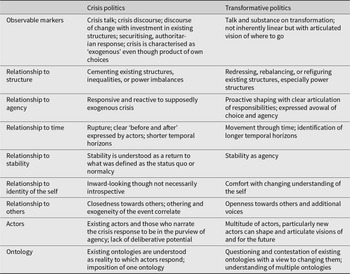
More practically for the study of ontological security, observable markers for identifying ontological security change from focusing on crisis talk and discourse to tracing discourse and action that substantively articulate and aim to materialise alternative futures (see Table 1). In other words, ontological security needs to avow a study of material effects and material change. This affects how actors articulate the relationship to existing structures. Scholars, could, for example, trace moments of redressing structural injustices rather than track where actors cement existing ones. The understanding and analysis of agency also changes – rather than being driven by habit or routines, which presupposes a limited possibility of agency, we can trace how actors proactively avow agency and responsibility. This alters the relationship to time and stability. Whereas crisis politics are characterised by articulations of rupture, transformative politics are understood as moving through time, allowing scholars to track lager temporal horizons. Stability here is the recognition of agency of the self and others, rather than a return to a previously accepted status quo.
Differences in studying crisis politics and transformative politics.

Table 1 Long description
The table contrasts crisis and transformative politics across nine dimensions: markers, structure, agency, time, stability, self-identity, relations to others, actors, and ontology I encourage ontological security scholars to draw on this table to guide empirical and methodological strategy when studying ontological security. Crisis politics is marked by crisis discourse tied to existing institutions, often paired with securitising or authoritarian responses and framing the crisis as external. It tends to cement existing structures and power imbalances, with agency described as reactive and responsibility displaced onto an allegedly exogenous event. Its time horizon emphasizes rupture and a clear before-and-after, aiming for stability as a return to normal. It is expressed in more inward-looking approaches, often more closed to others, and centers existing actors who narrate the response, with limited deliberation. Transformative politics emphasises narrative and material substance of transformation, guided by an articulated vision that might not be linear. It can rebalance or refigure power structures, assert choice and responsibility, adopt longer time horizons, and treat stability as something created through agency. It is expressed as more comfort with changing self-understandings and material change, more open to additional voices, includes new actors shaping future visions, and questions dominant ontologies while recognising multiple ways of understanding reality.
I illustrate this by considering transformative politics as a means to reconstitute the material foundations of everyday life, including energy systems that we know have political and social effects.Footnote 69 Transformative infrastructure switches – such as China’s electrification of energy and mobility systems, its massive renewable energy buildout, or Costa Rica’s national electricity system transformation – present shifts in energy systems that reduce dependence on volatile fossil fuels. They also enable new identities to emerge via transformation in recognition, of course, that, for example, China remains significantly wedded to coal power. This reduces the need to defend the existing system or identity through either symbolic commitments or incremental reforms, both of which are likely to deepen ontological insecurity.
As Hausknost argues ‘regarding systemic problems’, ‘states tend to retreat to reactive position that allows them to deny authorship of unpalatable social facts and to rely on externally generated sources of reality like capitalist market dynamics and natural disasters instead’.Footnote 70 It follows that ‘states tend to manage a reality they construct as externally given and evolving, and manage to disavow their own power to wilfully create realities through binding political decisions’.Footnote 71 Yet, this rendering choiceless is an articulation of ontological insecurity through the denial of agency, mischaracterising the very agency that is needed to articulate it. For example, after slashing the UK’s aid budget, the Labour government ‘re-iterated its manifesto commitment to return to spending 0.7% of GNI on aid’, when ‘fiscal circumstances allow’.Footnote 72 That the choice to cut aid itself produces fiscal circumstances and costs that impede on fiscal ‘normalcy’ was not part of the discussion. The delay logic connected to climate change,Footnote 73 therefore, not only produces outcomes in which climate change is more difficult to tackle but also makes the already illusory ‘return to normalcy’ even more unlikely.
Transformative politics instead conceptualises the ‘return to normalcy’ as not only a closure but also an undesirable and impossible response that requires overshadowing the sources of the crisis that actors aim to mitigate. This comfort with a changing identity opens the possibility to articulate, re-politicise, and re-democratise agency in international climate politics. Given that actors have already committed to a change of the climate and the environment through fossil fuel identities, they have committed to the very change in identity that they resist. This of course, necessitates an understanding of the material environment and the climate as inherently tied to the concept of identity, which ontological security scholars such as Ejdus have previously articulated.Footnote 74
The transtemporal view on the constellation of world politics contained in transformativity also acknowledges that if the processes of world ordering have led us to this climatic point, then there is no inherent value in maintaining a performance of order without questioning possible alternatives. Ordering conceived as a return to order creates the very insecurity that is sought to be alleviated by the impulse to order. We decide how long-lasting our addiction to existing structures – loosely defined as order – is going to be. Every investment in the impulse to order to secure those structures is a means to cement them and thus ensuant insecurity.Footnote 75 Positioning the restoration of order as hierarchically superior to the ‘anarchy’ of change leads to an ‘aura of a superior order’,Footnote 76 with little substance when it continues to create insecurity. This anticipated return to order in the context of a warming world concomitantly leads to the overestimation of the cost of action by underestimating the cost of inaction.
From maladaptive routines to reflexive responsibility
The focus on crises above links to routines as a key feature of the ontological security literature.Footnote 77 So far the theorisation of routines allows us to understand and explain the behaviour of actors in the production of their insecurity via the attachment to insecure or maladaptive routines or relationships.Footnote 78 As such, ontological security scholarship is well equipped to highlight fossil fuel routines’ connection to identity, though more research exploring this relationship is needed. Yet, the very notion of climate change challenging a way of life, one that is both characterised as right and without alternatives, is one such routine when it is expressed in policies that seek to maintain it. McLaren and Corry, for example, show that rather than reflexive responsibility, actors aim to secure policies that enable the way of life to continue as is, in ill recognition of producing the climate crisis in this way, expressed in policies and laws that criminalise climate activism or pursue geoengineering fantasies.Footnote 79 Carbon capture and storage is another such routine policy, one that not only promises to prolong the fantasy of being able to continue with the extraction and burning of fossil fuels but also unhelpfully redirects resources away from established technologies such as solar and wind.Footnote 80 Climate change exposes the active investments required in sustaining routines that are evidenced to produce harmful effects. Far from an automatic habit, the invocation of routines is costly and requires work. From a Lacanian perspective, the investment in the fantasy takes work, and from an existentialist perspective this investment constitutes a form of bad faith.Footnote 81
Yet, in the existing ontological security literature, routines are rarely discussed as a symptom of insecurity and are instead characterised as response mechanisms to perceived insecurity to ‘stabilise’ a sense of self. Mitzen, for example, has understood routines as identity-giving, or identity-confirming.Footnote 82 She therefore suggests that ‘identities are anchored in routines with significant others, and actors – even corporate actors such as states – become attached to or invested in these routines’.Footnote 83 Yet, routines are not inherently ‘stabilising’ when they produce differentiated vulnerabilities and insecurities. Mitzen has likewise argued that routines are ‘internally programmed cognitive and behavioral response[s] to information or stimuli’.Footnote 84 This reflects Hopf, who argues that ‘the logic of habit necessarily precludes rationality, agency, and uncertainty’.Footnote 85 However, as discussed above, stimuli as seen through a politics of crisis are by far merely signals to an open and responsive cognitive system. Agency instead sits as the space between stimulus or emotion and action. This reflects psychologist Victor Frankl’s observation that ‘between the stimulus and response, there is a space. And in that space lies our freedom and power to choose our response. In our response lies our growth and our freedom.’Footnote 86 In other words, Mitzen’s core features of routines as investment in and internally programmed exclude consideration of the space where agency rests.
Additionally, their characterisation as automatic helps de-democratise their invocation, overshadowing where and how agency is required to sustain the status quo. Benoit Pelopidas writes in the context of the birth of nuclear eternity that the ‘naturalization of nuclear weapons’ ‘[removed] them from the realm of democratic choice at a particular point in time’.Footnote 87 Routines through their conceptualisation as automatic are also removed from democratic choice when their invocation is far from automatic. This is important because it links bigger questions about the production of systemic injustices through routine behaviours.Footnote 88 If ontological security scholars accept such injustices as a byproduct of ontological security-seeking behaviour, then, they sideline important questions about the production of insecurity that their consequences engender.
Fossil fuel routines as so embedded in the day-to-day of decision-making and funding bodies are likewise removed from democratic choice or rendered invisible to the possibility of democratic choice. Consider, for example, the $19bn UK pensions at risk of stranded asset loss by 2040, or the 6 per cent UK public ownership of global losses from stranded fossil fuel assets. Such routines – and insistence on their importance by decision makers in various sectors – accept and normalise that losses are born by the public rather than those chiefly responsible for climate losses while gains are privatised. Watts writes similarly that ‘the fact that perhaps $50bn of the total $240bn oil revenues that have flowed into the Nigerian exchequer since 1960 should have “disappeared” speaks powerfully to the deception at the heart of Nigeria as an oil nation’.Footnote 89 This inequality of loss-bearing extends further to climate-vulnerabilised countries who are at the forefront of experiencing the effect of the climate crisis while least responsible for producing it.Footnote 90 The making invisible of the cost of fossil fuel routines is also reflected in the one-sided debate about the cost of decarbonisation.Footnote 91
Ontological security scholarship requires a much more explicit investigation of the differentiated responsibilities governing states, businesses, and other areas of political life and the normalisation of accepted routines that produce present, past, and future harms. Indeed, the use of fossil fuels to ‘fuel’ power is, likewise, a routine or, as characterised by some, a ‘habit’.Footnote 92 Such habitualisation obfuscates the violence immanent in habit or routines when they embed injustices as outlined above or when they produce forms of ‘violent ordering’.Footnote 93 The important point of departure for climate change and climate politics, then, is that learned routine behaviours create the very crisis that the learned behaviour seeks to avoid. In the context of climate change, this need is not occasional, but existential. Ontological security scholars need to be better equipped to investigate the processes by which this need is denied and what it means for ontological security to be approximated or sought under these conditions.
To develop mechanisms that help us to ‘reconstruct the social environment in ways that will allow us to change our Selves and abandon unhealthy routines’, forms of ontological security seeking in recognition of planetary boundaries thus require a means to overcome maladaptive routines in favour of reflexive responsibility.Footnote 94 This, as Ralph, argues, is important because ‘in the face of actual material threats (pandemics, climate change, and nuclear atrocity), we do not want to be anxious (and therefore hesitant) in our opposition to a politics that conserves dangerous routines for the sake of exceptionalist identities’.Footnote 95 Even though Ralph does externalise the threat of climate change and seeks to understand anxiety as a hinderance to the ability to change, he rightly diagnoses the requirement to abandon unhealthy routines as a key factor in the production of ontological security.
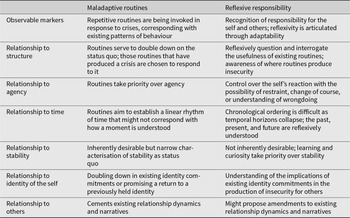
Moving beyond routines as a means to approximate or create ontological security, I argue that one way in which ontological security beyond routines can be expressed and to a degree learned is through an actor’s capacity for reflexivity and choice (see Table 2), itself not foreign to the ontological security literature.Footnote 96 If routines underwrite ontological insecurity (or are a means to address it), then it must be possible for alternative coping mechanisms to exist and for actors to create ontological security in sustaining sustainable routines and changing maladaptive ones. Reflexivity and reflexive responsibility, then, are broadly conceived of as a mode of critical thinking that is ‘capable of producing a different knowledge of world politics and also generating cognitive growth in the traditional sense of the term’.Footnote 97 This capacity for critical thinking is closely linked to the understanding of choice inherent to discussions of agency. Reflexive responsibility can also be understood as a part of Steele’s notion of restraint as the power ‘to go…against or resist…something we would otherwise expect to prevail’.Footnote 98 This resistance is an act of resistance against what is commonly assumed to be a routine that would secure the vulnerabilities of the aesthetic self in action. Such restraint is meaningful when enacted through time – that is, for conscious awareness, that power rests in the ability to control oneself through time, for without time, such control would be rendered meaningless. While this appears to contradict the notion of ‘flow’ that Steele highlights in his work, I maintain that reflexivity is a requirement for the comfort with a changing self, inherent to Steele’s concept of flow.Footnote 99
Differences in studying maladaptive routines and reflexive responsibility.

Table 2 Long description
The table compares two approaches across seven dimensions: observable markers, structure, agency, time, stability, identity, and relationships with others. Maladaptive routines are described as repetitive crisis responses that follow existing behavior patterns and reinforce the status quo, even when those routines contributed to the crisis. Reflexive responsibility emphasizes recognizing responsibility to self and others and expressing reflexivity through adaptability. On structure and agency, maladaptive routines prioritize routine over choice, whereas reflexive responsibility interrogates whether routines are useful and supports restraint, changing course, or acknowledging wrongdoing. On time, maladaptive routines seek a linear rhythm, while reflexive responsibility notes collapsed temporal horizons where past, present, and future are understood together. On stability and identity, maladaptive routines treat stability as inherently desirable and double down on existing identity commitments, while reflexive responsibility treats stability as not inherently desirable and considers how identity commitments can create insecurity for others. Regarding others, maladaptive routines cement existing relationship narratives, while reflexive responsibility may propose amendments to those dynamics. The entries are qualitative characterizations rather than measured outcomes, so they summarize conceptual differences rather than quantify frequency or effect size.
This does not mean that change is inherently normatively desirable, but that a reflexive ability is required to identify when change is necessary. In this way, and drawing on Giddens, Chandler describes ‘resilience…as empowering, freeing, or liberating the agency of the individual’.Footnote 100 Beyond the individual, the logic of Giddens also extends to the state, namely in the liberation of agency for states ‘to make better life choices and adopt better lifestyle habits’.Footnote 101 Resilience then becomes a function of ‘work on the self’.Footnote 102 The work on the self in the context of states implies a questioning of the self-concept and the maladaptive politics it produces. Such a conceptualisation of resilience does not negate the importance of ‘basic trust’ identified by Flockhart but instead locates trust in an actor’s ability to learn and exert agency when required.Footnote 103 In other words, while trust is a key ingredient in the creation and approximation of ontological security, reflexivity can answer the question of trust in, in this case, one’s ability and openness for reflexivity.
In practice, initiatives such as the fossil fuel non-proliferation treaty or the First Conference on Transitioning Away from Fossil Fuels in Santa Marta, Colombia, can be considered examples of where actors have attempted to disrupt and challenge maladaptive routines by targeting fossil fuel expansion rather than emissions alone. It challenges the assumption that continued exploration and extraction of fossil fuels are necessary and instead ideates the deliberate closure of destructive fossil fuel futures and their underlying material infrastructures. On 20 August 2023, Ecuadorians voted by nearly 59 per cent in a nationwide referendum to leave heavy crude oil in the Yasuní National Park in the ground, despite billions of dollars’ worth of expected revenues and Ecuador’s significant dependence on income from oil production. The referendum was seen by international observers as a starting point for future replication elsewhere, the bottom-up, civil society strategy a mechanism through which climate justice concerns can be leveraged.Footnote 104 Watts writes in the Guardian, for example, that the referendum results were ‘the fruit of years of dogged campaigning by the Yasunídos collective and other civil society groups’ that ‘will surely inspire climate activists in other parts of the world’.Footnote 105 Next to the impressive victory of the referendum itself, however, the result, if implemented,
obliges the state oil company to dismantle operations – 12 drilling platforms and 225 wells that produce up to 57,000 barrels a day – in block 43 of the Ishpingo-Tambococha-Tiputini (ITT) project, an area of the Amazon rainforest famed for its ecological diversity, and which is home to two tribes that live in voluntary isolation.Footnote 106
One year after the referendum, the Ecuadorian government under the leadership of President Daniel Noboa announced that the phase out and dismantling of oil infrastructure could take up until 2032. Environmental organisations, however, have lamented the slow progress and lack of action while oil continues to be extracted from the site.Footnote 107 Yet, outside of the strategy that led to the successful referendum and next to the lack of enforcement of the referendum, the material politics the referendum represents are more powerful than the mere production of discursive shifts precisely because they demonstrate that mobilisation around routines can produce shifts in the acceptance of oil and fossil fuel extraction.
For the study of climate change and ontological security, then, the question is one of identifying where actors demonstrate reflexive capacity to expand the space between stimulus and response and where they opt to invest in costly routines instead. As argued, Steele’s notion of restraint is one such space-expanding technique.Footnote 108 Other mechanisms could include studying concessions of wrongdoing, the role of guilt, or a more active taking of responsibility for past failures. For scholars, this means drawing on a set of different conceptual tools as we move from identifying routines to reflexive capability. Consequently, analytical markers such as containing, dismantling, and undoing become much more important categories than those of maintenance, emphasis, or sustenance. For scholars of ontological security, this necessitates resisting a ‘doubling down on the identities that conserve failing routines’Footnote 109 and instead studying ontological security-seeking behaviour at moments at which actors invoke or avow reflexive responsibility. This allows for richer empirical insights into existing relationship dynamics and narratives by centring learning and curiosity, normatively acknowledging a responsibility for others.
From anxiety to emotive agency
Based on the discussion on crisis politics and routines, this section discusses the concept of anxiety within ontological security literature and how anxiety can be expressed as an approximation of ontological security in reference to planetary boundaries. Here the concern is not so much with the status of anxiety in OS itself given the extensive treatment of anxiety within the literature, but rather what it is seen as doing in the context of climate change and climate action.Footnote 110 This differentiation is important precisely because while the OS literature has acknowledged the emancipatory potential of anxiety, it has not done so in the context of climate change and has instead focused on the ways that climate change produces anxiety and thus invokes response mechanisms. In other words, the directionality of the relationship is centred on the climate crisis’s production of anxiety or on the production of anxiety through transitions.Footnote 111 This is important work, of course, especially where research links the production of ontological security to actors rather than a background condition of modernity alone.Footnote 112
Yet, in taking the creative potential of anxiety seriously, Berenskoetter suggests that early OS research suffered from an ‘anxiety paradox’ characterised by ‘the tendency of reflexive humans facing the freedom of being in time to attach themselves to constructs that provide a sense of temporal continuity or certainty’.Footnote 113 Because Berenskoetter suggests security-as-becoming, he links ‘creative-constitutive agency’ ‘to an event that undermines existing mechanism and thereby destabilizes conceptions of being in time, in turn, generating demand for the creation of (new) mechanisms’.Footnote 114 This takes seriously the possibility of ‘radical forms of agency’ or ‘emancipatory agency’ in the context of anxiety derived from creativity and an embrace of uncertainty.Footnote 115 Berenskoetter further suggests that the ‘ontological security framework has no place for emancipatory agency because it is stuck with the assumption that the possibility of a radically open future generates a heightened state of anxiety and, as such, ontological insecurity’.Footnote 116 This intervention is a welcome one and mirrors OS’s focus on anxiety as a byproduct of climate change that results in denial or inaction.
Yet, while the ontological security literature has paid significant attention to the alleviation of anxiety as a key driver of routine behaviour in times of crises, it has done less work on justifying the preoccupation with anxiety compared to other emotional states and differentiated responsibilities connected to acting on them. The overt focus on anxiety somewhat artificially inflates some forms of anxiety as more meaningful to ontological security considerations than other forms of anxiety or other emotional states such as fear, anger, joy, or, indeed, tackling the sources of or embracing insecurity.Footnote 117 It also prioritises forms of anxiety in one community over others, for example, by suggesting that eco-anxiety is a novel form of anxiety when both colonialism and nuclear weapons testing, for instance, produced significant and existential forms of eco-anxiety if the concept is to be taken seriously.
Second, and in the context of ontological security studies’ rendering of anxiety as non-agentic and presentist, climate change helps to centre our analysis on the agents that produce large-scale planetary harm. Here Erskine’s work on moral agency is useful, who – though not written in the context of ontological security studies – lamented a remarkable silence on the agents involved in international politics.Footnote 118 Without recognition of those agents that produce ontological insecurity,Footnote 119 it is impossible to theorise anxiety as actively produced rather than a byproduct of modernity. Celermajer writes in this regard that a burning world ‘commands’ responsibility in reference to action and to how the very notion of responsibility is understood.Footnote 120 Scholars have significant influence over both, but particularly the latter. The responsibility I wish to emphasise here is one that includes challenging the misidentification and normalisation of anxiety and instead identifying explicitly those agents that produce it.
Consider, for example, recent floods in Bangladesh, Nigeria, Spain, and England. While the context of each of those cases differs, a study of the production of ontological insecurity through continued fossil fuel use or climate inaction would render agents central. Given that ‘both the magnitude and variance of future rainfall losses are projected to increase’,Footnote 121 a passive understanding of anxiety risks overshadowing the agentic choice and responsibility inherent to decision makers’ wilful ignorance of such risks. This also means understanding the future of climate politics as one that goes beyond questions of material distribution.Footnote 122 Instead, a more detailed understanding of emotive agency demonstrates that climate inaction already renders certain claims to ontological security, for example those seeking ‘a safe home’ as invisible compared to the ontological security-seeking behaviour of the producers of large-scale planetary harm.Footnote 123 The empirics of climate politics in this context would need to expand by studying whose claims to ontological security are legible and whose claims are disregarded through the invocation of ‘unagentic’ ‘tragedy’ or happenstance.Footnote 124 Here, further analytical depth on the relationship between unaddressed grievances and the international order is necessary.Footnote 125
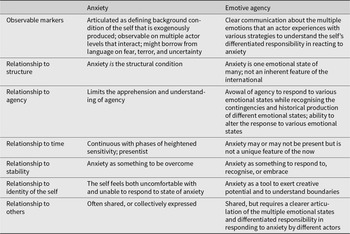
Instead, I suggest emotive agency as a corresponding marker for ontological security (see Table 3). I characterise emotive agency by not the absence of emotions but rather a capacity to manage and respond to them constructively. In this context, states carry differentiated responsibilities to that of the individual. Indeed, while ontological security scholarship has been successful at dispelling concerns that individual psychological traits are not applicable to states,Footnote 126 it has rarely articulated differentiated responsibilities connected to responding to anxieties between different actors. In this way, it is not a given that states would bear the same responsibility to that of an individual in responding to experiences of anxiety, not least when short-term strategies of responding to anxiety produce insecurity within the population or polities outside of a state.
Differences in studying anxiety and emotive agency.

Table 3 Long description
The table contrasts two concepts, anxiety and emotive agency, across seven dimensions: observable markers, links to structure, agency, time, stability, self-identity, and relations to others. Anxiety is described as an externally produced background condition of the self, visible across interacting actor levels and often discussed using language of fear, terror, and uncertainty. It is treated as the structural condition that limits how agency is apprehended and understood, and it is portrayed as continuous with periods of heightened sensitivity and a focus on the present. Anxiety is also framed as something to overcome, leaving the self uncomfortable and unable to respond, and it is often shared or collectively expressed. Emotive agency emphasizes clear communication about multiple emotions and strategies for understanding differentiated responsibility in reacting to anxiety. It treats anxiety as one emotional state among many rather than an inherent feature of international life, and it stresses avowing agency to respond, including altering responses while recognizing historical and contingent emotional production. Over time, anxiety may or may not be present and is not unique to the current moment; it can be recognized, embraced, or used creatively to explore boundaries. Both can be shared socially, but emotive agency requires clearer articulation of varied emotions and how different actors bear different responsibilities in responding.
I therefore understand emotive agency as the condition through which actors can reflect on and respond to ‘the dual dimension of emotions’.Footnote 127 Because emotions ‘can be both constituted by and constitutive of power relations’, their ‘management’ connects to when and how agency is invoked. In short, emotive agency allows us to question how the self-concept and the routines that seek to substantiate it interact. This partly connects emotive agency to discussions of resilience – a process that is possible despite significant adversity, trauma, and uncertainty.Footnote 128 Flockhart, for example, argues ‘that resilience as the capacity to continuously cope with, and adapt to change to overcome adversities in order to remain fit for purpose is dependent on agents having a sufficient level of ontological security to be able to invoke their agency when needed’.Footnote 129 While Flockhart accounts for reflexivity and adaptability, she makes the capacity or source of adaptivity contingent on ontological security. This denies the possibility of escaping the trap of maladaptive politics.
Lastly, the materiality of climate loss as it relates to climate effects needs much greater recognition in ontological security studies, which itself reflects the creativity and comfort connected to emotive agency. To be sure, the loss of a safe home or the anticipation of territorial loss or displacement are, of course, anxiety-inducing. Yet, loss spans much further and goes far beyond anxiety. This is the case on the level of individuals, communities, states, and the planet, not least because responses to loss can vary and are much more nuanced than ontological security scholarship is reflective of.Footnote 130 So far, ontological security has restricted itself to the immaterial consequences of climate losses, such as the production of anxiety, or the loss of routines, memory, and spatially embedded understandings of home. This is important, of course but risks underestimating the materiality of loss and the production of ontological insecurity while sidelining questions about the political economy of trauma.Footnote 131 It also risks underplaying creativity and adaptation. Meanwhile, a greater focus on emotive agency could invite investigations of how reparations in material and immaterial termsFootnote 132 can build ontological security or how ontological security requires ontological justice, that is, the recognition of the right to live in a just world. Having treated justice and order as opposites, ontological security scholars have mirrored the English School’s characterisation of both as antithetical.Footnote 133 Such an opposition analytically obfuscates theoretical insight into how ontological security could be sourced through addressing structural injustices that are inherent to the climate crisis. Focusing on the emotive agency that actors can draw on to respond to such losses, to address structural injustice, and to examine the material consequences of climate change carries a set of normative implications for the study of ontological security.
Conclusion
This paper has argued that unmitigated and unadapted-to climate change disrupts the foundational assumptions underpinning international relations theory at large and ontological security studies specifically. The persistent focus on insecurity in scholarship and practice – manifested through crises, routines, and anxiety – has shaped the ontological security literature in such a way that it has foreclosed analyses of how addressing climate change and broader planetary boundaries or existential concerns can be means of seeking ontological security. I therefore question the assumption that ontological insecurity is a byproduct of modernity and suggest instead that it is actively produced. A focus on the byproduct has tended to relegate responsibility in the production of insecurity as a product of tragic, anxious, or insecure politics. In seeking to redress this foreclosure, this paper proposed a reorientation of ontological security studies away from its preoccupation with the ‘management’ of insecurity and towards a framework capable of articulating necessary conditions for ontological security in the context of planetary boundaries and the production of planetary harm. I have argued that corresponding concepts are transformative politics, reflexive responsibility, and emotive agency.
I see the corresponding concepts as means to build on and expand the possibilities that ontological security studies both empirically and theoretically entertains. The conceptual shift proposed here instigates several future research directions and empirical strategies. First, and by far a question of legal consequences alone, international relations scholarship and ontological security scholars in particular – if they are to take a normative scholarship seriously – require clear means of identifying the actors in the production of ontological insecurity. Lerner’s observation that much of what is being considered as ontological security produces deep insecurity for communities within the international system is a starting point.Footnote 134 How, then, articulations of ontological security can capture accountability for producing ontological insecurity is a key question for future research, not least in identifying approaches to ontological justice.
Next, ontological security studies requires further research into the differentiated and context-dependent meanings of solidarity and loss by recognising that concepts such as eco-sovereignty could do much to help advance notions of agency that go beyond either extractivist logics or territorial possessions.Footnote 135 How people make sense of loss and generate new attachments to place and community is an important part of this research agenda for as long as it avoids normalising the loss of place and community as a product of happenstance. At the heart of climate politics are questions about not just sovereignty and power but also redistribution, the socio-economic organisation of the international order, justice, and reparations.Footnote 136 Ontological security studies would be erroneous were it to exclude this set of politics from its theorisation.
This means interrogating the type of structural redress required to produce ontological security more effectively. Irrespective of whether ontological security can be attained or not, a reorientation towards how our understanding of security can shift from order to justice is a central requirement of an ethics within ontological security studies that can meaningfully shape future discussions of responsibility. Climate change articulated as an exogenous threat to the existing stability is not a helpful mode of inquiry, nor does it help create the diagnostic tools for understanding how we can move towards safer ontological grounds. At the risk of a polemic finish, I close by emphasising that scholars of IR and ontological security require above all a better grasp of the type of moral commitments that their research imposes on the understanding of world politics. Climate change, if anything, is a wake-up call that what we have come to understand as stability has never been thus. The vision and actualisation of the future in absence of alternatives already expresses a future – just not one that is desirable, liveable, or possible. With this limitation in mind, the exercise of addressing existential concerns, planetary boundaries, and the climate crisis can be a means of generating what may be yet unknown forms of ontological security.
Acknowledgements
I would like first and foremost to thank Brent Steele and Cornelia Baciu for their commitment, encouragement, and time spent on this submission. I have learned so much. I would also like to thank all participants at the ISA Creating Ontological Security workshop, all of whom made the paper so much better than I had originally envisaged it to be. I would also like to thank the British Academy, which has funded part of the work on this manuscript as part of a Knowledge Frontiers Grant (KF8\230136) and the Critical Actuarial Science project.
Pauline Sophie Heinrichs is Lecturer in War Studies (Climate and Energy Security) at King’s College London and Co-Director of the Centre for Integrated Research on Risk and Resilience (CIRRR) at King’s College London. Pauline’s work focuses on the production of planetary insecurity.

 Open access

