







1. Introduction
A topic within the study of wall-bounded turbulence that has received extensive attention for many decades, due to its significant implications on flow representation and modelling, is the overlap region between the inner or wall region and the outer region of the flow. According to the classical literature, the mean velocity profile in this overlap region follows the well-known logarithmic law (1.1), which contains  $\kappa$, the von Kármán constant:
 \begin{equation} \bar{U}^+_{x\,OL}(y^+{\gg} 1~and~Y\ll 1) = \frac{1}{\kappa} \ln y^++ B. \end{equation}
In this equation,  $\bar {U}_x$ is the streamwise mean velocity, the ‘ $+$’ superscript indicates that we are using the viscous scaling, and the ‘ ${OL}$’ subscript indicates validity in the overlap region. The independent variable $y^+$ is the inner-scaled wall-normal coordinate, $y^+ = y u_\tau /\nu$, where $u_\tau$ is the friction velocity and $\nu$ is the fluid kinematic viscosity. The variable $Y$ is the wall-normal coordinate made dimensionless by the ‘outer scale of the flow’ $\ell$. Since the work of Nagib & Chauhan (Reference Nagib and Chauhan2008) the universality of the log law and the von Kármán ‘coefficient’ have been occasionally challenged or reaffirmed, e.g. see references by George & Castillo (Reference George and Castillo2006), Monkewitz, Chauhan & Nagib (Reference Monkewitz, Chauhan and Nagib2008), Vinuesa, Schlatter & Nagib (Reference Vinuesa, Schlatter and Nagib2014), Luchini (Reference Luchini2017). More recently, Monkewitz & Nagib (Reference Monkewitz and Nagib2023) (MN23 from now on) shed additional light on this topic, challenging the knowledge accumulated during the last century. The main point of MN23 is that a more thorough matched asymptotic expansion (MAE) of wall-bounded flows yields an overlap region containing a combination of logarithmic and linear terms of the distance to the wall in (1.2). They arrived at this result by considering in the inner asymptotic expansion a term proportional to the wall-normal coordinate, $O(Re_{\tau }^{-1})$. Here we will reference this overlap region as ‘ $\log$+ ${\rm lin}$’, and use $Re_{\tau } = u_\tau \ell / \nu$, which is the friction Reynolds number with $\ell$ a characteristic outer length. For consistency with MN23, this $\ell$ can be thought of as the radius $R$ in pipes, the semiheight in channels, $h$, or a length scale related to the 99 % boundary-layer thickness $\delta _{99}$ in boundary layers:
 \begin{equation} \bar{U}^+_{x\,OL}(y^+{\gg} 1\ {\rm and}\ Y\ll 1) = \kappa^{-1}\ln y^++ S_0 y^+{/}Re_\tau + B_0 + B_1/Re_\tau. \end{equation}
Note that in equation (1.2),  $S_0$, $B_0$ and $B_1$ are constants. Earlier publications by Yajnik (Reference Yajnik1970), Afzal & Yajnik (Reference Afzal and Yajnik1973), Lee & Moser (Reference Lee and Moser2015), Luchini (Reference Luchini2017) have considered a linear term in the overlap region of channel and pipe flows. However, unlike MN23, none of them revealed the non-universality of the Kármán constant, or the dependence of the overlap coefficients $\kappa$, $S_0$ and $B_0$ on the pressure gradient along the flow. In most literature on boundary layers, including for turbulent conditions, the commonly used pressure-gradient parameter is $\beta ^{*} \equiv (-\delta ^{*}/\tau _{w}) \ {\cdot } \ (\partial P_{e}/\partial x)$, where $\delta ^{*}$ is the displacement thickness, $\tau_w$ the wall-shear stress, and $P_{e}$ is the free-stream static pressure. In order to compare results from developing boundary layers to fully developed flow in channels and pipes, at corresponding pressure gradients, we will use the parameter $\beta \equiv (-\ell /\tau _{w}) \cdot (\partial P_{e}/\partial x)$. The outer length scale of all boundary-layer profiles used here, $\ell$, is established in the next section. Effects of pressure gradient on boundary layers have often been considered to have ‘history effects’ on the flow. In particular, several studies have documented flow-history effects on the Reynolds stresses and the wake region of the mean velocity profile (Harun et al. Reference Harun, Monty, Mathis and Marusic2013; Bobke et al. Reference Bobke, Vinuesa, Örlü and Schlatter2017), while other studies have also reported an effect of flow history on the overlap region and its coefficients $\kappa$ and $B$ (Vishwanathan et al. Reference Vishwanathan, Fritsch, Lowe and Devenport2023).
Our objective here is to examine whether such history effects are present in the overlap region, or a behaviour more like quasiequilibrium exists when the  $\log$+ ${\rm lin}$ overlap is used to analyse well-documented boundary-layer data under conditions of adverse pressure gradient (APG) or favourable pressure gradient (FPG), including strong favourable pressure gradient (SFPG), and, for reference, zero pressure gradient (ZPG). Here, we use ‘quasiequilibrium’ to signify that the three parameters defining the mean velocity profile in the overlap region between the inner and outer flow are independent of the upstream or history effects experienced by the boundary layer. We also expect that any quasiequilibrium, or diminished history effects, in turbulence quantities may be delayed past the establishment of more equilibrium in the mean flow.
2. Boundary-layer databases
Two sets of boundary-layer data were selected and used because the pressure gradients imposed were well controlled and documented, and independent wall-shear stress was measured directly by oil-film interferometry. One was carried out in the NDF wind tunnel at Illinois Tech (IIT, Chicago) (Nagib, Christophorou & Monkewitz Reference Nagib, Christophorou and Monkewitz2004) and the other was obtained in the MTL wind tunnel of KTH (Stockholm) (Sanmiguel Vila et al. Reference Sanmiguel Vila, Vinuesa, Discetti, Ianiro, Schlatter and Örlü2020). Both sets of data were measured by hot-wire anemometry and the free-stream velocity was measured independently using Pitot probe measurements at reference points above the boundary layers developing on a suspended flat plate. In the case of the MTL data we did not use the ‘strongly increasing’ pressure-gradient data, and only the 30 m s $^{-1}$ cases to avoid any low $Re_\tau$ effects and insure fully turbulent conditions even near the start of the boundary-layer development. More cases were studied by Sanmiguel Vila et al. (Reference Sanmiguel Vila, Vinuesa, Discetti, Ianiro, Schlatter and Örlü2020).
The velocity profiles of all the data used by us are shown in figure 1. Since the work by Chauhan, Monkewitz & Nagib (Reference Chauhan, Monkewitz and Nagib2009), a composite mean velocity profile has been used to determine an outer scale of ZPG boundary layers instead of various other measures of the boundary-layer thickness, including integral thicknesses, e.g. Samie et al. (Reference Samie, Marusic, Hutchins, Fu, Fan, Hultmark and Smits2018) and MN23. This outer scale  $\delta$ was systematically compared with the large data base used by Chauhan et al. (Reference Chauhan, Monkewitz and Nagib2009), and we concluded that for ZPG, $\delta \approx 1.25 \delta _{99}$. In both the NDF and MTL data sets we used, we also found that approximate measure of an outer scale to the edge of the boundary layers is valid under APG, FPG and SFPG conditions in addition to ZPG. Therefore, we utilized the outer scale $\ell \equiv \varDelta _{1.25}=1.25 \delta _{99}$, and $\beta \equiv (-\varDelta _{1.25}/\tau _{w}) \cdot (\partial P_{e}/\partial x)$. We also define $Y \equiv y^+ /Re_\tau$ to obtain the following from (1.2):
 \begin{equation} {U_x}^+_{OL}(Y\ll 1) \sim \kappa^{-1}\ln Y + \kappa^{-1}\ln Re_\tau +S_0 Y + B_0 + B_1/Re_\tau. \end{equation}
Simplifying, we obtain
 \begin{equation} {U_x}^+_{OL}(Y\ll 1) = \kappa^{-1}\ln Y + \kappa^{-1}\ln Re_\tau +S_0 Y + B_0 + {HOT}. \end{equation}
Mean velocity profiles from boundary layers of data sets used (Nagib et al. Reference Nagib, Christophorou and Monkewitz2004; Sanmiguel Vila et al. Reference Sanmiguel Vila, Vinuesa, Discetti, Ianiro, Schlatter and Örlü2020), normalized by free-stream velocity  $U_{\infty }$ and $\delta _{99}$; (a) FPG in magenta and SFPG in black from NDF; (b) APG in red from MTL and APG in blue from NDF; dashed red lines at $y/\delta _{99} = 1.25$, corresponding to $\varDelta _{1.25}$.

With increasing Reynolds number, the higher-order terms (HOT) starting with  $B_1/Re_\tau$ may be ignored. The pressure-gradient parameter defined using the outer scale $\varDelta _{1.25}$ calculated for all profiles of boundary layers from the NDF and MTL data sets are displayed in figure 2. Note that in figure 3 of Sanmiguel Vila et al. (Reference Sanmiguel Vila, Vinuesa, Discetti, Ianiro, Schlatter and Örlü2020) the pressure-gradient parameter used was $\beta ^*$ utilizing $\delta ^*$ as a length scale and yielding conditions of ‘approximately constant’ or ‘mildly increasing’ APG. With the closely spaced data in the range around $0.99 U_\infty$, and well into the free stream from the NDF wind tunnel (see figure 3), which included the full APG, ZPG, FPG and SFPG cases, the $\varDelta _{1.25}$ was far more reliable than experienced in the literature, and represented more physical thicknesses than for example the Clauser thickness.
Reynolds-number dependence of pressure-gradient parameter,  $\beta$, in boundary layers of data sets used; APG data in red dots with second-order best fit for two configurations in MTL by Sanmiguel Vila et al. (Reference Sanmiguel Vila, Vinuesa, Discetti, Ianiro, Schlatter and Örlü2020), ‘mildly increasing’ APG (dotted red line) and ‘approximately constant’ APG (red line); data from NDF by Nagib et al. (Reference Nagib, Christophorou and Monkewitz2004) for three configurations at six streamwise locations and three free-stream velocities: FPG in magenta, SFPG in black and APG in blue; black lines depict ZPG (solid) fully developed channel (dotted) and fully developed pipe (dashed) conditions.

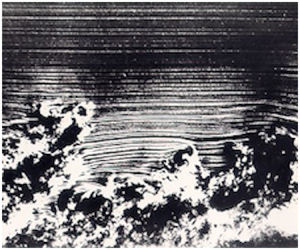
(a) Inner-scaled mean velocity profiles plotted on linear scales against  $y/\varDelta _{1.25}$ for boundary layers of data sets used: FPG (magenta), SFPG (black), ZPG (green), and APG (blue) from NDF, and APG (red) from MTL; dashed green lines at $y/\varDelta _{1.25} = 0.05$ and $0.2$ correspond to dashed green lines in figure 4; (b) smoke-wire visualization of ZPG boundary layer in NDF at $Re_\theta$, which is the Reynolds number based on momentum thickness, and is around $1800$ with arrows corresponding to approximate locations of $y/\varDelta _{1.25} = 0.05\ {\rm and}\ 0.2$.

(a) Inner-scaled mean-velocity-profile data plotted against logarithmic-scaled  $y/\varDelta _{1.25}$ for two boundary layers from NDF, for FPG (magenta) and APG (blue); green lines represent the $\log$+ ${\rm lin}$ fit of the overlap region between two vertical dashed green lines at $y/\varDelta _{1.25} = 0.05$ and $0.2$, and vertical dashed red lines correspond to $y/\varDelta _{1.25} = 0.05\ {\rm and}\ 0.11$, which is consistent with MN23; (b) indicator function, $\varXi$ plotted against same scale of (a).

Finally, the commonly used indicator function based on the mean velocity profile for wall-bounded turbulence,  $\varXi$, can be obtained from
 \begin{equation} \varXi = y^+\frac{{\rm d}{U}_x^+}{{\rm d} y^+} = Y\frac{{\rm d}{U}_x^+}{{\rm d}Y}. \end{equation}
 From (2.3) it can be noted that  $\varXi$ takes a constant value if a pure logarithmic region of the form (1.1) is present in the mean velocity profile. Furthermore, from (2.2) and (2.3), one can obtain the equation for $\kappa$ and $S_0$:
 \begin{equation} \varXi_{OL} = \kappa^{-1} +S_0 y^+{/}Re_\tau = \kappa^{-1} +S_0 Y . \end{equation}
3. Determining overlap coefficients
Applying (2.3) to mean-velocity-profile data of any wall-bounded flow in inner or outer distances from the wall,  $y^+$ or $Y$, respectively, can result in determining $\kappa$ and $S_0$ by a linear fit corresponding to (2.4). One needs to only select the range in $y^+$ or $Y$ to fit the linear relations. In figure 3(b) of Lee & Moser (Reference Lee and Moser2015), for $Re_\tau \approx 5200$, they applied a linear fit over around $300 < y^+ < 700$ $(0.06 < Y < 0.14)$ and obtained $\kappa = 0.384$ and $S_0 = 0$. Instead, if they had applied a linear fit over $0.21 < Y < 0.45$ $(1100 < y^+ < 2300)$, they would have obtained $\kappa = 0.41$ and $S_0 = 1.11$, which compare very well with values for channel flows obtained by MN23, i.e. $\kappa = 0.417$ and $S_0 = 1.1$. Recently, Hoyas et al. (Reference Hoyas, Vinuesa, Baxerras and Nagib2023) obtained values of $\kappa = 0.51$ and $S_0 = 2.6$ also for channel flows computed with two different resolutions using this approach over $0.3 < Y < 0.6$ for $Re_\tau = 550$. The value of $B_0 = 6.9$ was then obtained using the already determined values of $\kappa$ and $S_0$ by minimizing the differences between the velocity profile data to (2.2).
This approach requires highly accurate and closely spaced data for the velocity profiles to apply the derivatives of the indicator function  $\varXi$. This is often the case from direct-numerical-simulation (DNS) data, and to some degree in the boundary-layer data from the NDF, where over $200$ data points with equal physical spacing were measured. Typical wall-bounded-flow measurements, including in boundary layers, collect the measurements using points with logarithmic physical spacing, i.e. with increasing physical separation away from the wall. This has been a tradition based on an expected ‘log law’ in the overlap region. The MTL data set was obtained in this way with only $45$ to $75$ measurement points in the wall-normal direction. The profiles of figure 3 display the measured points and demonstrate the contrast in spacing between MTL (red) and NDF (blue, green, magenta and black). While determining the indicator function $\varXi$ from the MTL data was attempted using several ways, it was found to be not reliable and produced noisy results. On the other hand, two examples of $\varXi$ obtained from NDF profiles are shown in figure 4. To process both data sets using the same approach and algorithms, a different method was required. However, the $\varXi$ profiles from all of the NDF data were very important to select the range of $Y$ to use for the overlap region. Based on the experience from MN223 and Hoyas et al. (Reference Hoyas, Vinuesa, Baxerras and Nagib2023), it is found that fitting in the outer-scaled distances $Y$ from the wall is more representative of the overlap region than by using inner-scaled distances $y^+$, over wider ranges of $Re_\tau$. It also helps in avoiding the wake region especially for APG conditions, and other pressure-gradient boundary layers, including ZPG.
The approach used here is different from that for channel and pipe flows described above as we are retrieving all three parameters of (2.2) at the same time, by utilizing all profiles in  $U^+$ vs Y (= $y/\varDelta _{1.25}$). After choosing the limits of the overlap region in Y, we compute the best combination of parameters using nonlinear least-squares curve fitting. We fit our function to the data by adjusting the parameters of the function to minimize the sum of squared differences between the observed and predicted values. This optimization involves minimizing the sum of squared residuals.
Given the set of data points ( $Y_{i}$, $U^+_{i}$) and the model function $f(\kappa, S_{0}, B_{0}, Y_{i})$, represented by (2.2), we approximate the combination of parameters that minimizes the difference between the equation and the data for each mean velocity profile: $\forall N \in \mathbb {N}^{*}$, $(\kappa _{opt}, S_{0_{opt}}, B_{0_{opt}})=\underset {\kappa, S_{0}, B_{0}}{\rm argmin}\sum _{n=1}^{N} (U^+_{i} - f(\kappa, S_{0}, B_{0}, Y_{i}))^{2}$. This optimization algorithm, with an accuracy of the order of $10^{-8}$, leads to the final values of the three parameters of the $\log$+ ${\rm lin}$ overlap for each velocity profile, using $Y_{min}=0.05$ and $Y_{max}=0.2$.
4. Discussion and conclusion
With the approach described in the last part of the previous section, a parametric evaluation of the range of  $Y$ to extract the parameters of the $\log$+ ${\rm lin}$ overlap from the mean-velocity-profile data was conducted using the NDF data first and then extended to the MTL profiles to arrive at a single range for all data. The choice of these values in our analysis is motivated by the important role of intermittency in boundary layers. This aspect is critical in particular in the presence of pressure gradients. For pipe and channel flows our work, not included here but used by Monkewitz & Nagib (Reference Monkewitz and Nagib2023), reveals a robust range for an overlap region of $0.3 < Y < 0.5$. To avoid the intermittent region primarily beyond $Y > 0.25$, we focused on and used an upper limit of $Y = 0.2$. To exclude the viscous sublayer from the overlap region we recommend and use $Y > 0.05$. This is supported by the experience from MN23, especially for ZPG. For the lower limit $Y_{OL,min}$ we arrived at a value of 0.05 to accommodate the lower range of $Re_\tau$ values in the MTL data. For the upper limit of the range $Y_{OL,max}$, we tested several values in the range $0.11 < Y < 0.4$ (compare with figure 7 of MN23). Based on both sets of data, and in order to avoid including parts of the wake, which varies with pressure gradient, we again converged on $Y_{OL,max} = 0.2$. Two ranges are indicated in figure 4 with dashed lines representing $Y_{OL,min} = 0.05$ and $Y_{OL,max} = 0.11$ in red, and $Y_{OL,min} = 0.05$ and $Y_{OL,max} = 0.2$ in green. The resulting $\log$+ ${\rm lin}$ overlap fit based on (2.4) is shown in solid curves, also in green, with the mean velocity profiles corresponding to an FPG case and an APG case. Note that for the FPG case with the smaller wake, as indicated by the $\varXi$ curves, the profile data are above the $\log$+ ${\rm lin}$ overlap fit beyond $Y > 0.3$. Further systematic study of the best choice may lead to an ultimate best value of $Y_{OL,max}$ and its possible dependence on pressure gradient, but we are satisfied with the $0.2$ value especially in light of the results presented in figures 5 and 6.
Best-fit overlap parameters,  $\kappa$, $S_0$ and $B_0$ based on (2.2) plotted against pressure-gradient parameter, $\beta$, for all data sets of figure 3; NDF in open blue circles and MTL in closed red circles, with ZPG from NDF and Samie et al. (Reference Samie, Marusic, Hutchins, Fu, Fan, Hultmark and Smits2018) in large black open circle; parameter values from Monkewitz & Nagib (Reference Monkewitz and Nagib2023) in closed cyan circles; parameter values from DNS of Hoyas et al. (Reference Hoyas, Vinuesa, Baxerras and Nagib2023) for channel (large brown open circles) and pipe (large red open square); recent experiments in CICLoPE Pipe in magenta triangle; green lines are second-order best fits of all figure data with dashed red line representing 20 % deviations from fit (see table 1); faint grey crosses represent profiles with high fit uncertainty.

Product of  $\kappa B_0$ plotted against $B_0$ to test universality of Kármán coefficient against lines of constant $\kappa$ based on best-fit overlap parameters from (2.2); NDF data in blue dots and MTL data in red dots; magenta line is best fit according to (4.2) with $10\,\%$ deviation indicated by dashed lines; green curve is similar fit of a wide range of data using composite profiles by Nagib & Chauhan (Reference Nagib and Chauhan2008) for a log-only overlap region, shown in (4.1).

Equations for second-order best fits of overlap parameters,  $\kappa$, $S_0$ and $B_0$, for NDF and MTL Data.

Boundary layers with small pressure gradients  $-0.5 < \beta < 0.5$, including ZPGs, are the most sensitive to the choice of $Y_{OL,max}$ for the accurate extraction of the $\log$+ ${\rm lin}$ overlap parameters and in particular $S_0$, because of the influence of the wake part. These profiles come from a mixture of NDF cases and the MTL cases, with the fewer data points in the profile, and the resulting parameters are included in figure 5 with grey crosses. The discrimination between the $\log$+ ${\rm lin}$ overlap region and the start of the outer-wake region requires closely spaced measurement points.
In figure 3(a), we included the selected values  $Y_{OL,min} = 0.05$ and $Y_{OL,max} = 0.2$ on the velocity profiles also in green dashed lines. The arrows starting from those values of $Y = y/\varDelta _{1.25}$ to the upstream edge of the flow-visualization image in figure 3(b) are intended to point to the approximate corresponding distances from the wall at the bottom of the image.
All the data for best-fit values of  $\kappa$, $S_0$ and $B_0$ for each boundary-layer velocity profile from both datasets are included in figure 5. Furthermore, data from MN23, Samie et al. (Reference Samie, Marusic, Hutchins, Fu, Fan, Hultmark and Smits2018) and Hoyas et al. (Reference Hoyas, Vinuesa, Baxerras and Nagib2023) are added to the figure. It is important to point out that MN23 defined their pressure-gradient parameter $\beta$ without a minus sign so pipe and channel flows were represented by positive values of $\beta$. All the data in each part of figure 5 were used to fit second-order polynomials, using an algorithm to minimize the differences with an accuracy of the order of $10^{-3}$, resulting in the summary of table 1.
A correlation to test the universality of the Kármán coefficient was developed by Nagib & Chauhan (Reference Nagib and Chauhan2008) and is shown by their equation (13), which was based on a log-only overlap region:
 \begin{equation} \kappa B = 1.6~[e^{0.1663 B} - 1]. \end{equation}
For a constant or universal Kármán constant,  $\kappa$, a linear relation between $\kappa B$ and $B$ needs to exist. In figure 6 we test the universality of $\kappa$ based on the $\log$+ ${\rm lin}$ overlap region and plot all the data from both sets. Lines of various values of constant $\kappa$ are included for reference and none of them represent the entire data sets or segments of them with any reasonable accuracy. Fitting the data extracted using the $\log$+ ${\rm lin}$ overlap by a similar relation to (2.2) we find, using an algorithm to minimize the differences with an accuracy of the order of $10^{-3}$, slightly different coefficients in the relation:
 \begin{equation} \kappa B_0 = 4.05~[e^{0.087 B_0} - 1] . \end{equation}
 Based on the results of figure 5, we conclude that when using the  $\log$+ ${\rm lin}$ overlap given by (2.2), no history effects are observed in the overlap region in either of the two data sets used here or between them, over a very wide range of Reynolds numbers, APGs and FPGs. We interpret this behaviour as quasiequilibrium of the overlap between outer and inner parts when the new understanding of the overlap region of Monkewitz & Nagib (Reference Monkewitz and Nagib2023) is adopted. In the literature, some history effects have been observed in pressure-gradient boundary layers but in the well-documented studies (Harun et al. Reference Harun, Monty, Mathis and Marusic2013; Bobke et al. Reference Bobke, Vinuesa, Örlü and Schlatter2017) they are reflected primarily in Reynolds stresses or the wake part of the mean flow. We only used the approximately constant and mildly increasing pressure gradient cases from MTL. Sanmiguel Vila et al. (Reference Sanmiguel Vila, Vinuesa, Discetti, Ianiro, Schlatter and Örlü2020) data included a strongly increasing case with $\beta ^*$ up to 2.38. The validity of our conclusions on the history effects will need to be examined for a wider range of $\beta$ as defined here with an outer length scale. Note that the new understanding of the overlap region developed by Monkewitz & Nagib (Reference Monkewitz and Nagib2023), and utilized here over a wide range of pressure-gradient boundary layers, can contribute to the development of novel modelling strategies for turbulence, as well as to enhanced correlations to predict, e.g. the skin friction of turbulent boundary layers subjected to various pressure gradients. It has already clarified differences between wall-bounded flows in pipes, channels and boundary layers. The contrast between the influence of the outer flow or wake region on the overlap region is far more pronounced when utilizing the $\log$+ ${\rm lin}$ overlap compared with the pure log interpretation of the overlap region.
Acknowledgements
V.B. and H.N. acknowledge the ongoing support of the J.T. Rettaliata Chair of Mechanical and Aerospace Engineering. R.V. acknowledges the financial support from ERC grant no. 2021-CoG-101043998, DEEPCONTROL. Views and opinions expressed are, however, those of the authors only and do not necessarily reflect those of the European Union or European Research Council. Neither the European Union nor granting authority can be held responsible for them.
Declaration of interests
The authors report no conflict of interest.


 Open access

