

Picture Cave (23WN79) is one of the most spectacularly decorated dark-zone caves in North America, with over 300 individual pictographs located on the sandstone walls where no natural light penetrates. Of importance to the origins of the Southeastern Ceremonial Complex or Mississippian Ideological Interaction Sphere, the site is a rare example of ritual cave activity and iconography tied to the Siouan (Dhegihan and Chiwere-Winnebago) cosmos. Many scholars hypothesize that the greater Cahokia population were the ancestors of the Omaha, Osage, Ponca, Kansa, and Quapaw (five cognate tribes), with linguistics supporting a single large group until approximately AD 1250. Simek and Cressler (Reference Simek, Cressler, Diaz-Granados, Duncan and Reilly III2015:27) state that “decorated caves were ceremonial precincts every bit as important as mounds and plazas.”
Picture Cave is situated within a highly isolated upland slope 5.6 km from the Missouri River Valley, 47.5 km west of the Mississippian residential and ceremonial center at Blake Mound (23SL51), and 98.2 km west of the Great Plaza at Cahokia (11MS2). In modern-day eastern Missouri in Warren County, the wooded area around Picture Cave is private property, and the site is not open to the public. A nearby spring would have been significant to visitors in the past. There are two entrances in the St. Peters sandstone formation that open to independent galleries, Picture Cave 1 and Picture Cave 2. Artifacts found inside Picture Cave indicate it was visited by Native Americans at least by the Late Archaic period.
Historic graffiti on the walls indicate that the cave was well known to Euro-American settlers during the 1800s. Garland Carr Broadhead (Reference Broadhead1863:3) reached the cave on November 13, 1858, after hiking over 2 km (1 mile) across hills forested with white oaks and black oaks. Broadhead, a geologist employed by the state of Missouri, was guided to the cave by a local citizen who was hopeful that it was a Spanish silver mine. Broadhead (Reference Broadhead1863) correctly realized that the cave was not a lost mine and noted that it had a very large bat colony. Picture Cave came to the attention of citizen scientists in 1964, when it was recorded and mapped by members of the Missouri Speleological Survey; it was reported to the Missouri Archaeological Survey around 1986 by James F. Keefe, a member of the Missouri Conservation Commission.
Archaeologists have made comparisons of the iconography at Picture Cave to the Gottschall site (47IA80) in southwestern Wisconsin, almost 500 km away. Parallels between the pictographs of Picture Cave and the Gottschall site in southwestern Wisconsin were first made by Diaz-Granados Duncan (Reference Diaz-Granados Duncan1993:185–196, 203–205, 382–387) and in subsequent publications (Diaz-Granados and Duncan Reference Diaz-Granados and Duncan2000; Duncan and Diaz-Granados Reference Duncan, Diaz-Granados and Dye2021:294). Other authors to draw the comparison include Koldehoff and Martens (Reference Koldehoff and Martens2004:24, Figure 4), Emerson (Reference Emerson2022:5, Reference Emerson2023:6), Holt (Reference Holt2013:17–18), Brown (Reference Brown, Reilly III and Garber2007:219), and Reilly (Reference Reilly, Singleton and Reilly III2020:222, 228). Schrab and Boszhardt (Reference Schrab and Boszhardt2016:146–148) discussed both Picture Cave and the Gottschall site, raising an important question as to whether the Red Horn pictograph at the Gottschall site is the “Red Horn” in Ho-Chunk sacred stories.
Previous Research
For over two decades, Carol Diaz-Granados and James Duncan dedicated extensive study to the site, which culminated in the Picture Cave Interdisciplinary Project and the publication of Picture Cave: Unraveling the Mysteries of the Mississippian Cosmos (Diaz-Granados and Duncan Reference Diaz-Granados and Duncan2025; Diaz-Granados et al. Reference Diaz-Granados, Duncan and Reilly III2015). They suggested that the cave may resemble the Dhegihan cosmos, with the depiction of celestial beings of the Middle World (Red Horn / Morning Star) located on the middle panels, and as a portal to those of the Lower World (Snake Hide) depicted on the lower levels. Duncan (Reference Duncan, Diaz-Granados, Duncan and Reilly III2015:209) described the imagery at Picture Cave as “discrete vignettes depicting a series of important cosmic events,” with ongoing interpretation informed by Osage and Quapaw ethnography and conversations with tribal members. Based on Osage ethnography, Fuller and coauthors (Reference Fuller, Fuller and Fuller2022) proposed that the imagery is biographical for specific elite warriors in Mississippian society.
From the more than 70 cave art sites known in eastern North America, Simek and coauthors (Reference Simek, Cressler, Douglas and Moyes2012) obtained more than 100 radiocarbon dates from deposits, cane torches, black torch marks on the cave walls, and charcoal pictographs. The oldest direct date on a black pictograph was obtained at the 48th Unnamed Cave in Tennessee and was 4980 ± 35 RCYBP (radiocarbon years before present; CAMS 127175) calibrated to 3930–3650 cal BC (95.4% probability). Simek and coauthors (Reference Simek, Cressler, Douglas and Moyes2012) and Watson (Reference Watson and Moyes2012) have noted Indigenous use of dark-zone caves during the Archaic, Woodland, and Mississippian periods. However, the most frequent age determinations for cave art in the southeast were during the Mississippian period.
Through previous research at Picture Cave, Marvin Rowe’s plasma oxidation laboratory reported five radiocarbon dates on four pictographs (Table 1) that were all statistically similar in age, with a weighted average of 980 ± 30 RCYBP calibrated to cal AD 990–1160 (95.4%; Diaz-Granados et al. Reference Diaz-Granados, Rowe, Hyman, Duncan and Southon2001; Duncan et al. Reference Duncan, Rowe, Diaz-Granados, Steelman, Guilderson, Diaz-Granados, Duncan and Reilly III2015). Many of the images at Picture Cave have a demonstratable affiliation with the northern form of the Classic Braden style—or more narrowly, the Eddyville style (Brown and Muller Reference Brown, Muller, Diaz-Granados, Duncan and Reilly III2015). However, faint imagery underneath darker ones hint at the palimpsest nature of the images. Reilly (Reference Reilly, Diaz-Granados, Duncan and Reilly III2015:134) states that the “drawings and polychrome paintings on the walls of Picture Cave are, in fact, rendered in several styles and are the creation of a number of artists over a significant period of time.” In contrast, Duncan and Diaz-Granados (Reference Duncan, Diaz-Granados, Diaz-Granados and Duncan2004:214) proposed that the religious iconography within Picture Cave was a “focused burst” of artistic activity by a “small group of artists working within a relatively short time span, a generation and possibly no more.”
Radiocarbon Dating Results for Picture Cave Pictographs.

a Previously reported in Diaz-Granados and coauthors (Reference Diaz-Granados, Rowe, Hyman, Duncan and Southon2001) and Duncan and coauthors (Reference Duncan, Rowe, Diaz-Granados, Steelman, Guilderson, Diaz-Granados, Duncan and Reilly III2015).
Prior to this new radiocarbon dating campaign, Fuller and coauthors (Reference Fuller, Fuller and Fuller2022) conducted additional photography and portable X-ray fluorescence (pXRF) spectroscopy to document the imagery. Blankenship (Reference Blankenship, Diaz-Granados, Duncan and Reilly III2015) had conducted scanning electron microscopy with energy dispersive spectroscopy (SEM-EDS) and electron microprobe analysis on paint samples and unpainted control samples. In contrast to past elemental analysis techniques, we conducted molecular analyses using X-ray diffraction (XRD) to identify minerals present in paint and rock substrate samples for this current study. The cave walls are cream colored, but freshly exposed surfaces are white. Pictographs were created by a myriad of application methods using both red and black wet paint and dry-applied pigment sticks.
Research Objectives
In order to understand the chronology of extant imagery at Picture Cave, Steelman’s laboratory used plasma oxidation and accelerator mass spectrometry (AMS) to radiocarbon date additional pictographs. The plasma oxidation technique converts organic carbon in the paint samples to carbon dioxide and water at <150°C, below the decomposition temperatures of carbon-containing minerals such as whewellite (>400°C) and limestone (>700°C). The extracted organic carbon is radiocarbon dated using AMS, whereas any inorganic minerals present in the paint sample (inorganic pigments, rock substrate, and associated mineral accretions) remain unreacted as a solid. This makes plasma oxidation an ideal method for processing paint samples for radiocarbon dating, given that acid washes typically used to remove carbonates prior to combustion methods are not needed. With milder chemical pretreatment steps, sample loss is avoided. Plasma oxidation followed by AMS measurement is able to radiocarbon date much smaller paint samples of charcoal, as well as the minute amount of organic material (binders/vehicles/emulsifiers) present in inorganic-pigmented paintings.
At Picture Cave, we obtained 16 additional radiocarbon dates for black and red pictographs (Table 1). By sampling a larger number of figures across multiple panels at the site, we obtained ages that extend from the Middle Woodland to the Late Mississippian time periods. The majority of dates fall within the Late Woodland and Early Mississippian periods. This chronological study demonstrates that there were multiple painting and drawing events during visitation to the cave over time, supporting its interpretation as a persistent sacred place on the landscape.
Methods
In September 2023, Steelman collected samples from 24 red and black pictographs and 22 control areas of unpainted rock substrate from Picture Cave. Collection locations for paint samples were typically 1 cm2 in surface area and appeared as natural weathering. Paint samples had visible red or black pigment, depending upon paint color. Control samples were collected adjacent to associated paint samples. We utilized the plasma oxidation method followed by AMS radiocarbon dating to directly date extracted organic material in the pictograph samples (Baker and Armitage Reference Baker and Armitage2013; Rowe Reference Rowe2009; Steelman et al. Reference Steelman, Boyd and Dering2025). Laboratory methods followed the procedures outlined in Steelman and coauthors (Reference Steelman, Boyd and Bates2021). For XRD mineral analyses, samples of red and black paintings as well as the unpainted rock substrate were examined following the methods outlined in Rowe and coauthors (Reference Rowe, Desrochers and Steelman2022).
Radiocarbon results were calibrated using the OxCal computer program version 4.4.4 (Bronk Ramsey Reference Bronk Ramsey2009, Reference Bronk Ramsey2025) with IntCal20 curve data from Reimer and coauthors (Reference Reimer, Austin, Bard, Bayliss, Blackwell, Ramsey and Butzin2020). For the pictograph samples, the δ13C value was assumed to be −25‰, given that no split of the carbon dioxide was used for stable carbon isotope measurement due the small sample sizes. We constructed a Bayesian chronological model to query the start, end, and span of pictograph production at Picture Cave (Supplementary Code 1).
Results
We report 15 radiocarbon dates for pictographs in Table 1 (see also Supplementary Table 1), along with five previously published results for Picture Cave (Diaz-Granados et al. Reference Diaz-Granados, Rowe, Hyman, Duncan and Southon2001; Duncan et al. Reference Duncan, Rowe, Diaz-Granados, Steelman, Guilderson, Diaz-Granados, Duncan and Reilly III2015; Supplementary Figures 1–19). One additional sample returned a significantly older date, and we conclude that this image is historic graffiti most likely drawn with coal (Supplementary Figure 20). Unfortunately, four red and four black pictograph samples contained insufficient carbon and were too small for AMS measurement. Control samples of unpainted rock substrate, which were processed in the same manner as the paint samples, had negligible organic contamination. Therefore, we can be confident that the dated organic material is inherent in the paint. During plasma ashing, the black color of the black pictograph samples disappeared, consistent with the identification of pyrolyzed carbon or charcoal pigment. Radiocarbon dates on charcoal pictographs should be considered maximum ages for painted images unless the effects of old wood and old charcoal can be ruled out (Bednarik Reference Bednarik1994; Schiffer Reference Schiffer1986). Dating results for red pictographs span the age range also found for the black pictographs. This suggests that old wood or old charcoal effects are unlikely.
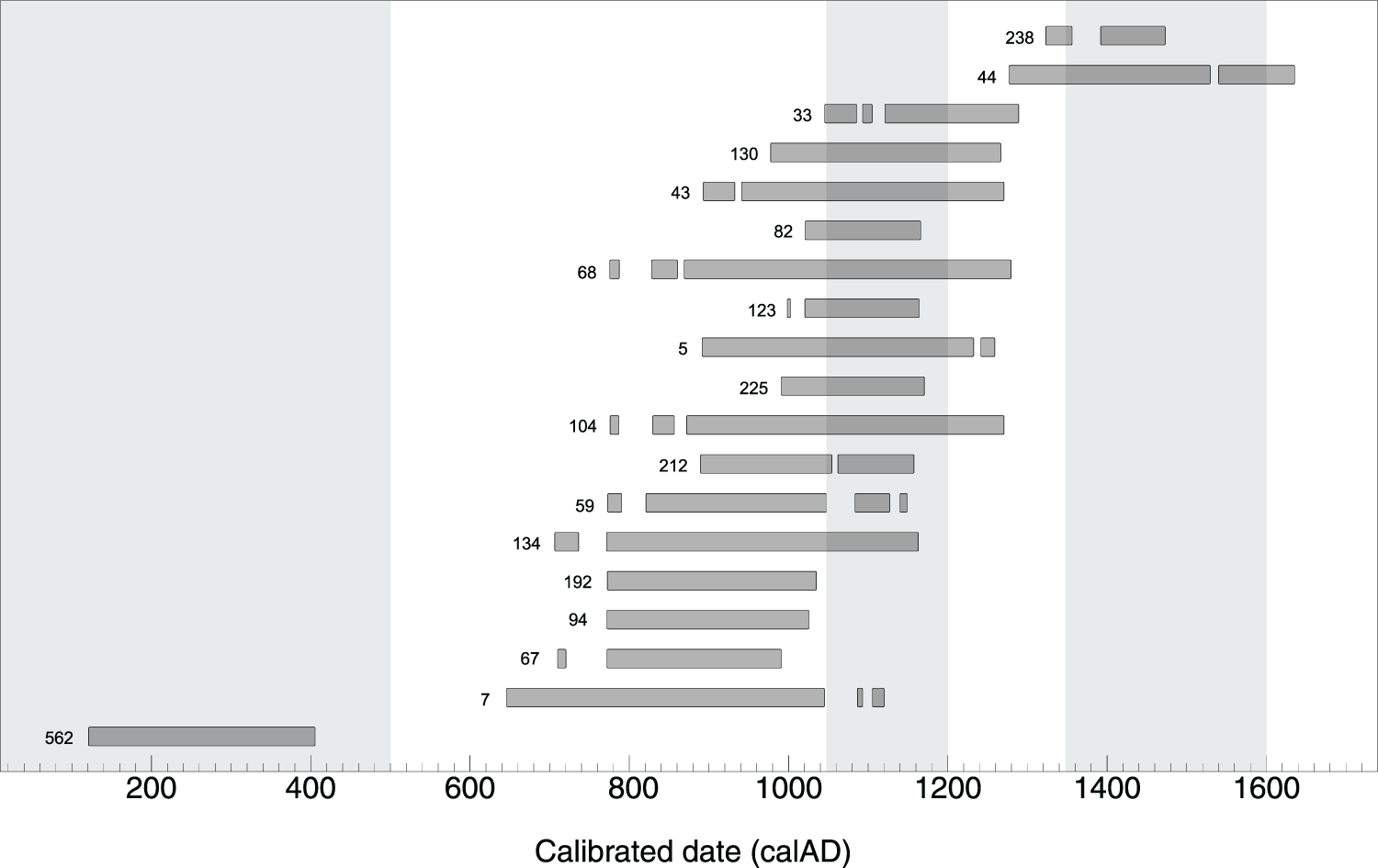
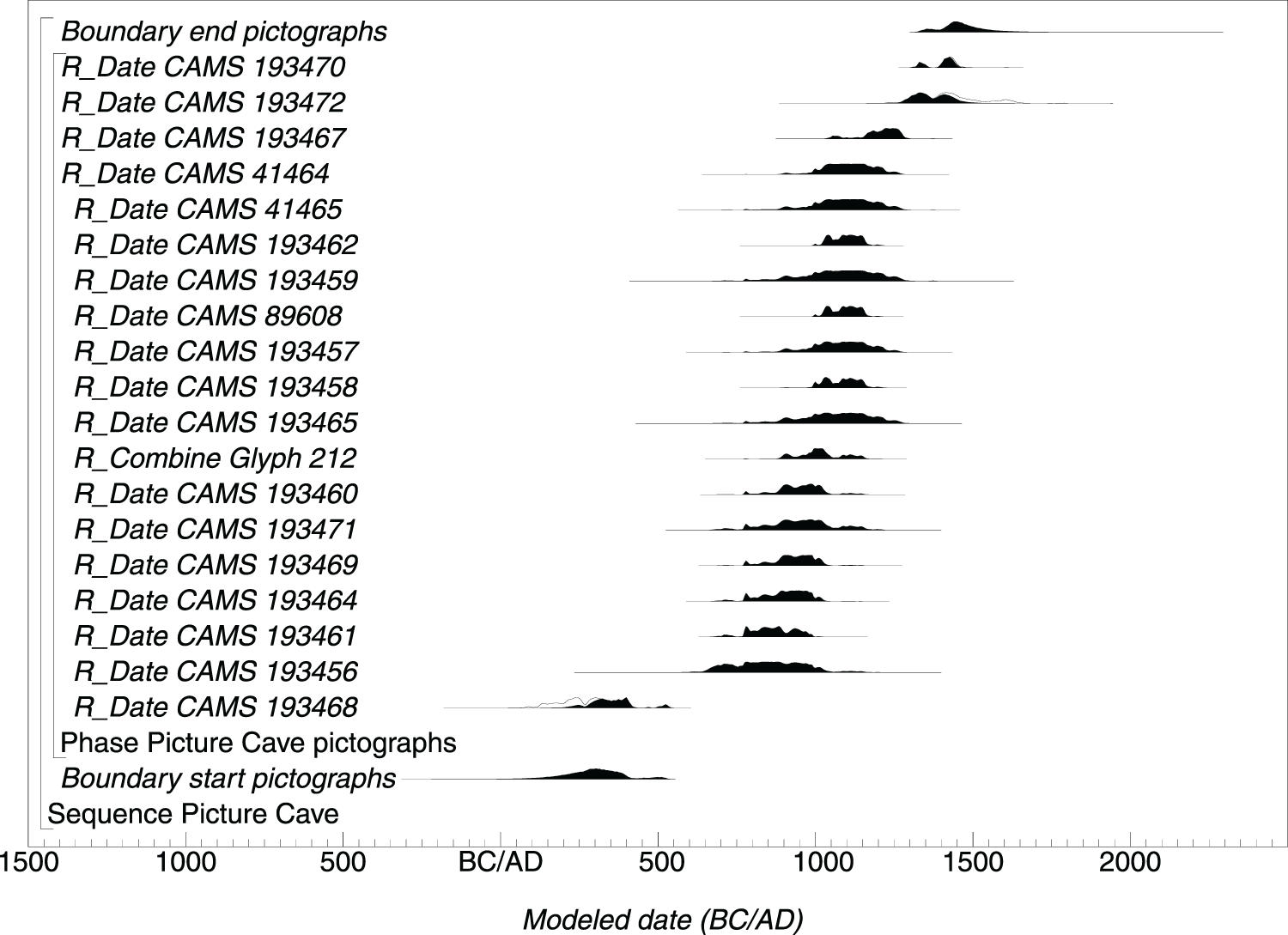
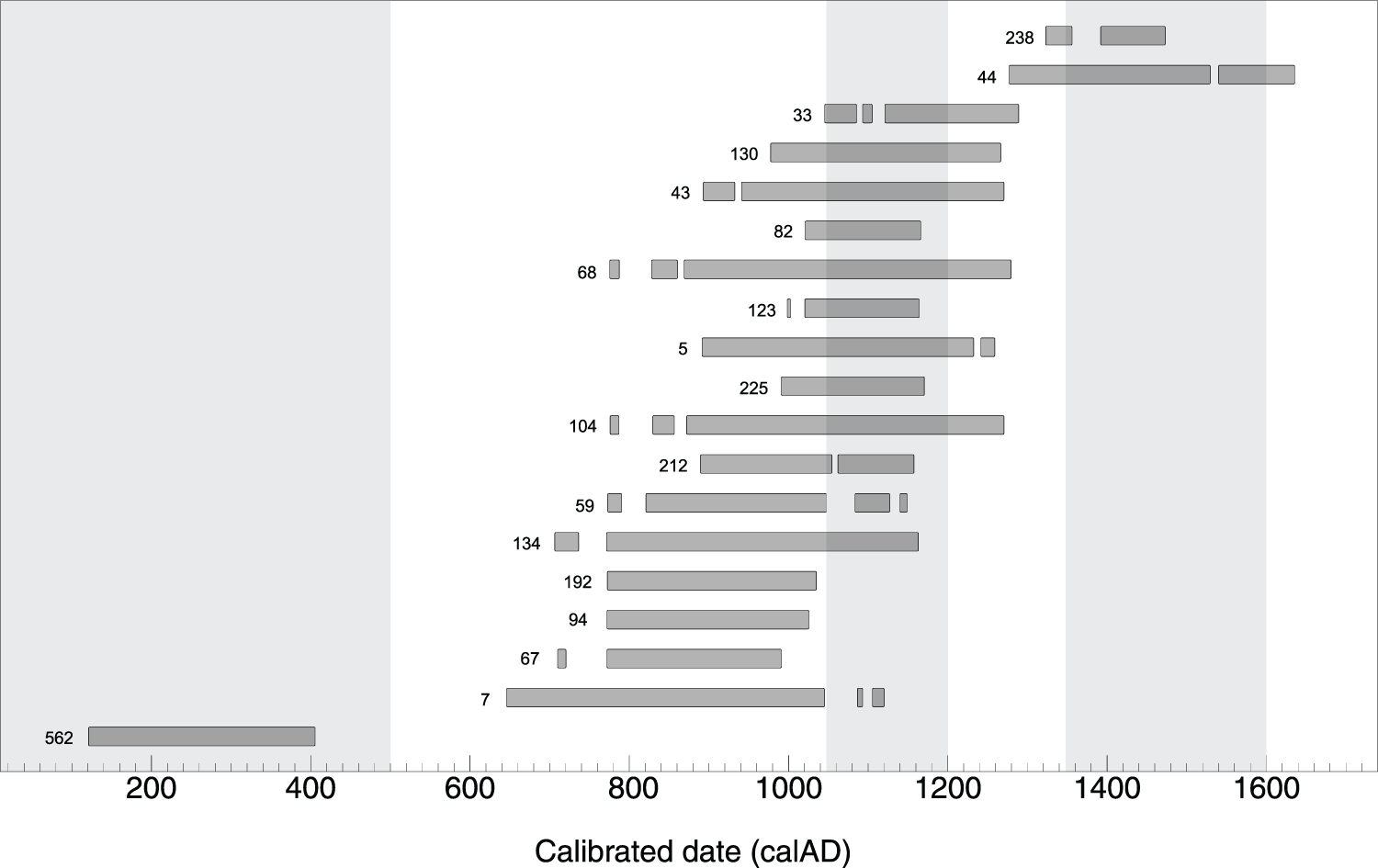
Bayesian chronological modeling estimates that pictograph production at Picture Cave began between cal AD 85 and 530 and ended in cal AD 1325–1630, with a duration span of 905–1480 years (95.4%, Figure 1). The Convergence (C) values for the elements in the model were all >95, and the model showed good agreement (Amodel = 93.2) between the chronometric dates and model assumptions. For each individual date, modeled and unmodeled posterior density estimates were similar, so we report the unmodeled calibrated age ranges for the pictographs in Table 1 and Figure 2.
Bayesian chronological model for Picture Cave pictograph dates. The brackets along the left-hand side and the OxCal commands define the model exactly. Figure created using OxCal v.4.4.4 (Bronk Ramsey Reference Bronk Ramsey2025).

Calibrated age ranges for Picture Cave pictographs at 95.4% probability. Shaded areas refer to general regional time periods: Middle Woodland (150 BC–AD 500), Late Woodland (AD 500–1050), Early Mississippian (AD 1050–1200), Middle Mississippian (AD 1200–1350), and Late Mississippian (AD 1350–1600).
XRD molecular analysis results (Supplementary Figure 21) are consistent with previous SEM-EDS and pXRF elemental analyses. The unpainted rock substrate is a quartzose sandstone (SiO2) of fine to medium-sized rounded or spherical grains with minor amounts of carbonates (CO32-) and trace element impurities. Black pictographs were colored with pyrolyzed carbon, often referred to as charcoal, soot, or carbon black, formed during the incomplete combustion of organic material such as plants and animal fats. Red pictographs were colored with iron-rich minerals such as hematite (Fe2O3) and goethite (FeO[OH]). Black pictographs had minor amounts of iron minerals, and red pictographs had minor amounts of carbon, indicating either intentional or accidental contamination by both colors. Both black and red pictographs also showed evidence of clay (Al, Si, K) minerals that were either naturally present in the ochers or that may have been added purposefully as an extender.
Discussion
The majority of age results fall within the Late Woodland and Early Mississippian time periods (Figure 2), as previously dated by Rowe (Duncan et al. Reference Duncan, Rowe, Diaz-Granados, Steelman, Guilderson, Diaz-Granados, Duncan and Reilly III2015). Interestingly, the two oldest ages obtained in our study are for red pictographs. The oldest at 1800 ± 60 RCYBP (cal AD 120–450; 95.4%) for a red grid design in Picture Cave 2 interpreted as a meat drying rack (glyph 562; Supplementary Figure 1) is the sole result from the Middle Woodland period. This is also the only radiocarbon date we obtained for Picture Cave 2, and future investigations are warranted to understand the relationship between the imagery in both chambers.
Most of the calibrated age estimates span 200–400 years, and the radiocarbon results do not have the resolution to distinguish between general time periods (Figure 2), let alone even narrower regional phases such as those defined by Pauketat (Reference Pauketat, Emerson, McElrath and Nolan2025:204; Supplementary Figure 22). However, four pictographs have shorter calibration ranges, falling squarely in the Late Woodland period. Six pictographs were created sometime during the Late Woodland or Early Mississippian periods. Six pictographs have age estimates that span from the Late Woodland to the Middle Mississippian periods. One pictograph has an age range from the Middle Mississippian to the Late Mississippian, and another ranges from the Middle Mississippian to the protohistoric/contact periods. Interestingly, even excluding five dates that fell outside of the expected age range based on Rowe’s previous weighted average of cal AD 990–1160 for four pictographs (Duncan et al. Reference Duncan, Rowe, Diaz-Granados, Steelman, Guilderson, Diaz-Granados, Duncan and Reilly III2015), our results fail a chi-squared test for “sameness” (df = 14, T = 416.730; 5%, 23.7). This suggests that the pictographs were created during multiple events and not all at the same time. We have recently demonstrated a similar span of radiocarbon dates ranging from Middle Woodland through the Late Mississippian / contact periods at the Deer Run Shelter site in southeast Missouri (Fuller et al. Reference Fuller, Steelman and Starr2025).
Interestingly, radiocarbon dating clarified the origins of ambiguous imagery at Picture Cave by distinguishing historic graffiti from authentic Indigenous imagery. Glyph 235 depicts two outlandish and incongruous human faces in profile with exaggeratedly long noses facing each other. These black drawings were assumed to be historic graffiti, because aspects of their execution suggest European-style authorship; however, long-nosed mask imagery is a well-documented motif in Mississippian imagery (Supplementary Figure 20). We obtained a radiocarbon date of 13,320 ± 130 RCYBP (CAMS 193466) for this pictograph. The very old radiocarbon age reflects the use of a coal-based pigment and confirms that the drawing is historic graffiti. In contrast, glyph 44 (Supplementary Figure 18) was also suspected to be historic graffiti of a red devil face but was dated to 520 ± 110 RCYBP (cal AD 1275–1635; 95.4%). This result indicates that the pictograph is authentic Indigenous imagery.
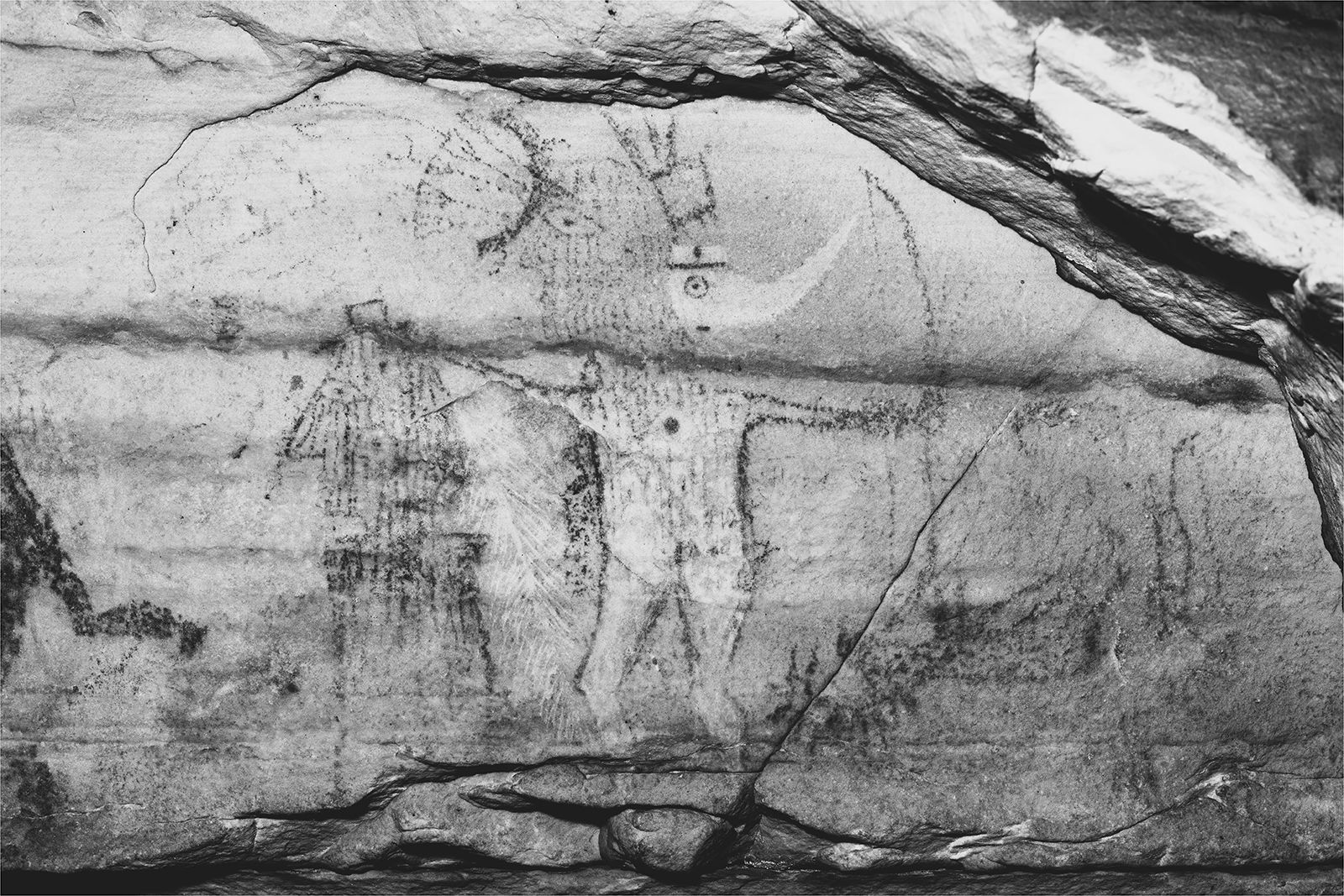
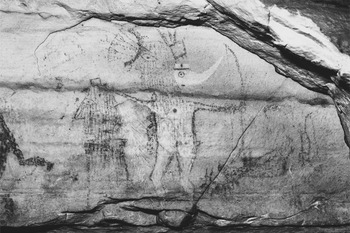
Diaz-Granados Duncan (Reference Diaz-Granados Duncan1993) highlighted the importance of several pictographs in Picture Cave in her dissertation. She proposed that the black-and-white glyph 104 is a representation of either Red Horn / Morning Star or his son by Woman-with-the-white-beaver-skin-as-a-wrap (Diaz-Granados Duncan Reference Diaz-Granados Duncan1993:364–370; Figure 3). This image was made by abrading to reveal the white sandstone substrate and drawing with black charcoal. The human figure has a profile face, with antler headdress and a long-nosed-god mask earring. The figure’s left hand brandishes a bow over an upside-down deer with antlers. The figure’s right hand extends out and holds the skin of another human figure. Loubser (Reference Loubser2016:173) characterized the Red Horn pictograph in Picture Cave as the most complex single image within Picture Cave “if not in all of southeastern rock art.” We measured a direct radiocarbon date of 980 ± 110 RCYBP (cal AD 775–1270; 95.4%) for the Red Horn pictograph, placing it in the date range proposed by Diaz-Granados and Duncan (Reference Diaz-Granados and Duncan2000:Table 6.1).
On panel 1 of Picture Cave 1, glyph 104 is approximately 30 cm tall. This well-known pictograph is thought to represent Red Horn / Morning Star. See Supplementary Figure 9 for color photograph. We obtained a radiocarbon date of 980 ± 110 RCYBP (CAMS 193465; cal AD 775–1270; 95.4%) for black charcoal pigment from this pictograph. Photo credit: Mike Chervinko.
Conclusions
Our radiocarbon results provide evidence for the creation of pictographs at Picture Cave primarily during the Late Woodland and Early Mississippian periods. However, results also reveal that at least one pictograph was created centuries earlier, during the Middle Woodland period, and that at least two pictographs were added as late as the end of the Mississippian period. This chronological study demonstrates multiple temporally distinct painting and drawing episodes with recurrent visitation of the cave, consistent with its interpretation as a persistent sacred landscape.
Acknowledgments
We acknowledge Indigenous peoples for whom Picture Cave is an important place within a spiritual landscape—especially the Omaha, Osage, Ponca, Kansa, and Quapaw. We also thank those who continue to protect and look after these special places. This research would not have been possible without the approval and support of the landowner before 2021 and the new landowner after 2021. Several professional and citizen archaeologists have participated in this project: Neathery B. Fuller, Eric C. Fuller, Thomas Mercer, Mike Chervinko, Richard Orr, Mark Leach, Allan Westfall, and Doug Porter. KLS thanks Rudy Banny, Burgess Rugeley, and Bailey Sparks for laboratory assistance. AMS radiocarbon measurement was conducted by Bruce Buchholz at LLNL-CAMS under contract DE-AC52-07NA27344. XRD was performed by Joseph Reibenspies at the X-Ray Diffraction Laboratory within the Department of Chemistry at Texas A&M University. No permits were required for this work.
Funding Statement
This project was funded by a private donor.
Data Availability Statement
Radiocarbon laboratory data and results are housed with Shumla Archaeological Research & Education Center.
Competing Interests
The authors declare none.
Supplementary Material
The supplementary material for this article can be found at https://doi.org/10.1017/aaq.2026.10200.
Supplementary Code 1. Bayesian chronological model in OxCal.
Supplementary Table 1. Plasma oxidation results from Picture Cave.
Supplementary Figure 1.Glyph 562.
Supplementary Figure 2. Glyph 7.
Supplementary Figure 3. Glyph 67.
Supplementary Figure 4. Glyph 94.
Supplementary Figure 5. Glyph 192.
Supplementary Figure 6. Glyph 134.
Supplementary Figure 7. Glyph 59.
Supplementary Figure 8. Glyph 212.
Supplementary Figure 9. Glyph 104.
Supplementary Figure 10. Glyph 225.
Supplementary Figure 11. Glyph 5.
Supplementary Figure 12. Glyph 123.
Supplementary Figure 13. Glyph 68.
Supplementary Figure 14. Glyph 82.
Supplementary Figure 15. Glyph 43.
Supplementary Figure 16. Glyph 72.
Supplementary Figure 17. Glyph 33.
Supplementary Figure 18. Glyph 44.
Supplementary Figure 19. Glyph 238.
Supplementary Figure 20. Glyph 235.
Supplementary Figure 21. Powder XRD spectra.
Supplementary Figure 22. Calibrated age ranges at 95.4% probability for Picture Cave pictographs.



 Open access

