

The availability of professionals ready to address the complex and fast-paced world of cultural resource management (CRM) is a key factor in the effective stewardship of cultural heritage. While there are several academic fields that offer students training for work in CRM (e.g., history, historic preservation, architecture, museum studies, Tribal and environmental policy), archaeology is the most prominent professional pathway. Further, a majority of archaeological jobs are within the CRM job sector. Central to this is ensuring archaeology students have the right skills needed to succeed in CRM. However, over the past few decades CRM professionals observed the need for better training of students with the skills necessary for employment in CRM over careers in academia (Altschul and Klein Reference Altschul and Klein2022; Larkin and Slaughter Reference Larkin and Slaughter2021; Morgan Reference Morgan2023; Neumann et al. Reference Neumann, Sanford and Neumann2022; Neusius Reference Neusius2009; Schuldenrein and Altschul Reference Schuldenrein, Altschul, Bender and Smith2000). This aligns with the general call for colleges to focus on preparing students in all four fields of anthropology for careers in applied contexts versus academia, particularly given the limited number of academic jobs for applied anthropologists and archaeologists (Briller and Goldmacher Reference Briller and Goldmacher2020; Hawvermale et al. Reference Hawvermale, Cronin, Davis, Byth, Torres, Giamarqo, Stutts, Koyuncuoglu and Burke2021).
In response to this pressing need, we conducted research on how to revise undergraduate and graduate student curricula in order for archaeological students to be better prepared for CRM careers. This work was driven by an effort at Portland State University’s (PSU) Anthropology Department to develop an updated curriculum that would offer students and employers assurance that newly graduated students have the necessary skills and knowledge to engage in CRM projects effectively and ethically with minimal retraining by companies or agencies. In particular, we sought to gather insight from archaeological professionals and cultural resource experts in the Pacific Northwest (PNW) on the necessary expertise generally needed in the CRM field, along with the specific skills that should be updated or incorporated into curricular design at both the undergraduate and graduate levels. While our study was limited to the PNW region, our research resulted in insights that are applicable to other US CRM programs. In this article, we review our research results in light of national data and literature on CRM careers and discuss recommendations for how these findings could be implemented in college curricula.
Methods
Our methods centered on collecting opinions from CRM professionals in the PNW regarding skills that CRM programs should concentrate on in undergraduate and graduate curricula. We focused our study on the PNW in part due to our affiliation with PSU but also since the region sees some of the highest rates of employment for archaeologists in the United States (Morgan Reference Morgan2023).
We used a mixed-methods approach in the research design to inform deeply as well as broadly on the topic. The first stage of the research included semi-structured interviews of key informants (Supplementary Material 1). Key informants or consultants are those with an extensive range of knowledge or specialized knowledge on a topic relevant to the research. In addition to offering factual knowledge, key consultants can offer insight and analysis that helps answer the research question (Schensul and LeCompte Reference Schensul and LeCompte2013:22–46). In order to fully discern the possible range of perceived skills needed for a career in CRM, we interviewed the primary types of professionals and experts commonly engaged in the operation of CRM projects. We identified three main groups or units of analysis: (1) archaeological companies and consultants, (2) staff of regulatory bodies (state and federal agencies), and (3) cultural resource employees for Native American Tribes. We chose the interviewees through quota sampling of key informants, specifically three representatives from each of the three units of analysis, for a total of nine semi-structured interviews. We conducted these interviews from April to August 2022. Semi-structured interviews include a list of predetermined questions that guide the interview but also allow the interviewer to follow up on issues the interviewee raises (Bernard Reference Bernard2018:165–166). Inductive coding helped us to identify recurring general themes in the interviews (Thomas Reference Thomas2006). While additional interviews are always beneficial to further nuance the evaluation of an issue, three interviewees per unit of analysis offered sufficient initial identification of issues while meeting funding and time constraints. In addition to informing the design of the survey, the interviews offered context to help interpret the survey results.
In the second phase of research, we conducted an anonymous survey that evaluated the level of importance on the issues we identified from the semi-structured interviews, focusing particularly on necessary skill sets for undergraduate and graduate students (Supplementary Material 2). This aligns with the standard ethnographic practice of designing surveys based on previous qualitative research (Schensul and LeCompte Reference Schensul and LeCompte2013). We used a convenience sampling of our professional network throughout the PNW for initial distribution of the survey. We then relied on chain-referral sampling to further distribute the survey. The benefit of a survey over further interviews (both in terms of time demanded of survey respondents and ease of distribution) allowed us to reach a larger number of research participants, facilitating our aim of gaining insight from the greatest number of CRM professionals and experts in the PNW. We used deductive analysis for the survey results, specifically exploring the level of frequency of particular responses, as well as the level of importance that survey respondents assigned to specific issues by mainly using the mean score for Likert-scale questions. Note that during the second phase of our research, we included a question on survey participants’ work history in the three professional fields, to ensure representation in the survey responses. While we sought the opinion of those currently employed with each unit of analysis, we did not seek to distinguish interview or survey responses according to participants’ current employment.
In March 2022, we submitted an application for this research to PSU’s Institutional Review Board (IRB) overseeing ethical compliance, which was approved in April 2022 (IRB application #227684-18). We submitted a brief description of the research design that emphasized how we engaged research participants, interview questions, recruitment material, and the interviewees’ informed consent form. One of the most crucial tenets guiding anthropological ethical practices is the impact on the communities at focus in the research, especially the individuals directly involved in the research. Some of the key practices include transparency in the work, receiving informed consent, and maintaining privacy and confidentiality (American Anthropological Association 2012; Ervin Reference Ervin2005; Fluehr-Lobban Reference Fluehr-Lobban2013). During all interactions with research collaborators (whether through email recruitment, interviews, or survey participation) we provided information on the nature and intent of the research, assured confidentiality, and emphasized that participation was voluntary. We went beyond the required IRB protocols to foster collaboration with interview participants through opportunities to review and comment on their interview transcript, potential survey questions, and draft documents.
Results
In this section, we present the findings of the interviews and surveys according to larger themes identified during the research. To help contextualize our key informants and research participants’ knowledge base, we first give a brief description of interview and survey participant demographics. We then explore CRM career preparedness and appropriate curricula for undergraduate and graduate students.
Demographics
Interview Key Consultants
All nine interviewees had at least 10 years of professional CRM experience. Furthermore, all interviewees have worked on CRM projects in the PNW within the past five years. While each of the interviewees had extensive experience working with the entities with whom they were currently employed, four of the nine interviewees also had experience working for the other professional groups (e.g., a current employee with a state regulatory body might have previous experience as an employee for a Tribe).
Survey Participants
We had a total of 87 survey respondents. We collected demographic information primarily related to educational background and professional experience in the PNW. The majority of the survey participants, 80 respondents (92%), had a master’s in anthropology/archaeology. We estimate that this is a roughly 17% survey response rate from CRM archaeologists with advanced degrees in the PNW. Our approximate survey response rate is based on Altschul and Klein’s (Reference Altschul and Klein2022) estimate of 12,000 CRM archaeologists employed full-time nationwide; if we assume the three PNW states have average employment numbers, then there are roughly 720 practitioners in the PNW. Approximately 504 (or 75%) of these practitioners have advanced degrees based on the national data (Altschul and Klein Reference Altschul and Klein2022). The actual employment numbers may be higher, since the PNW region has a high rate of CRM work, as previously discussed. Over half of our respondents currently have ties to academic institutions. In total, 48 respondents (55%) had taught archaeology or a CRM-related topic at college level. A total of six survey respondents were currently enrolled in college-level degrees in anthropology/archaeology, with three of those enrolled students having prior experience as college-level instructors.
A total of 76 respondents were currently engaged in CRM work in the PNW, with an additional five respondents within the past five years of the survey and another four respondents within the past six to 10 years of the survey. Within the three professional groups (i.e., employees for Tribes, CRM/archaeological consulting firms, and regulatory agencies), we had a range of experiences. Survey participants were able to choose the range of years (by five-year increments up to year 20) that they worked in each of the three professional groups. In total, we had 29 respondents (33%) report having experience as an employee for a Tribe, 59 respondents (68%) having experience working for a government agency (e.g., local, county, state, federal, etc.), and 78 respondents (90%) with work experience as a CRM/archaeological consultant or for a firm. As stated above, 48 respondents reported teaching archaeology or any CRM-related topic at college level; however, only 44 of the respondents reported having more than one year’s experience in education. In addition to work in education and the three targeted professional groups focused on in this research, we asked respondents to indicate if they worked in any other CRM-related field, from which 11 participants noted working in other sectors, notably nonprofits. Note that entry-level practitioners were not well represented in our survey respondents.
Undergraduate and Graduate Curricula
Five interviewees felt that undergraduate and graduate students in the PNW are not adequately prepared for work in CRM. Three of the interviewees thought that a few schools in the PNW were better geared toward assisting students in developing necessary CRM skills but that the majority of schools in the PNW are not adequately preparing students for CRM work. Only one of the nine interviewees thought students were adequately prepared for CRM work. One common theme was that schools are often still primarily geared toward work in academia. This is not surprising and reflects an ongoing national conversation on the relationship between academic training and CRM (e.g., Altschul and Klein Reference Altschul and Klein2022; Larkin and Slaughter Reference Larkin and Slaughter2021; Morgan Reference Morgan2023; Neumann et al. Reference Neumann, Sanford and Neumann2022).
Survey participants reflected the interview participants’ overwhelming perception that there is room for developing curricula that better prepare undergraduate and graduate students for CRM work. Survey participants ranked how well undergraduate and graduate students were trained for CRM work based on a 10-point Likert scale (1 = not trained to 10 = very well trained, with an option of 0 for no opinion). On average, survey participants ranked undergraduate students at a score of 4.44, with a standard deviation of 1.69. The median and mode were notably 5.00. Overall, survey respondents saw a slight increase in the level of preparedness with graduate students compared with undergraduate students, with the mean score for preparedness at 5.67, standard deviation 1.92, median at 6.00, and a mode of 7.00.
Research participants’ interview responses and follow-up communication helped identify skills that undergraduate and graduate students need for CRM work, as well as indicating the need to evaluate the level of importance for each skill based on the degree sought (i.e., undergraduate versus graduate). Correspondingly, in the survey we inquired about the level of importance for each skill for undergraduate-level degrees compared with graduate-level degrees.
Undergraduate Skills
Interviewees all stressed the need for more CRM professionals in the PNW, and that the high demand for individuals with CRM skills was not likely to decrease in the near future, particularly given the passage of the Infrastructure Investment and Jobs Act of 2021. While most of the interviewees noted the range of jobs for professionals with undergraduate degrees (i.e., BA/BS) was noticeably more limited than for individuals with graduate-level degrees (i.e., MA/MS and/or PhD), they still noted a high demand for employees with undergraduate-level degrees, particularly for fieldwork. Interviewees also mentioned a few other work settings available for individuals with undergraduate-level degrees, including aiding in laboratories, curation facilities, museums, and GIS mapping.
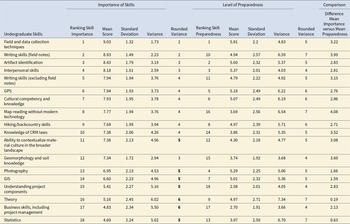
The skills identified by interviewees were included in the survey. Survey participants then had to rate the level of importance of each skill for individuals with undergraduate-level degrees seeking CRM jobs using a 10-point Likert scale (1 = not important to 10 = very important, with an option of 0 for no opinion; Table 1). In general, the skills important for fieldwork as an archaeological technician were ranked as more important than abstract skills, supervisory skills, or skills required for project management and collaboration with clients (Table 1; Supplementary Material 3).
Skills Important for Individuals with BA/BS Seeking Employment in CRM and Level of Skill Preparedness as Assessed by Employers.

Table 1 Long description
Employers rated 18 undergraduate skills on importance and on how prepared BA/BS job seekers are, reporting mean scores with variability and rankings for each scale. Importance scores are highest for field and data collection techniques (mean 9.03, rank 1), writing field notes (8.93, rank 2), and artifact identification (8.43, rank 3). Preparedness is highest for field and data collection (mean 5.81, rank 1), artifact identification (5.60, rank 2), and interpersonal skills (5.37, rank 3); photography (5.29, rank 4) and GPS (5.18, rank 5) follow. The largest gaps between importance and preparedness are map-reading without modern technology (importance 7.77 vs preparedness 3.69; difference 4.08), writing skills for field notes (8.93 vs 4.94; 3.99), geomorphology/soil knowledge (7.34 vs 3.74; 3.60), and knowledge of CRM laws (7.38 vs 3.86; 3.52). Smaller gaps appear for theory (5.16 vs 4.97; 0.19) and statistics (4.60 vs 3.97; 0.63), indicating closer alignment where importance is lower. Overall, preparedness means are consistently below importance means across all skills, suggesting employers perceive broad under-preparation, with the most pronounced shortfalls in traditional field navigation and writing/documentation. Standard deviations are generally larger for preparedness than importance, indicating more disagreement among employers about preparedness levels than about what is important.
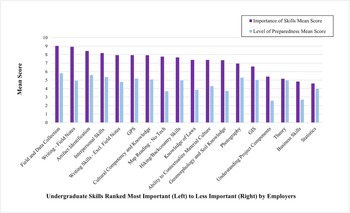
The survey also inquired about the level of preparedness for each skill that recent undergraduates demonstrate in CRM work using a 10-point Likert scale (1 = not prepared to 10 = very prepared, with an option of 0 for no opinion; Figure 1; Table 1; Supplementary Material 3). Variance measures the dispersion of data around the sample mean, similar to the standard deviation. High variance means that data points are spread out or vary. In this study, the variance in scoring/ranking for both the importance of skills and the perceived preparedness is interesting, as it sheds light on differences in employer emphasis or interest in particular skills (Table 1). The greatest variance (rounded variance greater than 5) in importance of skills for BA/BS employees was in ability to contextualize material culture in the broader landscape, photography, GIS skills, understanding project components, theory, business skills, and statistics. The greatest variance (rounded variance greater than 5) in BA/BS employee preparedness was in writing skills for field notes, artifacts identification, GPS, cultural competency and knowledge, map-reading without modern technology, hiking and backcountry skills, knowledge of laws, ability to contextualize material culture, photography, GIS, theory, and statistics.
Comparison of skills identified as important for BA/BS employees and employer rating of BA/BS employee actual skills/preparedness.

Figure 1 Long description
The bar graph compares the mean scores of the importance of skills and the level of preparedness for undergraduate employees. The horizontal axis lists skills ranked from most to least important by employers: field and lab collection, artifacts identification, writing skills for field notes, cultural competency and knowledge, GPS, map-reading without modern technology, hiking and backcountry skills, knowledge of laws, ability to communicate results, photography, G I S, theory, business skills and statistics. The vertical axis represents the mean score ranging from 0 to 10. The legend indicates two categories: importance of skills mean score and level of preparedness mean score. The importance of skills generally scores higher than preparedness across all categories, with field and lab collection having the highest importance score and statistics the lowest. Preparedness scores are consistently lower, highlighting a gap between employer expectations and actual preparedness.
We then considered how the level of importance of a skill compared with the level of preparedness for each skill, with the goal of helping academic programs to focus on the skills that should be targeted for curricular development. In particular, we ranked the importance of skills in decreasing level of importance based on mean values and then listed the associated mean value of preparedness for each skill (Figure 1; Table 1). While the level of preparedness generally tracked with the level of importance of the skill (i.e., undergraduate students were more prepared with skills that rank higher in importance), none of the skills ranked higher than a score of six for level of preparedness, indicating students needed increased training in all the identified skills, with particular attention to the skills ranked higher in level of importance. Of particular interest for academic program planning are skills that have a lower mean value for preparedness compared with similarly ranked skills (Table 1). For instance, writing skills for field notes, which ranks at number two for level of importance for undergraduate skills, had a mean value for preparedness that was lower than nine other skills. An interviewee captured the importance of this skill in stating that the field technician needs “to be able to explain what [they’re] seeing, and folks aren’t great at articulating that or documenting it well . . . that may be the only record before a site got completely demolished, and a lot of the time it’s brand-new technicians out there doing that recording.” Other skills with a greater difference (≥ rounded difference of 4) between mean scores for importance and level of preparedness for undergraduates were map-reading without modern technology, knowledge of laws, and geomorphology and soil knowledge.
Graduates’ Skills
Interviewees emphasized the high demand for CRM professionals with MA/MS-level or higher education in the growing CRM job market. Interviewees stressed the importance of MA/MS students writing a thesis or conducting their own research in order to meet Oregon statutory requirements as a qualified archaeologist. The Oregon requirements for becoming a permit holder or “qualified archaeologist” are generally constrained by having an MA/MS thesis involving specifically defined methods, involving excavation (ORS 390.235; OAR 736-051-0070(23)(a)). While this topic was not in the survey, when given a chance for open comments, a number of survey respondents also mentioned the importance of MA/MS students meeting Oregon statutory qualifications.
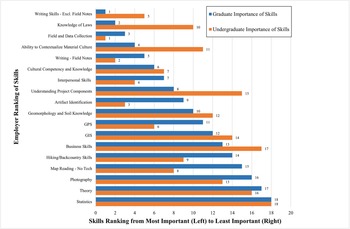
Interviewees mentioned that the skills they identified as necessary for undergraduate training were even more important for graduate students; however, interviewees noted that the relevance of particular skills would be different for graduate students, citing the varying roles and responsibilities for jobs aimed at BA/BS degrees compared with MA/MS-level or higher degrees. More specifically, MA/MS employees/jobs tend to require a suite of supervisory skills. Then, depending on the particular job (e.g., crew lead versus program lead), employers often want MA/MS-level employees to have an increased ability to work with clients and Tribes, to design projects, and to lead analysis/reporting activities. At the heart of this is that all types of work at the MA/MS level require enhanced communication skills. One interviewee explained that effective communication is an “ever-growing and ever-developing skill . . . that it is a continual process that is really important [for] a person in the field . . . people working in labs . . . people managing records and doing drawings, illustrations . . . it all requires communication.” Survey participants agreed with interviewees regarding the increased importance of all skills in graduate-level education, except for map-reading without modern technology (Figure 2; Table 1; Table 2). The ranked importance of skills from the survey results (based on mean values) differs for graduate students compared with the ranked importance of skills for undergraduate students, further reflecting the need for varying skill sets depending on education level. For example, the skills needed for supervision and technical reporting were ranked as more important for graduate students than undergraduate students.
Comparison of employer ranking of skills for MA/MS versus BA/BS students.

Figure 2 Long description
Employer importance of skills. Legend: Graduate Importance of Skills; Undergraduate Importance of Skills. Horizontal axis label: Skills Ranking from Most Important left parenthesis left end to Least Important right parenthesis right end. Horizontal axis range: 0 to 20. Vertical axis label: Employer Importance of Skills. Writing Skills comma Field Notes: Graduate Importance of Skills 1; Undergraduate Importance of Skills 2. Knowledge of Literature: Graduate Importance of Skills 2; Undergraduate Importance of Skills 10. Field Data and Collections: Graduate Importance of Skills 3; Undergraduate Importance of Skills 7. Ability to Conducting Natural History: Graduate Importance of Skills 4; Undergraduate Importance of Skills 11. Writing comma Field Notes: Graduate Importance of Skills 5; Undergraduate Importance of Skills 6. Cultural Competency and Knowledge: Graduate Importance of Skills 6; Undergraduate Importance of Skills 7. Interpersonal Skills: Graduate Importance of Skills 7; Undergraduate Importance of Skills 6. Understanding Project Components: Graduate Importance of Skills 10; Undergraduate Importance of Skills 15. Artifact Identification: Graduate Importance of Skills 11; Undergraduate Importance of Skills 7. Understanding and Safeguarding: Graduate Importance of Skills 12; Undergraduate Importance of Skills 10. G P S: Graduate Importance of Skills 4; Undergraduate Importance of Skills 12. G I S: Graduate Importance of Skills 6; Undergraduate Importance of Skills 14. Database Skills: Graduate Importance of Skills 13; Undergraduate Importance of Skills 11. Bioarchaeology Skills: Graduate Importance of Skills 14; Undergraduate Importance of Skills 9. Map Reading comma No Tech: Graduate Importance of Skills 5; Undergraduate Importance of Skills 8. Photography: Graduate Importance of Skills 16; Undergraduate Importance of Skills 13. Theory: Graduate Importance of Skills 18; Undergraduate Importance of Skills 15. Statistics: Graduate Importance of Skills 19; Undergraduate Importance of Skills 18.
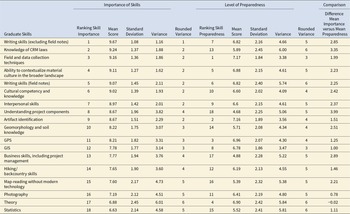
Skills Important for Individuals with an MA/MS or PhD Seeking Employment in CRM and Level of Preparedness Identified by Employer.

Table 2 Long description
Employers rated 18 graduate skills on importance and on how prepared MA/MS or PhD hires are, reporting rankings plus mean scores and variability (standard deviation and variance) for each. Importance is highest for writing (non–field notes mean 9.67; field notes 9.07) and knowledge of CRM laws (9.24), followed by field/data collection techniques (9.16). Preparedness is highest for field and data collection techniques (rank 1; mean 7.17), artifact identification (rank 2; 7.16), and GPS (rank 3; 6.96). The largest shortfalls between importance and preparedness are understanding project components (importance 8.67 vs preparedness 4.68; gap 3.99) and knowledge of CRM laws (9.24 vs 5.89; gap 3.35), with additional notable gaps in business/project management (gap 2.89) and writing excluding field notes (gap 2.85). The smallest gap is photography (0.78), and theory is the only skill where preparedness slightly exceeds importance (6.90 vs 6.88; gap −0.02). Overall, employers see strong preparation in technical field methods but weaker preparation in regulatory knowledge and project/business fundamentals; variability is generally higher for preparedness than for importance, suggesting less agreement about readiness than about what matters.
The variance in scoring/ranking for the importance of skills for MA/MS employees is less than the variance in the same scores for BA/BS employees (Table 2). However, the variance in preparedness is greater for MA/MS than BA/BS employees. The greatest variance (rounded variance greater than 5) in importance of skills for MA/MS employees was in map-reading without modern technology, photography, theory, and statistics. The greatest variance (rounded variance greater than 5) in MA/MS employee preparedness was in writing skills (excluding field notes), knowledge of laws, ability to contextualize material culture in the broader landscape, writing skills (field notes), interpersonal skills, understanding project components, business skills, hiking/backcountry skills, map-reading without modern technology, photography, theory, and statistics. We hypothesize that the greater variance in employer rating of MA/MS employee preparedness may be related to variability between the expectations for CRM jobs across the public, private, and Tribal sectors; additional research is required to explore this issue.
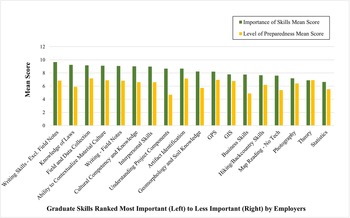
We used the same analysis of the mean value for level of preparedness compared against a ranked level of importance for graduate students, as we did for undergraduate students (Figure 3; Table 2). Overall, the level of skill preparedness is more closely aligned with the level of skill importance for MA/MS students versus the BA/BS students (Table 2; Supplementary Material 4). Only “understanding project components” had a large difference (≥ rounded difference of 4) between mean scores for importance and level of preparedness; this is compared with three skills areas in which BA/BS students were significantly underprepared. This indicates that graduate students demonstrate a higher level of preparedness for individual skills for careers suited to their education level than undergraduate students. As with undergraduate curricula, all skills can be improved, given the highest mean value for preparedness at 7.17, with particular attention to skills ranked higher in importance and skills that had lower mean values for preparedness than skills similarly ranked in importance.
Comparison of skills identified as important for MA/MS applicants seeking employment and employer rating of MA/MS actual skills/preparedness.

Figure 3 Long description
The bar graph compares mean scores for the importance of skills and the level of preparedness across various graduate skills. The horizontal axis lists skills ranked from most to least important by employers. The vertical axis represents mean scores ranging from 0 to 12. Skills include writing skills, field and lab skills, adaptability and more. Each skill has two bars: one for importance and one for preparedness. Importance scores are generally higher than preparedness scores. Notably, 'understanding project components' shows a significant gap between importance and preparedness.
Mode/Structure of Instruction
Interviewees resoundingly emphasized the need for practical experience for students. All interviewees noted field school as an important component in gaining such experience. One interviewee commented that when hiring they look for “somebody who went to field school, so I know if they have the basic training.” Beyond the technical skills learned in field schools, an interviewee noted that “it’s giving you the opportunity to look at what you’re doing, and to take notes about it, and to think about the bigger picture.” Interviewees differed as to their opinion on types of field schools and the level of rigor or type of technical skills taught, with some research participants believing any field school as sufficient for experience and other interviewees believing more discernment as being necessary for building adequate field skills. Internships and university courses that offer hands-on experience were also noted as valuable for skill-building. Almost half of all interviewees thought the location of where a student gains experience mattered, and that students looking for employment in the PNW are best served by seeking out an internship, field school, or other practical experience in the PNW region as part of their education and training.
Interviewees felt that classes with more practical experiences or “real-world” situations would be helpful. Some ideas of how to incorporate this principle into curricula include case studies, or a case study followed throughout the class, that highlight or discuss the issues and topics of the class; field visits; encouraging and presenting opportunities for mentor guidance outside the classroom; CRM professionals as guest speakers; and local/campus CRM exercises (e.g., surveying, GIS/GPS plotting, note-taking, basic map-reading, etc.).
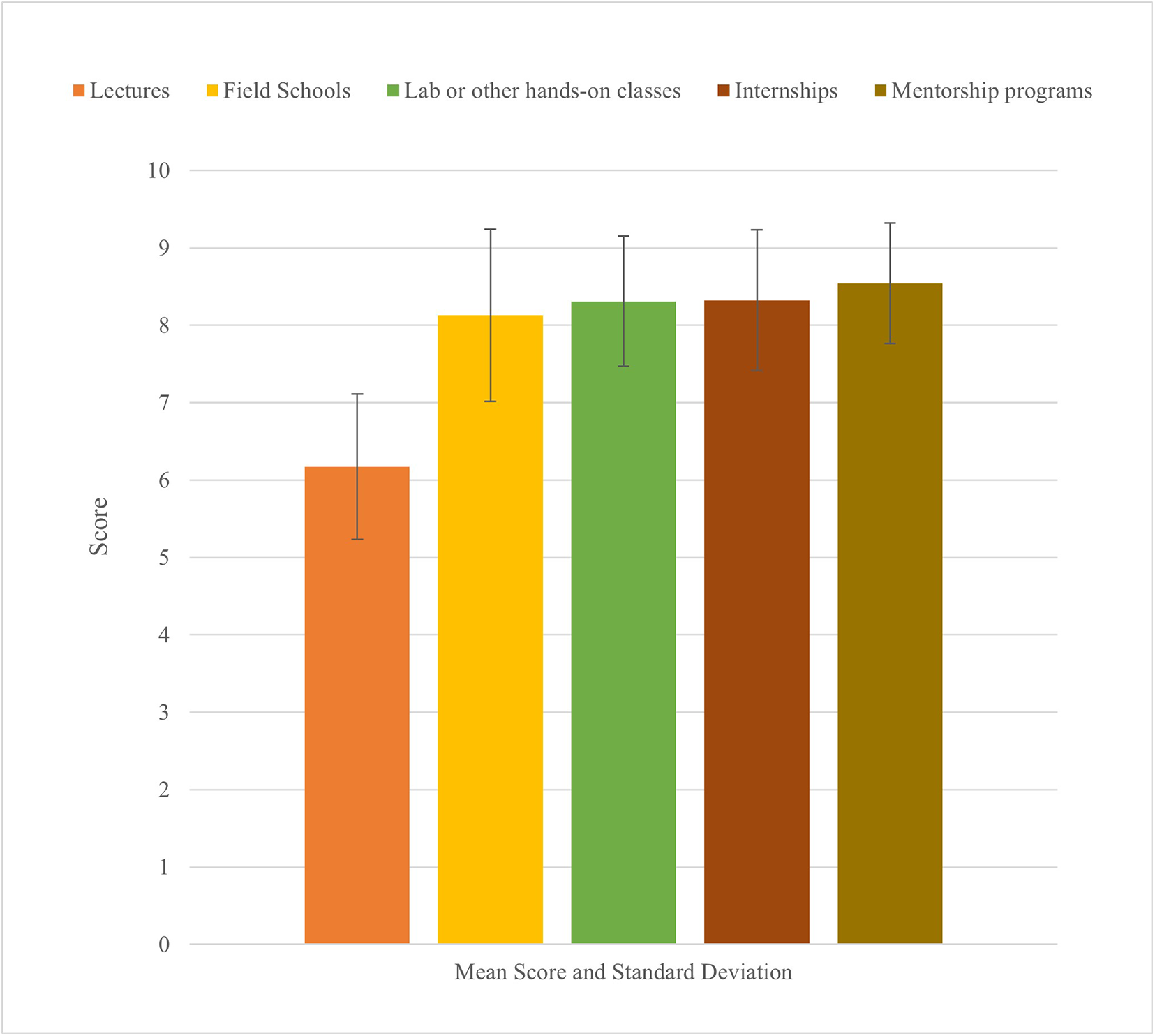
Survey respondents echoed the sentiment of emphasizing real-world experiences. In the survey, we asked participants to rank the level of importance for the five types of learning experiences identified during the interviews using a 10-point Likert scale (1 = not important to 10 = very important, with an option of 0 for no opinion; Figure 4). The rank for types of learning experience, based on mean score, from highest to lowest, were mentorship programs (8.54), internships (8.32), lab or other hands-on classes (8.31), field schools (8.13), and lectures (6.17). Markedly, modes for students to directly engage in topics were closely rated as important and ranked notably higher than the more passive form of learning, lectures.
Level of importance for the types of learning experiences in teaching CRM skills.

Figure 4 Long description
The bar graph includes a legend with five items: Lectures, Field Schools, Lab or other hands on classes, Internships, Mentorship programs. The vertical axis label is Score. The vertical axis range is 0 to 10. The horizontal axis label is Mean Score and Standard Deviation. Five vertical bars are shown with error bars. Lectures bar value is 6.17. Field Schools bar value is 8.13. Lab or other hands on classes bar value is 8.31. Internships bar value is 8.32. Mentorship programs bar value is 8.54.
Discussion and Recommendations
Broader Context—Statutory Requirements and a Changing Field
While we focused on the PNW region, we assert that the study’s findings are relevant for college curricula nationwide, in substantial part owing to the large volume of CRM work in the PNW (Morgan Reference Morgan2023:373). In addition, our research findings were similar to Morgan’s (Reference Morgan2023) review of archaeological job postings across the United States, and corresponding identification of important Knowledge, Skills, and Abilities (KSAs). Thus, we argue that our in-depth regional survey provides curricular insights and recommendations that are applicable more broadly across the United States.
In situating our research findings in the future of CRM, we urge educators to continue to assess the relevancy and importance of skills. This is in large part owing to the continually evolving practice of CRM. For instance, shifts in best practice, such as the trend toward community-based engagement and less invasive data recovery techniques, could alter what skills are seen as most relevant (Barcalow and Spoon Reference Barcalow and Spoon2018; Gonzalez et al. Reference Gonzalez, Ngandali, Lagos, Miller, Fitzhugh, Haakanson, Lape and Wylie2019; Watkins Reference Watkins, Higgins and Douglas2020). This is also coupled with the rise in the use of technological advancements, such as light detection ranging (lidar) or ground penetrating radar (GPR; Martorana et al. Reference Martorana, Capizzi, Pisciotta, Scudero and Bottari2023; Nelson Reference Nelson2021), which were not present in our results.
In more recent months, CRM has experienced a large shift in career prospects and an uncertain path forward in regulatory compliance under the Trump administration (Lidz Reference Lidz2025). Historically, CRM work has been driven by compliance with federal and state laws for cultural and environmental resources (Barcalow and Spoon Reference Barcalow and Spoon2018; Fiske Reference Fiske2008; Neumann et al. Reference Neumann, Sanford and Neumann2022). The current administration signaled their intent to alter National Environmental Policy Act (NEPA) regulations, cut historic preservation funding, and curb regulatory oversight (National Trust for Historic Preservation 2025; Stratton Reference Stratton2025a, Reference Stratton2025b). The role of CRM practitioners (and correspondingly the number of job prospects) hangs precariously in the balance moving forward. Further, changes in regulatory requirements may shift CRM practices throughout the profession. These uncertainties can present challenges to educators in how to best prepare students for CRM work, and we recommend ongoing academic–practitioner partnership in identifying the necessary skills and assessing career readiness for the changing CRM landscape.
Skills Rankings and Exploring Employer Expectations
As mentioned in the previous section, undergraduate expectations are those associated with archaeological technician jobs, which make up a large share of the employment opportunities for those with a BA/BS, while the highly ranked graduate skills are those associated with greater supervisory responsibility and more involvement in reporting, project planning, and implementation (e.g., writing, excluding field notes, cultural competency, etc.). Overall, the ranking for skills broadly mirrors our expectations based on other recent studies (Larkin and Slaughter Reference Larkin and Slaughter2021; Morgan Reference Morgan2023). Morgan (Reference Morgan2023) discusses these different skills and abilities extensively, so we have focused primarily on the student preparedness aspect. However, there are a few areas where the skills identified as important in our study do not align with other recent studies by being either ranked lower than expected or completely absent.
Two notable skills that research participants did not identify in our study were “research” and “ethics.” The absence of “research” as an important skill was particularly puzzling, given that it was identified as an important skill in 58% of archaeologist positions at both the undergraduate and graduate levels (Morgan Reference Morgan2023:382). While there is always room for improvement and greater refinement specifically for archaeological applications (e.g., researching archives, site files, and gray literature), research skills are one of the skills that students practice extensively in academia. We think that our study participants did actually cite the need for research, but they gave a more detailed understanding of the type of research skills. In particular, our participants cited that contextualizing objects, cultural competency, geomorphology, and soil knowledge are important skills—these all require research. The concept of “research” as a skill should be disentangled in future research. In addition, ethics did not explicitly arise in the in-depth interviews nor were ethics suggested as an important skill in the open-ended questions in the survey. Given that the professional community values employees versed in the ethics of our field (Fluehr-Lobban Reference Fluehr-Lobban2013; Register of Professional Archaeologists [RPA] 2025), we conjecture that those other identified skills—knowledge of laws, cultural competency, and professional communication skills—are all areas where ethical knowledge is applied in practice. In part, the infusion of ethics into all aspects of archaeological practice is embodied in the Society for American Archaeology’s (SAA) Principles of Archaeological Ethics, spanning from the stewardship of resources to engagement with descendent communities, other professionals, and the broader public. Notably, Principle No. 7 calls for ethics and the related best practices to be an essential part of archaeological training (Society for American Archaeology 2024). The Register of Professional Archaeologists Code of Conduct and Standards offers additional guidance for CRM professionals on how to put ethical principles into practice (RPA 2025).
Missing from the results were also domains of knowledge for nonarchaeological services included in CRM, such as architectural history, ethnography, and environmental assessment. While archaeology is a backbone of CRM work, these other lines of investigation offer crucial information not obtainable through archaeological methods and facilitate the inclusion of different perspectives for the myriad resources that fall under the umbrella term of CRM (King Reference King2013). While it is not practical to expect a CRM professional to have mastery of all CRM services, a broad understanding of the different methods can help a professional more appropriately assess what services should be used and how the different lines of investigation can be integrated.
There were a few skills that we expected to rank higher in importance in our results, notably statistics and theory. We anticipated that statistical skills would be ranked more highly at the MA/MS level, as statistics are an important aspect of analyzing and reporting on archaeological field and lab results. However, the reality is that these skills are not commonly used in our study region, as the majority of CRM work is basic inventory work that does not require statistical analysis of artifacts or other patterns. The more involved data recovery projects that would require statistical analysis are uncommon in this region. Further investigation of this skill at the national level, perhaps through review of archaeological CRM reports across regions and project types, would be informative, given the emphasis on statistics in many archaeology and CRM programs. Anecdotally, we have observed that programs typically require at least one statistics class at the BA/BS-level, with additional statistics training taking place in archaeological lab classes and electives like geospatial statistical analysis.
Theory ranked as being of low importance by employers suggests to us that academic programs can do a better job of teaching (and providing opportunities to practice) the practical application of theory to students. Theory underlies both CRM and academic work, whether it is explicitly discussed/acknowledged or not (Morgan Reference Morgan2022a, Reference Morgan2022b; Nelson Reference Nelson2021; Neumann et al. Reference Neumann, Sanford and Neumann2022; Smith Reference Smith2004). The importance of CRM professionals’ understanding how theory underlies CRM work allows for the more accurate application of methods and analyses, as well as providing space for often marginalized voices (Morgan Reference Morgan2022a, Reference Morgan2022b; Nelson Reference Nelson2021). We do not wish to add to the unhelpful debate between academia and CRM through this brief discussion of theory. Rather, our goal is to encourage better teaching that helps contextualize the application of theory in practice in order to improve job preparation.
Finally, our findings could be augmented through a study that focuses on entry-level employees and recent undergraduates’ perspectives on their training, which were underrepresented in our research. This could be especially informative if there are differences from our study in perceived level of skill importance or preparedness by entry-level employees. This could indicate shifts within academia, identify new gaps in curricula, or signal barriers to training previously not recognized.
Student Preparedness and Areas for Curricular Improvement
Our findings emphasized the need for hands-on training, or active learning, over passive learning such as lectures and readings, particularly through enrollment into field schools. Unfortunately, there are many barriers to field-school participation. Furthermore, there is a significant need for the creation of more inclusive field schools (Heath-Stout and Hannigan Reference Heath-Stout and Hannigan2020). Students also need more active learning opportunities to learn and practice field skills beyond field school (Freeman et al. Reference Freeman, Eddy, McDonough and Wenderoth2014). For example, students could experience this in many forms through ongoing classroom, mock field (e.g., a campus exercise), and real-world opportunities as they work toward degree completion. From a pedagogical perspective, it is unreasonable to expect students to learn and practice a skill once and/or in one particular context (e.g., field school) and then have sufficient mastery to apply these skills in diverse real-world field situations postgraduation without additional training and mentorship in the professional setting (Kang Reference Kang2016; King and Sweitzer Reference King and Sweitzer2014; Wiggins et al. Reference Wiggins, Sefi-Cyr, Lily and Dahlberg2021).
Another possible explanation for this pattern of low preparedness is that often undergraduate students in archaeology are not coming from a science background or interest. Rather, they either take archaeology courses for general education requirements and become more interested in the major and careers; or the students are interested in anthropology more broadly and then migrate toward archaeology and CRM because of interest and clearer career opportunities in archaeology at the BA/BS level. More data are needed to evaluate these hypotheses. Regardless, undergraduate students need early advising and direction to appropriate electives like geology/geomorphology, GIS, and statistics, as well as policy and ethics courses in both anthropology and other programs (e.g., environmental policy and planning, Tribal natural and cultural resource policy and planning, conflict resolution, etc.). Academic programs can assist students by forging strong connections between archaeology/anthropology programs and related fields.
Graduate students need more opportunities to practice the application and mastery of abstract ideas and concepts (e.g., how the law applies on the ground in practice), as well as technical writing and supervisory skills that include understanding project components and business skills. CRM graduate programs are increasingly incorporating business and project management skills into their curriculum. The importance of these skills is reflected in the skill requirements set forth by the American Cultural Resources Association (ACRA) for CRM programs that wish to be listed on the ACRA program website (American Cultural Resources Association 2023). Further, while Lightcast’s (2024a, 2024b) data might not give an accurate measurement of CRM jobs, their studies do indicate that “soft skills,” such as communication and cultural competency, were emphasized in other measures of the local job market. Additionally, in our study, soft skills were also ranked as highly as (or higher than) other “hard” technical skills.
Both undergrads and grads need more “soft” skills. In addition to technical skills, college curricula should include training in soft skills such as communication and cultural competency, as well as offering career guidance (Briller and Goldmacher Reference Briller and Goldmacher2020; Ding et al. Reference Ding, Storey, Lee, Jhoslien and Cora2023; Guerra-Báez Reference Guerra-Báez2019; Studebaker et al. Reference Studebaker, Briody, Malik and Nolan2024). A fundamental problem, however, at the graduate level is the need for MA/MS students to demonstrate their mastery of technical skills through the design and implementation of a research project (e.g., a thesis) and to also gain competency in communication, knowledge of laws, business skills, et cetera. Fitting this many topics meaningfully into a two-year academic program is virtually impossible; this is particularly problematic in states like Oregon, where the law requires field-connected thesis research for permit holders (i.e., MA/MS archaeologists). Academic programs need to acknowledge that it takes three years to gain mastery in all of these skills, or do more of this training at the undergraduate level so the gap between preparedness and expectations at the graduate level is not so wide. Academic programs could also partner more closely with employers to work training and practice opportunities into internship and mentorship activities while students are still in school. There is a need, and lots of opportunity, for academic–CRM collaboration in training through structured mentorship and internship programs at both the undergrad and grad levels (see recommendations).
Last, it is crucial to note that many of the academics designing and delivering CRM curricula did not receive formal training in many of the soft skills or business skills identified as important by employers. Further, they also were not instructed how to teach such skills (Guerra-Báez Reference Guerra-Báez2019). While many professors do have experience in CRM, they learned soft skills and business skills, and potentially information on laws, through on-the-job experience rather than in their academic programs. Certainly, PhD curricula would benefit from the addition of these skills, but here we want to emphasize that this means that academic–CRM collaboration on curriculum design and delivery for CRM is particularly important. Academic programs should regularly listen to and communicate with employers and colleagues in CRM and lean on professionals in CRM for mentorship and internship opportunities. Unfortunately, there are some structural barriers that limit these opportunities (see below).
Challenges to Making Curricular Revisions and to Training CRM Professionals More Broadly
The need for training students in the skills relevant for a career in CRM is established. What has not been discussed is that this need coincides with a decline in college and university enrollment (Lane et al. Reference Lane, Falkenstern and Bransberger2024) and an associated decline in funding for academic programs (Nayga et al. Reference Nayga, Liu and Kassas2024). COVID-19–driven enrollment declines and associated economic woes have accelerated funding problems for academic programs (Nayga et al. Reference Nayga, Liu and Kassas2024). The result is increased pressure on academic programs to do more for students with less (e.g., fewer faculty and staff), which is particularly difficult for CRM programs with high-touch/high-effort teaching activities like hands-on labs, field studies, internship supervision, mentoring program management, mentoring, professional network maintenance, et cetera. All of these modes of instruction were emphasized by interview and survey respondents as valuable modes of instruction over traditional lecture courses, which are less involved (i.e., require fewer resources) for those delivering the curriculum. Unfortunately, the decrease in academic funding and a greater need for collaboration with professionals in CRM coincides with a decrease in the availability of CRM professionals for mentoring, hosting internships, guest lectures, workshops, et cetera, due to the increased workforce demand and shortage of students.
Recommendations
Overall, research participants saw value in updating curricula for undergraduates and graduates in order to better prepare students seeking a career in CRM. We recommend that college-level departments and programs pursue these specific themes to help build CRM career-readiness into curricula:
• Increase instruction and classroom practice for skills ranked high in importance, particularly skills with a perceived lower level of preparedness, such as field note-taking and report writing both for undergraduate and graduate students.
• Identify, facilitate, and create opportunities for mentorship, including building partnerships with interested organizations and individuals.
• Invite CRM professionals to discuss relevant topics in class, as well as through program-sponsored speaking events. When appropriate, this can be tied to organizations promoting internships, field schools, or employment opportunities.
• Identify scholarships and other financial sources for students to fund field school and other career development opportunities. Additionally, provide students guidance on applying for such sources.
• Require archaeology graduate students to take a class on the basics of CRM laws and policies or otherwise demonstrate such knowledge through hands-on instruction/learning (e.g., thesis, internship experience, etc.).
• Increase case studies, local/campus exercises (e.g., surveying, GIS/GPS plotting, note-taking, basic map-reading, etc.), and invite guest speakers into classroom instruction.
• Increase opportunities in the classroom for students to apply their knowledge and use of critical thinking to possible work-related tasks or other practical scenarios.
• Provide a class that covers CRM project components, roles and responsibilities, professional/soft skills, academic path planning, and opportunities for extracurricular training. These topics and principles should also be reinforced throughout all CRM-related classes.
These recommendations should be augmented with further study on CRM career preparedness. For instance, future research could focus on what steps students can take in shaping their academic experiences and maximizing their training. Other research might do a comparative analysis of various college programs and their corresponding strengths and weaknesses. Another area to evaluate on an ongoing basis is the skills that should be covered in field school and the best ways to implement them. Further study is also needed of the techniques used in the classroom to effectively teach CRM skills (e.g., how case studies are presented, what to do for virtual versus in-person teaching, how to contextualize theory into practice, when to use active over passive teaching methods, etc.).
Conclusions
These recommendations recognize the importance of augmenting in-class instruction and associated activities, along with increasing enrollment and access to extracurricular activities. In general, this will require partnerships between academic and nonacademic CRM professionals to offer a more complete and hands-on training for students. As we head into the near future of an ever-expanding need for CRM compliance, better training for students can help individuals be more successful in their careers, diminish the need for organizations and companies to retrain employees, and generally elevate the reputation and perceived role of the profession. As colleges and universities continue to reconsider our/their role in preparing students for careers, programs and departments should seek ongoing communication and collaboration with CRM professionals in updating and delivering curricula. CRM professionals, in turn, can provide support to academic programs through time and/or funding to increase professional development opportunities and opportunities for hands-on learning for students.
Acknowledgments
We would like to acknowledge the research participants who gave their time to provide their knowledge and expertise on the topic and PSU Anthropology Department for the funding and overall support of the research. Additionally, we appreciate the feedback when presenting the initial findings during the 2024 Northwest Archaeological Conference. PSU’s IRB (Human Research Protection Program or) approved application HRPP #227684-18 for this research on April 1, 2022.
Funding Statement
We received financial support through PSU’s Anthropology Department and the Faculty Association (PSUFA).
Data Availability Statement
The authors conducted semi-structured interviews of CRM professionals. The interviews were transcribed and reviewed for reoccurring themes, which were used as the basis for questions for a widely distributed survey of CRM professionals. PSU’s IRB approved the research methods and sharing the results in an aggregated form that does not include identifying information without the permission of the research participant. This information is included in the article. Identified primary data cannot be made available.
Competing Interests
The authors declare no competing interests.
Supplementary Material
The supplementary material for this article can be found at https://doi.org/10.1017/aap.2025.10135.
Supplementary Material 1. Semi-structured interview questions on CRM curricula (text).
Supplementary Material 2. Survey questions on CRM curricula (text).
Supplementary Material 3. Additional Data (Median and Mode) for Skills Important for Individuals with BA/BS Seeking Employment in CRM and Level of Preparedness Identified by Employer (table).
Supplementary Material 4. Additional Data (Median and Mode) for Skills Important for Individuals with MA/MS or PhD Seeking Employment in CRM and Level of Preparedness Identified by Employer (table).


 Open access

