



Research has shown that summer food and nutrition programmes can help improve children’s overall nutrition and health knowledge(Reference Hollar, Collum and May1) and prevent childhood hunger(Reference Collins, Klerman and Briefel2). Summer camps particularly have been studied as influencers of developmental outcomes including educational, social, emotional and physical growth(Reference Shafer3). Of notable importance is the key role recreation plays in childhood and adolescence. Recreation, which is protected as a child right(4), has been shown to enhance social inclusion(Reference Donnelly and Coakley5) and school life adjustment(Reference Koo and Lee6) among several other benefits.
The WHO Global School Health Survey conducted in Lebanon in 2017(7) shows the alarming number of students aged 13–17 years old who engage in activities detrimental to their health which include substance use in addition to inadequate nutrition and hygiene practices. Moreover, a recent study found an alarmingly high prevalence (49·3 %) of food insecurity in Lebanese households with children(Reference Jomaa, Naja and Kharroubi8). Since nutrition and health awareness are of critical importance among children and adolescents, and refugees in particular are already at an increased probability for being exposed to physical and mental hardships such as food insecurity, malnutrition, violence and abuse, and issues with acculturation(Reference Hirani, Payne and Mutch9), it is vital to ensure that this population is offered the opportunity to learn about the effect nutrition and health have on lifelong outcomes.
Since 2011, Lebanon has hosted 1·5 million out of 6·5 million refugees(10) with great effects on the country(Reference Salloukh11). Furthermore, since the start of the Syrian conflict, reports indicate that Syrian refugee families, including children and adolescents, have fewer resources compared with previous years and are generally unable to meet needs such as food and health. Child labour and child marriage, in addition to a notably high level of both physical and psychological violence, remain main concerns(10). To add to this, research has shown the detrimental effect that community violence has on adolescents including delinquency and aggressive behaviour(Reference Fowler, Tompsett and Braciszewski12). Moreover, social cohesion stands out as a specifically sensitive psychosocial issue among Syrian refugees and local populations(Reference Calvert13,Reference Chica and Acosta14) . This construct is of particular concern in Lebanon where economic and political pressures are higher than other host countries which makes social cohesion generally more difficult(Reference Berti15) with local research indicating particular issues with social cohesion among Lebanese adults and Syrian refugees(Reference Harb and Saab16).
With all the above in mind, it is of utmost importance to support these vulnerable children and adolescents and address the abovementioned issues. As such, in 2016, the World Food Programme (WFP) partnered with the Lebanese Ministry of Education and Higher Education and the International Orthodox Christian Charity, to address this situation with a school meal programme which introduced yearly summer camps hosting both Syrian and Lebanese children. In 2019, a total of twenty 3-week long ‘Health and Nutrition Summer Camps’ were offered reaching more than 3000 students, aged 11–14 years old. These camps included numerous recreational activities, healthy snacks and educational activities covering all aspects of child and adolescent health including physical, psychosocial and emotional(17).
The aim of the present study was to assess the 2019 WFP Health and Nutrition summer camps, to provide insights on the content, format and lessons learnt which will allow for tangible information to be used locally and globally for future similar interventions. The specific research questions were the following:
-
RQ1. Did the summer camps improve the students’ (1a) nutrition knowledge, (1b) health knowledge, (1c) life skills and (1d) social cohesion?
-
RQ2. What differences (if any) in responsiveness were there between sex/nationalities/school location?
-
RQ3. What changes can be made to further improve these camps and similar initiatives?
Materials and methods
Study design and population
The study’s design is quasi-experimental conducted as part of the 2019 summer camps held by WFP in collaboration with Ministry of Education and Higher Education and International Orthodox Christian Charity targeting vulnerable Lebanese and Syrian youth (11–14 years old). The aim of these camps was to spread nutrition, health and life skills awareness while enhancing social cohesion between Lebanese and Syrian refugee children and providing the camp-goers with ready-to-eat daily snacks and opportunity for recreation. Specifically, nutrition experts from International Orthodox Christian Charity led the nutrition lessons, psychologists and health educators from the public schools led the psychosocial activities and life skills lessons, while trained nurses and midwives led the lessons related to child and adolescent health and preventive behaviours. The curriculum was based on material provided by International Orthodox Christian Charity and Ministry of Education and Higher Education. Concerning the recreational activities, youth volunteers, chosen from local scout associations and under the supervision of the camp manager at every school, provided sports-related games and arts and crafts.
As mentioned above, a total of twenty summer day camps were implemented and were split into three waves. Nevertheless, the present study included waves two and three only since the study was approved and data collection started after wave one had begun.
Sample size and recruitment
A power calculation was performed that indicated that at least nineteen students from each of the thirteen camps originally included are required to detect a significant difference in health and nutrition knowledge scores (effect size = 0·7) between pre- and post-intervention with 80 % power and 95 % CI. The expected effect size was based on results from another school-based nutrition intervention on changes in dietary knowledge, attitude and behaviour of Syrian refugee children in grades 4–6 and recruited from three informal primary schools located in the rural Bekaa region of Lebanon(Reference Harake, Diab and Kharroubi18). An additional 25 % was added to the sample size to account for potential dropouts and incomplete data. The intended sample size was therefore 325 school children. Since one of the camp locations was cancelled, twenty-eight students from each of the twelve camps enrolled in waves two and three were randomly chosen.
Data collection
After obtaining the ethical approval from the Institutional Review Board of the Lebanese American University, which is constituted in accordance with the US Code of Federal Regulation (45CFR 46.107, 21CFR 56.107), and Good Clinical Practice ICH (Section 3), sample selection commenced with participants being recruited from the different WFP summer camps across Lebanon in waves two and three. Data were collected at two levels: (1) students, (2) key informants including (a) camp managers and youth volunteers and (b) key informants from upper and middle management involved in the planning and implementation of the camps.
Data collected from the students included a questionnaire and focus groups. Caregivers of all students had previously signed a consent form pertaining to all activities and assessments to take place during the camps. The questionnaire was pilot tested in one camp on ten students. Based on the results, the questions were amended by changing some wording to adjust for the differing literacy levels among the participants. Those amendments were approved by the Institutional Review Board. Moreover, following these changes, the personnel administering the questionnaires were trained to answer the questions that may arise from the students in order to get a standardised data collection. For the questionnaires, students from each camp were randomly chosen via a random allocation sequence (e.g. taking every third name from a list of the students alphabetically ordered by last name). After explaining the anonymity and voluntary basis of participating in the questionnaire, assent was obtained from each student. Testing sessions occurred with up to twenty students at a time and lasted around 30 min in a separate classroom. Pre-test data collection was carried out on the first 3 d of the camps to ensure that no educational material had been given to the students. Similarly, post-test data were collected from the same students on the last 3 d of the camps to ensure that all educational material had been given. For the focus groups, five schools from different regions of Lebanon were chosen to ensure a wide spread of data. The schools were located in the following governorates of Mount Lebanon, Bekaa, North and South, with an average of seven students per focus group. The same alphabetised lists and randomisation techniques as above were used to choose the students while ensuring that the same students who filled the questionnaire were not chosen to take part in the focus group discussion. Assent was obtained from the selected students, and the purpose of the focus group as well as its anonymous and voluntary nature was explained. Discussions were carried out by a trained facilitator and lasted 30–45 min. After starting with an ice breaker, specific discussion points were tackled as described in the ‘Assessment Tools’ section found below.
Information collected from camp managers and youth volunteers was done via an online survey. Invitation emails were sent out with a link to the online survey. Anonymity and the volunteer basis were explained on the first page of the survey with the individuals choosing to participate and filling in the survey being an indication of their assent.
Finally, face-to-face interviews were done with the middle and upper level managers who were directly involved in the planning and implementation of the summer camps from start to finish. Since these individuals have busy schedules, invitation emails were sent out to several key partners involved with an explanation of the study. Ultimately, three individuals agreed to be interviewed. Assent was obtained, and the purpose of the study was explained in addition to the anonymity and volunteer basis of the interview. The interviews lasted from 30 min to an hour.
Assessment tools
The questionnaires given to students were based on the educational material used in the summer camps with reference to previous similar assessments(Reference Fuller, Junge and DeCelles19,Reference Turconi, Celsa and Rezzani20) . There were four major sections, namely: nutrition knowledge, consisting of nine multiple choice questions (e.g. ‘Which different foods contain carbohydrate?’), health knowledge, consisting of twelve true or false questions (e.g. ‘Washing for 30 seconds is enough to remove germs from hands.’), life skills knowledge, consisting of nine true or false questions (e.g. ‘Bullying leads to the loss of self-confidence.’) and finally social cohesion adapted from a recent report on social cohesion in Lebanon(Reference Harb and Saab16), consisting of twelve items answered on a Likert scale from 1 (extremely positive) to 5 (extremely negative) (e.g. ‘Specify your feelings towards local police.’). Maximum scores on the nutrition and health knowledge and life skills are 9, 12 and 9, respectively, with higher scores indicating better knowledge. For the social cohesion, the total score ranges from 12 to 60. Within the social cohesion scale, three subscales were created. The first one, intergroup contact, assessed the frequency of meeting and spending time with others. The second subscale, relational attitudes, evaluated the attitudes when meeting and spending time with others. Both subscales included two questions each, and their scores range from 2 to 10. The third subscale, attitudes towards community members, assessed the feeling towards different entities in the community. It includes eight questions and its score ranges from 8 to 40. For all social cohesion scales, lower scores indicate a higher social cohesion.
The specific points discussed in the focus group tackled the following topics: general impressions, main lessons learned, application of lessons learned, perception of personal change and suggestions for improvement and change. Some questions include: ‘What did you think of the summer camp?’, ‘What is the main thing you have learned throughout the last three weeks?’ and ‘If you could change anything about the camp, what would you change?’.
Regarding the key informant interviews and surveys, some questions were semi-structured, for example, ‘What is your opinion on the number of the volunteers?’ which was answered in a Likert-type scale from 0 (‘I don’t know’) to 3 (‘Too many’), whereas others were open-ended such as ‘What is your perception of the social cohesion witnessed between both communities?’. The following main topics were covered: facilitators and volunteers, infrastructure, quality assurance, materials and equipment, partnerships, perception of social cohesion, implementation issues and suggestions for improvement and change.
Data analysis
Quantitative data analysis
Exploratory data analysis was initially conducted, and descriptive statistics were performed and presented as means and standard deviations for continuous variables or as frequencies or percentages for categorical variables. Paired t tests were used to assess the differences in means of each score between pre- and post-intervention for the nutrition knowledge, health knowledge, life skills and social cohesion questionnaires. In addition, changes in individual items of the health knowledge questionnaire were evaluated using the nonparametric McNemar’s test. Similarly, McNemar’s test was used to assess changes in social cohesion by comparing frequencies of positive and neutral v. negative answers of the students in the pre- and the post-tests. The response ‘neutral’ was combined with the ‘positive’ responses because it can be assumed that in this case having a ‘neutral attitude’ can be viewed in a positive manner since the objective of the intervention was to increase the social cohesion and minimise the negative attitudes. Furthermore, results were stratified according to sex, nationality and school using independent t tests and one-way ANOVA to verify if these variables have affected the results.
For the items of different knowledge scores that had missing answers, and in order to maximise the sample size, missing answers on the nutrition, health and life skills knowledge were considered as wrong answers assuming that the participant did not know the answer. When a whole subscale was not answered, it was removed from the analysis of that particular scale. Regarding the social cohesion scales, the answers are based on a Likert scale and therefore, it cannot be assumed that a missing answer can be considered as a wrong one. Hence, participants with missing answers on different questions were considered as missing, leading to different sample sizes for each scale of the social cohesion score.
Statistical analyses were performed using the statistical package SPSS version 26.0, and significance was set at P < 0·05.
Qualitative data analysis
Focus group discussions and key informant interviews were analysed using thematic content analysis, a method described by Burnard(Reference Burnard21). Thematic content analysis is adapted from grounded theory and uses the systematic approach of immersion in the data, coding and data reduction into themes. Data were manually coded by two individual researchers and analysed taking into consideration the level of agreement between participants. Categories were identified to reach major themes.
Results
Sample description
The recruited sample at pre-test consisted of 443 students. Thirty-three percentage of the participants (n 148) were lost at post-test. Therefore, the sample consisted of 295 students (172 girls, 58·3 %) aged from 9 to 16 years old (mean 12·37 (sd 1·2) years). The distribution of nationalities was as follows: 172 (43·5 %) Lebanese, 123 (41·7 %) Syrian and 10 (3·4 %) students from other nationalities. The characteristics of the study’s sample and their distribution among each summer camp and governorate are presented in Table 1 and online Supplementary Fig. S1, respectively.
Baseline characteristics of participants present at both pre- and post-testing
(Mean values and standard deviations; numbers and percentages)
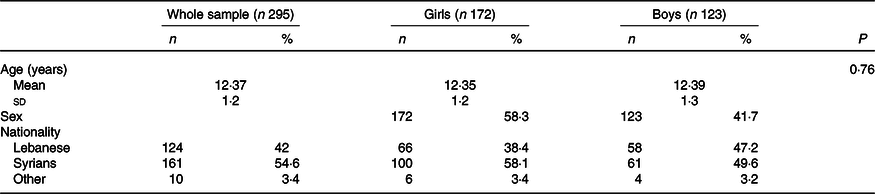
Baseline characteristics for all those recruited at pre-test (n 443) are shown in online Supplementary Table S2. Comparing the characteristics of those present at pre- and post-intervention with those lost to follow-up (n 295 v. n 148, respectively), results showed there are no significant differences in their age, nationalities and the four baseline knowledge scores (nutrition, health, life skills and social cohesion) (online Supplementary Table S2). Nevertheless, more boys (n 87, 41·4 %) were significantly lost to follow-up than girls (n 60, 25·9 %) (P = 0·001).
Concerning the interviews and online surveys, a total of forty-two individuals participated. Of these forty-two individuals, 7 % (n 3) were involved in the technical aspects of the camp, 4·88 % (n 2) were area managers responsible for all the schools in specific Lebanese areas, 9·76 % (n 4) were camp managers at the different schools, 48·78 % (n 20) were youth volunteers or team leaders who had direct contact with the children on a day-to-day basis, while 29·27 % (n 12) did not indicate what their position was.
Pre- and post-questionnaires
Nutrition and life skills knowledge
There was a significant difference in the scores for nutrition knowledge with students scoring higher on the post-test (5·34 (sd 2·7)) compared with the pre-test (4·79 (sd 1·9); t(269) = 4·51, P = 0·000) (Table 2).
Pre- and post-intervention scores on the nutrition, health, life skills and social cohesion questionnaires of participants present at both pre- and post-testing
(Mean values and standard deviations)
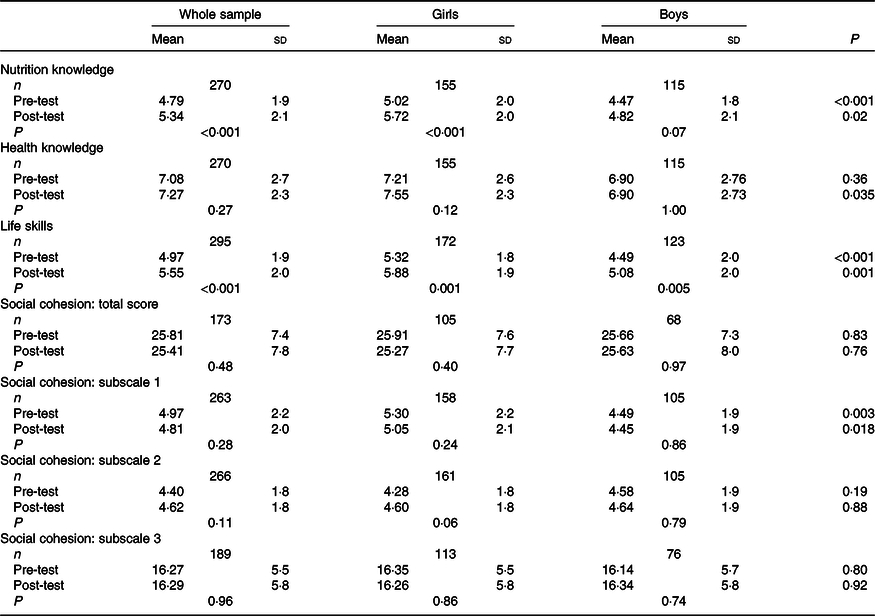
When comparing the nutrition scores between girls and boys, a significant difference was observed between pre- and post-tests among girls (5·02 (sd 2) v. 5·72 (sd 2), P = 0·000) and a borderline difference among boys (4·47 (sd 1·8) v. 4·82 (sd 2·1), P = 0·069). Moreover, pre-tests and post-tests scores were significantly higher in girls than in boys (P = 0·000 pre-tests and P = 0·019 post-tests) while the mean change was the same among both sexes (P = NS). No significant difference was observed when comparing scores between Lebanese and Syrians (data not shown). Furthermore, the pre-test nutrition scores were significantly different among schools (P = 0·000) and the mean change score among schools was borderline significant between schools (P = 0·047) (online Supplementary Table S3).
Similar results were observed for life skills knowledge with post-test scores (5·55 (sd 2)) being significantly higher than pre-test scores (4·97 (sd 1·9); t(294) = 4·52, P = 0·000) for the whole sample and for girls and for boys separately (Table 2). Moreover, girls scored significantly higher at pre- and post-tests than boys (5·32 (sd 1·8) v. 4·49 (sd 2), P = 0·000 pre-tests and 5·88 (sd 1·9) v. 5·08 (sd 2), P = 0·001 respectively). Nevertheless, the mean change in score was similar among both sexes. No significant difference was observed when comparing life skills scores between Lebanese and Syrians (data not shown). Furthermore, the pre- and post-tests scores for life skills were significantly different among schools (P = 0·000 and 0·004, respectively) while the mean change scores were borderline significant among schools (P = 0·069). Schools in the rural areas of the north governorate usually scored lower than other schools (online Supplementary Table S4).
Health knowledge
Regarding the health knowledge scores, no significant difference between pre- and post-tests was observed for the whole sample or among girls and boys (Table 2). Nevertheless, it is noteworthy to mention that girls scored higher than boys at both pre- and post-tests with the pre-test score for girls being higher than the post-test score for boys. The only significant difference observed for the health knowledge score was the post-test scores between girls and boys (7·55 (sd 2·3) v. 6·90 (sd 2·7), P = 0·035, respectively). It should also be noted that the mean change score for boys was equal to 0·00 (sd 3·14), and no significant difference in scores was observed between Lebanese and Syrians. Moreover, health knowledge scores were compared between schools with differences found between North and Akkar governorates (online Supplementary Table S5). Comparing the change in each item of the health knowledge questionnaire, the percentage of correct answers regarding tattoos (Q2), reproduction health (Q8) and menstrual period (Q9) questions was significantly higher at post-test than pre-test (online Supplementary Table S6). Surprisingly, the percentage of correct answers on the question involving pubertal changes (Q1) was lower at post-test than pre-test (respectively 24·1 v. 36·3 %, P = 0·002).
When comparing the answers separately among girls and boys, results showed that none of the pre- and post-tests scores on individual questions was significantly different among boys while four questions were significantly different between pre- and post-test among girls. A significantly higher percentage of correct answers at post-test compared with pre-test was observed for the reproduction question: reproduction (Q8) (69 v. 56·8 %, P = 0·017), and a borderline higher percentage for questions regarding periods (Q9) (83·9 v. 75·5 %, P = 0·061) and skin (Q12) (73·3 v. 78·7 %, P = 0·055), while a significantly lower percentage of correct answers at post-test compared with pre-test on the puberty question (Q1) (22·6 v. 37·4 %, P = 0·003).
Social cohesion
Concerning the social cohesion scores, no significant differences were observed for the total or the subscale scores for the whole sample and when analysis was stratified by sex (Table 2). The only difference observed for the social cohesion scores was for the subscale 1 where both pre- and post-scores were significantly lower in boys than girls, indicating that boys were meeting and spending more time with others than girls. Furthermore, when comparing the answers on each item of the social cohesion questionnaire, the only significant difference was observed for the first question ‘frequency at which you meet with people from other nationalities in the town’. At post-test, more participants were meeting people from other nationalities than at pre-test (84·3 v. 74·4 %, P = 0·000). This result remained significant among both sexes. When comparing nationalities, this item increased only among Syrians (81·6 % pre-test v. 92·4 % post-test, P = 0·002).
Differences between nationalities
No significant difference was observed when the scores of different tests were compared between Lebanese and Syrians (data not shown). Nevertheless, when comparing the scores of health knowledge, there was a higher percentage of correct answers for reproduction (Q8) at post-test compared with pre-test (68·3 v. 55·9 %, P = 0·026) while a lower percentage of correct answers was observed for the puberty question (Q1) at post-test compared with pre-test (23·4 v. 40·7 %, P = 0·002) among Syrians only (data not shown).
Focus groups
The emergent themes are presented below.
Social cohesion
One of the key impacts noted in the focus group discussions was the building of new friendships and the relative increase of social cohesion. Some mentionable quotes include (translated) ‘We were all like siblings here.’. This being said, one school, in particular, had some negative comments, for example, ‘At the beginning, we used to think that if they’re from another country they will be condescending with us, and it stayed the same.’ and ‘There are some people who do not like to mix with others.’. The above illustrates the mixed views on social cohesion.
In addition, some students noted social class as a divergent point of comparison. Comments such as (translated) ‘…And for us all to be wearing the same clothes’ and ‘Why do only 4 schools come? The private schools don’t come.’ point to the different aspects of social cohesion that do not only involve differences in nationality but also potential differences in socio-economic status.
Snacks
The students reported an overall acceptance of the snacks provided with most opinions being positive towards the snack choices. For example, one student said (translated) ‘We liked it a lot. They were tasty and good, and we liked everything.’. Several students even asked to include more snacks throughout the day. Overall, there was a positive attitude from the children with isolated complaints about incorporating more options.
Facilitators
There was a general positive attitude towards the youth volunteers and monitors who had direct contact with the students. Most students in the focus group discussions named their specific monitors by name stating that they were ‘the best’. Quotes from students include: (translated) ‘Responsive monitors. You feel a nice atmosphere…’ and (translated) ‘The teachers in this camp are good!’.
In particular, the students gave the general impression that they felt cared for. Some notable quotes from the participants include: (translated) ‘They’re very nice with us, their way of speaking and that they consider us like their family, like their siblings.’ and (translated) ‘….and they take care of us a lot’.
It is important to note many of the positive attitudes towards the facilitators stemmed from them not being violent or using physical punishment with the students. For example, one student said (translated) ‘They don’t hit us. They help us understand everything’.
Knowledge
All students noted acquiring new knowledge with salient topics mentioned including nutrition, bullying, health and pubertal changes. Some evident quotes include: (translated) ‘We learned about smoking, but in the future we won’t smoke.’, (translated)’…about the differences in religion and country and nationality, when someone foreign comes we shouldn’t bully them.’ and ‘We now know about how to take care of our health.’.
Recreation
All students noted their enjoyment of the summer camps and the activities and games carried out. Specific quotes from the different schools include: (translated) ‘We were very happy!’ and (translated) ‘These activities they’re giving us are a lot and they’re nice!’. Some students mentioned being ‘bored and restless’ at home with others not wanting the summer camps to end: ‘We enjoyed ourselves can you come every day?’
Child and adolescent health
The topic of child and adolescent health which involved educational topics about pubertal changes and reproductive health was newly integrated into the summer camps curriculum. Students from one particular school reported feeling uncomfortable and awkward being taught these topics with some stating that boys and girls being in the same classes while these topics were being taught was ‘embarrassing’. It is important to note that during the focus group discussions some students said that they should not be learning about these topics while other students replied back saying they indeed should. Some noteworthy quotes include: (translated) ‘The teacher of the personal health topics was a bit harsh. She said some things she should not have said’. and (translated) ‘We were a little bit embarrassed’. Other schools did not bring up any negative comments about the child and adolescent health topics with students simply mentioning that they learned about their bodies.
Time
The idea of longer days and an extended length for the camp in general was mentioned. Notable quotes included: (translated) ‘Let them make the camp longer.’ and (translated) ‘Make the hours longer, leaving at 2 instead of 1’. In addition, some students requested changing the start time of the camps: ‘Maybe we can change the time that we leave. We are leaving very early without breakfast without anything.’. In general, it can be said that students wanted to prolong the camps in terms of both the length of the days and the number of weeks.
Activities
Overall, the students enjoyed the activities and gave the impression that they had a good time in the summer camps. Some specific comments were made about the types of games and activities the students would like to be engaging in. Some notable quotes include: (translated) ‘Put nice games like trampoline or water games.’ and ‘I wish they took us on a field trip’.
Key informant interviews and surveys
Based on the semi-structured nature of the key informant interviews and online surveys, the below quantitative data were found.
Concerning the quantity and quality of facilitators, the majority (80·49 %) considered the number to be sufficient and their quality to be good (68·29 %). While for the quantity and quality of youth volunteers, the majority (75·61 %) considered the number to be sufficient and their quality to be adequate (46·34 %).
When asked about different steps that should be taken to ensure the availability of sufficient numbers of quality facilitators and youth volunteers, the majority (48·78 %) stated training as a step that should be taken with other notable steps being attractive salaries and benefits (41·46 %) and continuing education (39·02 %).
When asked if the infrastructure of the summer camps is sufficient in quality and quantity, 75·61 % answered ‘Yes’, 21·95 % answered ‘No’ and 2·44 % answered ‘I don’t know’. In addition, when asked if there is a need to improve the materials used in the summer camps, 36·59 % answered ‘Yes’, 60·98 % answered ‘No’, while 2·44 % answered ‘I don’t know’. Finally, when asked about the need for improvements in partnerships, 7·32 % answered ‘Yes’, 68·29 % answered ‘No’, while 19·51 % answered ‘I don’t know’.
The emergent themes from the key informant interviews and online surveys are presented below.
Social cohesion
The key informants reported new friendships made and the increase of social cohesion between the students throughout the length of the summer camps, with words such as ‘great’ and ‘positive’ being used to describe the cohesion between students. Significant quotes include ‘Many of the children are saying “well you guys treat us like equal”.’ and ‘Children are engaged and playing together.’. Several key informants pointing to the fact that children are naturally social and amiable: ‘A child is a friend to everyone until someone tells him not to be.’.
As expected, there were some isolated cases where discrimination was witnessed. For example, ‘In [one] school, monitors noticed racism cases from Lebanese students against Syrian students.’. Other key informants noted that social cohesion was low to modest with some saying that it was ‘not enough’.
Similar to the focus groups, the idea of social cohesion between socio-economic classes was brought up. One monitor mentioned that students who were worse-off economically were trying to imitate and be like those who were better-off which did not cause any issues in and of itself but was of notable importance while discussing social cohesion.
Integrated programme
A specific theme that emerged was the benefit of having an integrated programme and curriculum that holistically and systematically addressed all aspects involved in childhood and adolescent health. Notably, ‘It has to be holistic and it has to be following the definition of health from the WHO 1940 something(22). It is physical, social, emotional. So the three go together, and if you’re from a vulnerable area, from a vulnerable background, then your risk of having one or all of those three destabilized is much higher.’ and ‘We need to treat health from all its dimensions and not just in pieces’. This reveals the compliance with WHO’s definition of health and implies a benefit for using an integrated approach.
Monitors
Similar to the student focus group discussions, key informant interviews and surveys highlighted the crucial role of monitors and their impact on the summer camps with the general impression being that the monitors had a positive impact on the students, and they acted responsibly towards them with one interviewee stating: ‘I mean we [usually] hear complaints [about the monitors]. We haven’t heard complaints, so they’re good.’. However, some key informants mentioned that it was not all positive. For example, (translated) ‘Some were treating the kids badly.’ and ‘The lack of sense of responsibility between some of the monitors…’.
When asked about what steps can be taken to improve the educators and facilitators, the majority of the key informants mentioned training as a step in ensuring sufficient quality facilitators. Some specific suggestions for improvement in this area are as follows: sharing material ahead of time, recruiting more local facilitators and having more than one training session.
Time
One of the most salient themes mentioned in the key informant interviews and surveys was that of time, specifically wanting and needing more time to plan and carry out the execution of the summer camps. Particular quotes include the following: ‘Maybe start 2 months earlier than we would normally start.’, ‘I would say directly more time to get the project agreements signed, more time to screen, more time to train’ and ‘…only 3 or 4 weeks to plan like everything from A to Z.’.
Similar to the students’ comments, some key informants mentioned the length of the camp. ‘The camp is a bit short for 3 weeks to find difference in behaviour of children.’. In general, the impression given was that more time would ensure easier planning and execution and possibly better outcomes; however, all key informants questioned the feasibility and practicality of adding more time.
Partnerships and collaborations
Most key informants agreed on the fact that more cooperation needed to be involved in the planning and execution of the summer camps. Specific suggestions included more cooperation within the sister UN agencies and more communication between the partners so that everyone is ‘on the same page’.
Infrastructure and materials
There were mixed views on the material and equipment used. Although the majority did not see a need for any improvements due to the fact that the majority of materials are bought on a need by need basis at every school, some specific comments can be noted. For example, (translated) ‘the materials were too few and not appropriate for the age group of the students.’. In addition, it is important to note that a number of key informants mentioned the benefit of having more basketballs as well as microphones and megaphones.
Concerning the infrastructure, key informants noted that in order to choose the schools, there was a checklist with specific necessities such as shaded areas and equipped washrooms, yet they had to deal with what schools were available to them at the time. A notable number of key informants mentioned the need for improving washrooms and water supply with some noting the need for more classrooms: (translated) ‘…some games needed a classroom and we were forced to stay in the playground with the excuse of not being allowed to open the classrooms…’. In general, it can be said that following the checklist, the best schools are being chosen with one key informant saying: ‘I mean, that’s the best we have’.
Activities
Similar to the students’ suggestions, a number of key informants mentioned changing the types of activities used in the summer camps. Some important quotes include: ‘Implement less school style games’ and ‘Some activities can be changed and replaced by more fun activities’. In addition, some key informants recommended increasing the number of games and activities in general while others suggested involving the youth volunteers in the preparation of games.
Lessons and curriculum
The impression given about the lessons and curriculum was that they were sufficient and appropriate for the age group. One suggestion given by a key informant was to teach the bullying lessons at the start of the summer camps to avoid conflict and fights between groups from the very beginning. As stated above, several key informants noted that sharing the curriculum ahead of time in addition to more training would possibly contribute to more uniform messages sent to the students concerning the topics being taught.
Unlike the students’ point of view concerning child and adolescent health topics, the key informants did not notice any glaring issues in this sense with their general feedback being that they were initially worried about this part of the material but that it was the most smooth part of the lessons. It was noted that in a small number of camps, the boys and girls were split for these lessons for their comfort and when deemed more appropriate to context by the health facilitator.
Psychosocial support
Throughout the key informant interviews with the individuals involved in the technical aspects of the camp, it came to light that a reasonable number of referral cases were identified. These cases involved relatively minor issues such as behavioural problems and non-participation in activities but also more dangerous issues occurring at home such as sex-based violence and abuse. It was noted that these cases were referred to the proper entities when needed; however, the impression was that the camps could have been more prepared for this influx of psychosocial cases. Suggestions included having a psychosocial support counsellor present throughout the camps for immediate management and referral of psychosocial cases.
Discussion
The aim of the present study was to assess the 2019 WFP Health and Nutrition summer camps, to provide insights on the content, format and lessons learnt. Overall, these camps had a positive impact on the children’s social, emotional and physical health.
First, quantitative data revealed a significant increase in the nutrition and life skills knowledge scores in the post- compared with pre-test. This increase parallels the focus group results, with students requesting more fruits and vegetables. It indicates an overall rise in awareness of the importance of healthy nutrition which is of particular importance given the rising prevalence of childhood obesity in Lebanon(Reference Nasreddine, Naja and Akl23). Nevertheless, there was no significant increase in adolescent health knowledge scores in the post-tests. This could be explained by the fact that sexual practices are not openly discussed given the taboo associated with sexuality among unmarried Lebanese youth(Reference Ghandour, Mouhanna and Yasmine24). In fact, this lack of health awareness among children is recently highlighted in the Lebanese Global School-Based Student Health Survey including students from grade seven till twelve. This survey reported that more than half of the students ‘would support being taught about reproductive health in school’ and thought that ‘reproductive health education should start before and during the age of puberty’. As such, they looked up much of the information regarding sexual health on the internet or social media(7). An additional observation relates to the format of delivery of such classes as several students mentioned in the focus group being embarrassed with the mixed classroom model. This is in line with the local Global School-Based Student Health Survey report with around 47 % of students suggesting that ‘education about reproduction should be taught in boys only and girls’ only classes’(7). Together, the cultural approach to this topic and the lack of proper timely education may contribute to the students being uncomfortable and intolerant to such messages which could lead to less learning. Additionally, the educators’ cultural biases and personal beliefs about this topic may have affected the way in which the lessons were given which would subsequently affect the students’ knowledge and learning.
Lastly, no significant differences were found between pre- and post-tests for any of the social cohesion frequency assessments. This could be partially accounted for by the relatively short-time lag between testing points (2 weeks) as social cohesion attitudes are highly related to practices and overt behaviours which usually take much longer to show signs of significant change(Reference Marías and Glasauer25). It may be that although the children had knowledge of bullying and related topics, they did not have the time to express this in their practices and actions which is reflected in the results. Nevertheless, in terms of qualitative behavioural observations based on key informant interviews, it was noted that interactions across nationalities did improve over the course of the camps. Whether it was an observational bias, with the managers better able to know participants and monitor their interaction, or it was the children’s inability/inaccuracy to evaluate their own attitudes or behaviours in frequency measures, the overall end results showed a significant tendency of students to positively interact with other. It also showed that spending time with others (from different sexes or nationalities, etc.) starts improving social cohesion behaviours, which might subsequently drive changes in attitudes and stereotypes. Taken together, these results reveal a significant improvement in the students’ nutrition, health and life skills knowledge and an improvement in interactions between nationalities. This theme of knowledge acquisition was central in students’ focus groups and further approved by key informants’ appreciation of lessons and curricula.
Sex differences were observed for different knowledge scores. These sex differences may be due to higher motivation, discipline and self-regulation that is usually observed in girls compared with boys(Reference Weis, Heikamp and Trommsdorff26), for most areas of health knowledge, especially reproduction and early life(Reference Beier and Ackerman27). It is also worthy to mention that more boys than girls were lost to follow-up, partly because parents might be more likely to send boys to work(28). Regarding nationalities, the students had similar responsiveness and benefited equally. To the best of our knowledge, this is the first study looking into differential education interventions between Lebanese and Syrians. Earlier studies had previously reported a positive impact of a similar school-based intervention in nutrition knowledge and eating habits in 9–11-year-old students(Reference Habib-Mourad, Ghandour and Moore29) and in Syrian refugees separately(Reference Harake, Diab and Kharroubi18). The similar results between nationalities may have been supported by the friendly environment and enhanced social cohesion previously reported in the focus groups and key informant interviews.
On the other hand, when mapping the scores to camp location, it was generally observed that as distance from the capital increased, scores dropped in the pre- and post-surveys for life skills and health knowledge and pre-intervention for the nutrition knowledge. In fact, the distant/rural areas with the lowest socio-economic status and highest poverty rates in the country(30) scored lower on the questionnaires. This could be due to differences in the school districts and the size of the schools themselves which could differ on what health and psychosocial lessons the students are learning throughout the school year.
Results from questionnaires, focus group discussions and key informant interviews and surveys indicate an overall progress in the students’ nutrition, health and life skills knowledge. Such results could be further improved by implementing minor logistic changes. For instance, early planning would facilitate stronger and wider partnerships with other UN agencies that share compatible goals. Furthermore, a common training session for educators, pre-camps (and potentially consider a refresher training mid-camp), would ensure a more homogenous communication and a unified message delivery that would decrease inevitable individual differences between educators. This would also give time for a more in-depth screening of facilitators for suitability (and follow-up mid-way) thus enhancing the cohesion between the facilitators and the students.
Another possibility of improvement includes enhancing the referral system whenever at-risk cases related to health, nutrition or social issues are detected. In fact, summer camps can be used not only for enhancing knowledge and optimising behaviour but also for uncovering problematic cases with social and health concerns. Referring students to proper (and sometimes immediate) care facilities could take place in partnership with governmental or local non-governmental organisations. Furthermore, a major social issue in the current camp was the elevated rate of children drop-out of summer camps to go work. These children, while not in camps, would still need proper follow-up with partners working in protection.
Camp design could additionally be boosted, with longer activity duration, as well as more hands-on and play-focused types of activities as voiced in focus groups. For example, basic cooking activities could further enhance nutrition awareness while providing an ‘edu-taining’ approach to learning.
Finally, the adolescent health module needs to be improved. With the current lack of culture-specific guidelines or a school-specific curriculum, the core learning could be delivered in sex-separate methods to alleviate intimidation and embarrassment among participants, with more general activities/sessions taking place in sex-mixed methods. It is important to keep in mind the controversial and sensitive aspect of this approach and the geographic rural/urban differences in order not to fuel sex inequalities and foster additional disparities around this taboo topic.
Strengths and limitations
The most notable strength of the present study might be its multimodal methods, combining quantitative and qualitative data to better capture different aspects of the summer camp impacts. This has allowed an objective assessment of the planning and execution of summer camps. The viewpoint of students, team leaders, camp managers, area managers and those involved in the logistics gives a one-of-a-kind top-to-bottom perspective. This further helps determining and refining idiographic causation related to specific cultural and contextual factors. Other strength factors include multi-centric approach, direct comparison between nationalities and integrating nutritional, health and life skills aspects in holistic manner.
Some of the limiting challenges include the use of questionnaires. Although pilot testing of the questionnaire was carried out, differential literacy levels among students or age disparities within the same class (due to displacement of refugees or child labour) might bias the ability to complete such questionnaires, even though the questionnaires were pilot-tested in an attempt to minimise this bias. Furthermore, this is the first time the social cohesion questionnaire, originally used in an adult Lebanese and Syrians, is used in children. This might account for the lack of significant differences on the social cohesion scores pre- and post-intervention. Limitations also include social desirability bias and the loss of participants at follow-up, especially boys, which should be taken into consideration in future studies. In addition, the short time for data collection did not allow for the collection of anthropometric data or dietary data which could be studied in relation to students’ nutrition knowledge and used to assess how this knowledge translates into practice.
Conclusion and future implications
Overall, the WFP Health and Nutrition summer camps had a positive impact. The intervention not only focused on nutritional knowledge but also integrated other aspects of relevance to this vulnerable population in the format of a summer camp. It altogether addressed intellectual/rational, interpersonal/skills and emotional/social needs of participants. As such, the summer camps targeted nutritional matters such as food insecurity and issues leading to obesity by establishing awareness around food consumption and alternatives to affordable healthy eating habits in addition to the provision of healthy snacks. Based on student feedback, it can be said that for some students the healthy snack could be filling a big need concerning lack of food since some students requested adding even more snacks. In addition, this intervention targeted health issues particularly relevant to adolescents. This most definitely raised sensitive issues in the cultural context yet nonetheless provided a safe and scientific environment to start the conversation related to sexual education and intimate relationships. It also targeted life skills of utmost importance for both physical and psychological safety: anti-bullying. This is another under-reported and under-studied phenomenon within this age group and whether it is physical, emotional or verbal, bullying and violence remain very critical factors involved in teen depression, distorted body image, eating disorders and suicidality. It is also important to note that many students considered their team leaders to be nice since they ‘don’t hit’ them which could indicate that a big number of students are used to violent punishment and find the camps a nice reprieve. Last but not least, the camps intended to increase social cohesion across sex, nationality and socio-economic classes in relation to each other and to authority figures. This item is particularly relevant to the cycles of violence and discrimination in the region.
Both quantitative and qualitative data have shown that the intervention was successful in initiating change along those targeted lines. Future initiatives can take sex differences into consideration in terms of possibly using different learning approaches and looking into the specific cultural and social situations of each sex. In addition, special attention can be given to the topic of adolescent health with more educator training and potentially splitting girls and boys if culturally appropriate. Furthermore, students may also benefit from preparing their own healthy snacks to facilitate the translation of knowledge into practice. Models of such mixed camps (across sexes, nationalities and socio-economic backgrounds) should thus be replicated, especially in vulnerable adolescent populations as it seems immediate knowledge drives more positive short-term behaviour with potential long-term influence on attitudes and skills. These summer camps are commendable in incorporating an integrative approach to support education and development of vulnerable children and adolescents and are most definitely worth learning form and reapplying.
Acknowledgements
We would like to thank all the camp participants and managers for their valuable time and their cooperation.
This work was supported by a grant from the World Food Programme, grant no. LBN19NF33-RFP. The funders provided technical support in the study design, critical review of the manuscript and decision to publish. They had no role in the data collection, data analysis, presentation of results or preparation of the manuscript.
All authors conceived and planned the study. C. E. implemented and supervised the field work. B. R. did the analysis and interpretation. C. E., B. R. and N. Z. drafted the manuscript. M. K. M., L. M., S. M. and N. Z. critically revised the manuscript. All authors reviewed the manuscript and approved the final version for submission.
C. E., B. R., M. K. M., L. M. and N. Z. declare no conflict of interest.
S. M. was employed by the World Food Programme, Lebanon during the implementation of the present study. The author declares no financial interest in the development of the study and no other conflict of interest. The views expressed in this manuscript are my own.
Supplementary material
For supplementary materials referred to in this article, please visit https://doi.org/10.1017/S0007114520003682



