





Introduction
Seasonality is an important determinant of vector-borne diseases (Fecchio et al., Reference Fecchio, Wells, Bell, Tkach, Lutz, Weckstein, Clegg and Clark2019). Vectors, pathogens and hosts are dependent on abiotic conditions for reproduction and survival, and changes in these conditions may affect the transmission of many distinct diseases (Kelly-Hope et al., Reference Kelly-Hope, Hemingway and McKenzie2009; Gonzalez-Quevedo et al., Reference Gonzalez-Quevedo, Davies and Richardson2014; Ferraguti et al., Reference Ferraguti, Martínez-de la Puente, Bensch, Roiz, Ruiz, Viana, Soriguer and Figuerola2018). For instance, higher temperatures increase vector abundance and often accelerate parasite development in their vectors (Valkiūnas, Reference Valkiūnas2005; Lapointe et al., Reference Lapointe, Goff and Atkinson2010), thus likely increasing parasite prevalence in vertebrate hosts (Zamora-Vilchis et al., Reference Zamora-Vilchis, Williams and Johnson2012). Similarly, heavy rain periods and severe droughts can increase or decrease the prevalence of diseases transmitted by vectors dependent on water collections for breeding sites (Hoshen and Morse, Reference Hoshen and Morse2004; Landesman et al., Reference Landesman, Allan, Langerhans, Knight and Chase2007). Changes in the pattern of seasonality may become a challenge to future ecological studies due to global climate change (IPCC, 2021), thus it is important to understand the impact of seasonality on vector-borne pathogens distribution.
Avian haemosporidians are a diverse group of protozoan parasites, including the genera Plasmodium and Haemoproteus that use a variety of Diptera species as vectors. Plasmodium parasites are transmitted by mosquitoes (Culicidae) whereas Haemoproteus (Parahaemoproteus) and Haemoproteus (Haemoproteus) are transmitted by either biting midges (Ceratopogonidae) or louse flies (Hippoboscidae), respectively, hence, environmental conditions could affect their transmission differently (Ferreira et al., Reference Ferreira, Santiago-Alarcon, Braga, Santiago-Alarcon and Marzal2020). There are more than 200 species already described for these parasites, which can develop in a variety of bird and vector species (Marzal, Reference Marzal2012; Clark et al., Reference Clark, Clegg and Lima2014). Furthermore, avian haemosporidians are associated with mortality episodes in wild birds (Ricklefs, Reference Ricklefs2017) and can reduce longevity and reproductive fitness of chronically infected hosts (Marzal et al., Reference Marzal, De Lope, Navarro and Møller2005; Asghar et al., Reference Asghar, Hasselquist, Zehtindjiev, Westerdahl and Bensch2015).
Host biological and ecological traits also influence haemosporidian prevalence, diversity and distribution (Pulgarín-R et al., Reference Pulgarín-R, Gómez, Robinson, Ricklefs and Cadena2018; Fecchio et al., Reference Fecchio, Clark, Bell, Skeen, Lutz, De La Torre, Vaughan, Tkach, Schunck, Ferreira, Braga, Lugarini, Wamiti, Dispoto, Galen, Kirchgatter, Sagario, Cueto, González-Acuña, Inumaru, Sato, Schumm, Quillfeldt, Pellegrino, Dharmarajan, Gupta, Robin, Ciloglu, Yildirim, Huang, Chapa-Vargas, Álvarez-Mendizábal, Santiago-Alarcon, Drovetski, Hellgren, Voelker, Ricklefs, Hackett, Collins, Weckstein, Wells and Kamath2021; de Angeli Dutra et al., Reference de Angeli Dutra, Filion, Fecchio, Braga and Poulin2021a). Individual traits such as plumage colour and body mass are associated with differences in parasite prevalence (De La Torre et al., Reference De La Torre, Freitas, Fratoni, Guaraldo, Dutra, Braga and Manica2020; Filion et al., Reference Filion, Eriksson, Jorge, Niebuhr and Poulin2020). For example, a negative effect of haemosporidian parasites on body condition was detected among passerine species (Palinauskas et al., Reference Palinauskas, Platonova, Žiegyte and Mukhin2016; Schoenle et al., Reference Schoenle, Kernbach, Haussmann, Bonier and Moore2017). Species functional traits, such as habitat selection, plumage colouration, nest type, migratory behaviour and flocking, have all been implied as predictors in the variation of haemosporidian prevalence (Gonzalez-Quevedo et al., Reference Gonzalez-Quevedo, Davies and Richardson2014; Ganser et al., Reference Ganser, Monadjem, Mccleery, Ndlela and Samantha2020; de La Torre and Campião, Reference De La Torre and Campião2021; de Angeli Dutra et al., Reference de Angeli Dutra, Fecchio, Martins Braga and Poulin2021b; Aguiar de Souza Penha et al., Reference Aguiar de Souza Penha, Maia Chaves Bicalho Domingos, Fecchio, Bell, Weckstein, Ricklefs, Braga, de Abreu Moreira, Soares, Latta, Tolesano-Pascoli, Alquezar, Del-Claro and Manica2022). For instance, Haemoproteus prevalence reaches higher rates among avian species inhabiting mid-high and canopy strata and haemosporidian infections are more common among strictly migratory species (de La Torre and Campião, Reference De La Torre and Campião2021; de Angeli Dutra et al., Reference de Angeli Dutra, Fecchio, Martins Braga and Poulin2021b). Moreover, species that are phylogenetically closely related tend to exhibit greater similarity in functional traits as compared to distantly related species, which may be correlated with parasite exposure and likelihood of infection (Barrow et al., Reference Barrow, McNew, Mitchell, Galen, Lutz, Skeen, Valqui, Weckstein and Witt2019).
How seasonality affects avian haemosporidian parasites in tropical seasonally dry environments is still uncertain. Ferreira et al. (Reference Ferreira, Rodrigues, Ellis, Leite, Borges and Braga2017) found seasonal changes in parasite prevalence, while no variation was detected by Fecchio et al. (Reference Fecchio, Lima, Silveira, Ribas, Caparroz and Marini2015) These contrasting results indicate the need for further investigations of avian haemosporidian distributions across different periods in tropical areas with marked seasonality. The Caatinga is a seasonally dry tropical forest (SDTF) in Brazil. This domain is located exclusively in northeastern Brazil, covering an area of approximately 845 000 km2 which represents about 11% of the national territory (Bucher, Reference Bucher, Huntley and Walker1982). The region's climate is classified as hot semi-arid (type ‘BSh’) according to Koöppen's classification (Alvares et al., Reference Alvares, Stape, Sentelhas, de Moraes Gonçalves and Sparovek2013), characterized by a long dry season between July and January with irregular distribution of rainfall in the rest of the year. This domain, which had been considered inappropriately associated with low diversity regions in terms of endemism and species richness (Vanzolini et al., Reference Vanzolini, Ramos-Costa and Vitt1980; Leal et al., Reference Leal, da Silva, Tabarelli and Lacher2005), actually harbours high biodiversity. Caatinga is home to more than 200 bird species with 22 considered endemic (Tabarelli and Silva, Reference Tabarelli, Silva, Leal, Tabarelli and Silva2003)
Due to the high biodiversity in the Caatinga and the lack of knowledge of the distribution and diversity of avian haemosporidians in this region and in seasonally dry environments, we aimed to investigate the effect of seasonality and host functional traits on avian haemosporidian prevalence and diversity in the Caatinga ecosystem.
Methods
Study area
We conducted this study in Seridó Ecological Station – ESEC Seridó – (06° 34′36.2″ S and 37°15′20.7″ W), encompassing an area of 1163 ha and located in the municipality of Serra Negra do Norte, state of Rio Grande do Norte (Brazil) (Fig. 1). The region has a semiarid climate, with dry season reaching up to 10 dry months with irregular rainfall distribution. Mean annual precipitation varies between 500 and 800 mm year−1 and mean annual temperature varies between 28°C and 30°C, with lowest and highest temperatures ranging between 17°C and 40°C (Bucher, Reference Bucher, Huntley and Walker1982). Local vegetation is composed of grass-covered soil and arboreal-shrub Caatinga with sparse small trees (<7 m) (Duque, Reference Duque1953). The region has a high bird richness, with approximately 200 species, including some threatened and near-threatened species (Pichorim et al., Reference Pichorim, Damasceno, Toledo-Lima, de Araújo and Ferreira2016a, Reference Pichorim, Valdenor de Oliveira, de Oliveira Júnior, Câmara and Galvão do Nascimento2016b).
Map of Seridó Ecological Station (ESEC Seridó), Rio Grande do Norte, Brazil.

Sample collection and DNA extraction
We captured wild birds in 4 field campaigns, each consisting of 7 days in 4 different sampling seasons (June 2013: ‘first rainy’, which had 45.8 mm of accumulated precipitation, January 2014: ‘second rainy’, with 95.4 mm of accumulated precipitation, July 2014: ‘first dry’ 7.0 mm of accumulated precipitation, and December 2014 ‘second dry’, no precipitation). Birds were captured using mist nets (Ecotone®; 18 m × 3 m, mesh 19 mm) set in a 12-ha quadrant (400 × 300 m). This large quadrant was divided into 48 cells measuring 50 × 50 m, with the capture site (i.e. where the mist net was placed) located at the centre of each cell. We sampled 24 cells per day between 5h00 and 10h00 in each field campaign, resulting in an effort of 181 440 m2 h (54 m2 of per net × 5 h per day × 24 nets per day × 7 days per campaign × 4 campaigns; Straube and Bianconi, Reference Straube and Bianconi2002). Captured birds were identified, banded (with metal rings provided by CEMAVE/ICMBio (Centro Nacional de Pesquisa e Conservação de Aves Silvestres), weighed, and examined for the presence of ectoparasites (ticks, mites and lice) and brood patches. We collected blood samples from the brachial vein using insulin needles and stored the samples on filter paper. Captured birds were subsequently released near the capture sites. We extracted the genomic DNA from the blood samples using phenol-and Russellchloroform protocol followed by precipitation with isopropanol, as described by Sambrook and Russell (Reference Sambrook and Russell2001). We quantified the extracted DNA using NanoDrop™ Lite Spectrophotometer (Thermo Scientific®), according to the manufacturer's instructions.
Molecular detection and characterization of haemosporidian parasites
We performed a screening PCR using primers designed by Fallon et al. (Reference Fallon, Ricklefs, Swanson and Bermingham2003). To amplify both Plasmodium and Haemoproteus genera. All positive samples at the screening PCR were subjected to a Nested-PCR, described by Hellgren et al. (Reference Hellgren, Waldenstro and Bensch2004), which amplifies a 478 bp fragment of the mitochondrial cytochrome b gene (cyt-b) of Plasmodium and Haemoproteus. We did not perform the nested assay that amplifies Leucocytozoon parasites because of their low prevalence in Brazil (Fecchio et al., Reference Fecchio, Bell, Bosholn, Vaughan, Tkach, Lutz, Cueto, Gorosito, González-Acuña, Stromlund, Kvasager, Comiche, Kirchgatter, Pinho, Berv, Anciães, Fontana, Zyskowski, Sampaio, Dispoto, Galen, Weckstein and Clark2020). We used Plasmodium gallinaceum derived from experimentally infected chicks as a positive control. Sterile ultrapure water was used as a negative control. We performed all PCR and electrophoresis methods according to (Roos et al., Reference Roos, Belo, Silveira and Braga2015).
We purified the positive Nested-PCR products following (Green and Sambrook, Reference Green and Sambrook2012). The purified DNA was bi-directionally sequenced by the dideoxynucleotide method in ABI 3100® capillary automated sequencer (Applied Biosystems, USA) using the Big Dye Terminator Mix kit (Applied Biosystems, USA) following reaction and reading conditions indicated by the manufacturer.
We edited obtained sequences using Chromas Pro (Technelysium Pty Ltd, Helensvale, Australia) checking for the presence of mixed infections (presence of double peaks in the eletrochromatograms). We compared our assembled sequences to those deposited in public databases, such as GenBank (http://www4.ncbi.nlm.nih.gov) and MalAvi (Bensch et al., Reference Bensch, Hellgren and PÉrez-Tris2009). Sequences with a minimum of one base difference were considered unique cytochrome b lineages, and those with no database record were considered novel lineages. We deposited novel lineages in GenBank (acc. num.MK981615–MK981622). New records of previously described sequences were also deposited in GenBank (acc. num. MK981623–MK981646).
Host functional traits data
We obtained avian functional trait data for each host from AVONET (Tobias et al., Reference Tobias, Sheard, Pigot, Devenish, Yang, Sayol, Neate-Clegg, Alioravainen, Weeks, Barber, Walkden, MacGregor, Jones, Vincent, Phillips, Marples, Montaño-Centellas, Leandro-Silva, Claramunt, Darski, Freeman, Bregman, Cooney, Hughes, Capp, Varley, Friedman, Korntheuer, Corrales-Vargas, Trisos, Weeks, Hanz, Töpfer, Bravo, Remeš, Nowak, Carneiro, Moncada, Matysioková, Baldassarre, Martínez-Salinas, Wolfe, Chapman, Daly, Sorensen, Neu, Ford, Mayhew, Fabio Silveira, Kelly, Annorbah, Pollock, Grabowska-Zhang, McEntee, Carlos, Gonzalez, Meneses, Muñoz, Powell, Jamie, Matthews, Johnson, Brito, Zyskowski, Crates, Harvey, Jurado Zevallos, Hosner, Bradfer-Lawrence, Maley, Stiles, Lima, Provost, Chibesa, Mashao, Howard, Mlamba, Chua, Li, Gómez, García, Päckert, Fuchs, Ali, Derryberry, Carlson, Urriza, Brzeski, Prawiradilaga, Rayner, Miller, Bowie, Lafontaine, Scofield, Lou, Somarathna, Lepage, Illif, Neuschulz, Templin, Dehling, Cooper, Pauwels, Analuddin, Fjeldså, Seddon, Sweet, DeClerck, Naka, Brawn, Aleixo, Böhning-Gaese, Rahbek, Fritz, Thomas and Schleuning2022). We included the variables and categories as follows: (1) migratory behaviour: resident, partially migratory and strictly migratory; (2) primary lifestyle: insessorial, terrestrial and generalist; (3) body mass; (4) host distribution range (i.e. geographical distribution of a bird species).
Statistical analysis
Phylogenetic signal
All analyses were conducted in R version 4.0 (R Core Team, 2017). Firstly, we filtered all bird species that were sampled 4 or fewer times, this filtered dataset (N = 880) was used in all following analyses. To evaluate if the phylogenetic relationship among bird species is correlated with parasite prevalence in our dataset, we downloaded a full avian phylogeny file from the AllBirdsHackett1.tre website (https://birdtree.org/) which contain 10 thousand trees (Hackett et al., Reference Hackett, Kimball, Reddy, Bowie, Braun, Braun, Chojnowski, Cox, Han, Harshman, Huddleston, Marks, Miglia, Moore, Sheldon, Steadman, Witt and Yuri2008; Jetz et al., Reference Jetz, Thomas, Joy, Hartmann and Mooers2012). Later, we applied the ‘treeman’ package (Bennett et al., Reference Bennett, Sutton and Turvey2017) to create a treeman file containing all trees from the original file. Then, we randomly selected a phylogenetic tree to avoid selection bias. We excluded all bird species from the tree which were not present in our dataset. Then, we calculated K (i.e. a measure that allows comparisons of the amount of phylogenetic signal across a specific trait (Blomberg et al., Reference Blomberg, Garland and Ives2003)) to evaluate the phylogenetic signal for haemosporidian prevalence among bird species in our dataset. Values of K can range between 0 and 1, equalling 1 when the trait has evolved consistently with a Brownian motion and trait values are similar among related species, or 0 when trait values are phylogenetically unrelated among species. To estimate K, we applied the ‘phylosig’ function from the ‘phytools’ package (Revell, Reference Revell2012).
Bayesian analyses
We constructed 4 Bayesian models using the ‘brms’ package (Bürkner, Reference Bürkner2017) to evaluate whether bird functional traits and seasonality influence haemosporidian prevalence. In all models, we created a matrix with phylogenetic distances among all avian species to account for influence of host phylogenetic relationships on haemosporidian prevalence, which was included as a random variable. Since we observed strong phylogenetic signals in our dataset (see Results), adding phylogenetic relatedness among species in our models was important to take into consideration when evaluating the effect of the other variables included in the models. The explanatory variable effects included in each model are represented in Table 1. The 4 models were weighted using the function ‘loo_model_weights’ and the one with the highest weight value was selected. In all models, we used the infection status of individual birds as our dependent variable (binary response: 0 for uninfected, 1 for infected). We ran all models using the Bernoulli distribution family and 4 chains with 4000 total iterations per chain (2000 for warmup, 2000 for sampling). Priors were chosen using ‘get_prior’ function and the models' results were plotted using the ‘conditional_effects’ function to visualize the predictions of the population-level effects. The selected model was repeated 6 times using haemosporidians of both genera, Plasmodium only and Haemoproteus (both subgenera) only parasites (whenever the parasite ID was achieved through sequencing) and using the entire dataset (N = 880) or the dataset excluding Columbiformes (N = 483), which represented most of the birds sampled. It is imperative to rerun analyses excluding Columbiformes due to the minor influence of environmental conditions on H. (Haemoproteus) vectors, as those mostly reside on their hosts' skin and Columbiformes are the main hosts of H. (Haemoproteus).
Model averaging weights for the 4 models tested using pseudo-BMA (where higher values indicate better model fit) with Bayesian bootstrap method

Results
Plasmodium and haemoproteus diversity
We detected 481 positive samples (prevalence equal to 51.2%) in the screening PCR. Haemosporidian prevalence varied drastically among the 20 best sampled host species, ranging from 0 to 70% (Supplementary Table 2). All of those were subjected to cyt-b PCR and gene sequencing. However, we were able to obtain high-quality sequences for 191 individuals, which revealed 68 Plasmodium infections in 22 bird species (38.41%), 90 subgenus Haemoproteus (Haemoproteus) infections in 4 bird species (50.84%), and 19 subgenus Haemoproteus (Parahaemoproteus) infections in 10 bird species (10.83%). We were able to separate out haplotypes in 14 mixed infections in 10 bird species (3.92%), revealing Plasmodium/Plasmodium (n = 5), H. (Haemoproteus)/H. (Haemoproteus) (n = 7) and H. (Parahaemoproteus)/H. (Parahaemoproteus) (n = 2) infections. The parasite community was composed of 32 distinct lineages (Plasmodium = 17; H. (Haemoproteus) = 05 and H. (Parahaemoproteus) = 10); 7 haemosporidian lineages were obtained for the first time.
We observed a difference in host range among distinct parasite taxa. Haemoproteus (Haemoproteus) mainly infected Columbiformes (88/90; 04 species), with 2 lineages detected in passerines; SocH3 infected Pachyramphus polychopterus (Tityridae) and SocH2 Myiarchus tyrannulus (Tyrannidae). This parasite subgenus was represented by 5 genetic lineages: SocH3 (n = 69), COPIC01 (n = 16), SocH2 (n = 3) and by 2 new lineages ZENAUR01 (n = 1) and ZENAUR02 (n = 2). We obtained 68 sequences of genus Plasmodium representing 17 lineages, including three novel one (POLPLU01, PHAMUR01 and NYSMAC05), that mainly infected Passeriformes. The most common lineages were PADOM11 (detected 15 times in 6 bird species), PHPAT01 (13 times in 9 species) and PADOM09 (10 times in 8 species). Haemoproteus (Parahaemoproteus) parasites were found 19 times, and the most common lineage, PAPOL03, was observed 8 times in 4 bird species. All haemosporidian-host links are available in Supplementary Table 3.
Factors influencing haemosporidian prevalence
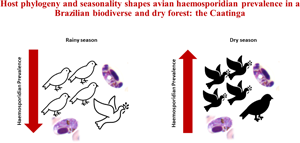
We observed that the haemosporidian prevalence was influenced by seasonality and body mass (Tables 2–4). However, the way that the seasonality influenced parasite prevalence varied according to the haemosporidian genus. When examining the entire dataset, we observed higher haemosporidian prevalence during the dry season (Fig. 2), whereas for Plasmodium we found higher prevalence in the rainy season (Fig. 3) and found no difference among seasons when looking at Haemoproteus parasites separately (Table 3). Likewise, when evaluating only non-Columbiform birds, we still observed higher Plasmodium prevalence in the rainy season. Nonetheless, seasonality did not influence overall haemosporidians prevalence and when Haemoproteus was analysed separately (Table 4). We also observed that Columbiform species were more common in the dry season, when they represented 66% of the sampled birds, compared to only 31% of the sampled birds during the rainy season. Further, haemosporidian prevalence varied between Columbiform and non-Columbiform species, being 61% for Columbiformes and 42% for other birds. Among non-Columbiformes birds, body mass was negatively associated with infection when evaluating Plasmodium prevalence among different species (Table 4B). We did not observe correlation between most bird functional traits and haemosporidian prevalence in our dataset, but overall prevalence varied according to phylogenetic relatedness among avian species (K = 0.67, Fig. 4).
Mean (±credible intervals) haemosporidian prevalence according to season birds were collected.

Mean (±credible intervals) Plasmodium prevalence according to season birds was collected.

Mean prevalence according to the phylogenetic relationships across all bird species with more than 10 individuals sampled (n = 32).

Summary information of the sampling seasons, including infection data

Estimate, standard error and credible intervals for A- haemosporidians, B- Plasmodium and C – Haemoproteus prevalence and host functional traits and seasonality

Estimate, standard error and credible intervals for A- haemosporidians, B- Plasmodium and C – Haemoproteus prevalence and host functional traits and seasonality excluding Columbiformes hosts.

Discussion
Investigating patterns and functional traits associated with infection is primordial to understand parasite infection dynamics and to determine main target species for conservation programs. Here, we reported that haemosporidian prevalence follows a seasonal pattern and varies distinctively among parasite taxa. Interestingly, we observed that body mass was negatively associated with Plasmodium prevalence among non-Columbiform birds, which contradicts a global analysis showing that infection probability for Plasmodium is higher in hosts with larger body (Gutiérrez-López et al., Reference Gutiérrez-López, Martínez-De La Puente, Gangoso, Soriguer and Figuerola2019; Filion et al., Reference Filion, Eriksson, Jorge, Niebuhr and Poulin2020). Moreover, we also evidenced a very high-level of phylogenetic association between haemosporidian prevalence and birds from the Brazilian Caatinga.
Phylogenetic relationships among hosts often reflect their association with parasites (Clark et al., Reference Clark, Clegg, Sam, Goulding, Koane and Wells2018; Pacheco et al., Reference Pacheco, Matta, Valkiūnas, Parker, Mello, Stanley, Lentino, Garcia-Amado, Cranfield, Kosakovsky Pond and Escalante2018; Park et al., Reference Park, Jorge and Poulin2020; de Angeli Dutra et al., Reference de Angeli Dutra, Fecchio, Braga and Poulin2022). For this reason, parasite prevalence might vary following phylogenetic relationships among hosts (i.e. closely related hosts present more similar infection rates than distantly related ones), was also observed in this study. Parasites often perform well (i.e. are more successful in completing their life cycle to then be detected in the blood stream) among closely related hosts (Pinheiro et al., Reference Pinheiro, Félix, Chaves, Lacorte, Santos, Braga and Mello2016), hence, similarity in prevalence among related species should reflect a tendency of those species to support the development of similar parasites lineages. Consequently, our results reinforce the fact that closely related hosts harbour similar prevalence patterns within a community. Most importantly, our results also evidence that the high abundance of Columbiformes species observed in the Caatinga could explain the uncommonly high prevalence of Haemoproteus parasites observed in this study in comparison to previous studies showing that Plasmodium is the most prevalent haemosporidian genus in Brazil (Lacorte et al., Reference Lacorte, Flix, Pinheiro, Chaves, Almeida-Neto, Neves, Leite, Santos and Braga2013; Ferreira et al., Reference Ferreira, Rodrigues, Ellis, Leite, Borges and Braga2017; Rodrigues et al., Reference Rodrigues, Felix, Pichorim, Moreira and Braga2021) and in the Neotropics (Fecchio et al., Reference Fecchio, Clark, Bell, Skeen, Lutz, De La Torre, Vaughan, Tkach, Schunck, Ferreira, Braga, Lugarini, Wamiti, Dispoto, Galen, Kirchgatter, Sagario, Cueto, González-Acuña, Inumaru, Sato, Schumm, Quillfeldt, Pellegrino, Dharmarajan, Gupta, Robin, Ciloglu, Yildirim, Huang, Chapa-Vargas, Álvarez-Mendizábal, Santiago-Alarcon, Drovetski, Hellgren, Voelker, Ricklefs, Hackett, Collins, Weckstein, Wells and Kamath2021).
Climatic conditions often affect the transmission of vector-borne pathogens due to direct effects on their vectors' abundance and diversity (Consoli and Oliveira, Reference Consoli and Oliveira1994). For this reason, regions presenting high seasonality might be subject to seasonal changes in parasite prevalence and incidence (Lalubin et al., Reference Lalubin, Delédevant, Glaizot and Christe2013; Ferreira et al., Reference Ferreira, Rodrigues, Ellis, Leite, Borges and Braga2017). It occurs due to seasonal changes in vector composition and abundance related to precipitation and temperature that are positively associated with vector abundance (Lalubin et al., Reference Lalubin, Delédevant, Glaizot and Christe2013; Ferreira et al., Reference Ferreira, Rodrigues, Sato, Borges and Braga2016). Indeed, the rainy season harbours higher abundance of haemosporidian vectors in the Caatinga (Vasconcellos et al., Reference Vasconcellos, Andreazze, Almeida, Araujo, Oliveira and Oliveira2010) and greater prevalence of Plasmodium. Nonetheless, when analysing haemosporidians in general we observed higher prevalence during the dry season in Caatinga, which could be due to the higher proportion of Columbiform birds in the dry season and H. (Haemoproteus) infections in those hosts.
We found a high haemosporidian prevalence in Caatinga (51%) compared to other Brazilian domains, such as 27–42% in the Brazilian savannah (Lacorte et al., Reference Lacorte, Flix, Pinheiro, Chaves, Almeida-Neto, Neves, Leite, Santos and Braga2013; Ferreira et al., Reference Ferreira, Rodrigues, Ellis, Leite, Borges and Braga2017), 25–33% in the Atlantic rainforest (Lacorte et al., Reference Lacorte, Flix, Pinheiro, Chaves, Almeida-Neto, Neves, Leite, Santos and Braga2013; Rodrigues et al., Reference Rodrigues, Felix, Pichorim, Moreira and Braga2021), and 20% in the Amazon rainforest (Fecchio et al., Reference Fecchio, Ellis, Bell, Andretti, D'horta, Silva, Tkach and Weckstein2017). H. (Haemoproteus) represented most of the infections (50.9%), followed by Plasmodium (38.4%) and H. (Parahaemoproteus) (10.8%). In most studies conducted in Brazil, however, Plasmodium parasites were the most common. This different scenario in parasite prevalence may be explained by the abundance of Columbina picui, which harbours a high prevalence of H. (Haemoproteus) parasites. High levels of infection among Columbiformes birds by H. (Haemoproteus) might be associated with its vector biology since those flies (Hippoboscidae) spend nearly their entire adult life on their hosts (Valkiūnas, Reference Valkiūnas2005). Changes in bird composition in Caatinga have been associated with low precipitation levels, which can trigger migratory movements among several species, increasing the relative proportion of resident species (Pereira, Reference Pereira2013).
Moreover, a high parasite richness in the Caatinga was observed in this study (Plasmodium = 17; H. (Haemoproteus) = 5 and H. (Parahaemoproteus) = 10) and 7 new parasite lineages were described. Both Plasmodium and H. (Parahaemoproteus) lineages infected a high number of bird species (22 and 10 species, respectively) while H. (Haemoproteus) only infected 4 bird species. This high parasite diversity and endemism (21% of all parasite lineages) in the Caatinga reveals the importance of studies in areas with a high degree of host endemism. Moreover, we detected H. (Haemoproteus) infecting Passeriform birds (SocH2 from M. tyrannulus and SocH3 from P. polychopterus). This parasite group is known to only infect a few seabird species and birds from the order Columbiformes (Levin et al., Reference Levin, Valkiūnas, Iezhova, O'Brien and Parker2012). Parasite lineages from this subgenus have also been found infecting passerine birds in 2 other studies conducted in Brazil (Lacorte et al., Reference Lacorte, Flix, Pinheiro, Chaves, Almeida-Neto, Neves, Leite, Santos and Braga2013; Ferreira et al., Reference Ferreira, Rodrigues, Ellis, Leite, Borges and Braga2017). These findings highlight that non-Columbiformes are exposed to parasites belonging to the subgenus H. (Haemoproteus) this SDTF. However, this likely represents abortive infections, i.e. infections in which the parasite cannot complete its lifecycle (Valkiūnas et al., Reference Valkiūnas, Iezhova, Loiseau and Sehgal2009). Overall, we found high diversity of haemosporidian parasites in the Caatinga, which infections are mostly represented by H. (Haemoproeus) parasites, unlike most other regions from Brazil and South America.
To conclude, haemosporidian prevalence in the Caatinga seems to be higher than in other Brazilian biomes. Prevalence varied between dry and rainy seasons depicting higher prevalence during the dry season. Plasmodium relative frequency was higher in the rainy season while H. (Haemoproteus) was more frequent during the dry season. Our models showed that seasonality was the main factor associated with haemosporidian infections, however, it affected distinct parasite genera differently. This is one of the first studies conducted in a SDTF in South America, the Caatinga, which harbours a high diversity and a considerable prevalence of haemosporidians parasites. However, it is important to note that this study comprises only 1 locality in the Caatinga and that several haemosporidian infections lacked parasite identification. For this reason, further studies with diverse host species comprising multiple locations may reveal the uncovered diversity and possible endemicity of haemosporidian lineages in Caatinga.
Supplementary material
The supplementary material for this article can be found at https://doi.org/10.1017/S0031182023000549
Data availability
Data used to perform this research is available as supplementary information or can be shared by Prof. Érika Martins Braga upon reasonable request.
Acknowledgement
We thank all LabOrnito – UFRN ornithologists and students for their valuable help in the field and laboratory work, especially Lidiane M. Andrade and Priscilla S. A. Araújo.
Authors’ contribution
AUK, FCF, PAM, MP and EMB conceived and designed the experiments; AUK, FCF and PAM performed the experiments; DdAD, MVB and PAM analysed the data; MP and EMB contributed reagents/materials/analysis tools; DdAD, PAM and EMB wrote the paper. All authors read and approved the final article.
Financial support
This work was funded by the Fundação de Amparo à Pesquisa do Estado do Minas Gerais – FAPEMIG, Conselho Nacional de Desenvolvimento Científico e Tecnológico – CNPq and Coordenação de Aperfeiçoamento de Pessoal de Nível Superior. During the project, Khan AU was supported by a doctoral fellowship from FAPEMIG (Process number 2015707063). FCF was supported by the National Postdoctoral Program/CAPES (PNPD/CAPES). DdAD was supported by a University of Otago doctoral scholarship.
Conflict of interest
NA.
Ethical standards
The use of mist-nets and banding at the fieldwork was approved by the Brazilian biodiversity monitoring agency (Institute Chico Mendes for Biodiversity Conservation -ICMBio, (Brazilian National Centre for Bird Conservation – CEMAVE, permission 3239 and, and Sistema de Autorização e Informação em Biodiversidade -SISBIO, 38647-2 and 33206-1). This study was approved by the Ethics Committee in Animal Experimentation (CETEA), Universidade Federal de Minas Gerais, Brazil (Protocol #254/2011).


 Open access

