

1. Introduction
Attitudes toward homosexuality, abortion, euthanasia, and family and gender roles together are often regarded as forming the so-called “moral traditionalism versus progressiveness” value dimension that pits traditionalist and progressive individuals against each other (De Koster and Van der Waal, Reference De Koster and Van der Waal2007; Raymond, Reference Raymond2011; Langsæther, Reference Langsæther2019). Besides being divisive for public opinion at large, individual views on these matters are known to inform voting choice, with culturally progressive individuals supporting progressive parties and their traditionalist counterparts favoring those with broadly conservative agendas (De Koster and Van der Waal, Reference De Koster and Van der Waal2007; Langsæther, Reference Langsæther2019).
Interestingly, the same attitudes related to the moral traditionalism–progressiveness dimension are central to two different streams of research on political and societal transformations in the West, namely, studies on the “cultural turn” in Western politics (e.g., Inglehart, Reference Inglehart1977; Inglehart and Welzel, Reference Inglehart and Welzel2005; Kriesi et al., Reference Kriesi, Grande, Lachat, Dolezal, Bornschier and Frey2008; Kriesi, Reference Kriesi2010) and studies on the religious cleavage (Knutsen, Reference Knutsen2004; Raymond, Reference Raymond2011; Langsæther, Reference Langsæther2019) inspired by secularization theory (e.g., Bruce, Reference Bruce2002). These literatures hold contrasting expectations on how the role of moral traditionalism changes in Western politics in general and in voting behavior in particular.
On the one hand, studies on the “cultural turn” expect all cultural issues, including those related to moral traditionalism, to increase in political and electoral relevance over time in Western politics as class-related redistributive issues appear to be losing their previous influence (Inglehart, Reference Inglehart1977; Dalton, Reference Dalton and LeDuc1996; Inglehart and Welzel, Reference Inglehart and Welzel2005; Kriesi et al., Reference Kriesi, Grande, Lachat, Bornschier and Frey2006; Kriesi, Reference Kriesi2010). Empirical studies testing this rather universalist proposition do not focus on issues related to moral traditionalism in particular and, therefore, do not test whether these particular attitudes have indeed become more important as motives behind voting choice.
On the other, studies on the religious cleavage expect the electoral relevance of these same attitudes to decrease over time (Knutsen, Reference Knutsen2004; Elff, Reference Elff2007; Minkenberg, Reference Minkenberg2010; Raymond, Reference Raymond2011; Goldberg, Reference Goldberg2020). Moral traditionalism–progressiveness is, in fact, central to the religious cleavage, as it forms a divide between the religious and the secular that gives motivation to vote for religious versus secular political parties (Lipset and Rokkan, Reference Lipset, Rokkan and Lipset1967; Bartolini and Mair, Reference Bartolini and Mair1990). Drawing from secularization theory (e.g., Bruce, Reference Bruce2002; Casanova, Reference Casanova2011), empirical studies on the expected decline of the religious cleavage suggest specific conditions under which it is likely to happen, namely religious decline in the West, but do not yet make the step to test this proposition empirically.
Since the two aforementioned streams of research feature contrasting expectations about the evolution of the electoral relevance of moral traditionalism and because there is yet no sufficient empirical support for either of them, we test their propositions against each other. Namely, we study whether and how the electoral relevance of moral traditionalism in particular has changed over time and with religious decline in Western Europe. To answer this question, we apply multilevel logistic regression analysis to the data of the European Values Study (EVS) for 20 West European countries nested in five waves (1981, 1990, 1999, 2008, 2017) and test whether the effect of moral traditionalism on voting for parties with morally traditionalist agendas varies over time and between religious and secular contexts.
In what follows, we first discuss the central propositions of the “cultural turn” literature regarding the electoral relevance of cultural issues in general and moral traditionalism in particular. Second, we focus specifically on the role of moral traditionalism–progressiveness value dimension in the religious cleavage and elaborate on why secularization theory expects religious decline to actually decrease the electoral relevance of moral traditionalism. After describing the data and methods, we demonstrate that the effect of moral traditionalism on voting for religious and conservative parties weakens between 1981 and 2017, especially in the most secularized countries of Western Europe. In the final section, we discuss the implications of decreasing electoral relevance of moral traditionalism for research on voting behavior.
2. Theory
2.1. Toward growing importance of culture in Western politics
Socio-political transformations of the 1960s in the West, among other consequences, also brought about the so-called “cultural turn” in Western politics. Class-based redistributive conflicts that previously used to dominate political agendas of Western democracies became increasingly overshadowed by conflicts over cultural issues such as minority rights, environment, gender equality, and cultural diversity (Inglehart, Reference Inglehart1977; Inglehart and Welzel, Reference Inglehart and Welzel2005; Kriesi et al., Reference Kriesi, Grande, Lachat, Bornschier and Frey2006; Bornschier, Reference Bornschier2010; Kriesi, Reference Kriesi2010; Ford and Jennings, Reference Ford and Jennings2020). Ample research on the cultural turn then demonstrated that social class and associated socio-economic preferences were losing their previously undoubted explanatory power over voting choice in Western Europe, while non-economic motives for voting choice, on the contrary, became increasingly relevant (Achterberg, Reference Achterberg2006; Bornschier, Reference Bornschier2010; Kriesi, Reference Kriesi2010; Ford and Jennings, Reference Ford and Jennings2020; Pless et al., Reference Pless, Tromp and Houtman2020). Although different studies suggest different explanations as to why the cultural turn in Western politics occurred (i.e., due to economic development and increasing educational attainment (Inglehart, Reference Inglehart1977), or due to globalization and opening of national borders (Kriesi et al., Reference Kriesi, Grande, Lachat, Bornschier and Frey2006; Kriesi, Reference Kriesi2010)), the “triumph of culture” in West European politics has become largely accepted in the social sciences and even led many social scientists to expect further increases in the electoral relevance of cultural issues.
The new cultural dimension of West European politics is generally described as an opposition between cultural progressives, who embrace progressive societal transformations, and cultural conservatives, and who understand these transformations as a threat to traditional identities and national security (Hooghe et al., Reference Hooghe, Marks and Wilson2002; Flanagan and Lee, Reference Flanagan and Lee2003; Bornschier, Reference Bornschier2010; Ford and Jennings, Reference Ford and Jennings2020). To conceptualize this cultural dividing line, most studies lump together attitudes toward such different matters as homosexuality, gender roles, and abortion, alongside attitudes vis-à-vis authority, immigration and cultural diversity, environment and climate change, globalization, and (European) integration (De Witte and Billiet, Reference De Witte, Billiet, De Witte and Scheepers1999; Hooghe et al., Reference Hooghe, Marks and Wilson2002; Flanagan and Lee, Reference Flanagan and Lee2003; Inglehart and Welzel, Reference Inglehart and Welzel2005; Stubager, Reference Stubager2008; Bornschier, Reference Bornschier2010). Flanagan and Lee (Reference Flanagan and Lee2003), for instance, use individual attitudes toward marital faithfulness alongside attitudes toward maintaining social order and respecting authorities to describe the authoritarian–libertarian cultural conflict. Inglehart's description of the “survival versus self-expression” cultural dichotomy similarly refers to attitudes toward gender equality (e.g., men having priority over women on the job market), national pride, and tolerance toward foreigners (Inglehart and Welzel, Reference Inglehart and Welzel2005). The famous GAL/TAN scale (Hooghe et al., Reference Hooghe, Marks and Wilson2002), in its turn, combines traditional morality (e.g., attitudes toward euthanasia and abortion) and attitudes toward authorities.
Besides being a part of a broader cultural dimension, the first group of aforementioned cultural attitudes (i.e., toward homosexuality, gender roles, and abortion) is often singled out as the moral traditionalism–progressiveness value dimension as it refers to matters of life/death, sexuality, procreation, and family and gender roles (Raymond, Reference Raymond2011; Langsæther, Reference Langsæther2019; Pless et al., Reference Pless, Tromp and Houtman2023). Because moral traditionalism in particular is not the primary focus in the cultural turn research, empirical studies in this group rather analyze the electoral relevance of all cultural issues amassed together and expect moral traditionalism to increase in electoral relevance as a part of a broader range of cultural issues (Inglehart, Reference Inglehart1977; Dalton, Reference Dalton and LeDuc1996; Kriesi et al., Reference Kriesi, Grande, Lachat, Bornschier and Frey2006; Kriesi, Reference Kriesi2010). If this rather universalist proposition of the “cultural turn” studies is correct, then:
(H1) The electoral relevance of moral traditionalism increases over time in Western Europe.
Looking inside the cultural dimension, Kriesi et al. (Reference Kriesi, Grande, Lachat, Dolezal, Bornschier and Frey2008), however, suggest that moral traditionalism in particular might be an outlier among other cultural issues and might actually lose its political relevance as cultural political agendas move from being centered around religious concerns to revolving around secular issues related to authoritarianism. This hypothesis of a different fate of moral traditionalism has not yet been tested empirically as most “cultural turn” studies still tend to use moral traditionalism and authoritarianism interchangeably to tap into the cultural dimension (see, for instance, how Häusermann and Kriesi (Reference Häusermann, Kriesi, Beramendi, Häusermann, Kitschelt and Kriesi2015) measure “cultural liberalism” via attitudes toward gender roles and homosexuality together with attitudes toward obedience and criminal punishment). Luckily, another strain of social research, namely religious cleavage research, focuses on moral traditionalism–progressiveness in particular and explicitly theorizes about the conditions under which moral traditionalism is likely to lose its electoral relevance (De Koster and Van der Waal, Reference De Koster and Van der Waal2007; Raymond, Reference Raymond2011; Langsæther, Reference Langsæther2019).
2.2. Moral traditionalism–progressiveness and the religious cleavage
The moral traditionalism–progressiveness value dimension in Western Europe typically taps into the opposition between religious, namely traditionally Christian, and secular individuals (De Koster and Van der Waal, Reference De Koster and Van der Waal2007; Raymond, Reference Raymond2011; Langsæther, Reference Langsæther2019; Pless et al., Reference Pless, Tromp and Houtman2023). Religious people are more likely to oppose abortion, as well as condone same-sex marriage and homosexuality because such practices are condemned by traditional Christianity. Secular individuals, on the contrary, hold more progressive views on these matters since their worldviews are not directly influenced by religion and its stances on such matters as abortion, euthanasia, and homosexuality (see, for instance, Finke and Adamczyk, Reference Finke and Adamczyk2008; Nicolet and Tresch, Reference Nicolet and Tresch2009; Halman and Van Ingen, Reference Halman and Van Ingen2015; Storm, Reference Storm2016).
In the electoral realm, it is first of all religious (i.e., Christian and denominational) and broadly conservative parties that cater to religious individuals with morally traditionalist views (Knutsen, Reference Knutsen2004; De Koster and Van der Waal, Reference De Koster and Van der Waal2007; Raymond, Reference Raymond2011; Langsæther, Reference Langsæther2019). Secular progressive voters, on the other hand, typically favor non-religious and non-conservative parties with morally progressive agendas (Kotler-Berkowitz, Reference Kotler-Berkowitz2001; Knutsen, Reference Knutsen2004; De Koster and Van der Waal, Reference De Koster and Van der Waal2007; Dolezal, Reference Dolezal2010; Engeli et al., Reference Engeli, Green-Pedersen and Larsen2012; Euchner and Preidel, Reference Euchner and Preidel2018). These electoral differences comprise the religious cleavage, with attitudes toward moral issues motivating religious voters to favor religious and conservative parties, and secular voters supporting secular, progressive ones (Bartolini and Mair, Reference Bartolini and Mair1990; Raymond, Reference Raymond2011; Engeli et al., Reference Engeli, Green-Pedersen and Larsen2012; Langsæther, Reference Langsæther2019). Unlike the studies on the cultural turn in politics, research on the religious cleavage focuses specifically on the moral traditionalism–progressiveness value dimension but rather expects it to lose its electoral relevance—due to religious decline.
2.3. Declining electoral relevance of traditional morality?
In the course of the twentieth century, Western Europe witnessed a tremendous decline in traditional Christian religiosity that affected both voters and political parties. While secularization in general is a complex process occurring on several interrelated levels (see Pickel, Reference Pickel2017; Stolz and Tanner, Reference Stolz and Tanner2019 for an overview), two of them are most often singled out by the religious cleavage studies as causing a theorized decline in the electoral relevance of moral traditionalism (Brooks et al., Reference Brooks, Nieuwbeerta and Manza2006; Minkenberg, Reference Minkenberg2010; Raymond, Reference Raymond2011). On the individual level, both believing and belonging, the key components of Christian religiosity, decreased significantly across Europe, with church attendance rates declining even faster than traditional Christian beliefs (Davie, Reference Davie1990; Norris and Inglehart, Reference Norris and Inglehart2004; Tromp et al., Reference Tromp, Pless and Houtman2020). On the social level, declining individual religiosity is typically accompanied by a decline in social significance of traditional Christian religion, i.e., religion losing its control over other societal spheres, including those of morality and politics (Bruce, Reference Bruce2002; Norris and Inglehart, Reference Norris and Inglehart2004).
As a result, West European countries experienced an observed shift toward moral progressiveness among both religious and non-religious individuals, with highly secularized countries also being the most morally progressive (Halman and Van Ingen, Reference Halman and Van Ingen2015). To compensate for the waning religious and traditionalist electorate, religious and conservative political parties in Western Europe are likely to take more progressive moral stances and appeal to a broader, less traditionalist audience, though such a change is likely to alienate their core morally traditionalist voters (Kalyvas, Reference Kalyvas1996; Euchner and Preidel, Reference Euchner and Preidel2018). Secularization of party programs is hence most likely in those countries where traditional Christian religion lost most of its social and political relevance.
Informed by secularization theory, then, studies on the religious cleavage theorize that religious decline has consequences not only for voters and political parties, as it also changes the motivation behind religious voting by weakening the role of religiously inspired voting motivesFootnote 1 (see, for instance, Knutsen, Reference Knutsen2004; Minkenberg, Reference Minkenberg2010; Best, Reference Best2011; Raymond, Reference Raymond2011; Botterman and Hooghe, Reference Botterman and Hooghe2012; Goldberg, Reference Goldberg2014, Reference Goldberg2020). Two groups of studies address this vital proposition.
Studies in the first group analyze whether the electoral relevance of religion and associated morality has already declined or whether religion is still an important predictor of voting choice in Western Europe (Botterman and Hooghe, Reference Botterman and Hooghe2012; Goldberg, Reference Goldberg2014). In framing the research problem in this way, these studies focus on one time point only and do not incorporate religious decline into their models, even though they do refer explicitly to the latter process to account for the expected increased irrelevance of religious motives. While religiously inspired motives are found to be still powerful in predicting voting choice in Belgium (Botterman and Hooghe, Reference Botterman and Hooghe2012) and Switzerland (Goldberg, Reference Goldberg2014), the design of the aforementioned studies does not allow to tell, first, whether the predictive power of these motives indeed decreased over the years and, second, if so, whether religious decline actually accounts for it.
The second group of studies does incorporate temporal change by studying whether the link between religion and politics has weakened across Western Europe in recent decades (Knutsen, Reference Knutsen2004; Elff, Reference Elff2007; Van der Brug et al., Reference Van der Brug, Hobolt and De Vreese2009; Elff and Rossteutscher, Reference Elff and Rossteutscher2011; Raymond, Reference Raymond2011; Goldberg, Reference Goldberg2020). These studies do also explicitly refer to religious decline as the main driving force behind changes in the electoral relevance of religious motives but, ironically, do not incorporate religious decline into their models either. Instead, they interpret the observed changes over time as directly caused by religious decline.
The overview provided above illustrates that existing studies do not yet offer strong empirical evidence for the main implications of secularization theory for the religious cleavage. However, if this central proposition of the religious cleavage research is correct, then:
(H2a) The electoral relevance of moral traditionalism decreases over time in Western Europe (H2b) due to religious decline.
3. Data, measurement, and methods
3.1. Data
To study what happens to the electoral relevance of moral traditionalism–progressiveness in Western Europe over time and with religious decline, we focus on individual moral traditionalism–progressiveness as a motive behind voting for political parties with morally traditionalist agendas. To do so, we require individual-level cross-sectional data with a time dimension, which allows us to not only detect a potential change over time, but also to test whether this change is explained through cross-sectional differences in the levels of contextual secularity (i.e., contexts affected by religious decline to a different degree). This way, we can test the hypothesis derived from the “cultural turn” literature for the electoral relevance of moral traditionalism in particular and not as a part of a broader cultural dimension. Contributing to the religious cleavage literature, we do not assume that the effect of religious decline equals that of time. Instead, we aim to identify whether the hypothesized change over time actually occurs due to varying levels of contextual secularity.
The data come from the European Values Study (EVS, 2021) featuring five waves (1981, 1990, 1999, 2008, 2017) and 20 West European countries: Austria, Belgium, Denmark, Finland, France, (West) Germany, Greece, Iceland, Ireland, Italy, Luxembourg, Malta, Netherlands, Norway, Portugal, Spain, Sweden, Switzerland, Great Britain, and Northern Ireland.Footnote 2 Respondents ineligible to vote due to age (i.e., below 18 years of age—0.1% of the initial sample) and followers of non-Christian religious traditions (i.e., Islam—0.91% and otherFootnote 3—2.19%) were excluded from the analysis. The sample in use amounts to 71,451 respondents from 79 contexts (i.e., country-year combinations) with an average of 916 respondents per context (see Appendix A for details).
3.2. Measurement
The dependent variable is a dummy for voting for religious or broadly conservative parties with morally traditionalist agendas (1) versus other parties (0). To measure religious/conservative voting, we used a standard EVS question on party preferences (i.e., “If there was a general election tomorrow, which party would you vote for?”) and divided the political parties preferred by the respondents into party families as suggested by the Manifesto Project Database (Volkens et al., Reference Volkens, Burst, Krause, Lehmann, Matthieß, Merz, Regel, Weßels and Zehnter2020). As discussed in the theory section, religious (i.e., Christian, Christian-Democratic, denominational) and mainline conservative parties are more likely, than parties from other families, to include morally traditionalist issues in their programs, and religious parties are, on average, more morally traditionalist than conservative ones (Van der Brug et al., Reference Van der Brug, Hobolt and De Vreese2009; Raymond, Reference Raymond2011; Euchner and Preidel, Reference Euchner and Preidel2018; Langsæther, Reference Langsæther2019). Appendix B demonstrates that this is indeed the case in our country-level sample and provides details of how religious and conservative party families feature favorable mentions of traditional morality in their programs compared to other party families in the period of 1981–2017. The list of parties in religious and conservative families is available in Appendix C. In line with the theory, we use “voting for religious/conservative parties versus the rest” as the dependent variable in the main analysis and provide the results of (less statistically conclusiveFootnote 4) robustness checks for religious and conservative voting separately in Appendix D.
The explanatory variables are individual moral traditionalism, time, and contextual secularity. Individual moral traditionalism is measured through a standard scale of religiously inspired moral attitudes (see, for instance, Langsæther, Reference Langsæther2019; Pless et al., Reference Pless, Tromp and Houtman2023). We use five questions on whether a respondent finds that abortion, homosexuality, euthanasia, divorce, and suicide “can always be justified, never be justified, or something in between” measured on a 10-point scale. To construct the scale, we standardize the five attitudinal variables and combine them with equal weights, assigning scores to those respondents who validly responded to at least four of the five questions. The resulting scale of moral traditionalism ranges from 0 (progressive) to 10 (traditionalist) and is highly reliable with an overall Cronbach's α of 0.82.Footnote 5
To measure time, we use the five waves of the EVS as a continuous predictor recoded to range from 1 to 5.
Contextual secularity is an indicator of how countries in the sample were affected by a decline in traditional Christian religion measured through its two key individual-level components that have been theorized to affect the electoral relevance of religiously inspired voting motives, i.e., believing and belonging.Footnote 6 For believing, we construct an additive scaleFootnote 7 for Christian beliefs that measures whether a respondent believes in God, heaven, hell, sin, and life after death (all the questions are binary). We then reverse the scale so that respondents with the highest scores are the most secular, and standardize it. To measure belonging, we standardize the religious participation variable (i.e., “apart from weddings, funerals, and christenings, about how often do you attend religious services these days?”) that originally ranges from “more than once a week” (1) to “never” (7). The correlation coefficient between believing and belonging is 0.62. Then we combine believing and belonging with equal weights into a general scale of traditional Christian religiosity–secularity that ranges from 0 (religious) to 10 (secular). Finally, we average individual-level scores of religiosity–secularity within each context (i.e., country-year) to compute contextual secularity scores. The highest values refer to the most secularized contexts, and the lowest values—to the most religious contexts.
Control variables are age, gender, and education (age when completed).Footnote 8 Descriptive statistics for all the variables in use can be found in Table 1.
Descriptive statistics: main variables and scale components

3.3. Method
In the analysis, we test whether the effect of moral traditionalism on religious/conservative voting increases or decreases over time (H1 versus H2a) and if the latter is correct, whether religious decline plays a role in it (H2b). Before moving to regression modeling, we first present several descriptive figures that demonstrate how all the components of the hypotheses change in Western Europe. Specifically, we look at religious decline and a shift toward moral progressiveness, the role of moral traditionalism in the programs of religious and conservative parties, and the electoral support for these parties in Western Europe between 1981 and 2017. Having demonstrated how all the components change over time, we can move to study whether and how the link between moral traditionalism and religious/conservative voting changes.
Because respondents in our sample were surveyed in different countries and in different years, we use multilevel regression analysis to account for the hierarchical nature of the data. We fit two-level logistic regression models with individual respondents on the first level and 79 contexts (i.e., country-years) on the second level, while controlling for country fixed effects.Footnote 9 Since regression coefficients in multilevel logistic regressions are difficult to interpret, especially for cross-level interaction terms, we compute marginal effects of moral traditionalism on voting preference based on each model. We then produce graphs of average marginal effects and predicted probabilities to demonstrate and interpret the results.
4. Results
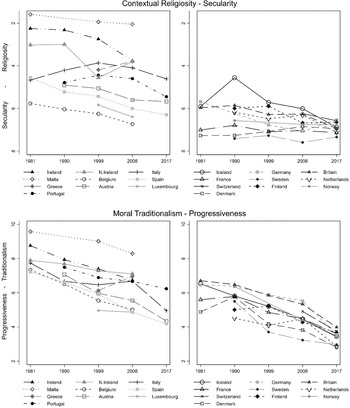
We start the analysis by visualizing how the different components of the “morally traditionalist voting” equation changed across Western Europe between 1981 and 2017. Figure 1 demonstrates how levels of contextual secularity and moral traditionalism changed between 1981 and 2017 in each country in the sample. Countries that were already highly secularized by 1981 (i.e., Sweden, Denmark, France) hardly recorded any further religious decline in the period under study. On the opposite, comparatively more religious societies moved toward secularity, with the exception of Greece and Italy. In the graph for average moral traditionalism, religious countries can be found at the traditionalist bottom, whereas highly secularized countries are at the progressive top. Greece is also the only country that moved toward more moral traditionalism, while other countries experienced a predicted shift toward moral progressiveness.
Changes in contextual secularity and moral traditionalism across Western Europe between 1981 and 2017 (EVS 1981–2017).

In Figure 2, we zoom in at how religious and conservative parties mention morally traditionalist issues in their programs in 1981–2017 (based on the Manifesto data). Although religious parties, unsurprisingly, feature more mentions of traditional morality than conservative parties, the overall trends are remarkably similar for the two party families. After an increase in attention toward moral traditionalism between 1981 and 1999, both party families then recorded a strong decrease in the share of party programs devoted to traditional morality. Figure 3 then brings the supply (i.e., parties) and demand (i.e., voters) sides of the equation together and plots support for religious and conservative parties against time in more religious (on the left) and more secular (on the right) countries of Western Europe. On average, support for these parties is higher in more religious countries than in more secular ones, and the declining trend is more pronounced in more religious countries.
Positive mentions of moral traditionalism in party programs of religious and conservative parties, 1981–2017 (Manifesto).

Declining support for religious and conservative parties in comparatively more religious (on the left) and more secular (on the right) countries of Western Europe in 1981–2017 (based on aggregated EVS data).

While all separate components of the equation decline over time, does it mean that the strength of the link between moral traditionalism and voting for religious/conservative parties also decreases? First, we estimate the average effect of moral traditionalism on voting for religious/conservative parties across all waves by means of multilevel regression analysis and then analyze how it changes over time (see Appendix D for main effects in all regression models). Figure 4 demonstrates how the predicted probability of religious/conservative voting increases from around 14.3% for the least traditionalist voters to 49.6% for the most traditionalist ones.
Predicted probability of religious/conservative voting: main effect of moral traditionalism (average across all waves, multilevel modeling results).

Second, we use the same regression model to calculate how the electoral relevance of moral traditionalism varies over time for each country in the sample. Figure 5 plots the predicted effects of moral traditionalism on voting for religious/conservative parties for comparatively more religious (on the left) and more secular countries (on the right) of Western Europe. The electoral relevance of moral traditionalism has declined strongly in comparatively religious countries of Western Europe (on the left), with the strongest decrease recorded for Spain, Italy, and Belgium. Even Ireland and Northern Ireland, which had only conservative parties, still show that moral traditionalism was relevant for this type of voting choice in 1981 but its relevance has declined since then. Interestingly, the only exceptions in the comparatively religious group that show no change in the effect of moral traditionalism over time are highly religious Malta and Greece, the only countries in this group that did not record a substantial decline in Christian religion in the period under study (see Figure 1).
Predicted electoral relevance of moral traditionalism in comparatively religious (left) and comparatively secular countries of Western Europe in 1981–2017 (multilevel modeling results).

In comparison, the trends in more secular countries (on the right) are not as pronounced, potentially because the link between moral traditionalism and voting was already weak in those countries in 1981 and could not weaken any further. The most secular countries of our sample (i.e., Nordic) can be found at the bottom of the graph. The effect of moral traditionalism is weak in those countries in all waves and does not decline over time, mirroring the patterns for traditional Christian religion that was already low there and could hardly decline further in the period under study (see Figure 1). Interestingly, moral traditionalism was relevant for conservative voting in Britain in 1981 but lost its relevance altogether by 1990. The trends for Germany and Switzerland, the most religious countries in this secular group, also demonstrate a clear downward trend in the electoral relevance of moral traditionalism similar to what we observed for more religious societies. The Netherlands is a clear outlier in both groups: the electoral relevance of moral traditionalism here is comparatively high and shows no decrease over time, which can potentially be attributed to the presence of several active religious parties (e.g., CDA, CU, SGP) on the political arena that effectively appeal to voters with various levels of traditionalism.
In the third step, we add an interaction between moral traditionalism and time to test whether, despite the highlighted country differences, there is a general increase (H1) or decrease (H2a) in the electoral relevance of moral traditionalism over time. Figure 6 demonstrates that the electoral relevance of moral traditionalism does decrease over time, therefore providing support for the hypothesis derived from the religious cleavage literature (H2a). To estimate whether this decrease in the effect of moral traditionalism on religious/conservative voting is substantial, we plot and compare the predicted probabilities of voting for these parties in 1981 and in 2017 (see the second row of Figure 6). The graph for 1981 features an obviously steeper curve of the predicted probability of religious/conservative voting based on individual levels of moral traditionalism compared to 2017. In 1981, the probability of voting for religious/conservative parties was around 14.9% for non-traditionalist voters and around 63.2% for their highly traditionalist counterparts. The differences between non-traditionalist and traditionalist voters decreased by 2017 reaching 15.2 and 40.0%, respectively. This figure also demonstrates that the weakening effect of moral traditionalism on religious/conservative voting over time is mainly due to the traditionalist voters becoming increasingly less likely to support these parties (i.e., 63.2% in 1981 versus 40.0% probability in 2017). On the contrary, the most progressive voters hardly changed their voting patterns over time and became only somewhat more likely to support parties with progressive agendas.
Declining electoral relevance of moral traditionalism over time (multilevel modeling results). First row: predicted average marginal effects of moral traditionalism on religious and conservative voting across time. Second row: predicted probabilities of religious/conservative voting in 1981 versus 2017.

While we have found that moral traditionalism becomes less relevant for religious/conservative voting over time (Figure 6) and that downward trends are especially pronounced in more religious countries that also experienced a decline in traditional Christian religion (Figure 5), changes over time alone do not suffice to assess whether moral traditionalism loses its electoral relevance due to religious decline (H2b). In order to test this hypothesis, we add an interaction between moral traditionalism and contextual secularity to the equation and plot average marginal effects of moral traditionalism on religious/conservative voting across contexts with different levels of secularity (see Figure 6). The effect of moral traditionalism on religious/conservative voting is significantly stronger in religious contexts compared to more secular ones. Adding the interaction term between moral traditionalism and contextual secularity renders the interaction with time insignificant, therefore providing support for H2b: the observed decline in the electoral relevance of moral traditionalism for religious/conservative voting can indeed be attributed to the erosion of traditional Christian religion in Western Europe.
To estimate how substantial the effect of contextual secularity on the electoral relevance of moral traditionalism is, we compute and plot the predicted probabilities of religious/conservative voting for more religious versus more secular contexts. In Figure 7, the curve of the predicted probability of religious/conservative voting is much steeper in religious contexts compared to secular ones. In religious contexts, the probability of religious/conservative voting is estimated to be 10.6% for non-traditionalist voters, while reaching 64.4% for their highly traditionalist counterparts. In secular contexts, however, the differences between the least and the most traditionalist voters are considerably smaller, i.e., 14.8 versus 43.7%, respectively, which can be attributed to the most traditionalist voters shifting away from religious and conservative parties. For highly traditionalist voters, the predicted probability of religious/conservative voting falls from 64.4% in the most religious contexts to 43.7% in the most secular ones.
Electoral relevance of moral traditionalism in religious versus secular contexts (multilevel modeling results). First row: predicted average marginal effects of moral traditionalism on religious and conservative voting across contexts with different levels of secularity. Second row: predicted probabilities of religious/conservative voting in the most religious versus the most secular contexts.

5. Conclusion and discussion
In this article, we have studied the electoral relevance of moral traditionalism across 20 West European countries in 1981–2017. During the period under study, both voters and religious and conservative political parties experienced a shift away from traditional Christian religion and associated morality toward more secularism and moral progressiveness. Since 1981, public support for these parties has decreased as well in most countries and is the lowest in the most secularized countries of Western Europe. Providing much needed empirical support for the hypotheses derived from the religious cleavage literature, we have demonstrated that the electoral relevance of moral traditionalism has been declining as well. More importantly, we have demonstrated this decrease in the electoral relevance of moral traditionalism to be a consequence of a decline in traditional Christian religion.
What we have not found, however, is any indication of an increase in the electoral relevance of moral traditionalism across Western Europe. In fact, the countries that have not recorded a steep decline in the electoral relevance of moral traditionalism are also the countries that have not experienced a significant decline in traditional Christian religion in the same period. On the one hand, Nordic countries featured both low levels of traditional Christian religion and electoral relevance of moral traditionalism as early as in 1981, and it is plausible that neither could decline any further since then. On the other, Malta and Greece represent highly religious societies that hardly secularized in the limited number of waves that they were surveyed in and, relatedly, did not record a decline in the electoral relevance of moral traditionalism. Religious decline, therefore, acts as an important condition for moral traditionalism to lose its electoral relevance: without religious decline, moral traditionalism is less likely to decrease in relevance.
Our findings, therefore, contradict the popular universalist claim of the “cultural turn” literature and suggest the need to refine the widely accepted thesis of a growing importance of all cultural issues in Western politics. We have identified religious decline as a condition under which one type of cultural issues rather loses its electoral relevance. Strikingly, issues related to moral traditionalism–progressiveness are still too often treated as a mere specific manifestation of a broadly conceived “cultural” or “non-economic” political dimension, and a less important add-on to other heated topics such as immigration and European integration, or environment (Inglehart, Reference Inglehart1997; Flanagan and Lee, Reference Flanagan and Lee2003; Achterberg, Reference Achterberg2006; Kriesi et al., Reference Kriesi, Grande, Lachat, Bornschier and Frey2006). The rare studies that do focus on moral traditionalism–progressiveness in particular show that this dimension became less rather than more divisive in Western democracies in recent decades (Pless et al., Reference Pless, Tromp and Houtman2023) and, as this study points out, became not more but less important for voting for political parties with morally conservative agendas. On the contrary, other cultural issues mentioned above are indeed likely to have grown in salience and become more polarizing for European electorates (see for instance Kriesi, Reference Kriesi2010; Silva, Reference Silva2018; Green-Pedersen and Otjes, Reference Green-Pedersen and Otjes2019; Pless et al., Reference Pless, Tromp and Houtman2023), not least due to the electoral successes of political parties of the new left and the new right that “own” these cultural issues. While parties of the new left have successfully brought environmental issues (i.e., nuclear energy, pollution, and climate change) to the agendas of Western democracies (Dolezal, Reference Dolezal2010), parties of the new right have capitalized on immigration, European integration, globalization, cultural diversity, and law and order (Kriesi et al., Reference Kriesi, Grande, Lachat, Bornschier and Frey2006).
Our findings give rise to two major questions for future research. First, if moral traditionalism loses its power as a motive for religious and conservative voting, does this mean that other motives take over as drivers of these types of voting? Both types of morally traditionalist parties may indeed diverge in terms of new issues they foreground, in the process increasing their appeals to new and different audiences. On the one hand, although conservative parties are generally known to capitalize on economic issues and to call for reductions in government spending, recent studies demonstrate that electoral success of the new right in a given country makes conservative parties more likely to pick up the typically new-rightist anti-immigrant agenda (Abou-Chadi and Krause, Reference Abou-Chadi and Krause2020). Conservative parties, therefore, appear to look for new ways to appeal to economically and culturally conservative voters, but their cultural conservatism may increasingly be defined in secular and not in religious terms.
On the other, research on a so-called “greening of Christianity” in the United States addresses the ethical aspects of climate change and the incorporation of ecological issues into Christian doctrines (Wardekker et al., Reference Wardekker, Petersen and van der Sluijs2009; Clements et al., Reference Clements, Xiao and Mccright2014). While there is as yet no compelling evidence that religious parties in Western Europe actually adopt an environmental agenda (Carter, Reference Carter2013), more research is needed to determine whether religious decline leads such parties to turn to more environmentally concerned voters. Unfortunately, the existing data do not yet allow us to study how religious and conservative voting separately changes in response to religious decline (see the measurement section and Appendix B for details). Upcoming waves of international survey projects and Manifesto data, however, will hopefully provide enough observations to study the link between different voting motives, including moral traditionalism, and voting for political parties with varying levels of focus on traditional morality from both religious and secular contexts, and over a longer period of time.
The second major question our findings give rise to is whether traditionalist voters switch to other parties with morally conservative agendas when religious and conservative parties lose their previously uncontested appeal to them. Given that the period under study (i.e., 1981–2017) covers the emergence and growing electoral success of parties of the new right in various West European countries (Kriesi et al., Reference Kriesi, Grande, Lachat, Dolezal, Bornschier and Frey2008; Bornschier, Reference Bornschier2010), it is plausible that morally traditionalist voters rather switch to them. These parties are known to attract voters disappointed by modernization processes, the so-called “losers of modernization” not comfortable with cultural change, not least in the domains of traditional gender and family roles (see Arzheimer, Reference Arzheimer and Rydgren2018 for an overview; Kriesi, Reference Kriesi2010). Based on this, moral traditionalism can be expected to become more relevant for new-rightist voting in the same period when it loses its relevance for voting for mainstream parties with culturally conservative agendas.
However, it is also entirely plausible that moral traditionalism becomes less relevant for new-rightist voting as well. Although new-rightist parties and their voters have since the early 1990s typically been regarded as morally traditionalist (Kriesi et al., Reference Kriesi, Grande, Lachat, Bornschier and Frey2006; Bornschier, Reference Bornschier2010), recent studies suggest that both the parties of the new right and their supporters may be moving toward more morally progressive stances. Among others, Geert Wilders' “Party for Freedom” in the Netherlands provides an example of a relatively morally progressive new-rightist party as it combines straightforward ethno-nationalism with permissive positions on homosexuality and gender and family roles (De Koster et al., Reference De Koster, Achterberg, Van der Waal, Van Bohemen and Kemmers2014; Vossen, Reference Vossen2017; Hurka et al., Reference Hurka, Knill and Rivière2018). Reflecting a similar trend, the share of morally progressive voters among supporters of the new right has increased in recent decades in the West with the aforementioned supporters viewing themselves as defenders of morally progressive Western values threatened by Muslim immigrants and Islam more generally (De Koster et al., Reference De Koster, Achterberg, Van der Waal, Van Bohemen and Kemmers2014; Spierings and Zaslove, Reference Spierings and Zaslove2015; Hurka et al., Reference Hurka, Knill and Rivière2018; Lancaster, Reference Lancaster2020). At the moment, existing empirical studies mainly treat morally progressive parties of the new right and their morally progressive supporters as peculiar outliers and do not emphasize that both are typically found in quite secular and morally progressive countries (i.e., the Netherlands in the example above). This, however, suggests that religious decline is likely to decrease the differences in moral traditionalism between those supporting and opposing the new right, therefore weakening the electoral relevance of moral traditionalism for new-rightist voting in the West.
Our findings hence call for more research on particular motives behind voting choice and what the observed decreasing relevance of moral traditionalism for religious and conservative voting actually entails: whether moral traditionalism becomes more important for other types of voting (i.e., new-rightist), or whether it loses its electoral relevance altogether. As new waves of international survey projects become available, we particularly welcome empirical studies that contextualize the role of moral traditionalism in the ideology of the new right and in its electoral support across Europe, both cross-sectionally and over time.
Supplementary material
The supplementary material for this article can be found at https://doi.org/10.1017/S1755048323000068.
Financial support
This work was supported by the Research Foundation—Flanders (FWO) under grant (number G.0731.16N).
Conflict of interest
The authors declare none.
Anna Pless (Kulkova) is a PhD candidate at the Centre for Sociological Research (CeSO), KU Leuven, Belgium. Her PhD project addresses the consequences of secularization for cleavage-based politics and voting behavior in Europe. Together with Paul Tromp and Dick Houtman, she recently published an article titled “Religious and Secular Value Divides in Western Europe: A Cross-National Comparison (1981–2008)” (IPSR, 2021). Personal website: www.annapless.com.
Paul Tromp is a PhD candidate at the Centre for Sociological Research, KU Leuven, Belgium. His PhD project addresses the decline and change of traditional Christian religion, and the emergence and growth of a post-Christian “New Age” spirituality and spiritual self-identifications in Western Europe (1981–2017). His most recent publication in Review of Religious Research is titled “A Smaller Pie with a Different Taste: The Evolution of the Western-European Religious Landscape (European Values Study, 1981–2017)” (with Anna Pless and Dick Houtman).
Dick Houtman is a Professor of sociology of culture and religion at KU Leuven, Belgium. His principal research interests are cultural conflict and cultural change in the West since the 1960s. His latest book is Science under Siege: Contesting the Secular Religion of Scientism (co-edited with Stef Aupers and Rudi Laermans, Palgrave Macmillan, 2021). Personal website: www.dickhoutman.nl.



 Open access

