


I. Counting Athenian pottery
How many black-figure and red-figure pots were made in the sixth and fifth centuries BCE, and how many potters and painters were making those pots? These sorts of questions might appear fairly reductive, part of an emerging ‘quantitative turn’ in the humanities,Footnote 1 a trend at one time popular in ancient history in the 1980s.Footnote 2 But finding quantities is not a means to an end. Numbers help to place us more accurately within orders of scale and to elucidate the boundaries of possibility and likelihood. That is what this paper sets out to do: to suggest via some mathematical models how much pottery was being made in late Archaic/early Classical Athens and to think through how the labour for production might have been organized.
The lion’s share of black-figure and red-figure pottery dates to 600–350 BCE,Footnote 3 fine tablewares produced in a variety of shapes for a variety of functions.Footnote 4 Variation is important, too: production of painted pottery was not at a consistent rate between 600 and 350 BCE, with a peak around the second quarter of the fifth century BCE and a much lower production rate around 600 BCE (when there was not yet demand from an international market) and around 350 BCE (when demand for the product was waning).Footnote 5 Various scholars have worried about whether or not these pots were considered ‘art’ by sixth- and fifth-century Athenians,Footnote 6 but it is now more generally accepted that pots were commodities that could be sold in bulk at a low price;Footnote 7 that said, it is hard to imagine that in such a huge and productive industry pieces revered today as objets d’art, such as fine items by Exekias or the Berlin Painter, could have stood out as truly remarkable against a sea of (so much) background noise.
The chaîne opératoire for pottery production involved different people and different places (see also Appendix 2).Footnote 8 First, fuel and clay were gathered, the latter of which could be processed by mixing with another clay or temper, sieving, pounding, washing and drying.Footnote 9 ‘Potting’ was a multistep process that involved wedging and working the clay, throwing on a wheel and, either in one whole piece or in various component pieces, constructed by one potter or by different people. The pots would require further drying before being fired in kilns and, having cooled after firing, could be painted, although huge numbers of pots were ultimately left unpainted.Footnote 10 On the basis of the size of excavated remains, ethnographic comparisons and literary testimony, it has been estimated that a ‘workshop’ in Classical Athens comprised five or six individuals,Footnote 11 and literary and historical documents show that potting a named profession, the κϵραμϵύς.Footnote 12 Pot-painting has not yet been identified as a profession, but inscriptions and dipinti would suggest that this was a different activity undertaken by (usually) different people (contrast μ’ ἐποίησϵν with μ’ ἔγραψϵν); potting and painting were not mutually exclusive activities, understood by the ‘double-signing’ on pots too.Footnote 13 Like artisans of other crafts in Classical Greece,Footnote 14 potters and painters were mobile, and we can assume of their work there was a range in quality, skill and compensation.
Previous attempts have been made at putting a figure on the rate of production for Athenian black-figure and red-figure pottery. Robert Manuel Cook was one of the first to think about quantities of Athenian pottery.Footnote 15 He based his estimate on the surviving corpus of Attic Panathenaic amphorae: if Cook could only locate 90 from the fifth century BCE, but ca. 1,300 vessels were created quadrennially for the Panathenaic games, this implies that of the 32,500 vessels once created only 0.25 per cent have survived to the present day.Footnote 16 Various scholars have considered whether or not this survival rate is fair, with alternative estimates ranging between 0.2 per cent and 10.0 per cent;Footnote 17 but Vladimir Stissi has also critiqued the core of Cook’s argument, that it extrapolates the size of the whole potting industry from the production rate of a particularly unusual object such as the Panathenaic amphora.Footnote 18 There is probably, notes Stissi, a survival bias for such amphorae that could have found their way into graves and sanctuary dedications, while there might also be a discovery bias, such contexts being more intensively explored than others (for example, domestic). In his early work, Stissi nuanced this view by setting possible survival figures against the assumed excavation rate of funerary contexts in Athens and by estimating the annual consumption rate of a small Athenian household,Footnote 19 arriving at the assumption that Athens might have required between 50,000 and 100,000 painted pots per year by the end of the fifth century, with a further annual demand for between 250,000 and 500,000 Attic pots across the Mediterranean. More recently, Stissi has revisited these figures,Footnote 20 looking at updated values for the number of pots currently published in the Beazley archive, and adjusting both for survival bias and publication bias (the former draws on the figures above, worked through 20 years previous; the latter is an extrapolation of ‘some exemplary cases [Stissi] checked’ in Beazley’s ABV). This, he argues, puts the total number of pots produced both for consumption in Attica and from elsewhere higher than his first estimate at around 1 million per year.
Further to the issue of potting, Philip Sapirstein has concentrated on painting,Footnote 21 suggesting that the ‘typical’ Attic specialist might have painted 8.3 per cent of the pots that survive to us today. His estimate is based on a weighty database of painter attributions, divided by the number of years in which painters were active.Footnote 22 Although this estimate seems convincing for the fact that there is a strong linear correlation between the number of years a painter worked and the number of attributions that can be made, Stissi has pointed out that Sapirstein risks huge distortion by excluding from his counts any artist for whom there are fewer than 30 attributions, thereby, Stissi suggests, critically under-estimating the size of the industry.Footnote 23 Sapirstein also sought to revise Cook’s potting estimate, as he notes that the newer data demonstrate that Cook’s assumption of a 25-year painting career is far too long.Footnote 24 Taking Cook’s survival ratio, he provided a new estimate for the number of pots produced by scaling up the attribution rate to suggest that a painter might actually have produced between 800 and 1,700 pots per year.Footnote 25
On even a cursory review, then, it is apparent that few of these estimates are compatible with one another. On the one hand, this is a question of maths: scholars are working with such different ballpark estimates within wide ranges that invariably the values calculated are inevitably incompatible. But there is also a question here of history, namely that each of these different ballparks suggests a different social reality for pot-painting. It is very difficult to see from this wide range of estimates whether we should be talking about a fairly large industry, staffed with full-time workers producing pots in rapid succession to meet a high demand, or a smaller set of potters, perhaps operating only part-time. Only by refining these quantitative estimates can we have a fuller view of the shape and scale of the industry at large.
Data from Cook, Stissi and Sapirstein will be discussed and modelled further below, as this paper seeks not only to address a substantive historical point but also to contribute to a wider methodological discussion. Substantively, this article argues that the numbers for the potting and painting industries, however approximative, only balance if we commit to the possibility, sometimes discussed fairly agnostically, that potting was a part-time and seasonal profession, but that (some) painters would be required to work on painting alone full-time. In the final part of this article, the pottery-production chaîne opératoire is considered, to model how the personnel of small workshops could be deployed most efficiently in order to balance out these production steps. The broader methodological point is to illustrate the utility of a quantitative approach. Namely, seemingly insignificant assumptions compound rapidly, and fairly small adjustments have a very big impact, putting us into a completely different order of scale.
II. Modelling production rates for black-figure and red-figure production
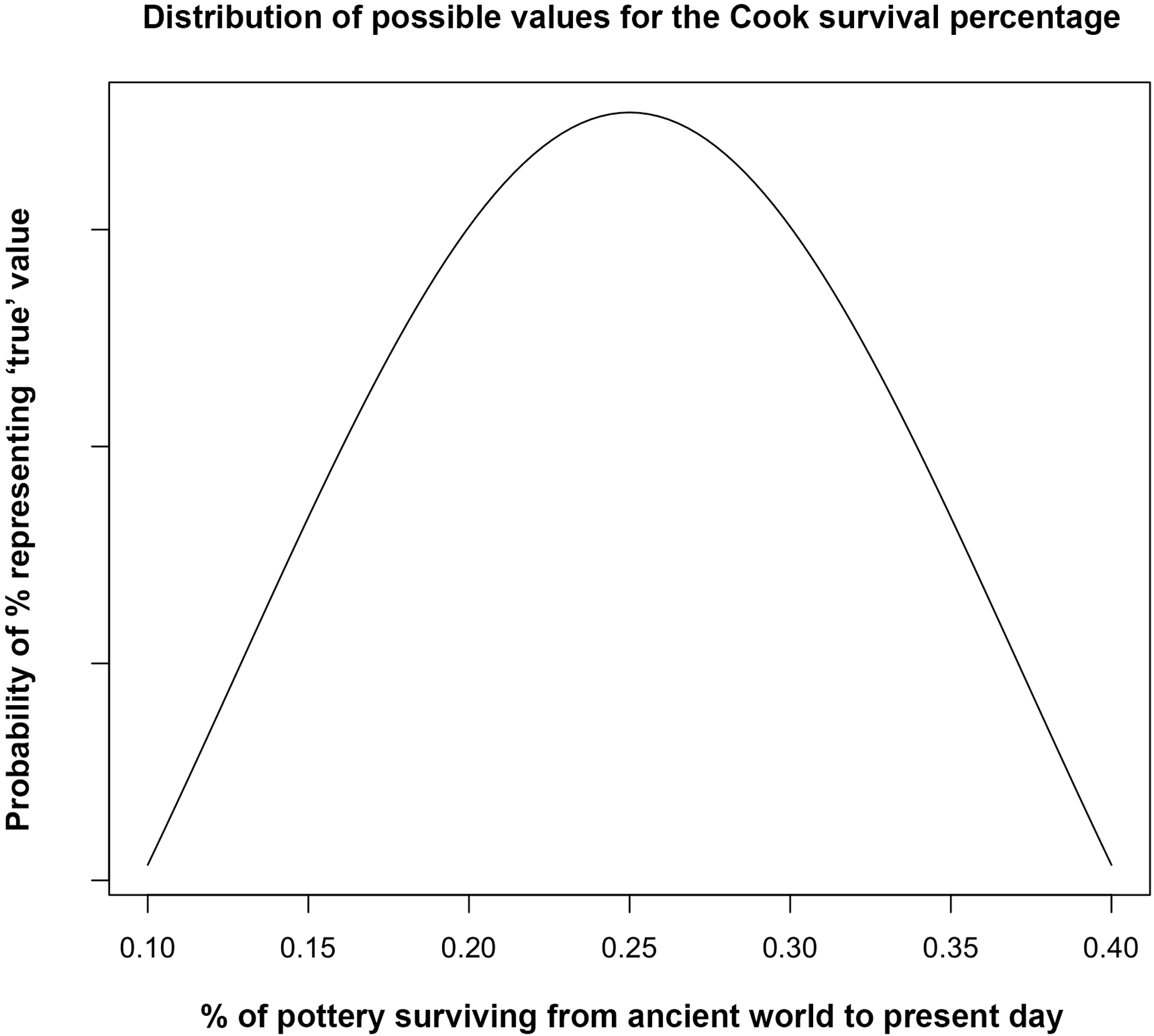
What exactly is meant by ‘modelling’? In the simplest terms, this article is concerned with considering ranges of possibilities. We cannot be confident of the precision of ‘fixed’ values for historical data points used in quantitative calculations:Footnote 26 Cook’s survival ratio of 0.25 per cent might be a good ballpark estimate, but treating this figure with too much certainty is a misuse of the historical evidence. Better to take account of any uncertainty associated with these numbers into calculations and to look at the range of scenarios that they produce. This is perhaps best understood by means of an example. Stissi uses Cook’s 0.25 per cent in going from a base number of pots to a projection, but that 0.25 per cent is by no means an historically certain value. The ‘true’ survival rate might be closer to 0.20 per cent, or to 0.30 per cent or to 0.15 per cent, and so it is better to represent a figure such as Cook’s survival rate as a range (for example, 0.10–0.40 per cent) and to test various values within this distribution of probable outcomes instead of undertaking just one ballpark calculation. This provides one not with a single output answer, but with a set of answers representing different historical probabilities.
The sort of modelling used in this article employs Monte Carlo methods.Footnote 27 This set of statistical techniques explores ranges of possibilities rather than focusing on fixed values, the importance of which has just been outlined above. Using only the lowest or highest value in the range (or only the mid-point) and then undertaking multiple calculations using new values calculated, the variance compounds and can put one very quickly into a different order of scale (see Appendix 1, for a worked example of this principle). Monte Carlo methods are particularly useful for thinking about a continuum of historical possibilities, not only because they handle a range of different input values, but because they consider which values might be more likely. Consider again the example from above on the survival rate of painted pottery: 0.10 per cent and 0.40 per cent might represent the boundaries of possibility, but 0.25 per cent was stated to be the most likely value; 0.10 per cent and 0.40 per cent, actually at the limits of the range, have a fairly low possibility of representing the ‘true’ value. This confidence, or the likelihood that a value represents the ‘true’ survival rate, could be represented as a normal distribution, around a median point of the most likely value (fig. 1).
Illustrative beta distribution of values, indicating the possible ‘true’ values of Cook’s survival rate estimate.

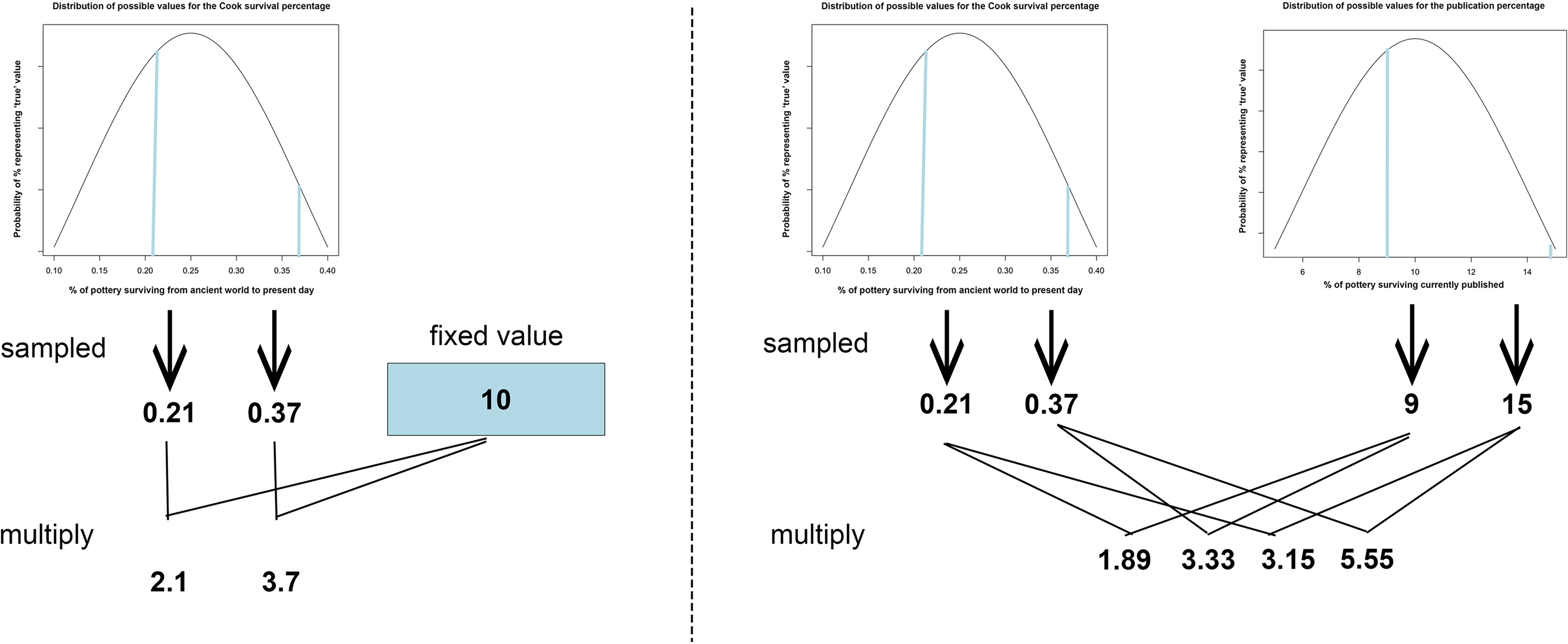
In a Monte Carlo scenario, the model randomly draws a value from this input range: it could, for example, draw 0.21 per cent, which would imply that the original number of pots was 86,000/0.0021 = 40,952,380. This is just one possible reality, though, so the model draws another value from the input range, for example 0.37 per cent, which would imply that the original number of pots was 86,000/0.0037 = 23,243,243. The model continues to draw a large number of random samples to test from the input range, most usually in the order of thousands or tens of thousands. Here, the input variables for the calculation are compared against a fixed value (86,000), but Monte Carlo methods could just as easily be used to compare two sets of ranges, sampling randomly against one another (fig. 2).
Example of drawing random sample values from a beta distribution, for use in further calculations. The left-hand image indicates the multiplication of random samples against a fixed value, while that on the right illustrates random samples taken from two different distributions multiplied against one another.

It follows that, in using multiple draws from the input range, there are as many solutions to the calculations computed as there are draws from the model: these, like the input, can be expressed as a distribution, to illustrate the range of possible solutions or the range of different historical probabilities. As with the input distributions, this is particularly useful as it allows one to see not just the range of possible answers, but also those answers which might represent more likely possibilities (that is, more plausible historical scenarios). In this article, the quartile and median values are taken as the most useful indicators of different types of historical scenarios.
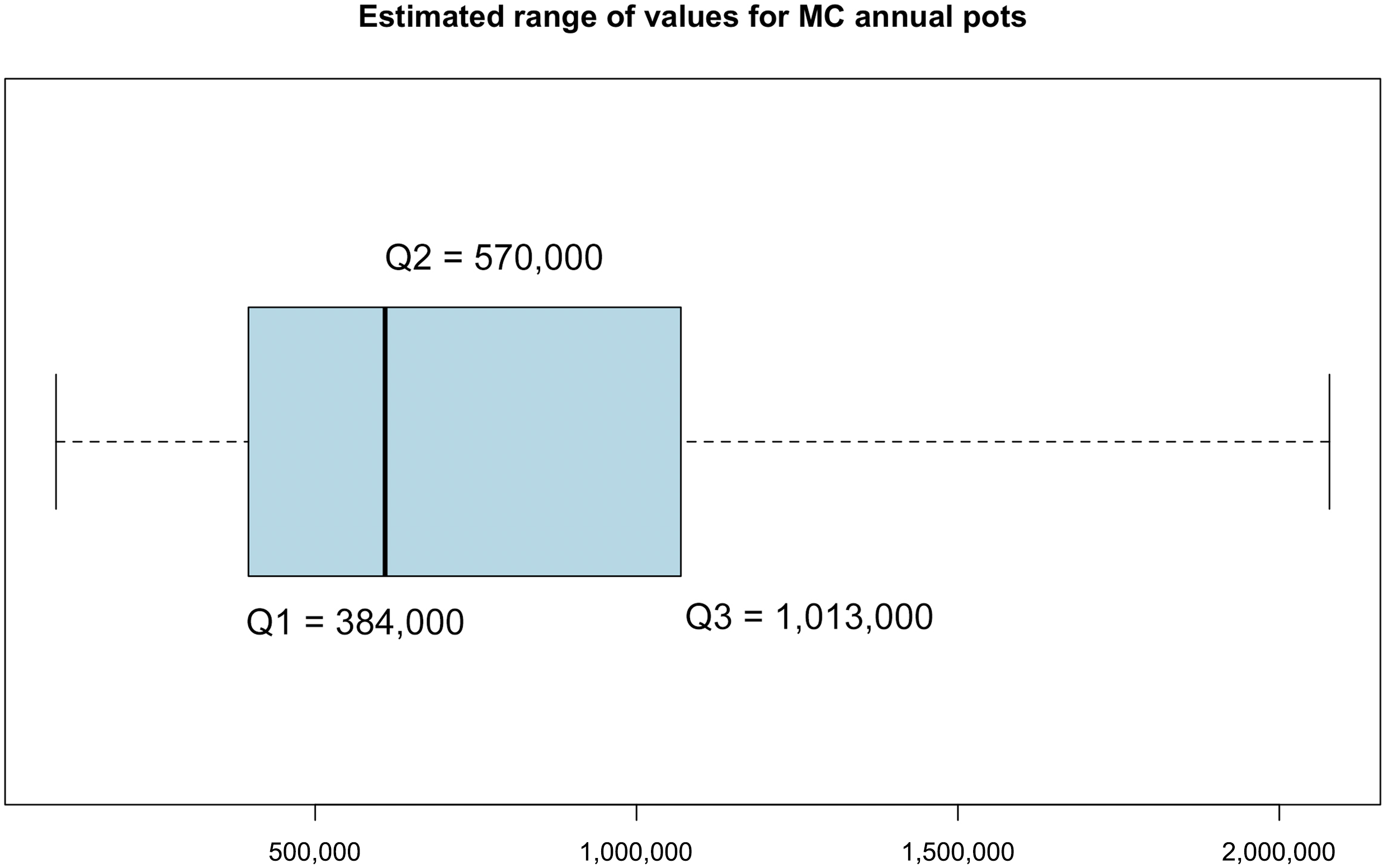
Stissi and Sapirstein worked separately and each of their conclusions is eminently sensible, but what happens if we put their work together and consider the limits of interpretation? Stissi’s calculation of 1 million pots created per year looks a little different when his assumptions are buffered under Monte Carlo (a summary of the assumptions made by Stissi is presented in table 1, supplementary material).Footnote 28 Stissi takes the number of pots published in the Beazley archive (86,000) and multiplies this by a value for survival rate and publication rate, both of which can be expressed as ranges (0.25–1.00 per cent and 5–15 per cent, respectively).Footnote 29 Sampling 100,000 possibilities from these ranges (and dividing by 250 to go from total number of pots to a value per year in the period 600–350 BCE) delivers an estimate somewhat lower than 1 million pots (i.e. Stissi’s ballpark estimate), expressed between 384,000 (quartile 1) and 1,013,000 (quartile 3), with a median value of 570,000 (fig. 3); this range is referred to throughout the rest of the article as ‘MC annual pots’.
Box-and-whisker plot illustrating the estimated range of values for MC annual pots.

Moving from pots to potters, Stissi gives the fixed value for production rate at 2,000 pots per potter per year. Expressing this, too, as a range (1,500–2,500) and dividing this range by MC annual pots, the number of potters might be somewhere between 210 (quartile 1) and 550 (quartile 3), with a median value of 320 (fig. 1, supplementary material).
This range is fairly significant for two reasons. First, the jump between quartile 1 and quartile 3 represents more than a doubling of the number of potters, implying that there is so much uncertainty within this framework that we could quite easily imagine a potting industry twice or half the size able to manufacture what we think was produced; second, Stissi’s own estimates of 500–1,000 pot makers is within possibility in the Monte Carlo scenario, but lies between the 75th and 90th quantiles, implying perhaps that there is a possibility of such a figure but a relatively low probability.
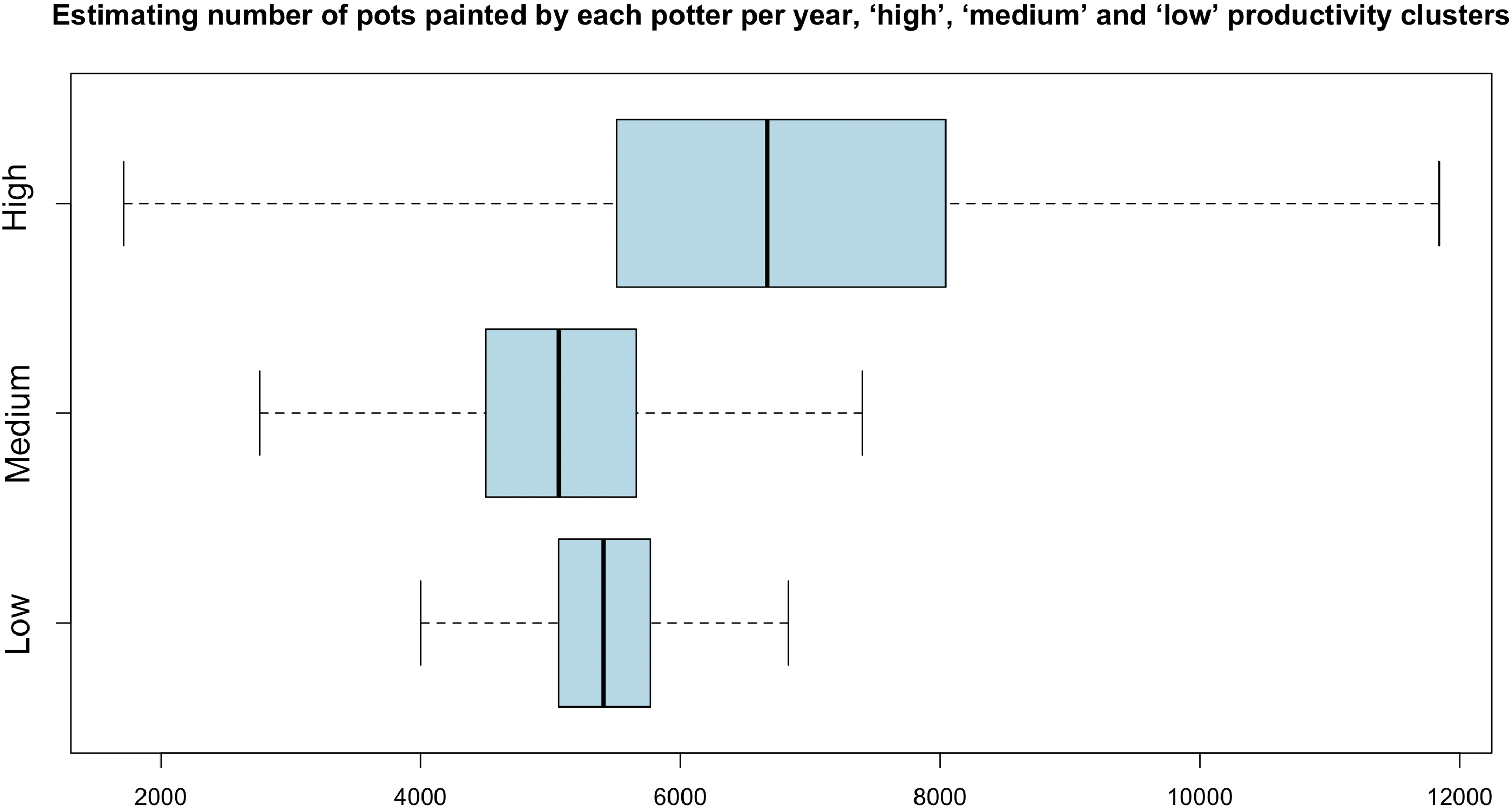
Equally, Monte Carlo methods should encourage us to look twice at Sapirstein’s round number of painters (a summary of the assumptions made by Stissi is presented in table 2). Taking an average attribution rate (8.30), scaled to the survival rate of pottery and dividing MC annual pots by this figure, the number of painters might be somewhere between 250 (quartile 1) and 820 (quartile 3) with a median of 430 (fig. 2, supplementary material). This would imply that a painter might expect to complete four or five pots a day to keep pace with the potters. But Sapirstein argues that this estimate is too high: of the number of hands identified in Beazley across various generations, he indicates that there were probably no more than around 45–200 painters active at any one time. This wide range takes account of chronological variation in the story of Athenian fine pot-painting, where the most ‘usual’ number of painters at work was probably around 100 annually, with only 200 at work during the ‘peak’ of artistic production around 475–450 BCE, and as few as 45 during the earliest and latest periods of production (around 600 BCE and 350 BCE). This chronological variation in mind, the above calculation proves quite concerning. Even for the lowest quartile estimate (250 painters), this is greater than the maximum that Sapirstein considers (200 painters) for the period of greatest production (475–450 BCE). So, as Sapirstein does, one can run a second calculation that works the other way around, beginning with a projected number of painters and working up to the number of pots and the painting rate. Taking 45–200 as a whole range is perhaps unhelpful, and it is better to consider separately periods of low-, medium- and high-intensity production. This correlates with the periods discussed above, but could just as easily model scenarios of work intensity, clusters of different production rates: from a small group of ‘masters’ working steadily on detailed and intricate scenes on small kylixes (or producing similar material on much bigger amphorae)Footnote 30 to a large groups of painters providing only very quick, rough outline or framing decoration to a piece.Footnote 31 We might, then, look at three ranges for the number of potters (MC painters): a ‘low’ estimate at 45–70, a ‘mid-range’ estimate at 100–125 and a ‘high’ estimate at 175–200.Footnote 32 The results of this experiment, dividing MC annual pots by MC painters (table 3 and fig. 4) for the ‘mid-range’ and ‘high’ production period estimates are generally within the same ballpark: an average of around 5,500 pots to be painted per potter per year, which, assuming six working days per week year-round, equates to something around 17 pots per day.Footnote 33
Box-and-whisker plots estimating the number of pots that could be painted by each potter per year, dividing MC annual pots by MC painters, and assuming alternative scenarios of ‘high’, ‘medium’ and ‘low’ productivity clusters.
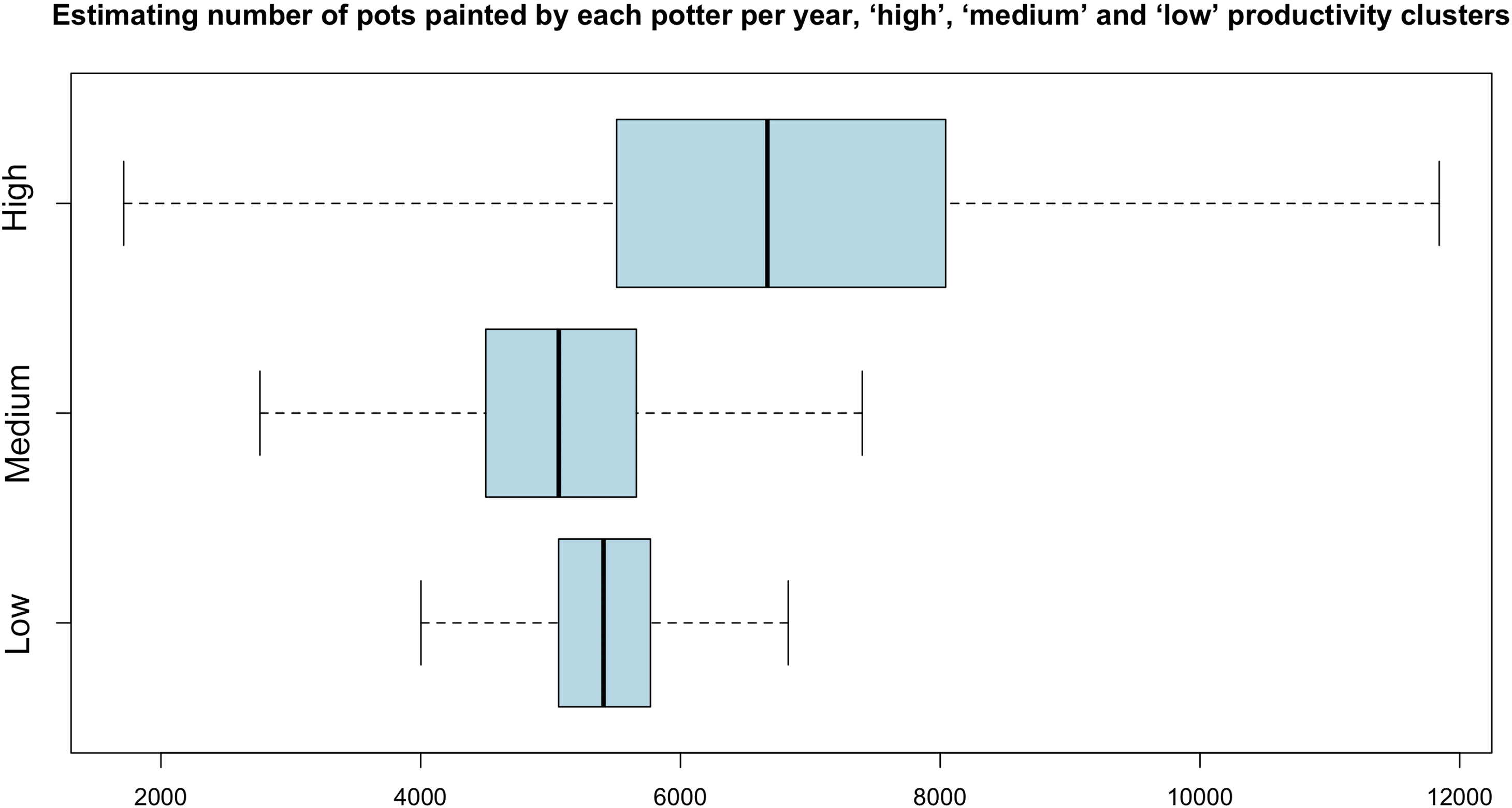
It is only the results for the ‘low’-capacity production period that are in a wildly different ballpark, assuming, on the highest quartile result, that potters might each be required to finish nearly 8,000 pots per year, or around 26 per day. This higher workload might, of course, be entirely permissible for an industry just starting up. On the one hand, the results of this initial experiment are encouraging: pottery production rates and the estimates for the number of pots appear to scale very neatly. On the other hand, though, there is a point for caution here. That is, the scaling only works if we assume that the group of painters are employed full-time year-round: with even a small adjustment to the model allowing for a small group of these painters to work only nine months of the year or four/five days a week on painting and the rest of the time on some other profession (table 4), we quite soon arrive at a scenario where each painter might be required to complete up to 40 figured pots in one day, perhaps quite a remarkable suggestion.
Two points emerge from this very brief venture into production modelling (data summarized in table 5). First, by simple adjustment of the input variables, a substantial range of possible outcomes is created. Methodologically, this should not be a surprise; but, historically, it is concerning that the mathematics leave room for anything between small family workshops to large factories of painters working impossibly fast. More crucially, though, there are gaps between the possible outcomes. And the most significant gap is between the scale and the rate of production for the potting and the painting industry. Even if we take the most conservative estimates for MC annual pots (the lower quartile figure of 384,000 per year) and the most optimistic estimate on how quickly those pots could be painted (40 pots per day, or around 12,000 pots per year per painter), these ballparks are in quite different orders of scale. To balance the numbers is to assume that there was an almost impossibly large cohort of painters working steadily, or a smaller cohort working under considerable time pressure. In the remainder of this article, the logistics of these possible results will be explored.
III. Part-time and seasonal work
Of the alternative of many painters working continuously and steadily or few painters working highly productively, contextual evidence seems to favour a smaller workforce. The practice of signing pots suggests a preference for a smaller workforce. Why else sign a pot unless to give that work the authority of a brand?Footnote 34 A brand is certainly more effective if its name is more widely known. The larger the sea of painters, the greater the amount of background noise and the harder it is for individual artists to stand out: so one expects that the pool needs to be small enough that the name of any particular painter could become well-known. Data from the Beazley archive reinforce the notion of a smaller population of painters: only a few painter signatures are documented per generation.Footnote 35 Alternatively, if we posit a larger population of painters, the argument would necessitate either that the signing of pots was done by only a few against a background of very many more non-signers (perhaps breaking down the argument of the brand, as a larger total cohort would make it much harder for each named painter to be seen), or that there is a significant gap in the dataset, either a publication bias or a survival bias of the material that excludes a similar number of named painters from each generation (quite unlikely). It might seem reasonable, then, to consider a low number of painters working somewhat steadily throughout the year, either full-time or almost full-time, but how does that stack up numerically?
The amount of time and number of personnel required to complete the work obviously depends on the amount of work to be done. In the discussion above concerning MC annual pots, the problem is somewhat masked by the fact that there were pots both of different sizes and whose designs exhibited different levels of complexity, such that different levels of work were demanded to complete them. As a purely illustrative example of some extremes, it has recently been suggested that a large krater by Euphronios could take around seven to eight hours of work over the course of a week to paint one side,Footnote 36 while it is possible that for something like the small lekuthoi of the Haimon Group, around 40 pots could be finished in one day. Taking these values as the boundaries of very exceptional outliers,Footnote 37 an estimation can be made for the different times that could be required to finish one pot (fig. 3, supplementary material), where the lower quartile is 0.3 hours, the upper quartile is 0.9 hours and the median 0.6 hours (referred to hereafter as ‘MC painting time’).
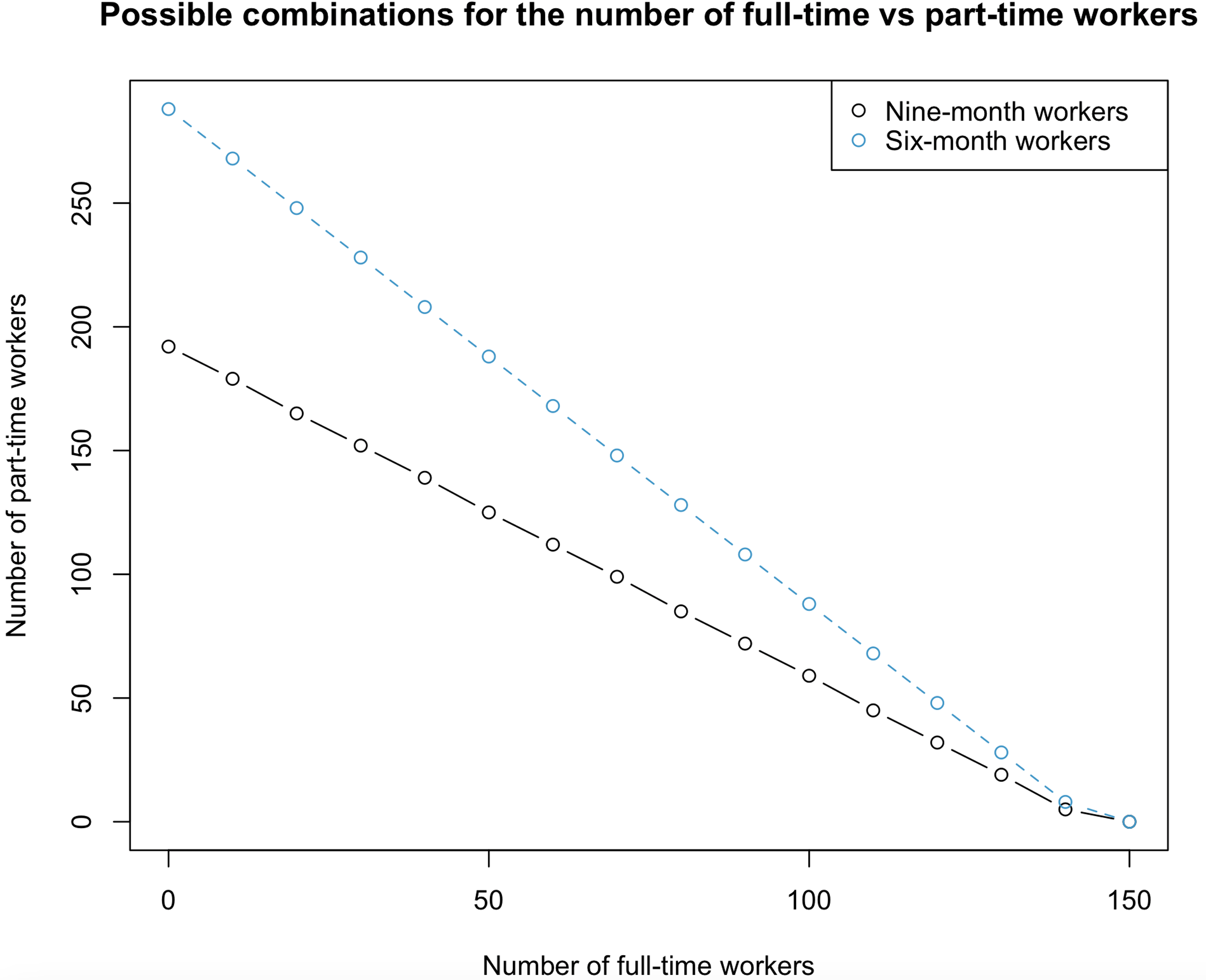
MC annual pots can be multiplied by MC painting time to estimate the total number of hours per year to be spent on painting (referred to hereafter as ‘MC annual painting hours’; see fig. 4, supplementary material): 170,000 hours as a lower-quartile estimate, 725,000 hours as an upper-quartile estimate and 357,000 as a median estimate. Assuming eight hours of work per day and six work days per week throughout the year, this would require 70–290 full-time painters, with an average of 145 painters: these figures resemble Sapirstein’s estimates for the number of painters (albeit slightly higher). But these figures also indicate that Sapirstein’s estimates only hold true if we assume that all of these painters are full-time workers, and we must estimate that the size of the industry was slightly larger than he had originally posited. It is possible that only some painters were employed full-time, to plug away at the basic work on a large backlog of pots, and that others could be employed elsewhere and simply called in as the need arose, perhaps ‘masters’ who came to do the detailed work on a smaller number of pots (tables 6 and 7, and fig. 5).
Graphical representation of possible combinations for the number of full-time vs part-time workers, to complete 357,000 hours of painting in one year (median of MC annual painting hours).

As the figures modelled here indicate, the numbers plausibly balance to account for all work being done if we assume a mixture of full-time and part-time work: the total number of part-time workers needed does start to become rather implausibly big, though, assuming any less than about 70–100 full-time painters (depending on whether we assume the part-timers are working nine or six months a year). These figures for different work models are not presented definitively, nor should they be used as anything other than ballpark estimates: rather, they are presented to demonstrate two points about the ceramics industry. First, given the quantity of work to be done, it was necessary that at least some of those employed as painters be required to work on just this task alone throughout the year. Second, the industry did not require the engagement of only full-time painters, and the numbers balance completely reasonably assuming that there was a group of painters who were only deployed to this task for even half the year.
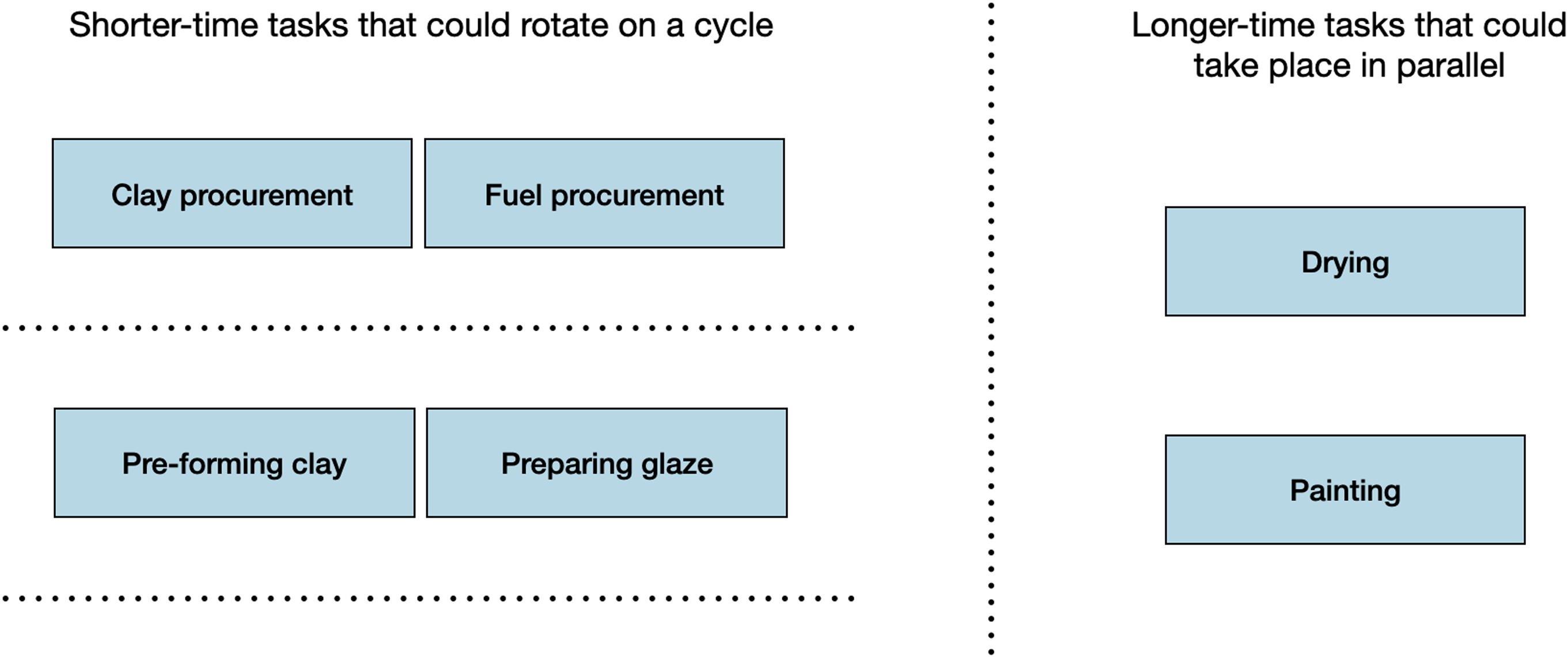
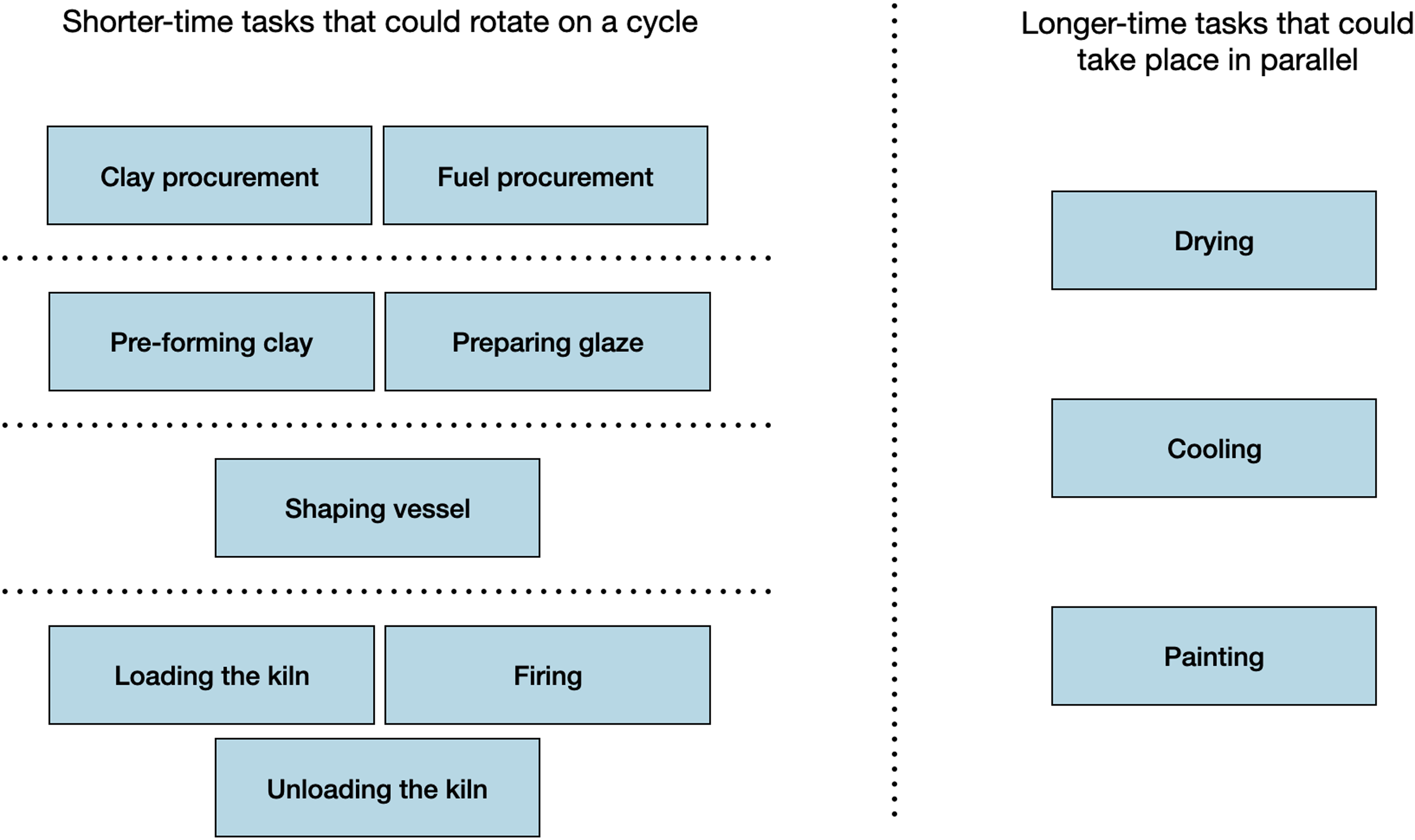
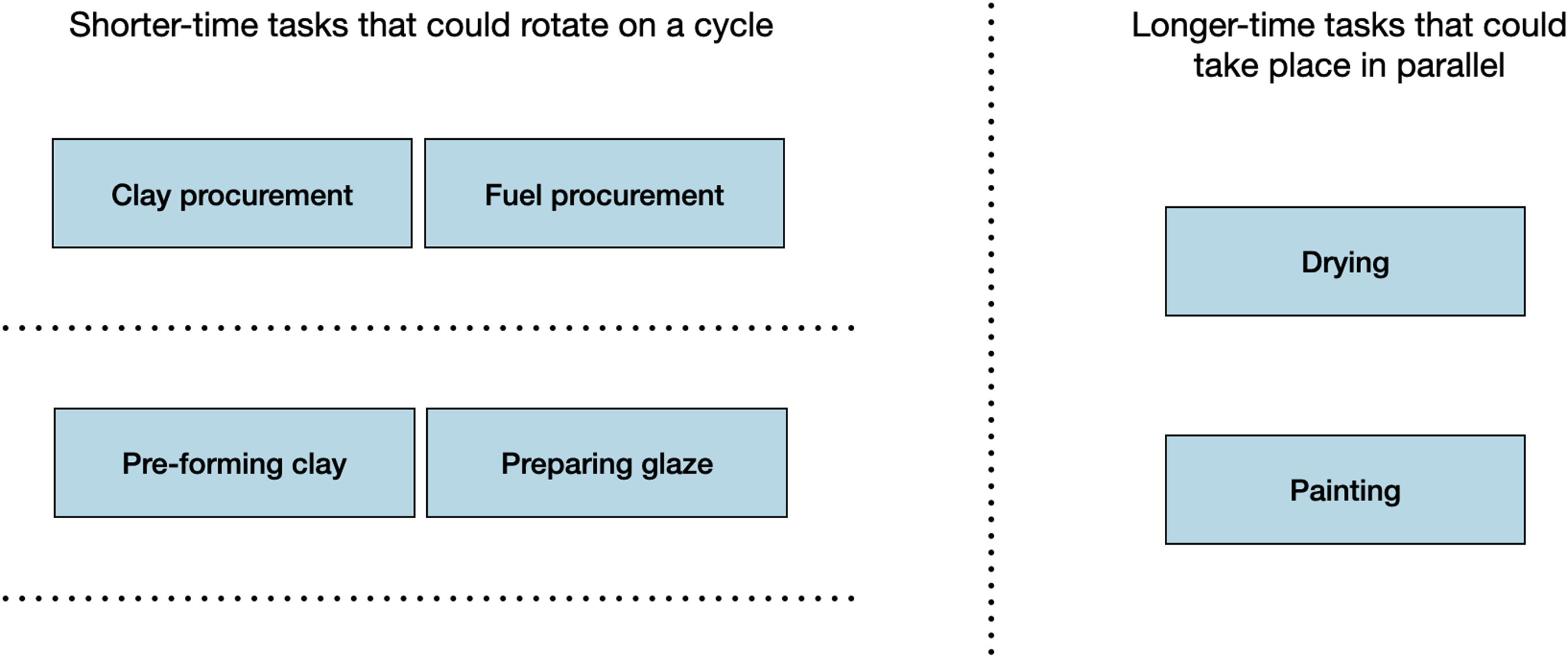
How does the work of those professional painters sit in the overall workflow of ceramic production? From gathering clay and fuel, to firing the kiln, to finally painting the pots, the whole chaîne opératoire for one kiln-full of pottery could take up to two weeks, or even longer if a month were devoted to drying the clay after washing (table 8; see Appendix 2, for extensive discussion of the comparative data on which these calculations are based).Footnote 38 More efficiently, if tasks were completed in parallel then different batches could be processed to different stages simultaneously. The key limiting factor would be that the kiln could only be fired twice a week (even that is quite an optimistic estimate assuming rather ruthless efficiency and suitable weather conditions),Footnote 39 and so, even theoretically, if one assumes a three-day process for firing then other preparatory tasks would need to run on a three-day cycle (fig. 6).
Schematic illustration of chaîne-opératoire tasks that could be completed in parallel during the pottery-production workflow.

As shown in the data of Appendix 2, the process of gathering fuel from a nearby storehouse, shaping ceramic vessels, then loading, firing and unloading the kiln are tasks that could all quite comfortably be completed within this window:Footnote 40 and so a parallel distribution of tasks within the workshop appears to be a realistic model. Furthermore, arranging the work in this way would allow for two or three individuals to cycle through these routine tasks; on firing day, when workers would be less actively employed, other routine tasks, such as cleaning or general maintenance of equipment and tools, could take place, or perhaps workers could be involved in other tasks such as packaging and distribution.
The other major limiting factor in the workflow, though, is the drying of a batch of pots before it can be fired. As indicated in Appendix 2, drying times were highly variable, but on average could have taken around one week. If we assume that other batches of ceramics can be formed, fired and finished (i.e. the three-day process) while one batch is drying, this would suggest that there were two or three batches ‘on the go’ in a single workshop at any one time. This would, of course, have implications for storage space, another limiting factor, something that will be discussed more extensively below. Aside from this, the only part of the process that is somewhat separate and could operate almost continually is painting. That is, given that it would take an almost equivalent amount of time (two or three days) to paint or to create a full batch of pots, one can also imagine that the potting workflow (with all its various tasks) and the painting workflow (with fewer tasks, but those tasks which each individually took longer) could operate simultaneously on parallel tracks.Footnote 41 That is, there needs to be a separate group of painters steadily chipping away, working at a steady average rate, to keep pace with the potters.Footnote 42 This is necessarily a simplification. As mentioned above, the time taken to paint pots varied considerably. Some required significantly more time, to the extent that a group of painters might need almost double the time (six days) it took to process for forming and firing (three days); necessarily a backlog would soon build up.
This backlog does not make the model impossible, though, and a diversion towards thinking about seasonality and the kiln-firing cycle helps to set up this justification. The seasonality of pot-making is a possibility that has been variously discussed over the past 30 years,Footnote 43 and there are certainly steps in the chaîne opératoire that are only suitable to certain times of the year. As noted above (n.39), the gathering of kiln fuel is best done in the late spring and autumn, when olive trees and vines are pruned and the olive pomace from processing is made available (see discussion and sources in Appendix 1).Footnote 44 While this task was suitable for the off-season, it is probable that it would not have engaged workers throughout the entire winter: doing nothing but gathering fuel would not only result in a quantity far outstripping the requirements for firing the kilns during the rest of the year,Footnote 45 but storage would be an issue. There are no known warehouses of the Kerameikos, and the workshops archaeologically attested were only modest in size,Footnote 46 such that there would be nowhere suitable within the potting quarter to store up large quantities of fuel. It is more plausible that those responsible for gathering fuel would have needed to collaborate with local farmers or agricultural facilities,Footnote 47 so that fuel could be brought (in the off-season) part-way from the rural hinterlands of Attica and only take the last step of the journey into the Kerameikos as each firing episode required in the summer (i.e. to minimize the journey time for the on-season).Footnote 48 Drying would also be necessarily restricted to the summer months (or at least to the dry months), with the result that the main ‘firing season’ was only around six months of the year, from April to September.Footnote 49 Modelling the distribution for the capacity of a medium-sized kiln between 50–300 vessels with an average of around 150 vessels (referred to hereafter as ‘MC kiln capacity’; see fig. 5, supplementary material),Footnote 50 and dividing MC annual pots by MC kiln capacity, it would mean that something like 2,500 (first quartile) to 11,500 (third quartile) firing episodes (median at 4,800 episodes) were required (fig. 6, supplementary material); or, if assuming two firing episodes per kiln per week for 26 weeks, 50–220 kilns; more likely around 90 kilns (median value).
To bring this point back to painters and professional activity: ethnographic data have suggested that the ceramic kilns were fired for half the year, and it follows, therefore, that those working in the various tasks associated with potting and firing would be working full-time for these six months. By contrast, an exploratory pass through the quantitative data has indicated that there is little alternative than to assume that painting took place throughout the year. We can think, then, of the chaîne opératoire looking slightly different at different points in the year (fig. 7).
Schematic illustration of seasonal variation in chaîne-opératoire workflow, winter months or firing ‘off-season’.
That is, considering a workshop of six workers,Footnote 51 it is plausible that three were assigned in the summer months to painting tasks and the other three were on a rotation of other tasks (i.e. gathering fuel from storehouses, sourcing clay, shaping vessels and operating the kilns).Footnote 52 In the off-season, those three who had been fully occupied with painting in the summer would need to continue with their painting, to make sure the full quantity of pottery created in the summer months was processed. But the other three in the workshop are freed up to work on other tasks. Fuel collection, for instance, would not occupy them full-time, so for the remainder of the off-season they would be free to undertake other work. Such other work might be required in the workshop itself (such as maintenance or repairs), in agriculture (for example, in the harvest and processing of olives) or even in some other entirely different profession. Some might occupy themselves by helping out with the painting backlog, working as part-time painters.Footnote 53 Indeed, the idea that labourers employed for the most part in one profession could also be skilled professionals in other capacities is entirely realistic, and much recent scholarship on labour in Classical Greece has agreed that even those identifying themselves with certain named professions might be engaged in multiple different occupations throughout the year.Footnote 54 That is to say that, taking a view that combines chaîne opératoire and quantitative estimation, the following scenario seems completely reasonable: that there were permanent full-time painters chipping away at large batches of fired pots throughout the year; part-time potters who worked primarily in the summer, those who might also be part-time painters or might go off to other professions during the winter months; and other part-time painters who could be brought in from elsewhere to help process the critical mass of pots fired earlier in the year.
The workflow already seems constrained, but there are additional factors to consider. That is, there are further elements of complexity that have not been modelled here: the notion that there might have been multiple kilns per workshop, so that one could fire while the other cooled; steps for mixing glaze and the making of tools and brushes; and the ‘promiscuity’ of painters (or potters) moving between different workshops and collaborating on sets of vessels.Footnote 55 And one further critical factor that comes right at the end of the chaîne opératoire (or is, arguably, part of its workflow of packaging, loading, moving and unloading) is shipping fine painted pots overseas, accounting for the fact that not all fineware was made for local consumption and that high quantities of figured Attic wares have been found outside of Athens, principally in Etruria.Footnote 56 Shipwreck evidence of the fifth century BCE indicates that some merchant ships could carry up to 120 tonnes (with a hull around 25–30m in length), ca. 4,000 loaded amphorae, while others were much smaller and, with a carrying capacity of only around one quarter of larger ships, are estimated to have been able to carry a maximum of 1,000 loaded amphorae.Footnote 57 This range of carrying capacities can be distributed (fig. 7, supplementary material), and then divided by MC kiln capacity to suggest that in order to fill a ship with pottery, between ten (first quartile) and 31 (third quartile) firing episodes would be required, with a median estimate at 17 firing episodes (fig. 8, supplementary material). Either this would require one kiln to work on putting together a single shipment for between five and 15 weeks (this scenario seems very unlikely: where would these large quantities of fired pots be stored until they were shipped off?), or that multiple workshops would need to coordinate and work in concert to put together a shipment. This adds a layer of complexity, but the timeline becomes even more constrained when factoring in the short sailing season. Cargo could be safely transported to Etruria only between April and September and this journey alone would take at least a month.Footnote 58
How does this point relate back to the wider discussion on the chaîne opératoire and professional workflows? Simply, the case of shipping illustrates that the more factors are investigated in understanding how the ceramic industry operated, the more complex the whole scenario appears, and crucially, the much tighter and more time-critical everything appears. There must have been immense amounts of planning and coordination holding the whole chaîne together: knowledge of what people wanted,Footnote 59 where they were, what tasks other workers were doing; the management of resources and raw materials, the enmeshing of workflows, boats’ carrying capacities and storage availabilities. Peter Acton in his discussion of industry logistics makes reference to ‘factory discipline’,Footnote 60 a theory of working practice that states that workers have the pace, timing and conduct of their work closely dictated to them by an employer or manager, essential to an industry oriented towards making profit.Footnote 61 This model does not quite work for small, family-sized workshop units of four to six individuals where, presumably, those working within the workshop had a more personal stake than merely working fairly anonymously in a larger factory-level environment.Footnote 62 What is clear, though, is that there was some degree of organization and management required. It is more useful to think about a managerial compartmentalization of tasks and coordination:Footnote 63 efficient workflows rely on a small group working closely together in an organized fashion to move pots efficiently from one step of the process to another with minimal lag at each stage. In fact, the most efficient and smooth flow would demand that one keeps the supply chain as fixed as possible, with the same regular collaborators. Osborne’s ‘promiscuous’ mix of potter-painter collaborators, therefore, would be quite exceptional to this model, perhaps something that was not required of the day-to-day workflow of potting and painting, but reserved for creating certain ‘special’ products. Who, then, was orchestrating the coordination of these various tasks? The names of professions have come down to us, occasionally accompanied by duties that can be inferred through contextual or associated evidence, but nothing so clear as a job description or a list of duties for these professionals. We do not have attested ‘managers’, or individuals whose major task we might assume was the large-scale coordination of major industries. Might it be plausible that such responsibilities were within the purview of the κϵραμϵύς? We might anachronistically talk about the ‘workshop master’ (a term that is not attested in historical sources), but being a ‘master’ was not in itself a separate profession, rather simply a duty that a potter might also have to step up to. That is, within the remit of the potter, it is possible that there were significant elements of what we might call ‘project management’, and that keeping the whole chaîne opératoire coordinated was just as central to the potter’s role as was getting their hands dirty. This aspect of the job, at least, must have been a full-time role that someone within the workforce was required to fulfil throughout the year, not least because the quantitative data would suggest that fuel collection and painting were still happening outside the main potting season.
This model, involving full-time and part-time potters and painters, along with tasks related to project management within these professions, carries significant implications for how we might conceptualize the ancient potting industry of Classical Athens. First, even though we do not know pot-painting as a named profession, if it were routine work that required such a large workforce processing steadily throughout the year to keep up with the demands of potting, then surely this is a profession from which one could earn a daily wage. Second, the balance of the whole industry was incredibly precarious, with a chaîne opératoire that demanded extreme coordination not just between different parts of the same workshop but also between different workshops (and with a wider network of agricultural workers and merchants). This indicates a third aspect, namely that even at its most coordinated, the quantitative data show that there were tight turn-arounds between production steps, high daily outputs and the requirement to work at a certain pace in order to avoid problematic backlogs. This picture is of a fairly pressed and hectic industry, well-balanced but more efficient and fast-paced than the caricature of a cosy and relaxed family-run potting business. Finally, the success of the whole industry was predicated upon a huge amount of knowledge held in the heads of a few individuals. This was knowledge that extended beyond the mere workings of the local workshop to a wider knowledge of what was going on in other workshops, the demands of various markets, storage limits and shipping capacities, the fine-tuned workings of the agricultural and shipping cycles. If this was knowledge that was the preserve of the potter, then it would appear that to be a ‘workshop master’ was to be a master not just of one trade, but of a network of interlinking professional activities.
IV. Conclusions
The value of taking a statistical approach to investigating social and economic history has been well demonstrated through the case studies discussed in this article. Most obviously, statistics allows one to estimate quantities which (although numbers tell very little by themselves) help the historian in estimating orders of scale and complexity, arriving at estimates that are not only probable but also reasonable. Such has been the objective in calculating the numbers of pots produced per year, the numbers that painters needed to process in one season, the number of firing episodes required to meet expected levels of demand: statistics has helped to demonstrate that these quantities were both very high and demanded efficient and productive work at all stages. That is, the data can robustly support a complex model of the Kerameikos with large capacity, multiple moving parts and high production rates. In adopting a specifically Monte Carlo statistical approach, a range of possible historical scenarios have been considered, illustrating that even in making rather modest adjustments to the starting assumptions a range of historical outcomes were mathematically possible. This is an aspect that could be concerning: even with the same initial assumptions, different conclusions might emerge due to variations in magnitude. Necessarily, if the assumptions were combined, it would be the case that each of these factors in combination would significantly affect the outcome. This is, in essence, an historical butterfly effect: each seemingly small decision has a big impact on quantitative outputs and, by extension, on conclusions reached.
Substantively, the statistical approach has proven to be more than a mere numerical experiment. Rather, the data generated can be used to suggest that there were full-time painters employed within pottery workshops, steadily chipping away at a backlog of pottery made during the main firing season. By situating these quantitative estimates within the chaîne opératoire for producing figured pottery, the case can also be made for the existence of a group of potters (or other bodies) within the same workshop who could be redeployed to painting outside of the firing months. Temporal rhythm (both seasonal and day-to-day) was key to the fluidity of professional activities undertaken within and between workshops. But time was also of the essence, and it has been suggested that to maintain the flow of tasks in order and to meet the series of deadlines arising each season, some element of project management would have been necessary. While there are no obviously managerial professions attested in Classical Athens, it is possible that such duties fell to those called κϵραμϵύς: this would, in turn, imply that a successful potter was just as adept in managing the flow of their workshop as they were in the practical skills of shaping pots.
Proposing that the Classical Athenian Kerameikos had a notably complex structure is not new. What is reassuring, however, is that meticulous modelling of quantitative data allows for proposing a range of historical scenarios that not only robustly support the model’s plausibility, but also contribute new and important data to discussions of professional and part-time work undertaken in the production of Athenian black- and red-figure painted pottery.
Supplementary material
To view supplementary material for this article, please visit https://doi.org/10.1017/S0075426925100323
Acknowledgements
I would like to thank David Lewis, Anja Slawisch and James Whitley for reading drafts of this paper at various stages, and thanks also to James Whitley and to Flint Dibble for hosting me (virtually, from Zagori) at a Cardiff University Archaeology and Conservation Research Seminar where early ideas for this paper were presented. Helpful conversations with both Edward Harris and Robin Osborne also contributed to my early thinking on this topic. The fantastic advice of the anonymous peer reviewers was instrumental for shaping this paper and was much appreciated, as were further comments and encouragement from Lin Foxhall.
Funding statement
This work was completed during a period of research funded by The Leverhulme Trust, ECF-2022-015.


 Open access

