

In a profession designed for men with housewives, academic mothers continue to shoulder a disproportionate burden. Motherhood penalties in academia are well-documented, with research consistently showing negative impacts on mothers’ publication rates (Di Leo et al. Reference Di Leo, Epifanio, Scotto and Troegern.d.; Lutter and Schröder Reference Lutter and Schröder2020; Morgan et al. Reference Morgan, Way, Hoefer, Larremore, Galesic and Clauset2021), citations (Lawson et al. Reference Lawson, Geuna and Finardi2021), and promotion trajectories (Antecol et al. Reference Antecol, Bedard and Stearns2018; Finkel and Olswang Reference Finkel and Olswang1996; Mason et al. Reference Mason, Wolfinger and Goulden2019) — effects not observed among fathers. In recent years, both institutional frameworks and grassroots movements have sought to address these inequities, yet their strategies and impacts differ significantly.
The Athena Swan Charter, originally developed in the United Kingdom, represents a top-down effort to promote gender equity in academia. Its recent expansion to countries including Brazil and India raises important questions about whether such institutional frameworks should be exported across diverse contexts. At the same time, movements like Parent in Science in Brazil have emerged organically, driven by academic parents themselves, advocating for structural changes from the ground up.
This Note draws on our personal experiences: one of us as a member of the board of the movement Parent in Science (PiS) (Infanger), and the other as a member of an Athena Swan committee at a UK university (Weeks). These different perspectives allow us to critically examine the contrasting logics and impacts of the two initiatives. In what follows, we explore each model, interrogating whether efforts like Athena Swan risk genderwashing commitments to equity — especially for academic mothers — and highlighting what grassroots movements like PiS can teach us about building more inclusive and effective gender equality initiatives.
An Institutional Framework: Athena Swan and Its Global Ambitions
The Athena Swan Charter was established in the UK in 2005 to address the unequal representation of women in academia (Barnard Reference Barnard, White and O’Connor2017). Its original mission — “to encourage and recognise commitment to advancing the careers of women in science, technology, engineering, maths and medicine (STEMM)” — focused on increasing women’s representation and progression in higher education and research. Athena Swan was created and is managed by a charity: Advance HE, formerly the Equality Challenge Unit. Thus, the framework differs from state feminism, in which grassroots activism and state institutions work together to promote gender equality through state-directed mechanisms (Hernes Reference Hernes1987; Weldon Reference Weldon2024).
The Charter was expanded in 2015 to include arts, humanities, social sciences, business, and law. It has been highly influential in the UK, with over 120 universities participating, holding more than 950 awards between them, and is now expanding across the globe to address gender equality concerns. Research on Athena Swan highlights several benefits, including raising the visibility of gender equality (Caffrey et al. Reference Caffrey, Wyatt, Fudge, Mattingley, Williamson and McKevitt2016; Tzanakou and Pearce Reference Tzanakou and Pearce2019), improving staff perceptions of institutional commitment to tackling gender inequality (Munir et al. 2014), and prompting the adoption of initiatives aimed at enhancing working conditions and addressing structural disparities (Caffrey et al. Reference Caffrey, Wyatt, Fudge, Mattingley, Williamson and McKevitt2016; Ovseiko et al. 2017).
While framed as a tool for equity, Athena Swan is equally a form of institutional branding. The Equality Challenge Unit, which managed the Charter until 2018, explicitly linked Athena Swan awards to institutional competitiveness, helping universities “to remain attractive to talented staff and potential students in a global market.” In practice, the process of obtaining Athena Swan recognition has become a way for universities to enhance their reputations in the higher education marketplace (Ball Reference Ball2012). Thus, the Charter serves not only as a framework for internal change but also as a symbolic asset for universities.
The instrumental use of gender is not necessarily a problem, insofar as gains are being made for women and gender equality (see also the strategic use of women’s suffrage, gender quotas, and family policy by political actors; Morgan Reference Morgan2013; Teele Reference Teele2018; Weeks Reference Weeks2018). However, we note a troubling disconnect between the Charter award and tangible outcomes for gender equality. Scholars have observed that Athena Swan prioritizes certain results — application scores, action plans, and awards — over sustained cultural transformation (Tzanakou and Pearce Reference Tzanakou and Pearce2019; Yarrow and Johnston Reference Yarrow and Johnston2023) or policy change (Armstrong and Sullivan Reference Armstrong and Sullivan2025). The Charter’s emphasis on technical compliance fosters a “box-ticking” culture, wherein departments perform equality work sporadically, often without deep reflection or long-term commitment. As one participant in Tzanakou and Pearce’s (Reference Tzanakou and Pearce2019) study noted, the Charter can feel like a form of tokenism — more about appearances than meaningful change.
Had Athena Swan been grounded in the principles of genuine state feminism, characterized by a state-led commitment to dismantling gender hierarchies through sustained institutional integration (Forester and Mazur Reference Forester and Mazur2024) — its impact on women in academia might have by now reached a more clearly transformative threshold. Instead, awards are made on the basis of data collection, analysis, and, importantly, action plans — not on demonstrated change or progress toward gender equality goals. The result is that we lack concrete evidence that the Charter is effective. As Pflaeger Young et al. (Reference Pflaeger Young, Amery, Bates, McKay, Miller and Billings2021) report in their analysis of Athena Swan award holders and outcomes for women in political science, “there is no available evidence to suggest that the level of award – that is, bronze or silver – has any impact on the proportion of female political scientists within an institution” (29). Given the significant workload pressures facing women in academia — who continue to perform more service work than their male colleagues (Järvinen and Mik-Meyer Reference Järvinen and Mik-Meyer2025) — it is worth questioning whether engagement with the Charter, in its current form, represents the best use of our collective time and effort.
A marked example of this performativity is the absence of focused, critical engagement with the realities of academic motherhood. While Athena Swan acknowledges “caring responsibilities” in general terms in its guiding principles, it avoids direct reference to mothers or parenting as distinct dimensions of inequality. This rhetorical vagueness matters: motherhood is not merely a subset of general caregiving. It is a specific, gendered experience with demonstrable and disproportionate career impacts that can’t be solved with blanket policies. And during the COVID-19 pandemic — when gender gaps in academic productivity widened dramatically (Staniscuaski et al. Reference Staniscuaski, Kmetzsch, Soletti, Reichert, Zandonà and Ludwig2021) — Athena Swan failed to deliver responsive, data-informed adjustments.
Instead of updating assessment frameworks, putting out a call for action, or instituting emergency support, Athena Swan remained largely inert. Pereira (Reference Pereira2021) similarly argues that the absence of targeted policies during the pandemic reflects a deeper institutional inertia — a failure to see caregiving, especially motherhood, as central to gender equity. But addressing motherhood is not a niche issue. It is a critical front in the struggle for gender equity in academia (Ward and Wolf-Wendel Reference Ward and Wolf-Wendel2012) and beyond. Studies increasingly show that well-established gender gaps are in fact motherhood penalties (Kleven et al. Reference Kleven, Landais, Posch, Steinhauer and Zweimüller2019).
On a personal level, working within an institutional framework that sidelines the lived realities of motherhood in this way feels demoralizing, and this poses a risk to the wider, sustained buy-in of colleagues necessary for success. For example, one of the authors (Weeks) worked to advance improvements to university parental leave policy through the Athena Swan framework. However, these proposals were stalled during the pandemic, even as its disproportionate impact on caregivers — particularly mothers — was increasingly evident. Ignoring motherhood in this moment of crisis undermines the credibility of institutional gender equity efforts and casts doubt on who, exactly, such initiatives are designed to support.
These questions about the goals of the Charter, what it achieves, and for whom, are important to reflect on especially now, as the Athena Swan charter expands to Ireland, Australia, India, and Brazil. In Brazil, recipients of Athena Swan-linked funding reported that suggestions to include the perspectives of mothers were rejected for being too narrow — framed as the concerns of a “specific group.” Instead, officials recommended folding such concerns into broader agendas like “work-life balance.” But when motherhood is not named, it is easily ignored. When equity is viewed as a compliance task, addressing interactions like gender and parenthood can be seen as another hurdle to be cleared. Indeed, similar critiques have been made about “Athena fatigue” leading to reluctance to address racial inequalities in similar charters (Bhopal and Henderson Reference Bhopal and Henderson2019). The Charter’s avoidance of motherhood prioritizes optics over outcomes.
Grassroots Innovation: The Case of Parent in Science in Brazil
The case of the grassroots academic movement Parent in Science (PiS)Footnote 1 in Brazil offers a useful comparison to the institutional charter approach. PiS emerged not from a charity or institutional mandate, but from the lived realities of academic mothers themselves. Founded in 2016, the movement began with a straightforward but urgent question: How does parenthood, especially motherhood, affect scientific careers?
Unlike Athena Swan, which largely operates through compliance with preset evaluation criteria, Parent in Science arose organically from researchers who had experienced firsthand the penalties imposed on mothers in academia — most notably, the invisibilized productivity gaps resulting from pregnancy, early childcare, and long-standing caregiving demands. These “gaps” are often misread by funding agencies and academic institutions as indicators of underperformance, rather than reflections of inequitable structures and systems. Over its ten-year trajectory, Parent in Science has evolved into a powerful platform for academic mothers, achieving tangible changes in Brazil. The movement combines data generation, political advocacy, and direct action. Its national reach is exemplified by its Ambassadors Program, which connects 69 researchers across 55 higher education institutions (HEIs). Overall, the movement comprises 90 researchers nationwide, and its policy influence is evident in government consultations where PiS representatives now routinely advise on gender and education policy.
A cornerstone of the movement’s impact is its empirical research. Parent in Science was one of the first initiatives in Latin America to systematically collect and analyze data on how parenthood — and motherhood in particular — affects scientific productivity. These data were not merely descriptive; they became advocacy tools, used to pressure funding bodies and institutions to recognize maternity leave in CV evaluations and revise evaluation metrics accordingly. A remarkable achievement of the movement was the inclusion of maternity leave in the national academic curricula platformFootnote 2, so academic mothers were then able to formally include parental leaves in their academic trajectory — and, hopefully, no longer be penalized by perceived dips in productivity. A second important achievement is the protocol to exclude individual extensions taken in graduate courses due to maternity leave from the evaluation of programs’ average completion period, a heavily weighted criterion considered by the body that regulates graduate programs in Brazil.
Beyond data and lobbying, the movement also delivers practical support mechanisms. One example is the Tomorrow program, which provides financial assistance to undergraduate and graduate student mothers in vulnerable situations, allowing them to continue their academic journeys. The program was funded by the Nature Research Awards for Inspiring Women in Science, recognizing PiS in the Science Outreach category — a testament to the movement’s growing global visibility and credibility.
One of the authors (Infanger), who joined the board of Parent in Science while pursuing a master’s degree, observed firsthand the significant impact of the movement’s advocacy. Her experience as a student navigating the early stages of an academic career sharply contrasted with the accounts of women who became mothers in the 1980s and 1990s — a time when motherhood in academia was often hidden and unsupported by peers or institutions (Infanger and Lima Reference Infanger and Lima2019). The movement offered a framework through which academic motherhood could be recognized not as an individual shortcoming but as a structural challenge, contributing to a broader sense of belonging among mothers in academia.
By publicly naming and validating the needs of academic mothers — such as the ability to attend conferences with infants, manage flexible work arrangements, or receive institutional understanding for caregiving-related delays — Parent in Science has played a crucial role in enabling students with children to remain in academia. For Infanger, who had a son during her master’s program and a daughter shortly before beginning a PhD in Political Science at the University of São Paulo, the existence of such a vocal and supportive movement was instrumental in her continued academic career. The movement also demonstrated that senior academics are both capable and committed to transforming institutional cultures, drawing on their own struggles as fuel to drive changes in scientific policymaking.
Parent in Science also played a pivotal role in the discussions leading to Brazil’s version of a gender equality charter for HEIs, inspired by Athena Swan. As part of a UK–Brazil bilateral funding initiative, several Brazilian institutions — some represented by PiS members — engaged in collaborations focused on academic motherhood. These efforts resulted in valuable recommendations, documents, and consultations advocating for the inclusion of parenthood as an intersectional axis of inequality.
However, despite this sustained advocacy, the final Brazil Gender Equality Framework for Higher Education Institutions fails to adequately address parenthood. References to motherhood and caregiving are scarce and superficial — confined to a few isolated questions in evaluation templates or vague suggestions in engagement strategies (e.g., British Council Brazil 2022, 28, 68). There is no designated section, strategic priority, or targeted policy guidance concerning academic parents. The result is a framework that risks engaging in genderwashing — projecting a commitment to equity without addressing one of its most foundational dimensions (Walters Reference Walters2022).
The marginalization of motherhood here highlights a deeper issue: when frameworks like Athena Swan are transplanted without a radical rethinking of their priorities, they risk replicating the same problems abroad that have been criticized at home. The reluctance to name motherhood directly, the conflation of caregiving intensity with generic “work-life balance,” and the emphasis on compliance rather than transformation — all these characteristics have been, unfortunately, exported intact.
By contrast, Parent in Science demonstrates what feminist, decolonial, and grassroots approaches can achieve when grounded in lived experience and collective action. The movement’s guiding principles — centering motherhood in policy support, advocating shared caregiving responsibilities, foregrounding racial disparities, and challenging competitive, individualist evaluation systems — offer a radically different model of equity. It is inclusive, responsive, and built from the bottom up, rather than imposed from the top down.
Together, the juxtaposition of these two cases (see Table 1) offers an important lesson for the gender equity landscape in academia: transformative change is far more likely to come from below — from those who experience inequality directly and mobilize against it — than from institutional charters oriented toward (symbolic) compliance. We note parallels here to key findings from the gender and politics literature related to the effectiveness of strong, autonomous women’s movements for achieving policy change (Htun and Weldon Reference Htun and Weldon2018). The story of Parent in Science is an important example of what a gender equity framework can look like if it places motherhood, and parenthood more broadly, at its center — not as a marginal add-on, but as a defining concern.
Comparing institutional vs. grassroots approaches to gender equity in academia
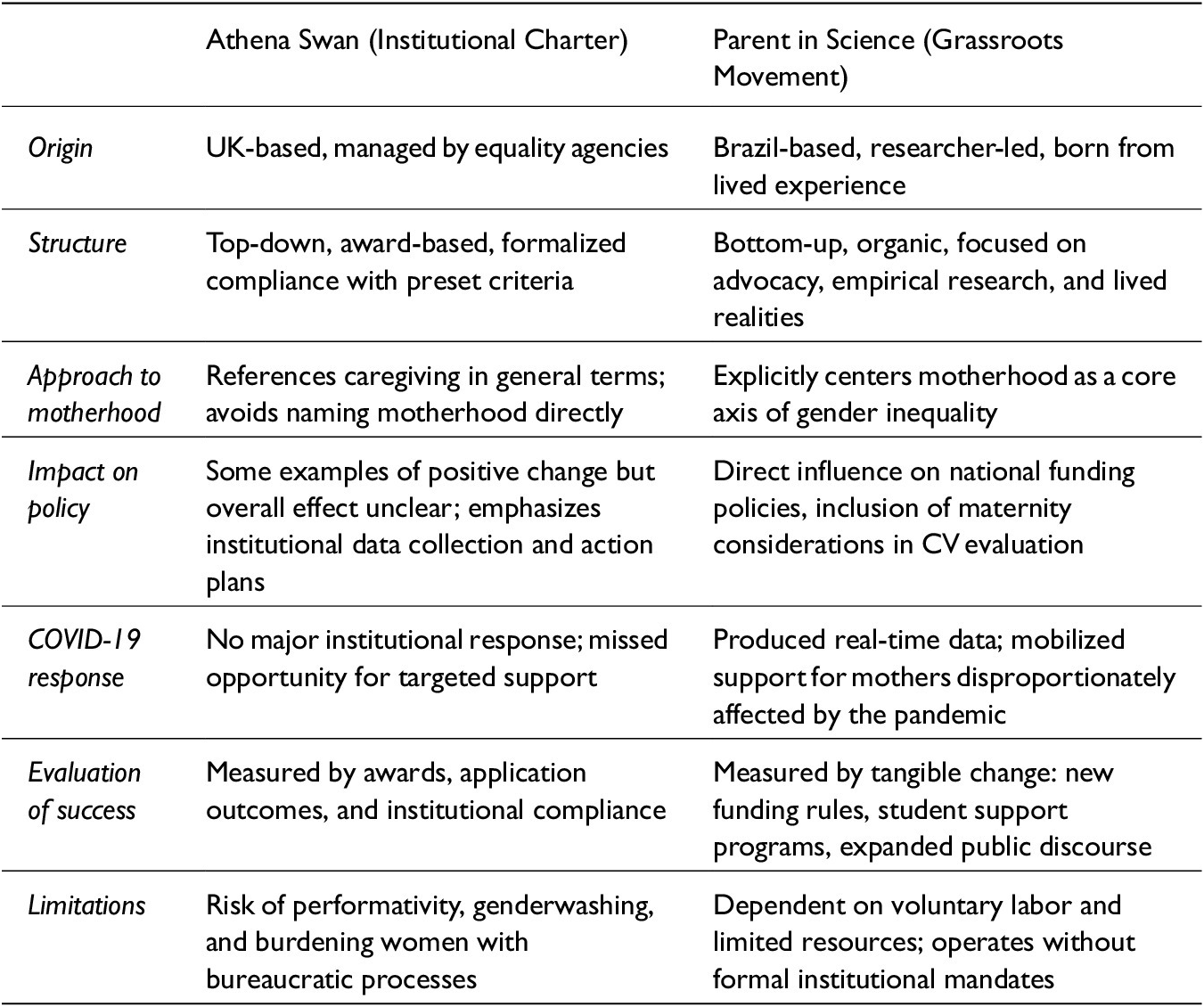
Table 1. Long description
Starting from the top row, the table compares Athena Swan (institutional charter) and Parent in Science (grassroots movement) across seven categories. For origin, Athena Swan is UK-based and managed by equality agencies, while Parent in Science is Brazil-based, researcher-led, and rooted in lived experience. Structure is top-down, award-based, and formalized for Athena Swan, versus bottom-up, organic, and advocacy-focused for Parent in Science. Athena Swan references caregiving broadly and avoids naming motherhood, while Parent in Science explicitly centers motherhood as a core axis of gender inequality. Policy impact for Athena Swan includes some positive change but unclear overall effect, emphasizing institutional data collection and action plans; Parent in Science directly influences national funding policies and includes maternity in C V evaluation. In response to COVID-19, Athena Swan had no major institutional response, missing opportunities for targeted support, while Parent in Science produced real-time data and mobilized support for mothers affected by the pandemic. Success for Athena Swan is measured by awards, application outcomes, and compliance; for Parent in Science, it is measured by tangible change such as new funding rules, student support, and expanded public discourse. Limitations for Athena Swan include risk of performativity, genderwashing, and bureaucratic burden on women; Parent in Science relies on voluntary labor, limited resources, and lacks formal mandates.
Toward a Motherhood-Inclusive Gender Equity Framework
The international expansion of Athena Swan offers a critical opportunity to reassess its priorities and impacts. Yet, the persistent omission of parenthood — and particularly motherhood — from the central agenda reveals a deep disconnect between institutional commitments and the lived realities of academic women. The Parent in Science movement in Brazil shows us that grassroots mobilization can effectively place caregiving responsibilities and intersectional motherhood at the heart of equity work. Their data-driven, politically engaged approach demonstrates that institutional transformation is not about awards tables, but about redesigning policies to reflect the everyday, gendered challenges of academic careers.
Moving forward, we call for gender equality inititatives to explicitly address motherhood as a key dimension of inequality in academic careers. This includes embedding parenthood as a core axis in intersectional analyses; implementing targeted funding and leave policies that acknowledge reproductive timelines; formally recognizing caregiving in performance evaluations; and ensuring that women with caregiving responsibilities are meaningfully included in leadership and governance roles. We also call for a focus on the measurement of tangible outcomes for women over awards. Without these structural shifts, charters like Athena Swan risk serving as symbolic tools that mainly benefit university employers, rather than vehicles of real change for mothers in academia. Learning from the PiS movement in Brazil, the goal should be to build locally responsive frameworks that prioritize measurable inclusion, recognize reproductive and caring labor, and work to dismantle long-standing institutional blind spots.


 Open access

