





1. Introduction
Recalling and expressing emotions is unique to each individual. For example, while some people may display a calm attitude and self-control when confronted with emotionally charged situations, others will be unable to restrain their emotions. This will become evident in the way that they behave, the words that they use and the intensity of their emotional reactions. Emotional intelligence (EI) is an essential component of emotional regulation, behaviour and communication. EI has been conceptualised from different perspectives. According to the ability model developed by Salovey and Mayer (Reference Salovey and Mayer1990), EI refers to the human ability to recognise and understand one's own and other people's emotions and to use this knowledge to regulate one's thoughts and behaviour (Mayer et al., Reference Mayer, Salovey, Caruso, Sternberg and Sternberg2000; Salovey & Mayer, Reference Salovey and Mayer1990). The trait approach proposed by Petrides and Furnham (Reference Petrides and Furnham2000) suggests that EI consists of mental abilities and individual personality traits, such as empathy, adaptability, self-esteem and assertiveness, which influence the way in which people process affective information (Petrides & Furnham, Reference Petrides and Furnham2000, Reference Petrides and Furnham2001; Petrides et al., Reference Petrides, Mikolajczak, Mavroveli, Sanchez-Ruiz, Furnham and Pérez-González2016). Trait EI is believed to be a stable component of personality across the life span (Petrides & Mavroveli, Reference Petrides and Mavroveli2018; Petrides et al., Reference Petrides, Mikolajczak, Mavroveli, Sanchez-Ruiz, Furnham and Pérez-González2016; Vernon et al., Reference Vernon, Petrides, Bratko and Schermer2008).Footnote 1
This study adopted the trait approachFootnote 2 to investigate the extent to which trait EI contributed to the emotional vocabulary that adolescent bilinguals with Spanish as their heritage language (HL) and German as their second language (L2) used in their written autobiographical memories (AMs) of anger and surprise in both their HL and L2. We also collected data from first-language (L1) Spanish and German speakers in order to examine whether similar patterns of emotional vocabulary would emerge in HL Spanish and L1 Spanish, as well as in L1 German and L2 German. Although previous studies of adolescents' EI have mainly focused on L1 speakers, the multilingual societies in which we currently live, which are characterised by an increasing number of L2 users, third-culture individuals, migrants and heritage speakers, have increased the demand for examining how EI influences young bilinguals' abilities to express and regulate their emotions not only in their L1s, but also in their L2s. It is therefore important to take the particularities of each individual into account – both in terms of their personality traits (trait EI in this case) and language background (e.g., without merely using general labels such as “heritage or native speakers” which only provide a limited account of the richness and diversity of the characteristics of their languages; see Darvin & Norton, Reference Darvin, Norton, Li, Hiver and Papi2022) –, as well as the specific features of the emotion elicitation stimuli (e.g., valence and arousal). As emotional processing and emotional expression are very broad terms and require different methodologies and data collection procedures, which component of either processing or expression each study aims to assess must be narrowed down. The current study focuses on emotional expression, and particularly on emotional vocabulary elicited through AMs of different valence.Footnote 3
Our study contributes to bilingualism and emotion research in several ways. First, heritage speakers represent a unique type of bilingualism; they have acquired their heritage language(s) naturally and in affective contexts, which may influence how they regulate and express their emotions (Montrul, Reference Montrul2015, Reference Montrul, Dressman and Sadler2019; Montrul & Polinsky, Reference Montrul and Polinsky2021) – two core facets of EI. Moreover, the number of heritage speakers across Europe – particularly of HL Spanish speakers in Germany – is increasing rapidly (Loureda Lamas et al., Reference Loureda Lamas, Moreno Fernández, Álvarez Mella and Scheffler2020); therefore, more research on these still underrepresented HL contexts is needed to achieve an in-depth understanding of the complexities and particularities of the emotional expression of these minority language groups. Second, although anger is a prototypical negative emotion, surprise has variable affective valence and can generate mixed or ambivalent emotions, which is probably the norm rather than the exception in real-life situations (see Mavrou & Dewaele, Reference Mavrou and Dewaele2020). Previous studies with L1 Spanish and L1 German speakers have found differences in the conceptualisation and emotional processing of anger and surprise (Bormann-Kischkel et al., Reference Bormann-Kischkel, Hildebrand-Pascher and Stegbauer1990; Durst, Reference Durst, Harkins and Wierzbicka2001; Fontaine et al., Reference Fontaine, Scherer and Soriano2013; Oster, Reference Oster, Navarro i and Ferrando2019; Soriano Salinas et al., Reference Soriano Salinas, Fontaine and Scherer2015), but very little is known about how bilinguals who are proficient in both Spanish and German express and verbalise these emotions. Furthermore, the experience of anger and surprise may be expressed differently depending not only on the language that the heritage speakers use (the HL or the L2), but also on their levels of EI (MacCann et al., Reference MacCann, Erbas, Dejonckheere, Minbashian, Kuppens and Fayn2020). This is supported by recent studies revealing that individuals with high trait EI are able to adjust the valence of their emotions and to regulate their arousal levels (Bodrogi et al., Reference Bodrogi, Bereczkei and Deak2022); for example, by experiencing negative emotions less intensely (Gao & Yang, Reference Gao and Yang2023). Third, some recent studies have found that L2 learners with higher levels of trait EI are likely to perform better in L2 writing tasks (Beheshti et al., Reference Beheshti, Nejadansari and Barati2020) and in lexical retrieval tasks targeting emotional words (Mavrou, Reference Mavrou2021; see also Barrett, Reference Barrett2017). However, these studies addressed general language abilities or specific language competences, rather than “contextualised” emotional expression, and this is another gap that the present study aims to fill. The above findings, along with the extensive research on the role of EI in various aspects of emotional processing (e.g., Fiori et al., Reference Fiori, Udayar and Vesely Maillefer2022; Lea et al., Reference Lea, Qualter, Davis, Pérez-González and Bangee2018; Mikolajczak et al., Reference Mikolajczak, Nelis, Hansenne and Quoidbach2008), provide us with reasonable grounds to hypothesise that this positive influence of trait EI on L2 performance and use will also extend to the verbal expression of emotionally charged experiences among heritage speakers, which constitutes an underexplored area of enquiry. Lastly, despite the abundant research using decontextualised stimuli (e.g., pictures of emotional scenes, isolated emotionally charged words or sentences), the current study employed AMs, which are understood as the recall of emotionally meaningful, personal past experiences that provide people with good opportunities to reflect on and verbalise their emotions (Brewer, Reference Brewer and Rubin1986; Fivush, Reference Fivush, Neisser and Fivush1994). It has been suggested that the characteristics of these AMs depend on the narrators' EI (Houle & Philippe, Reference Houle and Philippe2020; Yamamoto & Toyota, Reference Yamamoto and Toyota2013; see also Bohanek et al., Reference Bohanek, Fivush and Walker2005). As Houle and Philippe's (Reference Houle and Philippe2020) study illustrates, those individuals who were able to regulate their emotions appropriately wrote coherent negative AMs in their L1 that were integrated into the story of the personal self, leading to increased levels of personal well-being. We can therefore hypothesise a similar link between AMs narrated by heritage speakers and their levels of EI.
2. Emotional intelligence and bi-/multilingualism
Before discussing the role of EI in emotional expression of heritage and bilingual speakers, which is the focus of the current study, it is important to understand how EI is involved in bi-/multilingualism in general. Recent evidence suggests that multilingualism and trait EI are mutually influential. Daga and Rajan (Reference Daga and Rajan2023) argued that individuals who speak more than one language tend to have high levels of self-reported empathy and trait EI (assessed with the Trait Emotional Intelligence Questionnaire-Short form [TEIQue-SF]). Dewaele et al.'s (Reference Dewaele, Petrides and Furnham2008) study revealed that multilinguals with high trait EI (TEIQue-SF scores) tended to experience less self-perceived anxiety when communicating in their different languages. It has also been suggested that trait EI of adolescents raised in families with a heritage background is influenced by parenting practices. A study by Sung (Reference Sung2010) found that adolescents with Chinese or Korean as their HL and English as their L2 whose parents used rigid and directive parenting practices (i.e., practices based on the values of the heritage culture such as hard work, discipline, saving face, strict family hierarchy or the use of anger to control behaviour) had very low trait EI, which was assessed with the Bar-On Emotional Quotient Inventory (Bar-On, Reference Bar-On2004). Conversely, adolescents with medium or high trait EI had parents who were open-minded and tolerant, adopted English cultural norms to some extent and supported their children's emotional development.
Additionally, trait EI has been found to correlate with bilinguals' linguistic practices and other personality factors. Bilinguals with more extroverted personalities and high trait EI (TEIQue-SF scores) were found to engage in more social interactions and thus developed greater L2 proficiency than did those with more introverted personality traits (Ożańska-Ponikwia, Reference Ożańska-Ponikwia2013; Surahman & Sofyan, Reference Surahman and Sofyan2021). However, introverts were more successful in L2 written tasks, whereas extroverts outperformed their peers in L2 oral tasks (Ożańska-Ponikwia, Reference Ożańska-Ponikwia2018). Furthermore, certain aspects of trait EI, such as adaptability and emotional expression, had a positive influence on the frequency and degree of L2 English use by HL Polish speakers with a migrant background, while assertiveness and emotional regulation emerged as the most influential factors for communicating in L2 English among Polish–English bilinguals without a migrant background (Ożańska-Ponikwia, Reference Ożańska-Ponikwia, Gabryś-Barker and Gałajda2016). Findings such as the ones described above highlight the need to continue investigating EI in multilingual settings, including heritage contexts. Although any comparison between monolingual and heritage/bilingual speakers, or the interaction between EI and other personality traits are topics that go beyond the scope of the current study, the aforementioned evidence points to the same direction: EI is an individual differences factor that appears to play a facilitative role in bilinguals' linguistic practices, and eventually in the emotional vocabulary used by heritage speakers, as will be discussed in the next section.
3. Emotional intelligence and emotional vocabulary
Emotional experience and language use are closely related, as we use words to describe our emotional experiences and explain their affective meaning by providing specific information about their valence and arousal (Barrett, Reference Barrett2004). A rich emotional vocabulary in the L1 has been associated with a wide variety of emotional experiences, and the number of positive and negative words contained in the emotional lexicon has been linked to personal experiences of positive or negative emotional events, respectively (Vine et al., Reference Vine, Boyd and Pennebaker2020). Emotional vocabulary develops and increases in sophistication and diversity throughout adolescence. Bazhydai et al. (Reference Bazhydai, Ivcevic, Brackett and Widen2019) found that emotional vocabulary was richer and more precise in late adolescence, while it was less diverse in early adolescence and mainly consisted of descriptors of emotional states. Similar findings were reported by Ros-Morente et al. (Reference Ros-Morente, Coronel, Ricard-Aranda and Solé-Llussà2022) in a study of L1 Spanish speakers aged between 12 and 16 who performed a 3-minute emotional vocabulary retrieval task; older participants used a greater number of negative words, while females used more emotional (positive and negative) words than did males.
The question that arises is whether having a richer and more diverse emotional vocabulary is a direct consequence of individual differences (such those in EI), beyond the impact of age, previous experiences and other contextual factors which have already been established in the literature. The available evidence suggests that trait EI influences domains in which the use of emotional words is key, such as emotional granularity (i.e., the ability to describe positive and negative states using a wide range of emotional words and concepts; see Lindquist & Barrett, Reference Lindquist, Barrett, Lewis, Haviland-Jones and Barrett2008), emotional awareness (Agnoli et al., Reference Agnoli, Mancini, Andrei and Trombini2019) and alexithymia (Davidson & Morales, Reference Davidson and Morales2022; Taylor & Taylor-Allan, Reference Taylor, Taylor-Allan, Bar-On, Maree and Elias2007). Barrett (Reference Barrett2017) argued that high EI individuals are better equipped to use a wide variety of emotional concepts to describe their emotional states and experiences. Further links have been established between trait EI and emotional word recognition and retention (Lea et al., Reference Lea, Qualter, Davis, Pérez-González and Bangee2018; Mikolajczak et al., Reference Mikolajczak, Roy, Verstrynge and Luminet2009). When it comes to the use of emotional words, Le Hoang and Grégoire (Reference Le Hoang and Grégoire2021) found that L1 Vietnamese children with higher emotional awareness exhibited a richer emotional vocabulary to describe vignettes in which they had to explain the emotions of others. Another study by Mavrou (Reference Mavrou2021) revealed a positive association between trait EI (TEIQue-SF scores) of 174 students who were L1 or L2 Spanish and English speakers and their ability to retrieve emotional words, particularly positive ones. Moreover, the most frequently retrieved emotional words varied in accordance with the language of retrieval, thus suggesting that the emotional vocabulary in the L1 and in the L2 may be processed and represented differently by different speakers.
Research on emotional vocabulary acquisition and use among heritage speakers remains limited, and to our knowledge no study to date has investigated the role of EI in heritage speakers' emotional competencies and vocabularies. By contrast, general vocabulary acquisition in this population has received significant attention and appears to depend on multiple factors including age of onset, the quantity and quality of exposure to the HL, linguistic competence in the societal language, language maintenance and use in the HL community and formal instruction, among others (Montrul, Reference Montrul2015; Polinsky & Scontras, Reference Polinsky and Scontras2020). Heritage speakers have been found to have a smaller general vocabulary in their HL than in their societal language or in comparison to L1 speakers of the HL (Montrul & Mason, Reference Montrul and Mason2020; Montrul & Polinsky, Reference Montrul and Polinsky2021). However, findings pertaining to their emotional – and particularly their productive – vocabulary are scant. Vañó and Pennebaker (Reference Vañó and Pennebaker1997) found that bilingual children of HL Spanish and L2 English exhibited a smaller emotional vocabulary in HL Spanish when describing emotion-evoking pictures. They attributed these results to the reduced opportunities for affective communication in the HL, which mainly took place at home. However, the authors examined exclusively these children's emotional concepts referring to basic emotions (sadness, anger, happiness, fear and guilt), whereby the complete emotional vocabulary remained unexplored. In a more recent study, Driver (Reference Driver2022) investigated the impact of emotional valence on vocabulary learning with a sample of 64 HL Spanish and L2 English bilinguals and 57 students of Spanish as a foreign language from different language backgrounds. The participants were required to read three texts with positive, negative and neutral emotional valence, and were asked to learn a set of positive, neutral and negative words included in each text. The results revealed that retention of words in the neutral and negative texts was more successful, although words with neutral valence had better overall recall. A qualitative analysis further indicated that the emotional meaning and the affective arousal of the texts played a beneficial role in vocabulary learning, particularly when the topics concerned emotionally significant personal experiences.
4. The current study
Previous research has suggested that EI (both trait EI and ability EI) influences individuals' abilities to express their emotions in both positive and negative ways (Bodrogi et al., Reference Bodrogi, Bereczkei and Deak2022; Gao & Yang, Reference Gao and Yang2023; Larsen, Reference Larsen, Leary and Hoyle2009; Larsen & Augustine, Reference Larsen, Augustine and Elliot2008). However, evidence concerning the specific linguistic elements that are determined by EI – specifically trait EI – is scarce and has been largely obtained from L1 speakers (see, e.g., Alba-Juez & Pérez-González, Reference Alba-Juez, Pérez-González, Mackenzie and Alba-Juez2019). Studies of trait EI among bilingual speakers have mainly focused on general language proficiency (Ożańska-Ponikwia, Reference Ożańska-Ponikwia2013, Reference Ożańska-Ponikwia2018; Surahman & Sofyan, Reference Surahman and Sofyan2021) or on the emotional words that were used in somewhat neutral production tasks (Mavrou, Reference Mavrou2021). Nevertheless, the role of EI may become more evident when we reflect on and describe affective states and emotions related to our personal experiences. To the best of our knowledge, the present study is the first to investigate the role of EI in the productive emotional vocabulary of adolescent HL Spanish–L2 German bilinguals as elicited via their personal AMs of anger and surprise in both their HL and L2. Furthermore, we collected data from L1 Spanish and L1 German speakers based on the same AMs in order to examine whether similar patterns of emotional vocabulary would emerge in HL Spanish and L1 Spanish, as well as in L1 German and L2 German. The following research questions guided our study:
(1) To what extent do trait EI, the language of retrieval and the valence of the AMs influence the number of emotional (positive and negative) words produced by adolescent HL Spanish–L2 German bilinguals in their written AMs of anger and surprise in HL and L2? Are similar patterns observed in the same AMs of anger and surprise produced by L1 Spanish speakers and L1 German speakers?
(2) To what extent do trait EI, the language of retrieval and the valence of the AMs influence the number of high-arousal words produced by adolescent HL Spanish–L2 German bilinguals in their written AMs of anger and surprise in HL and L2? Are similar patterns observed in the same AMs of anger and surprise produced by L1 Spanish speakers and L1 German speakers?
(3) To what extent do trait EI, the language of retrieval (HL/L2) and the valence of the AMs (anger versus surprise) influence the diversity of these participants' emotional vocabularies?
We hypothesised that high trait EI participants would describe their experiences of anger and surprise using a broader emotional vocabulary in terms of positive/negative and high-arousal words (Barrett, Reference Barrett2017; Mavrou, Reference Mavrou2021). We further speculated that high trait EI participants would use a more diverse emotional vocabulary, regardless of the valence of their AMs (Beheshti et al., Reference Beheshti, Nejadansari and Barati2020; Le Hoang & Grégoire, Reference Le Hoang and Grégoire2021). With regard to language status and following previous studies involving early or balanced bilinguals (Ferré et al., Reference Ferré, García, Fraga, Sánchez-Casas and Molero2010; Vañó & Pennebaker, Reference Vañó and Pennebaker1997; Vargas Fuentes et al., Reference Vargas Fuentes, Kroll and Torres2022), we expected that our bilingual participants would retrieve more emotional words in their L2 German. We also hypothesised that bilinguals' emotional vocabulary would be less diverse in their HL Spanish than in their L2 German due to the reduced availability of general vocabulary in the HL (Montrul & Polinsky, Reference Montrul and Polinsky2021). Regarding the valence of the AMs, our hypothesis was that AMs of anger would elicit more emotional words because events with negative valence and high levels of emotional arousal are likely to be recalled in more detail than neutral or positive events (Chae et al., Reference Chae, Goodman and Edelstein2011; Earles et al., Reference Earles, Kersten, Vernon and Starkings2016; Kensinger, Reference Kensinger2007; Talarico et al., Reference Talarico, Berntsen and Rubin2009). By contrast, we expected AMs of surprise to be described in a less elaborate way, i.e., with the use of fewer negative, positive and high-arousal words.
5. Method
5.1 Participants
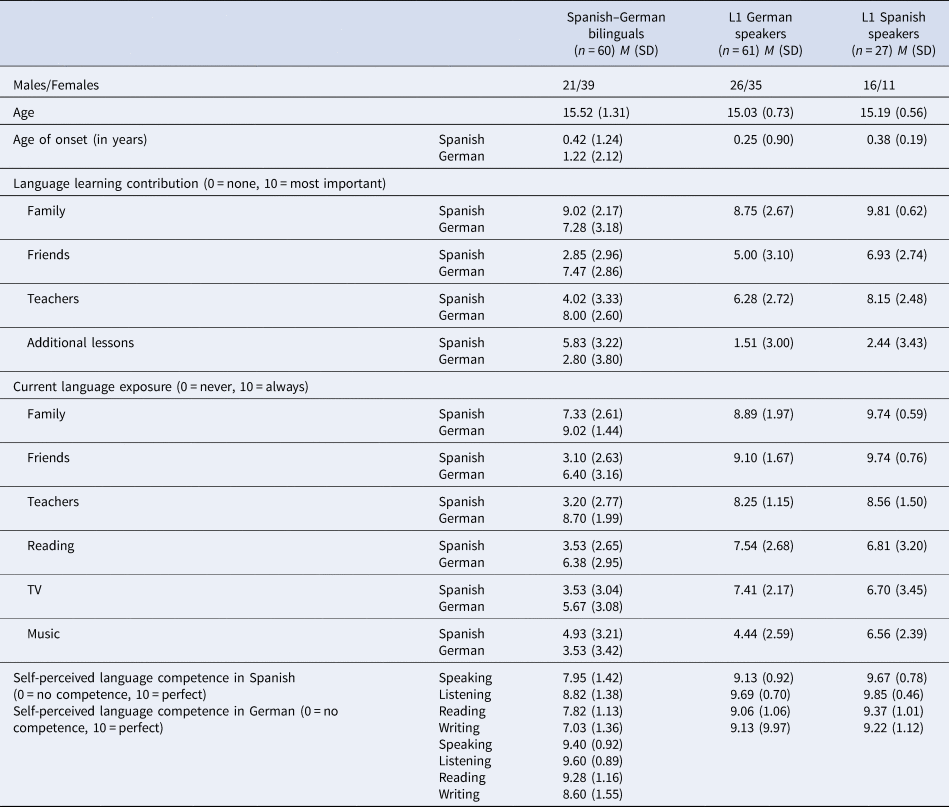
The sample consisted of 148 adolescents aged between 13 and 18; there were 60 HL Spanish–L2 German bilinguals, 27 L1 Spanish speakers and 61 L1 German speakers. The Spanish–German bilinguals had been raised in Germany, and most of them had grown up in bicultural Spanish and German families (n = 53), while the remainder (n = 8) had L1 Spanish or HL Spanish parents. All of the bilingual speakers attended C1/C2 CEFR level (Council of Europe, 2001) Spanish language and culture classes (ALCE) in different German cities. ALCE is an extracurricular educational project that is supported by the Ministry of Education and Vocational Training of the Government of Spain and aims to promote the Spanish language and culture among child and adolescent heritage speakers in Germany. Although German was the main language of communication and socialisation in their environment (with friends and at school), they had acquired Spanish from their parents and mainly used it with their families. The L1 Spanish and the L1 German speakers attended secondary schools in Spain and Germany, respectively. All the L1 Spanish and L1 German speakers reported speaking only or mainly their L1 (Spanish and German, respectively) with their parents, teachers and peers. Information about the participants' demographic and language backgrounds, as collected via the pencil-and-paper children's version of the Language Experience and Proficiency Questionnaire (Marian et al., Reference Marian, Blumenfeld and Kaushanskaya2007), is summarised in Table 1.Footnote 4
Descriptive statistics for participants' language background
5.2 Procedure
Permission to conduct the study was obtained from the three governmental institutions involved in the education of the participants. The participants and their parents or legal caregivers were informed about the aims and procedures of the study via a letter that was distributed by the adolescents' teachers. All the parents or legal guardians, as well as the participants themselves, provided their written consent. Data collection took place during normal school hours. The participants wrote the AMs using writing templates that were provided by the first researcher (see next section for a detailed description of the prompts). The order of the AMs that they had to write (anger/surprise) was counterbalanced, and the instructions were given in the language in which they had to write each AM. The bilingual participants wrote four AMs in total – two about anger and two about surprise – in their respective languages (Spanish and German), while the L1 speakers wrote two AMs – one for each emotion – in their L1. The bilingual participants started with the AMs in Spanish to avoid the influence of German, the language in which they were slightly more proficient. The participants were not allowed to use additional resources, such as paper or online dictionaries and electronic devices (mobile phones or laptops), nor were they allowed to consult their classmates or their teacher. However, if they had questions regarding the completion of the AMs, they were encouraged to ask the first researcher, who was present during the entire data collection. After writing the AMs, the participants were asked to complete the TEIQue version for adolescents (TEIQue-ASF). The study was conducted in compliance with the Declaration of Helsinki and the ethical principles for research developed by the American Psychological Association.
5.3 Measures
5.3.1 Autobiographical memories
AM retrieval is a valid and widely implemented method in cognitive psychology and in linguistic research (Mills & D'Mello, Reference Mills and D'Mello2014; Rubin, Reference Rubin, Wenzel and Rubin2005; Schrauf & Durazo-Arvizu, Reference Schrauf, Durazo-Arvizu and Pavlenko2006). AM recall involves two components: the knowledge related to the memory of the event and the activation of the emotional state experienced during the event (Mills & D'Mello, Reference Mills and D'Mello2014). The prompts for the AMs were created in accordance with previous studies that also used a similar emotion elicitation method to examine the bilingual emotional vocabulary (e.g., Ho, Reference Ho2009; Marian & Kaushanskaya, Reference Marian and Kaushanskaya2008). All the participants were asked to write AMs of anger and surprise based on the following prompt: “Write about a real personal experience in which you felt particularly angry/surprised in Spanish/German. Your text should be about one page long and you should complete the task in about 15 minutes”. Participants were instructed to recall and include as much detail as possible about their emotions before, during and after the event in their AMs, as well as what they said and how they said it, how they acted, their physical response, their age, the other people involved and the consequences. A total of 416 AMs were collected and analysed, of which 230 reported events that occurred during adolescence and 80 events that took place during childhood (5 in early childhood and 75 in middle and late childhood). For the remaining 106 AMs no specific time frame was provided, although the context suggested that the event was recent, i.e., during adolescence.
5.3.2 Emotional intelligence
The participants' EI was assessed via the short version of the Trait Emotional Intelligence Questionnaire for adolescents (TEIQue-ASF; Petrides et al., Reference Petrides, Mikolajczak, Mavroveli, Sanchez-Ruiz, Furnham and Pérez-González2016; Siegling et al., Reference Siegling, Vesely, Saklofske, Frederickson and Petrides2017). Bilingual participants had the option of completing the questionnaire either in Spanish or in German, while L1 speakers completed the questionnaire in their respective L1s. The TEIQue-ASF consists of 30 statements that assess four EI domains, namely well-being, self-control, emotionality and sociability. The participants were required to indicate their level of agreement with each statement using a 7-point Likert scale (1 = totally disagree, 7 = totally agree). The average score for each participant was calculated after applying reverse scoring procedures to a number of items, as recommended by the authors of the questionnaire. Internal consistency was satisfactory: for bilinguals, Cronbach's α = .826, 95% confidence interval (CI) [.783, .863], for L1 German speakers, Cronbach's α = .856, 95% CI [.797, .902] and for L1 Spanish speakers, Cronbach's α = .848, 95% CI [.743, .917].
5.4 Affective vocabulary analysis
The handwritten AMs were transcribed, and the texts were lemmatised according to the guidelines of the Real Academia Española (2023) for Spanish and the Dudenredaktion (2023) for German. EmoFinder (Fraga et al., Reference Fraga, Guasch, Haro, Padrón and Ferré2018) and the Automatically Generated Norms (AGN) of abstractness, arousal, imageability and valence for 350,000 German lemmas (Köper & Im Walde, Reference Köper, Im Walde, Calzolari, Choukri, Declerck, Goggi, Grobelnik, Maegaard, Mariani, Mazo, Moreno, Odijk and Piperidis2016) were employed to establish the affective vocabulary in Spanish and in German, respectively. These databases provide ratings of valence and arousal using different scales. Therefore, the AGN scale .00–10.00 (min, max) was normalised using the EmoFinder scale 1.00–9.00(a, b) by applying the algorithm f(x) = (b − a)(x − min)/(max − min) + a. Words were then classified according to their valence as negative (1.00–3.99), neutral (4.00–5.99) or positive (6.00–9.00) (Hinojosa et al., Reference Hinojosa, Martínez-García, Villalba-García, Fernández-Folgueiras, Sánchez-Carmona, Pozo and Montoro2016). Negative (e.g., accident) and positive (e.g., friend) words are considered to be affectively charged, as opposed to neutral ones (e.g., streetlight). In our study, emotional words represented the sum of negative and positive words. With regard to arousal, the cut-off points were 1.00–4.99 for low-arousal words and 5.00–9.00 for high-arousal words (Guasch et al., Reference Guasch, Ferré and Fraga2016; Võ et al., Reference Võ, Conrad, Kuchinke, Urton, Hofmann and Jacobs2009). Emotional tokens and emotional types were estimated using V_Words v2.0 (Meara & Miralpeix, Reference Meara and Miralpeix2016). The diversity of the emotional vocabulary was assessed using the Uber index (Jarvis, Reference Jarvis2002, Reference Jarvis, Jarvis and Daller2013) which is based on the algorithm LG10(Tokens)2/(LG10(Tokens) − LG10(Types)).
5.5 Data analysis
Linear mixed-effects regression models were computed in RStudio 2023.03.1 (Posit Team, 2023) using the lmer function in the lme4 package (Bates et al., Reference Bates, Maechler, Bolker and Walker2015), and the performance package (Lüdecke et al., Reference Lüdecke, Ben-Shacha, Patil, Waggoner and Makowski2021), which was used to calculate the indices of model performance. We checked model assumptions using residuals versus fitted plots, normal probability plots and variance inflation factor (VIF) values. Although the assumptions were generally met, we also computed the same models using the robust function (Wang et al., Reference Wang, Zamar, Marazzi, Yohai, Salibian-Barrera, Maronna, Zivot, Rocke, Martin, Maechler and Konis2022). The language used in the AMs of the heritage speakers (HL Spanish, L2 German), the valence of the AMs (anger versus surprise), trait EI and gender were introduced as fixed effects, participant ID as random effects and emotional words, high-arousal words and the diversity of the emotional vocabulary as the outcome variables (see Table 3 for a summary of these models). We also included an interaction term for the language used in the AMs and the valence of the AMs, but as this did not improve the fit of the models, it was removed from the final analyses, except for one case – the model that tested high-arousal words in the bilingual group in which the interaction term resulted in statistical significance and was therefore maintained.
6. Results
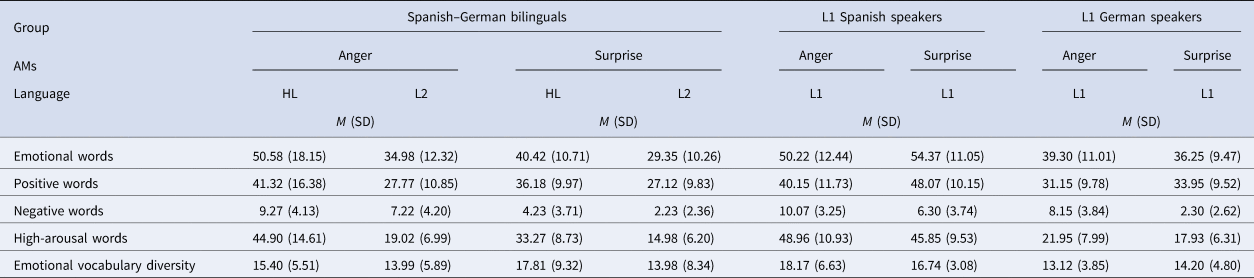
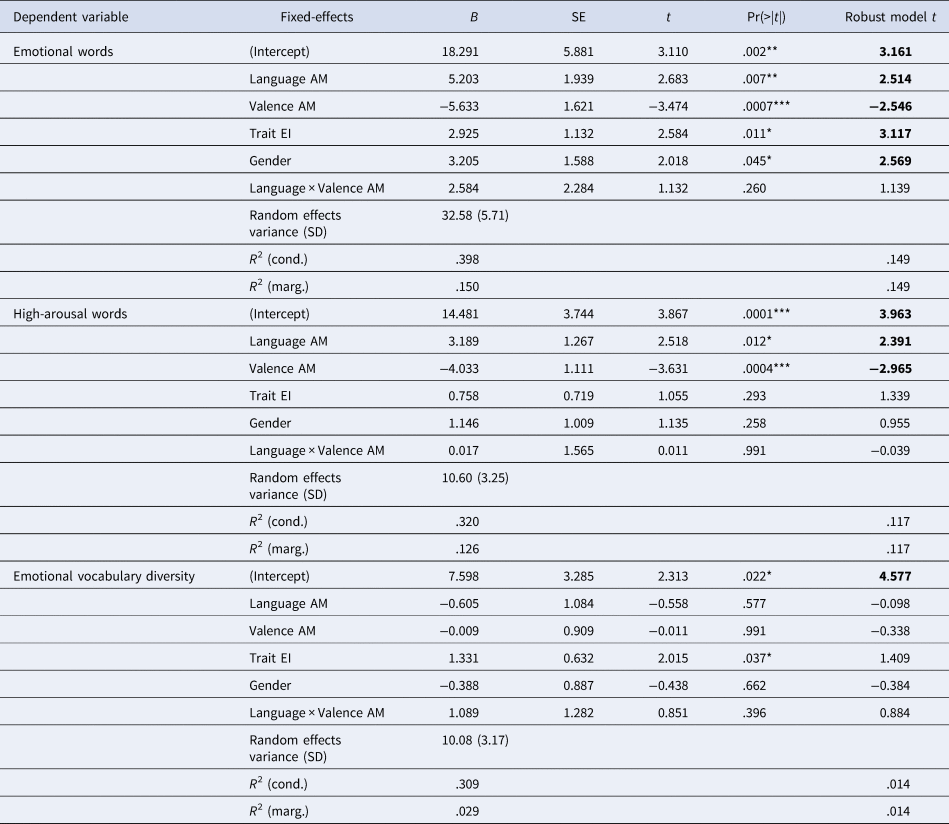
Descriptive statistics for the number of emotional (positive and negative) words, the number of high-arousal words and the diversity of the total number of emotional words per group (heritage speakers, L1 speakers), language (HL, L1, L2) and valence of the AMs (anger, surprise) are summarised in Table 2. The results of the statistical models (Table 3) revealed a main effect of the language of retrieval and the valence of the AMs on emotional vocabulary; that is, our bilingual participants used more emotional (positive and negative) and high-arousal words in their AMs in the HL and in their AMs of anger. In addition, a statistically significant interaction was found in that our bilingual participants used a significantly greater number of high-arousal words in their AMs of anger that they wrote in their HL. Trait EI was a statistically significant predictor of both the number of emotional words (B = 5.696, t = 3.449, p = .001) and the number of high-arousal words that the participants produced (B = 3.272, t = 2.756, p = .007). The diversity of the emotional vocabulary was only predicted by the language of retrieval; that is, the participants used more diverse emotional words in their AMs in the HL. Separate yet complementary models for negative and positive words were computed and revealed that the language of retrieval and the valence of the AMs predicted the number of negative words, with AMs in the HL (Spanish) and AMs about anger including a significantly higher number of negative words compared to the AMs in the L2 (German) and the AMs about surprise. Furthermore, the language of retrieval (t = −8.510, p < .001), EI (t = 3.700, p = .0004) and gender (t = 2.355, p = .022) contributed significantly to the number of positive words; that is, female participants and those participants with higher trait EI produced more positive words in their AMs in the HL, particularly in those AMs about anger (t = −2.176, p = .031).
Descriptive statistics for the affective vocabulary per group, language of retrieval and valence of the AMs
Emotional vocabulary as a function of language (HL Spanish versus L2 German), valence of the AMs (anger versus surprise), trait EI and gender (bilingual speakers only)
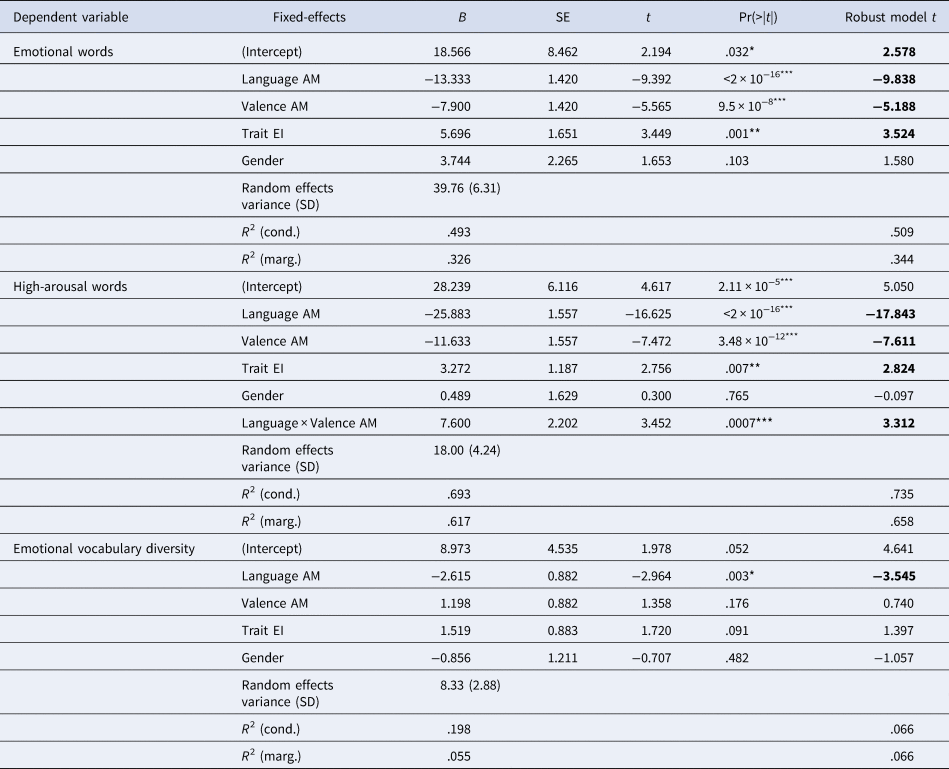
*p < .05, **p < .01, ***p < .001. Statistically significant t-values for the robust models are marked in bold.
The aforementioned models for emotional words, high-arousal words and emotional vocabulary diversity were replicated in order to examine differences between the AMs in HL Spanish produced by our bilingual participants and the AMs in L1 Spanish written by our L1 Spanish speakers (see Table 4), as well as between the AMs in L2 German (bilingual participants) and the AMs in L1 German (L1 German participants) (see Table 5). In what follows, we only focus on the results that complement the previous analyses. Specifically, no considerable differences were observed between heritage speakers of Spanish and L1 Spanish speakers in the emotional vocabulary (number of positive/negative and high-arousal words) they used in their AMs in Spanish. Moreover, both groups tended to use a greater number of these words in their AMs about anger as compared to their AMs about surprise. However, L1 Spanish speakers used a significantly greater number of both emotional words and high-arousal words in their AMs about surprise events. The comparison of the affective vocabulary in the AMs in L2 German (heritage speakers) and L1 German (L1 German speakers) further revealed a main effect of the language used and the valence of the AMs, that is, the AMs in L1 German included a significantly greater number of emotional (positive/negative) and high-arousal words than the AMs in L2 German, as did the AMs about anger compared to the AMs about surprise.
Comparison of the affective vocabulary in the AMs in HL Spanish (heritage speakers) versus L1 Spanish (L1 Spanish speakers)
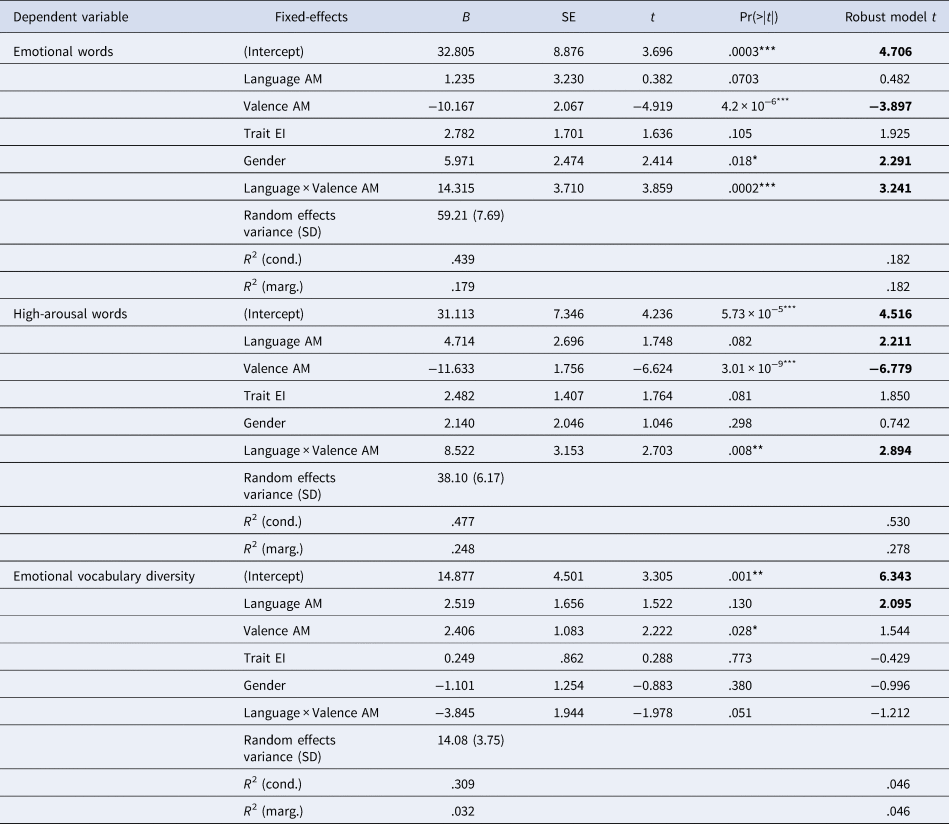
*p < .05, **p < .01, ***p < .001. Statistically significant t-values for the robust models are marked in bold.
Comparison of the affective vocabulary in the AMs in L2 German (heritage speakers) versus L1 German (L1 German speakers)
*p < .05, **p < .01, ***p < .001. Statistically significant t-values for the robust models are marked in bold.
7. Discussion
EI is considered to be the key to success in interpersonal relationships, academic and professional settings and for mental well-being. Heritage speakers may also benefit from a developed EI when expressing their emotions; this hypothesis motivated our study. Specifically, we investigated the extent to which trait EI contributed to the emotional vocabulary that adolescent bilinguals with HL Spanish and L2 German used in their AMs of anger and surprise in both their HL and L2. Data from L1 Spanish and L1 German speakers were also gathered to explore whether similar emotional vocabulary patterns would be observed in Spanish L1 and HL and in German L1 and L2.
Overall, the results revealed that our bilingual participants who scored higher for trait EI used more emotional vocabulary, confirming our hypothesis that emotionally intelligent bilingual speakers are likely to describe their emotions in more detail (i.e., using more emotional words) because they are better aware of their emotional states and more well-equipped to reflect on them (Barrett, Reference Barrett2017; Mavrou, Reference Mavrou2021; Petrides & Furnham, Reference Petrides and Furnham2001; Petrides et al., Reference Petrides, Mikolajczak, Mavroveli, Sanchez-Ruiz, Furnham and Pérez-González2016). Emotionally intelligent bilinguals may also be more adept in the use of a greater amount of emotional vocabulary because they have more emotional concepts at their disposal due to speaking two languages (Paradis, Reference Paradis2008; Pavlenko, Reference Pavlenko2005).Footnote 5 With regard to arousal, our results revealed that high trait EI heritage speakers exhibited greater emotional expressivity in that they used more high-arousal words in their AMs as compared to low trait EI heritage speakers. As previous studies have suggested, the recall of emotionally charged AMs is closely related to expressive writing: individuals with high EI appear to be more confident, possibly because they have fewer inhibitions about writing and communicating highly intense personal emotional experiences (Bohanek et al., Reference Bohanek, Fivush and Walker2005; Pennebaker & Chung, Reference Pennebaker, Chung, Friedman and Silver2007; Yamamoto & Toyota, Reference Yamamoto and Toyota2013). Moreover, as our participants were adolescents, they may have been more prone to expressing their emotions with particular intensity (Coe-Odess et al., Reference Coe-Odess, Narr, Allen, LoBue, Pérez-Edgar and Buss2019; Denham, Reference Denham, LoBue, Pérez-Edgar and Buss2019). However, it is important to note that trait EI was only associated with the number of emotional words, not with emotional vocabulary diversity. Although this result contradicts previous studies (Beheshti et al., Reference Beheshti, Nejadansari and Barati2020; Le Hoang & Grégoire, Reference Le Hoang and Grégoire2021), any discrepancies could be attributed to methodological differences; for example, Beheshti et al. (Reference Beheshti, Nejadansari and Barati2020) considered general (rather than emotional) lexical diversity, whereas Le Hoang and Grégoire (Reference Le Hoang and Grégoire2021) focused on the link between emotional awareness and emotion-related types and tokens.
Furthermore, the language of retrieval proved to be a significant determinant of the emotional vocabulary used by our bilingual participants. The results revealed that AMs in the HL contained a greater number of emotional and high-arousal words and more diverse affective vocabularies than the AMs in L2 German. In other words, the HL – Spanish in our study – emerged as a particularly emotional language when recalling AMs, even if our participants self-reported a slightly lower proficiency level in their HL Spanish compared with the societal language (German). Although this finding differs from previous studies among bilinguals that used retrieval tasks or decontextualised emotional situations (Ferré et al., Reference Ferré, García, Fraga, Sánchez-Casas and Molero2010; Vañó & Pennebaker, Reference Vañó and Pennebaker1997; Vargas Fuentes et al., Reference Vargas Fuentes, Kroll and Torres2022), it allows us to conclude that the use of AMs as a methodological technique may provide useful information by uncovering heritage speakers' emotional competences. Using this technique, our study found that emotional vocabulary is particularly salient in the HL, especially when heritage speakers have the opportunity to express and explain their emotions in relation to contextualised memories that have a personal meaning for them. Notably, previous evidence suggested that heritage speakers had limited general vocabulary in their HL due to a lack of input, fewer opportunities to practice the HL and fewer people to communicate with in the HL (Belpoliti & Bermejo, Reference Belpoliti and Bermejo2019; Montrul & Mason, Reference Montrul and Mason2020; Montrul & Polinsky, Reference Montrul and Polinsky2021). However, the same factors that were considered limiting (intimate and affective contexts of language use, and interlocutors who are family members and loved ones) may actually provide an advantage for emotional vocabulary development, or the development of this vocabulary in the HL may be less dependent on the frequency and more on the quality of interactions (Daskalaki et al., Reference Daskalaki, Blom, Chondrogianni and Paradis2020; Gollan et al., Reference Gollan, Starr and Ferreira2015).
To explain the above results, it is necessary to consider differences between the HL and the societal or majority language. The HL is acquired naturally and in emotionally charged contexts through interactions with parents and other family members – contexts in which positive affect and the expression of emotions tend to play important roles – whereas heritage speakers' L2s are usually acquired through later socialisation in educational contexts (Montrul, Reference Montrul, Dressman and Sadler2019; Pavlenko, Reference Pavlenko2008, Reference Pavlenko2012; Shablack & Lindquist, Reference Shablack, Lindquist, LoBue, Pérez-Edgar and Buss2019). Moreover, the HL is acquired during early childhood, a sensitive and malleable life stage in which linguistic and emotional regulation systems develop simultaneously (Bloom & Beckwith, Reference Bloom and Beckwith1989; Cole et al., Reference Cole, Armstrong, Pemberton, Calkins and Bell2010), which could influence the way in which bilinguals (learn to) express their emotions in their HL. Another plausible explanation relates to the specific target languages examined in this study, in that Spanish (the HL) is considered to be a more emotionally expressive language than is German (Barañano et al., Reference Barañano, Zlobina and Rovira2004; Den Ouden, Reference Den Ouden2016; Rehbein, Reference Rehbein, Rupp, Zelno, Dalipi and Scheitza2011).
The results of our study further suggested that the emotional event that was recalled influenced the emotional vocabulary, at least to some extent. In line with our hypothesis, AMs about anger contained more emotional words and more high-arousal words than did AMs about surprise (with AMs of surprise in L2 German being the least emotional). Both anger and surprise are high-arousal emotions but have different durations (Fontaine et al., Reference Fontaine, Scherer and Soriano2013; Soriano Salinas et al., Reference Soriano Salinas, Fontaine and Scherer2015). While anger tends to be a prolonged emotion, often involving rumination, surprise is experienced briefly giving rise to other emotions (Scherer et al., Reference Scherer, Wranik, Sangsue, Tran and Scherer2004). Therefore, the above finding could be attributed to the increased memorability of negative emotions because they serve adaptive functions or are discussed more frequently and in more detail (Chae et al., Reference Chae, Goodman and Edelstein2011; Earles et al., Reference Earles, Kersten, Vernon and Starkings2016; Kensinger, Reference Kensinger2007; Talarico et al., Reference Talarico, Berntsen and Rubin2009), as well as to the greater or prolonged intensity with which anger is usually experienced, which could lead to more expressivity (Alia-Klein et al., Reference Alia-Klein, Gan, Gilam, Bezek, Bruno, Denson, Hendler, Lowe, Mariotti, Muscatello, Palumbo, Pellegrini, Pietrini, Rizzo and Verona2020). The fact that the valence of the AMs did not influence emotional vocabulary diversity could be due either to methodological issues (e.g., the lexical diversity measure used in the current study) or to the wide range of extralinguistic factors which are more closely related to general lexical diversity, such as individual development of language skills (David & Wei, Reference David and Wei2008), age and educational level (Sankoff & Lessard, Reference Sankoff and Lessard1975), the topics addressed in the AMs (see Van Gijsel et al., Reference Van Gijsel, Speelman and Geeraerts2006) and cognitive anxiety (Bradac et al., Reference Bradac, Bowers, Courtright, Clair and Giles1980), to mention just a few.
It is interesting that our bilingual participants employed a significantly higher number of high-arousal words in their AMs of anger in their HL. High-arousal words in an HL are acquired through emotional and sensory experiences (Bloom & Beckwith, Reference Bloom and Beckwith1989), which explains why these words may be used more frequently in the HL than in the L2. In addition, challenging behaviours may arise during adolescence (such as rebellious attitudes, breaking the norms, problems at school or disagreements with parents), thus triggering emotionally charged or aggressive behaviours that are more likely to be exteriorised in the HL – the language of the heart (McKay, Reference McKay, Williams and Thurlow2005; Shooter & Bailey, Reference Shooter and Bailey2010).
Finally, it is important to highlight both the similar and dissimilar emotional vocabulary patterns that emerged from the comparisons between AMs in L1 Spanish and HL Spanish and between AMs in L1 German and L2 German. First, despite the differences in self-reported Spanish proficiency level between our heritage speakers and L1 Spanish speakers, both of them used a similar number of emotional words in their AMs in Spanish, which was significantly greater in their AMs of anger. Anger is experienced very often during adolescence, especially at home with parents (Coe-Odess et al., Reference Coe-Odess, Narr, Allen, LoBue, Pérez-Edgar and Buss2019; Denham, Reference Denham, LoBue, Pérez-Edgar and Buss2019). As almost all the parents of our Spanish HL and L1 participants were Spanish speakers themselves, it is likely that they also made a similar use of emotional vocabulary in situations of anger with their children at home – vocabulary which was later acquired by or was more accessible to their children. However, L1 Spanish speakers produced more emotional words in their AMs of surprise in Spanish than did our heritage speakers, which could be explained by the fact that surprise is experienced less frequently than other emotions (Scherer et al., Reference Scherer, Wranik, Sangsue, Tran and Scherer2004). Therefore, our bilingual participants might have had fewer available emotional words in their HL that they could associate with the emotion of surprise as they probably had fewer opportunities to experience this emotion and to acquire and practice the corresponding vocabulary in that HL, whereas L1 speakers might have had more opportunities to do so given their relatively more extensive use of their L1. Second, our L1 German speakers used more emotional words than did our bilingual participants in their AMs in L2 German. This may be due to emotional words being richer and more deeply encoded in the L1 than in the L2 (Altarriba et al., Reference Altarriba, Bauer and Benvenuto1999); similarly, the retrieval of high-arousal words appears to be more prominent in the L1 than in the L2 (Baumeister et al., Reference Baumeister, Foroni, Conrad, Rumiati and Winkielman2017). Taken together, these results indicate that for our bilingual group the HL functioned as the language of the heart, although they were highly socialised in the majority language. We also found that AMs of anger in German (L1 and L2) included more emotional words than AMs of surprise. This result could be explained by the fact that people from individualistic societies (such as Germany) tend to express anger more openly as they highly value their personal needs (Holodynski, Reference Holodynski2006; Matsumoto et al., Reference Matsumoto, Yoo, Chung, Potegal, Stemmler and Spielberger2010; Mesquita & Frijda, Reference Mesquita and Frijda1992), and this may provide them with more emotional-linguistic resources to express this emotion in German.Footnote 6
Nevertheless, our study is not without limitations. We only analysed written AMs, which might have conferred an advantage on our introverted participants, while oral AMs may have been more appropriate for extroverts (Ożańska-Ponikwia, Reference Ożańska-Ponikwia2018). Moreover, these AMs are sensitive to time (Friedman & de Winstanley, Reference Friedman and de Winstanley1998), thus future studies need to consider the temporal distance of past events narrated in AMs. In addition, trait EI is a multidimensional construct. The TEIQue-ASF used in this study assesses four components of trait EI, namely well-being, self-control, emotionality and sociability. Due to space limitations we did not run statistical models for each trait EI dimension separately. However, we encourage future studies to conduct more in-depth analyses of the link between emotional vocabulary in L1/HL and different facets of multidimensional constructs such as EI, as well as to use alternative theoretical models and measurements to test not only trait EI but also ability EI. Furthermore, future studies should include indices of general vocabulary knowledge to disentangle whether differences in emotional vocabulary between heritage speakers and L1 or late L2 users may be due to differences in overall vocabulary size; if not, they should proceed to collect data related to broader contextual and social factors (see Kupisch & Rothman, Reference Kupisch and Rothman2018; Rothman et al., Reference Rothman, Bayram, DeLuca, Di Pisa, Duñabeitia, Gharibi, Hao, Kolb, Kubota, Kupisch, Laméris, Luque, van Osch, Soares, Prystauka, Tat, Tomić, Voits and Wulff2023, for discussions on this matter). Another important caveat refers to the analysis of the emotional vocabulary, which was limited to the word level. To overcome this limitation, holistic perspectives that consider the affective tone of the AMs and the emotional effects that these AMs arouse in L1 speakers would advance our understanding of heritage speakers' emotional discourse. Less studied emotions, such as solitude, anxiety or blended emotions, are also worthy of consideration in this line of enquiry.
8. Conclusions and implications
This study led to three main conclusions. First, trait EI appears to be a proxy for the breadth of emotional vocabulary used by heritage speakers to express their emotional states and experiences, at least with regard to anger and surprise. Second, the HL of adolescent bilinguals remains the language of the heart – the language that triggers more emotional vocabulary, affective expressivity and a varied emotional repertoire in comparison to the societal language. Third, AMs about negative emotions (anger in this study) elicited a greater emotional and expressive vocabulary than did AMs about positive or dynamic emotions, such as surprise.
The relationship between EI and emotional vocabulary has broad implications for linguistic research, educational policies and health services. The ability to express emotions appears to be inherently individual rather than language specific, albeit partly. Therefore, our study calls for a more careful consideration of emotional abilities and personality factors in studies that investigate emotional vocabulary and the expression of emotion among bi-/multilinguals, including heritage speakers, migrants and third culture individuals. Regarding language pedagogy, the teaching of emotional vocabulary and emotional expression should occupy an important position in L2/HL curricula and classrooms. HL teaching needs to be learner-centred and to make use of both the HL and the societal language. This would allow bilingual speakers to reflect on the differences between their HL and their L2 when expressing their moods and emotional states, and to increase their awareness of the cross-linguistic and cross-cultural differences between their languages; this would ultimately enable them to manage the communication challenges in multilingual societies in the twenty-first century.
Additionally, emotional vocabulary, particularly in the HL, becomes an external mirror of adolescents' inner psycho-emotional states and personalities and can serve as a diagnostic and therapeutic tool to be used by educators and health professionals to identify and treat potential socio-emotional and behavioural maladjustments sufficiently early (Yun et al., Reference Yun, Jenicek and Gerdes2019). This is becoming increasingly relevant in the case of young refugees who have had traumatic experiences, as well as with regard to multilingual adolescents in foster care or who are experiencing vulnerable mental health circumstances. Yun et al. (Reference Yun, Jenicek and Gerdes2019) argued that “We can't start treatment until we hire a bilingual therapist” (p. 511). Therefore, language barriers should be addressed early and resolved effectively in the health care system. Furthermore, when an emotional barrier among young multilinguals and their parents, educators or therapists is created, being able to establish communication using the multilingual's different languages may be key to gaining access to their emotions and feelings and providing them with appropriate support (Serrani, Reference Serrani2023), as their ability to express their feelings may be more developed in one of their languages than in another.
The findings of our study have broader implications for other fields, such as human resources and population sciences. In the job market, recruiters may need to conduct interviews in multilinguals' or heritage speakers' different languages to gain insights into their personalities and to better assess their suitability for different positions. Governmental data collection tools, such as surveys that are used to obtain population-representative statistics measuring parameters related to psychological well-being, such as the psychological effects of isolation during a pandemic situation or the impact of home schooling on the mental health of children and adolescents, should allow multilingual speakers to express their emotions and opinions in their preferred language, possibly in their L1 if providing these data in their L2 may lead to biased or skewed results. We can only achieve more inclusive societies and ensure that all citizens benefit from equal opportunities by taking the diversity of the individuals who form modern societies, particularly young people, into account.
Data availability statement
The data that support the findings of this study are available from the first author of this study.
Acknowledgements
We would like to acknowledge the Spanish Embassy's Education Office in Berlin and the Lower Saxony State Board of Education in Germany, as well as the Education Council of Junta de Andalucía in Spain for their support and for granting permission to collect the data. We would also like to thank the participants and their families for sharing their personal memories with us.
Funding statement
This study is part of the project EMILIA (FFI2017-83166-C2-2-R) funded by MCIN/AEI/10.13039/501100011033 and by “ERDF A way of making Europe” and was also supported by the Community of Madrid and the European Social Fund (IN.MIGRA3-CM, ref. H2019/HUM5772).
Competing interests
None.


 Open access

