




Introduction
Glass trade beads are powerful symbols of European colonialism, particularly in the Americas, where they were an early and enduring tool that Indigenous peoples obtained as they negotiated new relationships with Europeans (Turgeon Reference Turgeon and Murray2004). Relatively inexpensive to produce in large volumes, made in attractive colours and comparatively lightweight, these objects played an important role in the North American fur trade across the Great Lakes and Eastern Woodlands, and beadwork continues to be an integral element of Indigenous cultural life in these regions today (Gray Reference Gray2017). Archaeologists have long recognised regional shifts in bead colour and style over time and here we go beyond temporal comparison by examining the technological histories of glass beads to investigate transatlantic interactions in the seventeenth century.
Glass beads connected the lives of artisans in European glasshouses and European merchants with Indigenous traders and Indigenous consumers (Figure 1). In what is now Ontario, Canada, the archaeologies of post-colonisation Indigenous lives are being acknowledged and practised (Ferris Reference Ferris, Ferris, Harrison and Wilcox2014; Beaudoin Reference Beaudoin2019), in contrast with earlier narratives of cultural loss (see McGuire Reference McGuire, Meskell and Preucel2004 for a review). We recognise that across different colonial contexts, Indigenous peoples often integrated or reworked European-made objects such as glass beads into socially or ideologically meaningful new items (e.g. Kenyon Reference Kenyon1984). People would have used glass beads on clothing and other personal items, perhaps combined with adornments of other materials like shell, bone or stone (Figure 1a). Glass trade beads of different colours could hold multiple meanings in Indigenous communities (Hamell Reference Hamell and III1983; Kenyon & Kenyon Reference Kenyon, Kenyon and Hayes1983; Panich Reference Panich2014), a trait that allowed beads to ‘succeed’ as trade items in many contexts.
a) representation of Wendat women adorned with beads (from Champlain Reference Champlain1619); b) A Glass and Coral Factory (1629–1670) by Jacob Van Loo, a painting illustrating a bead workshop apparently in Amsterdam (Statens Museum for Kunst Reference Loon.d, open.smk.dk, public domain; composite figure by authors).

Approximately 25 years of archaeometric analyses of glass beads from archaeological sites across eastern North America and glassworks in Europe (Figure 1b) have resulted in substantial datasets (Moreau et al. Reference Moreau, Hancock, Moussette and Pérez-Arantegui2006; Dussubieux & Gratuze Reference Dussubieux and Gratuze2012; Hancock Reference Hancock and Janssens2013; Dussubieux & Karklins Reference Dussubieux and Karklins2016; Walder Reference Walder2018). Minimally invasive analyses can identify glass trade bead compositions, including base glass recipes, opacifiers and colourants and how these changed over time on an inter-regional scale. By combining legacy and new compositional data we examine paths of integration, manipulation and use of these European-made objects in Indigenous worlds. We ask how glass-bead chemistries can clarify relationships among different Indigenous communities, focusing on Wendat/Wyandot and Anishinaabe interactions across the Western Great Lakes and their participation in emergent global trade (Wendat refers to people of the pre-1640 Confederacy in Ontario and descendants who later moved to the Québec region; Wyandot identifies post-1650 Wendat descendants who moved west with Tionnontaté and Attawandaron peoples).
Background
Histories of the seventeenth century AD around the Great Lakes region have often focused on intertribal conflicts and the devastating impact of European-introduced disease (e.g. Trigger Reference Trigger1976; White Reference White1991). In doing so, they reinforce a colonial narrative of Indigenous peoples’ worlds as violent and chaotic. Even recently, the Wendat people were described as “Hurons, who became virtually extinct” after the 1640s (Jung Reference Jung2018: 148). Recent theorisation and examinations of colonialism (e.g. Witgen Reference Witgen2012; Labelle Reference Labelle2013; Morrissey Reference Morrissey2015) forcefully rebut such passive destruction tropes. We do not deny that conflict occurred during the fur trade, nor that populations moved in the seventeenth century, but here we explore other relationships, ones with deep history and built on mutualism, led by skilled strategists and orators such as the Wendat leader Kandiaronk (e.g. Graeber & Wengrow Reference Graeber and Wengrow2021: 481–92). In doing so, we deliberately refocus on Indigenous agency and strategies of cultural survivance (Sioui Reference Sioui1999; Vizenor Reference Vizenor and Vizenor2008).
Archaeological and historical evidence identifies a long-standing amicable relationship between the mainly settled agricultural Wendat and more mobile Odawa and Nipissing (Anishinaabe) to the north well before European colonisation (Trigger Reference Trigger1976; Labelle Reference Labelle2013). During the contact period, Wendat people living in villages in Ontario initially received European-made items through Algonquin traders. Soon afterward, Wendat delegations travelled via northern routes to the St Lawrence River to interact directly with French traders. Wendat people became intermediaries in a larger economic endeavour: they obtained glass beads for their own use and as items for exchange with northern and western Anishinaabe people supplying furs (Trigger Reference Trigger1976: 350–53). Wendat traders held the key position in the emergent fur trade both because of their geographic location on Georgian Bay and because of their close relationships with French traders and missionaries visiting Wendat homes and villages from as early as 1616. The period during which trade items flowed through Wendake—that is, sixteenth- and seventeenth-century Wendat territory in Ontario (following Sioui Reference Sioui1999, although note that the current Wendat homeland in Québec is also termed ‘Wendake’)—lasted until the mid-seventeenth century, when, due to increasing pressure from Haudenosaunee peoples, both the Wendat and the French moved out of the region. The French and some Wendat travelled east to Québec and other Wendat, joined by Tionnontaté people, went west, settling within Anishinaabe territories and living beside or within their communities in the Western Great Lakes region (Mason Reference Mason1986; Labelle Reference Labelle2013). Exchange with the French continued through Montréal, and soon Odawa traders became the main figures in trade in the region.
In the Western Great Lakes region, in the interior of the continent, European-made material culture arrived, via down-the-line exchanges, decades prior to French explorers, missionaries and traders, who were infrequent visitors until the 1670s (Brown & Sasso Reference Brown, Sasso, Brose, Cowan and Mainfort2001). In the west and north, Dakota and Anishinaabe leaders used political power and extant exchange relationships to build and manage a ‘Native New World’ shaped by Indigenous, not European, goals and lifeways (Witgen Reference Witgen2012). In the early seventeenth century, the land surrounding Green Bay of western Lake Michigan became a central place for many Indigenous peoples, including Potawatomi, Meskwaki, Miami, Illinois, Wyandot and other nations from further east and south (Mason Reference Mason1986; Loew Reference Loew2013). At a few sites (e.g. Hall Reference Hall1947), archaeologists have recovered diagnostic ceramic types (i.e. ‘Huron Incised’, MacNeish Reference MacNeish1952) and other objects like those made by Wendat people in Wendake. These indicate Wendat exchange connections or influence and/or Wyandot population movement to the Western Great Lakes (Figure 2); events that were also described in seventeenth-century documents (Trigger Reference Trigger1976; Labelle Reference Labelle2013). Wyandot newcomers met ancestors of Menominee and Ho-Chunk peoples, who are broadly linked with Oneota archaeological cultures situated west of Lake Michigan hundreds of years earlier (Griffin Reference Griffin and Diamond1960; Hall Reference Hall and Green1995; Overstreet Reference Overstreet2009). They skilfully negotiated this dynamically changing cultural landscape instigated by colonial intrusions and conflict to the east. European and Indigenous leaders employed gift-giving as a social strategy of relationship-building or “social regeneration” (Turgeon Reference Turgeon2001: 103), often presenting items such as glass beads.
Map of archaeological site locations in the Western Great Lakes and visualisation of the distribution of Wendat or Wyandot-style objects. Diagnostic “Huron-Incised” rim sherds: a) Clay Banks (Milwaukee Public Museum catalogue #57523, photograph by H. Walder); b) Ellery (Wendake, photograph by A.L. Hawkins); c) Plate 1 reprinted with permission from Hall (Reference Hall1947) (base map from Natural Earth; composite figure by authors).

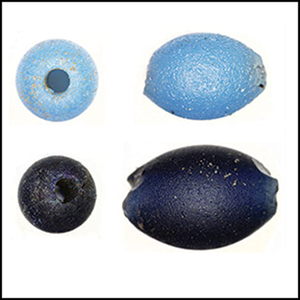
Our study compares glass objects (Figure 3) recovered from 15 confidently identified Wendat settlements in Ontario with objects from 31 sites in the Western Great Lakes and midcontinent, including six with possible Wyandot associations (Figure 4, see also online supplementary material (OSM) Table S1). The Ontario sites are single-component villages, each likely occupied for 10–25 years, spanning c. AD 1580–1650. In contrast, there are relatively few (less than 10), widely distributed sites across the Western Great Lakes where glass beads have been recovered and confidently dated to before AD 1660 (Table S1). Many locations of Indigenous camps, villages and towns inhabited from AD 1620 onward are multi-component archaeological sites attributed to several different Indigenous peoples and some are connected to French colonial military endeavours.
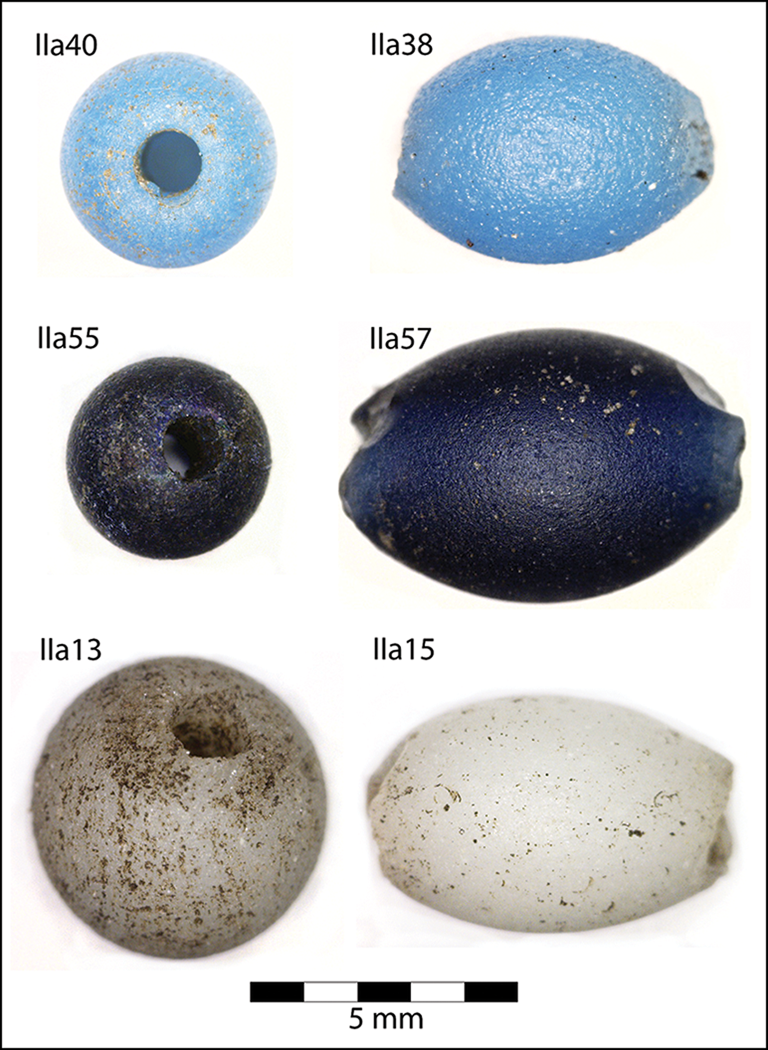
Representative examples of the beads analysed (figure by authors).
Map of archaeological site locations for glass beads in this study (base map from Natural Earth; figure by authors).

Glass beads traded at these places were produced across Europe, within a historical context specific to those locations, documented through texts, artworks and archaeology (Karklins Reference Karklins1993). Analysts recognise the complexities of investigating European glassmaking, including the numerous workshops of primary and secondary production, changes in technologies through time, exchange of raw materials and partially finished glasses, glass recycling and other complicating factors. Yet, there has been successful identification of workshop distinctions arising from varied use of locally available silica sands, flux agents and preparations and other technological styles unique to individual glassmaking traditions (De Raedt et al. Reference De Raedt, Janssens, Veeckman, Vincze, Vekemans and Jeffries2001; Cagno et al. Reference Cagno, Favaretto, Mendera, Izmer, Vanhaecke and Janbssens2012; Dussubieux & Karklins Reference Dussubieux and Karklins2016; Vilarigues et al. Reference Vilarigues, Coutinho, Medici, Alves, Gratuze and Machado2019; Coutinho et al. Reference Coutinho, Cambil Campaña, Cerqueira Alvas and Medici2021).
Here, we compare previously published bead compositions from six European contexts (see Tables S3–S5; Karklins et al. Reference Karklins, Jones and Sheppard2001, Reference Karklins, Dussubieux and Hancock2015; Dussubieux Reference Dussubieux2009; Dussubieux & Gratuze Reference Dussubieux and Gratuze2012; Dussubieux & Karklins Reference Dussubieux and Karklins2016). These predominantly date to the early to mid-seventeenth century, with some as late as the early eighteenth century. We also provide new data for six beads from an Amsterdam glasshouse (Asd/Kg10) c. 1601–1610 in the Waterlooplein, a Jewish quarter of the city (Karklins Reference Karklins1985; Karklins et al. Reference Karklins and Jakes2002), and include beads from La Belle, a French ship that was provisioned in 1684 and sank in 1686 off the coast of Texas (Bruseth et al. Reference Bruseth, Borgens, Jones and Ray2017).
Materials and methods
To trace global patterns of glass-bead production and exchange, we conducted a meta-analysis of published and new data and examined 1012 chemical compositions of glass artefacts from archaeological sites as described above. To focus on Wendat/Wyandot exchange connections and population movements across the Great Lakes region c. AD 1600–1660, we restricted our dataset to beads produced before AD 1700. We examined three glass colours, corresponding to chemical elements related to key glass ingredients. Navy blue beads are coloured with cobalt (Co); turquoise blue beads are coloured with copper (Cu); and pre-1650 white beads found in Ontario are opacified with tin (Sn). The primary analysis method is laser ablation inductively coupled plasma mass spectrometry (LA-ICP-MS) with some legacy data from instrumental neutron activation analysis (INAA). Analytical procedures and evidence for comparability across these methods are published (Walder et al. Reference Walder, Petrus, Dussubieux, Hancock and Hawkins2021) and detailed materials and methods are provided in the OSM.
Results
Glassmakers in Europe
For historical reasons related to migrations of Venetian glassworkers, many European producers used related recipes to produce glass beads, resulting in similar proportions of the major and minor elements. The primary components of glass include a base glass network former (generally silica, measured as silica dioxide, SiO2), fluxes (potash and soda, contributing oxides of potassium and sodium, K2O and Na2O), a stabiliser (generally calcium-based such as lime, contributing calcium oxide, CaO), opacifiers (such as tin from tin (IV) oxide, SnO2) and colourants (e.g. Co or Cu). That beadmakers in different production centres used similar recipes is supported by the relative proportions of three oxides—K2O, Na2O and CaO (Figure 5a). For these major ingredients, regardless of European provenance or archaeological findspot in Wendake (Figure 5b), the compositions vary mainly by bead colour.
Proportions of potash (K2O), sodium oxide (Na2O) and calcium oxide (CaO) for beads, by colour, from a) European and b) Wendat contexts (figure by authors).

We should not anticipate, however, that raw materials were all sourced from the same locations. Silica, which comprises the largest portion of glass ingredients and is globally ubiquitous, was likely sourced locally from available sands (Henderson Reference Henderson2013: 56). European glass in the seventeenth century was fluxed mainly with plant ash, but sources varied and could have included wood ash or ash from salt marsh plants (Dussubieux & Karklins Reference Dussubieux and Karklins2016). Work by de Raedt and colleagues (Reference De Raedt, Janssens, Veeckman, Vincze, Vekemans and Jeffries2001) demonstrates that Venetian glass can be distinguished by trace elements such as zirconium (Zr <25ppm) and hafnium (Hf <1.0ppm) in concentrations less than that of façon-de-Venise glass from Antwerp. Zr, Hf and niobium (Nb) values vary among silica sources (Degryse & Shortland Reference Degryse and Shortland2020: 122) but glass canes, rods and ingots were exchanged among regions (Dussubieux & Karklins Reference Dussubieux and Karklins2016). Our data show that, regardless of colour, glass from Rouen has significantly higher trace element (Nb and Zr) content compared with glass from other centres (Figure 6), indicating a zircon-rich silica source. Historical and archaeological evidence indicates that Rouen was an important glassmaking centre in the seventeenth century (Loewen Reference Loewen2019). Further, while some glass from Paris and Amsterdam, particularly the turquoise beads, has Zr values in the range expected for Venetian glass (<25ppm), the beads analysed from Rouen and London do not. Despite historically documented potential for glass recycling, mixing and the exchange of raw materials, we demonstrate diverse compositions of beads produced in different European locations (Figure 6).
Biplots of zirconium (Zr) versus niobium (Nb) composition for previously published European-context beads, at different scales (figure by authors).

Wendat communities in Ontario
The Wendat beads come from villages dating c. 1580–1650 (covering all three ‘glass bead periods’ or GBPs, see Kenyon & Kenyon Reference Kenyon, Kenyon and Hayes1983). We consider these compositions in the context of documented changes in European production and trade. Like beads from European sites, their base glass recipes differ mainly in regard to glass colour (Figure 5b); we focus, therefore, on trace elements associated with silica sands.
In the late sixteenth century, Basque and French traders dominated trade with Indigenous peoples in the St Lawrence river valley. French merchants launched expeditions from several locations, including Rouen, but until 1599 trade items were supplied by other European countries (Fitzgerald et al. Reference Fitzgerald, Knight and Bain1995). Beads from GBP1 (1580–1600) have very low Zr and Nb values, consistent with expectations for beads manufactured in Venice (Figure 7). In 1600, King Henri IV issued a monopoly to a merchant based in Normandy, the timing of which approximately coincides with the establishment of glasshouses in Rouen (Loewen Reference Loewen2019). Figure 7 shows trace element values of GBP2 (1600–1625/30) beads obtained by Wendat people, indicating that many compositions fit the range for glass from Rouen (Zr >400ppm). A broader conflict between France and England starting in 1627 resulted in the English capture of Québec, disrupting French exchange relationships with Wendat communities (Trigger Reference Trigger1976: 455). Between 1628 and 1631, English traders took control over trade in the St Lawrence region, cutting off Wendat access to French-supplied goods (Fitzgerald et al. Reference Fitzgerald, Knight and Bain1995: 123). When French trade was re-established in 1633, it was through a Parisian company. Thus, we infer that at least some GBP3 (1625/30–1650) beads found at Wendat villages may have been produced in the Netherlands or England. In earlier GBPs, Cu-coloured turquoise beads mainly have low Zr and Hf concentrations, but in GBP3b (1640–1650) these values are higher, indicating Rouen or another unidentified Zr-rich sand source.
Biplots of zirconium (Zr) versus hafnium (Hf) composition for Wendat-context beads by glass bead period, at different scales (figure by authors).

Wendat movements westward c. 1650–1660
The seventeenth-century Western Great Lakes sites in this analysis include locations affiliated with Wyandot people and many other Indigenous Nations. Relatively few archaeological sites west of Lake Michigan that date to before AD 1660 have yielded glass beads, and even fewer are confidently Wyandot affiliated. Tracing western Wyandot populations during the mid-seventeenth century requires assessing beads alongside other material culture such as diagnostic ceramics from ethnohistorically documented locations associated with their communities. Blocky shell beads, wampum, ‘Huron-Incised’ style ceramics (Figure 2a & b) and glass beads of types and compositions that differ from the local pattern (see Walder Reference Walder2018) are all indicators of the western Wyandot presence (Garrad Reference Garrad2014). Based on such assemblages, potential Wyandot-affiliated archaeological sites with pre-1660 components in this study include Cadotte (Mazrim Reference Mazrim2011), Rock Island Period 2 (Mason Reference Mason1986) and Hanson (Overstreet Reference Overstreet1993; Rosebrough et al. Reference Rosebrough, Broihahn, Eisenberg and Walder2012). Of these three sites, only beads from Hanson, an aceramic mortuary context in eastern Wisconsin (Figure 2), have compositional similarities to beads from Wendake.
Beads from Wendake and from Hanson have relatively higher proportions of potash and lower proportions of lime for Co- and Cu-coloured blue beads. This composition also appears at non-Wyandot-affiliated pre-1660 sites in both the Western Great Lakes and Wendake (Figure 8), potentially indicating trade rather than direct population movements. Another pre-1660 marker is the increase of calcium in the composition through time, while cobalt decreases (Figure 9a), possibly due to the use of different colourant sources in Europe (Gratuze et al. Reference Gratuze, Soulier, Barrandon and Foy1992). Lastly, for pre-1660 sites in the Western Great Lakes, the high trace element (Zr-Hf-Nb) composition (Figure 9b) matches some Co-coloured beads from pre-1650 Wendat sites in Ontario. The glass compositions of beads from Hanson, combined with other Wendat-style material culture nearby (Figure 2; Hall Reference Hall1947), support the historically documented Wyandot population movements to the Green Bay region after AD 1650. Once they had arrived, Wyandot people likely traded with local communities, such as Ho-Chunk, Menominee and others. This is evidenced by 10 glass beads of the high Zr-Hf-Nb composition from Red Banks, a nearby central place for Ho-Chunk ancestors and those of other nations on the shore of Green Bay (Hall Reference Hall and Green1995).
Proportions of potash, calcium oxide and sodium oxide visualised as triplots for all cobalt-coloured and copper-coloured beads from North American contexts included in this study (figure by authors).

Biplots of a) cobalt (Co) against calcium oxide (CaO); and b) zirconium (Zr) against niobium (Nb) illustrating temporal differences among all cobalt-coloured beads from Wendat and Western Great Lakes sites. Note different Zr/Nb ratio for the La Belle and post-1700 Western Great Lakes (WGL) beads (figure by authors).

Western Great Lakes
In the Western Great Lakes, bead chemistry indicates connections to Wendake at sites that pre-date the AD 1650 westward Wyandot movements, suggesting down-the-line exchange. Sn-opacified white beads and high trace elements (Zr-Hf-Nb) in blue beads (such as beads from Rouen in Figure 6) mark these connections, perhaps a generation before any sustained European presence. In present-day Upper Michigan, Goose Lake Outlet #3 (GLO#3) (Paquette & Walder Reference Paquette and Walder2017; Legg & Demel Reference Legg and Demel2020) is interpreted as a 1630s Anishinaabe winter camp with highly mobile occupants well-connected to eastern trade sources. For all pre-1660 Cu-coloured beads examined (Figure 10a), high Zr and Nb concentrations occur only in beads from GLO#3, Red Banks and Hanson (Figure 2), as well as Wendake and Rouen. At GLO#3 and as distant as Iliniwek Village in north-eastern Missouri, inhabited c. 1640–1683 (Ehrhardt Reference Ehrhardt and Card2013), a distinct oval-shaped turquoise bead (type IIa38 in the Kidd & Kidd (Reference Kidd and Kidd1970) typology) with this composition marks inland movement of beads ahead of the earliest French missionaries and other settler-colonisers. Three white beads from GLO#3 (Figure 10b) are a rare (for the interior) Sn-opacified simple drawn type (IIa13) that hint at access to glass beads also available at contemporaneous Wendat villages, such as Auger, and known from European production centres (Hancock et al. Reference Hancock, Aufreiter, Kenyon and Latta1999). Sn-opacified beads at GLO#3 may indicate their connections to Wendat or other Eastern Great Lakes traders in the 1630s.
Biplots of zirconium (Zr) against niobium (Nb) for a) copper(Cu)-coloured and b) tin(Sn)-opacified beads from Western Great Lakes and Wendat contexts (figure by authors).

Sn-opacified white beads also occur at early seventeenth-century Huber-phase Oneota villages in present-day north-eastern Illinois, including Middle Grant Creek (McLeester & Schurr Reference McLeester and Schurr2020), Palos and Oak Forest (Esarey & Emerson Reference Esarey and Emerson2021) and New Lenox (Billeck Reference Billeck2021). Tight radiocarbon chronologies and the predominance of white and blue glass beads identify these as likely GBP2 sites (AD 1600–1625). Huber Oneota sites have a deep place-based connection to the Upper Mississippi Valley hundreds of years before European arrivals and have been described as ancestral Ho-Chunk occupations (Esarey & Emerson Reference Esarey and Emerson2021). Some Co-coloured blue beads from New Lenox (n = 5; Zr mean 422ppm, Hf mean 12ppm, Nb mean 8.5ppm) and Middle Grant Creek (n = 1; Zr 451ppm, Hf 12ppm, Nb 10ppm), have high Zr, Hf and Nb values, like GBP2 and GBP3 beads (c. 1630–1650) in Wendake (Figure 9b).
To our knowledge, no white beads from probable Wyandot sites in the Western Great Lakes with possible c. 1650 or earlier components have yet been analysed and identified as Sn-opacified. Such artefacts may exist in curated collections (e.g. Rock Island, Clay Banks) and could help untangle early seventeenth-century Indigenous exchange relationships. Clearly, Wyandot, Odawa, Ho-Chunk, Illinois, Miami, Peoria and other historically documented Nations of the interior (Morrissey Reference Morrissey2015) were all obtaining glass beads and other European-made goods via various economic connections and exchange networks during this period, creating a human connection to artisans across the Atlantic.
Discussion
The geography of variation and similarity in glass-bead chemistry within Europe reflects seventeenth-century historical events on that continent. Glassmakers from Venice/Murano who had traditionally guarded their recipes set up production centres in the Low Countries (De Raedt et al. Reference De Raedt, Janssens, Veeckman, Vincze, Vekemans and Jeffries2001), possibly because these places were less hostile to Jewish artisans during the Inquisition (Kurinsky Reference Kurinsky1991: 385). Others established glasshouses in France, ostensibly to provide beads for an emerging global market (Loewen Reference Loewen2019). Yet transatlantic trade suppliers apparently obtained beads from both local producers and more distant ones, likely including Venice.
We trace shared recipes but different raw material sources through time and space, demonstrating the compositional distinctiveness of beads passed between hands from Europe to North America in the early to mid-seventeenth century, focusing on objects recovered where Wendat people lived and traded. Both the Western Great Lakes and Wendake were homelands of Indigenous Nations allied with the French at the time, and we show that at least some bead chemistries align with those of beads produced in Rouen or Paris (Figures 6 & 7) and differ from beads produced later (Figures 8–10).
Changes in glass-bead assemblages in North America and manipulation of glass beads are indicators of Indigenous preferences. As Kenyon and Kenyon (Reference Kenyon, Kenyon and Hayes1983: 69) note, the white and navy-blue glass-bead colours and shapes common in GBP2 parallel the colours of shell beads and were thus easily integrated into existing social and symbolic systems, particularly in coastal regions. A marked change in bead assemblage colours occurs after GPB2 (post c. 1630), when blue and white beads are replaced by a palette favouring reds. Kenyon and Kenyon (Reference Kenyon, Kenyon and Hayes1983) interpret this as a European response to Wendat colour preference as they became more important regional trading partners. Documentary supporting evidence for different colour preferences comes from French Recollect friar Gabriel Sagard, who in 1624 noted that his attempt to trade red glass beads with Nipissing (Anishinaabe) people failed, but that other Indigenous Nations particularly desired red beads (Kenyon Reference Kenyon1984: 7–8). The high value Wendat traders placed on red items is evidenced by their modification of trade beads. Polychrome beads were ground to remove outer layers of white and blue glass, revealing a red interior (Kenyon Reference Kenyon1984). Even monochrome red tubular beads were sometimes ground to remove the shiny exterior, making them more like the red stone beads traded contemporaneously.
In Wendake (Ontario), we see glass-bead chemistry changing over time, likely reflecting changing suppliers: GBP1 beads have a Venetian signature low in trace element concentrations, while some later beads have higher values of Zr, Hf and Nb, like beads from the Rouen area, among others. In the interior midcontinent of North America, beads with the high trace element signature also occur in north-eastern Missouri, at c. 1630s Huber Oneota sites and an Illinois village, and at GLO#3 in northern Michigan, attesting to the extensive reach of Indigenous exchange networks prior to European arrivals.
Sites that likely post-date the western Wyandot movements are diverse in both glass-bead chemistry and their occupational histories. At Hanson, historical records, distinctive trace element concentrations in beads and artefact styles associated with Wendat sites attest to the integration of Wyandot peoples into this region, and their opportunities to trade with local communities, such as those at Red Banks. The role of Wyandot people in continuing trade with the French at the strategically located rendezvous points of Rock Island and Cadotte is less clear; beads from these sites have low Zr, Hf and Nb concentrations. But not all beads from Western Great Lakes and Wendat sites dating to GBP2 and later have high trace element concentrations either—those with very low values possibly indicate Venetian origins.
Conclusions
European artisans made beads using similar but not identical glass recipes in historically contingent contexts of production; some of these beads were carried across the Atlantic Ocean and incorporated into Indigenous systems of value and exchange, connecting these peoples across time and space. We demonstrate how the glass composition of beads from archaeological sites affiliated with various Indigenous Nations, particularly Wendat confederacy members, reveals connections to broader interregional exchange systems c. AD 1600–1670. In this way, our work provides new supporting evidence for relationships among different communities and Nations, focussing on Wendat/Wyandot interactions and influences across the Western Great Lakes, highlighting Indigenous participation in emergent global trade.
This article provides a case study addressing a challenging topic: tracing the exchange networks, influences, relationships and population movements of the Wendat/Wyandot community, whose historically documented presence is also evidenced by distinctive material culture identified in Western Great Lakes contexts. Such movements are common during colonial periods, as are processes of calculated resilience and resistance (Vizenor Reference Vizenor and Vizenor2008; Witgen Reference Witgen2012). Scholars investigating the complexities and dynamic social changes of colonial encounters in other periods and regions can similarly trace European-made materials across these landscapes of interaction, using methods such as LA-ICP-MS. By carefully examining mass-produced and seemingly standardised commodities such as glass beads, hidden patterns emerge from the chemical compositions, which can be useful in untangling and clarifying archaeological understandings of these complex situations.
Acknowledgements
We thank the Huron-Wendat Nation/Nation Huronne-Wendat. We acknowledge the numerous curators and institutions lending artefacts for analyses for this and our previous publications, other scholars who previously published their data and our many collaborators on glass-bead research, especially Joe Petrus. We greatly appreciate the valuable feedback that Laure Dussubieux, Ron Hancock and Louis Lesage and three anonymous reviewers provided on this manuscript.
Funding statement
Funding sources for analyses not published elsewhere include a Graduate Women in Science fellowship (Walder) and a National Science Foundation subsidy to the Elemental Analysis Facility at the Field Museum, Chicago (Walder and Hawkins).
Data availability statement
The data supporting this study are previously published or available in Tables S3–S5 (see OSM).
Online supplementary material (OSM)
To view supplementary material for this article, please visit https://doi.org/10.15184/aqy.2024.80 and select the ‘Supplementary materials’ tab.


 Open access

