

Introduction
Age-related macular degeneration and qualitative research
Age-related macular degeneration (AMD) is a chronic eye disease that is a major cause of central vision loss worldwide (Lim et al., Reference Lim, Mitchell, Seddon, Holz and Wong2012). Risk of AMD increases with chronological age, and global estimates suggest that 196 million people were living with AMD in 2020 (Wong et al., Reference Wong, Su, Li, Cheung, Klein, Cheng and Wong2014). AMD is often categorised as either ‘wet’ (neovascular) or ‘dry’ (non-neovascular); both forms can lead to visual impairment, although the wet form can develop very suddenly, while the dry form progresses more gradually. Treatment for wet AMD involves eye injections, which can slow and stabilise the vision loss; however, no treatment is available for the dry form of AMD (Ammar et al., Reference Ammar, Hsu, Chiang, Ho and Regillo2020).Footnote 1
While there is now a substantial qualitative literature on the lived experience of AMD (i.e. what it is like to live with AMD) (Thier and Holmberg, Reference Thier and Holmberg2020), to our knowledge no studies have set out to explore AMD discourse (i.e. the language used to construct meaning around AMD). Therefore, the research presented in this paper aimed to identify the discourses that are mobilised by people with AMD to construct their experiences within the context of research interviews or focus groups. This secondary analysis of participant quotations in published qualitative studies on AMD aimed to focus on how experiences of AMD are constructed in talk, in light of broader, dominant discourses about ageing, illness and visual impairment. This research involved a discourse analysis approach underpinned by social constructionist epistemology, entailing a critical approach towards taken-for-granted knowledge (Burr, Reference Burr2015).
Defining our approach to discourse analysis
Discourse analysis concerns itself with close attention to how ‘language is organized into discourses which are culturally specific and whose availability depends upon social, historical and cultural contexts’ (Willig, Reference Willig and Flick2014: 342). The language and terminology that is used to construct age-related vision loss illustrates how discourse – ‘a set of meanings, metaphors, representations, images, stories, statements and so on’ – can ‘produce a particular version of events’ (Burr, Reference Burr2015: 75), or in more Foucauldian terms a ‘regime of truth’ (Foucault, Reference Foucault, Dreyfus and Rabinow1983), historically and socially contigent norms and ideas that, although human constructions, become seen as the natural order of things.
Discourse analysis can be considered a broad family of approaches, rather than a distinct method (Burr, Reference Burr2015). In this paper, we adopted a Foucauldian Discourse Analysis (FDA) approach, which allows for reflection on how socially and culturally available discourses around AMD, visual impairment (or ‘blindness’), ageing and disability may circumscribe or shape possibilities for individuals' practice and subjective experiences.
Some discourses may be more dominant than others, and FDA considers how power structures and ideologies may amplify, co-opt or repress certain discourses. A ‘dominant discourse’ can be seen to reflect the prevailing ideology of a particular status quo (Hare-Mustin, Reference Hare-Mustin1994), thus becoming more readily ‘available and accepted’ (Becker et al., Reference Becker, Chasin, Chasin, Herzig and Roth1995: 145) than alternative, more marginal discourses. While dominant discourses can become neutralised – taken for granted as the seemingly non-ideological ‘common sense’ position on an issue (Fairclough, Reference Fairclough1985) – they may also be resisted through alternative discourses which can gain traction as social practices evolve (Burr, Reference Burr2015).
Critical disability studies as a framework underpinning the discourse analysis
Discourse analysis involves a ‘top-down approach to interpretation’, whereby discourse analysts ‘come to their data with a set of conceptual tools derived from theory’ (Willig, Reference Willig, Willig and Stainton Rogers2017: 279). In this paper, our analysis was informed conceptually by critical perspectives on visual impairment, disability and later life. Such perspectives draw attention to alternatives to common-sense understandings of chronic illness and disability, alert to how the medical model of disability has typically predominated in research on age-related vision loss (McGrath et al., Reference McGrath, Laliberte Rudman, Trentham, Polgar and Spafford2017). This model has tended to dominate common-sense understandings of disability (Barnes, Reference Barnes, Watson, Roulstone and Thomas2012), locating the ‘problem’ or ‘personal tragedy’ (Oliver, Reference Oliver1986) of disability in the individual's ‘body-gone-wrong’ (Michalko, Reference Michalko2002).
In contrast, the social model of disability (SMD) distinguishes between impairment – the specific issue affecting a person's body – and disability, which are losses and restrictions stemming from physical barriers, economic discrimination, prejudicial attitudes or behaviours, and social oppression (Oliver, Reference Oliver1986; Barnes, Reference Barnes, Watson, Roulstone and Thomas2012). From this SMD perspective, a person with visual impairment from AMD is disabled when confronted with inaccessible features of the environment, such as small print on documents, or obstacles on pavements which hinder mobility and navigation (Bolt, Reference Bolt2005). The SMD is therefore a transformative tool for political action and social change, shifting the focus away from perceived individual-level ‘deficits’ or ‘problems’, and towards collective action to confront barriers and discrimination at the social or environmental level (Oliver, Reference Oliver, Barnes and Mercer2004). Building on and nuancing the SMD, critical disability theorists have also highlighted the direct, bodily consequences of impairment that can often involve pain, suffering and fatigue (Morris, Reference Morris1992; Crow, Reference Crow, Barnes and Mercer1996), particularly when disability arises from chronic illness (Wendell, Reference Wendell2001).Footnote 2 Carol Thomas' social-relational model of disability (Thomas, Reference Thomas1999, Reference Thomas2004) recognises the impact of ‘impairment effects’ (the direct and unavoidable restrictions on embodied functioning attributable to impairment) alongside ‘disablism’ (the avoidable restrictions imposed upon disabled people at interpersonal, institutional and/or societal levels). For example, challenges with face recognition experienced by a person with AMD could be considered as a direct ‘impairment effect’ stemming from AMD itself, which would persist even if disablism or disabling barriers in the environment were to be addressed (McGrath et al., Reference McGrath, Laliberte Rudman, Trentham, Polgar and Spafford2017). In the present analysis, these disability frameworks helped to interpret participants' talk critically, and to interrogate and deconstruct the dominant discourses around AMD.
Discourses of age-related vision loss
As noted above, to our knowledge, discourse analysis has not been used to analyse the talk used by research participants with AMD specifically. However, discursive constructions of AMD draw on broader societal discourses that surround the phenomena of ageing, disability, chronic illness and visual impairment. For example, a critical ethnography by McGrath et al. (Reference McGrath, Laliberte Rudman, Polgar, Spafford and Trentham2016) considered how aspects of the environment shape disability for older adults living with age-related vision loss, all of whom were living with AMD (as well as, in the case of some participants, other chronic eye conditions such as glaucoma). Specifically, the authors explored how positive ageing discourses (associated with terms such as ‘active ageing’ or ‘successful ageing’) shape the experience of age-related vision loss. They trace how positive ageing discourses – initially a reaction against society's and the academic gerontological literature's disproportionate focus on the losses and limitations of ageing (Boudiny and Mortelmans, Reference Boudiny and Mortelmans2011) – can exclude frail and/or disabled older adults, including those living with visual impairment.Footnote 3 Such discourses risk an excessive emphasis on individual agency and personal responsibility for staying well, overlooking the societal and structural factors that exclude older adults with disabilities and present barriers to their participation in society. In particular, McGrath et al. (Reference McGrath, Laliberte Rudman, Polgar, Spafford and Trentham2016) illustrate how discourses of positive ageing (in combination with biomedical discourses around disability) construct independence as the valorised, idealised goal for older adults living with vision loss. By constructing independence narrowly in physical, functional terms as an achievement of the individual, such discourses in turn risk perpetuating stigma around depending on others (McGrath et al., Reference McGrath, Laliberte Rudman, Trentham, Polgar and Spafford2017; Fuchigami et al., Reference Fuchigami, McGrath, Bengall, Kim and Laliberte Rudman2022).
Turning to literature in social science and the humanities on discourses of visual impairment, scholars have sought to examine and deconstruct the use of terms such as ‘blindness’ both historically and in contemporary society and culture. For example, Georgina Kleege (Reference Kleege1999: 21) reflects that ‘the word [blind] connotes a lack of understanding or discernment, a wilful disregard or obliviousness, a thing meant to conceal or deceive’. David Bolt (Reference Bolt2005) similarly discusses the many connotations linked to discourses of ‘blindness’ in English, including imagery of darkness, confusion, ignorance and concealment. Bolt highlights that using the term ‘visual impairment’ (rather than ‘blindness’) is more ‘pertinent to the discourse of the Social Model of Disability’ (Bolt, Reference Bolt2005: 547), and sees the notion of visual impairment as a continuum as a contrast to the ‘dominant, ableist discourse’ (Bolt, Reference Bolt2005: 550) of ‘the sighted and the blind’, configured as binaries. Indeed, constructions and imaginaries of blindness as ‘irreversible, unremitting darkness’ (Paterson, Reference Paterson2013) or a ‘complete absence of any visual experience’ (Kleege, Reference Kleege1999) obscure the reality that only a small proportion of those certified as severely sight impaired have total visual impairment (without light perception). In the context of visual impairment rehabilitation, Botha and Watermeyer (Reference Botha and Watermeyer2022) conducted discourse analysis on a sample of material drawn from websites of organisations that provide visual impairment rehabilitation services in South Africa. Their analysis found that such organisations tend to construct visual rehabilitation as a linear, predictable journey, with ‘beneficiaries’ transformed from being hopeless and dependent to independent, productive members of society. The authors note that these polarised constructions ‘perpetuate blindness fantasies between which real visually impaired people must navigate their lives’, for example by dichotomising concepts such as in/dependence, or overlooking complex lived experiences, such as the fact that feelings of loss and struggle may persist even after visually impaired people have seemingly reached a point of ‘acceptance and success’ (Botha and Watermeyer, Reference Botha and Watermeyer2022: 393).
Research objectives
The examples above aim to illustrate that talk about visual impairment in older age is informed by broader discourses around ageing, disability and sight/vision, deeply rooted in specific social and cultural contexts. They illustrate how discourses may circumscribe or shape possibilities for individuals' practice and subjective experiences, by opening up and legitimising certain ways of talking about a phenomenon and closing down others.
The present analysis aims to explore whether and how these broader discourses are drawn upon in previous qualitative literature to construct the phenomenon of life with AMD. Foucauldian Discourse Analysis (FDA) is a particularly apt methodology for the purpose of exploring how AMD is socially constructed in discourse; as FDA allows us not only to map the discourses circulating within qualitative research on AMD, but also to consider speculatively how these discursive resources may have implications for how the condition is subjectively experienced. This contrasts with other critical psychology methodologies rooted in social constructionist epistemology such as discursive psychology, which is more fundamentally concerned with the micro-level features of language within social interaction and largely focuses on naturally occurring talk or text (rather than interview-based data, especially as decontextualised in the present analysis). FDA by contrast allows for tentative consideration of how dominant discursive constructions of AMD within existing qualitative research may enable or limit possibilities for subjectivity and practice (Seymour-Smith, Reference Seymour-Smith2015).
In this analysis, we therefore aim to identify discourses used to talk about AMD (with reference to social scientific scholarship on disability and ageing), and the implications of these discourses and repertoires for subjective ‘ways-of-being’ with AMD. The overall, broad research question is: How do research participants with age-related vision loss talk about their experiences? In particular, we aim to consider the dominant, ‘common sense’ discourses and positions represented in the qualitative research on AMD experiences – as well as those that are relegated to the margins – and consider how these discourses may in turn shape the practices and subjectivities of people with AMD.
Method
Secondary analysis of published qualitative data
Our approach to secondary analysis follows Wästerfors' typology of qualitative data re-analysis, one option being to use ‘other researchers’ data in the form of published excerpts’ (Wästerfors et al., Reference Wästerfors, Åkerström, Jacobsson and Flick2014: 468) as the source data. Wästerfors and colleagues highlight the decontextualised nature of such data and the secondary analyst's lack of knowledge of the original circumstances of data collection as potential issues in this kind of (re-)analytic exercise. They recommend ‘cultivating a cautious and reflexive attitude’ (Wästerfors et al., Reference Wästerfors, Åkerström, Jacobsson and Flick2014: 475), as in any qualitative analysis. However, they also note that drawing on decontextualised data can ‘motivate a fresh perspective in relation to contexts previously taken for granted’ (Wästerfors et al., Reference Wästerfors, Åkerström, Jacobsson and Flick2014: 475); this perspective arguably lends itself particularly well to some of the underpinning tenets of discourse analysis, which involves interrogating and deconstructing taken-for-granted knowledge (Burr, Reference Burr2015).
Compiling the dataset using initial steps of qualitative meta-synthesis
To compile the dataset, this study drew on the techniques of qualitative meta-synthesis. Over the last decade, several meta-syntheses on AMD experiences have been conducted (Bennion et al., Reference Bennion, Shaw and Gibson2012; McGrath and Corrado, Reference McGrath and Corrado2019; Thier and Holmberg, Reference Thier and Holmberg2020). Qualitative meta-synthesis is an area of increasing methodological interest, as a method of integrating findings from an ever-growing number and range of qualitative studies (Finfgeld-Connett, Reference Finfgeld-Connett2018; Beck, Reference Beck2019). A vital objective of meta-synthesis is to go beyond organising and collating existing findings, taking a critical, reflexive approach which is ‘interpretive, rather than merely aggregative’ (Thorne, Reference Thorne2015: 1348). This is where our analysis departed from meta-synthesis, since our aim was less about integrating thematic findings across studies, and more focused on using studies as data sources, from which we could assemble a comprehensive corpus of qualitative extracts about living with AMD. In the early stages of the study, we followed stages similar to those undertaken in other qualitative meta-syntheses. However, we ultimately conducted a form of secondary analysis, using existing data (in the form of published qualitative data extracts) to answer a new research question that differed from the research questions posed in the source research articles (Hinds et al., Reference Hinds, Vogel and Clarke-Steffen1997).
To assemble the corpus of extracts, structured searches were carried out using the databases Academic Search Complete, CINAHL, MEDLINE, PsycINFO and PsycARTICLES, and citation tracking for further articles was conducted using Google Scholar. We combined two families of search terms: firstly, terms relating to qualitative research (qualitative OR interview OR ‘focus group’ OR ‘qualitative survey’ OR phenomenol* OR ‘thematic analysis’ OR ‘grounded theory’ OR ‘lived experience’) and, secondly, terms relating to AMD (AMD OR ARMD OR nAMD OR ‘age-related macular degeneration’ OR ‘macular degeneration’). Inclusion criteria were studies published in any year, that were: reported in English; where sufficient data extracts, with full sentences, were available for secondary analysis; and where all participants had a diagnosis of AMD. Studies specifically about experiences of people with neovascular (‘wet’) AMD undergoing treatment were excluded, as these often explore highly specific aspects of the treatment procedure or service delivery, in contrast to our interest in more everyday talk about AMD.
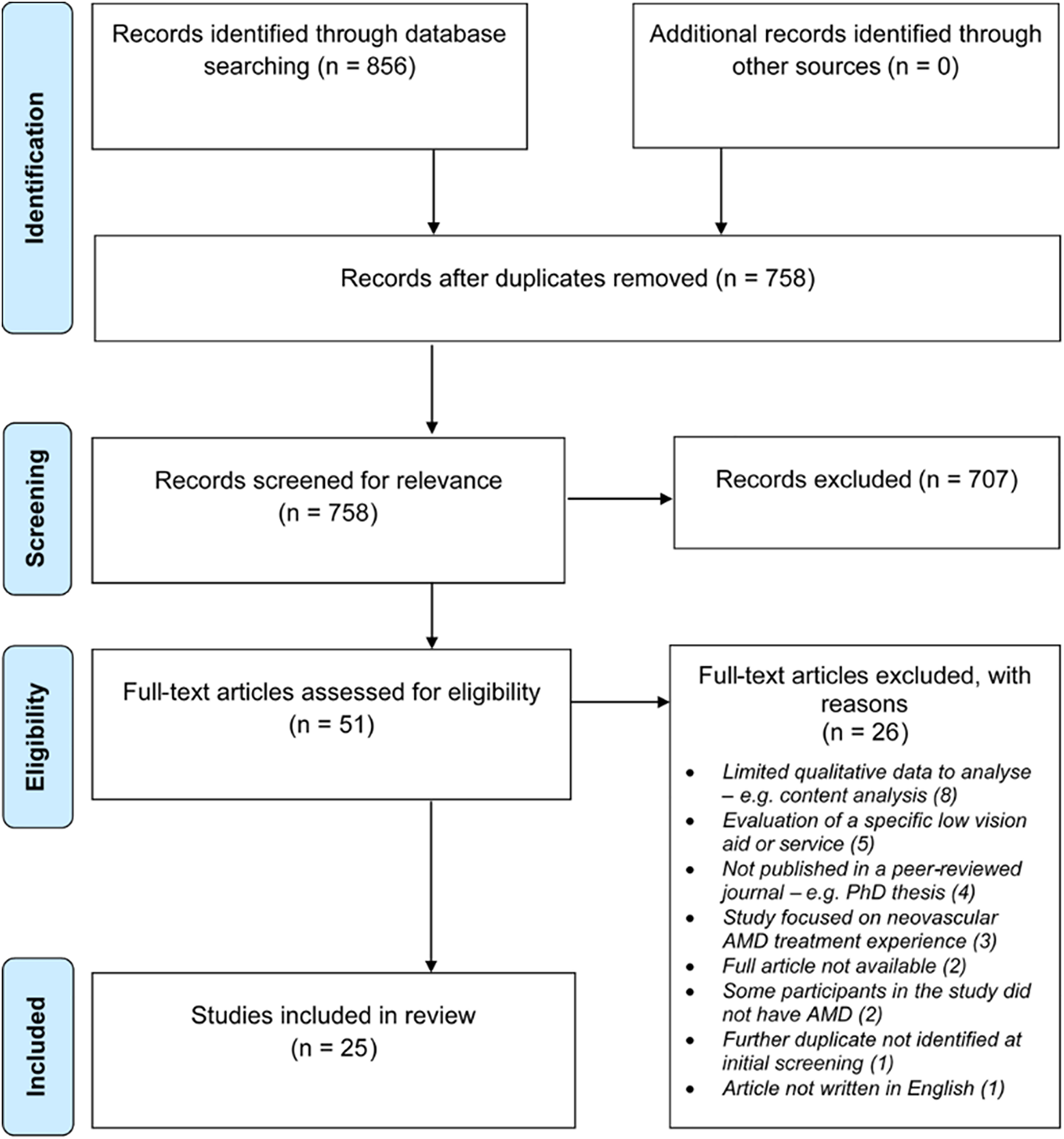
The electronic database search – run on 9 December 2020 – yielded 856 records. Through screening (Figure 1), we narrowed down to 25 articles, from which participant quotations were extracted for discourse analysis.
Diagram showing the study selection process.
Analytic procedure: FDA and interpretative repertoires
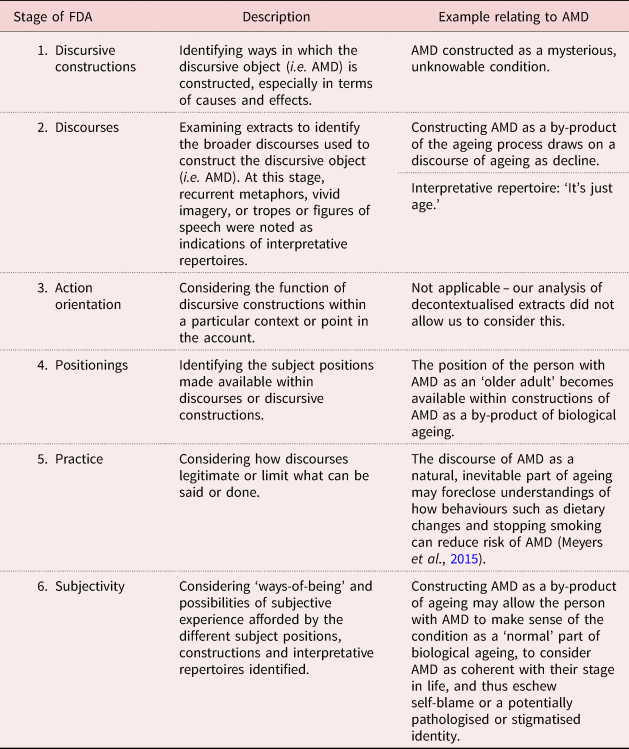
Our analysis used FDA, underpinned by a social constructionist epistemology, to explore discourses in published qualitative data extracts about the experience of living with AMD. Willig's six-stage approach to FDA was used as a starting point (Willig, Reference Willig2013), while omitting the third stage regarding ‘action orientation’, since this would require an understanding of where the relevant extract fits within the discursive context of the participant's entire account. After compilation and extraction of data extracts, and familiarisation with the extracts, the six stages were undertaken as displayed in Table 1.
Summary of Willig's six-stage approach to Foucauldian Discourse Analysis (FDA) (Willig, Reference Willig2013) with examples relating to age-related macular degeneration (AMD) for each stage
Within the analysis of broader discursive constructions and positions, we also considered ‘interpretative repertoires’ about AMD, defined by Wetherell and Potter as
building blocks speakers use for constructing versions of actions, cognitive processes and other phenomena … Commonly these terms are derived from one or more key metaphors and the presence of a repertoire will often be signalled by certain tropes or figures of speech. (Wetherell and Potter, Reference Wetherell, Potter and Antaki1988: 172)
There are rich debates regarding the precise definition and distinctions between a discourse and interpretative repertoire (Parker, Reference Parker1990; Potter et al., Reference Potter, Wetherell, Gill and Edwards1990). Here, we considered interpretative repertoires as operating at a more granular, micro level, as commonsensical everyday discursive resources (Golden and Pomerantz, Reference Golden and Pomerantz2015), in contrast to discourses as more macro-level ‘structures that impose a certain kind of subjectivity’ (Burr, Reference Burr2015: 188). As such, a focus on interpretative repertoires allows the researcher to examine the more precise and localised ways in which discourses construct their objects and subjects.
Following the stages of FDA (in a recursive, non-linear fashion), we identified five distinct ways in which AMD was constructed in the data. Each of these five sets of constructions encompassed discourses and interpretative repertoires which recurred across the published extracts included in our dataset. Here, we present the discourses and repertoires that we found to be most dominant. Making a judgement of ‘dominance’ in part depended on how commonly we found discourses to recur across studies, illustrating that certain discourses to construct the experience of AMD prevail across different study contexts. However, recurrence alone was not the only criterion; we also focused on constructions that appeared to draw upon naturalised, dominant ‘common-sense’ discourses around disability, visual impairment, chronic illness and ageing. Furthermore, we were particularly interested in instances where there was a high degree of thematic or linguistic consistency in how a particular phenomenon was constructed across studies, that appeared to indicate the dominance of a given discursive construction. For example, in constructions of ‘losing independence’ due to AMD (see below), extracts from different studies showed striking similarities in terms of vocabulary and syntax used to construct this phenomenon.
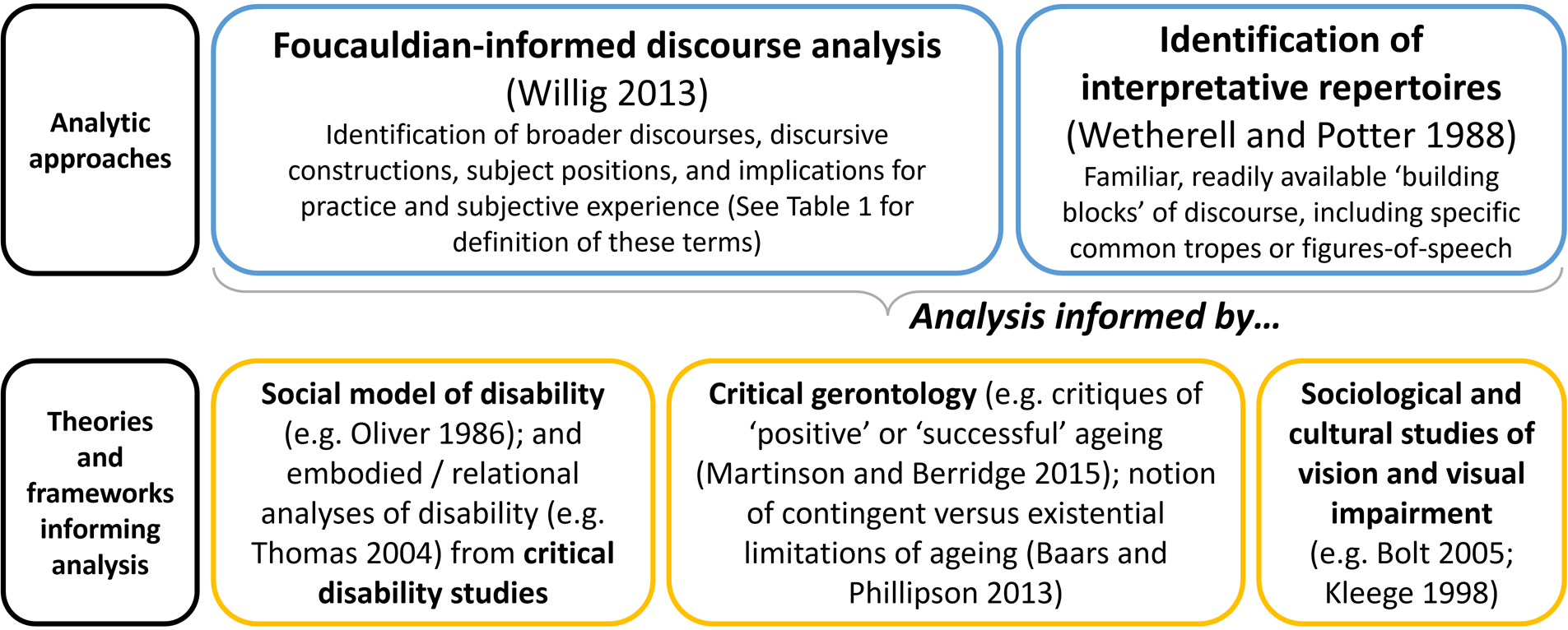
Figure 2 summarises the approaches and frameworks employed in the analysis.
Summary of analytic approaches used, and theories/frameworks informing the analysis and interpretation of results.
Findings: key discourses identified
Details of the 25 studies selected are displayed in Table 2. Our analysis identified five distinct ways in which AMD was constructed in research participants' talk about their experience of AMD. They included constructions of: AMD as a mysterious affliction, linked to biological ageing; AMD as a total loss of independence; AMD as grievous loss; AMD as a condition to be stoically accepted; and – to a more limited extent – AMD as an opportunity for discovery. In what follows, we present each construction individually, and examine its implications for how AMD may be experienced. Full quotations are displayed in the tables under the respective construction; the relevant quotation is numbered, e.g. as Q1 for Quotation 1. In the Discussion at the end of the paper, we reflect on the relationships between the constructions as well as their wider implications for research on AMD.
Summary of included studies
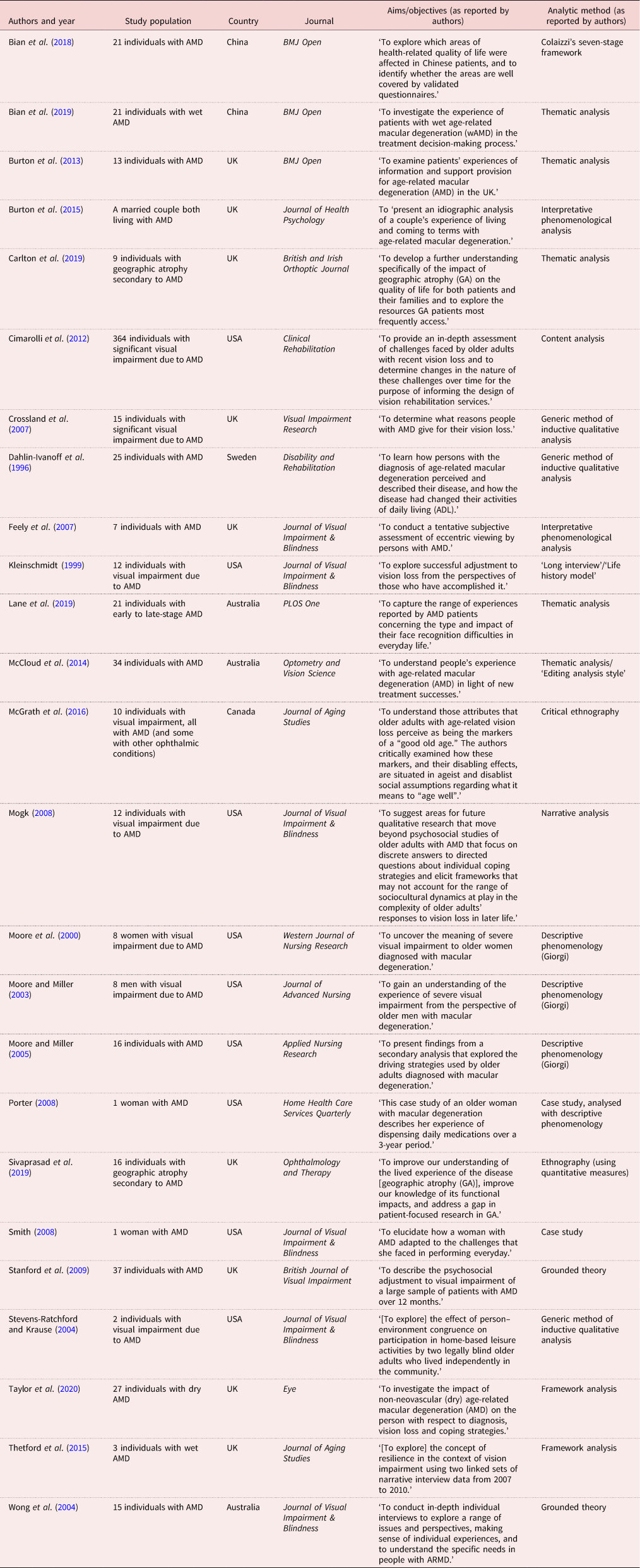
Notes: N = 25. AMD: age-related macular degeneration. UK: United Kingdom. USA: United States of America.
Constructing AMD as a mysterious affliction, linked to biological ageing
In talk about the aetiology of AMD (quotations displayed in Table 3), participants across studies used language to invoke a sense of surprise, mystery and unknowability to discuss how they first either became aware of AMD themselves, or were made aware by a professional. AMD was constructed as a profound surprise or ‘shock’, drawing on a repertoire we termed ‘I never would have expected this’ (Q1–Q3, e.g. ‘I never, never dreamed that … I was going to have this’).
Quotations for first construction: ‘age-related macular degeneration (AMD) as a mysterious affliction, linked to biological ageing’
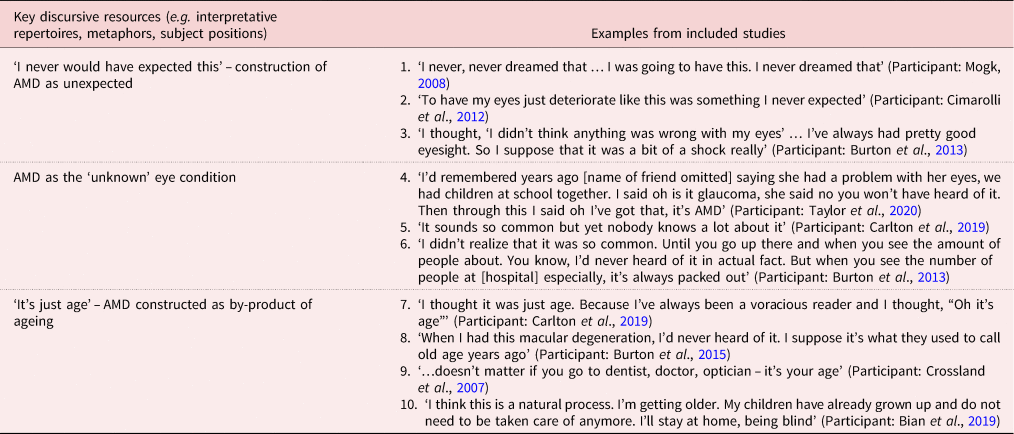
Across studies, participants constructed AMD as ‘the unknown eye condition’ when compared to other diseases (Q4–Q6, e.g. ‘nobody knows a lot about it’). AMD was constructed as obscure and unknown relative to conditions such as glaucoma, and as poorly understood in relation to its high prevalence. As many of the study authors themselves conclude (e.g. Burton et al., Reference Burton, Shaw and Gibson2013), from a practice point of view, such talk highlights implications for demystifying and improving awareness of the risk factors and symptoms of AMD.
In tension with AMD as a source of shock and encounter with the unknown, the condition was also constructed as a seemingly predictable consequence of age (termed the interpretative repertoire ‘It's just age’). This repertoire constructed AMD as an unsurprising by-product of bodily decline (Q7–Q10) due to ‘old age’ or ‘getting older’, seemingly an ‘existential [inherent] limitation’ of ageing (Baars and Phillipson, Reference Baars, Phillipson, Baars, Phillipson, Dohmen and Grenier2013). This may be unsurprising for a condition such as age-related macular degeneration, a name that explicitly associates the condition with later life. However, such constructions may foreclose a focus on what Baars and Phillipson (Reference Baars, Phillipson, Baars, Phillipson, Dohmen and Grenier2013) term ‘contingent limitations’ of ageing, which are more structural in nature (such as unsuitable housing, inaccessible transport or ageism) and could be modified or addressed. For example, one participant in Bian et al. (Reference Bian, Wan, Tan, Wu, Su and Wang2019) stated (Q10):
I think this is a natural process. I'm getting older. My children have already grown up and do not need to be taken care of anymore. I'll stay at home, being blind.
Here, the participant constructs ‘stay[ing] at home, being blind’ as the seemingly inevitable end-stage consequence of AMD, a construction which appears to preclude possibilities of interventions to prevent the speaker from becoming isolated at home. Furthermore, such a construction, which simplifies the links between older age and AMD, risks erasing the potential contribution of health behaviours such as smoking cessation in reducing AMD risk (Lawrenson and Evans, Reference Lawrenson and Evans2013). Thus, it is possible that an overemphasis on the organismic, biological process of ageing – represented as ‘a natural course of functional decline’ (Kelley-Moore, Reference Kelley-Moore, Dannefer and Phillipson2010) – can overshadow the social and structural lifecourse processes that could contribute to AMD risk.
Therefore, in participants' constructions of the origins of AMD, there is a seeming tension between AMD constructed as entirely unexpected and unknown, and AMD constructed as a fundamentally ‘natural’, unsurprising consequence of growing older. To explore this tension in all its complexity would require access to participants' action orientation, understanding how participants may deploy these different constructions at different points in their account in the service of specific discursive functions. In this analysis of de-contextualised extracts, it is not possible to explore how constructions might be differentially mobilised depending on discursive context. However, the tension alerts us to the potential for the co-existence of seemingly contradictory sets of constructions. One possible common thread uniting these sets of constructions are the ‘dividing practices’ of normal versus abnormal (Foucault, Reference Foucault, Dreyfus and Rabinow1983) bound up within both. In the case of constructions of AMD as unexpected and unknown, participants construct AMD as a fundamentally abnormal event, disrupting their hitherto normal, healthy state; in contrast, constructions of AMD as natural – located within a biomedical discourse of ageing as decline (Phelan, Reference Phelan, Ayalon and Tesch-Römer2018) – equate it with being a normal, expected part of chronological ageing. Both constructions thus arguably converge in affording a subjectivity of normalcy, in a world where impairment or illness is often stigmatised and othered.
Furthermore, both constructions arguably position the subject with AMD as the unsuspecting, passive recipient of a condition beyond their control, potentially helping avoid feelings of guilt or self-blame. This subjectivity could be understood against the backdrop of moralistic discourses surrounding many chronic illnesses with multifactorial (i.e. interacting genetic and environmental) determinants, that often place heavy responsibility on the individual for lifestyle modifications (see e.g. Peel, Reference Peel2014, on discourses of the aetiology of dementia). Interestingly, such discourse around individual responsibility for prevention was absent in the included extracts on AMD. Therefore – with the caveat that lifestyle factors (such as smoking exposure and access to a healthy diet) are socioeconomically and structurally determined rather than purely individual choices (Everest et al., Reference Everest, Marshall, Fraser and Briggs2022) – it could be noted that the constructions represented here overlook the fact that risk of AMD may be determined by more than purely ageing and, implicitly, genetics. (While AMD is largely genetically determined, changes to smoking and diet in particular may reduce AMD risk for those with an elevated genetic risk; Colijn et al., Reference Colijn, Meester-Smoor, Verzijden, de Breuk, Silva, Merle, Cougnard-Grégoire, Hoyng, Fauser, Coolen, Creuzot-Garcher, Hense, Ueffing, Delcourt, den Hollander and Klaver2021).
Constructing AMD as a total loss of independence
A recurrent interpretative repertoire across studies was the idea of ‘losing independence’ due to AMD, with independence constructed as an all-or-nothing, binary phenomenon, linked above all to continuation with functional activities (see Table 4 for quotations Q11–Q13). For example, a participant in McCloud et al. (Reference McCloud, Khadka, Gilhotra and Pesudovs2014) stated:
I was independent all my life, I've done everything by myself, and now I have to depend on someone … it's [vision loss] taken away my ability to perform a normal functional life, because I now have to rely on other people to help in many, many ways.
Quotations for second construction: ‘age-related macular degeneration (AMD) as a total loss of independence’
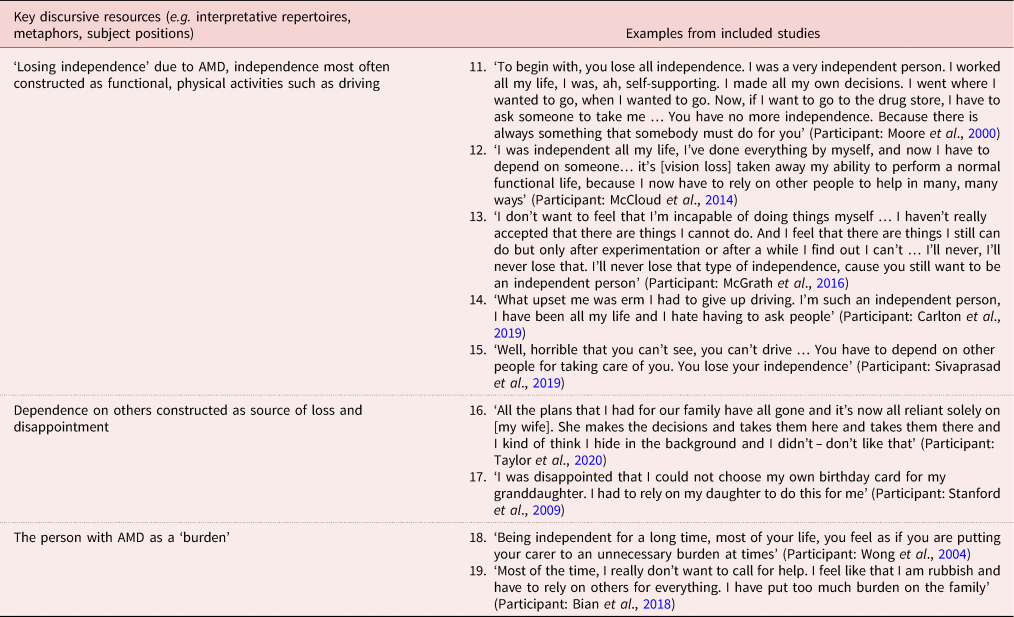
The construction of independence as a binary in included studies was reinforced through the use of extreme case formulations (Pomerantz, Reference Pomerantz1986), intensifying words which take participants' claims to extremes; for example, in the extract above, ‘I was independent all my life’, ‘I've done everything by myself’ (italics added for emphasis). Specifically, independence was largely constructed as inseparable from the notion of ‘doing things’ (Q13), physically acting on the world. In particular, driving was constructed as an essential element of independence, and giving up driving due to AMD was constructed as a loss of freedom and self-reliance (Q14, Q15), aligning with other studies where older adults construct cessation of driving as a critical turning point towards dependence (Laliberte Rudman et al., Reference Laliberte Rudman, Friedland, Chipman and Sciortino2006; Sanford et al., Reference Sanford, Rapoport, Tuokko, Crizzle, Hatzifilalithis, Laberge and Naglie2019). Arguably, this reflects a cultural preoccupation in industrialised societies with the car; as Kleege writes:
The inability to drive sets them apart, reinforcing their status as abnormal. Because in America today, and increasingly in the rest of the industrialised world as well, normal means not only to see, hear, walk, talk and possess an average IQ and income, but also to drive. (Kleege, Reference Kleege1999: 30)
Indeed, while using a car represents its own form of dependence on an object, car use becomes overwhelmingly constructed as a means of independence due to the driver's sense of apparent total control over where and when they travel (Hagman, Reference Hagman2003).
In more biomedical research on age-related eye disease, ‘functional independence’ (the notion of performing – mostly physical – daily activities) tends to be valorised as a taken-for-granted positive goal of treatment and rehabilitation. However, more critical perspectives suggest that discourses of positive, successful ageing can obfuscate the very real potential for ill health and disabilities to ‘make independence an untenable goal’ (Trentham, Reference Trentham2019). Conceivably, the pedestalising of independence may create distress or self-blame for people with AMD, if independence becomes internalised as a key marker for success which is challenging to achieve in reality (McGrath et al., Reference McGrath, Laliberte Rudman, Trentham, Polgar and Spafford2017). Perspectives from disability studies may encourage us to take a more expansive view of independence, whereby independence is ‘not linked to the physical or intellectual capacity to care for oneself without assistance; independence is created by having assistance when and how one requires it’ (Brisenden, cited in Morris, Reference Morris2004). Accordingly, independence is not necessarily about self-sufficiency, in terms of managing on one's own or doing everything for oneself, but more about being in a position to make one's own decisions and access appropriate support (Beresford, Reference Beresford and Watson2012). From this perspective, social or material support from others can strengthen wellbeing and empowerment, rather than being a marker of dependence (McLaughlin, Reference McLaughlin2020).
Such a discourse of interdependence, recognising that people with AMD may rely on but also be relied upon by others in a complex web of relational ties, is certainly underrepresented in the included studies when compared to discourses centred around a binary of dependence versus independence. This is not to deny the lived experience of many people with AMD, who may see maintenance of independence as a crucial prerequisite for living well; but more to highlight that alternative ways to configure in(ter)dependence do not generally find their way into discourse about AMD within these qualitative studies. Indeed, where a dependence on others is discussed, it tended to be presented in at best a neutral sense (e.g. ‘She [participant's wife] now reads to me, she knows that it gets so arduous for me’; Participant: Moore and Miller, Reference Moore and Miller2003) or at worst as a source of great loss or disappointment (Q16, Q17, e.g. ‘All the plans that I had for our family have all gone and it's now all reliant solely on [my wife] … I hide in the background’). Here, agency is constructed as being transferred from the participant to a family member, reminiscent of the ‘all or nothing’ independence–dependence binary discussed earlier. There is little sense of collaboration or shared decision-making, but rather the speaker deferring entirely to their relative, with the participant consequently becoming ‘hid[den] in the background’.
It is noteworthy that strong dichotomies of dependence versus independence are a common feature in research and policy spheres considering ageing more generally. Many dominant models of ‘successful ageing’ are concerned with ‘independence, avoidance of disability, and individual responsibility’ (Martinson and Berridge, Reference Martinson and Berridge2015), while fears of becoming ‘dependent’ may underpin hegemonic ideologies which see ageing and disability as states to be feared (Stone, Reference Stone2003). However, a more critical perspective helpfully directs attention to the complex social, structural, relational and environmental factors which shape possibilities for independence (Priestley and Rabiee, Reference Priestley and Rabiee2002). Indeed, it is instructive that in a study exploring how a couple experience living with AMD together (Burton et al., Reference Burton, Shaw and Gibson2015), the participants co-constructed a more nuanced, dialectical and dynamic view of in/dependence:
Sally: And I do try to write things, but when we've written things down we can't see what we've wrote! I write the shopping list, but he has to take the magnifying glass, that means when he goes around the supermarket he's got the supermarket trolley, the shopping trolley, the shopping list and the magnifying glass…
Jack: And a thing to tick them off (Sally laughs) I'm like an octopus (laughs).
The participants – both living with AMD – construct a division of labour within the dyad, where each partner uniquely contributes within their collective unit. This construction of a harmonious, humorous interdependence arises in a specific interview context, involving two partners living together with AMD. This contrasts with the other studies, where the constructions generally reinforce a rigid demarcation between the now-‘dependent’ person with AMD, and either their ‘independent’ pre-AMD self, or the rest of their family or social group.
Closely bound up with discursive constructions of (in)dependence is the metaphor of ‘burden’, either constructed as an imaginary state to be feared or as one currently experienced (Q18, Q19). AMD was often constructed as precipitating a shift from being an independent, fully functioning person to an implicitly dehumanised ‘burden’ position, bound up with feelings of guilt, passivity and worthlessness. In their critical ethnography of older adults living with vision loss in Canada, McGrath et al. (Reference McGrath, Laliberte Rudman, Polgar, Spafford and Trentham2016) note the preponderance of participants describing themselves with terms such as ‘burden’ and ‘nuisance’, out-of-place in a world teeming with seemingly efficient, independent agents. More broadly, McLaughlin's (Reference McLaughlin, Watson, Roulstone and Thomas2012) exploration of ‘burden fixation’ in the context of families affected by disability demonstrates how this pervasive framing can obscure the full and valued role of disabled people within their families and communities. Furthermore, the burden metaphor has political and socioeconomic implications, with disability scholars linking the discourse of burden with the privatisation of care in many societies. For if care for people with chronic conditions and disabilities becomes discursively configured as an individual or familial ‘burden’, it may become a private, hidden activity that absolves public services of their responsibilities. Equally, if community or public services do not provide appropriate forms of support, individuals then become more likely to require more material help and care within the private domain, and this may itself reinforce a sense of inconveniencing others (Soldatic and Meekosha, Reference Soldatic, Meekosha, Watson, Roulstone and Thomas2012).
Constructing AMD as grievous loss
Consistently across studies, participants constructed the experience of AMD as one of deep loss and grief, either being experienced in the participant's present or as a fear for their future (for quotations, see Table 5). From a critical perspective in disability studies, many of the extracts can be considered examples of what Oliver refers to as ‘disability as personal tragedy’ (Oliver, Reference Oliver1986). For example, extracts from a diary study based in the United Kingdom (UK) (Stanford et al., Reference Stanford, Waterman, Russell and Harper2009) included entries such as ‘I live in a sad world of my own’ or ‘I'm in a state where there is no way out’. These comments vividly construct a sense of despair, loneliness and claustrophobia. An associated interpretative repertoire is ‘AMD as a prison’ (Table 5, Q20–Q22), with participants constructing themselves as ‘imprisoned’ or ‘cut off’; such metaphors of entrapment, of a world closing in around the participant, have a concrete, physical quality.
Quotations for third construction: ‘age-related macular degeneration (AMD) as grievous loss’
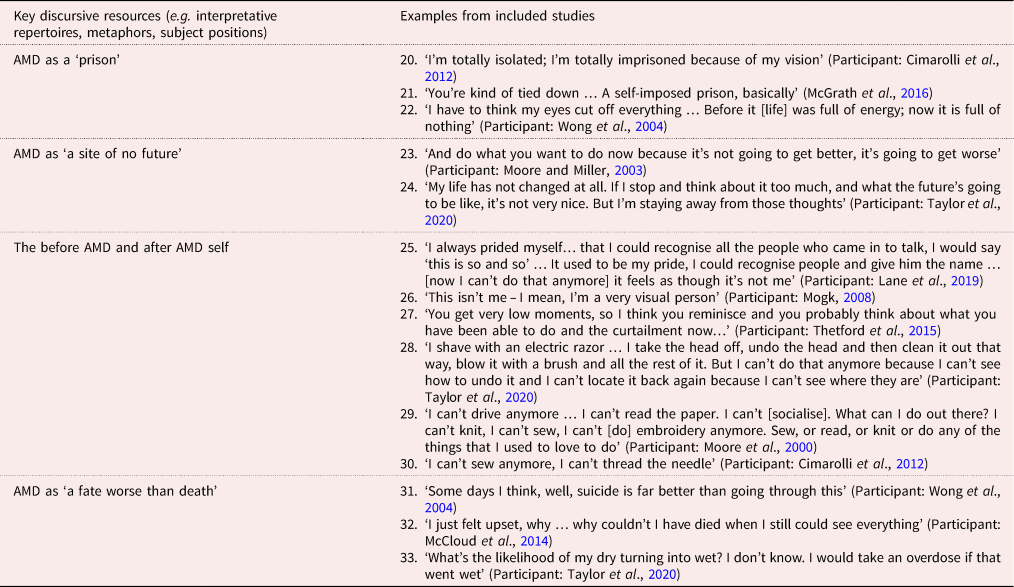
One feature common to these accounts is a sense of dread, drawing on the interpretative repertoire of life with AMD as a site of ‘no future’ (Q23, Q24), a common construction in many dominant, culturally-entrenched representations of disability (Kafer, Reference Kafer2013; Rice et al., Reference Rice, Chandler, Rinaldi, Changfoot, Liddiard, Mykitiuk and Mündel2017). Indeed, with AMD being a progressive disease, the construction of decline over time was a common discursive feature across accounts, e.g. with one participant in Moore and Miller (Reference Moore and Miller2003) stating: ‘And do what you want to do now because it's not going to get better, it's going to get worse.’ This constructs a sense of ‘living on borrowed time’ and a diminished future that awaits, where opportunities and possibilities will become restricted.
Underpinning these constructions is a sense of what Alison Kafer identifies as:
the ‘before disability’ self and the ‘after disability’ self (as if the distinction were always so clear, always so binary). Compulsory nostalgia is at work here, with a cultural expectation that the relation between these two selves is always one of loss, and of loss that moves in only one direction. (Kafer, Reference Kafer2013: 42)
In line with Kafer's notion of ‘compulsory nostalgia’, and the idea of the ‘before disability’ and ‘after disability’ self, there were several examples of participants constructing themselves as a fundamentally different person to who they were before the onset of AMD, an interpretative repertoire we termed the ‘before AMD and after AMD self’. For example, a participant in Mogk (Reference Mogk2008) stated starkly: ‘This isn't me – I mean, I'm a very visual person.’ As an element of this interpretative repertoire, we identified constructions of a dichotomy between pre-AMD success and post-AMD failure with reference to functional activities. These constructions were frequently deployed in talk about inability to perform daily functional activities, concentrated around frequent use and emphatic repetition of the term ‘can't’ (Q28–Q30, e.g. ‘I can't read the paper. I can't [socialise]. What can I do out there?’). In the latter quote, the participant positions themselves as isolated from the activity-rich world outside and excluded from functional activities. It is noteworthy that difficulties with functional daily activities are a predominant theme in the qualitative literature on everyday life with AMD. From a social constructionist perspective, a focus on ‘activities of daily living’ can itself be considered a discourse that codifies ‘normal’ and ‘abnormal’ functioning within a body. This risks ‘reducing a life to functional limitation in instrumental or daily care acts’ (Richardson and Abrams, Reference Richardson and Abrams2020: 43), and reproducing restrictive normative limits for what it means to function and age well with AMD. Such discourse creates parameters for a ‘normal functional life’ (Q12), which if unattainable, may result in a subjective experience of failure.
Another common discursive construction within this theme is the repertoire of vision loss due to AMD as a ‘fate worse than death’ (Q31–Q33), with one participant in Wong et al. (Reference Wong, Guymer, Hassell and Keeffe2004) stating: ‘Suicide is far better than going through this.’ Such constructions of AMD as a fate worse than death are arguably drawn upon by participants to emphasise how they could not accept or imagine a future without sight. This trope of ‘better off dead than disabled’ is widespread, as disability scholars have noted (e.g. Shakespeare, Reference Shakespeare, Bickenbach, Felder and Schmitz2013), reflecting the negative valuation of impairment in many contemporary societies, and rooted in a discourse of disability as personal tragedy (Oliver, Reference Oliver1986). As Kleege states, regarding the portrayal of vision loss in the 1992 film Scent of a Woman, ‘darkness might as well be death; life without sight is hardly living’ (Kleege, Reference Kleege1999: 47). Profound fear of blindness, often constructed as the ultimate negative destination of AMD, permeates this discourse that frames life with vision loss as unliveable and unacceptable (e.g. ‘I just hope I don't live too long if I go completely blind’; Participant: McCloud et al., Reference McCloud, Khadka, Gilhotra and Pesudovs2014). Notable here is the construction of ‘blindness’ as an imagined, anticipated state rather than an experienced reality. This aligns with the argument that extreme hypothetical imaginaries of visual impairment as catastrophe can drown out the complex, more nuanced perspectives of individuals living with visual impairment (Schillmeier, Reference Schillmeier2006). Additionally, on a practical level, such discourses that position blindness as the catastrophic endpoint of AMD underline potential for eye care professionals to raise awareness that AMD rarely leads to total loss of vision (Crossland et al., Reference Crossland, Helman, Feely, Gould and Rubin2007).
Constructing AMD as a condition to be stoically accepted
In contrast to the constructions of AMD as a catastrophe or source of loss and grief discussed above, the extracts also included examples of participants taking up a more stoical subject position and drawing on constructions of perseverance (for quotations, see Table 6). Often this stoic position was made available by drawing on constructions of carrying on as before and accepting AMD (Table 6, Q34–Q40, e.g. ‘I'll accept it, what happens will happen’; Participant: Moore and Miller, Reference Moore and Miller2003). Alternatively, participants drew on constructions of acceptance that were more gradual and phased in their nature, involving initial shock and depicting acceptance as an eventual restoration of equilibrium (e.g. Q36). Some participants adopted a stronger position of stoicism (e.g. Q39, ‘It doesn't affect me at all’). However, participants' stoical constructions also presented unconcern about AMD as an effortful, wilful process (e.g. Q40, ‘I don't let it bother me. I'm not going to’), an outlook to be cultivated rather than emerging naturally.
Quotations for fourth construction: ‘age-related macular degeneration (AMD) as a condition to be stoically accepted’
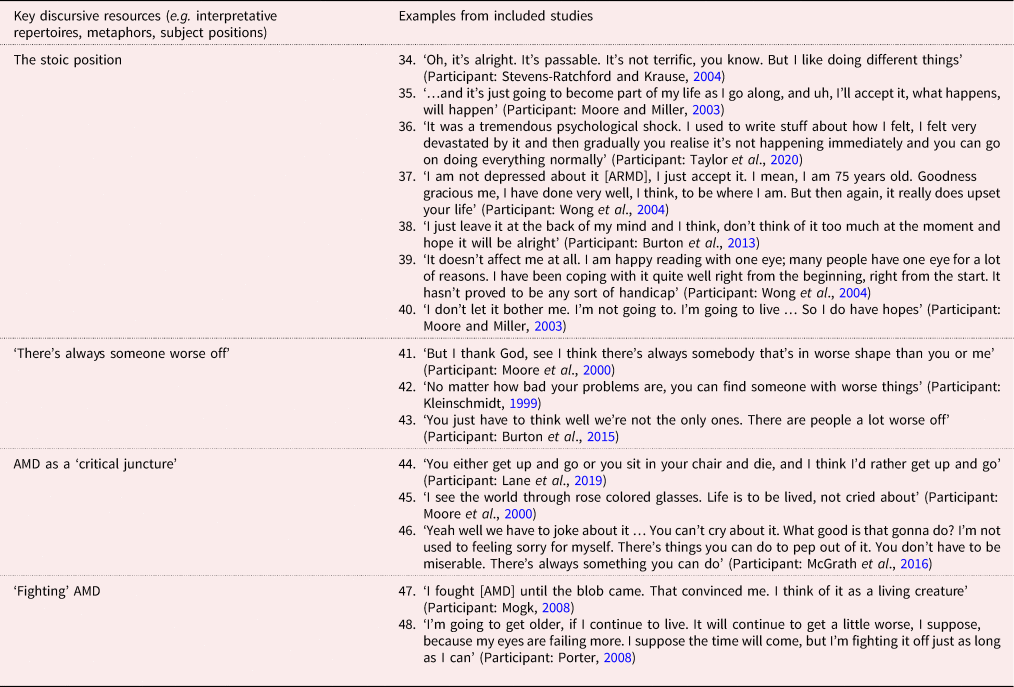
A common discursive strategy was the use of comparisons with imagined or real others in more difficult situations, a repertoire termed ‘there's always someone worse off’ (Q41–Q43), which has been noted in several studies of age-related vision loss (e.g. McGrath and Corrado, Reference McGrath and Corrado2019). Such downward comparisons can set up a kind of ‘hierarchy of impairment’ (Deal, Reference Deal2003), a continuum of more- or less-desirable health states, that may communicate a sense of gratitude and acceptance even as this creates a distance from those positioned as ‘worse off’. An additional discursive strategy that emerged across extracts to set up positions of persevering in spite of AMD was the construction of AMD as a ‘critical juncture’ (Q44–Q46), a fork-in-the-road presenting a choice between becoming stuck in self-pity versus adopting a resolute, forward-looking attitude (e.g. ‘You either get up and go or you sit in your chair and die, and I think I'd rather get up and go’; Participant: Lane et al., Reference Lane, Rohan, Sabeti, Essex, Maddess, Dawel, Robbins, Barnes, He and McKone2019). These constructions set up the subject position of the agentic individual, summoning their willpower, control and determination to choose to ‘get up and go’.
Indeed, in common with discourses surrounding other chronic conditions, metaphors of ‘fighting’ AMD were drawn upon, which configure the body as a battleground and put the onus on individuals with a chronic condition not to give up the fight (Willig, Reference Willig2011). It is notable that AMD was constructed as a kind of ‘encroaching enemy’ by one participant (e.g. ‘I think of it as a living creature’; Mogk, Reference Mogk2008), which the individual has to fight to keep at bay (Q47, Q48). This discourse of fighting AMD is employed to convey a desired resilience to the effects of AMD: a sense that even if vision loss attributable to AMD becomes more advanced, the speaker will not allow the condition to erode their quality of life. As has been highlighted elsewhere, such discourse affords positions that are often typified by their ‘relentless and unforgiving individualism’ (Willig, Reference Willig2011: 902), in terms of the individual's responsibility to ‘stay strong’.
However, one extract from Moore et al. (Reference Moore, Constantino and Allen2000) provided a counterpoint to this individualistic position, with the participant discussing the value of audiobooks and an access bus for people with disabilities: ‘I'd fight to the death anybody that decides to take those books away from me, or that bus.’ Here the participant positions themselves in a fight to retain vital resources such as accessible audiobooks or transport for themselves, but which could also be congruent with the social model of disability. In this way, we see an alternative construction of a ‘fight’ to expand or protect collective rights and resources, an endeavour whose effects could have implications beyond the individual.
Constructing AMD as an opportunity for discovery
In a small number of extracts, participants’ talk went beyond a stoical acceptance of AMD to draw on constructions of new discoveries and growth since diagnosis (Table 7, Q49, Q50). In these extracts, AMD was constructed as a journey or ‘quest’ with a focus on ‘what can be reclaimed of life’ (thus resonating with what is referred to as the ‘quest narrative’ in Frank, 1998: 204), for example in terms of meaningful changes to their way-of-being (Q49, ‘I'm a more balanced person’) or a sense of curiosity and playfulness, e.g. treating a buffet as a ‘treasure hunt’ (Q50).
Quotations for fifth construction: ‘age-related macular degeneration (AMD) as an opportunity for discovery’
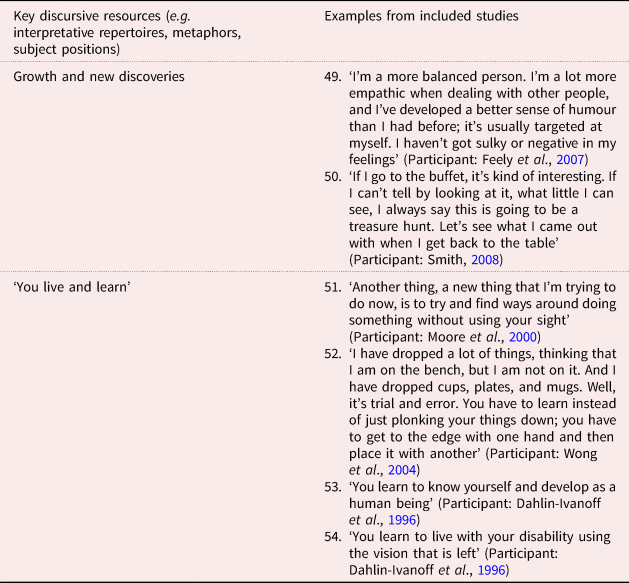
Several participants – when describing how they had adapted to AMD – drew on constructions of compensating by using other faculties and skills, setting up the subject position of the person with AMD as an innovator who ‘lives and learns’ (Table 7, Q51, Q52). These constructions, of innovation, effort and learning, challenge the idea of ‘compensatory powers’ (Jernigan, Reference Jernigan1974; Makepeace, Reference Makepeace2021), a common trope in narratives of vision loss, suggesting that visually impaired people have extraordinary abilities that ‘compensate’ for low vision.Footnote 4 Indeed, this trope discounts the time, practice and effort that people with visual impairment may expend in order to adapt to vision loss, as illustrated in one included extract with its emphasis on ‘trial and error’ (Q52).
Discussion
In sum, the dominant discourses around AMD, as drawn upon by participants quoted in peer-reviewed qualitative studies, appear largely – though not exclusively – to be shaped by biomedical logics that construct AMD as a tragedy and a threat to independence. The constructions of AMD identified are also inherently tied to biomedical discourses of ageing which configure ageing as bodily decline and, echoing the analysis of McGrath et al. (Reference McGrath, Laliberte Rudman, Polgar, Spafford and Trentham2016), frame the functional and psychological response to AMD largely as a question of individual responsibility. Constructions of the aetiology of AMD in the included studies (Theme 1) tended to position the participant with AMD as an unsuspecting, passive recipient of a condition constructed overwhelmingly as a consequence of physiological ageing, potentially helping avoid subjective experiences of guilt and self-blame. The emphasis on age as the fundamental cause of AMD runs counter to healthist discourses of individual responsibility for managing disease risk that dominate in many other chronic conditions (Peel, Reference Peel2014; Gibson et al., Reference Gibson, Lee and Crabb2015). This suggests there may be value in a public health approach to addressing some of the modifiable factors partially contributing to risk of AMD, particularly smoking and diet; while accepting that such ‘risk factors’ are socioeconomically and environmentally patterned, and so avoiding a potentially moralising discourse of individual risk management.
Approaching the analysis with the social model of disability in mind, extracts where participants saw the challenges of living with AMD and visual impairment as a social, collective, political or economic issue were notable in their scarcity. AMD was generally constructed as an individualised experience of shock, a loss of function and independence, and a source of deep distress (even as a ‘fate worse than death’ – Theme 3), that could generally only be overcome through individual effort (Theme 4). Such constructions of AMD as personal tragedy arguably function to legitimate the subjective experience of suffering caused by vision loss, in a society set up for sighted people where individuals are ‘subjected to a daily diet of the personal tragedy model of visual impairment’ (French and Swain, Reference French, Swain, Swain, French, Barnes and Thomas2004: 35).
It is important to note that the majority of the included studies were conducted in English, in high-income country contexts. However, two studies were conducted in China (Bian et al., Reference Bian, Wan, Smith, Li, Tan and Zhou2018, Reference Bian, Wan, Tan, Wu, Su and Wang2019). These studies both explicitly attest to the importance of family support, as well as concern about how AMD may impact both the individual and their wider family; not only emotionally, but also financially in a context where patients formerly paid for injection treatments for wet AMD, prior to 2019 when medical insurance was extended to cover wet AMD treatment in China (Lu et al., Reference Lu, Huang, Zhang, Huang, Zhang, Ma, Ren, Shi, Kuang, Yan, Luo, Zhang, He, Yang, Gao and Leng2021). In this context, constructions of loss of independence and the person with AMD as a burden – aligning with constructions found in studies conducted in other countries where AMD injections are free at the point-of-use or covered by medical insurance – may be informed not only by societal discourses but also by more material, economic concerns. The only other included study from a non-English-speaking context was conducted in Sweden, but this only included limited published extracts; the quotations published verbatim were most relevant to Theme 5 (Q53-54), within the repertoire of ‘You live and learn’, but the paper also focused prominently on problems and limitations linked to AMD. Therefore, on the basis of relatively limited data, it is challenging to argue that talk within any of these three studies conducted in non-English-speaking contexts represented a radical departure from the constructions identified across the included studies overall.
Our findings largely align with the call of McGrath et al. (Reference McGrath, Laliberte Rudman, Trentham, Polgar and Spafford2017) to incorporate critical disability perspectives into research on age-related vision loss, in order to question or nuance ideological notions of independence and normalcy. Indeed, it is striking in our analysis how frequently, and similarly across countries, that the experience of AMD was constructed as a total loss of independence (Theme 2), framed within an ‘all or nothing’ polarity. The analysis also identified a similar, though perhaps less strikingly uniform polarity, in the construction of AMD across studies as a ‘critical juncture’ or ‘fork-in-the-road’ (Theme 4), presenting a stark binary choice between exercising willpower to keep living well or withdrawing into oblivion. Such a binary arguably reproduces moralistic discourses common in Western, industrialised societies that emphasise individual will and self-reliance in achieving health and success (Kittay, Reference Kittay, Adams, Reiss and Serlin2015); and concurrently downplays the ways in which, for example, features of the physical, social, economic or political environment around the person may influence how they respond to and live with AMD and vision loss. To draw on Baars and Phillipson's (Reference Baars, Phillipson, Baars, Phillipson, Dohmen and Grenier2013) typology of ‘existential’ and ‘contingent’ limitations linked to ageing, the discourses and repertoires mobilised by participants generally tended to configure AMD solely as a source of inherent, ‘existential’ problems within the individual, rather than of problems stemming from societal, structural or environmental barriers which are arguably ‘contingent’ or modifiable. Indeed, the polarities and extremities often evidenced in the included extracts, such as the construction of losing all independence or vision loss as a fate worse than death, arguably close down the potential for life with AMD to be (for at least some individuals) ‘mundane, a mere matter of seeking practical solutions to everyday inconveniences’ (Kleege, Reference Kleege1999: 228).
The concept of ‘ideological dilemmas’ (Billig et al., Reference Billig, Condor, Edwards, Gane, Middleton and Radley1988) can help to make sense of the disparity between critical thought about disability and ageing (which suggests that many dominant, naturalised discourses are in fact socially and historically ‘contingent’), and participants’ talk (which constructs many of the effects of AMD as ‘existential’ and unavoidable).Footnote 5 Critical thought from gerontology and disability studies could be considered ‘intellectual ideology’ (defined as ‘a system of political, religious or philosophical thinking’; Billig et al., Reference Billig, Condor, Edwards, Gane, Middleton and Radley1988: 27), theoretical positions that valuably seek to reconfigure society's understanding of ageing and impairment. In contrast, participants' discourse is generally situated in the ‘lived ideology’ – ‘what passes for common sense within a society’ (Billig et al., Reference Billig, Condor, Edwards, Gane, Middleton and Radley1988: 27) – of illness, impairment and ageing that is rooted within biomedical understandings of these phenomena, which shape mainstream, ‘common-sense’ ideas around vision loss. From the ideological dilemmas perspective, there is a dialectic between the ‘intellectual ideology’ and the ‘lived ideology’. How these ideologies are deployed in discourse will change depending on social and argumentative context, rather than existing at polar opposite ends of a binary. From this viewpoint, research on AMD tends to be a context for focusing on understanding and addressing ‘problems’, especially as much of the research is conducted within the clinical worlds of ophthalmology and optometry. (There were a small number of exceptions to this more biomedical framing, where an expressly critical or sociocultural approach was adopted, e.g. Mogk, Reference Mogk2008; McGrath et al., Reference McGrath, Laliberte Rudman, Polgar, Spafford and Trentham2016.) Indeed, a recent scoping review considering the ‘loss focus’ in AMD research concluded that ‘negative expectations and attitudes reflected in research questions and the outcomes reported may contribute to negative outcomes’ (Tanner et al., Reference Tanner, Caserta, Ord, Bernstein, Kleinschmidt, Clayton and Guo2020). Such a ‘loss focus’ may explain why more dilemmatic, everyday aspects of living with AMD are less salient in the included extracts. Arguably, qualitative research in AMD may call for less dualist and more ‘both/and’ thinking (Spinelli, Reference Spinelli2014: 14), which recognises that individuals in their everyday life may move between, and find meaning in, both a more ‘intellectual ideology’ of interdependence and a ‘lived ideology’ of independence, for instance. In line with McGrath et al. (Reference McGrath, Laliberte Rudman, Trentham, Polgar and Spafford2017), our findings also suggest the value of an approach drawing on critical disability studies and critical gerontology, which could shift the emphasis towards a focus on how societies and environments produce (and can therefore also reduce) disability for people living with AMD.
Limitations
Our secondary analysis sought to attend to the discursive features of participant accounts of AMD within previously published qualitative studies. A particular limitation inherent in this approach was the decontextualisation of the included extracts, removed from their accompanying context, commentary or qualifiers. This lack of context can be a problem arising in secondary analyses of qualitative data generally (Wästerfors et al., Reference Wästerfors, Åkerström, Jacobsson and Flick2014), but particularly when using discourse analysis. Using our approach, there was no way to explore the different positions adopted by the same participant, and consider the consistency or variability in how they draw upon discursive resources and repertoires within an interactional context. In our analysis of decontextualised extracts, we could not trace how the same participant might have taken up different positions within the interview conversation, and how they might have been positioned in specific ways in interactions immediately before the talk that is quoted in the extract. Furthermore, in the case of studies conducted in non-English-speaking countries (Dahlin-Ivanoff et al., Reference Dahlin-Ivanoff, Sjostrand, Klepp, Lind and Lindqvist1996; Bian et al., Reference Bian, Wan, Smith, Li, Tan and Zhou2018, Reference Bian, Wan, Tan, Wu, Su and Wang2019), the focus group and interviews were conducted in Swedish and Mandarin Chinese, respectively. This creates a potential issue in terms of equivalence of meaning between the original and translated text, especially considering the notion of the translator's subjectivity (Munday, Reference Munday, Bermann and Porter2014) which introduces an additional level of interpretation, and thus creates additional distance between the participants' original words and our analysis.
This secondary analysis focused on decontextualised, published text rather than raw data from individuals' accounts; however, this does not preclude ethical issues arising from the analysis (Thorne, Reference Thorne1998), a second key area of limitations. A potential ethical issue with this analysis is that participants never provided consent for their talk to be analysed in this way from this particular epistemological standpoint; the included research studies generally assume a realist epistemology, rather than the social constructionist epistemology underpinning discourse analysis. While we do not anticipate risks to participant confidentiality, there is arguably an ethical issue of sensitivity and fidelity to participants' perspectives. Drawing on the hermeneutics of faith and suspicion, as theorised by Ricoeur, we can consider that the vast majority of the (largely) realist research articles included operate using a hermeneutic of faith. Namely many of the articles included in this study implicitly or explicitly adopt an empathic attitude towards participants of ‘care or concern … That concern, as we know, presents itself as a “neutral” wish to describe and not to reduce’ (Ricoeur, Reference Ricoeur1970: 28). Discourse analysis does not imply a lack of ‘care or concern’ or empathy for participants; however, it does to some extent involve using a hermeneutic of suspicion, a ‘tearing off of masks’ (Ricoeur, Reference Ricoeur1970: 30). This hermeneutic of suspicion entails a kind of questioning or deconstruction that looks beyond the face value of talk, described as an interest in ‘the sense beneath the sense’ (Tomkins and Eatough, Reference Tomkins and Eatough2018: 194). Subsequently, as attempted in our analysis, it is possible to re-engage with a hermeneutic of faith when tentatively considering the implications of discourse for subjective experience. In the present analysis, practising a hermeneutic of suspicion often involved working with theory from critical fields such as disability studies and gerontology. Much of this could be considered opaque and abstracted from participants’ experience, an ‘intellectual ideology’ seemingly divorced from (and potentially even seen as invalidating of) their ‘lived ideology’.Footnote 6 Participants in the original studies could, for example, validly critique our critique of biomedical discourse, given that advances in biomedical science hold out hopes of slowing their vision loss. Indeed, for reasons that may lie in participants' identities, politics, life histories or self-concepts, many people with AMD may not identify with the more social dimension of disability discussed in this analysis (Mogk, Reference Mogk2008; Kafer, Reference Kafer2013: 14; Grue, Reference Grue2017; McGrath et al., Reference McGrath, Laliberte Rudman, Trentham, Polgar and Spafford2017). Therefore, there is a fundamental tension that this secondary analysis proposes interpretations which could be problematic to the original research participants. This underscores a need for awareness that we as analysts are shaped and bounded by our own interests (e.g. here, critical gerontology and disability studies perspectives); and that a multiplicity of other valid complementary or divergent interpretations could be made on the basis of the same texts.
Conclusion
To conclude, we suggest that many of the constructions identified (through our analytic lens informed by critical gerontology and disability studies) are underpinned by broader societal discourses which construct ageing and disability in largely negative, medicalised and individualistic terms. While only tentative claims may be made regarding the implications of such discourses for subjective experience (especially when analysing decontextualised extracts), taking up subject positions within such discourses could potentially compound feelings of isolation, hopelessness and powerlessness, and close down alternative avenues of experience. For example, talk of losing all independence in extreme terms across studies underscores the absence of an alternative valid (but arguably less culturally available) discourse of interdependence, which if more available could potentially reduce feelings of guilt, failure or being a ‘burden’ when someone with AMD might require support with certain activities. From a policy and practice view, our analysis suggests a value in framings of AMD which may allow space for feelings of grief and loss but avoid alarmist or totalising narratives of tragedy or an end to independence (since from our FDA-informed perspective, such discursive constructions may end up shaping the expectations and assumptions of what people believe to be possible). For example, moving away from an all-or-nothing construction of AMD as the end of independence frees up space within research and policy to focus on supporting the broader inclusion and welfare of people with AMD even if their independence, in the narrow physical/functional sense, has been affected by vision loss. This therefore entails a shift in focus, away from focusing only on a person's impairment as the root of their challenges, towards a more holistic consideration of how the social, structural and environmental context around the person can shape their wellbeing with vision loss.
Relatedly, the analysis points to tensions between dominant discourses drawn upon by people with AMD in published studies, and the more counter-hegemonic frames offered by theory in disability studies and critical gerontology. This more meta-level finding suggests there could be a value in adopting a pluralist, multi-perspectival approach to research on experiences of living with AMD, which attends to both the embodied, corporeal, phenomenological realities of AMD, and the discourses, norms and practices that shape the social and environmental context in which AMD is experienced. For example, in line with Thomas' ‘social relational’ theory of disability (Thomas, Reference Thomas1999), this could involve attending to both impairment effects – the embodied, sensory experience of living with AMD and vision loss – and disablism – avoidable oppression caused by institutions, physical and social structures, and discriminatory attitudes. As McGrath et al. (Reference McGrath, Laliberte Rudman, Trentham, Polgar and Spafford2017) suggest, research on age-related vision loss could benefit from a ‘a greater focus on the influence of the sociopolitical environment in the creation and sustainment of disability’ (McGrath et al., Reference McGrath, Laliberte Rudman, Trentham, Polgar and Spafford2017: 1996). Such research could explore the dialectic between social structure and embodied experience, e.g. considering how (dis)ableist and ageist discourses, institutions and systems shape the wellbeing of people with AMD, and how barriers and disablism could be dismantled and addressed. A more contextual research agenda could also attend to how factors such as gender, race and socioeconomic status intersect with disability and ageing to differentially shape the experiences of people with AMD. The analysis also points towards the need for more research on quality of life that moves beyond what Tanner et al. (Reference Tanner, Caserta, Ord, Bernstein, Kleinschmidt, Clayton and Guo2020) term the ‘loss focus’ in AMD research. This could involve adopting a broader approach that is sufficiently open to acknowledge the losses that often do occur with AMD, without assuming a priori that the experience of AMD is solely one of loss. A less ‘loss-focused’ research agenda could create more space for a multitude of alternative perspectives, perhaps moving beyond the individual to consider how the people, institutions and societies surrounding the person with AMD may affect the experience of living with vision loss. This broader understanding may help consider how physical and/or social inclusion can be enhanced for people with AMD, and quality of life and wellbeing potentially improved outside the clinical realm within everyday contexts.
Acknowledgements
We would like to thank all the anonymous reviewers for their constructive and detailed feedback on the manuscript.
Author contributions
JE: conceptualisation, methodology, analysis, data curation, writing – original draft. AS: writing – review and editing, supervision. CW: conceptualisation, methodology, analysis, writing – review and editing, supervision.
Financial support
This research received no specific grant from any funding agency in the public, commercial or not-for-profit sectors.
Competing interests
The authors declare no competing interests.


 Open access

