


The idea of American annexation is not new to the Canadian political imagination. In the nineteenth century, especially in the wake of the American Revolution and later during periods of economic uncertainty, some Canadian thinkers and politicians entertained the idea that joining the United States might offer greater economic prosperity and/or security. While such sentiments were far from dominant, they reflected genuine strategic and ideological debates about North American integration. For example, the Montreal Annexation Manifesto published in 1849 called for Canada’s annexation by the United States (Penny Reference Penny1924), but the pro-annexation movement faded out after the Canadian-American Reciprocity Treaty of 1854 (Ankli Reference Ankli1971).
The Constitutional Act of 1867 was a major development in Canadian history and by the following decades, Canada became “more and more American” but was still loyal to the British crown (Siegfried Reference Siegfried1906, 161–163). In some provinces like in British Columbia, which joined Canada in 1871, politicians used their strong connections and ties with the United States as leverage to threaten to pursue annexation by the US if more favourable terms were not secured with Britain and Canada (Siegfried Reference Siegfried1906). In other words, the idea that some territories or Canada itself might join the United States has, historically, been regularly brought to the table.
As Siegfried (Reference Siegfried1906) mentioned more than a century ago, it would be unwise to dismiss the possibility that Canada would ever be tempted to join the United States of America, and indeed, more than 20 per cent of Canadians wanted to join the United States in the 1940s (Schwartz Reference Schwartz1967). The issue became salient in December 2024 when Donald Trump (who was president-elect for a second term) mentioned during a dinner with Canadian politicians that Canada would be better off as the 51st State of the United States of America and that the two countries should merge. A senior cabinet member of the Canadian government initially said that “The president was telling jokes. The president was teasing us” (Taylor-Vaisey Reference Taylor-Vaisey2025). Several weeks later, Canadian Prime Minister Justin Trudeau admitted that it was not a joke and cabinet members made it very clear that Trump’s threats to annex Canada should be treated with seriousness.
Political elites in Canada are not divided on the issue. Every political party made it clear that annexation was not an option. That was true before the election of 2025, during the campaign as well as after the election. Not a single major party tried to adopt an original take to wedge voters on that issue. However, we know very little about citizens’ public opinion regarding the annexation of Canada by the United States. This is crucial for several reasons. First, if there is a substantial portion of the population that is sympathetic to annexation (even hypothetically), this could influence political discourse, which would be key for Canadian politics and political stability. Second, Canadians’ public opinion on the issue of the merging might not only affect Canadian politics, but also shape to some extent how American politicians (and citizens) view and discuss the US president’s wish to annex Canada. Third, analyses of public opinion on the issue can inform us on whether there are important variations across social groups and regions (e.g., Western Canada vs. Quebec or Atlantic provinces) which, in turn, could shape discourse in Canadian politics.
In this research note, we provide an important update on the critical issue of annexation that seemed to belong in the past but needs to be seriously addressed. The first objective of this research note is to describe public opinion using a fine-grained indicator of Canadians’ support for annexation. Moreover, we aim to do so by comparing public opinion before and after the implementation of major trade tariffs on Canadian goods.Footnote 1 Second, we leverage the large sample of an original survey to examine the determinants of citizens’ public opinion on annexation. In other words, we aim to provide a thorough assessment of who opposes or supports annexation by the US based on key sociodemographic and socioeconomic factors including those that have been said to be linked to one’s opinion on annexation (e.g., age, region). Third, we examine micro-level political determinants of citizens’ public opinion on the issue. We analyze how party identification with Canadian political parties shapes one’s attitude towards annexation. Finally, we provide what is, to the best of our knowledge, a first test explaining partisan effects. That is, we unpack citizens’ feelings towards Donald Trump as well as the United States and their relationship to Canadians’ willingness to merge with the US.
The main findings are threefold. First, we show that very few Canadians (about 8%) want to merge with the United States of America. This level of support is substantially lower than what most public opinion data signalled. Second, we surprisingly find relatively little variance across social groups or regions in Canada. While we find some differences in support for the annexation, they should not be overstated. Third, we find that there is, however, more variance in the support for the annexation based on Canadians’ partisanship. For example, Canadians who feel close to the Conservative Party of Canada (CPC) are substantially less likely to be very opposed to the annexation by almost 20 percentage points compared to people who do not feel close to any political party. Fourth, we also show that partisan effects are mostly explained by Canadians’ feelings towards Donald Trump. These feelings are in fact the main predictor of citizens’ support for the annexation, contrary to attitudes towards the United States which do not have any discernable effects. We conclude by discussing the implications of our findings for Canadian politics.
Canada-US relationships, public opinion and the issue of annexation
The relationship between the United States and Canada has been a recurring key for understanding Canadian politics. Far from being a marginal foreign-policy concern, the proximity, power and influence of the United States have repeatedly shaped political issues related to fundamental debates about trade, sovereignty and identity, especially during election campaigns.
Canada–US trade relations were the central issue in the 1891 and 1911 elections (Johnston et al. Reference Johnston, Blais, Brady and Crête1992, p. 7). In both elections, the party in favour of tightening the Canadian economy to the American market lost. For example, Wilfrid Laurier’s Liberal government supported a policy of reciprocity with the United States in 1911, which would have created a form of free trade in natural products such as agricultural goods, timber and minerals. Yet the proposal triggered a powerful nationalist backlash. Conservatives, led by Robert Borden, framed reciprocity as a threat to Canadian sovereignty and a potential stepping stone toward American annexation. This framing was fueled, among other things, by the US president (William H. Taft) who presented the reciprocity treaty to the Congress and Americans as “the first step toward subordination of Canada to American interests” (Rioux, Reference Rioux2019, p. 40).
The issue of free trade with the US resurfaced in the 1988 federal election. The Progressive Conservative government of Brian Mulroney negotiated an agreement in 1987, and the liberals and the New Democratic Party opposed it. It was the main issue in the 1988 Canadian election: “just as free trade dominated the media discussions of issues, so did it dominate the consciousness of the voters” (Johnston et al. Reference Johnston, Blais, Brady and Crête1992, p. 141). As in 1911, the opposition featured stark imagery of Canada being subordinated by the US. At the end of the day, Mulroney won a majority government, and the agreement (NAFTA) was implemented.
However, the influence of the United States on Canadian politics has not been limited to trade. Throughout the Cold War, questions of military alignment, nuclear weapons and continental security became important issues. In the late 1950s and early 1960s, Progressive Conservative Prime Minister John Diefenbaker clashed with Washington over whether Canada should accept American nuclear warheads on Canadian soil. The dispute split his cabinet, strained relations with the United States, and contributed to the defeat of his government in 1963 (Stevenson Reference Stevenson2014). More recently, the Afghanistan mission after 2001, conducted alongside American forces, became a contentious domestic issue (Massie Reference Massie2016).
Taken together, these episodes reveal a consistent pattern: American influence on Canada has long been a key factor in Canadian politics, with the issues of (in)dependence often salient. Public opinion exerts a powerful impact on how politicians respond to these issues, especially because they need to be at least somewhat responsive to the public given that they will be held accountable in the next election (Dassonneville et al. Reference Dassonneville, Blais, Sevi and Daoust2021).
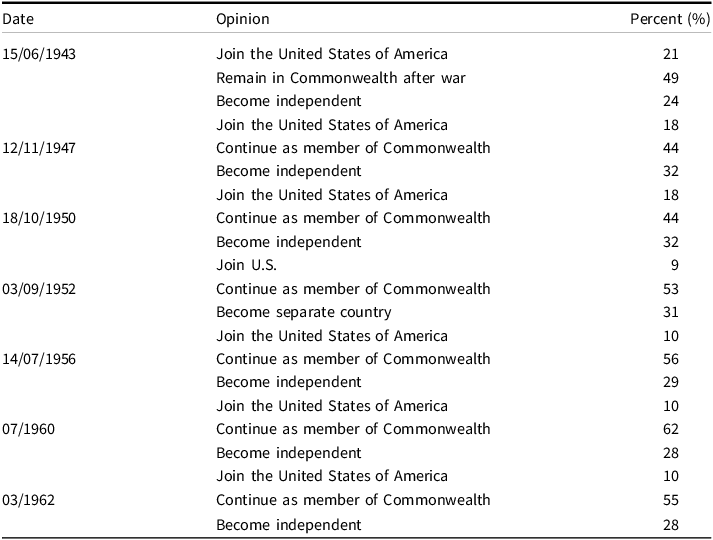
On the issue of annexation, public opinion data retrieved from Schwartz’s (Reference Schwartz1967) major book Public Opinion and Canadian Identity showed that the issue of annexation was discussed throughout the twentieth century and that Canadians did have an opinion on it. Table 1 below shows the key findings of public opinion research over two decades (from the 1940s to the 1960s). In 1943, about one-fifth (21%) of Canadians wanted to join the United States of America. While not very substantial, this support is far from trivial. Moreover, this level of support was not fully explained by the WWII context of 1943. Indeed, four years later, there was still about one-fifth of the population (18%) who favoured joining the US. Public opinion shifted in the 1950s as only 9% responded that Canada should be annexed by the United States. The level of support stabilized around 10% for the rest of the decade and the 1960s as well.
Public Opinion on Joining the United States of America

Table 1. Long description
The table presents public opinion data on the issue of joining the United States of America from 1943 to 1962. It consists of five rows and three columns. The columns are labeled Date, Opinion, and Percent (%). The rows list specific dates and the corresponding opinions with their respective percentages. In 1943, 21% of Canadians wanted to join the United States of America, 49% wanted to remain in the Commonwealth after the war, and 24% wanted to become independent. In 1947, 18% supported joining the United States, 44% wanted to continue as a member of the Commonwealth, and 32% wanted independence. In 1950, the percentages were similar: 18% for joining the United States, 44% for continuing in the Commonwealth, and 32% for independence. By 1952, only 9% supported joining the United States, 53% wanted to continue in the Commonwealth, and 31% wanted independence. In 1956, 10% supported joining the United States, 56% wanted to continue in the Commonwealth, and 29% wanted independence. In 1960, 10% supported joining the United States, 62% wanted to continue in the Commonwealth, and 28% wanted independence. In 1962, 10% supported joining the United States, 55% wanted to continue in the Commonwealth, and 28% wanted independence. The data shows a significant shift in public opinion over the decades, with a notable decrease in support for joining the United States and a stable preference for remaining in the Commonwealth.
Note: Data are retrieved from Schwartz ( Reference Schwartz 1967 , 74).
Theoretical frameworks from social psychology and political science are helpful in making sense of Canadians’ public opinion on this issue. Social identity theory is particularly insightful, especially in a context of the so-called “Americanization of Canada” (Raney Reference Raney2010) which posits that cultural, economic and technological influences of the US over Canada pose an important threat to the country’s identity. Canadians’ identity is partly individual but also collective and thus partly shaped by their “memberships” of social groups (e.g., Brewer and Gardner Reference Brewer and Gardner1996). Regarding Canada–US relationships, the process of social categorization from the social identity theory, positing the world into groups (e.g., “us” versus “them”) (Brewer and Gardner Reference Brewer and Gardner1996; Tajfel and Turner Reference Tajfel and Turner2004), seems key as Canadians do not include Americans as part of their in-group. As put by Raney (Reference Raney2010, p. 108, our emphasis), “nationalisms are by definition relational, relying on an oppositional frame in order to differentiate the shared values, characteristics, and beliefs of one nation over another. In Canada outside Quebec, this out-group has usually been the United States.”
Following the social identity theory and this conception of who is the in-group and out-group, people who do not feel Canadian should be more open to a merging with another country. That said, there is quite a lot of heterogeneity within Canada regarding citizens’ identification with the country, and research points out that these differences are in line with the expectations of social identity theory. For example, it has been shown that Quebeckers who do not feel Canadian are much more willing to secede from the rest of Canada (e.g., Mendelsohn Reference Mendelsohn2002).
Moreover, differences in (political) culture across regions and provinces might also affect citizens’ identity and, in particular, the extent to which they feel close or similar to Americans. For example, Alberta’s culture has been defined, according to Wesley (Reference Wesley2011), by individualism, populism, as well as a desire for greater provincial autonomy. Quebec is also much more collectivist than the rest of Canada (e.g., Béland and Lecours Reference Béland and Lecours2008), it is the only province where English is not the official language (French is the sole official language) and most of the population identify as Catholic. These differencesFootnote 2 might lead to different levels of support regarding the issue of annexation if, for example, Alberta’s individualism is closer to what is found in the US than in most part of Canada.
Another strand of research is insightful to better understand US–Canada relationships and the issue of annexation, that is, the subfield of constitutional preferences. Among other things, we know that gender and language are key in citizens’ preference for the status quo versus constitutional changes. The link between gender and favouring the status quo of a given constitutional order is well established: women tend to be more favourable than men to the status quo. The main mechanism has been said to be risk aversion (e.g., Verge et al. Reference Verge, Guinjoan and Rodon2015), women being more likely to perceive risks and the weight of that factor would play a greater role in their opinion compared to men. On language and in the specific case of Canada, Quebec French speakers who are quite worried about the precarity of French in Quebec and citizens who believe that French is in danger in the province are more likely to favour secession (e.g., Daoust and Gareau-Paquette Reference Daoust and Gareau-Paquette2026). Hence, support for a merging with the US might be less high in Quebec as the proportion of French-speaking citizens in the country would sharply decline if Canada were to become the 51st state (they would move from about one-fifth to less than 2 per cent of the country’s population).
In sum, Canada–US relationships have been key in Canadian politics and the issue of annexation has often been brought up. While it has received a decent amount of support at some point (e.g., in the 1940s, as shown in Table 1), the overall enthusiasm seems very low in modern Canadian politics. That said, there are reasonable theories and reasons to expect interesting variance across the population. In the next section, we detail the data and indicators used to improve our understanding of this issue in the twenty-first century.
Data and indicators
Data
We conducted an original survey using Leger’s LEO web panel from February 27, 2025 to March 14, 2025. Respondents received points for their participation in the survey. A total of 3,507 valid responses were received from adult Canadian citizens. Figure A1 of the appendix shows the number of people surveyed each day. On average, we surveyed about 219 respondents per day, with a minimum of 18 and a maximum of 679. The province of Quebec is over-represented in the sample (n = 1,871) compared to the rest of Canada (n = 1,636). In Quebec, the data match our established quotas for age, gender and first language, according to Statistics Canada’s 2021 census. Outside of Quebec, quotas were also established to ensure that the proportion of observations in the rest of Canada reflected the demographic weight of the nine other provinces, and that the characteristics of the sample matched the census on age and gender. Unfortunately, we excluded observations from the three territories as they were too few to be included in a regional unit in our further analyses.
Some respondents (not counted in the above-mentioned number of respondents) were excluded from the data for one of the following reasons: having failed the attention-testing questions, having a fraud score greater than 30 or a duplicate score greater than 70 based on calculations provided by Qualtrics to prevent duplicate or bot responses.
We believe that this survey is particularly insightful for several reasons. First, the timing of our survey is interesting: 1,528 respondents were surveyed just before the implementation of historical tariffs by the United States on Canadian products while 1,743 were surveyed right after. We believe that it is insightful to provide a pre/post-tariffs comparison to get a better sense of whether Trump’s March 4 announcement (confirming that he was not bluffing about imposing tariffs on Canada) moved Canadians’ public opinion in any way. Second, compared to mediatized public opinion polls aiming at measuring citizens’ level of support for Trump’s proposal of annexation, we include a more fine-grained indicator of that support moving beyond a dichotomous answer choice. Most importantly, we also measure other political variables allowing us to better understand citizens’ public opinion on the issue. Third, our very large number of observations, combined with our measures of key political variables, allows us to unpack how attitudes on the annexation vary (or not) across social and political groups. For example, we can examine how feeling close to minor political parties, like the People’s Party of Canada, correlates with citizens’ view on the annexation, which is not possible with typical survey data of 1,000 respondents.
Indicators
To measure Canadians’ attitude on annexation, we use a straightforward question which reads as follows: “Would you be in favour of Canada becoming the 51st state of the United States?” The answer choices were “very opposed,” “somewhat opposed,” “somewhat favourable,” “very favourable,” “don’t know/prefer not to answer.” The last category represents only 3 per cent of the respondents and were excluded from our analyses.
The first group of variables that we examine are sociodemographic and socioeconomic factors that might drive Canadians’ support for the annexation of their country by the US. They have all been identified as crucial to better understand public opinion in Canada (e.g., Cutler Reference Cutler2002; Dassonneville et al. Reference Dassonneville and Baowen Liang2022; Ornstein et al. Reference Ornstein, Michael Stevenson and Paul Williams1980). These variables are age, gender, education, material well-being (combining income and assets), language and regions. Appendix A describes the coding of these variables. We should note, however, that despite our large sample size, we had to merge some regions (e.g., Prairies combine Alberta, Saskatchewan, and Manitoba).
The second category of variable captures citizens’ party identification, which refers to a “feeling of closeness or psychological attachment to a political party” (Gidengil et al. Reference Gidengil, Nevitte, Blais, Everitt and Fournier2012, 6) and has been shown to be key in Canadian politics (Jenson Reference Jenson1975; Merkley Reference Merkley2022).Footnote 3 To capture citizens’ partisanship, we focus on a classic question asking respondents what they “think” of themselves in partisan terms, with the parties explicitly named as well as a “none of these” option. The question reads as follows: “In FEDERAL politics, do you usually think of yourself as a…” It captures partisanship in line with Campbell et al.’s (Reference Campbell, Munro, Alford, Campbell and Long1986) theory that “partisans are partisan because they think they are partisan” (p. 102).
While partisanship captures predispositions (i.e., relatively deeply rooted orientations), the third group of variables is more contextual and relates to Canadians’ feelings towards Donald Trump and the United States. It is reasonable to expect citizens who hold more positive views of Donald Trump and the United States to be more favourable to the annexation. However, feelings towards the president and the country must be unpacked, given that they could vary quite a lot within the same individuals. Hence, we included a feeling thermometer question in the survey that asked respondents to “set a slider to any number from 0 to 100, where 0 means you really dislike the group and 100 means you really like the group” to measure their opinion of “Donald Trump” and “The United States.”Footnote 4 It is worth noting that Canadians affect towards Trump and the US are not strongly correlated. About 85 per cent of the sample did not attribute the same score to Trump as they did for the US and the Pearson’s r (0.44) indicates a moderate correlation. Finally, we include a variable capturing whether citizens’ priority is Canada’s sovereignty vis-à-vis the US. Respondents were asked “What is the most important issue to you personally right now?” Answer choices were “the economy,” “health care,” “education,” “the environment,” “poverty,” “immigration,” “Quebec independence” (for the Quebec sample only), “Canadian sovereignty vis-à-vis the United States” and “another issue.” People whose priority is Canada’s sovereignty are coded 1 while those who provided a different answer are coded 0. While not directly capturing citizens’ attachment to Canada, which would have been ideal, we believe that it is fair to assume that people who selected this option as the most important issue for them are more attached to Canada than those who selected another issue.
The detailed distributions of feelings towards Trump and the US can be found in Table B1 of the appendix. Moreover, Table B2 of the appendix displays the descriptive statistics for all variables used in our research note.
Results
We present all our findings without isolating Quebec from the rest of Canada because doing so does not alter any of our conclusions but improves the simplicity of the presentation of our results. The over-representation of Quebec would be problematic if public opinion on the annexation is different in Quebec or if the examined relationships are different in Quebec versus the rest of Canada, which happens relatively often.Footnote 5 However, Appendix C shows that the support for the annexation is remarkably similar (Figure C1) and that the relationships that we show replicates very similarly when separating Quebec from the rest of Canada (Tables C1–C2).
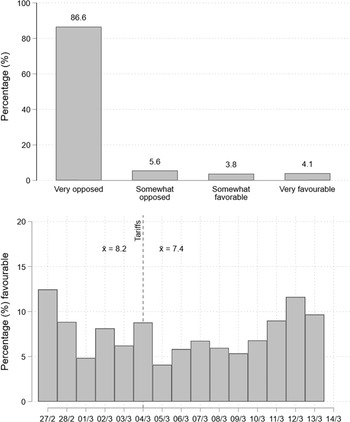
Figure 1 below shows the distributions of Canadians’ opinion on the annexation. Overall, about 92 per cent of respondents are opposed to being annexed by the US, among which almost 87 per cent are “very opposed.” Of the sample 3.8 per cent is somewhat favourable and about 4.1 per cent is very favourable to the merging, for a total of 7.9 per cent. The first key finding is thus that the vast majority of Canadians are very opposed to the annexation. However, it is worth noting that this magnitude of opposition is quite stronger than what several public opinion polls suggested. For example, Abacus Data (2025) found that “only” 71 per cent of Canadians were absolutely against a merging with the US and IPSOS’ (2025) results showed that 80 per cent of Canadians would never favour a merging. These levels of opposition are much less high than what we show in Figure 1, suggesting that the opposition might have been, if anything, underestimated.
Public Opinion on Canada’s Annexation by the United States.
Note: For the upper panel, N = 3,369. For the lower panel, N = 1,473 pre-March 4 and N = 1,668 post-March 4.

Figure 1. Long description
The bar graph compares public opinion on Canada’s annexation by the United States. The top bar graph shows four vertical bars representing different levels of opposition and favorability. The categories are ‘Very opposed’, ‘Somewhat opposed’, ‘Somewhat favorable’, and ‘Very favourable’. The values are approximately 86.6 percent for ‘Very opposed’, 5.6 percent for ‘Somewhat opposed’, 3.8 percent for ‘Somewhat favorable’, and 4.1 percent for ‘Very favourable’. The bottom bar graph shows daily percentage favorability over a period from February 27 to March 14. The x-axis represents dates, and the y-axis represents the percentage favorability. The average favorability before and after the introduction of tariffs is marked with dashed lines at 8.2 percent and 7.4 percent respectively. All values are approximated.
We are also interested in examining how a major event like the implementation of substantial trade tariffs on March 4 might have shifted Canadians’ public opinion. Despite the back and forth (see note 1), March 4 represents an interesting moment as it became quite clear that Trump was not bluffing. Our inquiry is exploratory as we do not have any clear expectations. Some might realize that the threat can actually be implemented and become even more worried that the Canadian economy and their quality of life will substantially decrease. Joining the US might thus become more tempting. Other people might react by expressing more solidarity with their fellow Canadians and become more radically opposed to the merging.
Was there a shift in Canadian public opinion after March 4? The lower panel of Figure 1 provides the answer. Overall, the average level of support (either somewhat favourable or very favourable to the annexation) just before the implementation of the tariffs is of 8.2 per cent compared to 7.4 per cent after. The difference in citizens’ level of support is of 0.8 percentage point, which is trivial and not meaningful. One possibility is that more Canadians were open to the merging before the threat of imposing trade tariffs and the threat itself (made in 2024) lowered the support so that the implementation of the tariffs per se did not alter public opinion. Another possibility is that Canadians were always massively opposed to the annexation and that the implementation of the tariffs did not change a thing. While we cannot provide such a comparison, we believe that it is still interesting to note that the implementation on March 4 did not move Canadians’ public opinion on the issue of annexation. We can confidently claim that support for the annexation was very low just before the tariffs and remained very low just after the implementation of the tariffs.
We should note, however, that there are some differences, albeit small, when comparing trends in Canadians’ public opinion before and after the implementation of the tariffs (March 4) in Quebec compared to the rest of Canada. As shown in Appendix C, which replicates all our findings unpacking Quebec versus the rest of Canada, Canadians outside of Quebec became less supportive of the merging after March 4 while Quebeckers became more supportive (see Figure C1). Substantially speaking, 9.3 per cent of Canadians outside of Quebec supported the annexation before the tariffs and this proportion decreased to 6.2 per cent after March 4, for a difference of about 3 percentage points. In Quebec, the pre-tariffs level of support was of 7.3 per cent compared to 8.5 per cent after March 4, for a tiny increase of 1.2 percentage points. We do not believe that these differences should be overstated, but we mention that one possible explanation is that the patriotism argument might have exerted a more powerful impact on Canadians outside of Quebec who feel more attached to Canada compared to Quebeckers (e.g., Mendelsohn Reference Mendelsohn2002).
While the overall level of support for the annexation is very low, it might be substantially larger for some people. As mentioned previously, it would be expected from research on constitutional preferences that women should be less likely to support constitutional changes like merging with the US as they are more likely than men to favour status quo; regional differences could emerge, etc. Our regression models allow us to examine how (1) sociodemographic and socioeconomic factors, (2) partisanship, and (3) feelings towards Donald Trump, the United States and prioritizing the issue of Canadian sovereignty shape Canadians’ support for the annexation. It also allows us to verify whether these factors explain partisan differences that might have emerged from the second model.
Table 2 shows the findings of an ordered logistic regression predicting whether respondents are very opposed, somewhat opposed, somewhat favourable or very favourable to the annexation. More precisely, there are three regression models. First, we only include sociodemographic and socioeconomic variables, as they are causally prior to citizens’ partisanship and affects towards Trump and the US. Second, we add partisanship, which is, as mentioned previously, quite deeply rooted and causally prior to citizens’ feelings towards Trump and the US. Indeed, it seems very reasonable to believe that citizens’ (lack of) partisan attachment is causally prior and more stable than their feelings towards specific items like Donald Trump and the US, which are much more contextual, even in Canada where partisanship is weaker than in the US (Jenson Reference Jenson1975). Hence, our third model adds our two feeling thermometers as well as perceived issue importance, which is also more contextual than party identification (Fournier et al. Reference Fournier, Cutler, Soroka and Stolleand Éric Bélanger2013; Daoust and Gareau-Paquette Reference Daoust and Gareau-Paquette2024).
Ordered Logistic Regressions Predicting Support for Annexation
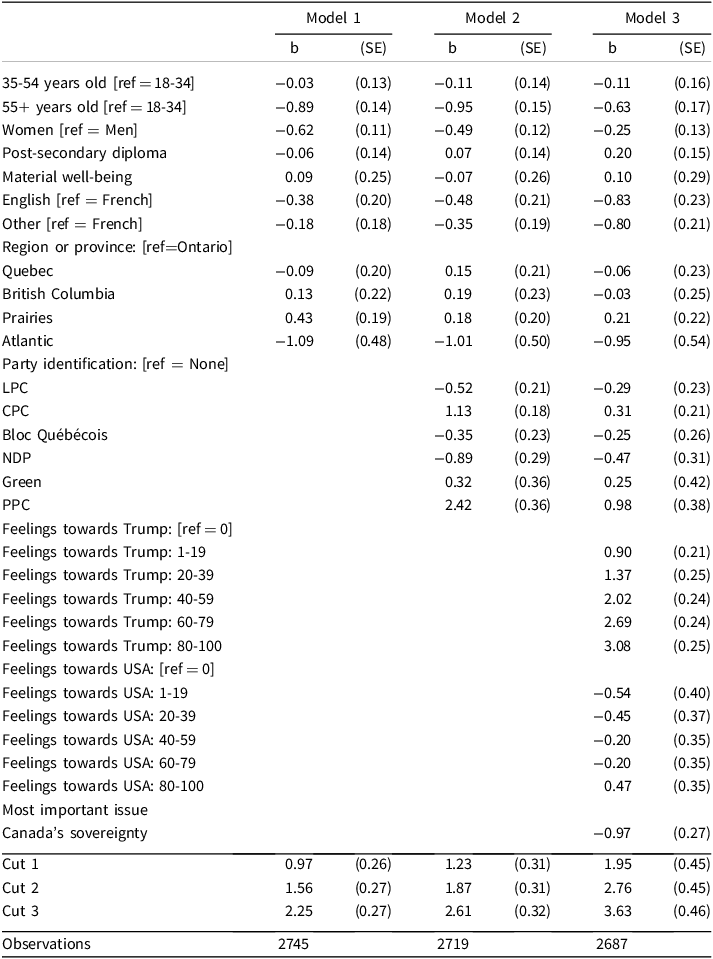
Table 2. Long description
The table presents the results of ordered logistic regressions predicting support for annexation across three models. It includes coefficients and standard errors for various demographic and political factors. The table has 27 rows and 12 columns, with columns labeled Model 1, Model 2, and Model 3, each containing coefficients (b) and standard errors (SE). The rows are labeled with different demographic and political variables such as age groups, gender, education, language, region, party identification, feelings towards Trump, feelings towards the USA, and most important issues. Notable trends include higher support for annexation among older age groups, men, and those with specific political affiliations. The table also shows the number of observations for each model.
Note: Ordered logistic regressions’ coefficients are displayed with standard errors in parentheses. Reference categories are: 18–34 years old for age, men for gender identity, none or some post-secondary education for education, French-speaking for language, Ontario for province or region, none for party identification, 0 for feelings towards Trump and 0 for feelings towards the United States.
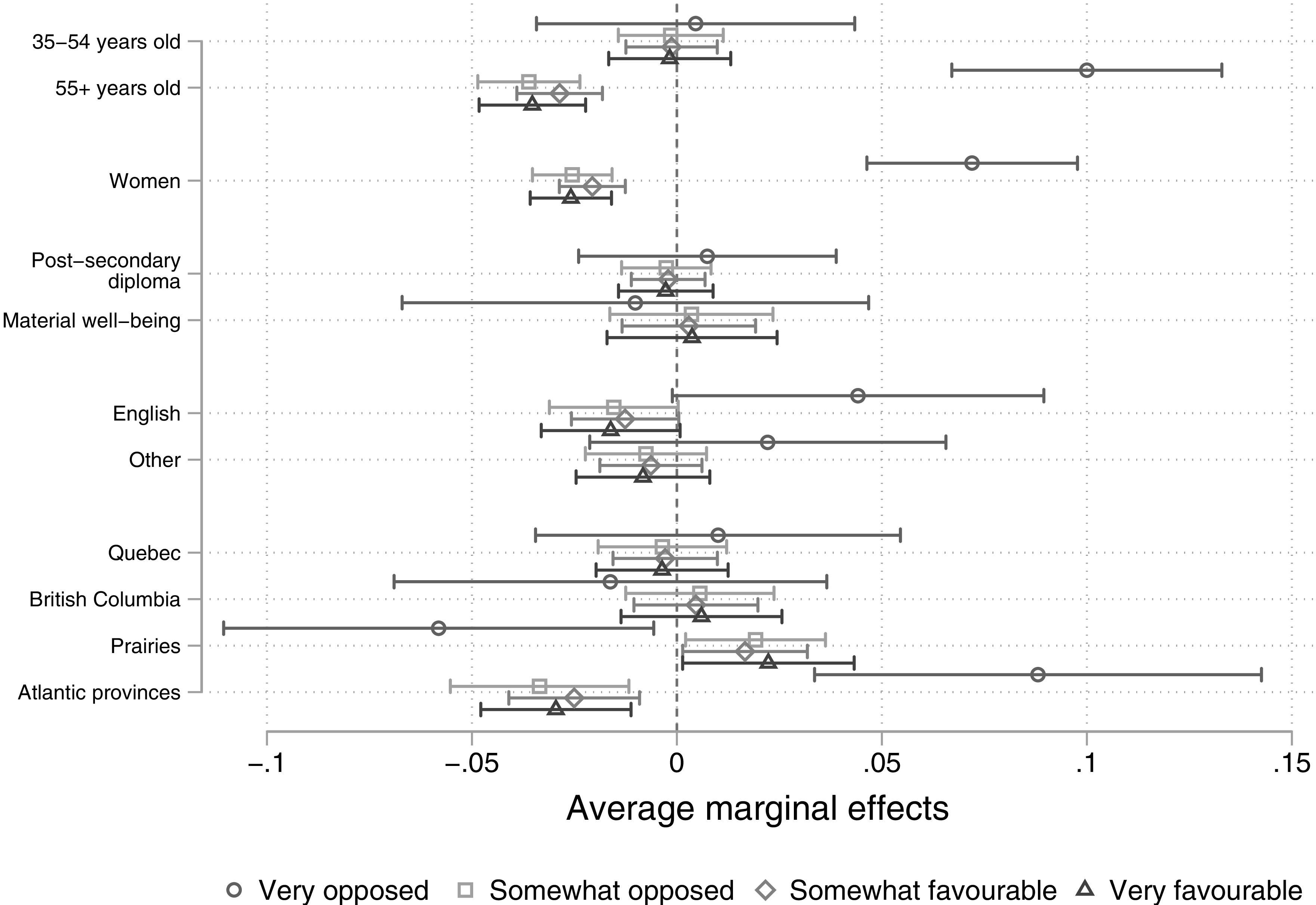
To interpret the substantial effects of our independent variables on Canadians’ support for annexation, we estimated their average marginal effects (AMEs) on each category of the outcome variable. AMEs translate the estimated effects of predictors into average changes in the expected value of the outcome across all observations (Arel-Bundock et al. Reference Arel-Bundock, Greifer and Heiss2024). Figure 2 below shows the findings for the sociodemographic and socioeconomic variables. Most effects (28 out of 44 estimates) are not statistically significant (at p < .05), but some relationships are worth noting.
Average Marginal Effects of Sociodemographic Variables.
Note: Average marginal effects are computed from model 1 of Table 2. 95% confidence intervals are included. See Table 2 for the reference categories.

Figure 2. Long description
The line graph displays the average marginal effects of various sociodemographic variables on attitudes toward American annexation in Canada. The x-axis represents the average marginal effects ranging from negative 0.1 to 0.15, while the y-axis lists different sociodemographic categories such as age groups, gender, education level, material well-being, language, and regional divisions. Each category is represented by different symbols indicating levels of opposition or favorability toward annexation: circles for very opposed, squares for somewhat opposed, diamonds for somewhat favorable, and triangles for very favorable. The graph shows varying levels of opposition and favorability across different groups, with some categories displaying wider confidence intervals than others, indicating more variability in responses. For instance, the 55 plus years old group and those with a post-secondary diploma show a range of effects from slightly negative to slightly positive. The Atlantic provinces exhibit a broader range of effects compared to other regions. All values are approximated.
Some age effects are noteworthy. While the 35–54 years old are identical to the youngest group (18–34), the 55+ years old are substantially more likely to be “very opposed” to the annexation. The effect reaches 10 percentage points (comparing 55+ years old to 18–34 years old). Moreover, the oldest group are less likely to be “somewhat opposed,” “somewhat favourable” and “very favourable” compared to the 18–34 years old. It is interesting to note that, contrary to some surveys (e.g., Abacus Data 2025; Leger 2025) the pattern is not linear given that the level of support from the 35–54 years old group does not fall in-between the youngest and the oldest citizens.
On the gender gap, women (compared to men) are more likely to be “very opposed” by about 7 percentage points. They are also less likely to answer any of the three remaining answer choices (somewhat opposed, somewhat favourable and very favourable). This finding aligns with the robust assumption that women are more likely than men to favour status quo. Moreover, we should mention that contrary to what some polling data suggested,Footnote 6 there is no significant interaction between age and gender (see Table D1 of the Appendix).
In sharp contrast to age and gender, there seems to be no “class cleavage” in Canada regarding citizens’ support for the annexation by the US. Indeed, both education as well as material well-being (which combines income and assets) do not seem to be correlated with support for annexation. Moreover, Figure 2 indicates no strong language cleavage, although the average marginal effect for English-speaking respondents (compared to French-speaking respondents) shows that English-speaking Canadians are more likely to be very opposed to the annexation by about 4.4 percentage points. However, this effect fails to reach conventional levels of statistical significance (p = 0.056).
Finally, some regional effects emerge from Figure 2. The reference category is Ontario. While British Columbia and Quebec do not differ from Ontario, the Prairies and Atlantic provinces are statistically different. That is, respondents from the Prairies are less likely to be very opposed to the annexation. In contrary, respondents from the Atlantic provinces are about 9 percentage points more likely to be very opposed. The magnitude of the regional effects displayed in Figure 2 are quite aligned with what has been signalled by mediatized public opinion data. While not trivial, these effects should not be overstated. For example, at the end of the day, 90.3 per cent of respondents from the Prairies are either very opposed or somewhat opposed to the annexation, which is very similar to the full sample average (92.2%).
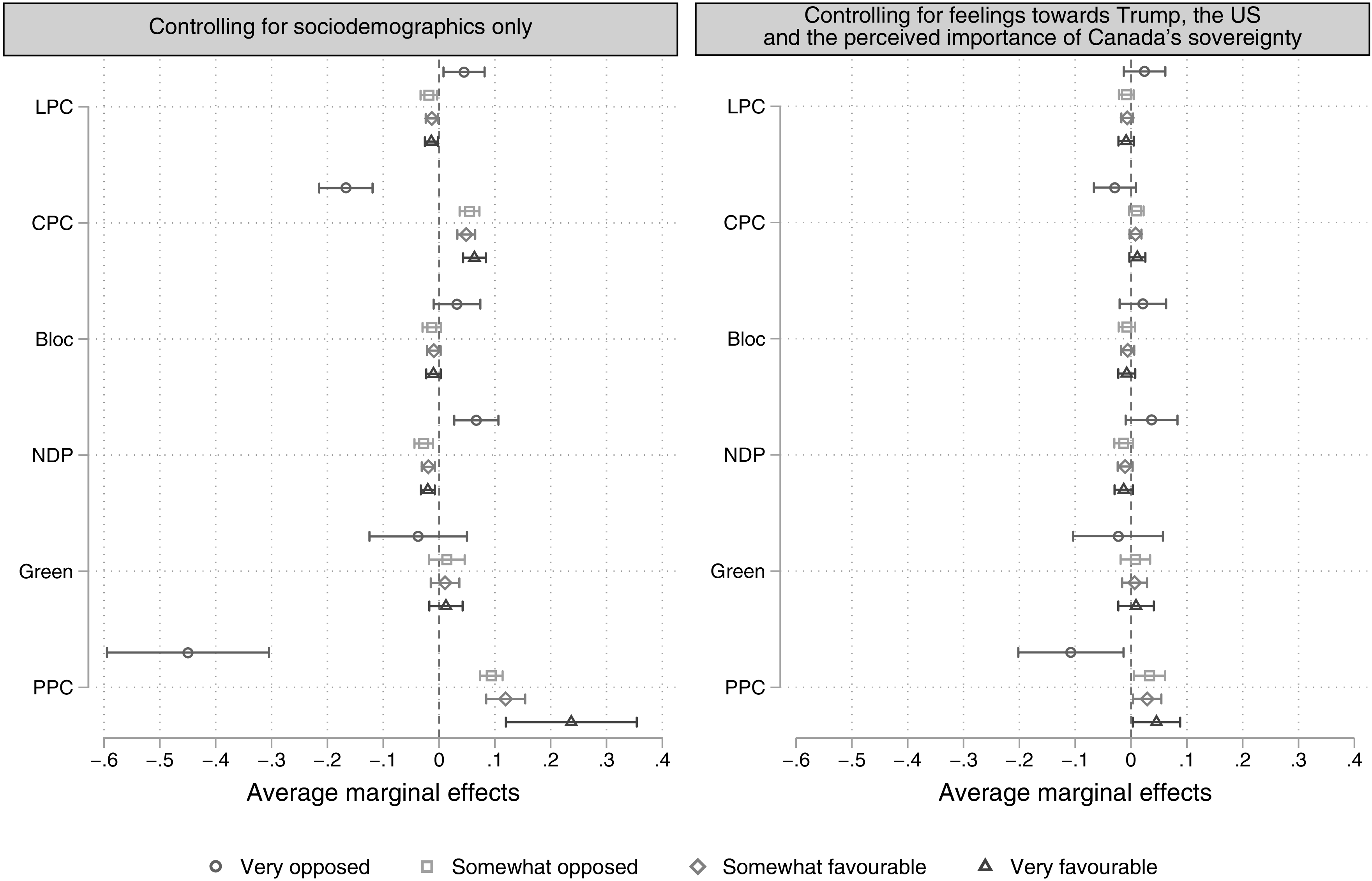
We now turn to the role of partisanship, which is added in model 2 of Table 2. The left panel of Figure 3 below shows the relationships between party identification in Canadian politics and citizens’ attitudes towards the annexation. Feeling close to the Liberal Party of Canada and the New Democratic Party is associated with an increase in respondents’ likelihood of being very opposed to the annexation (of 4 and 7 percentage points, respectively). Feeling close to the Conservative Party of Canada is associated with a decrease of 17 percentage points in one’s likelihood of being very opposed to the annexation. This effect reaches 45 percentage points for citizens feeling close to the People’s Party of Canada (PPC). Moreover, partisans of the PPC are 24 percentage points more likely to be very favourable to the annexation. These effects are quite systematic (16 out of 24 estimates are statistically significant at p < .05) and some of them are substantially large.
Average Marginal Effects of Party Identification.
Note: Average marginal effects are computed using model 2 (left panel) and model 3 (right panel) of Table 2. 95% confidence intervals are included. Reference category is not feeling close to any political party.

Figure 3. Long description
The image contains two side-by-side graphs comparing the average marginal effects of party identification under different controls. The left graph controls for sociodemographics only, while the right graph controls for feelings towards Trump, the United States, and the perceived importance of Canada’s sovereignty. Each graph features six political parties: LPC, CPC, Bloc, NDP, Green, and PPC. The x-axis represents average marginal effects ranging from -0.6 to 0.4, and the y-axis lists the political parties. Different symbols represent varying levels of favorability: circles for very opposed, squares for somewhat opposed, diamonds for somewhat favorable, and triangles for very favorable. The graphs show how these effects vary across parties and conditions, with error bars indicating the confidence intervals for each estimate.
In an exploratory fashion, we examine who, among CPC partisans (n = 612), are more likely to favour the merging and compare the correlates to non-CPC partisans (n = 2,107). We do not provide this kind of test of the PPC because the sample size is not large enough (n = 34). Table D3 of the appendix shows the regression output and Figure D1 displays the average marginal effects. There are three noteworthy differences. First, among CPC partisans, age effects are more important compared to other Canadians. That is, 55+ years old conservatives are much more likely to be very opposed to the merging (AME of 18 percentage points) compared to non-conservatives (AME of 8 percentage points). In other words, the support for annexation is mostly driven by youth, but this is even more the case among conservatives.Footnote 7 Second, the gender gap is slightly larger among conservative partisans: women are almost 10 percentage points more likely to be very opposed to the merging among conservatives versus about 5 percentage points among others. Third, conservatives from the Atlantic are not more opposed than conservatives in Ontario while Canadians from the Atlantic that do not identify the CPC are 8 percentage points more likely to be very opposed to the annexation compared to non-conservative Ontarians.
The next model (model 3 from Table 2) allows us to compare the partisanship effects while taking into account feelings toward Trump, the US as well as respondents’ importance attributed to the issue of Canada’s sovereignty vis-à-vis the US. As made clear by comparing model 2 to model 3, most of the effects found from model 2 are drastically reduced and most relationships are not statistically significant (at p < .05) once we take these additional factors into account. In other words, most of the effects found in the left panel of Figure 2 are due to these three variables. But do these three variables hold a similar weight in the reduction of these effects? Table D2 of the appendix includes several models including one variable at the time and shows that the feeling thermometer towards Trump is the driver explaining the differences in partisanship effects.
For example, partisans of the CPC are 17 points less likely to be very opposed to annexation compared to respondents who do not feel close to any political party when we only control for sociodemographic variables (left panel of Figure 3). However, once affects toward Trump are considered, levels of support for the annexation from respondents who feel close to the Conservative Party of Canada are undistinguishable from respondents who do not feel close to any party (i.e., the reference category). In other words, CPC partisans’ more positive view on the potential annexation is almost fully explained by their affect towards Trump. The median score given to the feeling thermometer is telling: among CPC partisans who favour the merging, the median feeling towards Trump is of about 80/100 on the original scale compared to 10/100 among CPC partisans who are opposed to the annexation.
The only average marginal effect that still stands out in the right panel of Figure 3 is the one from the People’s Party of Canada regarding the odds of being very opposed to the annexation. It is substantially reduced from about 45 points to about 11 percentage points. While reduced, this effect is still noteworthy: even controlling for feelings towards Trump, feeling close to the PPC is associated with a large decrease in one’s likelihood to be very opposed to the annexation.
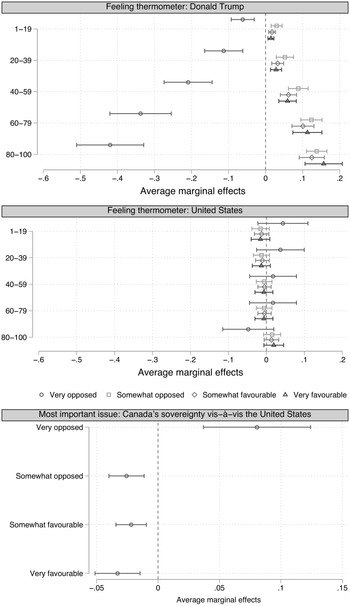
We now examine how these feeling thermometers as well as citizens’ perceptions of the importance of the issue shape Canadians’ public opinion on the annexation. Model 3 of Table 2 shows the findings from the regression model. We merged different ranges on the feeling thermometers to allow for potential non-linear patterns. The reference category is a score of 0, that is, really disliking Trump or the US. The issue importance variable is a dichotomous variable comparing respondents who believe that Canada’s sovereignty vis-à-vis the US is the most important issue.
Findings can be found in Figure 4 below. The effects of feelings towards Donald Trump are crystal clear: the more one dislikes Trump, the less likely they are to be very favourable to the annexation. The pattern of the effects is mostly linear, and the average marginal effect reaches 42 percentage points when comparing respondents who really like Trump to citizens who really dislike the president. However, even just moving from one category to the next one still leads to large effects, as shown by the left panel of Figure 4. Canadians’ feelings towards the United States are very different (that is, much more positive see Table B1 of the appendix) and so is the relationship between these feelings and their opinion on annexation. In a nutshell, there is no statistically significant relationship between Canadians’ feelings towards the US and their opinion on the annexation, which is quite surprising as one might expect that the more positive one’s view of the US, the more likely they would favour a merging with the US.
Average Marginal Effects of Feelings Towards Trump, the United States and perceiving Canada’s sovereignty vis-à-vis the US as the most important issue.
Note: Average marginal effects are computed using model 3 of Table 2. 95% confidence intervals are included. Reference category is a score of 0 for the thermometer feelings (top panels) and any other issues regarding the issue importance variable (bottom panel).

Figure 4. Long description
The image contains three separate graphs. The first graph, titled ‘Feeling thermometer: Donald Trump,’ shows the average marginal effects of feelings towards Donald Trump across different age groups. The x-axis represents the average marginal effects, ranging from -0.6 to 0.2, while the y-axis represents age groups from 1-19 to 80-100. Different symbols represent levels of opposition and favorability: circles for very opposed, squares for somewhat opposed, diamonds for somewhat favorable, and triangles for very favorable. The second graph, titled ‘Feeling thermometer: United States,’ shows similar data for feelings towards the United States. The x-axis ranges from -0.6 to 0.2, and the y-axis represents the same age groups. The third graph, titled ‘Most important issue: Canada’s sovereignty vis-à-vis the United States,’ shows the average marginal effects of perceiving Canada’s sovereignty as the most important issue. The x-axis ranges from -0.05 to 0.15, and the y-axis represents levels of opposition and favorability. Each graph uses different symbols to represent levels of opposition and favorability. The graphs illustrate the relationships between these variables and the perceived importance of Canada’s sovereignty.
Finally, the effect of considering Canada’s sovereignty to be the most important issue is also statistically significant (see model 3 of Table 2), but is nowhere near the size of the effects of feelings towards Trump. Perceiving Canadian sovereignty as the issue of the moment increases the chances of being very opposed to the annexation by 8 percentage points. It decreases the likelihood of being somewhat opposed or (somewhat or very) favourable by 2 to 3 points.
Discussion and implications
In this research note, we investigated contemporary Canadian public opinion on the annexation of Canada by the United States—an idea rooted in historical debates (e.g., Schwartz Reference Schwartz1967) but recently revived by the American president Donald Trump. Using original survey data (N = 3,507) collected in March 2025, we assessed the level of Canadians’ support for the merging, the correlates of that support, and provided an explanation for partisan effects that we find.
Our first main finding show that support for annexation is very low. That is, only about 8 per cent of Canadians seem to be somewhat or very favourable to the merging. This level of support is quite a bit lower than what has been suggested by public opinion polls.
Second, we show that there is some heterogeneity across sociodemographic and socioeconomic variables, although they should not be overstated. For example, people in the Prairies are indeed more likely to favour the annexation, but they are only few percentage points more likely to be somewhat or very favourable to this idea. This seems particularly insightful in the context of a potential referendum on Alberta’s independence from Canada (Zhao Reference Zhao2025). Indeed, Albertans who want to leave Canada might be less enthusiast if the alternative becomes (or is framed as) staying in Canada versus being merged with the US. Age effects were much larger than regional differences. That is, younger Canadians are much more likely to be open to the merging with the US than 55+ years old citizens. Moreover, in line with the literature on constitutional preferences, women are less likely to favour constitutional changes and their likelihood to reject the merging is greater than men. Contrary to many issues in Canadian politics, language does not seem to be a source of divide in the case of the merging with the US.
Third, we find key political divides in Canadians’ public opinion on the issue of the annexation. Most importantly, Canadians identifying with the Conservative Party of Canada and the People’s Party of Canada are less likely to be strongly opposed to the annexation. We also put forward what is, to the best of our knowledge, the first test aiming to explain these findings. We find that people who feel close to the CPC and the PPC are more favourable to the annexation because they hold more positive views of the president of the United States, Donald Trump. In fact, the gap for the CPC partisans completely disappear once we take into account feelings towards Trump. To the contrary, affects towards the United States do not explain these differences. The implications of these findings are twofold. First, we might expect some movements in Canadians’ public opinion on the issue of annexation if views on Donald Trump change. For example, the level of support for the merging might reach a new low if CPC partisans, who are numerous, become more negative towards Trump (e.g., Canada might face an economic recession due to the US’ trade policies). Second, our findings suggest that more positive views about the US would not move Canadians’ public opinion on the issue of annexation because it is not a strong predictor.
The study underscores that while annexation talk is politically marginal, the implications seem important. Understanding who supports it and why remains crucial for gauging public reactions to US–Canada tensions and for anticipating shifts (or lack of) in political discourse.
Supplementary material
To view supplementary material for this article, please visit https://doi.org/10.1017/S0008423926101280


 Open access

