


In the nineteenth century, many cities saw a remarkable transformation in how meat was produced and supplied. The concentration of population in urban centres forced the traditional art of butchering to increase in scale and speed, while the developing sanitary and medical sciences demanded stricter control over slaughtering. Following their western colleagues, Russian scientists connected meat with strength, health and resistance to epidemics and argued that more and better meat should be consumed.Footnote 1
More meat inevitably meant more slaughtering. The nineteenth-century preoccupation with morality, sanitation and order demanded the dissociation between the healthy and nutritious meat and the act of killing that it implied. To mask this relation, the process of slaughter and the site where it took place had to be transformed. Previously, animal death had been a daily experience of urban life. The herds of livestock intended for slaughter regularly passed through the city streets and some were slaughtered right behind the butchers' shops. The new sensibilities and norms of hygiene required that death, blood, foul odours and physical violence were removed or hidden from the public gaze in the modern city.Footnote 2
As the anthropologist Noëlie Vialles put it in her study of French abattoirs, ‘slaughtering was required to be industrial, that is to say large scale and anonymous; it must be non-violent (ideally: painless); and it must be invisible (ideally: non-existent). It must be as if it were not.’Footnote 3 The slaughter was exiled to the outskirts, enclosed and confined within the walls of the new institution; it had to be marginalized, hidden, excluded from everyday life and turned into a ‘no place’. Even the euphemism of its name – ‘abattoir’ instead of French ‘tuerie’ and English ‘slaughterhouse’ – was meant to disguise the violence of its purpose.Footnote 4 In the last 15 years, cultural historians have taken Vialles' formula of ‘a place that was no place’ to explore the meaning of the slaughtering reform in other cities across the western world and emphasized the intention for anonymity, invisibility and dissimulation embedded in the projects of the modern abattoirs.Footnote 5
This article studies the public abattoir in Moscow, which provides a case that in some respects sharply contrasted with the pattern outlined by Vialles. Constructed between 1886 and 1888, the centralized municipal abattoir in Moscow, like in many other European cities, came to replace small private facilities and to transform slaughter into a more efficient, hygienic and controlled process. Yet, instead of becoming a ‘no place’, it faced a rather different prospect: to turn into one of the city's most recognized infrastructural projects and, in the words of a contemporary, to ‘join the rows of the institutions that constitute the city's pride such as museums, art galleries, universities and the like’.Footnote 6 Looking at the construction and operation of the slaughterhouse in the context of urban modernization, changing scientific paradigms and cultural norms, this article will explore how and why the abattoir in Moscow avoided marginalization and emerged as one of the city's landmarks.
Meat production, veterinary medicine and public health
Reorganization of meat supply and slaughterhouse reform emerged as important features of urban modernity during the Napoleonic era, and in the second half of the nineteenth century new abattoirs and stockyards were built all over the western world.Footnote 7 In Russia, the necessity of such reform had been discussed since the 1840s, but the first public abattoir appeared only in 1882 in St Petersburg, – the example that was soon followed by other cities of the empire, including Moscow.Footnote 8
Moscow's path to the public slaughterhouse was long and winding. In the early 1860s, the Moscow City Council discussed the reorganization of existing private slaughterhouses in view of their dirt, stench and ‘unsatisfactory condition’ and concluded that the only way to improve the situation was to open municipal abattoirs. For these purposes, in 1866 the city bought a plot of land south of Moscow, in the area of the Serpukhov gate, which was then the main hub for livestock and the destination of the drove-routes.Footnote 9 This initiative, however, was soon lost in municipal discussions and then abandoned until 1885 when the city council returned to the project.Footnote 10
In the meantime, the city and the entire country changed dramatically as a result of the so-called Great Reforms of the 1860s and 1870s. These liberal reforms freed the labour market, accelerating urbanization and the development of an industrial capitalist economy. They marked the culmination – and the end – of the belief in reform from above and awoke Russian civil society. Although autocracy remained the core of the Russian political structure, the reforms increased the number of participants in political life and changed the patterns of political communication.Footnote 11 Moscow itself transformed into a booming migrant city: compared to the late 1860s, its population almost doubled and exceeded 700,000. The new Municipal Statute of 1870 gave greater independence, power and economic resources to the elected city government, turning it into an arena for civic activism and providing motivation and financial means for the implementation of large infrastructural projects.
In these years, the public health agenda too experienced a paradigmatic shift. The growing awareness of the transferability of diseases and their aetiology as well as the rise of germ theory revealed the interdependence of human and animal health and pressed for stricter controls over animal bodies.Footnote 12 The questions of animal health became a matter of interest for state and local government, which, in turn, stimulated the professionalization of veterinary medicine.
As the prominent Russian veterinarian and the founder of Moscow veterinary organization, Valentin Nagorsky, later described this shift,
the difference to previous times is that we know what infection is, what its qualities are, where and in which form it can be located outside the body, how it is affected by natural forces and the artificial conditions in which we have power to put it, how, where and by which means it can be destroyed until it becomes harmless. We also know how to influence the agents of certain diseases to produce the material for vaccination. . .No doubt, there is more work to be done, because for some diseases the microbes have not been identified, for others the immunization attempts have not been successful, but still, what we have now already gives us the possibilities to deal quickly with such calamities as the plague or cattle plague used to be just yesterday.Footnote 13
Cattle plague (rinderpest) indeed played a remarkable role in the emergence of control over animals. Although not dangerous to humans, this viral disease caused extremely high death rates among cattle, disrupting the entire economy and undermining the well-being of the population in the affected regions. In Russia at the turn of the 1880s, the outbreaks of rinderpest claimed a million head of cattle each year. In 1879, as a measure against the epizootic, the Ministry of the Interior obliged zemstvos (rural self-government institutions) to exterminate the plagued animals – this was the law that prompted the institutionalization of veterinary medicine in most of the zemstvo provinces.Footnote 14
The next step was the restriction of animal movement across the country. The nineteenth-century expansion of the Russian empire south and east and the colonization of the frontier regions north of the Black Sea and the Caspian allowed for increased animal husbandry and resulted in the growing spatial separation of cattle-raising and meat consumption.Footnote 15 Similar to the American cowboys moving herds of animals from the prairies of the Midwest to the meatpacking plants in Chicago,Footnote 16 their less iconic colleagues named prasol drove cattle far greater distances across the Romanov empire – from the steppes of Central Asia, Ciscaucasia and the Azov to the slaughterhouses of Central Russia. In the 1870s, the majority of animals killed in Moscow had to walk more than 1,000 kilometres from the Don Cossack Host, Kuban, Stavropol and Ekaterinoslav provinces, and some more than 3,000 kilometres from the areas of Semipalatinsk and Semirechye (present-day Eastern Kazakhstan and Northern Kyrgyzstan). Despite the appearance of the railways, this practice remained very popular – in 1881, half of all cattle brought to Moscow went there on foot.Footnote 17 These constant long-distance migrations of cattle were a perfect vehicle for the epizootics. In 1882, the Ministry of the Interior requested that all cattle should be transported by railway to curb the spread of infection.Footnote 18 Despite its seeming rationality and convenience, this measure provoked little enthusiasm among the drovers and cattle owners. Although slower, the traditional cattle-drives were cheaper than railway transportation, given the existing tariffs, and allowed animals to graze on the way, while in the train, it was claimed, the lack of proper fodder made them lose weight.Footnote 19
The new technology of delivering cattle brought an important change to the spatial morphology of Moscow's slaughtering arrangements. The old drove-roads lost their significance, and so did the plot of land to the south of Moscow that the city had bought for its intended slaughterhouse. Instead, the herds of animals now arrived at the terminals of the Kursk and Ryazan railways, located on the east of the city. This pressed for the relocation of the slaughterhouse eastward, close to the stations that would not only prevent the spread of epizootics from the imported animals to the local horses and milk cattle, but also spare the city streets from the inconveniences of cattle-drives.Footnote 20 The centralization of arrival paved the way for the centralization of veterinary inspection and slaughtering and promised to turn the trip from the steppe pasture to the Moscow meat market into a more controlled but less visible process than ever before.
If rinderpest stimulated the institutionalization of veterinary medicine and animal inspection, it was trichinosis that connected meat production to the scientific laboratory. Caused by the parasite roundworm trichina spiralis, this disease was discovered by James Paget in 1835. In the second half of the century, medical practitioners, most notably German researchers Rudolph Virchow and Friedrich Albert von Zenker, described the lifecycle of trichinella and revealed that humans were at risk of contracting the disease through eating pork.Footnote 21
In Russia, the first detailed description of this disease appeared in 1862 on the basis of reports from abroad. However, when in 1865 the pathologist Mikhail Rudnev, a student of Rudolph Virchow, discovered a case of trichinosis in a dissected female corpse in St Petersburg, it became clear that the disease was present in Russia as well.Footnote 22 In the following years, his colleagues reported incidents of trichinosis from Moscow, Saratov, Kharkov, Riga and other cities. Microscopic examination of meat was seen as the only way to ensure its safety. Otherwise, the experts advised, eating pork should be avoided.Footnote 23 In 1876, the Medical Council of the Ministry of the Interior discussed the questions of trichinosis and concluded that the meat of trichined animals was to be prohibited from sale, forage or any use and subject to immediate destruction. To implement this ban, the Ministry also recommended introducing microscopic examination as an important step in pork production.Footnote 24
The centralized abattoir, equipped with laboratories and an adequate system of veterinary inspection, therefore came to be seen as a mechanism to ensure the safety of meat and livestock. This ‘veterinary turn’ in meat production, as the members of the Moscow Slaughterhouse Commission acknowledged, should be reckoned with when devising a project of the enterprise:
Previously, the only demand for the improved slaughterhouse was that it was kept clean and did not produce any foul odours. Now this is not enough. From the veterinary side it is required that the slaughterhouse helps to combat rinderpest, raging in Russia. From the sanitary side it is considered necessary that the slaughterhouse serves as a controlling point for the quality of meat to prevent the sale of meat from sick animals.Footnote 25
Finally, a not insignificant part of the story belongs to the example of St Petersburg. The traditional rivalry between the ‘two capitals’ of the empire entered a new phase when, in the second half of the nineteenth century, Moscow emerged as a centre of the growing Russian bourgeoisie, as opposed to the socially and economically ‘westernized’ St Petersburg.Footnote 26 In 1882, St Petersburg successfully completed its centralized municipal slaughterhouse. This not only proved that such an institution could successfully function in Russia and provided an illustration of how it could be achieved, but also included the questions of city pride in the agenda of the slaughtering reform.
In May 1885, the commission prepared a preliminary plan of the new Moscow abattoir. It was proposed to move it to another location south-east of the city and connect it with a special branch railway to the main routes of cattle transportation. In addition to the infrastructural advantages, this location, considering Moscow's compass rose with prevailing western winds, spared the city from the odours of the slaughter. The complex was also supposed to include a stockyard, storage facilities and factories to process blood and tallow.Footnote 27
Although the preliminary project was generally designed according to the model of St Petersburg, there was a crucial difference. The abundance of water in St Petersburg – as the Neva, although short, is among the most full-flowing rivers in Europe – and the proximity to the Baltic coast offered the city an easy solution to the question of slaughterhouse sewage, which was simply carried away into the sea. In Moscow, the shallow and slow Moskva River, going through a densely populated area downstream of the city, could not offer a sufficient reservoir for the offal of meat production. As the members of the Slaughterhouse Commission concluded that ‘the slaughterhouse brings no harm only if it is kept clean’ and that ‘in light of contemporary knowledge, it cannot be allowed to discharge the waste waters from the slaughterhouse straight into the river, without filtration or decontamination’.Footnote 28
It was thus proposed to connect every building of the complex to the sewerage system that would bring the refuse to the filtration fields to be organized at a large wetland (Sukino boloto) south-east of Moscow. This was indeed an impressive plan in view of the overall level of urban infrastructure. In the early 1880s, neither Moscow, nor any other city in the Russian empire had a sewerage system that involved the treatment of wastes. The wetland was indicated as a possible site of filtration fields in the project of Moscow's sewerage, designed by the author of Berlin's sewerage system and the most influential German expert in urban infrastructure, James Hobrecht, who was invited by the Moscow City Council in 1880.Footnote 29 The filtration fields of the slaughterhouse, in the opinion of the commission members, were thus meant to serve as a kind of testing platform for a system of urban waste treatment that was new in Russia.Footnote 30
Slaughterhouse reform in municipal discussions
The construction of the central slaughterhouse, according to the new scientific imperatives, was a complicated and expensive undertaking. The costs of the complex were estimated at 1.9 million roubles – a sum that amounted to more than 40 per cent of all annual municipal revenues in the early 1880s.Footnote 31 As one municipal deputy claimed when the project was discussed in the city council,
[i]n light of the anti-sanitary conditions in which the urban population lives, the universal pollution of soil and ground waters, the existing [private] slaughterhouses do not exacerbate the awful anti-sanitary state of Moscow. Considering the absence of public services in the city, the organization of the new slaughterhouse can be compared to the following: we were given a man, sick from eternal dirt, crippled, in rags, uncombed and hungry and were told to put him in order – but instead of cleaning, dressing and treating him, we would only wash his feet, only the toes, and give him shiny shoes. In my opinion, the slaughterhouse is no more than shiny shoes in the matters of urban accomplishment. The slaughterhouse is just a detail and cannot be as important and urgent as the enterprises necessary for general infrastructure and health of the city, such as water supply and sewage system.Footnote 32
When so many spheres of urban life required municipal intervention, it was questionable whether the efforts and resources should concentrate on the production of meat. Yet, moving the slaughterhouse to the top of municipal agenda, ahead of the sewerage system, had several important advantages. The most obvious of them was the price of the abattoir construction (which was 12 times lower than the sewerage system in Hobrecht's project) and the promise that the enterprise would eventually pay off the investment – while the sewerage system, it was believed, would never generate enough profit to do so.Footnote 33 Another important aspect was that in the 1880s there existed a certain consensus in the expert community on how and why the abattoir should be constructed, while the field of sanitary engineering and waste treatment was painfully adjusting to the new bacteriological discoveries. In this context, the abattoir appeared as a more feasible and worthwhile undertaking, which would allow the municipality not only to accomplish quickly an important sanitary reform for the common good (and take credit for it), but also to gain experience in large infrastructural projects before approaching a much more complicated sewerage system.
Although not supportive of the project, the above quotation reveals how important the ‘common good’ rhetoric was for the slaughterhouse construction. Similar to other European cities, and different from American experience, where large meatpacking plants were running for profit and serving markets across the country and beyond,Footnote 34 the motivation behind the centralization of slaughtering in Moscow was to improve the health and well-being of a specific urban community.
As the members of the Slaughterhouse Commission warned in their project,
[i]f we admit that the aim is not in material profit but in the desire to protect the city from the harm arising from an uncontrolled meat supply and the upkeep of slaughterhouses in conditions incompatible with the elementary notions of cleanliness, as well as to shield the city and its suburbs from the epizootics, we have to agree that this aim can only be achieved at the expense of the material profits of production. Certainly, better veterinary and sanitary control, cleaner upkeep of the slaughterhouse, faster removal of wastes mean higher costs and, consequently, lower income of the enterprise.Footnote 35
This argument targeted not only the private butchering facilities, but also the management of the municipal slaughterhouse by a private concessionaire, because, in the words of one of the authors of the project, ‘an entrepreneur is always inclined to gain maximum profit and to avoid the sanitary rules’ and that ‘the dirtier the slaughterhouse is, the less expense it requires’.Footnote 36 The members of the commission thus concluded, and the majority of the city council agreed with them, that the municipally run slaughterhouse was the only way to reach the public health goal.
Furthermore, the mere assumption that the abattoir could potentially become a profitable enterprise was used as an argument against (and not for) its construction. A group of deputies opposed turning the production of essential goods into a source of municipal profit and thus placing additional burden on the city dwellers. One such deputy, Nikolay Lanin, himself a factory owner, warned:
If we see the slaughterhouse as a profitable enterprise, the revenues of which will come to the municipality from the poor consumers, we need to admit that this principle is perverted, that it does not match the status of the city deputies, whose mission is to protect the interests of the majority that they are meant to represent. Therefore, if the main motive for the construction of the slaughterhouses is that it would be a profitable commercial enterprise, I am against this construction. We all complain about the expensiveness of city life, but it arises from a sum of circumstances that we are in power to remove, because the wise lawmaker gave us this possibility.Footnote 37
The new public abattoir was imagined not as a correction, but as an antipode to the existing businesses in the sphere of meat production. If the private facilities were small and dispersed, the new one should be large and centralized. If the private enterprise was running for money, the main rational for the municipal one was common good. While the existing slaughterhouses were dirty, fetid and full of rotting wastes, the abattoir was a clean and hygienically kept place, where pure and abundant water carried all the refuse away to the filtration fields. Private slaughterhouses endangered city dwellers by letting out the contaminated meat, whereas the new public abattoir mobilized the achievements of veterinary medicine and sanitary engineering to protect the health of the urban population. The private slaughterhouse was all about disorder, the new abattoir was ‘rational’ and ‘scientific’.
To reach the private slaughterhouses, the cattle were driven through the streets of the city, exposing the population of adjacent neighbourhoods to the sight, smells and sounds of animals and reminding them of their imminent death. In the new public abattoir, as Nagorsky formulated it in his note on the project, ‘the turnover of animals should be confined to the most limited space, while all the time spans between the unloading and the arrival to the stockyard, between the exit from the stockyard and the slaughter. . .should be cut to a minimum’.Footnote 38 The new abattoir thus would enclose not only the circulation of animals, but also the awareness of their transition from life to death, making it invisible, inaudible and hidden.
Besides, the public abattoir was seen to be so irresistibly European. Although the circulation of knowledge and practices and borrowing from foreign models was a common feature of the time,Footnote 39 the entire discussion of the project in the city council was embedded in the narrative of Moscow's perceived ‘backwardness’ compared to western cities. The speakers invoked Moscow's ‘universal pollution’, ‘anti-sanitary conditions’, infection, disease and poverty to call upon the council to ‘make a step towards the accomplishment of the city so that it resembled a European one’.Footnote 40
Quite illustratively, one municipal deputy cited the English law of 1486 against the organization of slaughterhouses in cities to claim that Moscow was 400 years behind in the resolution of the questionFootnote 41 – although the City of London banned private slaughterhouses only in 1927, and throughout the nineteenth century, British butchers successfully opposed the introduction of public abattoirs.Footnote 42 Foreign achievements in urban accomplishment presented a challenge and motivation for slaughterhouse reform. The references to the experience of European cities, such as London, Paris, Berlin, Vienna, Geneva and, ultimately, St Petersburg, were thus used to emphasize the necessity and urgency of the abattoir construction and its priority over the other infrastructural concerns.
To ensure rationality and the proper scientific basis of the slaughterhouse it was decided to commission three independent projects. The winning design was chosen for its detailed attention to infrastructural solutions, such as internal roads, waste removal and filtration fields. That project profited from various spheres of expertise, both in Russia and abroad; its authors consulted Russian hygienists, veterinarians, sanitary physicians, meat producers and made a study trip to visit the public abattoirs in Berlin, Hanover, Brussels, Paris and London.Footnote 43 On 27 May 1886, the Moscow City Council approved the project and construction works began.Footnote 44
Science, technology and the public image of the abattoir
The construction process of the new public abattoir was in itself remarkable. The large complex of 50 buildings and complicated infrastructure, most of which was new in Russia, was built in less than two years. The size of this complex was about 30 hectares; the abattoir's sewage farm and filtration fields took up another 150 hectares. The final cost of the abattoir was 2.3 million roubles.Footnote 45 The efficiency and speed of construction as well as the relatively low financial overrun could speak for the strong commitment of the municipality and the project team to the cause of the public good rather than personal material profit.
The abattoir was officially opened in June 1888, yet its operation did not start until mid-August when the cattle were finally redirected to the municipal stockyard, giving the abattoir a competitive advantage over private slaughterhouses (which were never officially forbidden but eventually closed in 1892 by an administrative decree in connection with the cholera epidemic). In the first three days of its proper operation, the new Moscow abattoir processed 5,312 head of livestock. ‘This was how’, wrote Dmitry Gorbunov in his volume on the 25th anniversary of the Moscow abattoir, ‘the factory production in the sphere of animal slaughter began’.Footnote 46
‘Factory’ was indeed an appropriate word. Everything was done to turn slaughter into an industrial process. It became highly technological and dependent on complicated mechanisms and engineering structures. A separate railway line was built to bring animals to the abattoir. Special transporters, rails, wagons, winches and lifts moved their bodies and then their carcasses inside it. The water from a ground pumping system washed away the blood and the paunch manure to the sewers, where a combination of flush tanks and ejectors carried it to the filtration fields. Fans and filters ensured proper ventilation of the slaughterhouse, and steam engines were used in a central heating system and refrigerators. Microscopes helped detect dangerous organs and carcasses, which were then sent to shredders and sterilization machines.Footnote 47
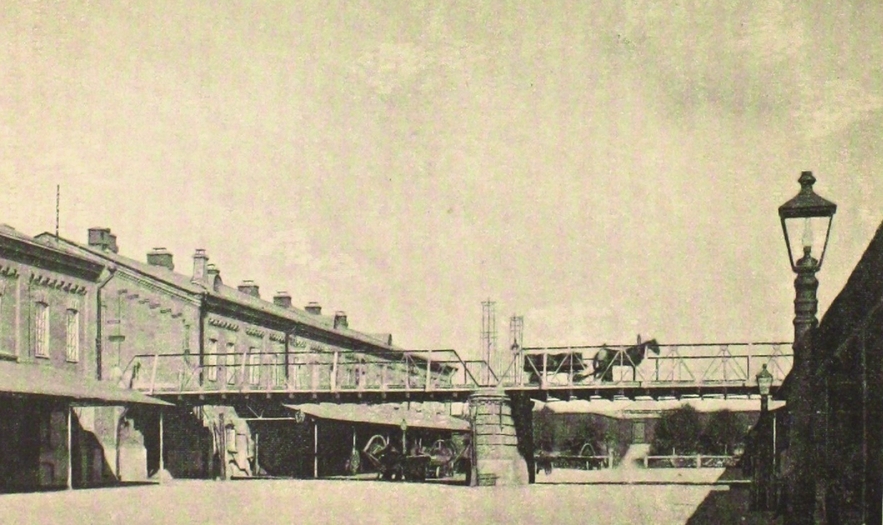
The public abattoir was in many ways a western product on Russian soil. The idea of it was borrowed from western Europe and inspired by its examples. Study-trips to Germany, France, Belgium and Britain and consultation with foreign experts facilitated knowledge circulation and direct transfers. Thus, the Moscow abattoir absorbed the expertise and experience of several European cities. It was constructed according to the French system, where each function was performed in a separate building (Figure 1).Footnote 48 Its refrigerators were built on the model of Hamburg slaughterhouses. The Delacroix sterilization machines used in Moscow were invented by a veterinarian at the Antwerp abattoir and developed by German engineers. The hydro-pneumatic sewerage system, implemented in the Moscow slaughterhouse, was devised by Isaac Shone and successfully used in several British cities.Footnote 49
The yard between slaughterhouses for cattle connected with a bridge. Source: S.A. Poderni, Tekhnicheskoye opisaniye Moskovskikh tsentral'nykh gorodskikh boyen (Moscow, 1896). State Public Historical Library of Russia.
However, it was mostly the ideas and plans that travelled from abroad. The realization remained in Russian hands. Local engineers prepared the final project of the slaughterhouse and stockyard, and scientists from the Moscow Agricultural Academy planned and organized the sewage system and the filtration fields. A Russian industrial company, Dobrov & Nabholz, produced most of the equipment and invented the system of lifts and transporters used within the slaughterhouse, which allegedly made the killing process there faster and easier than in its western prototypes.Footnote 50
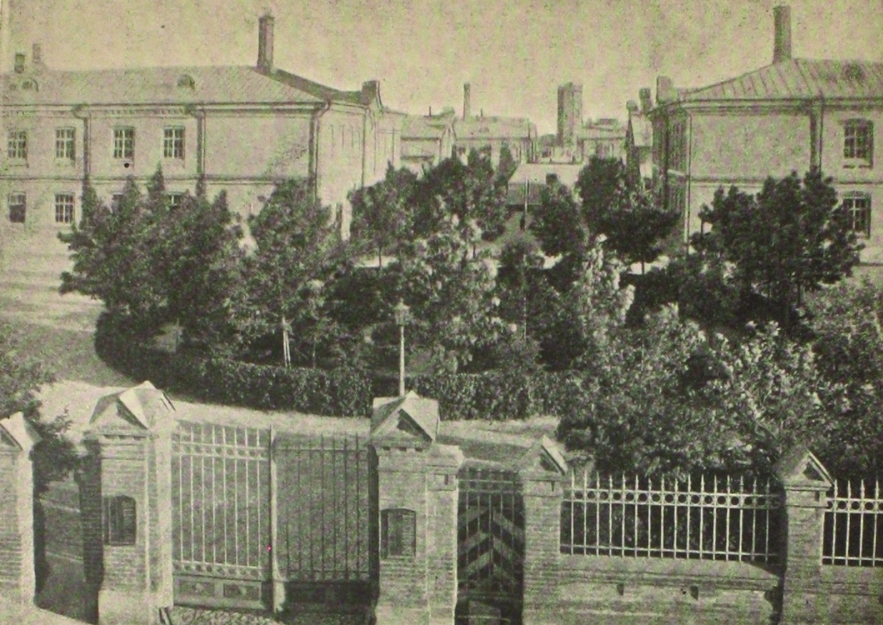
At the same time, the new municipal abattoir had to adjust to some specifically Russian realities. In particular, unlike similar institutions abroad, it had to organize housing for its personnel. Employer-provided accommodation was a typical feature of Russian factories, both in the countryside and in the big cities. Furthermore, housing at the industrial site was common not only among the workers but also among the white-collar employees and even the factory owners themselves, who often chose to stay next to their enterprises instead of relocating to quieter and greener areas.Footnote 51 The Moscow abattoir provided free accommodation for its personnel of all ranks. Those housing facilities were located within its walls, turning the abattoir into a small town with several hundred permanent residents (see Figure 2).
Central entrance to the abattoir complex and the apartment buildings for the administration; immediately behind them are workers' barracks. The slaughterhouses for pigs and calves are visible in the background. Source: S.A. Poderni, Tekhnicheskoye opisaniye Moskovskikh tsentral'nykh gorodskikh boyen (Moscow, 1896). State Public Historical Library of Russia.
Yet, it was not the industrial production of meat but sanitation and health goals that the municipality invoked to create a public abattoir. Animal and meat inspection therefore had to become an important part of its operation. However, the organization of effective meat quality control was a difficult task. According to a report of the abattoir veterinarians, in the early years ‘the organs of the killed animals were piled on the floor of the slaughter chamber which immensely complicated their inspection, at the same time allowing the butchers to cut off or hide the damaged parts, and often made it impossible to identify the carcass of the infected organ’. In 1891, the introduction of new devices for hanging and numbering the organs and carcasses and the invitation of registrar personnel allowed veterinarians to concentrate on inspection and to start individual registration of all pathologies, regardless of whether they caused the rejection of the meat or not (see Figure 3). The high frequency of detected animal pathologies (in the mid-1890s c. 70 per cent of all cattle were found to be in some way diseased) worked as a powerful justification of the necessity of the public abattoir with veterinary inspection.Footnote 52
A slaughtering room for cattle with the transportation devices for animal carcasses. Source: S.A. Poderni, Tekhnicheskoye opisaniye Moskovskikh tsentral'nykh gorodskikh boyen (Moscow, 1896). State Public Historical Library of Russia.

The inspection of hogs and pork was set up more effectively. The key reason for that was the fear of trichinosis, which was also among the crucial arguments for the centralization of meat production and the ban on private slaughtering. At the Moscow abattoir, from the very beginning, meat samples from every hog were sent to the microscopic laboratory. Although actual cases of trichinosis were rare, this policy favoured better detection of other pork parasites.Footnote 53 Relatively small amounts of pork facilitated its meticulous inspection. In Moscow, unlike many cities of continental Europe, the meat market was fully dominated by beef while the consumption of pork remained quite limited, despite its lower price and better preservation potential. Although the hog-raising regions – Tambov, Voronezh, Saratov and Penza – were closer to Moscow than the cattle-raising ones, only one out of eight animals killed at the Moscow abattoir was a pig; pork comprised just about 9 per cent of all the meat it produced.Footnote 54
The control and expertise of the abattoir's veterinary organization, in fact, reached far beyond the city it was meant to serve. The effective inspection of dissected animal bodies in Moscow revealed what the local veterinarians in the southern provinces of the Russian empire had overlooked. In 1893, Moscow veterinarians informed the local authorities of Kharkov about the cases of rinderpest in the herds coming from that province, helping to prevent this dangerous epizootic on the spot. Similarly, the frequent detection of tubercular animals at the Moscow abattoir undermined the widespread belief that, unlike in western European countries, the cattle of the Russian steppes were free from bovine tuberculosis. In the words of its veterinarian, the Moscow abattoir emerged as a ‘station for the control of the veterinary-sanitary condition of the stock-raising in the vast region of Russia that sends its cattle to Moscow’.Footnote 55
The presumed scientific role of the abattoir had influenced its construction from the very beginning. Commenting in 1885 on its project, Nagorsky emphasized the importance of studying animal pathologies at the abattoir:
Livestock, particularly steppe livestock, and its diseases have so rarely become an object of scientific studies – although these studies could give valuable knowledge to science and practice – that it would be very much desirable to organize at the abattoir a laboratory and a museum: the first one to conduct scientific research in the field of animal pathologies, the second to collect and preserve all those rare pathologies with which neither practitioners, nor scientists can work at the moment.Footnote 56
The implementation of these recommendations was probably helped by the fact that Nagorsky was personally involved in the project discussions and organization of the abattoir's veterinary control. The abattoir received a laboratory for research and a museum which held the sole Russian collection of waxworks for the study of meat, preserved examples of animal pathologies and parasites, exhibits from slaughter-related industries as well as statistical materials, maps and diagrams on morbidity and rejection. Both the laboratory and the museum contributed to the scientific reputation of the institution and served as models for veterinary organizations in the other parts of Russia.Footnote 57 Furthermore, as veterinarian Nikolai Zelenin wrote in his study of the Moscow abattoir,
the laboratory examination of the slaughter products allowed the veterinary organization of the Moscow abattoir to put the inspection and rejection of meat on a strictly scientific basis. This not only offered better guarantees to consumers regarding the quality of meat on the market, but also saved the livestock-owners from the unnecessary losses because it eliminated rejection on suspicion. In addition, the systematic laboratory research of certain pathologies allowed the Moscow abattoir to become the first in Russia to detect cases of anthrax and other dangerous diseases that had previously eluded control. Footnote 58
Indeed, the large quantities of empirical data empowered the Moscow abattoir to become a centre of research in animal diseases. This was also helped by the newness of the field and the lack of scientific studies, established rules and elaborate legislation.
The scientific importance of the abattoir, its complicated technology and its role as a sanitary enterprise shaped and defined its image in the public eye. As was discussed above, historians have stressed that in the western cities, particularly in Britain and France, the shift towards new public abattoirs not only made killing invisible and anonymous, but also led to the cultural marginalization of the slaughterhouse itself, its exclusion from everyday life and transformation into a ‘no place’. In this respect, the Moscow abattoir followed a different path.
From the very beginning of its construction, it was meant to symbolize the municipal commitment to the goals of public health and be a step on Moscow's way towards becoming a ‘European city’. Indeed, regarding the slaughterhouse as a technological and scientific masterpiece, the municipality turned it into a centre for promoting science and education. For example, apart from the laboratory and the museum, it got a 300-seat auditorium for scholarly lectures and hosted national exhibitions of cattle-raising and butchering.Footnote 59
If in France and Britain the brutality of slaughter was mitigated by using the euphemism of ‘abattoir’, the original Russian word ‘boynya’ retained the most direct reference to slaughter (it has been known as the more neutral ‘meat complex’ since Soviet times). Furthermore, the function of the abattoir was highlighted in several new toponyms that emerged around it: the neighbouring railway station was named Gorodskiye Boyni (City Slaughterhouse) and Cattle-Driving Square (Skotoprogonnaya ploshad’) between the railway platform and the abattoir unambiguously continued with a Meat Boulevard (Myasnaya-Bul'varnaya ulitsa) that led to downtown (see Figure 4).
A part of one of the most widely used Moscow city maps that clearly names and depicts the abattoir (including the buildings inside the complex) and indicates the related toponyms – railway station City Slaughterhouse, Cattle-Driving Square between the railway station and the abattoir and Meat Boulevard, going along the western wall of the complex and then north-east towards the city (Moscow, 1912). From the author's collection.

Russian health reformers, city deputies, medical scientists or journalists did not display any embarrassment or moral concerns about the presence of slaughter in the city; indeed, the latter was not masked but emphasized. Every city map clearly named the abattoir and many depicted it in detail. The municipal journal each month devoted dozens of pages to its work while the city guidebooks advertised it as ‘one of the most remarkable city institutions’ and ‘a grandiose construction’, ‘built according to the newest scientific requirements’.Footnote 60
Conclusion
Similar to its western European prototypes, the Moscow abattoir was meant to remove blood and death from the city and to confine them within its walls, turning killing into a scientific and strictly controlled process. Avoiding the eyes of city dwellers, the cattle from the remote provinces arrived to the slaughterhouse by train and left it already in the form of meat, lard, leather or bone meal. The by-products and wastes of that transition were sterilized, recycled or removed with the help of the complex sewerage system to filtration fields so that the urban public was spared not only from the sight but also the smell of slaughtering.
Yet, exactly the scientific success and the technological innovativeness of the project, especially in a city that was striving to catch up with Western metropolises, prevented the marginalization of the slaughterhouse. The Moscow abattoir was simply too good to become a ‘no place’. In the eyes of the Russian public, it was an archetype of modernity: conceived by the liberal self-government body, it consolidated technology and science for the sake of the common good and social progress. And thus, as a successful, profitable and ‘modern’ municipal institution, it deserved to be named and its presence within the urban space had to be acknowledged. Instead of turning the Moscow abattoir into a ‘no place’, science and technology constructed a site where the rationalized, mechanized and sanitized transition from the living animal to the edible meat was rather a source of pride than of discomfort.



