

What distinguishes those political scientists who publish highly prominent research late in their career from those who do not? Abundant literature on the relation of age to scholarly research suggests various hypotheses that may account for notable late-career achievement. Yet, one of the most promising lines of inquiry for this topic is research in education and psychology on intellectual “precocity” that has not been extended systematically to the study of academic research success. Extant research on aging and scholarly productivity recognizes that scholars can demonstrate varying paths of creativity throughout their career, but it has not investigated rigorously the relationship of precocious or early-career to late-career achievement (Simonton Reference Simonton and Plucker2022).
Abundant research on precocity analyzes the relationships of high intelligence in adolescents to their subsequent educational, occupational, and creative achievements (Lubinski and Benbow Reference Lubinski and Benbow2021). Typically, a sample of gifted adolescents is identified and their subsequent achievements in the adult career field they entered are tallied. This research finds that many of these scholars demonstrate high career achievements of various types, especially when compared to population means for such achievements. Yet, those high achievers typically comprise a small number of all of the precocious students, and all of the attributes that distinguish those who do and do not succeed notably in their career have not yet been well identified (Lubinski and Benbow Reference Lubinski and Benbow2021, 15–19; see Lubinski, Benbow, and Kell Reference Lubinski, Benbow and Kell2014 on gender differences).
Feist and Barron (Reference Feist and Barron2003, 65), however, proposed how this type of research can account for late-career success in academia. They first defined “highly creative careers,” in general, as those that “make significant contributions to individuals’ fields.” Then they proposed that “precocious creative achievement” in science is indicated by early-career publications that make such significant contributions. Furthermore, they hypothesized that more numerous early-career publications of this type will predict more numerous comparable publications late in a scholarly career. Feist and Barron (Reference Feist and Barron2003) also cited prior studies that they claimed support the hypothesis. Yet, the research that they cited is limited in how it assesses the relationship of the significance of early- or late-career research. Cole (Reference Cole1979, 967–68); Dennis (Reference Dennis1966); and Horner, Rushton, and Vernon (Reference Horner, Rushton and Vernon1986, 322) presented evidence for academics in several discrete fields that suggests that those who start their career with high research productivity are likely to remain highly productive for their full career. Feist (Reference Feist, Kaufman, Glaveanu and Baer2017, 207) cited several other studies for various disciplines that support the same conclusion. Yet, these studies assess only frequency and not significance of publications, and some studies assess accumulated productivity throughout an entire career rather than late-career work per se.
Thus, this research does not validly test the Feist and Barron (Reference Feist and Barron2003) hypothesis. Therefore, it cannot indicate how many scholars with notable early-career achievements have similar late-career achievements or what distinguishes those who do have the latter from those who do not. The cited empirical studies, however, highlight an important research-design consideration. Discipline-specific analyses such as those discussed previously are widely believed to be valuable at this early stage of theory development because of varying patterns of throughout-the-career publications by discipline (Feist Reference Feist, Kaufman, Glaveanu and Baer2017, 200–202). This article is an assessment for political scientists on the importance of early-career research precocity for late-career publication success that considers the significance of early- and late-career publications, as operationally defined in the next section.
THE HYPOTHESES AND DATA FOR OUR ANALYSES
Our primary hypothesis, compatible with Feist and Barron’s (Reference Feist and Barron2003) proposition, is that more numerous early-career publications of high significance in the field are associated with more numerous late-career publications of the same type. Our empirical tests provide evidence for both the validity of this hypothesis and the proportion of those who have both notable early- and late-career publications.
Our primary hypothesis … is that more numerous early-career publications of high significance in the field are associated with more numerous late-career publications of the same type.
Of course, alternative rival explanations in addition to precocity may account in part for late-career research achievements. A subsidiary research question is: How influential are those rival hypotheses already identified in extant research in accounting for late-career achievements? There is considerable evidence that political scientists who earned their doctorate in a highly ranked department have numerous publications in general (Hesli and Lee Reference Hesli and Lee2011, 400). Comparably, there also is evidence that faculty members whose appointments are in a highly ranked department have high long-term productivity (Kim and Grofman Reference Kim and Grofman2019, 297–99).
These two findings also comport with one in education and psychology about how “educational acceleration”—that is, exposure to educational programs that challenge and cater to the learning needs of exceptional students—is associated with “greater creative output years later” (Lubinski and Benbow Reference Lubinski and Benbow2021, 14). It is plausible that the educational programs of top-ranked departments challenge and nurture the most promising students and provide the resources necessary for them to act on their intellectual ambitions. Equally, the collegial culture and research resources of top-ranked departments may have similar effects on precocious professors. Thus, these two rival explanatory variables may have interactive effects whereby high levels of significant early-career research productivity for those who began their career in a top-25 department or earned a PhD at that institution are associated with similarly significant late-career productivity.
Finally, every multivariate analysis of research publications by political scientists since Hesli and Lee (Reference Hesli and Lee2011) found that women publish less than men. This gender effect in cross-sectional analyses also may extend to publications at every stage of individual careers. Our analyses consider all of the preceding rival explanations for late-career publication success—and they may explain, at least in part, why some scholars are successful in both early- and late-career work whereas others are not.
To test these hypotheses, we followed the advice of King, Keohane, and Verba (Reference King, Keohane and Verba2021, 135) for choosing an optimal dataset. They explained the common research design consideration that “a strong hypothesis test should be based on a sample that captures a high degree of variation in one’s key independent variable.” For our analysis, this meant a sample with a wide range of variation in significant early-career publications as defined by Feist and Barron (Reference Feist and Barron2003). The sample should have many scholars with few or no such publications as well as many with moderately to very numerous publications. We determined that to best meet that criterion, we needed a sample of scholars whose first academic position was in a research institution, which expects publications to earn tenure and promotion. Thus, we first used Hill’s (Reference Hill2021) data on the career research paths of a sample of political scientists who began their career in a research institution, taken from the associated Harvard Dataverse archive (Hill Reference Hill2020). The data are for political scientists who entered their first tenure-track position in 1998 and 1999 in Carnegie doctorate-granting institutions, as reported in the “People in Political Science” sections of PS: Political Science & Politics. There are 81 scholars in our sample. To extend the generalizability and statistical power of our analyses, we collected original, comparable data on the cohort of those political scientists who entered the same categories of institutions in 1990 as reported in PS. Our complete dataset includes 138 individuals: 45 women and 93 men (Hill and Jordan Reference Hill and Jordan2026). More information on these data and the data-collection procedures is in the online appendix.
The dataset included measures of numbers of publications of various types for each scholar as well as how many were in highly prestigious outlets. The prestige measures were aggregated from Garand and Giles’ (Reference Garand and Giles2003, Reference Garand and Giles2011) surveys of American political scientists. They were asked to indicate their first and second choices to which they would send a “very strong” manuscript for review along with their responses to questions about which journals’ or book presses’ publications they “read regularly or otherwise rely on for the best research in your area of expertise” (Garand and Giles Reference Garand and Giles2003, 294). Thus, these questions identified outlets that publish “the most significant creative contributions” as perceived by scholars in our discipline, compatible with Feist and Barron’s (Reference Feist and Barron2003) hypothesis. Furthermore, these data allowed Garand and Giles (Reference Garand and Giles2003) to identify journals and university book presses, respectively, in two high tiers of prestige.
The three top-ranked journals were the American Political Science Review, American Journal of Political Science, and Journal of Politics. Another 18 highly ranked journals constituted a second tier of those that are widely familiar in the discipline and that include other general journals and prestigious subfield journals. In rank order, these journals were World Politics, International Organization, British Journal of Political Science, American Sociological Review, American Economic Review, Comparative Politics, American Journal of Sociology, Comparative Political Studies, PS: Political Science & Politics, Political Research Quarterly, Public Opinion Quarterly, Journal of Conflict Resolution, International Security, Legislative Studies Quarterly, Political Theory, Public Administration Review, and Journal of Political Economy. We added Perspectives on Politics to the second-tier list, which was not published at the time of the Garand and Giles (Reference Garand and Giles2003) analysis based on its impact score. The top-tier university book presses were those for Cambridge, Princeton, Oxford, and Chicago; the second-tier university book presses were those for Harvard, Cornell, Michigan, Yale, and Kansas.
We then tallied the number of top- and second-tier journal articles, books, and book chapters published by each scholar in his dataset for the first seven years after the subjects took their faculty appointment, for the next decade, and for the following decade. Thus, the first period generally captures the pre-tenure period and the third period has publication data for respondents who generally were in their 40s, 50s, or 60s, depending on their age when they earned their doctorate and assumed a faculty position.
We also observed that both top- and second-tier publications were highly prestigious, that some second-tier outlets were prestigious in subfields of their discipline, and that no scholar in the dataset published exclusively in only one tier. Thus, we based our measures of prestigious early- and late-career research output on totals of top- and second-tier publications. We assumed that the number of these publications in the first seven years of the scholars’ faculty appointment represent the degree to which they demonstrated precocious creative achievement. We also assumed that more publications in the second decade after the pre-tenure period represent greater late-career creative achievements.
Our expectations, furthermore, were that numerous top-tier publications in both periods would be relatively rare, especially for the late-career period. The expectation that late-career top-tier publications are rare is supported by data showing that the publications of scholars in diverse disciplines, on average, decrease substantially in their 40s, again in their 50s, and again in their 60s (Cole Reference Cole1979, 962; Horner, Rushton, and Vernon Reference Horner, Rushton and Vernon1986, 321; Simonton Reference Simonton and Plucker2022, 156–57). Comparably, only small percentages of the political scientists in our data published notable numbers of top- and second-tier works in this late-career period.
We present tests of Feist and Barron’s (Reference Feist and Barron2003) hypothesis with measures of the dependent and independent variables created specifically to capture the “most significant creative contributions.” The independent variable is the sum of all articles and books of original research authored or coauthored in first- and second-tier outlets in the first seven years of a scholar’s career. A comparable measure for such publications in the second decade is the dependent variable. Both measures are based on (1) the recognition that articles and books of original research are peer reviewed more rigorously than edited books and chapters in edited books; and (2) the judgments of scholars in the field about which outlets publish the most significant research.
We recognized that not all publications in highly rated outlets earn numerous citations and that citation counts could serve as an alternative measure of early- and late-career publication prominence. Yet, citation data may have limitations, especially because late-career publications may not have been published long enough to reflect their long-term citation success.
For our first and second rival explanatory variables, we measured highly ranked departments with a dummy variable for those that were ranked by peer scholars as the top 25 in “the quality of program faculty” reported in Jones, Lindzey, and Coggeshall (Reference Jones, Lindzey and Coggeshall1982). The ratings on this scale correlate at 0.98 with the comparable peer ratings of “familiarity with the work of the program faculty” and “the effectiveness of the program in educating research scholars.” Of the scholars in our data, 77 earned their PhD in top-25–ranked department, and the initial faculty appointments of 23 scholars were in these top-ranked departments.
THE HYPOTHESIS TEST RESULTS
As explained previously, our dependent variable is a count of the publications of original research articles and books in the two top-tier outlets produced by scholars in their second decade. This late-career publication count, however, is strongly biased toward zero: 90 scholars, or 65% of our sample, produced no such publications. Conventional count model estimators typically fail to account well for so many zero observations. Thus, our modeling strategy needed to account for both the count nature of the dependent variable and the surplus zeros; hurdle models are especially successful in these cases (Zorn Reference Zorn1998, 388–92). In these models, one data-generating process is modeled for the likelihood that scholars have no publications in the second period. A second estimation is modeled for those who do publish in that period to explain the number of works they publish. These models often have the same predictor variables, which is the approach we adopted in our analysis.
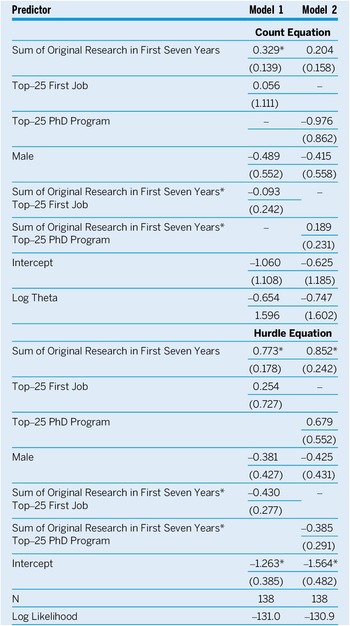
Table 1 presents estimates from the hurdle function in the Political Science Computational Laboratory package in R (Zeileis, Kleiber, and Jackman Reference Zeileis, Kleiber and Jackman2008) for our dependent variable for these top-tier original publications for both the hurdle specification (i.e., the probability that scholars published nothing in their second decade) and the count specification (i.e., the number of articles published, presuming that scholars published anything in the second decade). Model 1 predicts publications with an interaction term for the effect of having a first job in a top-25 department. Model 2 includes an interaction term for earning a PhD from a top-25 program. Thus, each model includes an interaction between initial productivity (i.e., original research publications in the first seven years) and the hypothesized conditioning (or educational acceleration) variables.
Hurdle Models Predicting the Sum of Top-Tier, Original Research
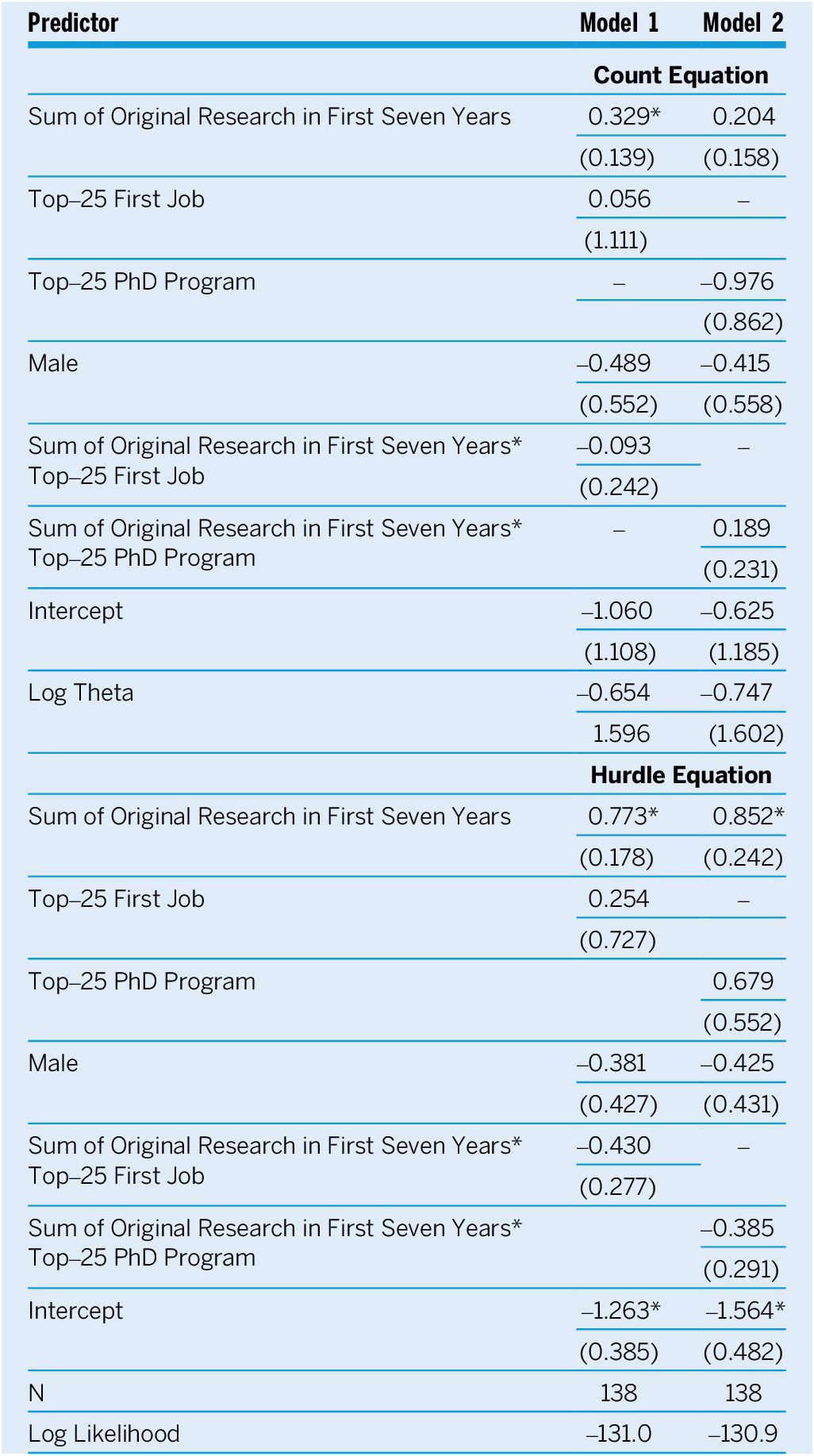
Note: *p<0.05.
Hurdle models suffer from the limitation of most maximum-likelihood estimation models in that their coefficients are not substantively interpretable beyond their direction and statistical significance. To resolve this, we present graphic representations of the predicted probability of crossing the hurdle (for the hurdle equation) and the predicted number of publications (for the count equation).
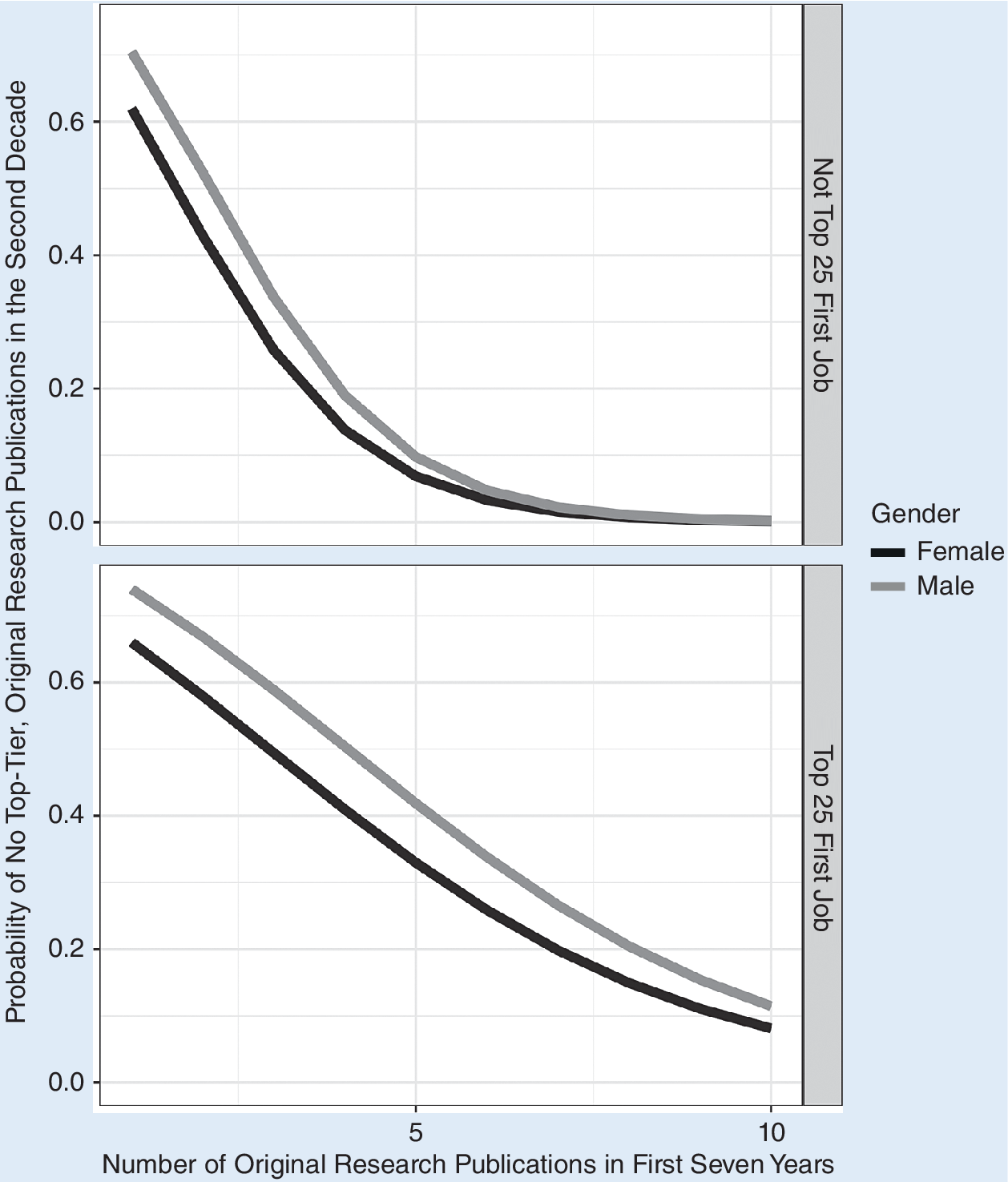
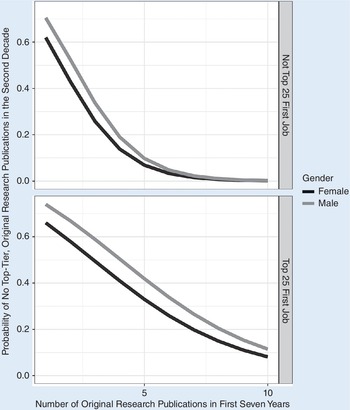
We begin by interpreting the graphic results for the hurdle equation of model 1 that predicts whether scholars published anything in their second decade and based on whether their first job was in a top-25 department. The graphical results for this equation are in figure 1. Along the x-axis is the number of original research publications in the first seven years; men and women are differentiated by color. Scholars whose first job was in a top-25 department are in the bottom panel; those whose first job was not are in the top panel. As observed in the top panel, scholars with no publications in the first seven years are highly unlikely to be productive later in their career, regardless of their department. Each pair of lines has a more than 60% probability of publishing nothing in the second decade for these scholars. Yet, the graphs demonstrate that scholars not in a top-25 department are more productive later in their career, contingent on early productivity. For example, men not in a top-25 department who had five or more early-career publications have only a 10% probability of publishing nothing in their second decade. Comparable men in a top-25 department might be “resting on their laurels” with a 40% chance of no productivity in their second decade. Notably, as well, the gap between men and women is insignificant in both of these graphs.
Graphic Results for the Hurdle Model Predicting the Probability of No Top-Tier, Original Research Publications in the Second Decade for Scholars Whose First Job Was in Top-25 Department and for Those Whose First Job Was Not in Such a Department
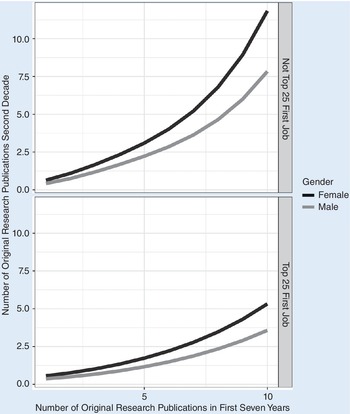
We next interpret the count equation of model 1: presuming that scholars cross the hurdle and publish something in the second decade, how likely are they to publish? Several comparisons in figure 2 indicate that, although significant, early-career output is related to similar late-career output; that is, most scholars have fewer publications in the later than in the early period. For example, in both the top and the bottom panels, scholars who published about five or even a few more major, early-career publications had notably fewer in the second decade. Among those whose first job was in a top-25 department, even more early-career publications were followed by many fewer later-career publications. Only scholars whose first job was not in a top-25 department (i.e., those in the top panel), on average, published more in the late-career than the early-career period.
Graphic Results for the Model Predicting the Number of Top-Tier, Original Research Publications in the Second Decade for Scholars Who Publish Anything in That Period For Those Whose First Job Was Not in a Top-25 Department and for Those Whose First Job Was in Such a Department
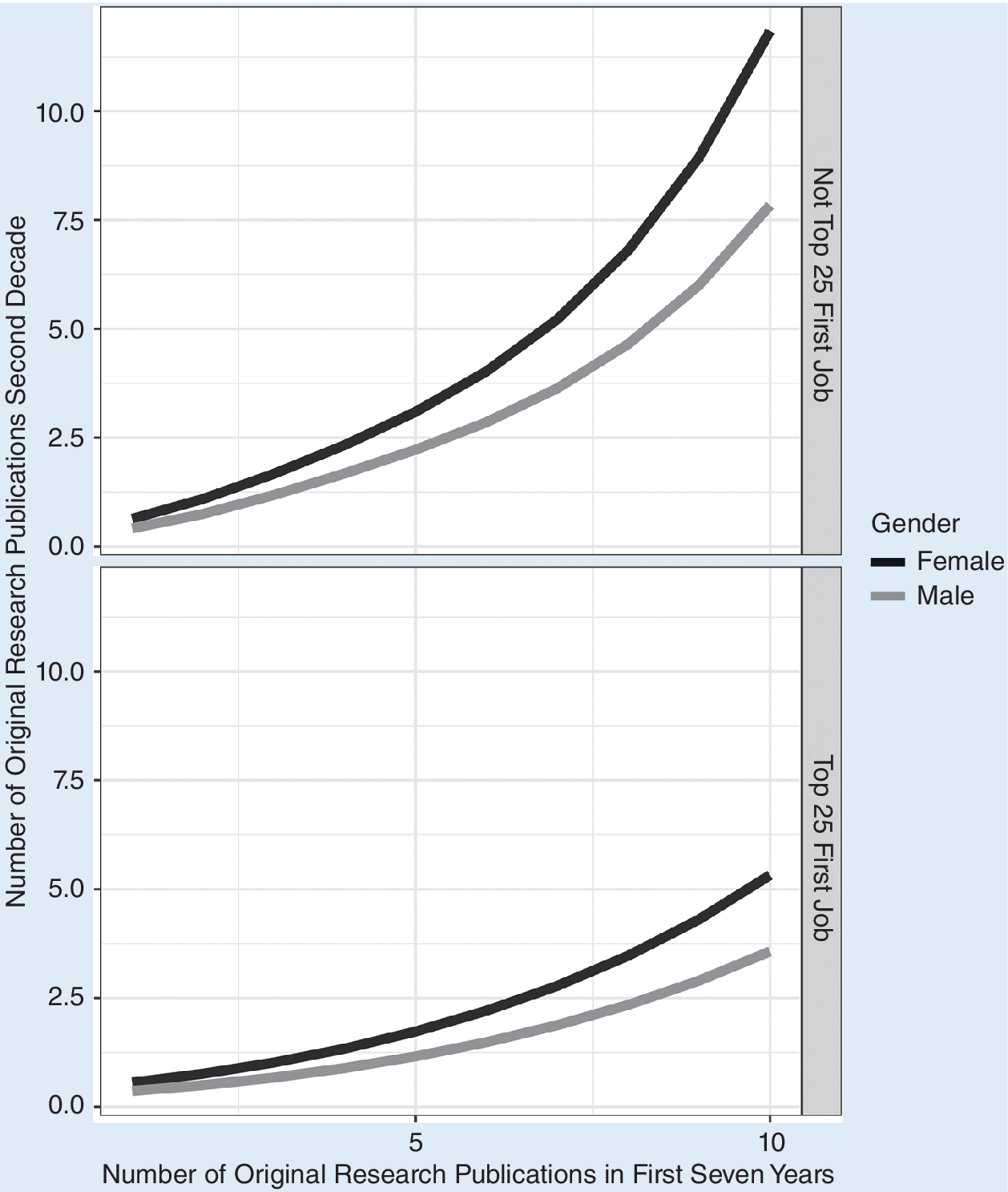
Scholars not in a top-25 department (see top panel, far right in figure 2) who published seven or more original works in their first seven years are predicted to publish three to seven late-career original articles or books for men and six to 10 for women. Contrast this with similarly productive early-career scholars in a top-25 department who are predicted to publish only two to five works in their second decade regardless of gender. In summary, there is a significant relationship between early- and late-career publications in figure 2 but none that accounts for all of the late-career variation that we observe. However, the results in the top panel also indicate a significant interaction between numerous early-career publications and not having a first top-25 job in their effect on notable late-career productivity; this implies a long-term educational-acceleration effect.
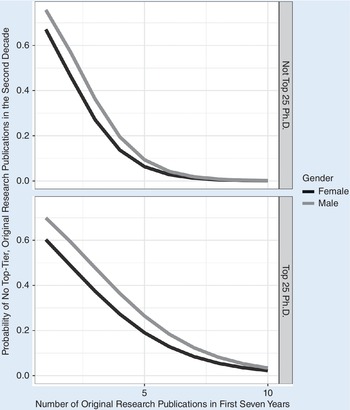
Model 2 predicts productivity using an interaction with whether scholars obtained their PhD from a top-25 institution. Figure 3 is a graphic representation for the probability of no late-career publications. The number of research publications in the first seven years is along the x-axis. The effects of both gender and a top-25 PhD program are marginal and insignificant, and only modest differences between the two groups otherwise arise in the graph. Individuals from a top-25 PhD program who published nothing in their first seven years (i.e., at the far left of the lower panel) are marginally more likely than those who do not have a top-25 PhD to publish in their second decade. However, this pattern reverses for highly productive scholars. Men and women who are not from a top-25 PhD program and who publish seven articles in their first seven years are slightly more likely to publish in their second decade than comparably productive scholars with a top-25 PhD. In both comparisons, the differences between the two groups are modest.
Graphic Results for the Hurdle Model Predicting the Probability of No Top-Tier, Original Research Publications in the Second Decade for Scholars Whose PhD Was Not from a Top-25 Department and for Those Whose PhD Was from Such a Department
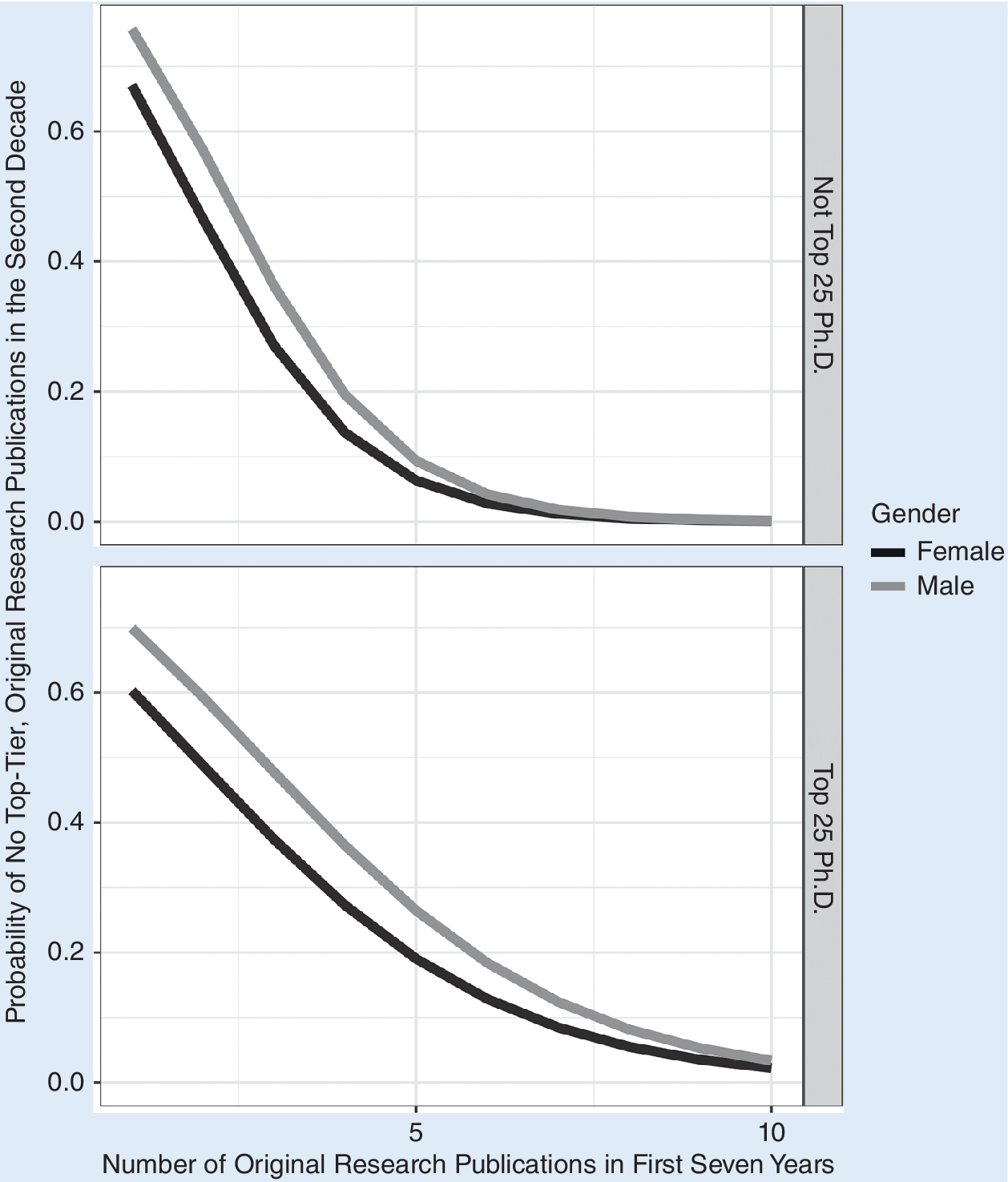
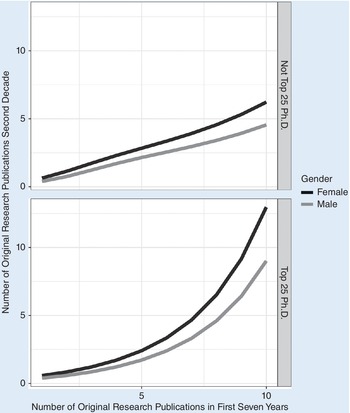
Figure 4 reports the count-equation graphics for model 2 and demonstrates results generally similar to those in figure 2. As shown in figure 4, most scholars in both types of departments published fewer works in the late-career period than in the early-career period. Thus, as in figure 2, there is a probabilistic but not very strong relationship between early- and late-career publications overall. However, the exception to this generalization, as in figure 2, is for those whose first job was not in a top-25 department—who generally were more productive in their late career as opposed to their early career, which again demonstrates long-term educational-acceleration benefits.
Graphic Results for the Model Predicting the Number of Top-Tier, Original Research Publications in the Second Decade for Scholars Who Publish Anything in That Period For Those Whose PhD Was Not from a Top-25 Department and for Those Whose PhD Was from Such a Department
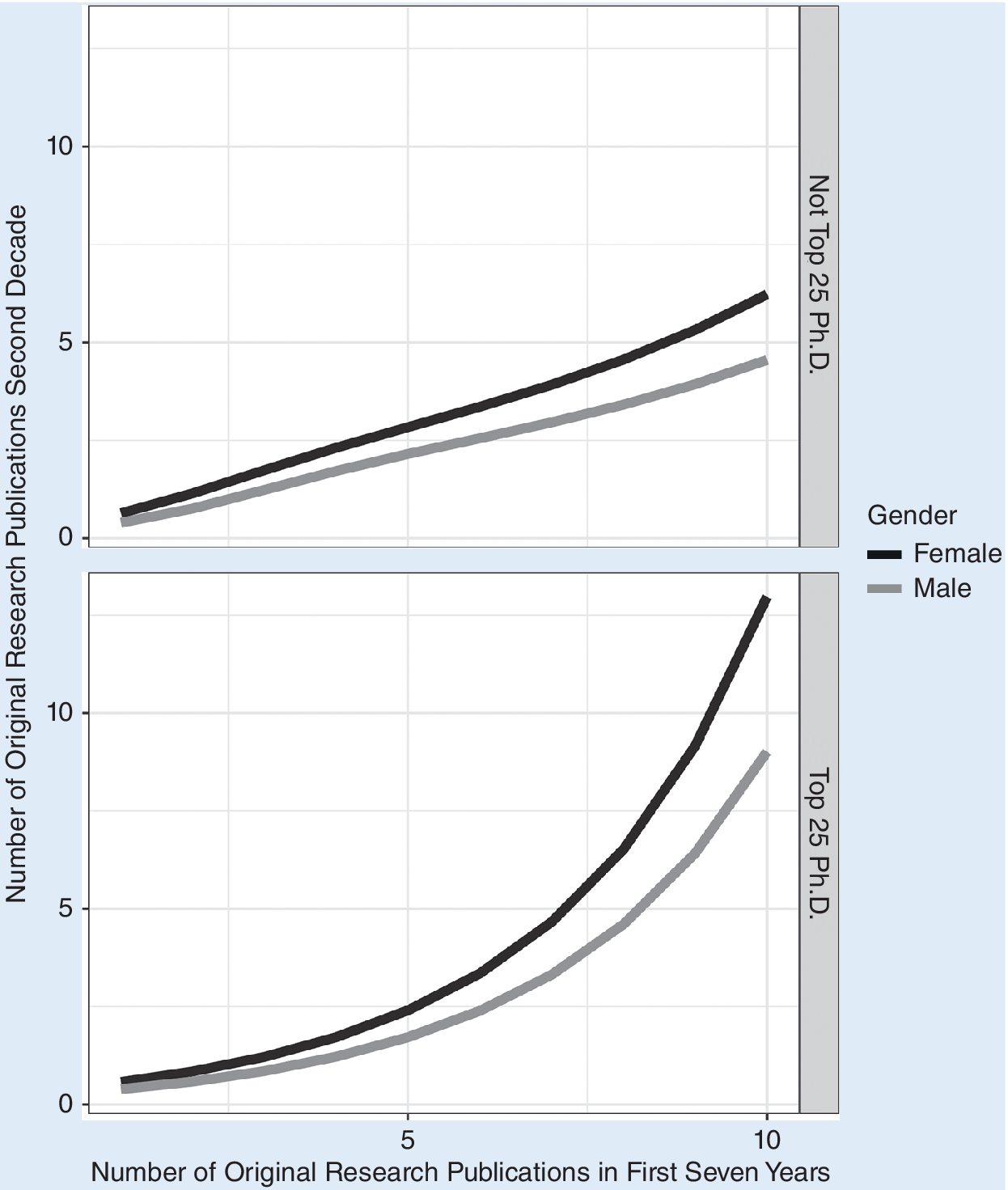
On a first reading, we might think there is a contradiction between the results in the figure 2 graph that shows very high early- and late-career output by not-top-first job-PhD department scholars and the results in the figure 4 graph that shows very high early- and late-career output for graduates of a top-25 department. However, these are largely the same scholars: those who earned a PhD from a top department but whose first job was not in such a department.
CONCLUSIONS
Using data on a sample of political scientists who began their career in a doctorate-granting department, this study provides evidence for a notable relationship between numbers of early-career original research publications in leading outlets and the number of similarly placed publications late in a scholar’s career. The late-career output of many scholars, however, was much lower than in their early career. However, the interaction between earning a PhD in a leading department and significant early-career productivity substantially increased the likelihood of comparable or even larger numbers of late-career compared to early-career publications (i.e., an educational-acceleration effect). In contrast, neither getting a first job in a top-ranked department nor being a male scholar had a significant direct or interactive effect on late-career publications. Thus, we found support for only one rival explanatory variable for late-career productivity in current literature.
…the interaction between earning a PhD in a leading department and significant early-career productivity substantially increased the likelihood of comparable or even larger numbers of late-career compared to early-career publications.
These findings suggest a multipart agenda for future research. First, and in light of the support we found for Feist and Barron’s (Reference Feist and Barron2003) hypothesis, future studies might profitably investigate it with more diverse datasets in terms of the original and even the second faculty positions that scholars assume. Second, future research might investigate some of the plausible rival explanations of late-career productivity suggested by the research on precocious adolescents. A strong expectation that has not yet been deeply researched is that late-career success in most fields depends on scholars’ willingness to commit significant time to their career compared to that devoted to personal and family concerns (Lubinski and Benbow Reference Lubinski and Benbow2021, 13, 19). Evidence for the latter expectation for research scholars, however, likely will require original survey or qualitative interview data to document career commitments.
A strong expectation that has not yet been deeply researched is that late-career success in most fields depends on scholars’ willingness to commit significant time to their career.
SUPPLEMENTARY MATERIAL
To view supplementary material for this article, please visit http://doi.org/10.1017/S1049096526102017.
DATA AVAILABILITY STATEMENT
Research documentation and data that support the findings of this study are openly available at the PS: Political Science & Politics Harvard Dataverse at https://doi.org/10.7910/DVN/RXKFCR.
CONFLICTS OF INTEREST
The authors declare that there are no ethical issues or conflicts of interest in this research.


 Open access

