


Introduction
Mathematics and astronomy were key subjects of study for Indigenous Maya scholars, scribes and religious specialists, and are widely reflected in artworks, architecture and glyphic texts from the Classic period (250–900 CE) onward. These Indigenous Maya sciences included certain kinds of predictive astronomy and associated formulae, systematic reconciliations and commensurations between human calendars and astronomical cycles, as well as almanacs and divination tools that were built upon “Indigenous concepts that deal with quantitative knowledge of the natural world” (Aveni Reference Aveni2001: 187). During the Classic period, these sciences framed and structured many key aspects of Maya social, political and religious life. Calendar dates and complex numerological calculations, such as the temporal distance between notable events or the symbolically significant multiples of planetary cycles, are prominent in formal inscriptions. Archaeological and textual evidence from monumental stelae, murals and ritual offerings suggest such knowledge was presented and performed in public forums, in ways that would have emphasised impressive results (i.e. co-ordinated human and celestial events) without necessarily revealing the tedious mechanics underpinning those results. In these ways, complex numerological units of time could influence everything from decisions about the erection of monuments to the dedication of civic and ceremonial buildings to the inauguration of kings and queens.
In this article, we present a newly deciphered calendrical formula; designated Text 19, it is located within a chamber of wall paintings at the site of Xultun, Guatemala (Figure 1). Text 19 records a unique set of astronomical calculations that were attributed to an individual named Sak Tahn Waax (‘White-chested Fox’). Unlike the units of time grounded by historical context that are commonly recorded in formal inscriptions, Text 19 presents a sequence of dates with calendrical intervals as a mathematical exercise associated with idealised numbers. Its nested cycles encode several well-known calendrical and astronomical intervals observed by the Classic Maya, including cycles related to the movement of Venus and Mars; yet these are internally arranged in a novel and otherwise previously unattested way. Today, we would regard the nature of Text 19 as reflective of both mathematical knowledge and observational astronomy—thus we refer to its author as a mathematician-astronomer. Throughout this article, we use the words ‘mathematician’, ‘astronomer’, ‘scholar’ or ‘scribe’ to refer to the specialised Maya practitioners engaged in such related activities. These titles are modern constructs and did not exist for Classic Maya peoples; they are offered here to translate the knowledge and work of these individuals for current audiences. Aside from the numerological and astronomical importance of the formula, the attribution to its author, Sak Tahn Waax, provides the only known example of a Classic-period Maya mathematician-astronomer identified by name and claiming direct credit for their intellectual work.
a) Artist’s reconstruction of structure 10K-2, showing painted figures on north and east wall, and the location of the signed mathematical formula discussed in the text; b) Text 19 as it appeared on the east wall of structure 10K-2 (photograph by F.D. Rossi; drawing by H. Hurst).

Structure 10K-2, Xultun, Guatemala
In 2010, archaeological excavations at the Maya site of Xultun, Guatemala, revealed evidence of astronomical and mathematical inscription, as well as mural painting, being practised during the Classic period (250–900 CE) (see Saturno et al. Reference Saturno2015). The inscriptions are located within a small masonry building designated as Structure 10K-2. The four interior walls of the chamber were also painted with portraits of seated and kneeling men of various age and rank, each with painted hieroglyphic texts providing their personal title, taaj ‘obsidian’ (Rossi Reference Rossi2015). Depicted among these ‘obsidians’, the eighth-century Xultun ruler Yax We’n Chan K’inich sits within a niche on the north wall, dressed as a Maize-Wind Deity with a Scorpion Tail (Saturno et al. Reference Saturno2017; Rossi Reference Rossi and Freidel2024). Numerous painted and inscribed texts, as well as small scale ‘microtexts’, are concentrated in the north-east interior corner and on the east interior wall where they were painted over figures and on re-applied lime plaster patches. This cluster of approximately 52 texts reveals the ‘rough drafts’ of Maya mathematicians as they charted and predicted the cycles of celestial objects relative to earth and to one another, and also worked to numerically reconcile such cycles with the other time units from various calendars (Aveni et al. Reference Aveni2013; Bricker et al. Reference Bricker2014; Rossi & Stuart Reference Rossi and Stuart2015). These 52 texts are uncommon for the Classic period in their focus on the mechanics of celestial cycles and formulae, and they include a lunar table, a ring number and texts with nested cycles tied to local calculations; several grapple with very large units of time. Notably low in frequency, however, are personal names, titles and verbs describing historical actions, items that are more common in glyphic texts of the period.
The calendrical nature of these microtexts, their physical properties (in terms of their scale and disregard for the original figural mural programme) and the layered lime plaster patches upon which several were inscribed, suggest that the chamber was a workspace for specialists making codex books during the mid-eighth century CE. This interpretation is supported by archaeological evidence of papermaking tools, found both in the mural chamber and nearby contexts and dated through ceramic and radiocarbon analysis to an occupation spanning approximately 650–950 CE (Rossi et al. Reference Rossi2015; see online supplementary material (OSM)). Moreover, the titles indicating ranking among the taaj scribes depicted in the west- and north-wall paintings suggest mentorship and training among those using the chamber. It is likely this was a space where calendrical calculations were taught alongside the making of barkpaper books (Rossi Reference Rossi2017). Only four pre-colonial Maya ‘codex’ books survive, all made more than five centuries after the mural; none are archaeologically documented (Vail Reference Vail2006). Thus, the 10K-2 mural room offers a rarely preserved archaeological context for bookmaking and its attendant intellectual work that can tell us about the ways in which Maya astronomical sciences were engaged with and worked through mathematically.
Materials and methods
The Structure 10K-2 mural chamber has a single, southern doorway; a large bench occupies the northern half of the room. The chamber was used for an undetermined period of time before it was filled in by residents, likely sometime in the mid- to late-eighth century CE, at which point it became the foundation for a small, raised building. By 950–1000 CE, most of the ceremonial and administrative centre of Xultun, as well as its extensive residential areas (including Structure 10K-2), had been abandoned as part of a larger social upheaval and dispersal of peoples from the central Maya lowlands. The east and north walls of the mural chamber remained sealed in this buried context until archaeological excavations re-opened the chamber between 2010 and 2012. The fill of mud, stone and debris was removed through controlled archaeological excavation. Due to root growth, water filtration and the proximity of the chamber walls to the modern ground level, preservation of the painted lime plaster surfaces is uneven and generally poor. However, conservation and documentation of each exposed wall proceeded in tandem with archaeological excavation to obtain high-quality records; this included field examination by experts in imaging and epigraphy. Ultimately, the mural chamber was reburied for its ongoing protection and preservation (Beltrán et al. Reference Beltrán, Saturno and Rivera Castillo2014).
The faint painted imagery and texts of the east wall presented substantial challenges for documentation (Hurst Reference Hurst, Rivera Castillo and Saturno2012). The mural surface was systematically scanned at 400dpi using a standard flatbed scanner and scale drawings of mural imagery were completed in the field under variable light sources, both during excavation and post-cleaning. These drawings were subsequently edited using additional imaging software and were peer reviewed by team members. Alongside traditional photography and scanning, images were acquired in the infra-red spectrum and the RGB photo-scans were post-processed using dStretch software to aid study of the painted marks.
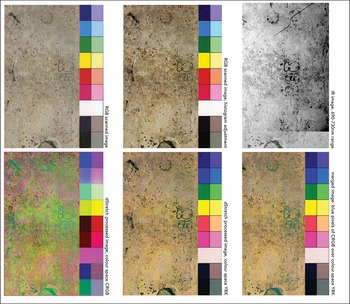
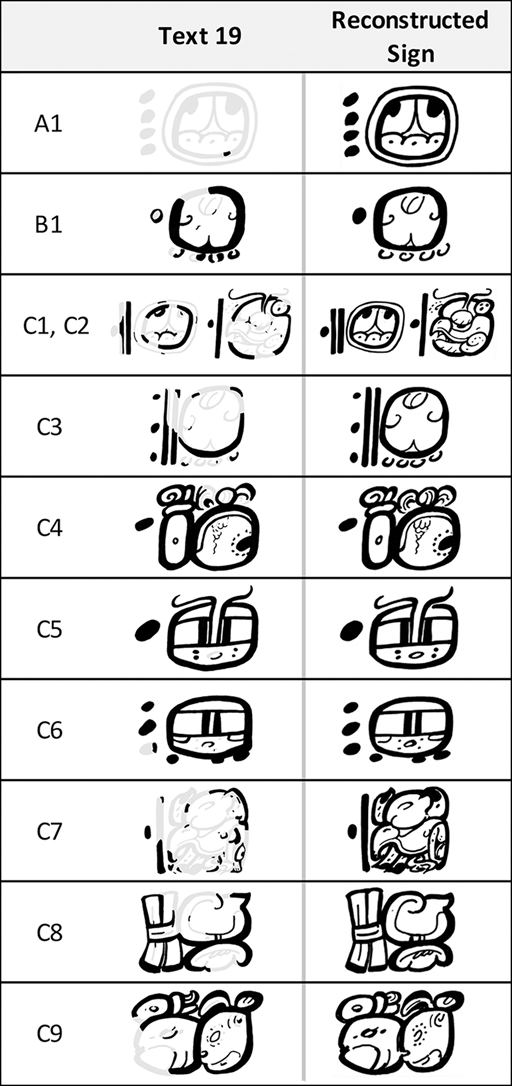
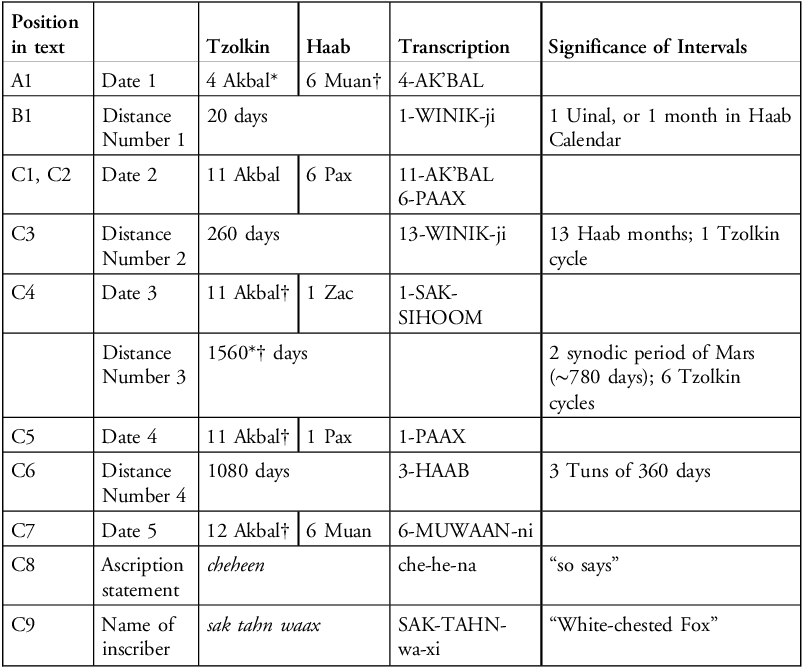
Comparison of image data enabled detection of 11 hieroglyphs that comprise Text 19 on the east wall of the 10K-2 mural chamber. Text 19 was first illustrated using colour scans, photographs and examination under magnification and a variable light source. Illustrations were then revised with multispectral and dStretch image data, which aided visibility in some areas of pigment loss (see Figure 2). The resulting illustration (Figure 3) records the visible marks of Text 19. Based on the epigraphic corpus of Maya graphemes and the limited content of the text to dates, it was possible to reconstruct some partial signs (Figure 4 & Table 1). This text was collaboratively deciphered following current discourse and accepted readings for Classic period Maya glyphic texts. The mechanics of Maya calendrical mathematics have long been understood, and it is within the rules of this system that eroded values in Text 19 were reconstructed. Figure 4 and Table 1 provide a full reconstruction of the text, alongside transcriptions, text position and descriptions of time intervals.
Scanned images of Text 19, east wall, structure 10K-2, with dStretch modifications (images by W.A. Saturno, F.D. Rossi & G. Ware; image processing using dStretch by H. Hurst).

Multispectral imaging and reconstruction drawing of Text 19: a) blue pixels of CRGB merged with YBK colour space; b) multispectral image of upper portion of Text 19; c) multispectral image of lower portion of Text 19; d) merged multispectral images of complete text with column and row numbers indicated; e) reconstruction drawing of Text 19 (photographs by G. Ware; processed images by H. Hurst; drawing by F.D. Rossi).

Figure 3 Long description
Panel A: A color-coded image with blue pixels of CRGB merged with YBK colour space. The image shows various colors representing different spectral data. Panel B: A grayscale multispectral image of the upper portion of Text 19, displaying faint hieroglyphic text. Panel C: A grayscale multispectral image of the lower portion of Text 19, also showing faint hieroglyphic text. Panel D: A merged multispectral image of the complete Text 19 with column and row numbers indicated. The text is divided into sections labeled A, B, and C, with rows numbered from 1 to 9. Panel E: A reconstruction drawing of Text 19, showing clear and detailed hieroglyphic text divided into columns A, B, and C, with rows numbered from 1 to 9.
Illustration of Text 19, visible text (left) and reconstructed glyphs (right) (drawings by D. Stuart & F.D. Rossi).

Summary of glyphic and numerical information, see reconstructed glyphs illustrated in Figure 4.

*Denotes reconstructed date or numeral; †denotes date or numeral omitted by Maya author.
The Text 19 formula
Text 19 is located at the centre of the east wall and comprises 11 glyph blocks arranged in an inverted ‘L’ (at 180° rotation) in black paint. It is 192mm high and 28mm wide at glyph C4, and approximately 80mm wide at glyphs A1 to C1 (Figure 1). The preservation of this painted inscription is comparatively good, with some areas of loss.
Maya texts are often structured by units of time. The organisation of Text 19 moves through a sequence of five specific date records spaced by precise time intervals regularly used by ancient Maya scribes, followed by a two-glyph attribution to its author, Sak Tahn Waax. The calculations all involve familiar astronomical and/or calendrical units of time, which are reported in a conventional manner with ‘Distance Numbers’ between inscribed dates. However, the selected intervals and relationships drawn by the groupings in Text 19 are unique among Maya texts. This creative thought expression, alongside the personal name that we suggest might be the author’s signature, constitute a formula that represents one person’s own distinctive ‘patterning’ of well-known calendrical and astronomical interval permutations and commensurations.
Text 19 presents a total count of 2920 days composed of smaller counts that encode at least six units of time that were of great interest to Classic Maya timekeepers. The interval of 2920 days (8.3.0 in Maya notation) is significant as it is the lowest common multiple of the Venus synodic period of 584 days (583.92 days) and the Haab or solar year of 365 days. In other words, the position of Venus relative to the sun repeats almost exactly every 2920 days, which is equal to eight solar years or five synodic Venus periods (Förstemann Reference Förstemann1894: 431–43; Teeple Reference Teeple1926: 402–408). This interval is found throughout the corpus of Maya inscriptions, perhaps most famously within the Dresden Codex Venus tables, where these periods are tracked in relation to various embodied manifestations of Venus (Förstemann Reference Förstemann1894; Bricker & Bricker Reference Bricker and Bricker2011: 163–248). At Xultun, the scribe who created Text 19 was interested in how the 2920-day cycle could be parcelled into time intervals other than the five synodic periods of Venus (584 days) that generated it. The text engages six other time cycles embedded within the full count, these being (from smallest to largest): Uinal of 20 days; Tzolkin of 260 days; Tun of 360 days; Haab (solar year) of 365 days; Venus year of 584 days; Mars year of 780 days. Names for these periods and units of the Maya calendar correspond to Yukatek Mayan terminology found in sixteenth-century documents, using colonial-era orthography. This follows long-standing conventions in Maya studies and helps to distinguish common scholarly terminology from the names we see spelled in the ancient texts, which were often different and varied (‘Zac’ was usually Saksihoom in the Classic period, for example).
The first nine glyphs of Text 19 represent a mathematical statement that tabulates these six units of time (see Figures 2, 3 & 4). The use of nine glyphs is likely an intentional choice. The number nine carried particular ideological importance in Indigenous Maya thought (perhaps most notably as the organising principle of the ‘nine lords of the night’, see Seler Reference Seler1904; Thompson Reference Thompson1960). The resulting formula is a concise encoding of six units of time that are each made up of additional numerically significant multiples. The reading of the text makes visible these complex relationships of bundled time.
Eroded sections of the formula required that we start with the best-preserved segment of text at position C4 and work from there (Figure 4 & Table 1). The glyph at C4 clearly reads ‘1 Zac’, a record corresponding to a position in the Maya 365-day Haab calendar. Working backward, at position C3 two legible bars and three dots indicate the associated coefficient is 13. The main sign at C3 is too eroded to clearly read; however, the glyph at C2 sheds light on its reading with just enough detail to identify it as the Haab station 6 Pax, falling exactly 13 Uinals (20-day ‘months’) before 1 Zac (C4). Thus, the presence of the number 13 at C3 strongly suggests it is a Distance Number (DN) or time interval expressing 13 Uinals, serving to connect the two date records.
This interval (13 Uinals) is equivalent to 260 days, the length of one Tzolkin cycle. In Mesoamerican calendrics, the 365-day Haab ran concurrently with a 260-day Tzolkin calendar and any given day could be expressed as a station in either system or, as was customary, in both. Together these formed the ‘Calendar Round’ (CR), a cycle of time in which any specific combination of a Tzolkin with a Haab date repeats once every 52 years, or 18 980 days. This information is particularly relevant here since the glyph at C1 is a Tzolkin day, rather than a Haab day; this means that together C1 and C2 form a CR date. Enough remains of the Tzolkin day-sign at C1 to identify it as Akbal. Its numerical coefficient is the number 11, with the remnants of two bars being visible and the faintest line of a dot in line with the glyphic column below. The resultant CR would thus be 11 Akbal 6 Pax.
Moving backward from positions C1-C2 is a DN at position B1, which is recognisable as 1 Uinal (1-WINIK-ji, read as huun winik-ij, “one-score days hence”). This DN links the 11 Akbal 6 Pax CR station at C1-C2 with a now eroded date recorded beforehand. When we count back 20 days from the CR date at C1-C2, we reach 4 Akbal 6 Muan, evidently the start of the sequence. Before the 1 Uinal there is space for only one component of a date, and we posit A1 was the Tzolkin position 4 Akbal. As we will see, the end date of the entire formula includes 6 Muan, suggesting that the first glyph of the formula (4 Akbal) and the last glyph of the formula (6 Muan) reference the initial CR. Based on the existing calendrical fragments and distance numbers, the first six hieroglyphs (A1–C4) of Text 19 give us the following sequence:
4-AK’BAL (A1) / 1 WINIK-ji (B1) / 11-AK’BAL (C1) / 6-PAX (C2) / 13-WINIK-ji (C3) / 1-SAK-SIHOOM (C4) …
chan ak’bal huun winikij buluch ak’bal wak pax uxlajuun winikij huun saksihoom…
“4 Akbal, then one-score days hence to 11 Akbal 6 Pax, then thirteen-score days to (11 Akbal) 1 Zac…”
Counting 13 Uinals from the CR position 11 Akbal 6 Pax provided at C1-C2, the corresponding full CR for position C4 (1 Zac) would be 11 Akbal 1 Zac. Yet, as noted, only 1 Zac was inscribed; the Tzolkin position for the CR date (11 Akbal) was omitted, probably because the 11 Akbal was already provided at C1. The use of shorthand forms and abbreviations like this are common in Maya script (Houston & Martin Reference Houston and Martin2011; see also OSM). Moving forward to C5, we would normally expect a DN counting forward to the next position in the formula. Instead, we find a Haab date (1 Pax, using an alternate form of the Pax sign from that used at C2) in yet another instance in which the Tzolkin position in the larger CR station was omitted by the author. Without a DN (which had been provided between date stations up until this point), the interval of time between C4 and C5 is not explicit but we believe the accompanying Tzolkin for this 1 Pax date at C5 is also 11 Akbal.
The calculated interval between the date at C4 (11 Akbal 1 Zac) and the date we argue for at C5 (11 Akbal 1 Pax) is 1560 days, a significant number as it is equal to two cycles of the planet Mars (780 × 2 = 1560 days). The 780-day period, an approximation of the synodic period of Mars (779.94 days), appears in a variety of Classic Maya contexts, including codex books and monumental inscriptions (Willson Reference Willson1924; Aveni Reference Aveni2001: 82–96). A numerical array painted on the northern wall of the 10K-2 chamber consists of four inscribed columns, all of which are evenly divisible by the Mars cycle of 780 days (Saturno et al. Reference Saturno2012); therefore, we know Xultun’s astronomer-mathematicians were aware of this cycle and were already working with it in their calculations. Although the scribe’s use of shorthand requires interpretation, this meaningful interval of time supports our reading of the date at C5. In an expertly and elegantly rendered passage like Text 19, any omissions were undoubtedly considered and thoughtful.
At C6, a DN of 3 Tuns (3 × 360 days, or 1080 days) leads to the final date in the sequence. Calculating 3 Tuns forward from 1 Zac leads to the Haab station 6 Muan which we believe was written at C7, where part of the bar and dot numeral is visible. This would be the shorthand form of the full CR 12 Akbal 6 Muan, and it ends a sequence that began on the very same Haab day (6 Muan) 2920 days prior. As previously discussed, the interval of 2920 days is significant as the lowest common multiple of the Venus synodic period (584 × 5 = 2920 days) and the solar year (365 × 8 = 2920 days).
In nine hieroglyphs, Text 19 elegantly expresses the varied relationships among six temporal cycles, including those related to Mars, Venus, the Tzolkin and the Haab solar year, all represented within a single count of days that spans an eight-year period (Figure 4 & Table 1). The five dates are spaced within the 2920-day interval to highlight smaller sub-intervals. As a text, the passage sheds light on how observable celestial phenomena and planetary cycles were not only tracked in relation to one another, but how Maya mathematicians parsed and bundled shorter cycles within larger counts of time. Within the full count, the scribe also chose to embed intervals in a gradually increasing sequence: the first interval is one Uinal (20 days), the second is one Tzolkin (260 days), followed by two Mars years (1560 days) and three Haab cycles (1080 days) and the total length of the formula is five Venus synodic cycles (2920 days). These intervals follow what is known as a Fibonacci sequence in western mathematics; however, the degree to which ancient Maya mathematics incorporated and understood this pattern in nature is unknown.
Despite its poor preservation in places, the formula can be reconstructed from the visible details, including the 11 Akbal, the two Haab positions and the three time intervals. Our reconstruction paired with the palaeography of the painted glyphs suggests that the best fit for the initial date is the Long Count 9.17.10.17.3 4 Akbal 6 Muan, corresponding to 7 November 781 CE in the Julian Calendar (11 November 781 CE Gregorian) (see Table S2).
The signature
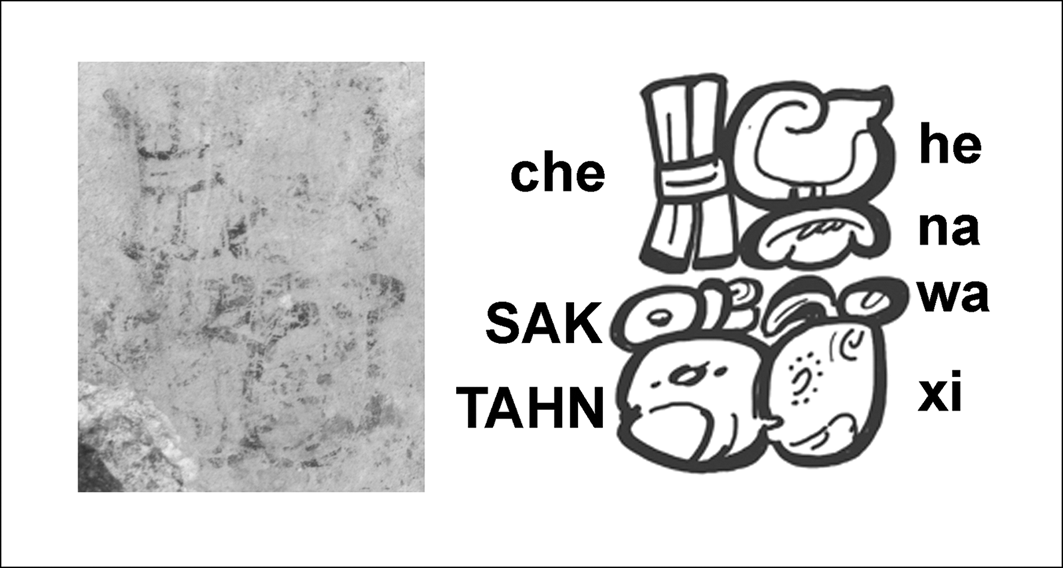
The most significant part of Text 19 is its two final glyphs, C8 and C9, which are non-calendrical in nature (Figure 5). The first of these reads che-he-na, or cheheen: a quotative particle translatable as “so says…” (Grube Reference Grube and Dedenbach-Salazar Sáenz1998; Kaufman & Norman Reference Kaufman, Norman, Justeson and Campbell1984: 77–167; Hofling, Reference Hofling2011: 239; see also OSM). This phrase is followed by a clear personal name, spelled SAK-TAHN-wa-xi or Sak Tahn Waax, ‘White-chested Fox’. Here, cheheen serves to indicate that a person named Sak Tahn Waax in some way expressed or ‘said’ the mathematical and astronomical notation that precedes it. We interpret the closing statement as an attribution statement that connects the formula to a historic individual: “…so says Sak Tahn Waax”. It is possible that Sak Tahn Waax calculated and painted Text 19 directly, or it might be that the scribe cited the name in reference to another person, perhaps some noted mathematician-astronomer. In either case, it is a direct personal attribution of mathematical and astronomical work, and unique in the corpus of Maya texts.
Attribution of mathematician ‘White-chested Fox’, using the phrase che-he-na followed by name spelled SAK-TAHN-wa-xi (multispectral photograph by G. Ware; drawing by D. Stuart).

Discussion
The importance of the 10K-2 mural has been recognised since its discovery in 2010. Subsequent work has only re-emphasised these initial sentiments, revealing the chamber as a space in which the generation and transmission of Indigenous Maya sciences not only took place but could be connected to ranked courtly titles, political figures and even an entombed individual (see Rossi et al. Reference Rossi2015)—as well as to the production of Maya books or codices. Its inscriptions directly parallel content from surviving Maya codices, despite the rarity and later date of these codices. Serving as the closest Classic period analogue to a Maya codex workshop, the 10K-2 inscriptions grant us a much different window into the social contexts of codex production than those gleaned from colonial accounts. Behind the scenes of political ceremony, Indigenous Maya scholars understood and even ‘played’ with numerical relationships to commensurate particular numbers with certain seasons, celestial cycles and significant calendar dates, helping to shape public understandings of causality.
Text 19 is among more than 52 discrete texts identified in the 10K-2 mural room. Most were painted and located on the east wall, though a handful were incised. Style and glyphic sign comparisons suggest several of the room’s texts could have been inscribed by the same hand. Sak Tahn Waax, if we understand them to be the scribe of the Text 19 formula, could thus have authored several texts in the room. Evidence of plaster layering reveals repeated use of wall spaces, and expertly rendered texts are often adjacent to the few that were clearly inscribed by less-skilled hands.
In this sense, the east-wall texts suggest active engagement with the mechanics of how astronomical cycles and human measures of time were calculated in relation to one another. The texts include: sophisticated ‘super numbers’, each evenly divisible by the Calendar Round and Mars cycle and in one case (Column B) by both the Mars and Venus cycles; a lunar table akin to those used in the Dresden Codex, but shorter, spanning roughly 13 years of 177–178 lunar semesters (see Saturno et al. Reference Saturno2012); and counts and a caption argued elsewhere as connecting a lunar eclipse to the movements of Mars and certain star groups (Bricker et al. Reference Bricker2014: 164). At least some of these inscriptions overlap in their calculated results or observed cycles, suggesting potential links among them are yet to be discovered. The so-called ‘Area B texts’, for example, seem to be either documenting or predicting specific observable occurrences that may be related to Text 19 (see Aveni et al. Reference Aveni2013; Bricker et al. Reference Bricker2014).
The rationale for the signature itself is curious. Efforts to identify scribes through bodies of work may reveal their profound impact at places such as Chichen Itza (see Aldana y Villalobos Reference Aldana y villalobos2022) and the Venus and Mars tables within later codices contain a variety of scribal modifications used to track and reconcile cycles of time in inventive ways that seem to equally warrant scribal signature. Yet no other example of a direct attribution of a Maya mathematician to their intellectual work exists. Given this abundance of related texts, it is difficult to assess exactly why the scribe chose to add an attribution to Text 19 rather than to any of the other numerous texts in the room.
Perhaps Text 19 is distinct in that it could be viewed as a self-contained or ‘complete’ formula, possibly with recyclable potential to be applied to other 2920-day intervals. In contrast, other legible texts in the room tend to be partial, functioning as components of more well-known calculation tools (like the ‘super numbers’, the lunar table or the ‘ring numbers’; see Saturno et al. Reference Saturno2012). Text 19 thus reflects a familiar interest on the part of Maya scribes but in a novel format. While similar expressions are embedded within the dates of innumerable monuments across the Maya area, as well as in the Dresden Codex (Justeson & Lowry Reference Justeson and Lowry2025), their mechanics are never shown; 10K-2 is special precisely because it was a location where the finished results that show up on monuments were meticulously worked through.
Surviving codices, rather than monuments, might offer a more helpful window into the hidden mechanics underpinning finished dates. The Mars and Venus tables across the Dresden and Madrid codices tend to focus on each planet’s distinct cycles separately, or in relation to seasonal factors and star groups. These tables compare well with many texts in the 10K-2 mural room, but do not quite line up with Text 19. Perhaps the ‘aberrant multiples’ in the Dresden Mars tables might resonate with the counts between Text 19’s Date 2 through Date 4 (260 + (2 × 780)) (see Bricker & Bricker Reference Bricker and Bricker2011: 368). There is also one less well-known table first described by Förstemann (Reference Förstemann1901, Reference Förstemann1906), what Bricker and Bricker (Reference Bricker and Bricker2011) call the ‘Incomplete Planetary Table’ of the Dresden Codex (D.58–59). They argue this would-be almanac (sadly incomplete) was concerned with Venus deity sacrifices in the Venus tables, yet features multiples used in Mars calculations, ultimately concluding that the table might have once focused on the commensuration of the cycles of Venus and Mars (and potentially Mercury) (Bricker and Bricker Reference Bricker and Bricker2011: 469–85). One wonders whether Text 19’s concern with reconciling these two planets in relation to one another offers yet another connection between the 10K-2 murals and much later Maya codices. However, the suggested structure for this ‘lost almanac’ bears no resemblance to the organisation and mechanics of Text 19. While Text 19 may have held a similar function, its structure seems to be unique. Its organisation is unusual and highly particular—even bordering on ‘play’. This novel expression of calendrical and celestial relationships within an otherwise well-known cycle might have been what warranted the signature, a kind of personal take on the 2920-day cycle.
Conclusion
Maya glyphic texts of the Classic period typically detail the exploits of leaders and lineages, celebrating the highest-status individuals and officials by name and connecting their stories to narratives that could be historical or divine. During the eighth-century peak in glyphic writing, more individuals, many of them court officials, were represented with increasing frequency in Maya art and writing (Stuart Reference Stuart, Sabloff and Henderson1993; Jackson Reference Jackson2013; Houston Reference Houston and Costin2016). At this time, individual scribes, artists and sculptors were coming into glyphic view by signing their work (e.g. Stuart Reference Stuart1987, Reference Stuart and Kerr1989a & Reference Stuart and Kerrb; Reents-Budet Reference Reents-Budet1994; Houston Reference Houston and Costin2016). Although these ‘hands’ were likely recognisable in their own time, attaching personal names to creative works was a distinct cultural shift in claiming credit over original art, craft and artistic style. Yet, despite the importance of mathematics and astronomy in Classic Maya society (in addition to the high levels of effort such observation-based thought work demanded), no example of a mathematician-astronomer’s ‘signature’ or attribution was known, until the decipherment of Text 19. Thus, 16 years after its discovery, the Xultun mural chamber and its layered texts continue to shed new light on the authorship of Indigenous Maya intellectual and scientific insights during the first millennium CE. This signed formula attests to a previously undocumented practice in Classic Maya contexts: in (or near) the year 781 CE, a scholar, perhaps at Xultun, observed the sky and noted the progression of Venus and other planetary bodies in a new way and claimed credit for it. Astronomer-mathematicians across the ancient world have long been recognised for their observations and discoveries; perhaps now, we can add an Indigenous Maya name to this history—an expert mathematician named Sak Tahn Waax—who lived and worked more than 12 centuries ago in what is now north-eastern Guatemala.
Acknowledgements
We thank members of the San Bartolo archaeological project who have contributed to this research, especially previous project directors during the excavation of the 10K-2 murals, William Saturno, Luis Alberto Romero, Patricia Rivera Castillo, as well as current project co-director Boris Beltrán for subsequent conservation and materials analysis. We thank Angelyn Bass for the conservation of the mural chamber and the careful cleaning of the wall surfaces that made visible the microtexts, as well as Caitlin O’Grady for her analysis of paint composition and Gene Ware for imaging that assisted text decipherment. We also thank the Guatemalan Ministerio de Cultura y Deportes, Instituto de Antropología e Historia and Departamento de Monumentos Prehispánicos for their support.
Funding statement
Excavation, conservation and documentation of Xultun Structure 10K-2 by the Proyecto Regional Arqueológico San Bartolo–Xultun were supported by: Boston University Graduate Research Abroad Fellowship (FDR); National Geographic Society, Committee for Research and Exploration (grants 8782-10, 8931-11, 9091-12) (William A. Saturno); National Geographic Society, Expeditions Council (EC0497-11) (William A. Saturno); National Science Foundation, Advance Grant, 2011–2012 (0820080) (HH); The Cora Dubois Trust (FDR); Dumbarton Oaks Research Library and Museum (FDR); The Austen Stokes Postdoctoral Fellowship at Johns Hopkins University (FDR).
Online supplementary material (OSM)
To view supplementary material for this article, please visit https://doi.org/10.15184/aqy.2026.10378 and select the supplementary materials tab.




 Open access

