

Statement of Research Significance
Research Question(s) or Topic(s): This study investigated whether the fourth edition of the Wechsler Adult Intelligence Scale underestimates intellectual abilities in bilingual individuals who have a non-majority cultural background. Main Findings: The study demonstrated that in a sample of Danish-Arabic bilingual university students who have done their whole education in Denmark, intelligence test scores correlated with levels of bilingualism and acculturation. Also, despite being academically high-achieving university students, participants performed below the national mean on most measures of the intelligence test. Study Contributions: The study suggests that even if an individual is fluent in the majority language (Danish) and has done their whole education in Denmark, their intellectual abilities are likely to be underestimated if they are bilingual and have a non-majority cultural background. Clinicians should be cautious when administering and interpreting performance on the Wechsler Adult Intelligence Scale in such populations.
Introduction
With the rise in international migration and globalization, psychologists are increasingly asked to assess intellectual functions in adults from diverse cultural and linguistic backgrounds across many clinical contexts. Statistics Denmark projects that by 2025, 20% of the Danish population will have a non-Danish background (Statistics Denmark, 2025). Arabic is the third largest minority language in the European Union (EU) after Russian and Turkish. In several countries, including Denmark, Arabic-speakers represent the largest non-EU minority group (European Commission, 2024). The Arabic-speaking population in Denmark is heterogeneous, comprising immigrants, refugees, and their descendants, from any of the 22 Arabic-speaking countries, primarily of Syrian, Iraqi, Lebanese, Somalian, and Moroccan heritage (Statistics Denmark, 2025).
The Wechsler Adult Intelligence Scales (WAIS) are the most widely used standardized intelligence tests and are considered gold standard in clinical research and practice (Egeland et al., Reference Egeland, Lovstad, Norup, Nybo, Persson, Rivera, Schanke, Sigurdardottir and Arango-Lasprilla2016; Rabin et al., Reference Rabin, Paolillo and Barr2016; Strauss et al., Reference Strauss, Sherman and Spreen2006). The fourth edition of the WAIS (WAIS-IV; Wechsler Reference Wechsler2008) has been adapted across over 25 different cultures (Staios, Kosmidis, Nielsen, et al., Reference Staios, Kosmidis, Nielsen, Papadopoulos, Kokkinis, Stogiannidou, March and Stolwyk2023), including Denmark (Wechsler, Reference Wechsler2011), and provides an overall intelligence estimate along with indexes for verbal comprehension, perceptual reasoning, working memory, and processing speed. It is used across clinical, educational, occupational, and legal settings to assess cognitive abilities in older adolescents and adults, helping identify cognitive strengths and weaknesses, supporting neuropsychological assessments of individuals with neurological conditions or psychiatric disorders, and in legal settings to determine competency or intellectual disability.
Although WAIS-IV is widely used internationally, most versions, except the United States (US) standardization, have been normed on native-born majority populations, raising concerns about its clinical utility in multicultural assessments (Shuttleworth-Edwards, Reference Shuttleworth-Edwards2016).
Cultural and linguistic experience shape cognitive development and behavior (Ardila, Reference Ardila2005), yet research on their impact on WAIS scales remains sparse. Most studies on multicultural WAIS-IV assessment focus on Hispanic, Asian, and African American groups in the US (Holdnack & Weiss, Reference Holdnack and Weiss2013), while considerably less attention has been given to smaller minorities and other cultural contexts (e.g., Dudley et al., Reference Dudley, Barker-Collo, Wilson and Garrett2019; Nielsen & Staios, Reference Nielsen and Staios2023; Staios, Kosmidis, Nielsen, et al., Reference Staios, Kosmidis, Nielsen, Papadopoulos, Kokkinis, Stogiannidou, March and Stolwyk2023). WAIS-IV norms differ across countries (Duggan et al., Reference Duggan, Awakon, Loaiza and Garcia-Barrera2019; Harrison et al., Reference Harrison, Armstrong, Harrison, Lange and Iverson2014; Lee et al., Reference Lee, Ryu and Ahn2024; Roivainen, Reference Roivainen2019), and results may be biased for immigrant populations whose cultural, language, and educational backgrounds differ from the normative sample (e.g. Staios, Kosmidis, Nielsen, et al., Reference Staios, Kosmidis, Nielsen, Papadopoulos, Kokkinis, Stogiannidou, March and Stolwyk2023). Clinicians often assume valid assessment is possible for descendants of immigrants fluent in the majority language and educated locally, using the national standardized norms. However, evidence shows cognitive performance may be influenced by bilingualism (Ardila et al., Reference Ardila, Lopez-Recio, Sakowitz, Sanchez and Sarmiento2019; Celik et al., Reference Celik, Kokje, Meyer, Frölich and Teichmann2022; Gollan et al., Reference Gollan, Montoya and Werner2002; Gollan et al., Reference Gollan, Fennema-Notestine, Montoya and Jernigan2007; Stålhammar et al., Reference Stålhammar, Hellström, Eckerström and Wallin2022) and acculturation (Al-Jawahiri & Nielsen, Reference Al-Jawahiri and Nielsen2020; Boone et al., Reference Boone, Victor, Wen, Razani and Ponton2007; Manly et al., Reference Manly, Miller, Heaton, Byrd, Reilly, Velasquez, Saccuzzo and Grant1998; Nielsen et al., Reference Nielsen, Vogel and Waldemar2012; Razani, Burciaga, et al., Reference Razani, Burciaga, Madore and Wong2007; Razani, Murcia, et al., Reference Razani, Murcia, Tabares and Wong2007; Tan & Burgess, Reference Tan and Burgess2020). Bilingualism is a multifaceted phenomenon that refers to the ability to use two or more languages proficiently (Mackenzie, Reference Mackenzie2024), while acculturation refers to the complex process of social, psychological, and cultural change that occurs when individuals interact across cultures. Acculturation is understood as a multidimensional process that involves both maintenance of the original culture and assimilation to the new culture (Berry, Reference Berry2003).
Two US studies have found that performance on the Wechsler Abbreviated Scale of Intelligence (WASI) is associated with acculturation in fluent English-speaking young adult bilinguals (Hasson et al., Reference Hasson, Wu and Fine2019) and middle-aged bilinguals (Razani, Murcia, et al., Reference Razani, Murcia, Tabares and Wong2007) of Hispanic, Asian, Middle Eastern, and North African descent. This is a critical issue, as biased test results can lead to misinterpretation with serious consequences in educational, occupational, or legal decisions (Gollan et al., Reference Gollan, Montoya and Werner2002). It is therefore crucial to explore whether bilingualism and acculturation influence WAIS-IV performance to guide the interpretation of test results in underserved minority groups.
The present study aimed to evaluate WAIS-IV performance in Arabic-Danish bilingual university students, focusing on associations between subtest scores, index scores, and full-scale IQ, and levels of acculturation and bilingualism. We hypothesized that: 1) Danish WAIS-IV normative data are not representative for this minority population, 2) WAIS-IV performance is positively associated with parental education and participants’ high school grade point average (GPA), 3) WAIS-IV performance is associated with degree of Danish acculturation and degree of Danish language use and proficiency, even when controlling for educational variables.
Methods
The data described in the present paper was collected in the context of the project: Bicultural Cognition (BiCON) - Effects of acculturation and bilingualism on measures of intellectual functioning. This paper focuses on results from the Danish version of the WAIS-IV.
The study was approved by the Department of Psychology Ethics Committee at the University of Copenhagen (approval number IP-EC-11112022). The hypotheses and plans for data analysis were pre-registered prior to analysis on OSF on February 4, 2025 (https://osf.io/mnjyq/?view_only=030c39317b3a4bca94f1dca365e3c161). Data were analyzed using IBM SPSS (Version 30.0.0.0).
Participants
Participants were recruited in Greater Copenhagen in Denmark using ads shared in university students’ Facebook groups and via Instagram, and were hung up on ad boards at the University of Copenhagen campus between December 2022 and December 2024. Inclusion criteria were being Arabic-Danish bilingual and currently enrolled at a Danish university. Exclusion criteria included severe psychiatric or neurological disorder, alcohol and/or substance abuse, immigrating to Denmark after the age of five (age for entering formal schooling in Denmark), and having more than two years of a psychology degree. The latter exclusion criterion sought to avoid participants with psychological test knowledge. All participants provided written informed consent in accordance with the Declaration of Helsinki (World Medical Association, 2013).
Focusing on university students educated entirely in Denmark allowed us to focus on potential test bias, rather than other factors, including the true intelligence of a sample of bilinguals. Since university admission in Denmark is based on academic merit, low WAIS-IV scores in this group are more likely to reflect test bias than low true intelligence.
One of the advantages of carrying out this study in Denmark is its homogeneity when it comes to education. Denmark is a small country with a population of approximately 6 million. It has an educational system from elementary school to high school that is strongly centrally regulated at the national level. Therefore, there is little variability in content and quality of education between schools meaning there is no reason to expect that differences in performance can be attributed to variations related to quality of education (Danish Ministry of Children and Education, 2026).
Procedure
Testing took place at the Department of Psychology at University of Copenhagen. Participants completed the WAIS-IV and a neuropsychological test battery, administered by trained master’s students in Psychology under the supervision of licensed psychologists with PhD degrees in neuropsychology (RJR and TRN). Before testing, participants completed an online survey including demographics and standardized questionnaires. Participants were offered feedback (RJR) and remuneration (600 DKK, approx. 80 Euros).
Instruments
Vancouver Index of Acculturation. The Vancouver Index of Acculturation (VIA; Ryder et al., Reference Ryder, Alden and Paulhus2000) is a bidimensional self-report measure of acculturation that assesses orientation towards mainstream (Danish) and heritage (Arabic) traditions separately. The tool includes 10 heritage items, and 10 matched mainstream items related to values, social relationships and cultural norms that are rated on a 9-point Likert-type scale. The heritage (Arabic) subscale score and mainstream (Danish) subscale score represent an average of the responses. Higher scores indicate a stronger cultural orientation. The VIA does not include items related to language, ensuring that acculturation is measured separately from language. The tool was translated to Danish prior to this study (forward and back-translation). Cronbach’s α was .84 (Arabic subscale) and .80 (Danish subscale).
Bidimensional Acculturation Scale – Language use and proficiency. The Bidimensional Acculturation Scale (BAS; Marin & Gamba, Reference Marin and Gamba1996) is a bidimensional self-report measure of acculturation that in this study was used to assess language. We only included the tool’s language subscales in this study: the Language Use Subscale (6 items) and a shortened version of the Language Proficiency Subscale (eight items instead of 12, as items on understanding radio and music were not considered culturally relevant in Denmark currently). Each subscale included equal items for heritage (Arabic) and mainstream (Danish) languages, rated on four-point Likert scales. For this study, scores for items from the language subscales were averaged into a BAS Arabic and a BAS Danish Language score. Scores range from 1 to 4 points with higher scores representing more use of the language and higher proficiency. The tool was translated to Danish prior to this study (forward and back-translation). Cronbach’s α for the Danish version was .81 for the BAS Arabic Language score and .79 for the BAS Danish Language score.
The Wechsler Adult Intelligence Scale, fourth edition. The Danish WAIS-V (WAIS-IV-DK; Wechsler, Reference Wechsler2011) includes ten core subtests yielding four index scores. The Vocabulary, Information, and Similarities subtests yield a Verbal Comprehension Index (VCI), the Block Design, Matrix Reasoning and Visual Puzzles subtests yield a Perceptual Reasoning Index (PRI), the Digit Span and Arithmetic subtests yield a Working Memory Index (WMI), and finally, the Symbol Search and Coding subtests yield a Processing Speed Index (PSI). WAIS-IV was administered and scored according to the manual using the provided norms (Wechsler, Reference Wechsler2011). Raw scores (Rs) for the subtests and indexes are converted into scaled scores (Ss; mean = 10, SD = ±3) and standard scores (SS; mean = 100; SD = ±15) respectively, which are used to calculate a full-scale IQ (FSIQ; mean = 100; SD = ±15) (Wechsler, Reference Wechsler2011).
Data analysis
To investigate hypothesis 1 concerning whether the Danish WAIS-IV normative data are representative for Arabic-Danish bilingual university students, we compared mean WAIS-IV index SS and subtest Ss of the sample to the Danish national mean scores (Wechsler, Reference Wechsler2011) and expected mean scores based on their level of education (Holdnack & Weiss, Reference Holdnack and Weiss2013). Differences >7.5 index SS and >1.5 subtest Ss (i.e., > .5 SD) were considered clinically meaningful (Draak et al., Reference Draak, de Greef, Faber and Merkies2019). We then investigated whether our sample had index profiles that were significantly more uneven than predicted by the normative data (Wechsler, Reference Wechsler2011). First, we used the Binomial Test to determine whether the sample had a significantly larger proportion of participants with significant (p < .05) and unusually large differences (seen in less than 15% of the normative sample) between pairs of index scores (VCI - PRI, VCI - WMI, VCI - PSI, PRI - WMI, PRI - PSI, and WMI - PSI) than expected (Wechsler, Reference Wechsler2011). Then, we carried out a post hoc analysis to determine whether individual participants had significantly more abnormal pairwise differences between index scores than expected. Using a chi-square goodness-of-fit test, we compared the number of participants with zero, one, two, three, four, five, or six abnormal pairwise differences to the predicted distribution based on the normative data (Wechsler, Reference Wechsler2011). We determined the predicted number of participants with 0-6 abnormal pairwise differences using a Monte Carlo simulation method that takes multiple comparisons into consideration (Crawford et al., Reference Crawford, Garthwaite and Gault2007; Crawford et al., Reference Crawford, Garthwaite and Gault2007). For a comprehensive description of the analysis, see Supplementary Material.
Due to non-normally distributed data, for Hypotheses 2 and 3, the relationship between WAIS-IV scores and educational, language, and acculturation variables was assessed with Spearman’s rank-order correlations (Pearson’s correlations were planned in the preregistered analysis). Correlations were interpreted as weak (.10–.29), moderate (.30–.49), or strong (.50–1.00) (Cohen, Reference Cohen1988). The unique effects of BAS Danish, BAS Arabic, VIA Danish and VIA Arabic scores were investigated using hierarchical linear regression analysis with plots of residuals as model control. All analyses were performed in IBM SPSS (Version 30.0.0.0), with significance set at p < .05 (two-tailed).
Results
Participant characteristics
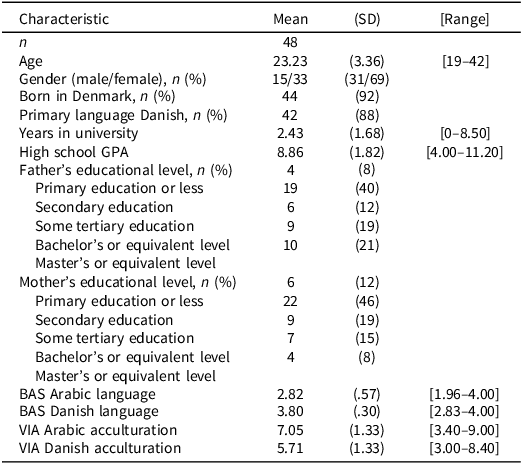
Six participants were excluded due to immigration to Denmark after age five (all females; mean age 23.00 ± 2.37 years; mean years in university 2.42 ± 1.24 years). The final sample included 48 fluent Danish-speaking Arabic-Danish bilingual university students (aged 19–42), of which 92% were born in Denmark and 88% reporting Danish as their primary language. Educational, language, and acculturation characteristics of the included participants are summarized in Table 1. Participants represented diverse Arabic-speaking heritage cultures, mainly Iraqi, Palestinian, Lebanese, Syrian, and Moroccan. Most were bachelor’s students (79%), and the majority were enrolled within the health sciences (n = 20), followed by engineering (n = 6), law (n = 5), arts and humanities (n = 4), education (n = 3), social sciences (n = 3), science (n = 2), and information and technology (n = 2). Participants generally had high school GPAs in the high range (mean GPA = 8.86 vs. Danish national mean of 7.50; Danish Ministry of Child and Education, 2025) and 46% had at least one parent with a bachelor’s, master’s, or equivalent degree. BAS scores indicated stronger Danish than Arabic language use and proficiency; while VIA scores indicated greater orientation towards Arabic heritage than Danish mainstream culture (see Table 1). One participant had missing data for the Visual Puzzles subtest due to test administration error. PRI and FSIQ scores were not calculated for this participant.
Sample characteristics

Note: GPA = Grade point average; BAS = Bidimensional Acculturation Scale; VIA = Vancouver Index of Acculturation.
WAIS-IV performance
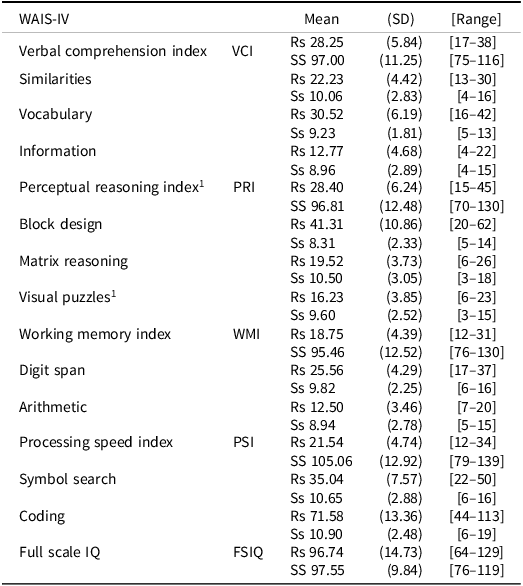
WAIS-IV scores are presented in Table 2. The mean FSIQ SS was 97.55 ± 9.84. Index SS ranged from 95.46 ± 12.52 (WMI) to 105.02 ± 12.92 (PSI) and subtest Ss ranged from 8.31 ± 2.33 (Block Design) to 10.90 ± 2.48 (Coding).
WAIS-IV performance in fluently Danish-speaking Arabic-Danish bilingual university students, n = 48
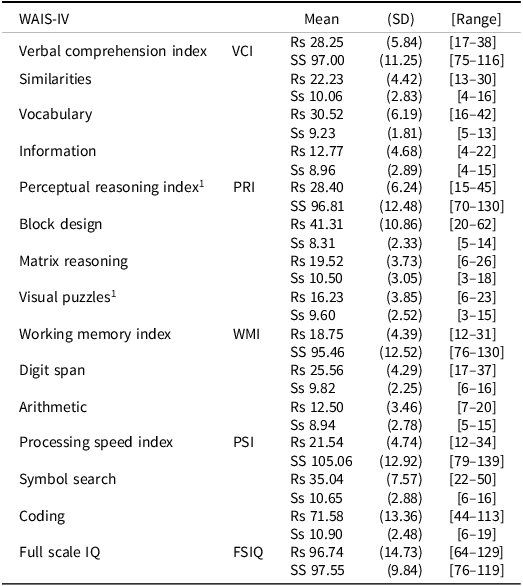
Note: WAIS = Wechsler Adult Intelligence Scale; SD = Standard deviation: Rs = Raw score; SS = Standard score; Ss = Scale score.
1Missing data for one participant, n = 47.
Figure 1 compares WAIS-IV index and subtest mean scores of the study sample with the Danish national mean and expected mean scores based on their level of education (Holdnack & Weiss, Reference Holdnack and Weiss2013). Except for PSI, mean scores were 2.45 to 4.54 points below the Danish national mean across WAIS-IV indexes, and 7.59 to 11.00 points below the expected mean score based on their level of education. Clinically meaningful differences (>7.5 SS) between observed and expected scores based on level of education were present on all WAIS-IV indexes, except PSI. On WAIS-IV subtests, the present sample scored .18 to 1.69 points below the Danish national mean on all subtests, except Vocabulary, Matrix Reasoning, Symbol Search, and Coding, and .60 to 2.64 points below the expected mean scores based on their level of education on all subtests, except Symbol Search and Coding. The lowest mean Ss were found on the Block Design subtest (8.31 ± 2.33), followed by the Arithmetic (8.94 ± 2.78) and Information (8.96 ± 2.89) subtests. Clinically meaningful differences (>1.5 Ss) between observed and expected scores based on level of education were present on the Vocabulary, Similarities, Information, Block Design, and Arithmetic subtests.
Radar charts of WAIS-IV index (A) and subtest (B) mean scores in the present sample compared to the Danish national mean and expected mean scores based on level of education (Holdnack & Weiss, Reference Holdnack and Weiss2013). Note: VCI = verbal comprehension index; PRI = perceptual reasoning index; WMI = working memory index; PSI = processing speed index; FSIQ = full scale IQ.

Rate of atypical differences between index scores
The proportion of participants with significant and unusually large pairwise differences between index scores (VCI vs PRI: 11/47 (23%), VCI vs WMI: 11/47 (23%), VCI vs PSI: 14/47 (30%), PRI vs WMI: 11/47 (23%), PRI vs PSI: 14/47 (30%), WMI vs PSI: 18/47 (38%)) was significantly higher than expected according to the norms (i.e., 15%) for all pairwise differences involving PSI: VCI vs PSI (p = .007), PRI vs PSI (p = .007), and WMI vs PSI (p < .001). Due to partial missing WAIS-IV data, one participant was excluded from this analysis.
The observed and predicted (in brackets; Crawford, Reference Crawford2007; Crawford et al., Reference Crawford, Garthwaite and Gault2007) distribution of participants according to number of abnormally large pairwise differences between index scores was as follows: 16 (24.8) participants with 0 abnormally large pairwise differences; 7 (9.0) with one; 8 (7.3) with two; 9 (4.8) with three; 6 (1.0) with four; 1 (.08) with five; and 0 (.0) with six abnormally large pairwise differences. The distribution of abnormally large differences between index scores was significantly different from the expected distribution, χ 2 (6, N = 47) = 43.25, p < .001.
Effects of bilingualism and acculturation on WAIS-IV performance
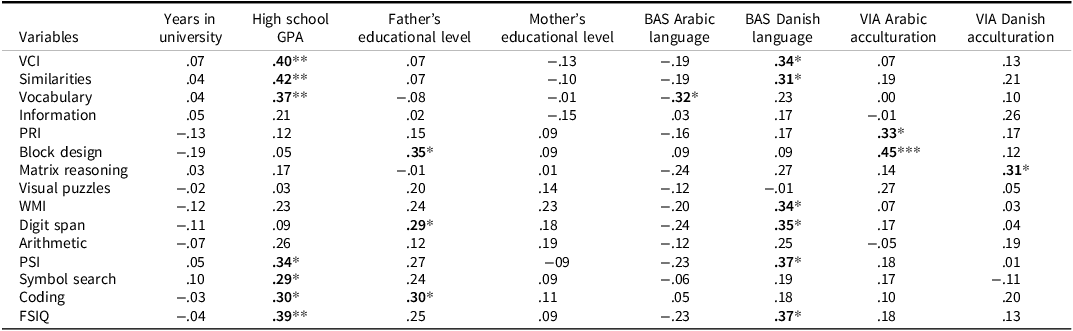
Spearman correlation analysis was performed to examine the relationship between WAIS-IV scores and educational, language, and acculturation variables (Table 3). High school GPA was positively correlated with VCI, PSI, and FSIQ SS, and with Similarities, Vocabulary, Symbol Search and Coding Ss; father’s educational level was correlated with Block Design, Digit Span, and Coding Ss. BAS Arabic language use and proficiency was negatively correlated with Vocabulary Ss; BAS Danish language use and proficiency was positively correlated with VCI, WMI, PSI, and FSIQ SS, and with Similarities and Digit Span Ss; VIA Arabic acculturation with PRI SS and Block Design Ss; and VIA Danish acculturation with Matrix Reasoning Ss. Years in university and mother’s educational level were not significantly correlated with any of the WAIS-IV index or subtest scores. Correlations between educational, language and acculturation variables are presented in Supplemental Table S1.
Spearman correlations between educational, language, and acculturation variables, and WAIS-IV scores
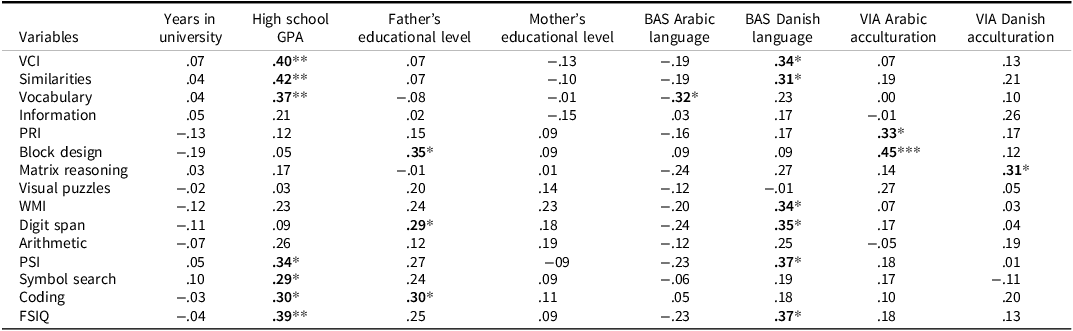
Note: GPA = Grade point average; BAS = Bidimensional Acculturation Scale; VIA = Vancouver Index of Acculturation; VCI = Verbal Comprehension Index; PRI = Perceptual Reasoning Index; WMI = Working Memory Index; PSI = Processing Speed Index; FSIQ = Full Scale IQ. Significant results are in bold. *p < .05, **p < .01, *** p < .001.
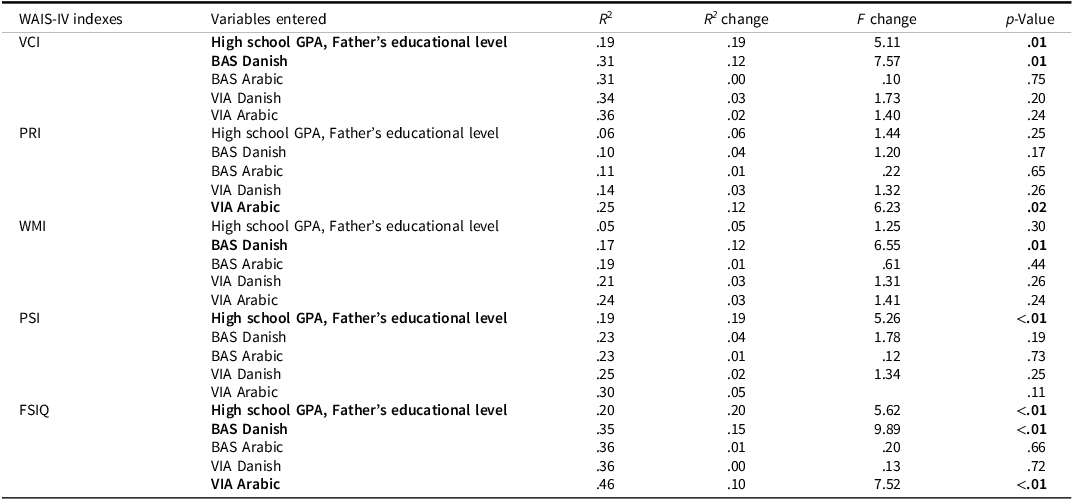
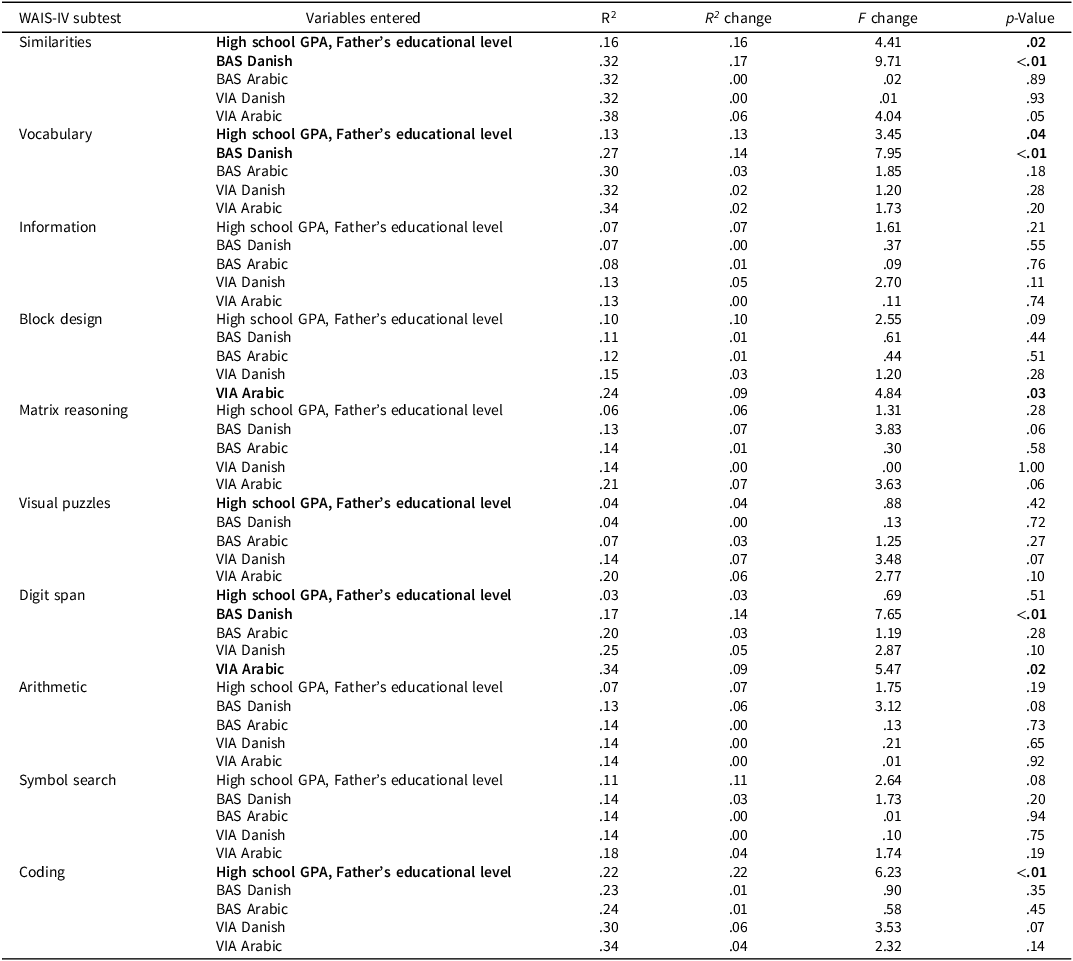
To examine the individual effects of bilingualism and acculturation variables on WAIS-IV scores, a series of five-step hierarchical regression analyses were performed with WAIS-IV index SS and subtest Ss as dependent variables and, based on the results of the correlation analysis, high school GPA, father’s educational level, BAS Danish, BAS Arabic, VIA Danish, and VIA Arabic as predictor variables. High school GPA and father’s educational level were entered in the first stage as the focus of this study was the effects of bilingualism and acculturation on WAIS-IV scores over and beyond these variables. BAS Danish and BAS Arabic language use and proficiency scores were entered in the second and third stages, and VIA Danish and VIA Arabic acculturation in the fourth and fifth stages. The results presented in Tables 4 and 5 reveal that, after taking high school GPA and father’s educational level into account, BAS Danish accounted for a significant proportion of the variance in FSIQ (15%), VCI (12%), WMI (12%), Similarities (17%), Vocabulary (14%), and Digit Span (14%), while VIA Arabic acculturation accounted for a significant proportion of the variance in FSIQ (10%), PRI (12%), Block Design (9%), and Digit Span (9%). Also, strong trends for an effect of VIA Arabic acculturation were found on Matrix Reasoning (p = .06) and Similarities (p = .05).
Hierarchical regression analyses for educational, language, and acculturation variables predicting WAIS-IV index scores

Note: GPA = Grade point average; BAS = Bidimensional Acculturation Scale; VIA = Vancouver Index of Acculturation; VCI = Verbal Comprehension Index; PRI = Perceptual Reasoning Index; WMI = Working Memory Index; PSI = Processing Speed Index; FSIQ = Full Scale IQ. Significant variables are in bold.
Hierarchical regression analyses for educational, language, and acculturation variables predicting WAIS-IV subtest scores

Note: GPA = Grade point average; BAS = Bidimensional Acculturation Scale; VIA = Vancouver Index of Acculturation; VCI = Verbal Comprehension Index; PRI = Perceptual Reasoning Index; WMI = Working Memory Index; PSI = Processing Speed Index; FSIQ = Full Scale IQ. Significant variables are in bold.
Discussion
The results of the present study revealed that fluent Danish-speaking Arabic-Danish bilingual university students performed below both the Danish national mean, and expected scores based on their level of education, on most WAIS-IV indexes and subtests. This is extremely unlikely to reflect true intellectual functioning as all participants were university students, with the majority enrolled in highly demanding academic studies (e.g., medicine, engineering, law). In addition, the sample had high school GPAs well above the national mean and there is substantial evidence that general intelligence is the most powerful single predictor of academic achievement (Bergold & Steinmayr, Reference Bergold and Steinmayr2018). Despite all participants having grown up and completed their entire education in Denmark, and 88% had Danish as their primary language, performances on several WAIS-IV indexes and subtests were related to degree of bilingualism and acculturation, even after correcting for the effects of educational variables (high school GPA, father’s educational level). This is intriguing as it suggests that subtle cultural and linguistic factors, for example familiarity with specific task formats and language proficiency relevant to the items included, may affect WAIS-IV performances.
When compared to the Danish WAIS-IV normative data, participants on average performed approximately 2.5 SS points below the mean on FSIQ, approximately 3 SS points below the mean on VCI and PRI, and approximately 4.5 SS points below the mean on WMI. Only PSI scores, as well as Coding and Symbol Search scores were consistent with expected performances based on level of education (see Figure 1). These findings are consistent with previous studies in bilingual samples using similar Wechsler tests (Ardila et al., Reference Ardila, Lopez-Recio, Sakowitz, Sanchez and Sarmiento2019; Hasson et al., Reference Hasson, Wu and Fine2019; Razani, Murcia, et al., Reference Razani, Murcia, Tabares and Wong2007; Staios, Kosmidis, Tsiaras, et al., Reference Staios, Kosmidis, Tsiaras, Nielsen, Papadopoulos, Kokkinias, Velakoulis, March and Stolwyk2023) but the magnitude of variation from the expected scores was unexpected and, surprisingly, the lowest mean performance across all subtests was found on Block Design, often considered a culture-free test (Razani, Murcia, et al., Reference Razani, Murcia, Tabares and Wong2007). Also, index profiles were more uneven than expected. There were significantly more participants in our sample with abnormal differences between PSI scores and other index scores. Also, there were more participants in the sample with several abnormally large differences between pairs of index scores than expected based on the norms. These findings question the value of examining differences between WAIS-IV indexes in people who are culturally and linguistically different from the normative sample. Taken together, these findings support the first hypothesis that WAIS-IV normative data from the Danish majority population are not representative for Arabic-Danish bilingual university students.
Socioeconomic status, including parents’ educational level, is known to influence intelligence test performance (Sajewicz-Radtke et al., Reference Sajewicz-Radtke, Łada-Maśko, Olech, Jurek, Bieleninik and Radtke2025). Educational attainment has also been linked to test outcomes (Mayes et al., Reference Mayes, Calhoun, Bixler and Zimmerman2009; Spinks et al., Reference Spinks, Arndt, Caspers, Yucuis, McKirgan, Pfalzgraf and Waterman2007). Providing partial support for hypothesis 2, father’s education and the participants’ high school GPA showed weak to moderate correlations with several WAIS-IV indexes and subtests. The most robust associations were found between father’s educational level and participant’s high school GPA, and FSIQ, VCI, PSI, Similarities, Vocabulary, and Coding, explaining 13–22% of the variance in performances. In contrast to previous studies (Hasson et al., Reference Hasson, Wu and Fine2019; Razani, Murcia, et al., Reference Razani, Murcia, Tabares and Wong2007; Sajewicz-Radtke et al., Reference Sajewicz-Radtke, Łada-Maśko, Olech, Jurek, Bieleninik and Radtke2025), performance was unrelated to participant’s years of education and mother’s educational level, possibly due to limited variability in socioeconomic characteristics, i.e., all participants were university students and 46% had at least one parent with a bachelor’s, master’s, or equivalent degree. It can be argued that such higher socioeconomic factors may have resulted in access to more enriched environments, educational resources, and cognitively stimulating experiences, limiting the specific influence of mother’s educational level in WAIS-IV performance in this sample. In comparison, approximately 30% of the Danish WAIS-IV normative sample had at least a bachelor’s or equivalent degree (Wechsler, Reference Wechsler2011).
In support of our third hypothesis, several WAIS-IV indexes and subtests were related to degree of bilingualism and acculturation, even after correcting for the effects educational variables. Danish language use and proficiency was moderately correlated with FSIQ, VCI, WMI, PSI, and the Digit Span subtest, and weakly correlated with the Similarities subtest, while negative moderate correlations were found between Arabic language use and proficiency and the Vocabulary subtest. In fact, over and beyond educational predictors, Danish language use and proficiency continued to account for a significant proportion of the variance in FSIQ, VCI, WMI, and the Similarities, Vocabulary, and Digit Span subtests, explaining 12–17% of the variance in performances. These findings are intriguing as they suggest that, even among fluent Danish-speaking bilinguals who have grown up and completed all their education in Denmark, factors related to the bilingual experience affect performances on WAIS-IV indexes and subtests relying on verbal processes. For instance, while performances were not analyzed at the item-level, it was apparent that participants generally responded well to items requiring knowledge of more common everyday words but often struggled with items requiring knowledge of more abstract and complex terms. Previous studies have also reported bilingual effects on verbal intelligence tests (Ardila et al., Reference Ardila, Lopez-Recio, Sakowitz, Sanchez and Sarmiento2019; Hasson et al., Reference Hasson, Wu and Fine2019; Razani, Murcia, et al., Reference Razani, Murcia, Tabares and Wong2007) and various neuropsychological tests relying on verbal processing (Celik et al., Reference Celik, Kokje, Meyer, Frölich and Teichmann2022; Stålhammar et al., Reference Stålhammar, Hellström, Eckerström and Wallin2022) but in much more heterogeneous samples in terms of their language skills.
Contrary to our hypothesis, Danish acculturation was not significantly associated with WAIS‑IV index or subtest performance, except for a moderate correlation with Matrix Reasoning. These findings differ from prior studies linking WASI performance to acculturation toward US mainstream culture (Hasson et al., Reference Hasson, Wu and Fine2019; Razani, Murcia, et al., Reference Razani, Murcia, Tabares and Wong2007), potentially due to differences in sample profiles and acculturation measurement. Notably, in the present study 92% of the sample was born in Denmark and unlike most acculturation scales, VIA excludes language-related items. In contrast, Arabic acculturation demonstrated moderate positive associations with PRI and the Block Design subtest and accounted for a significant proportion of variance in FSIQ, PRI, and the Block Design and Digit Span subtests, explaining 9–12% of the variance in performance. Additionally, trend-level effects of Arabic acculturation were observed for the Matrix Reasoning and Similarities subtests. These findings were not anticipated and underscore the potential value of employing bidimensional acculturation measures in cognitive research, where such approaches remain relatively uncommon (Tan & Burgess, Reference Tan and Burgess2020). A possible interpretation is that a strong orientation toward the Arabic heritage culture, alongside successful engagement in mainstream educational contexts, may be associated with cognitive or contextual resources that support higher WAIS‑IV performance. However, further research is required to elucidate the mechanisms underlying this association and to assess its robustness and generalizability across populations.
The relationship between PRI, and the Block Design and Matrix Reasoning subtests, and Arabic acculturation supports previous reports that nonverbal intelligence tests are not independent of cultural factors (Gonthier, Reference Gonthier2022). In line with previous studies, performance on Matrix Reasoning approximated the expected scores (Hasson et al., Reference Hasson, Wu and Fine2019; Razani, Murcia, et al., Reference Razani, Murcia, Tabares and Wong2007). This contrasts with studies in less educated immigrant populations (Nielsen & Staios, Reference Nielsen and Staios2023; Staios, Kosmidis, Tsiaras, et al., Reference Staios, Kosmidis, Tsiaras, Nielsen, Papadopoulos, Kokkinias, Velakoulis, March and Stolwyk2023) but suggests that in Arabic-Danish bilinguals with educational experiences similar to the normative sample, Matrix Reasoning may be relatively robust against the influence of education, bilingualism, and acculturation factors.
This contrast between Block Design and Matrix Reasoning may reflect differences in culturally mediated cognitive demands required by the tests. Matrix Reasoning is a nonverbal abstract reasoning test that primarily depends on problem-solving abilities acquired through formal education (Nielsen & Staios, Reference Nielsen and Staios2023), whereas Block Design not only require problem-solving abilities, but also visuospatial reasoning abilities that may be influenced be culturally mediated experiences from outside the classroom. For instance, building with blocks or LEGOs are common childhood activities in Danish mainstream culture, while other (sub)cultures may prioritize other activities. Cultural differences in the perception, manipulation, and conceptualization of visuospatial materials have been documented in a series of studies comparing Western and Eastern cultures (Kitayama et al., Reference Kitayama, Duffy, Kawamura and Larsen2003; Miyamoto et al., Reference Miyamoto, Nisbett and Masuda2006; Nisbett & Miyamoto, Reference Nisbett and Miyamoto2005), and in studies on cross-Atlantic differences in WAIS cognitive profiles that partly attribute differences in PRI, PSI and WMI to differences in child rearing practices (Roivainen, Reference Roivainen2010, Reference Roivainen2019). This is supported by studies on the Wechsler Intelligence Scale for Children (WISC), reporting relatively higher scores on the Block Design and lower scores on the Digit Span and Coding subtests in European compared to US children (Roivainen, Reference Roivainen2019).
In contrast to VCI, PRI, and WMI, performances on the PSI, and the Symbol Search and Coding subtests, were associated with educational variables, but not degree of bilingualism or acculturation. Although a previous Danish study found processing speed to be affected by acculturation in middle-aged and older immigrants (Al-Jawahiri & Nielsen, Reference Al-Jawahiri and Nielsen2020), cultural differences in processing speed have mainly been attributed to different attitudes towards, and exposure to, timed tests in different cultures and educational systems (Agranovich & Puente, Reference Agranovich and Puente2007; Melikyan et al., Reference Melikyan, Puente and Agranovich2020; Rosselli & Ardila, Reference Rosselli and Ardila2003). This suggests that in Arabic-Danish bilinguals who have their education from the same educational system as the normative sample, PSI may be relatively robust against the influence of bilingualism and acculturation. Our results indicate that PSI may be a valid index in this population. Accordingly, when administering the full WAIS‑IV in similar populations, clinicians may place greater interpretive weight on PSI, as it is more likely to reflect true intellectual ability than the other indexes or the FSIQ.
A strength of this study is the cultural, linguistic, and educational homogeneity of the sample. Focusing on academically high-achieving fluent Danish speaking Arabic-Danish bilingual university students supports the interpretation that the results reflect test bias rather than true intellectual ability, highlighting the importance of considering acculturation and bilingualism when interpreting WAIS-IV results. The study also has some limitations that should be considered. The small sample size and limited range in acculturation, bilingualism, and sociodemographic variables may have obscured or diminished the effects of acculturation and bilingualism on WAIS-IV. Second, correcting for participants’ GPA and father’s education may not sufficiently have accounted for other explanatory factors such as assessor bias, stereotype threat, or influence of minority stress (Fujii, Reference Fujii2018; Ponton et al., Reference Ponton, Ardila and Uzzell2007). Third, the adopted normative data for WAIS-IV were collected in 2010 (Wechsler, Reference Wechsler2011) and may not be representative for young adults in 2025. However, as the Flynn effect predicts an increase in standardized intelligence test scores during the last one and a half decades (Trahan et al., Reference Trahan, Stuebing, Fletcher and Hiscock2014), this would be expected to overestimate WAIS-IV performances. Fourth, all participants were raised by immigrant parents and, on average, demonstrated a stronger orientation toward their Arabic heritage culture than toward the Danish mainstream culture. Consequently, it cannot be ruled out that cultural differences in the conceptualization of intelligence may have contributed to the present findings (Fujii, Reference Fujii2018). For example, within Islamic cultures, spiritual knowledge and moral understanding are often considered salient components of intelligence, dimensions that are not captured by the WAIS‑IV (Shaari & Matore, Reference Shaari and Matore2019). Finally, the restricted range of sociodemographic characteristics may limit generalizability. Nevertheless, it is reasonable to expect stronger effects of acculturation and bilingualism in individuals who differ more substantially from the WAIS-IV normative sample in terms of cultural, language, and educational backgrounds. This needs to be established in future research. Importantly, underestimating FSIQ may have more serious consequences for individuals in the lower ranges. For instance, a 10-point underestimation of FSIQ in someone with a true IQ of 82, considered within the low average range, would result in a measured FSIQ of 72, typically considered indicative of intellectual disability.
The findings from the present study provide further evidence of the influence of cultural and language factors on WAIS-IV performances and extend this to fluent Danish-speaking Arabic-Danish bilinguals who have completed all their education in Denmark. Despite being academically high-achieving university students, the sample performed below the national mean on most WAIS-IV indexes and subtests, and this was partly attributed to effects of acculturation and bilingualism. The results have important implications for clinical practice as they suggest that equitable and valid assessment in Arabic-Danish bilinguals may not be possible using the national standardized norm-referenced WAIS-IV. FSIQ results should be interpreted with great caution as it was the measure most significantly affected by educational, acculturation, and bilingual factors. Understanding such influences is of utmost importance as biased results from WAIS-IV or other standardized intelligence tests may result in erroneous clinical interpretations with important implications for the individual being assessed. When assessing Arabic-Danish bilinguals, psychologists should consider whether communicating a FSIQ based on the WAIS-IV adheres to the ethical code of conduct for their profession. Clinicians should also be cautious when administering and interpreting other indexes and subtests in this population, especially the Block Design subtest. However, clinicians assessing similar populations can have some confidence that PSI, and the Symbol Search and Coding subtests, might measure processing speed without significant acculturation or bilingual influences. The results of the current study are intriguing and raise additional questions for future research on the complex role of acculturation and bilingualism on intelligence tests and other test performances. In future studies, it will be important to determine how best to adjust for these factors and explore whether the findings generalize to other standardized intelligence tests and other groups, including groups with other cultural, language, and sociodemographic characteristics and children being assessed with WISC. As the sample predominantly included second-generation immigrants, it would also be worth repeating the study in a sample of third-generation Arabic-Danish bilingual university students to investigate generational effects.
Supplementary material
The supplementary material for this article can be found at https://doi.org/10.1017/S1355617726102045.
Acknowledgments
We would like to thank Tarek Ziad Choheiber, Eline Baad-Hansen, Louis Fuglsang Andresen, Victor Bjerring Scherfig, Amanda Kaas and Rubina Fray Gogolu for contributing to the project during their master’s degree at the Department of Psychology at the University of Copenhagen. We would also like to thank all the participants for signing up for the study and being generous with their time. Finally, we would like to thank our colleague Prof. Karen-Inge Karstoft for her feedback throughout the study.
Funding statement
The authors disclosed receiving financial support for the remuneration of participants (seed funding from the Department of Psychology, University of Copenhagen, Denmark).
Competing interests
The authors declared no potential conflicts of interest with respect to the research, authorship, and/or publication of this article.



 Open access

