


Introduction
Gambling is a worldwide and cross-cultural recreational activity with growing importance (Binde, Reference Binde2013; Abbott et al., Reference Abbott, Binde, Clark, Hodgins, Johnson, Manitowabi, Quilty, Spangberg, Volberg, Walker and Williams2018). For example, in the United States of America (USA), between 76.9 and 82.2 per cent of the general population report having gambled in the past year (Calado and Griffiths, Reference Calado and Griffiths2016). In Canada, it is between 66.6 and 82.9 per cent depending on the province (Hilbrecht et al., Reference Hilbrecht, Baxter, Abbott, Binde, Clark, Hodgins, Manitowabi, Quilty, Spångberg, Volberg, Walker and Williams2020), in Australia, 63.9 per cent (Dowling et al., Reference Dowling, Youssef, Jackson, Pennay, Francis, Pennay and Lubman2016) and in Asia, between 41.8 and 81.1 per cent (Calado and Griffiths, Reference Calado and Griffiths2016). Internationally, the rate of problem gambling ranges from 0.12 to 5.8 per cent, and in Europe from 0.12 to 3.4 per cent (Calado and Griffiths, Reference Calado and Griffiths2016). More specifically, in France, where 47.2 per cent of the population reported gambling activity in 2019, the prevalence of problem gambling is 2.9 per cent (Costes et al., Reference Costes, Richard, Eroukmanoff, Le Nézet and Philippon2020). While French households are spending less money on leisure in general (9.6% of budget in 2000 versus 8.3% in 2015), they are spending more money on gambling (8.3% of leisure budget in 2000 versus 10% in 2015), that is, €9,713 million for the entire population in 2015 (Observatoire Des Jeux, Reference Observatoire Des2016). Finally, according to the National Institute of Statistics and Economic Studies (INSEE, 2016), the largest consumers of gambling in France are seniors aged 55–64 years. Gambling has attracted considerable attention from researchers since the 2000s. In addition to a large amount of work on the general population, much research has focused on adolescents and young people, who are considered a vulnerable population. However, seniors are vulnerable too (Wainstein et al., Reference Wainstein, Grall-Bronnec and Venisse2008; Tse et al., Reference Tse, Hong, Wang and Cunningham-Williams2012; Subramaniam et al., Reference Subramaniam, Wang, Soh, Vaingankar, Chong, Browning and Thomas2015). While youth are considered an at-risk population when participating in particular activities, such as gambling, due in part to their lack of resources, older adults may also be at risk due to diminished resources (Gibbs Van Brunschot, Reference Gibbs2009). This large consumer population therefore merits specific research, although there has been very little to date (Skinner and Turner, Reference Skinner and Turner2018). After reviewing the main findings from studies conducted with seniors (for reviews, see Subramaniam et al., Reference Subramaniam, Wang, Soh, Vaingankar, Chong, Browning and Thomas2015; Luo and Ferguson, Reference Luo and Ferguson2017; Guillou Landreat et al., Reference Landreat M, Cholet, Grall Bronnec, Lalande and Le Reste2019), we describe the gambling processes in terms of illusion of control (Langer, Reference Langer1975), a key factor that influences gambling behaviour across the general population, regardless of age. Based on decision-making research, we first set out to show that age influences attitudes towards risk-taking, an observable indicator of gambling behaviour. We then consider illusion of control and the possible age-related deterioration in decision-making processes that leads to risk-taking. We end by introducing a new gambling variable, namely time perspectives (TPs), which may be a predictor of gambling behaviour.
Seniors from many different cultures display positive attitudes towards gambling, which they regard as an ordinary and safe form of entertainment (Tse et al., Reference Tse, Hong, Wang and Cunningham-Williams2012; Luo and Ferguson, Reference Luo and Ferguson2017). Gambling participation rates among seniors from different cultures range from 26.6 to 56.2 per cent (Luo and Ferguson, Reference Luo and Ferguson2017). In France, 49.3 per cent of 55–64 year olds and 37.6 per cent of 65–75 year olds gambled in 2019 (Costes et al., Reference Costes, Richard, Eroukmanoff, Le Nézet and Philippon2020) compared to 44.1 and 31 per cent, respectively, in 2010 (Costes et al., Reference Costes, Pousset, Eroukmanoff, Le Nezet, Richard, Guignard, Beck and Arwidson2011). In both the USA and Canada, where casino gambling is legal, seniors are increasingly spending their leisure time in these venues (McNeilly and Burke, Reference McNeilly and Burke2001). The main reason for seniors’ growing attraction to casinos is that they provide an opportunity to break with social isolation and boredom. Older people's urge to gamble is triggered by various social stimuli such as advertisements for, among others, lotteries and casinos, presented as attractive and promising places (Medeiros et al., Reference Medeiros, Leppink, Yaemi, Mariani, Tavares and Grant2015; Luo and Ferguson, Reference Luo and Ferguson2017). Seniors perceive gambling in all its forms as ‘something therapeutic, analgesic, rejuvenating, motivational, liberating, and bonding, as opposed to being gambling per se’ (Tira and Jackson, Reference Tira and Jackson2015: 26). These perceptions favour the development and maintenance of gambling problems among seniors. Not perceiving gambling as gambling is a risk factor because its dangers are then ignored, and when the practice is problematic, preventive actions are ignored as well (Hirsch, Reference Hirsch2000). It should be noted, however, that recreational gambling among older adults is associated with positive outcomes in terms of socialisation, health, wellbeing and even cognitive stimulation (Desai et al., Reference Desai, Maciejewski, Dausey, Caldarone and Potenza2004; Hagen et al., Reference Hagen, Nixon and Solowoniuk2005). In contrast, problem gambling behaviours have been associated with elevated levels of anxiety and loneliness (Kerber et al., Reference Kerber, Black and Buckwalter2008; Grant et al., Reference Grant, Kim, Odlaug, Buchanan and Potenza2009). Seniors can perceive gambling as a way of reducing negative mood states (Parke et al., Reference Parke, Griffiths, Pattinson and Keatley2018). Indeed, when the main motivation for gambling is to escape anxiety and loneliness, the likelihood of experiencing gambling-related harm is greater (van der Maas et al., Reference van der Maas, Mann, McCready, Matheson, Turner, Hamilton, Schrans and Ialomiteanu2017; Parke et al., Reference Parke, Griffiths, Pattinson and Keatley2018; Granero et al., Reference Granero, Jiménez-Murcia, del Pino-Gutiérrez, Mena-Moreno, Mestre-Bach, Gómez-Peña, Moragas, Aymamí, Giroux, Grall-Bronnec, Sauvaget, Codina, Vintró-Alcaraz, Lozano-Madrid, Camozzi, Agüera, Martín-Romera, Sánchez-González, Casalé, Sánchez, López-González, Munguía, Valenciano-Mendoza, Mora, Baenas-Soto, Menchón and Fernández-Aranda2020).
The rate of problem or pathological gambling among seniors around the world ranges from 2 to 10.4 per cent (Luo and Ferguson, Reference Luo and Ferguson2017). In France, 3.8 per cent of gamblers aged 55–64 and 3.5 per cent of gamblers aged 65–75 are problem gamblers (Costes et al., Reference Costes, Richard, Eroukmanoff, Le Nézet and Philippon2020). Older adult populations have lower prevalence rates of problem gambling than their younger counterparts but it is a significant problem in this demographic (Pietrzak et al., Reference Pietrzak, Molina, Ladd, Kerins and Petry2005; Subramaniam et al., Reference Subramaniam, Wang, Soh, Vaingankar, Chong, Browning and Thomas2015; Luo and Ferguson, Reference Luo and Ferguson2017), particularly because of the seriousness of the consequences. Older gamblers (i.e. over 60 years of age) have greater difficulty recovering from the health complications, psychological and social problems, and financial difficulties resulting from problem gambling (Ariyabuddhiphongs, Reference Ariyabuddhiphongs2012). Older people who engage in excessive gambling more often go undetected and are less likely to seek help. Fixed incomes, isolation, inactivity and failing health make them extremely vulnerable to gambling-related problems (Subramaniam et al., Reference Subramaniam, Wang, Soh, Vaingankar, Chong, Browning and Thomas2015; Granero et al., Reference Granero, Jiménez-Murcia, del Pino-Gutiérrez, Mena-Moreno, Mestre-Bach, Gómez-Peña, Moragas, Aymamí, Giroux, Grall-Bronnec, Sauvaget, Codina, Vintró-Alcaraz, Lozano-Madrid, Camozzi, Agüera, Martín-Romera, Sánchez-González, Casalé, Sánchez, López-González, Munguía, Valenciano-Mendoza, Mora, Baenas-Soto, Menchón and Fernández-Aranda2020). They therefore constitute a more vulnerable population in terms of financial fragility and risk of suicide than other age groups (Pittet et al., Reference Pittet, Simon and Besson2014), especially since pathological gambling is the most common behavioural addiction among older adults (Guillou Landreat et al., Reference Guillou Landreat, Le Reste, Théréné-Mouden, Caillon, Cholet and Grall Bronnec2016).
In view of these statistics and the vulnerability of older people, it is important to study the effect of age on gambling behaviours, if we are to understand and identify the profiles of older gamblers and, ultimately, reduce risks more effectively through appropriate primary prevention. Given the lack of empirical studies of gambling mechanisms among seniors (Tse et al., Reference Tse, Hong, Wang and Cunningham-Williams2012), in order to understand the specific behaviours of gamblers over 55 years, we applied current reference models of gamblers and knowledge of gambling relating to the general population, postulating the role of illusion of control as a key factor.
Expectation of a personal success greater than the objective probability, the so-called illusion of control (Langer, Reference Langer1975), plays a major role in the general population's gambling behaviour (Keren and Wagenaar, Reference Keren and Wagenaar1985; Blaszczynski and Nower, Reference Blaszczynski and Nower2002; Barrault and Varescon, Reference Barrault and Varescon2012). To our knowledge, illusion of control has not been studied with seniors in gambling. Illusion of control is influenced by various situational factors (Presson and Benassi, Reference Presson and Benassi1996; Stefan and David, Reference Stefan and David2013). Sequence of outcomes is particularly relevant here, which is the order in which losses and gains occur. In some cases, the player faces a series of losses followed by gains. In other cases, the opposite is true. When Langer and Roth (Reference Langer and Roth1975) manipulated a sequence of 30 trials (15 gains and 15 losses in total) under three experimental conditions (descending, ascending, random), results showed that participants exhibited a greater illusion of control in a descending order (first gains then losses) than in an ascending one. However, another study (Ejova et al., Reference Ejova, Navarro and Delfabbro2013) found a stronger illusion of control in an ascending condition (first losses then gains), which the authors attributed to a false impression of learning an appropriate strategy. An increasing success rate, although objectively independent of the individual's actions, may indeed lead gamblers to believe that they have learned a strategy to control the uncontrollable (Matute, Reference Matute1995). These contradictory findings may arise from a measurement problem identified by Langer (Reference Langer1975). As illusion of control covers several aspects (belief in a degree of skill, control over the game, power of prediction, negation of chance), a wide variety of measures have been used in the literature, each relating to only one of these dimensions (Goodie et al., Reference Goodie, Fortune, Shotwell, Heinz, Romanczuk-Seiferth and Potenza2019). Focusing on the risk-taking associated with, for example, the sequence of outcomes is a means of objectifying gambling behaviour.
According to Rogers’ (Reference Rogers1998) definition, gambling is a situation in which the gambler decides to run the risk of losing, with the hope of winning with a certain probability. Widely investigated in the literature on decision making (for a review about ageing, see Löckenhoff, Reference Löckenhoff2018), based on the work by Kahneman and Tversky (Reference Kahneman and Tversky1979), risk-taking has only been studied in a limited number of studies of gambling, but they were primarily interested in the effect of age. Mather et al. (Reference Mather, Mazar, Gorlick, Lighthall, Burgeno, Schoeke and Ariely2012) studied risk-taking among adults aged 55–89 years in relation to the certainty effect (Kahneman and Tversky, Reference Kahneman and Tversky1979), where individuals perceive certain outcomes (i.e. 0 or 100%) as having more weight in their decision than uncertain outcomes (probabilities between 0 and 100%). Associated with the desirability of the outcome (gains being desirable and losses undesirable), the certainty effect predicts risk aversion when it concerns gains, and a search for risk when it concerns losses. Older adults are more sensitive than younger ones to the certainty effect for losses (Mather et al., Reference Mather, Mazar, Gorlick, Lighthall, Burgeno, Schoeke and Ariely2012). They are thought to be more averse to loss than young people, owing to an exacerbation with age of the certainty effect in the area of losses but not in the area of gains. These results were corroborated by Tymula et al. (Reference Tymula, Belmaker, Ruderman, Glimcher and Levy2013), who also found an exacerbated certainty effect with age in the gains domain despite preserved intellectual abilities. Older adults choose riskier options than younger when it concerns potential gains (Pachur et al., Reference Pachur, Mata and Hertwig2017). These findings from the decision-making literature suggest that attitudes towards risk change with age. In a specific context (with the Iowa Gambling Task as the measure of decision making), older people have impaired decision making despite their intellectual abilities (Denburg et al., Reference Denburg, Tranel and Bechara2005; Fein et al., Reference Fein, McGillivray and Finn2007; Beitz et al., Reference Beitz, Salthouse and Davis2014). These age-related changes in decision making under risk would be influenced by different factors such as affect (Pachur et al., Reference Pachur, Mata and Hertwig2017) or motivation (Strough et al., Reference Strough, Bruin and Peters2015). Other factors can be considered, such as TP.
The gambling habits of seniors (over 55 years) are strongly impacted by life events such as retirement, health problems, finance, leisure, social relationships and psychological health (Poupard, Reference Poupard2013; Giroux et al., Reference Giroux, Ferland, Savard, Jacques, Brochu, Nadeau, Landreville and Sévigny2016). These life experiences influence individuals’ relationship to time, just as their relationship to time can influence their perception of these experiences. It therefore seems appropriate to articulate gambling behaviours with TPs as defined by Zimbardo and Boyd (Reference Zimbardo and Boyd1999) (for an overview, see Stolarski et al., Reference Stolarski, Fieulaine and van Beek2015).
According to Zimbardo and Boyd (Reference Zimbardo and Boyd1999), TPs ‘refer to the dynamic relationships, both emotional and cognitive, that a person has with his or her past, present registration and future projections’ (Gana et al., Reference Gana, Klein, Saada and Trouillet2013: 50). Individuals’ behaviour revolves around temporal dimensions that are sensitive to context. Their relationship to the past is either mainly positive or mainly negative. Their relationship to the present depends on whether their attitude is hedonistic (perception of the ephemerality of the present moment that we want to take advantage of) or fatalistic (perception of events as predetermined and a more or less severe form of resignation). Their relationship to the future depends on anticipation and investment as a function of other temporalities. A negative past and fatalistic present have a negative effect on the life satisfaction of older people, whereas a hedonistic present has a positive effect (Gana et al., Reference Gana, Klein, Saada and Trouillet2013). The work of Gana et al. (Reference Gana, Klein, Saada and Trouillet2013) suggests that the perception of the environment has a more decisive influence than the actual reality of that environment on behaviours. For example, a TP with a dominant fatalistic present means that events are regarded as predetermined and unavoidable. This perceived lack of control leads individuals to adopt a wait-and-see, passive or even resigned posture. Feeling that an event has an external cause and that a situation cannot be controlled prevents individuals from initiating actions.
TPs are a good indicator of risky behaviours in different areas, including environment and health. Focusing on future TP, Demarque et al. (Reference Demarque, Monaco, Apostolidis and Guimelli2011) established a link between individuals’ relationship to time and their social belonging and social support, which jointly influence future projections in terms of environmental behaviour. Individuals who belong to environmental groups or have high perceived social support project themselves into a longer-term future and adjust their current behaviours according to their self-reported personal involvement in environmental issues, such as designing an action related to the environment.
Going back to gambling research, Hodgins and Engel (Reference Hodgins and Engel2002) showed that pathological gamblers have significantly more hedonistic and fatalistic-present TPs than social gamblers. Contrary to expectations, however, the former did not have shorter future TP. According to the authors, pathological gamblers focus more on the pleasure of the present moment, without considering the impact of their behaviour on the future, as they do not believe they can influence this future. In adolescent boys, the fatalistic present perspective predicts gambling frequency and the future perspective is negatively related to problem gambling (Donati et al., Reference Donati, Sottili, Morsanyi and Primi2019). To our knowledge, only these two studies have examined gambling in relation to TP. Research on TP, however, has more broadly investigated the effects of age.
Contrary to the preconceived idea that older people are more oriented towards the past, ageing seems to foster the predominance of the present (Cameron, cited by Nuttin, Reference Nuttin1979). More precisely, ageing is associated with an increased fatalistic present time orientation (Rönnlund et al., Reference Rönnlund, Åström and Carelli2017). If we compare this predominance of the present in older people (Cameron, cited by Nuttin, Reference Nuttin1979) with the predominance of the present in pathological gamblers (Hodgins and Engel, Reference Hodgins and Engel2002), we can legitimately ask whether it can explain the finding of Wainstein et al. (Reference Wainstein, Grall-Bronnec and Venisse2008) regarding the increasing prevalence of pathological gambling in older people. Other TPs may nuance this effect in non-pathological gamblers. TPs may underpin the functional development of psychological adaptability (Kruger et al., Reference Kruger, Reischl and Zimmerman2008). Acting as ‘a cognitive style that influences attitudes and behaviours’ (Epel et al., Reference Epel, Bandura and Zimbardo1999: 592), TPs can help to understand the risk-taking component of gambling behaviour among seniors in refining current models of illusion of control.
The main purpose of the present study was to explore the age-related specifics in terms of gambling-related illusion of control, risk-taking and TP. We expected to find age-related differences on these different variables. The age of seniors in the literature is not consensual, the lower boundary ranging from 50 to 70 (for a review, see Guillou Landreat et al., Reference Landreat M, Cholet, Grall Bronnec, Lalande and Le Reste2019). The World Health Organization (2015) recognises that old age should be defined by new roles and different factors other than years. With many changes occurring in life as early as age 55 (Giroux et al., Reference Giroux, Ferland, Savard, Jacques, Brochu, Nadeau, Landreville and Sévigny2016) and many gambling studies setting the lower age boundary at 55, the seniors in this study are people over 55 years old. As we have indicated, there has so far been little work to investigate the effects of ageing and TPs on gambling behaviour. We therefore specifically addressed the effect of age on illusion of control and risk-taking, as well as the possible mediating effect of TPs on these influences. As there is no consensus in the literature, we began by investigating the effect of the sequence of outcomes on participants’ illusion of control, asking whether this effect increases with an ascending sequence (Ejova et al., Reference Ejova, Navarro and Delfabbro2013) or with a descending one (Langer and Roth, Reference Langer and Roth1975). We then tested whether the sequence of outcomes also has an effect on risk-taking. We expected seniors to take more risks than young people in a loss situation (i.e. ascending sequence: first losses, then gains).
Method
Participants
Participants were recruited through call for volunteers announcements posted on students, retirees and gamblers Facebook groups. No financial compensation nor any recompense was offered in exchange for participation. Data were collected online, using the Qualtrics platform, between 29 January 2017 and 31 March 2017.
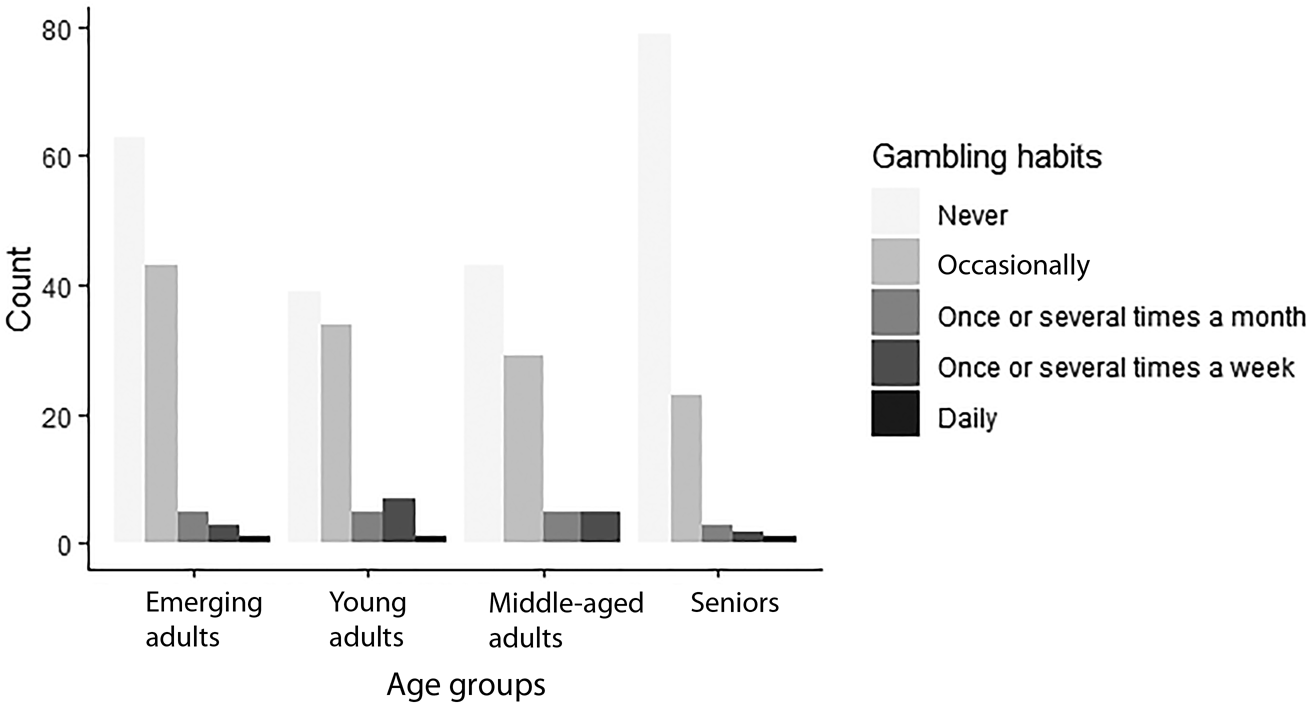
Six hundred and eighty-nine people took part in the study; 399 fully responded to the online protocol (socio-demographic questionnaire, game, and illusion of control and TP questionnaires). We excluded eight participants as they left the game stage before the first round, leaving data from 391 participants; 47 per cent gamble at least occasionally (for gambling habits by age, see Figure 1). Table 1 shows the participants’ socio-demographic information. Participants were divided into eight groups according to age (emerging adults, young adults, middle-aged adults, seniors) and sequence of outcomes (ascending: losses then gains versus descending: gains then losses).
Gambling habits according to age.
Participants’ socio-demographic characteristics
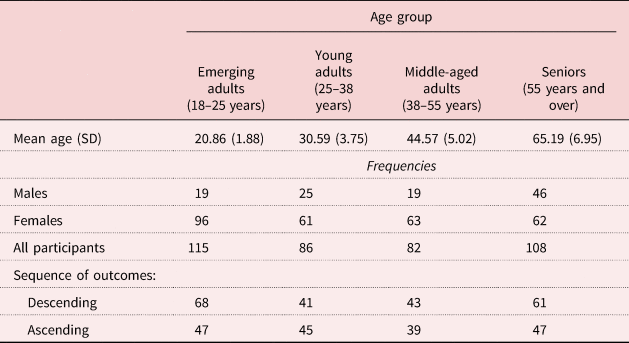
Notes: N = 391. SD: standard deviation.
Materials
Game
Participants were invited to play an online game of chance, in which they had to bet in order to win as many points as possible (see the Appendix). It took the form of a set of cards arranged in four piles, each with a different probability of winning and a different number of points in the event of a win. Inspired by the bets in French roulette, the first pile offered 18/37 chances of recovering the initial stake, the second 12/37 chances of winning double the stake, the third 3/37 chances of winning 11 times the stake and the fourth 1/37 chances of winning 35 times the stake. Participants had to choose the pile on which they wanted to bet and the size of the stake, depending on how many points they had left. They had an initial capital of 100 points (as in Martinez et al., Reference Martinez2004). As this capital fluctuated, it was displayed in the top left-hand corner of the screen during each round. Based on research showing that an illusion of control is present after two rounds (Ladouceur and Mayrand, Reference Ladouceur and Mayrand1984), we set the maximum number of rounds at ten.
Risk-taking
For a precise behavioural measure, we used the risk-taking formula validated by (Martinez et al., Reference Martinez2004) and used by Mouneyrac (Reference Mouneyrac2019) too:

where RT = risk-taking in each round, SW = state of wealth at the time of the bet in each round, Pile = win probability for each round and Stake = number of points wagered in each round.
The calculation of the mean risk took into account the number of rounds played by the participant and the reason for stopping. Thus, a different calculation was made depending on whether the participant had left the game or had no more points left. In the first case, a round was added, reasoning that the participant had stopped taking risks, so the risk-taking in the next round was zero. In the second case, we performed a standard mean calculation. Thus, the mean risk-taking if the participant had left the game was calculated as follows (n = number of rounds):

The risk-taking if the participant had no more points left was calculated as follows (n = number of rounds):

Questionnaire 1
This was an explicit measure of illusion of control via four questions inspired by Martinez et al. (Reference Martinez2004) and Mouneyrac (Reference Mouneyrac2019). Participants were asked to indicate how much they agreed with each statement, by moving a cursor along a line from 0 (strongly disagree) to 100 (strongly agree):
• The game I just played is a game that involves skill.
• I have control over the results of the game I just played.
• It was possible to predict the outcome of the game I just played.
• The game I just played is based on chance (reversed item).
We verified the internal consistency of this measurement scale by calculating McDonald's omega (Béland et al., Reference Béland, Cousineau and Loye2017) for all four items (ω = 0.608). The McDonald's omega is interpreted in the same way as Cronbach's alpha but it is a more efficient alternative in terms of internal consistency (Dunn et al., Reference Dunn, Baguley and Brunsden2014). Here, the omega remained below the consensual consistency threshold of 0.700, but above 0.600, so still acceptable (Murphy and Davidshofer, and Nunally, in Peterson, Reference Peterson1995).
Questionnaire 2
This measured participants’ TPs. We used the validated French-language version of the Zimbardo Time Perspective Inventory developed by Apostolidis and Fieulaine (Reference Apostolidis and Fieulaine2004). This is a 54-item questionnaire measuring five dimensions: negative past (ten items), positive past (seven items), fatalistic present (seven items), hedonistic present (18 items) and future (12 items). Respondents had to indicate their level of agreement with each statement on a five-point scale ranging from ‘does not apply to me at all’ to ‘completely applies to me’. This French version of the questionnaire shows adequate psychometric properties: the test–retest fidelity indices of the five dimensions range from 0.68 to 0.78, the internal consistency indices (Cronbach's alpha) are all greater than or equal to 0.70.
We verified the internal consistency of this measurement scale in this study sample by calculating McDonald's omega (Béland et al., Reference Béland, Cousineau and Loye2017) for each dimension: negative past (ω = 0.883), positive past (ω = 0.796), fatalistic present (ω = 0.781), hedonistic present (ω = 0.836) and future (ω = 0.808).
Procedure
The online study consisted of three steps. After giving their consent, participants first completed the socio-demographic questionnaire with an anonymous code, providing information on age, sex, employment status, education level and gambling habits.
The second step was a computerised card game. As the gambling sequence was manipulated, the platform alternated between an ascending sequence (three losses, one gain, one loss, one loss, three gains, one loss, one loss, one loss) and a descending sequence (three gains, one loss, one gain, three losses, one gain, one loss) as the game progressed. In order to be as close as possible to an ecological situation, participants could quit the game at any time. There were three ways to end the game: the player had no more points left; the player completed all ten rounds; the player pressed the ‘Exit the game’ button.
Once the game was over, a link to the third step appeared. In this final step, we randomised the presentation of the illusion of control questionnaire (the order of items was also randomised) and the TP questionnaire.
Results
All analyses were performed with R (R Core Team, 2016) and the Rpackages psych (Revelle, Reference Revelle2016), because (Fox and Weisberg, Reference Fox and Weisberg2011), multilevel (Bliese, Reference Bliese2016), ggplot2 (Wickham, Reference Wickham2009), ez (Lawrence, Reference Lawrence2016), RcmdrMisc (Fox, Reference Fox2016), dplyr (Wickham and François, Reference Wickham and François2016), lavaan (Rosseel, Reference Rosseel2012) and semPlot (Epskamp, Reference Epskamp2014).
We first analysed the influence of the gambling sequence and age on illusion of control and risk-taking. We then analysed the mediating effect of TP on the relationships between age and illusion of control, and between age and risk-taking.
Influence of gambling sequence and age on illusion of control
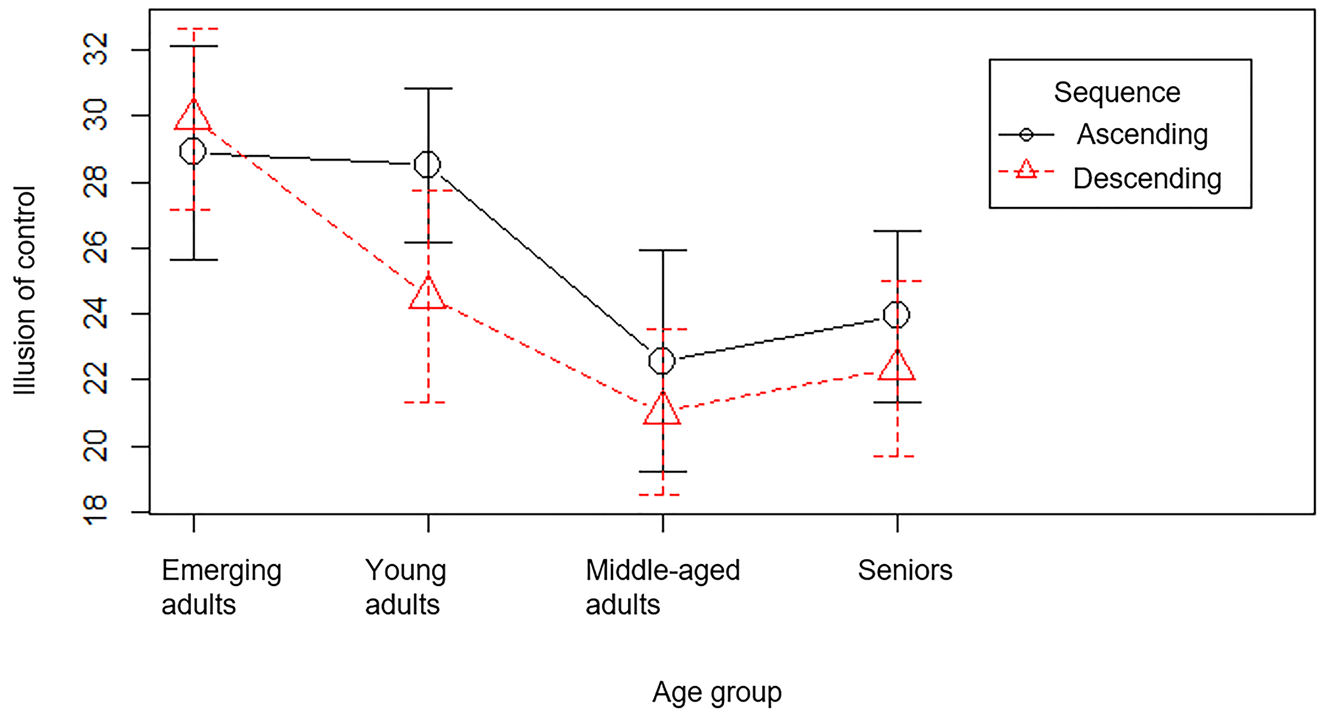
Despite a non-normal distribution of illusion of control, as tests indicated the homoscedasticity of variances and independence of observations (Norman, Reference Norman2010), we ran a 2 (type of game: ascending versus descending sequence) × 4 (age group: emerging adults, young adults, middle-aged adults, seniors) analysis of variance (ANOVA) (Figure 2). There was a significant main effect of age group on illusion of control, F(3, 382) = 3.02, p = 0.030, η2 = 0.0231. Pairwise comparisons with a Tukey correction indicated that emerging adults had a significantly greater illusion of control (mean = 29.51, standard deviation (SD) = 22.34) than either middle-aged adults (mean = 21.76, SD = 18.56), t(389) = −2.72, p tukey = 0.034 or seniors (mean = 22.80, SD = 19.40), t(389) = −2.44, p tukey = 0.071 (trend towards significance). However, there was no effect of gambling sequence on illusion of control, F(1, 382) = 0.63, p = 0.428 (not significant), and no interaction effect, F(3, 382) = 0.26, p = 0.850 (not significant).
Mean illusion of control as a function of sequence and age.
Note: The 95 per cent confidence intervals are shown.
Effects of gambling sequence and age on risk-taking
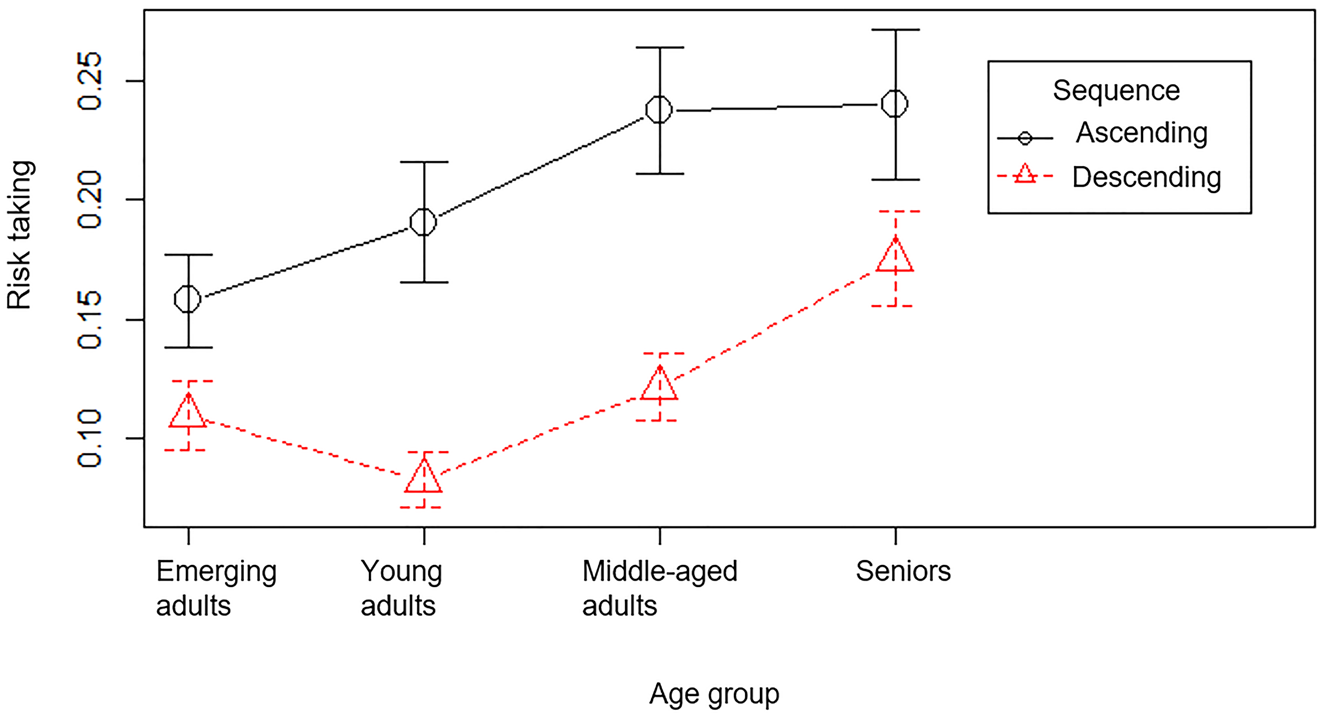
Although illusion of control and risk-taking were not correlated (r = 0.01, p = 0.70, not significant), we were interested in the influence of age and gambling sequence on risk-taking as an observable indicator of gambling behaviour. The distribution was not normal, but for the same reasons as for illusion of control, we ran a 2 (type of game: ascending versus descending sequence) × 4 (age group: emerging adults, young adults, middle-aged adults, seniors) ANOVA (Figure 3). Analysis of the main effects indicated a significant influence of gambling sequence on risk-taking, F(1, 382) = 31.96, p < 0.001, η2 = 0.0772. All participants, regardless of age, took significantly more risks in the ascending condition (i.e. when they experienced losses first, then gains) (mean = 0.20, SD = 0.17) than in the descending one (mean = 0.12, SD = 0.12). There was also a main effect of age group on risk-taking, F(3, 382) = 5.72, p < 0.001, η2 = 0.0430. Regardless of gambling sequence, seniors took significantly more risks (mean = 0.20, SD = 0.18) than either emerging adults (mean = 0.13, SD = 0.13), t(389) = 3.66, p tukey = 0.002 or young adults (mean = 0.14, SD = 0.14), t(389) = 3.36, p tukey = 0.005. The interaction effect was not significant, F(3, 382) = 1.15, p = 0.33.
Mean risk-taking as a function of sequence and age group.
Note: The 95 per cent confidence intervals are shown.
To test for the supposed mediating effect of TP on illusion of control and risk-taking in gambling with ageing, we calculated a causal path model of this hypothesis. To assess this mediating effect, we used the resampling procedure (bootstrap), which has the advantage of not requiring either a normal distribution or a large sample (Efron, Reference Efron2000). According to MacKinnon et al. (Reference MacKinnon, Lockwood and Williams2004), this procedure seemed to produce the most accurate results, given the constraints associated with our sample: estimates of model parameters, significant at p < 0.05, with significant confidence intervals (CIs) if they did not cross 0.
Analysis of mediating effect of TP on relationship between age and illusion of control
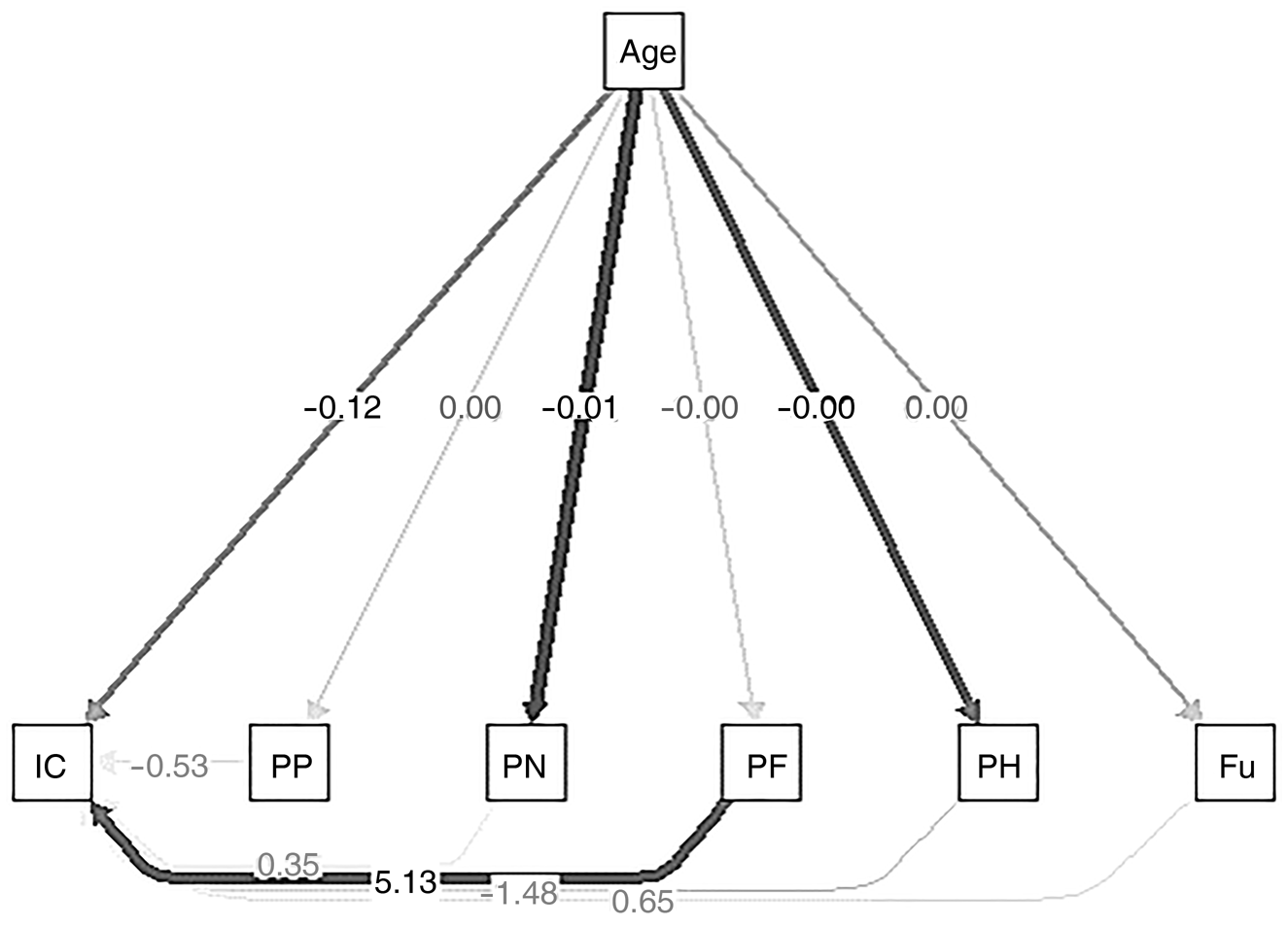
We used the maximum likelihood estimation method to perform the model evaluation. This method is based on different fit indices: a non-significant chi-square, a Root Mean Square Error of Approximation (RMSEA) below 0.06, a Comparative Fit Index (CFI) and a Tucker–Lewis Index (TLI) above 0.95, and a Standardised Root Mean Square Residual (SRMR) below 0.08 (Hooper et al., Reference Hooper, Coughlan and Mullen2008). Our results, obtained with a bootstrap procedure (N = 10,000) to compensate for data non-normality, indicated good adequacy of the model, χ2 = 2.85, p = 0.241, CFI = 0.99, TLI = 0.96, RMSEA = 0.03, SRMR = 0.02 (Figure 4). Examination of the model parameters revealed that the total effect (i.e. sum of direct and indirect effects) was significant (β = −0.14, p = 0.016, 95% CI = −0.25, −0.03). However, none of the indirect effects was significant, so we cannot conclude that TPs had a mediating effect on illusion of control. Nevertheless, there was a direct positive effect of fatalistic present on illusion of control (β = 5.13, p = 0.002, 95% CI = 1.84, 8.41) (Figure 4). A predominantly fatalistic-present TP therefore increased illusion of control. Results also showed a direct negative effect of age on illusion of control (β = −0.12, p = 0.039, 95% CI = −0.23, −0.003), confirming the results of the previous ANOVA showing that illusion of control decreased with age. There was also a negative effect of age on negative past (β = −0.01, p < 0.001, 95% CI = −0.014, −0.006) and hedonistic present (β = −0.005, p = 0.001, 95% CI = −0.008, −0.002): ageing brings with it a less negative perception of the past and, more surprisingly, a reduced desire to enjoy the present time.
Illusion of control (IC) path model.
Notes: PP: positive past. PN: negative past. FP: fatalistic present. PH: hedonistic present. Fu: future.
Analysis of TP mediation of the relationship between age and risk-taking
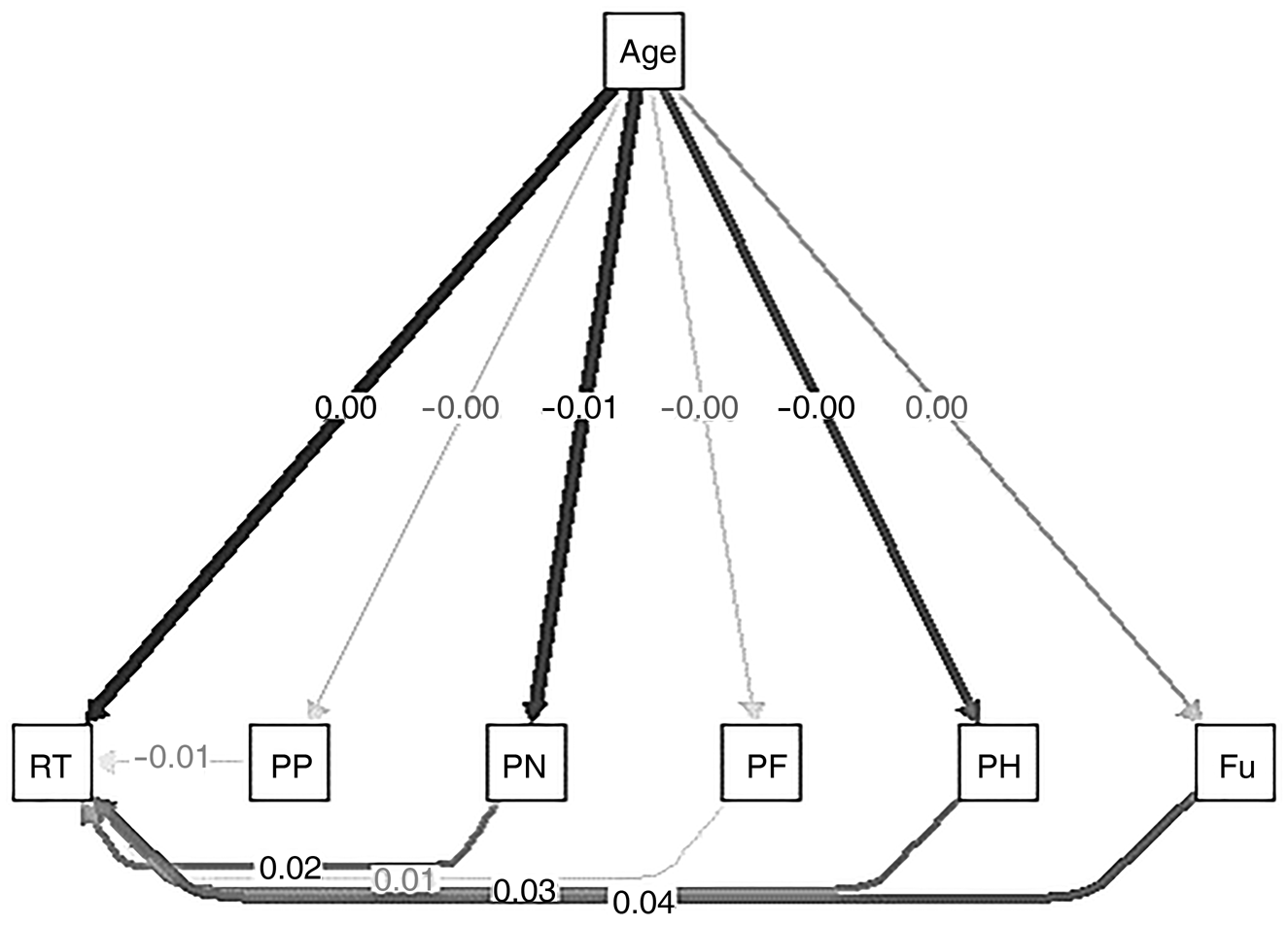
The results of the model evaluation (bootstrap, N = 10,000) indicated a satisfactory fit of the model to the data: χ2 = 2.85, p = 0.241, CFI = 0.99, TLI = 0.97, RMSEA = 0.03, SRMR = 0.02 (Figure 5). Examination of the model's parameters showed a significant total effect (β = 0.002, p < 0.001, 95% CI = 0.001, 0.003) but, as with the illusion of control model, there was no significant indirect effect. We therefore could not conclude that TPs had a mediating effect on risk-taking. By contrast and in line with the results of the previous ANOVA, age positively influenced risk-taking (β = 0.002, p < 0.001, 95% CI = 0.001, 0.003), such that the older the participants, the more risks they took (Figure 5). Risk-taking was also positively influenced by the future TP (β = 0.04, p = 0.021, 95% CI = 0.005, 0.07), suggesting that the dominance of future time leads individuals to take more risks. This result contradicts the literature on future TP, according to which a long-term rather than a short-term projection into the future implies reasoned regulation of present behaviour. Finally, this model confirmed the negative influence of age on negative past (β = −0.01, p < 0.001, 95% CI = −0.014, −0.006) and hedonistic present (β = −0.005, p = 0.001, 95% CI = −0.008, −0.002).
Risk-taking (RT) path model.
Notes: PP: positive past. PN: negative past. FP: fatalistic present. PH: hedonistic present. Fu: future.
Discussion
Population ageing in post-industrialised countries constitutes a major challenge to ensure that their health and social systems are ready to make the most of this demographic shift. Seniors’ gambling behaviour is rarely investigated, even though, in France, they are the heaviest consumers of gambling. To help reduce this gap, we tested, in older adults, the concepts behind compulsive gambling that are well known in the gambling literature. First, we hypothesised that the sequence of outcomes has an age-related influence on both illusion of control and risk-taking. We then predicted that TP would have a mediating effect on both these relationships. Our hypotheses were partially confirmed: we found no significant effect of the sequence of outcomes on illusion of control, but a significant effect on risk-taking. Participants took significantly more risks in a loss (versus gain) situation. Thus, suffering losses before achieving gains leads gamblers to take more risks than if the gains precede the losses (e.g. lottery gamblers presumably experience many losses before enjoying what are generally small gains). Our results could serve as the basis for formulating primary and secondary preventive recommendations focusing on the cumulative amount of losses compared to the amount of gains. More specifically, seniors took more risks than younger people. At first glance, this risk-taking may seem contradictory, given the more pronounced loss aversion among seniors (Mather et al., Reference Mather, Mazar, Gorlick, Lighthall, Burgeno, Schoeke and Ariely2012). The certainty effect (Kahneman and Tversky, Reference Kahneman and Tversky1979) helps to make sense of this result. As gambling is a risky and uncertain situation where one is likely to lose, and since older people have a greater aversion to loss than young people, it is logical that they should take more risks than younger people do. One constant emerged from our analyses: even though illusion of control decreased with age, risk-taking increased. These results therefore call into question the positive correlation established by Martinez et al. (Reference Martinez, Le Floch and Gaffié2005) between increased illusion of control and increased risk-taking, at least for seniors. We must therefore review the influence of this cognitive distortion in gambling.
While we cannot conclude that TP has a mediating effect on either illusion of control or risk-taking, the direct effects of some TP dimensions justify further research in this area. The link between a high score on the fatalistic-present dimension and high illusion of control is surprising, as the fatalistic present refers to a view whereby events are dictated by uncontrollable forces and a tendency to resignation. It is a confusing influence if we remain at a semantic level where believing in uncontrollable forces increases illusion of control. The positive influence of this TP on illusion of control therefore raises several questions, such as whether fatalism fosters such a belief in luck (by definition uncontrollable) that individuals paradoxically think they are so lucky that it increases their illusion of control. Individuals who perceive the present to be determined by uncontrollable forces would believe that these forces serve their interests. Such individuals rely on luck, and this pushes them to manifest an illusion of secondary control (Ejova et al., Reference Ejova, Delfabbro and Navarro2015). We cannot answer this question without rethinking the measurement, and perhaps even the very definition, of illusion of control, as this concept remains highly controversial, even though many studies have examined it in recent decades (Masuda et al., Reference Masuda, Sakagami and Hirota2002).
Our results highlight the problem of measuring illusion of control, as this concept has several, sometimes conflicting, aspects, such as belief in specific abilities and the negation of chance. Then again, the dimensions of illusion of control may not be contradictory, as individuals may believe in chance but also believe that this chance is favourable to them because they are lucky people. Work on defining and constructing items for a reliable and accurate multi-dimensional scale to measure illusion of control is needed if we are to have a better understanding of this cognitive distortion. How we measure illusion of control, beyond its use in gambling research, is a crucial issue. A better measurement of illusion of control would enhance its study in all areas where it is involved (e.g. gambling, driving, sports). Including TPs as behavioural indicators and cognitive and emotional style acting on attitudes (Epel et al., Reference Epel, Bandura and Zimbardo1999) in this research is a new and, given the current results, promising way of considering illusion of control in gambling.
At first glance, the surprising finding that future TP has a positive influence on risk-taking would appear to contradict the literature (environment and health) on the role of TP in risky behaviours. However, this future TP may be biased by the illusion of gain. If individuals are able to project themselves into the long term by imagining that they have won a wager, they may be liable to take more risks (in order to realise this imaginary future) than individuals with a reduced future TP who therefore consider more immediate losses. The question of the valence (positive versus negative) of the future TP, in relation to its depth, therefore merits investigation.
Our results on the effect of age on TPs, and more specifically the negative influence of age on the negative past, suggest that the older people become, the less negatively they perceive the past. Although this finding addresses a different dimension of TP, it is consistent with the work of Menahem (cited by Nuttin, Reference Nuttin1979) suggesting that positive emotional attitudes towards the past increase with age. By contrast, the negative influence of age on the hedonistic present, suggesting that the older people become, the less they want to enjoy a present perceived of as ephemeral, questions our naïve representations of ageing and nuances the findings of Cameron (cited by Nuttin, Reference Nuttin1979). These authors noted that the predominance of the present is affirmed with age to the detriment of a future TP. We do not in any way claim to invalidate the conclusions in the literature, nor would the absence of an influence of age in our results on the fatalistic-present or future TP allow us to do so. However, the existence of contextual feedback on TP may explain these contradictory results. The very specific gambling situation in which the participants were placed may have influenced their responses to the TP questionnaire. To avoid discouraging the participants from the start and biasing their risk-taking, we chose to administer this questionnaire after they had played the game. Nevertheless, even if it meant greater experimental mortality, it would be interesting to randomise the timing of the TP questionnaire and the game. In addition, the context effect could be manipulated in future research on TP. The question of TP sensitivity to context could also be explored in terms of the type of gambling elicited and participants’ degree of autonomy. The online version of the game may not have been suited to a population of seniors, and using the internet inevitably meant that we did not reach every segment of our population of interest. It would therefore be useful to replicate the experiment with a different, more traditional form of gambling. One limitation of this study is the representativeness of our sample. The results should be taken as a starting point for addressing the issues of illusion of control and risk-taking and time perspectives in senior gambling. Future research may examine cultural and other variability on these matters.
Looking at TP in the form of profiles seems to us to be an interesting avenue of research in order to evaluate their combined influences on gambling behaviours. Profiles of TP would make it possible to summarise the different types of relationship that an individual has with the temporalities likely to influence his or her behaviours. They would also shed light on the latent emotional aspects interacting with age. The work on TP (Nuttin, Reference Nuttin1979; Rönnlund et al., Reference Rönnlund, Åström and Carelli2017) indicates that TP changes with age, so a profile specific to seniors can be hypothesised, which is useful for developing targeted gambling prevention measures. Indeed, present results would invite a focus on a reminder of losses as negative past events, specifically for seniors, who tend to perceive the past less negatively than younger people. Future research is needed to test these hypotheses.
Financial support
The study has not been funded by external funds or grants.
Conflict of interest
The authors declare no conflicts of interest.
Appendix


 Open access

