


Introduction
Humans, livestock, predators and prey share common resources (Aryal et al., Reference Aryal, Brunton, Ji, Barraclough and Raubenheimer2014). This overlap leads to interactions between humans and animals that have negative outcomes, such as economic loss (Pettigrew et al., Reference Pettigrew, Xie, Kang, Rao, Goodrich and Liu2012), retaliatory killings as a response to livestock predation (Oli et al., Reference Oli, Taylor and Rogers1994), human mortality (Treves & Karanth, Reference Treves and Karanth2003) and disease (Thirgood et al., Reference Thirgood, Woodroffe, Rabinowitz, Woodroffe, Thirgood and Rabinowitz2005). Such outcomes threaten large mammals and are anticipated to increase in severity (Kansky & Knight, Reference Kansky and Knight2014). Felids are often affected despite their low densities because they occupy large home ranges and attack domestic animals and humans (Treves & Karanth, Reference Treves and Karanth2003). Because many felids are threatened, killings can be detrimental to their populations (Woodroffe & Ginsberg, Reference Woodroffe and Ginsberg1998). Such loss can have macroecological impacts as large felids influence trophic cascades downwards, and increase biodiversity (Miller et al., Reference Miller, Dugelby, Foreman, Martinez del Rio, Noss and Phillips2001).
Carnivores place financial burden on herders via livestock depredation, leading to negative attitudes, retaliatory killing, and disagreements between community members and agencies seeking to protect wildlife (Treves & Karanth, Reference Treves and Karanth2003). Livestock loss is, however, preventable by non-lethal means (Ogada et al., Reference Ogada, Woodroffe, Oguge and Frank2003). Predator proof corrals have been successful in India (Jackson & Wangchuk, Reference Jackson and Wangchuk2004), Africa (Lichtenfeld et al., Reference Lichtenfeld, Trout and Kisimir2015) and North America (Cluff & Murray, Reference Cluff, Murray, Carbyn, Fritts and Seip1995). Increased human activity has been effective in Kenya (Ogada et al., Reference Ogada, Woodroffe, Oguge and Frank2003), and shifting campsites decreased loss in Mongolia (Mijiddorj et al., Reference Mijiddorj, Alexander, Samelius, Badola, Rawat and Dutta2018). Guard dogs Canis familiaris have been used to alert herders and ward off predators (Ogada et al., Reference Ogada, Woodroffe, Oguge and Frank2003). In addition, post-predation interventions, such as livestock insurance, can reduce financial loss and negative perceptions, although these are often insufficient (Jackson & Wangchuk, Reference Jackson and Wangchuk2004; Hemson et al., Reference Hemson, Maclenna, Mills, Johnson and Macdonald2009).
The success of mitigation strategies largely depends on community participation (Jackson & Wangchuk, Reference Jackson and Wangchuk2004). Effective implementation requires research on the attitudes of local stakeholders (Dickman, Reference Dickman2010; Kansky & Knight, Reference Kansky and Knight2014). Although values direct attitudes, attitudes precede and direct behaviour (Vaske & Manfredo, Reference Vaske, Manfredo, Decker, Riley and Siemer2012) and thus knowledge of the attitudes of herders is necessary for inferring actions towards carnivores. Attitudes are influenced by many factors, including knowledge, social norms, economic constraints and religious affiliation (Dickman, Reference Dickman2010). Few studies have examined the attitudes of pastoralists in Central Asia despite overlap of people with carnivores, including the threatened snow leopard Panthera uncia (Green & Zhimbiev, Reference Green, Zhimbiev, Jackson and Ahmad1997; Suryawanshi et al., Reference Suryawanshi, Bhatia, Bhatnagar, Redpath and Mishra2014).
The snow leopard is categorized as Vulnerable on the IUCN Red List (McCarthy et al., Reference McCarthy, Mallon, Jackson, Zahler and McCarthy2017). The species influences surrounding ecosystems through predation on wild ungulates and competition with sympatric carnivores (Li et al., Reference Li, Wang, Yin, Zhaxi, Jiagong and Schaller2014). Reduced wild prey populations combined with higher abundance of domestic animals leads to livestock predation by snow leopards (Schaller et al., Reference Schaller, Junrang and Mingjiang1988). Depredation events are costly to herders, and foster negative attitudes towards snow leopards and motivate calls for their elimination. Although there have been previous studies of attitudes towards snow leopards in China (Xu et al., Reference Xu, Jiang, Li, Guo, Da and Cui2008; Li et al., Reference Li, Wang, Yin, Zhaxi, Jiagong and Schaller2014, Reference Li, Jiang, Li, Tang, Li and Luo2015; Alexander et al., Reference Alexander, Chen, Damerell, Youkui, Hughes and Shi2015), findings cannot be generalized across regions (Alexander et al., Reference Alexander, Chen, Damerell, Youkui, Hughes and Shi2015). Additionally, repeated assessments are needed to examine temporal changes, particularly on the Tibetan Plateau where rapid societal and environmental changes are occurring (Bauer, Reference Bauer2015).
We sought to identify variables influencing the attitudes of herders towards snow leopards and their conservation. Associations between herding practices, animal loss and demographics were explored to understand the most important factors influencing attitudes. We hypothesized that negative attitudes would be associated with greater livestock loss and fewer years of formal education, whereas positive attitudes would be associated with fewer losses, more years of formal education, livestock insurance and Tibetan beliefs. We further predicted that herders would consider depredation the most threatening risk to livestock and that herders using predator proof corrals would report fewer losses.
Study area
Interviews were conducted in Suojia Village, Zhiduo County, Yushu Prefecture, Qinghai Province, China (Fig. 1). Of the 38,793 km2 of Zhiduo County (excluding Hoh Xil National Nature Reserve) 22,395 km2 overlaps with Sanjiangyuan National Park (Dai et al., Reference Dai, Hacker, Zhang, Li, Li and Zhang2019). The 152,000 km2 Sanjiangyuan National Park is the largest stretch of continuous snow leopard habitat in China (Li et al., Reference Li, Yin, Wang, Jiagong and Lu2013; Liu et al., Reference Liu, Weckworth, Li, Xiao, Zhao, Lu, Nyhus, McCarthy and Mallon2016). The area has alpine meadow vegetation with limestone massifs and mountain ranges of < 5,500 m altitude (Schaller et al., Reference Schaller, Junrang and Mingjiang1988). The climate is windy and dry with temperatures from −20 °C in January to 8 °C in July (Mallon, Reference Mallon2004). Interview sites were at a mean altitude of 4,429 m (range 4,109–4,670 m).
Interview locations in Suojia Village, Yushu Prefecture, Qinghai Province, China.

Methods
Questionnaire development
Preliminary interviews were conducted with five herders, to identify any problems with clarity (Hemson et al., Reference Hemson, Maclenna, Mills, Johnson and Macdonald2009). The revised questionnaire contained statements regarding attitudes towards snow leopards, importance of snow leopards to religion, and perceived wildlife abundance, ranked on a Likert type scale (Likert, Reference Likert1932), followed by questions regarding animal ownership and management, livestock loss to snow leopards, knowledge of retaliatory killing, threats to livestock, and demographics (Supplementary Material 1). A 5-year recollection period was used to avoid recall bias (Bernard, Reference Bernard2013). Questions regarding retaliatory killing were worded to reduce social desirability bias (Fisher, Reference Fisher1993). The questionnaire was limited to one page to avoid interviewee fatigue and disinterest (de Vaus, Reference de Vaus2002).
Data collection
Herders were interviewed in July 2018. Interviews were verbal, to avoid any potential misunderstandings stemming from illiteracy, and lasted c. 15 minutes. Local guides served as translators. The content, objectives and anonymity were explained to the potential interview subjects, and interviewees were told they could halt the interview at any time. The snowball sampling strategy was used to maximize sample size and engender participant trust (Goodman, Reference Goodman1961; Sadler et al., Reference Sadler, Lee, Kim and Fullerton2010).
Data analysis
Likert scale scores for negatively worded attitude statements were reversed to match the Likert scale scoring of positively worded attitude statements. For example, a 1 became a 7, a 2 became a 6, and so on. Reported scores from each herder were summed and divided by the total number of interviews to calculate the percentage of herders who had positive, neutral, or negative attitudes towards a specific statement. The Likert type scale values of 1, 2 and 3 were collapsed into a Disagree category, 4 assigned to a Neutral category, and 5, 6 and 7 were collapsed into an Agree category. Cronbach's alpha was used to ensure internal consistency within all five attitude statements (Cronbach, Reference Cronbach1951). A principal component analysis (PCA) with varimax rotation and pairwise exclusion of cases was used to identify variables contributing most to variation in attitudes (Kaiser, Reference Kaiser1958; Jolliffe, Reference Jolliffe2002). Components with eigenvalues > 1 were selected for interpretation (Kaiser, Reference Kaiser1960) and internal consistency of statements in separate components assessed. Likert type scores for statements in each component were averaged to give an overall agreement score. A Wilcoxon signed-rank test was completed to assess statistical differences between PCA components (Wilcoxon, Reference Wilcoxon1945). Relationships among variables were examined using Spearman's rho (Spearman, Reference Spearman1904). Those exhibiting multi-collinearity with high significance (P < 0.01) had one variable removed based on author expertise and number of other highly significant correlations (Dormann et al., Reference Dormann, Elith, Bacher, Buchmann, Carl and Carré2013). Generalized estimating equations were used to determine influential predictors of positive and negative attitudes. These equations are appropriate for datasets with non-normal distributions, without having to make data corrections (Kowalski & Tu, Reference Kowalski and Tu2008; Tang et al., Reference Tang, He and Tu2012). A series of general models were constructed based on eight predictor variables (Table 1). The first model was built using all variables. The least impactful variable was then removed in a stepwise fashion for each sequential model. The quasi-likelihood under the independence model criterion was used to rank models, with the lowest quasi-likelihood value deemed most appropriate (Cui, Reference Cui2007; Hardin & Hilbe, Reference Hardin and Hilbe2003). SPSS 25.0 (SPSS, Chicago, USA) was used for all analyses, with significance set at P < 0.05.
The eight predictors used in model construction to assess variables contributing to positive and negative attitudes towards the snow leopard Panthera uncia.

Results
Interview responses
We completed interviews with 73 herders (67 men, six women), over an area of c. 476 km2, of whom 94.5% reported pastoralism and 5.5% reported civil service employment as being their primary income source. The greatest Euclidian distance between sites where interviews were conducted was 231 km. No retaliatory killings of snow leopards were reported. The results of the other interview questions are presented in Table 2.
Results of interviews with 73 herders (67 men, six women), with demographics, perceptions of wild animal abundance, animal holdings, management practices, livestock loss and perceptions of threats to livestock.
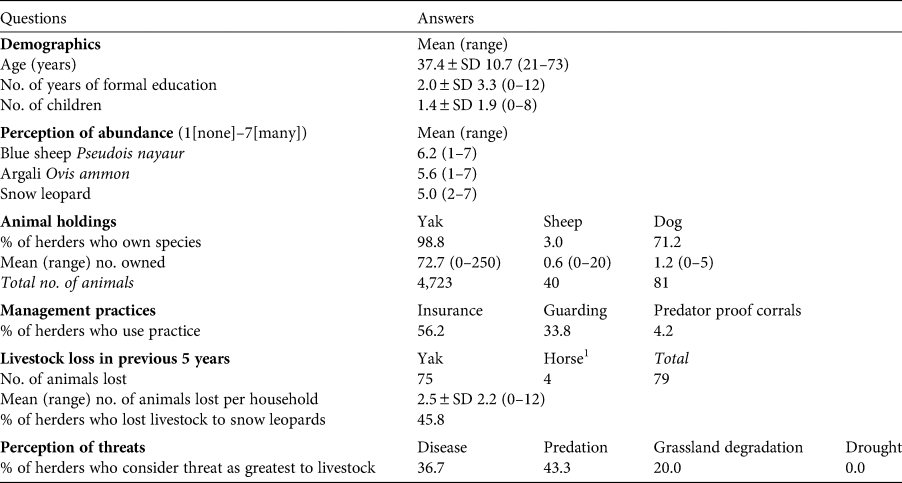
1 All horses previously owned by interviewees had been predated, therefore horses are not listed under animal holdings.
Principal component analysis and correlation coefficients
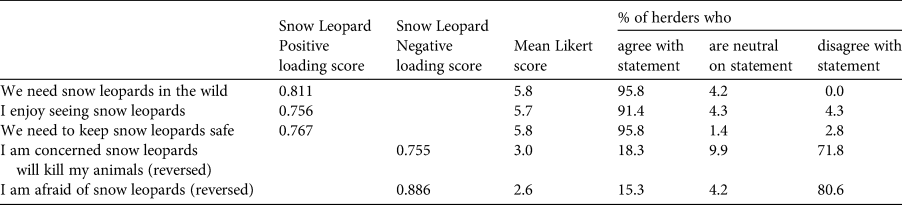
Reliability statistics showed internal consistency (â = 0.72). There were two components with eigenvalues > 1, accounting together for 67.3% of variance observed (Table 3). The highest scores for component 1 were associated with positive attitudes towards snow leopards, which we refer to as Snow Leopard Positive (â = 0.70). The highest scores for component 2 were associated with negative attitudes, which we refer to as Snow Leopard Negative (â = 0.53). Agreement was significantly higher for positive than for negative statements (P < 0.001). The mean scores for each attitude statement and per cent of agreement, neutrality and disagreement were evaluated and correlation coefficients for predictor variable relationships resulted in the removal of four variables (Table 4).
Principal Component Analysis factor loadings for Snow Leopard Positive and Snow Leopard Negative factors, mean Likert score for each question on a seven point scale (1, strongly disagree with statement, to 7, strongly agree with statement), and per cent agreement of herders to each statement.
The Spearman rank-order correlation coefficients (with two-tailed significance in parentheses) of relationships between predictor variables.
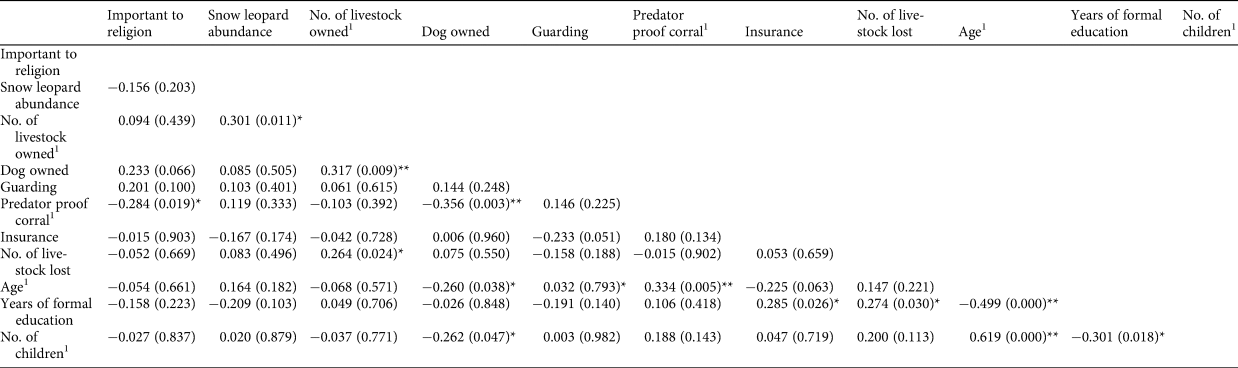
*P < 0.05 (2-tailed); **P < 0.01 (2-tailed).
1 Variable removed from consideration in general model construction.
Attitude correlates
The model with the lowest quasi-likelihood score for Snow Leopard Positive included number of animals lost (−0.125, 95% CI −0.221–−0.028, P = 0.012) and years of education (0.077, 95% CI 0.18–0.135, P = 0.011). The model with the lowest quasi-likelihood score for Snow Leopard Negative included number of animals lost (−0.154, 95% CI −0.244–−0.063, P = 0.001), years of education (−0.099, 95% CI −0.174–−0.024, P = 0.010) and importance of snow leopards to religion (−1.119, 95% CI −2.175–−0.63, P = 0.038; Supplementary Table 1).
Discussion
Similar to previous studies in China, herders had positive attitudes towards snow leopards (Li et al., Reference Li, Wang, Yin, Zhaxi, Jiagong and Schaller2014, Reference Li, Jiang, Li, Tang, Li and Luo2015; Alexander et al., Reference Alexander, Chen, Damerell, Youkui, Hughes and Shi2015). The factors most strongly associated with positive attitudes were more years of formal education and fewer livestock lost. Education has previously been linked to positive attitudes towards snow leopards (Suryawanshi et al., Reference Suryawanshi, Bhatia, Bhatnagar, Redpath and Mishra2014). In our study, age and education were negatively correlated, suggesting that younger herders are receiving more schooling. Reduced nomadism among Tibetans has decreased the income generated from traditional sources such a pastoralism, lessening the assistance families need from children and allowing time for schooling (Bauer, Reference Bauer2015). Students now have more opportunities for conservation education in school and through organizations that inspire environmental protection (Shen & Tan, Reference Shen and Tan2012). In addition, students learn to read, promoting lifetime awareness of posted wildlife laws and knowledge of the benefits of carnivores (Suryawanshi et al., Reference Suryawanshi, Bhatia, Bhatnagar, Redpath and Mishra2014).
Previous research, in Spiti Valley, India, found that livestock depredation by snow leopards did not substantially influence attitudes (Suryawanshi et al., Reference Suryawanshi, Bhatia, Bhatnagar, Redpath and Mishra2014). In contrast, we found that the number of animals lost contributed to both greater positive and negative attitudes towards snow leopards. Intuitively for positive attitudes, those who lost less livestock would be more likely to agree with positive statements. For negative attitudes, it is possible they may have been instilled prior to loss, or that the herder experienced greater predation more than 5 years previously, and therefore agreed with negative statements. Another possibility is that herders with more negative attitudes exercise greater caution and use protective measures not outlined in our survey (e.g. fenced pastures, housing newborn livestock), thus reducing loss. Livestock loss was positively correlated with number of livestock owned, indicating that all herders experienced comparable rates of predation. However, the cultivation of negative attitudes and likelihood of retaliation against snow leopards for livestock predation may be dependent on the predated animal's size, age and condition.
Tibetan religious beliefs, which mandate respect for wildlife, may contribute to lower likelihood of holding negative attitudes towards snow leopards. Tibetan Buddhism influences c. 80% of the geographical regions that overlap with snow leopard habitat (Li et al., Reference Li, Wang, Yin, Zhaxi, Jiagong and Schaller2014). Snow leopards were considered religiously important by 93% of the herders we interviewed. Such beliefs probably contribute to the absence of retaliatory killing, although previous interviews in the same area during 2009–2011 reported their occurrence (Li et al., Reference Li, Yin, Wang, Jiagong and Lu2013, Reference Li, Wang, Yin, Zhaxi, Jiagong and Schaller2014). Although it appears heartening that no killings were reported to us, it is nevertheless possible that a greater number of interviews would have uncovered such reports, or that herders adopted a ‘universal silence’ in our presence (Oli et al., Reference Oli, Taylor and Rogers1994).
Other sympatric carnivores, such as the wolf Canis lupus, probably face a greater risk of retaliatory killing despite Buddhist teachings (Mishra, Reference Mishra1997). Although we did not enquire about attitudes towards wolves, six herders expressed concern about predation of livestock by wolves. Wolves are viewed negatively because herders presume they play a larger role in livestock predation than snow leopards (Suryawanshi et al., Reference Suryawanshi, Bhatnagar, Redpath and Mishra2013). Herders are considered knowledgeable in discerning the species responsible for kills, via resulting wounds (Aryal et al., Reference Aryal, Brunton, Ji, Barraclough and Raubenheimer2014). However, some kills reported in this study as being by snow leopards could nevertheless have been misidentified and caused by wolves or domestic dogs.
Over 70% of herders interviewed owned at least one dog. Predator proof corrals were positively correlated with herder age, whereas dog ownership was negatively correlated, demonstrating that dogs are more popular with younger herders. Neither predator proof corrals, guarding, nor dog ownership were correlated with number of livestock lost, suggesting these practices alone may not be sufficient to prevent loss, are not deployed effectively or are implemented post-predation. However, the model including the predictor variable livestock guarding was numerically closely competitive in the final model shaping positive attitudes, and therefore may be playing the largest role among the deterrent methods assessed in this study.
Dogs can spread disease (Mamaev et al., Reference Mamaev, Denikina, Belikov, Volchkov, Visser and Fleming1995), stress, harass and kill wildlife (Lenth et al., Reference Lenth, Knight and Brennan2008; Young et al., Reference Young, Olson, Reading, Amgalanbaatar and Berger2011), and compete with native species for resources (Vanak et al., Reference Vanak, Thaker and Gompper2009). The number of dogs reported in our study is probably a small portion of the total population because ownership is informal, with limited spaying/neutering, leading to free ranging and feral individuals (Home et al., Reference Home, Pal, Sharma, Suryawanshi, Bhatnagar and Vanak2017). In trans-Himalayan India, dogs were responsible for 40% more livestock mortalities than snow leopards (Suryawanshi et al., Reference Suryawanshi, Bhatnagar, Redpath and Mishra2013). Research examining how dogs may be affecting wildlife and livestock is needed.
Nearly half of the herders who reported livestock losses possessed insurance. In China, compensation is targeted towards losses caused by protected animals (Pettigrew et al., Reference Pettigrew, Xie, Kang, Rao, Goodrich and Liu2012). Herders did not comment on insurance, but it is widely accepted that the programmes are insufficient (Madhusudan, Reference Madhusudan2003). Conservation performance payments that compensate herders for achieving goals that benefit carnivores may be an alternative in areas with inadequate financial coverage of livestock losses (Zabel & Holm-Müller, Reference Zabel and Holm-Müller2008; Kunkel et al., Reference Kunkel, Hussain, Khatiwada, Nyhus, McCarthy and Mallon2016).
Herders indicated comparatively high numbers of snow leopards, blue sheep Pseudois nayaur, and argali Ovis ammon on the Likert scale provided to them. Although reports of wildlife abundance may have limited consistency across herders, they provide useful information (Davis & Wagner, Reference Davis and Wagner2003). We had planned to conduct counts of prey, to substantiate the responses of the interviewed herders, but most of the wild ungulate populations had at the time moved to higher elevations as a result of higher temperatures and increased human activity (X. Ran, pers. comm., 2018), making this infeasible. For snow leopard abundance, scat surveys as part of a separate, contemporaneous study examining snow leopard population genetics indicated the presence of six females in the area (Zhang et al., Reference Zhang, Hacker, Zhang, Xue, Janecka and Li2019). Pastoralists depend on their environment and can serve as strong conservation allies (Foggin & Torrance-Foggin, Reference Foggin and Torrance-Foggin2011), and local perceptions and scientific studies can be in agreement regarding the status of wildlife populations (van der Hoeven et al., Reference van der Hoeven, de Boer and Prins2004; Danielsen et al., Reference Danielsen, Topp-Jørgensen, Levermann, Løvstrøm, Schiøtz and Enghoff2014), although more research on this is needed in our study area.
Predation was considered the primary threat to livestock by 43% of herders, followed by disease at 37%. Predation has been reported to be of the greatest concern in other studies, even when disease caused more mortality (Dar et al., Reference Dar, Minhas, Zaman and Linkie2009). Grassland degradation was the third ranked threat, at 20%, with herders implicating the pika Ochotona curzoniae as a pest that kills grass roots and competes with livestock for vegetation (Zhou et al., Reference Zhou, Zhao, Tang, Gu and Zhou2004). Drought and other weather conditions were not reported as being threats, probably because major climatic events are relatively infrequent in this area.
Our study contributes to previous studies of herder attitudes towards snow leopards in China, and provides data 7 years after a previous survey in the same area (Li et al., Reference Li, Yin, Wang, Jiagong and Lu2013). Similar to findings by Li et al. (Reference Li, Yin, Wang, Jiagong and Lu2013), herders had positive views towards snow leopards, with formal education playing a significant role in greater positive attitudes and fewer negative attitudes. It is unlikely that older adults harbouring negative views will change their views through conservation education alone and compensation for actions that protect apex predators may be required (Conforti & de Azevedo, Reference Conforti and de Azevedo2003). How livestock loss shapes attitudes towards snow leopards is unclear; more research is needed to determine livestock factors impacting tolerance, including species (i.e. sheep, goat or yak), and age and quality of animal lost. Predator proof corrals, guarding and dogs do not appear to reduce losses significantly, but this finding could be influenced by inconsistent implementation and temporal shifts in management practices. Herders may be effective sources of information on relative wildlife abundances, but this should be corroborated with population surveys. Our results support the notion that Tibetan beliefs play an important role in protecting snow leopards (Li et al., Reference Li, Yin, Wang, Jiagong and Lu2013), exemplifying the role of societal and cultural norms in perceptions of wildlife (Dickman, Reference Dickman2010).
Acknowledgements
We thank translators X. Ran, T. Ding, Z. Xi, G. Bao and C. Ren; A. Phelps for assistance with statistics; and two reviewers for their valuable comments. This work was supported by the Cleveland Metroparks Zoo Asia Seeds Grant Program, the Panthera Sabin Snow Leopard Grant Program, The Snow Leopard Conservancy, The Britton Foundation, the Public Welfare Project of the National Scientific Research Institution of China (No. CAFYBB2018ZD001) and the National Key Programme from Ministry of Science and Technology of China (No. 2017YFC0506405).
Author contributions
Survey design: CH, LM; survey translation: YuguangZ; interviews: YD, YC, YuZ, YuguangZ; survey response translation: YuZ; data analysis: CH, LM; data interpretation: CH, JJ, LM; writing: CH.
Conflicts of interest
None.
Ethical standards
An Institutional Review Board exemption was granted by Duquesne University as no identifiable information was gathered. The research otherwise abided by the Oryx guidelines on ethical standards.


 Open access

