



Early childhood is a critical period in human development, leading to calls for ‘making early childhood count’( Reference Hertzman and Williams 1 ). Neurodevelopmental trajectories may be established in early life and persist throughout the life course. Moderate or even mild Fe-deficiency anaemia (IDA) is known to be associated with delays in early childhood cognitive development that may be irreversible, while severe anaemia has been reported in young children with stroke, congestive heart failure and even death( Reference McCann and Ames 2 – Reference Baker and Greer 4 ).
Fe deficiency peaks in prevalence during the toddler years (1–3 years) largely due to nutritional factors( Reference Baker and Greer 4 ). Although there are no nationally representative data for Canadian children, regional studies suggest a prevalence among infants of 12 % or higher for Fe deficiency and a prevalence of 1·5 % or higher for IDA( Reference Chan-Yip and Gray-Donald 5 – Reference Hodgins, Dewailly and Chatwood 14 ). Social determinants are known to increase the risk of Fe deficiency in early childhood, with substantially higher prevalence in low-income populations. A recent report on the Fe status of Canadians using data from cycle 2 (2009 to 2011) of the Canadian Health Measures Survey (CHMS) highlights the gaps in data for children under 3 years who are not included in the CHMS( Reference Cooper, Greene-Finestone and Lowell 15 ). Fe deficiency in Canadian infants has been described as ‘an inadequately addressed and significant public health problem’( Reference Hartfield 16 ).
There are no current Canadian guidelines regarding screening young children for IDA or Fe deficiency. Therefore, early stages of Fe deficiency may go undetected and progress to anaemia with associated poor health outcomes.
Over the past decades, several recommendations have led to important changes in feeding practices in the first year of life, such as exclusive breast-feeding for the first 6 months of life, the use of Fe-fortified formulas and Fe-containing complementary foods, and delaying the introduction of whole cow’s milk until 12 months of age( Reference Ramakrishnan and Yip 17 ). Despite these key recommendations, data from the US National Health and Nutrition Examination Surveys (NHANES) from 1976 to 2002 show that the prevalence of IDA did not change significantly in US children aged 1 to 3 years( Reference Brotanek, Gosz and Weitzman 18 ). Current recommendations may not adequately address optimal feeding practices, particularly in the second year of life. Transition from exclusive breast-feeding to a mixed diet may be challenging for some infants and parents. This developmental stage overlaps with the age of peak prevalence for Fe deficiency. Thus, research identifying potentially modifiable feeding practices and translating research findings to recommendations for practice and policy remain a priority.
The primary objective of the present study was to describe the characteristics of young children aged 6–36 months with severe anaemia (Hb<80 g/l) due to Fe deficiency in a national sample. The secondary objective was to examine potentially modifiable feeding practices using a comparison sample of healthy young children without Fe deficiency.
Methods
Design
For the primary objective, we assembled a national sample of young children with severe IDA. For the secondary objective, we identified a second sample of healthy, young children with Fe sufficiency for comparison. We did not design a case–control study, as the geographic sampling frames of the two samples differed (national v. regional).
Data sources
Two data sources were used to meet the primary and secondary objectives. For the primary objective, data were collected prospectively from Canadian paediatricians through the Canadian Paediatric Surveillance Program (CPSP; www.cpsp.cps.ca/). For the secondary objective, data from the CPSP were used as well as data collected prospectively from young children participating in a longitudinal child health study called TARGet Kids! (www.targetkids.ca).
The CPSP is a national surveillance programme and is a joint partnership of the Public Health Agency of Canada and the Canadian Paediatric Society( Reference Rao, Georgieff and Ugnat 19 ). Each month, the CPSP invites more than 2500 practising Canadian paediatricians and paediatric sub-specialists to complete a reporting form of new cases of conditions under study. The CPSP reports a mean response rate per month of 80 % for the monthly check-off forms among participating paediatricians. When a case is reported, the individual reporting paediatrician is mailed a detailed case report form, developed by the study investigators, which is completed by the paediatrician, returned to the CPSP and forwarded to the investigators. The reporting paediatrician and child remain anonymous.
TARGet Kids! is a longitudinal study of child health. Research assistants are embedded in participating primary-care practices in Toronto, Canada and prospectively collect standardized data on young children at scheduled health surveillance visits, including questionnaires, physical measurements and laboratory tests.
Although the two samples differed according to sampling strategy, children in both samples were of the same age group, were enrolled during the same time period and received health care in the same developed country that has a national universal health-care system.
Data collection
For the primary objective, national surveillance for severe IDA was conducted through the CPSP for 24 months between October 2009 and September 2011. The case report form, completed by the reporting paediatrician, included questions regarding demographics, laboratory indices, health outcomes, health utilization and feeding practices. Inclusion criteria were healthy children, 6–36 months of age, with severe IDA defined as Hb<80 g/l (a threshold considered by other investigators as clinically meaningful, and at which there is modest diagnostic accuracy for clinical pallor( Reference Chalco, Huicho and Alamo 20 )) and low mean corpuscular volume (below normal for age), and at least one of the following measures of Fe deficiency (according to the reference ranges of each paediatrician’s laboratory): low serum ferritin, low Fe, high transferrin receptor, high free-erythrocyte protoporphyrin or correction of anaemia with Fe therapy. Exclusion criteria were chronic disease, malabsorption, blood loss, haemoglobinopathy and clotting disorder.
For the secondary objective, of children enrolled in the TARGet Kids! study, those meeting the following criteria were included: healthy, 12–36 months of age, non-anaemic and Fe sufficient (defined as Hb≥110 g/l, serum ferritin ≥14 µg/l and C-reactive protein <10 mg/l)( Reference Baker and Greer 4 , Reference Cogswell, Looker and Pfeiffer 21 ). Questions regarding feeding practices were also collected. Healthy children from the TARGet Kids! sample were compared with a subgroup of children aged 12–36 months from the CPSP sample with severe IDA. (There were insufficient data from the TARGet Kids! sample regarding children aged 6–12 months.)
Questions regarding three feeding practices (volume of cow’s milk consumption, bottle use during the day, bottle use in bed) were asked in an identical manner in both the CPSP and TARGet Kids! samples, allowing comparisons.
Data analysis
The primary analysis used descriptive statistics for the characteristics of the CPSP sample with severe IDA. The secondary analysis used comparative statistics to compare the CPSP sample (severe IDA) with the TARGet Kids! sample (Fe sufficient) on child and laboratory characteristics and three a priori hypothesized potentially modifiable risk factors: (i) daily volume of cow’s milk consumed; (ii) bottle use during the day; and (iii) bottle use in bed. Means were compared using Student’s t test; medians were compared using the Mann–Whitney U test; and proportions were compared using odds ratios and 95 % confidence intervals.
The study was conducted according to the guidelines laid down in the Declaration of Helsinki and all procedures involving human subjects/patients were approved by The Hospital for Sick Children Research Ethics Board, Toronto, Canada. Written informed consent was obtained from all parents participating in the TARGet Kids! sample. For the CPSP sample, data were collected by the paediatrician; therefore, consent was not obtained from the parents.
Results
Between October 2009 and September 2011, Canadian paediatricians returned 342 reports to the CPSP of severe IDA among Canadian children using the monthly check-off form; 298 detailed case report forms were completed and returned (87 %); ninety-seven did not meet eligibility, leaving 201 confirmed cases. Between December 2008 and November 2011, in the TARGet Kids! sample, 597 children 12–36 months of age met the inclusion criteria as non-anaemic and Fe sufficient.
The characteristics of the children in the CPSP sample with severe IDA are shown in Table 1. The mean age was 18·1 (sd 6·5) months. The mean Hb was 55·1 (sd 15·2) g/l with a range of 13–79 g/l; and median serum ferritin was 4 (interquartile range 2–8) µg/l. Significant health outcomes included: developmental delay (n 34, 16·9 %), dental caries (n 20, 13·0 %), heart failure (n 9, 4·5 %), cerebral thrombosis (n 2, 1·0 %) and supraventricular tachycardia requiring admission to an intensive care unit (n 1, 0·5 %). Health-care utilization included: hospitalization (n 85, 42·3 %), blood transfusion (n 25, 12·4 %) and consultation with a paediatric haematologist (n 42, 20·9 %). The mean Hb of children receiving a blood transfusion was 38·8 (sd 15·8) g/l. For those children currently drinking cow’s milk, the median daily volume consumed was 1080 (interquartile range 750–1420) g/l, 74·4 % of children used a bottle during the day and 55·2 % used a bottle in bed.
Characteristics of 201 children aged 6–36 months with severe IDA in the CPSP sample, Canada, 2009–2011
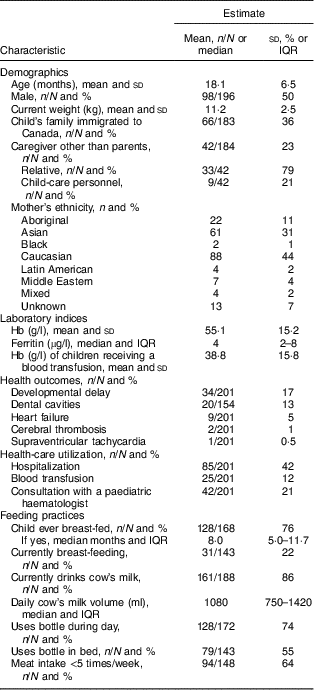
IDA, Fe-deficiency anaemia; CPSP, Canadian Paediatric Surveillance Program; IQR, interquartile range.
The comparison of the subgroup of children 12–36 months of age from the CPSP sample (n 168, severe IDA; 33/201 children under 12 months of age were not included) and TARGet Kids! sample (n 597, Fe sufficient) is shown in Table 2. The median age in both samples was approximately 18 months, and there were significant differences in their levels of Hb and serum ferritin. Children with severe IDA from the CPSP sample as compared with Fe-sufficient children from the TARGet Kids! sample consumed a larger volume of cow’s milk daily (median 1065 ml v. 500 ml, P<0·001) and were more likely to be using a bottle during the day (78·4 % v. 43·3 %, OR=6·0; 95 % CI 4·0, 8·9) and using a bottle in bed (59·5 % v. 21·2 %, OR=6·5; 95 % CI 4·4, 9·5).
Comparison of children, aged 12–36 months, from the CPSP severe IDA sample and the TARGet Kids! iron-sufficient sample, Canada, 2009–2011

IDA, Fe-deficiency anaemia; IQR, interquartile range; CPSP, Canadian Paediatric Surveillance Program.
CPSP sample with severe IDA: Hb<80 g/l, low mean corpuscular volume, abnormal Fe status.
TARGet Kids! sample with non-anaemic Fe sufficiency: Hb≥110 g/l, serum ferritin ≥14 µg/l, C-reactive protein <10 mg/l.
Discussion
Canadian children 6–36 months of age with severe IDA experienced substantial morbidity including developmental delay, heart failure, cerebral thrombosis and supraventricular tachycardia requiring admission to an intensive care unit; and substantial health-care utilization, including hospitalization and blood transfusion. Compared with healthy Fe-sufficient children 12–36 months of age, children of the same age with severe IDA reported high-risk feeding practices including higher daily volume of cow’s milk, daytime bottle use and bottle use in bed.
Studies of developmental outcomes of IDA have been largely conducted in developing countries due to the high prevalence. Poor developmental outcomes of IDA, which persist in the long term despite Fe therapy, have been summarized in a review of longitudinal observational studies( Reference Grantham-McGregor and Ani 22 ). Lozoff and colleagues have extensively studied the neurodevelopmental outcomes of IDA in infancy through a longitudinal study conducted in infants from Costa Rica. These infants were reassessed at age 5 years, early adolescence, mid-adolescence, 19 years and 25 years, and the authors conclude that IDA in infancy results in ‘substantial loss of human potential’( Reference Lozoff, Jimenez and Wolf 23 – Reference Lozoff, Smith and Kaciroti 27 ). Abnormalities in dopamine metabolism and myelination have also been identified in animal models( Reference Georgieff 28 ).
Case series and case–control studies suggest an association between IDA and childhood stroke, including reports in Canadian children( Reference Maguire, deVeber and Parkin 3 , Reference Hartfield, Lowry and Keene 29 ). Proposed mechanisms for this association include hypercoagulability, thrombocytosis and anaemic hypoxia( Reference Hartfield, Lowry and Keene 29 ). The development of congestive heart failure and the need for hospitalization and blood transfusions (mean Hb concentration 28 g/l) were also noted in a case series from Philadelphia, USA( Reference Kwiatkowski, West and Heidary 30 ).
In our view, three potentially modifiable feeding practices may present opportunities for preventive interventions through primary care and public health settings. First, after 1 year of age cow’s milk intake should be limited to 500 ml/d. Second, bottle use should be discontinued by 12–15 months or earlier. Third, infants should not be put to sleep with a bottle.
Previous research has identified an association between prolonged use of bottle-feeding and Fe deficiency( Reference Bonuck and Kahn 31 – Reference Sutcliffe, Khambalia and Westergard 33 ). Overweight, obesity, wheezing and dental caries have also been found to be associated with prolonged bottle-feeding and bedtime bottle use( Reference Bonuck, Kahn and Schechter 34 – Reference Darmawikarta, Chen and Carsley 39 ). In an analysis of NHANES data, the mean age of bottle-weaning for US children was 18·78 months( Reference Bonuck, Kahn and Schechter 34 ). Recent research suggests a relationship between bottle use and lack of self-regulation of milk intake, suggesting the possibility that prolonged bottle use and daily volume of milk consumed may be closely related( Reference Li, Fein and Grummer-Strawn 40 ). It is possible that bottle use leads to lack of self-regulation of milk intake, which leads to excessive consumption of cow’s milk. Several mechanisms have been proposed for an association between Fe deficiency and cow’s milk. These include the low Fe content of cow’s milk; occult intestinal blood loss; and inhibition of the absorption of non-haem Fe by Ca and casein in cow’s milk( Reference Ziegler 41 ).
Previous case series of severe IDA have been single-site retrospective chart reviews from children hospitalized or referred to a haematology clinic( Reference Kwiatkowski, West and Heidary 30 , Reference Sandoval, Berger and Ozkaynak 42 , Reference Cetinkaya, Yildirmak and Kutluk 43 ). Although these reports did not have a comparator group, they also identified excessive daily milk consumption and prolonged bottle-feeding as factors associated with severe IDA. For example, one case series reported daily milk intake to exceed 946 ml (1 quart) in 76 % of children with a Hb concentration ≤60 g/l( Reference Kwiatkowski, West and Heidary 30 ).
A strength of the CPSP sample was the collection of data through prospective national surveillance. However, our findings may be limited by under-reporting from paediatricians, and family physicians and other primary-care practitioners did not participate in the CPSP. Therefore, we did not calculate a national prevalence rate of severe IDA. Using data from the TARGet Kids! sample of healthy prospectively enrolled children provided a comparison group; however, these children were from one city only, limiting our ability to make comparisons with the national sample on characteristics such as ethnicity. For the same reason, we did not design or analyse data from these two samples as a case–control study and were unable to examine the role of potential uncontrolled confounders.
Healthy full-term infants have adequate Fe stores until 4 to 6 months of age, and IDA peaks between 1 and 3 years of age( Reference Baker and Greer 4 ). Therefore, identifying optimal feeding practices beyond the first 6 months of life is critical to preventing IDA. In a recent joint statement, Health Canada, Canadian Paediatric Society, Dietitians of Canada and Breastfeeding Committee for Canada reaffirm their recommendation of exclusive breast-feeding for the first 6 months( 44 ). Further, the statement recommends that breast-feeding be sustained for up to 2 years or longer, emphasizes the introduction of complementary foods and that first foods introduced should be Fe-rich( 44 ). The importance of Fe-rich complementary foods for infants breast-feeding beyond 6 months of age was recently demonstrated in our analysis of 1647 healthy children (median age 36 months) participating in TARGet Kids! We found an association between increasing duration of breast-feeding and lower serum ferritin (P=0·0015). Adjusted logistic regression analysis revealed the odds of Fe deficiency increased by 4·8 % (95 % CI 2 %, 8 %) for each additional month of breast-feeding( Reference Maguire, Salehi and Birken 45 ).
Guidelines for other feeding practices in the second year of life have received less attention. Findings from our study strongly support the recent recommendations for infants aged 6 to 24 months, presented in a joint statement of Health Canada, Canadian Paediatric Society, Dietitians of Canada and Breastfeeding Committee for Canada. These draft recommendations include: introduction of Fe-rich foods, such as meat and meat alternatives and Fe-fortified cereal; delayed introduction of cow’s milk until 9 to 12 months of age; limiting cow’s milk to 500–750 ml/d; offering liquids in an open cup; avoiding night-time bottles( 46 ). A recent analysis of 1311 children (median age 48 months) participating in TARGet Kids! found that increasing cow’s milk intake led to a trade-off between decreasing serum ferritin and increasing vitamin D levels. Two cups of cow’s milk per day appears sufficient to maintain healthy Fe and vitamin D for most children( Reference Maguire, Lebovic and Kandasam 47 ). Furthermore, a TARGet Kids! randomized trial found that anticipatory guidance in paediatricians’ offices may lead to a reduction in prolonged bottle-feeding, suggesting that implementation of these recommendations is feasible and effective( Reference Maguire, Mekky and Jacobson 48 ). Future research should examine other feeding practices, such as the use of an open cup rather than a bottle or sip cup, and weaning directly from the breast to a cup avoiding the use of a bottle throughout infancy.
The role and optimal age for screening for IDA in young children remain unclear. The American Academy of Pediatrics (2010) recommends universal screening for IDA with a Hb measurement to identify anaemia at 12 months of age along with assessment of risk factors( Reference Baker and Greer 4 ). The US Preventive Services Task Force (2006) concludes that evidence is insufficient to recommend for or against routine screening for IDA in asymptomatic children aged 6 to 12 months( 49 ). The Canadian Task Force on the Periodic Health Examination (1994) concludes that there is insufficient evidence to recommend the inclusion of routine early detection of anaemia by Hb measurement between ages 6 and 12 months and there is no other current Canadian guideline( Reference Feightner 50 ). Our study suggests that understanding the potential role of screening for the early stages of Fe deficiency, prior to the development of severe IDA, should remain a priority.
Finally, our study highlights the critical gaps in national data for young children. The CHMS excludes children under 3 years and has limited data on children 3 to 5 years of age( Reference Cooper, Greene-Finestone and Lowell 15 ). If Canada aims to make ‘early childhood count’, we will need to identify feasible surveillance approaches( Reference Hertzman and Williams 1 ). In the current study we present two successful approaches to sentinel site surveillance through paediatric and community-based health-care practitioners: the CPSP (www.cpsp.cps.ca/) and TARGet Kids! (www.targetkids.ca). These approaches are scalable, may complement current CHMS approaches, and provide opportunities for integration of community-based health care and public health.
Conclusion
In conclusion, young children with severe IDA experienced substantial morbidity, health-care utilization and high-risk feeding practices. Three potentially modifiable feeding practices are associated with severe IDA in young children: (i) cow’s milk consumption greater than 500 ml/d; (ii) daytime bottle use beyond 12 months of age; and (iii) bottle use in bed. These feeding practices should be highlighted in future recommendations for public health and primary-care practitioners. The study highlights critical gaps in national data for young children and the potential to scale up sentinel site surveillance through community-based health-care practitioners.
Acknowledgements
Acknowledgements: CPSP cohort: the authors gratefully acknowledge the contributions of Danielle Grenier, Mark Belletrutti, Manual Carcao, Janet Grabowski, Anne-Marie Ugnat and Sam Wong. They gratefully acknowledge the contributions of the Canadian paediatricians who completed the case report forms from the CPSP. TARGet Kids! cohort: the authors gratefully acknowledge the contributions of Azar Azad, Tony Barozzino, Sarah Carsley, Brian Chisamore, Tonya D’Amour, Karoon Danayan, Anh Do, Mark Feldman, Moshe Ipp, Sheila Jacobson, Kanthi Kavikondala, Marina Khovratovich, Eddy Lau, Taran Malhi, Muhammad Mamdani, Magda Melo, Sharon Naymark, Patricia Neelands, Michael Peer, Marty Perlmutar, Michelle Porepa, Subitha Rajakumaran, Alana Rosenthal, Janet Saunderson, Juela Sejdo, Carolyn Taylor and Laurie Thompson. Financial support: The CPSP cohort received in-kind funding support from the Canadian Paediatric Society and the Public Health Agency of Canada. These study sponsors designed the Canadian Paediatric Surveillance Program and were responsible for collection of data from Canadian paediatricians using a data collection form designed by the authors. These study sponsors had no role in the analysis and interpretation of data; the writing of the report; and the decision to submit the paper for publication. The TARGet Kids! cohort received funding support from The Hospital for Sick Children Foundation, the St. Michael’s Hospital Foundation and the Canadian Institutes of Health Research. These study sponsors had no role in the study design; the collection, analysis and interpretation of data; the writing of the report; and the decision to submit the paper for publication. Conflict of interest: S.Z. has received grant funding and support for travel expenses from the National Institutes of Health; received institutional grants from the Saving Lives at Birth Foundation and the Muskoka Initiative Consortium; received payments for lectures from Nutreo and the Government of Colombia; and received institutional funding from UNICEF for consultation meetings related to micronutrient powders. The remaining authors have no financial relationships relevant to this article to disclose. S.Z. has served on a scientific advisory committee for Danone; provided expert testimony for the Ministry of the Attorney General of Ontario; holds a North American patent on micronutrient powders; and has a non-exclusive agreement on micronutrient powders with NEW GPC Ltd in Guyana. The remaining authors have no conflicts of interest to disclose. Authorship: P.C.P. conceptualized and designed the study, designed the data collection instruments, drafted the initial manuscript and approved the final manuscript as submitted. J.D. carried out the initial analyses, reviewed the manuscript and approved the final manuscript as submitted. J.L.M., C.S.B. and S.Z. conceptualized and designed the study, designed the data collection instruments, critically reviewed the manuscript and approved the final manuscript as submitted. Ethics of human subject participation: The Hospital for Sick Children Research Ethics Board, Toronto, Canada, approved both the CPSP and the TARGet Kids! cohorts.



