





Introduction
At a global level, about half of the population has a dog as a pet animal (Blaisdell, Reference Blaisdell1999). There is a well-known tight relationship between people and their pets, which offers benefits related to mental health, physical exercise stimulators, and socialization (Zablan et al., Reference Zablan, Melvin and Hayley2024). Zoonotic pathogens associated with domestic dogs have been well studied, especially in the current context of climate change and wildlife urbanization (Rupasinghe et al., Reference Rupasinghe, Chomel and Martínez-López2022; Thompson, Reference Thompson2023). Many infective parasitic forms (cysts, oocysts, eggs, larvae) are dispersed with the faeces and can represent an important source of environmental contamination, considering the risk of infection for people as well (Pal and Tolawak, Reference Pal and Tolawak2023). In the case of hookworms, in European countries, there is limited information about Ancylostoma caninum and Uncinaria stenocephala distribution across the continent (Štrkolcová et al., Reference Štrkolcová, Mravcová, Mucha, Mulinge and Schreiberová2022; Illiano et al., Reference Illiano, Ciuca, Maurelli, Pepe, Caruso, Bosco, Pennacchio, Amato, Pompameo and Rinaldi2023). Both A. caninum and U. stenocephala are capable of causing human infection (Pal and Tolawak, Reference Pal and Tolawak2023). Zoonotic parasites from dogs are recognized as an important public health problem worldwide but have been mainly associated with developing countries and communities (Soriano et al., Reference Soriano, Pierangeli, Roccia, Bergagna, Lazzarini, Celescinco, Saiz, Kossman, Contreras, Arias and Basualdo2010).
Stray animals have an essential role as spreaders or reservoir hosts of many parasites to both animals and humans (Deplazes et al., Reference Deplazes, Van Knapen, Schweiger and Overgaauw2011; Szwabe and Blaszkowska, Reference Szwabe and Blaszkowska2017). In most European countries, the stray dog population was limited by implementing strategic actions like trapping-neutering-return, collect-neuter-vaccinate-return, shelters for stray dogs with limited use of euthanasia, neutering-responsible dog ownership, and microchipping (Papavasili Th et al., Reference Papavasili Th, Kontogeorgos, Mavrommati, Sossidou and Chatzitheodoridis2024). In other parts of Europe, such as the Balkans, stray dog management is overseen by the municipal authorities, which often do not have the proper infrastructure (Papavasili Th et al., Reference Papavasili Th, Kontogeorgos, Mavrommati, Sossidou and Chatzitheodoridis2024). Kosovo, especially the capital, Pristina, is known for the large population of stray dogs, which are seen as living memorials. Dogs in Kosovo are free-ranging, but the entire community supports them, and the no-killing strategy has now been adopted in the country (Ashton, 2023). The capture-neutering-vaccination-release protocol was implemented in 2017, but the country is still in economical incapacity of building specific facilities for stray dogs (Ashton, 2023). While there are currently no public dog shelters, there are several private dog shelter facilities in Pristina, which are financially supported by either organizations based in Northern Europe or individual/private donators that collect stray dogs and offer them treatment, shelter, and the chance of a better life by being adopted in higher developed European countries or USA (personal communication). Such facilities and dog management can lead to a range of health issues for dogs and are a risk of potential zoonotic transmission to humans, as they frequently house a dense population of animals with varying health statuses and unknown backgrounds (Overgaauw et al., Reference Overgaauw, Vinke, Van Hagen and Lipman2020).
To investigate the extent of parasite infections in dogs destined for rehoming, the aim of this study was to investigate the proportions of parasite-positive dogs kept in private dog shelters in Prishtina, Kosovo, with a focus on hookworm diversity. Given the large population of stray dogs and their export to other countries in Europe and elsewhere, molecular tools were used to investigate the precise identity of hookworms and their susceptibility to benzimidazole by evaluating their frequency of the canonical F167Y and Q134H isotype-1 β-tubulin mutations, which confer benzimidazole resistance.
Materials and methods
Study group
Samples were collected from two different private dog shelters in Pristina (capital city) of Kosovo. The two shelters were randomly selected based on their availability. Shelter A hosted 32 dogs. Dogs were housed in pens placed directly on the ground. Each pen accommodated 3–6 dogs. Shelter B hosted around 300 dogs in pens with 25–35 dogs each. Each pen floor was covered with gravel. In both shelters, faeces were removed from the pens every 3 h during the day by dog keepers who were permanently present, working on shifts. Dewormings were routinely done (various unknown products) when new animals were captured and introduced into the dog shelter, and after that, only in clinically ill animals. Both shelters were euthanasia-free and promoted adoption, meaning they were housing animals of all ages and in different health conditions. In both cases, dogs were sent for adoption in European countries or USA. In instances where a dog either succumbed to a fatal disease, experienced a lethal attack by a group of dogs within an enclosure, or underwent euthanasia due to various reasons, the carcass was buried in a designated area separate from the shelter to minimize the risk of contact with other dogs. In Shelter A, which accommodated a smaller population of dogs, staff members facilitated daily walks outside the shelter. Conversely, Shelter B provided a dedicated space for walking and relaxation, an outside fenced paddock with ground and some vegetation, where dogs were taken on a rotating schedule. Following their walks, all dogs returned to their enclosures, where they remained for a 24-hour period until their next scheduled outing.
Following the current ethical and welfare regulations, faeces collection from the rectum is to be avoided; therefore, fresh faecal samples were collected from each pen as group samples/pen. A total of 50 faecal samples were analysed: 13 from Shelter A and 37 from Shelter B. Shelter A housed 32 dogs, with samples collected from 40.6% of the population. Shelter B housed approximately 300 dogs, with samples collected from 12.3% of the population.
Data about the number of animals, their sex, and approximate age of animals from each pen were noted. To avoid manipulation of the animals, and for safety reasons, age was marked according to the information received from the dog keepers and the visual inspection of animals and divided into two categories as follows: puppies (0–12 months) and adults (over 1 year).
Parasitological diagnosis using coproscopy
Collected samples were stored in plastic ice boxes and transported to the Department of Parasitology and Parasitic Diseases from the University of Agricultural Sciences and Veterinary Medicine of Cluj-Napoca for further investigations. Each sample was processed by macroscopic observation, then individually well homogenized using a single-use wood stick. From each homogenate, 3 g were processed and microscopically analysed by Mini-FLOTAC®, using a sugar flotation solution (specific gravity [SG] = 1.27). Around 1 g of faeces from each sample was placed in 2.5 mL cryotubes and stored in a freezer at −18 for further molecular processing.
Parasitological diagnosis using molecular tools
DNA was isolated from each sample using a commercial kit (ISOLATE II Faecal DNA kit, meridian Bioscience, London, UK), according to the manufacturer’s instructions. The amplification of various target genes of the parasites was performed by Polymerase chain reaction (PCR), using previously published primers and protocols (Table 1). The amplification set included a positive control of parasite DNA and a no-template control (PCR-grade water) to rule out possible contamination. All products were visualized by electrophoresis in 2% stained agarose gels. The size was determined by comparison to a molecular marker. DNA purification was done with a commercial kit (Gel/PCR DNA Fragments Kit, Geneaid Biotech, New Taipei, Taiwan) and externally sequenced (Macrogen Europe B.V., Amsterdam, The Netherlands). Obtained sequences were assembled and edited using Geneious software and compared to those available in the GenBank database using the Basic Local Alignment Search Tool (BLAST) analysis.
Table presents all primers and protocols used in this study

Amplicon metabarcoding and illumina deep sequencing for hookworms
All isolated DNA samples were first screened for the presence of nematode DNA using nematode ITS-2 rRNA gene quantitative PCR, and samples with Ct < 35 were considered suitable DNA material for follow-up processes. Total DNA was subjected to three independent real-time PCR amplifications. ITS-2 rRNA gene was amplified with NC-1 and NC-2 primers designed by Gasser et al. (Reference Gasser, Chilton, Hoste and Beveridge1993) and two BZ167 and BZ200 isotype-1 β-tubulin fragments were amplified using primers designed previously (Jimenez Castro et al., Reference Jimenez Castro, Howell, Schaefer, Avramenko, Gilleard and Kaplan2019; Table 1). All primers were adapted for Illumina metabarcoding using next-generation sequencing (NGS). All reactions utilized SYBR-chemistry using SensiFAST™SYBR® No-ROX mix (Meridian Bioscience, Australia) and amplified as previously described by Abdullah et al. (Reference Abdullah, Stocker, Kang, Scott, Hayward, Jaensch, Ward, Jones, Kotze and Šlapeta2025), including a final melting temperature curve analysis. Each run included a no-template control (ddH2O) to monitor for potential contamination. Amplicon sequencing was performed at the Ramaciotti Centre for Genomics, University of New South Wales, Sydney, Australia, and sequenced on MiSeq using MiSeq Reagent Kits v2 (250PE, Illumina). De-multiplexed FastQ files were generated via BaseSpace (Illumina).
All FastQ files were processed through R package ‘dada2’ v1.34 (Callahan et al., Reference Callahan, McMurdie, Rosen, Han, Johnson and Holmes2016) in R v4.4.2 (R Core Team, 2022), as previously described (Abdullah et al., Reference Abdullah, Stocker, Kang, Scott, Hayward, Jaensch, Ward, Jones, Kotze and Šlapeta2025). Before processing through the dada2 pipeline, primers were removed from all forward and reverse FastQ reads using ‘cutadapt’ version 4.0 (Martin, Reference Martin2011). Resulting amplicon sequence variants (ASVs) were aggregated according to species, and samples with >2000 good quality sequence reads were considered sufficiently sequenced. The species were assigned based on ITS-2 and β-tubulin gene sequences analysed in CLC Main Workbench v22.0 (Qiagen Australia) as previously described (Stocker et al., Reference Stocker, Ward and Šlapeta2024; Abdullah et al., Reference Abdullah, Stocker, Kang, Scott, Hayward, Jaensch, Ward, Jones, Kotze and Šlapeta2025). For species assignment, an alignment of ASVs with an in-house curated reference ITS-2 rRNA gene hookworm sequence library consisting of publicly available sequences (KP844736; MT345056; JQ812692; LC036567; JX220891; EU344797; AB793527) was constructed. For β-tubulin reference sequences included A. caninum (DQ459314) (Schwenkenbecher et al., Reference Schwenkenbecher, Albonico, Bickle and Kaplan2007), A. duodenale (EF392850), U. stenocephala (Stocker et al., Reference Stocker, Scott and Šlapeta2023), Necator americanus (EU182348), and those available from ‘WormBase ParaSite’ (Howe et al., Reference Howe, Bolt, Cain, Chan, Chen, Davis, Done, Down, Gao, Grove, Harris, Kishore, Lee, Lomax, Li, Muller, Nakamura, Nuin, Paulini, Raciti, Schindelman, Stanley, Tuli, Van Auken, Wang, Wang, Williams, Wright, Yook, Berriman, Kersey, Schedl, Stein and Sternberg2016; Bolt et al., Reference Bolt, Rodgers, Shafie, Kersey, Berriman, Howe and Kollmar2018; Harris et al., Reference Harris, Arnaboldi, Cain, Chan, Chen, Cho, Davis, Gao, Grove, Kishore, Lee, Muller, Nakamura, Nuin, Paulini, Raciti, Rodgers, Russell, Schindelman, Auken, Wang, Williams, Wright, Yook, Howe, Schedl, Stein and Sternberg2019) which enabled the identity of the exon/intron boundary and amino acids Q134, F167, E198, and F200 (Venkatesan et al., Reference Venkatesan, Jimenez Castro, Morosetti, Horvath, Chen, Redman, Dunn, Collins, Fraser, Andersen, Kaplan and Gilleard2023). New sequence data were deposited in GenBank SRA: (PRJNA1240660), and associated analysis data are available at LabArchives: https://dx.doi.org/10.25833/x7y0-fh81.
Statistical analysis
To determine the minimum number of dogs required to detect at least one positive case with 95% confidence, the Modified Hypergeometric Exact Method was applied (Cameron and Baldock, Reference Cameron and Baldock1998). Based on this model, a sample size of six dogs was calculated to be sufficient to detect at least one infected individual with 95% confidence, assuming a true prevalence of 40% (Epitools: https://epitools.ausvet.com.au/freecalctwo). The assumed prevalence of 40% for hookworm infections was informed by published data from dog shelters across Europe (Sommer et al., Reference Sommer, Zdravković, Vasić, Grimm and Silaghi2017; Raza et al., Reference Raza, Rand, Qamar, Jabbar and Kopp2018; Štrkolcová et al., Reference Štrkolcová, Mravcová, Mucha, Mulinge and Schreiberová2022; Fagundes-Moreira et al., Reference Fagundes-Moreira, Bezerra-Santos, Alves, Palazzo, Lia, Mendoza-Roldan, Šlapeta and Otranto2025). For each shelter, the minimum detectable prevalence based on the number of samples obtained, assuming a PCR sensitivity of 95% and specificity of 100% were calculated.
The data collected was incorporated into an Excel File and the statistical analysis was done using EpiInfo™ 7.2.2.6 software (CDC, USA). The frequency, prevalence and 95% confidence interval (CI) of infection for each identified species of parasite were calculated overall and according to the shelter and age. The differences among groups were assessed by chi-square test and were statistically significant for P values ≤ 0.05.
Results
Study group
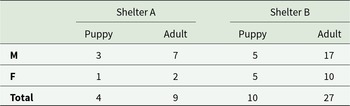
A total of 50 samples were collected across two shelters: 13 samples from Shelter A, representing 40.6% of its dog population, and 37 samples from Shelter B, accounting for 12.3% of its population. Of these, 36 samples (72%) were obtained from adult dogs and 14 (28%) from puppies across both facilities (Table 2). To contextualise the sampling effort at Shelters A and B, the probability of failing to detect the parasite if it were present at specific prevalence levels using the modified hypergeometric exact method were estimated. Assuming no positive samples were found, the probability that the parasite is present at a prevalence of ≥20% in Shelter A or ≥8% in Shelter B would be <5%, respectively.
The distribution of samples collected from dogs by the shelters, age, and sex

Hookworms and Trichuris vulpis as the most frequent parasites detected by coproscopy
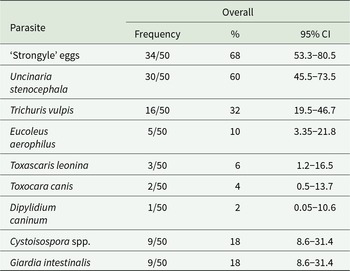
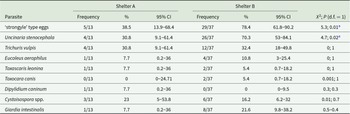
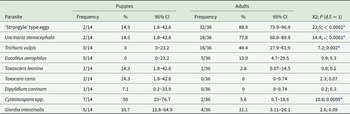
Of the examined samples, 44 (88%; 95% CI 75.69–95.47%) were infected with at least one parasite. Cystoisospora spp. (n = 9, 18%), Toxocara canis (n = 2, 4%), Toxascaris leonina (n = 3, 6%), Trichuris vulpis (n = 16, 32%), hookworms (n = 34, 68%), Eucoleus aerophilus (n = 5, 10%) and Dipylidium caninum (n = 1, 2%) were identified using the MiniFLOTAC technique (Tables 3–5). Co-infections with at least two parasites were identified in 24 samples (48%).
Table showing the overall frequencies, prevalence and 95% CI of all identified parasites

Table showing the frequencies, prevalence and 95% CI of all identified parasites based on shelter and the statistical differences between shelters

a Statistically significant.
Table showing the frequencies, prevalence and 95% CI of all identified parasites based on the age and the statistical differences

a Statistically significant.
Molecular analysis revealed infection with G. Duodenalis assemblage B
Overall, for Giardia duodenalis, 9 samples (18%) were confirmed by PCR amplification and sequencing with 5 (55.6%) coming from puppies and 4 (44.4%) from adult dogs. Based on the BLAST analysis, assemblage B (subassamblage B4) (syn. G. enterica) was identified based on the tpi gene in one single adult dog from Shelter B. Additionally, 3 puppies and one adult were infected with assemblage D (syn. G. lupus), while 2 puppies and 1 adult with assemblage C (syn. G. canis) with 1 single puppy dog from Shelter A infected with assemblage C.
No positive results were obtained for D. caninum and other cestodes (Taenia spp., Echinococcus spp.).
Uncinaria stenocephala identified using ITS-2 rRNA gene amplicon metabarcoding
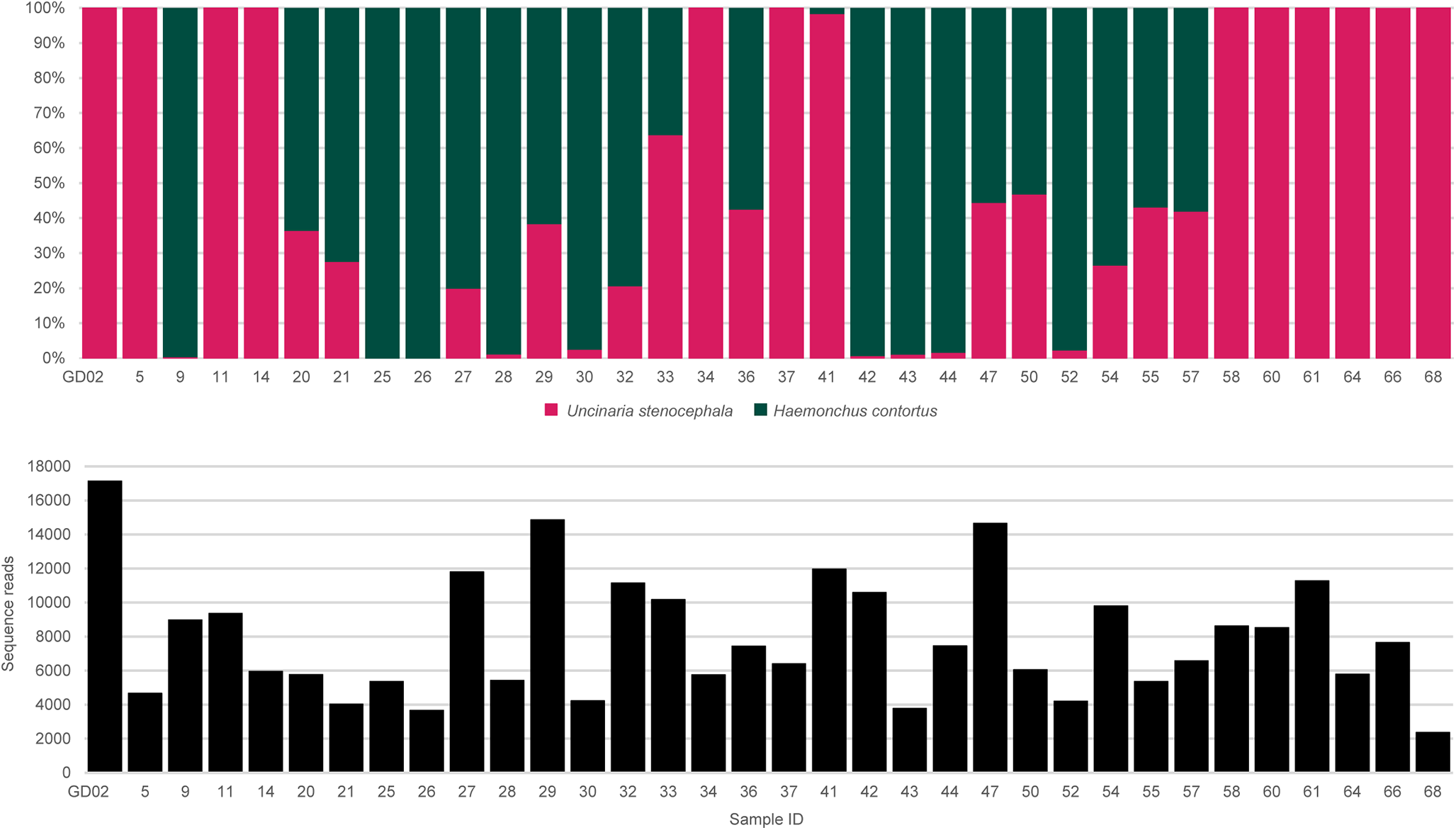
Hookworm-like eggs (Ancylostomatidae-like, ‘strongyle’) were detected in 68% (34/50; 95% CI: 53.3–80.5%)) of the faecal samples. All 50 samples underwent DNA isolation and real-time PCR amplification of ITS-2 rRNA gene using primers targeting ‘strongyle’ DNA. The real-time PCR amplification was successful for 68% (34/50; Ct-values 19.9–30.4). Melting curve analysis revealed two dominant temperature peaks, 84°C and 81°C. There were 14 samples with a predominant or only melting peak at 84°, 10 samples with a predominant or only melting peak at 81°, and the remaining 10 samples had both peaks at 84°C and 81°C recognizable. All 34 amplicons underwent deep-sequencing using and yielded >2000 high-quality sequencing reads per samples (average: 7860, min. 2385, max. 17 148, total 257 224) (Figure 1).
Identification of ‘strongyle’-type eggs from dogs using internal transcribed spacer (ITS)-2 rRNA gene amplicon metabarcoding assay. Percentage of nematode species within each sample (depicted as percentage). Number of sequencing reads per sample in the bar chart directly below. Sampled with hookworm-like eggs (=‘strongyle’-type eggs) were profiled using metabarcoded deep Illumina amplicon sequencing. Amplicon sequence variants (ASVs) were pooled according to species of nematodes to which they belonged using a reference sequence alignment. Proportion of each species (Uncinaria stenocephala, Haemonchus contortus) is colour coded in the stacked bar chart; H. Contortus represents spurious parasite sequences, specifically from goats/sheep.

The only hookworm ITS-2 rRNA gene sequences were those of U. stenocephala (Ancylostomatidae). There were 24 samples with >2000 sequence reads belonging to U. stenocephala, in addition to nine samples with <2000, and one with no detectable U. stenocephala ITS-2 rRNA gene reads (Figure 1). The percentage of U. stenocephala reads in samples ranged from 100% to 0% (average 54%) and the remaining reads were matched to Haemonchus controtus and considered spurious results.
The PCR amplicon with the predominant temperature melting peak of 84°C returned on average 94% reads belonging to U. stenocephala (min. 42%, max. 100%), and those with the predominant temperature melting peak of 81°C returned on average 5% reads belonging to U. stenocephala (min. 0%, max. 47%) with 9 out of 10 samples returning >97% of reads from H. contortus. The samples with both melting temperature peaks returned on average 40% reads belonging to U. stenocephala (min. 20%, max. 100%).
Uncinaria stenocephala isotype-1 β-tubulin gene reveals only canonical benzimidazole susceptible residues
Further, two isotype-1 β-tubulin regions (BZ167, BZ200) that amplify region with mutations known to be associated with resistance to benzimidazole drug class, specifically the regions that encode amino acids: glutamine 134 (Q134), phenylalanine 167 (F167), glutamic acid 198 (E198), and phenylalanine 200 (F200) were amplified. Amplification was successful for 30 samples. Sequencing was successful for 16 samples (average hookworm high-quality reads 5271, min. 653, max. 18321) for BZ167 assay, and for all samples include only U. stenocephala sequences with canonical susceptible residues coding for Q134 and F167. Three (3/16) samples yielded <2000 high-quality hookworm reads (1447; 997; 653) at the BZ167 assay. The sequencing was successful for 12 samples (average hookworm high-quality reads 2264, min. 116, max. 6029) for BZ200 assay, and for all samples included only U. stenocephala sequences with canonical susceptible residues coding for E198 and F200. Three (4/12) samples yielded <2000 high-quality hookworm reads (952; 414; 318; 116) at the BZ200 assay.
Discussion
Hookworms, ancylostomatids, were the most prevalent parasites identified by coproscopy in this study, with an overall prevalence of 68% among tested dogs. Such high prevalence is in accordance with other reports on shelter dog populations, places in which environmental contamination and close contact between animals facilitate the transmission (Mukaratirwa and Singh, Reference Mukaratirwa and Singh2010; Alvarado-Esquivel et al., Reference Alvarado-Esquivel, Romero-Salas, Aguilar-Domínguez, Cruz-Romero, Ibarra-Priego and Pérez-de-león2015; Lopes et al., Reference Lopes, Gomes, Lozano, Louro, De Carvalho, Da Fonseca, Lobo, Monteiro, Carvalho, Afonso, Almas and Cunha2025). Interestingly, in studies done on European shelter dogs, hookworms were reported with a much lower prevalence: 5.3% in Spain (Ortuno and Castella, Reference Ortuno and Castella2011) and 0.4% in Germany (Becker et al., Reference Becker, Rohen, Epe and Schnieder2012). These lower prevalences could be correlated to the proper use of prophylactic deworming and more strict environmental hygiene. However, in other geographically close countries such as Serbia and Romania, hookworms were identified with 41% and 56% prevalences in shelter dogs, respectively (Mircean et al., Reference Mircean, Dumitrache, Mircean, Colosi and Györke2017; Sommer et al., Reference Sommer, Zdravković, Vasić, Grimm and Silaghi2017; Rusu et al., Reference Rusu, Gabriela, Dumitru and Liviu2023), showing a lack of successful prophylactic treatments and parasite-control measures implemented.
These results revealed a high prevalence of hookworm-like eggs in dog faecal samples (68%), with U. stenocephala being the only hookworm species detected. Given the relatively small number of samples analysed, limiting detection to prevalence rates above 20% in Shelter A and 8% in Shelter B, it remains plausible that Ancylostoma spp. may be present but undetected in these shelters. This inference is supported by the use of the modified hypergeometric exact method, which estimates the probability of missing infections at lower prevalence levels. Nevertheless, the dominance of U. stenocephala in these findings aligns with numerous studies across Europe, which consistently report it as the predominant hookworm species in canine populations (Sommer et al., Reference Sommer, Zdravković, Vasić, Grimm and Silaghi2017; Raza et al., Reference Raza, Rand, Qamar, Jabbar and Kopp2018; Štrkolcová et al., Reference Štrkolcová, Mravcová, Mucha, Mulinge and Schreiberová2022; Fagundes-Moreira et al., Reference Fagundes-Moreira, Bezerra-Santos, Alves, Palazzo, Lia, Mendoza-Roldan, Šlapeta and Otranto2025).
Interestingly, U. stenocephala is considered to occur in temperate/colder areas like Central and Northern Europe, Canada, and the United States, but it was also reported in tropical Africa (Bowman et al., Reference Bowman, Montgomery, Zajac, Eberhard and Kazacos2010; Reinemeyer, Reference Reinemeyer2016; Demkowska-Kutrzepa et al., Reference Demkowska-Kutrzepa, Szczepaniak, Dudko, Roczeń-Karczmarz, Studzińska, Żyła and Tomczuk2018; Merino-Tejedor et al., Reference Merino-Tejedor, Nejsum, Mkupasi, Johansen and Olsen2019). In the United States, using the amplicon metabarcoding approach, U. stenocephala was shown to be a rarely detected species of hookworms regardless of the region considered, with A. caninum dominating the distribution of hookworms from the southern warmer climates to the cooler northern parts (Venkatesan et al., Reference Venkatesan, Jimenez Castro, Morosetti, Horvath, Chen, Redman, Dunn, Collins, Fraser, Andersen, Kaplan and Gilleard2023; Stocker et al., Reference Stocker, Ward and Šlapeta2024). The presence of U. stenocephala in the Mediterranean region was hypothesized to be due to the changes caused by climate change and increased animal movements (Illiano et al., Reference Illiano, Ciuca, Maurelli, Pepe, Caruso, Bosco, Pennacchio, Amato, Pompameo and Rinaldi2023). In Europe, the application of molecular tools has and will significantly improve the understanding of hookworm diversity, and based on the more recent data, it is more likely to reveal that many historical records of A. caninum species were, in fact, U. stenocephala. Contrary to traditional textbook knowledge, which often presents a mix of both, molecular analyses suggest that U. stenocephala might be dominating across Europe or at least in the Mediterranean area, while the presence of A. caninum appears to be limited (Štrkolcová et al., Reference Štrkolcová, Mravcová, Mucha, Mulinge and Schreiberová2022; Illiano et al., Reference Illiano, Ciuca, Maurelli, Pepe, Caruso, Bosco, Pennacchio, Amato, Pompameo and Rinaldi2023). The European distribution of hookworms is unknown, while outside the European continent, distribution patterns were observed in North America (Leutenegger et al., Reference Leutenegger, Evason, Willcox, Rochani, Richmond, Meeks, Lozoya, Tereski, Loo, Mitchell, Andrews and Savard2024; Jimenez Castro et al., Reference Jimenez Castro, Willcox, Rochani, Richmond, Martinez, Lozoya, Savard and Leutenegger2025) and Australia (Abdullah et al., Reference Abdullah, Stocker, Kang, Scott, Hayward, Jaensch, Ward, Jones, Kotze and Šlapeta2025), where distinct biogeographic boundaries exist. In Australia, U. stenocephala is the only canine hookworm species in the South, while in the North is A. caninum with areas in between, like Sydney, representing the halfway meeting of hookworm species, with both species reported (Abdullah et al., Reference Abdullah, Stocker, Kang, Scott, Hayward, Jaensch, Ward, Jones, Kotze and Šlapeta2025).
In this study, all analysed U. stenocephala isotype-1 β-tubulin sequences lacked the F167Y and Q134H mutations known to confer benzimidazole resistance in A. caninum (Venkatesan et al., Reference Venkatesan, Jimenez Castro, Morosetti, Horvath, Chen, Redman, Dunn, Collins, Fraser, Andersen, Kaplan and Gilleard2023). There is a renewed interest in hookworms due to the multiple anthelmintic drug resistance (MADR) that has emerged (Jimenez Castro et al., Reference Jimenez Castro, Howell, Schaefer, Avramenko, Gilleard and Kaplan2019, Reference Jimenez Castro, Willcox, Rochani, Richmond, Martinez, Lozoya, Savard and Leutenegger2025; Kitchen et al., Reference Kitchen, Ratnappan, Han, Leasure, Grill, Iqbal, Granger, O’Halloran and Hawdon2019; Geary et al., Reference Geary, Drake, Gilleard, Chelladurai, Castro, Kaplan, Marsh, Reinemeyer and Verocai2025). Resistance is speculated to have emerged due to the indiscriminate use of anthelmintics, particularly in greyhound racing kennels where the first resistant A. caninum was detected (Von Samson-Himmelstjerna et al., Reference Von Samson-Himmelstjerna, Thompson, Krücken, Grant, Bowman, Schnyder and Deplazes2021; Marsh and Lakritz, Reference Marsh and Lakritz2023; Geary et al., Reference Geary, Drake, Gilleard, Chelladurai, Castro, Kaplan, Marsh, Reinemeyer and Verocai2025). These resistant isolates are now present in other breeds as well. The widespread resistance of A. caninum to benzimidazole is demonstrated by phenotypic and molecular assays across North America and Australia (Venkatesan et al., Reference Venkatesan, Jimenez Castro, Morosetti, Horvath, Chen, Redman, Dunn, Collins, Fraser, Andersen, Kaplan and Gilleard2023; Abdullah et al., Reference Abdullah, Stocker, Kang, Scott, Hayward, Jaensch, Ward, Jones, Kotze and Šlapeta2025). Until recently, the canonical F167Y and Q134H mutations were detected only in A. caninum. However, the first U. stenocephala with the F167Y (TTC > TAC) isotype-1 β-tubulin mutation, with 51% frequency of the sequence reads, was already detected in Australia (Abdullah et al., Reference Abdullah, Stocker, Kang, Scott, Hayward, Jaensch, Ward, Jones, Kotze and Šlapeta2025). No phenotypic evidence, whether in vivo faecal egg reduction tests or in vitro egg hatch assays, exists for benzimidazole resistance in U. stenocephala. Nevertheless, milbemycin oxime lacks efficacy against U. stenocephala (Bowman et al., Reference Bowman, Lin, Johnson and Hepler1991; Niamatali et al., Reference Niamatali, Bhopale and Schad1992). Given that U. stenocephala is dominant in Europe and in shelters from which dogs are rehomed to other countries, the emergence of resistance under similar conditions to those where A. caninum MADR emerged should be considered a tangible reality. Although not widely used in Europe yet, there is a commercially available qPCR panel that can detect A. caninum BZ resistance (Leutenegger et al., Reference Leutenegger, Lozoya, Tereski, Andrews, Mitchell, Meeks, Willcox, Freeman, Richmond, Savard and Evason2023).
Dogs are known for their coprophagy. This behaviour, however, can lead to spurious parasitological results, as parasitic stages from ingested faeces can pass through the gastrointestinal tract and appear intact in the dogs’ faeces (Mircean et al., Reference Mircean, Cozma and Gyorke2011). Some spurious results are generally well known by veterinary parasitology diagnosticians, such as oocysts/sporocysts of Adelina spp. and Monocystis spp. from ingested beetles and earthworms, respectively, because of their well-recognizable features (Santana-Hernández et al. Reference Santana-Hernández, Priestnall, Modrý and Rodríguez-Ponce2021). For parasitic stages such as ‘strongyle’ eggs, identification can be more problematic due to the general uniformity of ‘strongyle’ eggs, regardless of their true origin (e.g. dog, rabbit and sheep). Therefore, the detection of H. contortus ITS-2 rRNA gene sequences in dog samples raises questions about the origin of these findings. The amplicon metabarcoding approach based on NC1-NC2 primers targeting the ITS-2 rRNA gene of nematodes (i.e. nemabiome) is capable of targeting most trichostrongylids and ancylostomatid nematodes simultaneously, thus providing an unbiased perspective on the ‘strongyle’ type eggs present in the faeces.
It is plausible that the dogs ingested H. contortus eggs or larvae during their time outside the shelter confinement, as both shelters were on the outskirts of the town, surrounded by pastures occupied by ruminants, H. contortus hosts. Additionally, the faecal sampling was done in June, when temperatures are very high and H. contortus contamination on pastures is at its peak. It is not, however, plausible that dogs are hosts of adult H. contortus because it does not infect dogs. At the PCR amplification stage, a melting peak at 81°C that correlated with the presence of H. contortus was noticed, suggesting that contamination post-PCR or barcode hopping during Illumina NGS is unlikely. All negative controls during the PCR remained negative, confirming that the used PCR consumables were clean and devoid of H. contortus DNA. Although dogs can actively ingest ruminant faeces, the faeces could have been passively contaminated because they were collected off the ground due to ethical considerations, with high larval and egg burdens from the surrounding pastures either by wind or rain. The dog keepers frequently moved between different shelter locations separated by pasture, potentially carrying parasite eggs on their shoes and introducing them into the dog enclosures. In a previous study using an analogous approach, trichostrongylid ITS-2 rRNA gene sequences were detected in several dogs and concluded to be a consequence of dogs’ coprophagy by farm dogs (Abdullah et al., Reference Abdullah, Stocker, Kang, Scott, Hayward, Jaensch, Ward, Jones, Kotze and Šlapeta2025). In a telling analogy, cat hookworms Ancylostoma tubaeforme were detected in four dogs’ faeces and speculated as a consequence of dogs’ inclination to eat cat faeces (Stocker et al., Reference Stocker, Ward and Šlapeta2024; Abdullah et al., Reference Abdullah, Stocker, Kang, Scott, Hayward, Jaensch, Ward, Jones, Kotze and Šlapeta2025).
The hypothesis of coprophagy, the ingestion of faeces by dogs, is plausible but would require follow-up longitudinal evaluation. It would be expected that subsequent faeces from the same dog would have reduced or no presence of H. contortus while U. stenocephala would persist. Unfortunately, no repeated sampling was done, and the study could not fully address this hypothesis. Regardless of the underlying reason, this finding highlights the need to interpret diagnostics in parasitology carefully. The presence of ‘strongyle’-type eggs in dog faecal samples does not necessarily indicate an active hookworm infection, especially in dogs with potential access to environmental sources of contamination. Unbiased molecular survey tools, such as the ‘nemabiome’ approach, enable us to discern the presence of spurious results that traditional approaches do not provide sufficient granulation.
The identification of other prevalent nematodes, such as T. vulpis (32%), suggests that soil-transmitted parasites represent a significant concern in these two shelters. It is generally accepted that whipworms show some resilience to some anthelmintics and require multiple administrations and sometimes even combinations of various nematodicide molecules for an effective treatment (Traversa, Reference Traversa2011). It is though suggested that the evaluation of the response to treatment in shelter dogs might give a better view into potential drug resistance. Although there are some reports about T. vulpis infections in humans (Márquez-Navarro et al., Reference Márquez-Navarro, García-Bracamontes, Álvarez-Fernández, Ávila-Caballero, Santos-Aranda, Díaz-Chiguer, Sánchez-Manzano, Rodríguez-Bataz and Nogueda-Torres2012), this zoonotic disease is still considered uncommon, but should not be neglected as in heavy infections humans can develop eosinophilia, dysentery syndrome, anaemia and rectal prolapse (Márquez-Navarro et al., Reference Márquez-Navarro, García-Bracamontes, Álvarez-Fernández, Ávila-Caballero, Santos-Aranda, Díaz-Chiguer, Sánchez-Manzano, Rodríguez-Bataz and Nogueda-Torres2012).
Eucoleus aerophilus eggs were identified in only 5 dogs (10%), and no eggs of E. boehmi were detected. The absence of E. boehmi may be due to the slightly different biology of the two capillarids with E. boehmi, mainly localized in the nasal cavities of carnivores, making it less likely to be detected in faecal examinations. Additionally, although still controversial, E. boehmi has an indirect life cycle and the absence of an intermediate host in the shelter environment may further reduce the transmission (Traversa et al., Reference Traversa, Di Cesare, Lia, Castagna, Meloni, Heine, Strube, Milillo, Otranto, Meckes and Schaper2011). Human pulmonary capilariosis due to E. aerophilus was occasionally reported, including in a woman misdiagnosed with bronchial carcinoma from a bordering country, Serbia (Lalosević et al., Reference Lalosević, Lalosević, Klem, Stanojev-Jovanović and Pozio2008).
Among ascarids, T. leonina (6%) was more frequent than T. canis (2.4%), which could be explained, by the low number of young animals examined as T. canis is mainly associated with young age (Baneth et al., Reference Baneth, Thamsborg, Otranto, Guillot, Blaga, Deplazes and Solano Gallego2016).
Although MiniFLOTAC showed good results in the detection of Metastrongylid lungworms (Ianniello et al., Reference Ianniello, Pepe, Alves, Ciuca, Maurelli, Amadesi, Bosco, Musella, Cringoli and Rinaldi2020), their transmission involves intermediate or paratenic hosts that are not commonly present in shelter environments, explaining the negative results.
Dipylidium caninum, the most common cestode detected in companion animals, being transmitted via fleas or lice (Beugnet et al., Reference Beugnet, Labuschagne, Vos, Crafford and Fourie2018), was identified in one single sample. The authors are aware that this finding might not reflect the actual prevalence, as the identification of such cestodes is difficult (Deak et al., Reference Deak, Györke, Pop and Mircean2025), as the parasitic forms are shed with the ovigerous proglottids. A recent study showed that the best technique to be used to diagnose dipylidiosis is the scotch band test from the perianal area (Morelli et al., Reference Morelli, Cesare, Traversa, Colombo, Paoletti, Ghietti, Beall, Davenport, Buch, Iorio, Marchiori, Di Regalbono and Diakou2024). Furthermore, negative PCR results for all tested samples, including the one positive in coproscopy, can be explained by the lack of proglottids in the tested faeces.
The absence of all Taenia spp. though may correlate to the lack of intermediate hosts in the shelters, as Taenia spp. require the consumption of rodents or other mammals for transmission, and in the present case, all dogs were fed strictly dog commercial pellets, eliminating their exposure to such parasites by the consumption of raw meat or carcasses (Deplazes et al., Reference Deplazes, Van Knapen, Schweiger and Overgaauw2011). A second reason could be related to the DNA isolation technique, as for tapeworms eggs, it is recommended that the DNA isolation is done from egg concentrate (Trachsel et al., Reference Trachsel, Deplazes and Mathis2007).
A low prevalence (18%) of G. duodenalis was confirmed by PCR, with a higher frequency in puppies. Despite the molecular confirmation, no Giardia cysts were detected using the MiniFLOTAC method, which could be explained by the intermittent shedding of cysts, commonly leading to false-negative results, or the sensitivity limitations of this technique compared to the direct immunofluorescence or it was just a basic matter of cyst degradation in the faeces as samples were transported and examined two days after the collection.
In Kosovo, a limited number of studies previously investigated the parasitic fauna of dogs, and they were mainly focused on vector-borne diseases, especially Leishmania (Xhekaj et al., Reference Xhekaj, Stefanovska, Sherifi, Rexhepi, Bizhga, Rashikj, Nikolovski, Kniha and Cvetkovikj2023), and few studies were done on Echinococcus spp. (Sherifi et al., Reference Sherifi, Rexhepi, Hamidi, Behluli, Zessin, Mathis and Deplazes2011) in dogs.
The authors acknowledge that this study had several limitations that should be taken into consideration. First, due to the type of management system, faecal samples were collected as pooled samples from each pen rather than individually, which might have limited the correlation of parasites with each animal, in regard to the age, sex and clinical signs. Additionally, the study included two private shelters in Pristina, which might not reflect the real parasite prevalence or diversity in other regions of the country or even wider Balkans. However, the study was not designed as an epidemiological study; rather, its aim was to determine the parasitological fauna in two shelters in the vicinity of the capital that provide animals for adoption to EU countries.
Conclusion
The present study represents the most comprehensive molecular investigations conducted in the Balkans on the parasite-positivity of shelter dogs destined for rehoming across Europe, showing that 88% of examined dogs were infected with at least one parasite, with U. stenocephala (northern hookworm) being the most prevalent. In the investigated samples, no benzimidazole resistance-associated mutations were found in U. stenocephala, indicating its susceptibility to benzimidazole drugs.
The potential indiscriminate use of benzimidazoles in shelters in Europe may mimic the conditions that led to the emergence of benzimidazole resistance in A. caninum in greyhound racing dog kennels (Marsh and Lakritz, Reference Marsh and Lakritz2023; Geary et al., Reference Geary, Drake, Gilleard, Chelladurai, Castro, Kaplan, Marsh, Reinemeyer and Verocai2025). While U. stenocephala resistance to benzimidazole is yet to be confirmed, mutations associated with benzimidazole resistance, mutation F167Y, has already been detected (Abdullah et al., Reference Abdullah, Stocker, Kang, Scott, Hayward, Jaensch, Ward, Jones, Kotze and Šlapeta2025). The distribution of dog hookworms across Europe is largely assumed based on historical records that used post-mortem adult hookworms for species identification. Ante-mortem amplicon metabarcoding for hookworm identification and benzimidazole SNP screening is a suitable medium to high-throughput approach. Monitoring the susceptibility of U. stenocephala to benzimidazoles is crucial because milbemycin oxime is ineffective against U. stenocephala. Additionally, the presence of ‘strongyle’-type eggs in dogs, identified as H. contortus using amplicon metabarcoding, points to the importance of accurate diagnosis methods and the need to interpret the results in the clinical context and the environment the animals inhabit.
Author contributions
GD and BX conceived and designed the study and wrote the first draft. KS, ALU, ML, VM, JS, and AMI did the investigation, data analysis, and revised the manuscript.
Financial support
Funding, in part, was provided by the Margo Roslyn Flood Bequest (Sydney School of Veterinary Science, The University of Sydney, Australia). Mariana Louro held the PhD Research Fellowships from FCT – Foundation for Science and Technology, I.P., (UI/BD/152818/2022; DOI:10.54499/UI/BD/152818/2022). Georgiana Deak was supported by a grant agency of the Ministry of Research, Innovation, and Digitization, CNCS-UEFISCDI, project number PN-IV-P2-2.1-TE-2023-0054.
Competing interests
The authors declare there are no conflicts of interest.
Ethical standards
All procedures involving animals in this study were non-invasive. Faecal samples were collected from the ground within the animals’ enclosures, without any direct handling, restraint or disturbance of the dogs. No experimental treatment, stress-inducing procedures or harmful activities were performed on the animals. As such, the study did not require ethical approval in accordance with current national and institutional regulations on animal welfare.


 Open access

