


The widespread adoption of glyphosate-resistant crops has increased rates of glyphosate application and reduced the use of soil-applied herbicides, thus reducing the cost of weed control programs (Prince et al. Reference Prince, Shaw, Givens, Newman, Owen, Weller, Young, Wilson and Jordan2012a; Young Reference Young2006). Consequently, glyphosate has become the most commonly used herbicide in agriculture worldwide (Dill et al. Reference Dill, Sammons, Feng, Kohn, Kretzmer, Mehrsheikh, Bleeke, Honegger, Farmer, Wright and Haupfear2010; Duke and Powles Reference Duke and Powles2008). Moreover, glyphosate-resistant crop technology has encouraged no-till or conservation tillage practices where weed control is primarily based on the application of herbicides (Coffman and Frank Reference Coffman and Frank1991; Gianessi Reference Gianessi2005; Jhala et al. Reference Jhala, Knezevic, Ganie and Singh2014a; Norsworthy et al. Reference Norsworthy, Ward, Shaw, Llewellyn, Nichols, Webster, Bradley, Frisvold, Powles, Burgos, Witt and Barrett2012), which is believed to aid in the shift towards small-seeded broadleaf weed species such as common waterhemp (Culpepper Reference Culpepper2006; Legleiter and Bradley Reference Legleiter and Bradley2008; Owen Reference Owen2008).
The continuous use of glyphosate in glyphosate-resistant crops for the past several years has created the unintended consequence of selection pressure on weed communities, resulting in the evolution of glyphosate-resistant weeds (Owen and Zelaya Reference Owen and Zelaya2005). Horseweed [Conyza canadensis (L.) Cronq.] was the first glyphosate-resistant weed reported in the United States (VanGessel Reference VanGessel2001), and currently, 35 weed species have evolved resistance to glyphosate in 25 countries worldwide, including 16 species in the United States (Heap Reference Heap2016a). Six weed species in Nebraska, including common waterhemp, have been shown to be resistant to glyphosate (Jhala Reference Jhala2016; Sarangi et al. Reference Sarangi, Sandell, Knezevic, Aulakh, Lindquist, Irmak and Jhala2015). Management of glyphosate-resistant weeds has become the greatest challenge for Nebraska corn (Zea mays L.) and soybean growers (Chahal and Jhala Reference Chahal and Jhala2015; Ganie et al. Reference Ganie, Sandell, Mithila, Kruger, Marx and Jhala2016; Jhala et al. Reference Jhala, Sandell and Kruger2014b; Kaur et al. Reference Kaur, Sandell, Lindquist and Jhala2014).
Common waterhemp, a summer annual broadleaf weed, is native to the northern United States (Waselkov and Olsen Reference Waselkov and Olsen2014). It can thrive under a wide range of climatic gradients and can be found from arid regions in Texas to humid/semi humid regions of Maine (Costea et al. Reference Costea, Weaver and Tardif2005; Nordby et al. 2007; Sarangi et al. Reference Sarangi, Irmak, Lindquist, Knezevic and Jhala2016). Surveys conducted in the past few years have listed common waterhemp as one of the most commonly encountered and troublesome weeds in agricultural fields (Prince et al. Reference Prince, Shaw, Givens, Owen, Weller, Young, Wilson and Jordan2012b; Rosenbaum and Bradley Reference Rosenbaum and Bradley2013). It is a highly competitive weed, causing significant economic damage to many crops, including corn and soybean (Bensch et al. Reference Bensch, Horak and Peterson2003; Steckel and Sprague Reference Steckel and Sprague2004). In Illinois, common waterhemp reduced soybean yield by 43% when allowed to compete up to 10 wk after soybean unifoliate expansion, with a density of up to 362 plants m–2 (Hager et al. Reference Hager, Wax, Stoller and Bollero2002b). Favorable biological attributes of common waterhemp, including its rapid growth (Horak and Loughin Reference Horak and Loughin2000) and prolific seed production potential (Steckel et al. Reference Steckel, Sprague, Hager, Simmons and Bollero2003) favor its persistence as a successful weed in row-crop production systems in the midwestern United States (Owen Reference Owen2008).
Common waterhemp is a dioecious species, and the rapid evolution of herbicide resistance in common waterhemp is partially due to the high genetic diversity present in the species and the potential for gene flow (Liu et al. Reference Liu, Davis and Tranel2012; Sarangi Reference Sarangi2016). Legleiter and Bradley (Reference Legleiter and Bradley2008) reported the first occurrence of glyphosate-resistant common waterhemp in Missouri, and it has now been confirmed in 18 states (Heap Reference Heap2016b). In addition, common waterhemp biotypes resistant to acetolactate synthase (ALS) inhibitors (Horak and Peterson Reference Horak and Peterson1995), photosystem II inhibitors (Anderson et al. Reference Anderson, Roeth and Martin1996), protoporphyrinogen oxidase (PPO) inhibitors (Shoup et al. Reference Shoup, Al-Khatib and Peterson2003), 4-hydroxyphenylpyruvate dioxygenase inhibitors (Hausman et al. Reference Hausman, Singh, Tranel, Riechers, Kaundun, Polge, Thomas and Hager2011), and synthetic auxins (Bernards et al. Reference Bernards, Crespo, Kruger, Gaussoin and Tranel2012) have already been confirmed in the United States.
In the midwestern United States, soybean growers are mostly relying on POST herbicides in no-till systems to control troublesome weeds, including pigweed (Amaranthaceae) species (Legleiter et al. Reference Legleiter, Bradley and Massey2009; Prince et al. Reference Prince, Shaw, Givens, Newman, Owen, Weller, Young, Wilson and Jordan2012a). Widespread resistance in common waterhemp against ALS-inhibiting herbicides and glyphosate is compelling soybean growers to depend mostly on PPO-inhibiting herbicides such as acifluorfen, fomesafen, or lactofen (Shoup et al. Reference Shoup, Al-Khatib and Peterson2003; Shoup and Al-Khatib Reference Shoup and Al-Khatib2004). Hartzler et al. (Reference Hartzler, Buhler and Stoltenberg1999) reported that common waterhemp has an extended period of emergence compared to other summer annual weed species, and Werle et al. (Reference Werle, Sandell, Buhler, Hartzler and Lindquist2014) considered this weed as a late-emerging species. The PRE (soil-applied) herbicides may lose their residual activity later in the growing season; therefore, the application of POST herbicide is necessary to control late-emerging common waterhemp flushes (Hager et al. Reference Hager, Wax, Bollero and Simmons2002a). Conversely, most POST herbicides have limited or no residual activity, meaning that they can control common waterhemp present at the time of herbicide application, but cannot control later-emerging plants. Additionally, herbicide selection and application rates and weed height are important factors to be considered for the effective control of common waterhemp with POST herbicide programs (Chahal et al. Reference Chahal, Aulakh, Rosenbaum and Jhala2015; Falk et al. Reference Falk, Shoup, Al-Khatib and Peterson2006; Ganie et al. Reference Ganie, Stratman and Jhala2015; Hager et al. Reference Hager, Wax, Bollero and Stoller2003).
Several PRE herbicides have been registered for weed control in soybean, and several reports have confirmed excellent control of pigweeds with certain PRE herbicides. For example, sulfentrazone applied PRE alone or tank-mixed with other residual herbicides such as S-metolachlor, chlorimuron, or cloransulam resulted in >90% control of common waterhemp up to 56 d after application (Hager et al. Reference Hager, Wax, Bollero and Simmons2002a; Krausz and Young Reference Krausz and Young2003). Legleiter et al. (Reference Legleiter, Bradley and Massey2009) reported that alachlor, flumioxazin, S-metolachlor plus metribuzin, or sulfentrazone followed by (fb) POST application of lactofen or acifluorfen provided ≥85% control of glyphosate-resistant common waterhemp at 90 d after PRE (DAPRE). Similarly, a study conducted in Virginia showed that PRE applications of flumioxazin plus chlorimuron, and saflufenacil plus imazethapyr resulted in ≥89% control of glyphosate-resistant Palmer amaranth (Amaranthus palmeri S. Wats), a species closely related to common waterhemp, at 2 wk after herbicide application (Ahmed and Holshouser Reference Ahmed and Holshouser2012).
Limited scientific literature is available for comparison of POST-only programs with PRE fb POST programs for controlling glyphosate-resistant common waterhemp in glyphosate-resistant soybean. Moreover, this information would be beneficial for soybean growers in developing season-long effective plans for controlling glyphosate-resistant common waterhemp. The objectives of this study were to compare POST-only herbicide programs with PRE fb POST programs to control glyphosate-resistant common waterhemp and to evaluate their effect on soybean injury and yield. We hypothesized that PRE fb POST herbicide programs would provide better control of glyphosate-resistant common waterhemp and higher soybean yield compared to POST-only programs.
Materials and Methods
Site Description
Field experiments were conducted in Dodge County, NE (41.47ºN, 96.46ºW) in 2013 and 2014 in a grower’s field infested with glyphosate-resistant common waterhemp. The site was selected for having a uniform density of >300 common waterhemp plants m–2. The field had been under glyphosate-resistant corn or soybean production with reliance on glyphosate for weed control for at least 8 yr. Greenhouse dose-response studies confirmed that the level of glyphosate-resistance in the biotype collected from the experimental site was 24-fold compared to a known glyphosate-susceptible common waterhemp biotype (Sarangi et al. Reference Sarangi, Sandell, Knezevic, Aulakh, Lindquist, Irmak and Jhala2015). The soil texture at the experiment site was determined as clay with a pH of 6.7, with 29% sand, 30% silt, 41% clay, and 4% organic matter. Glyphosate-resistant soybean (Cv. “Pioneer 93Y12”) was planted into a conventionally tilled seedbed at 346,000 seeds ha–1 in rows spaced 76.2 cm apart. Soybean planting was delayed (June 11) in 2013 due to adverse weather conditions in May, though the planting date was May 20 in 2014. The plots were 3 m wide by 9 m long. The experimental site was under rainfed/dryland environment with no supplemental irrigation. Fertilizer applications were made based on soil test recommendations. During both years, precipitation was adequate to activate the residual herbicides applied in this study (Table 1).
Monthly mean air temperature and total precipitation during the 2013 and 2014 growing seasons and 30 yr average at Fremont, NE.Footnote a
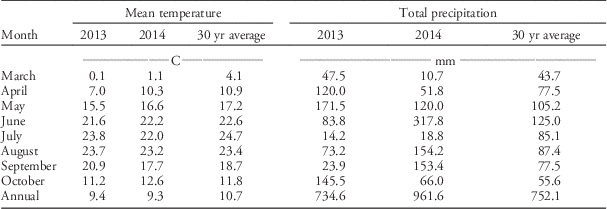
a Mean air temperature and total precipitation data were obtained from National Oceanic and Atmospheric Administration (2015).
Field experiments were arranged in a randomized complete block design with each treatment replicated four times. The herbicide programs evaluated to control glyphosate-resistant common waterhemp consisted of early-POST fb late-POST (i.e. POST-only) and PRE fb POST herbicide programs (Table 2). A nontreated control was included for comparison. Herbicides were applied with a hand-held CO2-pressurized backpack sprayer equipped with AIXR 110015 flat fan nozzles (TeeJet® Technologies, Spraying Systems Co., P.O. Box 7900, Wheaton, IL 60187) calibrated to deliver 140Lha−1 at 276 kPa at a constant speed of 4.8 kmh−1. The PRE herbicides were applied on the day of or day following soybean planting, whereas early-POST (E-POST) herbicides were applied at 21 DAPRE (July 1 2013 and June 9 2014), when common waterhemp was 8- to 12-cm tall and soybean was at the V2 to V3 stage. Late-POST (L-POST) herbicide applications were made 14 d after E-POST (DAEPOST) applications (July 15 2013 and June 24 2014), when common waterhemp plants were 15- to 20-cm tall and soybean was at the V4 to V5 stage.
Details of herbicide treatments, application timing, and rates used for control of glyphosate-resistant common waterhemp in soybean in field experiments conducted in Nebraska in 2013 and 2014.Footnote a

a Abbreviations: AMS, ammonium sulfate (DSM Chemicals North America Inc., Augusta, GA); COC, crop oil concentrate (Agridex, Helena Chemical Co., Collierville, TN); fb, followed by; NIS, nonionic surfactant (Induce, Helena Chemical Co., Collierville, TN).
b AMS was mixed at 2.5% wt/v; COC was mixed at 1% v/v; NIS was mixed at 0.25% v/v.
Data Collection
Common waterhemp control was assessed visually at 21 DAPRE, 14 DAEPOST, 14 d after late POST (DALPOST), 28 DALPOST, and at soybean harvest on a scale of 0% to 100%, with 0% meaning no control of common waterhemp and 100% meaning complete control. Common waterhemp densities were also recorded on the same dates mentioned for the visual control, by counting the number of common waterhemp plants in two 0.25 m2 quadrats placed randomly between the center two soybean rows in each plot and are presented as number of plants m−2. At 28 DALPOST, common waterhemp plants surviving herbicide treatments were cut at the soil surface from two randomly selected 0.25 m2 quadrats per plot and oven-dried at 65 C until they reached a constant weight. Aboveground dry biomass was recorded and converted into percent biomass reduction compared to the nontreated control:
 $${\rm \,\%\, biomass\ reduction\, {\equals} \, [(}C{\minus}B{\rm )\!/\:}C{]}{\times}{\rm 100}$$
where C is the biomass of the nontreated control plot, and B is the biomass of an individual treated plot. Soybean injury data were recorded at 14 DAPRE, 7 DAEPOST, 7 DALPOST, and 28 DALPOST on a scale of 0% to 100%, with 0% meaning no soybean injury and 100% meaning death of the soybean plants. Soybeans were harvested from the center two rows in each plot using a plot combine, and grain yield was adjusted to 13% moisture content.
Statistical Analysis
Data were subjected to ANOVA using the PROC GLIMMIX procedure in SAS® version 9.3 (SAS Institute Inc., 100 SAS Campus Drive, Cary, NC 27513-2414). In the model, years (experimental runs) and treatments were considered fixed effects, whereas blocks (nested within year) were considered random effects. Data were tested for normality with PROC UNIVARIATE. Visual control estimates, percent biomass reduction, and soybean injury data were arcsine square root transformed before analysis; however, back-transformed data are presented with mean separation based on transformed data. Individual treatment means were separated at the 5% level of significance using Fisher’s protected LSD test. To determine relative treatment efficacy for common waterhemp control, density, biomass reduction, and soybean yield a priori orthogonal contrasts (single degree of freedom contrasts) were performed.
Results and Discussion
Year-by-treatment interactions for glyphosate-resistant common waterhemp control, density, and biomass were not significant; therefore data were combined across the two years.
Common Waterhemp Control
The PRE herbicide programs provided ≥83% control of glyphosate-resistant common waterhemp at 21 DAPRE, indicating the importance of early season control of common waterhemp using residual PRE herbicides (Table 3). Among PRE herbicides, sulfentrazone-based tank mixtures, pyroxasulfone [5-(difluoromethoxy)-1-methyl-3-(trifluoromethyl)pyrazol-4-ylmethyl 4,5-dihydro-5,5-dimethyl-1,2-oxazol-3-yl sulfone], alone or tank-mixed with flumioxazin, S-metolachlor plus fomesafen/metribuzin, and saflufenacil plus imazethapyr plus dimethenamid-P provided 94% to 97% control at 21 DAPRE. Several studies reported application of PRE herbicides as one of the most effective methods for early-season control of common waterhemp; for example, Johnson et al. (Reference Johnson, Breitenbach, Behnken, Miller, Hoverstad and Gunsolus2012) reported that the PRE application of sulfentrazone tank-mixed with cloransulam or imazethapyr, S-metolachlor plus fomesafen provided 96% to 99% control of common waterhemp at 27 d after planting. Aulakh and Jhala (Reference Aulakh and Jhala2015) reported that the application of PRE herbicides resulted in ≥92% control of common waterhemp at 15 DAPRE. Similarly, Meyer et al. (Reference Meyer, Norsworthy, Young, Steckel, Bradley, Johnson, Loux, Davis, Kruger, Bararpour, Ikley, Spaunhorst and Butts2015) reported that PRE herbicide programs provided at least 95% control of common waterhemp at 3 to 4 wk after herbicide application.
Control of glyphosate-resistant common waterhemp in glyphosate-resistant soybean at 21 days after preemergence (DAPRE), 14 days after early postemergence (DAEPOST), 14 days after late postemergence (DALPOST), and at harvest in field experiments conducted in Dodge County, NE in 2013 and 2014.

a Abbreviations: fb, followed by.
b Data were arc-sine square-root transformed before analysis; however, back-transformed original mean values are presented based on the interpretation from the transformed data.
c Means presented within each column with no common letter(s) are significantly different according to Fisher’s protected LSD where α = 0.05.
d Early-POST herbicides were not applied at this time; therefore, control in POST-only treatments were zero. Data from POST-only treatments were not included in analysis at 21 DAPRE.
e a priori orthogonal contrasts; * = Significant (p<0.05).
Due to decline in residual activity of pyroxasulfone applied alone or tank-mixed with flumioxazin, common waterhemp control reduced to ≤86% at 14 DAEPOST (Table 3). Similarly, Knezevic et al. (Reference Knezevic, Datta, Scott and Porpiglia2009) reported that pyroxasulfone applied at 152 gaiha−1 provided 90% control of tall waterhemp [Amaranthus tuberculatus (Moq.) Sauer] at 28 d after treatment (DAT), though higher rates (≥198 gaiha−1) were needed to achieve the same level of control at 45 and 65 DAT. The POST-only herbicide programs resulted in ≤70% control at 14 DAEPOST, which was lower than PRE fb POST herbicide programs (≥83%), except for S-metolachlor or pendimethalin plus metribuzin fb fomesafen plus glyphosate, which resulted in <80% control (Table 3). Averaged across herbicide treatments, control of glyphosate-resistant common waterhemp was 87% at 14 DAEPOST compared to 57% with only E-POST application of herbicides.
The POST-only herbicide programs resulted in <82% control of glyphosate-resistant common waterhemp compared to up to 97% control with PRE fb POST programs at 14 DALPOST (Table 3). Relatively lower control of common waterhemp in POST herbicide program can be attributed to the larger plant size at the time of herbicide applications and lower herbicide coverage due to dense population, especially L-POST herbicides that were applied at the plant height of 15- to 20-cm and a density of >100 plants m−2 in the POST-only herbicide programs. Similarly, Hager et al. (Reference Hager, Wax, Bollero and Stoller2003) reported that common waterhemp control was dependent on the height of the plants; therefore, L-POST herbicide applications with acifluorfen, fomesafen, or lactofen showed ≤86% control of common waterhemp, whereas control was up to 91% at 21 DAT with E-POST applications. The PPO-inhibitors are contact herbicides that require adequate spray coverage to provide optimum weed control, especially in dense foliage (Anonymous 2012; Creech et al. Reference Creech, Henry, Werle, Sandell, Hewitt and Kruger2015). At 14 DALPOST, control of glyphosate-resistant common waterhemp was ≥94% with several PRE fb POST herbicide programs (Table 3). Similarly, Patton (Reference Patton2013) reported that the application of sulfentrazone-based PRE herbicides fb POST application of fomesafen and glyphosate, saflufenacil fb fomesafen plus glyphosate, S-metolachlor plus metribuzin fb fomesafen plus glyphosate provided ≥98% control of common waterhemp throughout the growing season. Owen et al. (Reference Owen, Lux, Franzenburg and Grossnickle2010) also reported that the application of saflufenacil plus imazethapyr fb glyphosate provided 96% and 91% control of common waterhemp at 3 and 7 wk after POST herbicide application, respectively.
Later in the season (at soybean harvest), control of glyphosate-resistant common waterhemp showed trends similar to earlier observations. Averaged across herbicide programs, control was 84% with PRE fb POST herbicide programs compared with 42% control under POST-only herbicide programs (Table 3). Results of this study showed that control of glyphosate-resistant common waterhemp was consistently higher with PRE fb POST herbicide programs compared to the POST-only programs. Similar results were reported by Johnson et al. (Reference Johnson, Breitenbach, Behnken, Miller, Hoverstad and Gunsolus2012), Legleiter et al. (Reference Legleiter, Bradley and Massey2009), and Schuster and Smeda (Reference Schuster and Smeda2007), where PRE fb POST herbicide programs resulted in higher control of common waterhemp compared to POST-only programs.
Common Waterhemp Density and Biomass
The results of common waterhemp control were reflected in common waterhemp density and biomass (Table 4). Application of PRE herbicides reduced common waterhemp density to ≤35 plantsm−2 compared with >300plantsm−2 without any herbicide application at 21 DAPRE. At 14 DAEPOST, the nontreated control had the highest number of common waterhemp plants (242 m−2), which was comparable with the sequential glyphosate treatments (215 plants m−2), indicating the presence of glyphosate-resistant common waterhemp at the experimental site. Averaged across the PRE fb POST herbicide programs, common waterhemp density increased (13 plants m−2) at 14 DAEPOST compared to 6 plants m−2 at 21 DAPRE; mainly due to reduction in residual activity of soil-applied PRE herbicides and the continuous new emergence of common waterhemp (Table 4). At 14 DALPOST, POST-only treatments of imazethapyr plus fomesafen plus glyphosate plus acetochlor fb lactofen plus glyphosate reduced common waterhemp density to 30 plants m−2, which was comparable to several PRE fb POST herbicide programs, including saflufenacil plus imazethapyr, S-metolachlor, or pendimethalin plus metribuzin fb fomesafen plus glyphosate (Table 4). The residual activity of micro-encapsulated acetochlor tank-mixed with other herbicides in POST herbicide programs can suppress common waterhemp emergence later in the growing season (Jhala et al. Reference Jhala, Malik and Willis2015). Similarly, Cahoon et al. (Reference Cahoon, York, Jordan, Everman, Seagroves, Braswell and Jennings2015) and Sarangi et al. (Reference Sarangi, Sandell, Knezevic and Jhala2013) reported that micro-encapsulated acetochlor applied alone or tank-mixed with other residual herbicides showed >90% control of common waterhemp and Palmer amaranth, reducing plant density significantly.
Effect of herbicide programs on glyphosate-resistant common waterhemp density at 21 days after preemergence (DAPRE), 14 days after early postemergence (DAEPOST), 14 days after late postemergence (DALPOST), and at harvest, and on biomass reduction in glyphosate-resistant soybean in field experiments conducted in Dodge County, NE in 2013 and 2014.

a Abbreviations: fb, followed by.
b Means presented within each column with no common letter(s) are significantly different according to Fisher’s protected LSD where α = 0.05.
c Data were arc-sine square root transformed before analysis; however, back-transformed original mean values are presented based on the interpretation from the transformed data.
d a priori orthogonal contrasts; *, significant (p<0.05); NS, non-significant.
The precipitation in early August during 2013 and 2014 (Table 1) triggered the late emergence of common waterhemp that resulted in slightly higher density at harvest and the overall increase in density from 14 DALPOST was estimated as 16% and 25% in POST-only and PRE fb POST treatments, respectively (Table 4). Hartzler et al. (Reference Hartzler, Buhler and Stoltenberg1999) reported that common waterhemp emergence can be enhanced after substantial amounts of rainfall. At harvest, lower common waterhemp densities (≤12 plants m−2) were observed with herbicide programs including saflufenacil plus imazethapyr plus dimethenamid-P fb fomesafen plus glyphosate, sulfentrazone plus cloransulam fb fomesafen plus glyphosate, S-metolachlor plus fomesafen fb acifluorfen plus glyphosate, flumioxazin plus pyroxasulfone fb fomesafen plus glyphosate, and S-metolachlor plus metribuzin fb fomesafen plus glyphosate (Table 4). Legleiter et al. (Reference Legleiter, Bradley and Massey2009) also reported that PRE fb POST herbicide programs reduced common waterhemp density up to 1 plantm−2 at 8 wk after POST herbicide treatments.
Common waterhemp biomass followed the same trend as common waterhemp control and density (Table 4). More than 85% reduction in biomass was observed in the PRE fb POST treatments including flumioxazin plus chlorimuron/pyroxasulfone, saflufenacil plus imazethapyr plus dimethenamid-P, sulfentrazone plus imazethapyr/chlorimuron/cloransulam, pyroxasulfone, S-metolachlor plus metribuzin, and all followed by fomesafen plus glyphosate and with S-metolachlor plus fomesafen fb acifluorfen plus glyphosate. The contrast analysis suggested that PRE fb POST herbicide programs provided 86% reduction in common waterhemp biomass compared with 33% reduction with POST-only programs.
Soybean Injury and Yield
Soybean injury at 14 DAPRE and at 7 DAEPOST was minimal (<6%); therefore, only injury at 7 DALPOST is presented (Table 5). The late-POST application of lactofen plus glyphosate resulted in 24% injury at 7 DALPOST compared with 15% and ≤6% injury when glyphosate was tank-mixed with acifluorfen or fomesafen, respectively. However, soybean plants were resilient enough to overcome injury at 28 DALPOST (data not shown). POST-application of PPO inhibitors during hot and humid weather may cause soybean injury at 7 to 14 DAT (Sarangi and Jhala Reference Sarangi and Jhala2015). Several other studies reported similar level of soybean injury due to POST application of PPO inhibitors, without affecting soybean yield (Legleiter and Bradley Reference Legleiter and Bradley2008; Patton Reference Patton2013; Riley and Bradley Reference Riley and Bradley2014).
Effect of herbicide programs on soybean injury and yield in field experiments conducted in Dodge County, NE in 2013 and 2014.

a Abbreviations: fb, followed by.
b Means presented within each column with no common letter(s) are significantly different according to Fisher’s protected LSD where α = 0.05.
c Soybean injury was evaluated at 7 days after late postemergence DALPOST and the data were arc-sine square root transformed before analysis; however, back-transformed original mean values are presented based on the interpretation from the transformed data.
d Year-by-treatment interaction was significant for soybean yield; therefore, data from both the years were not combined.
e a priori orthogonal contrasts; *, significant (p<0.05); NS, non-significant.
Year-by-treatment interaction was significant for soybean yield; therefore, data from 2013 and 2014 were analyzed separately (Table 5). The difference in soybean yield might be due to the substantial amount of rainfall (>150 mm) received during August and September in 2014, which resulted in stagnant water conditions for several days, affecting soybean growth and yield (Table 1). Saflufenacil plus imazethapyr plus dimethenamid-P fb fomesafen plus glyphosate resulted in 2,559 and 2,404kgha−1 soybean yields in 2013 and 2014, respectively, which were comparable to soybean yields obtained in herbicide programs including sulfentrazone plus cloransulam fb fomesafen plus glyphosate, S-metolachlor plus fomesafen fb acifluorfen plus glyphosate, S-metolachlor plus metribuzin fb fomesafen plus glyphosate (Table 5). Similarly, Legleiter et al. (Reference Legleiter, Bradley and Massey2009) reported the highest soybean yield (≥3,100 kgha−1) with S-metolachlor plus metribuzin fb lactofen/acifluorfen plus glyphosate compared to other PRE fb POST and POST-only herbicide programs.
Averaged across PRE fb POST herbicide programs, soybean yield was 2,053 and 1,974 kg ha−1 in 2013 and 2014, respectively, whereas the average yield in the POST-only programs was 1,537 and 1,048kgha−1 in 2013 and 2014, respectively. Results of this study indicate that early-season common waterhemp control using PRE residual herbicides is important to avoid soybean yield reduction. Though common waterhemp can emerge throughout the crop growing season, it is essential to control weed species effectively during the critical period of weed control in soybean, which ranges from the V1 (first trifoliate stage) to the V4 stage of soybean development, depending on the climate, row spacing, and weed species and density (Knezevic et al. Reference Knezevic, Evans and Mainz2003; Meyer et al. Reference Meyer, Norsworthy, Young, Steckel, Bradley, Johnson, Loux, Davis, Kruger, Bararpour, Ikley, Spaunhorst and Butts2015). In a previous study conducted in Illinois, Hager et al. (Reference Hager, Wax, Stoller and Bollero2002b) reported that removal of common waterhemp no later than 2wk after soybean unifoliate leaf expansion is extremely important in preventing yield reduction.
Practical Implications
Results of this study indicated that few PRE fb POST herbicide programs evaluated in this study resulted in >90% season-long common waterhemp control, significant reduction in density and biomass, and high soybean yields. In fact, averaged across programs, PRE fb POST programs provided >80% control throughout the growing season compared to POST-only programs (<65%). Effective control of glyphosate-resistant common waterhemp means less seed production per unit area, which reduces the weed seed bank (Buhler and Hartzler Reference Buhler and Hartzler2001; Legleiter et al. Reference Legleiter, Bradley and Massey2009). The application of soil-residual herbicides applied PRE is essential for providing early-season control of common waterhemp. PRE applications of very-long-chain fatty acid–inhibiting herbicides, including acetochlor, S-metolachlor, or pyroxasulfone are effective initially (25 to 35 DAT) for controlling common waterhemp, depending upon environmental conditions; however, POST herbicide applications following PRE are necessary to obtain season-long control of common waterhemp. The results from this study revealed that relying on POST-only herbicide programs would not provide economically acceptable control of common waterhemp, even if it includes herbicides with multiple modes of action; so, application of the residual PRE herbicide is important. Few herbicide premixes with multiple effective modes of action that can control glyphosate-resistant common waterhemp effectively have been registered as PRE in soybean.
Weed management programs relying on herbicide(s) with the same mode of action increase the likelihood of resistance evolving (Norsworthy et al. Reference Norsworthy, Ward, Shaw, Llewellyn, Nichols, Webster, Bradley, Frisvold, Powles, Burgos, Witt and Barrett2012; Wrubel and Gressel Reference Wrubel and Gressel1994); therefore, it is important to select programs that include herbicides with disparate modes of action to minimize selection pressure of a single herbicide or herbicides with similar modes of action. The evolution of multiple herbicide-resistant weeds has reduced the number of POST herbicide options for soybean growers. In fact, a common waterhemp biotype in Illinois was confirmed resistant to ALS inhibitors, glyphosate, PPO inhibitors, and triazine herbicides, leaving no POST herbicide option for glyphosate-resistant soybean growers (Bell et al. Reference Bell, Hager and Tranel2013). Soybean cultivars resistant to 2,4-D or dicamba will be commercialized in the near future and will provide soybean growers with additional POST herbicide options for controlling glyphosate-resistant and hard-to-control weeds (Chahal et al. Reference Chahal, Aulakh, Rosenbaum and Jhala2015; Craigmyle et al. Reference Craigmyle, Ellis and Bradley2013a, Reference Craigmyle, Ellis and Bradley2013b; Soltani et al. Reference Soltani, Shropshire and Sikkema2015; Spaunhorst et al. Reference Spaunhorst, Siefert-Higgins and Bradley2014). Management strategies for glyphosate-resistant common waterhemp must include long-term integrated strategies such as crop rotation, rotational use of herbicide-resistant crop technologies, residual herbicides, and the use of herbicides with different modes of action.
Acknowledgments
The authors would like to thank the Indian Council of Agricultural Research (ICAR), New Delhi, India for partial financial support to the graduate student involved in this study. We appreciate the help of Jordan Moody, Luke Baldridge, Ethann Barnes, Ian Rogers, Irvin Schleufer, and Mason Adams in this project.



