





Developing strong social skills early in life is critical for adaptively navigating interactions with others. Social interactions involve a highly complex continuous volley of nuanced emotional and contextual cues. One of the first social skills children develop is the ability to recognize others’ facial expressions, which is foundational for understanding and responding to others’ emotional states (Herba & Phillips, Reference Herba and Phillips2004; Malti et al., Reference Malti, Peplak, Acland and Jensen2020). Emotion recognition skills normatively improve over childhood, but some children show stronger abilities than others (Gao & Maurer, Reference Gao and Maurer2009, Reference Gao and Maurer2010; Lawrence et al., Reference Lawrence, Campbell and Skuse2015). For example, more overtly aggressive children (i.e., those who engage in hitting and verbal threats) tend to have more difficulty recognizing emotions in others, which may contribute to serious long-term challenges in various areas of life (Acland et al., Reference Acland, Jambon and Malti2021; Denham et al., Reference Denham, Caverly, Schmidt, Blair, DeMulder, Caal, Hamada and Mason2002; Hubbard et al., Reference Hubbard, McAuliffe, Morrow and Romano2010; Huesmann et al., Reference Huesmann, Dubow and Boxer2009; Schultz et al., Reference Schultz, Izard and Bear2004). Little is known, however, about how certain types of emotion recognition (i.e., biases vs. insensitivities) are associated with specific functions of aggression (i.e., proactive vs. reactive) and how these links change over development. For instance, if a child tends to misidentify others’ distress as being threatening – that is, a bias toward anger – they may be more inclined to react aggressively during challenging interpersonal situations (Crick & Dodge, Reference Crick and Dodge1994; Martinelli et al., Reference Martinelli, Ackermann, Bernhard, Freitag and Schwenck2018). Alternately, if a child has trouble detecting distress cues in others – that is, perceiving sad facial expressions as showing no emotion (sadness insensitivity) – they may engage in more goal-oriented forms of aggression as they are not receiving the type of negative feedback that should evoke affective empathy (Blair, Reference Blair1995, Reference Blair2018). To address these gaps, we examined how specific emotion recognition components may be important for different functions of aggression. We employed a developmental approach by examining these questions across childhood and early adolescence in two community samples to test the consistency of our findings.
Development of emotion recognition and overt aggression
Emotion recognition abilities typically increase over childhood, whereas overt aggression tends to peak in toddlerhood to early childhood and decreases thereafter (Côté et al., Reference Côté, Vaillancourt, LeBlanc, Nagin and Tremblay2006; Gao & Maurer, Reference Gao and Maurer2010; Herba & Phillips, Reference Herba and Phillips2004). These trends in development may be related as those who have difficulty recognizing emotions (especially negative emotions) are more likely to exhibit antisocial traits and aggression (Acland et al., Reference Acland, Jambon and Malti2021; Dawel et al., Reference Dawel, O’Kearney, McKone and Palermo2012; Marsh & Blair, Reference Marsh and Blair2008; Schultz et al., Reference Schultz, Izard and Bear2004). Further, research suggests that recognition of negative emotions may be associated specifically with overt aggression in children, as opposed to externalizing symptoms more generally (Acland et al., Reference Acland, Jambon and Malti2021). Thus, an inability to recognize negative emotional states in others may prompt inappropriate or mismatched behavioral responses in social settings (Crick & Dodge, Reference Crick and Dodge1994). However, as children age and develop more social skills, emotion recognition becomes one of many tools for understanding complex social interactions (Izard, Reference Izard2010). Poor emotion recognition in older children may, therefore, influence behavior less as they are better able to compensate for difficulties in one area with other social tools. Thus, each individual social skill might be less informative for understanding aggression as children age. Further, how individual emotions contribute and whether relations differ based on the function of aggression is unknown.
Functions of aggression
Aggressive acts can be in response to provocation (i.e., reactive aggression) or can be deliberate and goal-oriented (i.e., proactive aggression; Little et al., Reference Little, Brauner, Jones, Nock and Hawley2003). These functions of aggression often co-occur, especially in serious aggressors (Euler et al., Reference Euler, Steinlin and Stadler2017; Polman et al., Reference Polman, Orobio de Castro, Koops, van Boxtel and Merk2007), prompting discussions over whether functions of aggression are meaningfully distinct (Merk et al., Reference Merk, Orobio de Castro, Koops and Matthys2005; Waschbusch & Willoughby, Reference Waschbusch and Willoughby1998). However, researchers have found that much of the overlap may be due to methodological limitations, and functions of aggression have been linked to unique social-emotional correlates (Euler et al., Reference Euler, Steinlin and Stadler2017; Hubbard et al., Reference Hubbard, McAuliffe, Morrow and Romano2010; Jambon et al., Reference Jambon, Colasante, Peplak and Malti2019; Peplak & Malti, Reference Peplak and Malti2017; van Dijk et al., Reference van Dijk, Hubbard, Deschamps, Hiemstra and Polman2021). This suggests that functions of aggression (and their mechanisms) are meaningfully distinct and should be differentiated to better understand how aggression develops in young minds.
Regarding links between functions of aggression and emotion recognition, research with adults has shown that psychopathic traits – akin to callous-unemotional traits in childhood/youth – are related to impaired experiences and processing of fear/aversive stimuli (i.e., the low-fear and fearlessness theories; Brook et al., Reference Brook, Brieman and Kosson2013; Lykken, Reference Lykken and Lykken1995; Raine, Reference Raine2002). Callous-unemotional traits are affectively characterized by a lack of sympathy, ethical guilt, and emotionality (Frick & Ray, Reference Frick and Ray2015; Jambon et al., Reference Jambon, Colasante, Mitrevski, Acland and Malti2022). Similarly, proactive aggression has been uniquely linked to greater callous-unemotional traits and lower emotionality and sympathy in children/adolescents (Hubbard et al., Reference Hubbard, McAuliffe, Morrow and Romano2010; Jambon et al., Reference Jambon, Colasante, Peplak and Malti2019; Moore et al., Reference Moore, Hubbard, Bookhout and Mlawer2019). Thus, difficulty experiencing fear and identifying it in others may also be related to proactive aggression given its association with callous-unemotional traits. This is supported by research showing that elevated callous-unemotional traits in youth is associated with proactive aggression through reduced amygdala activation in response to fearful faces (Lozier et al., Reference Lozier, Cardinale, van Meter and Marsh2014). Further, according to the violence inhibition mechanism theory, recognition of distress signals (submission cues) inhibits violence (Blair, Reference Blair1995). Thus, if an individual has difficulty identifying when others are in distress, they may have more trouble de-escalating their behavior. Together, these theories suggest that failure to detect sadness and fear in others (i.e., distress insensitivity) may impair children’s ability to care for others’ suffering, which then increases proactive aggression (Euler et al., Reference Euler, Steinlin and Stadler2017; Jambon et al., Reference Jambon, Colasante, Peplak and Malti2019).
On the other hand, the social information processing theory suggests that the tendency to mistake ambiguous social cues and behaviors as being hostile is a socio-cognitive factor underlying reactive aggression (Arsenio & Lemerise, Reference Arsenio and Lemerise2004; Crick & Dodge, Reference Crick and Dodge1994; Dodge & Crick, Reference Dodge and Crick1990). In line with this theory, research has shown that children who are more likely to misattribute hostile intent to others in ambiguous situations tend to be more reactively aggressive (Hubbard et al., Reference Hubbard, McAuliffe, Morrow and Romano2010; Martinelli et al., Reference Martinelli, Ackermann, Bernhard, Freitag and Schwenck2018). Further, an anger attribution bias has been linked to aggression in 7-year-olds (Schultz et al., Reference Schultz, Izard and Bear2004). These findings suggest that reactively aggressive children tend to incorrectly assess others’ feelings and motivations as being angry, which may lead them to respond in kind and escalate conflicts.
The present study
The goal of the present study was to further understand associations between emotion recognition and reactive and proactive aggression over childhood and early adolescence. In study 1, we explored how happiness, sadness, anger, and fear recognition and their subforms (insensitivities versus biases) were related to overt reactive and proactive aggression in early and middle childhood (children ages 4 and 8). Based on previous research, we hypothesized that fear and sadness insensitivity would be uniquely tied to proactive aggression, whereas a bias towards anger would be uniquely related to reactive aggression. However, as we were the first to explore these queries, we tested for possible relations between all emotion recognition variables. In study 2, we assessed whether our findings from study 1 were generalizable to a similarly aged independent cohort of children (predominantly 5–6 and 8–9 years) and explored whether associations extended to early adolescence (predominantly 11–12 years). We hypothesized that links between emotion and aggression variables would be the same across ages, but that these links would be weaker in older cohorts as social skills improve as children age; thus they may rely less on any single cue. Whether relations differed based on gender was also explored; this was assessed in response to feedback from a reviewer, thus we had no a priori hypotheses for these analyses. Lastly, we combined the study samples to improve our analytic power to test associations and added age as a moderator (requested by reviewers). Gender, caregivers’ education (indicator of socioeconomic status), and age were assessed as potential control variables due to differences previously reported in children’s aggression (Baillargeon et al., Reference Baillargeon, Keenan, Wu, Zoccolillo, Côté, Pérusse, Boivin and Tremblay2007; Letourneau et al., Reference Letourneau, Duffett-Leger, Levac, Watson and Young-Morris2013; Tremblay et al., Reference Tremblay, Nagin, Séguin, Zoccolillo, Zelazo, Boivin, Pérusse and Japel2004).
Method
Participants
The only exclusion criterion for both studies was the presence of an autism spectrum disorder as the studies contain social tasks that may be uncomfortable for children on the spectrum to complete. Both samples were similarly ethnically diverse and drawn from the same geographical area. All children and caregivers were fluent in English. Education level of the participating caregivers was somewhat higher than the population level of education for the sampled city and samples appeared similarly ethnically diverse to the recruited populationFootnote 1 .
Study 1
Children from both early (4-year-old cohort: M = 4.53, SD = .30, range = 4.03 – 4.99, n = 150, 50% girls) and middle childhood (8-year-old cohort: M = 8.52, SD = .27, range = 8.01 – 9.06, n = 149,Footnote 2 50% girls) and their primary caregivers participated. Families were recruited from local community centers, events, and summer camps in an urban Canadian city. Cross-sectional data from the first data collection wave – assessments took place between 2015 and 2017 – of a longitudinal study was used for the present study. Ethnicity of participating caregivers was reported as follows: 22% Western European, 16% South/Southeast Asian, 10% East Asian, 8% Central/South American & Caribbean, 6% Eastern European, 3% African, 1% West/Central Asian, 1% Middle Eastern, 18% multi-ethnic, and 3% other (11% missing/chose not to answer). The highest level of education attained by the participating caregiver was: 3% PhD, 21% master’s degree, 49% bachelor’s degree, 17% college degree, 1% apprenticeship or trades diploma, 4% high school diploma, 1% no diploma, 3% chose not to answer.
Study 2
Participants of specific ages were focused on during recruitment to allow comparisons between distinct developmental periods. Ages that were over-sampled included those aged 5 to 6 (M = 6.25, SD = 0.56, range = 5.04 – 6.98, n = 126, 46% girls), 8 to 9 (M = 9.20, SD = 0.73, range = 7.08 – 10.7, n = 124, 52% girls), and 11 to 12 (M = 12.24, SD = 0.60, range = 11.1 – 13.8, n = 124, 53% girls) years, creating a trimodal distribution of ages. These distinct age groups are referred to as the 6-, 9-, and 12-year-old cohorts, which represent early childhood, middle-to-late childhood, and early adolescence, respectively. Families were recruited from schools, local community centers, events, and summer camps from four geographically close urban Canadian cities (same area as in study 1). The ages of the participants recruited from schools (n = 178) versus the community (n = 196) did not significantly differ (t(345) = −1.90, p = .058). Families participated in assessments between the years 2017 and 2019 and the study design was cross-sectional. Ethnicity of participating caregivers was reported as follows: 17% Western European, 13% North American, 7% South/Southeast Asian, 6% East Asian, 6% Eastern European, 3% Central/South American, 1% West/Central Asian, 2% Middle Eastern, 11% multi-ethnic, and 9% other; 25% missing/chose not to answer. The highest level of education attained by the participating caregiver was: 4% PhD, 14% master’s degree, 33% bachelor’s degree, 24% college degree, 2% apprenticeship or trades diploma, 7% high school diploma, 1% no diploma, and 15% chose not to answer.
Procedure
The University of Toronto ethics review board granted approval prior to the start of data collection for both studies (“Longitudinal Study of Emotions, Aggression, and Physiology,” #00028256 and “Intergroup Membership and Moral Emotional Responding across Social Encounters,” #35578). For study 1 and 2, written informed consent was obtained from caregivers and oral assent was obtained from children. Child interviewers were undergraduate and graduate psychology students with extensive training on child interview techniques. Each child and their caregiver(s) visited the laboratory for approximately 60 minutes. Children were assessed in a designated testing room while their caregiver remained in a nearby waiting area to complete questionnaires on a touch-screen tablet. After the assessments, caregivers were debriefed. In study 2, children who were recruited through schools engaged in the interview at their school in a private room, and questionnaires were sent to caregivers to complete by mail. Children were provided with debriefing information to share with their caregiver. All children received an age-appropriate book as a gift following the session.
Measures
Emotion recognition
Children completed a validated sorting task assessing their recognition of angry, happy, fearful, and sad facial expressions (Gao & Maurer, Reference Gao and Maurer2009, Reference Gao and Maurer2010). They were presented with 10 photographs of each emotional facial expression. Each emotional expression ranged from 10% to 100% intensity, which was created by morphing emotional faces with a neutral face (see example in Supplementary Figure 1). One “true” neutral facial expression (i.e., no emotion) was presented. Facial expressions were from one adult woman (study 1 and 2) and man (study 2) from the NimStim Set of Facial Expressions (Tottenham et al., Reference Tottenham, Tanaka, Leon, McCarry, Nurse, Hare, Marcus, Westerlund, Casey and Nelson2009). Children were presented (gender-matched in study 2) faces in a random order and were asked to put the photographs of faces into houses labeled with corresponding emoticons (including a neutrally expressive emoticon). They were not told how many facial expressions there were for each emotion/nonemotion. Children who were interviewed in schools participated in a portable digital version of the task whereby each facial expression photograph was presented to the child on an iPad, and children had to verbally indicate (with reference to an emotion scale they were previously instructed how to use) which emotion the adult was showing.
Coding
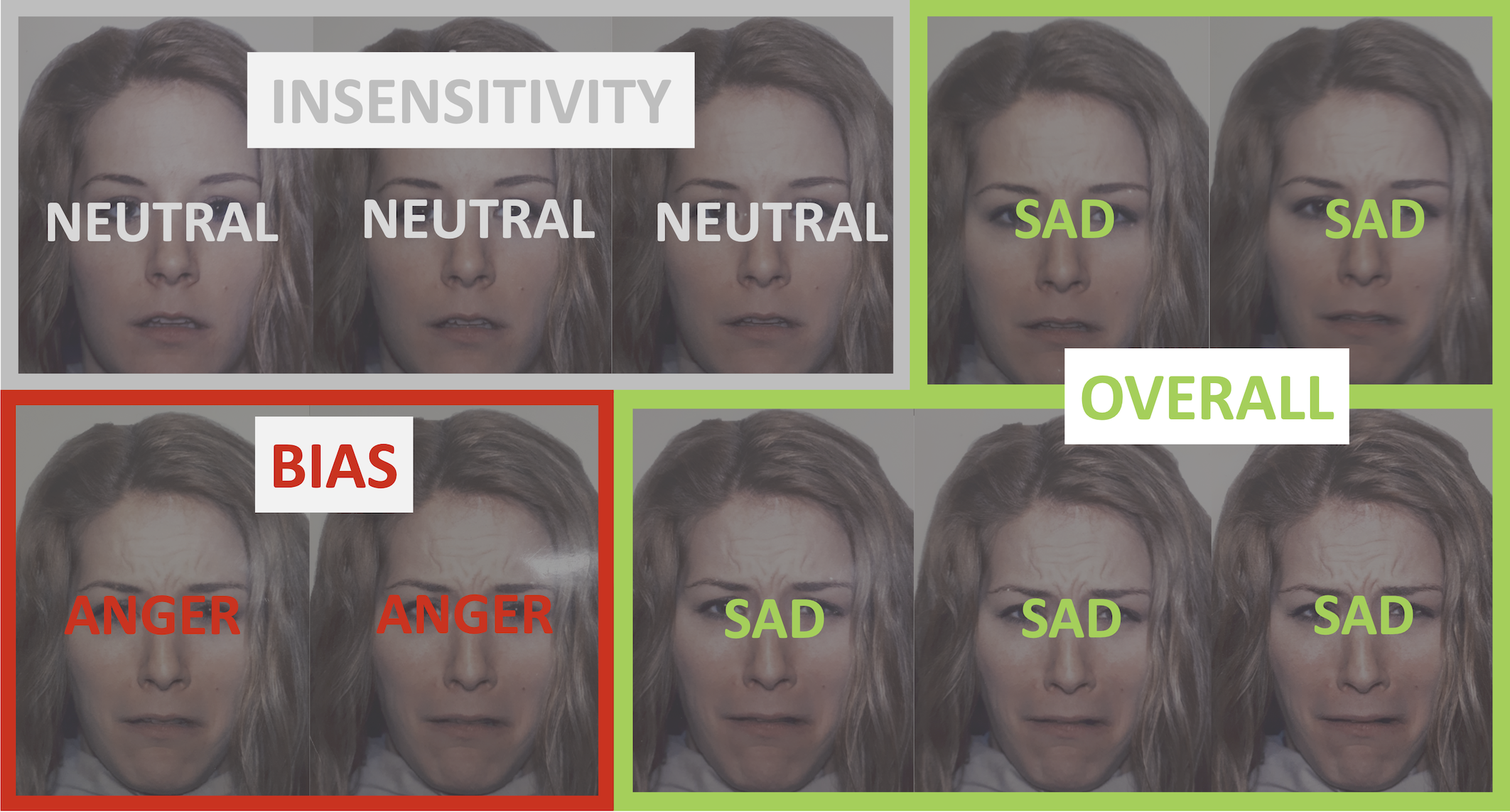
Three types of emotion recognition scores were calculated: overall, insensitivity, and bias scores (see Figure 1 for examples; overall α = .78, .76, insensitivity α = .78, .85, bias α = .80, .81, respectively for study 1 and 2). All scores were calculated as proportions for each discrete emotion (ranging from 0 to 1). A higher overall score reflected increased accuracy of identifying that discrete emotion. For example, if a child identified six (out of a possible ten) sad faces as sad they would have an overall sadness score of 0.60. Higher insensitivity scores reflected less sensitivity to an emotion (i.e., more likely to identify that emotion as showing no emotion). For example, if a child identified three (out of a possible ten) sad faces as neutral they would have a sadness insensitivity score of 0.30. Higher bias scores reflected a greater tendency to mistake other emotions for a particular (incorrect) emotion. For example, if a child identified five (out of a possible thirty-one) happy, sad, fear, and/or neutral faces as angry they would have an anger bias score of 0.16.
An example of how a participant may hypothetically identify the 10 sad facial expressions presented (ordered here from 10% to 100% sad) and how these identifications contribute to their overall, bias, and insensitivity scores. The top-left group shows how identifying sad faces as showing no emotion (neutral) is used to create the participant’s sadness insensitivity score (3/10 sad faces = 0.3 sadness insensitivity). The right-hand group shows how identifying sad faces as being sad is used to create the participants overall sadness score (5/10 sad faces = 0.5 overall sadness recognition). The bottom-left group shows how incorrectly identifying sad faces as being angry adds to the participant’s anger bias score (2/31 non-angry faces = +0.07 to anger bias score).
Secondary scores were also created to assess the influence of emotion intensity on findings (requested by reviewers). The same scores were created as described above except that they were grouped into the following emotion intensities: 10–20%, 30–40%, and 50%+. These grouping ranges were based on emotion recognition accuracy plateauing when the emotion intensity reaches ∼50% (see example in Supplementary Figure 2). The other difference was that the intensity scores were count variables, not proportions, due to the rarity of certain identifications. For example, the anger insensitivity score for 50%+ intensity would be the number of times a participant identified an angry face that was 50 to 100% intense as appearing neutral.
Aggression
Caregivers completed a questionnaire on children’s dispositional overt reactive and proactive aggression. In study 1, the overt reactive and proactive 12-item self-report scale from Little et al. (Reference Little, Brauner, Jones, Nock and Hawley2003) was adapted and assessed on a 7-point scale (0 = never to 6 = always; reactive: 4-year-olds α = .89, 8-year-olds α = .85; proactive: 4-year-olds α = .89, 8-year-olds α = .86). In study 2, six items from the overt reactive and proactive self-report scale were adapted from Little et al. (Reference Little, Brauner, Jones, Nock and Hawley2003). Items for reactive aggression included: “when hurt by someone, often fights back,” “when threatened by someone, often threatens back,” “often hurts others who make him/her mad or upset.” Items for proactive aggression included: “often hits, kicks, or punches others to get what s/he wants,” “often threatens others to get what s/he wants,” “often starts fights to get what s/he wants.” Items were assessed on a 6-point scale (1 = not at all true to 6 = always true; reactive: 6-year-olds α = .82, 9-year-olds α = .83, 12-year-olds α = .74; proactive: 6-year-olds α = .76, 9-year-olds α = .81, 12-year-olds α = .78).
Control variables
Caregivers’ education, children’s date of birth, and children’s gender (coded as: boy = 0, girl = 1) were reported by caregivers. Caregivers’ education was used as a proxy for socioeconomic status. The participating caregiver reported both their own and their partner’s highest education attained; the caregiver with the higher educational attainment was used as a control variable. Caregiver education options ranged from 1 (no high school diploma) to 7 (PhD degree). In combined sample analyses, participant membership in study 1 or 2 and assessment location (school versus laboratory) were also tested as controls.
Data analyses
First, we ran boxplots separately by age group to examine potential outliers in the total emotion recognition scores. Descriptive statistics with independent sample t tests (study 1) and one-way ANOVAs (study 2) were performed on control variables, criterion variables, and emotion recognition scores to assess mean-level differences between age groups. Emotion recognition scores were only included in the descriptive statistics if they were found – via analyses described below – to be consistently related to aggression in both studies; significant emotion recognition variables identified in the study 2 early adolescence cohort were also included. Correlations separated by age were performed (via the corrplot package in R; Wei & Simko, Reference Wei and Simko2021) to explore relations between all study variables. A simplified correlation matrix including only emotion variables that were consistently associated with aggression across studies was also included for communication purposes (see Figure 2). Control variables that were not significantly related to aggression were included as auxiliary variables in models to aid in missing data estimation.
Age-separated zero-order correlations for emotion recognition (only consistent predictors included), covariates, and aggression for study 1 (left plot) and 2 (right plot). Correlations for 4- and 6-year-old cohorts are on right-upper sides of plots, while 8- and 9-year-old cohorts are on left-lower sides of plots. *p ≤ .05, **p ≤ .01, ***p ≤ .001.

Study 1: model 1
First, study 1 was used to explore potential relations between emotion recognition variables and aggression in children. Study 2 was later used to assess the generalizability and consistency of findings from study 1. A power sensitivity analysis (via G*Power 3.1; Faul et al., Reference Faul, Erdfelder, Buchner and Lang2009) indicated that for the exploratory analyses in study 1, there was an 80% chance of correctly rejecting the null hypothesis when relations were r ≥ .21 via the following specifications: α = .05, N = 299, Power = 0.80, number of predictors per model = 5.
In study 1, multigroup path analyses were performed in R (version 4.1.2) using the lavaan package (Rosseel, Reference Rosseel2012). Different types of emotion recognition scores were assessed in separate models as one type of score can affect another type of score (e.g., having a bias for angry faces reduces other emotions’ overall correct scores). In model 1a, overall emotion recognition scores were assessed for their relations to reactive and proactive aggression. In model 1b, emotion insensitivity scores were assessed, and in model 1c, emotion bias scores were assessed. Several variables were skewed (see Tables 1 and 2). To accommodate these nonnormal distributions, we used maximum likelihood estimation with robust standard errors (MLR estimator; Lai, Reference Lai2018).
Descriptive statistics by age group

Note. Both age groups contained 50% girls. M = mean, SD = standard deviation.
a Levene’s test for equality of variance was significant (p < .05): t test estimates not assuming equal variances were used in these cases.
Descriptive statistics by age group

Note. One-way ANOVA tests were performed to assess mean differences between age cohorts. The ns for the three age cohorts were as follows (respectively): Education = 109, 102, 107, emotion recognition = 123, 116, 117, aggression = 109 for all. M = mean, SD = standard deviation.
a p < .05 Tukey HSD test between age 6 and 9 cohorts.
b p < .05 Tukey HSD test between age 6 and 12 cohorts.
c p < .05 Tukey HSD test between age 9 and 12 cohorts.
Each model was tested in several steps. First, multigroup path models that freely estimated parameters between age groups and gender were compared to models where the regressions and intercepts were constrained to be the same in both age and gender groups (using a likelihood ratio test). If unconstrained models had significantly better fit, they were retained. If the multigroup age or gender path model was supported, subsequent path models were conducted separately by age or gender, respectively. As is best practice to assess robustness of findings, relations were tested for their sensitivity to model specifications (Nuijten, Reference Nuijten, O’Donohue, Masuda and Lilienfeld2021); nested models – where nonsignificant paths were constrained to 0 – were compared to the unconstrained models. If models were not significantly different (via likelihood ratio test), nonsignificant paths/variables were trimmed from the model. Main findings were then reassessed for their consistency in the more parsimonious trimmed models. Lastly, to assess whether relations found were unique to one function of aggression, models were re-run controlling for the influence of the other function of aggression.
Study 2: models 1 & 2
Trimmed models 1a-c from study 1 – that is, only including variables that were significant and robust from study 1 – were reassessed in similarly aged cohorts in study 2 to examine the generalizability and consistency of the study 1 exploratory findings (statistics reported in-text). For example, significant findings in 4-year-olds from study 1 were retested in study 2’s 6-year-old cohort. Study 2 also included an early adolescent cohort that was not present in study 1. Emotion scores for this cohort were analyzed using the same exploratory method as was done in study 1 (with the exception of conducting multigroup analyses; models 2a–c).
Combined sample and intensity analyses: models 3 & 4
Exploratory models 1a-c were performed again except the two samples were combined and age was used as a moderator (models 3a-c; N = 674; methodological details in Supplementary Materials Appendix A). A power sensitivity analysis indicated that there was an 80% chance of correctly rejecting the null hypothesis when relations were r ≥ .16 via the following specifications: α = .05, N = 674, Power = 0.80, number of predictors per model = 13. Lastly, emotion recognition scores that were consistently related to aggression across studies were analyzed to assess whether relations were specific to certain emotional intensities, for example, determining whether identifying fear correctly only matters at high (50%+) emotional intensities (models 4a-c). Models 3 and 4 analyses were requested by reviewers.
Missing data
In study 1, data were missing for the emotion recognition task (n = 4) and caregiver education (n = 9). Little’s missing-completely-at-random test was nonsignificant, X 2 (19, N = 299) = 11.71, p = .898. In study 2, data were missing for the emotion recognition task (n = 17), aggression (n = 47), and education (n = 57). Little’s missing-completely-at-random test was nonsignificant, X 2 (96, N = 374) = 106.5, p = .218; full information maximum likelihood was used to estimate missing data (Enders & Bandalos, Reference Enders and Bandalos2001).
Results
Descriptive statistics
Three extreme outliers (i.e., 1.5 × interquartile range) were identified. In study 1, one participant scored 6.7 standard deviations (SDs) below the average for 8-year-olds on emotion recognition. In study 2, one scored 4 SDs below the average for the 9-year-old cohort and one scored 6.5 SDs below the average for the 12-year-old cohort on the emotion recognition task. These participants’ emotion recognition data were treated as missing in all analyses.
Descriptive statistics and independent sample t tests and one-way ANOVAs for age group comparisons are provided in Tables 1 and 2. Overall fear recognition was significantly greater in ages 8 and 9 compared to ages 4 and 6, while a bias for sad faces was significantly lower in ages 8 and 9 compared to ages 4 and 6, respectively. The mean level of happiness and sadness bias for most age cohorts was relatively low (average of <2 expressions identified incorrectly as happy/sad). In both studies, proactive and reactive aggression were lower in ages 8 and 9 compared to ages 4 and 6, and were lower in 12-year-olds compared to 9-year-olds, however, not all of these differences were significant. Age differences in happiness bias and anger insensitivity were inconsistent between studies, making inferences about developmental differences not possible for these measures. Together this suggests that older children/youth exhibit fewer errors in emotion recognition and less aggression, however, they do not show consistent advantages in all areas.
Zero-order correlations for all covariates, aggression, and emotion recognition variables are included in Supplementary Figures 3–5 (see Figure 2 for matrix including controls, aggression, and only consistent emotion recognition predictors). There were two correlations that were significant in both studies: in both 4- (study 1) and 6-year-olds (study 2), greater overall fear recognition was related to lower proactive aggression, and a bias for happy faces was related to higher reactive aggression. This suggests that overall fear recognition and happiness bias scores are consistently related to aggression in early childhood across studies. To further probe these relations path analyses were performed to account for missing data and potential confounds.
Relations between emotion recognition and aggression
For models 1a-c, multigroup analyses and model fit indices are provided in Supplementary Tables 1–3. For models 2a-c, path analysis estimates are provided in Supplementary Tables 4–6. In all study 1 models (1a–c), model fit significantly improved when regressions and intercepts were unconstrained between the 4- and 8-year-old groups, supporting that emotion scores and their relations to aggression vary by age. Allowing model regressions and intercepts to vary by gender significantly improved some fit indices for model 1b, however, worsened others to unacceptable levels. This gender difference was also not consistent between study 1 and 2Footnote 3 . Thus, gender invariant and age group variant models were retained, that is, models were assessed separately by age group, but not gender. Models 3a-c path analysis estimates are provided in Supplementary Tables 7–9. Insensitivity scores were moderately-to-strongly correlated (see Supplementary Figures 3–5); however, insensitivity models had Variance Inflation Factors ranging from 1.39 to 1.62 in study 1 and from 1.54 to 2.83 in the 12-year-old cohort in study 2, suggesting collinearity was not a serious concern.
Overall emotion recognition
Study 1
In 4-year-olds, higher overall fear recognition was related to significantly lower proactive and reactive aggression, whereas, in 8-year-olds, none of the overall emotion scores were related to aggression. The 4-year-old nested model – where nonsignificant paths were constrained to 0 – did not significantly differ from the more complex model (age 4: Δχ2(Δ8, 150) = 13.5, p = .097). Findings for the 4-year-old cohort remained unchanged in the trimmed model, such that overall fear recognition was related to proactive (B = −0.42, SE = .17, β = −.16, p = .015) and reactive aggression (B = −0.62, SE = .26, β = −.17, p = .015). Adding overall fear recognition accounted for a ΔR 2 = .029, .029 for reactive and proactive aggression. These relations were not maintained when proactive was controlled in the overall fear-reactive path, and vice versa (B = −0.16, SE = .20, β = −.04, p = .413; B = −0.06, SE = .13, β = −.02, p = .658, respectively), suggesting this relation is not unique to one form of aggression.
Study 2
In the 6-year-old cohort, overall fear recognition was similarly (but not significantly) related to proactive aggression as in study 1 (B = −0.65, SE = 0.38, β = −.20, p = .085), but was not similarly related to reactive aggression (B = −0.18, SE = 0.42, β = −.04, p = .671). Adding overall fear recognition accounted for a ΔR 2 = .040 of proactive aggression. Further, constraining the relation between overall fear recognition and reactive aggression to zero did not significantly worsen model fit indices (Δχ2(Δ1, 126) = 0.18, p = .669), and resulted in the fear-proactive relation becoming significant (B = −0.56, SE = 0.27, β = −.17, p = .036); thus, together, the path model findings, the effect sizes, and the significant zero-order correlations suggest that the relation between higher overall fear recognition and lower proactive aggression in early childhood was consistent between studies. However, whether poor fear recognition is uniquely related to proactive aggression remains unclear. No overall emotion score was related to aggression in the 12-year-old cohort.
Combined samples
When age cohorts and studies were combined, greater overall sadness recognition was significantly related to lower proactive aggression; nested models did not significantly differ from the more complex models (trimming step 1: Δχ2(Δ11, 674) = 14.0, p = .235; step 2: Δχ2(Δ8, 674) = 8.24, p = .411). In the trimmed model, overall sadness recognition maintained a significant relation to proactive aggression (B = −0.38, SE = .12, β = −.10, p = .001). After nonsignificant relations were trimmed, higher overall fear recognition was associated with lower proactive aggression (B = −0.22, SE = .10, β = −.07, p = .027). Adding overall fear and sadness recognition each accounted for a ΔR 2 = .009 of proactive aggression. Both relations were maintained when reactive was controlled (sad-proactive: B = −0.41, SE = .12, β = −.11, p > .001; fear-proactive: B = −0.23, SE = .10, β = −.07, p = .023), suggesting these relations are unique to proactive aggression.
Emotion recognition insensitivity
Study 1
In 4-year-olds, none of the insensitivity scores were significantly related to aggression, whereas, in 8-year-olds, greater insensitivity to angry faces was related to higher proactive aggression. In 8-year-olds, the nested model did not significantly differ from the more complex model (Δχ2(Δ8, 149) = 6.74, p = .565). In the trimmed model, the relation between anger insensitivity and proactive aggression was maintained (B = 1.24, SE = .50, β = .17, p = .013). Adding anger insensitivity accounted for a ΔR 2 = .030 of proactive aggression. Controlling for reactive aggression did not meaningfully alter this relation (B = 0.99, SE = .36, β = .14, p = .006).
Study 2
No significant relations were found in the 4-year-old cohort in study 1, thus no relations were tested in the 6-year-old cohort. In the 9-year-old cohort, higher anger insensitivity was significantly related to higher proactive aggression (B = 1.24, SE = 0.62, β = .17, p = .044); controlling for reactive aggression did not meaningfully alter this finding (B = 1.05, SE = 0.43, β = .15, p = .014). Adding anger insensitivity accounted for a ΔR 2 = .029 of proactive aggression. Thus, we found that higher anger insensitivity was consistently and uniquely linked to greater proactive aggression in middle-to-late childhood across studies. No insensitivity emotion score was related to aggression in the 12-year-old cohort.
Combined samples
Greater anger insensitivity was significantly related to higher proactive aggression; nested models did not significantly differ from the more complex models (step 1: Δχ2(Δ10, 674) = 7.04, p = .722; step 2: Δχ2(Δ7, 674) = 7.50, p = .379; step 3: Δχ2(Δ1, 674) = 1.15, p = .285). In the final trimmed model, anger insensitivity maintained a significant relation to proactive aggression (B = 0.54, SE = .21, β = .08, p = .009). Adding anger insensitivity accounted for a ΔR 2 = .007 of proactive aggression; this relation was maintained when reactive was controlled (B = 0.72, SE = .20, β = .11, p > .001), suggesting a unique relation to proactive aggression.
Emotion recognition bias
Study 1
In 4-year-olds, a bias for happy faces was significantly related to greater reactive aggression. In 8-year-olds, a bias for sad and happy faces was related to lower proactive aggression and a bias for sad and angry faces was related to lower reactive aggression. Nested models for the 4- and 8-year-old cohorts did not significantly differ from the more complex models (age 4: Δχ2(Δ8, 150) = 7.77, p = .456; age 8: Δχ2(Δ7, 149) = 6.16, p = .521). In the trimmed model for 4-year-olds, the relation between happiness bias and reactive aggression was maintained (B = 2.55, SE = 1.07, β = .19, p = .017). Happiness bias accounted for a ΔR 2 = .035 of reactive aggression. In the trimmed model for 8-year-olds, the links between happiness bias and proactive aggression (B = −3.43, SE = 2.18, β = −.07, p = .116), and anger bias and reactive aggression (B = 7.46, SE = 4.76, β = .10, p = .117) were sensitive to model specifications and, thus, may not be robust. Constraining these paths to zero did not significantly worsen model fit (Δχ2(Δ2, 149) = 5.69, p = .058). In the further trimmed model, the link between greater sadness bias and lower proactive (B = −1.60, SE = 0.71, β = −.14, p = .023) and reactive (B = −2.12, SE = 1.05, β = −.13, p = .044) aggression was maintained. This link was not maintained when reactive aggression was controlled, or vice versa (B = −0.65, SE = 0.48, β = −.06, p = .175; B = −0.46, SE = 0.75, β = −.03, p = .537, respectively). Sadness bias accounted for ΔR 2 = .021, .016 of proactive and reactive aggression, respectively.
Study 2
In the 6-year-old cohort, a bias for happy faces was significantly related to higher reactive aggression (B = 2.31, SE = 0.88, β = .23, p = .009); controlling for proactive aggression did not meaningfully alter this finding (B = 1.51, SE = 0.69, β = .15, p = .029). Happiness bias accounted for ΔR 2 = .040 of reactive aggression. Thus, the unique relation between a bias for happy faces and higher reactive aggression in early childhood was consistent across studies. In the 9-year-old cohort, sadness bias was not significantly related to proactive aggression (B = −1.13, SE = 1.37, β = −.05, p = .409) and sadness and anger bias were not significantly related to reactive aggression (B = −1.99, SE = 2.14, β = −.07, p = .354; B = 0.98, SE = 0.84, β = .06, p = .242); thus, these findings from study 1 were not consistent with study 2. However, in the 12-year-old cohort, a bias for sad faces was linked to significantly lower reactive aggression. The nested model for 12-year-olds did not significantly differ from the more complex model (Δχ2(Δ7, 124) = 8.96, p = .263). In the trimmed model, the relation between a bias for sad faces and lower reactive aggression was maintained (B = −13.3, SE = 3.84, β = −.25, p = .001). Sadness bias accounted for a ΔR 2 = .064 of reactive aggression.
Combined samples
Greater sadness bias was significantly related to lower proactive and reactive aggression; these relations were also significantly moderated by age. Higher happiness bias was significantly related to lower reactive aggression and this link was also moderated by age. Nested models did not significantly differ from the more complex model (step 1: Δχ2(Δ8, 674) = 11.8, p = .163; step 2: Δχ2(Δ5, 674) = 5.65, p = .342; step 3: Δχ2(Δ1, 674) = 7.23, p = .124). Trimming models caused sadness bias relations to become nonsignificant (ps > .05), suggesting that these relations may not be robust. In the trimmed model, happiness bias no longer had a significant main relation (B = 0.73, SE = 0.42, β = .06, p = .083), however, age still significantly moderated the relation to reactive aggression (B = −0.29, SE = 0.13, β = −.07, p = .030). Adding the age*happiness bias interaction accounted for a ΔR 2 = .006 of reactive aggression; this relation was maintained when proactive was controlled (B = −0.29, SE = 0.13, β = −.07, p = .030), suggesting a unique relation to reactive aggression.
Emotion intensities
When emotion variables were separated by expression intensity and entered into trimmed path models including only consistent predictors across studies, several patterns emerged (see Supplementary Tables 10–12). In the 4- and 6-year-old cohorts from study 1 and 2, greater fear recognition at 30–40% expression intensity was consistently related to lower proactive aggression and accounted for a ΔR 2 = .045, .051 of proactive aggression, respectively. In study 1, the 10–20% intensity fear recognition-proactive relation was also significant. Reporting that 10–20% intensity non-happy facial expressions appeared happy was consistently related to greater reactive aggression. There were also significant happy bias-reactive relations at 30–40% and 50%+ intensities, although inconsistently between studies. This suggests that in early childhood, more accurate recognition of ambiguous/subtle fear expressions is especially related to lower proactive aggression and a bias for reporting non-happy faces as happy across emotional intensities is related to greater reactive aggression.
In the 8- and 9-year-old cohorts from study 1 and 2, no consistent patterns of how emotion intensity may alter relations emerged. In the 12-year-old cohort, reporting 10–20% intensity non-sad faces as appearing sad was the only significant link to lower reactive aggression. This suggests that perceiving subtle non-sad emotions as being sad is linked to lower reactive aggression in early adolescence.
Together we found several consistent findings across studies and one exploratory finding; see Figure 3 for trimmed path models with consistent predictor variables. Higher proactive aggression was linked to (1) poorer recognition of subtle fearful faces, especially in 4- and 6-year-old cohorts, (2) poorer recognition of sad faces, and (3) misidentifying angry expressions as showing no emotion (anger insensitivity), especially in 8- and 9-year-old cohorts. Greater reactive aggression was linked to (1) identifying non-happy faces as being happy (happy bias), but only in 4- and 6-year-old cohorts, and (2) being less likely to perceive subtle non-sad emotions as being sad (low sadness bias), but only in the 12-year-old cohort (exploratory finding).
(a) Path model includes all significant relations from exploratory analyses on full combined samples (N = 674, age range = 4 to 13 years). Exact age was included as a covariate for proactive aggression. Happiness bias, exact age, assessed at school (as opposed to the laboratory), and gender were included as covariates for reactive aggression. Auxiliary variables included age cohort, caregiver education, and whether they were a part of study 1 or 2. (b, c) Path models include all relations that were consistent between study 1 and 2 for each similarly aged cohort (n = 150, 126, Mage = 4, 6 years; n = 149, 124, Mage = 8, 9 years, respectively for study 1 and 2). Study 1: estimates are on the top-side of arrows and R2 is on the left-side; study 2: estimates on bottom-side of arrows and R2 on right-side. In the study 1 model for 4-year-olds, overall fear recognition was allowed to covary with reactive aggression. For ages 4 & 6 models, gender was included as a predictor for reactive aggression, for ages 8 & 9, gender was included as an auxiliary variable. Exact age and caregivers’ highest level of education were included as auxiliary variables in all models. Fit indices for panels a and b (combined and study 1, 2), respectively: SRMR = .02, .04, .05, RMSEA = .05, .05, .00, CFI = 0.99, 0.99, 1.00, TLI = 0.93, 0.98, 1.00. Panel c was a saturated model, thus did not have fit indices. B = unstandardized beta, () = standard error, β = standardized beta. *p < .05, ** p < .01.

Discussion
The present paper employed a multi-study design to explore how different types of emotion recognition associate with aggression across childhood. We assessed two forms of overt aggression (proactive and reactive) and three types of emotion recognition (overall, insensitivity, and bias) in two independent, diverse, community samples of children. Developmentally-sensitive emotion biases and sensitivities were found to be important for specific functions of aggression. Several novel developmental and emotion recognition findings were identified, and past findings on emotion recognition were further clarified, contributing an important addition to the developmental literature.
Emotion recognition and proactive aggression
Sadness and fear insensitivity were expected to be related to proactive aggression given past theories and findings (e.g., violence inhibition mechanism model, low-fear hypothesis, and fearlessness theory; Blair, Reference Blair1995, Reference Blair2018; Brook et al., Reference Brook, Brieman and Kosson2013; Lykken, Reference Lykken and Lykken1995; Raine, Reference Raine2002). We did not find that sadness and fear insensitivity were related to proactive aggression, however, the overall recognition scores for sadness and fear were associated with proactive aggression, partially supporting our hypothesis. This suggests that both distress recognition specificity and sensitivity are important for understanding proactive aggression in children. Specifically, we found that greater accuracy recognizing fearful expressions – especially in early childhood and when expressions were subtle – and sad facial expressions were related to relatively lower levels of proactive aggression. Additionally, we identified a novel, unexpected, consistent link between anger insensitivity and proactive aggression; mistaking angry expressions as showing no emotion (anger insensitivity) was consistently and uniquely related to greater proactive aggression, especially in mid-to-late childhood. Our findings extend previous research showing that sadness, fear, and anger recognition difficulties in children are linked to callous-unemotional traits – traits that are uniquely associated with proactive aggression (Dawel et al., Reference Dawel, O’Kearney, McKone and Palermo2012; Hubbard et al., Reference Hubbard, McAuliffe, Morrow and Romano2010; Jambon et al., Reference Jambon, Colasante, Peplak and Malti2019). Further research is needed to confirm that callous-unemotional traits are a mediating mechanism for why difficulty recognizing these negative emotions is related to proactive aggression in children.
Past research on callous-unemotional traits and aggression has not explored whether links to different negative emotions are sensitive to the developmental period of the child. We expected that associations between emotion recognition and aggression would weaken as children age. Instead, we found that different types of emotion recognition mattered more at different developmental periods. Gains in emotion recognition across childhood have been reported to be asymmetric depending on age and the specific emotion (Gao & Maurer, Reference Gao and Maurer2010). For example, fear recognition improved with age – in study 1, on average 45% (age 4) versus 74% (age 8) of fearful faces were accurately identified – therefore early differences in children’s abilities to recognize fear could indicate relatively greater socio-emotional skills, and concordantly lower aggression. Low and moderate levels of overt aggression is normative in young children, and typically decreases thereafter (Côté et al., Reference Côté, Vaillancourt, Barker, Nagin and Tremblay2007). This would explain why these early emotion recognition-aggression links may be temporary, as both these attributes are more normatively challenging early on, but then improve over time. Alternately, anger insensitivity was relatively similar across all ages (ranging on average from 17% to 22% across age cohorts; see Tables 1 and 2). As overt aggression normatively peaks in early childhood (Côté et al., Reference Côté, Vaillancourt, LeBlanc, Nagin and Tremblay2006), it is possible that sensitivity to threats (i.e., anger) becomes especially important once children are actively learning to avoid overt conflicts. Additionally, physical conflicts can become more dangerous as children age, increasing the importance of being sensitive to threat cues; sensitivity to threats may matter less when threatening behavior is relatively inconsequential. Together these findings suggest that threat-related cues can either serve as protective or risk factors as children age and navigate their social environments. Fear perception may be a protective factor early on, making children risk averse. Conversely, anger insensitivity may promote reckless or fearless behavior as children age and become more likely to cause serious physically harm. Future longitudinal research will need to explore these possibilities. Lastly, previous research suggests sadness recognition is important for psychopathic/callous-unemotional traits, our findings extend this to include proactive aggression and we showed that this relation may not depend on age during childhood and early adolescence (Dawel et al., Reference Dawel, O’Kearney, McKone and Palermo2012).
Together, these findings support the violence inhibition mechanism and the low-fear/fearlessness hypotheses, such that children exhibiting greater proactive aggression may have more difficulty detecting cues of distress in others. These recognition difficulties may originate from the aggressors experiencing shallow affect (i.e., lacking emotional depth), making it difficult for them to see those same emotions in others (Hubbard et al., Reference Hubbard, McAuliffe, Morrow and Romano2010; Schultz et al., Reference Schultz, Izard and Bear2004). These recognition challenges may also maintain or escalate their aggression as they are not getting the same feedback as others about how their actions negatively impact those around them. Both the violence inhibition mechanism and low-fear/fearlessness theories do not emphasize the potential importance of difficulty recognizing anger in others (which gives the perceiver information about threats in their environment). This information is important for avoiding provoking and/or further escalating conflicts. Individuals who engage in proactive, callous aggression may experience lower fear, in part, because they do not pay attention to or have difficulty perceiving threats in their environment, that is, fear is perceiving threat and anger is signaling threat. In sum, children who engage in goal-oriented aggression may have particular challenges in recognizing distress and threats signals from others, and the relative importance of the difficulties depend on the child’s developmental period.
Emotion recognition and reactive aggression
We hypothesized that perceiving non-angry emotions as angry (anger bias) would be related to reactive aggression, as past work has documented links between hostile attribution biases and reactive aggression (Bailey & Ostrov, Reference Bailey and Ostrov2008; Martinelli et al., Reference Martinelli, Ackermann, Bernhard, Freitag and Schwenck2018). We found that greater anger bias was related to higher reactive aggression in the 8-year-old cohort (study 1), however, this finding was sensitive to model specifications and was not observed in study 2 nor in the combined sample analyses. It is possible that anger recognition biases are more aptly tapped into when emotional expressions are mixed together (e.g., 20% angry and 80% happy morphed together), as opposed to the task used in the current study, which only varied the intensity of the expressed emotion. For example, Schultz et al. (Reference Schultz, Izard and Bear2004) used mixed-emotion expressions in their recognition task and found that identifying ambiguous emotions as angry was related to aggression in children. Similar to our findings, van Zonneveld et al. (Reference van Zonneveld, de Sonneville, van Goozen and Swaab2019) – who used an emotion recognition task that only varied emotion intensity – also did not find group differences in anger bias between children at high risk of antisociality and typically developing children. Future research incorporating both intensity and mixed-emotion morphs would help determine whether (a) the form of measurement is pivotal to observing this link or (b) a bias for angry expressions is distinct from other forms of hostile attributional biases.
We identified one consistent, novel (and unexpected) link between reactive aggression and emotion recognition across studies. We found that children who were more likely to misidentify emotions as being happy (i.e., having a happiness bias) exhibited greater reactive aggression, but only in early childhood. This relation was unique, such that controlling for proactive aggression did not alter this finding. Mistaking fearful and angry facial expressions for happiness were the most consistent contributors to the happiness bias scores. Reactive aggression has previously been linked to lower levels of daily happiness, but greater happiness reactivity to positive events in youth (Moore et al., Reference Moore, Hubbard, Bookhout and Mlawer2019); thus, young children who display reactive aggression may be particularly sensitive to cues of happiness and may be searching for happiness when it is not there due to it being especially rewarding for them. While Moore et al. (Reference Moore, Hubbard, Bookhout and Mlawer2019) included adolescents, we found this happiness bias-reactive link only in young children, emphasizing that further research is needed to understand the processes and development of this association. Further, because anger was often the emotion misidentified as happiness, it is possible that reactive aggressors are avoiding hostile cues due to their own difficulties regulating anger (Jambon et al., Reference Jambon, Colasante, Peplak and Malti2019; Moore et al., Reference Moore, Hubbard, Bookhout and Mlawer2019). A happiness bias could be seen as an especially serious impairment in emotion recognition because these children not only have difficulty with identifying specific emotions, but also struggle with identifying the overall valence of the emotion. This could create obstacles in understanding that they are annoying or provoking others (rather than making them happy), leading them to unintentionally escalate social frictions.
Lastly, we explored how emotion recognition was related to aggression in a cohort of early adolescents to assess whether relations weakened later in development as youth develop a greater repertoire of social tools. Interestingly, none of the relations found in the childhood cohorts were present in the early adolescent cohort. We did, however, find that mistaking other subtle emotions for being sad (i.e., greater sadness bias) was related to lower levels of reactive aggression in 12-year-olds. Older children/youth in our studies had lower sadness bias, which was due to younger children having more difficulty differentiating fear from sadness. In the early adolescent group, sadness bias was primarily linked to mistaking lower intensity emotions as being sad and lower anger bias scores, indicating that these less reactively aggressive youth are more likely to view subtle emotions as being sad, and are less likely to mistake emotions for being angry. Thus, viewing subtle and ambiguous cues as distress may facilitate the de-escalation of conflicts in youth, potentially leading to greater social cohesion.
Strengths and limitations
As with all studies, our findings have strengths and limitations. The greatest strength of this paper is its rigorous study design. Exploratory analyses are important for identifying novel relations that may otherwise be overlooked due to pre-existing theories that limit the scope of investigations. Additionally, we reduced the likelihood of reporting false positives by assessing the consistency of our findings in two independent samples of children. However, our findings are correlational, thus causal inferences could not be made. Additionally, the measure of emotion recognition we used only included young adult Caucasian faces, which may have influenced findings as the sample included diverse children and adolescents. Some, but not all, research suggests that it is easier to recognize faces of one’s own race and age (Elfenbein & Ambady, Reference Elfenbein and Ambady2002; Hauschild et al., Reference Hauschild, Felsman, Keifer and Lerner2020; Vetter et al., Reference Vetter, Drauschke, Thieme and Altgassen2018). Nevertheless, these biases are more limited or even non-existent when children have high levels of exposure to other races and ages; our sample was recruited from an age and ethnically diverse urban city, likely lessening the impact of this limitation (Ebner & Johnson, Reference Ebner and Johnson2009; Tham et al., Reference Tham, Bremner and Hay2017). There were also slight differences in the measures and sample characteristics between studies, such as gender-matching the emotion recognition stimuli to the child in study 2, but not 1. These differences can be viewed as a strength of our multi-study analysis given that the findings were consistent between studies, suggesting these relations are robust to some variability in method design and, therefore, may be more generalizable across contexts.
We additionally relied on caregiver-reported measures of children’s dispositional aggression. This is beneficial as children are still highly supervised by their caregivers making them important informants for their behaviors. However, caregivers do not witness their children’s behavior across contexts (e.g., school) and aggressive behavior may not generalize across settings in a community sample – this may be especially impactful in the early adolescent cohort who are more independent from their parents. It would be of interest in future studies to include additional informants and observed behavioral measures to assess how emotion recognition relates to dispositional versus situational aggression and how the informant/context of the aggression influences these relations. Lastly, samples were drawn from the community and schools, which allows us to understand these types of relations and how they develop in normative samples. However, caregivers reported on average high levels of education and low levels of aggression in children; thus, it is unknown whether our findings generalize to children from low socioeconomic backgrounds or those that experience clinical-level behavioral problems, which is important to know to understand what contexts these findings apply.
Conclusion
Together, our findings suggest that different forms of emotion recognition matter more, or less, depending on the developmental period of the child. Greater recognition of fearful and sad facial expressions and not being as adept as detecting expressions of anger were all independently linked to relatively greater proactive aggression. Fear and anger relations were especially strong in early and middle-to-late childhood, respectively. These findings indicate that children who engage in relatively more proactive aggression also tend to have more difficulty recognizing signals of distress and threats. Unexpectedly, mistaking negative emotions for happiness was consistently related to higher reactive aggression in early childhood, potentially indicating a bias towards rewarding emotions and/or difficulty discerning the valence of emotions. Lastly, we found that a bias for sad expressions was related to lower reactive aggression in early adolescence, however, this finding was exploratory and requires replication. This research contributes novel developmental insights into how emotion recognition relates to functions of overt aggression and provides important targets for interventions to assess whether these associations are causal and how interventions can be developmentally tailored to the social-emotional needs of the child.
Supplementary material
To view supplementary material for this article, please visit https://doi.org/10.1017/S0954579423000342
Acknowledgements
Erinn Acland is now at the Research Centre, Sainte-Justine University Hospital, the School of Psychoeducation, University of Montreal, and the Department of Educational and Counselling Psychology, McGill University. Joanna Peplak is now at the Department of Psychological Science, University of California-Irvine.
Thank you to all the children and families who participated in this study and the members of the Laboratory for Social-Emotional Development and Intervention at the University of Toronto who aided in collecting the data.
Funding statement
This work was supported by the Canadian Institutes of Health Research and Social Sciences and Humanities Research Council under Grant numbers FDN-148389 and 504464, respectively.
Competing interests
None.
Ethical standards
The data are not available to be shared due to privacy/ethical restrictions.


 Open access

