





The present paper provides an overview on the research on synergies between health and sustainability of current diets. This introduction explores the unsustainability of northern European diets and their impacts on the environment and nature.
It is more than 50 years ago that Meadows et al. (Reference Meadows, Meadows and Randers1) published ‘The limits to growth’. This book predicted that by 2018 we could expect peak food production, with a strong decline of the food security in the following decades. Have we reached peak food production, or could we provide enough, nutritious food for the coming generations? The growing population, increased demand for food, inefficient resource use and food distribution, adverse environmental impacts and high rates of food waste all call for a transition towards more sustainable practices. Given the need for a maximised healthy diet, three basic strategies are available and necessary to reduce the environmentally harmful effects of the agri-food system and to prevent a decline in food security(Reference Keating, Herrero and Carberry2):
(1) Filling the production gap: improving the efficiency of agriculture and food production by using natural resources more effectively and producing fewer impacts.
(2) Avoiding food losses and waste.
(3) Reducing demand: changing dietary consumption patterns by replacing resource-intensive food and beverages with more resource-efficient, but equally nutritious, alternatives(Reference Keating, Herrero and Carberry2).
Increased efforts are required to prevent further losses of terrestrial biodiversity and the ecosystem services it provides. Leclère et al.(Reference Leclère, Obersteiner and Barrett3) show that immediate efforts may allow us to feed the growing human population while reversing global terrestrial biodiversity trends from habitat conversion. Through further sustainable intensification and trade, reduced food waste and healthier human diets, more than two-thirds of future biodiversity losses are avoided and the biodiversity trends from habitat conversion are reversed by 2050 (Fig. 1)(Reference Leclère, Obersteiner and Barrett3).
Integrated strategy to avoid biodiversity loss. Through three strategies more than two-thirds of future biodiversity losses (‘exploiting’) can be avoided and the biodiversity trends from habitat conversion can be reversed (‘restoring’) by 2050 (X-axis: time from 2000 to 2050, Y-axis: difference to 2010 indicator value(Reference Loken, Opperman and Orr47), based on(Reference Leclère, Obersteiner and Barrett3)).

In western society we face a large public health problem: the current diet is not healthy and not sustainable. The way we eat has a large impact on nature as we look at greenhouse gas emissions (GHGE), biodiversity loss, deforestation, overfishing, water use and soil degradation. A food system (agriculture) is the major driver of the transgression of the Earth system boundaries and safe limits of: genetic diversity, biochemical flows (nitrogen and phosphorus), land-system change, freshwater use and climate change(Reference Campbell, Beare and Bennett4). Food is the major driver of deforestation and biodiversity loss. Agriculture is responsible for 80 % of global deforestation and accounts for 70 % of freshwater use. Food systems release a third of global GHGE(5). Drivers linked to food production cause 70 % of terrestrial biodiversity loss(Reference Almond, Grooten and Petersen6) and 50 % of freshwater biodiversity loss(Reference Almond, Grooten and Petersen6).
If it comes to land use, meat and dairy production occupies 82 % of the land used for food production but delivers only 18 % of the global energy supply and 37 % of the global protein supply(Reference Ritchie7). This results in land use outside national boundaries: the Dutch diet claims a land use of 74 % abroad, mainly for grasslands and feed(8) and 70 % of the cropland used for the UK diet is outside of the UK(Reference de Ruiter, Macdiarmid and Matthews9). Land use outside Europe could result in deforestation. The production of soy (as feed) and beef are respectively responsible for 31 and 10 % of the worldwide deforestation(Reference Pendrill, Persson and Godar10). A recent report of World Wide Fund for Nature-UK gives detailed insights on the UK's land footprint of imported commodities from outside Europe(Reference Jennings, McCormack and Cooper11). Seven commodities account together for an area outside the UK of 21⋅3 million hectares, as big as 88 % of the UK's total area, of which beef production account for 3⋅8 million hectares and soy production for 1⋅7 million hectares(Reference Jennings, McCormack and Cooper11). By using life-cycle analysis between 2010 and 2015 for 216 Dutch food products, it is possible to calculate the direct link between food consumption and current biodiversity loss in species*year/kg(Reference de Weert and Batlle-Bayer12). In the average Dutch diet the consumption of red meat contributes for 29⋅4 % of the total biodiversity loss, milk and dairy products 17⋅4 %, and chicken 7⋅4 %, making the consumption of animal proteins the major driver of biodiversity loss(Reference de Weert and Batlle-Bayer12). The same is true for GHGE. Most strikingly, impacts of the lowest-impact animal products (i.e. fish, poultry and eggs) typically exceed those of vegetable substitutes, providing new evidence for the importance of dietary change(Reference Poore and Nemecek13). Half of the emissions related to the present diet are linked to livestock and animal feed production(Reference Poore and Nemecek13). Overconsumption in terms of excessive energy intake is the dietary characteristic that has the second biggest environmental impact after meat consumption(Reference Vieux, Darmon and Touazi14).
What are sustainable, healthy diets?
To lower the impact of diets on nature, we first must define what sustainable, healthy diets are. The WHO, the FAO and the Federation of European Nutrition Societies have developed viewpoints and definitions for this issue. According to the FAO/WHO ‘Sustainable Healthy Diets are dietary patterns that promote all dimensions of individuals’ health and wellbeing; have low environmental pressure and impact; are accessible, affordable, safe, and equitable; and are culturally acceptable. … . And support the preservation of biodiversity and planetary health’(15). Recently a Task Force of the Federation of European Nutrition Societies concluded that environmental aspects should be included in the future conceptual framework for food-based dietary guidelines (FBDG). A change in terminology to sustainable FDBG could reflect this(Reference Tetens, Birt and Boeing16). In reaching the UN sustainable development goals, the role of nutrition is crucial. Healthy and sustainable diets can contribute to the goals of no poverty, no hunger, good health and quality education (food literacy)(17). Responsible consumption is also one of the UN sustainable development goals and can support the goals for climate action, and the preservation of life on land and life below water(17).
Synergies between health and sustainability: quick wins
The focus of nutritionists is on improvement of the health impact of current diets. Therefore, it is important to ask the question whether healthy diets are more sustainable than unhealthy diets. There is a growing field of research on synergies between health and sustainability. Clark et al.(Reference Clark, Springmann and Hill18) demonstrated that environmental impact of food groups correlates with mortality risk. The average environmental impact (gram carbon dioxide-eq per portion) was related to the mortality risk of an additional food portion daily: red and processed meat were high in environmental impact and mortality risk, compared to other product groups. Vegetables, fruits, potatoes, wholegrains, nuts and legumes are low in impact and risk, and chicken, fish and dairy are in the middle if it comes to impact and risk. Sugar-sweetened beverages are an exception to the rule; they are related to a high mortality risk, but have a relative low environmental impact(Reference Clark, Springmann and Hill18). Van Dooren et al.(Reference van Dooren, Douma and Aiking19) developed a sustainable nutrient-rich food index that reflects health-related nutritional impact of products in a single value, while reflecting the climate impact. This sustainable nutrient-rich foods index summarises six distinctive nutrients (three which should be encouraged and three limited), as well as (metabolic) energy density, and at the same time correlates with low GHGE. They concluded that products lower in energy density, with less SFA, and less sodium and added sugar and products higher in plant protein, essential fatty acids and dietary fibre – such as vegetables, legumes and berries – contribute to a diet with lower GHGE and a higher health score(Reference van Dooren, Douma and Aiking19).
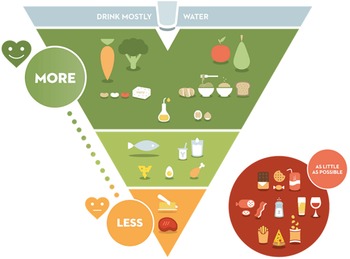
The nutrition triangle from Belgium (the official Flemish FBDG) demonstrates synergies between health and sustainability (Fig. 2)(20). Synergies are observed for shifts from animal-based to plant-based diets, from ultra-processed foods to fresh and whole foods and from reduction of food waste. Van Dooren et al.(Reference van Dooren, Marinussen and Blonk21) demonstrated that adhering to the Dutch FBDG, a flexitarian diet, a vegetarian diet or a Mediterranean diet is not only good for your health, but also reduces the environmental impact of your diet in terms of GHGE and land use(Reference van Dooren, Marinussen and Blonk21).
Nutrition triangle from Belgium. It demonstrates synergies between health and sustainability by advising to consume ‘more’ from products that are more healthy and low in environmental impact and to consume ‘less’ or ‘as little as possible’ from products that are less healthy and high in environmental impact(48).

But we do not see synergies for all health recommendations. Therefore we must look at other possibilities to further optimise diets: what are the quick wins? Some researchers have applied optimisation studies to calculate optimal diets from as well health and sustainability perspective(Reference van Dooren22). Such studies give insights on the role of protein shift from animal-based to plant-based proteins, lower fossil energy use for processing, transport, preparing food and reduction of food waste to lower the environmental impact of diets.
Acceptability: example of traditional diets
The question is how to deal with cultural acceptability and affordability of sustainable diets. A solution lies in looking at the role of traditional diets, based on studies on the Mediterranean, Nordic and low-land diets. For example, an optimised low-land diet has the same healthy nutritional characteristics as the Mediterranean diet and results in a lower environmental impact than the Mediterranean and Nordic diets. Through applying the method of linear programming, it is possible to calculate an optimal low-land diet with as little as possible adaptations in types and quantities of products consumed, which will result in a high acceptability. That diet is as healthy as and more sustainable than a transition to more foreign European diets(Reference van Dooren and Aiking23). That study confirms the usefulness of linear programming to improve existing or culturally relevant diets(Reference van Dooren and Aiking23). These traditional diets are embedded in eating habits, climate and agricultural tradition and therefore could contribute to a sustainable diet for the future. It could be expected that this is also the case for the traditional diets of England, Scotland or Ireland.
The Dutch Health Council found a common ground for these Mediterranean, Nordic and Low-Lands diets with the same favourite food products: ‘All of the patterns include a lot of vegetables, fruit, wholegrain products, nuts, legumes, oils rich in cis-unsaturated fatty acids, reduced-fat and low-fat dairy products, poultry and fish; none include much red or processed meat, full-fat dairy products, hard fats, salt or drinks (or other products) with added sugar; all involve alcohol moderation’(24).
Affordability: the crisis of cost of living
Nowadays the cost of living crisis is high on the agenda in Europe. It is argued that cost of food could conflict with sustainability targets. Sometimes it is argued that sustainable food is only reachable for people with high-income and high-education level(Reference Klink, Mata and Frank25).
The USA Thrifty Food Plan is using linear programming to calculate optimal diets to assess the costs of a nutritious diet in line with the US My Pyramid(Reference Marshall26). They demonstrated that it is possible to provide affordable diets, below the price of 4 USD, that meet all constraints for energy and nutrients.(Reference Wilde and Llobrera27) Van Dooren et al.(Reference van Dooren, Tyszler and Kramer28) used linear programming to calculate low cost, sustainable diets. The cost of the diet reduced when it met thirty-three nutritional constraints and lowered even further when in addition a constraint on GHGE was introduced. A healthy, sustainable full-day diet was possible for the price of €2⋅50 per person daily.(Reference van Dooren, Tyszler and Kramer28)
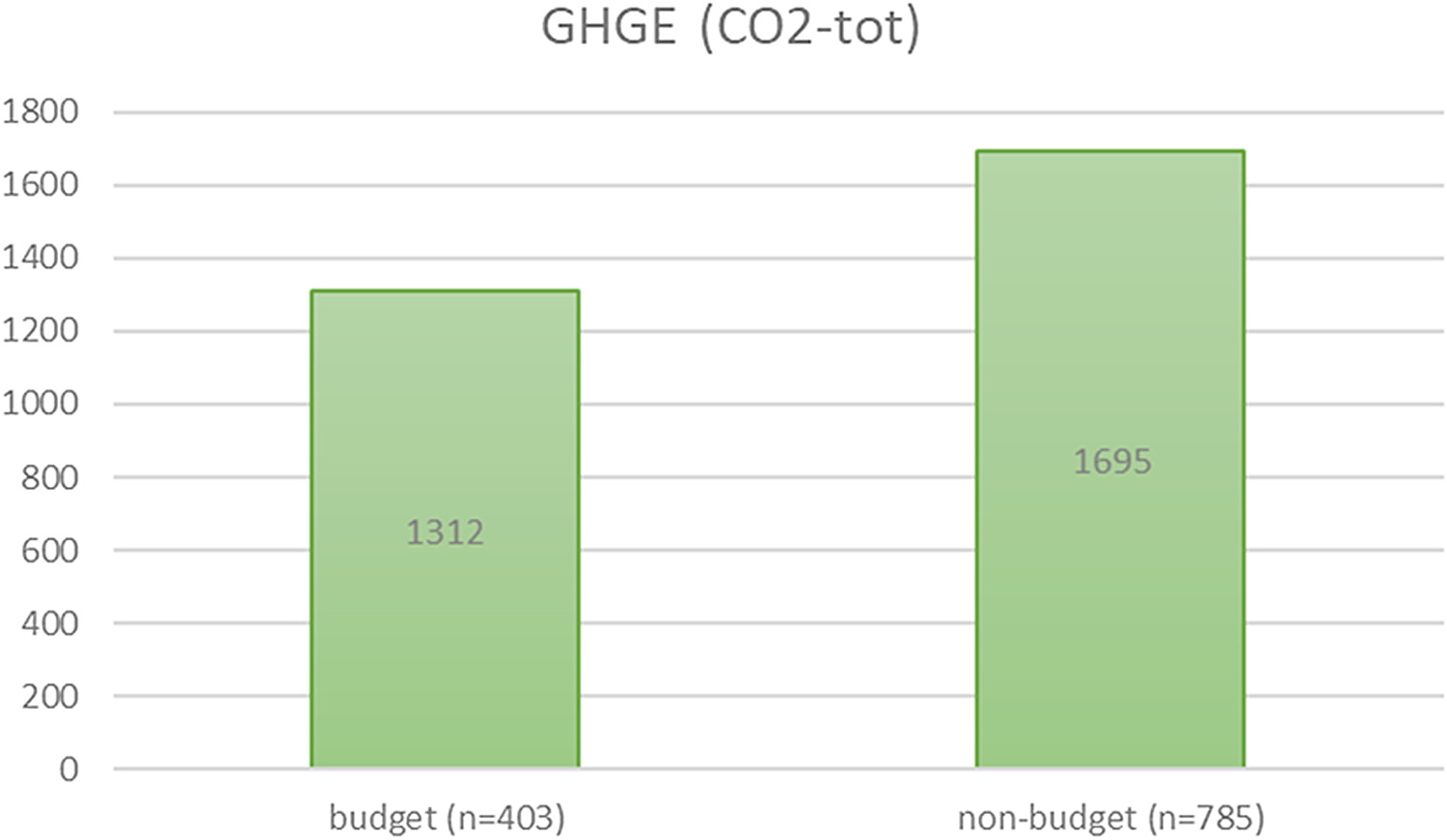
Educating cooking skills through applying healthy recipes is an effective intervention to stimulate healthy diets(Reference Lavelle29). The Netherlands Nutrition Centre applies this strategy by distributing recipes via websites, recipe books and newsletters. The recipe database exists of 1891 recipes of which 1188 are main courses(30). Some studies suggest that healthy recipes have a lower climate impact than unhealthy ones(Reference Angelsen, Starke and Trattner31). We confirmed this for the Dutch database. It was demonstrated that the climate impact of diets can be further reduced by choosing and promoting recipes that are highly nutrient-dense (sustainable nutrient-rich food index > 1), (pesco-)vegetarian, affordable (<€2⋅25), low-energy (<2197 kJ) and/or quick to prepare (<15 min)(Reference van Dooren32). Budget recipes (<€2⋅25) have a significant (P = 0⋅05) lower climate impact (−23 %) than non-budget recipes (Fig. 3). Promoting affordable recipes is the most promising intervention, because they are already more popular than expensive recipes among Dutch consumers, known for saving money(Reference van Dooren32).
Netherlands Nutrition Centre budget recipes (n 403; <€2⋅25) compared to non-budget recipes (n 1695; >€2⋅25) in greenhouse gas emissions (GHGE) in total grams of carbon dioxide per meal(Reference van Dooren32).

Incorporation of sustainability into food-based dietary guidelines
The importance of looking at sustainability of the present diets has led to steps made in Europe to incorporate sustainability into FBDG. Examples from Northern European and American countries are given.
We analysed current approaches from official and non-official FBDG that incorporate environmental sustainability issues and classified them into four approaches:
(1) Providing additional advice and consumer guidance (UK(33), Nordics(Reference Norden34,35) );
(2) Demonstrating synergies (Canada(36), Belgium(Reference Rubens, Neven and Jonckheere37));
(3) Diet modelling (France(38), Germany(Reference Schäfer, Schmidt and Bechthold39), Netherlands(Reference Brink, van Rossum and Postma-Smeets40)) and
(4) Proposing sustainable development goals as the outcome (FAO(41)).
Each approach has its advantages and disadvantages. The choice of method depends on the experience, budget, data and labour capacity available per country. The FBDG included in this example, expose the under-representation of low-income countries. This is a concern that deserves further consideration. The incorporation of sustainability into FBDG is a relatively recent development. The four approaches we classify warrant further development to ensure worthwhile FBDG are aligned with global environmental sustainability targets. Given increasing use of food systems analysis, we propose a fifth, future approach: food system-based guidelines, through the optimisation of several environmental parameters –ideally, all planetary boundaries that are at risk of being exceeded – and constraints for nutritional values and acceptability. This approach is not applied yet and has to be tested in practice.
Humanity can continue to develop and thrive for generations to come, only if the processes that regulate the earth system are respected. These so-called ‘planetary boundaries’ can be respected by achieving the sustainable development goals for climate action, life on land, life below water and clean fresh water(Reference Lucas and Wilting42). Ideally, all these planetary boundaries that are at risk of being exceeded in any approach are then included: GHGE, land use, water use, biodiversity loss, nitrogen and phosphate cycles, and constraints for nutritional values and acceptability. The combination of goals for health and environmental sustainability can be solved with the doughnut model(Reference Raworth43); this builds on a nutritional foundation and stays within the afore-mentioned planetary boundaries.
It is critical to enable consumers to adopt sustainable diets and engage with civil society and the media, to ensure that sustainable food systems are priorities on the political agenda. It is also essential to encourage teamwork between scientists, policymakers, politicians and practitioners(Reference Egal and Berry44).
Examples of future-proof diets
Several studies have demonstrated how to outline affordable, healthy diets within planetary boundaries, through the application of optimisation tools. Two examples from Belgium and the UK are given. Te Pas et al.(Reference te Pas, de Weert and Broekema45) calculated a diet scenario for Belgium with a simultaneously, substantial reduction of GHGE, land use and biodiversity loss. The GHGE of the average Belgium diet was more than halved, but the cost remained the same(Reference te Pas, de Weert and Broekema45). The diet was in line with dietary recommendations, and was composed of products with a high Nutri-Score (A)(Reference te Pas, de Weert and Broekema45). World Wide Fund for Nature-UK came up with a more sustainable alternative for the official UK FBDG. Their UK Livewell plate(Reference Kramer, Durlinger and Kuling46) is within the planetary boundaries for GHGE and land use. It reduces the GHGE of the diet with up to 30 % compared to the current diet, to stay within 2° global warming. This diet includes minimum five portions of fruit and vegetables daily, two servings of fish per week and a maximum of 70 g of red and processed meat daily(Reference Kramer, Durlinger and Kuling46). These examples show how easy it is to adopt a diet that is good for people and the planet and in which way official dietary guidelines can be improved in their level of sustainability.
Conclusion: planet-based diet approach
World Wide Fund for Nature has summarised what constitutes a future-proof diet: the planet-based diet, that is a healthy diet for future generations within planetary boundaries(Reference Loken, Opperman and Orr47). Planet-based diets for individuals can be defined as and summarised in four advices:
(1) Eat more plant-based and less animal-based foods.
(2) Prefer fresh and local afore-mentioned ultra-processed foods.
(3) Choose products from a more sustainable method of agriculture.
(4) Bring more variation and balance on your plate; avoid overconsumption(Reference Loken, Opperman and Orr47).
World Wide Fund for Nature conducted a comprehensive scientific assessment of how dietary shifts in 147 countries can contribute to reduce the pressure from the food system on nature(Reference Loken, Opperman and Orr47). The existing negative trend of biodiversity loss can be bend by moving from exploiting to restoring nature. There's something we can do several times a day to improve our health and our planet's health, that is eating a planet-based diet, high in human health benefits and low in environmental impacts. Adopting a planet-based diet could reduce food-based GHGE by at least 30 %; wildlife loss by up to 46 %; agricultural land use by at least 41 % and premature deaths by at least 20 %(Reference Loken, Opperman and Orr47). An online calculator supports individuals to calculate their own planet-based diet (https://planetbaseddiets.panda.org/impacts-action-calculator). These advises are in line with current FBDG and can contribute to future sustainable FBDG.
Acknowledgements
The author acknowledges the Nutrition Society, Scottish Section for inviting to its annual conference. The author thanks WWF colleagues Brent Loken (Food Practice), Titus Ghyselinck (Belgium) and Sarah Halevy (UK) for providing cooperation on planet-based diets and food-based dietary guidelines. The author is grateful to Netherlands Nutrition Centre for making the analysis of its recipe database possible.
Financial Support
This research is financed by WWF-NL's own resources.
Conflict of Interest
There is no conflict of interest. By working with business, WWF aims to change behaviour and drive conservation results that would not be possible otherwise. The author is Member of Dutch Academy of Nutritionists (NAV) and therefore bound by their code of conduct.
Authorship
The author had sole responsibility for all aspects of preparation of this paper.


 Open access

