





1 Introduction
Structured light beams with customized amplitude, phase and polarization configurations have become indispensable in modern photonics, offering unprecedented opportunities for both fundamental research and technological innovations[ Reference Forbes 1 – Reference He, Shen and Forbes 3 ]. Laguerre–Gaussian (LG) beams, well recognized by their doughnut-shaped intensity profiles and spiral phase fronts carrying orbital angular momentum (OAM), have found widespread applications in optical trapping[ Reference He, Friese, Heckenberg and Rubinsztein-Dunlop 4 , Reference Singh, Nagar, Roichman and Arie 5 ], high-dimensional optical communications[ Reference Wang, Yang, Fazal, Ahmed, Yan, Huang, Ren, Yue, Dolinar, Tur and Willner 6 - Reference Liu, Zhang, Liu, Lin, Li, Lin, Zhang, Huang, Mo, Shen, Lin, Chen, Gao, Zhang, Lan, Cai, Li and Yu 8 ] and quantum information processing[ Reference Mair, Vaziri, Weihs and Zeilinger 9 , Reference Zhou, Li, Ding, Zhang, Shi, Shi and Guo 10 ]. In comparison, Bessel beams represent another fundamental category of structured light characterized by diffraction-free propagation, self-healing and elongated depth of focus, which originate from their conical wavevector distributions[ Reference LaPointe 11 – Reference Lin, Seka, Eberly, Huang and Brown 13 ]. Notably, higher-order Bessel beams not only preserve these advantages but also incorporate OAM features through azimuthal phase modulation, thereby generating hollow intensity patterns similar to LG modes[ Reference Volke-Sepúlveda, Garcés-Chávez, Chávez-Cerda, Arlt and Dholakia 14 ]. This shared OAM-carrying characteristic places LG and Bessel beams within a unified class of structured light. Building on this connection, the additional propagation-invariant and self-healing capabilities of Bessel beams have promoted them as powerful tools in precision laser processing[ Reference Duocastella and Arnold 15 , Reference Baltrukonis, Ulčinas, Orlov and Jukna 16 ] and biomedical imaging[ Reference Yu, Ji, Dong, Yang, Xiao, Gong, Xi and Shi 17 , Reference Takanezawa, Saitou and Imamura 18 ]. Recent years have witnessed significant progress in combining structured light with ultrafast laser technologies. When endowed with femtosecond pulse durations, LG and high-order Bessel beams demonstrate unique spatiotemporal couplings where spatial phase singularities coexist with temporally coherent ultrashort pulses. This integration enables extremely high peak intensities while maintaining topological charge stability, thus facilitating novel nonlinear optical phenomena such as vortex harmonic generation[ Reference Coudrat, Boulliard, Gérard, Lemaître, Degiron and Leo 19 , Reference Géneaux, Camper, Auguste, Gobert, Caillat, Taïeb and Ruchon 20 ] and strong-field ionization control[ Reference Zhang, Shen, Zhang, Xu, Wang, Wang, Yi and Shi 21 , Reference Wang, Zhang, Wang, Zhao, Xu, Yu, Yi, Shi, Zhang, Xu, Liu, Pei and Shen 22 ]. These emerging applications have driven increasing interest in exploring methods for generating high-quality ultrafast LG and Bessel vortex pulses with high average power.
Conventional vortex beam generation mainly depends on extracavity elements such as q-plates[ Reference Cardano, Karimi, Slussarenko, Marrucci, de Lisio and Santamato 23 ], spiral phase plates (SPPs)[ Reference Miyamoto, Kang, Kim, Sasaki, Niinomi, Suizu, Rotermund and Omatsu 24 ], computer-generated holograms[ Reference Terhalle, Langner, Päivänranta, Guzenko, David and Ekinci 25 ], spatial light modulators (SLMs)[ Reference Forbes, Dudley and McLaren 26 , Reference Matsumoto, Ando, Inoue, Ohtake, Fukuchi and Hara 27 ] and metasurfaces[ Reference Yue, Wen, Xin, Gerardot, Li and Chen 28 , Reference Chen, Khorasaninejad, Zhu, Oh, Devlin, Zaidi and Capasso 29 ]. Although flexible and versatile, these methods suffer from critical limitations in the high-power ultrafast regime, including low damage thresholds, high costs, wavelength-dependent dispersion and beam quality degradation[ Reference Qiao, Xie, Wu, Yuan, Ma, Qian and Fan 30 ]. Intracavity structured light generation has emerged as an attractive alternative, utilizing mode selection and tailored cavity designs. LG modes, which are natural resonator eigenmodes, have been generated via annular pumping[ Reference Li, Yao, Yu, Xia and Zhou 31 , Reference Chen, Xu, Ni, Tang, Yi, Jia, Qiao, Li and Copner 32 ], defect-spot mirrors[ Reference Kano, Kozawa and Sato 33 ] and off-axis pumping[ Reference Wang, Zhang, Yang, Xie, Jiang, Feng and Zhou 34 ]. In 2019, LG beams at 720 nm were achieved using a slightly misaligned resonator with a graphene saturable absorber mirror (SAM), delivering 22 mW average power and 74.5 ps pulses[ Reference Li, Huang, Xu, Cai, Lu, Zhan, Luo, Xu, Cai and Cai 35 ]. In 2021, femtosecond LG pulses with tens of milliwatts power were obtained from a 2 μm laser via off-axis pumping[ Reference Zhao, Wang, Chen, Loiko, Mateos, Xu, Liu, Shen, Wang, Xu, Griebner and Petrov 36 ]. Alternatively, Hermite–Gaussian (HG) modes can also be generated within the cavity and converted to LG modes. In 2023, a hybrid off-axis and non-collinear pumping approach yielded femtosecond LG vortex pulses up to the 30th order with several hundred milliwatts output[ Reference Liu, Yan, Chen, Liu, Liu, Chew, Gliserin, Wang and Zhang 37 ]. Parallel efforts have also been devoted to intracavity Bessel beam generation. Pääkkönen and Turunen[ Reference Pääkkönen and Turunen 38 ] proposed a resonator configuration comprising a planar semi-transparent mirror and an aspheric radially phase-conjugating mirror. Axicons have been used within the cavities by Rogel-Salazar et al. [ Reference Rogel-Salazar, New and Chávez-Cerda 39 ] and Khilo et al. [ Reference Khilo, Katranji and Ryzhevich 40 ], enabling the direct generation of Bessel beams. While such intracavity schemes eliminate the need for lossy external phase elements, they continue to face challenges in simultaneously achieving high peak power and robust mode-locking performance. Practical limitations, such as thermal effects, crystal damage and inefficient mode–pump coupling, remain major bottlenecks for further power scaling. These challenges make the transformation of an intracavity LG beam into a Bessel vortex beam a more viable approach, which in turn requires a laser platform capable of generating high-power LG vortex modes.
Such requirements can be effectively met using thin-disk laser technology, which provides efficient thermal management, excellent power scalability and ultrafast mode-locking compatibility. Its superior heat dissipation enables stable high-power operation while reducing thermal lensing effects that degrade beam quality. In addition to generating fundamental laser modes exceeding hundreds of watts and sub-100 fs pulses[ Reference Seidel, Lang, Phillips and Keller 41 – Reference Zhang, Pötzlberger, Wang, Brons, Seidel, Bauer, Sutter, Pervak, Apolonski, Mak, Kalashnikov, Wei, Krausz and Pronin 43 ], thin-disk laser oscillators have shown promising capabilities for the direct generation of vortex beams. Continuous-wave (CW) LG mode vortex beams with output powers of 100 W[ Reference Chen, Wang, Liu, Liu, Guo, Yang, Yan and Zhang 44 ] and 80 W[ Reference Hao, Qin, Chen, Liu, Wang, Zhang, Zhang and Zhang 45 ] have been realized, while tunable vortex beams up to the 10th order have been obtained via HG mode conversion, achieving tens-of-watt output powers[ Reference Hao, Dai, Liu, Liu, Chen, Wang, Yan and Zhang 46 ]. Moreover, high-power femtosecond vortex beams exceeding 10 W average power with sub-300 fs pulses have been directly generated from a Kerr-lens mode-locked thin-disk oscillator using a Sagnac interferometer[ Reference Liu, Yan, Liu, Liu, Chen and Zhang 47 ]. Thin-disk technology has also enabled the generation of radially polarized beams with output powers exceeding 100 W by using polarizing grating waveguide mirrors, under both CW and sub-picosecond mode-locked regimes[ Reference Dietrich, Rumpel, Beirow, Mateo, Pruss, Osten, Ahmed and Graf 48 , Reference Beirow, Eckerle, Dannecker, Dietrich, Ahmed and Graf 49 ]. These developments underscore the considerable potential of thin-disk lasers as a robust platform for the generation of high-power, high-order, ultrafast structured laser pulses.
In this study, we demonstrate the direct generation of high-power femtosecond vortex beams in both LG and Bessel modes from a passively mode-locked ytterbium-doped yttrium aluminum garnet (Yb:YAG) thin-disk laser oscillator. The LG transverse mode is selectively excited through mode-matching, while the longitudinal mode-locking is realized via Kerr-lens mode-locking (KLM) assisted by a semiconductor saturable absorber mirror (SESAM). The vortex pulses exhibit high beam quality with a pulse duration of approximately 600 fs and an average power of 50 W, representing the highest average power reported for any mode-locked vortex laser oscillator to date. Furthermore, by replacing the conventional planar output coupler (OC) with a coated axicon, we achieve direct generation of the first-order Bessel vortex beams by reshaping the intracavity LG mode within the same oscillator. The experimentally measured beam profiles and propagation characteristics are in good agreement with numerical simulations, confirming excellent spatial fidelity. This intracavity approach eliminates the need for external beam-shaping components and provides a compact and efficient method to generate high-power ultrafast LG and Bessel modes, offering a practical solution for applications requiring high-performance ultrafast structured light sources.
2 Experimental setup and analysis
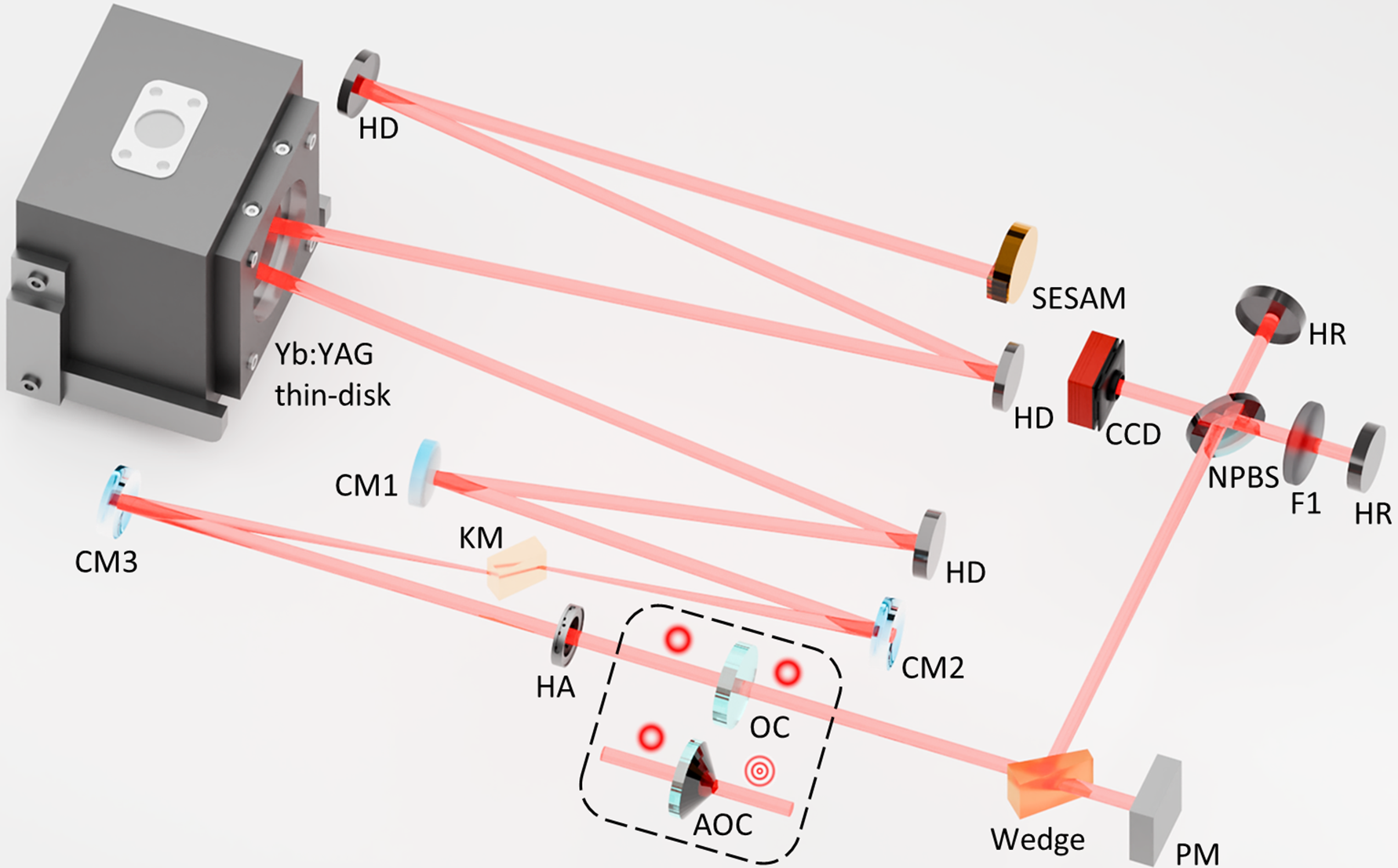
The experimental setup of the SESAM-assisted Kerr-lens mode-locked Yb:YAG thin-disk vortex laser oscillator is depicted in Figure 1. The Yb:YAG crystal, with an Yb3+ doping concentration of 7% and a thickness of 130 μm, is placed inside a 48-pass pump module and simultaneously acts as a folding mirror. A commercial fiber-coupled diode laser operating at a central wavelength of 940 nm functions as the pump source. The pump spot diameter on the disk was adjusted to be approximately 3.3 mm by tuning the collimating lens system. A Z-shaped standing-wave cavity with a length of 2.19 m is constructed, corresponding to a pulse repetition rate of 68.5 MHz. The cavity contains a telescope section consisting of two concave mirrors (CM2 and CM3), each with a radius of curvature of 350 mm, where a 5-mm-thick sapphire plate is placed at the focus to serve as the Kerr medium (KM), providing the nonlinear effect required for mode-locking. The beam diameter on the thin-disk crystal can be adjusted by shifting the convex mirror (CM1) located near the disk. To initiate and maintain the passive mode-locking, a SESAM is used as the end mirror, while a water-cooled hard aperture (HA) with a diameter of 3.2 mm is placed close to the OC. The round-trip dispersion is compensated to −17,400 fs2 by three high-dispersion mirrors (HDs). Initially, a conventional planar OC with 10% transmission is used in the oscillator. The planar OC is subsequently replaced by a specially coated axicon output coupler (AOC) to reshape the intracavity oscillating mode. The axicon is fabricated from fused silica with a base angle of 0.5° and a refractive index of 1.45 at 1030 nm. The conical end of the AOC is anti-reflection coated at the lasing wavelength, while the plano end is coated for 10% transmission and oriented inward to function as a resonator mirror. In this configuration, the inward-facing planar surface behaves similarly to a planar OC in supporting the transverse mode, thereby maintaining laser oscillation in the LG vortex mode within the cavity. The conical surface subsequently reshapes the generated LG beam into a first-order Bessel vortex beam. The AOC is mounted on a two-dimensional translation stage to ensure precise alignment between the center of the oscillating LG mode and the apex of the axicon. To determine the chirality of the output LG vortex laser beams, a homemade Michelson interferometer (MI) is built, consisting of two high-reflection mirrors (HRs), a convex lens (F1) and a non-polarizing beam splitter (NPBS). The lens F1 expands the reference pulse into a large-diameter beam, of which a portion can be approximated as a plane wave relative to the measured vortex pulse. The HR in the reference arm is implemented as a delay line to temporally synchronize the two pulses.
Experimental setup of the thin-disk oscillator and the homemade Michelson interferometer. HD, high-dispersion mirror; CM1, convex mirror; CM2, CM3, concave mirrors; KM, Kerr medium; HA, hard aperture; OC, output coupler; AOC, axicon output coupler; PM, power meter; NPBS, non-polarizing beam splitter; F1, convex lens; HR, high-reflection mirror. The dashed box highlights the two interchangeable OCs, where the planar OC is used for LG mode generation and the AOC is used for Bessel mode generation.

The cavity has cylindrical symmetry, which enables the generation of ideal LG vortex modes. By modifying the pump-to-mode ratio, which denotes the mode overlapping ratio between the pump and oscillating Gaussian mode, the thin-disk scheme provides a versatile platform for high-order LG mode excitation, thus facilitating simultaneous high-power operation in high-order modes. This mode selection mechanism in a thin-disk oscillator fundamentally relies on differential gain experienced by different transverse modes, which can be controlled via the pump-to-mode overlap ratio. For the ${\mathrm{LG}}_{0,l}$
mode, the threshold pump power
${\mathrm{LG}}_{0,l}$
mode, the threshold pump power ${P}_{\mathrm{p}_{\mathrm{th}}}$
is given by Equation (1)[
Reference Clarkson and Hanna
50
]:
${P}_{\mathrm{p}_{\mathrm{th}}}$
is given by Equation (1)[
Reference Clarkson and Hanna
50
]:
 $$\begin{align}{P}_{\mathrm{p}_{\mathrm{th}}}=\frac{h{\nu}_\mathrm{p}{I}_\mathrm{s}}{\tau_\mathrm{c}{\eta}_\mathrm{q}\left[1-\exp \left(-{\alpha}_\mathrm{p}d\right)\right]}{\left[{\int}_\mathrm{cavity}{r}_\mathrm{p}\left(x,y,z\right){s}_0\left(x,y,z\right)\mathrm{d}V\right]}^{-1},\end{align}$$
where $h$
is the Planck constant,
$h$
is the Planck constant, ${\nu}_\mathrm{p}$
is the pump frequency,
${\nu}_\mathrm{p}$
is the pump frequency, $d$
is the thickness of the thin-disk gain medium,
$d$
is the thickness of the thin-disk gain medium, ${\alpha}_\mathrm{p}$
is the absorption coefficient of the pump in the disk medium,
${\alpha}_\mathrm{p}$
is the absorption coefficient of the pump in the disk medium, $z$
is the axial distance perpendicular to the disk surface,
$z$
is the axial distance perpendicular to the disk surface, ${\tau}_\mathrm{c}$
is the cavity photon lifetime,
${\tau}_\mathrm{c}$
is the cavity photon lifetime, ${I}_\mathrm{s}$
is the saturation intensity and
${I}_\mathrm{s}$
is the saturation intensity and ${\eta}_\mathrm{q}$
is the quantum efficiency. The function
${\eta}_\mathrm{q}$
is the quantum efficiency. The function ${r}_\mathrm{p}\left(x,y,z\right)$
describes the normalized pump distribution, while
${r}_\mathrm{p}\left(x,y,z\right)$
describes the normalized pump distribution, while ${s}_0\left(x,y,z\right)$
represents the normalized intensity distribution of the laser mode. According to this equation, the oscillation thresholds for different-order transverse modes are strongly determined by the spatial overlap between the laser modes and the pump distribution on the thin disk. Modes with lower overlap require higher pump power to reach the threshold, whereas those with favorable overlap can be preferentially excited. In practice, the overlap can be modified by adjusting the length of the resonator stability zone, which directly changes the mode size ratio between the pump spot and the fundamental laser beam on the thin disk, thereby enabling control over the transverse mode selection within the cavity.
${s}_0\left(x,y,z\right)$
represents the normalized intensity distribution of the laser mode. According to this equation, the oscillation thresholds for different-order transverse modes are strongly determined by the spatial overlap between the laser modes and the pump distribution on the thin disk. Modes with lower overlap require higher pump power to reach the threshold, whereas those with favorable overlap can be preferentially excited. In practice, the overlap can be modified by adjusting the length of the resonator stability zone, which directly changes the mode size ratio between the pump spot and the fundamental laser beam on the thin disk, thereby enabling control over the transverse mode selection within the cavity.
The reconfiguration of the proposed thin-disk oscillator is realized by utilizing different output coupling optics. When replacing the planar OC with an AOC, the mode-locked LG modes are converted into ultrafast Bessel beams. In this case, the experimentally generated Bessel beam differs from the ideal Bessel beam, as it has finite energy and a limited propagation-invariant region determined by the axicon parameters and the incident LG mode. The electric field amplitude of an $l$
th-order Bessel beam is described by the following equation[
Reference Arlt and Dholakia
51
]:
$l$
th-order Bessel beam is described by the following equation[
Reference Arlt and Dholakia
51
]:
 $$\begin{align}{E}_l\left(r,\theta, z\right)=A\exp \left(\mathrm{i}{k}_z\mathrm{z}\right){J}_l\left({k}_{r}r\right)\exp \left(\mathrm{i} l\theta \right),\end{align}$$
where ${J}_l$
is the
${J}_l$
is the $l$
th-order Bessel function and
$l$
th-order Bessel function and ${k}_z$
and
${k}_z$
and ${k}_{r}$
are the longitudinal and radial components of the wavevector
${k}_{r}$
are the longitudinal and radial components of the wavevector $k$
, respectively. When an
$k$
, respectively. When an ${\mathrm{LG}}_{0,l}$
vortex mode illuminates an axicon placed at the position of its beam waist, a Bessel-like beam carrying OAM order
${\mathrm{LG}}_{0,l}$
vortex mode illuminates an axicon placed at the position of its beam waist, a Bessel-like beam carrying OAM order $l$
is generated. The inner ring radius of the generated high-order Bessel beam can be calculated by
$l$
is generated. The inner ring radius of the generated high-order Bessel beam can be calculated by ${r}_\mathrm{B}={\alpha}_l/{k}_{r}$
, where
${r}_\mathrm{B}={\alpha}_l/{k}_{r}$
, where ${\alpha}_l$
is the first minimum of the
${\alpha}_l$
is the first minimum of the $l$
th-order Bessel function. The radial wavevector component, determined by the axicon parameters, is approximated as
$l$
th-order Bessel function. The radial wavevector component, determined by the axicon parameters, is approximated as ${k}_{r}\approx k\left(n-1\right)\gamma$
, where
${k}_{r}\approx k\left(n-1\right)\gamma$
, where $n$
and
$n$
and $\gamma$
are the refractive index and the base angle of the axicon, respectively. Furthermore, the corresponding non-diffracting propagation distance can be estimated as
$\gamma$
are the refractive index and the base angle of the axicon, respectively. Furthermore, the corresponding non-diffracting propagation distance can be estimated as ${z}_\mathrm{max}=R/\tan \theta$
, where
${z}_\mathrm{max}=R/\tan \theta$
, where $R$
is the radius of the incident beam on the axicon and
$R$
is the radius of the incident beam on the axicon and $\theta \approx \left(n-1\right)\gamma$
is the cone angle of the refracted wave. These relationships establish a direct link among the axicon geometry, the resulting radial wavevector component and the transverse profiles of the output beam, providing the theoretical basis for predicting the spatial characteristics of high-order Bessel vortex beams in the experiment.
$\theta \approx \left(n-1\right)\gamma$
is the cone angle of the refracted wave. These relationships establish a direct link among the axicon geometry, the resulting radial wavevector component and the transverse profiles of the output beam, providing the theoretical basis for predicting the spatial characteristics of high-order Bessel vortex beams in the experiment.
3 Results and discussion
3.1 Generation and characterization of femtosecond LG vortex beams
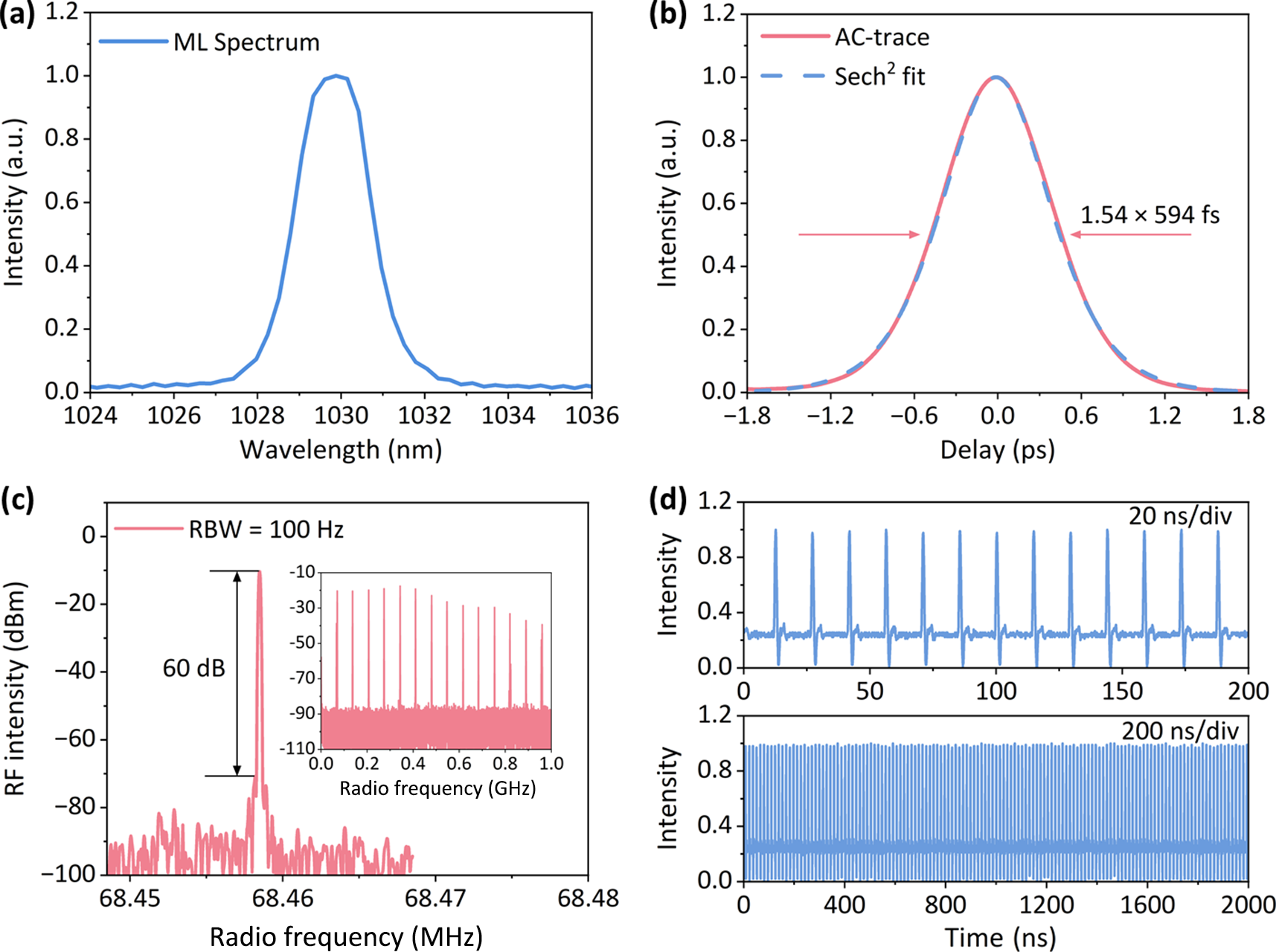
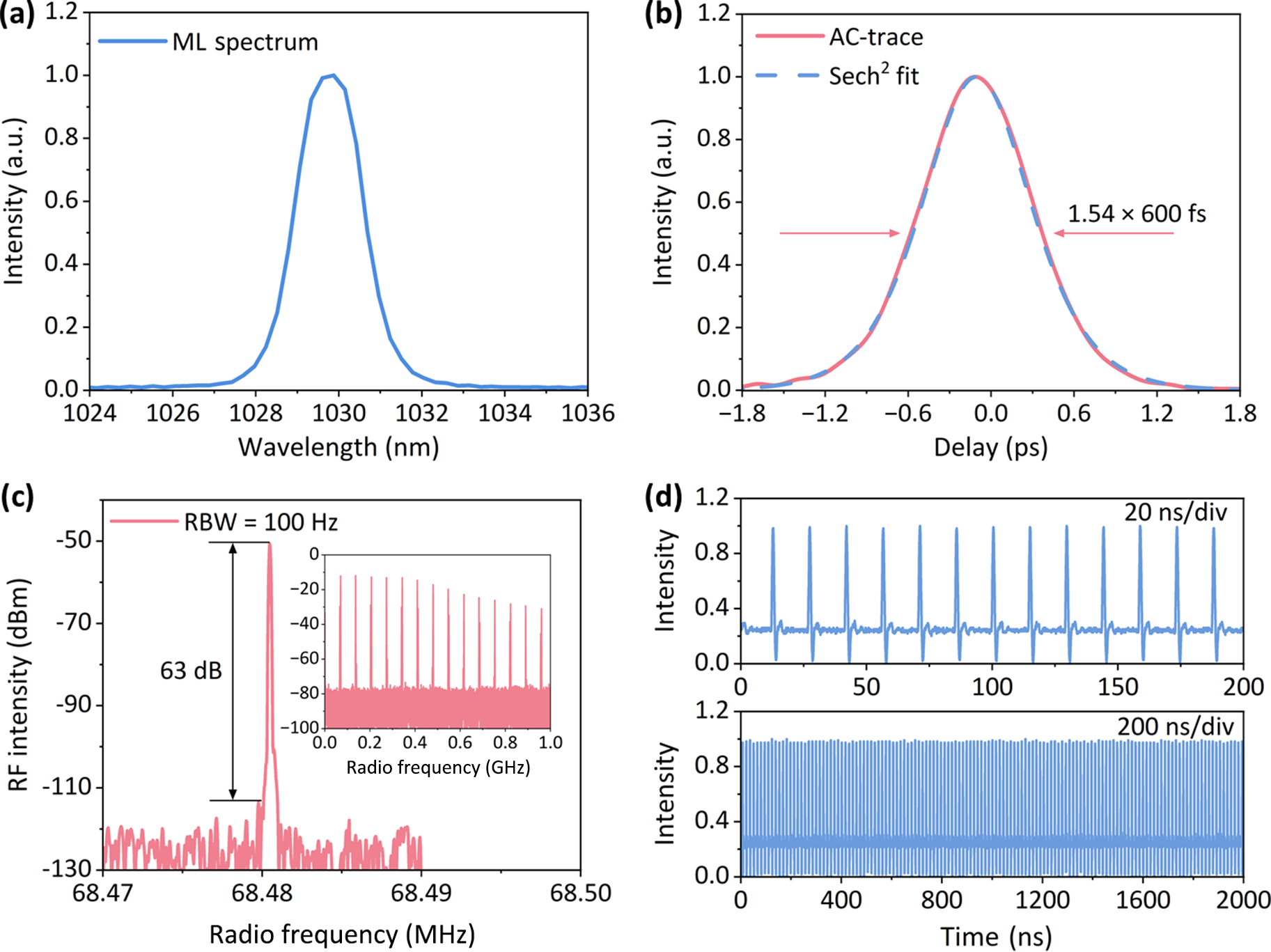
The experimental results of the intracavity-generated femtosecond vortex beams in both LG and Bessel modes are presented in this section. We first employ a planar mirror with 10% transmittance as the OC. Following the mode-matching method described above, the pump-to-mode ratio is adjusted to approximately 2.84 by tuning the cavity stability region. Under this condition, the LG0,1 or LG0,–1 mode reaches the threshold before other transverse modes as the pump power increases. Switching between LG vortex beams with positive or negative chirality is realized by introducing a slight tilt to the SESAM, which creates a weak asymmetry in the effective round-trip loss and breaks the degeneracy between opposite-helicity LG modes, causing the cavity to preferentially oscillate in the mode with lower effective loss. By optimizing the position of the KM and the size of the copper aperture, stable mode-locking of the single LG mode is obtained. The optical spectrum and the temporal properties of the mode-locked pulses are measured using a commercial optical spectrometer (Deviser, AE8600) and an intensity auto-correlator (APE PulseCheck USB), respectively. Figure 2(a) shows a spectrum with a full width at half maximum (FWHM) of 2.0 nm centered at 1030 nm. The measured intensity autocorrelation (AC) trace in Figure 2(b) indicates a pulse duration of 594 fs assuming a sech2 fit, representing an almost Fourier-transform-limited pulse with a time-bandwidth product of 0.336. The radio frequency (RF) spectrum is measured with a commercial RF spectrum analyzer (Agilent E4440B), as shown in Figure 2(c). The fundamental frequency is 68.5 MHz with a signal-to-noise ratio (SNR) of 60 dB at a resolution bandwidth (RBW) of 100 Hz. The inset in Figure 2(c) shows the high-harmonic signals of the RF spectrum over a 1 GHz span at an RBW of 100 kHz, confirming stable mode-locked operation. Figure 2(d) illustrates the measured pulse trains at different time scales, further verifying the stability of the mode-locking, consistent with the absence of beat frequencies shown in the RF spectrum.
Mode-locking performance of the LG modes: (a) optical spectrum; (b) AC trace; (c) RF spectrum; (d) pulse trains.

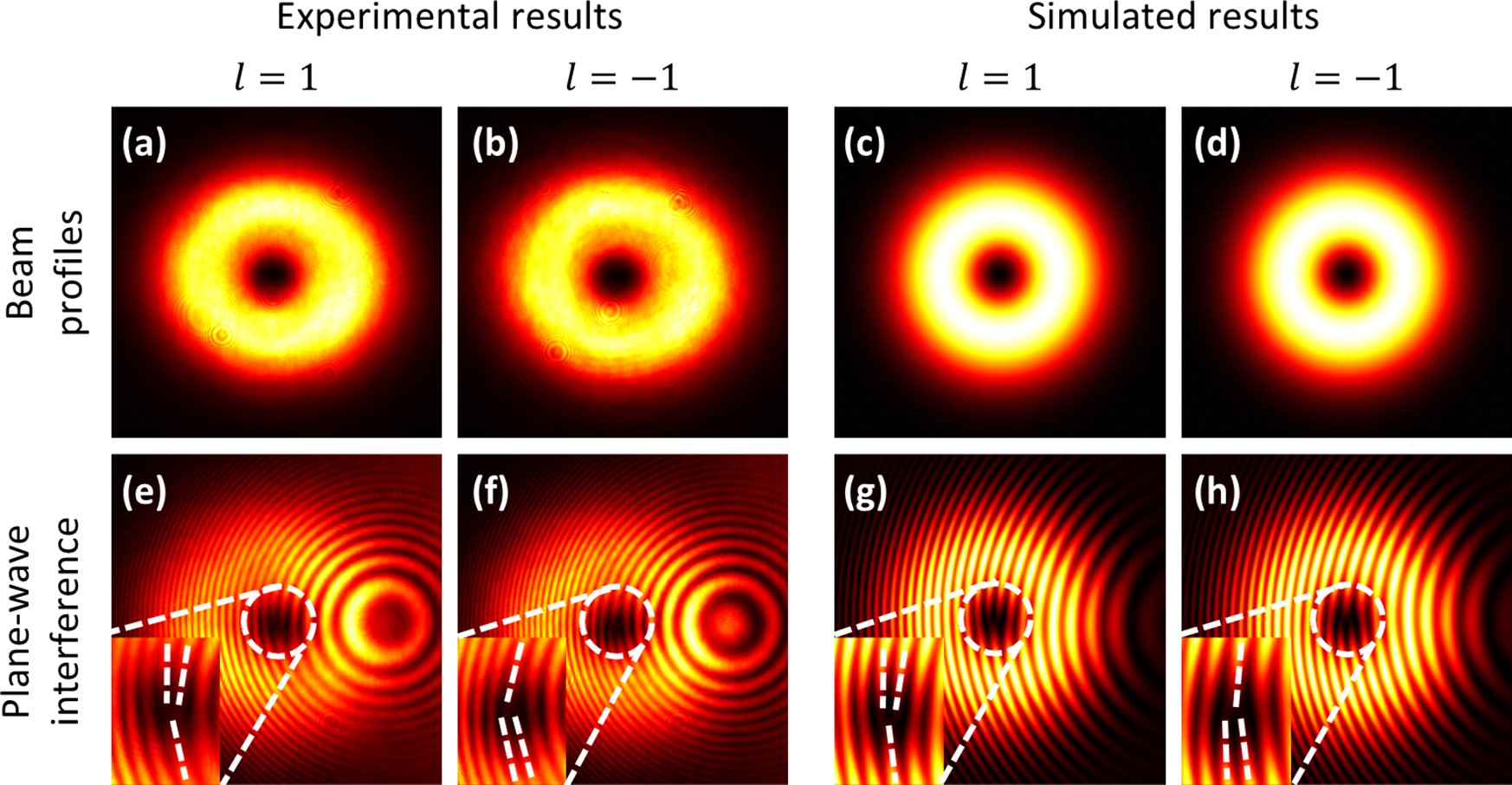
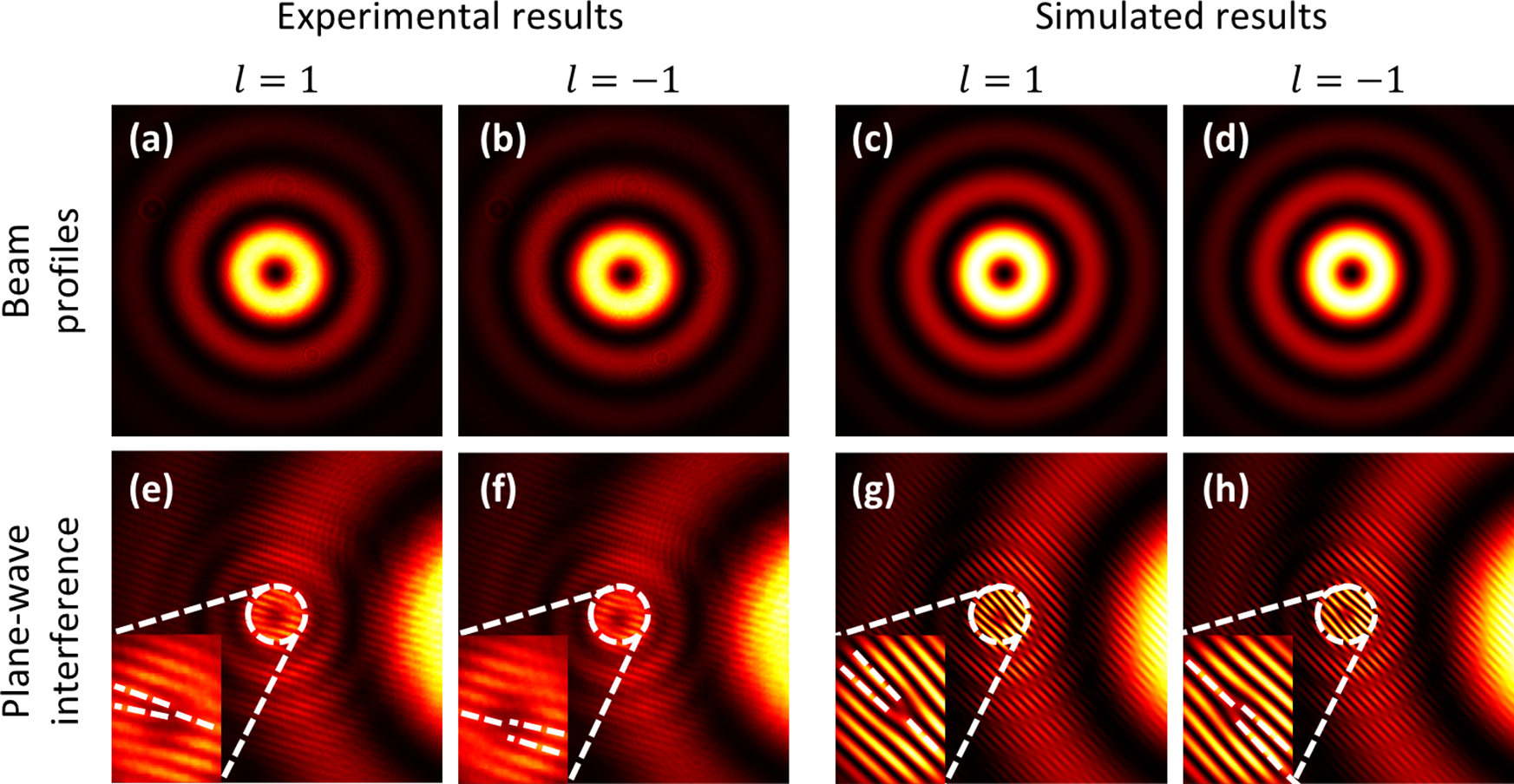
The intensity and phase characteristics are analyzed through the MI. The measured and simulated beam profiles are shown in Figures 3(a)–3(d), both exhibiting clear doughnut shapes with excellent agreement. Figures 3(e)–3(h) illustrate the resulting interference patterns between the target LG modes and the reference plane wave. A pair of Y-shaped forks with opposite orientations can be observed for the LG0,1 and LG0,–1 modes, demonstrating the vortex nature and opposite chirality. The consistency between the measurement and simulation confirms the high vortex quality of the generated femtosecond LG beams.
Beam profiles and interference patterns of the femtosecond LG vortex beams. (a)–(d) Experimentally measured and numerically simulated intensity distributions of the LG0,1 and LG0,–1 modes. (e)–(h) Corresponding interference fringes obtained by interfering the LG beams with a plane wave, revealing oppositely oriented forks.

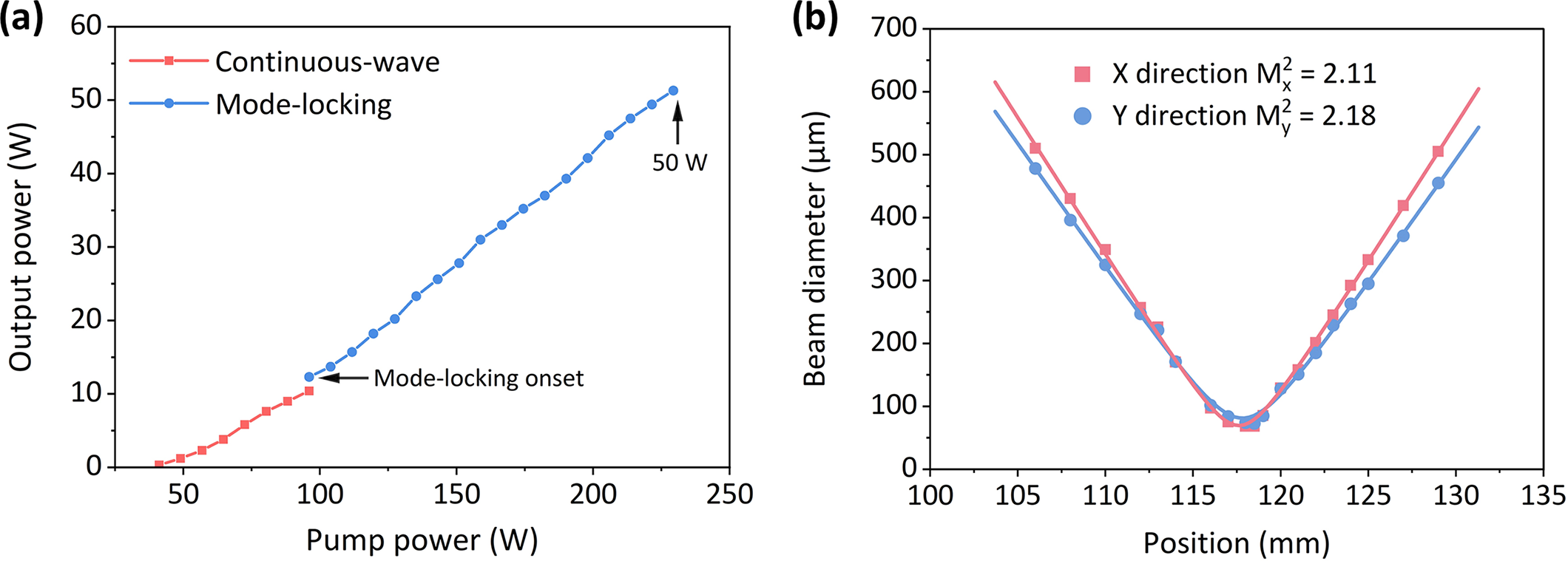
The power scalability of the proposed thin-disk oscillator is evaluated by measuring the average output power of the generated LG modes as a function of pump power, as illustrated in Figure 4(a). When the pump power is increased to 96 W, the oscillator transitions from CW operation to a mode-locked state following a slight perturbation, resulting in the generation of femtosecond LG vortex pulses. In the mode-locked regime, the slope efficiency increases to 30%, noticeably higher than that in the CW regime. This improvement is attributed to the high peak power of the pulses, which drives the SESAM into saturation during each pulse, thereby reducing the effective intracavity loss and enabling more efficient power extraction. With further increase in the pump power, the mode-locked operation remains stable, and the output power scales nearly linearly, reaching 50 W at 230 W pump power. This corresponds to an optical-to-optical efficiency of 22%, reflecting the efficient pump energy extraction enabled by the larger effective mode area of the LG vortex mode in the thin-disk configuration. Although the output power does not show an obvious saturation trend within the measured range, the pump power is not increased further because the SESAM begins to experience noticeable thermal loading at higher intracavity intensities, which gradually reduces the robustness of the mode-locked state. As shown in Figure 4(b), the generated LG vortex beam has an excellent beam quality at the maximum output power of 50 W, with beam quality factors of ${M}_x^2=2.11$
and
${M}_x^2=2.11$
and ${M}_y^2=2.18$
, which are close to the theoretical value of
${M}_y^2=2.18$
, which are close to the theoretical value of ${M}^2=2$
, confirming that high beam quality can be maintained even at high power.
${M}^2=2$
, confirming that high beam quality can be maintained even at high power.
Power scaling and beam quality of the mode-locked LG vortex beam. (a) Average output power of the LG vortex beam versus pump power. The arrows mark the onset of mode-locking and the maximum average output power of 50 W. (b) Measured beam quality (M 2 factor) at an average output power of 50 W.

3.2 Generation and characterization of femtosecond Bessel vortex beams
Building upon the successful generation of LG vortex pulses, we next investigate the direct generation of high-power Bessel vortex beams from the same thin-disk oscillator. The planar OC is replaced by a coated axicon with a base angle of 0.5°, which preserves the intracavity LG mode oscillation and simultaneously reshapes the generated LG beam into a first-order Bessel beam. By slightly adjusting the position of the KM, the femtosecond Bessel vortex pulses are directly obtained while maintaining stable mode-locked LG mode oscillation within the cavity, as the planar surface of the axicon facing the resonator behaves equivalently to the planar OC with respect to the intracavity mode. In addition, fine-tuning the two-dimensional translation stage supporting the axicon ensures precise alignment of the LG mode axis and the apex of the axicon, thereby optimizing the spatial profile of the Bessel vortex beam, and no further modifications of the resonator are required to sustain stable mode-locking beyond these minor alignment adjustments. Figure 5 shows the mode-locking performance of the first-order Bessel vortex pulses, which exhibit similar performance to that of the LG pulses. The generated Bessel vortex beam delivers an average power of 50 W with a pulse duration of 600 fs. The RF spectrum and the pulse trains demonstrate stable mode-locking operation without evidence of multi-pulsing or Q-switching behaviors.
Mode-locking performance of the first-order Bessel vortex beam generated using the AOC with a base angle of 0.5°: (a) optical spectrum; (b) AC trace; (c) RF spectrum; (d) pulse trains.

Using the same MI setup, the intensity distribution and chirality of the generated Bessel vortex beams are characterized, as shown in Figure 6. The experimental multi-ring structures and Y-shaped fork patterns are in good agreement with the simulations, highlighting the versatility and scalability of the presented oscillator for high-power ultrafast structured light generation.
Beam profiles and interference patterns of the first-order Bessel vortex beams. (a)–(d) Experimentally measured and numerically simulated intensity distributions of the Bessel vortex beams with opposite helicities. (e)–(h) Corresponding interference fringes obtained by interfering the Bessel vortex beams with a plane wave, revealing oppositely oriented forks.

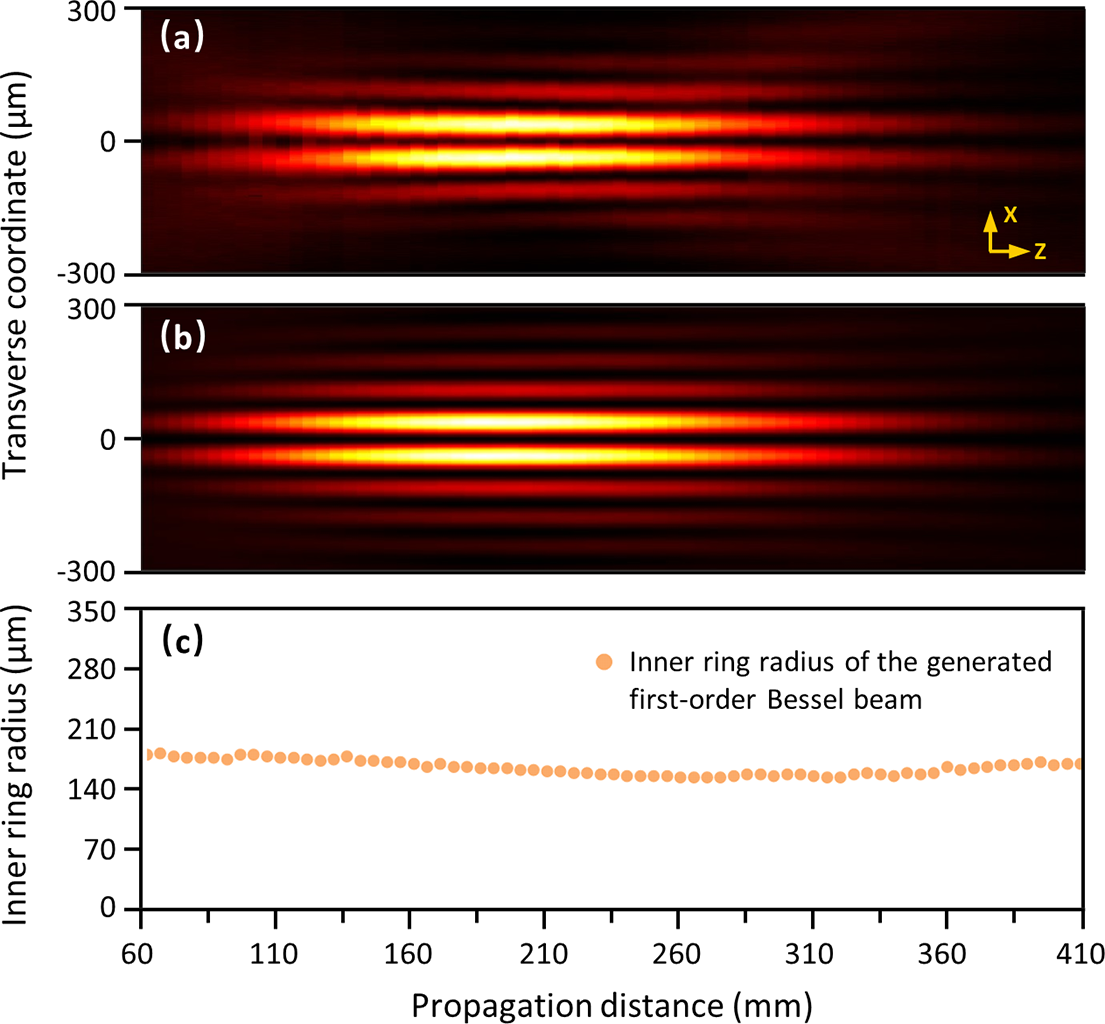
To examine the propagation properties of the generated Bessel vortex beam, we evaluate its intensity variation along the z-axis. The intensity profiles are captured using a charge-coupled device (CCD) camera mounted on a long-range linear translation stage placed behind the AOC and aligned with the propagation axis. Due to the presence of optical attenuators used to protect the CCD from damage, the closest detection position is limited to 60 mm from the axicon. The intensity distributions are recorded from 60 to 410 mm with a step of 5 mm. Thus, a total number of 71 frames are utilized to reconstruct the x–z plane intensity map. The experimental result is shown in Figure 7(a), alongside the simulation results for comparison. Very good agreement is observed, with minor discrepancies caused by limited sampling resolution and manual calibration. Based on the parameters of the AOC and the radius of the LG vortex beam, the theoretical non-diffracting propagation distance is approximately 290 mm, which is consistent with the experimentally observed propagation range of the generated Bessel beam. Furthermore, the evolution of the inner ring radius along the propagation direction is analyzed, as illustrated in Figure 7(c). According to the theoretical calculation, the inner ring radius of the first-order Bessel beam is approximately 160 μm. The experimental results show that the inner ring radius fluctuates slightly with increasing propagation distance. This behavior is attributed to alignment tolerances, optical aberrations and the finite resolution of the CCD sensor. Despite these variations, the measured inner ring radius remains close to the theoretical prediction, confirming the quasi-diffraction-free nature of the Bessel vortex beam.
Propagation properties of the generated first-order Bessel vortex beam: (a) experimentally measured and (b) numerically simulated intensity maps in the x–z plane; (c) experimentally measured inner ring radius as a function of propagation distance along the z-axis.

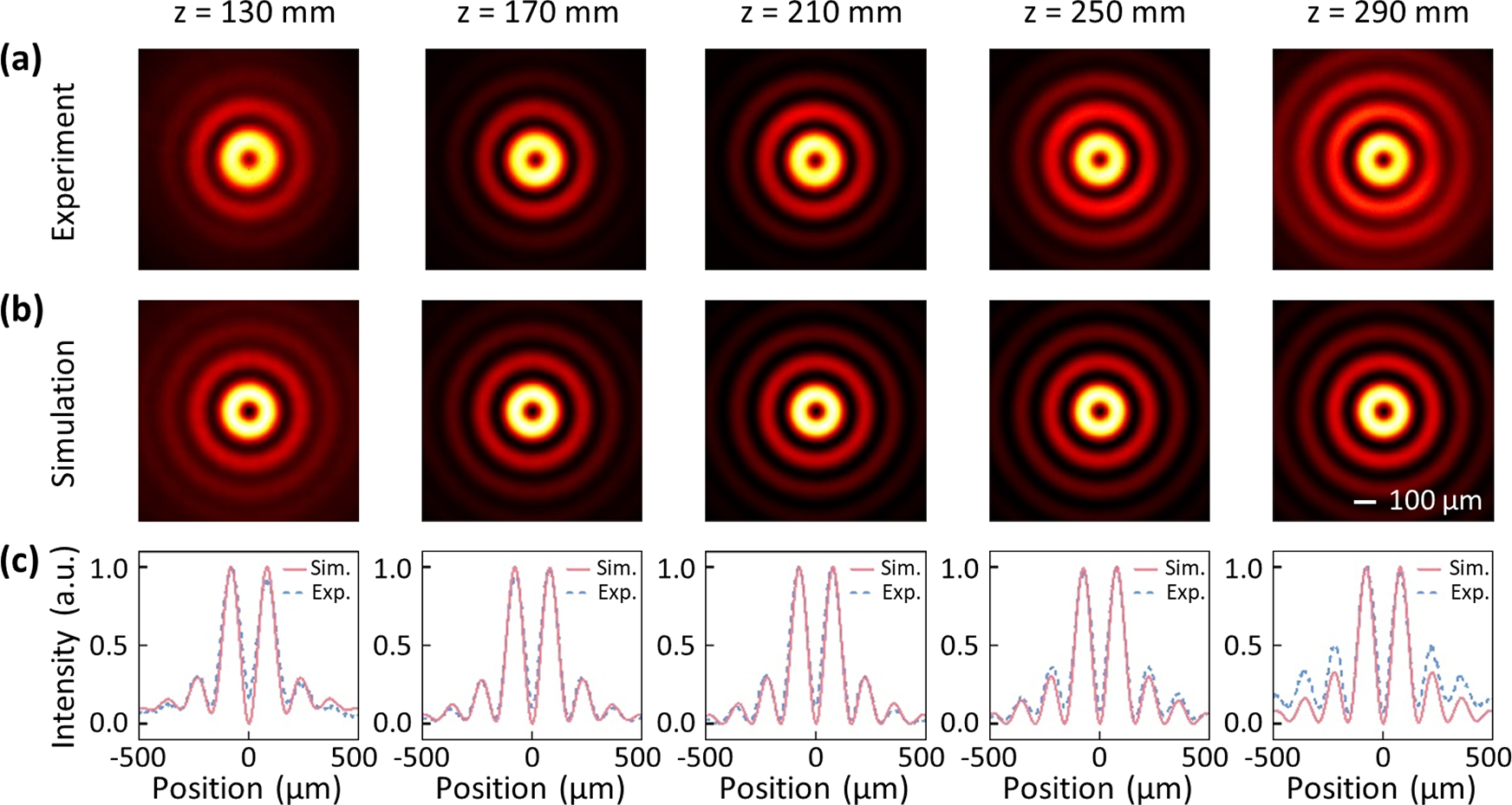
To further assess the propagation quality, Figures 8(a)–8(c) display the measured and simulated beam profiles at several axial positions, together with the corresponding one-dimensional radial intensity plots, demonstrating excellent consistency and further confirming the high quality and propagation invariance of the generated first-order Bessel vortex beam.
Propagation characteristics of the generated first-order Bessel vortex beam: (a) experimentally measured and (b) numerically simulated beam profiles at different propagation distances; (c) comparisons between the experimentally measured and numerically simulated radial intensity plots.

Looking ahead, further optimization of both LG and Bessel vortex generations will focus on enhancing power scalability, ultrafast performance and beam quality. We plan to incorporate multi-pass pumping techniques to scale the output power into the hundred-watt regime, while simultaneously refining intracavity dispersion compensation to achieve even shorter femtosecond pulses. In the present configuration, the pulse duration is mainly limited by the balance between intracavity self-phase modulation and residual dispersion, because the available self-phase modulation is insufficient to fully compensate higher-order dispersion. Such improvements would significantly expand the potential of ultrafast LG and Bessel beams, particularly for precision material processing and strong-field physics. The spatial quality and stability of the generated structured beams can be further improved through precise intracavity mode selection and aberration-minimized beam-shaping elements. Furthermore, the demonstrated scheme offers both switchability in vortex order (positive and negative) and reconfigurability between different transverse modes, from LG to Bessel and potentially to other exotic structured light fields such as higher-order Poincaré or vector modes. This versatility paves the way for a broader class of ultrafast structured light sources in advanced photonics and industrial applications.
4 Conclusion
In conclusion, we have demonstrated a reconfigurable Yb:YAG thin-disk oscillator capable of directly generating 50 W average power femtosecond vortex beams at 68.5 MHz in both LG and Bessel modes. To the best of our knowledge, this represents the first realization of femtosecond optical vortex generation at this power level directly from a laser oscillator. Using SESAM-assisted KLM, pulse durations of 594 fs for the LG0,1 and LG0,–1 modes and 600 fs for the first-order Bessel vortex modes are achieved. The resonance of intracavity vortex modes is enabled by adjusting the pump-to-mode overlap ratio, highlighting an intrinsic advantage of thin-disk geometry for high-order mode selection. The transition between LG and Bessel is realized simply by replacing a planar OC with a coated axicon, without any external beam-shaping optics, significantly simplifying the system and reducing cost. The measured spatial distributions and vortex characteristics of all modes show excellent agreement with numerical simulations, further confirming the feasibility and robustness of the system. By combining high power, ultrashort pulse duration, switchable vortex modes and intracavity reconfigurability, this system opens a pathway to compact and efficient ultrafast structured light sources, enabling practical scenarios such as chirality-sensitive micromachining, OAM-assisted optical manipulation and strong-field light–matter interactions. Future efforts will focus on further improving mode-locking performance, enhancing beam quality and extending this architecture to higher-order structured beams for applications in industrial manufacturing and scientific research.
Acknowledgement
This work was supported by the National Natural Science Foundation of China (Grant Nos. 62335009 and 62405100).

 Open access

