




Regularity and complexity, among other factors, influence the course of morphological and morpho-syntactic acquisition. These key factors have been studied extensively, both together and primarily separately, focusing on various morphological systems across a wide range of languages. These factors are also at the core of models of language development, such as, the Dual-Mechanism models (e.g., Clahsen, Reference Clahsen1999; Marcus, Reference Marcus1995) and the Usage-Based approach (e.g., Diessel, Reference Diessel and Aronoff2017; Tomasello, Reference Tomasello2001). The current study examines, for the first time, the interaction between these two factors – regularity and complexity – in the acquisition of morphology and morpho-syntax in Hebrew. The study focuses on the performance of 78 monolingual Hebrew-speaking children, aged 4–8 years, in three linguistic systems: singular agreement, noun pluralization, and plural agreement. Each of these structures can be characterized, in Hebrew, by both regularity and relative complexity measures, providing an excellent opportunity to explore the interplay between them during acquisition. The study highlights the role of regularity and complexity as organizing factors in mastering morpho-syntactic structures with varying levels of complexity – regular structures precede irregular ones, and within each level of regularity, less complex structures are acquired before more complex ones.
1. Regularity in the acquisition of morphology
Regularity is among the key factors in the acquisition of morphology in many languages and in diverse morphological and morpho-syntactic structures, including verb inflection (Boerma et al., Reference Boerma, Wijnen, Leseman and Blom2017; Clahsen, Reference Clahsen1999; Clahsen et al., Reference Clahsen, Aveledo and Roca2002; Nicoladis et al., Reference Nicoladis, Palmer and Marentette2007; Royle et al., Reference Royle, Beritognolo and Bergeron2012), noun pluralization (Boerma et al., Reference Boerma, Wijnen, Leseman and Blom2017; Clahsen, Reference Clahsen1999; Köpcke & Wecker, Reference Köpcke and Wecker2017; Marcus, Reference Marcus1995; Ravid & Schiff, Reference Schiff and Ravid2012; Reznick & Armon-Lotem, Reference Reznick and Armon-Lotem2022; Zaretsky et al., Reference Zaretsky, Lange, Euler and Neumann2013), agreement structures (Ågren & van de Weijer, Reference Ågren and van de Weijer2013; Ravid & Schiff, Reference Schiff and Ravid2012), derivational morphology (Jun, Reference Jun2014), and more. Findings from these and other studies demonstrate the advantages of regular structures over irregular ones. For example, Clahsen et al. (Reference Clahsen, Aveledo and Roca2002) focused on the production of inflected verbs by Spanish-speaking children aged 1;7–4;7, distinguishing between regular and irregular inflectional processes both in stem formation and inflectional suffixes. The researchers found that errors occurred mainly in irregular forms and highlighted the asymmetry in the distribution of error types, with over-regularizations of regular inflection (of stem and/or suffix) to irregular verb inflections (with a changing stem and/or irregular suffix), but not vice versa (i.e., no irregularization errors). It is worth noting that the overall rate of over-regularization errors was relatively low and decreased with age due to the strengthening of irregular representations in memory and improved access to them (Clahsen et al., Reference Clahsen, Aveledo and Roca2002).
In the domain of pluralization, it has been found that children select the plural suffix based on the morpho-phonological characteristics of the singular form. For example, Björnsdóttir (Reference Björnsdóttir2023) shows that young Icelandic-speaking children aged 2;4–5;6 infer the grammatical gender of a noun and its plural suffix based on the morpho-phonological cue in the singular suffix, with a direct relationship between the productivity of these cues and the ability to form the plural according to the cue. Similar findings regarding the reliance on the singular form’s characteristics in word pluralization are reported for German-speaking children (Köpcke & Wecker, Reference Köpcke and Wecker2017; Zaretsky et al., Reference Zaretsky, Lange, Euler and Neumann2013), with emphasis on the role of regularity in the pluralization process by young children (Zaretsky et al., Reference Zaretsky, Lange, Euler and Neumann2013). Several studies have investigated Hebrew-speaking children’s ability to inflect nouns in the plural, considering both stem characteristics (non-changing/changing) and suffix characteristics (regular/irregular). The findings highlight the significant role of stem and suffix type in children’s performance, with better performance on words with a non-changing stem compared to those with a changing stem, and better performance on words with a regular suffix compared to those with an irregular suffix (Ravid & Schiff, Reference Ravid and Schiff2009; Reznick & Armon-Lotem, Reference Reznick and Armon-Lotem2022; Schiff et al., Reference Schiff, Ravid and Levy-Shimon2011; Schiff & Ravid, Reference Schiff and Ravid2012).
The regularity dimension also influences children’s performance in the production and/or comprehension of agreement structures. In Hebrew, children’s ability to produce plural adjective agreement structures was examined in preschool to sixth-grade students (Ravid & Schiff, Reference Ravid and Schiff2012; Schiff & Ravid, Reference Schiff and Ravid2012). In this task, an effect of the noun’s plural suffix was found, similar to the findings in the noun pluralization task in these studies: agreement with nouns that have a regular plural suffix is the easiest, while agreement structures with nouns that have an irregular plural suffix are significantly more challenging for the children, with mastery developing gradually over time. Likewise, Ågren and van de Weijer (Reference Ågren and van de Weijer2013) examined the production and comprehension of verb agreement structures by French-speaking children aged 5–10 years. The researchers reported greater difficulty with agreement structures involving verbs with stem alternation, both in production and comprehension.
The centrality of the regularity factor in children’s performance calls for exploring the role of type and token frequency of regular and irregular forms (Clahsen, Reference Clahsen1999; Dąbrowska, Reference Dąbrowska2004; Jun, Reference Jun2014; Nicoladis et al., Reference Nicoladis, Palmer and Marentette2007). For example, Nicoladis et al. (Reference Nicoladis, Palmer and Marentette2007) examined the occurrence of past tense morphemes in the narratives of 4- to 6-year-old English-speaking and French-speaking children. English speakers produced more irregular forms compared to regular ones, whereas among French speakers, this ratio was reversed, with more regular forms compared to irregular ones. Additionally, over-regularization errors were more common in English than in French, where French speakers did not produce such errors at all. According to the researchers, these findings are explained by the type and token frequency of different verb types in each language, where high type frequency promotes the acquisition of regular forms, and high token frequency promotes the acquisition of irregular forms (Nicoladis et al., Reference Nicoladis, Palmer and Marentette2007). Over-regularization errors are more common for verbs with lower frequency, and the rate of over-regularization errors itself is relatively low in children’s speech (Clahsen, Reference Clahsen1999; Clahsen et al., Reference Clahsen, Aveledo and Roca2002; Maratsos, Reference Maratsos2000; Marcus, Reference Marcus1995). Findings from Hebrew also indicate a correspondence between success rates in the pluralization system and the frequency of morphological forms in the linguistic input directed at children (Ravid et al., Reference Ravid, Dressler, Nir-Sagiv, Korecky-Kröll, Souman, Rehfeldt, Gillis and Behrens2008).
It has been claimed that regular and irregular morphological forms are processed differently: regular forms are generated by rule-based mechanisms, while irregular forms are retrieved from memory (Clahsen, Reference Clahsen1999; Clahsen et al., Reference Clahsen, Aveledo and Roca2002; Jun, Reference Jun2014; Marcus, Reference Marcus1995; Pinker & Ullman, Reference Pinker and Ullman2002; Ullman, Reference Ullman2004). This is captured by the Dual-Route Model (e.g., Pinker & Ullman, Reference Pinker and Ullman2002) which distinguishes between a procedural system that applies productive rules to create regular forms and a declarative system that stores and retrieves irregular forms from memory. The importance of frequency is emphasized within Usage-Based theories (Diessel, Reference Diessel and Aronoff2017; Tomasello, Reference Tomasello2001), which place a central role on the frequency effect in the acquisition of morphology – an effect that is well documented across various morphological and morpho-syntactic contexts (Ågren & van de Weijer, Reference Ågren and van de Weijer2013; Ambridge et al., Reference Ambridge, Kidd, Rowland and Theakston2015; Bybee, Reference Bybee2006, Reference Bybee2011; Davies et al., Reference Davies, Xu Rattanasone and Demuth2020; Ellis, Reference Ellis2002; Köpcke & Wecker, Reference Köpcke and Wecker2017; Lieven et al., Reference Lieven, Behrens, Speares and Tomasello2003; Tatsumi et al., Reference Tatsumi, Ambridge and Pine2018; Zaretsky et al., Reference Zaretsky, Lange, Euler and Neumann2013). Yet, the discussion regarding the role of this effect in Penke and Wimmer (Reference Penke, Wimmer, van der Auwera, Stolz, Urdze and Hitomi2012) and Rodina and Westergaard (Reference Rodina and Westergaard2013) while emphasizing its importance, also highlight other factors that influence acquisition. There are also proposals for an approach that integrates both rule-based and usage-based perspectives (Köpcke & Wecker, Reference Köpcke and Wecker2017), alongside Dąbrowska (Reference Dąbrowska2004), who discusses the differences between various models that assume the distinction between regular and irregular processing and presents support for a dual model in a specific version of it.
2. Complexity factor
Another major factor that impacts language acquisition is complexity (e.g., Givón, Reference Givón1991; Hawkins, Reference Hawkins2004). For example, in the phonological domain, there is a distinct influence of phonological and morpho-phonological patterns, even within categories of stimuli that differ in regularity (Blom et al., Reference Blom, Vasić and de Jong2014; Davies et al., Reference Davies, Xu Rattanasone and Demuth2020; Marshall & Van Der Lely, Reference Marshall and Van Der Lely2007; Rimikis & Buchwald, Reference Rimikis and Buchwald2019). In the morpho-syntactic domain, different types of gender agreement can be distinguished, with better performance observed in processing masculine agreement compared to feminine agreement (Kaplan, Reference Kaplan1983; Keating, Reference Keating2025; Ravid & Schiff, Reference Ravid and Schiff2012; Reznick, Reference Reznick2019). In the syntactic domain, the common distinction is between structures with canonical and non-canonical word order, with non-canonical being considered more complex and requiring more processing capacity (Durrleman et al., Reference Durrleman, Marinis and Franck2016; Friedmann & Reznick, Reference Friedmann and Reznick2021; Zwitserlood et al., Reference Zwitserlood, van Weerdenburg, Verhoeven and Wijnen2015).
Singular agreement structures, pluralization, and plural agreement structures can also be characterized in terms of varying levels of complexity, with these levels differing cross-linguistically. In languages that distinguish between singular and plural, the plural form is always more complex than the singular form (Alexiadou, Reference Alexiadou2019). The singular form is defined as the unmarked form, whereas the plural form is defined as the marked form. Marked forms are more complex and less frequent (Andersen, Reference Andersen and Andersen2001).
Regarding agreement structures, the relative complexity level of singular versus plural agreement depends on language-specific agreement features, which influence the determination of the complexity and difficulty of each type of agreement. For example, understanding agreement occurs earlier in languages like Greek and French, and later in languages like English, Spanish, and German (Kenanidis et al., Reference Kenanidis, Chondrogianni, Legendre and Culbertson2021). However, even in these languages, agreement production emerges quite early. What differentiates the languages are morpho-phonological differences in the agreement system, with two central features in the acquisition process being perceptual salience and semantic cue reliability (e.g., Kenanidis et al., Reference Kenanidis, Chondrogianni, Legendre and Culbertson2021) which contribute to the morpho-phonological complexity. Köpcke and Wecker (Reference Köpcke and Wecker2017) expand the range of relevant features for children’s performance, addressing characteristics such as type and token frequency, saliency, iconicity, and validity.
Kenanidis et al. (Reference Kenanidis, Chondrogianni, Legendre and Culbertson2021) examined the comprehension of verb agreement structures in 2- to 3-year-old Greek-speaking children. The study focused on the comprehension of third-person singular and plural agreement, which have high salience and reliability in Greek – similar to French and in contrast to languages like English and Spanish. Given the bias towards choosing a plural scene, the researchers compared performance on the two types of agreement not only in terms of accuracy but also in terms of sensitivity, finding no difference between the two structures in this measure. Additionally, the researchers demonstrate that in Greek, the understanding of agreement emerges earlier (by age 3), which contrasts with findings from languages like English and Spanish – languages with lower salience and reliability in these structures, highlighting the importance of language-specific features in the acquisition process.
Hsin et al. (Reference Hsin, Gonzalez-Gomez, Barrière, Nazzi and Legendre2022) examined the comprehension and production of verb agreement structures in 3.5- to 5.5-year-old Spanish-speaking children. Their study found that sensitivity to singular agreement was higher than sensitivity to plural agreement, meaning that across tasks, children showed greater sensitivity to the singular cue than to the plural cue. The researchers conclude that this advantage for singular agreement reflects specific linguistic features characteristic of agreement structures in Spanish.
Ågren and van de Weijer (Reference Ågren and van de Weijer2013) investigated, among other things, the production and comprehension of verb agreement by 5- to 10-year-old French-speaking children. They found greater success in the production of singular agreement compared to plural agreement. However, in comprehension, the pattern was different – with greater success in plural agreement compared to singular agreement. This indicates a comprehension advantage for morphologically marked forms in French – plural – compared to the default null category – singular.
Finally, Rodina and Westergaard (Reference Rodina and Westergaard2013) show that in a language with an opaque gender system, like Norwegian, expressing grammatical gender in agreement structures is more challenging for young children (ages 1;9 to 3) compared to marking it through suffixation. The findings of the study provide evidence of the impact of lack of transparency on the acquisition of gender agreement in childhood.
In summary, these studies emphasize the importance of specific features of the target structures in each language. In the next section, we will discuss the characteristics of the three structures – singular agreement, noun pluralization, and plural agreement structures – that are central to the current study, in Hebrew.
3. Regularity and complexity in pluralization and agreement in Hebrew
The distinction between regular and irregular forms is maintained in Hebrew across all three systems: singular agreement, noun pluralization, and plural agreement structures.
In Hebrew, inanimate nouns in the singular form are arbitrarily assigned a grammatical gender. Most feminine nouns end in -a or -t, while most masculine nouns end with other consonants or a stressed -e. These forms are defined as regular forms, in which there is a complete correspondence between the grammatical gender of the word and the morpho-phonological cue at its end. Alongside these forms, there are exceptions where a masculine singular noun ends, for example, with -t, or a feminine noun ends with a consonant other than -t.
3.1. Regularity factor in Hebrew pluralization
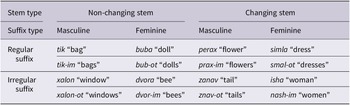
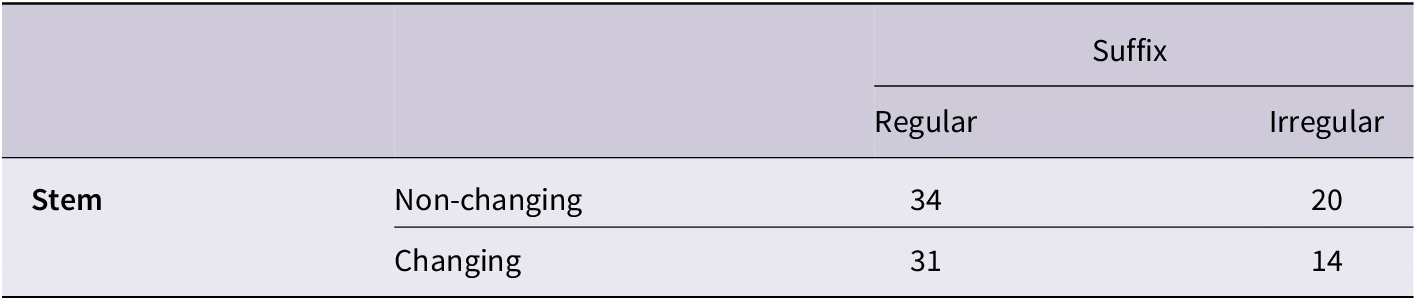
The grammatical gender of a word directly influences its plural form. According to the morphological rule, masculine plural nouns typically end with the suffix -im, while feminine plural nouns typically end with the suffix -ot (in these cases, the plural suffixes are considered regular). However, there are exceptions to this rule – masculine nouns that take the plural suffix -ot and feminine nouns that take the plural suffix -im (in these cases, the plural suffixes are considered irregular). When inflecting a word from singular to plural, the word’s stem may also undergo a change, regardless of the type of suffix (regular or irregular). There are two main types of word stems: those that do not change during pluralization (which may be referred to as regular stems) and those that do (irregular stems). Table 1 illustrates the role of these two factors – stem type and suffix type, in the formation of plurals in Hebrew, creating four word types in Hebrew: words with the highest level of regularity (non-changing stem and regular suffix), two types of words with either a changing stem or an irregular suffix, and an additional type of words in which both the stem changes and the suffix are irregular (see Reznick and Armon-Lotem (Reference Reznick and Armon-Lotem2024) for further categorization in this context, distinguishing between two types of words: fully regular forms – words with a regular suffix and non-changing stem and non-regular words, whose plural forms require lexical and/or morpho-lexical knowledge – words with a changing stem and/or irregular suffix).
Hebrew plural noun categories

3.2. Regularity factor in Hebrew agreement
In Hebrew, adjective agreement structures are characterized by concordance in the gender, number, and definiteness features of the controller and target. In cases of regular singular forms and/or regular plural forms, suffix harmony is achieved (Berman, Reference Berman and Slobin1985), manifesting in identical suffixes on the agreement components (“alliterative agreement,” Corbett, Reference Corbett1991, Reference Corbett2006). For example: tik gadol “big bag,” buba-a gdol-a “big doll,” tik-im gdol-im “big bags,” bub-ot gdol-ot big dolls.” However, in the case of singular or plural forms with an irregular suffix, this harmony is disrupted because the adjective suffix is determined by the grammatical gender of the noun (rather than its suffix). For example: xalon-ot gdol-im “big windows,” dvor-im gdol-ot “big bees.”
3.3. Acquisition of pluralization and agreement in Hebrew
The regular aspects of the Hebrew pluralization system are typically acquired around the age of 3. During this process, children progress from the overgeneralization of the plural suffix -im to establishing distinctions between different singular forms and selecting the appropriate plural suffix (Kaplan, Reference Kaplan1983; Levy, Reference Levy1983a, Reference Levy1983b). Studies highlight the significant roles of stem type and suffix type in children’s performance, with better outcomes observed for words with a non-changing stem compared to those with a changing stem, and for words with a regular suffix compared to those with an irregular suffix (Ravid & Schiff, Reference Ravid and Schiff2009, Reference Ravid and Schiff2012; Reznick & Armon-Lotem, Reference Reznick and Armon-Lotem2022; Schiff et al., Reference Schiff, Ravid and Levy-Shimon2011; Schiff & Ravid, Reference Schiff and Ravid2012). These studies also found that the category of words with a non-changing stem and a regular suffix is the easiest for pluralization, while the most challenging category for children is words with a changing stem and an irregular suffix. Another factor influencing plural production in Hebrew is grammatical gender, with better control over the plural forms of masculine nouns compared to feminine nouns (Ravid & Schiff, Reference Ravid and Schiff2012; Reznick & Armon-Lotem, Reference Reznick and Armon-Lotem2022). These effects in the acquisition of Hebrew pluralization align with the frequency of different plural forms in the linguistic input to which children are exposed (Ravid et al., Reference Ravid, Dressler, Nir-Sagiv, Korecky-Kröll, Souman, Rehfeldt, Gillis and Behrens2008).
The acquisition of agreement with regular nouns is also relatively early in Hebrew. By the ages of 2 to 3, Hebrew-speaking children demonstrate good control of singular agreement for gender and number, with a precedence of masculine agreement over feminine agreement (Kaplan, Reference Kaplan1983; Levy, Reference Levy1983b). In the acquisition of plural agreement, children show a reliance on the strategy of matching suffixes: a plural noun with the suffix -im is paired with an adjective with the suffix -im, and a plural noun with the suffix -ot is paired with an adjective with the suffix -ot (Berman, Reference Berman1981a, Reference Berman1981b, Reference Berman and Slobin1985). According to Berman, the process of acquiring plural agreement with nouns that have an irregular plural suffix follows these stages (Berman, Reference Berman1981b, p. 273):
-
a. ages 2–3/4: regularized plural (beca/*bec-ot “eggs”; kir/*kir-im “walls”);
-
b. ages 3–4: correct irregular plural (sometimes) (bec-im; kir-ot);
-
c. ages 4–5: agreement with plural suffix (*bec-im triy-im or *bec-ot triy-ot; *kir-ot lvan-ot or *kir-im lvan-im);
-
d. school age: agreement by gender of noun (bec-im triy-ot “fresh eggs”; kir-ot levan-im “white walls”).
The role of suffix type, alongside stem type, in the production of agreement structures is also emphasized in additional studies conducted in Hebrew (Ravid & Schiff, Reference Ravid and Schiff2012, Reference Ravid and Schiff2015; Schiff & Ravid, Reference Schiff and Ravid2012).
3.4. Complexity factor in Hebrew: The hierarchy between the Hebrew singular agreement, pluralization and plural agreement
The production of singular agreement structures in Hebrew requires mastery of a morpho-syntactic rule, whereby the suffix of the target aligns with the grammatical gender of the controller. For regular singular forms (which are used in the current study), the morpho-phonological cue of the singular form in Hebrew reliably indicates the grammatical gender of the word. As a result, both gender assignment and gender agreement are rule-governed processes that are applied without difficulty, making singular agreement the least complex structure. It involves only one rule governed process – agreement of the adjective with the lexical gender of the noun with no exceptions and no changes to the noun itself.
The production of plural forms of nouns requires control of the morphological rule of pluralization. This rule is based on selecting the plural suffix according to the characteristics of the singular form. In the case of a regular plural suffix, there is full correspondence between the grammatical gender and the plural suffix. However, this is not the case with an irregular plural suffix – in these instances, the morphological rule becomes irrelevant, and the correct plural form relies on lexical learning, making cases with an irregular plural suffix more challenging. This challenge is often compounded by the need to manage morpho-phonological changes in the stem, as required. This makes noun pluralization more complex than singular agreement. It is rule governed but with lexical exceptions in the plural suffix and morpho-phonological changes to the stem itself which call for relying on lexical knowledge.
Finally, plural agreement combines both reliance on lexical gender for the gender of the adjective and on the dual mechanism for the pluralization of the noun itself, with the result sometimes being non-congruent, that is, a masculine noun with a feminine plural suffix still requires a masculine plural suffix on the adjective, for example, “shulxan-ot gdol-im” “big tables.” The combination of pluralization with its challenges and agreement which is challenged by the irregularity in pluralization makes the production of plural agreement the most complex of the three tasks.
Accordingly, in the context of the three Hebrew structures under discussion, the factor of complexity is measured by the number of processes and by the need (or no need) to rely on lexical knowledge when rules cannot apply.
4. Research question
While the roles of the regularity and complexity factors in language acquisition have been studied previously, there is still insufficient knowledge about the interaction between these two measures. Hebrew pluralization and agreement systems provide an excellent opportunity to test for the effect of each factor and the interaction between them. These morphological and morpho-syntactic systems can be characterized in terms of both regularity and complexity. Regularity is reflected in the type of stem (non-changing, changing) and the type of suffix (regular, irregular). In terms of complexity, the three structures form a clear hierarchy of difficulty, as presented earlier. Thus, the current study explores the interaction between the regularity and complexity factors in the acquisition of three morphological and morpho-syntactic systems in Hebrew – singular agreement, pluralization, and plural agreement structures. Three research questions are addressed:
-
1. What is the contribution of stem type and plural suffix type and the interaction between these two factors of regularity to the performance on the plural structures across ages?
-
2. Is the hierarchy reported in the literature for singular agreement, pluralization, and plural agreement structures maintained? What is the role of the factors of regularity and complexity in all three tasks together?
-
3. Do the group-level differences also appear at the individual level?
We expect to replicate the hierarchy observed in the literature and to add more nuanced insights into the factors that contribute to it, particularly regarding the interaction between the two factors in the acquisition process.
5. Method
5.1. Participants
For the study, 85 Hebrew-speaking monolingual children were recruited. Seventy-eight participants completed all three tasks. Therefore, the findings reported in this study are based on the performance of 78 participants. Parent reports obtained for all participants indicated the absence of factors associated with language-related difficulties (hearing problems, recurrent ear infections in the previous year, or any concerns on the part of the parents for the linguistic development of their child). The study participants were part of a larger research project (the first author’s doctoral dissertation under the supervision of the second author) that examined the acquisition of morphology and morpho-syntax in Russian–Hebrew bilinguals. The participants in the current study served as the control group for the bilingual participants.
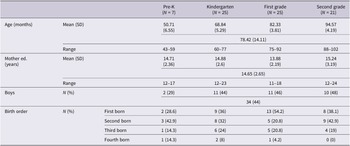
Table 2 presents participant characteristics, according to the school setting variable (pre-kindergarten/kindergarten/first grade/second grade). One-way analysis of variance was conducted (participants’ age being the dependent variable) indicating a main effect for school setting (F(3, 76) = 203.83, p < .001), with significant differences in age observed for different school settings (p < .001). The groups did not differ on the variable of mother’s years of education (Fs = 1.1, p = .36). Further, it was found that the groups did not differ on gender characteristics (χ 2 ≤ .06, p ≥ .81; p ≥ .66). No significant group differences were observed for the variable of number of children with older siblings in the family (χ 2 ≤ 1.63, p ≥ .2; p ≥ .39).
Background information on the participants. Pre-K = pre-kindergarten

5.2. Tools
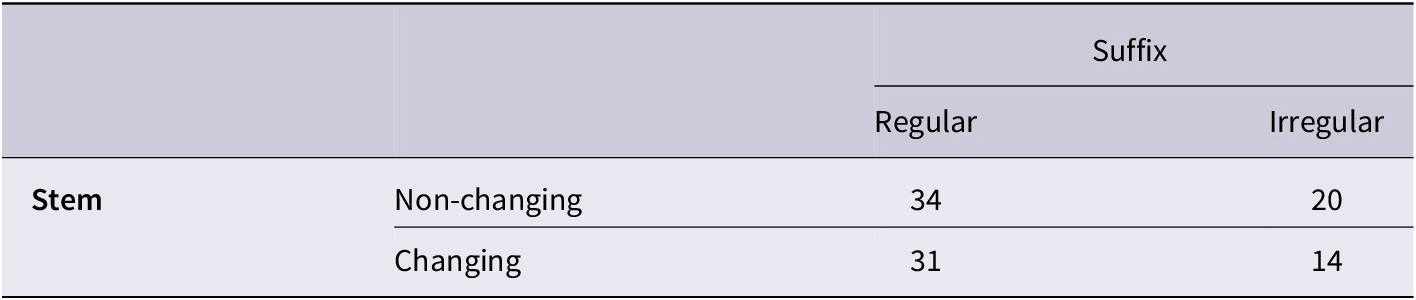
Three tasks were used to test singular agreement, noun pluralization, and plural agreement. The same items were used in order to reduce the influence of potential confounding factors arising from the use of different lexical elements and enable accurate tracking of participants’ performance profiles in various morpho-syntactic tasks. This study reports the findings from 99 words with a regular singular form (57 masculine and 42 feminine words). Of target words with regular singular form, 24% (24/99) contained biological gender cues: 37.5% (9/24) feminine and 62.5% (15/24) masculine words, with no significant difference between them (χ 2 = 3, p = .08). The 99 items were divided into regular and irregular plural categories based on stem properties (non-changing/changing) and plural suffix properties (regular/irregular) (Ravid, Reference Ravid1995; Ravid & Schiff, Reference Ravid and Schiff2009). Table 3 presents the distribution of the 99 tasks nouns by stem and plural suffix types. The unbalanced distribution reflects, first, the properties of Hebrew, with irregular being less frequent, and second, the motivation to select items with appropriate representation of grammatical gender across languages in the larger bilingual project from which this study was derived.
Distribution of the 99 tasks nouns by stem and suffix properties in the plural
Stem types included (Ravid, Reference Ravid1995; Ravid & Schiff, Reference Ravid and Schiff2009): The “non-changing stem” (regular) category included: non-changing stem (parpar/parpar-im “butterfly”), and final vowel omission of -a (kcica/kcic-ot “cutlet”), or -e (sade/sad-ot “field”). The “changing stem” (irregular) category included: final consonant omission of -t (taba’at/taba-ot “ring”), vowel reduction only (perax/prax-im “flower”), vowel change only (ohel/ohal-im “tent”), vowel change/reduction with omission of a/t (misgeret/misgar-ot “frame”), more than one change without stem consonants alternation (gesher/gshar-im “bridge”), change in stem consonants and/or their number (lev/levav-ot “heart”), and stop/spirant alternation only (cav/cab-im “turtle”).
Suffix types included: The “regular suffix” category included cases where a masculine plural suffix –im is used to form the plural of masculine nouns (tapux-im “apples”), and a feminine plural suffix –ot is used to form the plural of feminine nouns (tmun-ot “pictures”). The “irregular suffix” category included cases where a masculine plural suffix –im is used to form the plural of feminine nouns (dvor-im “bees”), and a feminine plural suffix –ot is used to form the plural of masculine nouns (shulxan-ot “tables”).
Comparability in frequency and length between the word types (defined by stem type and suffix type) was verified. The frequency of the target words (singular and plural forms) was rated on a scale of 1–7, from “very rare” to “very common” based on judgements by 61 native Hebrew speakers, all of which were education or speech and language therapy students. Judges were asked to evaluate word frequency based on the language input relevant to young children. The high correlation between the two frequency measures – singular and plural forms – was confirmed (r = .841, p < .001).
Tables 4 and 5 present the frequency of plural forms and word length in number of syllables for each condition of stem type (Table 4) and suffix type (Table 5). To compare word characteristics across conditions, independent samples t tests were conducted. No significant differences were found between conditions, with small effect sizes.
Plural form frequency and number of syllables by stem type: M (SD), Cohen’s d

Plural form frequency and number of syllables by suffix type: M (SD), Cohen’s d

Three sentence completion tasks were used:
Singular agreement task. The singular agreement task evaluated participants’ ability to produce agreement between an adjective and a noun by completing sentences of the form The {noun1} is {adjective}, and the {noun2} is also…, with the two nouns being of different grammatical genders, for example: The box is big, and the newspaper is also… (big).
Noun pluralization task. The pluralization task tested participants’ ability to produce the plural form of target nouns, by completing sentences of the form Here there is one {noun}, and here there are many…, for example: Here there is one doll, and here there are many… (dolls).
Plural agreement task. In the plural agreement task participants were asked to form plural adjective structures by completing sentences with the following structure: Here there is {singular adjective agreement structure}, and here there are many…, for example: Here there is a big pear, and here there are many… (big pears).
The main purpose of the two tasks with plural nouns (noun pluralization and plural agreement) was to evaluate and characterize the ability of participants to form the plural constructions, with reference to stem properties (non-changing/changing) and suffix properties (regular/irregular) (Ravid, Reference Ravid1995; Ravid & Schiff, Reference Ravid and Schiff2009). Six common everyday adjectives were used for the agreement structures, taken from morpho-lexical categories easily accessible to young children, with stem alternations that are mastered at early age (Ravid, Reference Ravid1995; Schiff & Ravid, Reference Schiff and Ravid2012): gadol “big,” katan “small,” lavan “white,” shaxor “black,” xadash “new,” yafe “pretty.”
5.3. Administration of the tasks
For each test item, visual stimulus was presented followed by a presentation of oral stimulus through headphones (sentence for completion) 2 seconds later. Participant’s verbal response was recorded by the computer and by an experimenter in real time. The order in which sentences were presented was fully randomized within task and all participants were exposed to the same randomized order. Four trial sentences were administered before the test began to introduce the different schemas. The order of administration of the tasks was the same for all study participants: the singular agreement task first, the noun pluralization task second, and the plural agreement task third. The singular agreement and pluralization tasks were administered in one session, and the plural agreement task was administered in the second session.
5.4. Data coding
The first response served as the basis for analysis. The central categories for error analysis included a reference to the properties of the whole structure (correct/incorrect), that is, wrong agreement or wrong plural form. Lexical replacements of an adjective for another adjective and responses in which the only error was an adjective stem error were not counted as errors in the agreement constructions so long as the agreement was preserved. The omission of an element, production of one of the elements in the singular, and production of the singular agreement were coded as errors in the plural agreement construction.
5.5. Analyses
Group-level analyses. Given that the dependent variable is binary (correct/incorrect), binomial generalized linear mixed models (GLMMs) were created with fixed effects according to the purpose of the analysis with a binary dependent variable “success” for each item (success/failure). The GLMM results are presented as predicted probabilities of success, which can be converted to percentages by multiplying by 100.
The models included random intercepts and slopes by both participant and items. All coefficients and hypothesis tests are reported on the log odds scale, with back-transformed predicted probabilities provided for interpretability. Confidence intervals (CIs) and p values were computed from the log odds estimates, ensuring consistency between SEs, CIs, and inferential statistics.
Pairwise comparisons of estimated marginal means (EMMs) were conducted on the probability scale for interpretability but were based on the model’s log odds estimates. In addition, for analyses with multiple comparisons, a Bonferroni correction was applied. For analyses with specific planned comparisons, an LSD test was used. Additionally, for continuous predictors, B represents the log odds, and for categorical predictors, B represents the change in log odds (delta log odds). Continuous variables were included in each analysis only once – either as a main effect or as part of an interaction – in order to avoid multi-collinearity.
Individual-level analyses. In addition to group-level analyses, observation at the level of the individual participant was also maintained throughout this study, similar to the one implemented by Friedmann and Reznick (Reference Friedmann and Reznick2021). As part of this observation, an attempt was made to organize participants’ performance along a Guttman scale (Guttman, Reference Guttman1944), in which the presence of a higher order skill indicates the presence of a lower order skill.
6. Results
The results of the study are presented in three parts. The first two parts present the findings at the group level: we begin with a comparison between the two plural-related tasks – the noun pluralization task and the plural agreement task. We then compare the singular agreement structure with the plural-related structures and summarize the group-level results. In the third part, we present the performance of the study participants at the individual level.
Descriptive statistics for success rates in the singular agreement task, the pluralization task and the plural agreement task, according to the grade level, stem type, and suffix type, are presented in the supplementary materials (Supplementary Tables S1–S3, respectively).
6.1. Group level: Nouns pluralization and plural agreement
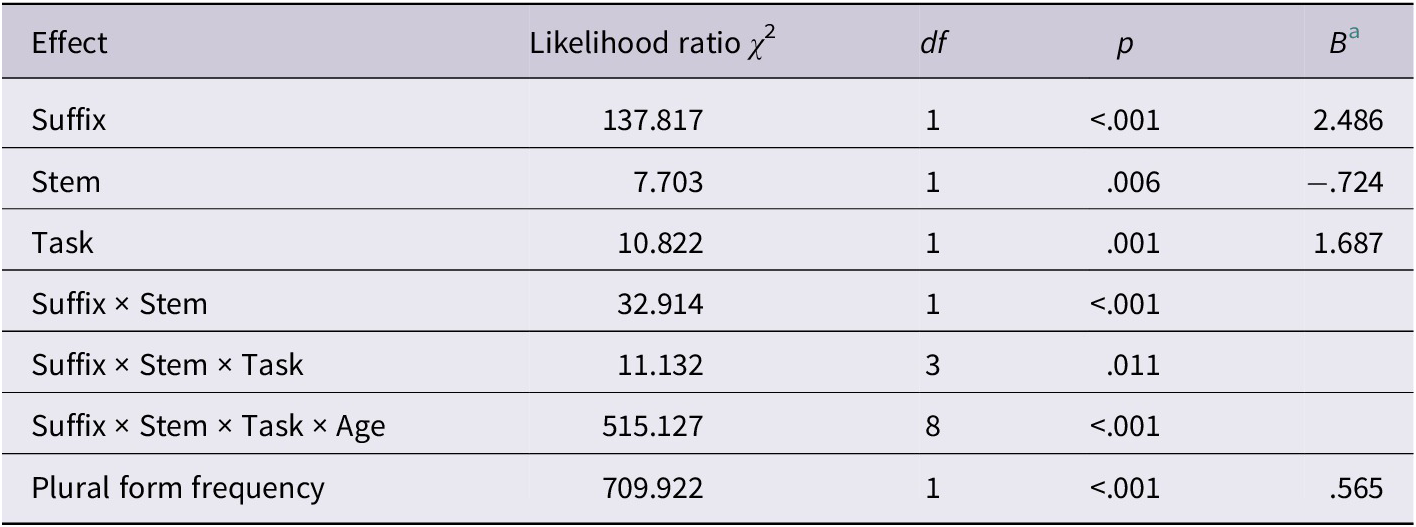
The analysis was conducted using a binomial generalized linear mixed model with a logit link function, predicting the probability of a correct response (correct = 1, error = 0). The following variables were included as categorical predictors: stem type (two levels: non-changing, changing), suffix type (two levels: regular, irregular), task (two levels: noun pluralization, plural agreement), and their interaction. Additionally, the model included two continuous predictors – age (in months) and word frequency in the plural form (on a 1–7 scale). The model further incorporated a four-way interaction between the categorical predictors and the continuous predictor age. Word frequency in the plural form was entered as a covariate. The model fit the data significantly better than the intercept-only model, likelihood ratio χ 2(16) = 3795.973, p < .001, AIC = 9155.025, BIC = 9284.990.
Several significant effects were found (Table 6). First, a significant effect of suffix type was observed, with higher predicted probabilities of success for regular suffixes (M = 0.91, SE = 0.003) compared to irregular suffixes (M = 0.64, SE = 0.008). Second, a significant effect of stem type was found, with higher predicted probabilities of success for non-changing stems (M = 0.85, SE = 0.005) compared to changing stems (M = 0.76, SE = 0.006). Third, a significant effect of task was found, with higher predicted probabilities of success for noun pluralization (M = 0.87, SE = 0.005) compared to plural agreement (M = 0.72, SE = 0.006). Additionally, a significant effect of plural form frequency was found: as frequency increased, the predicted probabilities of success increased (B = 0.565, SE = 0.0219, χ 2 = 709.922, p < .001).
GLMM effects: Suffix, stem, task, age and plural frequency

a The B value (log odds) is presented only for effects with two groups and for the continuous predictor (i.e., for variables that do not require follow-up tests). The B values for the interactions are presented next.
In addition to these effects, three significant interactions were found. First, we report the higher-order interaction of the fixed factors: suffix type × stem type × task. We then address the four-way interaction with age (the continuous predictor).
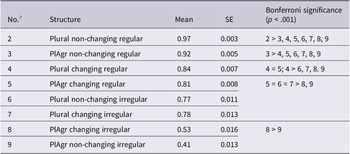
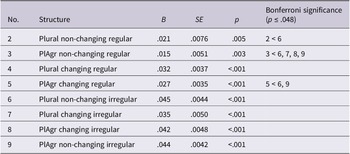
Table 7 presents the predicted probabilities of success for each of the eight structures (suffix type × stem type × task interaction), along with a summary of the differences between them (in this study we focused on differences between the structures in the predicted probabilities of success, see Table S4 in the supplementary materials for log odds, which allow comparison of the contributions of the different structures).
Predicted probabilities of success in eight structures by stem, suffix, and task: Summary of the differences
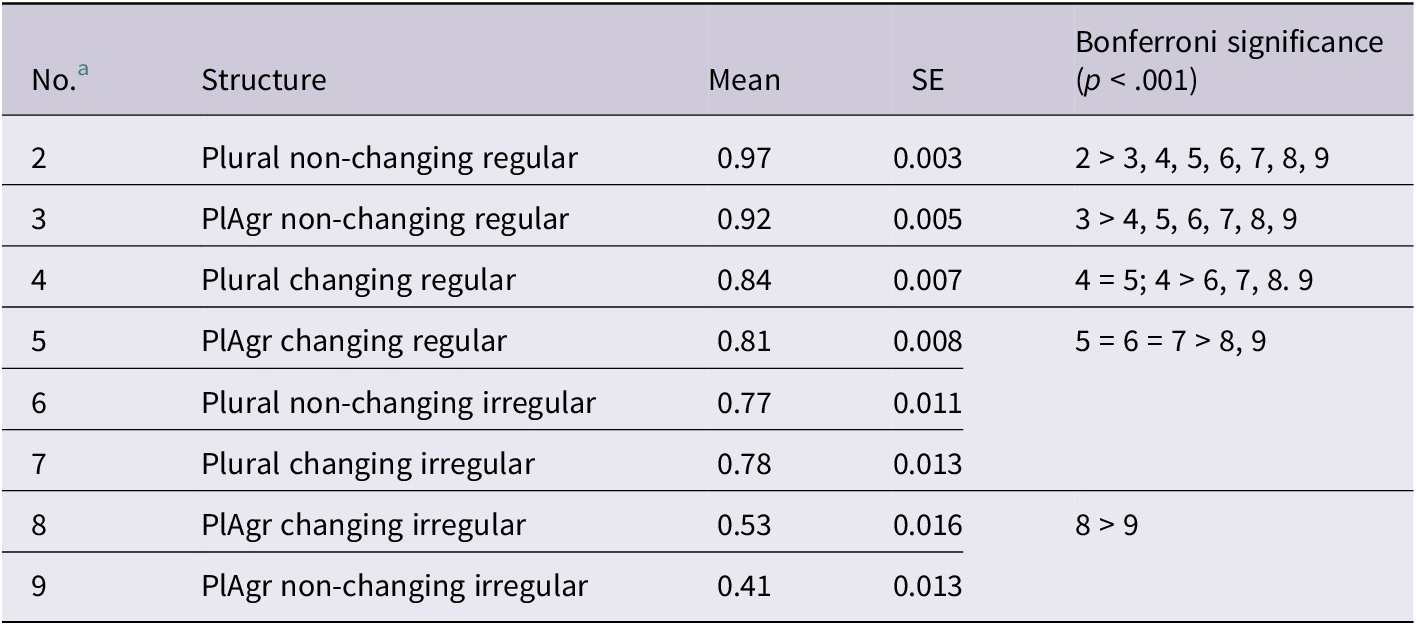
Plural = noun pluralization, PlAgr = plural agreement, non-changing = non-changing stem, changing = changing stem, regular = regular suffix, irregular = irregular suffix.
a The numbering of the structures begins with 2 because structure 1 is the singular agreement structure, which is discussed later.
The highest predicted probabilities of success were observed for two structures characterized by the maximal level of regularity: noun pluralization and plural agreement constructions with nouns that have a non-changing stem and a regular plural suffix, with an advantage for noun pluralization over plural agreement. Four additional structures (three irregular noun plural structures – with a changing stem and/or an irregular suffix – and one plural agreement structure with nouns with a changing stem and a regular suffix) showed no significant differences among most of these structures. Their predicted probabilities of success were significantly lower than those observed in the most regular structures, yet significantly higher than those found in the two most challenging structures, namely the plural agreement constructions with nouns with an irregular plural suffix, which yielded the lowest predicted probabilities of success.
In an additional analysis based on delta log odds values and odds ratios (OR), the magnitude of the differences between the structures was revealed (see Table S4, supplementary materials): overall, this analysis highlights that the sharpest contrasts occur in comparisons between structures with a regular suffix and plural agreement structures with an irregular suffix, whereas within each suffix category (regular or irregular) the differences are more moderate.
In the next step, we examined the effect of age (in months) on children’s performance by testing a four-way interaction that included this continuous variable (suffix type × stem type × task × age). In each of the eight structures, a significant positive effect of age was found: as age increased, the predicted probabilities of success also increased (Table 8, the B column is the log odds). To examine the extent of the effect in each structure, pairwise comparisons of slope differences were conducted using Wald chi-square tests (with Bonferroni correction), and the significant results are presented in Table 8 (see Table S6 in the supplementary materials for a detailed report of all comparisons). The significant differences appeared mainly between structures with a regular plural suffix and those with an irregular plural suffix, with the latter showing significantly steeper slopes compared to the former, indicating a greater contribution of age in the irregular suffix structures. In contrast, within the same suffix category (regular or irregular), the slopes were similar, indicating a comparable contribution of age in these structures.
The contribution of age (in months) to the predicted probabilities of success across the different structures and the differences between the slopes

Plural = noun pluralization, PlAgr = plural agreement, non-changing = non-changing stem, changing = changing stem, regular = regular suffix, irregular = irregular suffix.
6.2. Group level: Comparison of the singular agreement structure with the eight plural and plural agreement structures
The analyses in the first stage focused on two plural structures: noun pluralization and plural agreement. In this section, we compare participants’ performance in the singular agreement structure with their performance in the noun pluralization and plural agreement structures. For these eight planned and specific comparisons (singular agreement vs. each of the eight additional structures), a binomial generalized linear mixed model with a logit link function was constructed to predict the probability of a correct response (correct = 1, error = 0). The model included one categorical predictor – structure type (nine levels: singular agreement, four noun pluralization structures defined by stem type and suffix type, and four plural agreement structures, also defined by stem type and suffix type). In addition, the model included two continuous predictors – age (in months) and word frequency (singular word frequency for the singular agreement structure, and plural word frequency for the noun pluralization and plural agreement structures). The model also included an interaction between structure type and age. Word frequency was entered as a covariate. The model fit the data significantly better than the intercept-only model, likelihood ratio χ 2(18) = 6206.967, p < .001, AIC = 9836.671, BIC = 9989.630.
First, a significant effect of structure was found (likelihood ratio χ 2(8) = 238.365, p < .001), with higher predicted probabilities of success in the singular agreement structure (0.9837) compared to each of the eight other structures presented and discussed in the previous section (p ≤ .017).
Similarly, in this model a significant effect of frequency was also observed (B = 0.559, SE = 0.0213, likelihood ratio χ 2(1) = 728.186, p < .001), with higher predicted probabilities of success for more frequent words. In addition, a significant interaction was found between structure type and age (likelihood ratio χ 2(9) = 522.123, p < .001). Pairwise comparisons of age slopes revealed that the singular agreement structure showed significantly shallower slopes compared to the plural and plural agreement structures with an irregular plural suffix (structures 6, 8, and 9), indicating a stronger contribution of age in these structures. No other significant slope differences were found between singular agreement and the remaining structures (see Table S6 in the supplementary materials).
In the analysis based on delta log odds values and odds ratios (OR), consistent differences were found between the singular agreement structure and all other structures (see Table S5, supplementary materials). The gap was smallest in comparison with the most regular plural structure and became progressively larger across less regular and more complex structures, reaching its maximum in the plural agreement structures with an irregular suffix.
6.3. Interim summary: Group level
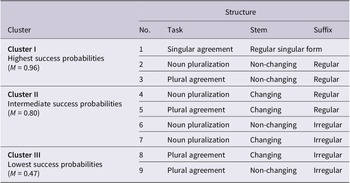
The results demonstrate the centrality of the regularity and complexity factors in the morphological and morpho-syntactic performance of study participants. The highest predicted probabilities of success compared to all other constructions was observed for three constructions having a maximal level of regularity: singular agreement with regular singular form and noun pluralization and plural agreement constructions with nouns with a non-changing stem and a regular plural suffix (these three structures formed cluster I). Four additional structures (three irregular noun plural structures – with a changing stem and/or an irregular suffix – and one plural agreement structure with nouns with a changing stem and a regular suffix) formed Cluster II, characterized by an intermediate level of difficulty. Within this cluster, no significant differences were found between most of the structures. Their predicted probabilities of success were significantly lower than those observed in the most regular structures (Cluster I), yet significantly higher than those in Cluster III – two most challenging plural agreement constructions with nouns with an irregular plural suffix (Table 9).
Nine structures organized into three clusters

The smallest gaps were found between the maximally regular constructions, whereas the largest gaps emerged in comparisons with the plural agreement constructions involving an irregular suffix. In addition, age was found to have a consistent positive effect on performance across all structures, with older participants showing higher probabilities of success. The contribution of age was strongest in structures with an irregular plural suffix, which displayed steeper slopes, whereas within the same suffix category (regular or irregular) the slopes were comparable. Finally, word frequency also showed a positive effect, such that higher frequency words were associated with higher probabilities of success.
6.4. Individual performance level
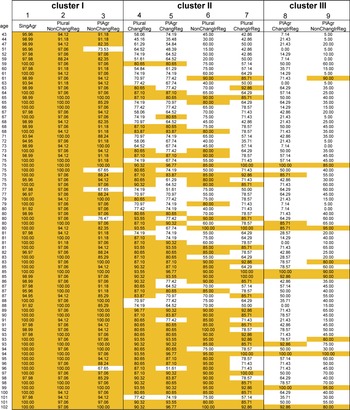
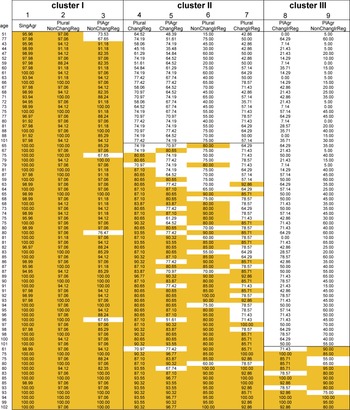
Figure 1 presents participant performance organized according to chronological age, and Figure 2 presents participant performance organized according to success patterns. The cells present the success percentages of every participant for each structure. Success was defined as a performance level at a rate of at least 80% correct answers (following Friedmann & Reznick, Reference Friedmann and Reznick2021; Hashoul-Essa & Armon-Lotem, Reference Hashoul-Essa and Armon-Lotem2025) and these cells are colour marked.
Individual performance level by chronological age. SingAgr = singular agreement, Plural = pluralization, PlAgr = plural agreement, NonChang = non-changing stem, Chang = changing stem, Reg = regular suffix, IrReg = irregular suffix.

Individual performance level by clusters. SingAgr = singular agreement, Plural = pluralization, PlAgr = plural agreement, NonChang = non-changing stem, Chang = changing stem, Reg = regular suffix, IrReg = irregular suffix.

Children of similar ages presented varying success profiles (Figure 1). However, the hierarchy of difficulty among the three clusters observed at the group level is also reproduced at the individual level (Figures 1 and 2): the first structures in which children succeed are those from Cluster I, followed by emerging mastery of the Cluster II structures, and finally success in the two most challenging structures from Cluster III, with mastery of these structures developing either in parallel with or subsequent to mastery of the Cluster II structure. In addition, success with the two higher order structures (Cluster III) guarantees success with all lower order structures (Clusters I and II). Success in all or in part of the Cluster II structures ensures, for the vast majority of children (all except three), success in all structures of Cluster I.
7. Discussion
The primary aim of this study was to examine the interaction between regularity and complexity in the acquisition of Hebrew as a first language, focusing on the performance of monolingual Hebrew-speaking children aged 4–8 in three morphological and morpho-syntactic systems: singular agreement, pluralization, and plural agreement. The findings of the study highlight, first and foremost, the central role of regularity and complexity in language acquisition: regular structures are acquired before irregular ones, and within each level of regularity, less complex structures are acquired before more complex ones.
7.1. Regularity and complexity in morphological and morpho-syntactic acquisition
Three clusters of structures were identified: the first with the highest predicted probabilities of success compared to the other structures (an average of 96%), the second with an intermediate level of difficulty (an average of 80%), and the third with the most challenging structures, showing the lowest success probabilities (an average of 47%). The first cluster includes singular agreement with a regular singular form and noun pluralization and plural agreement with nouns that have a non-changing stem and a regular plural suffix. That is, this cluster consists of three structures with the highest level of regularity. Yet, a clear hierarchy of success probabilities was observed among the three structures, based on their level of complexity: singular agreement is the easiest to produced, followed by noun pluralization, and plural agreement is the most difficult of the three. The other two clusters included only structures with non-regular words – those with a changing stem and/or irregular suffix and what differentiates these clusters is the level of complexity: the second cluster includes three noun pluralization structures and one plural agreement structure, while the third cluster, with the lowest predicted probabilities of success, consists solely of plural agreement structures. These findings show that there is a significant advantage for regular structures over irregular structures (at the stem and/or suffix level), as reflected, for example in the clear advantage of the first cluster’s structures over the others. The significance and novelty of this study lie in demonstrating that this hierarchy is observed not only at the group level but also at the individual level – most participant in the study exhibited this hierarchy of acquisition across the three structures (the profile analysis indicated the possibility of additional profiles, and to substantiate this possibility, future research should focus on a larger sample of children).
Several properties of Hebrew make singular agreement the easiest task for Hebrew-speaking children, with impressive success probabilities even among the youngest participants. Producing singular agreement in Hebrew requires recognizing morpho-phonological cues related to singular forms and producing a target that aligns with the grammatical gender of the controller. In the case of regular singular form, which were the only forms used in this study, there is a complete match between the singular form and the noun’s grammatical gender. That is, in the case of regular singular forms, the morpho-phonological cues for grammatical gender in Hebrew are reliable and available, contributing to the rapid and efficient acquisition of singular agreement with these forms. These findings align well with what is known about the ability of Hebrew-speaking children to rely on morpho-phonological cues to determine grammatical gender – a skill that develops as early as ages 2–3 (Berman, Reference Berman and Slobin1985; Levy, Reference Levy1983b). Another factor that makes this task the easiest among the three is the nature of agreement with nouns with a regular suffix in Hebrew. In such cases, alliterative agreement occurs (Corbett, Reference Corbett2006), where the agreement marking on both the controller and the target is phonetically similar (a phenomenon referred to by Berman, Reference Berman and Slobin1985, as the suffix harmony effect). Relying on this phonological match between suffixes simplifies the production of agreement structures for Hebrew-speaking children (Berman, Reference Berman and Slobin1985). Finally, singular nouns in Hebrew are more frequent than plural nouns, both in children’s language and in child-directed speech (Ravid et al., Reference Ravid, Dressler, Nir-Sagiv, Korecky-Kröll, Souman, Rehfeldt, Gillis and Behrens2008). This quantitative advantage, both in terms of types and tokens, further explains the advantage in producing singular agreement compared to tasks like plural agreement.
The next task in the acquisition hierarchy of difficulty is pluralization of nouns, which was found to be more challenging compared to singular agreement but easier than plural agreement. The pluralization task requires the application of pluralization rules. This involves processing the singular form and determining the plural form based on its features – a correct plural suffix and the appropriate morpho-phonological change to the stem (if required). As noted, in the case of regular plural suffixes, there is complete alignment between the noun’s inherent grammatical gender and its plural suffix. In the case of regular singular forms (as used in this study), there is also a full match between the noun’s grammatical gender and its singular form. In these cases, the production of plural forms aligns perfectly with a productive morphological rule, which is acquired very early in Hebrew (Kaplan, Reference Kaplan1983; Levy, Reference Levy1983a, Reference Levy1983b; Ravid & Schiff, Reference Ravid and Schiff2009, Reference Ravid and Schiff2012; Reznick & Armon-Lotem, Reference Reznick and Armon-Lotem2022; see Ravid et al. (Reference Ravid, Dressler, Nir-Sagiv, Korecky-Kröll, Souman, Rehfeldt, Gillis and Behrens2008) for a discussion of phonological cues in the singular form as contributing to performance in the domain of Hebrew pluralization). This is not the case with irregular plural suffixes. These are exceptions that do not follow a morphological rule and require lexical learning, which is more challenging for Hebrew speakers compared to the application of a morphological rule in the case of regular plural suffixes (Ravid & Schiff, Reference Ravid and Schiff2009, Reference Ravid and Schiff2012; Reznick & Armon-Lotem, Reference Reznick and Armon-Lotem2022). Another challenge in the pluralization system is the morpho-phonological change of the word stem (Ravid, Reference Ravid1995; Ravid & Schiff, Reference Ravid and Schiff2009, Reference Ravid and Schiff2012; Reznick & Armon-Lotem, Reference Reznick and Armon-Lotem2022). Some of these changes are unpredictable and constitute idiosyncratic lexical items, while others involve morpho-phonological changes that are shared by other nouns, forming morpho-phonological clusters. In both cases, mastering these stem changes depends on lexical and/or morpho-lexical and morpho-phonological learning. This learning process, in turn, is influenced by exposure to rich and varied linguistic input, given that irregular forms are less frequent in the linguistic input children are exposed to (Ravid et al., Reference Ravid, Dressler, Nir-Sagiv, Korecky-Kröll, Souman, Rehfeldt, Gillis and Behrens2008; see also Ornan, Reference Ornan2003; Tubul, Reference Tubul2003). All of this makes the pluralization task more challenging compared to singular agreement, which aligns with the existing literature.
The plural agreement task was found to be the most challenging of the three tasks in the study. Producing plural agreement requires the application of two operations: a morphological rule (pluralization) to produce a plural noun and a morpho-syntactic rule (agreement) to form a correct plural agreement structure. In other words, in this single task, children are required to perform the operations underlying both of the previous tasks. This accumulation of linguistic operations in itself increases the complexity of the plural agreement task. In addition to the challenges associated with producing plural nouns in Hebrew, as discussed earlier (irregular suffixes and/or changing stems), plural agreement with irregular plural suffixes in Hebrew is characterized by the disruption of phonological harmony (Berman, Reference Berman and Slobin1985) and these structures are the most challenging for Hebrew-speaking children (Ravid & Schiff, Reference Ravid and Schiff2012; Reznick, Reference Reznick2019). These unique, language-specific features of Hebrew make plural agreement more complex, not only compared to pluralization of nouns but also in comparison to singular agreement. This finding aligns with the extensive literature emphasizing the importance of language-specific agreement features in understanding the relative complexity of different agreement structures.
7.2. Frequency and age factors
The findings of this study also point to the contribution of frequency to the success probabilities, and they align with research highlighting the central role of frequency in language acquisition (e.g., Ambridge et al., Reference Ambridge, Kidd, Rowland and Theakston2015; Bybee, Reference Bybee2011; Davies et al., Reference Davies, Xu Rattanasone and Demuth2020; Ellis, Reference Ellis2002; Köpcke & Wecker, Reference Köpcke and Wecker2017; Tatsumi et al., Reference Tatsumi, Ambridge and Pine2018; Zaretsky et al., Reference Zaretsky, Lange, Euler and Neumann2013). This frequency effect underscores the importance of exposure and linguistic experience in the acquisition of language systems. At the same time, it should be noted that reliable and valid frequency data have not been systematically collected for Hebrew, apart from limited sources (e.g., Ravid et al., Reference Ravid, Dressler, Nir-Sagiv, Korecky-Kröll, Souman, Rehfeldt, Gillis and Behrens2008) that indicate that regular structures in Hebrew are more frequent than irregular ones. The age effect found in this study further sharpens the role of exposure and linguistic experience in language acquisition – particularly in irregular structures, where the contribution of age was shown to be greater.
7.3. Theoretical implications
The findings of this study on the centrality of regularity, both at the stem level and the suffix level, align with the extensive body of research emphasizing this factor in language acquisition cited earlier. The Dual-Mechanism Model (Pinker & Ullman, Reference Pinker and Ullman2002) highlights the contribution of linguistic representations and processes to the understanding of the distinction between regular and irregular forms. This model posits two separate mechanisms in language acquisition: one that operates via productive rules for generating regular forms, and another that relies on lexical retrieval from memory for irregular forms. In the current study, the absence of differences between irregular plural forms with a non-changing versus a changing stem (structures 6 and 7) supports the claim that irregular words are stored in memory rather than generated by a morphological rule. Likewise, differences were found between plural forms with a regular suffix – those with a non-changing stem versus those with a changing stem – which can be explained by the fact that the former result from the application of a morphological rule, whereas the latter involve processes of storage and retrieval of the irregular form (changing stem). Moreover, the smallest gaps observed between the maximally regular constructions, alongside the largest gaps found in comparisons with plural agreement constructions involving an irregular suffix, further support to the Dual-Route Model, given that frequency alone cannot account for them, since no differences in frequency were found between the different word types.
Nonetheless, the Usage-Based approach and its related models offer a complementary perspective that incorporates the observed effects of frequency and the role of regularity in the linguistic input, as well as the effect of age which is related to experience in using the language (Bybee, Reference Bybee2011; Goldberg, Reference Goldberg2009; MacWhinney, Reference MacWhinney, Ellis and Robinson2008, Reference MacWhinney, Gass and Mackey2013; Tomasello, Reference Tomasello2003). Within these models, regularity serves as a string cue for language acquisition, and is thus expected to be acquired earlier. At the same time, we must be cautious with any conclusion that is based on the frequency effects, due to the limitations of the frequency data available to us. Thus, in order to adjudicate more conclusively between the competing models, additional evidence is required, such as comprehensive frequency data, more fine-grained measures such as reaction times, and so forth – beyond the scope of this study. Thus, although the findings of the current study do not serve to adjudicate between the various models or theoretical approaches, they contribute to our understanding of the theoretical value of each in understanding the complexity of language acquisition and the influence of the structure and quality of input and language-specific realizations of morphological and morpho-syntactic features.
7.4. Limitations of the study and future research
One limitation of the current study lies in the use of the singular agreement task and the pluralization task, both of which required completion with a single word – unlike the plural agreement task, which required the production of a two-word phrase. Future research should explore the differences between the tasks using a singular agreement task and noun pluralization task that also require the production of a two-word phrase. Another limitation could be the small number of participants in the youngest group. This was addressed in the study by using age as a continuous variable in the statistical analyses. Yet, future studies might consider using a larger sample of younger children to allow direct comparison between the preschool age groups. An important direction for future work is to complement the present group-level analyses by fitting mixed-effects models and examining participant- and item-level random effects (shrinkage/BLUP-type predictions), which can provide more reliable individual-level estimates than raw proportions by accounting for trial counts and separating within- and between-unit variability (Kliegl et al., Reference Kliegl, Masson and Richter2010). Another limitation of this study relates to the frequency data. Although no differences were found between the word types in terms of frequency, we nevertheless included this variable as a covariate in the statistical models due to the large variability within each word type. Yet the results may reflect the absence of robust frequency data and the relatively small number of raters. In addition, the study did not examine in depth the potential effect of word length, beyond ruling out differences in syllable number. Future research should therefore address these gaps by relying on comprehensive frequency databases and examining more closely the contribution of word length. An additional limitation of this study arises from the imbalance across the four word types (defined by stem type and suffix type), with fewer items containing an irregular suffix, particularly those with an irregular suffix combined with a changing stem. Finally, the restriction to regular singular forms did not allow us to examine the role of sonority in cases of mismatch between singular form and grammatical gender, and future studies should address this issue.
7.5. Conclusions and implications
The current study is the first to examine the interaction between regularity and complexity in the acquisition of morphology and morpho-syntax in Hebrew. The findings emphasize the central role of regularity in the acquisition process – regular structures are acquired before irregular ones, even when they involve varying levels of complexity. Complexity also plays a significant role in acquisition, as success rates within each level of regularity reflect the complexity of the structures, with less complex structures being acquired before more complex ones. These findings have direct implications for linguistic assessment and intervention processes. In the domain of assessment, it is crucial to evaluate language functioning while considering both regularity and complexity as factors. Intervention programmes should be structured according to the developmental sequence identified in this study and other related research.
Supplementary material
The supplementary material for this article can be found at http://doi.org/10.1017/S0305000926100567.
Acknowledgements
We thank the reviewers for drawing our attention to the interpretation of the findings in a more focused and specific manner.
Funding statement/financial support
This research was funded by the Israel Science Foundation [863/14].
Institutional review board statement
The study was conducted in accordance with the Declaration of Helsinki and approved by the Ministry of Education of Israel (protocol code 8883.646 approved 27 December 2015).




 Open access

