




Introduction
The importance of textiles, basketry and cordage within prehistoric societies is inversely proportional to their presence in the archaeological record. Various taphonomic processes typically deprive us of evidence for these essential ancient technologies, leading to an archaeological emphasis on objects made of stone, ceramic and other durable materials, such as shell. The infrequent preservation of artefacts made of plant and animal products, such as wood, wool and flax, may lead archaeologists to underestimate the technological sophistication of past societies, and the extent of their knowledge and exploitation of their environments. Yet, the use of these technologies was integral to prehistoric life—perhaps even defining. The Neolithic, for example, could be seen as a key period of human history, not purely because of the revolutionary effects of plant and animal domestication, but also because of a new dominance over the environment and the acquisition of knowledge about the processing and utilisation of raw materials. For this reason, the Neolithic has been suggested to have been a ‘Wood Age’ as much as a ‘New Stone Age’ (Bocquet & Noël Reference Bocquet and Noël1985).
In this article, we provide an overview of a rare assemblage of basketry, cordage and textile remains, and some of the tools used to manufacture them, recovered from the submerged Early Neolithic site of La Marmotta, in the comune of Anguillara Sabazia, approximately 30km north-west of Rome, Italy.
Early evidence for the manufacture of textiles, basketry and cordage
Palaeolithic sites have yielded some of the earliest evidence for the production of textiles, basketry and cordage. At Dzudzuana Cave, Georgia, the remains of linen fibres were recovered in levels dated to between 32 000 and 13 000 BP (Kvavadze et al. Reference Kvavadze2009; for doubts concerning the identification of linen, see Bergfjord et al. Reference Bergfjord2010). Meanwhile, at Olhao II (19 000 BP, Israel), small fragments of woven fibres (2–3mm in length) have been interpreted as the remains of cordage (Nadel et al. Reference Nadel1994).
The evidence increases considerably during the Holocene. In the Mesolithic Europe, wet or arid conditions have facilitated the preservation of string and rope used to make fishing nets and traps, as well as bows, arrows and other objects at Tybrind Vig (7400–6000 BP, Denmark), Friesack (9700 BP, Germany) Dabki 9 (7000 BP, Poland), Zamostje 2 (8200 BP, Russia) and Santa Maira Caves (13 200–10 200 BP, Spain) (Fischer Reference Fischer1985; Gramsch Reference Gramsch and Coles1992; Myking et al. Reference Myking, Hertzerb and Skrøppa2005; Kabaciński & Terberger Reference Kabacin´ski, Terberger, Kabaciński, Hartz, Raemaekers and Terberger2015; Lozovski & Lozovskaya Reference Lozovski and Lozovskaya2016; Aura et al. Reference Aura2019).
Serving one the earliest Neolithic communities in the Near East, the mortuary cave of Nahal Hemar, Israel, dated to 9900 BP, has yielded fragments of rope and basketry made from rushes (Phragmites australis), reeds (Juncus sp.) and flax (Linum usitatissimum; Schick Reference Schick1986). Also from mortuary contexts are textiles and basketry from Çatalhöyük, Turkey, dated to 7500–7000 BP (Burnham Reference Burnham1965; Marciniak et al. Reference Marciniak2015; Rast-Eicher et al. Reference Rast-Eicher, Karg and Jørgensen2021) and several textile fragments of hemp (Cannabis sativa) or flax dated to 9600–9300 BP from Tell Halula, Syria (Alfaro Reference Alfaro2012).
Numerous European Neolithic lake sites have also preserved objects made from perishable materials. Examples include Charavines, on Lake Paladru, France, with ropes, textiles and baskets dating to 6000 BP (Bocquet & Berretror Reference Bocquet and Berretrot1988) and the use of lime (Tilia sp.) bast and flax at Arbon-Bleiche 3, Lake Constance, Switzerland, dated to 5400–5300 BP (Médard Reference Médard2003). Also in Switzerland, excavation of the Egolzwil settlement, located on the former Lake Wauwilermoos, yielded textiles, cordage and basketry made of flax, and oak and lime bast (Vogt Reference Vogt1951). Artefacts of lime and Clematis sp. bast have also been recovered from La Draga (7300–7000 BP), on the shores of Lake Banyoles, Spain (Piqué et al. Reference Piqué2018; Romero et al. Reference Romero, Piqué and Herrero2021).
As well as waterlogged contexts, objects made of organic materials have also been preserved in extremely arid contexts. This is the case, for example, with sandals and baskets made from esparto grass (Stipa tenacissima) and dated c. 6800–6000 BP recovered from the Cueva de los Murciélagos in Albuñol, Spain (Cacho et al. Reference Cacho, Papí, Sánchez-Barriga and Alonso1996). Finally, preserved in the frozen conditions of the high Alps, the textiles and other objects associated with the ice mummy known as ‘Ötzi’ (5300 BP) also deserve mention. These include artefacts made of lime bast: a dagger sheath, cords and a knotted net of twined strings, as well as shoe components (Spindler Reference Spindler1995).
The Neolithic settlement of La Marmotta
In the context of the above overview, here we present an introduction to the remains of basketry, textiles and cordage recovered from the submerged site of Early Neolithic of La Marmotta. The assemblage retrieved from this site is so large that a detailed description of each object cannot be provided here. Instead, the aim of this article is to offer an overview, in order to illustrate the diversity and exceptional preservation of the La Marmotta material, which emphasise the fundamental importance of the site for the study of plant exploitation and technologies in the European Neolithic.
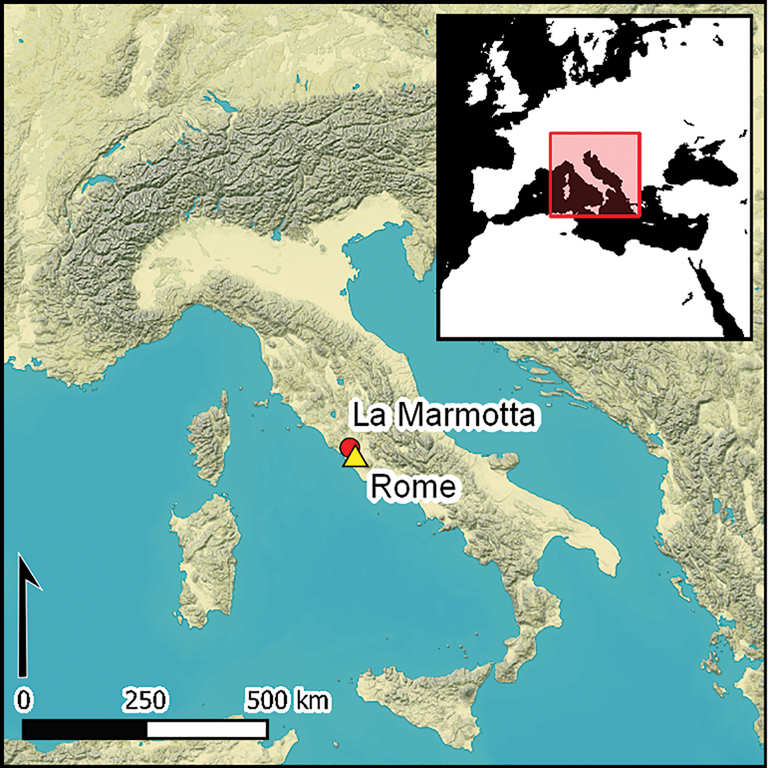
La Marmotta lies beneath the waters of Lake Bracciano. The first archaeological remains were discovered in 1989 during works to lay pipes on the lakebed. Archaeological excavations were conducted from 1992 to 2009, under the supervision of M.A. Fugazzola, director of the Superintendence of the Museo nazionale preistorico ed etnografico ‘Luigi Pigorini’, which was subsequently merged with the Museo delle Civiltà (Fugazzola et al. Reference Fugazzola, D'Eugenio and Pessina1993) (Figure 1). In 2018, an international team directed by the new Museo delle Civiltà–Museo nazionale preistorico ed etnografico ‘Luigi Pigorini’ and the Spanish National Research Council (CSIC) was formed to undertake a study of the archaeological remains from La Marmotta and to bring them to publication. When completed, this work will make known a site and associated material culture of the utmost importance that, to date, have been only cursorily and incompletely published.
Location of La Marmotta (Anguillara Sabazia) (produced by G. Remolins).
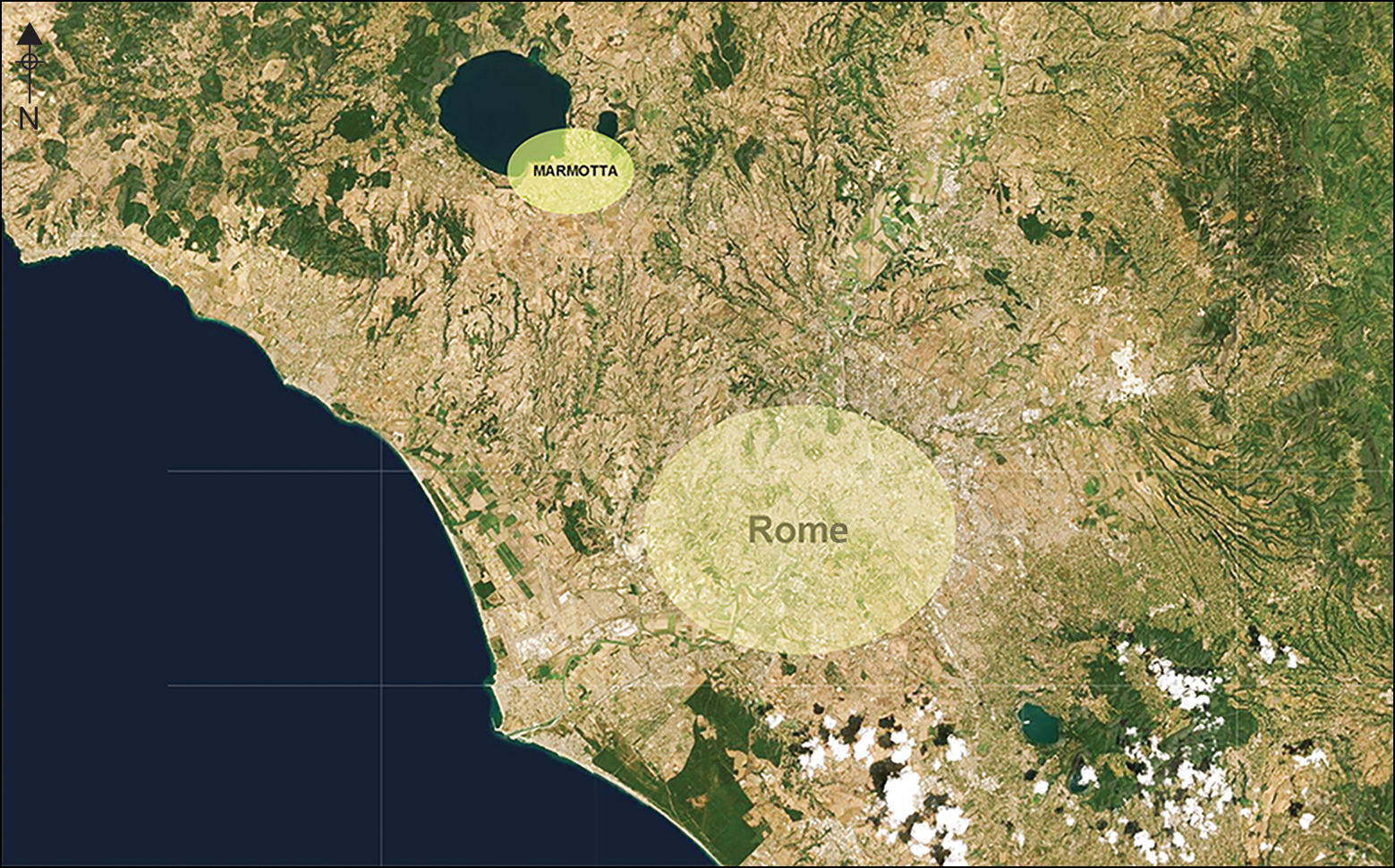
The site lies approximately 300m from the modern shoreline, submerged at a depth of 11m, which comprises 8m of water and 3m of sediment (Figure 2). Lake Bracciano is connected to the Tyrrhenian coast by the river Arrone—a route that will have provided access from the sea during the Neolithic period. It is estimated that approximately 25 per cent of the 2ha village site has been excavated, although the full extent of the remains still needs to be confirmed (Fugazzola Reference Fugazzola, Fugazzola, Pesina and Tiné2002: 375).
Top) Lake Bracciano; bottom) excavation of the site of La Marmotta (photographs by Museo delle Civiltà-Mario Mineo).

Three phases or levels have been defined, dating to between c. 7700 and 7150 BP, encompassing the Italian Early Neolithic (Mazzucco et al. Reference Mazzucco2022). Level II, corresponding to the foundation of the settlement, is characterised by the presence of Impressed Ware pottery and smaller quantities of incised ware associated with painted ware. Level I represents the latest phase of the settlement and is associated with painted and incised pottery in the Sasso-Fiorano style and very little painted ware. Finally, lying above Levels I and II, a third level (known as Chiocciolaio) reflects the abandonment of the settlement. It has been suggested by the excavators that the geographical location of, and finds from, the settlement at La Marmotta might indicate a place of interaction between different cultural groups (Fugazzola & Mineo Reference Fugazzola and Mineo1995). In a number of ways, however, the site is unique; for example, some ceramics, such as the canoe-shaped vessels, are unknown elsewhere in Italy (Fugazzola Reference Fugazzola2019).
Archaeological investigation of the site has documented several thousand wooden piles or support posts on the lakebed; the spatial distribution of these piles permits the identification of a minimum of 13 house structures arranged parallel to one another on the Neolithic lake shore. These dwellings—8 to 10m long and approximately 6m wide—were rectangular, with internal partition walls and a central hearth. Five wooden canoes, some found next to the houses, are currently the only known examples from the Neolithic Mediterranean (Fugazzola & Mineo Reference Fugazzola and Mineo1995; Fugazzola Reference Fugazzola, Fugazzola, Pesina and Tiné2002).
The abandonment of the settlement may have been connected to a sudden rise in the water level of the lake. Whatever the reason, the inhabitants left behind all their possessions, including tools, food-preparation vessels and the canoes. Numerous building elements and wooden objects were also found to have been burnt, similar to what has been observed in other submerged villages, such as in some Alpine lake sites (Neolithic, Switzerland) and Must Farm (Bronze Age, UK) (Bleicher & Harb Reference Bleicher and Harb2018; Knight et al. Reference Knight2019). Future geomorphological studies may help to determine precisely what happened at the end of the site's occupation.
The archaeobotanical and zooarchaeological finds indicate a community practising a well-developed farming economy. Among the domestic livestock, which comprise approximately 75 per cent of the minimum number of individuals (MNI) documented, goats and sheep are the best represented species, followed by cattle, pigs and dogs. Several wild mammal species including red deer (Cervus elaphus), roe deer (Capreolus capreolus), aurochs (Bos primigenius) and red fox (Vulpes vulpes), as well as birds, reptiles and fish have also been recorded (Tagliacozzo Reference Tagliacozzo2005).
Within the archaeobotanical assemblage, 65 per cent of the material comprises cereals, especially emmer wheat (Triticum dicoccum L.) and other varieties of wheat and barley (T. monococcum S., Hordeum distichum, H. vulgare L. and T. aestivum compactum and durum). Other plant resources include legumes (Pisum sativum, Lens culinaris, Lathyrus cicera/sativus and Vicia cfr. sativa), several types of fruit (e.g. Prunus spinosa, Ficus carica, Sambucus sp., Fragaria vesca, Rubus fruticosus, Corylus avellana, Quercus sp.), flax (Linum usatissimum) and poppy (Papaver somniferum), as well as wild plants, such as Carthamus lanatus and Silybum marianum (Rottoli Reference Rottoli1993, Reference Rottoli2002). The inhabitants of the site also gathered fungi, which may have been used to light fires (e.g. Fomes fomentarius) or for their medicinal properties (e.g. Daedalopsis tricolor; Bernicchia et al. Reference Bernicchia2006).
The site's excellent preservation conditions have conserved numerous wooden objects, such as bows, mattocks, sickles, spoons and containers. These organic finds are complemented by thousands of lithic tools made from flint and obsidian, numerous stone axes, adzes and querns, and an array of bone tools (Fugazzola et al. Reference Fugazzola, D'Eugenio and Pessina1993).
The provenances of some of the raw materials recovered from the site demonstrate that the La Marmotta community participated in extensive and complex exchange networks with populations hundreds of kilometres away. Examples include flint from the Gargano promontory (Mazzucco et al. Reference Mazzucco2022) in the Foggia region of south-eastern Italy, obsidian from the Palmarola and Lipari Islands, and Alpine stone used to make axes and adzes (D'Amico Reference D'Amico, Pessina and Muscio2000).
In the following sections, we focus on the evidence from La Marmotta for textiles, basketry and cordage, and the tools used for their production. We start with an overview of the carpological evidence, which informs discussion of fibres and textile manufacture, before turning to the remains of baskets, cordage and textiles, and the tools possibly used to make them. Our aim is not to provide a detailed description of each object but, rather, to furnish an idea of the range and importance of the craftwork activities they represent.
Carpological evidence
Focusing on material potentially related to textile production, to date, out of more than 20 000 archaeobotanical determinations, only five flax seeds have been identified (by M. Rottoli) at La Marmotta. Flax, however, may be underrepresented in archaeological assemblages from the site for a number of reasons. For example, although many of the samples were sieved as soon as sediments were brought to the surface, the mesh size of several millimetres which permitted the recovery of the cereals and fruit stones probably missed smaller seeds, such as flax. Even in sealed contexts, such as the contents of vessels, however, evidence for flax is absent, with the exception of a single poorly preserved seed. Here, it is worth noting that the high oil content of flax seeds often causes their fragmentation in waterlogged conditions (Märkle & Rösch Reference Märkle and Rösch2008).
Among the other plant species that we have documented at La Marmotta, several may have been used for dyeing (e.g. Hypericum perforatum, Phragmites australis, Persicaria maculosa, Prunus spinosa, Sambucus spp.), but until now, no particular archaeological contexts with accumulations of seeds or other parts of these plants have been found that can demonstrate this use. In contrast, the charred and waterlogged seeds of Carthamus lanatus are widely distributed at the site (Rottoli Reference Rottoli1993, Reference Rottoli2002). This species, undocumented at other Italian Neolithic sites, is similar to Carthamus tinctorius (safflower), which can be used for dyeing and for the extraction of an edible oil. Safflower, however, did not spread to Europe until the start of the Bronze Age (Marinova & Riehl Reference Marinova and Riehl2009) and C. lanatus perhaps served a similar purpose in the Neolithic. Notably, the seeds of C. lanatus are larger than those of flax and may therefore be better represented in the La Marmotta samples.
Textiles
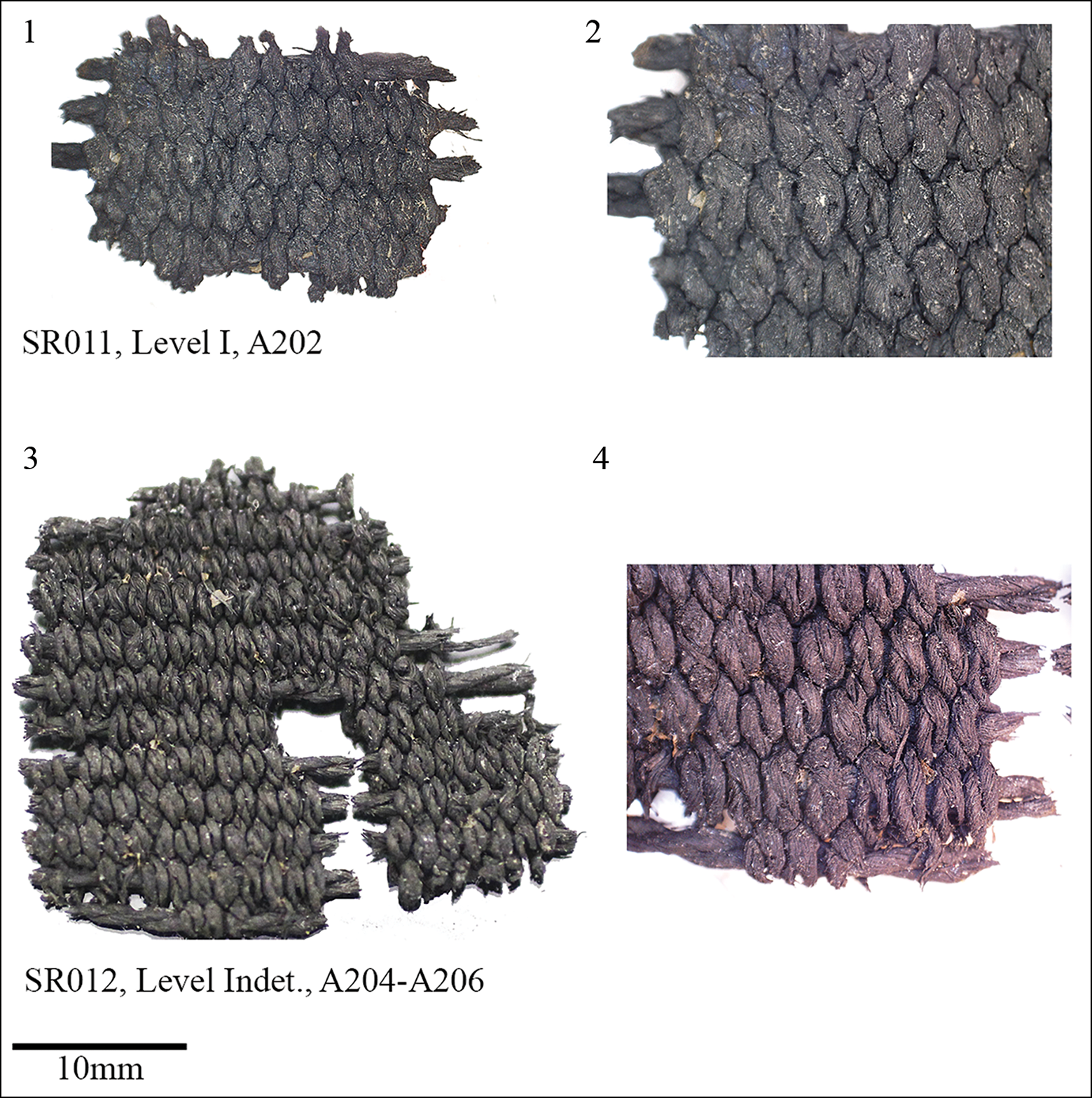
Among the most outstanding finds from La Marmotta are four small textile fragments (Figure 3) found in 1995, when Canoe 1 was recovered (Fugazzola & Mineo Reference Fugazzola and Mineo1995; Mineo Reference Mineo, Massussi, Tucci and Laurito2019). Their maximum dimensions are 11mm (SR011), 27mm (SR012; with probable hole), 11.5mm (#3) and 13mm (#4). These fragments are currently under analysis by a team at the University of Copenhagen (Eva B. Andersson and Christina Margariti). It is probable, however, that they are made of plant fibres. This is suggested by the analysis of a short fragment of 6mm-diameter cord found in Square A41. Examination by using a binocular microscope indicates that this cord is made with flax (Linum sp.) fibres (Maria Rita Giuliani and Giulia Gaietta of the Biological Research Laboratory at the IsCR, pers. comm.).
Textile fragments found at La Marmotta (photographs by J.F. Gibaja).
Cordage
In total, 28 fragments of cord and two lengths of thread have been identified at La Marmotta (Figure 4; Table S1 in the online supplementary material (OSM)). Cords such as these could be made using one of three methods—twisting, braiding or knotting short fibres—and used for a wide variety of purposes. The preserved examples vary considerably in size, from small, short fragments to cords several centimetres in length; in some cases, they are rolled or wound in balls and cannot therefore be measured. They also vary in their diameters, from extremely fine threads to durable ropes capable of resisting heavy weights and tensions. Taxonomic identification of the plant fibres used to produce these cords and threads may shed further light on their usage.
Rope from La Marmotta, made by twisting (photographs by Juan F. Gibaja).

Basketry
Basket-making was another common activity of Neolithic farming societies (Gleba & Mannering Reference Gleba and Mannering2012). Basketry could be used for many tasks, including the gathering and processing of food, and the storage and transport of goods. Among the 43 fragments of basketry recovered from La Marmotta, the most frequently attested production technique is the coiling of bundles of fibres around a rigid material, sewn together with stitches, probably using a bone needle (Table S2; Mineo Reference Mineo, Massussi, Tucci and Laurito2019). In some cases, as seen in Figure 5, food remains are preserved in the bottoms of baskets; the imprint of basket walls has also been identified impressed on pieces of bread. As in the case of cordage, taxonomical analysis of the fibres used is ongoing.
Basket from La Marmotta, with remains of food preserved in the bottom (photographs by Juan F. Gibaja).

Spindles, spindle whorls and loom weights
Spindles were used to spin thread by hand. These are typically made of shafts of wood, pointed at either end and with thickening of the mid shaft. The eight spindles found at La Marmotta are exceptional finds in a European prehistoric context. Of great significance is a complete spindle, consisting of a cylindrical wooden shaft with thread still wound around it in a bi-conical shape (Figure 6, no. 1). A second, broken, spindle is notable, as the shaft is slightly curved; thread is wound around this spindle in a conical shape (Figure 6, no. 2).
Spindles from La Marmotta (photographs by Museo delle Civiltà-Mario Mineo).

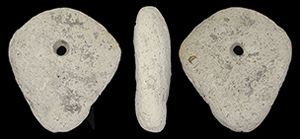
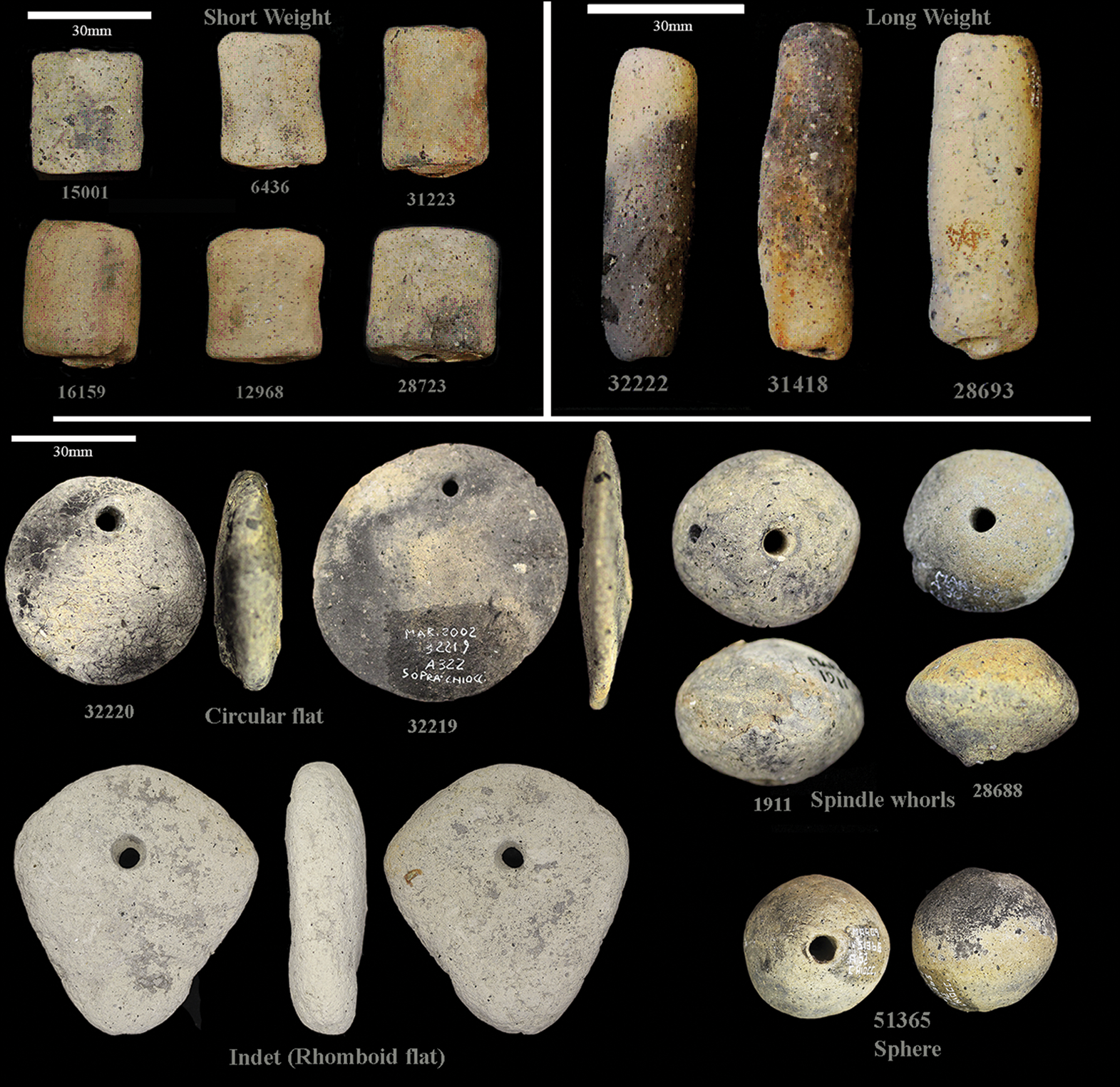
Other objects commonly associated with textile production are spindle whorls and loom weights (Rast-Eicher Reference Rast-Eicher and Bichler2005; Mazare Reference Mazare2012; Forte & Lemorini Reference Forte, Lemorini, Gleba and Laurito2017; Grömer Reference Grömer, Siennicka, Rahmstorf and Ulanowska2018; Grabundžija et al. Reference Grabundžija2021). Some 78 loom weights and three spindle whorls have been recovered from La Marmotta (Figure 7). The loom weights vary widely in shape and size: cylindrical, triangular, trapezoidal, rhomboidal, circular and spherical. The spindle whorls are lenticular or bi-conical discs, with a central hole. These objects are made from refined clay to which various mineral inclusions were occasionally added (see Table S3).
Spindle whorls and loom weights from La Marmotta, possibly used in weaving or fishing rod (photographs by Museo delle Civiltà-Mario Mineo and J.F. Gibaja).
Weaving tools
Finally, we report a group of wooden tools probably used in textile production, or for processing plant materials. Earlier site reports have labelled these finds as ‘spadoni’, weaving swords, and ‘draghetti’. Spadoni, of which 34 complete or fragmented examples are documented from the site, take the form of a long, narrow spatula, with a sharp side and lenticular cross-section (Figure 8). At least one of the two ends is always narrower, forming a handle, and the surviving surfaces are smoothed, probably by prolonged hand contact. In some cases, the handle terminates with a pommel to enable the tool to be held more securely. Spadoni can be differentiated from weaving swords based on size, as morphologically they are very similar (Mineo Reference Mineo, Massussi, Tucci and Laurito2019). Weaving swords (four cases) are no longer than 600mm in length, 35mm wide and 15mm thick, while the spadoni are sometimes considerably larger—up to 1.34m in length, 73mm wide and 14mm thick. Because of their large size, some of the spadoni appear to have handles at both ends, and they may have been intended for use by two persons. Weaving swords are also known at other Neolithic sites in Switzerland (Niederwil-Egelsee and Robenhausen-Wetzikon) and Italy (Fiave) (Bazzanella et al. Reference Bazzanella, Mayr, Moser and Rast-Eicher2003). They were probably used during weaving to ensure that each new weft thread was tightly packed down.
Wooden implements known as ‘weaving swords’ (1) or spadoni in Italian (2), from La Marmotta (photographs by Museo delle Civiltà-Mario Mineo).

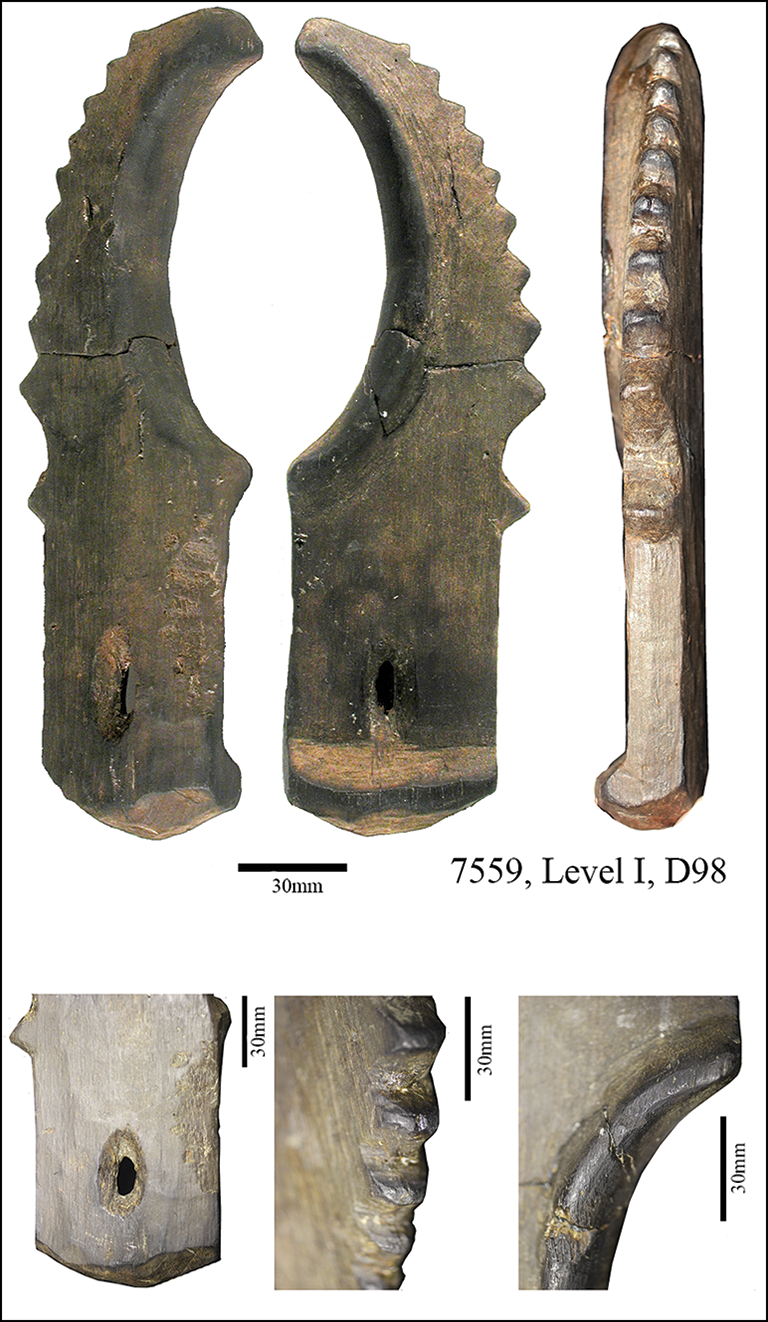
Draghetti—the name derived from the resemblance of their toothed form to a dragon's back—are represented by seven complete or fragmented examples. These tools are characterised by a straight proximal part, invariably pierced by a small hole for a cord that could have been used to suspend and/or secure it around the wrist, and a curved part. The latter consists of an internal concave surface worn smooth by use, and an external convex face with a series of aligned triangular teeth, some with longitudinal striations and distinct rounding—probably the result of repeated abrasion during use. Although the complete specimens range between 230 and 255mm in length, one of the broken examples (#12240, Level I, Square D241) must have been much longer, as it is 245mm long, despite missing much of the distal end. The proximal areas are between 48 and 65mm wide, while the convex distal part varies from 55 or 65mm in its widest section to 20 or 30mm at the pointed end. The proximal part is 11–16mm thick and the distal part 22–28mm thick (Figure 9). Relatively similar objects have been found at the Neolithic lake site of La Draga, Spain (Bosch et al. Reference Bosch2006). Ethnographically attested tools of similar form to the spadoni and draghetti (the latter with metal tips) were used in traditional linen working (Loi Reference Loi2012). They would have been used in a similar way to weaving swords, but designed for working on coarser and larger textiles.
Wooden implement known as a draghetto in Italian, from La Marmotta (photographs by J.F. Gibaja).
The distribution across the site of objects associated with textile production shows a wide spread of activity, with various concentrations in different houses, such as spadoni in house 7 and loom weights in house 12 (Figure 10), which may indicate household specialisation. Perhaps only some of these houses’ inhabitants practised weaving.
Distribution of the artefacts described in the manuscript across the excavated areas of La Marmotta (produced by G. Remolins).

Among other finds from La Marmotta, some tools, such as awls, spatulas and needles made from goat and sheep bone, were clearly used to work raw materials. The pointed ends of some of the awls are extremely smooth and shiny, presumably as a result of use-wear, such as repeated contact with plant fibres or animal skins (Mozota & Gibaja Reference Mozota and Gibaja2015). Flaked stone tools were also used to process plant fibres at La Marmotta, as is well known from other Epipalaeolithic and Early Neolithic sites in the Mediterranean. Plant-working activities have been reconstructed based on use-wear trace analysis in several Capsian sites in Algeria and Tunisia (i.e. Saint Trivier, Kef Zoura D, Aïn Metherchem), but also in many settlements of the first agropastoral communities, such as La Draga or Cueva de Chaves in the Iberian Peninsula (Mazzucco et al. Reference Mazzucco2015; Mazzucco & Gibaja Reference Mazzucco and Gibaja2018). From an assemblage of several thousand lithic finds from La Marmotta, a sample of 831 pieces from Layers I and II includes eight tools (with a total of 12 used edges). These are all bladelets that were used on their unretouched edges to scrape plant materials, exhibiting a smooth polish with clear transversal directionality. The striaes and directionality of the micropolish, especially on the upper face of the tools, show that they were used for scraping. Experiments have demonstrated that this type of tools was used to prepare plant fibres for cord making and basketry (Caspar et al. Reference Caspar2005; Little & van Gijn Reference Little and van Gijn2017). The analysis of a larger sample of the lithic material from La Marmotta will allow us to assess more fully the importance of plant fibre processing activities at the site. Data from other Neolithic sites in the Western Mediterranean suggest that up to 20 to 30 per cent of the tools used were for wood- and plant-working activities; for example, at La Draga, 51 used edges from 467 tools show evidence of wood and plant processing (Mazzucco & Gibaja Reference Mazzucco and Gibaja2018; Gassin et al. Reference Gassin2020).
Conclusions
In recent decades, the expansion of the Neolithic way of life has often been discussed in the archaeological literature as a turning point in human history. One of the factors explaining the success of that expansion is the technological sophistication of those earliest farming communities. Our understanding of their technical knowledge and skill is typically limited to objects made of durable stone and ceramic. The limited extent of the picture that we can usually reconstruct is made clear by the settlement of La Marmotta. Here, the excellent preservation of wooden structures and objects of various perishable materials creates a much fuller understanding of the technical complexity of these early farming societies, perhaps even pointing to the existence of craft specialists. In particular, we might note the building of canoes almost 11m in length, the use of a suite of specialised tools for the production of textiles, and sickles of advanced design (Mineo Reference Mineo, Massussi, Tucci and Laurito2019; Mazzucco et al. Reference Mazzucco2020). Finds such as these point to the central importance of these technologies not only at La Marmotta but almost certainly at other less well-preserved sites. Even so, the 28 fragments of cordage from La Marmotta can only represent a small fraction of the material culture, including clothes, tools and containers that were made and used by the site's inhabitants, and we still lack completely many other objects whose presence is only implied, such as looms. Nonetheless, the evidence from submerged sites in various parts of Europe clearly indicates that Early Neolithic societies were highly knowledgeable about the varied plants resources to which they had access and the methods required to process them. The full publication of La Marmotta in due course will establish the site as one of the highest importance for the study of European prehistory.
Supplementary materials
To view supplementary material for this article, please visit https://doi.org/10.15184/aqy.2023.21.
Acknowledgements
This article is dedicated to the memory of Filippo Maria Gambari (Director of the Museo delle Civiltà di Roma). The research was made possible by the collaboration of the ‘La Marmotta’ research team, the management, curators, researchers and other staff at the Museo delle Civiltà and the CSIC (Institución Milá y Fontanals and Española de Historia y Arqueología in Rome). The photographs of La Marmotta and the archaeological artefacts were kindly provided by the Museo delle Civiltà. This article would not have been possible without the research of all the archaeologists who have worked at La Marmotta over the years. Finally, the authors would like to thank the reviewers for their comments. They have undoubtedly improved the text.
Funding statement
Several projects funded by the Ministry of Science and Innovation of Spain, Agencia Estatal de Investigación of Spain, CSIC, Marie Curie Europe Program and Ministry for University and Research of Italy have resulted from this collaboration: PID2020-112513RB-I00, HAR2016-75201-P, PIAR-201818008, PIAR-201918010, QUANT-792544 and Rita Levi Montalcini project AGER.


 Open access

