



The obesity epidemic is a public health challenge worldwide. Although most of the efforts have been deployed to elaborate effective weight-loss strategies, some data also suggest that obesity rates may well be compounded by the progressive weight gain seen in normal-weight individuals throughout adulthood( Reference Ostbye, Malhotra and Landerman 1 ). It thus seems relevant and necessary to develop both effective weight-loss and weight-gain prevention strategies to manage overweight and obesity.
Although traditional weight-management diets rest upon continuous daily energy deficit over varying time periods, this has been shown to result in about 5 % weight loss in only 30 to 40 % of individuals; the maintenance of this weight loss remains quite challenging( Reference Ostbye, Malhotra and Landerman 1 – Reference Varady 3 ). In contrast to long-term continuous energy restrictions, intermittent severe energy depletions have been suggested as an efficient weight-loss intervention( Reference Varady 3 ). This strategy mainly consists in alternating short-term (1–4 d) energy restrictions with adequate (following nutritional recommendations)( Reference Harvie, Wright and Pegington 4 , Reference Harvie, Pegington and Mattson 5 ) or ad libitum ( Reference Varady, Bhutani and Church 6 – Reference Varady, Bhutani and Klempel 8 ) food consumption on the other days. Recently, Clayton et al.( Reference Clayton, Burrell and Mynott 9 ) showed that in lean adults (men and women) a 24-h severe energy restriction of 75 % of their daily energy requirement (intake of only 25 % of their estimated individual daily energy needs) favoured a transient increase in subjective appetite accompanied by a small increase in food intake the following day. In their recent work, O’Connor et al.( Reference O’Connor, Scisco and Smith 10 ) compared an energy-balanced day (energy intake was controlled to match for total energy expenditure) with a 90 % energy deficit day (energy intake corresponded to about 10 % of total EE) in healthy young adults (21 (sd 3) years old, both sexes). According to their results, such a severe energy depletion increased appetite feelings and food consumption( Reference O’Connor, Scisco and Smith 10 ).
Although these experiments investigated the effects of different diet-induced energy deficits on subsequent food intake and appetite, others have questioned whether equivalent energy deficit induced by exercise might lead to similar compensatory responses. In 1998, Hubert et al. ( Reference Hubert, King and Blundell 11 ) showed for the first time that although an acute energy depletion induced by dietary restriction led to increased hunger and food intake at the following meal, in contrast a similar energy deficit induced by a bout of moderate exercise did not significantly alter perceived hunger and did not induce an increase in energy intake in healthy adults. Interestingly, concordant compensatory responses have been found in healthy men and women( Reference Alajmi, Deighton and King 12 ). In their recent randomised controlled trial, Cameron et al.( Reference Cameron, Goldfield and Riou 13 ) explored compensatory responses over a 3-d period among healthy young males. According to their results, food restriction represented a greater challenge to appetite compared with an equivalent deficit induced by exercise, with greater appetite and ad libitum energy intake( Reference Cameron, Goldfield and Riou 13 ). Interestingly, recent evidence suggests that these compensatory responses to an imposed energy deficit might also depend on the degree of the induced deficit. Ad libitum energy intake has been found to negatively correlate with the degree of exercise-induced energy deficit but to positively correlate when the deficit is created using diet in obese youth( Reference Thivel, Doucet and Julian 14 ).
Although transient total diet-induced daily energy deficits are experienced by some people when following intermittent fasting or during Ramadan periods for instance( Reference McNeil, Mamlouk and Duval 15 ), their impact on appetite and energy intake remains poorly questioned( Reference Cameron, Goldfield and Finlayson 16 ) and it has never been compared, to our knowledge, with a similar total daily exercise-induced deficit. The aim of this study was to compare the appetite, food reward and energy intake responses with a complete 24-h energy deficit induced by diet (fasting) v. exercise, in healthy young males. We hypothesised that while hunger and ad libitum energy intake would be increased in response to fasting they would remain unchanged in response to a full deficit induced with exercise.
Methods
Population
In all, twelve healthy young males (21·5 (sd 0·5) years old) were recruited among university students with a body weight of 71·1 (sd 6·7) kg and BMI of 22·5 (sd 1·7) kg/m² to participate in this randomised study. The mean fat mass percentage of the sample was 11·6 (sd 4·2) %, with a fat-free mass of 59·5 (sd 4·2) kg. To be included in the study, they had to be free of any illnesses or medications that could interfere with the study outcomes and had to be engaged in no more than 180 min of structured physical activity per week (assessed using the International Physical Activity Questionnaire). This study was conducted according to the guidelines laid down in the Declaration of Helsinki, and the local Research Ethics Committee approved all procedures involving human subjects (CPP Sud Est VI). Written informed consent was obtained from all subjects.
Design
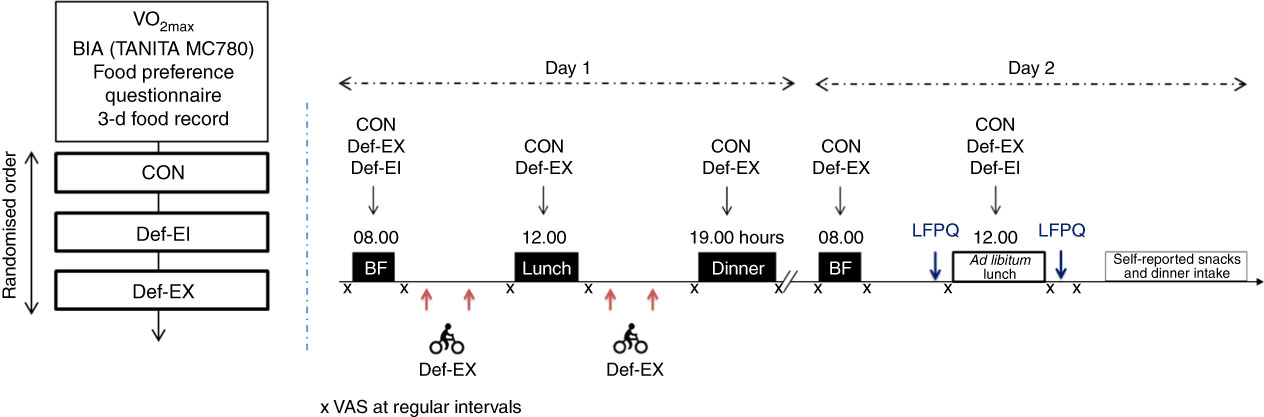
After a medical inclusion conducted by a physician to confirm the ability of each candidate to perform the whole protocol, anthropometric measurements, body composition (bio-impedance analysis), aerobic capacity (VO2max), food preferences and daily energy intake (3-d dietary record) were assessed for all the participants. The dietary status of the participant was checked with the use of the Three-Factor Eating Questionnaire (TFEQ). They had to then complete three experimental sessions in a randomised order (block randomised using Stata software): (i) a no energy depletion control condition (CON); (ii) a full 24-h energy-restriction condition (Def-EI); and (iii) an exercise condition during which they had to cycle to expend their whole daily energy intake (Def-EX). Each session (detailed below) lasted over 2 d from 08.00 hours on day 1 to 13.30 hours (after lunch time) on day 2. Each session ended with an ad libitum lunch meal, before (15 min) and after (15 min) which the participants had to perform the computer-based Leeds Food Preference Questionnaire (LFPQ). Food intake after lunch was also assessed using self-reported food diaries. Appetite feelings were assessed using Visual Analogue Scales at regular intervals throughout the sessions.
Experimental conditions
Control condition (CON)
From 06.00 hours on day 1 to 12.00 hours on day 2 the participants were asked to consume their usual amount of energy content. Individually prepared food bags for each meal were distributed to the participants based on the completed 72-h dietary record. They were asked to give back the bags by the end of the sessions with all the empty containers and wrappings in order to monitor the consumption of every meal. During the whole day, the participants were asked to maintain their usual daily activities but to refrain from any moderate to intensive exercise training. On day 2, an ad libitum lunch meal was offered to the participants in our laboratory and they were asked to perform the computerised LFPQ 15 min before and after lunch. Dinner energy intake on day 2 was assessed using a self-reported food diary.
Energy restriction condition (Def-EI)
Performed on the same weekdays as CON, the participants were asked to maintain their usual daily activities, without any moderate to intense exercise training. From the end of the breakfast (08.30 hours) on day 1 to 12.00 hours on day 2, they were not allowed to eat or drink anything but water. On day 2, an ad libitum lunch meal was offered to the participants in the laboratory and they were asked to perform the computerised LFPQ 15 min before and after lunch. Dinner energy intake on day 2 was assessed using a self-reported food diary.
Exercise condition (Def-EX)
From 06.00 hours on day 1 to 12.00 hours on day 2, the participants were asked to replicate the CON condition except that on day 1: twice during the morning and twice during the afternoon they were asked to cycle at 70 % of their maximal aerobic capacities in order to expend the energy corresponding to their 24-h energy intake (and to create the same energy deficit as during Def-EI but using exercise this time). The duration of the total exercise time was calculated using the energetic equivalent of the quantity of VO2 at 70 % of the participants maximal aerobic capacities( Reference Ferrannini 17 ), on the basis of the targeted total exercise-induced expenditure needed to cover the participants’ total 24-h energy intake. The VO2max tests previously performed provided for each participant the linear relationship between oxygen uptake and the mechanical workload (in W) imposed on the ergocycle at each stage of the test (see description of the test below). Because of this individual linear relationship, the workload corresponding to 70 % of the measured VO2max was identified (the corresponding heart rate (HR) was also used as a double indicator of the targeted intensity). This workload was then imposed to the ergocycle used during the exercise sessions on Def-EX. The rate of perceived exertion (RPE) was assessed by the end of each exercise session. Similar to CON and Def-EI, an ad libitum lunch meal was offered to the participants in the laboratory on day 2, and they were asked to perform the LFPQ before and after lunch. Dinner energy intake on day 2 was assessed using a self-reported food diary. It is important to note that for each participant the experimental sessions were conducted on the same days of the week with at least 2 weeks separating the experimental conditions.
Anthropometric measurements and body composition assessment
A digital scale was used to measure body mass to the nearest 0·1 kg, and barefoot standing height was assessed to the nearest 0·1 cm by using a wall-mounted stadiometer. The BMI was calculated as body mass (kg) divided by height squared (m2). Body composition was assessed on the same occasion using impedance analysis (Tanita MC 780; Tanita Inc.). This Tanita MC780 device has been recently validated in young adults of various physical activity levels( Reference Verney, Schwartz and Amiche 18 ).
Aerobic capacities
VO2max was measured during a graded exhaustive cycling test that was performed during a preliminary session at least 1 week before to the first experimental session (test performed under medical supervision). The initial power was set at 30 W for 3 min, followed by 15-W increments every 3 min. Participants were strongly encouraged by experimenters throughout the test to perform a maximum effort. Criteria for reaching VO2max were subjective exhaustion with HR above 195 beats per min (bpm) and/or RER (VCO2/VO2) above 1·02 and/or a plateau of VO2 ( Reference Rowland 19 ). An electromagnetically braked cycle ergometer (Ergoline) was used to perform the test. VO2 and VCO2 were measured breath-by-breath through a mask connected to O2 and CO2 analysers (Oxycon Pro-Delta; Jaeger). Calibration of gas analysers was performed with commercial gases of known concentration. Ventilatory parameters were averaged every 30 s. The electrocardiogram was monitored for the duration of the test.
Three-Factor Eating Questionnaire
The TFEQ was administered during the initial visit to determine the subject’s individual eating behaviour traits. The questionnaire measures characteristics that are relatively stable, but that might be affected during weight loss, for example( Reference Bryant, Caudwell and Hopkins 20 ). This is a fifty-one-item questionnaire assessing three main attitudes to food: (1) chronic dietary restraint, which describes strategic dieting behaviour, attitude to self-regulation and so on; (2) disinhibition, which describes the vulnerability to lose control and over-consume and the responsiveness to the sight and smell of food; and (3) susceptibility to hunger, which describes internal and external loci of hunger( Reference Stunkard and Messick 21 ).
Daily energy intake
After study inclusion, subjects were invited to complete a self-reported 72-h dietary record composed of 2 weekdays (Thursday and Friday) and 1 weekend day (Saturday). The participants were asked to indicate as precisely as possible all the details regarding the food ingested at each meal and in-between meals. They were assisted by an instruction manual for coding food portions that included validated photographs of more than 250 foods represented in three different portion sizes (SUVIMAX method). The records were analysed by a trained dietitian. The mean daily energy intake assessed with the 3-d dietary record was 11 209 (sd 1326) kJ (2679 (sd 317) kcal).
Ad libitum energy intake
On the 2nd day of each experimental session, an ad libitum lunch meal was offered to the participants based on their taste preferences, as determined by the food questionnaire completed during the preliminary visit (the breakfast on day 2 was standardised on CON and Def-EX and no breakfast was allowed on Def-EI). Top-rated items were avoided to limit over-consumption, and items indicated as ‘liked but rarely consumed’ were not proposed to avoid occasional eating. The buffet offered to each participant was identical for the three experimental sessions, and they were told to eat until satisfied; additional food was provided if desired. Food consumption was weighed and recorded by investigators. On the same day, the participants were asked to self-report their snacks and dinner energy, assisted by the SUVIMAX methods as described below. Total energy intake and the proportion of the total energy intake derived from fat, carbohydrate (CHO) and protein were calculated using Bilnut 4.0 (SCDA Nutrisoft software).
Subjective appetite sensations
At regular intervals throughout the experimental sessions (day 1: before and after breakfast, before and after lunch time and before and after dinner time; day 2: before and after breakfast time, before and after the lunch test and 30 min after the lunch test), participants were asked to rate their hunger, fullness, desire to eat (DTE) and prospective food consumption (PFC) using visual analogue scales (visual analogue scale of 150 mm) whose reliability has been previously reported( Reference Flint, Raben and Blundell 22 ).
Food reward: the Leeds Food Preference Questionnaire
The participants were asked to complete a validated computer-based procedure to measure food reward (LFPQ)( Reference Finlayson, King and Blundell 23 ) before and immediately after the ad libitum lunch test. Briefly, the LFPQ provides measures of the wanting and liking for an array of food images, varying in both fat content and taste. A total of sixteen different foods, divided into four categories (high-fat savoury, low-fat savoury, high-fat sweet and low-fat sweet), were used. During the forced choice part of the test, each food image was presented with every other image in turn. The participants were instructed to select the food they ‘most want to eat now’ during each trial. A standardised implicit wanting score for each food category was calculated as a function of the reaction time in selecting a certain food adjusted for the frequency of choice for each category( Reference Dalton and Finlayson 24 ). To measure the explicit liking and explicit wanting, participants were asked to rate the extent to which they ‘liked’ or ‘wanted’ each randomly presented food item with a 100-mm visual analogue scale. The questions and scoring methods used to assess the implicit wanting, explicit wanting and explicit liking during this task are described elsewhere( Reference Dalton and Finlayson 24 ). For all food reward measurements, bias scores for fat content and taste were computed by subtracting the mean low-fat scores from the mean high-fat scores, and the mean savoury scores from the mean sweet scores, respectively. Positive values indicate a preference for high-fat or sweet foods, negative values indicate a preference for low fat or savoury foods and a score of 0 indicates an equal preference between fat content and taste categories.
Statistical analysis
The statistical analyses were performed using Stata software (version 13; StataCorp) with a type I error set at 0·05. Sample size was determined according to previous works reported in literature( Reference Thivel, Doucet and Julian 14 ) and to an estimation based on effect-size difference of 1 for a two-sided type I error at 1·7 % (correction due to multiple comparisons), a statistical power >80 % and a correlation coefficient at 0·5 (three conditions for a same subject). For these assumptions, twelve subjects were enough to detect such true difference between different conditions. Continuous parameters were expressed as means and standard deviations or medians and interquartile ranges, according to statistical distribution. The assumption of normality was studied by Shapiro–Wilk test. Concerning repeated data, random-effects models were performed to study the evolution of parameters across time, taking into account between- and within-subject variability (as random effect). The normality of residuals was checked for each random-effects model. When appropriate, a log transformation was proposed to achieve the normality of dependent variables. Finally, concerning non-repeated comparisons, usual statistical tests were performed: Student’s t test or Mann–Whitney test if the assumptions of t test were not met ((i) normality and (ii) homoscedasticity verified using Fisher–Snedecor test). AUC were calculated for each appetite sensations using the trapezoid method.
Results
Exercise characteristics and perceived exertion
The participants had to cycle for a total mean of 4 h and 52 (sd 40) min at 70 % of their VO2max in order to reach a mean energy expenditure of 11 209 (sd 1326) kJ (2679 (sd 317) kcal (to reach a full energy deficit). The mean corresponding HR (corresponding at 70 % VO2max) was 139 (sd 1) bpm. The mean RPE were 5·5 (sd 1·5); 6·4 (sd 1·5); 6·7 (sd 1·1) and 7·7 (sd 2·0) after the first, second, third and fourth bouts of exercise, respectively (NS).
Energy intake
Ad libitum energy intake at the test meal (day 2) was significantly higher on Def-EI (7330 (sd 2975) kJ (1752 (sd 711) kcal) compared with CON (5301 (sd 1205) kJ (1267 (sd 288) kcal)) (P=0·03). There was no difference in ad libitum intake between CON and Def-EX (6238 (sd 1741) kJ (1491 (sd 416) kcal) (P=0·38) and between Def-EI and Def-EX (P=0·22).
There was no difference in the percent energy ingested from fat, CHO and proteins between conditions during this test meal (Table 1).
Energy intake and macronutrient repartition during each condition (Mean values and standard deviations)
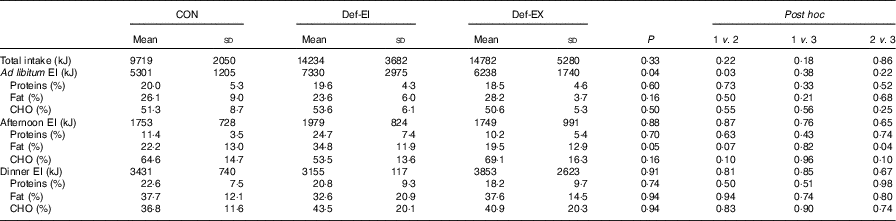
CON, control condition; Def-EI, deficit induced by energy restriction; Def-EX, deficit induced by exercise; 1, CON; 2, Def-EI; 3, Def-EX; CHO, carbohydrate; EI, energy intake.
The absolute energy intake from afternoon snacks on day 2 was not significantly different between conditions (Table 1), with a higher energy ingested derived from fat on Def-EI (34·8 (sd 11·9) %) compared with CON (22·2 (sd 13·0) %; P=0·07, tendency) and Def-EX (19·5 (sd 12·9) %, P=0·04).
No difference was noted between conditions for absolute energy ingested and the energy derived from each macronutrient at dinner time on day 2 (Table 1).
There were no significant differences between conditions for the total energy ingested (test meal+snacks+dinner) (P=0·33) (Table 1) (Fig. 1).
Design of the study. CON, control condition; Def-EI, deficit induced by energy restriction; Def-EX, deficit induced by exercise; BIA, bio-impedance analysis; LFPQ, Leeds Food Preference Questionnaire; VAS, visual analogue scale; BF, breakfast.
Appetite sensations
Fig. 2(a) illustrates the results for hunger sensations throughout the experiments for each condition. Fasting hunger on days 1 and 2, as well as pre-lunch time on day 2 (right before the ad libitum test meal), was not significantly different between conditions. The AUC analysis revealed significant differences for hunger throughout the experiment (days 1 and 2) between conditions, with AUC for CON and Def-EX being significantly lower than AUC for Def-EI (P<0·001). Hunger AUC for day 1 only was significantly higher on Def-EI (P<0·001) compared with CON and Def-EX (which are not different, P=0·48), and no significant difference was observed for hunger AUC day 2 between conditions (P=0·54).
Hunger (a), satiety (b), prospective food consumption (c) and desire to eat (d) sensations throughout the three experimental sessions.  , Control condition;
  , deficit induced by energy restriction;
  , deficit induced by exercise; BF, breakfast; VAS, visual analogue scale. *** P<0·001.
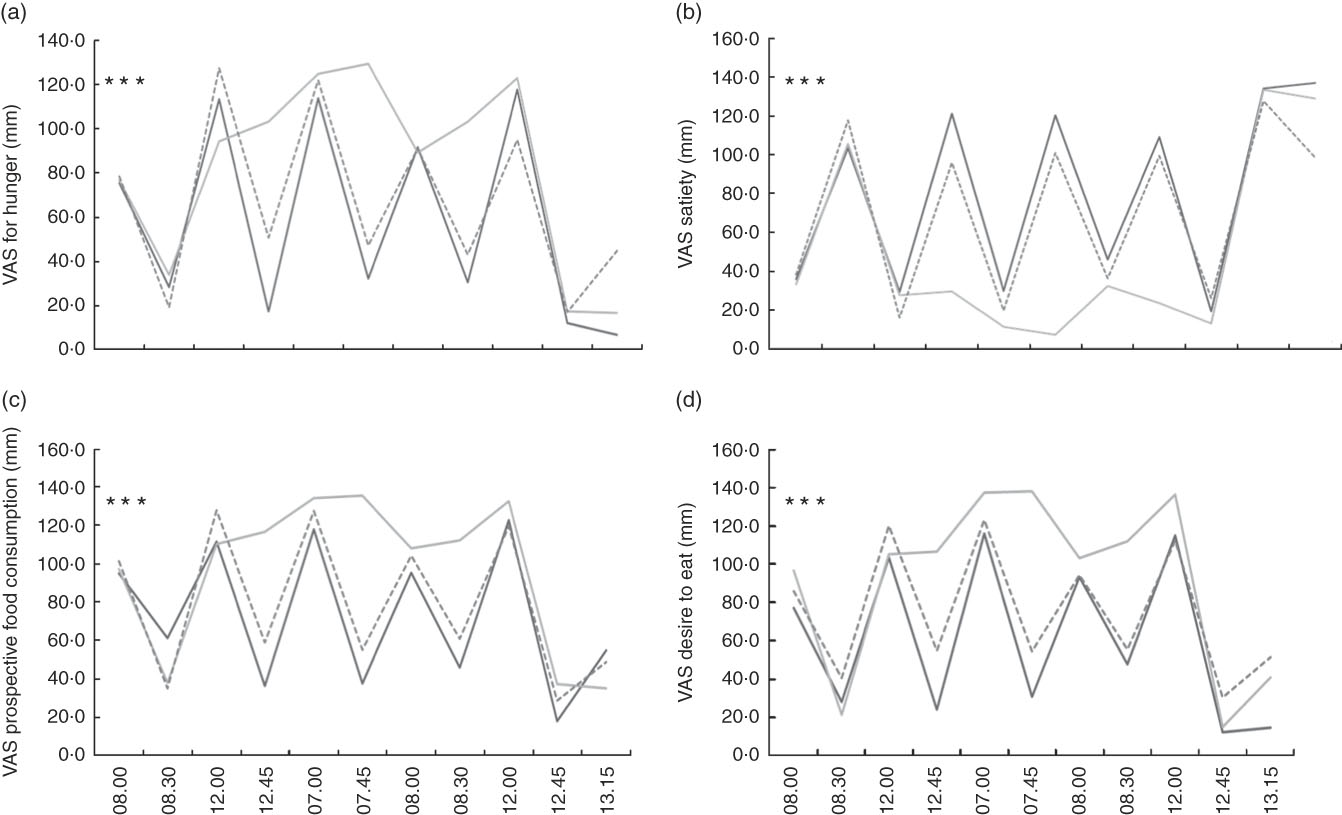
As illustrated by the Fig. 2(b), fasting satiety was not different between conditions on both day 1 (P=0·79) or day 2 (P=0·30). The feeling of satiety right before the ad libitum test meal on day 2 was not significantly different between conditions (P=0·22). The AUC was significantly different between conditions considering both the whole experimental duration (day 1+day 2) and day 1 only, with AUC satiety significantly higher on CON and Def-EX v. Def-EI (P<0·001), with no difference between CON and Def-EX (P=0·64). On day 2, no difference is observed for the AUC satiety between conditions (P=0·30).
Similar results are observed for both PFC (Fig. 2(c)) and the DTE (Fig. 2(d)), with similar fasting feelings on both days 1 (P=0·80 and P=0·59, respectively) and 2 (P=0·51 and P=0·95, respectively) and similar sensations right before the test meal on day 2 (P=0·20 and P=0·14, respectively). The AUC are significantly higher for both sensations (PFC and DTE) on Def-EI compared with CON and EX (P<0·001), without difference between CON and Def-EX (P=0·54 and P=0·62, respectively).
Food reward
Table 2 details all the results related to the LFPQ evaluation. Taste Bias (for sweet v. savoury foods) for implicit wanting, food choice, explicit wanting and explicit liking was significantly lower after the test meals on every experimental day (CON, Def-EI and Def-EX) (P<0·001). There is an increase in pre-meal fat bias in food choice only after Def-EI compared with CON (P=0·04). There was a tendency for pre-meal fat bias implicit wanting to increase on Def-EI (P=0·06) and Def-EX (P=0·08) compared with CON.
The relative preference, implicit wanting, explicit wanting and explicit liking before and after the test meal between exercise conditions (Mean values and standard deviations)
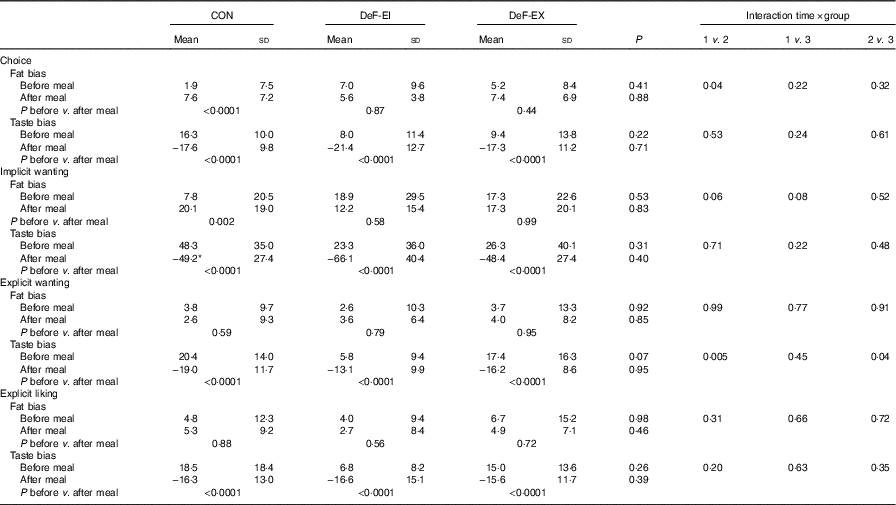
CON, control condition; Def-EI, deficit induced by energy restriction; Def-EX, deficit induced by exercise; 1, CON; 2, Def-EI; 3, Def-EX.
*P<0·05.
Although our statistical mixed model did not show any difference between conditions for pre- and post-meal LFPQ indicators, it underlined a significant interaction of condition×time (before and after the meal) between CON and Def-EI for food choice fat bias (P=0·04). Specifically, post-meal food choice fat bias was reduced more during Def-EI compared with Def-EX. There was a significant condition × time (before and after the meal) effect between Def-EI and CON (P=0·005) and Def-EI and Def-EX (P=0·04) for explicit wanting taste bias.
Discussion
Although at present there is a growing interest for the effects of intermittent fasting on energy balance, the present work aimed to compare the eating behaviour responses (appetite, energy intake and food reward) with an energy depletion induced either by complete 24-h food restriction (fasting) or through an equivalent deficit with physical exercise in healthy young males.
As hypothesised, our results show a significant increase in energy intake during the ad libitum test meal that followed the 24-h Def-EI restriction, whereas it did not change significantly with a similar energy depletion induced by exercise (as compared with the control condition). Importantly, however, total energy intake (lunch test meal+snacks and diner) did not differ between conditions (although self-reported diaries were used). The measured appetite feelings also corroborate our hypothesis, as hunger increased and satiety decreased during Def-EI when compared with CON and Def-EX. Although these results are in line with previously published studies on the effects of 24-h fasting on energy intake( Reference Cameron, Goldfield and Finlayson 16 ) or comparing partial similar deficits induced by exercise v. dietary restriction( Reference Hubert, King and Blundell 11 – Reference Cameron, Goldfield and Riou 13 , Reference King, Wasse and Ewens 25 ), results presented herein are, to our knowledge, the first ones comparing the effects of a complete 24-h fast with a comparable energy deficit induced with exercise. Importantly, although our results provide interesting new insights regarding the energy balance regulation, such extreme total energy deficits should not be considered in an anti-obesity perspective and might only apply to operative military troops or individuals trying to achieve short-term important weight loss, such as weight category athletes or crash dieters.
In their recent work, Cameron et al. ( Reference Cameron, Goldfield and Finlayson 16 ) investigated the effects of a 24-h fasting period on food reward and energy intake in healthy adults and observed an increase in hedonic ratings of food, the rewarding value of food, as well as a 74·1 % increased food intake compared with a fed control condition. Such a compensatory increase in food consumption has also been observed in response to a severe 75 % daily energy restriction in healthy adults( Reference Clayton, Burrell and Mynott 9 ). This increased food intake can be explained by increased hunger, DTE and PFC, as well as reduced fullness in response to both total fasting( Reference Cameron, Goldfield and Finlayson 16 ) and 75 % severe energy restrictions( Reference Clayton, Burrell and Mynott 9 ). Interestingly, this overeating was observed despite lower postprandial concentrations of the orexigenic acylated ghrelin, higher glucose and non-esterified fatty acids and unchanged glucagon-like peptide 1 and insulin( Reference Clayton, Burrell and Mynott 9 ), suggesting that in healthy normal-weight adults altered sensitivity to appetite-mediating hormones may contribute to an adaptive counter-regulatory response to such severe dietary-induced energy depletions. Further studies are needed to clarify the exact hormonal responses to exercise- and dietary-induced energy deficits.
In 1998, Hubert et al.( Reference Hubert, King and Blundell 11 ) published the first evidence, suggesting that although an acute energy depletion induced by dietary restriction led to increased hunger feelings and energy intake at the following meal in contrast an energy deficit induced by a bout of moderate exercise did not significantly alter perceived hunger and did not induce an increase in energy intake at the test lunch in healthy adults. More recently, these divergent short-term appetite and intake responses to diet- or exercise-induced energy depletion have been attributed to changes in Acylated Ghrelin and PYY3-36 concentrations that have been found sensitive to the nature of the generated depletion (exercise or diet)( Reference King, Wasse and Ewens 25 ). Such compensatory responses have been found to be similar in healthy men and women( Reference Alajmi, Deighton and King 12 ). Although these studies questioned the effects of daily depletions, Cameron et al.( Reference Cameron, Goldfield and Riou 13 ) recently showed similar increased energy intake and AUC scores for hunger, DTE and PFC after a 3-d 25 % dietary restriction as compared with a similar 3-d deficit induced by exercise in healthy young males, however, with no difference between conditions for ghrelin and leptin concentrations.
As previously stated, Cameron et al.( Reference Cameron, Goldfield and Finlayson 16 ) also observed an increase in the hedonic ratings of food and the rewarding value of food in response to a 24-h fasting period in healthy adults compared with a fed control condition. According to our results, a full 24-h energy deficit induced whether by exercise (Def-EX) or energy restriction (Def-EI) favours an increased pre-meal fat bias in food choice and implicit wanting (close to significance for implicit wanting). Our results also underline that the food choice fat bias in response to the ad libitum test meal was reduced on Def-EI compared with the control condition and that the explicit liking response to the test meal was significantly lower on Def-EI compared with both CON and Def-EX. Although it seems that a 24-h energy deficit can alter pre-meal fat bias in food choice regardless of the nature of the induced deficit (exercise or dietary restriction), food reward in response to a meal seems affected when the deficit is induced by energy restriction but not by exercise. Importantly, contrarily to what is usually observed in the literature, fat bias increased and sweet bias decreased in response to our test meal in CON, whereas opposite results are usually observed.
The significantly higher energy intake observed at the test meal on Def-EI in the present work is not accompanied by significant absolute or relative fat, CHO or protein intake difference between conditions (although the absolute intake of each macronutrients was higher on Def-EI compared with both CON and Def-EX; this did not reach the level of significance). The absence of macronutrient difference is in line with previously published results( Reference Hubert, King and Blundell 11 , Reference Cameron, Goldfield and Riou 13 ). However, King et al.( Reference King, Wasse and Ewens 25 ) showed increased absolute consumption of proteins, CHO and fat after their dietary-induced deficit compared with the control and exercise condition, with increased fat-related energy ingested (in percentage of total intake) and decreased relative energy ingested from CHO after food depletion, with no difference for the percentage of energy derived from proteins. Although Alajmi et al.( Reference Alajmi, Deighton and King 12 ) reported an increase of all macronutrients in response to their dietary-induced energy deficit, their results do not accurately define whether this concerns absolute (expressed in g) or relative (expressed in percentage energy ingested from each macronutrient) macronutrient intake. Interestingly, we observed a significantly higher intake of self-reported snacks derived from fat on Def-EI compared with both CON and Def-EX, with again no difference between conditions at dinner time. However, our results are in contrast to those from Cameron et al., who found significant 64·8 and 95·8 % increased energy derived from CHO and proteins, respectively, with a non-significant 87·7 % greater intake from fat after 24 h of fasting compared with their control condition( Reference Cameron, Goldfield and Finlayson 16 ).
This study presents some strengths and limitations that must be considered when interpreting the results. First, the absence of breakfast on day 2 during the Def-EI session has to be considered. Indeed, while this study was designed to assess the effect of a complete 24-h fasting v. equivalent deficit induced by exercise, which remains challenging from a methodological point of view, the potential effect of this breakfast omission on day 2 on our test meal must be considered( Reference Clayton, Barutcu and Machin 26 ). The presence of a breakfast on day two on Def-EX, but not on Def-EI, might indeed contribute to the observed lower ad libitum energy intake at the test meal, whereas its absence on Def-EI creates a longer fast also potentially affecting food consumption at the test meal. Nevertheless, the aim of this work was to compare two identical 24-h energy depletions (focusing on matching for energy expenditure itself); it must be noticed that the exercise and diet conditions not only differ in terms of energy balance but also in terms of substrate use and availability, which might have affected our results. Regarding the realisation of the exercises, although the control of HR and of the workload imposed to the ergocycle (based on a previously performed laboratory-based direct measure of VO2max) have been shown to be reliable methods to calibrate the induced energy expenditure, this remains less precise than the use of indirect calorimetery that would have provided more precise measurements. It must be also acknowledged that our results might also partly be owing to the effect of exercise itself (and not the induced expenditure) on energy intake and appetite as it has been suggested to affect them independently of the induced energy expenditure( Reference Thivel, Aucouturier and Doucet 27 ). The use of self-reported food records to assess both the 24-h usual food intake used to calibrate our deficit, and to assess energy consumption after our weighted ad libitum lunch meal, also composes a limitation. Although it remains a challenge to objectively assess food intake under free-living condition, self-reported diaries are usually used outside laboratories but might favour underestimation of the actual energy consumption( Reference Nielsen, Nielsen and Toubro 28 , Reference Biltoft-Jensen, Matthiessen and Rasmussen 29 ). Moreover, energy intake was assessed for the rest of day 2 only (snacks and dinner), whereas it would have been better to assess intake for a longer duration (i.e. 1 week) as such severe deficits might affect eating behaviours for several days. Similarly, tracking physical activity and energy expenditure during and for several days after each experimental condition would have provided a better view of the exact effects of such exercise- and dietary-induced total daily energy deficit on energy balance (using accelerometers for instance). The use of an ad libitum buffet meal whose composition excluded all the top and lowest rated items according to a food preference and habits questionnaire to avoid over- and under-consumption, as well as all the items that are not regularly consumed to avoid occasional eating( Reference Thivel, Genin and Mathieu 30 ), composes a strength of the present work. Indeed, some of the cited works assessed food intake using their participants’ favourite food( Reference Cameron, Goldfield and Finlayson 16 ), pizzas and deserts buffets( Reference Cameron, Goldfield and Riou 13 ) or other appetitive and palatable items (such as sandwich, crisps or chocolate muffins( Reference King, Wasse and Ewens 25 )) that might have affected their results by favouring overeating( Reference Thivel, Duché and Morio 31 ). Although this was a pilot study, it would have been important to assess some physiological parameters implicated in the control of appetite and energy intake, such as gastrointestinal peptides, to better understand and explain or results. Finally, our sample was composed of relatively fit young males only, who are not necessarily representative of the general population.
To conclude, this pilot study compared identical 24-h full energy deficits induced by dietary restriction or exercise compared with no energy depletion, and the results suggest that although 24-h fasting leads to increased energy intake at the following meal and increased hunger profile, such nutritional responses are not observed after a similar deficit induced by exercise. Looking at the acute nature of this work, further longer-term studies are needed.
Acknowledgements
The authors thank the participants for their implication.
This research received no specific grant from any funding agency or from commercial or not-for-profit sectors.
D. T., L. M., Y. B., M. D. and E. D. designed the study. M. M., D. T. and L. M. realised the data collection. D. T., L. M., E. D., G. F. and B. P. analysed the data. D. T and L. M. supervised the entire protocol and wrote the first draft of the paper, and all the co-authors have been actively involved in the data interpretation and writing of the paper.
The authors declare that there are no conflicts of interest.



