


Introduction
Tsakhiurtyn Hundi (Flint Valley), located about 700km south of Ulaanbaatar (the capital of Mongolia), is one of the most extensive prehistoric sites of Central Asia (Figure 1A & B). Discovered by the Joint Mongolian-Russian-American Archaeological Expeditions (JMRAAE, established in 1995), the area owes its name to the presence of abundant flint outcrops and their innumerable flint artefacts (Figure 1C–E). During archaeological surface investigations in 1995, more than 30 000 implements were collected; these lithic assemblages have been assigned to the Early, Middle and Late Palaeolithic (Derevianko et al. Reference Derevianko, Zenin, Olsen, Petrin and Tsevendorj2002). Despite the remains of numerous sites from the Stone Age, only limited archaeological research has been conducted so far (Derevianko et al. Reference Derevianko, Krivoshapkin, Larichev and Petrin2001; Gunchinsuren Reference Gunchinsuren, Habu, Lape and Olsen2017; Masojć et al. Reference Masojć, Szykulski, Gunchinsuren, Odsuren, Szmit, Gankhuyag and Namjilmaa2017, Reference Masojć, Szykulski, Gunchinsuren, Odsuren, Winiarska–Kabacińska and Szmit2019). The current project aims to analyse the nature of long-lasting prehistoric occupation around Tsakhiurtyn Hundi. Environmental reconstructions, the chronology of the site and its raw-materials economy provide a picture of human activity in this area over several hundred thousand years. The findings highlight the significance of the region's archaeological record in expanding understanding of the presence and adaptation strategies used by Pleistocene and early Holocene human groups in harsh environments in Central Asia.
A) location of Tsakhiurtyn Hundi and Khutul Usny cave; B) study area in the southern edge of the Arts Bogdyn Nuruu massif; C) Tsakhiurtyn Hundi mesa-like plateau; D) abundant Pleistocene workshops; E) flint raw material outcrops (figure by authors).

Palaeolakes near Tsakhiurtyn Hundi: palaeoenvironmental record and prehistoric settlement
Several palaeolakes south of Tsakhiurtyn Hundi with traces of human activities were recorded then selected for archaeological survey and palaeoenvironmental research (Figure 2A–D). The central site cluster is on the shoreline of the biggest palaeolake—Talingaryn Shal. Its sediments (clays, silts and sands) were found to reach a maximum of 6m below ground level and were dated to 138ky by optically stimulated luminescence (OSL). Archaeological evidence—comprising more than 150 sites detected by opportunistic survey from vast areas around flint outcrops—confirms the presence of Pleistocene hunter-gatherers through to early Holocene groups, characterised by pressure micro-blade production with microliths. Despite the presence of jasper and other siliceous rocks, the predominant raw material is identical to the greyish flint occurring in Tsakhiurtyn Hundi. Site Flint Valley (FV)92 (Figure 2C) represents the remains of an early Holocene camp, where red jasper was the main raw material (Figure 3A & B). The flint inventory from site FV118 (Figure 2C) corresponds closely to the series of lightly abraded artefacts from Tsakhiurtyn Hundi, assigned there to the Early Upper Palaeolithic (Figure 3C).
Selected palaeolakes: A) Talingaryn Shal; B) Zuun Khuree; C) geological map of Talingaryn Shal lake with sediments dated to 138kya through coring and archaeological sites; D) coring in Zuun Khuree lake (figure by authors & A. Klyuev).

A) site FV92; B) selection of artefacts from FV92: 1–2) cores; 3) bifacial foliate; 4–7 microliths; C) Upper Palaeolithic cores from site FV118 (figure by authors).

Khutul Usny cave with Pleistocene occupational sequence
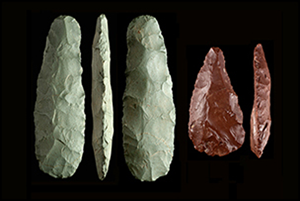
Significant discoveries were made during the survey within the mountainous area of the Arts Bogdyn massif surrounding Tsakhiurtyn Hundi. Nearly 50 open-air Palaeolithic sites were found within the valleys, yielding not only flint but also other raw materials, such as greenish quartzite (Figure 4.1), reddish jasper (Figure 4.2) or blackish flint (Figure 4.3). Three caves in Cretaceous lavas were discovered (Figure 5), which were unmarked on previous maps (Masojć et al. Reference Masojć, Szykulski, Gunchinsuren, Odsuren, Szmit, Gankhuyag and Namjilmaa2017). Trial trenching of the FV8 site (Figure 5C), the biggest cave, reached a depth of 3.2m (Figure 6). Six archaeological horizons have been documented so far (layers II–VII) and each contains lithic artefacts and animal remains; a few bone beads were also discovered within layer VII. The C14 dating results for layer IV (28952–27854 cal BC with 95.4% probability: Poz-161672) indicate that the four oldest horizons are connected with the Upper Palaeolithic. This is also confirmed by the presence of two large blades in layers VI and VII (Figure 6C). However, the techno-typological features of the remaining lithics discovered in the cave include simple debitage, unidirectionally reduced flake cores, single endscrapers and retouched flakes. Among animal bones (i.e. Mongolian gazelle, argali, camel, wild ass, Cervidae and Canidae), there are 36 cracked-open diaphyses and pointed bone flakes showing X-shaped fracture planes from small oval impact marks on those that are punctured, on opposing edges of the bone. The closest parallel for this newly discovered cave site is Tsagaan Agui Cave, located west of the Arts Bogdyn Nuruu (Khatsenovich et al. Reference Khatsenovich, Tserendagva, Bazargur, Marchenko, Rybin, Klementiev, Shelepaev, Gunchinsuren, Olsen and Derevianko2022).
A selection of Pleistocene lithic finds from the Gobi-Altai area: 1) bifacial foliate; 2) Mousterian point; 3) flake from a centripetal Levallois core (figure by A. Klyuev).

A) Khutul Usny valley; B) location of caves shown by white arrow; C) inside cave FV8 (figure by authors).

A) photogrammetry image of Khutul Usny cave; B) profile's picture with C14 chronology; C) 120mm-long chalcedony blade; D) animal bones; E) bone beads; F) profile's drawing with geological description (figure by authors, A. Klyuev & M. Jórdeczka).

Conclusions
The results presented in this article confirm that the area surrounding the flint outcrops, known as Tsakhiurtyn Hundi, was densely inhabited. Two types of stone raw materials played a key role here during the Pleistocene and Holocene. In addition to Tsakhiurtyn Hundi flint—which was frequently used in the lowland around the palaeolakes—the use of yellowish and reddish jasper was common. Its outcrops were discovered in the Arts Bogdyn massif. Flint is common at mountainous sites, including the cave, but also present in the lowland—for example, accompanying the early Holocene jasper microlithic inventory of site FV92.
In the palaeolakes area, south of Tsakhiurtyn Hundi, there are the remains of nearly 100 Pleistocene and early Holocene sites. The lakes themselves bear deep sediments indicating conditions suitable for human settlement that are more than 100 000 years old. The intensive exploration of the mountainous territory since that time is confirmed by more than 50 surface lithic clusters. Khutul Usny cave contains a stratified sequence of sediments reaching a depth of at least 3.2m. The chronology established for layer IV in the cave suggests that humans sheltered from the extreme climatic conditions around the beginning of the Last Glacial Maximum. It is possible that those two environments—the lakeland in the lowlands and the mountainous valleys including the caves—were used in different seasons and periods. The lakeland area was intensively exploited during the early Holocene while the mountainous area shows more traces of human activities during the Pleistocene. Palaeogeographical results, chronological determinations and archaeozoological analyses following this initial phase of research will help expand on those issues.
Funding statement
The project is funded by the National Science Centre, Poland (NCN2019/33/B/HS3/01113). The research is supported by the Institute of Archaeology, Mongolian Academy of Science and Mongolian National University of Education (www.archeo.mongolia.uwr.edu.pl/en/).
Acknowledgements
We thank the government of Mongolia for authorising our work (Permit 22-13). Special thanks to Sundariya Erdenesaikhan and Andriej Klyuev for their photography.



