




Introduction
Industrialization has been the main route to higher national incomes over the past 200 years, but nations have traversed it using different models. While much research has emphasized distinctions between approaches in different countries and regions, there were regional differences within early industrializers.Footnote 1 This paper considers three approaches to industrial development that emerged in the Northeast United States textile industry in the late eighteenth and early nineteenth century, and analyses job quality in each model. The object of analysis has become increasingly salient: in 1999, the International Labour Organization introduced the concept of “decent work”, of which job quality is a key constituent, and it is now a global policy priority in the Sustainable Development Goals.Footnote 2 Job quality is one of the best predictors of self-reported well-being, and is more predictive than income alone.Footnote 3 Recent studies have shown that differences in wages do not fully capture the variation in rewards that workers receive from employment.Footnote 4 However, the quality of jobs has received no systematic attention in economic history until very recently, even though job stability, safety, and work intensity varied across time and space.Footnote 5
The literature on approaches to industrialization has focused on the determinants of development paths and their macroeconomic implications. The main contrast identified in this research is between the relatively capital- and energy-intensive industrialization practiced in Western Europe and North America, and the relatively labour-intensive approach used first in East Asia.Footnote 6 These perspectives emphasize that development paths were shaped by the availability of factors, with the comparative abundance of capital in Western Europe leading to capital-intensive approaches, and abundance of labour encouraging the intensive use of that factor in East Asia. The role of the state in supporting industrialization in the East Asian cases and the importance of labour quality are further salient distinctions. While there is new literature on present job quality in high-income nations in Asia, the comparative role of historical development in current employment quality is little considered.Footnote 7 Historical investigation of job quality and varying industrialization approaches may show a relationship between development policies and living standards, and such an investigation can enable a better understanding of both the determinants of historical quality of life, and international variation in job quality.Footnote 8
Textile production in the early United States is a useful case study for investigating variation in job quality as it presents three different and concurrent approaches to industrialization in the same sector with the same legal and institutional context. Further, the US was primarily an adopter of textile technology invented elsewhere, although American business owners did not simply replicate the British model. Therefore, the US experience may have more external validity and provide more useful comparisons to other industrialization experiences than the exceptional circumstances of the first mover. There is a rich existing literature that describes individual models of industrialization in detail. However, the comparative dimension has been less explored, and job quality has not been analysed systematically across the branches of the US spinning industry.Footnote 9
For economic history, this example shows the importance of investigating within-country variations in real wages and labour conditions to understand historical quality of life. The two most influential uses of real wage series have been in tracking the development of living standards and explaining the genesis of industrial technology through induced innovation.Footnote 10 However, national living standards measured as the real wage observed for one or few occupations in a single location may be unrepresentative, opulence provides a limited view of living standards, and jobs are a bundle of amenities and disamenities that shape capability, not simply a wage.Footnote 11 This paper explores the mixture of compensating or compounding aspects of jobs apart from real wages, regional variation in wages and working conditions, and inequality across occupations. While there were only modest differences in real wages for the same occupations between locations in this historical case, there were notable disparities across different dimensions of job quality between the three models, and the worst-paid occupations were also of lower quality on other dimensions.
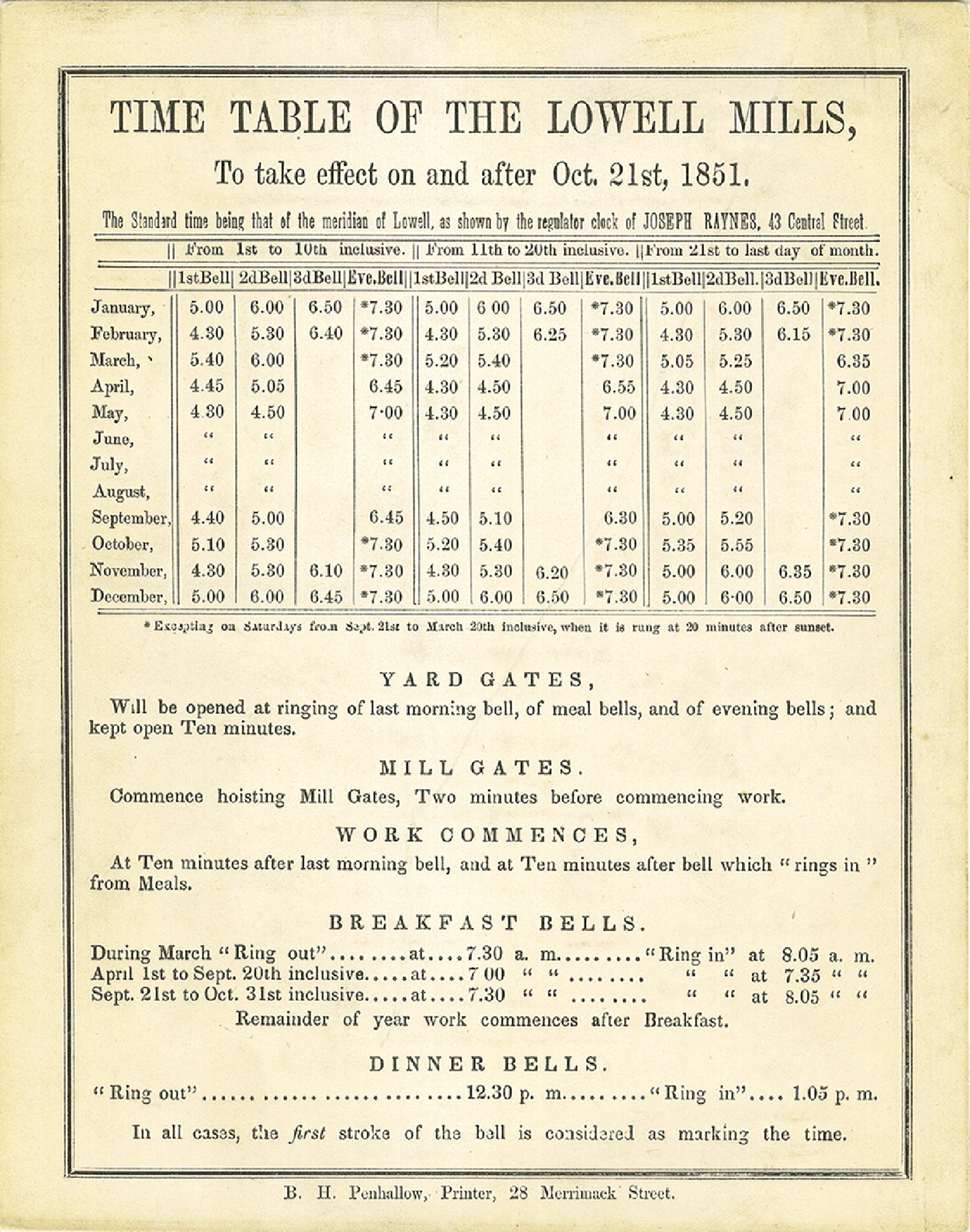
The first section sketches the recent literature on job quality, and the second summarizes the development and features of the three industrial models established in the late eighteenth and early nineteenth centuries by Samuel Slater, the Boston Associates, and Philadelphia manufacturers. The paper defines an ‘industrial model’ as a coherent, though not inflexible, set of entrepreneurial choices of factor proportions, technology, labour management strategies, output mix, and firm interactions. The third section describes the implications of these models in the spinning rooms, beginning with an overview of spinning labour before proceeding to analyse eight dimensions of job quality included in the Historical Job Quality Indicators. The Slater (Rhode Island) and, to a greater extent, Lowell (Massachusetts) models attempted to mitigate negative aspects of industrialization, but also to control the social lives of workers. Within the factory, a job quality perspective suggests that several dimensions of the Massachusetts system were modestly better than lower wages and less stable pay in the Philadelphia model, although workers in Lowell mills laboured for longer shifts (Figure 1) and higher New England prices limited disparities in real wages. These findings suggest that some industrialization models can offer better quality of life for workers, even before the existence of widespread labour regulation and in contexts with little labour organization.
Work schedule for the Lowell mills (Lowell, Massachusetts), 1851.
Analysis of Job Quality
Social scientists have measured aspects of living standards and quality of life for more than a century, but multidimensional analysis reached a firmer theoretical basis with the establishment of the Human Development Index (HDI) in the 1990s.Footnote 12 Following from the HDI and discussions of the “quality of working life” in the 1960s and 1970s, the International Labour Organization proposed “decent work”, of which job quality is a major element, as a global policy objective in 1999.Footnote 13 The subsequent decades have seen much research on job quality and this scholarship has clearly demonstrated its importance to overall quality of life.Footnote 14 This literature has been complemented by efforts to define and measure job quality, commonly using multidimensional systems of indicators or composite indices.Footnote 15 Most present metrics of job quality use data from large-scale surveys such as the European Working Conditions Survey.
Historians have also taken interest in quality of life, although the only elements of work in historical indices are national-level data for wages and working time.Footnote 16 The growing contemporary literature on job quality has demonstrated the multidimensionality of work, explored regional and inter-occupational disparities, and has shown the importance of non-wage dimensions.Footnote 17 The Historical Job Quality Indicators (HJQI) provide a theoretically and historically grounded framework to analyse and compare traditional aspects of work measured by historical social scientists (real wages and working hours) alongside non-wage dimensions of jobs (such as autonomy and work intensity) using criteria to code objective, qualitative evidence.Footnote 18 Unlike many historical indices of life quality, the HJQI are not aggregated, but follow present-day frameworks such as the Eurofound Indicators of Job Quality by presenting a system of indicators.Footnote 19
This paper uses the eight indicators in the HJQI to analyse work quality: wages (as welfare ratios), working time, stability of earnings, short-term health (accident) risk, long-term health (disease) risk, autonomy, intensity, and repetitiveness. The indicators were derived from evidence about aspects of employment that attracted the interest of historical workers, contributed to increasing their capability, and can be captured with historical sources. The main limitation of the HJQI for analysing the relationship between development models and quality of life in this case study is that the indicators do not incorporate employment-related conditions outside the workplace, such as housing and socialization rules. While not part of job quality as generally defined and measured today, such attendant aspects of employment were elements of the factory systems discussed and may have influenced workers’ quality of life.
Textile Industrialization in the United States
Three distinct models of factory production in the early American republic replaced the homespun textiles of the colonial period and claimed market share from previously dominant British imports. These models exhibited variation in factor proportions, technical choice, establishment size, labor supply, and product outputs, as well as varied work quality within the same jobs and inequality across the factory. The first model of factory production in the United States, established by Samuel Slater in Rhode Island, employed families to operate spinning frames and some mules.Footnote 20 The second, initiated in Waltham, Massachusetts and expanded in Lowell and other central New England towns, gathered young women in large, vertically integrated mills to tend continuous machines. The third, based around Philadelphia, was characterized by smaller firms, more employment of British immigrant and child workers, and more fine spinning on mules.
Samuel Slater and the First Factories
The industrialization of spinning in the United States began with Samuel Slater. Slater had worked for the British manufacturer Jedediah Strutt for six years and emigrated to Rhode Island shortly after the American Revolution, where he partnered with two local textile manufacturers to set up a cotton spinning factory in 1790.Footnote 21 Over the first decades of the 1800s, Slater joined with other investors to construct thirteen mills in Rhode Island, Connecticut, Massachusetts, and New Hampshire, using a similar production system and organization, predominantly spinning with continuous machinery. During Slater's lifetime (d. 1835), the model used small, mill-based partnerships and a family labour system. Families were recruited to move to rural mill settlements in which women and children worked in the factory and men were employed in agricultural jobs. The male head of household assented to the conditions for his spouse's and children's work, and sometimes collected their wages. Labour recruitment was made easier by the relative scarcity of alternative waged work in New England during the late eighteenth century, and steady labour supply secured through annual employment contracts. This strategy can be seen as using family commitment, combined with compensation.Footnote 22
The gender division of labour mirrored Slater's experience in Britain and had the same occupational segretation in continuous and intermittent spinning: factory supervisors were men, as were the small number of mule operatives, machinists, and overseers.Footnote 23 For example, all mule operatives and overseers in the wage book of the Steam Cotton Manufacturing Company in 1831 were male.Footnote 24 Male managers of individual mills directed the room overseers and reported to the owners.Footnote 25 Assistants to the mule operatives were children, and the workers operating continuous (frame) machinery were women or children. The accounts of the Slater & Tiffany mill, which used continuous machinery, from 1829–1830 show about sixty-five per cent of payments to women and girls. There is more specific information about the age of workers at Slater's Union Mills in Webster, Massachusetts: in 1840, seventy-six per cent of spinners were children younger than sixteen, and two thirds were girls.Footnote 26
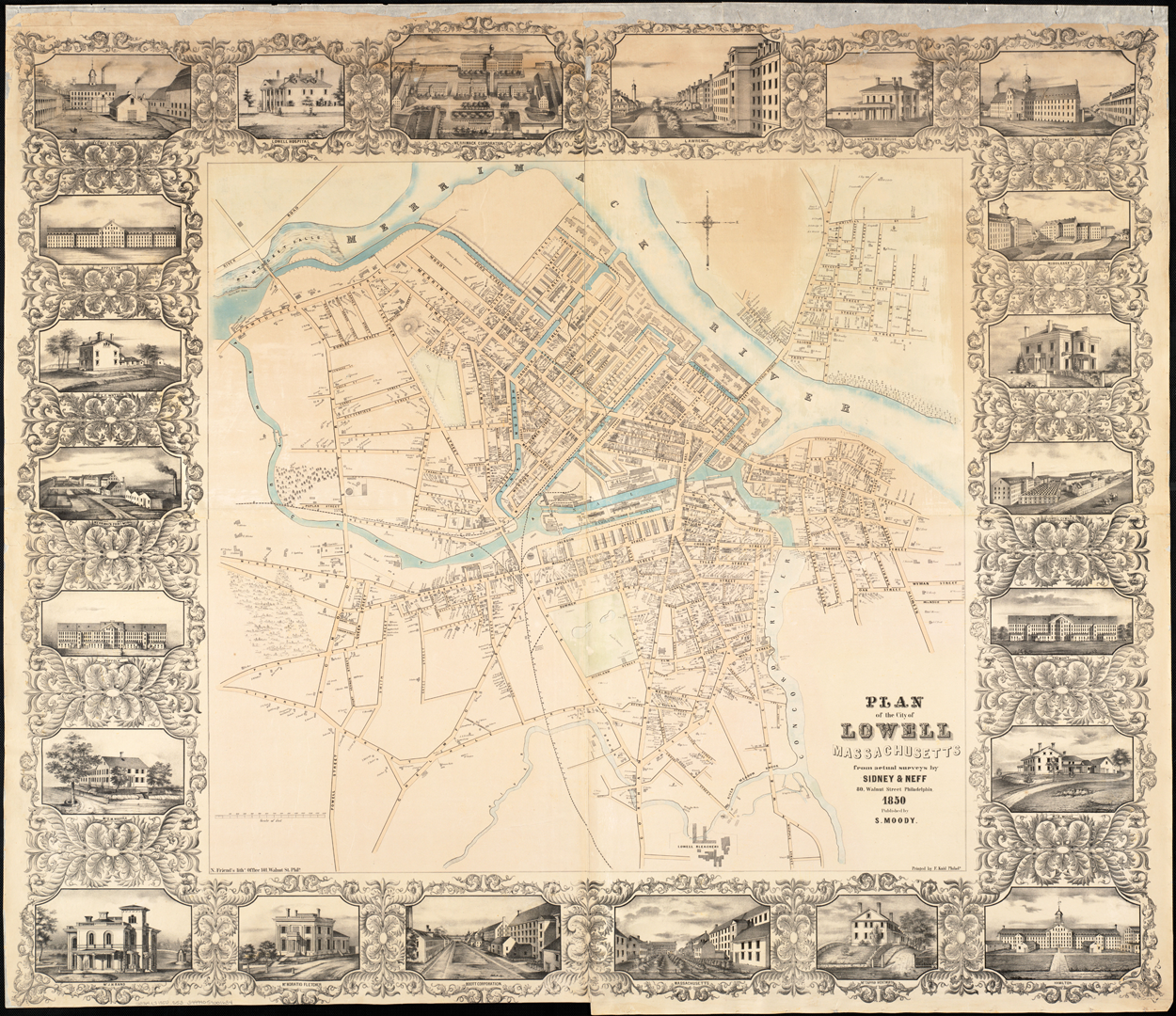
While Slater's factories used child labour extensively, he only hired overseers in 1800 and did not levy fines as punishment in the early years, probably to attract workers concerned by the reputation of harsh discipline in British mills.Footnote 27 Instead, parents retained responsibility for disciplining their children. After Samuel Slater's death, his son Horatio Nelson Slater hired professional factory managers and more overseers to supervise production, and the Slater mills began to replace family labor with individual employment relationships. Mill managers recruited single workers and encouraged the families who lived in company houses to take on children or single young women as boarders (Figure 2).Footnote 28
Overview of Lowell, Massachusetts, printed by S. Moody, 1850.
Sources: Map reproduction courtesy of the Norman B. Leventhal Map & Education Center at the Boston Public Library.
The Slater model borrowed some elements from British practices, but with less employer control over the spinning rooms at first. Most mills were small, but the predominance of frame spinning reduced the demand for experienced mule operatives.
The Lowell Model
The Rhode Island mills pioneered factory spinning in America, but they were modest in scale. The Non-Importation Act (1806), the Embargo (1807), and the War of 1812 stimulated a new wave of textile mechanization by limiting overseas commerce, which encouraged import substitution.Footnote 29 Entrepreneurs took advantage of this opportunity, and the first Census of Manufactures (1810) counted 230 textile mills. These were almost invariably small concerns with at most a few thousand spindles and very rarely more than 100 workers.Footnote 30
The Boston scion Francis Cabot Lowell exploited the brief respite from British competition using the fruits of industrial espionage. While visiting Britain from 1810–1812, Lowell memorized the design of Edmund Cartwright's power loom and, on his return, instructed a mechanic on how to construct one. He brought together fellow Boston Brahmins to organize the Boston Manufacturing Company, which built America's first vertically integrated spinning and weaving mill at Waltham, Massachusetts in 1813.Footnote 31 After the war, British imports flooded the market and drove many incipient American spinning firms out of business. However, the Waltham mill survived, and tariffs protected coarse textile production from 1816.Footnote 32
Lowell and his partners, the Boston Associates, expanded their operations in the 1810s and in 1820 they purchased land for new factories in East Chelmsford (later renamed for Lowell).Footnote 33 The Waltham-Lowell mills were incorporated rather than Slater-style partnerships, which allowed the Associates to accumulate more capital to construct larger factories.Footnote 34 Investors replicated the Lowell model in other New England towns such as Manchester, New Hampshire in the 1830s and Lawrence, Massachusetts in the 1840s.Footnote 35 The Lowell model was the most capital-intensive and integrated of the three approaches to spinning mechanization in the early United States. By 1832, about two thirds of Massachusetts workers (9200) were employed in 185 Slater-type mills, with one third (4800) in just seven Lowell-model establishments, which illustrates the disparity in the size of production units.Footnote 36 Interlinked leadership between the various businesses of the Associates, interlocking directorships across the large corporate textile mills, and integration of spinning with power-loom weaving and textile marketing were further important elements of their model (Figure 3).Footnote 37
Recruitment leaflet for the cotton mills in Lowell and Chicopee, Massachusetts, ca. 1870.
Source: Harvard University Library.
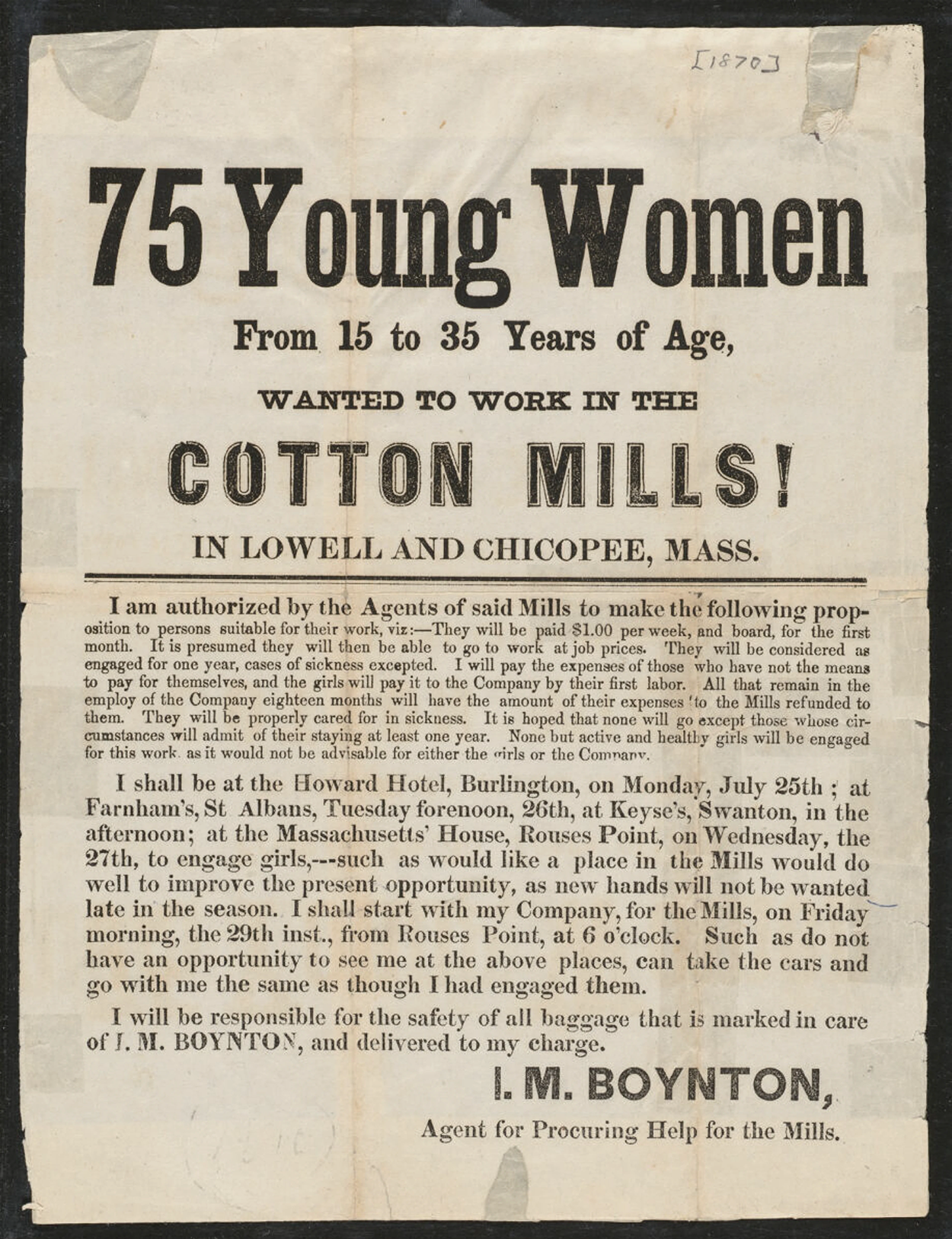
The mills at Lowell used continuous machines to spin coarse yarn. This product and technology mix allowed the Associates to avoid hiring expensive and militant mule operatives, and ensured their output was largely protected by tariffs.Footnote 38 Travelling recruiters enticed single New England women to the mills, and the Lowell system employed few children, unlike British mills and the Slater system.Footnote 39 The striking gender distribution of employment is shown in company accounts: in 1819, the Waltham factory employed just fourteen men and 286 women and children, and, in 1838, ninety-three per cent of employees at Lowell were women and girls, while the remaining seven per cent men were all overseers. Broader evidence on the gender composition of continuous mills from the 1810s to the 1830s shows that 80–95 per cent of employees were women and girls.Footnote 40 Lowell operatives tended to only work in the mills for a few years in their late teens and into their twenties, and the system had a flexible labour supply because the ‘mill girls’ could return to their family farm during periods of low demand.Footnote 41
The Lowell corporations possessed and exercised labour and product market power: Massachusetts and southern New Hampshire manufacturers colluded on output, wages, and hours. They prevented dismissed employees from being hired elsewhere, although firms sometimes broke these agreements when workers were scarce.Footnote 42 Collusion also included blacklisting union members and workers who petitioned for factory regulation, and coordinated lockouts.Footnote 43 Labour organizing and free competition did not fit in the Associates’ controlled industrial society.
In addition to profit, the Boston Associates had social and political goals for their model of industrialization. To prevent the ‘degradation’ of the British factory system and the development of class politics, they imposed paternalistic control inside and outside of the factory. Workers’ socializing and conduct were surveilled by the company, workers had to live in company-approved boardinghouses, and they were required to attend church weekly.Footnote 44 Subsidized accommodation in the boardinghouses helped to limit wage demands.Footnote 45 At the same time, the Lowell mills paid higher wages than other female employments in New England to attract and retain higher quality workers, and this benefit was paired with less strict supervision within the factory.Footnote 46 Observers including Charles Dickens commented that the Lowell factories were kept clean and neat by comparison with British establishments, although some workers did not agree.Footnote 47
The Philadelphia Mills
The two New England systems primarily used continuous spinning machinery, which was suited to coarse output and required few highly-trained workers.Footnote 48 In the area around Philadelphia, the available textile workforce was much different: many mule operatives and handloom weavers immigrated there from England, especially between the Revolution and the War of 1812. This supply of skilled labour enabled specialization in finer yarn using more intermittent spinning machines.Footnote 49 After some decades, when spinners operated hand-powered mules, the first water-powered factories were built in the 1810s and 1820s. These establishments were smaller than New England mills and few were owned by corporations, which produced extensive organizational churn as firms failed, partnerships ended, or owners died.Footnote 50 While the Lowell mills produced standardized, coarse outputs, the Philadelphia mills operated on a system of “contract spinning”, producing finer, higher quality textiles and shifting their output with changing tastes and seasons.Footnote 51
Mid-Atlantic mills employed many women, but a lower proportion than the Lowell factories or continuous mills on the Slater model. Witnesses before a Pennsylvania State Senate investigation in the late 1830s reported varying shares of female employees, from fifty per cent up to seventy-five per cent. Some of the establishments with the fewest women had very high shares of children, which suggests these were probably intermittent mills where mule operatives employed boys as assistants. Mill managers also recruited large families to supplement the supply of children.Footnote 52 Child labour around Philadelphia included younger workers than the children employed in Lowell-type mills; some were as young as seven, and witnesses reported from ten per cent to thirty per cent of workers were under the age of twelve.Footnote 53
Labour relations and interactions between firms in the Philadelphia region were much different from New England. Adult male immigrants from the more militant and organized British textile industry expected greater shopfloor control and fought to retain their autonomy. The presence of many small firms without a network of interlocking directors meant that the business environment was more competitive, which encouraged firms to hold down wages and led to a disinterest in working conditions.Footnote 54 Employers tried to combine to control wages, but likely lacked the ability to credibly commit on other types of anticompetitive practices outside periods of labour unrest.Footnote 55 While the workers in Lowell were selected in part because they were respectable women, contemporaries described workers in Philadelphia-area mills as impoverished.Footnote 56
In addition to smaller establishments and a different labour force, the Philadelphia mill owners had none of the social motivations of the Boston Associates. Strikes were much more common in this context of explicit class conflict and labor organizing.Footnote 57 Workers complained of harsh supervision, which also contributed to adversarial labour relations.Footnote 58 The conflicts between mule operatives and managers included attempts to displace the former using early self-acting mules or throstles, but common mules continued to be used in fine spinning until the 1840s.Footnote 59
Owners and managers in Philadelphia yearned for the control and labour market power of their competitors in New England, which enabled discipline and combination against organized labour to reduce wages. They understood their disadvantages in power generation, with one manufacturer wishing for “more water” to power his spindles, and they complained that their workforce was of lower quality than the Lowell mills.Footnote 60 This system was the most labour-intensive, requiring experienced mule operatives, and it was based on smaller establishments with shorter organizational lifespans.
Summary and Comparison of the Three Models
Table 1 summarizes the main differences between the three systems. The Philadelphia region mills featured the smallest firms – some simply rented space and power in factories that contained other manufacturing enterprises – with the most ephemeral existences. Firms in this area were more likely to use mules, to employ many skilled men and young children, and they operated in the most competitive business environment. The Lowell system was capital-intensive, using a high-volume, low-margin approach to produce fairly standard, coarse cloth with low-skilled women operating continuous machinery, and it included forward integration into weaving and marketing. The Slater-type mills were somewhat of a middle ground between the two, with the labour force varying depending on technical choice in each establishment. As was common across textile industries, jobs with higher expected skill requirements were occupied by men, with women in lower-skilled jobs, and children undertaking the most menial tasks.
Stylized attributes by system.
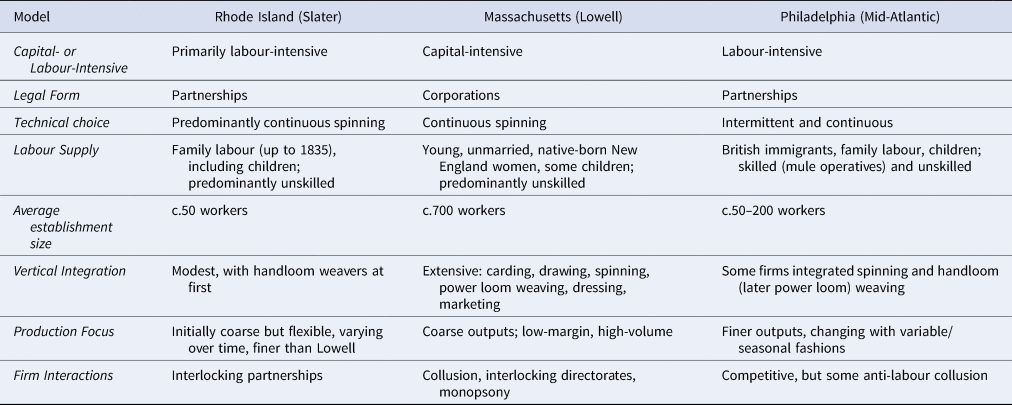
Sources: See the text.
There was likely path dependency in each model: greater access to capital in Massachusetts was conducive to large establishments, while the larger number of trained mule spinners in Philadelphia encouraged the use of intermittent technology. The complementarity of factors such as labour supply, technological choice, and perhaps even geography through water power imposed substantial costs to any attempt to change from a labour-intensive to capital-intensive approach.
The clearest contrast was between the capital-intensity of the Lowell system and the labour-intensity of the Philadelphia system.Footnote 61 As noted in the Introduction, the most common global comparison in models of industrialization is made between the European and North American industrialization, which took advantage of relative capital abundance, and East Asian industrialization based on intensive use of labour, especially skilled labour.Footnote 62 If one were to construct an analogy, the Lowell mills would be compared to Europe and North America, while the Philadelphia mills’ reliance on a relative availability of skilled labour would be compared to the East Asian model.Footnote 63 The global comparative literature also emphasizes the role of the state, which is depicted as more salient in East Asian industrialization than Europe and North America.Footnote 64 In this case, government support almost entirely functioned through tariffs, which protected the coarse textiles of capital-intensive Lowell and prevents a simple and direct comparison with the global literature. Moreover, while Japanese employers aimed to improve the quality of the labour inputs in their labour-intensive approach, the Philadelphia manufacturers did not adopt similar strategies.Footnote 65
Factory Work
Within the three factory models, labour conditions were shaped by technology and management choices. The following subsections provide more detail on work tasks, the environment of the spinning rooms, and components of job quality, noting common elements and variation across the Slater, Lowell, and Philadelphia models.
In continuous spinning, women (called “operatives”, “tenders”, or “spinners”) monitored one frame (a “side”) of spindles. They removed empty bobbins of roving and replaced them with full bobbins, and pieced broken threads.Footnote 66 Lowell workers started as “sparehands” who filled in for absent colleagues as they adapted to factory employment. They were not expected to work a full schedule for 2–3 months and were paired with an experienced operative who taught them how to operate a “side” of throstles or a pair of looms.Footnote 67 In the early decades of the Lowell system, each “tender” monitored a frame of 128 spindles, piecing broken threads and cleaning around the machine.Footnote 68 Piecing was required when a thread in tension split. To return the spindle to action, the tender overlapped the two ends of yarn and applied a small amount of twist over the breakage. To resume spinning after piecing, the worker took the end of the roving off the bobbin, pulled it to the drafting rollers, and passed it between them. Then, the worker pulled the yarn down onto the bobbin and tied it off before restarting spinning. Frames were placed in rows, so most workers had machinery in front of and behind them. Many mills employed “doffers” to remove full bobbins, replace them with empty bobbins, and carry off the yarn.Footnote 69 The frames were small enough that operatives were close to other workers (within six metres). In Lowell, the pace of work in the early years was modest, so employees could have short conversations and even rest on occasion.Footnote 70 However, the tasks of frame tending were few and the work was highly repetitive.Footnote 71
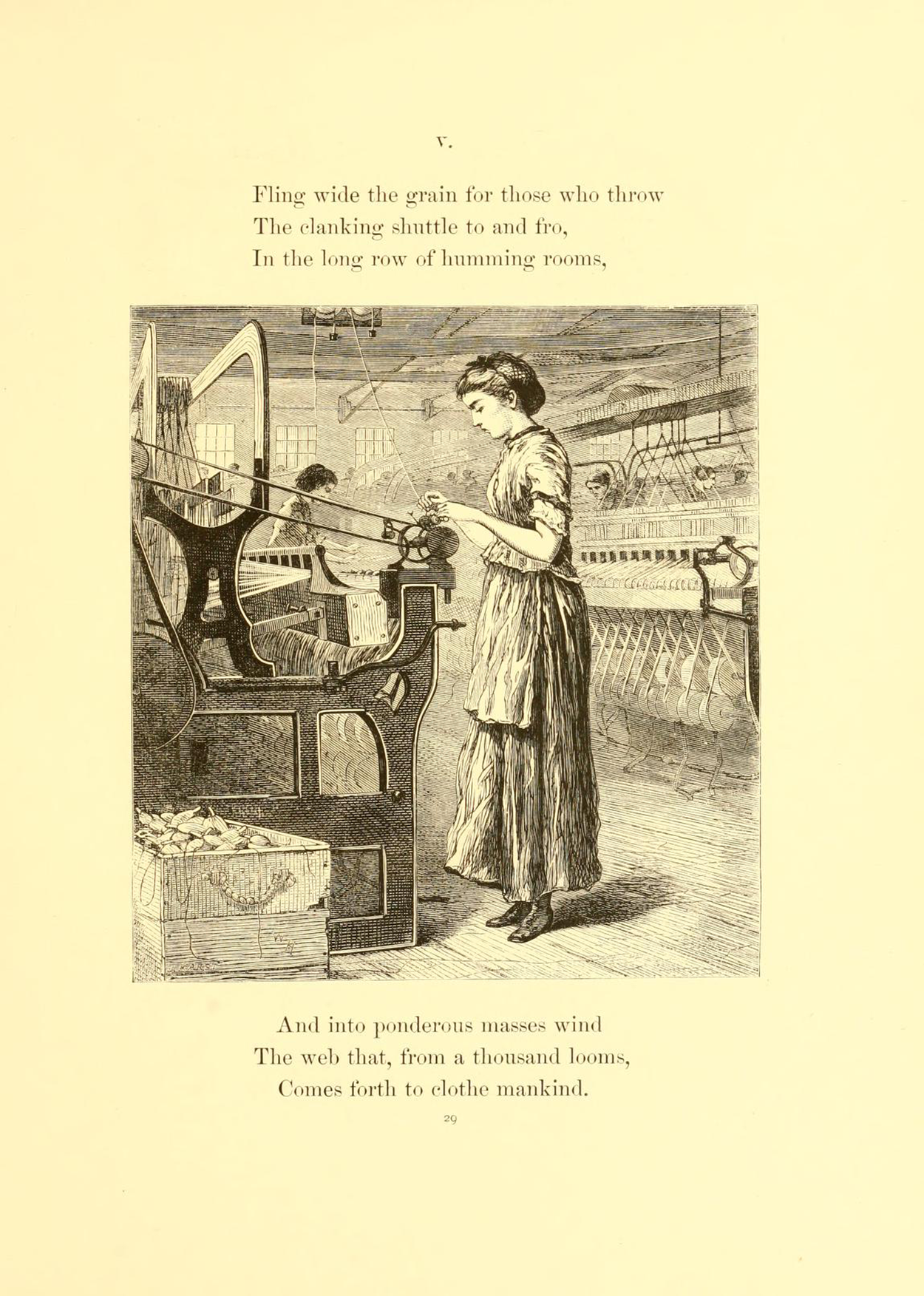
Workers who began as doffers or bobbin girls could become spinning operatives and, in combined mills, eventually shift to work in higher-paid processes such as weaving (Figure 4).Footnote 72 Doffers or bobbin girls and boys had little work for much of the day, but their hours were punctuated by intervals of intense activity as they raced along the frames with heavy boxes of full bobbins.Footnote 73 Like frame tending, this work was highly repetitive.
Bobbin girl in a weaving room in William Cullen Bryant, The song of the sower (New York: D. Appleton & Co., 1871).
Source: Internet Archive. Public Domain.
Overseers ensured that workers kept to their tasks, disciplined workers, reported production and attendance, and ensured that the spinning rooms were cleaned. In the Lowell system each overseer had an assistant or “second hand”, with whom he maintained and repaired the machinery, while in some Slater establishments maintenance was carried out by specialized mechanics.Footnote 74 Overseers in the smallest mills worked directly under the agent or manager and were responsible for discipline and operation of machines in one room of the productive process, while in larger establishments there was usually another layer of management, a superintendent for carding, spinning, or weaving, between the agent and the overseers of each production room. Their tasks were more varied than those of the workers they supervised, although not greatly.
The division of labour in mule spinning largely followed the British model. An operative controlled the pace of production by determining the number and speed of “draws”, the outward movements of the wheeled carriage holding the spindles. He also hired and disciplined one or two piecers for his mule. The piecers cleaned, creeled (added fresh roving to the machine), pieced threads, and doffed. Most operatives maintained and adjusted the machines they operated.Footnote 75 In the Philadelphia mills, operatives frequently received poor quality roving, which required more piecing. As a result, mule teams sometimes had a third piecer.Footnote 76 While Americans contributed important improvements to continuous spinning, mule technology in the United States advanced more slowly than in Britain. Into the 1830s, only the rollers and spindles of American common mules were powered, so the operative had to pull and push the carriage back and forth, which was tiring, limited the number of spindles on a machine, and held down piece rate earnings.Footnote 77 Mule spinning was fairly repetitive, although for operatives it incorporated more distinct biomechanical actions and decision-making than frame tending.
The interior environment of factories was hot and humid to minimize the need for piecing, and higher heat and humidity were needed for finer production. The Lawrence Corporation recorded temperatures in its mill rooms for a week in January 1834; average temperatures in the spinning rooms were 75–79°F (25–26°C), which was the highest of any area of the factory.Footnote 78 In Pennsylvania mills, workers reported temperatures of 80°F (27°C) on average in some mills, but highly variable temperatures across the year – sometimes factories were overly hot, and on other days cold.Footnote 79 Work rooms were poorly lit with candles or oil lamps, which polluted the air and reportedly led to shortsightedness.Footnote 80 The use of oil and grease as a lubricant for machine gearing and power transfer mechanisms infused the air with the same scents.Footnote 81 Even so, no amount of lubrication could eliminate the din of grinding gears, spindles, and whirring power transfer belts that surrounded the workers.Footnote 82
Away from the spinning rooms were the offices of the mill managers, whose tasks varied depending on the size of the establishment. In smaller mills, managers had a greater variety of hands-on tasks and responsibilities and they were sometimes selected for mechanical expertise and repaired or even operated machines.Footnote 83 Managers for the Slater mills handled recruitment, correspondence with other Slater administrators, and communicated with wholesalers or retailers.Footnote 84 In the Lowell mills, the senior on-site employee was an “agent”; he was responsible for decisions about machinery and raw material purchases, and dealt with some employment matters. He corresponded with the treasurer (the chief executive) and the board of directors about production and procurement needs, and oversaw the department superintendents and the administrative and clerical staff.Footnote 85 His work was somewhat varied, and he had few of the occupational risks or tiring physical conditions of the spinning rooms.
Wages
Workers’ income is economic historians’ main indicator of material welfare, and it is one part of the Historical Job Quality Indicators. There is little evidence of occupation-level wages in the first two decades of the American factory textile industry (1790s–1800s). Extant payroll books, government investigations, and the reports of observers provide evidence from the 1810s to the 1840s, albeit unevenly across the three factory systems and different occupations. The job quality analysis (Figures 5 and 6 and Tables 3–10) uses these sources, including more than 2000 wage observations from the Slater system and rare evidence of wages for mule spinners in New England.Footnote 86

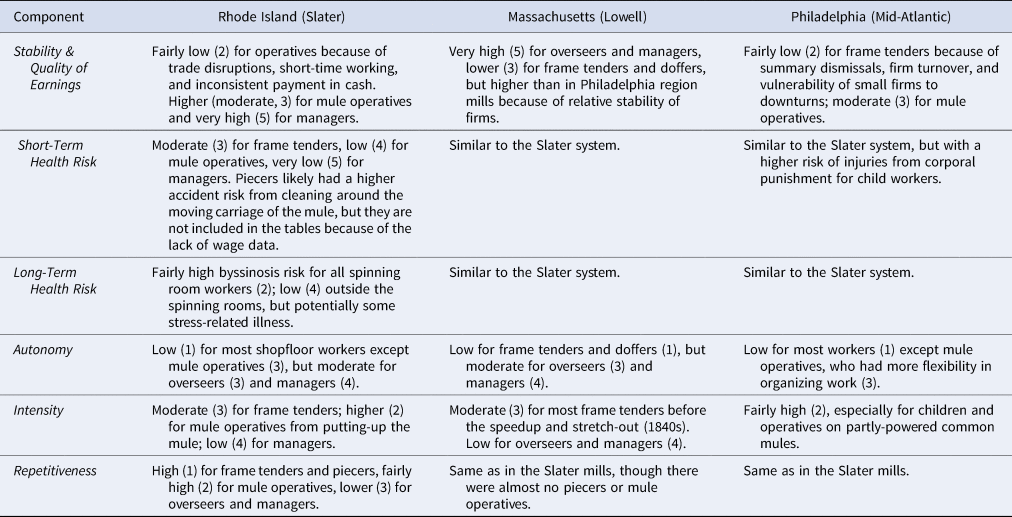
Summary comparison of qualitative components of job quality and coding.
Job quality for continuous operatives (Massachusetts), 1820–1840.

Sources for Tables 3–10: see the text, Schneider (forthcoming), Allen et al. (2011), Allen (2015), and the UC-Davis Global Prices and Incomes Database. Notes: Hours/Week figures for factory workers are based on scheduled hours (described in the text) and archival evidence of average days worked per week. Welfare ratios are computed using archival evidence of days worked and the consumption requirements for a full week. Following Humphries (2013), caloric requirements for women workers were lower than for men, so their Consumption Needs are estimated to be eighty-five per cent of an adult male basket. Omitted decades are those for which there is no wage data. The wage component (w) is an IHS transformation of the welfare ratio; the t column codes hours per week into five bins. The formula and bins are provided in in the HJQI codebook (Schneider accepted). The six qualitative components are coded on a 1–5 Likert-type scale based on criteria set out in the HJQI codebook.
Job quality for continuous overseers (Massachusetts), 1820–1840.

Job quality for managers (Massachusetts), 1830–1840.

Job quality for continuous operatives (Rhode Island), 1830.

Job quality for mule operatives (Rhode Island), 1810–1830.

Job quality for managers (Rhode Island), 1830–1840.

Job quality for continuous operatives (Pennsylvania), 1840.

Job quality for mule operatives (Pennsylvania), 1840.

Managers of mills using continuous machinery considered spinning a low-skill operation, and in the Lowell system frame tenders’ pay was lower than all other women workers except drawers and sparehands.Footnote 87 Lowell throstle tenders earned 40–50¢ per day in the first half of the nineteenth century, and wages for Slater's continuous spinners averaged 30–35¢/day, although individual pay varied more substantially. Mule operatives earned far more than throstle tenders, with wages of $1.25–1.50 per day in New England. The wage ratio between mule operatives and throstle tenders in Slater mills was similar to the ratio observed in Britain, and mule spinners’ pay was close to that of overseers.Footnote 88 Managers could earn several times the wages of shopfloor workers. The Slaters hired managers for $800 annually in the 1830s and $1000 in the 1840s.Footnote 89 The male mule operatives were paid piece rates, varying by the fineness of yarn spun, while women throstle tenders were paid time (day) rates. The children who assisted the mule operatives were conventionally paid time rates.Footnote 90
Nominal wages in the Philadelphia region were lower, especially for operatives, although this difference was partially offset by lower prices.Footnote 91 The scarcity of firm-level material on the Philadelphia mills means it is impossible to construct a longer-term wage series for this area. However, the available evidence indicates that Philadelphia throstle spinners earned around 25¢ per day in 1840, substantially lower nominal earnings than continuous spinning workers in Lowell, and with lower welfare ratios.Footnote 92 For Philadelphia mule spinners, wages were as high as to $2/day in the 1820s, but more commonly around $7.50–8.50 per week, and wages fell in the following decades. Women in Philadelphia spinning mills earned between $1 and $2 per week, and children about 75¢ per week, although the witnesses before the State Senate committee that investigated the Philadelphia mills rarely stated wages for specific occupations.Footnote 93 As noted above, New England mill owners combined to control wages as well as hours, and wage collusion was also a feature of the Philadelphia model.Footnote 94
Working Time
Managers’ incentives for scheduling are well-known: long shifts spread out the high fixed costs of the plant and machinery. Hours varied somewhat between establishments and across the year, but were consistently long, even to the view of some contemporaries. Surveys of Massachusetts manufacturers during the 1820s showed that most establishments operated twelve to fourteen hours per day.Footnote 95 A standard working day in Lowell-type mills began between 5 and 5:30 AM and ended at 7 PM, with total meal breaks of between thirty and ninety minutes.Footnote 96 In 1840, British observer James Montgomery stated that hours varied across the year in the Lowell system. The shortest workdays were during December and January (eleven hours, twenty-four minutes per day) and the longest were in April (thirteen hours, thirty-one minutes). In the winter months, there was no breakfast break.Footnote 97
The Rhode Island mills operated for twelve to sixteen hours per day and six (or seven) days per week, but most employees did not work a full week consistently because of exhaustion, illness, or problems with the machinery.Footnote 98 Two meal breaks during the day, signalled by a factory bell, totalled sixty to seventy-five minutes.Footnote 99 Contemporaries commented that short intervals for breakfast and lunch made it difficult for operatives to consume their food.Footnote 100 In non-paternalistic mills, some employees were required to spin and to repair machinery on Sundays.Footnote 101 While most factories did not operate on the Sabbath, workers could toil around frames for up to seventy-five hours per week.
Philadelphia mills had similar schedules and seasonal variation. Witnesses before the Pennsylvania State Senate investigation into factory work in the late 1830s reported that a common summer schedule was from sunrise, or 5 AM, until 7 PM, or sunset; in the winter, sunrise to 7:30 or 8:30 PM. Breaks for breakfast and dinner were no more than ninety minutes in total, and sometimes only forty-five minutes for a single meal each day.Footnote 102 In addition to long scheduled hours, establishments operated on ‘mill time’, which was set earlier than the actual time in the morning and later in the evening.Footnote 103
Most workers toiled around frames or next to mules for twelve to thirteen hours per day on average through the year, after deducting time for breaks. There was some absenteeism despite managers’ efforts to ensure consistent attendance.Footnote 104 Therefore, actual hours worked were lower than scheduled hours, generally sixty to seventy per week.
Stability and Quality of Earnings
The third component of the HJQI captures whether workers were paid frequently, in full, with an easily usable form of payment, and whether they were at risk of unemployment. Factory spinning operatives in America could experience inconsistent earnings or non-specie payment, and many employers held back wages to ensure attendance. During 1796, Slater's first mill ran out of cotton once and closed twice because there were insufficient workers for operation. At other points in the early years work halted because of low demand for yarn or insufficient water power.Footnote 105 Factories placed below falls could flood, damaging equipment and suspending operations. Sometimes work ceased for repairs or upgrades to machinery.Footnote 106 Demand fluctuations produced periodic stretches of unemployment, especially in the Mid-Atlantic with its smaller and less financially secure establishments. Wages and hours were the variable cost shock absorber for factory owners, who implemented part-time working and layoffs in downturns. Mills closed completely and precipitately in 1819 and 1829 because of financial panics or slack demand.Footnote 107
In some New England mills, workers were paid quarterly until the 1860s.Footnote 108 The Waltham-Lowell establishments paid workers in cash monthly, but many Rhode Island mills paid credit that could only be used in the company store.Footnote 109 Other mill owners paid in bank notes rather than specie, and monthly intervals between payments or late disbursement were common.Footnote 110 Employers held back wages to keep workers at their factory, on the basis that workers who left without two weeks’ notice forfeited their pay. Summary dismissal was a risk, especially for repeated lateness.Footnote 111 A lack of coinage was mainly a problem in the early nineteenth century and became less common over time, although it did not disappear entirely. Payment terms and frequency were somewhat better in the Lowell system than elsewhere, though only supervisory workers had high job security.
Short- and Long-Term Health Risks
Exposed machinery, few safety arrangements, and worker exhaustion produced lacerations from fast-running power belts, fingers snapped by gearing, and even, rarely, children trapped between the moving carriage and stationary creel of mules. Limbs and especially digits were most at risk.Footnote 112 Some employers offered voluntary compensation for accidents, but commonly this meant payments for medical treatment, and companies rarely paid wages to injured workers. Lawsuits against employers for workplace injuries were rarely pursued and were successful even less frequently.Footnote 113 Paternalism in New England did not extend to the widespread addition of protection over gearing systems, so occupational risks from this source were similar between the three systems.
In addition to industrial accidents, mule operatives used knotted ropes or leather strips, sometimes with tacks, to punish child workers and young women who pieced and cleaned.Footnote 114 While witnesses before the Pennsylvania State Senate committee investigating conditions in factories generally stated that punishment was not “frequent”, it was common enough to merit mention. Striking child workers and “strapping” were the main methods.Footnote 115 There is little evidence of corporal punishment in the Lowell mills, fitting the paternalistic paradigm, or in the Slater system.Footnote 116
In the long run, textile manufacture is associated with respiratory disease from inhaling fibre dust, although what the British called “mill fever” received less comment among Americans in the early phase of industrialization.Footnote 117 Evidence from textile mills in Britain throughout the nineteenth century demonstrated the risks of long-term dust exposure.Footnote 118 A Massachusetts doctor observing the Lowell system noted that “dust and flue” inhalation led to “a cough gradually increasing in severity” and eventually “a slow and formidable disease of the chest”.Footnote 119 There was a contemporary intuition that ventilation was important, and witnesses before the Pennsylvania State Senate investigation were asked about air quality in the mills. Their responses varied widely: most workers and parents of child employees stated that there was no ventilation except sometimes opening windows in hot weather; supervisors and owners of mills claimed that their ventilation was “sufficient”.Footnote 120 While the scientific basis of worker complaints was less robust than in Britain, workers spoke of “the dust that exists in the factories […] as very prejudicial to health”.Footnote 121 Manufacturers were reluctant to ventilate because, if a window was left open, the introduction of dry, cold air could break threads that workers had to piece back together, slowing production.Footnote 122
Mill villages could also suffer from epidemic disease, likely caused by cramped living and working conditions and poor sanitation. Tuberculosis, cholera, and typhoid were common. As these ailments may not have been causally related to labor but contracted outside of work, they are not included in the job quality coding, but they nonetheless reduced life expectancy and quality of life.Footnote 123 There were separate concerns about physical disability from factory work: ‘the spinning is the most injurious, and particularly to the girls; it requires constant stopping, the frames being about two feet high from the floor […] the limbs of children are often swollen from the nature of their work’ stated one worker from the Philadelphia mills.Footnote 124 However, the evidence for these complaints was not as extensive as for respiratory ailments.
While accidents were less common than in some other industrial occupations and fatalities very rare, some appendages were at risk, corporal punishment was used against child workers in Pennsylvania, and long service entailed substantial risk of respiratory disease.
Autonomy
Although Samuel Slater declined to impose strong discipline at first, US factories eventually adopted strict regulations to control their workforce. All three models included inter-employer coordination and some mill owners imposed penalties for conduct outside the factory. Employers’ first concerns were tardiness or absenteeism that could inhibit full use of their capital, so missing work was punishable with fines or discharge.Footnote 125 In addition to monitoring entry times, factory owners prohibited workers from leaving the workroom without the overseer’s permission.Footnote 126 Factories forbid smoking – not unreasonable given the risk of factory fires – and, in some cases and with less justification, eating. Books (including bibles), games, and other distracting materials were occasionally banned.Footnote 127
As noted in the description of the Lowell model, the Lowell system included extensive social control: workers had to live in company housing, dress respectably, behave properly, and attend church each week.Footnote 128 Workers could be fired for drinking, swearing, dancing, ‘disrespectful conduct’, or other indiscretions inside or outside the factory. There were even specified times for eating and sleeping. Especially in the early years, managers and overseers were concerned with establishing their authority over worker behaviour and maintaining a workforce of good character. To receive an “honourable discharge”, mill girls had to work for at least one year and provide two weeks’ notice before leaving. Workers who were dismissed for rules violations or who left without notice could be blacklisted from employment by other Lowell manufacturers, although such rules were not always enforced during labour shortages. By contrast, employers could dismiss employees or change wages, schedules, and conditions at any time. Moreover, while employers colluded, union activity and strikes were prohibited and could lead to dismissal and blacklisting.Footnote 129
Mid-Atlantic manufacturers also blacklisted workers who left employment without two weeks’ notice or engaged in labour organizing, including lobbying for hours regulation. The common policy in the Philadelphia-area mills was the same as in Lowell: anyone seeking employment had to present a certificate of discharge if they had previously been employed in a factory. Certificates were given to departing workers at the discretion of the management, and generally only if workers provided the required notice period. As in New England, employers did not necessarily consider themselves bound to provide two weeks’ notice to dismiss employees.Footnote 130
Mill discipline was not static across the nineteenth century. While the Lowell system began to change only in the 1840s with the introduction of the speedup and stretch-out, the Slater mills became more restrictive and controlling during the 1830s when managers replaced family discipline with overseer control. Fathers were prohibited from entering the mill to supervise their children, and the whole family could be dismissed for violating this rule. Managers began to demand work on the Sabbath, to split up family members’ shifts, to impose fines for poor work or tardiness in place of family discipline, and they reduced or eliminated breaks.Footnote 131 Not all workers were treated equally: while mule assistants and frame tenders were commonly fined, chastised, or dismissed for missing work, the scarcity of mule operatives gave them a privileged position, with the prerogative to control their work pace and to discipline the piecers who worked on their mule. This entailed a substantial difference in autonomy between different occupations.
Overall, American manufacturers sought to control day-to-day labour supply and, in the Lowell and Slater models, the conduct of workers inside and outside of the factory. Mule operatives had more discretion, but piecers, frame tenders, and doffers had little say over the organization and pace of work.
Intensity
Workers were exhausted by adjusting to the speed of machinery, the dexterity required to repair threads and avoid accidents, and the noise and atmosphere of the factory. The early months of work were particularly challenging.Footnote 132 Physical exhaustion from carrying bobbins or long hours, compounded by respiratory impairment, were common.Footnote 133 Some factory workers complained of being on their feet for twelve-hour days, six days per week, which caused discomfort and pain.Footnote 134 However, not all workers were pushed equally: child doffers in the Lowell system might only remove bobbins for fifteen minutes in each hour, and some overseers allowed them to rest and read when not doffing.Footnote 135 Before the 1840s, workers in the Lowell system were rarely driven and had some respite during the day.
There is stronger evidence of industrial fatigue from the Philadelphia system. The State Senate investigation into the Philadelphia mills heard many reports of exhausted children unable to eat from tiredness or children falling asleep in the factory. One worker reported that “[t]he children are tired when they leave the factory […] [t]he younger children are generally very much fatigued, particularly those under twelve years of age”.Footnote 136 Another stated that “many [children] neglect their work from exhaustion, and seek repose in sleep; for this, they are generally punished”.Footnote 137 These descriptions fit the picture of a competitive system with managers and overseers seeking competitive advantage through labor intensification.
Synthesis of Job Quality
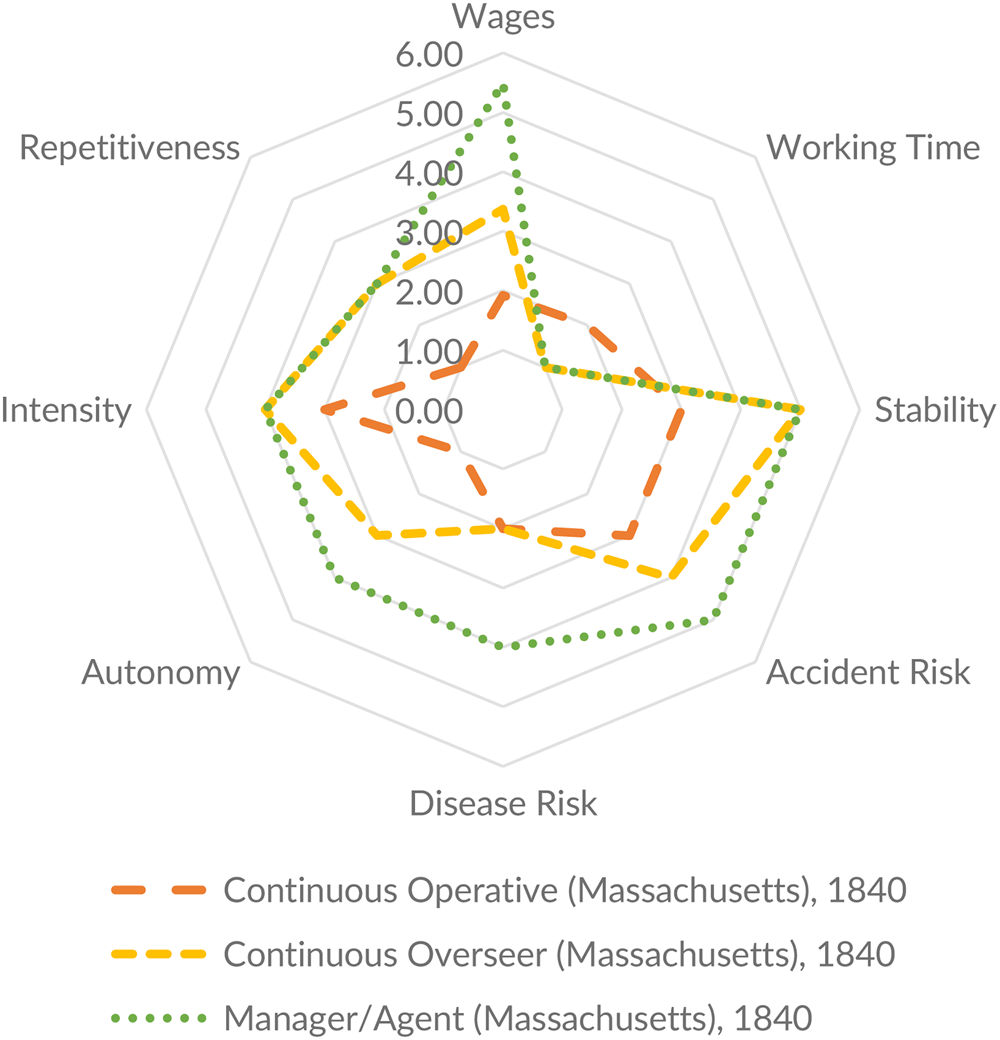
The Historical Job Quality Indicators provide criteria to code the qualitative evidence presented above for cross-sectional and longitudinal comparison.Footnote 138 Table 2 summarizes the differences in stability of earnings, short-term and long-term health risks, autonomy, intensity, and repetitiveness. This coded qualitative evidence can be combined with transformed welfare ratios (using an inverse hyperbolic sine) and binned working time for visual representation in Figures 5 and 6. Points are closer to the centre of the radar charts when a job was of lower quality for a given dimension. Figure 5 compares job quality for the eight HJQI dimensions across three occupations in the Lowell system in 1840, and Figure 6 compares work for frame operatives in the Lowell and Philadelphia mills in 1840.
The differences in work quality generally compounded differences in income: jobs that were well-paid had superior non-wage conditions. Mule operatives earned good wages in the Slater mills, reasonable incomes in Pennsylvania, and experienced more autonomy. Throstle tenders had lower wages and less autonomy, and were more likely to be dismissed. Overseers enjoyed high autonomy and good wages, and mill managers or agents received even higher earnings and benefitted from safer work environments than the hot, humid, dusty spinning rooms (Figure 5). As discussed above and shown in Tables 3–10, there was little within-occupation and within-system longitudinal change in the period considered; more notable shifts, primarily the speedup and stretch-out, occurred after 1840.
While wages were an important element of the job quality differences between the three systems, non-wage components also varied between the three approaches. Work intensity was highest in the Philadelphia mills, while workers in the Lowell system experienced less exhausting conditions. The high turnover of firms in Philadelphia was an important reason for less stable earnings. Managers in the Lowell mills had greater responsibilities for larger businesses, but also reaped greater rewards in much higher wages than those paid to managers in Slater-type mills.
The limited availability of wage data means that it is not possible to compare the work of continuous operatives across all three systems in one temporal cross-section, but Figure 6 visualizes the quantitative and coded indicators of job quality from the Lowell and Philadelphia systems in 1840. It encapsulates the discussion above: workers in Massachusetts experienced lower labour intensity, greater stability of employment and earnings, and slightly higher real incomes than workers in Philadelphia. The lack of data on piecers’ wages prevents a comparison of children's work across all eight indicators, but as discussed in the summary of short- and long-term health risks, there was likely a higher risk of occupational injury from intentional workplace violence in the Philadelphia system than the New England mills. Accident risks were similar for the same occupations between the three models as no system instituted safety practices or installed safety devices.
Conclusion
Work in early US textile factories included long hours, substantial risk of long-term respiratory disease, and frequently tiring conditions. Nearly all workers laboured for twelve to thirteen hours per day, some were injured by accidents from exposed gearing, and the majority were in low-autonomy employment. The differences in factor proportions, organization, and technology between the different parts of the US textile industry were not as dramatic as the differences in industrialization between Europe and East Asia. Nonetheless, variation in technical choice, capital–labour ratios, and product mix had implications in the spinning rooms. The labour-intensive Philadelphia model used many mules operated by British immigrants, featured smaller firms, was more competitive, and paid somewhat lower wages than the paternalistic, controlling Lowell system. The capital-intensive Lowell system featured larger establishments and separated financial, organizational, managerial, maintenance, and operational roles, with more inequality in work quality across the factory. The Slater mills began with family labour and a mixture of mules and frames, and eventually hired professional overseers for discipline.
This variation in approaches produced differences in work quality between occupations and locations. Work intensity and stability are two notable areas of difference in addition to disparities in real wages. The differing labour supplies of each model meant that workers could not simply move to better conditions in other textile factory systems: the young children who experienced poor job quality in Philadelphia would not have been hired in the Lowell mills, even if they could have migrated alone. Mule operatives, meanwhile, worked in superior employment in the short-run compared to their assistants in the Philadelphia mills, but remained under technological pressure from managers seeking to replace them with improved continuous machines or self-acting mules.Footnote 139
As identified in some present-day settings, lower wages were commonly accompanied by lower job quality on other dimensions, both within each system and across the three models analysed here. This finding suggests a long history of “high road” and “low road” employment practices that preceded extensive employment regulation and substantial labour representation, and that these roads may have been largely shaped by firms rather than labour or government institutions.Footnote 140 While some aspects of this study could inform broader global discussions of industrialization models, the fact that state support was provided to the capital-intensive model through tariff protection for coarse textiles suggests that further research will be required to establish whether a capital-intensive development route generally provides higher job quality. The chronology is also distinct from global comparisons; the primarily labour-intensive Slater system was the first-mover, but the Lowell and Philadelphia systems developed within a few years of each other, so “late industrialization” did not require state assistance.Footnote 141 Finally, unlike in the Japanese case, there was no effort to improve the skill levels of workers in the labour-intensive industrial models of the United States, which may have contributed, in part, to the eventual decline of the Philadelphia mills. Nonetheless, the differences in job quality identified here suggest that international comparisons of industrial models could also reveal important differences in the trajectories of workers' quality of life.
Firms’ difficulty in switching between models demonstrates that entrepreneurial choice was but one relevant factor influencing the elements of each model. Entrepreneurial choices were shaped by pre-existing factor conditions, and, in turn, those bounded choices shaped employment conditions. Later in the century, the Lowell corporations sloughed off their initial paternalistic motivations, reduced their investment in new capital equipment, and demanded higher worker effort. That little of the American textile industry made the opposite shift from “low road” labour practices to better job quality may suggest that employers in internationally competitive tradable sectors such as textiles were unlikely to provide good labour conditions absent paternalistic motivations or an outside force such as regulation or labour representation.


 Open access

