





1. Introduction
Anomalous, non-diffusive transport is becoming a fundamental problem in plasma physics, since it is often observed in both laboratory and astrophysical plasmas (Carreras, Lynch & Zaslavsky Reference Carreras, Lynch and Zaslavsky2001; del Castillo-Negrete, Carreras & Lynch Reference del Castillo-Negrete, Carreras and Lynch2004; Perri & Zimbardo Reference Perri and Zimbardo2007, Reference Perri and Zimbardo2008; Mier et al. Reference Mier, Sánchez, García, Carreras and Newman2008; Perrone et al. Reference Perrone2013; Bovet et al. Reference Bovet, Fasoli, Ricci, Furno and Gustafson2015; Zimbardo et al. Reference Zimbardo, Amato, Bovet, Effenberger, Fasoli, Fichtner, Furno, Gustafson, Ricci and Perri2015; Furno et al. Reference Furno, Bovet, Fasoli, Gauthey, Gustafson, Ricci and van Milligen2015). Anomalous transport is characterised by a nonlinear growth of the mean square displacement with time, $\langle \Delta x^2 \rangle =2 {\mathcal{D}}_\alpha t^{\alpha }$
, and both superdiffusive (
$\langle \Delta x^2 \rangle =2 {\mathcal{D}}_\alpha t^{\alpha }$
, and both superdiffusive ( $\alpha \gt 1$
) and subdiffusive (
$\alpha \gt 1$
) and subdiffusive ( $\alpha \lt 1$
) regimes are observed in a wide variety of systems (Geisel, Nierwetberg & Zacherl Reference Geisel, Nierwetberg and Zacherl1985; Zaslavsky Reference Zaslavsky2002; Metzler & Klafter Reference Metzler and Klafter2004; Klafter & Sokolov Reference Klafter and Sokolov2005). In fluid and plasma physics, the presence of turbulence is one of the main ingredients to cause anomalous transport (Klafter, Blumen & Shlesinger Reference Klafter, Blumen and Shlesinger1987; Shlesinger, West & Klafter Reference Shlesinger, West and Klafter1987; Zimbardo Reference Zimbardo2005; Mier et al. Reference Mier, Sánchez, García, Carreras and Newman2008; Lazarian & Yan Reference Lazarian and Yan2014; Isliker et al., Reference Isliker, Pisokas, Vlahos and Anastasiadis2017a,Reference Isliker, Vlahos and Constantinescub; Shukurov et al. Reference Shukurov, Snodin, Seta, Bushby and Wood2017), while non-Markovian pitch-angle scattering (Malkov Reference Malkov2017; Perri et al. Reference Perri, Pucci, Malara and Zimbardo2019; Zimbardo & Perri Reference Zimbardo and Perri2020) and particle interaction with a hierarchy of small-scale magnetic flux ropes (le Roux & Zank Reference le Roux and Zank2021; le Roux Reference le Roux2023) can be the clue to energetic particle superdiffusion in collisionless plasmas.
$\alpha \lt 1$
) regimes are observed in a wide variety of systems (Geisel, Nierwetberg & Zacherl Reference Geisel, Nierwetberg and Zacherl1985; Zaslavsky Reference Zaslavsky2002; Metzler & Klafter Reference Metzler and Klafter2004; Klafter & Sokolov Reference Klafter and Sokolov2005). In fluid and plasma physics, the presence of turbulence is one of the main ingredients to cause anomalous transport (Klafter, Blumen & Shlesinger Reference Klafter, Blumen and Shlesinger1987; Shlesinger, West & Klafter Reference Shlesinger, West and Klafter1987; Zimbardo Reference Zimbardo2005; Mier et al. Reference Mier, Sánchez, García, Carreras and Newman2008; Lazarian & Yan Reference Lazarian and Yan2014; Isliker et al., Reference Isliker, Pisokas, Vlahos and Anastasiadis2017a,Reference Isliker, Vlahos and Constantinescub; Shukurov et al. Reference Shukurov, Snodin, Seta, Bushby and Wood2017), while non-Markovian pitch-angle scattering (Malkov Reference Malkov2017; Perri et al. Reference Perri, Pucci, Malara and Zimbardo2019; Zimbardo & Perri Reference Zimbardo and Perri2020) and particle interaction with a hierarchy of small-scale magnetic flux ropes (le Roux & Zank Reference le Roux and Zank2021; le Roux Reference le Roux2023) can be the clue to energetic particle superdiffusion in collisionless plasmas.
From a microscopic point of view, superdiffusive transport can be described by a scale-free random walk process, which typically involves a Lévy walk. This is characterised by the probability $\varPsi$
of a random walker making a free path of length
$\varPsi$
of a random walker making a free path of length $\ell$
in a time
$\ell$
in a time $\tau$
given by
$\tau$
given by $\varPsi (\ell , \tau ) \propto |\ell |^{-\mu -1} \, \delta (|\ell | - v\tau )$
for large
$\varPsi (\ell , \tau ) \propto |\ell |^{-\mu -1} \, \delta (|\ell | - v\tau )$
for large $|\ell |$
(Geisel et al. Reference Geisel, Nierwetberg and Zacherl1985; Klafter et al. Reference Klafter, Blumen and Shlesinger1987; Shlesinger et al. Reference Shlesinger, West and Klafter1987; Zimbardo & Perri Reference Zimbardo and Perri2013; Zaburdaev, Denisov & Klafter Reference Zaburdaev, Denisov and Klafter2015), where
$|\ell |$
(Geisel et al. Reference Geisel, Nierwetberg and Zacherl1985; Klafter et al. Reference Klafter, Blumen and Shlesinger1987; Shlesinger et al. Reference Shlesinger, West and Klafter1987; Zimbardo & Perri Reference Zimbardo and Perri2013; Zaburdaev, Denisov & Klafter Reference Zaburdaev, Denisov and Klafter2015), where $v \gt 0$
is the speed of the particle. When the exponent
$v \gt 0$
is the speed of the particle. When the exponent $\mu \lt 2$
, the second-order moment of
$\mu \lt 2$
, the second-order moment of $\varPsi$
,
$\varPsi$
, $\langle \ell ^2 \rangle = \int \ell ^2 \varPsi (\ell , \tau )\, {\rm d}\ell$
, is diverging and the central limit theorem does not apply, leading to the need of a description of transport that goes beyond standard diffusion. Indeed, in the case of Lévy walks, superdiffusion with
$\langle \ell ^2 \rangle = \int \ell ^2 \varPsi (\ell , \tau )\, {\rm d}\ell$
, is diverging and the central limit theorem does not apply, leading to the need of a description of transport that goes beyond standard diffusion. Indeed, in the case of Lévy walks, superdiffusion with $\alpha =3-\mu$
is found.
$\alpha =3-\mu$
is found.
While probabilistic models based on continuous-time random walks allow for a microscopic description of anomalous diffusion, it is also possible to describe the problem in terms of macroscopic transport equations, in a way similar to normal transport processes. A classical approach is to change, in one dimension, the second-order derivative in the standard diffusion equation with a fractional derivative of order $\mu$
with
$\mu$
with $1\lt \mu \lt 2$
(Metzler & Klafter Reference Metzler and Klafter2000; Zaslavsky Reference Zaslavsky2002; Metzler & Klafter Reference Metzler and Klafter2004; Calvo et al. Reference Calvo, Sánchez, Carreras and van Milligen2007; Isliker et al., Reference Isliker, Vlahos and Constantinescu2017b; le Roux & Zank Reference le Roux and Zank2021),
$1\lt \mu \lt 2$
(Metzler & Klafter Reference Metzler and Klafter2000; Zaslavsky Reference Zaslavsky2002; Metzler & Klafter Reference Metzler and Klafter2004; Calvo et al. Reference Calvo, Sánchez, Carreras and van Milligen2007; Isliker et al., Reference Isliker, Vlahos and Constantinescu2017b; le Roux & Zank Reference le Roux and Zank2021),
 \begin{equation} \frac {\partial n}{\partial t} = \kappa _{\mu } \frac {\partial ^\mu n}{\partial |x|^\mu }, \end{equation}
where $\kappa _{\mu }$
is a fractional diffusion coefficient with dimensions
$\kappa _{\mu }$
is a fractional diffusion coefficient with dimensions $L^{\mu }/T$
and
$L^{\mu }/T$
and $\partial ^\mu /\partial |x|^\mu$
represents the completely symmetric Riesz fractional derivative (Metzler & Klafter Reference Metzler and Klafter2000; Zaslavsky Reference Zaslavsky2002; Perrone et al. Reference Perrone2013; Effenberger et al. Reference Effenberger2025). In (1.1), we have retained the diffusion term only and
$\partial ^\mu /\partial |x|^\mu$
represents the completely symmetric Riesz fractional derivative (Metzler & Klafter Reference Metzler and Klafter2000; Zaslavsky Reference Zaslavsky2002; Perrone et al. Reference Perrone2013; Effenberger et al. Reference Effenberger2025). In (1.1), we have retained the diffusion term only and $n$
is the particle number density that depends on the coordinate
$n$
is the particle number density that depends on the coordinate $x$
and on time
$x$
and on time $t$
. Upon Fourier transforming, the completely symmetric Riesz derivative is equivalent to the multiplication by
$t$
. Upon Fourier transforming, the completely symmetric Riesz derivative is equivalent to the multiplication by $-|k|^{\mu }$
(where
$-|k|^{\mu }$
(where $k$
is the wavenumber), so that (1.1) yields the characteristic function
$k$
is the wavenumber), so that (1.1) yields the characteristic function $\exp (-\kappa _{\mu } t |k|^{\mu })$
, which is the Fourier representation of the Lévy distribution (Metzler & Klafter Reference Metzler and Klafter2000; Zaslavsky Reference Zaslavsky2002). As it is known, Lévy distributions having power law tails are one of the main tools for studying superdiffusion (Klafter et al. Reference Klafter, Blumen and Shlesinger1987; Shlesinger et al. Reference Shlesinger, West and Klafter1987; Zaslavsky Reference Zaslavsky2002; Zimbardo & Perri Reference Zimbardo and Perri2013; Zaburdaev et al. Reference Zaburdaev, Denisov and Klafter2015; Effenberger et al. Reference Effenberger2025). However, the introduction of spatial fractional derivatives to describe transport needs a justification starting from elementary transport processes. The standard diffusion equation can be obtained by combining the continuity equation with Fick’s law, which relates the flux
$\exp (-\kappa _{\mu } t |k|^{\mu })$
, which is the Fourier representation of the Lévy distribution (Metzler & Klafter Reference Metzler and Klafter2000; Zaslavsky Reference Zaslavsky2002). As it is known, Lévy distributions having power law tails are one of the main tools for studying superdiffusion (Klafter et al. Reference Klafter, Blumen and Shlesinger1987; Shlesinger et al. Reference Shlesinger, West and Klafter1987; Zaslavsky Reference Zaslavsky2002; Zimbardo & Perri Reference Zimbardo and Perri2013; Zaburdaev et al. Reference Zaburdaev, Denisov and Klafter2015; Effenberger et al. Reference Effenberger2025). However, the introduction of spatial fractional derivatives to describe transport needs a justification starting from elementary transport processes. The standard diffusion equation can be obtained by combining the continuity equation with Fick’s law, which relates the flux $J$
to the local density gradient,
$J$
to the local density gradient, $\boldsymbol{J}=-\kappa \boldsymbol{\nabla }n$
. As pointed out by Chaves (Reference Chaves1998), the continuity equation is a fundamental conservation law, therefore, to obtain a fractional diffusion equation, we have to modify Fick’s law.
$\boldsymbol{J}=-\kappa \boldsymbol{\nabla }n$
. As pointed out by Chaves (Reference Chaves1998), the continuity equation is a fundamental conservation law, therefore, to obtain a fractional diffusion equation, we have to modify Fick’s law.
We notice that an integral expression for the non-local heat flux due to steep temperature gradient was discussed by Luciani, Mora & Virmont (Reference Luciani, Mora and Virmont1983), while Karpen & DeVore (Reference Karpen and DeVore1987) addressed a non-local heat flux in the astrophysical context. A general treatment of linear-response theory is given in the monograph by Kubo (Reference Kubo1985), while non-local transport in laboratory plasmas was reviewed by Ida et al. (Reference Ida2015). In the field of solar physics, more recent works on non-local transport were provided by Bian, Emslie & Kontar (Reference Bian, Emslie and Kontar2017) and Emslie & Bian (Reference Emslie and Bian2018). Vermeersch & Shakouri (Reference Vermeersch and Shakouri2014) proposed to write the non-local diffusive flux as
 \begin{equation} J(x,t) = - \int _0^t \text{d}t' \int _{-\infty }^{\infty } \text{d}x' D(x-x', t-t') \frac {\partial n}{\partial x'}(x',t') \, , \end{equation}
where $D(x,t)$
is a generalised diffusivity kernel that embodies both non-local effects and memory effects. Equation (1.2) represents a convolution product between the density gradient and
$D(x,t)$
is a generalised diffusivity kernel that embodies both non-local effects and memory effects. Equation (1.2) represents a convolution product between the density gradient and $D(x,t)$
, so that it can easily be reduced to the standard Fick’s law for a localised kernel
$D(x,t)$
, so that it can easily be reduced to the standard Fick’s law for a localised kernel $D$
expressed in terms of
$D$
expressed in terms of $\delta$
-functions. As a side remark, we note that (1.2) is reminiscent of the non-local relation in physical space between the electric current
$\delta$
-functions. As a side remark, we note that (1.2) is reminiscent of the non-local relation in physical space between the electric current $j_i^{(e)}$
and the electric field
$j_i^{(e)}$
and the electric field $E_j$
, which is implied by the standard relation in Fourier space
$E_j$
, which is implied by the standard relation in Fourier space
 \begin{equation} j_i^{(e)}(\boldsymbol{k},\omega ) =\sigma _{ij} (\boldsymbol{k},\omega ) E_j(\boldsymbol{k},\omega ), \end{equation}
where $\sigma _{ij}(\boldsymbol{k},\omega )$
is the conductivity (see for instance (4.2.3) of Gurnett & Bhattacharjee Reference Gurnett and Bhattacharjee2005). This familiar relation is the starting point for the study of linear waves in homogeneous plasmas, and either two-fluid theory or kinetic theory offer standard tools to compute
$\sigma _{ij}(\boldsymbol{k},\omega )$
is the conductivity (see for instance (4.2.3) of Gurnett & Bhattacharjee Reference Gurnett and Bhattacharjee2005). This familiar relation is the starting point for the study of linear waves in homogeneous plasmas, and either two-fluid theory or kinetic theory offer standard tools to compute $\sigma _{ij}(\boldsymbol{k},\omega )$
. Therefore, non-local effects are the rule rather than the exception in plasma physics.
$\sigma _{ij}(\boldsymbol{k},\omega )$
. Therefore, non-local effects are the rule rather than the exception in plasma physics.
In this paper, we concentrate on the fractional Fick’s law, neglecting time non-locality, because this helps to understand the origin of non-local, superdiffusive transport and because a non-local espression for the flux turns out to be very useful for the description of anomalous transport under steady-state conditions, in the presence of boundaries, and for asymmetric conditions (Paradisi et al. Reference Paradisi, Cesari, Mainardi and Tampieri2001; Néel et al. Reference Néel, Abdennadher and Joelson2007), which can be routinely found in astrophysical systems such as collisionless shocks (Perri & Zimbardo Reference Perri and Zimbardo2007, Reference Perri and Zimbardo2009). In addition, knowledge of the non-local diffusive flux can be important for the interpretation of experimental data and for the understanding of uphill transport, that is, a flux in the same direction as the gradient. We note that in laboratory plasmas, several evidences of uphill transport have been found (e.g. Luce, Petty & De Haas Reference Luce, Petty and De Haas1992; Petty & Luce Reference Petty and Luce1994; Stroth et al. Reference Stroth, Geist, Koponen, Hartfuß and Zeiler1999; Hoang et al. Reference Hoang2003; van Milligen, Carreras & Sánchez Reference van Milligen, Carreras and Sánchez2004), a subject which recently has attracted new attention (van Milligen et al. Reference van Milligen, Carreras, García, Martín de Aguilera, Hidalgo and Nicolau2016; Müller et al. Reference Müller, Manz and Ramisch2023).
In § 2, we give a simple derivation of the fractional Fick’s law and we show that this allows us to recover the fractional diffusion equation with the Riesz derivative. In § 3, we propose a method for the numerical evaluation of the fractional flux and test it with the derivatives of a Gaussian function. In § 4, we apply the numerical method to the computation of energetic particle fluxes accelerated at interplanetary shock waves, which are frequently observed in space plasmas, and point out that the non-local flux is able to generate uphill transport. In § 5, we give the conclusions.
2. A simple derivation of fractional Fick’s law
The diffusion equation can be obtained by combining the continuity equation,
 \begin{equation} \frac {\partial n}{\partial t} + \boldsymbol{\nabla }\boldsymbol{\cdot }\boldsymbol{J} = 0 \end{equation}
with the standard Fick’s law
 \begin{equation} \boldsymbol{J} = -\kappa \boldsymbol{\nabla }n, \end{equation}
where $\kappa$
is the diffusion coefficient; assuming that
$\kappa$
is the diffusion coefficient; assuming that $\kappa$
is independent of coordinates, in the case of one spatial dimension, we obtain
$\kappa$
is independent of coordinates, in the case of one spatial dimension, we obtain
 \begin{equation} \frac {\partial n}{\partial t} = \kappa \frac {\partial ^2 n}{\partial x^2} \, . \end{equation}
We now try to generalise Fick’s law to take into account the non-local character of the particle flux $\boldsymbol{J}$
and the scale-free properties of the particle random walk. For this purpose, we follow the logical steps adopted by Richard Feynman in his famous lectures, since we believe that Feynman’s approach is clearer from the physical point of view than using (1.2). Indeed, the assumption that the contribution of far away points to the non-local flux is proportional to the density derivative in
$\boldsymbol{J}$
and the scale-free properties of the particle random walk. For this purpose, we follow the logical steps adopted by Richard Feynman in his famous lectures, since we believe that Feynman’s approach is clearer from the physical point of view than using (1.2). Indeed, the assumption that the contribution of far away points to the non-local flux is proportional to the density derivative in $x'$
, as in (1.2), is not always clearly justified.
$x'$
, as in (1.2), is not always clearly justified.
Consider the net flow in the $x$
direction that crosses a plane surface perpendicular to the
$x$
direction that crosses a plane surface perpendicular to the $x$
axis. We have to count the number of particles that cross the plane in the direction of positive
$x$
axis. We have to count the number of particles that cross the plane in the direction of positive $x$
, which is
$x$
, which is $n_{-}v_{x}$
, and subtract from this value the number of particles crossing the surface in the negative
$n_{-}v_{x}$
, and subtract from this value the number of particles crossing the surface in the negative $x$
direction, which is
$x$
direction, which is $n_{+}v_{x}$
. Here,
$n_{+}v_{x}$
. Here, $n_{-}$
is the number density of particles to the left of the point
$n_{-}$
is the number density of particles to the left of the point $x$
at which we intend to evaluate the net flux,
$x$
at which we intend to evaluate the net flux, $n_{+}$
is the number density of particles on the right side and
$n_{+}$
is the number density of particles on the right side and $v_{x}$
is the mean particle velocity in absolute value along
$v_{x}$
is the mean particle velocity in absolute value along $x$
. The net flux density
$x$
. The net flux density $J$
can be expressed as
$J$
can be expressed as
 \begin{equation} J = (n_{-}-n_{+})v_{x} \equiv -(n_{+}-n_{-})v_{x}, \end{equation}
which is indeed (43.22) of Feynman, Leighton & Sands (Reference Feynman, Leighton and Sands1989). At this point, Feynman et al. (Reference Feynman, Leighton and Sands1989, vol. I, pp. 43–47) say
‘What shall we use for $n_{-}$
and
$n_{-}$
and $n_{+}$
? When we say “the density on the left”, how far to the left do we mean? We should choose the density at the place from which the molecules started their “flight”, because the number which start such trip is determined by the number present at that place. So by
$n_{+}$
? When we say “the density on the left”, how far to the left do we mean? We should choose the density at the place from which the molecules started their “flight”, because the number which start such trip is determined by the number present at that place. So by $n_{-}$
we should mean the density at a distance to the left equal to the mean free path
$n_{-}$
we should mean the density at a distance to the left equal to the mean free path $\lambda$
, and by
$\lambda$
, and by $n_{+}$
, the density at the distance
$n_{+}$
, the density at the distance $\lambda$
to the right.’
$\lambda$
to the right.’
In the standard case of a local flux, for small distances $\Delta x$
, we can writeFootnote 1
$\Delta x$
, we can writeFootnote 1
 \begin{align} (n_{+}-n_{-}) = \frac {\partial n}{\partial x} \ \Delta x = \frac {\partial n}{\partial x} \ 2\lambda . \end{align}
Thus, we can rewrite (2.4) as
 \begin{equation} J = -2\lambda v_{x} \ \frac {\partial n}{\partial x}. \end{equation}
Therefore, the flow of particles along $x$
is proportional to the derivative of the density, and the diffusion coefficient is given by
$x$
is proportional to the derivative of the density, and the diffusion coefficient is given by $\kappa \simeq \lambda v_{x}$
.
$\kappa \simeq \lambda v_{x}$
.
Here, we would like to obtain a non-local flux which also includes the contribution to the flux of particles coming from ‘far away’ regions: how far do we mean? We mean from $x'=x+\xi$
and
$x'=x+\xi$
and $x'=x-\xi$
, that is, from a range of distances
$x'=x-\xi$
, that is, from a range of distances $\pm \xi$
from the current position
$\pm \xi$
from the current position $x$
. Therefore,
$x$
. Therefore, $n_{+}$
and
$n_{+}$
and $n_{-}$
in (2.4) are to be replaced by
$n_{-}$
in (2.4) are to be replaced by $n(x+\xi )$
and
$n(x+\xi )$
and $n(x-\xi )$
. We introduce the small flux
$n(x-\xi )$
. We introduce the small flux $\mathrm{d}J$
coming from a small extent
$\mathrm{d}J$
coming from a small extent $\text{d}\xi$
of positions as
$\text{d}\xi$
of positions as
 \begin{equation} \mathrm{d}J = - [{n(x+\xi ,t) - n(x-\xi ,t)}] \ v_x \ W(\xi ) \ \frac {\text{d}\xi }{\xi _0}, \end{equation}
where $\xi _0$
is a scale length introduced for dimensional reasons. We note that, in the case of non-local flux contributions, the use of (2.6) with the density derivative is not appropriate. We also introduced a dimensionless weight
$\xi _0$
is a scale length introduced for dimensional reasons. We note that, in the case of non-local flux contributions, the use of (2.6) with the density derivative is not appropriate. We also introduced a dimensionless weight $W(\xi )$
, which takes into account the fact that, physically, the contribution to the flux of nearby regions should be larger than that of distant regions. This weight could be taken as either a Gaussian function or a bi-exponential decrease. For instance, in the context of laser-produced plasmas, for electron heat flux, Luciani et al. (Reference Luciani, Mora and Virmont1983) assume a weight proportional to the exponential decrease of an integral of density over distance; the same weight is adopted by Karpen & DeVore (Reference Karpen and DeVore1987) in the astrophysical context. For electron transport in the solar corona, Bian et al. (Reference Bian, Emslie and Kontar2017) derived from a kinetic equation in velocity space, assuming a finite mean free path, a weight
$W(\xi )$
, which takes into account the fact that, physically, the contribution to the flux of nearby regions should be larger than that of distant regions. This weight could be taken as either a Gaussian function or a bi-exponential decrease. For instance, in the context of laser-produced plasmas, for electron heat flux, Luciani et al. (Reference Luciani, Mora and Virmont1983) assume a weight proportional to the exponential decrease of an integral of density over distance; the same weight is adopted by Karpen & DeVore (Reference Karpen and DeVore1987) in the astrophysical context. For electron transport in the solar corona, Bian et al. (Reference Bian, Emslie and Kontar2017) derived from a kinetic equation in velocity space, assuming a finite mean free path, a weight $W(\xi )\sim \exp ({-{\sqrt {45}} \xi /\lambda })$
. In all those cases, the contribution to the flux becomes exponentially small for
$W(\xi )\sim \exp ({-{\sqrt {45}} \xi /\lambda })$
. In all those cases, the contribution to the flux becomes exponentially small for $\xi \gt \lambda$
. However, superdiffusion is basically related to the presence of power-law probability distributions for the free path lengths
$\xi \gt \lambda$
. However, superdiffusion is basically related to the presence of power-law probability distributions for the free path lengths $\ell$
, which implies a diverging mean free path and a broader range of distances
$\ell$
, which implies a diverging mean free path and a broader range of distances $\xi$
for the contribution to the flux than that corresponding to a bi-exponential weight. Therefore, to have a more decidedly non-local flux, we choose an inverse power law
$\xi$
for the contribution to the flux than that corresponding to a bi-exponential weight. Therefore, to have a more decidedly non-local flux, we choose an inverse power law $W(\xi )\sim (\xi /\xi _0)^{-(1+\beta )}$
, so that
$W(\xi )\sim (\xi /\xi _0)^{-(1+\beta )}$
, so that $\mathrm{d}J$
can be written as
$\mathrm{d}J$
can be written as
 \begin{equation} \mathrm{d}J = - [{n(x+\xi ,t) - n(x-\xi ,t)}] \ v_x \ \left ( \frac {\xi }{\xi _0} \right )^{-(1+\beta )} \ \frac {\text{d}\xi }{\xi _0}, \end{equation}
that is,
 \begin{equation} \mathrm{d}J = - v_x \xi _0^\beta \ \frac {n(x+\xi ,t) - n(x-\xi ,t)}{\xi ^{1+\beta }}\, \text{d}\xi \ . \end{equation}
We can see that the length $\xi _0$
separates the regions where the weight
$\xi _0$
separates the regions where the weight $W(\xi )\gt 1$
from those where
$W(\xi )\gt 1$
from those where $W(\xi )\lt 1$
. Assuming that
$W(\xi )\lt 1$
. Assuming that $n(x)$
remains finite for
$n(x)$
remains finite for $x\to \pm \infty$
and that
$x\to \pm \infty$
and that $\beta \gt 0$
, we can extend the integration over
$\beta \gt 0$
, we can extend the integration over $\xi$
from
$\xi$
from $0$
to
$0$
to $\infty$
to obtain
$\infty$
to obtain
 \begin{equation} J(x,t) \simeq - v_x \xi _0^{\beta } \int _0^{\infty } \frac {n(x+\xi ,t) - n(x-\xi ,t)}{\xi ^{1+\beta }}\, \text{d}\xi \ . \end{equation}
This expression of the non-local flux depends on two new parameters, i.e. $\beta$
and
$\beta$
and $\xi _0$
. In a way similar to the power-law distributions of Lévy processes,
$\xi _0$
. In a way similar to the power-law distributions of Lévy processes, $\beta$
determines the degree of non-locality, that is, how heavy are the tails of the non-local flux. Due to the singularity for
$\beta$
determines the degree of non-locality, that is, how heavy are the tails of the non-local flux. Due to the singularity for $\xi \to 0$
, we require that
$\xi \to 0$
, we require that $\beta \lt 1$
to avoid the divergence, considering that the density
$\beta \lt 1$
to avoid the divergence, considering that the density $n(x)$
is a smooth function so that the numerator in (2.10) will be proportional to
$n(x)$
is a smooth function so that the numerator in (2.10) will be proportional to $\xi$
. However, the value of
$\xi$
. However, the value of $\xi _0$
contributes to determine the value of the fractional diffusion coefficient
$\xi _0$
contributes to determine the value of the fractional diffusion coefficient $\kappa _{\beta }$
, which is given as
$\kappa _{\beta }$
, which is given as
 \begin{equation} \kappa _{\beta } = v_x \xi _0^{\beta } \, . \end{equation}
Despite the partial similarity to the standard diffusion coefficient, we note that the scale length $\xi _0$
does not correspond to the mean free path
$\xi _0$
does not correspond to the mean free path $\lambda$
(the latter being divergent in the case of superdiffusion). As we show later,
$\lambda$
(the latter being divergent in the case of superdiffusion). As we show later, $\xi _0$
has the same physical meaning as the scale parameter
$\xi _0$
has the same physical meaning as the scale parameter $\ell _0$
of Perri & Zimbardo (Reference Perri and Zimbardo2015), namely it is related to the minimum free path length such that for
$\ell _0$
of Perri & Zimbardo (Reference Perri and Zimbardo2015), namely it is related to the minimum free path length such that for $\ell \gt \ell _0$
, the distribution of the free path lengths
$\ell \gt \ell _0$
, the distribution of the free path lengths $\psi (\ell )$
decays as a power-law. Thus, we can write the fractional Fick’s law as
$\psi (\ell )$
decays as a power-law. Thus, we can write the fractional Fick’s law as
 \begin{equation} J(x,t) \simeq - \kappa _{\beta } \int _0^{\infty } \frac {n(x+\xi ,t) - n(x-\xi ,t)}{\xi ^{1+\beta }} \,\text{d}\xi \ , \end{equation}
with $0\lt \beta \lt 1$
.
$0\lt \beta \lt 1$
.
We now proceed to show that the expression of the flux, (2.12), leads to a fractional diffusion equation with the Riesz derivative when $J(x,t)$
is inserted into the continuity equation. Let us consider
$J(x,t)$
is inserted into the continuity equation. Let us consider
 \begin{align} \frac {\partial }{\partial x} \int _{0}^{\infty } \frac {n(x+\xi ,t)-n(x-\xi ,t)}{\xi ^{1+\beta }}\,\text{d}\xi &=\int _{0}^{\infty } \frac {\partial n(x+\xi ,t) }{\partial x} \frac {1}{\xi ^{1+\beta }}\,\text{d}\xi\nonumber \\[5pt] &\quad - \int _{0}^{\infty } \frac {\partial n(x-\xi ,t) }{\partial x} \frac {1}{\xi ^{1+\beta }}\,\text{d}\xi , \end{align}
where
 \begin{align} \int _{0}^{\infty } \frac {\partial n(x+\xi ,t) }{\partial x} \frac {1}{\xi ^{1+\beta }}\,\text{d}\xi \ = \int _{0}^{\infty } \frac {\partial n(x+\xi ,t) }{\partial \xi } \frac {1}{\xi ^{1+\beta }}\,\text{d}\xi . \end{align}
If we integrate by parts, we obtain for the ‘right’ contribution
 \begin{align} \int _{0}^{\infty } \frac {\partial n(x+\xi ,t) }{\partial x} \frac {1}{\xi ^{1+\beta }}\,\text{d}\xi \ = \frac {n(x+\xi ,t)}{\xi ^{1+\beta }}\Big |_{0}^{\infty }+(1+\beta ) \int _{0}^{\infty } \frac {n(x+\xi ,t)}{\xi ^{2+\beta }}\,\text{d}\xi. \end{align}
In an analogous way, for the ‘left’ contribution, we have
 \begin{align} \int _{0}^{\infty } \frac {\partial n(x-\xi ,t) }{\partial x} \frac {1}{\xi ^{1+\beta }}\,\text{d}\xi \ = -\int _{0}^{\infty } \frac {\partial n(x-\xi ,t) }{\partial \xi } \frac {1}{\xi ^{1+\beta }}\,\text{d}\xi , \end{align}
that is,
 \begin{align} \int _{0}^{\infty } \frac {\partial n(x-\xi ,t) }{\partial x} \frac {1}{\xi ^{1+\beta }}\,\text{d}\xi \ = - \left [ \frac {n(x-\xi ,t)}{\xi ^{1+\beta }}\Big |_{0}^{\infty }+(1+\beta ) \int _{0}^{\infty } \frac {n(x-\xi ,t)}{\xi ^{2+\beta }}\,\text{d}\xi \right ]. \end{align}
Using the relation (Bayın Reference Bayın2016)
 \begin{equation} \frac {f(x-\xi )}{\xi ^{1+\beta }}\Big |_{0}^{\infty } = -\displaystyle \lim _{\xi \to 0} \frac {f(x)}{\xi ^{1+\beta }} = -(1+\beta ) \int _{0}^{\infty } \frac {f(x)}{\xi ^{2+\beta }}\,\text{d}\xi , \end{equation}
we obtain
 \begin{align} \int _{0}^{\infty } \frac {\partial n(x+\xi ,t) }{\partial x} \frac {1}{\xi ^{1+\beta }}\,\text{d}\xi \ = (1+\beta ) \int _{0}^{\infty } \frac {n(x+\xi ,t)-n(x,t)}{\xi ^{2+\beta }}\,\text{d}\xi \end{align}
and
 \begin{align} \int _{0}^{\infty } \frac {\partial n(x-\xi ,t) }{\partial x} \frac {1}{\xi ^{1+\beta }}\,\text{d}\xi \ = -(1+\beta ) \int _{0}^{\infty } \frac {n(x-\xi ,t)-n(x,t)}{\xi ^{2+\beta }}\,\text{d}\xi, \end{align}
which lead to
 \begin{align} \frac {\partial }{\partial x} J(x,t) \simeq -(1+\beta ) \kappa _{\beta } \int _{0}^{\infty } \frac {n(x+\xi ,t)-2n(x,t)+n(x-\xi ,t)}{\xi ^{2+\beta }}\,\text{d}\xi. \end{align}
We now recall that the Riesz derivative of order $\mu$
can be written as (e.g. Litvinenko & Effenberger Reference Litvinenko and Effenberger2014)
$\mu$
can be written as (e.g. Litvinenko & Effenberger Reference Litvinenko and Effenberger2014)
 \begin{align} \frac {\partial ^{\mu } n(x,t)}{\partial |x|^{\mu }} = \frac {\varGamma (1+\mu )}{\pi }\sin \left ( \frac {\pi \mu }{2} \right ) \int _{0}^{\infty } \frac {n(x+\xi ,t)-2n(x,t)+n(x-\xi ,t)}{\xi ^{1+\mu }}\,\text{d}\xi. \end{align}
Setting $\mu =1+\beta$
and using the properties of the Euler gamma function, we have
$\mu =1+\beta$
and using the properties of the Euler gamma function, we have $ \displaystyle \varGamma (2+\beta ) = (1+\beta ) \varGamma (1+\beta )$
. By comparing with (2.22), we can obtain from
$ \displaystyle \varGamma (2+\beta ) = (1+\beta ) \varGamma (1+\beta )$
. By comparing with (2.22), we can obtain from $\partial J{\kern-1.5pt/}\partial x$
the Riesz derivative by multiplying
$\partial J{\kern-1.5pt/}\partial x$
the Riesz derivative by multiplying $J$
by a constant
$J$
by a constant $A$
given as
$A$
given as
 \begin{equation} A = \frac {\varGamma (1+\beta )}{\pi }\sin \left [ \frac {\pi }{2}(1+\beta ) \right ], \end{equation}
which is of order 0.3 for $0\lt \beta \lt 1$
. Finally, we have
$0\lt \beta \lt 1$
. Finally, we have
 \begin{equation} J(x,t) = - \kappa _{\beta } \ \frac {\varGamma (1+\beta )}{\pi }\sin \left [ \frac {\pi }{2}(1+\beta ) \right ] \int _{0}^{\infty } \frac {n(x+\xi ,t)-n(x-\xi ,t)}{\xi ^{1+\beta }}\,\text{d}\xi . \end{equation}
We point out that (2.24) is equivalent to that proposed by Zanette (Reference Zanette1998), and coincides to that derived by Calvo et al. (Reference Calvo, Sánchez, Carreras and van Milligen2007) in terms of Riemann–Liouville fractional derivatives, except that those authors do not give an expression for $\kappa _{\beta }$
.
$\kappa _{\beta }$
.
We can conclude that with the flux defined as in (2.24), we see that $ {\partial J}/{\partial x}$
is exactly equal to
$ {\partial J}/{\partial x}$
is exactly equal to $ -\kappa _\beta {\partial ^{\mu } n(x,t)}/{\partial |x|^{\mu }}$
. Then, from the continuity equation, we obtain
$ -\kappa _\beta {\partial ^{\mu } n(x,t)}/{\partial |x|^{\mu }}$
. Then, from the continuity equation, we obtain
 \begin{align} \frac {\partial n(x,t) }{\partial t} = \kappa _{\beta } \frac {\partial ^{1+\beta }}{\partial |x|^{1+\beta }} n(x,t), \end{align}
which is exactly the fractional diffusion equation for the number density of particles, having as solution a Lévy distribution of index $\mu = 1+\beta$
.
$\mu = 1+\beta$
.
We notice that if our plasma domain is finite, we can stop the integration domain in (2.10) and (2.24) to the distances corresponding to our domain, including the case of asymmetric configurations, and still be able to compute a non-local flux. Another advantage of having the flux as in (2.24) is that the Riesz derivative is originally defined in Fourier space and, therefore, implies that the density $n(x,t)$
should admit a Fourier transform. However, (2.10) and (2.24) allow one to compute the flux even if
$n(x,t)$
should admit a Fourier transform. However, (2.10) and (2.24) allow one to compute the flux even if $n(x=\pm \infty )$
does not go to zero, provided that the difference
$n(x=\pm \infty )$
does not go to zero, provided that the difference $n(x+\xi ) - n(x-\xi )$
remains finite.
$n(x+\xi ) - n(x-\xi )$
remains finite.
2.1. Fractional diffusion coefficient $\kappa _\beta$
and scale length
$\xi _0$
$\kappa _\beta$
and scale length
$\xi _0$


It is worth recalling that in the case of anomalous diffusion, the fractional diffusion coefficient $\kappa _\beta = v_x\xi _0^\beta$
does not coincide with the anomalous diffusion coefficient
$\kappa _\beta = v_x\xi _0^\beta$
does not coincide with the anomalous diffusion coefficient $\mathcal{D}_\alpha$
, which enters the relation defining anomalous diffusion, that is,
$\mathcal{D}_\alpha$
, which enters the relation defining anomalous diffusion, that is, $\langle \Delta x^2 \rangle =2 {\mathcal{D}}_\alpha t^{\alpha }$
. In fact,
$\langle \Delta x^2 \rangle =2 {\mathcal{D}}_\alpha t^{\alpha }$
. In fact, $\kappa _\beta$
and
$\kappa _\beta$
and $\mathcal{D}_\alpha$
even have different physical dimensions. In the case of superdiffusion, the relation between these two constants has been given by Perri et al. (Reference Perri, Zimbardo, Effenberger and Fichtner2015), and can be written as
$\mathcal{D}_\alpha$
even have different physical dimensions. In the case of superdiffusion, the relation between these two constants has been given by Perri et al. (Reference Perri, Zimbardo, Effenberger and Fichtner2015), and can be written as
 \begin{equation} {\mathcal{D}}_\alpha = \frac {\varGamma (4-\alpha )}{\pi (\alpha -1)} \sin {\left [\frac {\pi }{2}(3-\alpha )\right ]} {v_x}^{\alpha - 1} \kappa _\beta, \end{equation}
which holds for superdiffusion.Footnote 2 Furthermore, Perri & Zimbardo (Reference Perri and Zimbardo2012) and Zimbardo & Perri (Reference Zimbardo and Perri2013) have shown that ${\mathcal{D}}_\alpha$
can be written as
${\mathcal{D}}_\alpha$
can be written as
 \begin{equation} {\mathcal{D}}_\alpha = \frac {2(2-\alpha )}{(3-\alpha )(4-\alpha )} \varGamma (\alpha -1) \ \ell _0^{2-\alpha } v_x^{\alpha }, \end{equation}
where $\ell _0$
is the shortest free path length for which the free path distribution
$\ell _0$
is the shortest free path length for which the free path distribution $\varPsi (\ell ,\tau )$
has a power law shape. Since
$\varPsi (\ell ,\tau )$
has a power law shape. Since $\alpha =2-\beta$
, a comparison of (2.26) and (2.27) shows that
$\alpha =2-\beta$
, a comparison of (2.26) and (2.27) shows that
 \begin{equation} \xi _0 = \left [ \frac {2\pi (2-\alpha ) \varGamma (\alpha )}{(3-\alpha ) \sin {\left [({\pi }/{2})(3-\alpha )\right ]} \varGamma (5-\alpha ) } \right ]^{1/\beta } \ell _0 \end{equation}
with the numerical factor being of order one for $1.2 \lt \alpha \lt 1.6$
. These values for
$1.2 \lt \alpha \lt 1.6$
. These values for $\alpha$
are typically found for the transport of energetic particles upstream of interplanetary shocks (Zimbardo, Prete & Perri Reference Zimbardo, Prete and Perri2020). Therefore, we can see that the scale length
$\alpha$
are typically found for the transport of energetic particles upstream of interplanetary shocks (Zimbardo, Prete & Perri Reference Zimbardo, Prete and Perri2020). Therefore, we can see that the scale length $\xi _0$
represents the distance which, in the non-local flux given by (2.8), separates regions with larger weight
$\xi _0$
represents the distance which, in the non-local flux given by (2.8), separates regions with larger weight $W(\xi )\gt 1$
from regions with smaller weight
$W(\xi )\gt 1$
from regions with smaller weight $W(\xi )\lt 1$
, and is of the same order of the shortest free path length for which the free path distribution has a power law shape. Notably, Perri & Zimbardo (Reference Perri and Zimbardo2012), Zimbardo & Perri (Reference Zimbardo and Perri2013), Perri et al. (Reference Perri, Zimbardo, Effenberger and Fichtner2015) and Perri & Zimbardo (Reference Perri and Zimbardo2015) have given a method to extract
$W(\xi )\lt 1$
, and is of the same order of the shortest free path length for which the free path distribution has a power law shape. Notably, Perri & Zimbardo (Reference Perri and Zimbardo2012), Zimbardo & Perri (Reference Zimbardo and Perri2013), Perri et al. (Reference Perri, Zimbardo, Effenberger and Fichtner2015) and Perri & Zimbardo (Reference Perri and Zimbardo2015) have given a method to extract $\ell _0$
from the measured profiles of energetic particles at shock waves.
$\ell _0$
from the measured profiles of energetic particles at shock waves.
3. Numerical computation of the non-local flux
To compute the value of the diffusive flux given by the fractional Fick’s law, we need to specify the number density of particles $n(x,t)$
. Indeed, the determination of
$n(x,t)$
. Indeed, the determination of $J(x,t)$
, apart from a constant, reduces to the calculation of the following integral:
$J(x,t)$
, apart from a constant, reduces to the calculation of the following integral:
 \begin{equation} I(x,t) = \int _{0}^{\infty } \frac {n(x+\xi ,t)-n(x-\xi ,t)}{\xi ^{1+\beta }}\,\text{d}\xi. \end{equation}
For practical applications, we aim to also address the cases when the analytic form of $n(x,t)$
is not known in advance; instead, its values are known at a finite number of points of coordinates
$n(x,t)$
is not known in advance; instead, its values are known at a finite number of points of coordinates $x_{j}$
. In such cases, the integral expression (3.1) can be evaluated using the trapezoidal formula, which is convenient since it is not very restrictive in terms of the regularity of the functions we intend to integrate. Thus, it can be effectively used when dealing with experimental data and spacecraft data, where the behaviour of the physical quantities of interest can be quite irregular. Obviously, the unbounded integration interval of (3.1) has to be truncated and an upper bound shall be introduced. Hence, instead of
$x_{j}$
. In such cases, the integral expression (3.1) can be evaluated using the trapezoidal formula, which is convenient since it is not very restrictive in terms of the regularity of the functions we intend to integrate. Thus, it can be effectively used when dealing with experimental data and spacecraft data, where the behaviour of the physical quantities of interest can be quite irregular. Obviously, the unbounded integration interval of (3.1) has to be truncated and an upper bound shall be introduced. Hence, instead of $[0,\infty ]$
, we will have the bounded interval
$[0,\infty ]$
, we will have the bounded interval $[0,\xi _{ \mathrm{max}}]$
. We note that in correspondence of
$[0,\xi _{ \mathrm{max}}]$
. We note that in correspondence of $ \xi = 0$
, the integrand function diverges. To deal with such singularity, it is convenient to write the integral (3.1) as the sum of the following two contributions:
$ \xi = 0$
, the integrand function diverges. To deal with such singularity, it is convenient to write the integral (3.1) as the sum of the following two contributions:
 \begin{align} I(x,t) &= I_{1} + I_{2} = \int _{0}^{\varDelta } \frac {n(x+\xi ,t)-n(x-\xi ,t)}{\xi ^{1+\beta }}\,\text{d}\xi \nonumber \\&\quad +\int _{\varDelta }^{\xi _{ \mathrm{max}}} \frac {n(x+\xi ,t)-n(x-\xi ,t)}{\xi ^{1+\beta }}\,\text{d}\xi \ \end{align}
and to treat them separately. Assuming that the distance $\varDelta$
is much smaller than the typical length scales of the density
$\varDelta$
is much smaller than the typical length scales of the density $n(x)$
under consideration, we can adopt the following approximation inside the singular term
$n(x)$
under consideration, we can adopt the following approximation inside the singular term $I_{1}$
:
$I_{1}$
:
 \begin{align} \frac {n(x+\xi ,t)-n(x-\xi ,t)}{\xi } \approx 2n'(x,t), \end{align}
where the first derivative of the density is
 \begin{align} n'(x,t) = \frac {\partial n}{\partial x} = \frac {n(x+\varDelta ,t)-n(x-\varDelta ,t)}{2\varDelta }+o(\varDelta ^{2}) \, . \end{align}
Therefore, the first integral can be written as
 \begin{align} I_{1} = \int _{0}^{\varDelta } 2n'(x,t)\frac {1}{\xi ^{\beta }}\,\text{d}\xi , \end{align}
which yields, after trivial calculations,
 \begin{equation} I_{1} = \frac {1}{1-\beta } \frac {n(x+\varDelta ,t)-n(x-\varDelta ,t)}{\varDelta ^{\beta }} \, . \end{equation}
The term $I_{2}$
is easily evaluated by means of the trapezoidal formula, which is implemented by running a programme written in Fortran 90.
$I_{2}$
is easily evaluated by means of the trapezoidal formula, which is implemented by running a programme written in Fortran 90.
As a validation of the above-mentioned method, we compute the diffusive current $J(x)$
associated with the non-normalised Gaussian density profile
$J(x)$
associated with the non-normalised Gaussian density profile $ \displaystyle n(x) = \exp {(-x^{2})}$
, which corresponds to the case considered by Zanette (Reference Zanette1998). In our numerical set-up, the
$ \displaystyle n(x) = \exp {(-x^{2})}$
, which corresponds to the case considered by Zanette (Reference Zanette1998). In our numerical set-up, the $x$
axis is discretised as follows:
$x$
axis is discretised as follows:
 \begin{align} x_{j} = j\varDelta , \quad j = -N_{x},\ldots ,N_{x}, \end{align}
so that a total number of $ 2N_{x}+1$
equally spaced nodal points is considered. Here,
$ 2N_{x}+1$
equally spaced nodal points is considered. Here, $J(x)$
is evaluated in correspondence of
$J(x)$
is evaluated in correspondence of $ 2N_{1} + 1$
nodal points, with
$ 2N_{1} + 1$
nodal points, with $N_1\lt N_x$
. For the present case,
$N_1\lt N_x$
. For the present case, $\varDelta = 0.1$
. As mentioned previously, the integration interval has to be reduced to a bounded domain
$\varDelta = 0.1$
. As mentioned previously, the integration interval has to be reduced to a bounded domain $[0,\xi _{N_{2}}]$
, which means that the number of
$[0,\xi _{N_{2}}]$
, which means that the number of $ \xi$
values involved in the computation of the integral (3.1) is
$ \xi$
values involved in the computation of the integral (3.1) is $N_{2}+1$
, including the singularity contribution, with
$N_{2}+1$
, including the singularity contribution, with $N_{1} + N_{2} \leqslant N_{x}$
.
$N_{1} + N_{2} \leqslant N_{x}$
.
Fractional flux, normalised to $\kappa _\beta$
, for a Gaussian density profile, for several values of
$\kappa _\beta$
, for a Gaussian density profile, for several values of $\beta$
(see legend). The normal first derivative of the Gaussian is also shown by the dashed blue line. The inset shows the same values in log–log axes, for
$\beta$
(see legend). The normal first derivative of the Gaussian is also shown by the dashed blue line. The inset shows the same values in log–log axes, for $1\lt x\lt 400$
.
$1\lt x\lt 400$
.

Values of the fractional flux, normalised to $\kappa _\beta$
, for a Gaussian function of variance
$\kappa _\beta$
, for a Gaussian function of variance $\sigma ^2$
and for
$\sigma ^2$
and for $\beta =0.5$
. Several values of
$\beta =0.5$
. Several values of $\sigma$
are used (see legend); as expected for normal derivatives, also for the fractional flux, the larger
$\sigma$
are used (see legend); as expected for normal derivatives, also for the fractional flux, the larger $\sigma$
, the wider and less peaked the flux.
$\sigma$
, the wider and less peaked the flux.
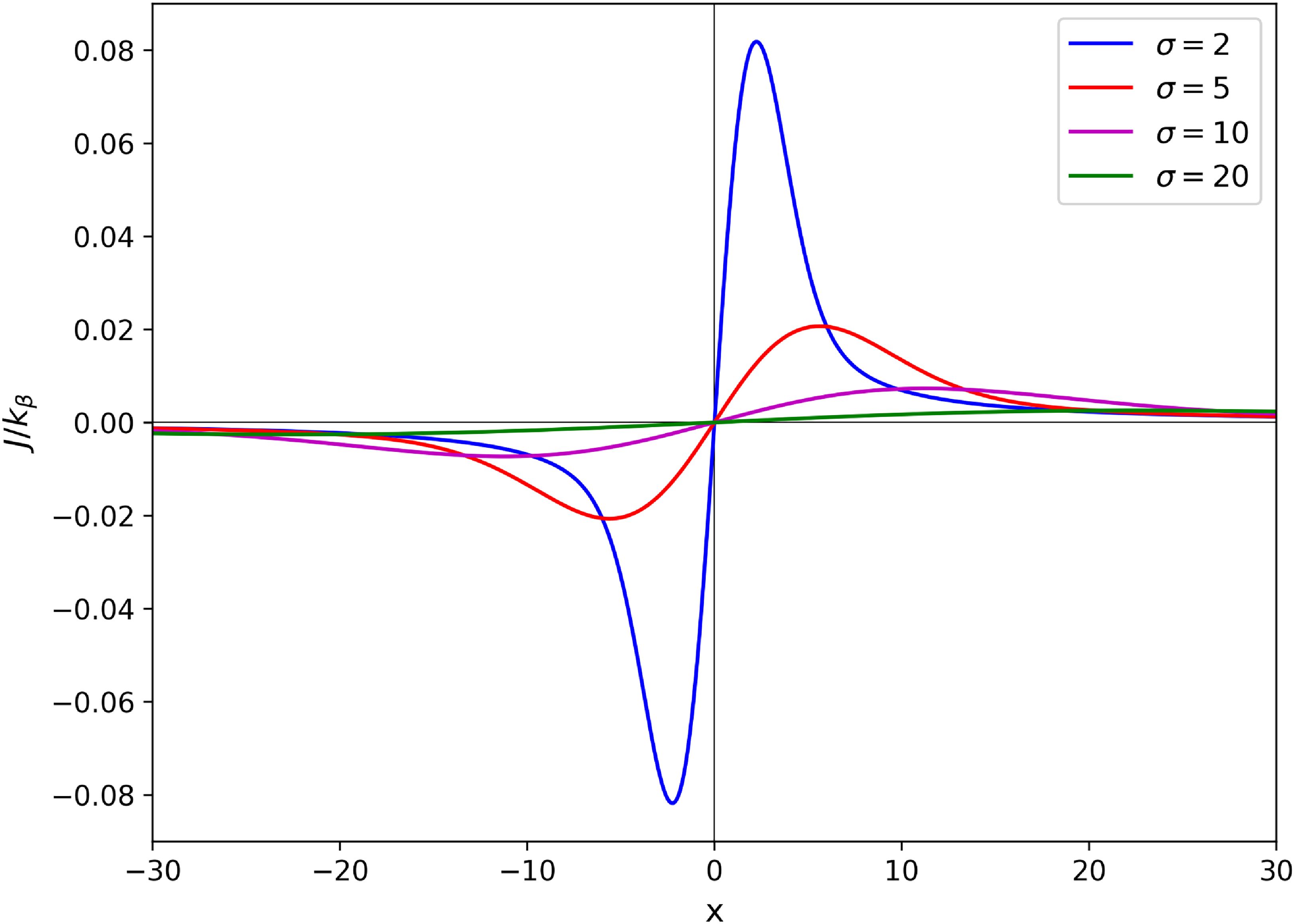
Figure 1 shows the results of the numerical calculation of $ J(x)/\kappa _\beta$
for various values of the parameter
$ J(x)/\kappa _\beta$
for various values of the parameter $\beta$
, which is related to the degree of non-locality, as explained before. We can notice that, as
$\beta$
, which is related to the degree of non-locality, as explained before. We can notice that, as $ \beta$
decreases, the tails of the current profile become higher, with slower decays (namely the non-locality is increasing and the process becomes increasingly more superdiffusive). For
$ \beta$
decreases, the tails of the current profile become higher, with slower decays (namely the non-locality is increasing and the process becomes increasingly more superdiffusive). For $|x|\gg 1$
, the tails follow a power law whose slope depends on
$|x|\gg 1$
, the tails follow a power law whose slope depends on $ \beta$
,
$ \beta$
, $J\propto |x|^{-(1+\beta )}$
, as clearly shown in the log–log scale inset in figure 1. Such a feature, noted by Zanette (Reference Zanette1998), is in agreement with the fact that diminishing
$J\propto |x|^{-(1+\beta )}$
, as clearly shown in the log–log scale inset in figure 1. Such a feature, noted by Zanette (Reference Zanette1998), is in agreement with the fact that diminishing $\beta$
is equivalent to increasing the value of the weight
$\beta$
is equivalent to increasing the value of the weight $ \displaystyle {\xi ^{-(1+\beta )}}$
inside (3.1) for large
$ \displaystyle {\xi ^{-(1+\beta )}}$
inside (3.1) for large $\xi$
. Figure 1 shows that as
$\xi$
. Figure 1 shows that as $ \beta$
approaches 1, the flux
$ \beta$
approaches 1, the flux $J(x)$
tends to the first derivative of
$J(x)$
tends to the first derivative of $ n(x)$
(apart from the sign), which means that the numerical method we are using is correct and consistent. Moreover, the inset shows the very fast decay of the first derivative of
$ n(x)$
(apart from the sign), which means that the numerical method we are using is correct and consistent. Moreover, the inset shows the very fast decay of the first derivative of $n(x)$
(dashed curve in figure 1) in contrast to the fractional flux, which decays slowly as a power law. The numerical calculation is also carried out assuming the normalised Gaussian profile
$n(x)$
(dashed curve in figure 1) in contrast to the fractional flux, which decays slowly as a power law. The numerical calculation is also carried out assuming the normalised Gaussian profile $ \displaystyle n(x) = ({1}/{\sqrt {2\pi } \sigma }) \exp { (-({x^{2}}/{2 \sigma ^{2}} ))}$
to evaluate the influence of the length parameter
$ \displaystyle n(x) = ({1}/{\sqrt {2\pi } \sigma }) \exp { (-({x^{2}}/{2 \sigma ^{2}} ))}$
to evaluate the influence of the length parameter $ \sigma$
on the values of
$ \sigma$
on the values of $J(x)$
for a fixed
$J(x)$
for a fixed $ \beta =0.5$
. The results are presented in figure 2, which shows that a larger
$ \beta =0.5$
. The results are presented in figure 2, which shows that a larger $\sigma$
results in a smaller peak value of
$\sigma$
results in a smaller peak value of $|J|$
and a broader range of
$|J|$
and a broader range of $|x|$
, where
$|x|$
, where $J$
is appreciably different from zero, as expected for the first derivative of a Gaussian function.
$J$
is appreciably different from zero, as expected for the first derivative of a Gaussian function.
4. Uphill transport of energetic particles at collisionless shock waves
As an application, now we compute the flux associated with the density profile of energetic particles around a collisionless shock wave, which is a powerful accelerator of particles (e.g. Bell Reference Bell1978; Drury Reference Drury1983; Giacalone Reference Giacalone2012). Investigating the flux of energetic particles around a shock wave is relevant because the most popular theory of cosmic ray acceleration at shocks, based on a diffusive–advection equation and called diffusive shock acceleration (DSA), foresees a density profile, for energetic particles, which is an exponential growth in the region upstream of the shock and a constant, flat profile in the region downstream of the shock (Giacalone Reference Giacalone2012). However, this is at variance with what is observed around shocks in interplanetary space and, in some cases, around shocks of supernova remnants (e.g. Perri & Zimbardo Reference Perri and Zimbardo2007, Reference Perri and Zimbardo2009; Perri, Amato & Zimbardo Reference Perri, Amato and Zimbardo2016). In practice, a long power-law-like density profile is observed upstream and a decreasing, non-flat density profile downstream (Perri & Zimbardo Reference Perri and Zimbardo2012; Perrone et al. Reference Perrone2013). This creates a tension with the solutions of the standard Fick’s law (Drury Reference Drury1983; Effenberger et al. Reference Effenberger2025).
If we assume a fractional diffusion process based on (2.24), the non-local flux $J(x)$
is an integral operator depending on the global properties of the density profile
$J(x)$
is an integral operator depending on the global properties of the density profile $n(x)$
, which can give rise to uphill transport (e.g. del Castillo-Negrete Reference del Castillo-Negrete2006). In this case, we can also get a negative fractional diffusive flux in the presence of a negative density gradient.
$n(x)$
, which can give rise to uphill transport (e.g. del Castillo-Negrete Reference del Castillo-Negrete2006). In this case, we can also get a negative fractional diffusive flux in the presence of a negative density gradient.
Let us assume to be in the shock frame, with the shock at $x=0$
and the plasma velocity
$x=0$
and the plasma velocity $V_{\mathrm{bulk}}$
going in the positive
$V_{\mathrm{bulk}}$
going in the positive $x$
direction, so the upstream side is found for
$x$
direction, so the upstream side is found for $x\lt 0$
and the downstream side for
$x\lt 0$
and the downstream side for $x\gt 0$
. The source of energetic particles is at the shock, and, in addition to performing a random walk, particles are convected downstream by the plasma flow. The density profile of energetic particles is obtained from test particle numerical simulations (Prete et al. Reference Prete, Perri and Zimbardo2019, Reference Prete, Perri and Zimbardo2021). In this simulation, particles are injected at
$x\gt 0$
. The source of energetic particles is at the shock, and, in addition to performing a random walk, particles are convected downstream by the plasma flow. The density profile of energetic particles is obtained from test particle numerical simulations (Prete et al. Reference Prete, Perri and Zimbardo2019, Reference Prete, Perri and Zimbardo2021). In this simulation, particles are injected at $x=0$
and make a one-dimensional motion according to
$x=0$
and make a one-dimensional motion according to
 \begin{equation} \text{d}x = V_{\mathrm{bulk}} \text{d}t + v_{\mathrm{ran}} \,\text{d}t. \end{equation}
Here, $V_{\mathrm{bulk}}=V_1$
upstream and
$V_{\mathrm{bulk}}=V_1$
upstream and $V_2$
downstream, with
$V_2$
downstream, with $V_1=600$
km s
$V_1=600$
km s $^{-1}$
and
$^{-1}$
and $V_2=200$
km s
$V_2=200$
km s $^{-1}$
. The random velocity
$^{-1}$
. The random velocity $v_{\mathrm{ran}}$
can be modelled to reproduce both normal diffusion and superdiffusion, by a suitable choice of the scattering times
$v_{\mathrm{ran}}$
can be modelled to reproduce both normal diffusion and superdiffusion, by a suitable choice of the scattering times $\tau$
; in particular, for superdiffusion,
$\tau$
; in particular, for superdiffusion, $\tau$
is distributed according to a power-law,
$\tau$
is distributed according to a power-law, $\psi (\tau )\sim \tau ^{-(1+\mu )}$
(the reader is referred to Prete, Perri & Zimbardo (Reference Prete, Perri and Zimbardo2019, Reference Prete, Perri and Zimbardo2021) for a full description of the code. See also Effenberger et al. (Reference Effenberger, Aerdker, Merten and Fichtner2024)). We recall that the superdiffusion exponent of the mean square displacement
$\psi (\tau )\sim \tau ^{-(1+\mu )}$
(the reader is referred to Prete, Perri & Zimbardo (Reference Prete, Perri and Zimbardo2019, Reference Prete, Perri and Zimbardo2021) for a full description of the code. See also Effenberger et al. (Reference Effenberger, Aerdker, Merten and Fichtner2024)). We recall that the superdiffusion exponent of the mean square displacement $\alpha$
is related to
$\alpha$
is related to $\mu$
and
$\mu$
and $\beta$
by
$\beta$
by $\alpha =3-\mu =2-\beta$
(Perri & Zimbardo Reference Perri and Zimbardo2015). Typically,
$\alpha =3-\mu =2-\beta$
(Perri & Zimbardo Reference Perri and Zimbardo2015). Typically, $10^6$
particles are injected and their motion is integrated within a very large box that allows us to reach a steady-state density shape, namely the simulation is only marginally affected by the presence of lost particles. After some trials, the simulation box size has been fixed to
$10^6$
particles are injected and their motion is integrated within a very large box that allows us to reach a steady-state density shape, namely the simulation is only marginally affected by the presence of lost particles. After some trials, the simulation box size has been fixed to $\pm 5\times 10^9$
m (almost one-tenth of an astronomical unit), while the vertical axis is in arbitrary units.
$\pm 5\times 10^9$
m (almost one-tenth of an astronomical unit), while the vertical axis is in arbitrary units.
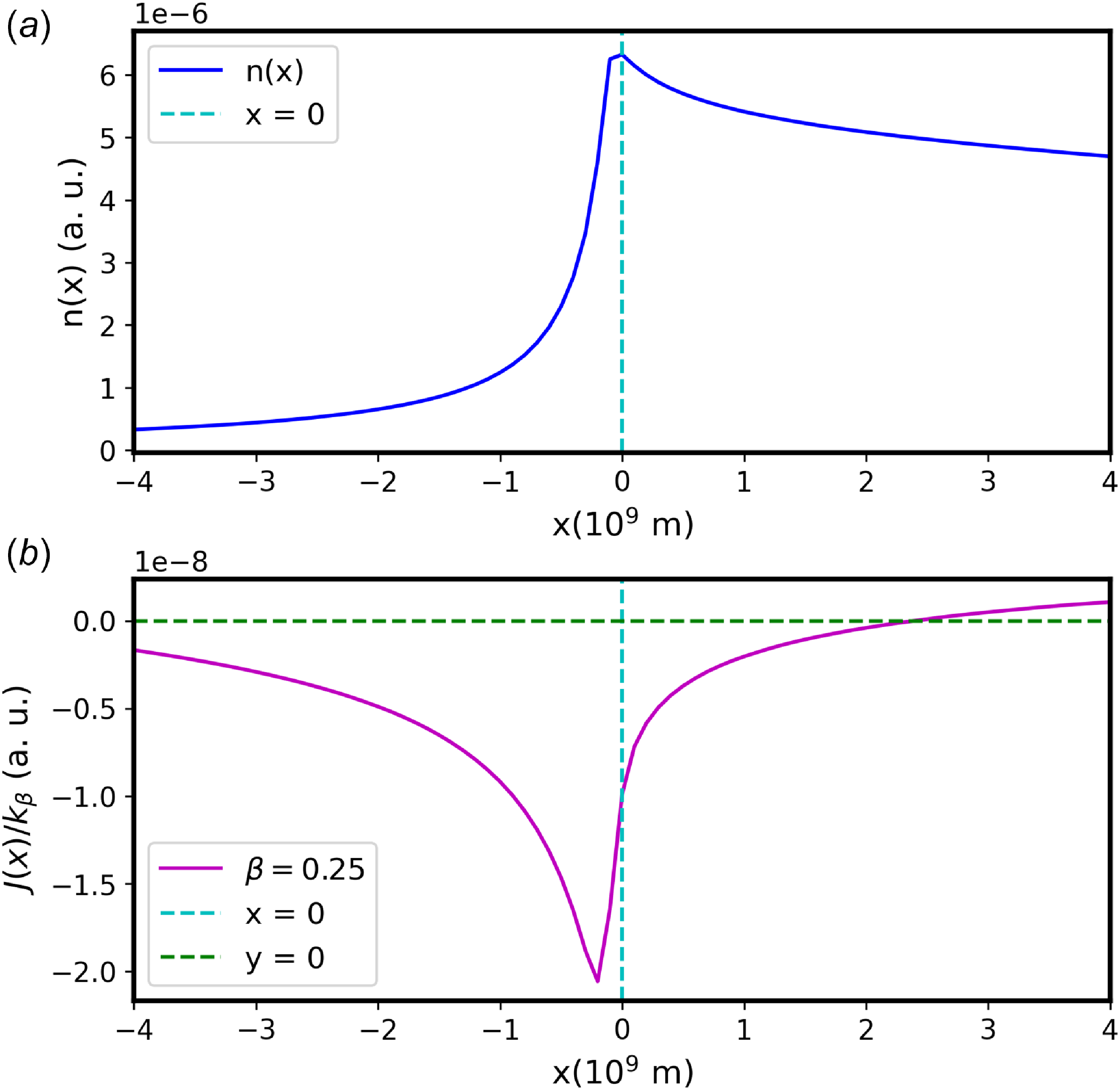
(a) Density profile $n(x)$
of energetic particles accelerated at a shock in
$n(x)$
of energetic particles accelerated at a shock in $x=0$
, with the upstream region on the left and the downstream region on the right, in the case of normal diffusion. (b) Corresponding fractional flux obtained for
$x=0$
, with the upstream region on the left and the downstream region on the right, in the case of normal diffusion. (b) Corresponding fractional flux obtained for $\beta =0.25$
. It can be seen that the flux is negative both upstream and downstream. If we used the local Fick’s law, the downstream flux would be zero.
$\beta =0.25$
. It can be seen that the flux is negative both upstream and downstream. If we used the local Fick’s law, the downstream flux would be zero.

4.1. Normal diffusion
The energetic particle density as a function of the distance from the shock $x$
, computed by a simulation that mimics the normal transport of energetic particles, is shown in figure 3(a). Indeed, the upstream density profile corresponds to an exponential decrease, which quickly goes to zero in linear axes, while the downstream density is constant, in agreement with the DSA theory. The diffusive flux
$x$
, computed by a simulation that mimics the normal transport of energetic particles, is shown in figure 3(a). Indeed, the upstream density profile corresponds to an exponential decrease, which quickly goes to zero in linear axes, while the downstream density is constant, in agreement with the DSA theory. The diffusive flux $J(x)$
is numerically calculated according to (2.24), that is, taking into account non-local transport, and the results are shown in figure 3(b). Notice that the flux in the upstream region is negative, that is, towards the left, which is consistent with the fact that the density is increasing to the right. Surprisingly, the flux in the downstream region is not zero, as would be found from standard Fick’s law in the case of a flat profile; rather, the flux is negative. This can be understood if we consider the integrand in (2.24) for
$J(x)$
is numerically calculated according to (2.24), that is, taking into account non-local transport, and the results are shown in figure 3(b). Notice that the flux in the upstream region is negative, that is, towards the left, which is consistent with the fact that the density is increasing to the right. Surprisingly, the flux in the downstream region is not zero, as would be found from standard Fick’s law in the case of a flat profile; rather, the flux is negative. This can be understood if we consider the integrand in (2.24) for $x\gt 0$
(downstream): the contribution from
$x\gt 0$
(downstream): the contribution from $n(x-\xi )$
includes also the upstream region because of non-locality; however, its own contribution is very small, so that
$n(x-\xi )$
includes also the upstream region because of non-locality; however, its own contribution is very small, so that $n(x+\xi )$
prevails and an overall negative flux is obtained.
$n(x+\xi )$
prevails and an overall negative flux is obtained.
4.2. Superdiffusion
The density as a function of the distance from the shock $x$
is shown in figure 4(a) for the case of superdiffusion with an exponent
$x$
is shown in figure 4(a) for the case of superdiffusion with an exponent $\alpha =1.75$
, which corresponds to
$\alpha =1.75$
, which corresponds to $\beta =0.25$
. The upstream density profile corresponds to a power-law decrease, that is, the upstream density is larger than in the case of normal diffusion, while the downstream density is decreasing. Both these features are in agreement with the studies of superdiffusion of shock-accelerated particles by Perri & Zimbardo (Reference Perri and Zimbardo2007, Reference Perri and Zimbardo2008, Reference Perri and Zimbardo2012); Zimbardo & Perri (Reference Zimbardo and Perri2013), Litvinenko & Effenberger (Reference Litvinenko and Effenberger2014), Aerdker et al. (Reference Aerdker, Merten, Effenberger, Fichtner and Tjus2025). Figure 4(b) shows the corresponding non-local flux: the upstream values are negative but smaller (in absolute value) than those found in the case of normal diffusion, see figure 3. This can be interpreted as the result of the larger upstream densities due to superdiffusion, so that the upstream gradients are smaller. In contrast, in the downstream region, the flux is negative (i.e. towards the left) up to approximately
$\beta =0.25$
. The upstream density profile corresponds to a power-law decrease, that is, the upstream density is larger than in the case of normal diffusion, while the downstream density is decreasing. Both these features are in agreement with the studies of superdiffusion of shock-accelerated particles by Perri & Zimbardo (Reference Perri and Zimbardo2007, Reference Perri and Zimbardo2008, Reference Perri and Zimbardo2012); Zimbardo & Perri (Reference Zimbardo and Perri2013), Litvinenko & Effenberger (Reference Litvinenko and Effenberger2014), Aerdker et al. (Reference Aerdker, Merten, Effenberger, Fichtner and Tjus2025). Figure 4(b) shows the corresponding non-local flux: the upstream values are negative but smaller (in absolute value) than those found in the case of normal diffusion, see figure 3. This can be interpreted as the result of the larger upstream densities due to superdiffusion, so that the upstream gradients are smaller. In contrast, in the downstream region, the flux is negative (i.e. towards the left) up to approximately $2.8 \times 10^9$
m, that is, in a region where the density is decreasing, as shown in panel (a). This gives evidence of uphill transport in the downstream region, and can be understood considering again the integrand in (2.24): when
$2.8 \times 10^9$
m, that is, in a region where the density is decreasing, as shown in panel (a). This gives evidence of uphill transport in the downstream region, and can be understood considering again the integrand in (2.24): when $x$
corresponds to downstream and
$x$
corresponds to downstream and $n(x-\xi )$
is to be evaluated in the upstream region, its contribution is smaller than that of
$n(x-\xi )$
is to be evaluated in the upstream region, its contribution is smaller than that of $n(x+\xi )$
, so a negative contribution to the flux is obtained. Interestingly, for
$n(x+\xi )$
, so a negative contribution to the flux is obtained. Interestingly, for $x$
larger than approximately
$x$
larger than approximately $2.8 \times 10^9$
m, the flux becomes positive, that is, downhill: being far downstream, the effects of the upstream region become of secondary importance and the decreasing density in the downstream region prevails. From the microscopic point of view, i.e. particle motion, we consider that uphill transport is due to the fact that, starting from downstream, particles performing a Lévy walk can make long displacements also in the direction upstream, that is, can move upwind more easily than particles performing a normal random walk.
$2.8 \times 10^9$
m, the flux becomes positive, that is, downhill: being far downstream, the effects of the upstream region become of secondary importance and the decreasing density in the downstream region prevails. From the microscopic point of view, i.e. particle motion, we consider that uphill transport is due to the fact that, starting from downstream, particles performing a Lévy walk can make long displacements also in the direction upstream, that is, can move upwind more easily than particles performing a normal random walk.
(a) Density profile $n(x)$
of energetic particles accelerated at a shock in
$n(x)$
of energetic particles accelerated at a shock in $x=0$
, with the upstream region on the left and the downstream region on the right, in the case of superdiffusion. (b) Corresponding fractional flux obtained for
$x=0$
, with the upstream region on the left and the downstream region on the right, in the case of superdiffusion. (b) Corresponding fractional flux obtained for $\beta =0.25$
. It can be seen that the flux is negative both upstream and downstream, so that uphill transport is obtained in the downstream region.
$\beta =0.25$
. It can be seen that the flux is negative both upstream and downstream, so that uphill transport is obtained in the downstream region.
The finding of an uphill transport in the downstream region, in connection with a decreasing density profile $n(x)$
, is consistent with the continuity equation (2.1) under steady-state conditions when the advection flux
$n(x)$
, is consistent with the continuity equation (2.1) under steady-state conditions when the advection flux $nV_{\mathrm{bulk}}$
is also considered,
$nV_{\mathrm{bulk}}$
is also considered,
 \begin{equation} \frac {\partial }{\partial x} (J + n V_{\mathrm{bulk}}) = 0 \, . \end{equation}
For the total flux to be constant, an increasing flux $J$
(that is negative for uphill transport), similar to that in figure 4, is needed when
$J$
(that is negative for uphill transport), similar to that in figure 4, is needed when $n(x)$
is decreasing. However, the ordinary Fick’s law is not consistent with the downstream increasing diffusive flux, in the presence of a decreasing number density. In other words, the case of a constant downstream density profile is not consistent with the continuity (4.2) and non-local flux: a constant density profile would require a constant flux
$n(x)$
is decreasing. However, the ordinary Fick’s law is not consistent with the downstream increasing diffusive flux, in the presence of a decreasing number density. In other words, the case of a constant downstream density profile is not consistent with the continuity (4.2) and non-local flux: a constant density profile would require a constant flux $J$
downstream, but this is not found in the case of non-local flux, as shown in figure 3. Therefore, spacecraft observations around a shock wave of a decreasing downstream density profile of energetic particles, as shown in figure 4, are an indication of non-local transport, that is, of particle superdiffusion.
$J$
downstream, but this is not found in the case of non-local flux, as shown in figure 3. Therefore, spacecraft observations around a shock wave of a decreasing downstream density profile of energetic particles, as shown in figure 4, are an indication of non-local transport, that is, of particle superdiffusion.
These results show that uphill transport can be obtained in a simple and natural way in a collisionless plasma, and are useful for understanding energetic particle transport and acceleration at astrophysical shocks.
5. Summary and discussion
In this paper, we have given a simple derivation of the non-local diffusive flux, which leads to the so-called fractional Fick’s law. The basic assumption is that the contribution to the diffusive flux of the particle densities at $x\pm \xi$
is weighted by a power law as
$x\pm \xi$
is weighted by a power law as $(\xi /\xi _0)^{-(1+\beta )}$
. The requirement that the integral flux be non-diverging, neither for
$(\xi /\xi _0)^{-(1+\beta )}$
. The requirement that the integral flux be non-diverging, neither for $\xi \to 0$
nor for
$\xi \to 0$
nor for $\xi \to \infty$
, leads to limit the exponent within
$\xi \to \infty$
, leads to limit the exponent within $0\lt \beta \lt 1$
. We have shown that when this expression of flux is inserted into the continuity equation, a transport equation with a spatial fractional derivative of order
$0\lt \beta \lt 1$
. We have shown that when this expression of flux is inserted into the continuity equation, a transport equation with a spatial fractional derivative of order $1+\beta$
in Riesz form is obtained. We think that this derivation fills a gap in the way fractional transport equations are usually introduced. We have also derived an expression for the fractional diffusion coefficient, linking it to the previously obtained anomalous diffusion coefficient.
$1+\beta$
in Riesz form is obtained. We think that this derivation fills a gap in the way fractional transport equations are usually introduced. We have also derived an expression for the fractional diffusion coefficient, linking it to the previously obtained anomalous diffusion coefficient.
After testing the expression of the fractional flux with a Gaussian density profile, we have obtained the fractional flux associated with energetic particles accelerated at a collisionless shock wave. In the case of a decreasing downstream density profile, which corresponds to superdiffusion, uphill transport is obtained. The use of a non-local expression for the flux clarifies that such an uphill transport is due to the low densities upstream of the shock. It is interesting to compare this result with the uphill transport found in laboratory plasmas: there, the density profile is monotonously decreasing, so that the origin of uphill transport is more involved, and likely related to plasma instabilities and profile consistency (Coppi & Sharky Reference Coppi and Sharky1981; Stroth et al. Reference Stroth, Geist, Koponen, Hartfuß and Zeiler1999; van Milligen et al. Reference van Milligen, Carreras and Sánchez2004, Reference van Milligen, Carreras, García, Martín de Aguilera, Hidalgo and Nicolau2016; Müller et al. Reference Müller, Manz and Ramisch2023).
However, for shock waves, understanding the properties of downstream density of energetic particles is crucial for determining the cosmic ray energy spectral index $\gamma$
, which depends on the ratio
$\gamma$
, which depends on the ratio $n_{2}/n_{0}$
as (e.g. Drury Reference Drury1983; Kirk, Duffy & Gallant Reference Kirk, Duffy and Gallant1996; Perri & Zimbardo Reference Perri and Zimbardo2012; Zimbardo & Perri Reference Zimbardo and Perri2013; Aerdker et al. Reference Aerdker, Merten, Effenberger, Fichtner and Tjus2025)
$n_{2}/n_{0}$
as (e.g. Drury Reference Drury1983; Kirk, Duffy & Gallant Reference Kirk, Duffy and Gallant1996; Perri & Zimbardo Reference Perri and Zimbardo2012; Zimbardo & Perri Reference Zimbardo and Perri2013; Aerdker et al. Reference Aerdker, Merten, Effenberger, Fichtner and Tjus2025)
 \begin{equation} \gamma = 3 \left [ 1+\frac {n_{2}}{n_{0}(r-1)} \right ], \end{equation}
where $n_{2}$
represents the cosmic ray density far downstream and
$n_{2}$
represents the cosmic ray density far downstream and $n_{0}$
represents the cosmic ray density at the shock, and
$n_{0}$
represents the cosmic ray density at the shock, and $r$
is the shock compression ratio. In other words, a decreasing density profile downstream would change the energy spectral index with respect to the one obtained by DSA. In particular, uphill transport allows one to have a larger energetic particle density
$r$
is the shock compression ratio. In other words, a decreasing density profile downstream would change the energy spectral index with respect to the one obtained by DSA. In particular, uphill transport allows one to have a larger energetic particle density $n_0$
at the shock, as can be verified by comparing the densities at (
$n_0$
at the shock, as can be verified by comparing the densities at ( $x=0$
) in figures 3 and 4 (see also Prete et al. Reference Prete, Perri and Zimbardo2021). This leads to harder spectral indices and potentially to faster energetic particle acceleration, since particles are more confined in the acceleration region. It is worth noting that the cosmic ray spectral index is one of the most important observables for cosmic rays and heliospheric energetic particles, measured by detectors both in space and on the ground.
$x=0$
) in figures 3 and 4 (see also Prete et al. Reference Prete, Perri and Zimbardo2021). This leads to harder spectral indices and potentially to faster energetic particle acceleration, since particles are more confined in the acceleration region. It is worth noting that the cosmic ray spectral index is one of the most important observables for cosmic rays and heliospheric energetic particles, measured by detectors both in space and on the ground.
We notice that the examples we considered in §§ 3 and 4 assume time-independent density profiles, so that the possible time dependence included in (2.24) is not relevant. However, we can consider more general cases where the density profile is time-dependent, or even different plasma problems like hot electron transport in coronal flares and in toroidal laboratory plasmas (Petty & Luce Reference Petty and Luce1994; Bovet et al. Reference Bovet, Fasoli and Furno2014, Reference Bovet, Fasoli, Ricci, Furno and Gustafson2015), where time dependence is an intrinsic property. In such cases, a more general expression, including an integration over time as in (1.2), should be used. We can exploit the time integration over $\mathrm{d}t'$
by setting
$\mathrm{d}t'$
by setting $t'= t-\tau$
and introducing a space–time coupling for particle displacements, as is typical of Lévy walks. The space–time coupling of Lévy walks refers to the single random walker free paths; if we extend such coupling to the spatial coordinates and travel times, we have that displacement distance and the travel time are related by
$t'= t-\tau$
and introducing a space–time coupling for particle displacements, as is typical of Lévy walks. The space–time coupling of Lévy walks refers to the single random walker free paths; if we extend such coupling to the spatial coordinates and travel times, we have that displacement distance and the travel time are related by $\delta (\xi -v\tau )$
. The result is the following fractional Fick’s law:
$\delta (\xi -v\tau )$
. The result is the following fractional Fick’s law:
 \begin{align} J(x,t) & = - \kappa _{\beta } \ \frac {\varGamma (1+\beta )}{\pi }\sin \left [ \frac {\pi }{2}(1+\beta ) \right ]\nonumber \\[5pt]&\quad \times \int _{0}^{\infty } \frac {n(x+\xi ,t-\xi /v)-n(x-\xi ,t-\xi /v)}{\xi ^{1+\beta }}\,\text{d}\xi. \ \end{align}
In practice, the flux is to be obtained in a way similar to that of retarded potentials in electromagnetism. In a future work, we will investigate the implications of (5.2) for the transport equation.
Acknowledgments
It is a pleasure to thank H. Fichtner, F. Effenberger, S. Aerdker, D. Walter, L. Merten and J. Lübke for stimulating discussions and for hospitality in Bochum. The authors acknowledge support by the Italian PRIN 2022, (G.Z., G.P. and S.P., grant number 2022294WNB, CUP H53D23000900006) project entitled ‘Heliospheric shocks and space weather: from multispacecraft observations to numerical modeling’. Finanziato da Next Generation EU, fondo del Piano Nazionale di Ripresa e Resilienza (PNRR) Missione 4 ‘Istruzione e Ricerca’ – Componente C2 Investimento 1.1, ‘Fondo per il Programma Nazionale di Ricerca e Progetti di Rilevante Interesse Nazionale (PRIN); the project ‘Data-based predictions of solar energetic particle arrival to the Earth: ensuring space data and technology integrity from hazardous solar activity events’ (G.Z. and S.P., CUP H53D23011020001), Finanziato dall’Unione europea – Next Generation EU’ PIANO NAZIONALE DI RIPRESA E RESILIENZA (PNRR) Missione 4 ‘Istruzione e Ricerca’ – Componente C2 Investimento 1.1, Fondo per il Programma Nazionale di Ricerca e Progetti di Rilevante Interesse Nazionale (PRIN), Settore PE09. This work was further supported by the Space It Up project by the Italian Space Agency, ASI, and the Ministry of University and Research, MUR, (S.P., G.P. and G.Z. under contract n. 2024-5-E.0 - CUP n. I53D24000060005).
Editor Antoine C. Bret thanks the referees for their advice in evaluating this article.
Declaration of interests
The authors report no conflict of interest.



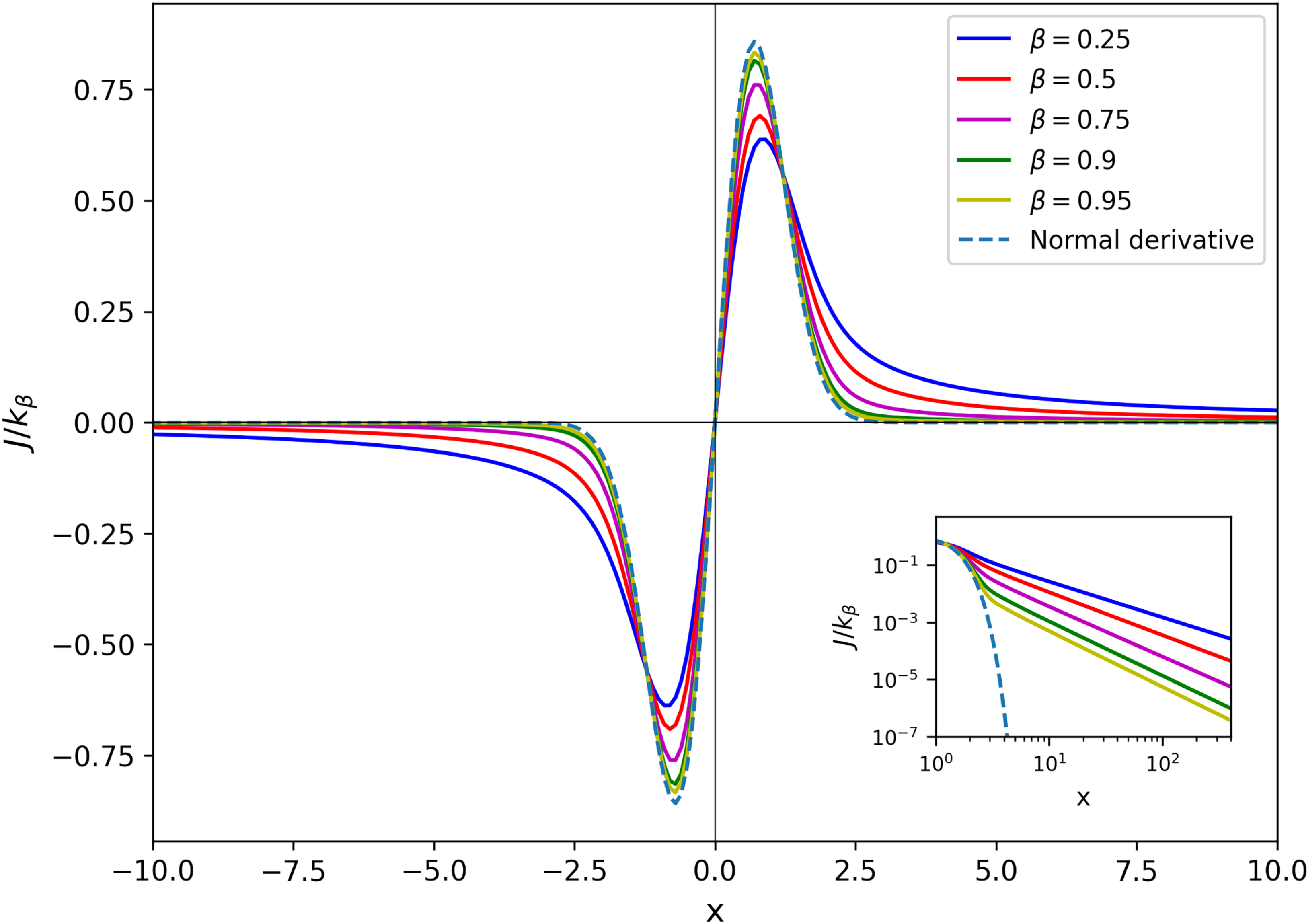


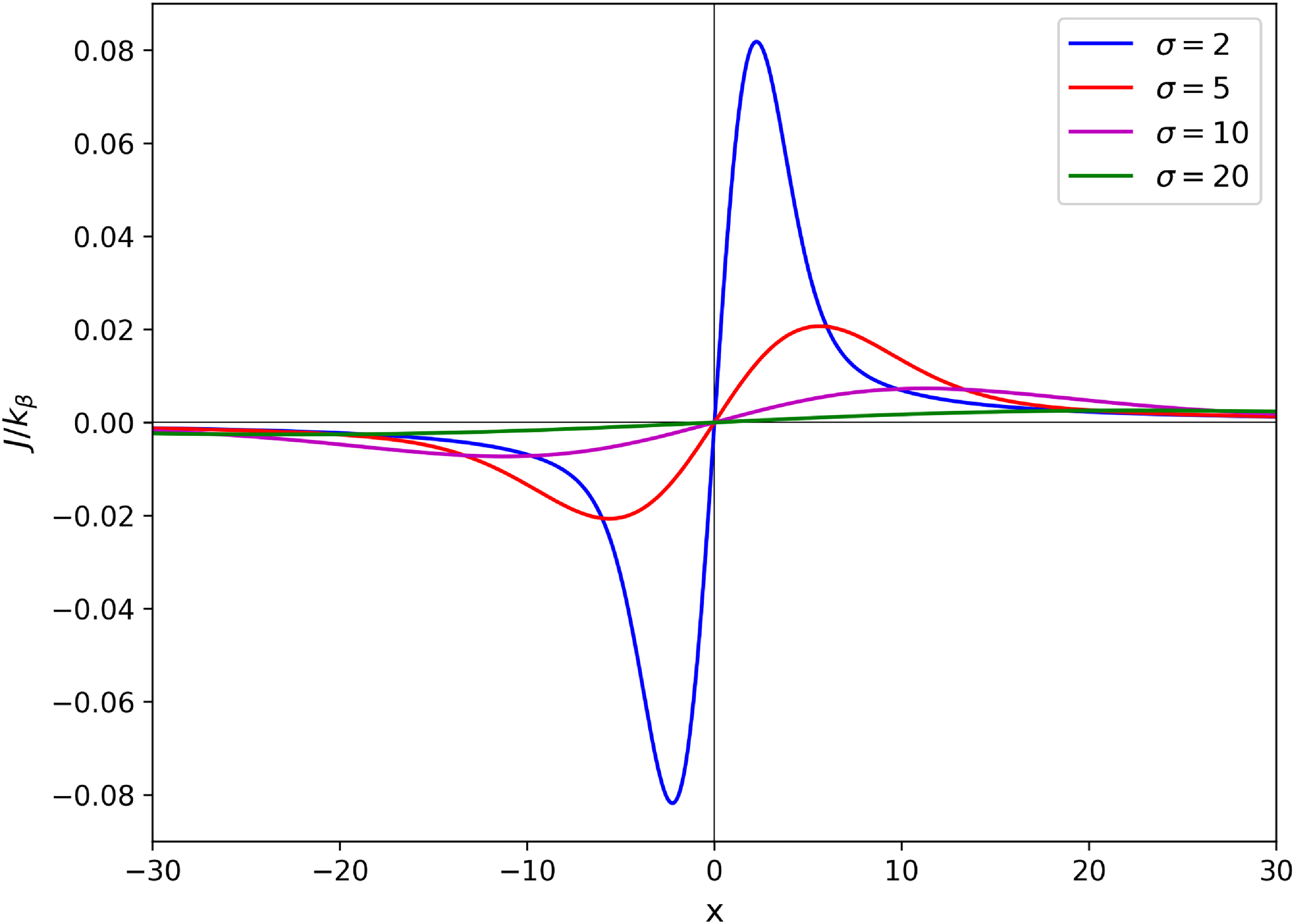


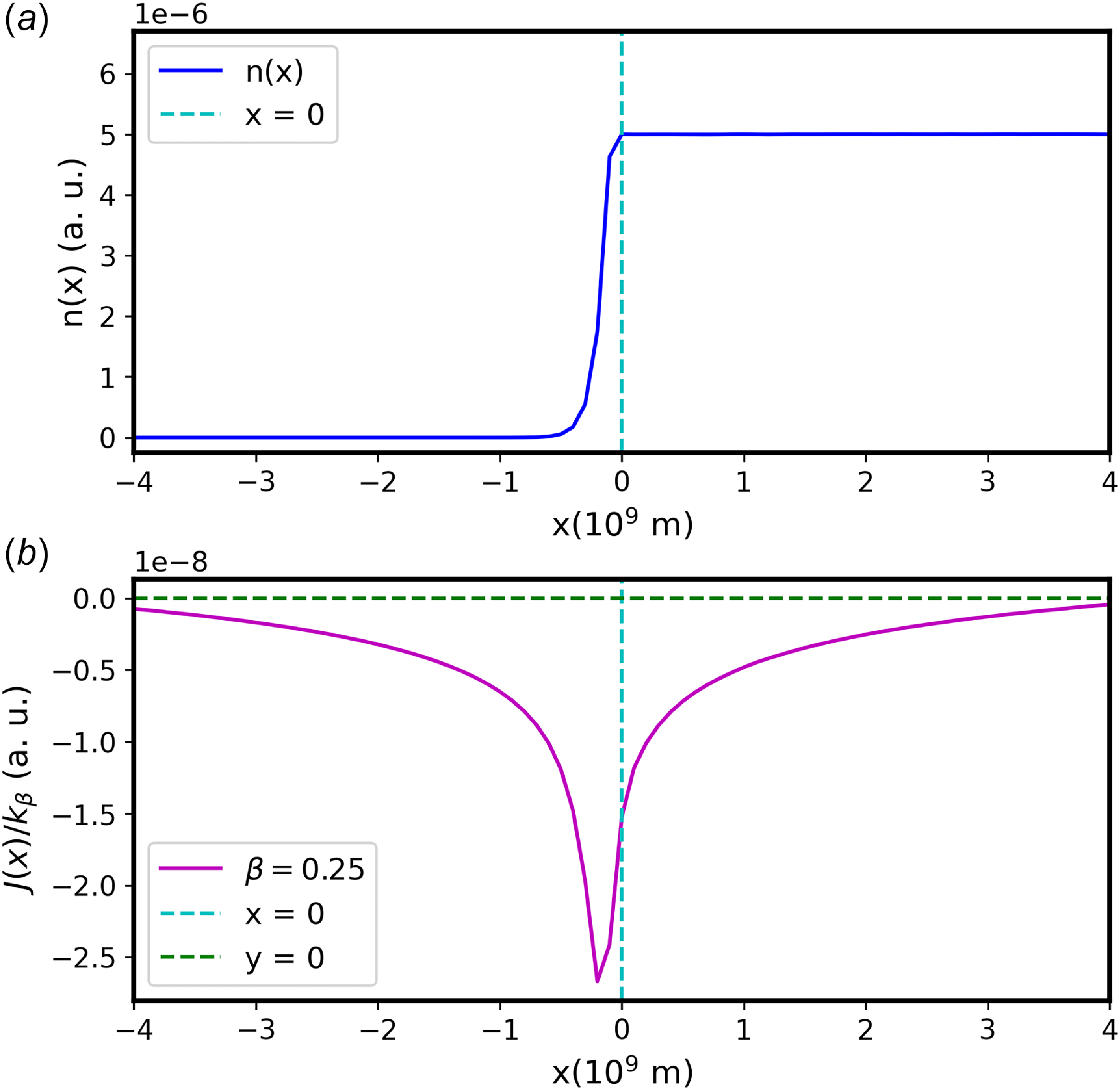


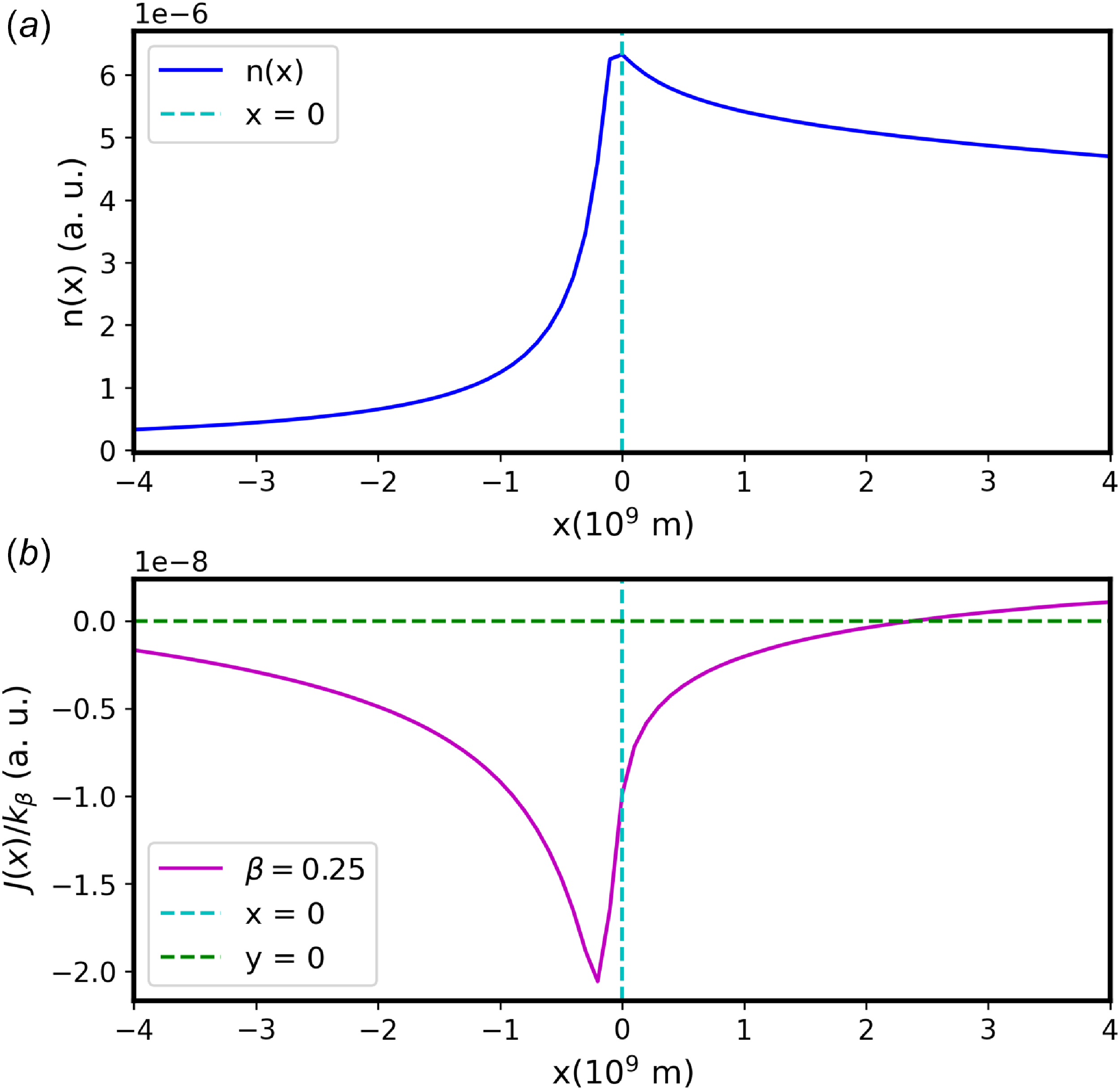


 Open access

