

In the 1930s, the hot jazz vocal trio the Boswell Sisters—Martha (1905–58), Connie (1907–76), and Helvetia, or “Vet” (1911–88)—enjoyed enormous popularity and critical acclaim in America and Europe during five years of intense performing, recording, and broadcast activity. As musicians, arrangers, and singers they commanded great respect from their peers, collaborating with many who were stars in their own right—the Dorsey brothers, Bing Crosby, Red Nichols, the Mills Brothers—as well as those who would go on to build their careers in the following decade, such as Glenn Miller, Benny Goodman, and Artie Shaw. By the time they disbanded in 1936, at the height of their popularity, they had inspired many avowed imitators, including the Andrews Sisters and Ella Fitzgerald.1
Fitzgerald said, “My mother brought home one of her [Connie Boswell's] records, and I fell in love with it. I tried so hard to sound just like her.” See Stuart Nicholson, Ella Fitzgerald (London: Indigo, 1996), 10–12. In a significant act of homage, Fitzgerald quoted Connie's biggest hit, “Martha,” at the opening of her own influential 1945 recording of “Flying Home.”
Most detailed consideration of the Boswell Sisters, and Connie alone, occurs in the context of histories of jazz and popular singing. See Will Friedwald, Jazz Singing: America's Great Voices from Bessie Smith to Bebop and Beyond, 3rd edn. (New York: Da Capo Press, 1996); John Potter, “Jazz Singing: The First Hundred Years,” in The Cambridge Companion to Singing, ed. John Potter (Cambridge: Cambridge University Press, 2000); Bruce Crowther and Mike Pinfold, Jazz: The Singers and Their Styles (London: Blandford, 1997). There is half of a chapter on the Boswells in Richard M. Sudhalter, Lost Chords: White Musicians and Their Contribution to Jazz, 1915–1945 (New York: Oxford University Press, 1999), 369–75. See also Jan Shapiro, “Filling in the Gaps in the History of Vocal Jazz: Connee Boswell and the Boswell Sisters,” Jazz Research Proceedings Yearbook 10 (1990): 106–25, and Jane Hassinger, “Close Harmony: Early Jazz Styles in the Music of the New Orleans Boswell Sisters,” in Women and Music in Cross-Cultural Perspective, ed. Ellen Koskoff (Westport, Conn.: Greenwood Press, 1987), 195–202. Connie Boswell changed the spelling of her name at the end of the 1930s to “Connee”; childhood polio had left her with residual weakness in her right hand and wrist, and she found dotting the “i” fatiguing when signing autographs. Throughout this essay, I use “Connie” as this is the spelling she used during the period I address.
Although their influence on those around them broached many aspects of arrangement and vocal styling, the most frequently acknowledged quality of the Boswells' singing, in both contemporary and retrospective criticism, is that they were the first white singers convincingly to “sound black.”3
For instance, Gunther Schuller, The Swing Era: The Development of Jazz, 1930–1945, vol. 2, The History of Jazz (New York: Oxford University Press, 1989), 624 n.; Frank Tirro, Jazz: A History, 2nd edn. (New York: W. W. Norton, 1993), 247.
Will Friedwald gives some indication of the technical characteristics of “white” and “black” singing in the United States during the1920s, but nonetheless he assumes his readers will already have an innate sense of what he means by the terminology; Friedwald, Jazz Singing, 1–22.
For a typical description, see Richard Middleton, “Rock Singing,” in The Cambridge Companion to Singing, ed. John Potter (Cambridge: Cambridge University Press, 2000), 30.
Clearly, the specter of essentialism looms large over any such discussion, although calls for critical examinations of the essentialist/anti-essentialist debate are beginning to appear both in race studies and in musicology; see, for instance, Ronald Radano and Philip V. Bohlman, “Introduction: Music and Race, Their Past, Their Presence,” in Music and the Racial Imagination, ed. Ronald Radano and Philip V. Bohlman (Chicago: University of Chicago Press, 2000), 44.
The idea that a pervasive and tenacious common sense regarding “color” of sound exists in the American imagination is supported by Ronald Radano, who suggests the “American populace [is] still convinced that the blackness and whiteness of sound is fundamentally, essentially, real.”7
Ronald Radano, Lying up a Nation: Race and Black Music (Chicago: University of Chicago Press, 2003), 12.
“In US society, then, a kind of ‘racial etiquette’ exists, a set of interpretative codes and racial meanings which operate in the interactions of daily life. … Everybody learns some combination, some version, of the rules of racial classification, and of their own racial identity, often without obvious teaching or conscious inculcation. Race becomes ‘common sense’—a way of comprehending, explaining and acting in the world.” Michael Omi and Howard Winant, Racial Formation in the United States: From the 1960s to the 1980s (New York: Routledge, 1986), 62.
Radano, Lying up a Nation, 26.
Ibid., xiii. Radano notes that Armstrong's 1928 recording of “Hear Me Talkin' to Ya” explicitly notes its hybridity of black and white practices, “the documenting and proposing of a new comprehension of blackness in whiteness, of whiteness in blackness, which characterizes this place, this time” (26).
Marsha Orgeron examines the role of fan magazines in the creation of stardom and the development of the star-fan relationship in “Making It in Hollywood: Clara Bow, Fandom, and Consumer Culture,” Cinema Journal 42/4 (2003): 76–81.
The Boswells' visual and musical racial ambiguity, and indeed their very existence as publicly creative women in jazz, had the potential to create anxiety for the press, the profession, and the public. This potential was nonetheless in time mitigated by their sustained performance of another social and cultural stereotype, the southern lady or belle, a social role that is transparently performative. Those that interact with her are acutely aware that, in the service of southern gentility and generosity, the belle will do whatever it takes to uphold decorum and morale, to keep her audience at ease, and to banish reminders of her considerable effort on their behalf, and of the even less palatable social and economic structures that give rise to her (American and white) way of life. The belle employs a specific construction of exaggerated femininity and decorum, one that allowed, and still allows, women to assume qualities that would otherwise be coded unfeminine—for instance, the capacity to manage large tracts of land and control huge numbers of human souls—but all in the service of upholding white patriarchy. The Boswells' ultrafeminine, singerly masquerade disguised their involvement in the arrangement, musical direction, and instrumental accompaniment of their performances—activities that were almost exclusively male preserves. Furthermore, as Tara McPherson states, “Although putting on southern femininity, that is, playing the belle or lady, may indeed function as a survival strategy (and one that has certainly enabled access to the public sphere for many white women), this survival often renders invisible other powerful social relations, particularly vis-à-vis race.”12
Tara McPherson, Reconstructing Dixie: Race, Gender, and Nostalgia in the Imagined South (Durham, N.C.: Duke University Press, 2003), 23.
McPherson sees such representations of the South as built upon “lenticular logic”: “The lenticular often serves to secure our understandings of race in precise ways, fixating on sameness or difference without allowing productive overlap or connection, forestalling doubled vision and precluding alliance” (ibid., 27).
Confronting the representation of the southern lady in the Boswells' work reveals the way the binary construction of northernness (as Self) and southernness (as Other) complicates the evaluation of race and gender in the music of southerners.14
David Ake has rightly pointed out the subtle, and not so subtle, ways the North/South binarism has figured in constructing the blues/bop divide in jazz historiography; see his Jazz Cultures (Berkeley: University of California Press, 2002), 46–51.
Listening in Black and White: Race and Voice in the 1920s
Despite the perceived innovation presented by the blackness of their vocal style, the Boswell Sisters grew up in an era in which the impersonation of blacks by whites was a commonplace of popular entertainment. We may presume that the Boswells' blackness resided in those features of their singing that were substantially different from other white popular singers: a southern accent making “correct” and pure vowel sounds more malleable; using the lower, speaking register of the female voice as the general tessitura; an expressive flexibility of tone enhanced by the closeness of the speaking with the singing voice; and vocal phrasing borrowed from instrumental technique. To understand what made their “blackness” something other than blackvoice, we must be clear how blackvoice, described by Gage Averill as “the stereotyped representations of black dialect, vocal mannerisms, and musical style that was the product of the minstrel stage,” was constituted for the Boswells' audience.15
Gage Averill, Four Parts No Waiting: A Social History of American Barbershop Harmony (New York: Oxford University Press, 2003), 11.
Blackface minstrelsy, although in sharp decline by the 1920s, had been the predominant form in American musical theater for nearly a century. Eric Lott comments on its decline provocatively, arguing that although minstrelsy was originally necessary to introduce black and white cultures to each other, by the 1920s that work was largely done, but instead of dying out, it began to “transmogrify,” or metamorphose. He further suggests that blackface “provided a channel for the black cultural ‘contamination’ of the dominant culture,” quoting John Szwed: “The fact that, say, a Mick Jagger can today perform in the same tradition without blackface simply marks the detachment of culture from race and the almost full absorption of a black tradition into white culture.”16
John Szwed, “Race and the Embodiment of Culture,” Ethnicity 2/1 (1975): 27; quoted in Eric Lott, Love and Theft: Blackface Minstrelsy and the American Working Class (New York: Oxford University Press, 1993), 6–7.
Minstrelsy is often described as an appropriation of black cultural forms by white entertainers. Nonetheless, minstrelsy's practice (whether enacted by white or black actors) relied upon establishing and retaining racial markers, and in doing so defined blackness, its cultural forms and its stereotypes on its own terms through what W. T. Lhamon calls the blackface lore, a unique repertoire of performative signifiers.17
W. T. Lhamon, Raising Cain: Blackface Performance from Jim Crow to Hip-Hop (Cambridge, Mass.: Harvard University Press, 1998), 56.
Pamela Brown Lavitt, “First of the Red Hot Mamas: ‘Coon Shouting’ and the Jewish Ziegfeld Girl,” American Jewish History 87/4 (1999): 265; see also M. Alison Kibler, Rank Ladies: Gender and Cultural Hierarchy in American Vaudeville (Chapel Hill: University of North Carolina Press, 1999).
Houston A. Baker Jr., Modernism and the Harlem Renaissance (Chicago: University of Chicago Press, 1987), 22.
In the first three decades of the century, the kaleidoscope of short acts that made up black and white vaudeville, variety, and minstrel shows—comic, sentimental, devotional, spoken, musical, sung, danced—were integrated into the new media and the lore developed in each according to both their possibilities and their limitations. Common to all of these developments was the preservation of the garbled vocality or the “bizarre phonic legacies” of minstrelsy's lore, the “mispronunciations and misidentifications” of a pidgin dialect and a faux regional accent that approximated southern origin.20
Ibid., 24.
Sarah Madsen Hardy and Kelly Thomas, “Listening to Race: Voice, Mixing, and Technological ‘Miscegenation’ in Early Sound Film,” in Classic Hollywood, Classic Whiteness, ed. Daniel Bernardi (Minneapolis: University of Minnesota Press, 2001), 416–18.
In nonmusical situations, blackface comedians clearly had their own coded vocality that was intended to sound or connote “black,” but it is difficult to know just how far earlier blackface singers went in modifying their vocal delivery in order to produce blackness in the voice. The few male recorded singing artists still known for and regularly performing in blackface during the early 1920s—especially Al Jolson and Eddie Cantor—did not sing in the same way blackface comedians spoke.22
Nick Tosches notes that Correll and Gosden, the original Amos and Andy, always sang in whiteface (without explaining what “whiteface” means), even if the song verses were interspersed with blackface dialogue; see his Where Dead Voices Gather (London: Jonathan Cape, 2002), 106.
Stephen Banfield, “Stage and Screen Entertainers in the Twentieth Century,” in The Cambridge Companion to Singing, ed. John Potter (Cambridge: Cambridge University Press, 2000), 71.
Banfield is right to see the belt as a development of “coon-shouting,” but it was not always part of its repertoire of signifiers for blackness. Lavitt cites the evidence of a “coon-song” accompanist who, writing in 1930, describes how “coon-shouting” had changed by Sophie Tucker's time, particularly through the transposition of most songs up a fifth, “causing ‘the shouter to use the upper ranges’ of her voice”; see John J. Niles, “Shout, Coon, Shout!” Musical Quarterly 16 (October 1930); quoted in Lavitt, “First of the Red Hot Mamas,” 258.
Banfield, “Stage and Screen Entertainers,” 67.
Banfield implies that Mayhew's singing diction was different from that of her speaking voice; this is consistent with observations of the one female blackface star of the twenties who left a body of recorded work to examine. Rosetta Duncan's singing was largely in the context of one character: Topsy, derived from the feisty urchin in Harriet Beecher Stowe's Uncle Tom's Cabin. In speech, Duncan's Topsy combines a gruff, babyish voice (as one might imagine a hoarse Shirley Temple) with the standard minstrel dialect, but in song she uses instead a well-moderated mezzo delivery, like Mayhew highlighting only key parlando phrases with Topsy's voice.26
The inspiration for Duncan's vocal characterization may come directly from a description of Topsy dancing and singing: “The thing struck up, in a clear shrill voice, an old negro melody … producing in her throat all those odd guttural sounds which distinguish the native music of her race … and giving a prolonged closing note, as odd and unearthly as that of a stream-whistle”; Harriet Beecher Stowe, Uncle Tom's Cabin (1852; repr., New York: Collier, 1967), 256. Some of the Duncan Sisters' Topsy and Eva songs can be accessed on John Williams's website, Uncle Tom's Cabin: The Greatest Hits, http://www.iath.virginia.edu/utc/songs/sohp.html.
As is shown by the examples of Mayhew and Duncan, a lower tessitura, especially in women's voices, seems to have been used as a signifier of blackness. Linguistically, of course, adjectival phrases such as “lowdown” or “gully-low” were applied to the blues and to the playing or singing that voiced them, but there also seems to have been an abiding fascination for the black female contralto.27
For instance, Harriet Beecher Stowe saw fit to comment on the “tenor range” of the black singer Elizabeth Greenfield; see Lott, Love and Theft, 235. Essie Whitman was billed as having “the lowest contralto voice on record”; see Nadine George-Graves, The Royalty of Negro Vaudeville: The Whitman Sisters and the Negotiation of Race, Gender and Class in African American Theatre, 1900–1940 (New York: St. Martin's Press, 2000), 16.
Janet Brown, “The ‘Coon-Singer’ and the ‘Coon-Song’: A Case Study of the Performer-Character Relationship,” Journal of American Culture 7 (1984): 4. The impersonator with whom she was compared, Julian Eltinge, was a blackface minstrel artist. Essie Whitman also played across gender lines by specializing in a drunk act, but appears to have sung “straight.” She made a point of competing with Tucker, singing Tucker's signature tune, “Some of These Days,” “in a contralto that reputedly made … Tucker sound like a soprano”; see George-Graves, Royalty of Negro Vaudeville, 45, 73.
Jim Bedoian, liner notes toLee Morse: A Musical Portrait, Take Two Records TT420CD, 1996
The traditional combination of comedy and music in blackface performance allowed some further variations on how blackness might be invoked by musical comedians; principal among these appears to have been the use of scat, a long-standing performance practice commonplace among the vocal quartets featured in black minstrelsy and vaudeville.30
For references to scat in minstrelsy and barbershop, see Lynn Abbott, “‘Play That Barber Shop Chord': A Case for the African-American Origin of Barbershop Harmony,” American Music 10/3 (1992): 303; Robert C. Toll, Blacking Up: The Minstrel Show in Nineteenth-Century America (London: Oxford University Press, 1974), 234
The Duncan Sisters, “Rememb'ring,” Victor 19206, 1924
Friedwald, Jazz Singing, 162, 16
For a recent biography of Miller, see Tosches, Where Dead Voices Gather
It could be that there were other unrecorded blackface singers who, like Miller, took a more physical approach to black vocality. However, at the other end of the class/cultural spectrum, recorded performances by Jolson, Cantor, and Duncan (and the more upmarket “coon-shouters,” such as Tucker) imply a less comprehensive practice, instead relying heavily on surface stylistic elements or vocal embellishments that were intended to connote blackness. The ideal of the sentimental, emotional Negro extended well into the twentieth century, becoming a defining element in white reception of blues singers and blues singing. Instructions in How to Play and Sing the Blues Like the Phonograph and Stage Artists recommended: “If one can temporarily play the role of the oppressed or the depressed, injecting into his or her rendition a spirit of hopeful prayer, the effect will be more natural and successful…. Without the necessary moan, croon or slur, no blues number is properly sung.”34
Quoted in Kathy J. Ogren, The Jazz Revolution: Twenties America and the Meaning of Jazz (New York: Oxford University Press, 1989), 16
With the release by OKeh Records in 1920 of the first specifically marketed race record, Mamie Smith's “Crazy Blues,” new and wider audiences became aware of and experienced black artists speaking and singing for themselves. Connoisseurship of the “real” African American experience now developed rapidly in the North, finding its apogee in New York's salon culture and resulting in white patrons such as Carl Van Vechten nurturing and endorsing black artists.35
Neil Leonard, Jazz and the White Americans: The Acceptance of a New Art Form (London: Jazz Book Club, 1964), 50–51, 70–72
Okeh advertisement, The Talking Machine World, 15 July 1921
Okeh advertisement, The Talking Machine World, 15 August 1923
Leonard, Jazz and the White Americans, 102; Ogren, Jazz Revolution, 107–8
It may not have been easy to express what constituted the changing criteria for racialized vocality, but it is certain that judgments of a performance's success or failure would have at least partially been based on them. For instance, the Phonograph Monthly Review of August 1930 criticized two sides by the African American singer Ethel Waters, saying she “apes white styles in My Kind of Man and loses much of her own individuality, but You Brought a New Kind of Love, with some magnificently tortured exhortations, is more striking.”39
‘Rufus,’ “Analytical Notes and Reviews,” The Phonograph Monthly Review 4/11 (1930); Ethel Waters, “My Kind of Man” / “You Brought a New Kind of Love,” Columbia 2222D, 1930
Before the phonograph industry, and more specifically its marketing strategy, was inflected by racial categorization, it was enough for white musicians to adopt black forms and for white blackface singers in vaudeville to employ simple gestural representations of blackness rather than to try to sound truly black. Indeed, by 1920 it may have been crucial to some comedians' delivery that they didn't attempt authenticity in at least part of their act, so that the obvious counterfeit became part of the humor. But with the advent of the race record, black musical artists set their own standards of “hot,” “jazzed,” and “black.” As white musicians' abilities to rely on the visual masks of blackface disappeared through the agency of recorded sound, a need to cultivate a more convincing aural black mask arose to retain white artists' popularity in a market hungry for black cultural forms; to ensure that white concerns could retain control over an increasingly lucrative and socially powerful industry; and to continue to tap in to, and even develop, the audience's fascination for cross-racial performance.40
For some, anxiety over white control of the labor market must still have been acute. Following the Great War, feelings of returning servicemen trying to secure employment ran high, and tension over job availability boiled over in the numerous race riots of 1917–19. See Ogren, Jazz Revolution, 4
Ethel Waters, His Eye Is on the Sparrow (1951; repr., New York: Da Capo Press, 1992), 135
Not All Black and White: The Boswell Sisters in the 1920s
The Boswell Sisters' sound was so convincingly black to their audience that misunderstandings constantly arose during the first year of their stardom. A letter addressed “To Whom It May Concern” was written soon after they began appearing on national radio: “I should like to know if the Boswell Sisters are white or colored. I am asking you to settle a long argument to the above question. I'm thanking you in advance, Herbert A. Bailey, Roxbury, Mass. October 17, 1931.”42
Quoted in Friedwald, Jazz Singing, 54. Friedwald implies that the letter was addressed to a radio station. No source is given for the letter, but a copy exists in David McCain's collection of Boswell material in the Hogan Jazz Archives, Tulane University
Vet Boswell Minnerly, personal interview with the author, 28 October 2002
Ake, Jazz Cultures, 10–41
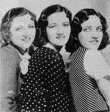
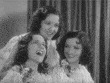
The Boswells (shown in Figure 1), with their dark eyes and hair, were not appreciably “whiter-looking” than Alice Whitman or Fredi Washington; if visual assessment could not establish their racial origin and aural assessment suggested they must be black, Bailey's perplexity was at least understandable. And in a society where Jim Crow existed everywhere, in both southern and northern states, racial origin mattered. For all the enthusiasm with which black cultural forms were embraced by whites during the Harlem Renaissance, by the 1930s social anxiety over blacks passing as white was at fever pitch; and passing could not have been an issue were the boundaries between black and white not still deeply inscribed. As George-Graves notes, theatrical passing, be it black-to-white with its “hint at miscegenation,” or white-to-black courtesy of burnt cork, was “intriguing and titillating,” but only because it “allowed the forbidden to be worked out” as part of a risk-free masquerade.45
George-Graves, Royalty of Negro Vaudeville, 65

The Boswell Sisters, left to right, Martha, Vet, and Connie, ca. 1932
Underpinning the anxiety of passing and the threat of miscegenation was the legally enshrined doctrine of “hypo-descent,” by which even a drop of African American blood qualified an individual as black.46
Omi and Winant, Racial Formation, 60–61: “In the United States, the black/white color line has historically been rigidly defined and enforced. White is seen as a ‘pure’ category. Any racial intermixture makes one ‘nonwhite.’ … This thinking flows from what Marvin Harris has characterized as the principle of hypo-descent: ‘Hypo-descent’ means affiliation with the subordinate rather than the superordinate group in order to avoid the ambiguity of intermediate identity,” quoting Marvin Harris, Patterns of Race in the Americas (New York: W. W. Norton, 1964), 56
Fannie Hurst's Imitation of Life was first published in 1933, and adapted by her for the screen in 1934. Edna Ferber's novel Show Boat was first published in 1926; Kern and Hammerstein's musical Show Boat was first produced by Ziegfeld on Broadway in 1927, and on film in 1929, albeit in a much condensed and altered version. The first full film version of the musical was directed by James Whale and distributed by Universal in 1936. Show Boat
See Linda Williams, Playing the Race Card: Melodramas of Black and White from Uncle Tom to O. J. Simpson (Princeton, N.J.: Princeton University Press, 2001), 158–86, for a discussion of the way music is used as a vehicle for the many racialized themes of Show Boat Magnolia, the central character of the book, is an “assimilating” southern girl who, much like the real-life Boswells, takes ownership of black performance styles through constant childhood exposure, and rises to fame and fortune as a convincing “coon-shouter” on the variety stage.
Although both Martha and Connie were born in Kansas City, the Boswell Sisters grew up in New Orleans. Brought up in a middle-class home, all three girls were given a privileged musical education: Martha played the piano, Connie the cello, and Vet the violin. Yet Martha learned to play stride piano from her father, who “had a way of playing with that left hand that was something else,” and the sisters' jazz abilities and sensibilities were fostered in what could be seen as a slightly bohemian salon culture that grew up around their Camp Street home.49
Connie's remembrance of Martha's piano playing comes from an interview she gave to Rich Conaty in the 1970s, quoted in Friedwald, Jazz Singing, 161
When evaluating the importance of this influence on the Boswells' musical development, it should be remembered that quartet singing was also a formative experience for Jelly Roll Morton and Louis Armstrong—themselves both natives of New Orleans. See Abbott, “‘Play That Barber Shop Chord,’” 314–19
The Boswells' version of “Crazy People,” featured in the 1932 Paramount film The Big Broadcast, includes a particularly clear “trans-vocalization” of traditional jazz instrumentation, with Martha providing a trombonelike foundation and Connie and Vet scatting in thirds above, imitating clarinet and trumpet
Lynn Abbott, “‘For Ofays Only’: An Annotated Calendar of Midnight Frolics at the Lyric Theatre,” The Jazz Archivist 27 (2003): 1–29
“Ethel Waters and Co. a Hit in New Orleans,” New York Age, 18 February 1922
In March 1925, the Victor Recording Company brought their mobile recording equipment to New Orleans seeking out new talent and the girls were offered the chance to record. Between 22 and 25 March they recorded five songs, becoming the first artists to record for Victor in the city. Two of their self-penned songs, “Cryin' Blues” and “Nights When I Am Lonely,” made it onto a single disc.54
“I'm Gonna Cry (Cryin' Blues)” and “Nights When I Am Lonely,” Victor 19639, 1925. The records feature the sisters singing only to piano accompaniment, as do virtually all of their pre-Brunswick recordings, the only exceptions being two sides with the Jackie Taylor Orchestra
In early coverage, the New Orleans press frequently refers to Connie as a “coon-shouter”; e.g., New Orleans States, 7 June 1925: “Martha, the eldest of the Boswell Sisters—they are all in their teens—is a pianist, Connie is a ‘coon shouter’ and ‘Vet’, a violinist.”
The structure of “Cryin' Blues” follows the established pattern of instrumental introduction/sung verse/sung chorus/instrumental chorus/sung chorus common to many vaudeville blues recordings. Connie's delivery closely emulates the classic blues singers, with the occasional guttural growl, sliding, sobbing and blue-note inflections to the thirds and fifths. Just as the song's lyrics (“I ain't no Queen of Sheba, I don't dress fine, but I'm the kind of mama that's home any time,” and the rhyming of go with mo') are filled with intimations of the singer's supposed race, Connie's performance is doubtlessly intended to invoke blackness, if not actually to sound black. Yet four other features of the recording—Connie's belting projection, her accent, the excessive yodeling hiccup on the word cryin', and the treatment of the instrumental chorus—suggest that “Cryin' Blues” is as much about minstrelsy's legacies as it is about the blues. The song is placed at the top of Connie's chest register, and the resultant belt brings to mind Banfield's comments regarding the optimum pitch for “coon-shouting.” The style is also implicit in her bizarrely modified pseudo-southern accent; not only are her vowels inconsistent with all of her later recordings (and all records of her adult speaking voice), they are inconsistent within the song alone, suggesting that she was deliberately, if not entirely successfully, adopting a specific performative style.
Connie's yodel/hiccup is a theatrical hypervocalization of emotion, reminiscent of Emmett Miller and, more particularly, Lee Morse. Morse did not work in blackface, but she was described as a singer of “quaint Southern melodies,” and when recording her studio band was always listed as The Bluegrass Boys. The southern element presumably was implied only by her yodeling and the subject matter of her songs, since her accompanists were all northern jazzmen playing hot jazz, not bluegrass.56
The Bluegrass Boys were in fact the Dorsey Brothers Orchestra, who acted pseudonymically for many singers in the 1920s. For Emmett Miller's recordings of yodeling blues, they became the Georgia Crackers
Although scat was by no means just a local practice, the New Orleans connections are intriguing. Jelly Roll Morton claimed to have used scat “for variety” as early as 1906 (although this chronology is debated), and it is likely that he was referring to precisely this kind of instrumental imitation. See Alan Lomax, Mister Jelly Roll: The Fortunes of Jelly Roll Morton, New Orleans Creole and “Inventor of Jazz,” 3rd edn. (Berkeley: University of California Press, 2001), 156
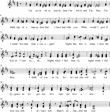
The second of the Victor songs, “Nights When I Am Lonely” (shown in Example 1) also has musical roots in recreational harmonizing. The verse is a note-on-note duet, but the chorus is sung by all three sisters.58
The transcriptions in Examples 1 and 2 are my own
This involves inserting “ggled” into each syllable of a word so that, for instance, “Boswell” becomes “Boggled-os-weggled-ell.” Only two sisters sing this chorus—it does not appear in the transcription
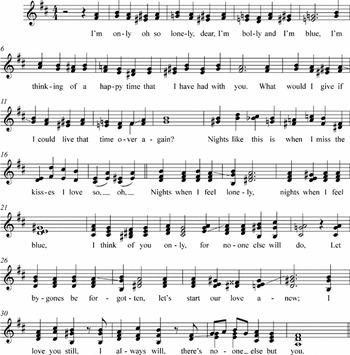
Example 1. Vocal arrangement excerpt of The Boswell Sisters' “Nights When I Am Lonely,” Victor 19639.Words and music by The Boswell Sisters
After the Victor session, the Boswells did not record again until 1930. There is no reason to suppose that the hiatus in their recording career had anything to do with a lack of interest in the initial disc; it is much more likely that personal circumstances dictated the subsequent course of events, limiting their professional activities between 1926 and 1927.60
In June 1925, the object of Martha's affection, the cornettist Emmett Hardy, died of tuberculosis. The shock of Hardy's death may have clouded her personal judgment, for by October of the same year she had eloped with another man, Jules Picard. She gave birth to a son the following year, but by 1927 had returned to the family home, seeking a divorce. See Sudhalter, Lost Chords, 50; and David McCain, liner notes to The Boswell Sisters Collection, Volume 4, Nostalgia Arts NOCD 3022, 2001. The disastrous flooding of the Mississippi River in 1927 also affected the local economy, but nonetheless provided the sisters with performing opportunities, as they were hired to sing to refugees from the back of a truck
Martha also did some radio acting, blackvoicing a character called Somaphine in a comedy called Tom and His Mule with Tom Breneman
The Boswells provided off-screen voices for the 1929 film Let's Go Places starring Crosby's wife, Dixie Lee; see David McCain, liner notes to The Boswell Sisters Collection, Volume 3, Nostalgia Arts NOCD 3009, 2000
Although Victor had introduced electrical recording in 1925, the field studio in New Orleans where the Boswells first recorded used acoustic apparatus. Film and radio work in Los Angeles gave the sisters daily experience with the latest sound technology, including electrical recording and condenser microphones, and soon they found ways to tailor their singing style to exploit the new equipment. They no longer had to shout into an acoustic horn, so perhaps the most dramatic change in their style is the way they began to sing softly. This gave them more freedom of expression; they could subtly articulate emotion through tone and breath rather than hysterically hiccupping to the gallery. The greater intimacy of the microphone allowed the sisters' natural vocal placement to develop; and though they could sing nasally in the conventional popular white-girl-singer sound, they began to use the tone only for a certain effect, the rest of the time letting their voices resonate more freely in their throats or their chests. Furthermore, the sisters created a more natural support for the voice; rather than sustaining tone quality for its own sake as a trained singer would do, they let the ebb and flow of their natural speech cadences inflect the vocal line. Moreover, singing with a greater degree of dynamic and tonal range allowed their New Orleans accent to be heard more clearly; the open, modulated vowel sounds and relaxed consonants enhancing the “instrumental” attitude of their phrasing, whether it was in block harmony or solo passages, in lyrics as well as scat.63
Early radio transcriptions show that the Boswells did very little to modify their vowels, even those distinctive to the New Orleans accent, for instance, “soyt'n” for “certain” or “lowje” for “large.” Sympathetic comparisons can be made to other singers from New Orleans, albeit of different gender and generation, such as Fats Domino, Professor Longhair, or Dr. John
From this time, too, the sisters found they could exploit the lower parts of their ranges (in effect, the speaking range), and Martha and Connie began almost to compete with each other for the lowest notes in the harmony. Connie later explained how their drop in range occurred:
We were going to cut our transcription one week and I had a terrible cold and couldn't hit the high notes strongly and clearly enough, so Martha covered the piano with burlap, I dropped all the songs … an octave or two and the three of us got very close around the mike and sang, sweet and low, into it. Of course, we had no idea what we sounded like, but the next week we heard the playback and knew we were on to something that no one else was doing.64
Quoted in Crowther and Pinfold, Jazz: The Singers and Their Styles, 38
Jackie Taylor and his Orchestra, “We're On the Highway to Heaven,” Victor 22500, 1930
The difference in the Boswells' voices between the Victor recordings and the Hollywood sessions is stark. Although maturity and experience had also given them a much tighter blend, three factors of vocal production—tonal variety (leading to greater expressiveness), tessitura, and regional accent—provided the technical basis for the Boswells' new sound, the sound that would be identified by their audiences as “authentically” black. All three qualities had been exploited by minstrelsy's blackface artists; what set the Boswells' sound apart from that tradition was the lack of travesty or hypervocalization, or the necessity for another contextual marker (blackface makeup, black-identified material) to confirm the racial categorization. Furthermore, the Boswells sang with voices that sounded naturally produced; the quality of tone, ornamentation, vibrato, and enunciation was not overly manufactured, and the accent was genuine. For one later reviewer, authenticity was the key to their initial and their lasting success:
The first of the really hot sister teams, the Boswells are still the best and it isn't difficult to know the reason after hearing this disc. Eschewing the laborious tricks and mannerisms of their competitors, they depend more than ever upon sincere emotion, simplicity of expression and a lust and engaging humor in their hot singing.66
[Horace Van Norman] Van, “In the Popular Vein,” The American Music Lover 1/2 (1935): 60 (review of The Boswell Sisters, “Dinah” and “Alexander's Ragtime Band,” Brunswick 7412, 1935)
Annette Hanshaw, “Big City Blues,” Columbia 1812D, 1929
It is perhaps the matter of an authentic southern accent that sealed the Boswells' vocal racial ambiguity, for outside the South, in an age when transcontinental travel was still fairly unusual and most broadcast or recording concerns were concentrated in the North and West, audiences were as yet unaccustomed to hearing white southern voices. What they thought they knew of black southern voices had, of course, been filtered through minstrelsy, but performers such as Bessie Smith and Louis Armstrong had begun to disseminate the accents of southern African Americans. What passed for a white southern accent in Hollywood in the early days of talkies would have been (and still is) unrecognizable to actual southerners; even a year after the Boswells gained international fame, Stuart Erwin's Texas millionaire, as portrayed in Paramount's The Big Broadcast (a major, big-budget production in which the Boswells also starred), speaks his lines in an almost incomprehensible garble, not remotely identifiable as any southern regional accent. “Pseudo-southern” was recognized as a ruse, especially when it was inconsistent, but regardless of its inauthenticity it still operated strongly as a signifier, normally with disadvantageous (class- and education/intellect-related) connotations. As such, white southern actress-singers, such as Ginger Rogers and Tallulah Bankhead, worked hard to eliminate their native accents, at least in performance. One might have expected the Boswells to do the same, but they did not. Together with the lower tessitura and the natural expressivity, the Boswells' genuine accent provided the complete racially identified vocal package.
Gary Giddins's analysis of Bing Crosby's developing style offers an appealing comparison. He states, “To Bing's generation, southern was a synonym for black,” and he makes a particular note of the way southern speech cadences “chimed well with [Crosby's] bottom notes and vocal affectations.”68
Gary Giddins, Bing Crosby: A Pocketful of Dreams: The Early Years, 1903–1940 (Boston: Little, Brown, 2001), 81
The Paul Whiteman Orchestra, “There Ain't No Sweet Man That's Worth the Salt of My Tears,” Victor 21624, 1928; Victor Young and His Orchestra, “Gems From George White's Scandals,” Brunswick 20102, 1931
Along with the blackness of their vocal quality, the sisters' musical style incorporated many elements that could be associated with blackness, blues, and hot jazz. “Boswellese” gibberish, although primarily an effective way of making a straight tune more rhythmically sophisticated, was also alienating and foreign to the listener, redolent of both scat and the “jive talk” being developed by the alternative black jazz community.70
The relationship between scat syllables and the need for the alternative culture of jazz to have its own private language is outlined in Brent Hayes Edwards, “Louis Armstrong and the Syntax of Scat,” Critical Inquiry 28/3 (2002): 618–59
Friedwald, Jazz Singing, 165
The Boswells gave their first coast-to-coast broadcast in July 1930, and almost immediately they became a hot property. Record companies renewed their interest, and in October the sisters cut four sides for OKeh; by November, they were negotiating to visit NBC headquarters in New York. Nevertheless, the incongruity of the Boswells' true racial origin on the one hand and their output on the other may have been disturbing, even more than confusing, to certain sectors of the public. This is suggested by a letter of complaint, written to a radio station in San Francisco by an Oakland woman: “But please, please, if you are going to keep those Boswell Sisters tell them to change their stuff and quit that squawking and harmonize a tune. All my friends say the same thing. They call them the savage chanters and tune them out.”72
David McCain, liner notes to The Boswell Sisters Collection, Volume 5, Nostalgia Arts NOCD 3023, 2001
This policing even extended to the comportment of blackface characters (portrayed by white actors) towards white characters; see Thomas Doherty, Pre-Code Hollywood: Sex, Immorality and Insurrection in American Cinema, 1930–1934 (New York: Columbia University Press, 1999), 281–82
Ibid., 282
The first byline is from the New York Evening World, March 1931; in the main body of the article, the girls' racial origin and class status become clear. The second comes from a undated magazine article (c. 1931), preserved in a 1930s fan's scrapbook of radio magazine memorabilia currently in the author's collection. “Creole,” then as now, has many meanings. In early-twentieth-century New Orleans, the term was still racialized by the white community to denote only those descended from antebellum European colonials, though northern journalists and northern readers would probably not have been aware of these valences
The need for such reassurance was, of course, heightened by the mode of broadcast and the performers' invisibility. As the Boswells' first medium for performance, radio accentuated the ambiguity of their sound by forcing the listener to speculate on its origins. In his analysis of black musical performance on film, Arthur Knight suggests that “radio's divorce of sound from image added a modern, technological anxiety to America's visually grounded but invisibly ‘blood’-based system of racism…. Insofar as radio was blind, it was also color blind, but in the context of a society that was extremely color attuned, radio's blindness made masking at once unavoidable and uncertain.”76
Arthur Knight, Disintegrating the Musical: Black Performance and American Musical Film (Durham, N.C.: Duke University Press, 2002), 92
Ibid., 198
For audiences like the letter writer from Oakland and her friends, used to listening in black and white, it was almost impossible to tell where whiteness ended and blackness began in the Boswells' collective voice. Their sophisticated arrangements suggested white jazz, recalling and surpassing Paul Whiteman's Rhythm Boys, who “hotted up” the traditional sound of male harmony by interspersing their Tin Pan Alley material with short scat breaks, but the blackness implied by the sisters' voices, their rhythm, and the influences they chose to bring to their material mitigated their whiteness.Yet it is clear that the sisters appreciated the difference between sounding white and sounding black, and they were not afraid to have a little fun playing one off against the other. Their arrangement of the Tin Pan Alley standard “Don't Tell Him (What's Happened to Me),” which they recorded while still in California, has a kind of split personality, rocking back and forth between white and black styles from the opening bars.78
The Three Boswell Sisters, “Don't Tell Him (What's Happened to Me),” OKeh 41470, 1930
Among the other sides the Boswells released on OKeh was one that critiqued and almost redefined an existing recording that had already achieved “definitive” status in the new jazz canon. One of the most enduring myths of jazz history is the “creation” of scat singing by Louis Armstrong, caught on wax in the recording of “Heebie Jeebies,” made by Armstrong and his Hot Five in February 1926.79
Louis Armstrong and His Hot Five, “Heebie Jeebies,” OKeh 8300, 1926. Edwards examines the creation of this myth and the reasons for its endurance in “Louis Armstrong and the Syntax of Scat,” 618
Friedwald, Jazz Singing, 29
Even among the small number of sides already cited in this essay, it is present in the Boswells' “Cryin' Blues” (1925) and the Duncans' “Rememb'ring” (1924)
The sheet music for “(The Original) Heebie Jeebies” was published after Armstrong's recording was issued, but a white artist, Paul Ash, is pictured on the front and given credit for “featuring” the tune.82
The melody, though attributed to the black saxophonist Boyd Atkins, is thought to be an appropriation of the second strain from the piano slow drag “Heliotrope Bouquet” by Louis Chauvin and Scott Joplin
The back cover of the sheet music is taken up with instructions for the Heebie Jeebies dance, suggesting that the dance craze was also a response to the recording: “You may obtain the HEEBIE JEEBIES record at all music stores…. Just ask for OKEH RECORD no. 8300, as this is the record Mr. Du Pont used in casting the HEEBIE JEEBIES DANCE.” Also intriguing are the implications (for judging the tempo relationship between recorded and live performances of dance music, and for understanding the listening and usage habits of the phonograph audience of the 1920s) of the instruction: “To obtain the right tempo (time) for the HEEBIE JEEBIES DANCE, adjust the speed regulator of your phonograph to 90 (ninety revolutions of the turn table to the minute) as shown on the dial; then practice counting, as shown above, in strict tempo to the music.” The label of OKeh 8300 clearly states “Fox Trot.”
Ethel Waters, “Heebie Jeebies,” Columbia 14153, 1926. The others, all released versions between September and October 1926, were Alberta Hunter, OKeh 8383; Adrian Rollini's Goofus Five, OKeh 40690; Fess Williams and His Royal Flush Orchestra, Vocalion 1054; The Original Indiana Five, Bell 456; and the Red Heads (Red Nichols and his Five Pennies), Pathé Actuelle 36557
The Boswell Sisters recorded their first version of “Heebie Jeebies” in October 1930, shortly before they were invited to New York to join NBC's national network. The tune was something of a talisman for the sisters: they recorded it twice for issue on 78 disc (in 1930 on OKeh and in 1931 on Brunswick with the Dorsey Brothers), and they also used it as an opening number for every new broadcast, largely retaining the arrangement intact.85
The Three Boswell Sisters, “Heebie Jeebies,” OKeh 41444, 1930; The Boswell Sisters “Heebie Jeebie,” Brunswick 6173, 1931. Two other performances were recorded, one an unused take for The Big Broadcast and the other an appearance on Bing Crosby's Woodbury Hour radio show on CBS in September 1934. The unused take (frequently mistakenly attributed as a transcription of the first CBS telecast in 1931) is available on Hollywood Rhythm: The Paramount Music Shorts, vol. 2, The Best of Big Bands and Swing, Kino K198, 2001. The Woodbury Hour performance is available on The Boswell Sisters: Airshots and Rarities, Retrieval Records, RTR79009, 1997
Friedwald, Jazz Singing, 164
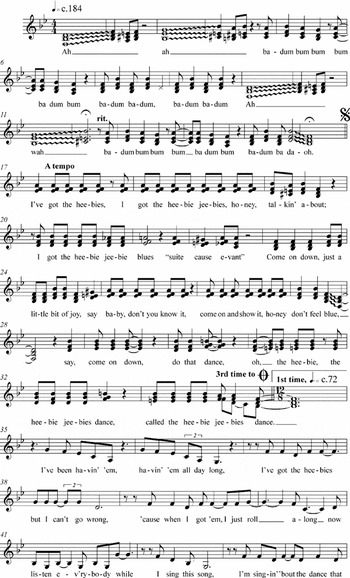
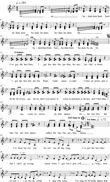
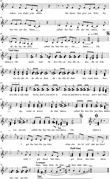
Example 2. Vocal arrangement of The Boswell Sisters' “Heebie Jeebies,” OKeh 41444
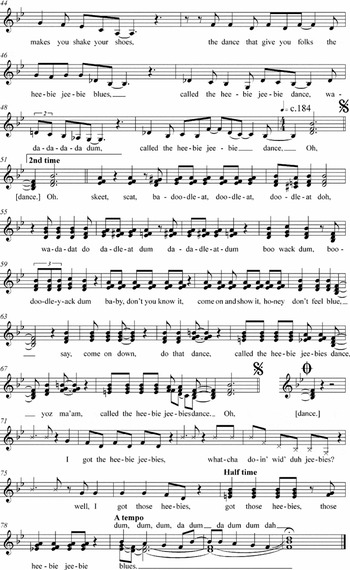
Example 6. “Heebie Jeebies,” Words & music by Boyd Atkins © 1926 MCA Music (a division of MCA Incorporated), USA. Universal/MCA Music Limited. Used by permission of Music Sales Limited. All Rights Reserved. International Copyright Secured
These similarities may arise from a common performance tradition in New Orleans, or they could be conscious modeling on the part of the Boswells; most likely, they are a combination of the two. But regardless of where the Boswells originally learned the tune, their treatment of “Heebie Jeebies” is every bit as radical as the schizophrenic “Don't Tell Him (What's Happened to Me”); if anything, it is more explicit about its many stylistic origins. From quartet singing come the sliding horn imitations of the opening and from instrumental brass band “jazz,” the material the voices imitate (Ex. 2, mm. 1–16). Connie's solo verse invokes the female blues tradition, slow and low-down (mm. 34–49).87
One assumes that the chorus is indigenous, self-penned by Connie or one of her sisters, rather than a relic of a previous performer
The dialect phrase also appears in Armstrong's recording, spoken by an unidentified band member as a response to his “Whoo, I got to have the jeebies!” in the first stopped rest of the coda. It is timed late, so that it coincides with the piano chords; the second stopped rest (where the Boswells put the phrase) is oddly bare. Perhaps it was intended for the second stop, but the band member made a mistake?
The recordings made for OKeh in California show the more or less raw material the Boswells brought to New York—they have no real instrumental involvement apart from Martha's piano and, judging by the number of rejected waxes, quality control seems to have been done at the pressing stage rather than in the studio.89
Eric Woodward, The Boswell Sisters and Connee Boswell: Discography (East Springfield, N.Y.: Boswell Museum of Music, 1998), 4–5. In contrast, Connie claimed that dozens of waxes were wasted in their late-night sessions with the Dorseys in New York; nevertheless, alternate takes exist for about half of their sides for Brunswick and Decca
In the only mention of the Boswells in his two-volume history of jazz, Gunther Schuller writes: “Although the Sisters' recordings may strike us today with a certain dated period charm, it should be remembered that … their performances, heard in context, are remarkably inventive and intricate, quite beyond anything of their time and even what their host of imitators managed to achieve.” Schuller, The Swing Era, 642
John Lucas, “Another Boswell Chronicle,” Jazz Journal 27/2 (1977): 5
Toll, Blacking Up, 254–62; and Lhamon, Raising Cain, 117–18.
Mel Watkins, On the Real Side: Laughing, Lying and Signifying (New York: Simon and Schuster, 1994), 263
a mixture of an authoritative tone and obscure content created by the dialogue partners chronically cutting one another off. When the partners are not interrupting one another, their sentences alternate between abstractions (usually because their pronouns have no clear referent), questions (that go unanswered), and hyperbolic pronouncements (which are immediately deflated). Along with precise gestures and timing, some punning and malapropisms, the deformations of dialect, and a schism between character and tone, what most makes indefinite talk unique (and funny) is that the indefinite talkers always understand one another. While the audience struggles to figure out what the indefinite talkers are (not) talking about, the indefinite talkers themselves never require clarification and continue as if their conversation were ordinary and comprehensible.94
Knight, Disintegrating the Musical, 110
Ibid., 112
Ibid
White Is the New Black: The Boswell Sisters in the 1930s
Once they arrived in New York, the Boswell Sisters began to record for Brunswick Records, coming under the control of Jack Kapp, the record mogul who eventually broke with Brunswick to form the international label Decca. In a way, they seem to be exactly the sort of act that Kapp would have rejected out of hand; he is best remembered, and almost universally vilified, for his constant exhortations to singers to “stick to the melody.” His stylistic policing has been blamed for dulling the jazz sensibilities of Bing Crosby, Mildred Bailey, Lee Wiley, and later in the 1930s, Armstrong and Ella Fitzgerald (among many others). Connie later said that Kapp was “a wonderful guy … a terrific commercial man,” but it is clear she regretted many of his commercially oriented impositions.97
Friedwald, Jazz Singing, 171
Leonard, Jazz and the White Americans, 97
In summer 1930, Kapp was promoted to head of all Brunswick recording laboratories; his ascendancy coincided with dramatic change in the main catalogue.99
Ross Laird, Brunswick Records: A Discography of Recordings, 1916–1931, vol. 1, ed. Michael Gray (Westport, Conn.: Greenwood Press, 2001), 10
In the Boswells, Kapp had found his marketing Holy Grail. They were white singers that sang white material (i.e., Tin Pan Alley rather than blues) but sounded black, who could ride the crest of the popularity of black music while simultaneously drawing in more racially conservative white audiences. But in order to do so, a public image needed to be cultivated for them that both dispelled ambiguity and nonetheless permitted them to retain ownership of black signifiers. From the Boswell's second Brunswick recording, “Roll On, Mississippi, Roll On,” backed by what would become their signature tune, “Shout, Sister, Shout,” much of their material authorized for release by Kapp capitalized on their southernness: “Got the South in My Soul,” “Lawd, You Made the Night Too Long,” “An Evening in Caroline,” “Swanee Mammy,” “Down on the Delta,” and “Louisiana Hayride” are just some examples.100
Brunswick 6302, 20109, 6218, 6625, 6395, 6470. All of these titles are reissued in the Nostalgia Arts series The Boswell Sisters Collection, Volumes 1–5. There are many indications that a good deal of material recorded by the Boswells was probably not released by Kapp
“The Boswell Sisters Are Three-Quarters French,” unidentified magazine article, ca. 1931. Another article in the scrapbook on the radio star Irene Beasley also links her southern accent with minstrelsy's figures: “Thousands were charmed by that something in her voice that takes one back to the old south of magnolias and darkies and banjos.” “Irene Beasley Taught Seven Grades and Had Eleven Pupils,” unidentified magazine article, ca. 1931
The Boswell Sisters, “Put That Sun Back in the Sky,” Brunswick 6257, 1931
The Boswells left behind few visual records of their performances, mostly as a star turn in larger features or publicity shorts. In one way or another, the southern theme was carried through most of these cameos, their rise in status as performers echoed in the social elevation of their image. In the Boswells' first film, a short titled Close Farm-ony shot in 1931, the sisters are characterized as rural farm workers or hillbillies, an established white southern stereotype, dressed in overalls and seated on hay bales (even the piano is disguised in hay).103
The image corresponds to the yokel look chosen by white New Orleans bands in vaudeville fifteen years earlier; see Sudhalter, Lost Chords, plate 1, for a picture of Tom Brown's “Band from Dixieland” in 1915, dressed as hillbillies
The use of white apparel and accessories to underscore the trope of “whiteness” was part of a well-understood visual rhetoric; see Meredith Goldsmith, “White Skin, White Mask: Passing, Posing, and Performing in The Great Gatsby,” Modern Fiction Studies 49/3 (2003): 456–57

Figure 2. The Boswell Sisters, shape left to right, Martha, Vet, and Connie, ca. 1932
Shortly after the release of The Big Broadcast, the sisters were the subjects of a short by Dave Fleischer, When It's Sleepy Time Down South, based on the song of the same name—and yet another tune that was strongly associated with Louis Armstrong.105
Armstrong recorded the song in the autumn of 1931, and it remained his theme song for the rest of his life
As innocuous as it might seem, the plantation scenario is fundamental to understanding of the performance's meaning. Drawing on the work of Cora Kaplan, Tara McPherson insists that in fantasies of the South, the plantation fixes white identities in a setting that “structures the possibilities for … racial performances”: “It is crucial to investigate the role of setting when analyzing fantasies and the narratives to which they become bound…. On doing so, it becomes difficult, if not impossible, to dissociate the [masquerades of the belle] from the plantation economy that first enabled them.” McPherson, Reconstructing Dixie, 54
I borrow the term “economy of visibility” from McPherson (ibid., 25), who in turn acknowledges Robyn Wiegman, American Anatomies: Theorizing Race and Gender (Durham, N.C.: Duke University Press, 1995)
Given both his interest in cashing in on musical passing and his well-documented involvement in his artists' musical development, it seems logical that Kapp was strongly influential in promoting the Boswells' southernness, yet the strategy must also have met with their approval. Southernness remained the foundation of the sisters' catalogue throughout their recording and broadcasting career, even after Kapp left Brunswick to form Decca in late summer 1934.108
Had they not been willing to characterize themselves in this way, one would expect that their material would have changed after his departure, but even in the year that the Boswells remained at Brunswick before they joined Kapp at Decca, they cut versions of “Dinah,” “Way Back Home,” and “St. Louis Blues.”
The Boswell Sisters, “Wha'dja Do to Me?” Brunswick 6083, 1931
The Boswell Sisters, “Minnie the Moocher's Wedding Day,” Brunswick 6442, 1932; “Louisiana Hayride,” Brunswick 6470, 1932. The band is the Dorsey Brothers Orchestra
For an examination of the issue of Connie's disability and its implications for her career and her music, see Laurie Stras, “‘Who Told You That Lie?’: Picturing Connie Boswell,” in Re-framing Representations of Women: Figuring, Fashioning, Portraiting and Telling in the “Picturing Women” Project, ed. Susan Shifrin (Burlington, Vt. and Aldershot: Ashgate, forthcoming)
In 1933 and 1934, the Boswells appeared in two larger-scale Hollywood musicals, Transatlantic Merry-Go-Round and Moulin Rouge; in both films, the sisters' numbers are framed as musical variety turns within the plot. The agency of Hollywood in shaping the performances and in the way it translated the Boswells' music to the screen is strongly felt, particularly in Moulin Rouge: without a visual tradition to draw upon for the portrayal of white jazz singers, the designers fall back on minstrelsy and vaudeville, but not without some discomfort. In the film, the Boswells sing a suggestive lyric, “(Coffee in the Morning and) Kisses in the Night,” as part of a lavish production number. The staging incorporates marked visual clues that reinforce the racialized musical traits in their performance and directly invoke the mammy, but it also simultaneously places the Boswells in opposition to those images.112
The basic stereotypes of minstrelsy as incorporated into twentieth-century dramatic representations on film are examined in Donald Bogle, Toms, Coons, Mulattoes, Mammies, and Bucks: An Interpretive History of Blacks in American Films, 3rd edn. (Oxford, UK: Roundhouse, 1994). The image of the “mammy,” with specific reference to white female blackface performers (as opposed to male performers in drag) is interrogated in Kibler, Rank Ladies, 124–25
The sheet music's lyrics, which differ from those printed here, are delivered from a male point of view and constitute a proposal of marriage. Sung from a female perspective, the screen lyrics are considerably more suggestive
[She] I've got a mission, just a simple thing I've one ambition, to have the right to bring you Your coffee in the morning …
[He] and kisses in the night.
[She] It's my desire to do as I am told, To have what you require, and never have it cold, dear— Your coffee in the morning …
[He] and kisses in the night. The wedding bells sound sad and dirgy, The wedding ties may spoil the fun;
[She] Without the helping hand of clergy I'm afraid it can't be done It isn't formal, but with a wedding ring It's natural and it's normal to give you everything, dear— From coffee in the morning …
[He] to kisses in the night.
“Kisses in the Night,” Words and music by Harry Warren and Al Dubin copyright 1933 (renewed) WB Music Corp. All rights administered by Warner/Chappell Music Ltd., London W6 8BS. Reproduced by permission.
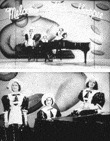
A curtain is then pulled back to reveal the Boswells, who are arranged on and around Martha's piano (shown in Figure 3 top); they are framed by a false proscenium advertising the “Melodee Coffee Shoppee.” The sisters are engulfed in cooks' uniforms, with gleaming aprons, broad white collars and huge, billowing chefs' hats (shown in Figure 3 bottom). Already low (to accommodate the speaking range of the non-singer Bennett, who sings in the same range as Columbo), the key drops by a further semitone, and the tempo slows. In harmony, the sisters slur and drawl their way through the lyric in its entirety: plosive sounds are minimized and smaller words swallowed; the title line becomes “cawffe' 'n'm-mawnin' ‘n’ gizzuhz 'n-n'nahht.” In an original coda, Connie almost entirely uncharacteristically assumes the sexualized persona of the “coon-shouter,” at once yielding and predatory, complete with a double entendre in the delivery: “Oh sweetheart I really want you [pause] to take me in your arms and hold me tight, now honey I'm warnin', you'll get coffee in the mornin' and kisses in the night.”114
The dualism inherent in the “red-hot mama,” as the female jazz singer was commonly identified, is discussed in Peter Antelyes, “Red Hot Mamas: Bessie Smith, Sophie Tucker, and the Ethnic Maternal Voice in American Popular Song,” in Embodied Voices: Representing Female Vocality in Western Culture, ed. Leslie C. Dunn and Nancy A. Jones (Cambridge: Cambridge University Press, 1994)
“Picks” (short for pickaninnies), or black child dancers, were ubiquitous to vaudeville, often the most successful aspect of a show. In the early 1900s, white female singers frequently relied on “picks” to enhance their acts; see Kibler, Rank Ladies, 119–24

Figure 3 (top and bottom). The Boswell Sisters in shape Moulin Rouge, Twentieth-Century Fox, 1934
Although the song's lyrics respect the Hays Code's pronouncements on marriage and sex in principle (especially when shared between a couple), when sung by women only, the song becomes risqué, and its purpose in underlining the film's will-he-or-will-he-not-commit-adultery plot is revealed. But nice white girls with impeccable southern manners do not sing about sex—at least not on film—therefore the sisters' performance is propped with visual allusions to a black stereotype.116
The use of a figurative black mask for a white woman's performance of suggestive material post-Hays brings to mind Irene Dunne's blackface song in the 1936 version of Show Boat, “Gallivantin' Aroun.”' See also Williams, Playing the Race Card, 174–79
The version of the song released by the Boswells on Brunswick has all the musical gestures of the film performance, and in addition Connie takes a whole chorus on her own; The Boswell Sisters, “Coffee in the Morning (Kisses in the Night),” Brunswick 6733, 1933. The recording was made on 14 November 1933; the reversal of the parenthetical title is from the disc's label. The song remained in the sisters' repertoire until at least August 1935, when they were still performing it on the radio; Lionel Merdler, “Night in New York,” Radio Pictorial 85 (1935)
Black and White and Reb All Over: The Boswells as Belles
Ruth Frankenberg recognizes that whiteness can be “the unmarked marker,” an empty signifier “more about the power to include and exclude groups and individuals than about the actual practices of those who are to be let in or kept out.”118
Ruth Frankenberg, “Introduction: Local Whitenesses, Localizing Whiteness,” in Displacing Whiteness: Essays in Social and Cultural Criticism, ed. Ruth Frankenberg (Durham, N.C.: Duke University Press, 1997), 13
But unlike Mezz Mezzrow, for instance, the Boswells should not automatically be taken for “exceptional whites”: those whose assumed blackness is an expression of a desire to be black.119
The phrase “exceptional whites” is derived from Phil Rubio, “Crossover Dreams: The ‘Exceptional White’ in Popular Culture,” in Race Traitor, ed. Noel Ignatiev and John Garvey, 148–61 (New York: Routledge, 1996)
Dale Cockrell, Demons of Disorder: Early Blackface Minstrels and Their World (Cambridge: Cambridge University Press, 1997), 167
Many scholars have commented on how minstrelsy offered a nostalgic Neverland of the agrarian South that assuaged the anxieties of the industrialized North, but the racial longing that minstrelsy and racialized vaudeville satisfied was no longer of the age.121
The “coon-shouters” created a particular kind of regretful, if passive, nostalgia, unsuited to the upbeat message of 1930s entertainment; see Kibler, Rank Ladies, 112–13
For a brief commentary on the effect of the early Depression on women and African-Americans, see Anthony J. Badger, The New Deal: The Depression Years, 1933–1940 (Basingstoke: Macmillan, 1989), 25
McPherson, Reconstructing Dixie, 19
Ibid. McPherson describes how the South became personified in the belle as a region feminized by defeat in war and by the loss of its male population
Ibid., 56
In fact, several late nineteenth-century Civil War melodramas and the melodramatic films that followed them, including The Heart of Maryland by David Belasco and William Gillette's Secret Service (made into films in 1927 and 1931, respectively) had plotlines in which the belle falls for, rescues, and eventually marries a Union soldier
Although not the first white southern musicians to make it in the North (the Original Dixieland Jazz Band preceded them by over a decade), as singers the Boswells gave an authentic voice to southern whiteness that contrasted—in class and in culture—with the other widely disseminated white southern stereotype, the hillbilly. Their media personae were early manifestations of what was soon to be an inundation of belles in American popular culture, epitomized by the character Scarlett O'Hara in Margaret Mitchell's 1936 novel, Gone With The Wind. There were good belles and bad belles, repentant belles that learned to be good after being bad, smart belles, and occasionally dumb belles (although these characters tended to be class-inflected to be closer to hillbillies). What these women shared, from Daisy Mae Scragg in the comic strip Li'l Abner (1934) to Bette Davis in Jezebel (1938), was a fierce sense of determination, a refusal to accept failure without a fight, and a willingness to risk all in order to attain their goals. In films, aspirational southern women working their way up in the entertainment business became a popular cliché, providing roles for bona fide southern actresses including Texans Ann Miller (Stage Door, 1937; Radio City Revels, 1938) and Mary Martin (Rhythm on the River, 1940; Kiss the Boys Goodbye, 1941, which also starred Connie Boswell in a speaking/singing role). That a southern accent had become a desirable asset in a singer, even for northern girls and despite its potential for racial marking, is reflected in the dialogue of the Oscar-winning 1937 film The Awful Truth. Cary Grant's character asks his date, a second-rate entertainer calling herself Dixie Belle Lee, “How long have you been talking like Amos and Andy, huh?” and she responds, “Oh, for quite some time. I got wise to the fact that it helps me in my work. So as long as I love my work, y'all'll have to pardon my southern accent.”
As southern white women, the Boswells would have been well inculcated into their societal role, and it was one based on an overt bargain: white privilege and limited access to the public sphere accorded in return for “mounting the pedestal on which southern femininity was popularly situated.”127
McPherson, Reconstructing Dixie, 19
John Lucas, “Cats Hepped by Connee's Chirping,” Down Beat, 15 October 1944, 3
Connie could, and did, perform blues, especially in her later career as a soloist, and blues changes appear in a number of the sisters' arrangements. However, apart from the 1935 recording of “St. Louis Blues,” only three of the sisters' sides specifically incorporate a blues—“Hand Me Down My Walkin' Cane” and “There'll Be Some Changes Made,” recorded in 1932, and a 1933 recording of “Mood Indigo,” on which Connie sings one chorus very similar to Bessie Smith's “Graveyard Dream Blues” (altering the lyrics on the final line); The Boswell Sisters, “Mood Indigo,” Brunswick 6470, 1933. This is the blues to which Lucas specifically refers in “Cats Hepped by Connee's Chirping.”
The ultrafemininity of the belle is also constructed as the binary opposite of the manly man. If the Depression can be read as a crisis in northern white masculinity, it is also reflected in the crisis in white masculine identities that occurred in American entertainment at the turn of the 1930s. While as a trope the flapper constituted a blurring of gender attributes, both visual and behavioral, from one direction (flattened chest, short hair, sexually predatory, substance using, eager to move into the employment market), her counterpart the sheik blurred in the other (slim-hipped, sensual, emotional, also substance using, financially dependent on women). The urban “pansy craze” of the 1920s and the concurrent “rise of the crooners” made the bandstand a prominent arena for the contesting and fashioning of gendered identities.130
See Allison McCracken, “‘God's Gift to Us Girls’: Crooning, Gender, and the Re-Creation of American Popular Song, 1928–1933,” American Music 17/4 (Winter 1999: 365–95), for a discussion of the racial and gendered implications of crooning in the 1920s and 1930s
Connie was one of Crosby's earliest and most productive duet partners; between 1937 and 1953 they cut nine duet sides, several of which topped the Billboard charts. She also was a regular cast member on his Kraft Music Hall show in 1941 and 1942 and continued to appear with him throughout the rest of her life
Giddins, A Pocketful of Dreams, 342–43. Rudy Vallee eventually emulated Crosby's use of the Boswell Sisters, recruiting the Three Vallee Girls for his Fleischman Hour show on NBC in 1935
For the belle, “access to the public sphere” obtained through the deployment of hyperfemininity could include involvement in more masculine pursuits such as business.133
McPherson discusses the many feminist critiques of Scarlett O'Hara, including her use of feminine wiles to build a lumber business, in McPherson, Reconstructing Dixie, 53–54
Sherrie Tucker, Swing Shift: “All-Girl” Bands of the 1940s (Durham, N.C.: Duke University Press, 2000), 57
Connie stated that during their some of their late-night sessions with the Dorseys, in order to save time (and possibly because her right hand suffered residual weakness from polio; see Stras, “‘Who Told You That Lie?’”), she would dictate parts to Glenn Miller, who acted as her amanuensis. Records for three sessions—on 5 February, 19 February, and 6 August 1932—show Glenn Miller's name as “arranger,” although he does not play on the sessions. See also Friedwald, Jazz Singing, 171
See, for instance, the collection of Down Beat articles voicing the gender in jazz debate during the 1930s and 1940s in Keeping Time: Readings in Jazz History, ed. Robert Walser (New York: Oxford University Press, 1999), 111–20
Tara McPherson's analysis shows how the belle can be deployed in both overt and covert representations of race. Overtly, she is positioned in the frame with a black counterpart, as with Gone With the Wind's Scarlett and Mammy; covertly, she is presented without reference to black bodies, but since her very existence is predicated on the social and economic conditions of her upbringing, she can operate on her own as a paradigm for whiteness that simultaneously presents and then takes ownership of specific (opposing) criteria for blackness. For example, the privileged status accorded by her whiteness to Magnolia, the white heroine of Show Boat, is enacted twice in the plot: first, she assumes Julie's star position in the showboat troupe when Julie's passing is exposed; second, Julie gives up her job as a nightclub chanteuse to Magnolia, so that Magnolia can provide for her daughter (and so competently fulfill her role as mother). In the same way that Magnolia absorbs the role of the black woman, effectively rendering invisible the blackness of her position and her performance, the Boswells absorb the blackness of “When It's Sleepy Time Down South,” recasting it through the subjectivity of southern white womanhood.
But perhaps the most startling aspect of the Boswells' southernness is how it intersects with their emulation of black male jazz musicians, particularly Louis Armstrong. Not only do the Boswells specifically critique his performances in their own, as in “Heebie Jeebies” and “When It's Sleepy Time Down South,” but throughout their, and later her own, recording career Connie also frequently performed “trumpet” solos in their arrangements (produced vocally à la Harry Mills), mirroring Armstrong's dual role as vocal and instrumental soloist. Certainly it could be argued that, as the black male popular singer was still a liminal figure in American entertainment, the Boswells' references to Armstrong helped fix his identity in the public's imagination. Yet as southern white women, their apparently easy and persistent deployment/manipulation of the same elements that made Armstrong into such a potent force in early jazz, and indeed marked him for who he was (for example, his accent; his irreverence; his “bilingualism” as vocalist and instrumentalist; his eclectic repertoire; the naturalized understanding of the polyphonic textures of New Orleans jazz), possibly also worked to destabilize the black jazzman's image—and performance—of masculine virility that, in turn, so threatened the already beleaguered white masculinity of the Depression years.137
See Krin Gabbard, Jammin' at the Margins: Jazz and the American Cinema (Chicago: University of Chicago Press, 1996), particularly chaps. 4 and 6. Gabbard notes: “Black Americans in the 1930s lionized Armstrong because he communicated his sexuality in code while turning an obsequious face toward his white handlers” (234). The close identification of jazz with black masculinity is also examined in Ingrid Monson, “The Problem with White Hipness: Race, Gender, and Cultural Conceptions in Jazz Historical Discourse,” Journal of the American Musicological Society 48/3 (1995): 396–421
The year after the stock market crash was a turning point for American entertainment. Throughout the decade of the 1920s, new technologies had made a new form of blackness—black vocality—increasingly available and recognizable to the public, for whom a frisson of impropriety, racial or otherwise, could satisfy an appetite for titillation. “Passing” performers may have risked offending some audiences with their transgressions, but they also knew they delighted others. Yet the frisson turned to a shiver in the colder social climate of the Great Depression, and the balance of audience desire tipped from titillation to reassurance, so that such anxieties, while still introduced, were increasingly to be assuaged (or eventually avoided, thanks to the Hays Code). The Boswells' swift rise to stardom coincided almost exactly with the nation's equally swift plummet into economic catastrophe, and one could argue that, bizarrely, the timing could not have been more fortuitous for the sisters. The overtly affected racial and gendered crossings that were so popular during the 1920s—Valentino's mysterious, made-up sheik; the loose, rhythmic shuffle of Clara Bow's flapper—were also symbolic of moneyed, northern, urban decadence, and as the Depression loomed they lost their cultural currency as rapidly as the Federal Reserve Bank lost its own. Although the Boswells also disrupted racial and gender etiquette, the mask of the southern belle allowed them to restore equilibrium with gracious decorum; they were seen as natural and authentic, their cultural miscegenation effectively rendered invisible by their southern charms. As good southern Democrats, moreover, they were ideal, New Deal sweethearts: fresh models of aspiration for a wholly different economic and social climate.138
The Boswells' political allegiances were made clear in the 1932 campaign, when the papers reported a meeting between them and President Hoover. The following is typical of a number of articles: “Washington, May 5: The three Boswell Sisters, radio singers whose home originally was in Louisiana, were introduced to President Hoover today as ‘good Democrats’ by Assistant Secretary Jahncke of the Navy. Those present reported the president replied gallantly, with a glance at Jahncke, a Louisianian, ‘That is all right if they are from Louisiana.”’ Unattributed newspaper clipping, David McCain Collection, Hogan Jazz Archives, Tulane University
When the Boswells Sisters disbanded as a performing unit in early 1936, the reason given was that Vet and Martha, both recently wed, were leaving show business to concentrate on marriage and family; Vet, although it was not revealed at the time, was also pregnant. Connie, too, had recently married, to their manager, but after the group's demise she concentrated on developing her solo career. Her sisters' sudden departure from the entertainment stage serves to underline the nature of the bargain they had struck with their audience: their performance of a specific kind of white femininity legitimized their access to both public life and blackness (and hence to a musical career and to jazz), but to remain respectable eventually they would have to fulfill their side of the exchange.139
To place them in Ruth Frankenberg's quartet of race and gender tropes, as White Women they were “on the one hand, accorded privileges and status by [their] race/gender positioning, and on the other hand, confined by it. In any case [they were] advantaged only conditionally on [their] acceptance of the terms of the contract. This includes especially [their] sexual practices, for the trope-ical family is strictly heterosexual and monoracial in its coupling.” Frankenberg, “Localizing Whiteness, Localizing Whitenesses,” 12
Connie, however, could continue her career, even once married; within Frankenberg's framework she could be excused from her reproductive obligations by virtue of her disability. Connie discussed her paralysis (though not its cause) in an interview with Down Beat in August 1938; see “Boswell Would Refuse Cure for Paralyzed Legs to Help Economic Cripples!,” Down Beat, August 1938. This interview, among many others, nonetheless stressed how well she fulfilled her wifely duties
Connie had some television and film exposure, but clearly she felt a lack of confidence on the part of producers as a result of her wheelchair use, which limited the opportunities presented to her. “Look Applauds Connee Boswell,” Look, 4 February 1958. Arguably, the attitude of the US government, which prevented her from participating in VSO tours overseas during World War II, had an even greater impact on her career; see Stras, “‘Who Told You That Lie?’”
Kay Starr and (of course) Patti Andrews were also heavily influenced by Connie. The 1944 Down Beat retrospective claimed that all jazz singers performing in the 1940s owed something to her style; Lucas, “Cats Hepped by Connee's Chirping,” 3
I have been the grateful and eager recipient of help from many generous people in the preparation of this essay. My warmest thanks go to Vet Boswell Minnerly and to musicians and scholars David Ake, Dale Cockrell, Susan Fast, Liz Garnett, Michael Hammond, Cynthia Lucas, David McCain, The Pfister Sisters, Bruce Raeburn, Derek Scott, Jan Shapiro, Robynn Stilwell, John Sullivan, Pete Thomas, Christoph Wagner, and my kind anonymous readers for information, loan of materials, advice, and comments on earlier drafts. I am also grateful for the financial assistance of the British Academy, which permitted me to visit the Boswell Museum of Music in East Springfield, New York, and the Hogan Jazz Archive at Tulane University. This essay is dedicated to the musicians of New Orleans, whose optimism, courage, and ability to keep playing joyous music in the midst of calamity are astounding, inspiring, and humbling in equal measure.
Every effort has been made to secure necessary permissions to reproduce copyrighted material in this work, though in some cases it has proved impossible to trace copyright holders. If any omissions are brought to our notice we will be happy to include appropriate acknowledgments on reprinting in any subsequent edition