


1. Introduction
Growing attention has been devoted to reducing the environmental impacts of healthcare delivery (Reference Pereno and ErikssonPereno & Eriksson, 2020; Reference Sherman, Thiel, MacNeill, Eckelman, Dubrow, Hopf, Lagasse, Bialowitz, Costello, Forbes, Stancliffe, Anastas, Anderko, Baratz, Barna, Bhatnagar, Burnham, Cai, Cassels-Brown and BilecSherman et al., 2020; Reference Sousa, Veiga, Maurício, Lopes, Santos and NetoSousa et al., 2021). While previous research has focused on the perspectives of healthcare professionals, policymakers, and industry actors (Reference Badawy, Shaban, Elsayed and HashimBadawy et al., 2025; Reference Eckelman, Huang, Lagasse, Senay, Dubrow and ShermanEckelman et al., 2020; Reference Hoveling, Svindland Nijdam, Monincx, Faludi and BakkerHoveling et al., 2024; Reference Ledda, George, Glasbey, Labib, Li, Lu, Kudrna, Nepogodiev, Picciochi, Williams and BhanguLedda et al., 2024; Reference Macneill, Hopf, Khanuja, Alizamir, Bilec, Eckelman, Hernandez, McGain, Simonsen, Thiel, Young, Lagasse and ShermanMacneill et al., 2020), integrating patient perspectives is crucial for achieving meaningful and lasting change (Reference van Overbeeke, Whichello, Janssens, Veldwijk, Cleemput, Simoens, Juhaeri, Levitan, Kübler, de Bekker-Grob and Huysvan Overbeeke et al., 2019). Patients are recipients and active consumers of care (WHO, 2013) whose attitudes, trust, and behaviours influence the acceptance, implementation speed, and success of sustainable healthcare practices. Understanding how patients perceive and respond to sustainability initiatives provides essential insight for designing interventions and communication strategies that align organisational environmental objectives with patient-centred care (Reference Havana, Kuha, Laukka and KansteHavana et al., 2023). Mapping patient journeys or care pathways is commonly used for understanding patient experience (Reference Bur, Wilson, Lewis and MissenBur et al., 2024; Reference Davies, Bulto, Walsh, Pollock, Langton, Laing, Graham, Arnold-Chamney and KellyDavies et al., 2023). Nevertheless, studies on patient perspectives regarding sustainable healthcare remain limited.
Emerging studies have begun to address this gap. A survey among 274 gynaecological patients found that most were concerned about climate change and open to choosing climate-friendly treatment alternatives (Reference Cohen, Kringos, Kouwenberg, Sperna Weiland, Richie, Aarts and HehenkampCohen et al., 2024). Follow-up qualitative research further indicated that patients are receptive to receiving environmental information in healthcare settings, though their preferences and values require deeper exploration (Reference Cohen, Kringos, Grandiek, Kouwenberg, Sperna Weiland, Richie, Hehenkamp and AartsCohen et al., 2025). Similarly, Reference Knagg, Dorey, Evans and HitchmanKnagg et al. (2024) recommend involving patients in sustainability efforts by providing transparent information, offering sustainable alternatives without coercion.
A recent scoping review (Reference Galvão, Cezar-Vaz, Xavier, Penha and LourençãoGalvão et al., 2023) shows that hospital sustainability initiatives (HSI) primarily focus on optimising water and energy resources and on monitoring and mitigating waste and emissions. Hospital waste largely consists of single-use medical products. A study by Reference Ivanović, Meisel, Som and NowackIvanović et al. (2022) quantified that up to 49% of used disposables can be attributed to protective clothing and surgical textiles. Studies show that reusable medical textiles like surgical gowns, can substantially reduce environmental impacts compared to single-use (Reference Vozzola, Overcash and GriffingVozzola et al., 2020).
Reference Creixans-Tenas, Gallardo-Vázquez and Arimany-SerratCreixans-Tenas et al. (2020) identified a positive relationship between hospitals’ social responsibility activities, communication practices, and financial outcomes, suggesting that transparent communication about sustainability contributes to institutional performance. Similarly, Reference Fangqi, Butt, Muneer, Naseem, Bhatti and NaveedFangqi et al. (2025) demonstrated that social and normative sustainability communication can positively influence employees’ ecological behaviour and foster a sustainability-oriented organisational culture in Chinese hospitals. Similarly, in Japan, Reference Huang, Ito and NemotoHuang et al. (2023) described how strategic organisational communication was used to align hospital staff and external stakeholders with sustainability goals.
Despite these advances, research on how hospitals communicate sustainability efforts to patients remains limited. According to the International Hospital Federation (2022), only a small proportion of hospitals actively communicate their sustainability missions and values to patients or the public. Reference Janssens, Huys, Van Overbeeke, Whichello, Harding, Kübler, Juhaeri, Ciaglia, Simoens, Stevens, Smith, Levitan, Cleemput, De Bekker-Grob and VeldwijkJanssens et al. (2019) further argue that incorporating patient preferences throughout the medical product life cycle can improve understanding of patient valuations and benefit–risk trade-offs, yet such inclusion remains rare in practice. Collectively, these studies underscore the importance of further qualitative research to understand how patient perspectives can inform the design, implementation, and communication sustainable medical devices and practices.
Building on the Theory of Planned Behaviour (TPB) (Reference Ajzen, Manstead, Hewstone, Schut, De Wit, Van Den Bos and StroebeAjzen & Manstead, 2007), this study explores how attitudes, subjective norms, and perceived behavioural control shape patients’ intentions and acceptance of HSI. The theory provides a behavioural lens for understanding how patients engage with sustainability-related decisions. However, to allow flexibility and openness in the study, qualitative inquiry was chosen for data collection.
The present study investigates how patients conceptualise and engage with the notion of sustainability within a hospital context. To facilitate concrete discussion during the interviews, the concept of hospital sustainability was operationalised through the example of using reusable medical textiles as a strategy to reduce hospital waste. This approach intentionally narrows the focus, excluding areas such as water, energy, and emission optimisation. Accordingly, the following research questions were formulated:
-
1. RQ1. What are patients’ attitudes, subjective norms, and perceived behavioural control towards engaging with hospital sustainability initiatives (HSI), including the acceptance of reusable medical textiles in their own medical procedure (e.g., drapes, sterile gowns, absorbent pads)?
-
2. RQ2: How can insights from these perspectives inform designers and policymakers seeking to create more sustainable healthcare systems?
2. Methods
This qualitative study examined patients’ acceptance of HSI, specifically the use of reusable medical textiles, through semi-structured interviews designed to address RQ1. Using insights from the interviews, groups of design students discussed how these findings could inform designers and policy in the development of strategies to promote sustainable healthcare practices (RQ2).
The interview guide was iteratively developed. First, student group teams generated questions that addressed the research questions and captured the TPB constructs (attitudes, subjective norms, perceived behavioural control, intentions, and underlying perceptions). Question sets produced by six groups of each four students from the second-year Bachelor in Product Development programme were reviewed and synthesised by the research team into a single interview guide (Appendix A), which was subsequently used for all interviews. The research team provided ongoing supervision throughout the process by holding weekly check-ins to address challenges and ensure adherence to protocols.
A total of 48 interviews were conducted by the students, each of whom interviewed two adult participants (≥18 years) with prior hospital surgical experience. Participants were recruited through social media, personal networks, and community contacts. Interviews were audio-recorded, transcribed automatically, and subsequently corrected for accuracy by the students before submission to the research team. All transcripts were screened for adherence to the interview guide; 18 were excluded due to insufficient relevance or quality, resulting in 30 semi-structured interviews for the final analysis.
To understand patient acceptance, we used deductive template analysis to structure the interview data (Reference Brooks, Mccluskey, Turley and KingBrooks et al., 2015). After familiarisation with the data, an initial coding template was developed with parent codes reflecting the TPB constructs (Reference Zoellner, Krzeski, Harden, Cook, Allen and EstabrooksZoellner et al., 2012). These TPB-based codes were applied to relevant text segments in the interview transcripts. During coding of the first transcripts, the template was refined (Reference Fife and GossnerFife & Gossner, 2024): subcodes and inductive codes were added to capture themes not encompassed by the original TPB categories. Coding consistency was achieved after seven interviews. From the interviewed patients (n = 30), most had undergone a surgical treatment in the last 1 to 10 years (63%). Interviewees were mostly female (80%), and aged 18 to 30 years (57%). Part of interviewees (33%) have a job in healthcare, ranging from pharmacy, nursing to administrative jobs.
To address RQ2, each student group conducted an internal discussion after the coding process to reflect on how these insights could inform designers and policy aiming to engage patients in HSI. These discussions resulted in group-level summaries outlining design opportunities and recommendations. A synthesised set of these recommendations, specifically focused on communication strategies along the patient care journey, is presented in the discussion section.
3. Findings
Findings from patient interviews are used to answer RQ1. Table 1 provides an overview of the interview themes with a description and example quotes. In addition to the TPB constructs, experience and communication were added as themes. Each theme is further detailed below.
Interview themes, descriptions and example quotes

Table 1 Long description
A table with five columns and eight rows, including a header row. The columns are labeled Themes, Description, and Example quotes. The table summarizes interview themes related to reusable medical textiles, with each theme described and accompanied by example quotes. The themes include Intention, Attitude, Subjective Norm, Perceived Behavioural Control, Experience, Perceptions about sustainable hospitals and waste creation, and Communication and information. Each row provides a detailed description of the theme and an example quote that illustrates the theme. The table captures the perceived acceptance, attitudes, social pressures, control, experiences, perceptions, and communication related to the use of reusable medical textiles in healthcare settings.
3.1. Factors shaping patients’ acceptance of reusable medical textiles
This section describes interview findings about patients’ acceptance of reusable medical textiles, according to TPB constructs: intentions, attitudes, subjective norms, perceived behavioural control, and experiences. Patients generally accept to undergo surgery with reusable textiles. They did not believe the use of reusables would affect the quality or outcome of their procedure. However, patients indicate that their choice of hospital would not be influenced by the use of reusable textiles. Decisions are primarily based on factors such as surgeon expertise, quality of care, and hospital proximity. As one patient said:
“I wouldn’t just go to a hospital that operates more sustainably, when I know that my current hospital has better doctors.”- B002A
Overall, patients expressed a positive attitude towards reusable medical textiles. Participants recognised the environmental benefits of reusables, particularly in reducing waste, while also acknowledging the associated resource demands of washing and reprocessing. Opinions on cost varied: some patients believed reuse could increase expenses, whereas others viewed it as a long-term cost-saving measure. They also reported trust in hospital’s expertise to maintain quality of care, emphasising that treatment outcomes depend more on surgical expertise than whether or not reusable materials are used.
“I think that society isn’t used to materials being reused 100 times, but that we have to trust the hospital and the health system to deliver good care.” B002F
Regarding subjective norms, patients believed that most people do not consciously hold an opinion about the use of reusable textiles in surgery. They anticipated that younger generations would be more accepting than older ones and that personal values influence positive or negative evaluations. Reusables were described as uncommon in healthcare practice, requiring time and familiarity to become normalised again. Clear communication about their advantages and disadvantages could raise awareness and support informed decision-making. Patients also recognised that news messages, friends, and scientific communication shape both personal and public views on sustainability in healthcare. One participant expressed her ambition to act as a role model by sharing her positive experience with reusables with her direct contacts. While patients mostly reported that their views were influenced by others, some described their opinions as independent.
Most patients reported feeling that they have little or no influence over hospitals’ material choices (perceived behavioural control). In order to strengthen the patient’s voice, they suggest to consolidate their message towards the hospital. For example, in the longer-term, patient influence can be attained by including sustainability in post-hospitalisation evaluations or public discussions. Additionally, increased awareness can stimulate more research and investments. However, patients noted to be more likely to voice concerns when they perceive a direct impact on their clinical treatment or recovery compared to sustainability issues.
The majority of patients reported not knowing or recalling whether reusable textiles were used during their surgery. One patient remembered wearing a reusable gown as a patient but could not recall what the surgical team wore. Participants with professional experience in healthcare, however, recalled the use of reusable textiles earlier in their careers.
“In the early days of my career, all medical instruments were washed by hand and placed in metal trays for sterilisation. Cloth towels were also washed in the laundry. This was beneficial in terms of reducing waste, but it was time-consuming.” A009 H
3.2. Sustainable healthcare or hospital and waste creation
Topics that arose when thinking of sustainable hospitals and care were: reducing waste, saving energy, avoiding food and packaging waste, reducing emissions, ecological water- and infrastructure management, and responsible medication use. Also human sustainability was taken into account; how staff is treated in the organisation to ensure long-term safe and ergonomic work environment. Patients observed that certain examinations or procedures were prescribed unnecessarily, leading to avoidable environmental and economic impacts. Some patients feared that HSI would be costly, raising medical bills or impeding adopting because of this cost. When asked about waste generation in their own care, most patients admitted they rarely consider it. They acknowledged, however, that large amounts of waste result from disposables such as needles, gloves, masks, gowns, and paper products. Upon reflection, some expressed discomfort with this wastefulness but viewed it as necessary to ensure hygiene and sterility. Several patients also assumed that disposables are cheaper, while others questioned whether more ecological yet equally hygienic alternatives could be implemented.
For example, when you get breakfast in the morning, the cheese and salami are often packed separately in plastic bags. I think that by organising things differently, less plastic will be used. The same goes for the materials that doctors and nurses use. They are all individually wrapped and are all thrown away. I don’t think that’s a sustainable way to use those materials. B005 D
All interviewed patients regarded HSI as an important responsibility, though they emphasised that quality of care should never be compromised as a result. Patients noted that hospitals can be motivated to adopt sustainable practices by observing successful examples in other institutions. One participant, employed in healthcare, explained that seeing other hospitals implement sustainability projects encouraged her to motivate colleagues to do the same. Most patients felt they had little responsibility or influence over sustainable practices in healthcare. Some suggested collective strategies such as petitions. However, they noted that change ultimately depends on the openness of surgeons and hospital management, whose priorities often centre on patient outcomes and cost-effectiveness rather than sustainability. Additionally, broader responsibility rests with governmental and political authorities, particularly the Ministry of Health.
3.3. Communication and information on sustainable healthcare
Most patients indicate that they do not wish to be explicitly informed about the use of reusable textiles during surgery, as such details are not typically communicated for disposable products either. Some noted that mentioning it could even provoke unnecessary concern. Instead, they prefer to rely on the hospital’s expertise in ensuring safety and sterility. Similarly, information about cleaning or sterilisation processes is not perceived as reassuring, except among those already feeling anxious or doubtful.
On the other hand, patients express interest in broader communication about HSI. They viewed such efforts as valuable for raising awareness and enhancing the hospital’s public image. While some patients appreciate the idea of surgeons or nurses mentioning sustainability initiatives during consultations, others prefer that this information remains separate from clinical discussions. Instead, they suggest making details about sustainable practices available online, in waiting areas, or upon request.
“But actually, patients should look that up on the website. Ultimately, a doctor has to diagnose what illness you have and shouldn’t be talking about the sustainability of the hospital, right? That’s not his job. He has to focus on his core business.” B004H
Patients suggest multiple communication channels to inform them about HSI, including the hospital website, brochures, social media, mail communication or an email footer message, and pre-surgery questionnaires. They also recommend using waiting periods in the hospital, either in the waiting room, entrance hall, or on notice boards, to share information through leaflets, videos, screen messages, or posters. Patients appreciate personal communication and value having the option to approach a hospital staff member for information, whether it be their surgeon or personnel at the reception.
Patients make a distinction between digital and printed communication, opinions were twofold. Avoiding printed communication helps reducing waste, nevertheless relying solely on digital information impedes accessibility for elderly or patients with conditions like dementia. For broader societal awareness and trust-building around reusables, patients suggested leveraging news outlets, social media campaigns, and influencer-led initiatives.
4. Discussion
Whereas RQ1 was addressed comprehensively in the findings presented above, RQ2 could not be answered directly from the interview data and therefore required additional interpretive reasoning. The synthesised set of recommendations were first connected to existing research on patient preferences for (sustainable) medical devices to clarify how such devices may function as enablers of sustainability from the patient perspective. We then further elaborated on how (design) interventions might be used to motivate and support patients in contributing to the sustainability transition in healthcare.
4.1. Patient perceptions on sustainable practices and reusable medical textiles
Patients most frequently identified waste generation as visible environmental concern, particularly in relation to disposable items, packaging, and food waste. Patients expressed ambivalence about the volume of waste in healthcare. Although they justified disposables for maintaining hygiene and sterility, they also pointed to broader societal shifts towards more sustainable practices in other sectors. This contrast led several patients to question why similar reductions in waste could not be pursued in hospital settings. Although patients generally recognise the importance of sustainability in healthcare, environmental considerations remain secondary to clinical outcomes. This observation is consistent with previous research into patient preference studies for medical devices, where a nuanced trade-off between comfort, safety, and sustainability has been revealed. A study among Spanish urology patients reported a preference for single-use cystoscopes, driven by contamination concerns heightened during the COVID-19 pandemic and a willingness to pay to reduce infection risk (Reference Brugés, Rindorf, Cepeda and HansenBrugés et al., 2022). Similarly, in the Netherlands, Reference Ten Buuren, Poolman, Bongers, Bullens, Van Hanegem, Klerkx, Timmermans, Zuithoff and KweeTen Buuren et al. (2024) found that patients preferred disposable plastic vaginal specula over reusable metal ones, mainly due to comfort and temperature. Nevertheless, many were willing to trade some comfort for more sustainable options. However, as noted by Reference Knagg, Dorey, Evans and HitchmanKnagg et al. (2024), it is crucial that sustainability initiatives do not lead patients to feel pressured into accepting forms of care they perceive as less safe or of lower quality.
Beyond the TPB constructs, participants noted emotions such as trust and perceived safety also shaped their attitudes. They reported HSI to be compatible with personal sustainability behaviour, like reducing waste during grocery shopping. Personal experiences as well as statements or recommendations from relatives or acquaintances, likewise influenced patient’s acceptance. These findings point to additional determinants relevant for patient acceptance and suggest value in combining conceptual models. For instance, the Decomposed Theory of Planned Behaviour integrates innovation attributes from Diffusion of Innovation theory with TPB components, offering a multi-level framework that incorporates compatibility, prior experience, and social examples (Reference Sanson-FisherSanson-Fisher, 2004; Reference Taylor and ToddTaylor & Todd, 1995). Moreover, in literature, emotions such as social stress, stigma and shame are well-known barriers in the medical industry (Reference VaesVaes, 2019). Integrating emotional design into healthcare products and services can improve patient experience, satisfaction, and health outcomes (Reference Yusa, Ardhana, Putra and PujaastawaYusa et al., 2023). One of the most recognised frameworks in this area is Don Norman’s three levels of emotional design (Reference NormanNorman, 2004), which have been applied to the development of medical devices. For example, Reference Lund, Feast, Skovfoged, Knoche, Mohammadi, Andreasen Struijk and LaursenLund et al. (2024) found that working at a reflective level of design increased patient acceptance of exoskeletons and post-stroke recovery devices.
4.2. Engaging patients along the care pathway
To prevent unnecessary concern, patients suggested to keep information sharing about sustainable engagements separate from clinical appointments. However, they valued the availability of such information along the perioperative care pathway. Patients suggested messages can contain how sustainable interventions like reusable medical textiles can benefit the environment and patient health, e.g. highlighting the natural feel of wearing textiles or the absence of skin irritations and allergies. To build understanding and trust, information about the reprocessing process can be reassuring, for instance patients mentioned having greater trust in automated processes that reduce the risk of manual errors. Visual images or showcasing of reusable gowns was not recommended as wear and tear or colour fading from repeated sterilisation might be falsely perceived unhygienic and unreliable. A combination of digital and printed formats was preferred to ensure accessibility for diverse patient groups.
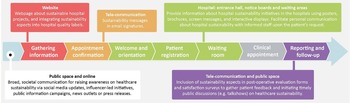
Interviewees made suggestions for communication along the patient journey (Figure 1). Similarly, in research information sharing and interpersonal communication are described as key elements in building patient confidence and satisfaction throughout perioperative care (Reference Bur, Wilson, Lewis and MissenBur et al., 2024). To engage patients before visiting the hospital, an information page on sustainable hospital projects on their website or sustainability messages in email signatures could introduce the topic. When visiting the hospital, posters or screen messages and brochures in hospital entrance and waiting areas were viewed as suitable ways to inform patients during waiting periods. Importantly, patients highlighted that hospital staff should be informed about HSI’s or know where to refer patients for further information so that patients can seek information by addressing staff during their visit. Broader, societal communication for raising awareness can use social media updates, public information campaigns or press releases. Sharing testimonials from hospital departments, or success stories from other institutions was seen as a way to enhance familiarity and trust. Finally, increased visibility and dialogue between hospitals and patients could help place sustainability more prominently on political and research agendas, fostering more research and investment. Patients can be viewed as consumers within health systems, and our findings indicate that their behavioural determinants closely mirror those identified in the SHIFT framework for sustainable consumer behaviour (Reference White, Habib and HardistyWhite et al., 2019). Similar to consumer contexts, patients’ acceptance of sustainable healthcare initiatives was shaped by social influence, personal identity, emotional responses, and cognitive evaluations. Correspondingly, several patient-driven solutions align with strategies proposed in the literature, including leveraging social desirability, providing clear and accessible information, and using recognisable markers such as eco-labels to signal sustainability. These parallels suggest that established consumer-behaviour models can offer valuable guidance for designing effective patient-facing sustainability interventions in healthcare.
Visual overview of recommended touchpoints along the patient journey

4.3. Limitations
This study sought to capture patient perspectives. However, several limitations should be considered when interpreting and transferring findings to other contexts. The sample predominantly consisted of female participants, partly due to the absence of sampling quota set in the study design. This gender imbalance may reflect a broader trend in which women tend to be more engaged with sustainability issues (Reference Diamantopoulos, Schlegelmilch, Sinkovics and BohlenDiamantopoulos et al., 2003) and thus more willing to participate in related research interviews. Additionally, the use of personal interviews may have influenced participants’ responses. Given the socially desirable nature of sustainability, some participants may have provided answers they perceived as favourable when interviewed by a known contact. Furthermore, using students as primary data collectors poses challenges for the quality assurance of data. To ensure consistency and reliability, we implemented safeguards: (i) a standardised interview guide used by all student interviewers, and (ii) full checks of interview transcripts by a senior researcher. We used qualitative interviews to gain insights into TPB constructs, while mostly quantitative methods are used in literature (Reference Renzi and KlobasRenzi & Klobas, 2008). However, to gain more nuanced understanding of patient underlying beliefs and contextual influences, qualitative interviewing was employed.
5. Conclusions
This study explored the patient perspective to foster the implementation and acceptance of hospital sustainability initiatives (HSI) and reusable textiles. Building on these insights, we sought recommendations for designing interventions and communication strategies that align environmental objectives with patient satisfaction. It reveals that while patients view reusable medical textiles as an environmentally responsible choice, their trust and decision-making remain anchored in safety, hygiene, and clinical quality. Patients and public opinion are shaped by social influences, including news coverage and interactions with personal contacts. Sustainability is generally seen as a hospital-level responsibility, yet patients value visible, transparent communication on HSI. Currently hospitals offer limited visibility of such initiatives, highlighting opportunities for tangible and relatable communication strategies that make sustainability efforts visible. Designing communication touchpoints, such as digital displays, interactive dashboards, or narrative posters, can help visualise ongoing sustainability actions. From the interviews, we found that beyond the TPB constructs, second-order determinants such as emotions, compatibility with personal commitment and knowledge also shaped patient acceptance. These factors relate with concepts from existing models, including the Decomposed Theory of Planned Behaviour (which incorporates innovation attributes from the Diffusion of Innovation theory e.g., compatibility and relative advantage), the SHIFT framework (which includes emotional drivers and social influence) and emotional design principles. Indicating that normative interventions, such as sustainability benchmarking, labels or awards, could further normalise environmentally responsible practices. We propose a subtle yet powerful design strategy that integrates sustainability communication into patient journeys in ways that inform and engage patients with without disrupting clinical interactions. In this way, design can help shift sustainability from a background initiative into a visible, participatory, and trusted part of healthcare practice.
Future research should expand the diversity of patient samples to better understand how different demographic and cultural groups perceive and engage with HSI. Quantitative studies could further test how specific informational, social and normative messages influence patients’ awareness, trust, and behavioural intentions. Additionally, future investigation may include how hospitals’ sustainability image influences institutional reputation, including their potential role in attracting both patients and healthcare professionals.
Acknowledgement
The authors would like to acknowledge the students for their work. This study received ethical approval from the University of Antwerp Ethics Committee for the Social Sciences and Humanities (SHW_2024_186_3) on November 26, 2024. The participants were informed about the study and written informed consent was obtained before participation in the interview.
Hyperlink to Table. Interview guide: https://drive.google.com/drive/folders/1dKy8sH9eqFqFAJOUaoKbpat6xdjxpBBS?usp=drive_link


 Open access

