

Introduction Footnote 1
During 2024, national elections were held in more than seventy countries across the world, encompassing more than half the global population. Several trends could be discerned from those elections, including the ousting of incumbents, the staying power of rightwing populism, polarizing “culture wars,” and enduring international conflicts.Footnote 2 More than a dozen elections across Africa conformed with some of these global trends. So, for example, in South Africa and then Botswana, incumbent political parties that had been in power for thirty and sixty years, respectively, fared poorly at the ballot box or were voted out of office altogether, as were incumbent political parties in Ghana, Mauritius, Senegal, and Somaliland. Right-wing populism and its tendencies toward autocratization were increasingly evident in Africa as well, with one intervention suggesting that a “democratic counter-wave has washed over the continent,” and that democracy has “suffered more in Africa than any other world region since 2020” (Chin and Bartos Reference Chin and Bartos2024, 116). At the same time, Bob-Milliar (Reference Bob-Milliar2025) notes that Africans still prefer democracy to other political systems though they may decry the performance of their own multiparty governments; other sources (Afrobarometer 2024; Mo Ibrahim Foundation Reference Foundation2024; Arriola, Rakner, and van de Walle Reference Arriola, Rakner and van de Walle2023) also suggest the possibility of democratic resilience across the continent.
Many of the assessments of the 2024 elections—in Africa or otherwise—failed to mention the progress of women candidates, or the lack thereof. Indeed, according to news reports, during the 2024 “mega” election year, the world saw the “growth of women in power grind to a near-halt” (Venema, Hegarty, and Robertson Reference Vibeke, Hegarty and Robertson2024).Footnote 3 According to an end of year report, the road to parliament for women was “still rocky” (Sow et al. Reference Rai, Eromo, Rachel and Come2024) across Africa, although women’s representation in parliaments continues to rise slightly from one year to the next. Women’s representation at the highest levels of political office in Africa—as heads of state or government—remains miniscule despite some successes (Ngutjinazo Reference Ngutjinazo2025).
These election results for Africa (and the world) can be put into the context of a global gender gap, as revealed by the Global Gender Gap Index that benchmarks the current state and evolution of gender parity across four key dimensions: economic participation and opportunity, educational attainment, health and survival, and political empowerment. For nearly two decades this index has tracked gender parity—or the lack thereof—for regions and for countries. Globally, and in many countries, the health and education gaps are nearly closed while the economic participation gap is also closing, though slowly, standing at 61 percent in 2025. But shockingly, at the end of the first quarter of the twenty-first century, there is still an enormous gap in political empowerment—only 22.9 percent closed (World Economic Forum 2025).Footnote 4 There are three indicators that contribute to the political empowerment subindex: the ratio of women to men heads of state or government, the ratio of women to men members of national legislatures, and the ratio of women to men cabinet ministers (World Economic Forum 2024).Footnote 5
Taking a cue from this last indicator, this article investigates the contributions and experiences of women cabinet ministers in five countries in West Africa.Footnote 6 With such a scope—five countries—the examination of women cabinet ministers in this article is necessarily cursory, with the opportunity of much greater detail to be explored in a forthcoming book. Still, there is much to be learned from their contributions and experiences in West Africa. This study recommends a broader understanding of what it means to hail from or “belong to a political family” as a pathway to cabinet for women ministers. For example, this could refer to an experience of growing up in a political household or environment more broadly, or of learning about politics from a different vantage point, namely, as a child accompanying a mother who was a grassroots activist during political campaigns. This study suggests that women ministers may do all they can to promote women to leadership positions within their own ministries, rather than worrying about gender parity in cabinet, over which they have no control. Further, this study suggests that women cabinet ministers in these five countries perceive that they are able to have some substantive and, especially, symbolic representation impact while in office. Finally, this study finds that how and why women ministers exit cabinet remains an area requiring further research. In the main, these women cabinet ministers understand that they serve at the pleasure of the presidents who have appointed them and that there will be contingencies that influence appointments into and out of cabinet.
The article proceeds as follows: the next section asks why women cabinet ministers and why West Africa. The following section discusses the theoretical approach, data collection, and data analysis for this study. The three sections thereafter examine women cabinet ministers in West Africa as they enter office—including their “paths to power”—as they experience office—including attitudes to gender parity and perceptions of representational effects—and as they exit office—including experiences of cabinet shuffles. A final section concludes the article.
Why women cabinet ministers and why West Africa?
There are a few reasons to focus on women cabinet ministers. There is scant research on them in general and in Africa in particular, perhaps, in part, because of a lack of consistent and comparable data on women in cabinets. Fortunately, the lack of both data and research is slowly changing. Most recently, Saaka (Reference Saaka2025a, Reference Saaka2025b) has created a novel dataset of 3,829 cabinet ministers for twenty-five African countries spanning three decades that he used to investigate questions concerning women cabinet ministers in Africa. Raleigh and Wigmore-Shepherd (Reference Raleigh and Wigmore-Shepherd2022), through the African Cabinet and Political Elite Data Project, tracked African cabinet ministers on a monthly basis from 1997 to the early 2020s, while Nyrup and Bramwell (Reference Nyrup and Bramwell2020) assembled a global database on cabinet ministers for all countries with a population over 400,000 from 1966 to 2016—both of which should assist in future research and scholarship, including on women cabinet ministers. Recently, using data from authoritarian regimes in thirty-eight countries from 1973 to 2013, Kroeger and Kang (Reference Kroeger and Kang2024) sought to explain variation in the inclusion of women in authoritarian cabinets in Africa, while earlier, Arriola and Johnson (Reference Arriola and Johnson2014) created an original dataset of cabinet ministers from 1980 to 2005 in thirty-four African countries in order to understand variation in women’s access to ministerial positions. Jacob, Scherpereel, and Adams (Reference Jacob, Scherpereel and Adams2014) used an original database of ministers from 1979 to 2009 to test the influence of the international diffusion of gender norms on increases in women’s presence in cabinets, and Krook and O’Brien (Reference Krook and O’Brien2012) compiled an original dataset of cabinet ministers in 117 countries in 2009, coding for gender and prestige of ministers and their portfolios. Still, aside from the annual map published by UN Women (UNWomen 2025),Footnote 7 no data source tracks women in cabinets like the Inter Parliamentary Union (IPU) does for women in parliaments, with the IPU updating their ranking monthly. Cabinets and their ministers are also more challenging to research than legislatures and their members because their work is opaque, often taking place behind closed doors with little public access or report back. This is in marked contrast to parliaments whose sessions are typically published verbatim, if not broadcast live on various media platforms. Thus, while there is a robust literature on women in parliaments, in Africa and around the world, there is much less of a literature on women in cabinets (Olaitan Reference Olaitan2024; Bauer Reference Bauer, Yacob-Haliso and Falola2021; Stockemer Reference Stockemer2017).Footnote 8
At the same time, across the world, cabinet ministers are significant political players with access to substantial political power. Indeed, for cabinet ministers, the appointment to cabinet likely represents a prestigious and lucrative career pinnacle, considerable agenda-setting and policymaking powers, and the opportunity for substantive and symbolic representation impact (Annesley and Franceschet Reference Annesley and Franceschet2015). Stockemer (Reference Stockemer2017, 434) has argued that cabinet “is more important to governmental decision-making processes and policy implementation than the legislature,” and Adams and Scherpereel (Reference Adams and Scherpereel2019) have asserted that in Africa “cabinet, rather than parliament, is the centre of power” for women. Barnes and O’Brien (Reference Barnes and O’Brien2025, 9.3), meanwhile, show that “women’s presence in the executive branch is always lower than in the legislative branch,” though both are increasing globally.
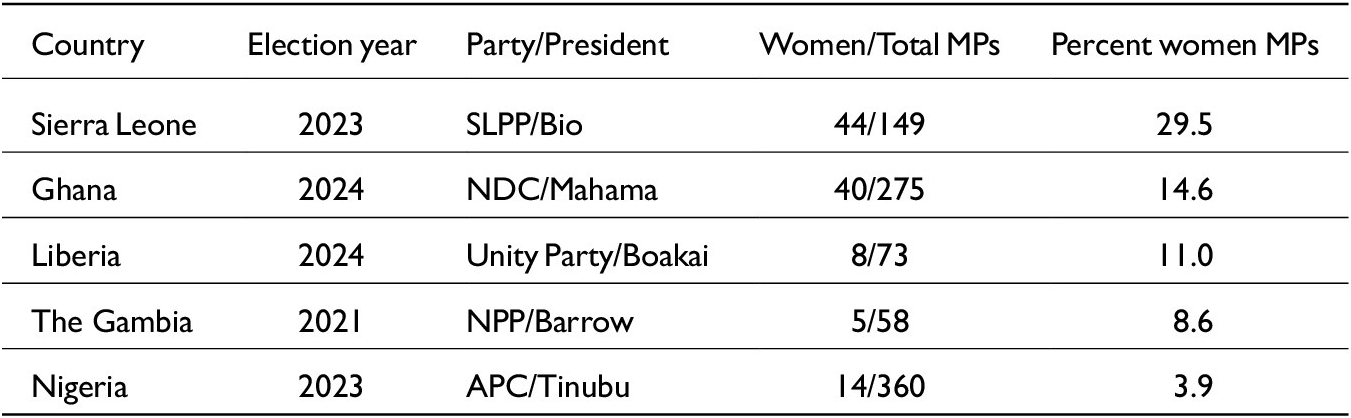
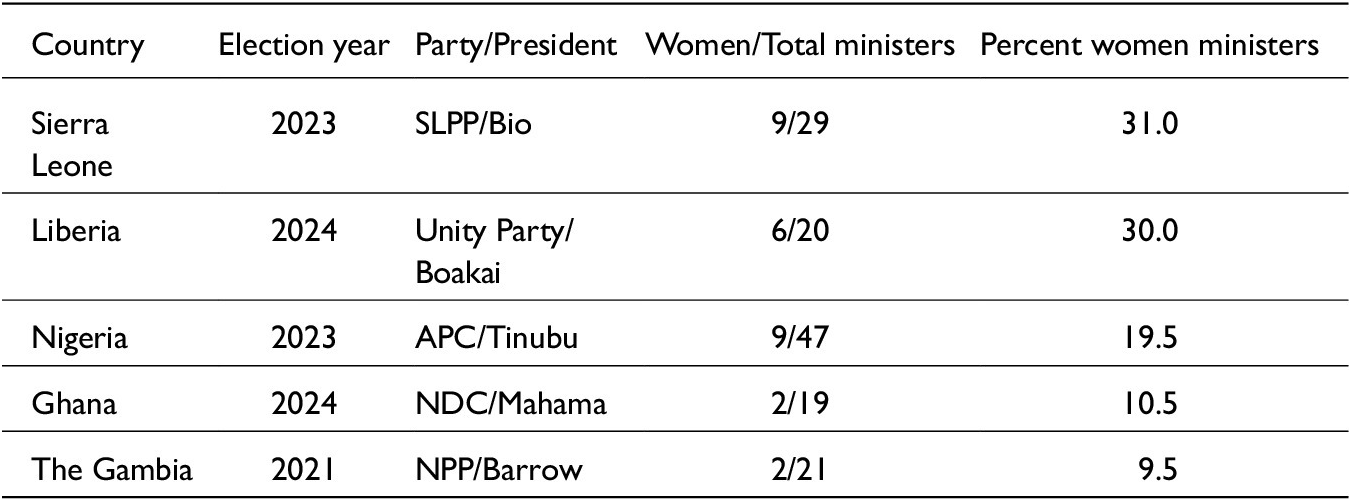
Five countries in West Africa have been selected for this study for a few reasons. I have been working on women in political office in Ghana for more than a decade and, with Akosua Darkwah, have published one of the few studies on the cabinet appointment process—and its gendered implications—in an African country, namely, Ghana (Bauer and Darkwah Reference Bauer and Darkwah2022). This study expands my previous work to other countries in West Africa. The “Anglophone” countries of the region have been chosen, in part, because of my own language limitations but also because the Anglo/American colonial heritage has implications for the type of electoral system used in a country and therefore implications for the level of women’s representation in politics. This is especially true for parliaments. Around the world, many former British colonies utilize some type of plurality/majority single member district (SMD) electoral system for parliament. As a “candidate-centered” electoral system this is also a “woman-unfriendly” electoral system and countries that use it, typically without an electoral gender quota, will have lower representation of women in parliament (Bauer Reference Bauer, Yacob-Haliso and Falola2021). In an exceptional move, Sierra Leone changed to the more “woman-friendly” proportional representation (PR) electoral system and added an electoral gender quota in 2023. Sierra Leone is now alone among the five countries in this study to have reached 30 percent women in parliament, while the others range from 4 percent (the lowest in Africa) for Nigeria, to 14.5 percent for Ghana (see Table 1). Parliament may be seen as a pipeline for cabinet; for example, in a study of 194 countries from 1965 to 2014, Stockemer (Reference Stockemer2017, 434) found a “strong link” between more women in parliament and more women in cabinet. Indeed, Sierra Leone now leads the five countries in this study both metrics (see Table 2).Footnote 9
Women’s representation in parliament in five West African countries, July 2025

Source: https://data.ipu.org/women-ranking/.
Initial appointments of women to cabinets in five West African countries, most recent elections

Source: See country tables in the Appendix.
All of this has meant that these five West African countries have lagged behind others in Africa—for example, Namibia, Rwanda, Senegal, South Africa, Tanzania, and Uganda—in women’s representation in political office and are, thus, worthy of further scrutiny.Footnote 10 Moreover, West Africa has also been the locus of military coups and military regimes in Africa, which may have negative implications for women’s representation in politics. A few studies (Bauer Reference Bauer2017; Fallon Reference Fallon2008; Ibrahim Reference Ibrahim2004; Mama Reference Mama1995) suggest the need for greater examination of the legacies of military rule for women’s political leadership in Ghana and Nigeria, given the way in which, under military rule, First Lady-led foundations occupied the associational space otherwise available to women’s organizations and mobilization. Postconflict countries, meanwhile, have been found to have some of the strongest guarantees of women’s rights and political empowerment across Africa (Hughes and Tripp Reference Hughes and Tripp2015; Tripp Reference Tripp2015),Footnote 11 though that appears to be less evident in Liberia and Sierra Leone (Beoku-Betts and M’Cormack-Hale Reference Beoku-Betts and M’Cormack-Hale2022). The five countries in this study include two postmilitary nations (Ghana and Nigeria), two postconflict states (Liberia and Sierra Leone) and one postdictatorship country (The Gambia).
Theoretical approach, data collection, and data analysis
Overall, this study follows an interpretive approach, relying on questions and observations to generate a rich and deep understanding of the contributions and experiences of women cabinet ministers in five West African countries; such an approach allows for the use of descriptive research, which proves particularly valuable in this context. One of the four benefits of descriptive research is how it contributes to political science by acknowledging “the complexity of the world,” as it “helps us to understand how we reflect or recreate the biases that exist in the world. Questions of whose voices are heard or assume prominence in the discipline are founded not only on questions of who is speaking but also who is listened to and heard” (Holmes et al. Reference Holmes, Gifford, Mendoza-Dave and Jurkovich2024, 54). This research introduces new voices to the study of women cabinet ministers across the world. The interviews that are the primary data for this study may be understood as constituting life-history research in that they delve into the respondents’ individual experiences, seeking to provide an in-depth understanding of their life trajectories from their perspectives (Geiger Reference Geiger1987). Life-history research involves collecting detailed accounts of lived experiences, personal narratives, memories, and reflections of individuals across time, and that has been the strategy with this article. The study relies upon a feminist theoretical framework that is normative and reflects a commitment to gender equality, for example, in appointed and elected public office.
To begin collecting data for each of the five countries, using a purposive sampling technique, I compiled lists of women cabinet ministers appointed to cabinets by presidents at the start of their administrations. Then, by a snowballing sampling technique, I amassed the names of additional women who were subsequently brought into cabinets during shuffles. I relied heavily on a network of mainly scholarly contacts to help me approach potential informants. Following the example of Annesley, Beckwith, and Franceschet (Reference Annesley, Beckwith and Franceschet2019), I interviewed only former women cabinet ministers. Ministers currently in office are likely to be difficult to access, while those out of office are likely to speak more candidly and reflectively about their experiences and to be less constrained by partisan politics. While I have visited all five countries except Nigeria, few of the former women cabinet ministers are there. Rather, these highly talented former ministers have been recruited for new jobs outside their countries, with international organizations like the United Nations or regional organizations like Economic Community of West African States (ECOWAS), or posted to embassies abroad as ambassadors, or even relocated abroad to join family or resume previous careers. As a result, most interviews were conducted via Zoom, typically lasting for an hour or more. I audio-recorded all interviews using the Recorder app on my mobile phone and then transcribed the interviews. My goal has been to augment the rich interview material with other firsthand accounts such as other published interviews and memoirs,Footnote 12 and with contemporary news reports and the secondary literature.Footnote 13 This article draws on the experiences of just over twenty former women ministers from all five countries, conducted between mid-2023 and late 2025; in addition, a few previous interviews conducted in Ghana in 2017 and 2019 are referenced as well. To date, I have interviewed five former women cabinet ministers from The Gambia, five from Ghana, four from Liberia, two from Nigeria, and five from Sierra Leone. While the identity of those interviewed is known to me—the interviewer and author—the interviews have been anonymized for purposes of this article.
In analyzing my data, I have relied upon “the most widely used qualitative analytic method in the social sciences,” according to Swain (Reference Swain2018, 5), namely, thematic analysis. In citing other scholars’ work on thematic analysis, Swain observes that thematic analysis identifies and sorts the themes deemed important in the description of the phenomenon under study—often in association with specific research questions. Thematic analysis, in addition to revealing themes that emerge, is a way of encoding patterns of meaning in qualitative data (Swain Reference Swain2018, 5). While in such situations one may use deductive or inductive approaches to “coding” the data, my study relies on a more inductive approach in which new data are being generated. Of course, I am mindful of my own role “as a mediator, influencing data/findings, by constantly making choices and selections on how and what to code, and how and why data/findings are presented and re-presented” as they are (Swain Reference Swain2018, 8). Indeed, the questions I posed to my informants set the stage for my findings.Footnote 14
My interview instrument consisted of a set of questions organized around four larger themes: paths to power, attitudes to gender parity, perceptions of representation impacts, and experiences of cabinet shuffles; these have been drawn from my reading of the broader literature on women cabinet ministers around the world but also of women in politics in West Africa. With a relatively small number of interviews, I was able to manually “code” the responses by searching for meanings and patterns in the conversations/interviews (Swain Reference Swain2018, 13). Eventually, I was able to identify excerpts from my interviews in which the interviewee had said something particularly “illustrative of a point or argument” (Swain Reference Swain2018, 20) that I would then use in the text of my article and which would contribute to my overall argument.Footnote 15 While the larger parameters may have been set by the interview questions, the findings emerged inductively from the collection of responses.
To begin: Entering political office as a woman cabinet minister in West Africa
A robust literature investigates what influences women’s appointments as cabinet ministers. Barnes and O’Brien (Reference Barnes and O’Brien2025) identify the “feminization of politics” (more women in legislatures), regime type (democracies vs. autocracies), and institutional factors as playing critical roles in women’s appointments to cabinets. Breuning and Okundaye (Reference Breuning and Okundaye2021) suggest, based on the Ethiopian experience, that appointments of women to cabinet in the Global South may be influenced by donor imperatives. Annesley, Beckwith, and Franceschet (Reference Annesley, Beckwith and Franceschet2019) conclude, based on seven cases from around the world, that formal rules and informal practices are key to the gender composition of cabinets, a finding that was confirmed by Bauer and Darkwah (Reference Bauer and Darkwah2022) for Ghana. Arriola and Johnson (Reference Arriola and Johnson2014) find, in a study of thirty-four African cases, that there will be fewer women cabinet ministers when politicized ethnicities must be accommodated, while Jacob, Scherpereel, and Adams (Reference Jacob, Scherpereel and Adams2014) suggest that, globally, a widely accepted gender-balanced decision-making (GBDM) norm is bringing more women into cabinets. Bauer and Okpotor’s (Reference Bauer and Okpotor2013) study confirmed what much of the literature argues, namely that the “specialist” method of appointment creates more opportunities for women cabinet ministers than the “generalist” method (discussed in more detail below), with normative influences also significant, while Krook and O’Brien (Reference Krook and O’Brien2012) argue that when there are more women among political elites, there will be more women ministers.
More specifically, the “paths to power” of women political leaders—those who have served as presidents and prime ministers, for example—have also been discussed broadly in the literature (Celik and Hager Reference Evren and Hager2021). One phenomenon that has received widespread attention, not only for presidents and prime ministers, but also for women cabinet ministers, is “belonging to a political family,” which has been found to be an advantage for entering national executive offices in democracies and nondemocracies alike (Jalazai and Rincker Reference Jalalzai and Rincker2018, 54). For example, Jalalzai and Rincker (Reference Jalalzai and Rincker2018, 55) have reminded us how surnames like Bush, Nehru-Ghandi, Marcos, Clinton, Trudeau, Bhutto, and Park have played “important roles in determining who holds national executive office, even in countries with free and fair elections.” Smith and Martin (Reference Smith and Martin2017, 131) investigated this question specifically for cabinet appointments in Ireland from 1944 to 2016 and found that, indeed, “politicians with a family history in cabinet do enjoy an advantage in cabinet selection.”
In terms of the path to power, the former women cabinet ministers I interviewed did not relate that they had gained access to political office because of close male relatives who were in politics—though they may well have come from political families, broadly understood. This is similar to what Tamale (Reference Tamale1999) found in her profiles of five women politicians in the 1990s in Uganda. Some of the former women ministers I spoke with may have had the occasional distant relative who had served in one government or another, but more likely the connections were of another sort. So, for example, a Minister of State from Sierra Leone described that her grandfather’s house—far from Freetown—“was like Grand Central,” (Interviewee 2023)Footnote 16 with important people coming and going daily. He lived a life of community service and from him his future minister granddaughter developed her empathy for others. Moreover, when she first ran for political office (she was an MP before being appointed minister), she noted: “I remember in every village people said ‘oh, your grandfather came from here’ and it was because he touched so many lives, he worked for so many people as a community leader.” (Interviewee 2023).Footnote 17 A former Justice Minister from Ghana recounted that she grew up in a house “full of politics and politicians,” (Interviewee 2023)Footnote 18 including political leaders from her own country and from across West Africa.
Not all the women ministers I interviewed hailed from elite or overtly political families, and when they did not, they had often been raised by single mothers—but mothers who were involved in politics from behind the scenes. As a former Foreign Affairs Minister from Sierra Leone remarked: “I am a first generation [meaning formally educated]. But my mother was an illiterate local activist. Because in politics in Africa, they have these women leaders who are the mobilizers, who get people together, who are the gatekeepers, and all politicians know, they have to have them on their side. So that is the background from my mother’s side. So, I saw her, and I benefited from it.” (Interviewee 2023)Footnote 19 Similarly, in The Gambia, a mother long ago campaigned for the country’s first president and brought along her children, including a daughter who would one day become a Minister of Trade, Industry, Regional Integration, and Employment and vice president. Also from The Gambia, a former Minister of Health and Social Welfare had “aunties” who were busy in politics behind the scenes, as she noted: “I was named after my dad’s younger sister, and she was engaged in politics—but behind the scenes. African women support candidates behind the scenes … women in Banjul in politics are just what I would call the support base.” (Interviewee 2023)Footnote 20 In many cases, these early experiences of grassroots politics led by women inspired their daughters to later enter formal politics.
But fathers who strongly encouraged their daughters in different ways from an early age also constitute a strong theme across all five countries in my interviews. Interestingly, this is consistent with what Dawuni (Reference Dawuni2025, 14) found in interviews with African women judges, challenging, she suggests, “the general assumption that the girl-child in Africa does not always have equal opportunities as the boy-child.” As one example among many, a former Foreign Affairs Minister from Ghana recounted how her father, thinking himself unable to enter politics himself, encourage both her and her sister to do so in his stead. Or the progressive Islamic jurist father of a former Women Affairs Minister from northern Nigeria who made sure that his lastborn daughter was highly educated and exposed to the world. Indeed, as others have observed, in these patriarchal societies a father’s blessing was surely needed for a daughter to take the steps that these women did—landing them one day at the pinnacle of political power.Footnote 21 Indeed, encouragement, and especially active recruitment from, say, political parties has been found to be hugely instrumental in women’s decisions to stand for political office—though still “not enough” as Dittmar (Reference Dittmar2015, 759) notes. A former Tourism Minister in Ghana emphasized the importance of such encouragement, in her case from other women in politics: “it takes a woman to hold another woman’s hand to get an entry point … so if you don’t have a sister-friend who can actually push you or urge you on, it could be difficult.” (Interviewee 2023)Footnote 22 , Footnote 23
Nearly all the women cabinet ministers in these countries appear to have been selected for office because of significant competencies and experience in the areas of their portfolios. So, for example, a Minister of Basic and Secondary Education in The Gambia with a thirty-year career developing girls’ education in rural Gambia; a Justice Minister in Liberia with a lifetime working in corrections; a Health and Sanitation Minister in Sierra Leone with a long career in the pharmaceutical industry; a Women Affairs Minister in Nigeria selected by a president in search of a minister outside his own political party but also a “technocrat” with the requisite training and skills.Footnote 24 In this regard, these former women ministers are consistent with a literature—including broader work on cabinet appointments (Davis Reference Davis1997; Siaroff Reference Siaroff2000; Bauer and Okpotor Reference Bauer and Okpotor2013, 85–86)—that observes that women usually fare better under ‘specialist’ appointment practices, where selection is based on skills and expertise, than under ‘generalist’ practices based on party or national political experience. At the same time, of the twenty-one former women ministers interviewed for this study, the vast majority headed “soft” portfolios like Education, Health, Gender or Women’s or Social Affairs, with only a few leading “hard” portfolios like Justice, Trade, or Foreign Affairs. In this regard too, these West African examples are consistent with global trends. Though this is changing around the world, women cabinet ministers have long been assigned “soft” or “outer” portfolios or departments while men cabinet ministers are assigned to the “hard” or “inner” portfolios or ministries (Kroeber and Hueffelmann Reference Kroeber and Hueffelmann2022).
War and conflict have propelled women into politics across Africa (Tripp Reference Tripp2015), in part because they disrupt gender relations; one reason for this is the education and training opportunities that women may have received when forced to flee their countries. In Liberia, a future Minister of Gender, Children, and Social Protection experienced detentions and executions of family members “because of their ties, or their names, or they were part of the ruling party,” (Interviewee 2023)Footnote 25 at the time of the country’s first military coup in 1980. Soon thereafter her family fled the country. Many former women ministers from Liberia and Sierra Leone ended up outside the country during the war years, often pursuing further education and training that would eventually prepare them to return home and enter public service in leadership positions, as former Justice Minister Tah (Reference Tah2020), for example, recounts in her memoir.
One very clear pipeline to a cabinet appointment in these countries (as in others)—is a term or two in parliament. Those women cabinet ministers who had not been MPs may at least have stood for parliament. Many of the women who stood for elected political office were compelled to do so for reasons identified by Dittmar (Reference Dittmar2020) in the context of US electoral politics since 2016: a perception of threat. A former Minister of State in Sierra Leone was motivated to stand for parliament by years of exploitation by iron ore mining companies in her constituency. She said she was so outraged by how people were living in the villages, that “fear went out the window.” (Interviewee 2023)Footnote 26 Moreover, she was repeatedly asked to stand by the grassroots women with whom she was working. A former Trade, Industry, Regional Integration, and Employment Minister and a human rights activist from The Gambia spent years documenting the suffering and abuse of her compatriots in the hinterland under the violent Jammeh dictatorship. She too was repeatedly asked to run for political office until finally she realized she had to offer herself as a candidate. In such cases, as Dittmar (Reference Dittmar2020) also found in the United States, candidates can emerge, at least in part, from perceptions that the costs of not running are too high to stay on the sidelines.
Creating a cabinet has been described as akin to assembling the pieces of a puzzle (Annesley, Beckwith, and Franceschet Reference Annesley, Beckwith and Franceschet2019), with many factors necessarily taken into consideration by the “selectors.” The selection of these former women cabinet ministers from West Africa—as they have described the processes—helps to expand our understanding of some of those factors, in particular, what “belonging to a political family” can mean—and to broaden our understanding about what the “path to power,” or entering cabinet, can look like for women accessing cabinet anywhere. For example, ‘”belonging to a political family” may refer to an experience of growing up in a political household or environment more broadly or of learning about politics from a very different vantage point than having a direct family relation in political office.
To continue: Experiencing political office as a woman cabinet minister in West Africa
I now turn to some of the ways in which some women cabinet ministers in these five countries experienced their time in office. In none of the five countries have there ever been gender parity cabinets, or even close, although gender parity is not a new concept in West Africa. For example, Senegal has had a gender parity law for its National Assembly in place since 2010 (Lim Reference Lim2025). The African Union recognizes gender equality as a fundamental human right and, closer to home in West Africa, ECOWAS states a commitment to gender equality in its public pronouncements. The Ellen Johnson Sirleaf Presidential Center based in Monrovia is actively engaged in programming seeking to ensure women are equally represented in leadership roles.Footnote 27 Bauer and Darkwah (Reference Bauer and Darkwah2022, 547) reveal that one presidential administration in Ghana once contemplated forming a gender parity cabinet but found it impossible given various rules and practices about the composition of cabinet that had to be fulfilled. Globally, as Krook (Reference Krook2026) documents, the future of electing women (for a change) is about gender parity.Footnote 28
All the women ministers interviewed for this study would like to see more women at the pinnacle of formal political power, including gender parity. That said, the political context also intervenes. There were women ministers who conveyed to me that in postwar Sierra Leone, for example, “the last thing” anyone might be thinking about in cabinet was “gender parity,” with so many other pressing demands and concerns. Though they also clearly recognized how gender was likely implicated in any strategies to meet those demands and address those concerns. As a former Foreign Affairs Minister from Sierra Leone related, when she began her term in 2007, she found a “dysfunctional ministry” in which almost nothing was working—the telephones, the elevator; “you didn’t even have a stapler.” (Interviewee 2023) And, so, one of her tasks had to be “crisscrossing the world” (Interviewee 2023) to raise money to rebuild her ministry—rather than contemplating gender parity in cabinet. A former Women Affairs Minister from Nigeria also recounted the need to raise money for her ministry; for her, however, the far greater concern about gender parity lay with the country’s legislature, where women’s representation stood at a paltry 4 percent in 2025. As she noted, presidents have appointed more women to cabinet in Nigeria, but electing women to seats in the national legislature has proved far more daunting, despite stated commitments to bring more women into political office.
Interestingly, some of the women ministers were less concerned about more women in cabinet (over which they had no control anyway) and were more concerned about increasing women in leadership positions in their own ministries. Indeed, this would be where they, with their own powers of appointment, could make a difference—and many did. So, for example, given the postwar environment in Liberia, where rape had been, in effect, a weapon of war for nearly two decades, a former Justice Minister deemed it especially important to appoint more women in her ministry, including her deputy and the head of the special Sexual and Gender Based Violence Unit. A Health and Sanitation Minister from Sierra Leone remarked that gender parity in cabinet may not have been on her mind—but “if you ask about parity within the Ministry of Health, that was on my mind.” (Interviewee 2023)Footnote 29 One of her achievements there, she said, was to introduce more women into leadership—moreover, women who had been bypassed or overlooked by previous ministers. “When I arrived there were zero percent women in leadership positions and by the time I left there were 20 percent women in leadership positions … So I was able to promote women who were in the ministry and doing the work, but who had not been promoted.” (Interviewee 2023)Footnote 30 A former Foreign Affairs Minister from Sierra Leone noted that she was the first foreign affairs minister to appoint three women ambassadors. As one former Foreign Affairs Minister from Ghana later observed of appointing more women within their own domains: “that is what we do” (Interviewee 2025) [appoint women when and where we can].Footnote 31
This finding demonstrates another way in which these African women cabinet ministers, and their experiences, contribute to a broader understanding of the roles that women cabinet ministers may and do play. From this we learn the extent to which women cabinet ministers, always in the minority within their cabinets, may instead focus their efforts on bringing more women into leadership positions in their own ministries, as their contribution to gender parity. Field (Reference Field2021, 722) sought to investigate this question for six governments in Spain from 1996 to 2018 and found that the presence of women ministers was “highly relevant” to advancing women’s inclusion in politics; when the political context was more gender-balanced overall, she found, both men and women ministers appointed more women.
There is vast research and scholarship (including on Africa) on the substantive and symbolic representation impacts of having more women in parliaments, with the bulk of it asserting positive effects for women and children (Olaitan Reference Olaitan2024; Bauer Reference Bauer, Yacob-Haliso and Falola2021).Footnote 32 The global literature is also quite clear that having more women in cabinets matters, although that scholarship for Africa hardly exists. Looking at political parties in ten European countries, the USA and Canada, Homola (Reference Homola2022) found that governing parties fulfill more of their policy pledges when they have a female party leader and when there are more women in cabinet. Liu and Banaszak (Reference Liu and Banaszak2016) discovered that women ministers have similar role model effects to women legislators, encouraging women to engage in politics albeit that women’s ministerial representation plays an even more significant role than women’s legislative representation. Atchison (Reference Atchison2015) found that, for several advanced industrial democracies, women ministers positively impacted the adoption of policies that create a more female-friendly working environment. Mavisakalyan (Reference Mavisakalyan2014) showed that, for a large sample of countries in 2000, an increase in the share of women cabinet ministers is associated with an increase in public health spending, with increased health spending an example of ministers substantively representing women’s interests.
Nwankwor (Reference Nwankwor2021) provides one of the few studies to date on the substantive or symbolic representation of women’s interests by African women cabinet ministers. In a richly sourced article that contributes the voices of dozens of women ministers from Nigeria and South Africa, she asks what women cabinet ministers do once they are in power. She finds that they represent women’s interests but in “non-legislative” ways—for example, by creating programs that have direct impacts on women’s lives, such as initiatives around domestic violence, economic empowerment, and the provision of potable water and fuel sources. In my interviews, I sought to determine to what extent the women ministers perceived that any of these impacts followed from their terms in office.
The former women cabinet ministers from all countries were unanimous in asserting their substantive and symbolic representation impacts while serving in cabinet. Effects of substantive representation included, in The Gambia, finally seeing a Gender Ministry created, after advocating for it for decades. Or echoing Nwankwor’s finding of “non-legislative impacts,” the building of infrastructure and transportation in Liberia, critical for market women transporting their goods from rural to the urban areas. Or, in Sierra Leone, more mundanely, enlightening male counterparts on gender mainstreaming and sensitizing them on gender issues more broadly, presumably in hopes of positively influencing policy agendas around women and children. A former Tourism Minister from Ghana credits the many women cabinet ministers in Rwanda with the successes for women and girls in that country: “So, if you look at Rwanda, I will bet my last cedi, that Rwanda is having this rapid development because there are more women who are part of the decision-making.” (Interviewee 2023)Footnote 33 While this may have been a casual remark on the part of the former Tourism Minister from Ghana, significant literature on women in politics in Rwanda ties positive impacts on matters of concern to women in the country to their higher representation in parliament and across the government (see Burnet Reference Burnet, Franceschet, Krook and Tan2019).
In all five countries, former women ministers identified effects of symbolic representation as well.Footnote 34 They described the mentoring they do of young women and girls but also how they have acted as role models even to women and girls outside their countries. Some of these women ministers, especially those from Liberia, had experienced such symbolic representation impacts themselves, via previous women cabinet ministers, including their later President Sirleaf. As a Minister of Gender, Children, and Social Protection recounted: “In 1979, before the coup in 1980, Ellen Johnson Sirleaf was serving in government as the Finance Minister, and I saw this tough and strong woman on TV, and I thought, wow, when I grow up, I want to be like her.”Footnote 35 Alternatively, some women ministers were motivated just by working side by side with one another wanting to do more to strengthen and rebuild their countries.
Experiences of women cabinet ministers from these five countries, then, largely conform to the literature on the effects of substantive and symbolic representation of more women in political office. Always sitting in cabinets with very few other women members, accomplishing any substantive representational effects was far more challenging; but as pathbreaking women ministers they demonstrated the transformative power of early women officeholders as role models for future generations—a symbolic representation effect. And, as Nwankwor (Reference Nwankwor2021) found for women cabinet ministers in Nigeria and South Africa, women ministers might also be able to accomplish some substantive representation impacts in “non-legislative ways,” a novel way of understanding substantive representation.
To end: Exiting political office as a woman cabinet minister in West Africa
Across the world, cabinet shuffles—“personnel-related changes within the lifetime of a cabinet”—allow for “silent” makeovers of incumbent governments by replacing or relocating cabinet ministers—while governing proceeds (Helms and Vercesi Reference Helms and Vercesi2024b, 1148). They tend to be political events accompanied by much interest from the public and much attention from the media. They can help leaders and governments to rebuild popularity by bringing in new faces, to avoid “ministerial drift” (tighten the grip on a government’s policy agenda), to secure party discipline, and to generate particular policy effects (Helms and Vercesi Reference Helms and Vercesi2024b, 1148). To date, little comparative research has been conducted on cabinet shuffles around the world, with most work focused on “Westminster democracies,” and parliamentary democracies in Western Europe (Helms and Vercesi Reference Helms and Vercesi2024a, Reference Helms and Vercesi2024b).
Indeed, there has been less research on cabinet shuffles in Africa than in other parts of the world. Saaka’s (Reference Saaka2025a) recent study is an exception. In an investigation of cabinet shuffles in twenty-five African countries over the last three decades, he shows that women cabinet ministers serve shorter tenures than men, even when they occupy high-prestige portfolios, but that there are no significant differences in the likelihood of remaining in office. Moreover, his study finds that during cabinet shuffles, ministers are more likely to be succeeded by someone of the same gender, with men overwhelmingly replacing men but with women still facing higher probabilities of being replaced by men.Footnote 36 Beyond Africa, in a comparative study of initial gender parity cabinets in France and Spain, Beckwith and Franceschet (Reference Beckwith and Franceschet2024) found gender parity to be sustained during shuffles, unaffected by political shocks and party system changes. This question—of whether gender parity is sustained during shuffles—has not been explicitly tested for African countries where there have been only a handful of gender parity cabinets. Inacio, Llanos, and Pinheiro (Reference Inacio, Llanos and Pinheiro2024), meanwhile, found that in Latin America, cabinet shuffles are a function of presidents’ political incentives and reputational resources (risks of reputational damage/loss to a president) as well as of exogenous factors. Bauer and Darkwah’s (Reference Bauer and Darkwah2022) study of the cabinet appointment process in Ghana did not explicitly focus on cabinet shuffles but strongly concludes that cabinet appointments (initial appointments and later shuffles) are the president’s prerogative, as they are widely referred to in the media and by ministers themselves, notwithstanding some potential constraints. Among other things, this finding suggests that (far) more women could be more readily appointed to cabinets, by presidential fiat, than is currently the practice.
This view was reflected clearly in my interviews. In the case of shuffles in these five countries, former women cabinet ministers assert nearly unanimously that ministers serve at the pleasure of the president, and they perceive cabinet shuffles as being largely purposeful. So, a former Tourism Minister from Ghana noted: “You know it’s in the Constitution. The President can appoint you today and remove you tomorrow.” (Interviewee 2023)Footnote 37 A former Minister of State from Sierra Leone described being brought into cabinet during a shuffle, in part to take her out of parliament where she was advocating persuasively for a safe-abortion bill. Also in Sierra Leone, a former Minister of Foreign Affairs felt she was removed from office because an opposition leader who wanted her portfolio had to be accommodated: “to bring the country together” since he was from “the other side of the country.” (Interviewee 2023)Footnote 38 In that case, she was shuffled to another portfolio. Similarly in Liberia, under President Sirleaf, male leaders of political parties other than the governing party needed to be accommodated with ministerial appointments and so shuffles removed some women ministers from the cabinet.
Another woman minister in Sierra Leone felt she was shuffled out of office because someone needed to serve as scapegoat for failed policies related to the Ebola epidemic. A former Minister of Women’s Affairs and vice-president from The Gambia suggested that women were more likely to be shuffled out of office than their male counterparts, in part because a “male mentality” prevails. But the women cabinet ministers who were shuffled out of office were almost always offered another position—like ambassador or “called back to Statehouse”—though they did not always accept the offers. And nor were there usually hard feelings. By contrast, most former women ministers I interviewed expressed significant gratitude and valued the opportunity they had had to serve in cabinet. Many recognize, as do the literature and media reports, that cabinet appointments are the “prerogative of the president,” and are content to leave it at that, while still to this day benefiting from the experience and skills they gained—and being recognized and honored as former cabinet ministers.
The shuffle experiences of women cabinet ministers from The Gambia, Ghana, Liberia, Nigeria, and Sierra Leone suggest a fruitful agenda for future research, for example, around questions of why women ministers may be more likely to be shuffled out of cabinet than men, under what circumstances women are also shuffled into cabinets as ministers, and whether there is any concern among leaders to maintain some minimum gender balance amidst shuffles, among other questions.
Discussion: Women “selectors”
This article, based on my 2024 ASA Presidential Lecture, has necessarily provided only a cursory glance at the contributions and experiences of women cabinet ministers from five countries in West Africa during the last twenty or thirty years of post-transition governments. Space limitations have prevented anything but a passing mention of historical and political contexts which are, of course, essential for understanding any social science phenomena. One contextual factor that I did not explicitly consider during my interviews was the gender of the “selector,” the one who ultimately makes cabinet appointments. This is especially pertinent in the case of Liberia, where Africa’s first democratically elected woman president served two six-year terms (2006–2018). O’Brien et al. (Reference O’Brien, Mendez, Peterson and Shin2015) looked at this very question a decade ago, observing at the outset of their article that the literature is divided on the extent to which women executives are more or less likely to appoint women cabinet ministers, among other senior level positions. In their study, they found that female leaders are no more likely than male leaders to appoint women to cabinet posts or to appoint them to prestigious cabinet posts (O’Brien et al. Reference O’Brien, Mendez, Peterson and Shin2015, 691).Footnote 39 They attributed this to the differing “opportunities and constraints” facing male and female leaders in different governmental systems.
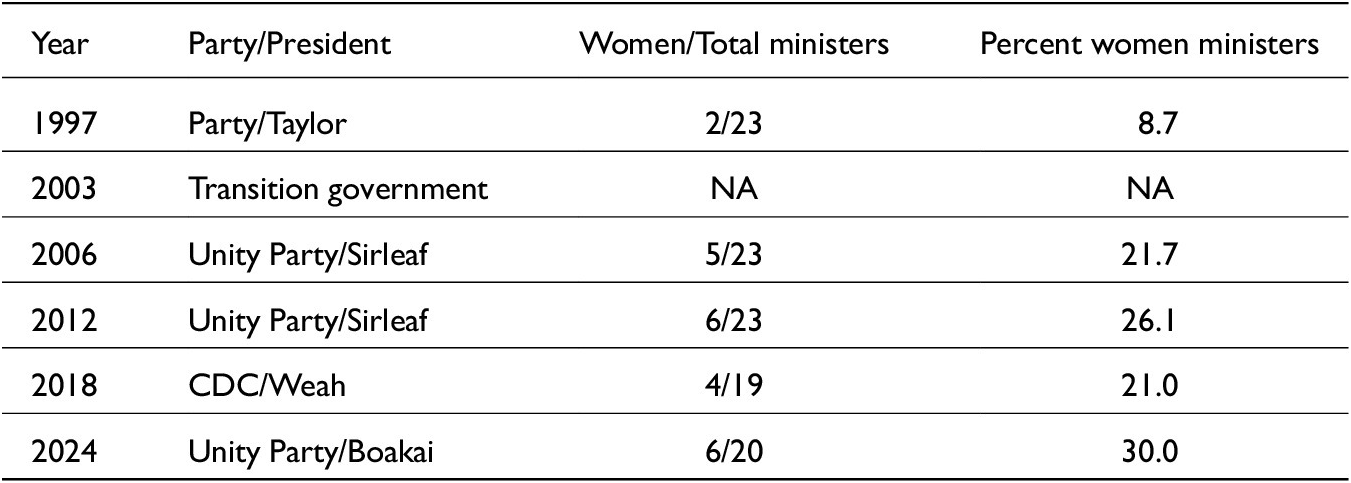
In the case of Liberia, we know that initial appointments to cabinets during President Sirleaf’s two terms were 22 and 26 percent women respectively (see Liberia table in the Appendix). Former President Sirleaf has addressed this very question in a 2019 Ted Talk. Given that it took two rounds for her to win the presidential election—in both 2005 and 2011—she had to promise away numerous presidential appointments to gain some political parties’ electoral support in the second round of balloting, thus also constraining her ability to appoint more women to cabinet. In her Ted Talk, she states that, instead, she sought to appoint as many women as she could to “cabinet level” positions albeit elsewhere in government (Sirleaf Reference Sirleaf2019). Those Liberian women who did serve as ministers in her cabinets found that she “had an eye for women” (Interviewee 2023) and she was plainly instrumental in persuading many Liberian women to return home at the end of war to serve in her government. In a 2017 book chapter, Adams probed the extent to which the substantive representation of women and their interests increased under President Sirleaf, acknowledging that the descriptive representation of women—more women—in the national legislature was not achieved. She concluded that the most significant gains during Sirleaf’s terms of office were in the area of symbolic representation, both in challenging gender norms and in serving as a role model for Liberian girls. A lack of legislative support impeded many substantive representation initiatives intended for women and girls (Adams Reference Adams and Montecinos2017, 184).
Conclusion: Contributions of women cabinet ministers from five West African countries
In conclusion, in the context of the historic 2024 presidential election in the United States, I have sought to call upon some examples of women’s executive political leadership in a few African countries. What my early interviews from The Gambia, Ghana, Liberia, Nigeria, and Sierra Leone reveal is that there is much that the scholarship on women in politics in Africa can contribute to the broader literature on women in politics literature.Footnote 40 In terms of entering cabinet as women ministers, we have gained a broader understanding of what it means to hail from or “belong to a political family.” For example, that this could refer to an experience of growing up in a political household or environment more broadly or of learning about politics from a very different vantage point. In terms of experiencing cabinet as a woman minister we have seen how women ministers do all they can to promote women to leadership within their own ministries rather than seeking gender parity in cabinet, over which they have no control. Further, that women cabinet ministers in these five countries perceive that they are able to have some substantive and, especially, symbolic representation impact while in office. Finally, there are many unanswered questions and potential areas of future research about exiting cabinet. In the main, these women cabinet ministers understand that they serve at the pleasure of the presidents who have appointed them and that there will be contingencies that influence appointments into and out of cabinet.
There is clearly much room for improvement in the numbers of women cabinet ministers in West Africa and elsewhere. As British political scientist Rainbow Murray (Reference Murray2014) has eloquently reminded us, by precluding a significant portion of the talent pool—namely, highly capable women as potential ministers—presidents and prime ministers dig deeper into an eventually less capable talent pool, which includes more men. In so doing, our leaders decrease the quality of representation for all of us, everywhere. What I have learned so far of women cabinet ministers in these West African countries seems to illustrate perfectly Murray’s assertion.
Finally, I would like to return to the quote in the original title of my original ASA Presidential Lecture from a former woman cabinet minister from The Gambia: “At the End of the Day it is the Politicians Who Make Policy.” She had spent much of her life as a civil society activist and only in her later years found herself in appointed political office. And from that vantage point, she realized that it is the politicians—those in elected and appointed office—who typically make policy though, more often than not, with the input of citizens from civil society. Hopefully, with deeper understanding and recognition of the important contributions that women can make in executive political leadership, for example in cabinets and including in a region like West Africa, women will continue to be appointed to cabinets in ever greater numbers and to ever more significant portfolios.
Acknowledgments
Many people helped me in this research, especially to secure interviews and during my research visits. I thank Dr. Aminata Sillah, Ms. Matty Saine-Dukuray, Mr. Sait Matty Jaw, Mr. Samba Bah, and Mr. Ebou Lawrence Mendy for significant efforts on my behalf in The Gambia, and Professors Aisha Fofana Ibrahim and Fredline M’Cormack-Hale, and Ms. Nimatulai Bah-Chang for their assistance in Sierra Leone. In setting up my interviews and travel to Liberia, Drs. Robtel Neajay Pailey and Tanya Ansahta Garnett were especially helpful. For assistance in setting up Zoom interviews with former women ministers from Nigeria, I thank Ms. Ayisha Osori. Finally, I acknowledge travel funding received from the University of Delaware Department of Political Science and International Relations and the Merian Institute for Advanced Studies in Africa (MIASA) based at the University of Ghana.
Appendix: Tables of women cabinet ministers from five West African countriesFootnote 41
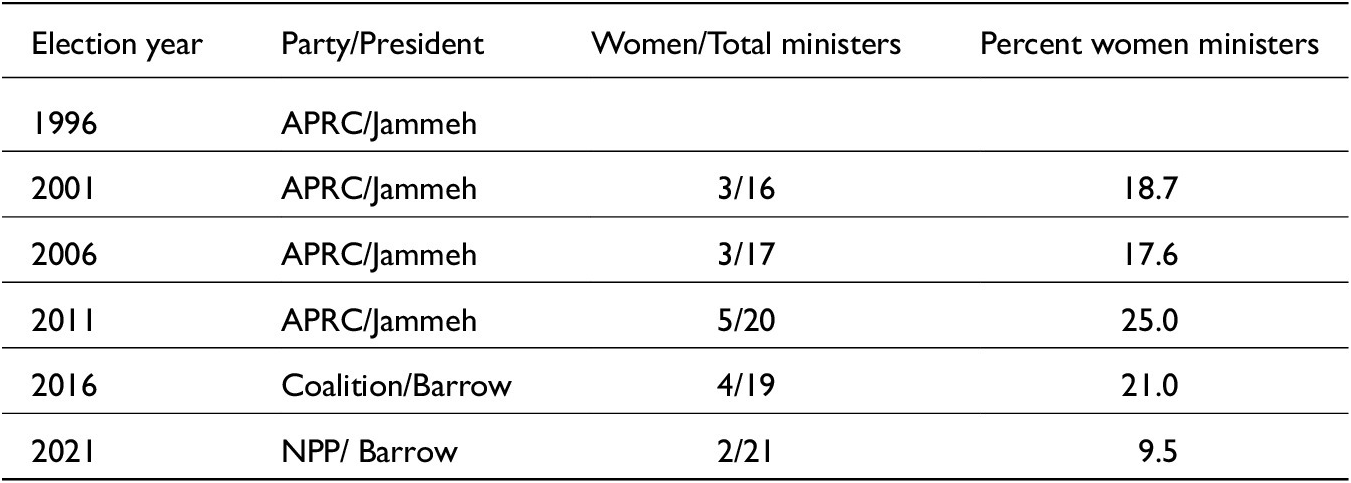
Women appointed to cabinet, The Gambia, Second Republic, initial appointments

Note: Ministers may not be MPs.
Sources: https://www.cia.gov/resources/world-leaders/static/historical-data/2001/January2001ChiefsDirectory.pdf; https://www.cia.gov/resources/world-leaders/static/historical-data/2006/January2006ChiefsDirectory.pdf; https://www.cia.gov/resources/world-leaders/static/historical-data/2011/January2011ChiefsDirectory.pdf; https://www.cia.gov/resources/world-leaders/static/historical-data/2018/January2018ChiefsDirectory.pdf; https://www.cia.gov/resources/world-leaders/historical-data/2022-august/gambia-the
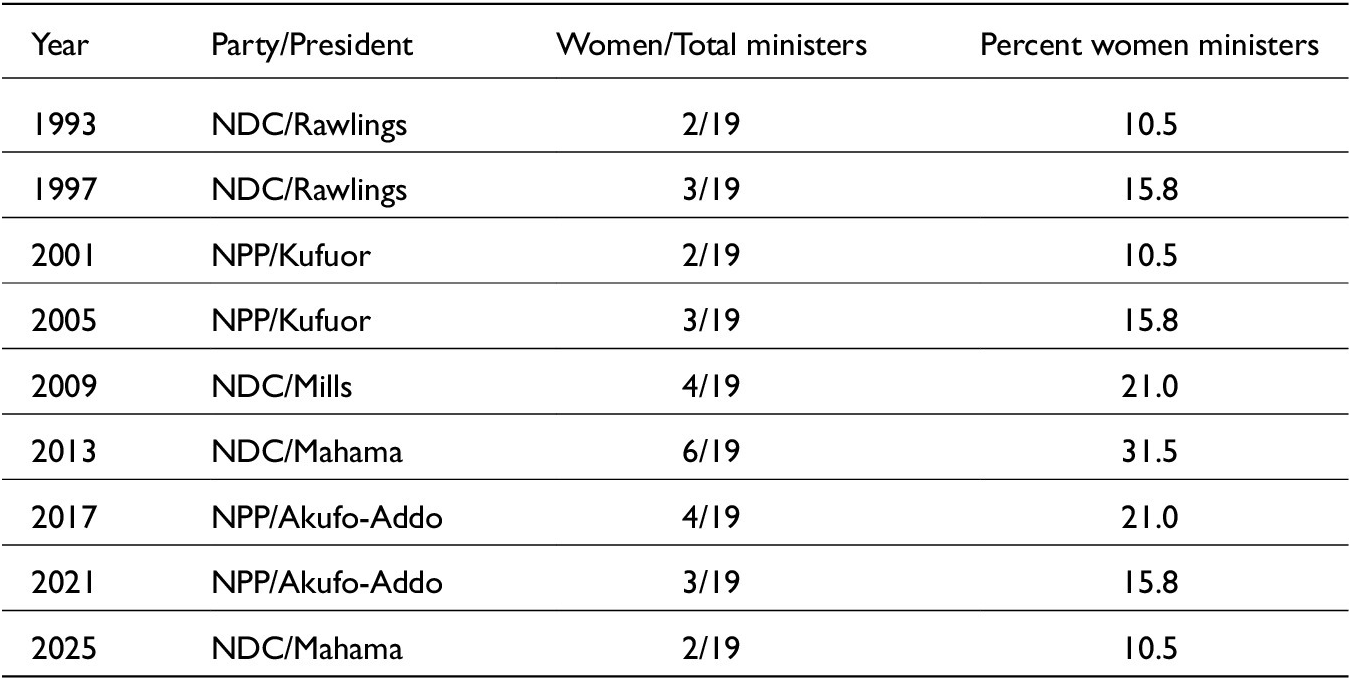
Women appointed to cabinet, Ghana, Fourth Republic, initial appointments

Note: According to the constitution of Ghana at least half (ten or more) of the nineteen ministers must be MPs from parliament.
Sources: Bauer and Darkwah (Reference Bauer, Darkwah and Scott2024); Bauer (Reference Bauer2025b).
Women appointed to cabinet, Liberia, initial appointments

Note: Ministers may not be MPs.
Sources: https://www.cia.gov/resources/world-leaders/static/historical-data/2001/January2001ChiefsDirectory.pdf; https://www.cia.gov/resources/world-leaders/static/historical-data/2006/June2006ChiefsDirectory.pdf; https://www.cia.gov/resources/world-leaders/static/historical-data/2012/June2012ChiefsDirectory.pdf; https://www.cia.gov/resources/world-leaders/historical-data/2022-october/liberia; https://www.cia.gov/resources/world-leaders/foreign-governments/liberia/
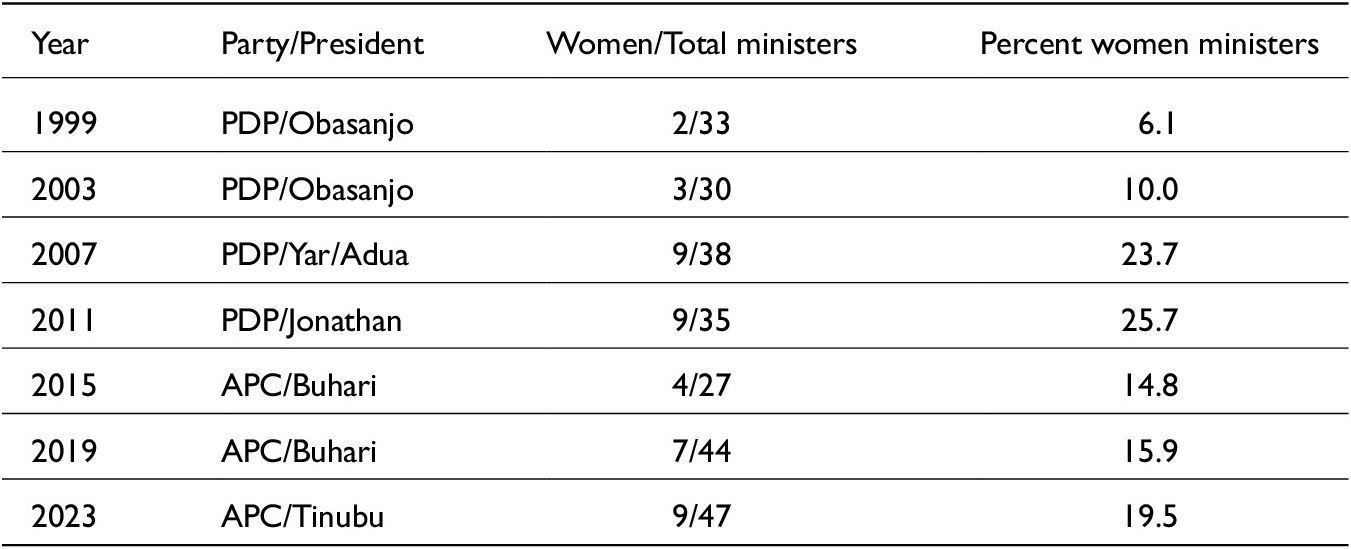
Women appointed to cabinet, Nigeria, Fourth Republic, initial appointments

Note: According to the constitution of Nigeria, there must be at least one Cabinet minister from each of the 36 states in Nigeria, although there are only 28 ministries and at times the President takes direct control of a key ministry such as Petroleum Resources. To ensure representation from each state, a minister is often assisted by one or more ministers of state. Ministers of state were sometimes included in the CIA World Factbook and sometimes not.
Sources: https://www.cia.gov/resources/world-leaders/static/historical-data/2001/January2001ChiefsDirectory.pdf; https://www.cia.gov/resources/world-leaders/static/historical-data/2003/December2003ChiefsDirectory.pdf; https://www.cia.gov/resources/world-leaders/static/historical-data/2007/December2007ChiefsDirectory.pdf; https://www.cia.gov/resources/world-leaders/static/historical-data/2011/December2011ChiefsDirectory.pdf; https://www.cia.gov/resources/world-leaders/static/historical-data/2016/December2016ChiefsDirectory.pdf; https://www.cia.gov/resources/world-leaders/static/historical-data/2019/December2019ChiefsDirectory.pdf; https://www.premiumtimesng.com/news/top-news/614108-ministerial-list-nigerian-women-kick-as-tinubu-fails-to-meet-35-per-cent-affirmative-action.html
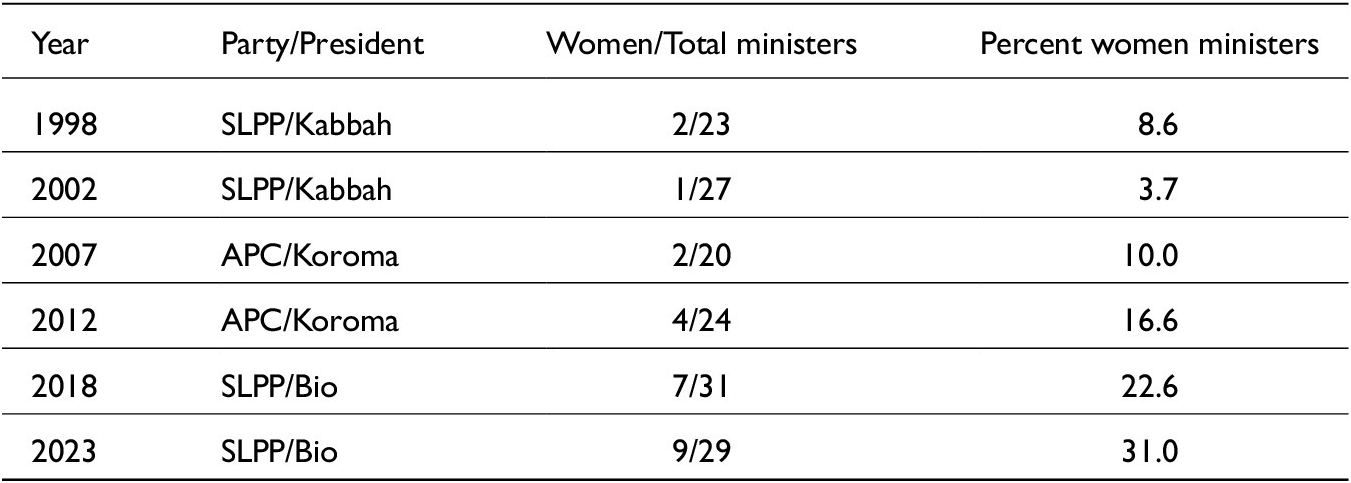
Women appointed to cabinet, Sierra Leone, Third Republic, initial appointments

Note: Ministers may not be MPs.
Sources: http://www.sierra-leone.org/cabinet-kabbah1.html; http://www.sierra-leone.org/cabinet-kabbah6.html; http://www.sierra-leone.org/cabinet-koroma1.html; http://www.sierra-leone.org/cabinet-koroma4.html; http://www.sierra-leone.org/cabinet-bio1.html; https://www.sierra-leone.org/cabinet-bio5.html

 Open access

