




1. Introduction
In some languages, canonical and non-canonical questions differ both syntactically and prosodically. For example, in Brazilian Portuguese, canonical questions are fronted and have final falling intonation, unlike non-canonical echo questions, which are not fronted (i.e. in-situ) and tend to end in a rise (Kato Reference Kato2019). In Italian, in-situ non-canonical questions are characterised by an upstepped rising nuclear pitch accent (L+¡H*); they also carry sentence prominence, reach a more elevated High, and have an expanded pitch range compared to information-seeking questions, which are fronted (henceforth, INF) (Badan & Crocco Reference Badan and Crocco2019).
In other languages, canonical and non-canonical questions only differ prosodically. For example, in-situ canonical and non-canonical questions in Korean differ in boundary tone, pitch range, and peak amplitude (Jun & Oh Reference Jun and Oh1996). In French, canonical and repetition questions show similar melodic contours, but the latter have a larger pitch range and longer duration of the wh-word (Glasbergen-Plas et al. Reference Glasbergen-Plas, Gryllia and Doetjes2021). In German, both echo and non-echo wh-in-situ questions are characterised by similar nuclear configurations, but the fundamental frequency (F0), duration, and intensity differ, with indignant echo questions showing the most elevated F0 and wh-phrase pitch range, and INF the lowest (Repp & Rosin Reference Repp and Rosin2015). Asu et al. (Reference Asu2022) reports a similar situation for Estonian, since canonical and non-canonical questions expressing surprise are realised with similar boundary tones, but surprise questions (SUR) have a longer total duration, wider pitch range, lower mean pitch, and a somewhat different distribution of pitch accents.
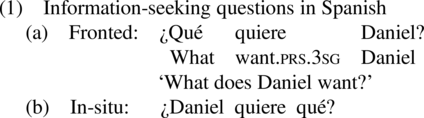
Content questions in Spanish are usually fronted as in Example (1a); but in some dialects, including Peninsular and Mexican Spanish, wh-in-situ questions are also used to request information as in Example (1b) (Jiménez Reference Jiménez1997, Uribe-Etxebarria Reference Uribe-Etxebarria2002, Etxepare & Uribe-Etxebarria Reference Etxepare and Uribe-Etxebarria2005, Reglero Reference Reglero2007, Reglero & Ticio Reference Reglero and Ticio2013). Wh-in-situ questions in most, if not all, Spanish dialects can also be used as ‘echo questions’ either to express surprise about or request the repetition of an immediately prior statement as in Examples (2)–(3).Footnote 2 , Footnote 3


This project investigates the intonational characteristics of these three types of wh-in-situ questions in Spanish: canonical or neutral wh-questions requesting new information (INF), and non-canonical repetition and surprise echo questions (REP and SUR, respectively). Although various analyses have been proposed to explain the syntactic differences between these three question types in Spanish and their connection to focus (see, for example Uribe-Etxebarria Reference Uribe-Etxebarria2002, Etxepare & Uribe-Etxebarria Reference Etxepare and Uribe-Etxebarria2005, Reglero Reference Reglero2007, Chernova Reference Chernova2013, Reglero & Ticio Reference Reglero and Ticio2013), their intonation has only been started to be investigated empirically in recent years (González & Reglero Reference González, Reglero, Ordoñez and Repetti2018, Reference González, Reglero, Bullock, Russi and Toribio2022). We focus on Northern Peninsular Spanish, a dialect where both canonical and non-canonical wh-in-situ questions have been reported in previous literature. Although this Spanish dialect is in contact with Basque, prosodic interference from Basque is not expected to occur, since in this language, canonical wh-in-situ questions are non-existent and reportedly non-canonical questions are highly marked (Etxepare & Ortiz de Urbina Reference Etxepare, de Urbina, Hualde and de Urbina2003: 515).Footnote 4 , Footnote 5
On the surface, canonical and non-canonical wh-in-situ questions in Spanish look very similar: they have the same word order and similar information structure, involving a focused wh-phrase preceded by a topic. However, there are clear pragmatic, semantic, and syntactic differences between them. First, while non-canonical in-situ questions are heavily contextualized or D-linked, as shown in Examples (2)–(3), canonical INF questions can be used out of the blue and do not need much of a context to be felicitous. The possibility of using clauses such as dime una cosa or dime algo ‘tell me something’ to elicit INF shows this, as in Example (1b); (Reglero & Ticio Reference Reglero and Ticio2013). INF questions can also appear in a context; in this case, they are typically preceded by the conjunction y ‘and’. In addition, only INF are used to request information in a neutral manner. REP questions are also information requests, but they are not neutral, since they involve a request to the hearer to repeat the information previously stated, as in Example (2). In contrast, SUR questions do not request information, but rather request confirmation regarding unexpected information and express shock and disbelief regarding such information, as in Example (3).Footnote 6
In addition to the semantic and pragmatic differences noted above, the position of the wh-phrase is different in canonical versus non-canonical in-situ questions in Spanish. In-situ wh-phrases in INF need to appear sentence-finally or at the end of an intonational group (this is also known as the Sentence Final Requirement; Uribe-Etxebarria Reference Uribe-Etxebarria2002). Thus, the INF question in Example (4c), involving a wh-phrase at the end of an intonational phrase, is felicitous, unlike Example (4b), which is questionable at best.

Furthermore, the position of the wh-phrase is less restricted in non-canonical questions, and the Sentence Final Requirement does not apply Example (5).Footnote 8 Additionally, Sobin (Reference Sobin2010) argues that non-canonical/echo questions exhibit a Comp freezing effect, that is, a discourse strategy that freezes the Complementizer Phrase (CP) of the utterance that is being echoed. In our previous examples in Examples (2) and (3), the non-canonical in-situ questions involve a declarative CP structure which is very similar to the context sentences being echoed and preserves the same word order. This is not the case in canonical questions in Example (1), as there is no frozen CP structure (no utterance is being repeated) (see Chernova Reference Chernova2013 and Reglero & Ticio Reference Reglero and Ticio2013 for additional discussion).

To the best of our knowledge, syntactic differences between REP and SUR have not been well studied in Spanish. However, Bošković (Reference Bošković2002) indicates that there are differences in grammaticality judgments in Serbo-Croatian echo-questions, with SUR being (more) acceptable in-situ. Bošković (Reference Bošković2002) attributes this difference to the more D-linked nature of SUR, as the value of the wh-phrase is known to the speaker and the hearer. An example is provided in Example (6), indicating the grammatical judgment for the repetition reading.

Canonical and non-canonical in-situ questions also show differences in focus structure, even if the wh-phrase carries the main focus of the sentence (Horvath Reference Horvath1986, Rochemont Reference Rochemont1986, Tuller Reference Tuller1992, Zubizarreta Reference Zubizarreta1998, Escandell-Vidal Reference Escandell-Vidal, Bosque and Demonte1999). We follow Reglero (Reference Reglero2007) and Reglero & Ticio (Reference Reglero and Ticio2013) in considering that INF in-situ questions have new-information focus.Footnote 9 Reglero & Ticio (Reference Reglero and Ticio2013) have argued that REP and SUR may have contrastive focus, as they exhibit the same syntactic distribution as contrastively focused elements (Zubizarreta Reference Zubizarreta1998; Example (5) above). However, recent research on SUR in Italian (Badan & Crocco Reference Badan and Crocco2019) strongly suggests that these non-canonical questions have mirative focus, since they convey surprise and unexpectedness, are counter-expectational, and convey expressive and emotional attitude; all of these being typical characteristics of this focus type. We consider that SUR in-situ questions have mirative focus in Spanish as well (for a more extensive discussion, see González & Reglero Reference González, Reglero, Bullock, Russi and Toribio2022).Footnote 10
The main question investigated in this paper is whether there are prosodic differences between canonical and non-canonical wh-in-situ questions in Spanish. In addition, we explore possible prosodic differences between non-canonical REP and SUR. Our study is framed within the Auto-Segmental (AM) intonational model (Pierrehumbert Reference Pierrehumbert1980, Pierrehumbert & Beckman Reference Pierrehumbert and Beckman1988, Ladd Reference Ladd2008), in which intonation results from anchoring Low (L) and High (H) tones to stressed syllables and edges of phonological domains. Specifically, we follow Spanish ToBI annotation conventions (Aguilar et al. Reference Aguilar, de-la-Mota and Prieto2009, Beckman et al. Reference Beckman, Díaz-Campos, McGory and Morgan2002, Estebas-Vilaplana & Prieto Reference Estebas‐Vilaplana and Prieto2008, Reference Estebas‐Vilaplana, Prieto, Prieto and Roseano2010). Stressed syllables bear pitch accents: nuclear on the last stressed syllable, and pre-nuclear otherwise; both are indicated with *. Boundary tones mark the end of full intonational phrases (IPs) and intermediate phrases (ips); these are indicated with % and -, respectively.
Figure 1 provides an example of prosodic annotation for a canonical information-seeking fronted wh-question in Northern Peninsular Spanish (in-situ canonical and non-canonical questions are exemplified in Section 3). Figure 1 includes four annotation tiers. The first two tiers indicate word and syllable segmentation, while tier 3 indicates the occurrence of ips (if present) and intonational boundaries (marked with ‘4’). Tier 4 annotates pitch accents and boundary tones. The first pre-nuclear accent, which occurs on dónde ‘where’ is rising, reaching its peak on the post-tonic syllable (L+>H*). The second pre-nuclear accent on the last syllable of celebrar ‘to celebrate’ is Low (L*). The nuclear accent shows an upstepped rising configuration (L+ ¡H*); it is followed by a final falling boundary tone (L%).
Example of prosodic annotation. Participant 15. Fronted wh-question: ¿Dónde vais a celebrar tu cumpleaños ? ‘Where will you celebrate your birthday?’

The rest of this paper is structured as follows. Section 2 provides more background on the syntax and prosody of canonical and non-canonical wh-in-situ questions in Spanish and other languages. Section 3 describes the methodology of our study, and Section 4 presents the main results. Sections 5 and 6 are the discussion and conclusion, respectively.
2. Syntax and prosody of canonical versus non-canonical in-situ questions in Spanish
2.1 Syntactic analyses
There are different proposals in the literature to account for the syntactic behaviour of in-situ INF questions in Spanish. On the one hand, Uribe-Etxebarria (Reference Uribe-Etxebarria2002) and Etxepare & Uribe-Etxebarria (Reference Etxepare and Uribe-Etxebarria2005) propose a movement analysis in which the interrogative moves overtly to Spec CP/F(ocus)P in Example (7b), followed by Inflectional Phrase (IP) remnant movement in Example (7c) to XP/Top(ic)P. This ensures that wh-phrases appear finally, conforming to the Sentence Final Requirement (Uribe-Etxebarria Reference Uribe-Etxebarria2002). A sample derivation for Example (1b) is provided below:

On the other hand, Reglero (Reference Reglero2007) and Reglero & Ticio (Reference Reglero and Ticio2013) propose a non-movement analysis, taking into consideration the syntactic and phonological properties of Spanish in-situ interrogatives. Following Zubizarreta (Reference Zubizarreta1998) and Stjepanovič (Reference Stjepanović2003), Reglero argues that Spanish in-situ wh-phrases appear finally to receive main stress via the Nuclear Stress Rule. A representative derivation is provided in Example (8) with multiple copies of the elements indicated.Footnote 11 As the wh-phrase carries the main, new information focus, it is marked intrinsically [+F]. Subject and verb correspond to presupposed information and are marked [-F]. The lowest copy of the in-situ wh-word qué ‘what’ is phonetically realised to receive final prosodic prominence. As noted in the derivation, the highest copies of Daniel and quiere ‘wants’ are realised phonetically.

Although non-canonical echo questions have been considered a non-syntactic phenomenon (Adger Reference Adger2003, Carnie Reference Carnie2007), recent work argues for syntactic analyses to account for the properties of echo questions in English and Spanish (including the Comp freezing effect) (Sobin Reference Sobin2010, Chernova Reference Chernova2013, Reference Chernova2017). Focusing on Spanish, Chernova (Reference Chernova2013) and Reglero & Ticio (Reference Reglero and Ticio2013) show that non-canonical in-situ questions differ semantically, pragmatically, and syntactically from canonical questions (see Section 1). To account for this distinction, Chernova and Reglero & Ticio propose that there is a C with a different feature composition in non-canonical questions, namely, CEQ (EQ stands for echo question). Following insights by Sobin (Reference Sobin2010) and Escandell-Vidal (Reference Escandell-Vidal2002), Chernova (Reference Chernova2013) provides the structure in Example (10) for echo wh-in-situ questions in Spanish (the structure has been adapted from Spanish to English terminology):


The structure in Example (10) contains 2 CPs, CPEQ, which selects another CP complement (CP1). The most embedded CP basically corresponds to the frozen CP structure. The head of the matrix CP, CEQ, has the features [Int] (interrogative), and [i-m] (interrogatively marked). Under a mechanism of unselective binding (Pesetsky Reference Pesetsky, Reuland and ter Meulen1987), CPEQ binds the echo wh-phrase, that also bears an [i-m] feature.Footnote 12
To the best of our knowledge, there are no specific syntactic proposals addressing the difference between REP and SUR. However, this information could conceivably be encoded in the feature composition of the CEQ head, perhaps as [+Focus] [+Contrast] for REP and [+Focus] [+Unexpectedness] for SUR (based on Jiménez-Fernández’s (Reference Jiménez-Fernández2015: 56) general feature-based analysis of foci in Spanish).Footnote 13 A tentative structure for the REP and SUR is provided in Examples (11) and (12), respectively:


2.2 Prosody
Even though the syntactic properties of canonical and non-canonical wh-in-situ questions in Spanish have received some attention in the literature, their intonational properties remain underinvestigated. Most of the prosodic research on wh-questions in Spanish focuses on fronted questions (see, for example, Sosa Reference Sosa1999, Estebas-Vilaplana & Prieto Reference Estebas‐Vilaplana and Prieto2008, Hualde & Prieto Reference Hualde, Prieto, Frota and Prieto2015). For canonical fronted wh-questions, a falling final contour (L* L%)–as in statements–is commonly attested across Spanish dialects, although other configurations are also possible. These include a final Low rise (L* HH%), which might convey a nuance of politeness and/or confirmation (Navarro Tomás Reference Navarro Tomás1944, Quilis Reference Quilis1993), and, for Peninsular Spanish, a rising-falling final/circumflex contour (L+¡H* L%) in repetitive questions (Figure 1).
For non-canonical questions, previous work has focused on echo questions optionally realised with a word-initial quotative marker que ‘that’ in Example (13a) and (que) si ‘that whether’ in Example (13b). These markers link questions to the previous discourse (Chernova Reference Chernova2017) and indicate that the speaker is expecting confirmation and/or expressing surprise. Fronted echo questions as in Example (13a) require a yes/no answer; they tend to have a circumflex nuclear configuration (L+¡H* L%), although a final rise (L* H%) is also attested. Non-fronted echo questions have similar final contours, as in Example (13b),Footnote 14 although a Low rise might imply surprise and/or disbelief (Hualde & Prieto Reference Hualde, Prieto, Frota and Prieto2015: 283, 284). In Peninsular Spanish, counter-expectational questions of this type might also be realised as L+¡H* HH% (Estebas-Vilaplana & Prieto Reference Estebas‐Vilaplana, Prieto, Prieto and Roseano2010).Footnote 15

For in-situ questions of the kind exemplified in Examples (1b) and (2)–(3) above, impressionistic reports mention that INF questions are characterised by falling intonation and extra or ‘marked’ stress (Escandell-Vidal Reference Escandell-Vidal, Bosque and Demonte1999: 63; Uribe-Etxebarria Reference Uribe-Etxebarria2002, Reglero & Ticio Reference Reglero and Ticio2013).Footnote 16 In contrast, non-canonical echo questions reportedly involve (falling)-rising or sharp/strong intonation and ‘marked’ stress on the wh-phrase, particularly for surprise questions (Pope Reference Pope1976, Contreras Reference Contreras, Bosque and Demonte1999, Escandell-Vidal Reference Escandell-Vidal, Bosque and Demonte1999, Sobin Reference Sobin2010, Chernova Reference Chernova2013). However, a preliminary acoustic analysis of four female speakers of North-Central Peninsular Spanish does not confirm the falling/rising distinction previously reported for INF versus echo questions (González & Reglero Reference González, Reglero, Ordoñez and Repetti2018). Results also show an expanded sentence tonal range and higher pitch in the wh-phrase of SUR compared to INF and REP; and longer duration of the wh-element (relative to sentence duration) for INF than for non-canonical wh-in-situ questions. We suggested that ‘sharp/strong intonation’ in SUR might relate to expanded scaling and High final tone, while the ‘marked’ stress in INF might be the perceptual result of longer duration of the wh-word.
In a more recent study, González & Reglero (Reference González, Reglero, Bullock, Russi and Toribio2022) report a significant difference in the High peak and wh-tonal range in INF versus SUR for 14 participants. These differences are interpreted as involving a rising versus upstepped rising contour in INF versus SUR, respectively, in line with Italian (Badan & Crocco Reference Badan and Crocco2019). Because the study concentrated on new-information and mirative focus, REP questions were not investigated.
The main questions investigated in this paper are: (i) whether canonical and non-canonical in-situ questions in Spanish have different prosodic properties, and (ii) whether there are prosodic differences between non-canonical REP and SUR questions. We hypothesise that canonical and non-canonical questions will differ in: (i) melodic contour, (ii) nuclear pitch accent, (iii) boundary tone, (iv) nuclear peak, and/or (v) wh-tonal range (Pope Reference Pope1976, Contreras Reference Contreras, Bosque and Demonte1999, Escandell-Vidal Reference Escandell-Vidal, Bosque and Demonte1999, Sobin Reference Sobin2010, Chernova Reference Chernova2013). We also hypothesise that REP and SUR will differ prosodically: since the speaker’s level of commitment is higher in SUR than REP questions, the former will have a more elevated nuclear peak and/or an expanded tonal range (Crocco & Badan Reference Crocco, Badan, Savy and Alfano2016, Huttenlauch et al. Reference Huttenlauch, Kutscheid, Wochner and Feldhausen2016, Badan et al. Reference Badan, Gryllia and Fiori2017, Machuca & Ríos Reference Machuca, Ríos, Gallego, Rodríguez and Fernández-Sánchez2017, Badan & Crocco Reference Badan and Crocco2019). The following section describes the methodology employed to test these hypotheses.
3. Methodology
3.1 Participants
The data were collected in Summer 2015 at the Phonetics Laboratory at the University of Deusto in Bilbao, Spain. Participants included 22 Spanish speakers from the province of Bizkaia in the Basque Country; their ages ranged from 20 to 24 years old (mean=21.86). Four participants were excluded from the study because of significant time studying abroad (n=2), experiencing a bad cold (n=1), or belonging to a different dialectal area (n=1). For this article, we report on data from all remaining female participants (n=14); four additional male participants were not analysed.
All participants completed the Bilingual Linguistic Profile (BLP; Birdsong et al. Reference Birdsong, Gertken and Amengual2012) to provide information on their language history, use, proficiency, and attitudes. Dominance scores were obtained by subtracting Basque scores from the Spanish scores. Scores around 0 indicated balanced bilingualism, positive scores Spanish dominance, and negative scores Basque dominance. Most participants are Spanish-dominant, except for P14, P7, and P3, dominant in Basque, as seen in Table 1.
(Colour online) Participants: Bilingual Language Profile (BLP) dominance scores.

3.2 Task
After signing a consent form and completing the BLP, participants completed reading and elicitation tasks presented via PowerPoint on a laptop computer. The PowerPoint included naturalistic contexts for target sentences accompanied by relevant pictures. A practice session preceded the experimental task. The experiment took approximately 1 hour per participant.
This investigation focuses on results from the elicitation task. Target sentences included wh-fronted questions, in-situ questions (INF, REP, and SUR), yes-no questions, and statements. Here, we focus on in-situ INF, REP, and SUR questions; contextualised examples are given below. Experimental contexts were presented exclusively aurally. Participants were free to answer spontaneously; there were no written prompts. On the few occasions that participants produced fronted questions instead of in-situ questions, the experimenter requested a reformulation. If participants still did not produce the target question, the data were later discarded.


3.3 Recording and coding
Audio data were recorded in 44,000 Hz in mono via a TASCAM DR-05 Digital Recorder with built-in omni-directional microphones. A total of 30 questions (10 INF, 10 REP, and 10 SUR) were examined per participant. There were eight INF, seven REP, and four SUR questions that were discarded because of distortion or production errors, including wh-fronting, leaving 401 sentences for acoustic analysis.
Data were coded in the Praat software program (Boersma & Weenink Reference Boersma and Weenink2021) according to Spanish Tones and Break Indices (ToBI) conventions (Aguilar et al. Reference Aguilar, de-la-Mota and Prieto2009, Face & Prieto Reference Face and Prieto2007). Both authors analysed the data; there were very few coding disagreements (approximately 5% of tokens), which were resolved by consensus. The analysis focused on: (i) the overall melodic shape of the question, (ii) its nuclear configuration, (iii) the nuclear peak (in Hz), and (iv) the wh-tonal range, that is, the difference between the lowest and highest F0 in the wh-phrase. The F0 peak was measured at the highest tonal point of the wh-question; the lowest F0 measurement was taken at the lowest point of the first vowel of the wh-phrase, unless the tonal valley was aligned with the preceding vowel, in which case, the F0 Low was taken at the lowest point of that vowel. Pitch is reported in Hz and also in semitones (ST) to normalise the data and refer more closely to the perception of pitch. Following T’hart (Reference T’hart1981), Toledo (Reference Toledo2000), and Pàmies-Bertrán et al. (Reference Pàmies-Bertrán, Fernández-Planas, Martínez-Celdrán, Ortega-Escandell and Amorós2002), a difference of 1.5 ST meets the perceptual threshold and is perceivable by all speakers. In addition, paired two-tailed t-tests were performed in SPSS software (IBM Corp 2020), averaging measurement values over speakers; significance was set at p≤0.05.
The figures below provide examples of intonation contours for canonical (Figure 2) and non-canonical in-situ questions (Figures 3, 4) from participant 3. In Figure 2, the INF question begins with a brief fall on the word y ‘and’, followed by a gradual rise up to the word preceding the in-situ interrogative. The nuclear configuration is rising (L* H%). The nuclear High is 350 Hz, and the wh-tonal range is 149 Hz (9.6 ST).
INF in-situ question. Participant 3. ¿Y el tercero está dónde? ‘And the third one is where?’

REP in-situ question. Participant 3. ¿Rafael se va a mudar a Burgos CUÁNDO? ‘Rafael will move to Burgos WHEN?’

SUR in-situ question. Participant 3. ¿Carlos va a pasar la noche DÓNDE? ‘Carlos will be spending the night WHERE?’

Figure 3 illustrates the REP question ¿Rafael se va a mudar a Burgos CUÁNDO? ‘Rafael will move to Burgos WHEN?’. This example involves a beginning rise up to the first stressed syllable, followed by declination, and a final rise (L+H* H%). This question shows a weak disjuncture before the wh-phrase (indicated with ‘3’ in the annotation tier) consistent with a Low ip (L–). The nuclear peak is 356 Hz, and the wh-tonal range is 163 Hz (10.7 ST).
Figure 4 displays the SUR question ¿Carlos va a pasar la noche DÓNDE? ‘Carlos will be spending the night WHERE?’. As in Figure 3, this question shows an initial rise, declination, and a final rise. The interrogative word is separated from the rest of the question with a stronger disjuncture than in Figure 3; this is consistent with a Low IP (L%), indicated with a ‘4’ in the third tier. The nuclear configuration involves a steep rise (L+ ¡H* ¡H%). The nuclear High is 433 Hz; and the wh-tonal range is 237 Hz (16.6 ST). Both measurements are higher than in the INF and REP examples illustrated in Figures 2, 3 above.
4. Results
4.1 Overall results: Canonical versus non-canonical questions
All non-canonical questions and 82% of INF questions show a rise through the first post-tonic syllable, followed by declination up to the beginning of the wh-phrase, and a final rise. INF questions optionally show an additional fall at the beginning (Figure 2); this is related to their beginning with y ‘and’, a pragmatic strategy used to establish a transition between the previous discourse and the wh-in-situ question (Jiménez Reference Jiménez1997).
Canonical questions have a nuclear High, on average, 37 Hz (1.8 ST) lower than non-canonical questions (Table 2). This difference is statistically significant (t(13)=3.7; p=.003). It also surpasses the perceptual threshold of 1.5 ST (T’hart Reference T’hart1981). Canonical questions also have a wh-tonal range 40 Hz (2.1 ST) lower on average than non-canonical questions. This difference is significant (t(13)= 4.5; p<.001) and surpasses the perceptual threshold.
(Colour online) Canonical versus non-canonical in-situ questions (participants pooled).

Note: H, high; L, low; ST, semitones.
Non-canonical in-situ questions categorically display an upstepped boundary tone (¡H%). Canonical questions are mostly realised with a High final boundary (H%), although 18% of realisations display other patterns. Rising nuclear accents are attested in over 70% of canonical and non-canonical questions; the second most attested nuclear pitch accent is Low (L*). In canonical questions, falling accents occur as variants of Low nuclear accents after a High ip; this option is not attested in non-canonical questions.
Summarising this section, non-canonical questions differ from canonical questions in having a more elevated nuclear High, a wider wh-tonal range, and having an upstepped rising final boundary. Canonical questions tend to have a rising final boundary tone and show more variability in their boundary tone. Both question types tend to involve rising nuclear accents, although Low nuclear accents are also attested.
4.2 Overall results: REP versus SUR
On average, SUR questions have a nuclear High 15 Hz (.7 ST) higher than REP questions; this difference is statistically significant (t(13)=2.2; p=.048). SUR questions also have a higher wh-tonal range than REP questions (1.6 ST). This difference is also significant (t(13)=2.9; p=.012) and also surpasses the perceptual threshold. It is interesting to note that there is a 10 Hz (.95 ST) difference in the nuclear Low for both question types; SUR not only has the most elevated nuclear High from all question types investigated but also the lowest Low.
SUR and REP questions are realised with an upstepped High final boundary (¡H); both question types favour rising nuclear accents, although Low nuclear accents are also attested (Table 3).
(Colour online) REP versus SUR in-situ questions (participants pooled).

Note: H, high; L, low; REP, repetition; ST, semitones; SUR, surprise.
4.3 Language dominance
Most participants are Spanish-dominant (Table 1); only three are dominant in Basque (participants 3, 7, and 14). This section focuses on the realisation of wh-in-situ questions in both participant groups. Because of the small number of Basque-dominant participants included, no statistics were run.
Both participant groups display similar tendencies for nuclear accents and final boundaries in canonical/non-canonical and REP/SUR questions (Sections 4.1, 4.2). However, both groups differ in nuclear peak height and wh-tonal range (Tables 4, 5). Specifically, although both participant groups have comparable nuclear peak heights in canonical questions, the Basque-dominant group has a much higher nuclear peak in non-canonical questions than the Spanish-dominant group (Table 4). In addition, the Spanish-dominant group has a wider tonal range in canonical questions than the Basque-dominant group. Finally, the difference between the nuclear High in canonical and non-canonical questions is much higher for the Basque group (2.7 ST) than the Spanish-dominant group (1.6 ST); so is the difference in the wh-tonal range (60 Hz for the Basque Spanish group vs. 34 Hz for the Spanish-dominant group).
(Colour online) Language dominance in canonical and non-canonical questions (participants pooled).

(Colour online) Language dominance in REP and SUR questions (participants pooled).

Note: H, high; REP, repetition; SUR, surprise.
For REP versus SUR questions, both participant groups have similar average values for nuclear High and wh-tonal range across pragmatic readings (Table 5); the exception is the nuclear peak in SUR questions, which is 2.3 ST higher for the Basque-dominant group compared to the Spanish-dominant group. In addition, the Basque-dominant group has a larger difference across pragmatic contexts for the nuclear High (1.8 ST) compared to the Spanish-dominant group (.3 ST).
5. Discussion
Canonical and non-canonical wh-in-situ questions in Spanish show similar melodic contours, probably reflecting the fact that both question types involve the same topic-focus structure. However, they differ prosodically: non-canonical questions have higher nuclear peaks, wider wh-tonal ranges, and upstepped final boundary tones, unlike canonical questions. Thus, our first hypothesis holds: canonical and non-canonical wh-in-situ questions in Spanish differ prosodically. The difference in the final rise for canonical and non-canonical questions has been reported for other structures in Spanish (Estebas-Vilaplana & Prieto Reference Estebas‐Vilaplana and Prieto2008, Reference Estebas‐Vilaplana, Prieto, Prieto and Roseano2010). Specifically, a rising boundary tone occurs at the end of non-final constituents and in confirmation yes-no questions, while an upstepped rise (rendered as bitonal HH% in these sources) is attested in information-seeking yes-no questions and counter-expectational yes-no and wh-questions.
According to our second hypothesis, REP and SUR will also differ prosodically. Our study also shows that REP and SUR in-situ questions also differ in nuclear peak height and wh-tonal range. Namely, and consistent with the level of speaker commitment involved, SUR questions have a more elevated nuclear High and an expanded wh-tonal range than REP. The wh-tonal range difference between SUR and REP surpasses the perceptual threshold and has a larger effect size, suggesting that both the lowering of the nuclear Low and the rising of the nuclear High are relevant for SUR questions, as reported by Repp and Rosin (Reference Repp and Rosin2015) for German. Thus, our second hypothesis also holds, although it is important to note that the effect size for both analyses is relatively small, which means that the prosodic differences between SUR and REP questions are not as pronounced as those between canonical and non-canonical questions.
We proposed in González & Reglero (Reference González, Reglero, Bullock, Russi and Toribio2022) that INF and SUR differ in nuclear contours, with INF being characterised by a rising pitch accent (L+H*), and SUR by an upstepped one (L+¡H*). The latter is consistent with SUR interrogatives bearing mirative focus, similar to comparable questions in Italian (Badan & Crocco Reference Badan and Crocco2019). We have yet to confirm the specific slope of nuclear rising accents in the wh-in-situ interrogatives in our study. However, we anticipate that our ongoing investigation will confirm the proposed pitch accent difference between INF and SUR and will reveal whether REP has a predominantly rising or upstepped rising nuclear accent.
Regarding dominance, we observe that Basque-dominant participants display more extreme nuclear peak differences between canonical versus non-canonical questions and REP versus SUR questions compared to the Spanish-dominant group. Because of the uneven number of participants in both groups of the study (11 Spanish-dominant vs. 3 Basque-dominant), these results need to be considered as trends; future studies including a larger number of Basque-dominant participants are needed to ascertain the prosodic differences noted here.
6. Conclusion
Our study shows that canonical and non-canonical in-situ questions in Northern Peninsular Spanish differ prosodically in nuclear peak height, wh-tonal range, and type of final rise. In addition, our investigation shows that non-canonical REP and SUR in-situ questions also differ prosodically, with the latter having a more elevated nuclear high and a wider tonal range, although these differences do not appear to be as prominent as in canonical versus non-canonical questions.
Investigation of scaling in nuclear syllables will provide further insight into whether REP and SUR questions involve different rising nuclear accents in Spanish, as in fronted counter-expectational questions, which have nuclear upstep, unlike REP questions (Aguilar et al. Reference Aguilar, de-la-Mota and Prieto2009, Estebas-Vilaplana & Prieto Reference Estebas‐Vilaplana, Prieto, Prieto and Roseano2010). In contrast, in other languages, including German, REP and SUR questions have similar nuclear accents (Repp & Rosin Reference Repp and Rosin2015).
The analysis of additional prosodic differences in the canonical and non-canonical questions investigated here, including mean F0, intensity and duration of the wh-phrase, and the realisation of pre-nuclear accents and ips before the in-situ interrogative will provide more information about the differences between these question types (Chung Reference Chung2012, Face Reference Face2001, Reference Face2002). In addition, the inclusion of data from male speakers and from a reading task will help to further elucidate the prosodic characteristics of these questions. One limitation of this study is the small pool of Basque-dominant participants in our data set; future studies on canonical and non-canonical questions should strive to achieve a balance in the number of Spanish and Basque-dominant participants, and also include participants from other dialectal areas.
Future studies should also investigate whether additional pragmatic contexts with a high degree of speaker involvement (such as in indignant questions) show prosodic similarities to the non-canonical questions researched here. An additional avenue to explore is voice quality, particularly in SUR questions. Jun & Oh (Reference Jun and Oh1996) report that incredulity questions in Korean are realised with breathy voice, and that breathiness might aid in the perception of these question types. Asu et al. (Reference Asu2022) shows that surprise questions involve more creak and breathy voice than canonical questions in Estonian, and Dehé (this volume) finds more breathy voice in rhetorical questions than in information-seeking questions in German. We have observed breathy voice at the end of wh-in-situ questions for some of our Spanish participants; we leave the investigation of this voice quality in this context for a future study.


 Open access

