

Introduction
When a new government takes the helm upon election, public attention and media coverage tend to focus on the deluge of appointments to staff the executive and associated organizations. Most attention is aimed at the core executive, which includes Cabinet ministers and top political and public service staff in their offices, but also the peripheral posts in agencies, boards, and commissions (ABCs). Appointments to ABCs are often subject to public scrutiny because they have been a site for political patronage—the thousands of leadership or board positions in ABCs represent opportunities to distribute the spoils of electoral victory at the same time as place a friendly agent in key decision-making venues. The traditional forms of patronage have largely been extinguished from the core, professionalized public service in Canada—though Aucoin (Reference Aucoin2012) and others have noted the other ways in which the public service has become more politicized—but ABCs, particularly leadership and board positions, remain open to politically connected appointments. Such appointments may not represent the majority of leadership personnel in ABCs, yet by operating partly outside of the traditional public service framework (and culture) they represent potential sites of politicization compared to core public service ministries and departments.
ABCs are not marginal institutions in governance. They constitute some of most important venues in which decisions are made, programs and services are delivered, and industries regulated. On a provincial level, key ABCs include health authorities, transit bodies, crown corporations, public utilities, environmental review organizations, and human rights tribunals, among others. Although challenging to measure on an ongoing basis, one past estimate from a governance review in Alberta suggested that more than 50% of government operating expenditures flowed through ABCs in that province (McCrank et al, Reference McCrank, Hohol and Tupper2007). The stakes in such institutions are therefore very high for an elected government; they have strong incentives to maintain control over such authorities. Yet this incentive comes in tension with a principal motivation for the creation of many ABCs, which is the desire to give them some autonomy from the government of the day, either for “credible commitment” purposes with regulatory bodies, to promote “expert-led” decision-making, or from a belief that service delivery will be superior if managed outside of the traditional public service. There are some ABCs for which independence and non-partisanship is sacrosanct—for example, the Bank of Canada—whereas others it is a more accepted practice to appoint ideologically-friendly leadership—such as the National Energy Board/Canada Energy Regulator.
The political significance of ABC appointments in Canada is helpfully illustrated in the province of Alberta in recent years. After decades of single-party Progressive Conservative (PC) rule, the New Democratic Party (NDP) came to power in 2015, marking a significant disruption in Alberta’s political landscape. The United Conservative Party (UCP), which defeated the NDP in 2019, was not simply a continuation of the PC tradition. Formed in 2017 through the merger of the PCs and the Wildrose Party, the UCP brought together elements of Alberta’s center-right coalition that had previously been divided. As Stewart and Sayers (Reference Stewart, Sayers, Bratt, Sutherland and Taras2023) note, this merger integrated two political traditions—one more pragmatic and institutionally centrist (PC), the other more populist, grassroots-oriented, and skeptical of centralized authority (Wildrose). These internal currents help to contextualize the UCP’s approach to governing, including its more assertive stance toward some public institutions and its approach to appointments to agencies, boards, and commissions.
Bratt (Reference Bratt2022) helps clarify that this merger marked not only a reorganization of the right but a broader structural shift in Alberta’s party system, ending the province’s long-standing one-party dominance and initiating a more competitive two-party dynamic. Unlike past governing parties that collapsed after defeat, the PCs were absorbed into a new vehicle that sought to consolidate conservative power more forcefully, with implications for how political control—including over appointments—would be asserted and maintained in a more polarized partisan environment.
In the nearly 10-year period from 2015 to 2024, we observe considerable turnover in ABCs as the respective governments seek to control the key levers of power in the province. The NDP, for example, when they came to power, went to great lengths to change the governance and personnel of the Alberta Investment Management Corporation (AimCO), which manages public pensions, and the Heritage Fund Savings Trust Fund—meant to store oil and gas royalties—to align with the new government’s priorities (Libin, Reference Libin2017). AimCO is a key target of concern for the UCP as well, which appointed a failed candidate, as well as a major donor, to the board, and most recently former PM Stephen Harper to Chair the board (Canadian Press, 2023; Kinney, Reference Kinney2024).
The key question is whether the ABC turnover is overtly politicized through patronage-style appointments, or if it takes on a different character. An example of a different character of ABC appointment patterns is for a government to take even more drastic action, such as dissolving the entire board. This most recently happened in Alberta with the Banff Centre for Arts and Creativity, when the UCP government dismissed the entire board and replaced with a single administrator, with extensive background in the oil and gas sector, but also in arts organizations (Markusoff, Reference Markusoff2023). This board dismissal followed a prior dismissal of the entire board of Alberta Health Services in 2022, also replaced by a single administrator, with the Premier citing the slow pace of reforms to promote efficiencies in the health care system (Gilligan, Reference Gilligan2022). These are merely some high-profile examples of the close attention elected executives devote to ABCs in Canada that speaks to the tension that exists between ABC autonomy and political control.
Formal or partial autonomy for an ABC represents a loss of control and therefore may incentivize elected officials to use other channels of influence via politicization of leadership or staffing, and is referred to as the “compensatory logic of politicization” in literature (Ennser-Jedenastik, Reference Ennser-Jedenastik2016; Bertelli and Feldmann, Reference Bertelli and Feldmann2007). That elected political leadership may seek to “compensate” for their loss of direct control over semi-autonomous agencies by seeking alternative mechanisms of influence, such as through appointment power, follows a clear logic well-articulated in literature. Lewis (Reference Lewis2008) argues that elected leaders know they govern for a limited period of time and confront an institutional context (for example, statutory independent agencies) that limits their ability to control the agenda and recognize that “personnel is an important part of any political control strategy” (208). Yet other comparative research challenges the thesis of the “compensatory logic of politicization,” and instead suggests that governments are more likely to use management instruments as alternative mechanisms for exercising political control over the bureaucracy (Bach et al. Reference Bach, Hammerschmid and Löffler2020). That is, political control of agencies can be retained to some degree through reporting requirements and legislative oversight mechanisms (Bernier, Reference Bernier2011) rather than through agency leadership or staffing co-optation. This research is motivated by the following research question: do the appointment patterns in Alberta ABCs conform to the compensatory logic of politicization theory? And to what extent is it conditional on the party in control of government and its policy priorities?
This article is structured as follows. First, we review literature that places the agencification literature in conversation with theories of patronage. Second, we advance hypotheses that stem from the compensatory logic of politicization thesis. The third section describes how we test these hypotheses by collecting appointment data for all ABCs in Alberta from 2015 to 2024, which amounts to over 2000 appointments, and analyzing their political character along with demographic and sectoral attributes. We find mixed evidence that appointments to ABCs with more formal autonomy are more likely to be politicized, but both governing parties have appointed politically connected representatives to ABCs at similar rates. Additionally, some metrics of appointments with political character suggest that the conservative party appointees are slightly more frequently politically connected, particularly in ABCs that reside in high priority policy areas for the appointing government and among the “most political” appointments. These results are suggestive rather than definitive, and require additional data and study to tease out patterns in the political character of appointments. The final section reflects on the implications of the findings and how the limitations of this study can be addressed through future research via the vast array of appointment data publicly available to researchers.
The Politicization of Appointments to Government Agencies, Boards, and Commissions
Government agencies, boards, and commissions (ABCs) are created under various justifications and perform diverse functions, and are deployed differently in countries with different administrative traditions (Pollitt et al., Reference Pollitt, Caulfield, Smullen and Talbot2004). ABCs have a long through line in public administration around the world, but exploded in number with the onset of new public management (NPM) as an organizational structure for service delivery and regulation that would promise more innovation, efficiency, autonomy from day-to-day political management (Osborne and Gaebler, Reference Osborne and Gaebler1992). The purported innovation and efficiency gains from agencification have been examined empirically in the foregoing decades, within and across countries, revealing an ambiguous performance record (Doberstein, Reference Doberstein2023; Reference Doberstein2022; Andrews, Reference Andrews, Christensen and Lægreid2010; James, Reference James2003; Overman and van Thiel, Reference Overman and van Thiel2016). The political autonomy dimensions of agencification trends have been subject to less theoretical development and empirical inquiry (Doberstein, Reference Doberstein2025).
One of the purported virtues of agencification—that is, government functions pulled out of ministries or departments under direct political control and instead structured some degree of arms-length from the civil service—is that it gives them space and autonomy to conduct their business in a manner that is streamlined to their mandate and more insulated from day-to-day political intervention, both of which could enhance performance and accountability. Yet the reality of democratic systems is that even if agencies are structurally separated from traditional public service hierarchies and granted greater autonomy, Ministers cannot escape political responsibility for actions taken under their umbrella of authority (even if delegated). Even though ABCs are not always understood by voters as public sector organizations—falling into a “twilight zone” of government (Seidman, Reference Seidman1999, in Peters and Pierre, Reference Guy, Pierre, Guy Peters and Pierre2004: 285)—when things go wrong, media and opposition are able to direct ultimate accountability to responsible Ministers, providing strong incentive for political management. The paradox, according to Peters and Pierre (Reference Guy, Pierre, Guy Peters and Pierre2004), is that agencification presents a situation in which Ministers “retain political responsibility but with fewer levers available to control what might occur” (284). Of those remaining levers of control—namely the power to appoint ABC leadership and board members—elected politicians have incentives to ensure that those leading ABCs are responsive to political demands. Therefore, there are crosscurrents to the goals of agencification that create incentives for Ministers to undermine the imagined autonomy structured for ABCs.
Elected officials, of course, have a long history of using appointment powers for political purposes, namely through classic notions of patronage. Traditional patronage involves “embed[ing] partisan players within the broader topography of the state” (Flinders, Reference Flinders and Levi-Faur2012: 269). The idea of patronage can evoke the thought of an unqualified political party official, failed candidate, fundraiser, etc., being appointed to a position in government as the spoils of power and with corrupt intent. However, not all instances of patronage are corrupt or lead to the appointment of incompetent individuals; while patronage can occur alongside corruption (the “illegal use of public resources for private gain” [Kopecký and Scherlis, Reference Kopecký and Scherlis2007: 357]), many so-called patronage appointments are made above-board and within legal bounds (Kopecký and Scherlis, Reference Kopecký and Scherlis2007). Rather, patronage has been used for multiple purposes, including to draw in and reward talent in political parties, facilitate parliamentary majorities in legislatures, and force public service compliance to the policy priorities of the government (Juillet and Rasmussen, Reference Juillet and Rasmussen2008). Classic patronage in many liberal democracies began to wane in the early twentieth century with the creation of civil service legislation (such as Canada’s in 1918) to establish merit as a central criterion for hiring in the public service, yet patronage remained prominent in ABCs (Brock and Shepherd, Reference Brock and Shepherd2022). In Canada, for example, there is a long tradition of Prime Ministers, even in the contemporary era, making appointments to ABCs in the dying days of their government aiming to control parts of government beyond their democratic mandate (Brock and Shepherd, Reference Brock and Shepherd2022).
Most scholars would not describe the political nature of appointments to ABCs today as patronage in the classic sense—what Flinders (Reference Flinders and Levi-Faur2012) calls “closed patronage.” It is not so much driven by rewarding party officials with the spoils of power, but has been recast to respond to the modern governance context in which a fragmented, unwieldy, and complex bureaucracy and its associated institutions is difficult to control (Flinders, Reference Flinders and Levi-Faur2012). Rather, we tend to see “open patronage,” in which public appointments can have a partisan character, but in ways that “facilitate effective coordination among complex policy issues and envelopes” (Brock and Shepherd, Reference Brock and Shepherd2018: 30). Such efforts can still be conceived as the “politicization” of appointments, which Peters and Pierre (Reference Guy, Pierre, Guy Peters and Pierre2004: 2) define as “the substitution of political criteria for merit-based criteria in the selection, retention, promotion, rewards, and disciplining of members of the public service.” Yet the purpose of so-called “politicized” appointments to ABCs has evolved away from using appointment power to bolster the health of the political party, as with classic patronage, and towards a mechanism to deliver on the political agenda within public sector institutions (Flinders, Reference Flinders and Levi-Faur2012; Kopecký and Mair, Reference Kopecký, Mair, Kopecký, Mair and Spirova2012; Kopecký et al. Reference Kopecký, Sahling, Panizza, Scherlis, Schuster and Spirova2016; Page and Wright Reference Page and Wright1999; Peters and Pierre, Reference Guy, Pierre, Guy Peters and Pierre2004). For Ennser-Jedenastik (Reference Ennser-Jedenastik2016), an appointment with political character ought not to be assumed to come at the expense of bureaucratic competence, and can provide a “form of social or organizational glue” through which to establish low-cost high-trust relationships (Flinders, 2016: 268). This is further reflected in Hustedt and Solomonsen’s (Reference Hustedt and Solomonsen2014) typography of politicization mechanisms in ministerial bureaucracies. They describe Formal Politicization as a set of formal rules which allow for appointments to be made on both meritocratic and political bases, “but also to provide additional competencies as well as providing the minister with an adviser based on a relationship of personal trust” (Hustedt and Solomonsen, Reference Hustedt and Solomonsen2014: 794).
On the other hand, Aucoin (Reference Aucoin2012) laments this evolution toward what he called New Political Governance, where we see more partisan control over public sector management, and the declining importance of core public sector values of impartiality and neutrality in service delivery. In a Canadian context, scholars have discovered that core values of impartiality and neutrality are increasingly viewed as obstacles to be managed or overcome by governments (Craft and Howlett, Reference Craft and Howlett2013). With ABCs in particular in Canada, Savoie (Reference Savoie, Guy Peters and Pierre2004: 153) contemplates whether Canada has created a two-tier public service with one “more pure” than the other: the main departments under a Public Service Commission framework anchored in the merit principle, and agencies operating outside of it.
In a typical government in the contemporary era there are thousands of appointments to be made to ABCs during a single mandate of a government. Though literature examining the politicization of ABCs is less developed than the literature seeking to understand the performance dividends of agencification, recent work has offered theory and empirics to build a knowledge base of this phenomenon. For example, Ennser-Jedenastik (Reference Ennser-Jedenastik2016) analyzed 700 top level appointments in over 100 regulatory agencies in 16 West European countries between 1996 and 2013 and shows that individuals with ties to the governing party are much more likely to be appointed as formal agency independence increases. What has been called the “compensatory logic of politicization” theory holds that higher levels of agency autonomy will incentivize politicians to appoint like-minded individuals to leadership positions. In other words, if the chain of command between the elected official ultimately responsible for the agency is diluted structurally, they will use an ideological link with their appointees to compensate (Ennser-Jedenastik, Reference Ennser-Jedenastik2016). Bertelli and Feldmann (Reference Bertelli and Feldmann2007) go farther by arguing that this compensatory logic may result in elected officials appointing individuals with more extreme views than their own to offset the influence of organized interests or opposition figures on agency decision-making. This is counter-intuitive, as many of the most independent agencies or authorities are those which governments purport to take great care to depoliticize as much as possible, such as central banks, regulatory bodies, administrative tribunals, etc. Indeed, Hanretty and Koop (Reference Hanretty and Koop2012) show that executive turnover in face of government change is lower in agencies with high levels of legal independence.
So, there is conflicting evidence in the literature about when governments are more likely or not to politicize appointments to ABCs on the basis of the level of their autonomy or independence from the government of the day. Further still, we do not have much data on whether governments of particular stripes are more or less likely to politicize appointments, though one may anticipate that conservative parties may have less trust in the professional civil service than progressive parties given bureaucratic dynamics and the composition of the ranks (Jeffrey, Reference Jeffrey2015). Certainly, classic political thought from Hayek (Reference Hayek1944) and Friedman (Reference Friedman1962), as well as foundational public administration scholarship (Wilson, Reference Wilson1989), lay out the basis for conservative suspicion of the administrative state. Yet the empirical work behind these propositions is limited. In a Canadian context, Miljan and Romualdi (Reference Miljan and Romualdi2022) analyzed the Governor-in-Council appointments to ABCs across two recent administrations, finding that progressive PM Trudeau prioritized diversity, equity, and inclusion (DEI) in selecting appointees more than conservative PM Harper, but did not look at politicization.
We can also reasonably expect that not all ABCs are of equal importance to all governments, and that the policy priorities of a particular government will shape their approach to ABC appointments. This could reflect the main interests or stakeholders to which the governing party or parties is most responsive or the ideological or policy commitments made during or after an election campaign. Previous research on the politics of US presidential appointments to agencies has shown that presidents tend to place their most trusted appointees in agencies of greatest importance or policy relevance to their own agendas (Epstein and O’Halloran, Reference Epstein and O’Halloran1999; Lewis, Reference Lewis2008; Hollibaugh, Horton, and Lewis, Reference Hollibaugh, Horton and Lewis2014; Weko, Reference Weko1995). And while there are substantial differences in the political and administrative institutions and traditions of the US compared with parliamentary democracies, such as Canada, research in other parliamentary democracies has found evidence that partisan politics flavors agency and bureaucratic appointments in policy areas of interest of the governing party, and especially where there is deep policy conflict among the competing political parties (Dahlström and Holmgren, Reference Dahlström and Holmgren2015).
To build on the knowledge base regarding the political character of ABC appointments, we offer the following hypotheses to be examined with data from Canada:
H1: Appointments to ABCs with more formal autonomy from government will have more political character, regardless of party ideology.
H2: Appointments to ABCs by conservative governments will have more political character than progressive ones.
H3: Appointments to ABCs with a mandate or in policy areas represented prominently in the governing party’s election platform will have more political character than those that are not.
Data and Methods
The Province of Alberta in Canada offers a ripe context in which to examine the politicization of appointments to ABCs in recent years. There have been task forces and reform efforts to respond to criticisms of the political character of appointments, yet media accounts suggest that the practice remains to some degree. Furthermore, empirically there is fruitful variation: Alberta has long-been governed as essentially a single-party state, with the conservative party (historically called the Progressive Conservatives (PC), now called the United Conservatives (UCP)) governing from 1971 to 2015, until a shock election result brought the left-leaning New Democratic Party (NDP) to power from 2015 to 2019, before the conservatives returned to power in 2019 to present day. This context provides natural periodization that can allow for comparative analysis of two very distinct political parties vis-à-vis ABC appointments.
A Board Governance Review Task Force was launched in 2007 following an investigative report that revealed a significant number of conservative party members in ABC-appointed positions; in some cases every member of a board was a member of the party (Mibrahim, 2014). Among the recommendations stemming from the task force was that recruitment for ABC appointments must be based on competence and be non-partisan, while also considering the diversity of the population (McCrank, Hohol and Tupper, Reference McCrank, Hohol and Tupper2007). These recommendations resulted in legislative change in 2009 with the Alberta Public Agencies Governance Act, which outlines two criteria for ABC appointments: skills, knowledge, and experience required for positions must be outlined before recruitment begins, and the appointee must be chosen based on their previously identified qualifications. Notably, the legislation does not speak to non-partisanship, which as suggested was an important criterion by the 2007 Task Force. These legislative changes did not eliminate the political character of ABC appointments, as in 2014 the Premier authorized a review of all provincial agencies appointment processes for directors, presidents and CEOs, though refused to release the findings. Freedom of information releases to media organizations suggests that the review once again pointed to the need to make appointments based on merit and reflect the diversity of Alberta’s population (Canadian Press, 2014).
When the NDP’s surprise electoral victory brought them to power in 2015, the Party launched another review into ABCs in the province, focusing on improving services and “ensur[ing] value for taxpayers” by “considering their role and mandate, board membership, and governance (Government of Alberta, 2015). Reforms stemming from this review included dissolving or amalgamating 26 ABCs (Canadian Press, 2016), cutting the salaries of the highest paid leaders of ABCs (Canadian Press, 2017), amending the conflict-of-interest laws to prevent public positions being used for private benefit (Government of Alberta, 2018), and streamlining and publicizing the process for the general public to apply to open positions in ABCs (Government of Alberta, 2016). The NDP were replaced by the UCP after the 2019 election, at which point a new set of ABC reforms were launched. In addition to the typical early ouster of many ABC appointees from the previous government with new appointees, many of whom had direct political ties to the new government (Graney, Reference Graney2019), the new government devised a centralized recruitment process to be undertaken by the Public Agency Secretariat rather than leaving recruitment responsibilities to the ABCs (Government of Alberta, 2019). Most recently, the Conservative government loosened the rules on executive compensation in public agencies (Parsons, Reference Parsons2023). Both of these reforms allow the Premier’s office to have more control and latitude over appointments to ABCs.
Given this context in which ABC governance reform and appointment activity was pronounced, we collected a census of all public appointment data for ABCs in Alberta during the progressive era (2015–2019) and the most recent conservative era (2019–2024), as well as demographic data of appointees and an estimate of their political character (elaborated below).
Data collection
The empirical strategy for this study is to measure the political character of public appointments across two government periods in Alberta, Canada, compiling a novel dataset encompassing a complete roster of appointments by the Notley (NDP) government (2015–2019) and the Kenney/Smith (UCP) governments (2019–2023). This comparative analysis draws on 2,248 appointments to understand the extent of politicization in ABCs by these ideologically distinct governments.Footnote 1 The data collection involved constructing a complete census of public appointments made within these specified periods. This process involved gathering information on each appointment, including (1) the appointing ministry, (2) the agency or board to which the appointee was assigned, (3) the date of appointment and its expiration, (4) the appointee’s role within the agency or board, (5) their gender, (6) the method of appointment, and, where applicable, (7) their remuneration. These details were gathered to correlate each appointment with the tenure of the respective governments and to be able to identify aspects of an appointment that may be orthogonal, or alternatively correlated, to the political character of the appointee.
Our dataset comes with two caveats which have implications for our findings. First, the complete list of candidates shortlisted for vacant ABC positions is not available; we cannot compare the degree of politicization of these appointments in relation to potential candidates (i.e., those considered, but who were not appointed). Second, owing to our method of data collection, we only account for demographic information, which is explicitly stated within an appointee’s publicly available biography. This has resulted in data on gender identity, but limited information on other aspects of identity (race or ethnicity, for instance).
Identifying the ministry responsible for an appointment helps trace the political and administrative lineage of decisions, revealing the priorities and influences within specific governmental sectors. Similarly, the agency or board to which an individual is appointed points to the functional domain of governance or oversight they are involved in, which is pivotal for analyzing the distribution of appointments across various sectors and their alignment with governmental priorities. The role assumed by the appointee (that is, a rank and file member, Vice Chair, Chair, and so forth) indicates the level of influence or responsibility entrusted to them, shedding light on the hierarchical and functional structure of governance within these bodies.
The appointment process to ABCs in Alberta tends to proceed as follows. Vacancies on all ABCs in Alberta are tracked by the Public Agency Secretariat, which posts these vacancies on the public agency website with an open application process. The Ministry responsible for that particular ABC then reviews all applications received for the position and develops a shortlist of candidates to be interviewed. Following this, the Minister makes a recommendation on which applicant should be appointed to the position. Afterward, the appointment is approved through one of two avenues: by Ministerial Order or by an Order in Council (i.e., Cabinet) (Government of Alberta, N.D.).
The distinction between a Ministerial Order and an Order in Council is crucial in understanding government appointment processes. A Ministerial Order—emanating from an individual minister—demonstrates a level of procedural flexibility and ministerial discretion in operational and administrative matters within a specific department. Conversely, an Order in Council, requiring cabinet or executive approval, denotes a higher degree of formality and collective decision-making. These distinctions point to the varied levels of discretion and formal procedures involved in public appointments, and the diverse accountability mechanisms that undergird ABC rosters. However, it is important to note that a Ministerial Order appointment may nevertheless require pre-screening and/or approval from the Premier’s office in the modern era of centralized executive control (Brock and Shepherd, Reference Brock and Shepherd2022). Lastly, remuneration details for appointees were sourced to help assess the political nature of appointments by revealing patterns and disparities in compensation that may reflect political priorities in the selection process.
The data were manually collected from official government releases, announcements, and other publicly accessible records to compile a comprehensive dataset of the appointments. A qualitative biography was assembled for each appointee, drawing from legislative records, media reports, and online sources such as LinkedIn or webpages for appointees’ associated organizations or affiliations. The biographies included detailed information, wherever possible, on each appointee’s education, professional career, specific roles and contributions within organizations, leadership positions, honors received, and involvement in professional associations and community services. The full dataset, associated codebook, and documentation of the coding protocol are placed on the Harvard Dataverse to enable replication and support further research.
Political appointment scale
Central to this study is the Political Appointment Scale (PAS), a measure that draws from Gilardi (Reference Gilardi2009) and Ennser-Jedenastik (Reference Ennser-Jedenastik2016), incorporating their approaches to assess the independence of appointed regulators and the politicization of bureaucratic appointments. The scale adapted in this study ranges from 0 to 2, with 0 representing non-partisan appointments, 1 indicating moderate partisan or ideological alignment, and 2 signifying appointments heavily driven by political considerations. This operationalization is particularly informed by Ennser-Jedenastik’s (Reference Ennser-Jedenastik2016) criteria for politicization, which include tangible indicators such as political office holding, candidacy, party membership, and demonstrated connection to political parties. These indicators serve as a framework for evaluating the extent to which political considerations, beyond mere qualifications and professional merits, play a role in the appointment process. Moreover, integrating lessons from Gilardi’s (Reference Gilardi2009) innovative measurement approach—which involved the construction of an independence index for European regulatory agencies—provides a quantitative backbone to this categorical ordinal ranking. Although Gilardi’s approach primarily focuses on the formal independence of regulators, its principles can be applied to assess the political independence of appointees in agencies more broadly.
Placement on the scale required a detailed review of each appointee’s qualifications, experiences, and an assessment of the extent to which political considerations—such as favoritism, partisanship, or ideological alignment—appeared to influence the appointment. The initial coding was conducted independently by three trained research assistants, who applied the Political Appointment Scale (PAS) to all 2248 appointments. Coders were instructed to assign a score of 0 only in clear-cut cases with no apparent political connection; in cases of uncertainty, they were directed to assign a provisional “1*”. This review process involved qualitative content analysis, where the research team systematically analyzed textual data (including biographical information, public records, and appointee affiliations) and categorized them into predefined categories of the political appointment scale. All appointments assigned a 1 or 2 on the PAS were subsequently reviewed by the lead author to ensure consistency and adherence to the coding criteria. Fewer than ten adjustments were made, resulting in an estimated intercoder consistency rate of approximately 96% for cases identified as having political character.
Political party financial contributions
The PAS measure aims to capture partisan political connections through political office holding, candidacy, and party membership or allied group affiliation. However, an alternative way to measure one’s connection to partisan politics is to examine their political party financial contributions. Studies focused on the USA have found that donors are more ideological than ordinary party voters (Broockman and Malhotra, Reference Broockman and Malhotra2020), more likely to contribute to ideologically proximate candidates (Barber et al., Reference Barber, Canes-Wrone and Thrower2017), and tend to donate because they perceive the stakes of the election to be higher for them and use contributions to complement their participation in the election (Hill and Huber, Reference Hill and Huber2017). Taken together, this signals that donors, as a category of people, tend to be deeply committed and connected to politics. The connection between political party contributors and ABC appointments is less established (except for US Ambassadorships, for which a consistent third of appointments tend to be major financial bundlers, cf. Scofield, Reference Scofield2021). Work by Mell, Radford and Thévoz (Reference Mell, Radford and Thévoz2015) in the UK found evidence that political party contributions helped to predict House of Lords appointees who were not the “usual suspects” (i.e., former party officials, MPs, etc.). Yet for conventional ABCs the evidence is scarce, and scholars working in this domain have called for research that analyzes the “flows of donations, political activities and their relation to appointments” through quantitative means (Gluck and Macaulay, Reference Gluck and Macaulay2017).
As such, we collected the complete records of political party and candidate contributions for the two governing parties in Alberta during the period of inquiry. Alberta campaign finance laws have limits and require the publication of the full names of contributors, their location of residence, the amount, and to whom the contribution is directed (i.e. the party or a specific candidate). There were 60,455 political party contributions to the two political parties under investigation from 2015 to 2024 (and 29,376 unique contributors, as some contribute multiple times or annually). The dataset of full names of contributors in this period were matched via R to the dataset we constructed for all ABC appointees. The matching process involved writing code to search for exact first and last name matches in the two datasets to create a new variable indicating whether the appointee was also a donor to the appointing party (“1”) or not (“0”). There were 327 donor-appointee matches and no cases in which a donor-appointee contributed to both political parties. We are also reasonably confident that all donor-appointee matches are indeed the same person, as financial disclosure data requires the donor to indicate their location of residence, which can be reconciled with the biographical information obtained for the appointee.
We perform the analysis of the political character of appointments using only the PAS measure of “political appointment,” only the Donor measure of “political appointment,” as well as combined measure capturing appointees that have characteristics of one or the other. The PAS has measured political connection through one pathway, and Donors another pathway, which in some instances overlap (N = 69), but not often. A combined measure seeks to capture appointees who are either personally or financially connected to the appointing party, the most inclusive measure of a politically connected appointee. The data analysis reports the findings from all three dependent variable measures. Beyond the political appointment data, the study derived several variables for closer analysis. These included the type of each agency or board (service delivery, regulatory, corporate enterprise, etc.) and the government’s priority areas (as identified through election platforms and throne speeches). Details on how these data were derived are found in the Appendix.
Data Analysis
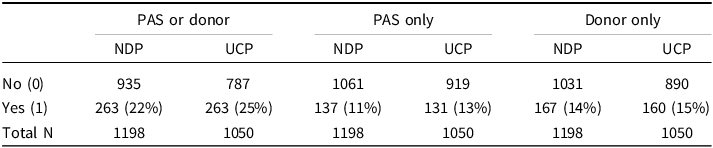
Table 1 below summarizes the structure of the dependent variable measures. The descriptive data shows that most appointments to ABCs in Alberta from 2015 to 2024 were not political in character. Of the 2248 public appointments in our dataset, 268 of them were identified on the PAS scale as having political character (137 by the NDP, 131 by the UCP). This is within the expected range, given public sector merit appointment procedures and practices in Canada, yet there are enough appointments with political character so as to invite questions about their patterns. Similarly, when we examine the political donations registry against ABC appointments, we see 327 matches (15% of all appointments)—people who donated the governing party and were also appointed to an ABC. This is not an insignificant number of matches, though also suggests, broadly speaking, that appointments to ABCs in Alberta are not substantially directed to party donors. The third measure of the dependent variable is a combined measure capturing appointees who were either on the PAS scale or a party donor, and 526 of the 2248 appointments fit this criterion.
Counts of dependent variable measures estimating “political” appointments by party

Dependent variable descriptive data
We are seeking to explain the factors that help predict whether an appointment to an ABC in Alberta will have political character. We conduct logistic regression analysis on binary outcome measures (“political” appointment or not), with independent variables and controls.
Regression analysis
Given the above hypotheses, every appointment in the dataset has an associated variable measure for the organization’s autonomy (autonomy), the appointing party (Conservative party, with NDP as reference value), and an estimate of the government’s priority to the area in which this ABC operates through electoral platform analysis. Prior research on agencies in Canada suggests that various dynamics in agencies differ depending on their type or mandate (Doberstein, Reference Doberstein2023; Reference Doberstein2022); as such, we control for agency type in the analysis. Additional features of an appointment that are controlled in the analysis but are not implicated in the theory under investigation include the gender of the appointee, the level of remuneration of the appointment (minimal versus high), appointment method (Ministerial versus full Cabinet), and the rank of the appointment (Member versus Chair).
Figure 1 below plots the average marginal effects (AMEs) from logistic regression models of the three measures of the outcome variable. Recall that the combined measure of a “political” appointment is most inclusive, though the PAS only and Donor only measure is presented as well to show the variation in AMEs depending on the measure. Comparing the regression models’ AIC and BIC (full regression tables in the Appendix), the models with the “PAS only” dependent variable measure represent a better fit and are given greater interpretive weight in the presentation of the findings in Fig. 1. Robustness tests were conducted just isolating the “most political” appointments (≥ 2 on the PAS or ≥ to $1000 financial contribution to the party) in the right-side column of Fig. 1, as well as alternative ways to measure policy priorities of the governing party (i.e., throne speech analysis versus election platform analysis in the main models). Those results are not substantively different than the main models presented here and are presented in full in the Appendix.
The main results show mixed evidence for H1, the expectation that we are more likely to see “political” appointments in ABCs with more formal autonomy from government. The measures of PAS only and Donors or PAS combined measures show no relationship in Fig. 1, and marginally positive if we use the Donors only measure. If we only examine the “most political” appointments, there is a similar mixed picture of a possible relationship between greater ABC autonomy and political appointment, depending on how it is measured. The evidence therefore does not point to an unambiguous relationship between political appointments and agency autonomy, but an indication of a possible, perhaps contingent, relationship.
Average marginal effects for predictors of the main dependent variable measures of all “political” appointments and “most political” appointments.

For H2, the expectation that we are more likely to see political appointments from conservative governments than progressive ones, we observe this pattern only when examining the “most political” appointments (Fig. 1), for which two of the three measures are positive in the models. The relationship is not evident in the more broadly defined political appointment measure. The dependent variable construction of appointments that were party donors (or not) is the measure that does not show a relationship consistent with H2 across both broad and “most political” appointment variable constructions.
The other variable of theoretical interest relates to whether the agency operates in a policy area of high priority for the appointing government (as measured through election platform analysis), our third hypothesis. Figure 1 shows more consistent effects of policy priority being associated with political appointments; we are more likely to see political appointments in ABCs that operate in a policy area that is a high priority for the government in power. Relatedly, a couple of agency types stand out as more likely to invite political appointments: corporate enterprises and regulatory/adjudicative agencies, prompting the need to explore further the possible contingent effects of agency type and policy priority.
Given that political party, policy priority area and agency type stand out in some models as meaningfully related to political appointments, we consider the potential interaction effects of an agency operating in an area of policy priority and the agency type, conditional on political party. In Fig. 2 we present the predicted probabilities of a political appointment to an agency in an area of policy priority for the government, if the UCP is in power and alternatively if the NDP is in power, differentiated by agency type. We show all three models, which again involve different ways of measuring a political appointment, and what stands out is that corporate enterprises and regulatory/adjudicative agencies are pronounced in terms of probabilities of being political appointments under these conditions. For example, the point estimates around the 0.5 range tell us that there is a 50% chance of a political appointment at a crown corporation in Alberta when the Conservatives are in power and it operates in an area of high priority for them. Likewise, for the NDP it is 40% for crown corporations, signaling this is an important area for governments of all stripes given the nature of their work. Regulatory/adjudicative bodies are also relatively high, in the range of 25–30% predicted probabilities of a political appointment for both parties, with the Conservatives again slightly higher across the board, though not statistically significantly. This is suggestive of a possible pattern of difference, but additional years of data collection and analysis would be required to make a definitive claim. It is worth noting that the kinds of organization that stand out in this analysis are corporate enterprises and regulatory agencies, which in all governments, but perhaps especially so in Alberta, are very important institutions in the political economy of the province.
Predicted probability plots for political appointments by agency type, conditioned on governing party and in an area of policy priority.

Discussion
This study presents several novel empirical findings of agencies, boards and commissions in Canada relating to the political character of appointments to these bodies. Most notably, our first-of-a-kind compilation of appointments over a nearly 10-year period and investigation into the political connections of appointees shows that, depending on how one measures a “political” connection, between 11% and 25% of ABC appointments in Alberta have political character. We have reported the results of the various measures for the reader to interpret them according to a definition they find most suitable. No matter the definition, however, it is reasonable to conclude that most ABC appointments are not obviously political, and yet at the same time, there are still hundreds of appointments that many would agree are indeed political. This is important to recognize, not because “political” appointments are by definition markers of corruption (Kopecký and Scherlis, Reference Kopecký and Scherlis2007), but that patterns of politically connected appointees occupying positions on regulatory, adjudicative, and crown corporation boards cuts against notions of independence and the purported virtues of ABCs.
Beyond a descriptive account of the scale of political appointments in Alberta, this study has also tested empirical data collected against theoretical propositions in literature. Namely, the “compensatory logic of politicization” thesis, that ABCs with more structural distance from appointing governments are more likely to be politicized via appointment to compensate for their lack of direct control. We find a mixed picture in this regard, depending on the measure used to gauge political appointments—using party donor data, we find confirmatory evidence, but with the constructed political appointment scale (PAS), largely based on biographical data, we do not. ABC autonomy was measured by whether the enabling legislation or bylaws of the organization referenced their “independent” status from the government of the day; it is a legalistic definition rather than a normative one or one that is confirmed in practice. In other areas of governance studies, we know that formal authority may not represent the dynamics in practice (for instance, a crown corporation can be formally defined as independent, but one in which elected officials routinely direct decisions), and therefore a more nuanced measure of autonomy may be required to further tease out the relationship between autonomy and politicization.
A third novel empirical finding in this data is that we find that H2 (political party) and H3 (policy priority) as independent hypotheses show weak evidence, but that combined through an interaction term, and conditioning on agency type, we observe an intriguing relationship: the conservative party appears slightly more likely to make an appointment with political character to an ABC in an area in which they have identified as a policy priority for the government than a progressive government. Further, that crown corporations and regulatory/adjudicative agencies are more likely than other types of agencies to host appointments with political character. A word of caution, however. The findings by party are statistically significant among the “most political” appointments (Fig. 1), but not substantially different as a practical matter, as per the predicted probability plot (Fig. 2 above). The share of appointments with any political character by the two parties over similar length terms is about the same (11–12% with restrictive measures, 22–25% with expansive measures of political character). Conservatives appear slightly more likely to make appointments with political character in ABCs operating policy areas of high priority, but the NDP are not substantively much different in their appointment practices during their time in power.
This finding is nevertheless consistent with the expectation that conservative parties in power confront a professional public service that is comprised of people who tend to have more progressive beliefs (Jeffrey, Reference Jeffrey2015), and limits on their ability to make appointments within it, and may seek out alternative venues like ABCs that have less strictly overseen appointment procedures. That appointing governments—perhaps especially conservative governments—might be particularly attentive to ABCs in policy areas in which they prioritize is further reinforced by findings that ABCs which are corporate enterprises or those which have regulatory/adjudicative authority are more likely to invite political appointments than service delivery, public trust and advisory ABCs (Fig. 1).
These findings, while suggestive, invite alternative interpretations. For example, given their much longer historical tenure in government, conservative parties in Alberta have had more time to cultivate politically experienced personnel and to normalize appointment practices across cycles of leadership. The available pool of politically affiliated individuals may therefore be larger and more institutionally embedded, increasing the likelihood of appointees with political connections. Further, the motives behind political appointments cannot be directly inferred from observed patterns. While some appointments may be intended to ensure political alignment in strategically important agencies, others may function as rewards for loyalty or reflect the operation of established elite networks. Our analysis identifies associations, but disentangling the intent behind each appointment would require different forms of data—such as interviews or internal records from within the appointment process—and remains an important avenue for future research.
Taken together, the findings from Alberta demonstrate that political science and public administration scholars should view ABCs as an important, though often ignored, site of political power and contemporary patronage. The continued growth of ABCs in many Canadian provinces effectively pulls more government business out of the traditional bureaucracy and into organizations with different relationships, accountabilities, and transparency requirements to legislators and the public. The claim is not that this is corrupt, but that some of the very organizations that were created to, in many cases, depoliticize their activity through the agency model, are key sites of politicization, undermining the logic of their creation.
Limitations and future research
The data compiled to draw inferences about the political character of ABC appointments in recent years in Alberta has many virtues, including its completeness, revealed preference (rather than perceptions), and comparative dimensions, yet it is not without limitations. First, while most measures used in the regression estimates are concrete and objective, the Political Appointment Scale (PAS), which is designed to be a systematic estimate of the political connections of an appointee, has a certain amount of subjective character in some instances. There are concrete markers (for example, a former elected official or candidate with appointing party, former party staffer), but there are appointees with an ideological or stakeholder connection that requires an interpretative placement on the scale. Not all teams of researchers would likely code such cases identically. Our strategy aimed to find definitive evidence of political or ideological connection to the appointing party rather than mere suspicion; hence we can expect placements on the PAS to be erring on an underestimate of political character rather than an overestimate.
A second limitation of this study is that we are not examining the behavior of appointees on ABCs in Alberta. We are examining their history prior to appointment, not their actions within the ABCs. Our findings cannot—and should not—be interpreted to imply that appointees who are coded as those with “political character” or those who donated to the appointing political party, are simply doing the bidding of the party at the ABC. One can be politically connected but also appropriate to serve in a position based on their skillset. It would indeed be a worthwhile inquiry to examine the behavior of individuals on ABCs according to the PAS or donor records as part of future research, though challenging to execute. One could examine board of director decision votes in this manner, but this would capture only a small slice of appointee behavior. Measuring behavior and actions in these positions would be difficult at the scale produced in this study, as agenda-setting dynamics (i.e., what issues are prioritized or not) are often critically important and are not represented in board of director meeting decisions, for example.
A final limitation of this study is that, while our dataset of appointments is comprehensive, it lacks potential appointees who were not selected for ABC positions. In other words, we do not have counterfactuals by which to measure the degree of politicization of these particular appointments. This is ultimately a limitation of the type of data we have utilized for this article, as the appointment process itself and shortlisted candidates are not publicly accessible. Nevertheless, there are promising future research avenues to build on these emergent findings from Alberta. First, the analytical strategy ought to be extended and replicated in other jurisdictions, including other provinces and the federal government. Nearly all governments have published ABC appointment data and campaign finance disclosure databases that formed the core of the data presented in this study. There is, however, considerable work to manually assemble demographic data on appointees and their political connections, and governance data on each of the ABCs. Second, to get more precise insight into appointee behavior, interviews with political and “nonpolitical” appointees would be valuable to better understand how they navigate the relationship to bureaucratic and political overseers. Finally, an inquiry could focus on the most important ABCs in a jurisdiction and examine the appointment patterns over a long period of time (for instance, key regulatory agencies, like the Alberta Energy Regulator, or key crown corporations) to identify any patterns such as people appearing to represent certain stakeholder or allied groups that are afforded effectively institutionalized representation.
Conclusions
This study of appointments to agencies, boards, and commissions in the Province of Alberta reveals that there are “political” appointments to such bodies that are typically conceived as independent from the government of the day. The widespread creation of Agency and Crown Resourcing offices in Canadian provinces and territories that seek to professionalize the appointment process and promote meritorious candidates may have reduced, but has not extinguished, appointments that have a political character. A relatively small share of appointments to Alberta ABCs are baldly political, but it is evident that for organizations that really matter to the governing party, they appear motivated to get their people, or allied stakeholders, into leadership or oversight roles. To the extent that this dynamic implicates important agencies, boards and commissions, it represents a significant trade-off from the purported virtues of arms-length agencies and authorities, namely that their distance from the government of the day enables credible commitment of long-term policy and regulation with some degree of insulation from ephemeral political winds. Yet if key ABCs are politicized, the credible commitment dividend may be diminished such that a primary justification for the creation of the ABC collapses.
Supplementary material
To view supplementary material for this article, please visit https://doi.org/10.1017/S0008423925100553
Acknowledgements
The authors are grateful for the dedicated research assistance from Arsh Singh and Carter MacLean. We also thank participants in the workshop series of McGill’s Centre for the Study of Democratic citizenship, as well as Sophie Borwein, for helpful feedback on a draft version of the manuscript.
Competing interests
The authors declare none.


 Open access

