





Introduction
This study examines an everyday interactional phenomenon in the exceptionally institutional setting of the US Supreme Court. It is motivated by the existence of a potential disconnect between the public perception of the Supreme Court and actual judicial practice: though the press and legal commentators tend to emphasize ideological disagreements among Justices on the Court, agreement may in fact be a more common practice. Most appeals are not politically salient, unanimous rulings are very common (one-third of cases per term, on average), and even divided rulings require at least five Justices to agree (The Federalist Society 2023; Feldman Reference Feldman2024). Indeed, a recent analysis of the Court’s opinions during the 2023–2024 term found that the two Justices who were on the opposite side the most frequently (Justices Sotomayor and Alito) still voted together 63% of the time, not counting unanimous decisions (Jens & Igur Reference Jens and Isgur2024); an older compilation of the 2013–2014 term found very similar figures (Bowers, Liptak, & Willis Reference Bowers, Liptak and Willis2014). The Justices are also the sole nine members of the highest authority in the judicial branch of the US federal government, with lifetime appointments, meaning that they work closely together for many years and often become close friends even across perceived ideological divides (Marimow Reference Marimow2024). All of these extrinsic reasons for accord and collegiality might not necessarily result in displays of agreement during oral arguments, but we might nevertheless expect to see some evidence of agreement, alignment, and cooperation among the Justices as the Court conducts its business.
Oral arguments are the public-facing side of the Court. It is at oral arguments that litigants (through their attorneys) are able to make their cases, and oral arguments are organized entirely around the questioning of attorneys by Justices. The Justices rarely speak directly to each other, and instead are limited to asking questions of the attorneys who are presenting their arguments. This makes it difficult or impossible for Justices to show agreement or alignment through direct statements to one another. Therefore, if agreement or alignment does occur in oral arguments, evidence of it would have to appear in the ways that questioning occurs.
In this study, I examine a single Supreme Court oral argument for evidence of a specific type of agreement, supportive alignment (Gordon Reference Gordon2003), among the Justices. Prior work has described a number of linguistic features that speakers can use to supportively align, including repetition and endorsement of a prior speaker’s utterance, and the use of prior utterances to construct new turns and make new points. In the data used for this study, I searched for questions from Justices that were later repeated and reused by other Justices, with a focus on questions that were nominalized by other Justices using a source marker that included the original speaker’s name. I found three such questions in the data, and these examples vary in the length and salience of their later repetition. Repetitions variously featured endorsement of the original question, pursuit of a further answer to it, or the use of the question to make other points. I analyze repetitions of two of the nominalized turns and argue that they display supportive alignment (the third example is introduced, but space does not permit full analysis). Though showing alignment through the elaboration of questions to a third party is a very different way of aligning than would occur in ordinary conversation, its appearance in this form is driven by the unique constraints on speaking turns in the Supreme Court.
Key concepts and prior literature
Two strands of prior research are relevant to what this study hopes to accomplish. The first is research about what makes a setting like a Supreme Court oral argument institutional, such as limitations on speaking rights, governmental objectives that drive the interactional agenda, and professional roles that are relevant to how the parties construct their speaking turns. The second is research about supportive alignment as an important tool that participants in an interaction can use to cooperate and show agreement with each other. In this section, I introduce background information about each of these.
Institutional discourse
As described in prior scholarship, there are several features shared by institutional settings that make their status as such relevant to the analysis of interactions that take place there. The first of these is the existence of restrictions on aspects of speaking turns, such as the selection of the next speaker, the topic of talk, and the length of turns (Drew & Heritage Reference Drew, Heritage, Drew and Heritage1992). An oral argument at the US Supreme Court has these types of constraints as a result of the formal rules of Supreme Court procedure (Supreme Court of the United States 2024a, 2024b), described below in the Data section in relevant part, that govern the speaking turns during the argument. These rules give control over most aspects of the interaction to the Justices rather than to the attorneys.
Another distinct feature of institutional settings is that ‘participants’ institutional or professional identities are… made relevant to the work or activities in which they are engaged’ (Drew & Heritage Reference Drew, Heritage, Drew and Heritage1992:4). Oral arguments at the Supreme Court feature two kinds of speakers, attorneys and Justices, and both have specific, institutionally governed roles (and identities) at the proceeding. The attorneys who appear before the Court do so for the sole purpose of advocating on behalf of clients, with whom they have a formal attorney-client relationship. The Justices, by contrast, have an official governmental role as the highest authority on the interpretation of US federal law and the US Constitution. So, whereas the attorneys are focused on the interests of their clients, the Justices must keep in mind each case’s implications for the body of federal law as a whole (Baum Reference Baum2021). The attorneys and Justices are each oriented towards these separate goals, and this goal orientation is an additional restriction (besides the formal rules of the Court) that shapes the talk in an oral argument. This, in turn, constrains the available means that parties have for performing conversational moves such as supportive alignment.
The literature on institutional discourse is vast, and much of it has been conducted using conversation analysis (CA) and other ethnomethodological approaches (e.g. Drew & Heritage Reference Drew, Heritage, Drew and Heritage1992; Ehrlich & Freed Reference Ehrlich, Alice, Freed and Ehrlich2010; Heritage & Clayman Reference Heritage and Clayman2010). While it is surely impossible to summarize all of this prior work, a common theme of research on institutional talk is how parties manage the interactional asymmetry caused by one party (or a group of parties) having control over speaking rights in the interaction. Institutional talk in legal settings is a common site for this research, not all of it necessarily using CA (e.g. Atkinson & Drew Reference Atkinson and Drew1979; Philips Reference Philips and Grimshaw1990; Drew Reference Drew, Drew and Heritage1992; Luchjenbroers Reference Luchjenbroers1997; Matoesian Reference Matoesian1999, Reference Matoesian2000; Eades Reference Eades2000, Reference Eades2012; Ehrlich Reference Ehrlich2002; Baffy & Marsters Reference Baffy and Marsters2015). Importantly, much of this prior literature about interactions in the legal system, including all of the studies cited in the preceding sentence, focuses on talk that occurs in trials. The present study instead involves talk occurring in oral arguments. There are several relevant differences between these two settings, despite the fact that both occur in a courtroom and involve enforceable speaking rules.
Whereas trial testimony occurs for the primary purpose of introducing facts into evidence for the benefit of a jury (who will render a verdict), an oral argument involves the discussion of points of law for the benefit of judges (who will decide an appeal). There are no facts introduced in an oral argument, there is no jury, and there are no witnesses. Instead, an oral argument involves intraprofessional discourse (Linell Reference Linell1998) between lawyers and judges who both possess specialized legal knowledge. And whereas the canonical discourse event in a trial is the questioning of a single witness by a single attorney, Supreme Court oral arguments involve an attorney speaking to a panel of nine Justices at once, any one of whom may interject. As discussed in the Analysis, several of these features that differentiate an oral argument from a trial are relevant to the present study.
There have been limited prior discourse analytic studies of oral arguments. These include investigations of politeness norms (Tracy Reference Tracy2011a), the ways that person-references might reveal judges’ political beliefs (Tracy Reference Tracy2011b), how judges appear to use ‘tough questioning’ more frequently with attorneys with whom they disagree (Tracy & Parks Reference Tracy and Parks2012), the use of gesture, prosody, and figurative language to show stance (Deeb Reference Deeb2013), the use of ideologically laden terminology (Deeb Reference Deeb2017), the personification of case names by judges and attorneys (Dundon Reference Dundon2024), and the varying interactional functions of speech by attorneys and Justices (Huang & Sang Reference Huang and Sang2024), though to my knowledge none have investigated supportive alignment.
Supportive alignment
The analysis in this study relies on the concept of alignment (Schiffrin Reference Schiffrin and Tannen1993), which is the sense that parties have of their relationships with other participants in an interaction, for example, whether someone is a friend, an ally, someone to support, someone to argue with, someone to doubt, and so on. In this study, I search specifically for evidence of supportive alignment, or ‘an alignment in which one participant ratifies and supports another’s turns at talk and what he or she has to say, creating ties of cooperation, collaboration, and agreement’ (Gordon Reference Gordon2003:397). In a multiparty discussion or argument, all parties might take opposing sides about a particular point, or some parties could take positions that overlap. Two parties who concur in their views might be expected to support one another’s positions during the interaction—when they do so openly, they show supportive alignment. This study explores whether and to what extent evidence of this phenomenon may occur in a Supreme Court oral argument.
Many prior studies have investigated parties aligning as a team or other forms of conjoined participation, in settings as varied as classroom interactions and orators speaking in front of audiences (Lerner Reference Lerner1987, Reference Lerner1993), governmental committee meetings (Kangasharju Reference Kangasharju1996, Reference Kangasharju2002), family interactions (Gordon Reference Gordon2003), patient consultations at a pharmacy (Nguyen Reference Nguyen2011), and storytelling among neighbors (Kulbayeva Reference Kulbayeva2022). Together, these studies illustrate a variety of linguistic features that can be used by parties to show that they align with one another. Those that are relevant to this study fall into several broad and partially overlapping categories: overt agreement, various forms of repetition, and joint production format.
A fairly straightforward way to show support with someone is to agree with something that the person has said, either overtly (“Yes, I agree with that”) or through more subtle agreement tokens such as “yeah” (Kangasharju Reference Kangasharju1996:294). In the most simple method of agreement, the speaker uses a turn immediately following whatever original statement is being agreed with, that is, Party A makes an assertion, and then Party B agrees with Party A’s assertion in the very next turn. This turn sequencing makes it clear what exactly the subsequent speaker is agreeing with.
However, in other cases, a subsequent speaker may wish to support a statement that had been made earlier than the immediately preceding turn. In order for other participants to understand which statement is being agreed with, the new speaker may need to reintroduce or repeat it. This can take the form of repetition or reformulation of the original utterance (Kangasharju Reference Kangasharju1996:313; Gordon Reference Gordon2003:397), and there is perhaps a cline between what is hearable as a true repetition versus an intentional rewording of the original. In either case, participants can use source markers to make explicit that an idea comes from another participant (Lerner Reference Lerner1987:149; Kangasharju Reference Kangasharju1996:303, 311). When the original speaker of a repeated utterance is identified like this, the subsequent speaker may upgrade the original utterance, such as with the word “really” (compare “This is important” with “This is really important”), to suggest that they stand behind the original statement independently. Speakers may also employ lexical, phrasal, prosodic, thematic, or other forms of linguistic repetition when invoking the prior talk of another participant (Tannen Reference Tannen1989: 63–67), though it may be less clear that repetition is occurring supportively without some sort of overt marker to that effect, such as explicit endorsement of the talk being repeated.
A final means of showing supportive alignment is joint production format, such as using the plural first-person pronoun “we” as the subject of sentences (Kangasharju Reference Kangasharju1996:295). The concept of production format, from Goffman (Reference Goffman1974, Reference Goffman1981), breaks the traditional notion of speaker into three components: an animator (the person who conveys a message), an author (the person in control of the content of the message), and a principal (the person whose interests or beliefs are represented by the message) (Reference Goffman1981:144). Joint production format can be used in conjunction with repetition, such as where Party A makes a statement, and Party B later repeats this statement but reformulates it as having originated from a joint “we” or “us” (imagine Party A saying “This is important”, with Party B later saying “We think this is important”). In so doing, Party B suggests co-authorship or co-principalship with the speaker of the repeated utterance, which is a form of alignment with Party A.
The present study builds on this prior research about supportive alignment by describing the tools that speakers have to supportively align in an institutional context where speaking turns are highly constrained. Interestingly, the means that Justices on the Supreme Court have to align appear to be highly similar to those that speakers use in other contexts. The main difference is that, because the Justices’ speaking turns are almost entirely in the form of posing questions to a third party (as opposed to making direct statements to each other), supportive alignment is shown primarily through the ways that questions are posed, prefaced, and explained. This differentiates oral arguments from settings like witness examination during trials, or indeed almost any ordinary face-to-face interaction, when participants are speaking to one another and can (dis)align directly.
Data and legal background
To investigate supportive alignment in the Supreme Court, I used an audio recording and transcript from the oral argument in the case of Federal Bureau of Investigation v. Fikre, which was argued before the US Supreme Court on January 8, 2024. An audio recording of the oral argument is available online (Oyez 2024), as is an official transcript of the recording (Supreme Court of the United States 2024c). The full argument is approximately one hour and twenty-two minutes long, and I selected several excerpts for in-depth analysis, as explained below in the Method section.
The US Supreme Court is a highly structured setting. The Court convenes in furtherance of the specific governmental objective of deciding appeals in the US federal court system, with appeals being ruled upon by a panel of nine judges (called ‘Justices’, of whom five appear in the data analyzed in this study). In an appeal before the Supreme Court (a ‘petition’), both parties first submit written summaries of their legal arguments (‘briefs’), through their attorneys. After the briefs are filed, the parties are invited to appear before the court to argue their legal points in person, again through their attorneys. The party that has filed the petition (i.e. the party that lost in the court below) is referred to as the ‘petitioner’, and the party that opposes the petition (i.e. the party that won below) is called the ‘respondent’.
In the oral argument, the attorneys for the petitioner and respondent are each allotted thirty minutes of speaking time, but the Justices are permitted to extend this limit (as they do in Fikre). The attorneys speak one at a time from a lectern and address all nine Justices at once; the Justices are seated side-by-side. There are formal rules (Supreme Court of the United States 2024b) and informal guidelines (Supreme Court of the United States 2024a) governing all aspects of the event: attire, eye contact, where to sit and stand, the allocation of speaking turns, who is allowed to interrupt whom, topics that attorneys should address, topics that attorneys should avoid, and how attorneys should address the Justices, just to name a few. Each attorney has two minutes of uninterrupted speaking time at the beginning of their appearance, which they typically use to summarize their primary or most contentious points. Following this, the Justices have free rein to ask questions and interrupt the attorney as they see fit. As in many other types of institutional discourse, the interactional event of an oral argument is organized around the asking of questions (Ehrlich & Freed Reference Ehrlich, Alice, Freed and Ehrlich2010), with the right to ask questions residing solely in the Justices. These questions allow the Justices to inquire about the legal points that the parties have made in their briefs, and to attempt to persuade their fellow Justices while doing so (Baum Reference Baum2021:113-114).
All oral arguments at the Supreme Court are recorded, which results in a massive amount of data that is available for linguistic analysis. For the present study, I chose a case that involves a relatively simple legal question (by the standards of the Supreme Court), so as to make the data more accessible to readers without a legal background. A brief explanation of the facts and legal question presented in the Fikre petition follows.
Yonas Fikre, a US citizen, was placed on a ‘No Fly List’ by the Federal Bureau of Investigation (FBI), meaning that he was forbidden from flying on any airplane traveling to, from, or in the United States. Fikre sued the FBI, alleging a violation of his constitutional right to due process of law. The FBI subsequently removed Fikre from the No Fly List. Following Fikre’s removal from the list, the trial court dismissed Fikre’s lawsuit as ‘moot’ (i.e. nonjusticiable, as a result of having no practical significance), given that he had already received the remedy that his lawsuit sought. On appeal, an appellate court reinstated the lawsuit because it was not clear that Fikre could not be put right back on the No Fly List for exactly the same reasons as before. Following this reinstatement, the FBI issued a declaration that Fikre would not be put back on the No Fly List based on all of its then-current information. The trial court once again dismissed the lawsuit as moot, and Fikre once again appealed. The appellate court reversed for the same reasons as before, and the government petitioned for Supreme Court review.
In the petition before the Supreme Court, the legal question presented is whether Fikre’s lawsuit should be dismissed as moot. Importantly, the appeal does not concern the ‘merits’ of the case, that is, whether Fikre’s due process rights were in fact violated, or what remedy he should receive if they were. Instead, the petition concerns only whether Fikre has the right to bring his lawsuit in the first place, given the rule that moot cases must be dismissed. The crux of the petition is whether it can be shown that the government’s action of placing Fikre on the No Fly List is reasonably likely to recur; if it is, then the lawsuit is not moot and the trial court’s dismissal should be reversed. Approximately two months after the oral argument, the Court handed down a unanimous decision in favor of Mr. Fikre (Federal Bureau of Investigation v. Fikre 2024).
Method
This study investigates the ways that Supreme Court Justices might show supportive alignment during oral arguments. My expectation was that, if any evidence of such alignment appeared in the data, it would likely manifest in the ways that Justices performed their questioning of attorneys, since the conventions of oral argument dictate that nearly all speaking turns of Justices are in this form. In the data used to investigate this research question, there were several possible examples of supportive alignment. I focused on questions that were asked by one Justice, and then later repeated by other Justices who endorsed, clarified, or pursued a further answer to the question, or who used the question to make some other point during the argument.
I started with the Court’s official transcript (Supreme Court of the United States 2024c), compared it to the audio recording, and added notations for linguistic and paralinguistic features such as false-starts, turn overlap, emphasis, and so on (none of which were marked in the official transcript). I relistened to the audio while reviewing the transcript, with a focus on stretches of speech where repetition was particularly salient, such as when a prior question was nominalized by another Justice and then used for some new purpose. For reasons of space, I limited my analysis to nominalizations that were accompanied by the name of the Justice who originally made the statement, such as “Justice Sotomayor’s hypothetical” or “Justice Alito’s … question”. Also for reasons of space, I excluded examples of reported speech, such as “But doesn’t that depend on him knowing, as Justice Sotomayor said, what might put him back on?” or “Justice Alito mentioned the possibility of just going before a judge in camera”. Finally, I did not include nominalizations by the attorneys or nominalizations of their turns—the attorneys and Justices can speak directly to each other in an oral argument, whereas I was primarily interested in alignment where such direct interaction is impossible.
In the analysis below, I investigate how two questions and their repetitions are embedded in interactions and how they compare with interactionally similar analogues elsewhere in the data (Schiffrin Reference Schiffrin1994). Most of the analysis treats repetitions of a turn from Justice Sotomayor, which are rich with linguistic features suggestive of alignment. I then briefly analyze a shorter repetition of a turn by Justice Alito, which is intended to illustrate that supportive alignment may occur even across perceived ideological divides.
Analysis
Justice Sotomayor’s hypothetical
Extract (1) shows a hypothetical question posed by Justice Sotomayor. ‘Hypotheticals’ are a ubiquitous rhetorical device in legal argumentation, both in legal education (Mertz Reference Mertz2007) and in oral arguments (Griffin Reference Griffin2023). In a hypothetical, the speaker challenges the validity of a legal argument by positing changes to legally significant facts that would take the position to its logical extremity.
The hypothetical is posed near the beginning of the oral argument (5:01–6:53), during the turn of Sopan Joshi, the government’s attorney, at the lectern. Immediately prior to extract (1), Joshi has just finished a forty-five-second turn, and the extract begins with Justice Sotomayor initiating a new topic. Her hypothetical tests the government’s argument that the harm originally suffered by Fikre (being placed on the No Fly List) was unlikely to be repeated. Justice Sotomayor labels her question as a “hypothetical” (line 1), and other Justices will reuse this term later on.
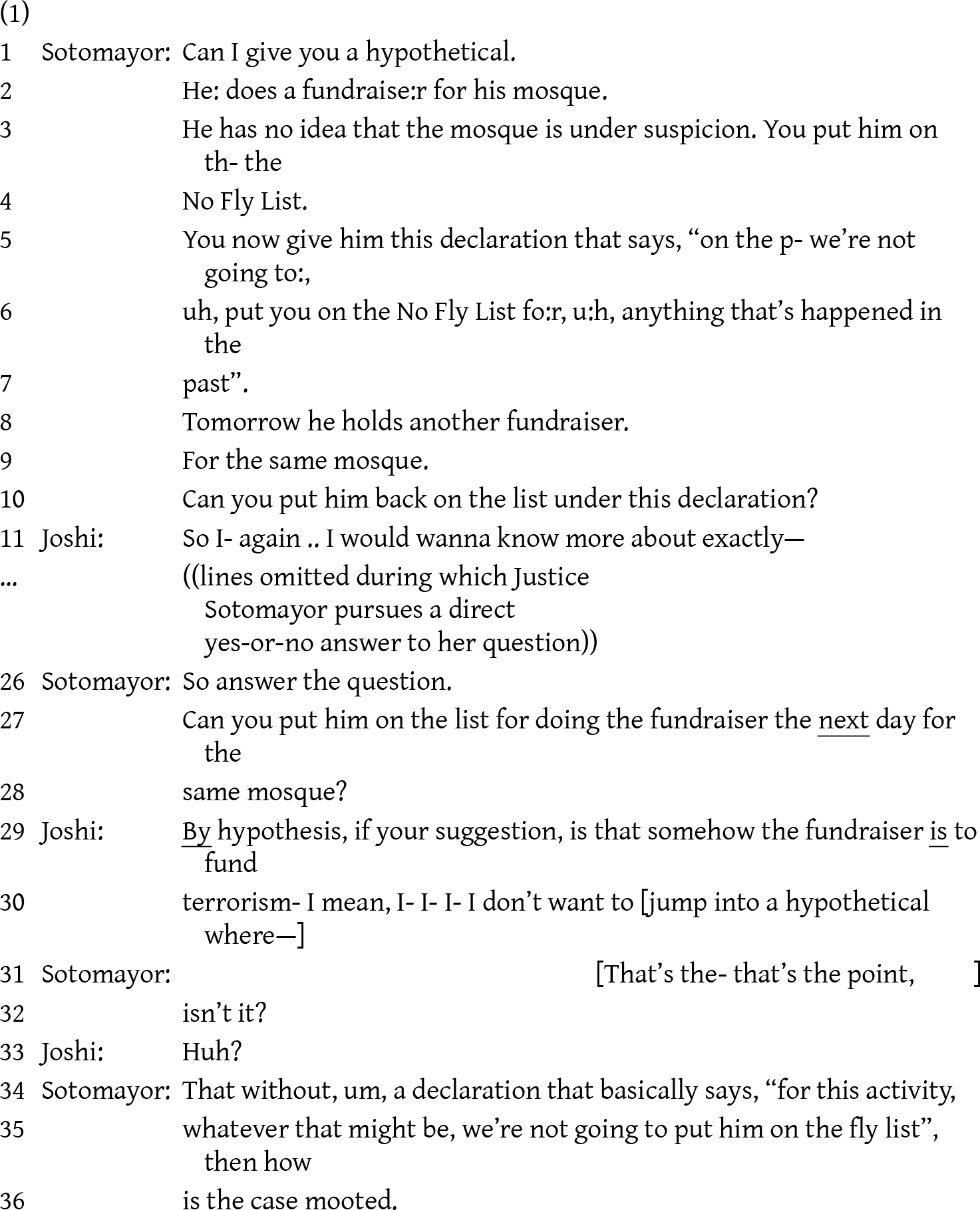
Long description
The table is a transcript excerpt with line numbers, speaker names, and spoken text from an exchange between Justice Sotomayor and Joshi. Sotomayor poses a hypothetical about a person who fundraises for a mosque, is placed on the No Fly List despite not knowing the mosque is under suspicion, and then receives a declaration saying past conduct will not be used to keep him on the list. She asks whether holding another fundraiser the next day for the same mosque would allow the government to put him back on the list under that declaration. After omitted lines where she seeks a direct answer, Sotomayor repeats the question and demands an answer. Joshi responds conditionally, suggesting it would depend on whether the fundraiser is tied to funding terrorism, and resists committing to the hypothetical. Sotomayor concludes that without a declaration covering the activity, it is unclear how the case is mooted. The excerpt is partial and includes omitted lines, so it does not show a final definitive answer.
Justice Sotomayor uses the hypothetical shown in this extract, elaborated over several turns, to make a legal point. The government had argued that the case was moot because, not only was Fikre no longer on the No Fly List, but the FBI had also promised that Fikre would not be placed back on the list based on the information that it had available at that time—there was therefore no further remedy for Fikre to gain by bringing a lawsuit. Justice Sotomayor’s hypothetical asks whether Fikre could be relisted for a single repetition of a seemingly innocent action that he had taken previously. If he could be, then it is in fact quite likely that he could be placed back on the list, and perhaps Fikre’s claim is not moot after all.
That this is a contentious issue in the oral argument, and one that will be returned to later, is foreshadowed in extract (1). Justice Sotomayor asks her question several times (lines 10, 27–28, and omitted lines), framing it each time as a yes-or-no question. Joshi gives answers (lines 11, 29–30, and omitted lines) that are not type-conforming (Raymond Reference Raymond2003), and Justice Sotomayor orients to these answers as inadequate, such as in line 26 (and omitted lines). Justice Sotomayor explains “the point” of her hypothetical in lines 31–32 and lines 34–36, and her explanation suggests that she may have been anticipating a negative answer to her original question: because Fikre could indeed be relisted for the same conduct, his lawsuit is not moot and should be allowed to proceed.
Two overt references to Justice Sotomayor’s hypothetical appear in the oral argument. In the first, Justice Kagan refers to Justice Sotomayor’s hypothetical several times, purports to clarify the purpose of the original question, and pursues a further answer to it. In the second, Justice Jackson refers to the hypothetical and uses it to distinguish the case at hand from the facts of a prior case, and also to hold the government’s attorney to his prior answer to a critical question in the oral argument.
Reiteration and clarification of the hypothetical
The first repetition of Justice Sotomayor’s hypothetical, by Justice Kagan, appears in extract (2) (10:25–12:08). This example involves three separate references to the hypothetical, and there are several linguistic features which suggest that Justice Kagan may be showing supportive alignment with Justice Sotomayor. These include reformulation of the hypothetical with overt source markers identifying Justice Sotomayor as the original author, explanation of the upshot of the hypothetical, and the use of a joint production format that may suggest co-principalship.
Extract (2) occurs just a few minutes after extract (1). In the interim, the Justices have questioned the government’s attorney about the apparent unwinability of the case for both parties, caused by the lack of information about why Fikre was originally placed on the No Fly List. For the government to succeed, it must show that the objectionable conduct (placing Fikre on the list) is not likely to reoccur; for Fikre to succeed, he must show that the objectionable conduct is likely to reoccur. Neither party seems to be able to make that showing based on the available information. As the discussion continues, Justice Sotomayor returns to her earlier concern about the problems caused for Fikre by his complete lack of knowledge of what conduct resulted in his inclusion on the No Fly List. References to the hypothetical are marked in bold text.
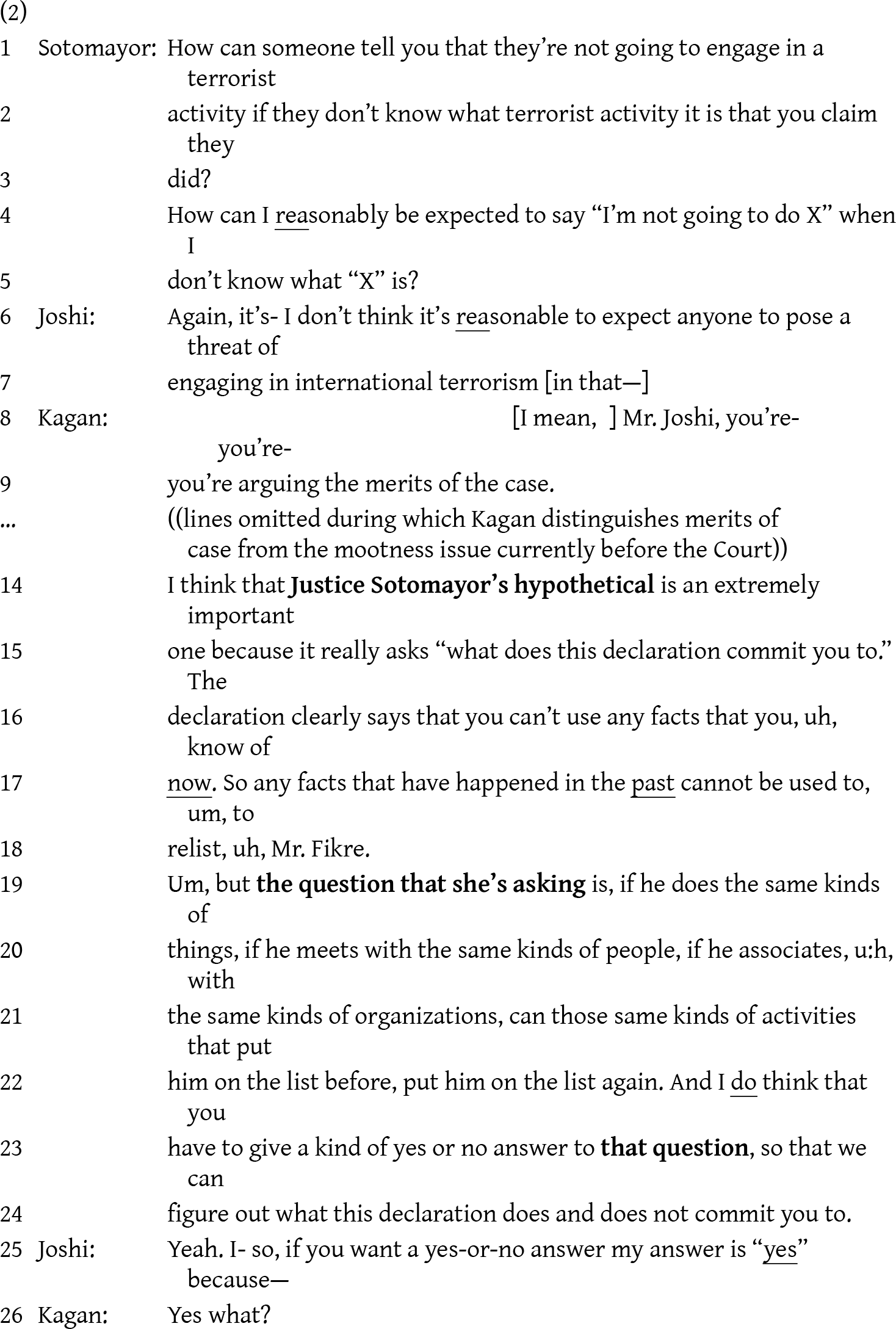
Long description
The table is a transcript-style excerpt with line numbers, speakers, and their statements. Justice Sotomayor asks how someone can promise not to engage in terrorist activity without being told what specific activity is alleged. Government counsel Joshi responds that it is not reasonable to expect anyone to pose a threat of engaging in international terrorism. Justice Kagan interrupts, saying Joshi is arguing the merits rather than the mootness issue before the Court, and notes that Sotomayor’s hypothetical tests what the government’s declaration commits to. Kagan summarizes that the declaration bars using currently known past facts to relist Mr. Fikre, but questions whether similar future conduct or associations could lead to relisting. Kagan presses for a clear yes-or-no answer, and Joshi says yes, prompting Kagan to ask “Yes what?” The excerpt includes an ellipsis indicating omitted lines, so the exchange is incomplete and may lack surrounding context.
Justice Sotomayor reapproaches the same general point from her hypothetical and asks how Fikre could possibly monitor his future conduct without knowing why he was placed on the No Fly List in the first place (lines 1–5). Joshi appears to dispute the premise of this question, arguing that the relevant legal issue is not whether Fikre might reengage in his everyday activities, but whether he might pose a threat of engaging in terrorism (lines 6–7). Justice Kagan then interjects (line 8) and draws Joshi back to the question of how Fikre could know whether he is likely to be relisted for posing a threat of engaging in terrorism without knowing how the government views his everyday activities. She does this by invoking Justice Sotomayor’s hypothetical.
Linguistically, several features of Justice Kagan’s turn (lines 8–24) suggest that she is showing supportive alignment. It would have been possible for Justice Kagan to make her point here by simply narrating her argument, that is, that Fikre still does not know why he was placed on the No Fly List and that it is therefore impossible to assess his chances of being relisted. But instead of doing this, Justice Kagan refers to “Justice Sotomayor’s hypothetical” (line 14) using the “hypothetical” label originally used by Justice Sotomayor herself in extract (1), line 1, and using source markers to show that she is repeating a coparticipant’s utterance. Justice Kagan then refers to the hypothetical twice more using shorter references (lines 19 and 23) that are consistent with their later position in the turn (Schegloff Reference Schegloff and Fox1996).
The placement of Justice Kagan’s references to the hypothetical within the overall sequence of questioning also has analytical significance. According to Justice Sotomayor, the “point” (extract (1), line 31) of her hypothetical had been, “That without, um, a declaration that basically says, ‘for this activity, whatever that might be, we’re not going to put him on the fly list,’ then how is the case mooted” (extract (1), lines 34–36). In lines 1–5 of extract (2), Justice Sotomayor makes this argument again in a different form, asking how Fikre could avoid engaging in suspicious conduct without knowing what specific conduct was suspicious—as before, the point is that Fikre’s claim is perhaps not moot.
Joshi objects to this conclusion, keeping the focus on Fikre’s chances of posing a threat of committing acts of terrorism. Justice Kagan intervenes, affirming that, unless Joshi can provide a clear response to Justice Sotomayor’s hypothetical, the case may not be moot. She does this two times, in line 15 (“[the hypothetical] really asks ‘what does this declaration commit you to’”), and again in lines 19–22 (“but the question that she’s asking is… can those same kinds of activities that put him on the list before, put him on the list again”). Both times, she indicates that she is clarifying the import of the original question—first with “it really asks” and then with “but the question she’s asking is”. Given that Justice Sotomayor was present and would have presumably been able to clarify the upshot of the question herself, this turn by Justice Kagan could be seen as face-threatening—Justice Kagan is, in effect, speaking on Justice Sotomayor’s behalf. But by the same token, the fact that Justice Kagan is willing to undertake such a risky move could instead suggest the very opposite. Perhaps, in the same way that close friends may engage in collaborative sentence completion to show support (Gordon Reference Gordon2003:398), an interpersonal, institutionally bound relationship between the Justices renders something that might otherwise appear threatening into a marker of affiliation. This possibility is bolstered by the fact Justice Kagan overtly endorses the utility of the hypothetical, referring to it as “extremely important” (line 14). She also orients to the fact that Joshi’s answers in the original sequence (extract (1)) and in his immediately preceding turn (lines 6–7) were non-type-conforming. She emphasizes that Joshi really does “have to give a kind of yes or no answer to that question” (line 23), that is, to the hypothetical, which up until now he still has not done. All of this suggests endorsement of the original point, and hence alignment.
The turn ends with Justice Kagan adopting the plural first-person pronoun “we”, when she asserts that an answer is needed “so that we can figure out what this declaration does and does not commit you to” (lines 23–24). Though Justice Kagan attributes authorship of the hypothetical to Justice Sotomayor, in this last sentence she is arguably adopting the position of a co-principal whose interests or beliefs are contained in the message (Goffman Reference Goffman1981). Recalling the governmental role of Justices on the Court, there is certainly a sense in which all members of the Court could be included as principals in this “we”—the Justices ask their questions in their capacity as Justices, which is a role that they all share. Whether the “we” is interpreted to mean “Justice Sotomayor and I” or “all of the other Justices and I”, the overall sense of this utterance is one of institutional alignment.
Viewed together, these features strongly suggest that Justice Kagan is supportively aligning with Justice Sotomayor. Justice Kagan refers to the prior question in three places and marks Justice Sotomayor as the original author. She reformulates and clarifies the original question, rather than merely repeating it. Justice Kagan also switches to the plural first-pronoun “we” by the end of the turn, which may indicate that she is adopting a joint production format which would have Justice Kagan as a co-principal of the legal point made in the question.
Use of the hypothetical to make new points
A second repetition of Justice Sotomayor’s hypothetical appears in extract (3) (18:33–19:30), this time by Justice Jackson. As in the previous extract, there are several linguistic features that suggest alignment with Justice Sotomayor and with the legal argument made in the hypothetical. Most prominently, Justice Jackson relies on the hypothetical to make two rhetorical points that she could have made without using Justice Sotomayor’s prior turn as a resource, and she both uses the label “hypothetical” and attributes authorship to Justice Sotomayor when doing so. This extract also contains a reference from Joshi to the hypothetical, and the manner in which this reference occurs offers an interesting point of contrast with the repetitions from the Justices, insofar as it appears to express disalignment with the hypothetical.
Extract (3) takes place approximately six minutes after the end of extract (2). By this point in the oral argument, the parties are discussing whether the FBI’s promise not to relist Fikre based on its then-available information rendered Fikre’s claim moot. Immediately prior to extract (3), Justice Jackson and Joshi have discussed the applicability of two specific cases to this issue, one of which is known by the case name “Lyons”. The extract begins as Joshi is finishing a twenty-second turn in response to a question from Justice Jackson about these cases.
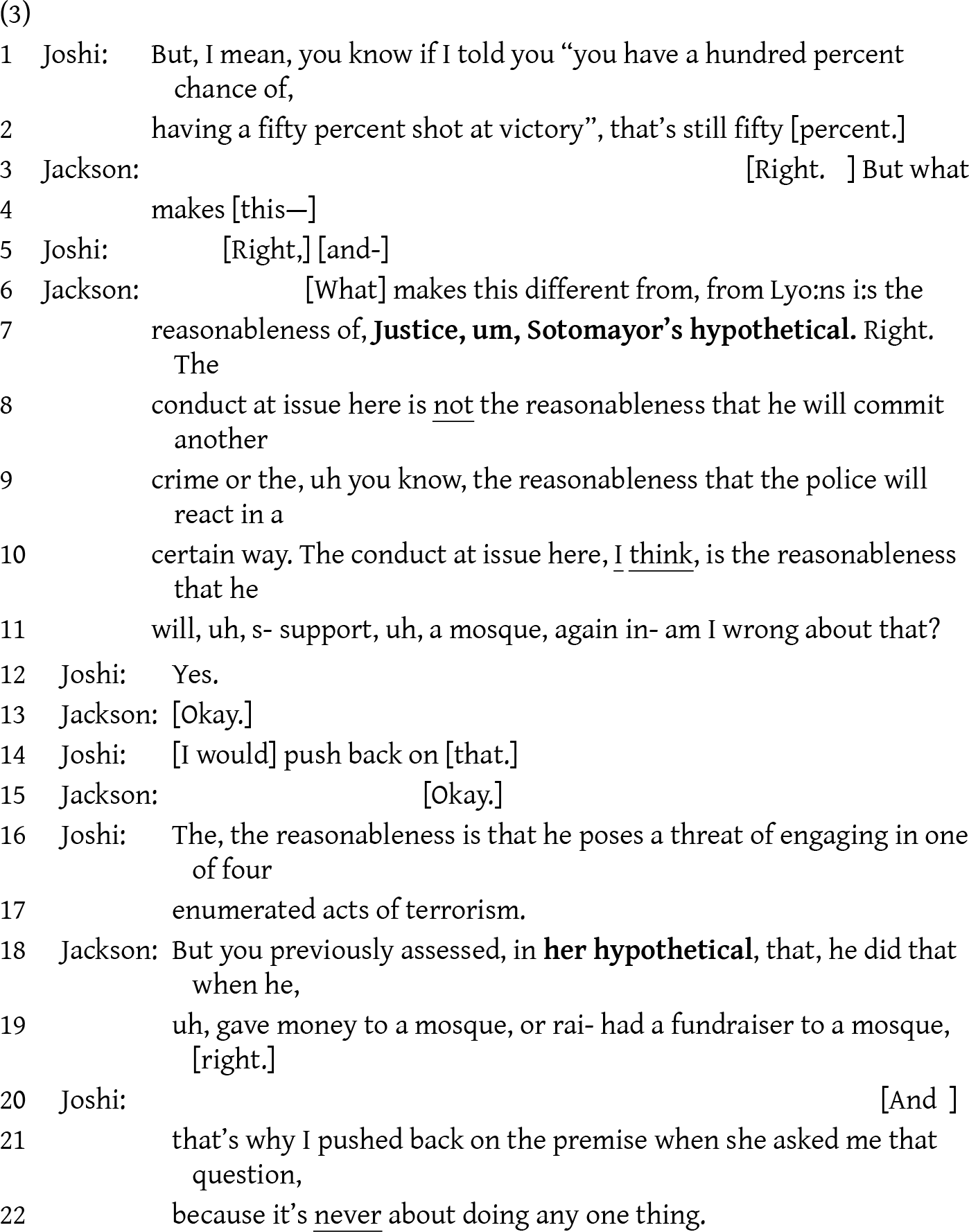
Long description
The table presents a numbered transcript excerpt of a dialogue between Joshi and Jackson. Joshi says that even with complete certainty of having a chance at victory, the chance remains fifty percent. Jackson agrees and asks what makes the situation different from Lyons, focusing on the reasonableness of Justice Sotomayor’s hypothetical. Jackson explains that the conduct at issue is not the likelihood of another crime or how police might react, but whether it is reasonable to think the person will support a mosque again. Bracketed words indicate overlapping speech and interruptions. The excerpt ends with Jackson asking if that framing is correct.
Justice Jackson refers to the hypothetical twice in this extract. First, in lines 3–4 and 6–11, she differentiates Fikre’s situation, as expressed through the hypothetical, from the holding of Lyons (a case on which the government was relying). Distinguishing Fikre’s situation from the Lyons case is a corollary of the argument that Justice Sotomayor had originally made with the hypothetical in extract (1)—because Fikre does not know why he was originally placed on the No Fly List, he has to assume that he could be relisted for merely doing the same everyday activities. Then, in lines 18–19, Justice Jackson refers to the hypothetical when asking Joshi to confirm that Fikre could indeed be relisted for engaging in the same conduct—Joshi had previously conceded this point, just after the end of extract (3).
That these uses of the hypothetical suggest alignment is a point most easily illustrated by comparison with other turns in the oral argument where the same two points are made. The likelihood of Fikre being relisted for the same conduct is a point Justice Jackson expresses later on in the oral argument, but without any reference at all to the hypothetical (47:12–47:23).
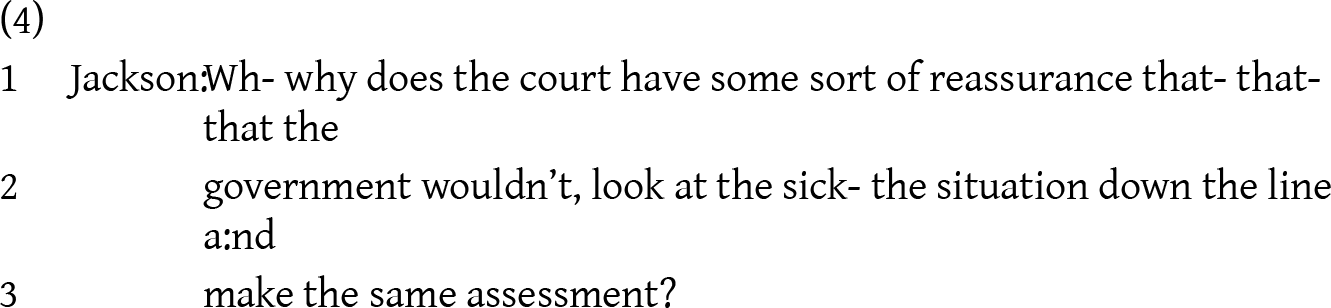
Long description
The table lists a short excerpt of dialogue attributed to Jackson across three lines. Jackson asks why the court has reassurance that the government would not revisit a sick person’s situation later and make the same assessment again. The content is presented as a continuous question broken across rows, with the speaker identified only in the first row and the remaining rows continuing the statement. No responses, outcomes, or additional speakers are included, so the table provides context for a concern rather than any measured results or comparisons.
In extract (4), Justice Jackson simply narrates a legal argument about the risk of Fikre being relisted for the same conduct. She does this without any features marking it as a repetition of an argument that Justice Sotomayor had already made. The existence of these two strategies, one with reference to the earlier hypothetical, and one without, shows Justice Jackson has multiple ways to make this particular argument. When she uses Justice Sotomayor’s prior hypothetical as a resource to construct her turn and her legal argument, she appears to add an element of alignment with Justice Sotomayor.
Likewise, Justice Jackson’s reference in extract (3) to Joshi’s previous concession (that Fikre could be relisted for the same conduct) is also a point that is later made without reference to Justice Sotomayor’s hypothetical. Justice Kagan does this, a few turns after the end of extract (3) (20:07–20:18).
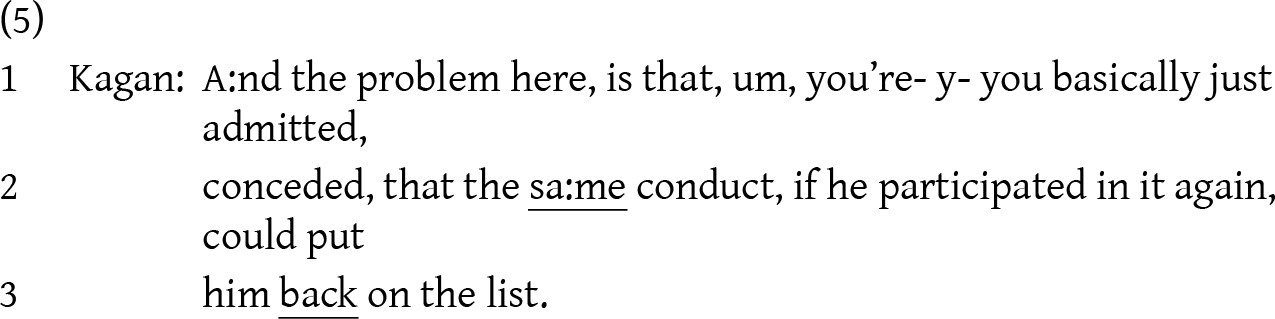
Long description
The table presents a three-line transcript excerpt labeled as item five. Line one attributes speech to Kagan, who says there is a problem and that the other speaker has basically admitted something. Lines two and three continue the statement, saying the other speaker conceded that the same conduct, if repeated, could place him back on the list. The excerpt emphasizes an admission and a consequence tied to repeating the conduct. No additional speakers, outcomes, or context beyond this brief exchange are provided.
This is same point Justice Jackson makes in lines 18–19 of extract (3), but Justice Kagan asserts it without referring to Justice Sotomayor’s prior turn. Thus, both of Justice Jackson’s points in extract (3) that are made with the hypothetical are made elsewhere without it. The existence of these other ways of making the same arguments supports the inference that Justices are supportively aligning in the cases where they do refer to Justice Sotomayor’s prior turn.
Finally, the conclusion that the Justices’ uses of the hypothetical in extracts (2) and (3) shows supportive alignment is bolstered by a comparison with Joshi’s turn in lines 20–22 of extract (3), which appears to show disalignment with the hypothetical. In his response to Justice Jackson’s question (lines 18–19) about the prior position he had taken in extract (1), Joshi describes how he had “pushed back on” it (line 21), and he refers to the hypothetical as “that question” (line 21), rather than using the label “hypothetical”. This disalignment would make sense, given that the hypothetical was used to make a point that was contrary to the government’s position.
Other nominalized turns
This study has investigated how supportive alignment occurs among Justices, given the interactional constraints of oral arguments. An interesting corollary question is whether there might be evidence of this supportive alignment even across perceived ideological lines. Such evidence, like the reasons for accord and collegiality described in the Introduction, might help dispel the perception of the Court as riven by ideologically driven conflict. To be clear, the notion that Justices have particular ‘ideologies’ is frequently criticized in legal scholarship as a misleading simplification (Fischman & Law Reference Fischman and Law2009), and it is likewise argued that more attention should be paid to Justices’ opinions on specific legal theories (Fischman Reference Fischman2019). And even assuming that judicial ideologies exist and can drive case outcomes, not all cases are necessarily ideologically salient. Nevertheless, it is notable that examples of nominalized turn recycling also occur in this study’s data across these perceived ideological lines.
One such example involves a persistent line of questioning throughout the oral argument, driven by Justice Alito, about the relationship between the remedy sought by Fikre and the procedural requirement of standing. In the first half of the oral argument, Justice Alito asks Joshi, counsel for the government, a number of questions about this, and these questions are elaborated over several multi-turn sequences. Later on, in the second half of the oral argument, the Justices question Gadeir Abbas, counsel for Fikre. In extract (6) (1:07:44–1:10:53), Justice Sotomayor asks Abbas the same question that Justice Alito had asked Joshi, and she refers to Justice Alito’s prior turns in doing so (given in bold below).
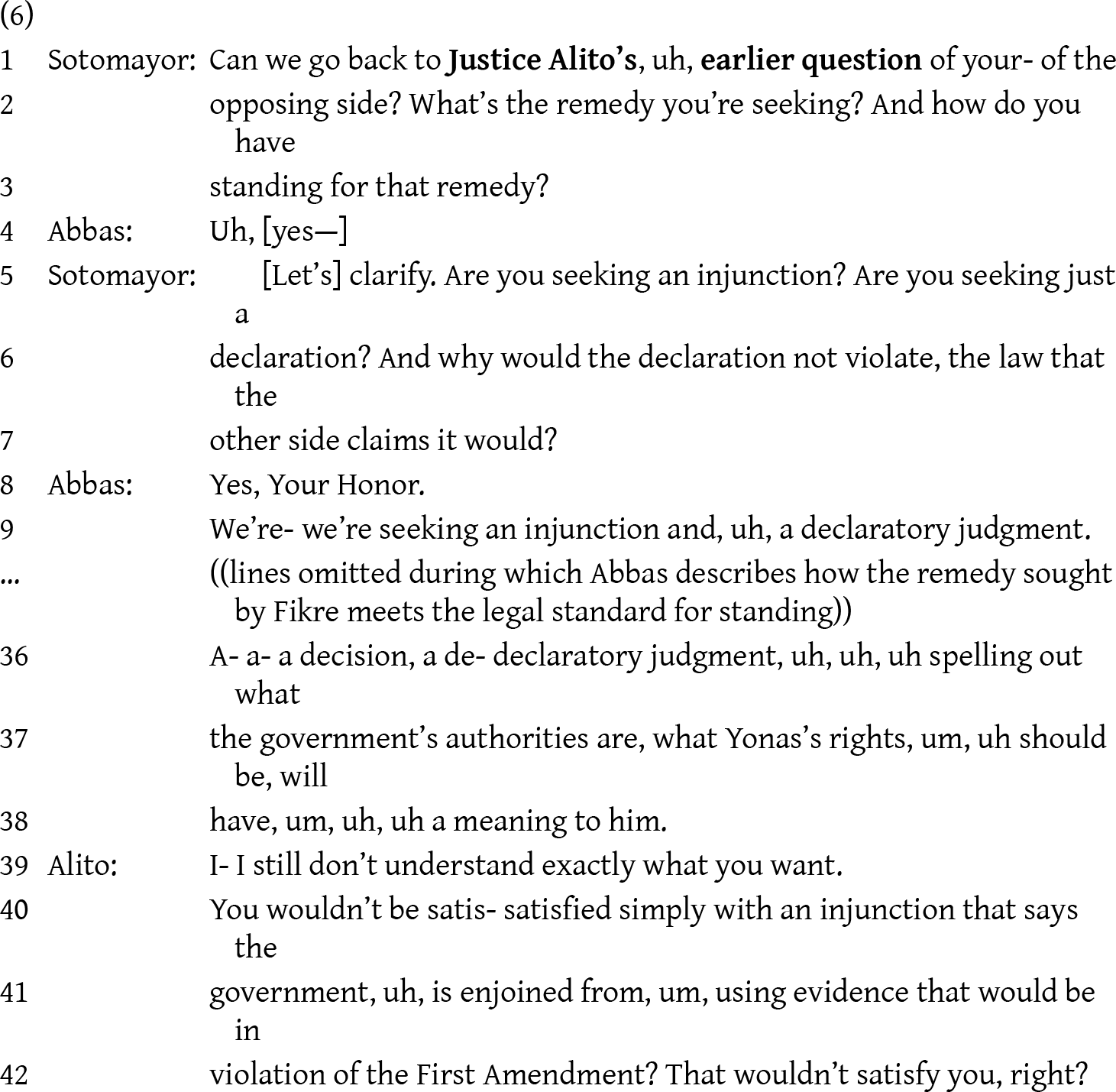
Long description
The table lists numbered transcript lines from a Supreme Court oral argument about the remedy requested and the basis for standing. Justice Sotomayor asks counsel Abbas to specify whether the party seeks an injunction, a declaratory judgment, or both, and questions why a declaration would not violate the law cited by the opposing side. Abbas responds that both an injunction and a declaratory judgment are sought. After omitted lines summarizing Abbas’s explanation of how the requested remedy meets the standing standard, Abbas states that a declaratory judgment defining government authority and the individual’s rights would have meaning to him. Justice Alito then says he still does not understand what is wanted and asks whether an injunction preventing the government from using evidence that violates the First Amendment would not be sufficient. The excerpt emphasizes judicial skepticism and repeated requests for specificity rather than providing a final resolution.
As in extracts (2) and (3), the question asked here by Justice Sotomayor in lines 1–3 could have been made without any reference to Justice Alito’s earlier turns, as in simply starting with, “What’s the remedy you’re seeking?”. And just as Justice Kagan clarified the meaning of Justice Sotomayor’s hypothetical in extract (4), here Justice Sotomayor elaborates the meaning of Justice Alito’s question with “Let’s clarify” (line 5) and the utterances that follow. As noted in the discussion of extract (2), this reformulation could be analogous to collaborative completion that is sometimes seen between close friends (Gordon Reference Gordon2003). The manner in which Justice Alito jumps back into the discussion following Abbas’s response to Justice Sotomayor (lines 8–38) is also notable. Had there been any mischaracterization of his original question, this is where we might expect to see Justice Alito make a clarification. Instead, he simply continues the sequence and seeks a further answer from Abbas (lines 39–42).
Given the brevity of this example, the evidence of alignment is perhaps not as strong as in the other extracts. But certainly the nominalization and reuse of Justice Alito’s question here is consistent with supportive alignment, notwithstanding that Justices Alito and Sotomayor are typically considered to be on opposite ends of the ideological spectrum. Likewise, elsewhere in the oral argument, Justice Gorsuch pursues an answer to an earlier question by Justice Kagan in a similar fashion, stating “I wanted to follow up actually on Justice Kagan’s question. That’s where I was headed earlier too” (33:48–33:53). Like Justices Alito and Sotomayor, Justices Gorsuch and Kagan are also usually thought to be ideologically opposed, so it is significant that there is potentially alignment here. As noted above, the purported ideological stances of the Justices are only relevant in a subset of the Court’s petitions, depending on the political salience of the precise legal issue. The fact that the Fikre petition resulted in a unanimous opinion may suggest that ideology was not particularly relevant. But at the very least, the recycling of turns occurs even between Justices who are not ideologically aligned generally, and this has interesting implications for the use of this linguistic tool in Supreme Court oral arguments.
Discussion and conclusion
This study demonstrates that, in Supreme Court oral arguments, Justices display supportive alignment by repeating, nominalizing, and endorsing one another’s questions, using these practices to signal agreement within the Court’s question-driven interactional format. In brief, extract (1) introduces a hypothetical posed and labeled by Justice Sotomayor; extracts (2) and (3) show Justice Kagan and Justice Jackson each redeploying that hypothetical to pursue related legal points, with Kagan overtly endorsing and clarifying the hypothetical and Jackson using it to hold the government to an earlier position. The fact that the same substantive points could have been made without recycling a prior turn, as illustrated by the assertions in extracts (4) and (5), indicates that the choice to reuse the hypothetical carries analytic weight as a resource for alignment rather than being a mere stylistic preference. Additional evidence comes from extract (6), where Justice Sotomayor takes up an earlier question from Justice Alito to continue a line of inquiry, showing that this practice can also occur across perceived ideological lines. At the same time, the data includes a contrasting use that does not display affiliation: at the end of extract (3), government counsel references Justice Sotomayor’s hypothetical without nominalizing it and asserts that he had resisted its premise in an earlier exchange. These differing uses of the same prior turn show that participants orient to nominalized speaking turns in distinct ways, and those orientations can make speakers’ alignments visible.
To be clear, the examples analyzed in this article are not necessarily indicative of judicial practice generally. Justices may recycle each other’s speaking turns for reasons other than to supportively align, and presumably they may also show supportive alignment or agreement through other means. This study has analyzed several examples that appear to show affiliation among the Justices, notably in the context of an oral argument where the Justices reached a unanimous decision. But importantly, the recycling of nominalized speaking turns can also be found in oral arguments that were marked by disagreement in the final opinion. The case of Trump v. United States, argued before the Court during the same term as Fikre, featured strikingly different arguments among the two ideological wings of the Court (Liptak Reference Liptak2024), and the eventual opinion was divided 6–3 and included two pointed dissents (Howe Reference Howe2024; Trump v. United States 2024). The Trump oral argument also featured the reuse of nominalized speaking turns, and this occurred both among Justices who voted together (such as Justice Gorsuch referring to “the Chief Justice’s hypothetical”), and among Justices who did not (such as Justice Sotomayor referring to “Justice Thomas’s question”) (Supreme Court of the United States 2024d)—Justices Thomas and Gorsuch joined Chief Justice Roberts’s majority opinion, whereas Justice Sotomayor authored a dissent. It therefore seems likely that the recycling of nominalized speaking turns can serve a variety of possible interactional functions.
The results of the present study are nevertheless additive to existing research on supportive alignment and other forms of conjoined participation. The linguistic features that show alignment in this data, such as repetition, explicit agreement, joint production format, and the use of prior turns to construct new turns, are consistent with those found in earlier studies such as Lerner (Reference Lerner1987, Reference Lerner1993), Kangasharju (Reference Kangasharju1996, Reference Kangasharju2002), and Gordon (Reference Gordon2003). The primary difference from prior studies is that all of the turns in which these language features appear are used to pose questions, which itself is a corollary of the institutional constraints on speaking turns at the Supreme Court. That evidence of supportive alignment can still be found in this context supports the conclusion that this is a fairly universal interactional tool used by parties to negotiate their relationships.
At the same time, this study is relevant to research on legal discourse, as it demonstrates the utility of concepts from discourse analytic research strands to the linguistic analysis of legal data. It also serves as a good test-case for the use of oral arguments as data, as distinguished from trial testimony and other more common sites of discourse analysis. Finally, research on the linguistic features of supportive alignment may help members of the legal press recognize it when it occurs in oral arguments. As noted above, the Fikre Court ultimately found in favor of Mr. Fikre, the petitioner, by unanimous decision (Federal Bureau of Investigation v. Fikre 2024). It should therefore come as no surprise that evidence of this agreement between the Justices was apparent in the oral argument. Further research in this space could be informative for legal commentators as they search for clues in oral arguments that may point towards the eventual outcomes of cases heard before the Court.
Appendix: Transcription conventions
The transcription conventions used in this study come from Tannen, Kendall, & Gordon (Reference Tannen, Kendall and Gordon2007) with minor modifications.
Carriage returns represent prosodic chunking of discourse.
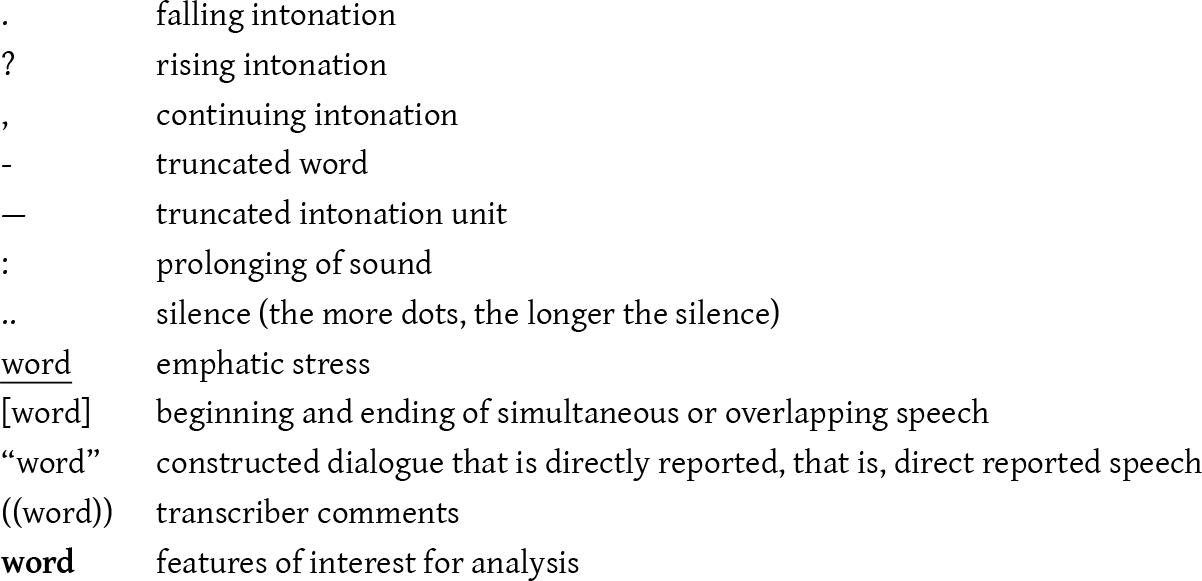
Long description
The table is a legend for conversation transcription symbols and formatting. It maps punctuation marks to intonation patterns: a period indicates falling intonation, a question mark indicates rising intonation, and a comma indicates continuing intonation. A hyphen marks a truncated word, while a long dash marks a truncated intonation unit. A colon indicates a prolonged sound, and multiple dots indicate silence with more dots meaning a longer pause. Emphatic stress is shown by writing the word in a stressed form, overlapping speech is shown with the word in square brackets, and directly reported speech is shown with the word in quotation marks. Transcriber comments are shown with double parentheses, and a word may also be specially formatted to flag features of interest for analysis. Meanings depend on this specific transcription convention and may differ in other systems.

 Open access

