




Introduction
Loneliness is a painful feeling of disconnection from significant others or detachment from relevant groups or communities (O’Rourke & Sidani, Reference O’Rourke and Sidani2017). Loneliness impacts at least 42 per cent of older adults that live in care homes but has long been understudied; interventions to address loneliness have not been systematically developed nor implemented for use in care home populations (Victor, Reference Victor2012). Within residential care homes (e.g., assisted living or long-term care), relationship-centred care could address residents’ objective social isolation (being alone) and subjective feelings of loneliness (feeling alone) by ensuring that everyday interactions promote feelings of intimate caring and belonging (i.e., social connectedness) (O’Rourke & Sidani, Reference O’Rourke and Sidani2017). In relationship-centred care, residents are active contributors to their communities both within and outside their homes (Nolan et al., Reference Nolan, Davies, Brown, Keady and Nolan2004). Gerontological leaders such as registered nurses, who model relationship-oriented behaviours towards residents and staff, have a critical role in addressing the longstanding problems of social isolation and loneliness experienced by care home residents (Woods et al., Reference Woods, Navarro, LaBorde, Dawson and Shipway2022). A social model of care that expands upon person-centred care, relationship-centred care recognizes that high-quality relationships with staff, family members, and the community are essential to promote individual choice and to align care with residents’ preferences (Nolan et al., Reference Nolan, Davies, Brown, Keady and Nolan2004). Mealtime experiences are an important aspect of relationship-centred care in care homes. This secondary analysis aimed to advance our understanding of the factors that are associated with care home staff members’ interest to make residents’ mealtimes more relationship-centred.
Background and purpose
In many care homes, communal dining occurs up to three times per day and may be one of the few opportunities for residents to interact with others in their social circle (de Medeiros et al., Reference de Medeiros, Saunders, Doyle, Mosby and van Haitsma2012). We should not assume, however, that communal dining is typically a positive relational experience (Morrison-Koechl et al., Reference Morrison-Koechl, Wu, Slaughter, Lengyel, Carrier and Keller2021), and how one experiences their surrounding community is a critical factor influencing loneliness (Finlay & Kobayashi, Reference Finlay and Kobayashi2018). Relationship-centred care can offer a practical framework to develop engaging mealtimes (Adams & Gardiner, Reference Adams and Gardiner2005) in order to promote social participation during mealtimes (Morrison-Koechl et al., Reference Morrison-Koechl, Wu, Slaughter, Lengyel, Carrier and Keller2021), improve the social environment (Keller, Trinca, et al., Reference Keller, Trinca, Dakkak, Wu, Bovee, Carrier, Cammer, Lengyel, O’Rourke, Rowe, Slaughter and Quiring2021), and improve residents’ quality of life (Ducak et al., Reference Ducak, Keller and Sweatman2015; Keller, Trinca, et al., Reference Keller, Trinca, Dakkak, Wu, Bovee, Carrier, Cammer, Lengyel, O’Rourke, Rowe, Slaughter and Quiring2021). Despite these benefits, ‘usual care’ at mealtimes may be more focused on task completion and efficiency (McGilton et al., Reference McGilton, Sidani, Boscart, Guruge and Brown2012), undermining personhood and dignity.
Like other quality issues, multiple, interrelated factors create the conditions within which care home staff can (or cannot) enact relationship-centred care during mealtimes. Size of home and funding structure have been identified as barriers to staff’s ability to provide quality care (Hsu et al., Reference Hsu, Berta, Coyte and Laporte2016) but are difficult to modify. While working conditions are modifiable and are critical to care home staff’s job satisfaction and delivery of quality care (Chamberlain et al., Reference Chamberlain, Hoben, Squires and Estabrooks2016), staffing levels alone do not guarantee relationship-centred mealtimes (Trinca et al., Reference Trinca, Chaudhury, Slaughter, Lengyel, Carrier and Keller2021). Staff also require essential relational knowledge and skills such as the ability to assess and respond to non-verbal communication (Douglas et al., Reference Douglas, Jung, Noh, Ellis and Ferguson2021), supportive leadership (Keller, Trinca, et al., Reference Keller, Trinca, Dakkak, Wu, Bovee, Carrier, Cammer, Lengyel, O’Rourke, Rowe, Slaughter and Quiring2021), and decision-making opportunities (Gaudenz et al., Reference Gaudenz, De Geest, Schwendimann and Zúñiga2019) to make changes to practice that improve care. Interdisciplinary gerontological leaders are essential to shifting staff behaviours and practices in care homes from task-focused to more relationship-centred approaches (Harvath et al., Reference Harvath, Swafford, Smith, Miller, Volpin, Sexson, White and Young2008).
Previous research has used the theory of planned behaviour (Bosnjak et al., Reference Bosnjak, Ajzen and Schmidt2020) to help to specify who or what should be targeted by interventions aimed to improve practices, such as reduced physical restraint use, in care homes (Wang et al., Reference Wang, Liu, Zhao, Xiao and Peng2021). The theory of planned behaviour purports that several kinds of beliefs predict one’s intention to change their behaviour (Bosnjak et al., Reference Bosnjak, Ajzen and Schmidt2020): (1) favourable or unfavourable opinions about the behaviour (i.e., attitudes); (2) beliefs about the ease of enacting the behaviour (i.e., perceived behavioural control); and (3) perceptions about a broader social group’s opinions about the behaviour (i.e., subjective norms).
The purpose of this study was to complete a secondary data analysis to examine how staff attitudes and perceptions of their work environment explain their interest to make changes to relationship-centred mealtime practices. Informed by the theory of planned behaviour, we hypothesized that:
H1 (attitudes): Staff who are dissatisfied with mealtimes are more interested in improving relationship-centred mealtime practices;
H2 (perceived behavioural control): Staff who have already been able to make changes in the care home are more interested in improving relationship-centred mealtime practices; and
H3 (subjective norms): Staff who perceived that their organization promoted relationship-centerd practices are more interested in improving relationship-centred mealtime practices.
Methods and procedures
Design
We analyzed survey data from a cross-sectional study. The overarching purpose of the primary study was to conduct an online survey to understand care home provider perceptions of meals and interest in making improvements in dining (Keller, Trinca, et al., Reference Keller, Trinca, Dakkak, Wu, Bovee, Carrier, Cammer, Lengyel, O’Rourke, Rowe, Slaughter and Quiring2021). For this secondary analysis, we selected survey items informed by the theory of planned behaviour, considering the theoretical constructs of intention to make change, attitudes, perceived behavioural control, and subjective norms. The survey also assessed home and participant demographic information to help contextualize the results and for use as adjustment variables in the analysis.
Study setting and sampling
We distributed the web survey to people working in care homes in Canada or the USA. We used snowball and convenience sampling to recruit participants. Research team members shared the survey link on social media (e.g., Twitter) and with their networks of stakeholders and with care home operators to ask them to participate or share the link with potential participants.
Inclusion and exclusion criteria
Participants were eligible if they were currently working in a care home in Canada or the USA. They needed to be involved in mealtimes in order to participate in the study. Participants working at more than one care home were instructed to answer the survey based on the home where they worked the most hours.
Instrument
A team of registered dietitians, registered nurses, and researchers developed the 23-item online QualtricsXM survey and assessed its clarity, functionality, and face validity prior to data collection. As data collection occurred between June 15 and September 30, 2020, shortly after the first wave of COVID-19 in Canadian care homes, the wording of some survey items specifically asked the staff to consider their perceptions or practices prior to COVID-19. The survey began with a description of the study and a consent question that had to be completed to proceed with the survey. Questions focused on care home staff perceptions of mealtime care practices, the impact of COVID-19 on mealtime practices, strategies used to support improvements in dining in the past, and desired ways of learning about how to improve mealtimes. The Mealtime Relational Care Checklist, which has evidence supporting its construct validity and reliability (Iuglio et al., Reference Iuglio, Chaudhury, Lengyel, Morrison, Boscart, Carrier and Keller2019), was included in the web survey. More detail about the complete set of web survey items is reported in the results paper for the primary analysis (Keller, Trinca, et al., Reference Keller, Trinca, Dakkak, Wu, Bovee, Carrier, Cammer, Lengyel, O’Rourke, Rowe, Slaughter and Quiring2021).
Data collection
To test our hypotheses, we held team meetings to review and select items from the web survey, informed by the constructs from the theory of planned behaviour. We selected variables from the survey which could be considered as indicators of the construct, based on the theory’s conceptual definitions. To operationalize the dependent variable and informed by the construct of intention to make change, we selected a single-item: staff’s level of interest in making mealtimes more relationship-centred. Because responses were highly skewed, this single item was dichotomized from a 10-point scale to reflect low interest to make change (1–7) as compared to high interest (8–10). Next, we selected items to measure independent variables (informed by the constructs of attitudes, perceived behavioural control, and subjective norms). Informed by the construct of attitudes, we selected items that reflected staffs’ beliefs about mealtimes and included: (i) satisfaction with residents’ mealtime experiences prior to COVID-19 (very dissatisfied/dissatisfied, satisfied, very satisfied); and (ii) feeling conflicted balancing safety and relationship-centred mealtimes during the pandemic (no/not sure, yes). We expected that respondents who were already satisfied with mealtime experiences and who did not feel conflicted during the pandemic (a time when safety became of paramount concern) would be less interested in making changes to mealtimes.
Informed by the construct of perceived behavioural control, we selected items that were indicators of staff’s abilities to make changes in their care setting. We expected that respondents who could identify strategies used to make change in the past would have more interest in making changes to mealtimes in the future. Participants were asked to indicate if there had been any care improvements in the past year and to select from a list of 24 strategies that helped make these improvements. Participants could select multiple strategies. As a team, we mapped the 24 strategies to Michie’s Behaviour Change Wheel because it links a comprehensive set of strategies to factors that influence behaviour change (Michie et al., Reference Michie, van Stralen and West2011), allowing us to use theory to make sense of the results. We mapped our 24 items to eight categories that reflected Michie’s intervention functions to achieve behaviour change, including education, incentivization, training, persuasion, coercion, enablement, environmental restructuring, and regulation (Michie et al., Reference Michie, van Stralen and West2011). Within each intervention function category, the number of strategies used was calculated. The count variable for enablement was further categorized using the median (0, 1–3, >3 strategies) due to the large number of strategies within this category and to preserve degrees of freedom in the final logistic regression model. The reference group for each category was the non-zero category with the highest frequency.
Informed by the construct of subjective norms, we selected items that reflected staff perceptions of other’s expectations related to relationship-centred mealtimes. We hypothesized that, if relationship-centred care was practiced or promoted in the care home, then staff would have more interest to make mealtimes relationship-centred. The items included: (i) whether their care home was making changes to promote resident−/relationship-centred care (no/not sure, yes); and (ii) the sum scores of task-focused and relationship-centred care mealtime practices that they reported typically occurred within their homes prior to COVID-19. The Mealtime Relational Care Checklist, which has demonstrated construct validity and reliability (Iuglio et al., Reference Iuglio, Chaudhury, Lengyel, Morrison, Boscart, Carrier and Keller2019), was used, and participants were asked to select practices that typically occurred in their home from a list of 15 relationship-centred and 11 task-focused mealtime practices. Items were not identified as either ‘relationship-centred’ or ‘task-focused’ on the survey to reduce potential social desirability bias.
We included covariates in the model to adjust for the influence of other respondent and care home characteristics. Respondent characteristics included gender (man, woman), age (18–39, 40–55, ≥56 years), length of time working in the home (<2, 2–4, 5–10, ≥11 years), and work role (foodservice, direct care, and other). Characteristics of the care home, as reported by the respondent included: profit status (non-profit/municipal, for-profit), chain affiliation (yes/no), continuum of care status (e.g., attached to a retirement community or assisted living community; yes/no), location of care home (Alberta, British Columbia, Manitoba/Saskatchewan, Maritimes, Ontario, USA), size of home (≤49 beds, 50–99 beds, ≥100 beds), and age of the care home building (≤10 years, 11–20 years, >20 years).
Data analysis
Descriptive statistics (frequency, mean, and standard deviation) were calculated for all variables. List-wise deletion was used to handle missing data. Bivariate associations between respondents’ level of interest in making mealtimes more relationship-centred and survey items were calculated using chi-square and between-subjects ANOVA tests. A multivariable binary logistic regression assessed if independent variables related to attitudes, perceived behavioural control, and subjective norms helped to explain respondents’ level of interest in making mealtimes relationship-centred. In the multivariable model, we adjusted for home and respondent characteristics that were of conceptual or clinical importance, regardless of their statistical significance in bivariate analysis. Statistical significance for all tests was determined using p < .050. SAS® Release 3.81 was used.
Ethical considerations
Ethics review and clearance were provided by the University of Waterloo (ORE# 42335) and the University of Alberta Research Ethics Board (Pro00113653). As per ethics requirements, participants could skip any question in the survey.
Results
Characteristics of the sample
Both descriptive (Tables 1 and 2) and bivariate analysis (available in a supplementary file) used data from the sub-sample of 670 respondents with complete data on all study variables included in the final regression (out of 1,036 respondents who consented and completed the first survey question). Most respondents were women (90%) working within a food or nutrition role (e.g., dietitian, dietary aide, and foodservice manager; 76%), aged 40–55 or 18–39 (41% and 36%, respectively), and had worked in their care home for ≥11 or 5–10 years (30% and 26%, respectively). Ninety-five of the participants (14.2%) worked in a direct care role. With respect to mealtime practices, most respondents felt satisfied with residents’ mealtime experiences (63%), and 76 per cent were interested in making mealtimes more relationship-centred. Relationship-centred practices were, on average, reported more commonly as compared to task-focused mealtime practices (9.9 ± 2.8 versus 4.8 ± 1.9, respectively). Most respondents (70%) reported their care home was making changes to promote relationship-centred care (prior to the COVID-19 pandemic), and 72 per cent reported feeling conflicted balancing safety and relationship-centred care during the COVID-19 pandemic. Of the 24 listed strategies that were used to help to make care improvements in the past year, a mean of 7.7 ± 5.4 strategies was reported. When strategies were categorized using Michie’s Behaviour Change Wheel, most respondents reported utilizing at least one or more strategies from categories of enablement (77.31%), persuasion (61.64%), and environmental restructuring (53.73%) (Table 2).
Descriptive statistics for survey items (N = 670)

* Sum of relationship-centred and task-focused mealtime practices is included in the dimension of subjective norms and is reported in text.
Descriptive statistics for strategies that resulted in care improvements in the past year mapped onto Michie’s behaviour change wheel (N = 670)
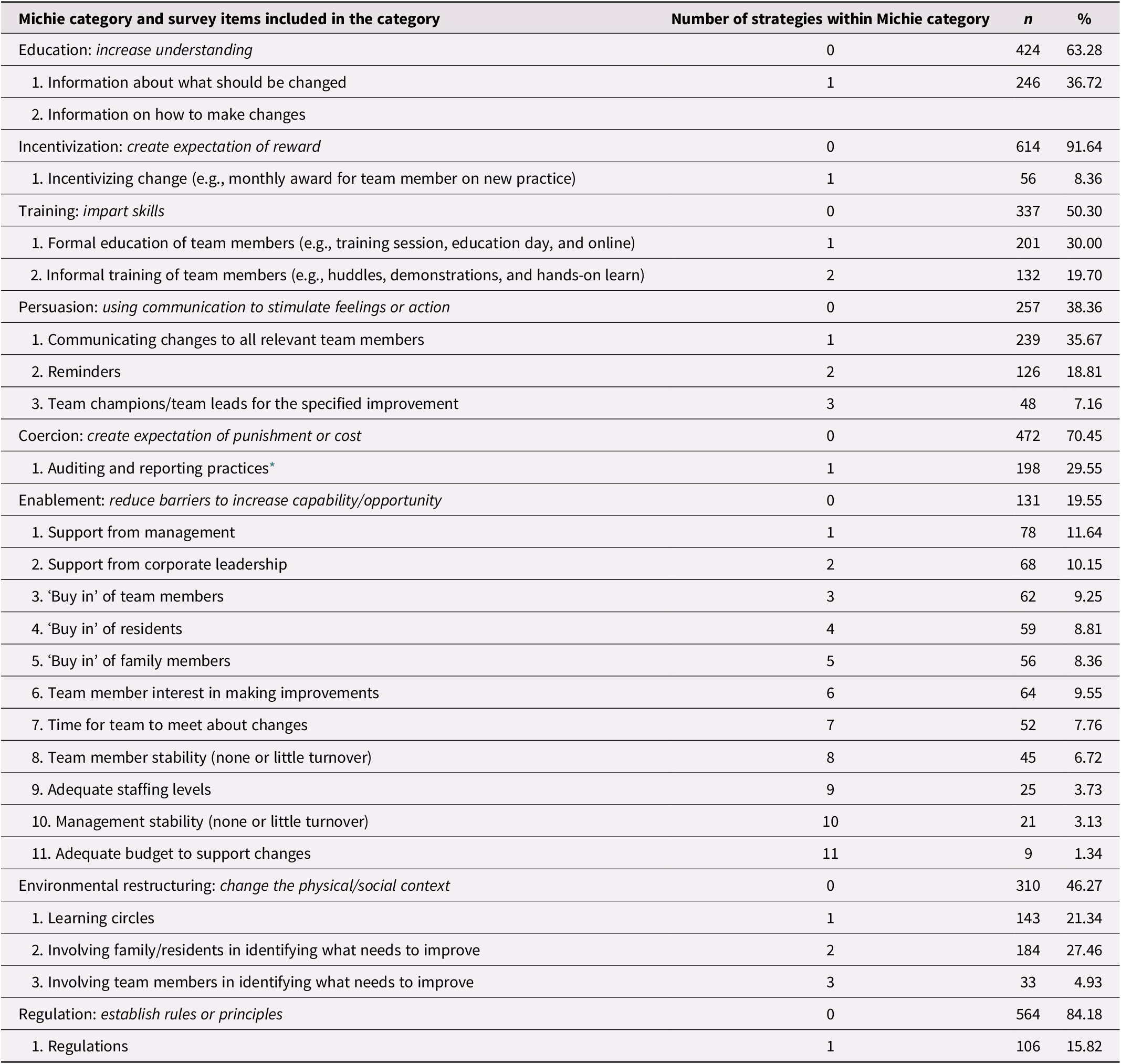
Note: Items numbered in each row indicate the number of survey strategy items included in the Michie’s category.
* Classified as ‘coercion’ because historically audits have been done for accreditation and perceived as a check-up on behaviour in care homes, rather than as a persuasive behaviour change tool.
Multivariable binary logistic regression
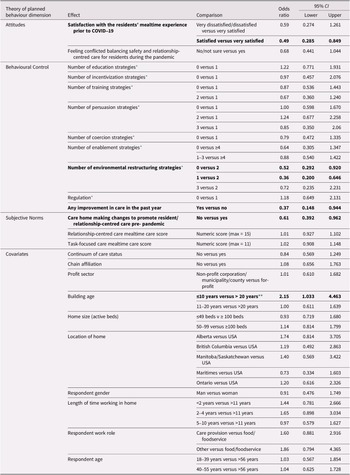
The overall model was statistically significant (LRT(41) = 61.84, p = .019, max-rescaled R2 = .13), and results are shown in Table 3. Our results do not support H1, where we selected variables informed by the construct of attitude. Respondents’ level of satisfaction with residents’ mealtime experience prior to the COVID-19 pandemic was significantly associated with respondents’ level of interest in making mealtimes more relationship-centred (χ2(2) = 6.58, p = .037), but the direction of effect did not support H1. Satisfied respondents had a significantly lower odds of reporting a high level of interest in making mealtimes more relationship-centred by 51 per cent when compared to respondents who indicated being very satisfied (CI [0.28, 0.85]). Similarly, respondents who were dissatisfied had lower odds of reporting a high level of interest compared to the very satisfied group, but this difference was not statistically significant. Also, respondents who felt conflicted balancing safety and relationship-centred care during the COVID-19 pandemic was marginally non-significant (χ2(1) = 3.11, p = .078), and the direction of effect was also opposite to what we hypothesized: respondents that reported feeling conflicted had 32 per cent lower odds of reporting a high level of interest in making mealtimes more relationship-centred (CI [0.44, 1.04]).
Logistic regression testing interest in making mealtimes more relationship-centred as outcome, statistically significant effects in bold (p < .050) (N = 670)

* Strategies indicated to improve care in the past year. Most frequent non-zero value for strategies chosen as the reference group.
** The global effect is not statistically significant. Caution should be taken when interpreting the odds ratio.
Our results provided mixed support for H2, where we selected variables informed by the construct of perceived behavioural control. The sum of environmental restructuring strategies applied in the past year was significantly associated with respondents’ level of interest in making mealtimes more relationship-centred (χ2(3) = 11.77, p = .008), and the direction of effect supported H2. Compared to respondents who reported using two strategies in the environmental restructuring category, respondents who indicated only one or none of these strategies had a significantly lower odds of reporting a high level of interest in making mealtimes more relationship-centred by 64 per cent and 48 per cent, respectively (CI [0.20, 0.65], [0.29, 0.92]). Reporting that any improvement was made in the past year was significantly associated with the level of interest in making mealtimes more relationship-centred (χ2(1) = 4.34, p = .037), but the direction of effect did not support H2. Compared to participants who reported that the care home had made no improvements in care in the past year, participants who reported an improvement had a significantly lower odds of indicating a high level of interest by 63 per cent (CI [0.15, 0.94]). Other items that were included as independent variables to measure perceived behavioural control (i.e., the sum of education, incentivization, training, persuasion, coercion, enablement, and regulation strategies) were not significantly associated with respondents’ level of interest in making mealtimes more relationship-centred (p > .050).
H3 was supported by our results, where we selected variables informed by the construct of subjective norms. Efforts made by the care home to promote resident and relationship-centred care prior to the COVID-19 pandemic were significantly associated with the level of interest in making mealtimes more relationship-centred (χ2(1) = 4.53, p = .033), and the direction of effect supported H3. Respondents who reported that their home was not making changes to promote relationship-centred care had a significantly lower odds of indicating they were highly interested in making mealtimes more relationship-centred by 39 per cent (CI [0.39, 0.96]). Other items that were included as independent variables to measure subjective norms (i.e., the sum of task-focused and relationship-centred mealtime care practices that typically occurred prior to COVID-19) were not significantly associated with respondents’ level of interest in making mealtimes more relationship-centred (p > .050).
None of the adjustment variables at the care home level (i.e., continuum of care status, profit status, chain status, age of building, size, and location) or the respondent level (i.e., age, gender, work role, and length of time working at the home) were statistically significant. However, while the overall effect of care home building age was nonsignificant (χ2(2) = 4.33, p = .115), participants working at homes built within 10 or fewer years had 2.15 times greater odds of reporting a high level of interest in making mealtimes more relationship-centred as compared to participants working at homes built more than 20 years ago (CI [1.03, 4.46]). Caution should be taken when interpreting this result due to the non-significant overall effect of building age.
Discussion
Strengths and limitations of the work
Strengths of this study include a large sample size (N = 670) with representation from several jurisdictions and both food service and direct care provider groups. We collected data on the respondent’s specific role within the home (e.g., dietitian, food service manager, nurse, and care aide), however, we more broadly categorized this variable for analysis. The respondent ethnic/cultural background was not collected. As such, the influence of one’s specific role and ethnic cultural background are areas for exploration in future research. The use of an established planned action theory to select measures and derive a priori hypotheses was another strength to prevent Type 1 errors and help make sense of our findings in this secondary analysis. We used logistic regression modelling to adjust for a host of potential covariates. A limitation of this secondary analysis was that the measures were selected as informed by constructs in the Theory of Planned behaviour after the study had already been conducted and may not have been the best way of measuring the theoretical constructs. For example, to select a measure of perceived behavioural control, we had to make the assumption that people who had used strategies in the past would be more likely to perceive that they could make changes to practice in the future; we did not have a direct measure of their perceptions. However, out of the 24 strategies organized into eight different types of changes, only those related to environmental restructuring had a statistically significant association with intention to make changes to relationship-centred mealtime practices. These 24 strategies were not specific to mealtimes, and were not a direct measure of attitudes; they may not have been sensitive enough to assess participants’ perceptions of behavioural control specifically in relation to mealtime experiences. Despite these limitations, environmental restructuring was associated with intentions to make mealtimes more relationship-centred. It was also notable that of 6 statistically significant terms in the model, five of these were selected based on theory. Given the well-established nature of the theory of planned behaviour (Bosnjak et al., Reference Bosnjak, Ajzen and Schmidt2020), this suggests that our measures did, in fact, tap into the theoretical constructs. Finally, this survey was conducted during the first wave of the COVID-19 pandemic, a time when care home staff were under immense strain. Although we cannot be sure of the impact of COVID-19 on our study responses in a cross-sectional design, this important contextual element could have impacted completion rates or staff’s perceptions.
Recommendations for further research
The findings of this study offered mixed support for our specific hypotheses. Satisfaction with the status quo was associated with interest in making mealtime more relationship-centred. However, the direction of effect was opposite to our hypothesis. We found that participants who were the least satisfied with the current status of mealtimes, or who felt the most conflicted balancing relationship-centred care and safety during the pandemic were also the least interested in making improvements to relationship-centred care. In this secondary analysis, where we did not have a more direct measure of attitudes towards relationship-centred mealtimes, it is possible that our measures were capturing people’s satisfaction with their working conditions and staff’s need for more support to balance safety and relationship-centred care in future outbreaks of COVID-19 or other infectious diseases. Previous research supports this interpretation and has shown that care home staff who were less satisfied in their jobs also felt less empowered in their workplace (Chamberlain et al., Reference Chamberlain, Hoben, Squires and Estabrooks2016), which may translate into having a reduced interest in making changes in their practice. This highlights the importance of considering contextual factors, such as staffing, resources, and culture within the setting (Harvey & Kitson, Reference Harvey and Kitson2016), in order to design and implement effective, sustainable programs that support behaviour change in care homes (Hoben et al., Reference Hoben, Ginsburg, Norton, Doupe, Berta, Dearing, Keefe and Estabrooks2021). It could also be that staff were more satisfied with mealtimes because they felt that their home was supportive of relationship-centred care practices (Caspar et al., Reference Caspar, O’Rourke and Gutman2009). We may have been tapping into perceived behavioural control, more so than individual attitudes towards mealtimes, with this item. Previous research supports that it is challenging to disentangle individual attitudes from workplace culture, because these are related to and influence each other (Abdul Rashid et al., Reference Abdul Rashid, Sambasivan and Abdul Rahman2004). More research is needed to directly assess how staff attitudes influence interest in making mealtimes more relationship-centred.
Participants had used a wide range of strategies to make other kinds of changes in their practice settings, the most common of which were enablement, persuasion, and environmental restructuring. Individuals who were in a setting where two environmental restructuring strategies were used to make change in the past (which we used in this secondary analysis as an indicator of behavioural control) were more likely to show high interest in making mealtimes more relationship-centred, as compared to those where just one or no strategy was used. Environmental restructuring in this study referred to the specific activities of learning circles, which are collaborative approaches to involve family, residents, or team members to identify what needs to improve. Similarly, effective quality improvement initiatives have required interprofessional team communication and involving front-line health care aides in care homes (Hoben et al., Reference Hoben, Ginsburg, Easterbrook, Norton, Anderson, Andersen, Boström, Cranley, Lanham, Weeks, Cummings, Holroyd-Leduc, Squires, Wagg and Estabrooks2020). In our sample, almost half (46.27 per cent) of participants reported that no environmental restructuring strategies had been used in the past year, highlighting that there is a need for interventions that promote an improvement culture (e.g., use of learning circles) to accelerate change in care homes (Westergren, Reference Westergren2012). Care staff who have not had the opportunity to engage in previous collaborative change efforts may be promising targets of future intervention research.
Mixed support was observed related to the variables that we selected to operationalize the construct of subjective norms. Respondents that perceived that the care home had made previous efforts to promote relationship-centred care had higher odds of interest in making changes to relationship-centred mealtime practices. This was an expected finding, supporting that participants’ perception that the home had implemented relationship-centred care (in general) was associated with their interest to make mealtimes (specifically) more relationship-centred. However, whether participants observed current mealtime practices to be more relationship-centred or task-focused based on the Mealtime Relational Care Checklist (Iuglio et al., Reference Iuglio, Chaudhury, Lengyel, Morrison, Boscart, Carrier and Keller2019) was not associated with their interest in making mealtimes more relationship-centred. This may reflect a lack of knowledge on the behalf of care providers as to what strategies reflect relationship-centred versus task-focused mealtime practices and indicate the need for training in these areas to increase knowledge and awareness of best practices (Trinca et al., Reference Trinca, Chaudhury, Slaughter, Lengyel, Carrier and Keller2021). Staff in care homes may need to be shown that there are deficits with respect to relationship-centred care, highlighting the potential value of educational interventions and offering staff feedback about their practices in order to promote practice change in care homes (O’Rourke, Lobchuk, et al., Reference O’Rourke, Lobchuk, Thompson and Lengyel2020).
It is important to note that ‘interest’ to change is not the same as behaviour change, and we did not measure behaviour change. However, research does support that intentions and actual behaviour change are related. For example, a study conducted in Chinese care homes using path analysis found that both staff attitudes and perceived behavioural control predicted intentions (R2 = 0.359), which subsequently predicted actual practice related to reduction in restraint use (Wang et al., Reference Wang, Liu, Zhao, Xiao and Peng2021). Our findings support that there are several key factors that could be targeted to influence staff interest in making change; further longitudinal and intervention research is needed to explore pathways between influencing factors, interest/intentions, and practice change specifically in relation to making mealtimes more relationship-centred.
Implications for policy and practice
The findings from this study, which was informed by the Theory of Planned Behaviour, support that there are several characteristics that could be used by researchers or gerontologists to identify care homes or staff who may be more ready to implement relationship-centred mealtime practices. Other research conducted in care home settings has similarly found that the constructs within the theory of planned behaviour offer a useful framework to identify barriers and facilitators to practice change (Beck et al., Reference Beck, McIlfatrick, Hasson and Leavey2017; O’Neill et al., Reference O’Neill, Dwyer, Reid-Searl and Parkinson2018) and to design effective interventions to change staff behaviours (Kop̈ke et al., Reference Kop̈ke, Muḧlhauser, Gerlach, Haut, Haastert, Moḧler and Meyer2012; Low et al., Reference Low, Fletcher, Goodenough, Jeon, Etherton-Beer, Macandrew and Beattie2015).
Social connectedness is promoted in different ways for different people (O’Rourke, Sidani, et al., Reference O’Rourke, Sidani, Jeffery, Prestwich and McLean2020). Results from the present study focused on relationship-centred care and communal mealtimes, but there are many other practices worthy of further exploration, such as how relationship-centred care is enacted to support residents who choose to have mealtimes in their own rooms. The Mealtime Relational Care Checklist used in this study includes many items related to resident choice (e.g., ‘I make sure that residents are happy where they sit and who they sit with’), however, there is no item that specifically asks whether residents are supported to eat in their own rooms, should that be the resident’s preference/choice. It is important to recognize that communal dining experiences are important for many, but not all, residents.
The study findings support the potential of using educational strategies, feedback about relationship-centred care, and collaborative approaches to promote relationship-centred care practices, and this may be a promising avenue for gerontological leaders who aim to protect care home residents from social isolation and loneliness. It remains essential, but challenging, to find ways to support people living in care homes to continue to connect meaningfully with their network of family and friends (O’Rourke, Sidani, et al., Reference O’Rourke, Sidani, Jeffery, Prestwich and McLean2020). Applying relationship-centred care, care home staff can personally acknowledge residents during care and create opportunities for intimacy and meaningful exchanges, which may help to reduce loneliness (Sjöberg et al., Reference Sjöberg, Edberg, Beck and Rasmussen2019). However, the implementation of relationship-centred care strategies should not be left up to individual providers (Lombard, Reference Lombard2021); feasible, acceptable, and effective interventions that target both providers’ knowledge and the improvement structures within organizations are needed to promote relationship-centred care during mealtimes and beyond, making relationship-centred care the responsibility of gerontological leaders. For example, the CHOICE+ intervention is a training program could be used by leaders in care homes, which uses participatory approaches to improve mealtimes and has demonstrated benefits to relationship-centred care practices (Keller, Wu, et al., Reference Keller, Wu, Iraniparast, Trinca, Morrison-Koechl and Awwad2021).
Conclusion
We aimed to identify potentially modifiable variables to help explain why some respondents are eager to make change in making mealtimes more relationship-centred, while others lack interest. Our secondary analysis of cross-sectional survey data supported that the respondents who were more satisfied with the mealtime practices in their care home, who had been able to use collaborative strategies to make change in the past, and who perceived that their organization supported relationship-centred care in general were more likely to intend to make future mealtime practices more relationship-centred. Overall, this suggests that the staff who are interested in making mealtimes more relationship-centred find task-focused mealtimes unacceptable and believe that their views are shared and supported by others in their organization. This supports the promise of ‘learning health systems’ to impact mealtime practices, where data are used by an organization to support continuous cycles of collaborative improvement (Estabrooks et al., Reference Estabrooks, Straus, Flood, Keefe, Armstrong, Donner, Boscart, Ducharme, Silvius and Wolfson2020). Future research should focus on determining how gerontological leaders can cultivate organizational practices that will support relationship-centred practices, such as mealtime experiences, to address social isolation and loneliness (Woods et al., Reference Woods, Navarro, LaBorde, Dawson and Shipway2022). If direct care providers and leaders engage collaboratively, working towards a shared goal, relationship-centred mealtimes may become a part of everyday life for care home residents, who seek healthcare but also – critically – human connection.
Supplementary material
The supplementary material for this article can be found at http://doi.org/10.1017/S0714980825000145.
Acknowledgements
The authors would like to thank the individuals who took the time to participate in our study, especially given the difficult situation in long-term care homes during the COVID-19 pandemic.
Financial support
This work was supported by the Social Sciences and Humanities Research Council [grant number 892-2020-0044].
Competing interests
The authors declare that there is no conflict of interest.



 Open access

