




Introduction
In the USA, current intensive agricultural production has led to undesirable effects on the environment and a gradual decrease in land productivity (Kassam et al., Reference Kassam, Derpsch and Friedrich2014; McDaniel et al., Reference McDaniel, Tiemann and Grandy2014; Benitez et al., Reference Benitez, Osborne and Lehman2017). The average soil loss over the last 100 yr of crop cultivation across the Midwest has been estimated to be 7.2 ± 4.8 Mg ha−1 yr−1 (Thaler et al., Reference Thaler, Kwang, Quirk, Quarrier and Larsen2022). Historic and modern soil erosion reduces cropland productivity and agroecosystem resiliency. Soil, nutrient and agrochemical losses are also major sources of water pollution. Between 2007 and 2009, nitrogen (N) leaching to water sources from intensively cultivated croplands in southern Minnesota amounted to 7–12 lbs N acre−1 yr−1 (Minnesota Pollution Control Agency, 2013). A high water N level could further lead to undesirable outcomes in aesthetic-, health- and economic-related issues (Khan et al., Reference Khan, Mobin, Abbas, Alamri, DellaSala and Goldstein2018; Wang et al., Reference Wang, Fan, Xu, Kumar and Kasu2021a).
The negative environmental consequences of crop production can be reduced by lowering tillage intensity, improving N use efficiency and/or using regenerative farming practices (Yadav et al., Reference Yadav, Datta, Imran Pathan, Lal, Meena, Babu, Das, Bhowmik, Datta, Saha and Mishra2017; Zomer et al., Reference Zomer, Bossio, Sommer and Verchot2017; Baffaut et al., Reference Baffaut, Ghidey, Lerch, Veum, Sadler, Sudduth and Kitchen2020). Conservation practices such as conservation tillage and cover crops can increase soil productivity, reduce erosion and slow climate change (Chalise et al., Reference Chalise, Singh, Wegner, Kumar, Pérez-Gutiérrez, Osborne, Nleya, Guzman and Rohila2019; Joshi et al., Reference Joshi, Ulrich-Schad, Wang, Dunn, Clay, Bruggeman and Clay2019; Page et al., Reference Page, Dang and Dalal2020; Singh et al., Reference Singh, Nouri, Singh, Anapalli, Lee, Arelli and Jagadamma2020). While a large and continually growing body of research examined factors associated with conservation practice adoption, not enough focus has been placed on ‘barriers to adoption, especially cultural (e.g., community norms) and structural (e.g., policy–market interface)’ (Prokopy et al., Reference Prokopy, Floress, Arbuckle, Church, Eanes, Gao, Gramig, Ranjan and Singh2019).
This paper studies farmer perceived challenges toward two conservation practices, conservation tillage and cover crops. Conservation tillage refers to any tillage practice that leaves at least 30% of crop residues on the soil surface after cash crop planting (Kassam et al., Reference Kassam, Friedrich, Shaxson and Pretty2009; Hagen et al., Reference Hagen, Delgado, Ingraham, Cooke, Emery, Fisk, Melendy, Olson, Patti, Rubin, Ziniti, Chen, Salas, Elias and Gustafson2020). Some common practices that fall under the conservation tillage category include no-till, reduced tillage, mulch tillage and ridge tillage (Kassam et al., Reference Kassam, Friedrich, Shaxson and Pretty2009). Conservation tillage helps preserve soil moisture in dry areas, improve soil and water quality, and, in many instances, can increase long-term crop yields (Busari et al., Reference Busari, Kukal, Kaur, Bhatt and Dulazi2015; Canales et al., Reference Canales, Bergtold and Williams2020; Saak et al., Reference Saak, Wang, Xu, Kolady, Ulrich-Schad and Clay2021). Using observational data from a study conducted in Corn Belt states between 2005 and 2018, Chen et al. (Reference Chen, Gramig and Yun2021) showed that conservation tillage had a positive effect on corn and soybean yields. A long-term (1992–2016) experimental study conducted in New York found that a continuous no-till practice increases soil heath and crop yields (e.g., corn) in the temperate region than plow-till practice (Nunes et al., Reference Nunes, van Es, Schindelbeck, Ristow and Ryan2018). They further indicated that the positive effect of no-till practice on crop productivity depends on soil type and whether the farming system adopted other conservation practices or not. No-till practices can present trade-offs associated with herbicide use, however, as a general practice, reducing tillage intensity provides multiple well-documented agroecosystem, soil health and water quality benefits (Hagen et al., Reference Hagen, Delgado, Ingraham, Cooke, Emery, Fisk, Melendy, Olson, Patti, Rubin, Ziniti, Chen, Salas, Elias and Gustafson2020; Hess et al., Reference Hess, Hinckley, Robertson and Matson2020).
Cover crops, referred to crops planted to cover the soil surface during fallow periods, protect soil on croplands that otherwise would be bare between harvest and planting of cash crops, typically from fall until spring in temperate climate zones or during the winter in tropical and subtropical climates. Cover crops help improve soil health and water filtration, control weeds, pests, and diseases and provide wildlife habitat (Pullaro et al., Reference Pullaro, Marino, Jackson, Harrison and Keinath2006; Oliveira et al., Reference Oliveira, Butts and Werle2019; Chen et al., Reference Chen, Rejesus, Aglasan, Hagen and Salas2022). Mahama et al. (Reference Mahama, Prasad, Roozeboom, Nipper and Rice2016) found that the integration of leguminous cover crops has the potential to reduce nitrogen requirement and increase grain yield. Cover cropping also affects the whole farm profitability of Midwest farmers with differing effects across state and cover crop types (Plastina et al., Reference Plastina, Liu, Miguez and Carlson2020). When implemented together, conservation tillage and cover crops can be used to improve agricultural system sustainability. While there is geographic variation, the complementarity benefits between these two conservation practices exists partly because no-till seeding equipment with minor additions could be utilized to plant cover crops, which can mitigate weed problems in no-till lands (Bergtold et al., Reference Bergtold, Ramsey, Maddy and Williams2019; Lee and McCann, Reference Lee and McCann2019; Canales et al., Reference Canales, Bergtold and Williams2020).
Despite the benefits, some conservation practices, such as cover crops, are not widely adopted by farmers. According to the 2017 Census of Agriculture, between 2012 and 2017, the adoption rate of cover crops was approximately 4% of total croplands (U.S. Department of Agriculture, 2019). Between 2017 and 2020, winter cover crops were planted in 4–5% of row crop acres in the Midwest (CTIC, 2022). The nationwide adoption rates of conservation tillage increased from 44% in 2012 to 51% in 2017 (U.S. Department of Agriculture, 2019). In the Corn Belt states, the conservation tillage adoption rate was 44%, while cover crops were only planted on 3% of the total corn and soybean acres (Hagen et al., Reference Hagen, Delgado, Ingraham, Cooke, Emery, Fisk, Melendy, Olson, Patti, Rubin, Ziniti, Chen, Salas, Elias and Gustafson2020). Emerging challenges associated with conservation practices, such as herbicide-resistant weeds, may result in discontinuation of such practices. During 1998–2016, tillage intensity across the US corn–soybean cropping systems first decreased with the adoption of herbicide-tolerant crops and then increased with emerging weed resistance and is likely to further increase as weed resistance persists (Lu et al., Reference Lu, Yu, Hennessy, Feng, Tian and Hui2022).
To facilitate farmers' adoption and effective use of conservation practices, this study investigated farmer perceived challenges toward using conservation tillage and cover crops at the margin of US Corn Belt, as well as potential factors that affect such perceived challenges. Conservation tillage and cover crops were selected in this study because of their potential complementarity in improving soil health and farm profitability over the long term. We investigated the effect of farmer characteristics, adoption duration, farmers' sense of place (SOP), farm management strategies and biophysical and climate factors on farmers' perceived challenges. A survey designed to identify the adoption challenges for conservation tillage and cover crops was mailed to South Dakota farmers located and the data were analyzed using ordinal logistic regression. Specifically, we targeted farm operators in central and eastern South Dakota where the production of corn and soybean is dominant to understand the challenges of using these two conservation practices in a corn–soybean cropping system at the west margins of the US Corn Belt.
Challenges associated with conservation tillage and cover crops
Previous studies indicated that major challenges to the adoption of conservation practices include biophysical conditions, opportunity costs and resource constraints (Greiner and Gregg, Reference Greiner and Gregg2011; Hayden et al., Reference Hayden, Rocker, Phillips, Heins, Smith and Delate2018; Kasu et al., Reference Kasu, Jacquet, Junod, Kumar and Wang2019; Fleckenstein et al., Reference Fleckenstein, Lythgoe, Lu, Thompson, Doering, Harden, Getson and Prokopy2020; Wang et al., Reference Wang, Jin, Kreuter, Feng, Hennessy, Teague and Che2020, Reference Wang, Xu, Kolady, Ulrich-Schad and Clay2021b). Reported challenges associated with conservation tillage include increased herbicide use and reduced crop yield (Fernandez-Cornejo et al., Reference Fernandez-Cornejo, Hallahan, Nehring, Wechsler and Grube2012; Reimer et al., Reference Reimer, Weinkauf and Prokopy2012). The reliance on pesticides to control pests also poses a threat to water quality in nearby streams. Yield reduction under no-till in corn-producing areas of South Dakota was mainly caused by wet fields in spring, which delayed the planting of cash crops (Reimer et al., Reference Reimer, Weinkauf and Prokopy2012). A global meta-analysis found that compared to conventional tillage, no-till decreases wheat and corn yields by 2.6 and 7.6%, respectively, due to high soil moisture (Pittelkow et al., Reference Pittelkow, Linquist, Lundy, Liang, van Groenigen, Lee, van Gestel, Six, Venterea and van Kessel2015). Adoption decisions related to conservation tillage could be also influenced by challenges such as biophysical conditions and opportunity costs (Carlisle, Reference Carlisle2016). Moreover, non-adoption decisions of conservation tillage could arise from the uncertainty about its effectiveness and perceived non-necessity (Reimer et al., Reference Reimer, Weinkauf and Prokopy2012).
The challenges with cover crop adoption in the USA include lack of technical knowledge on seeding rate and proper planting, lack of time, labor and equipment (e.g., roller-crimper), and most importantly, narrow planting window (Reimer et al., Reference Reimer, Weinkauf and Prokopy2012; O'Connell et al., Reference O'Connell, Grossman, Hoyt, Shi, Bowen, Marticorena, Fager and Creamer2014; Roesch-McNally et al., Reference Roesch-Mcnally, Basche, Arbuckle, Tyndall, Miguez, Bowman and Clay2018; Daryanto et al., Reference Daryanto, Jacinthe, Fu, Zhao and Wang2019; Clay et al., Reference Clay, Perkins, Motallebi, Plastina and Farmaha2020). Cover crop seeds cost, establishment and termination costs and yield reduction risks could also pose concerns for farmers (Daryanto et al., Reference Daryanto, Jacinthe, Fu, Zhao and Wang2019; Clay et al., Reference Clay, Perkins, Motallebi, Plastina and Farmaha2020). Regarding the yield reduction risk, a recent study conducted in US Midwest found that cover crops, particularly non-legume, reduced the corn yield but had no significant negative effect on soybean yield (Qin et al., Reference Qin, Guan, Zhou, Peng, Villamil, Jin, Tang, Grant, Gentry, Margenot, Bollero and Li2021). Additionally, high production costs associated with corn–soybean rotations have created strong path dependencies which discourage change due to the additional costs of cover crops (Roesch-McNally et al., Reference Roesch-Mcnally, Basche, Arbuckle, Tyndall, Miguez, Bowman and Clay2018; Spangler et al., Reference Spangler, Schumacher, Bean and Burchfield2022). Other challenges associated with cover crops include reducing the amount of water available for the cash crop and cool soil temperatures that slow germination (O'Connell et al., Reference O'Connell, Grossman, Hoyt, Shi, Bowen, Marticorena, Fager and Creamer2014; Clay et al., Reference Clay, Perkins, Motallebi, Plastina and Farmaha2020).
Previous studies indicated that farm and farmer characteristics can influence the perceived challenges associated with the adoption of several different conservation practices (Reimer et al., Reference Reimer, Weinkauf and Prokopy2012; Clay et al., Reference Clay, Perkins, Motallebi, Plastina and Farmaha2020; Wang et al., Reference Wang, Jin, Kreuter, Feng, Hennessy, Teague and Che2020, Reference Wang, Xu, Kolady, Ulrich-Schad and Clay2021b). For example, landowners with more owned land and better land quality perceived lower challenges with rotational grazing practices in the US Great Plains (Wang et al., Reference Wang, Jin, Kreuter, Feng, Hennessy, Teague and Che2020, Reference Wang, Xu, Kolady, Ulrich-Schad and Clay2021b). Furthermore, farming motivations could affect perceived challenges as survey findings in Northern Australia showed that compared with ‘conservation and lifestyle’ or ‘social’ oriented farmers, ‘financial/economic’-oriented farmers tended to rate ‘opportunity costs’ and ‘resource constraints’ as more important challenges (Greiner and Gregg, Reference Greiner and Gregg2011). Farmers who had more knowledge and experience with cover crops perceived a lower degree of challenges related to the practice (Clay et al., Reference Clay, Perkins, Motallebi, Plastina and Farmaha2020). Additionally, tenant farmers expressed concerns about adopting cover crops as long-term improvement in soil fertility could potentially increase the cash-rent auction price in subsequent years (Roesch-Mcnally et al., Reference Roesch-Mcnally, Basche, Arbuckle, Tyndall, Miguez, Bowman and Clay2018).
SOP often considers the affective, cognitive and/or attitudinal relationships between spatial settings and people (Low and Altman, Reference Low and Altman1992; Jorgensen and Stedman, Reference Jorgensen and Stedman2001). Previous studies have indicated that some SOP dimensions, such as attachment, identity and dependence, may provide useful measures to understand farmer's conservation behavior in agricultural landscapes, yet findings have been inconsistent. For example, Wyoming and Colorado farmers who reported economic dependence on their property were not interested in holding a conservation easement, an environment-friendly land-use practice (Cross et al., Reference Cross, Keske, Lacy, Hoag and Bastian2011). However, place attachment reported by Indiana farmers was a significant and positive predictor of conservation tillage practice on their working lands (Mullendore et al., Reference Mullendore, Ulrich-Schad and Prokopy2015). Multiple studies argue that additional research on the relationship between SOP, its various dimensions and conservation practice adoption among agricultural producers is needed (Low and Altman, Reference Low and Altman1992; Jorgensen and Stedman, Reference Jorgensen and Stedman2001; Eaton et al., Reference Eaton, Eanes, Ulrich-Schad, Burnham, Church, Arbuckle and Cross2019). In particular, Eaton et al. (Reference Eaton, Eanes, Ulrich-Schad, Burnham, Church, Arbuckle and Cross2019) advocate for the modification of existing SOP dimensions and items to better capture working landscape dynamics, including (1) the inclusion of economic dependence as a distinct dimension of overall dependence; (2) addressing the role of scale and (3) incorporating a conservation ethic dimension. While one study looked at the relationship between SOP and cover crop adoption in Iowa (e.g., Bennett et al., Reference Bennett, Burnham, Ulrich-Schad, Arbuckle, Eaton, Church, Eanes, Cross and Williamson2023), to our best knowledge, no previous study has investigated how factors such as farm and farmer characteristics and farmers' SOP is related to perceived challenges with conservation tillage or cover crops.
Methods
Data collection
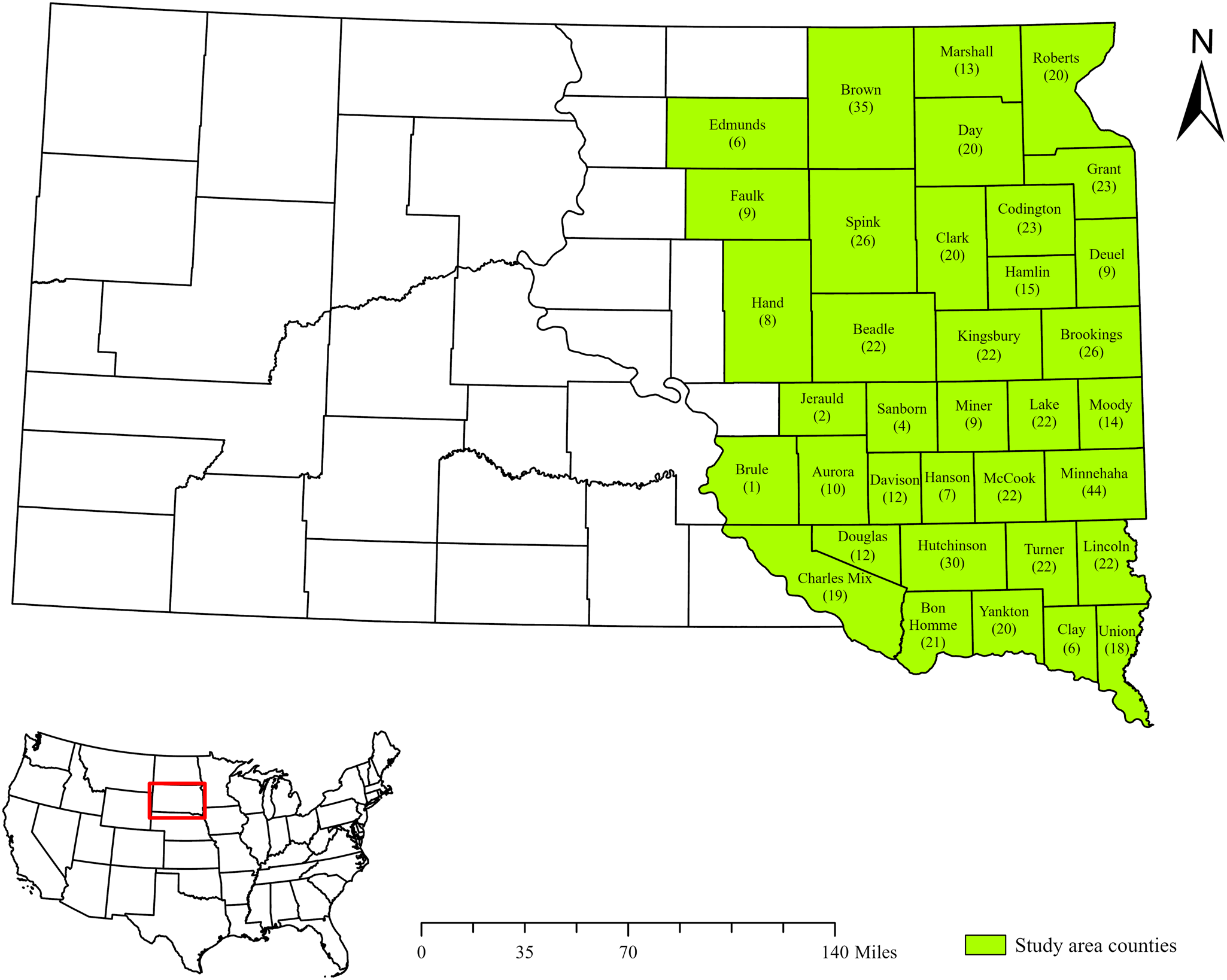
We conducted a mail survey in spring 2018 to understand existing farming practices implemented by agricultural producers in 36 counties of eastern South Dakota (Fig. 1), a major crop growing region in South Dakota dominated by a 2-yr corn–soybean rotations (O'Brien et al., Reference O'Brien, Hatfield, Dold, Kistner-Thomas and Wacha2020). The survey was mailed to a sample of 3000 farm operators, identified using proportionate stratified-random sampling from a list of farming operations that participated in Farm Service Agency (FSA) programs. The sample size for each stratum (i.e., county) was proportionate to the number of active farm operations in each study county. The selection of FSA program participants ensures that the farm operators selected had adequate farmlands for conservation practices (Adusumilli and Wang, Reference Adusumilli and Wang2018), and is a commonly used sample source for survey research with agricultural producers (Ulrich-Schad et al., Reference Ulrich-Schad, Li, Arbuckle, Avemegah, Brasier, Burnham, Kumar Chaudhary, Eaton, Gu, Haigh, Jackson-Smith, Metcalf, Pradhananga, Prokopy, Sanderson, Wade and Wilke2022). In 2017, a total of 43,487 farm operators participated in FSA programs in South Dakota (Wang et al., (Reference Wang, Xu, Kolady, Ulrich-Schad and Clay2021b)). According to the 2017 Census of Agriculture, no-till, reduced tillage and cover crops were practiced on 7.66 million acres (38.64%), 4.30 million acres (21.70%) and 0.28 million acres (1.42%), respectively, out of 19.81 million croplands in South Dakota.
Study area in eastern South Dakota with the number of responses for each county in parentheses.
The survey participants were contacted up to four times: a letter with a link to answer the online questionnaire, a paper questionnaire with a stamped return envelope, a reminder postcard and a second replacement questionnaire with a stamped return envelope. As a pre-incentive, a $2 bill with the first letter was randomly assigned to one-half of the total respondents to test whether that would increase the response rate, which it did by a statistically significant margin (Avemegah et al., Reference Avemegah, Gu, Abulbasher, Koci, Ogunyiola, Eduful, Li, Barington, Wang, Kolady, Perkins, Leffler, Kovács, Clark, Clay and Ulrich-Schad2021). The questionnaire had six sections (see Appendix A). The first and second sections included questions on farming decisions, farm management strategies and farming behavior. The third section consisted of questions related to benefits and challenges to the adoption of conservation practices, while section four included questions about the perceived change in costs and profits following conservation practice adoption. The fifth section included questions related to farming motivations or farmer's SOP, moral and social norms and environmental attitudes, and finally, the sixth section included the questions related to farm and farmer's socio-economic characteristics. This study used questions from all the sections except the fourth section.
Out of 3000 mailed questionnaires, a total of 708 respondents from 36 counties of eastern South Dakota returned the questionnaires. The adjusted survey response rate was 30% after those selected with incorrect addresses or no-longer farming status were excluded from the total. This is within the range (19.8–39.3%) of other recent studies that employed mail surveys of agricultural producers in the US Midwest (Wang et al., Reference Wang, Luri, Janssen, Hennessy, Feng, Wimberly and Arora2017, Reference Wang, Jin, Kasu, Jacquet and Kumar2019, Reference Wang, Jin, Kreuter, Feng, Hennessy, Teague and Che2020, Reference Wang, Xu, Kolady, Ulrich-Schad and Clay2021b, Reference Wang, Fan, Xu, Kumar and Kasu2021a; Church et al., Reference Church, Lu, Ranjan, Reimer and Prokopy2020). Usually, high response rate is an indicator of data quality and can reduce the likelihood of nonresponse error (Dillman et al., Reference Dillman, Smyth and Christian2014). In addition, we compared our respondents' age and cropland acres operated with the USDA's 2017 Census of Agriculture, and found these key demographics of our respondents were comparable to the state-level demographics (see Avemegah et al., Reference Avemegah, Gu, Abulbasher, Koci, Ogunyiola, Eduful, Li, Barington, Wang, Kolady, Perkins, Leffler, Kovács, Clark, Clay and Ulrich-Schad2021).
We used only 614 responses in this analysis because some respondents did not send their responses using the questionnaire with a printed unique ID or entered it incorrectly online which prevented us from locating their specific address and the associated weather data. Weather data such as precipitation and temperature were collected from the Parameter-Elevation Regressions on Independent Slopes Model (PRISM) dataset developed by PRISM Climate Group at Oregon State University. The PRISM utilizes point measurements of precipitation, temperature and other climatic factors to generate continuous, digital grid estimates of monthly, yearly and event-based climatic parameters (Daly et al., Reference Daly, Neilson and Phillips1994).
Data description
The survey questionnaire included five potential challenges associated with conservation tillage and 11 potential challenges associated with cover crops. We selected four challenges related to conservation tillage and five challenges related to cover crops as dependent variables for regression analysis based on their high levels of importance to farmers. The importance level of each potential challenge perceived by farmers was measured on a 4-point Likert scale where 1 = not important, 2 = slightly important, 3 = moderately important and 4 = very important. For model estimation purposes, we recoded the 4-point Likert scale to a 3-point Likert scale where ‘not important’ and ‘slightly important’ categories were combined as 1 (not or slightly important), ‘moderately important’ as 2 and ‘very important’ as 3 to balance the number of responses among different importance levels. In the discrete response variable, if the occurrence of an event is disproportionately high or low, the sample data become unbalanced and parameters estimated by regression analysis are affected. Thus, balanced data have lower variance of estimated parameters and better prediction capabilities than unbalanced data (Salas-Eljatib et al., Reference Salas-Eljatib, Fuentes-ramirez, Gregoire, Altamirano and Yaitul2018).
The empirical model included six categories of independent variables, namely: farmer characteristics, farm characteristics, adoption duration, farmers' SOP, management strategies and climate factors (Table 1). The variables related to farmers' socio-economic characteristics were farmer age (age) and highest education level completed (education). Socio-economic factors could possibly affect farmers' perceived challenges associated with conservation practices because of their connection with awareness and farming experiences (Carlisle, Reference Carlisle2016). For example, younger farmers might adopt conservation practices because they have longer farming horizons and see the potential of getting conservation benefits in the long term, while older farmers could be reluctant to accept innovations as they are more used to the longstanding farming traditions. The second category of variables was farm characteristics such as total acres of farmland (acres) and the proportion of owned farmland (owned land).
Description of the independent variables used in logistic regression analysis

The third category of independent variables was adoption duration of conservation practices, which were measured on a 5-point scale (1 = <3 yr, 2 = 3–5 yr, 3 = 6–10 yr, 4 = 10+ yr and 5 = never used). When farmers have experience with conservation practices, it helps decrease the perceived challenges associated with their implementation (Dunn et al., Reference Dunn, Ulrich-Schad, Prokopy, Myers, Watts and Scanlon2016). In South Dakota, conservation tillage has been practiced by farmers for decades, but the adoption of cover crops has not been widespread (NRCS, 2019). Working land conservation programs such as the Environmental Quality Incentives Program (EQIP) and the Conservation Stewardship Program (CSP) provide cost-share opportunities for 3–5 yr to adopt conservation practices on farmlands (Adhikari et al., Reference Adhikari, Grala, Grado, Grebner and Petrolia2022). Considering these factors and the number of observations in each category, three binary variables related to the adoption duration of conservation tillage and cover crops were constructed and used as explanatory variables in the related regression models. On conservation tillage adoption duration, we have three variables, ⩽5 years, 6 to 10 years and >10 years, with non-adoption serving as a reference category. As cover crops are a relatively new practice, the three adoption duration variables for cover crops are shorter than those for conservation tillage, which are <3 years, 3 to 5 years and >5 years.
The fourth category of independent variables included farmers' SOP including the dimensions of place attachment/identity, place dependence, social identity and economic dependence. Principal component analysis (PCA) was used to identify underlying components of farmers' SOP regarding the land they farm. There were 16 different items originally included in the survey questionnaire which were derived from Eaton et al. (Reference Eaton, Eanes, Ulrich-Schad, Burnham, Church, Arbuckle and Cross2019). Four components, selected based on greater than 1 eigenvalue criterion, explained 69.2% variation in the original data. Variables loaded under each component are presented in Table 2 with component 1 labeled as place attachment/identity, component 2 as place dependence, component 3 as social identity and component 4 as economic dependence. Factor scores were used as the measurements for each component. The fifth category of independent variables was related to farm management strategies such as ‘I always have a written business plan for my farm operation’ (business plan) and ‘I am often looking for ways to diversify my farm operation’ (diversification). Finally, independent variables related to climate factors were included, which are 30-yr average precipitation amount for crop growing season (precipitation), and 30-yr average temperature for crop growing season (temperature). The value of these climate variables was based on the county level. Climatic conditions greatly affect the need for and difficulty of establishing certain conservation practices on croplands (Ding et al., Reference Ding, Schoengold and Tadesse2009; Arbuckle and Roesch-McNally, Reference Arbuckle and Roesch-McNally2015).
PCA for SOP dimensions using varimax rotation method (n = 532, rho = 69.17%)

Note: Farmers provided their ratings for feeling about the land they farm in 4-point Likert scale: 1 = strongly disagree, 2 = somewhat disagree, 3 = somewhat agree and 4 = strongly agree.
Empirical model
Farmers were asked to provide ratings on the importance of the potential challenges associated with conservation practices to their farm operations. The stated responses for each potential challenge were specified as 3-point scale: not or slightly important, moderately important and very important. Given the ordered and discrete nature of the dependent variables, ordered logit models were constructed. The general form of the model in terms of the probability that an individual i chooses alternative m can be presented as follows (Williams, Reference Williams2006):

In Equation (1), if m = 3 categories, then j = 1 represents category 1 vs category 2 and 3, j = 2 represents category 1 and 2 vs category 3. Similarly, Yi is a dependent variable representing farmer perception about a potential challenge associated with the adoption of conservation tillage or cover crops. Xi is a vector of independent variables representing farm and farmer characteristics, adoption duration, SOP, farm management strategies and climate factors, which are explained in Table 1. The αj is cut-off point (constant) for each logit and β is a vector of parameters.
The ordered logit model produces m − 1 set of binary logit models with different constants but a common slope vector β. Brant test can be used to test this equality of parameters assumption or parallel regression assumption (Brant, Reference Brant1990). A generalized ordered logit model is recommended to avoid incorrect and misleading estimates when the Brant test rejects the null hypothesis of parallel regression (Williams, Reference Williams2006). A generalized ordered logit model is also known as a partial proportional odds model and relaxes the parallel regression assumption for all or a specified subset of independent variables. Assuming only a subset of variables violates the parallel regression assumption, a generalized ordered logit model can be specified as below (Williams, Reference Williams2006):

where β1 and β2 are the vectors of parameters which do not violate parallel regression assumption and β3j is a vector of parameters which vary by cut-off points. X1i and X2i are subsets of independent variables which hold proportional odds assumptions, but X3i is a subset of independent variables whose parameters are allowed to differ by first (category 1 vs category 2 and 3) and second (category 1 and 2 vs category 3) logits. Categories 1, 2 and 3 are represented by farmer's stated importance level for each potential challenge toward conservation practice adoption, which are ‘not or slightly important’, ‘moderately important’ and ‘very important’.
A total of four empirical models related to conservation tillage and five empirical models related to cover crops were estimated using an identical set of independent variables (Table 1). A user-written STATA command gologit2 was used to estimate a generalized ordered logit model (Williams, Reference Williams2006). Odds ratios (exp β) were computed to identify the magnitude of the association between independent variables and farmer's stated response with a potential challenge related to the adoption of conservation practices. In particular, the percentage change in probability (% Δodds) was computed by subtracting 1 from the odds ratio and then multiplying the resulted value by 100 (Stroman and Kreuter, Reference Stroman and Kreuter2016).
Results
Farm and farmer characteristics
We found the average age of the farmers participating in the survey was 57 yr old, with 71.8% completed some college or higher formal educational degree. The average participating farmer age is typical of farmers within South Dakota (U.S. Department of Agriculture, 2019). The participating farm operations had a total of 1184 acres on average as of 2017, with 59.1% of the acres owned and the rest rented (Table 1). Farmers participating in this survey on average had farms about three times larger than the average US farm, but smaller than South Dakota's average of 1443 acres as of 2017 (U.S. Department of Agriculture, 2019).
Conservation practice adoption and potential challenges
The adoption of conservation tillage on farmland was mainly constrained by biophysical conditions and opportunity costs. Biophysical conditions such as ‘too much soil moisture’ and ‘delayed planting due to slow soil warming in spring’ had mean values of 1.833 and 1.924 over the entire sample respectively on a 3-point scale indicating that these factors were important challenges for the implementation of conservation tillage (Table 3). Similarly, opportunity costs such as ‘increased dependence on herbicide/fungicides’ (1.916) and ‘reduced crop yields’ (1.878) were also important challenges for farmers regarding conservation tillage adoption in croplands.
Description of the farmer perceived challenges toward conservation tillage and cover crops

a Adopters, non-adopters and dis-adopters do not add up the entire sample because adopters are defined as all who had previously used the practice, which include dis-adopters.
Among the 577 farmers who indicated their experience of using conservation tillage, 45.8% had more than 10 yr of usage experience, while 21.8% reported that they had never adopted conservation tillage on their farmlands (Table 1). Compared to adopters, non-adopters of conservation tillage had slightly different perceptions on the potential challenges. They reported that adoption challenges related to opportunity costs were more important than biophysical conditions. Among the listed challenges, ‘reduced crop yields’ (1.956) and ‘increased dependence on herbicide/fungicides’ (1.948) were the two most important challenges for them. In contrast, farmers who had prior experiences in implementing conservation tillage expressed that ‘delayed planting due to slow soil warming in spring’ (1.933) and ‘increased dependence on herbicide/fungicides’ (1.908) were their most top concerns. Among the farmers who had prior experiences with conservation tillage, those who dis-adopted had greater concerns over all listed categories, with mean values for all listed challenges exceeding 2 on a 3-point scale.
In contrast to conservation tillage, South Dakota farmers had less experience with adopting cover crops on their farmlands. Of the total 581 respondents, a total of 52.5% of farmers had never adopted cover crops as conservation practice on farmlands, and only 14.1% of the farmers adopted this conservation practice for more than 5 yr (Table 1). Compared to the state average, the higher adoption rate of cover crops (48.5%) indicated by our survey likely suggest that producers who demonstrated interests in conservation practices were more likely to participate in our survey than those who did not (Wang et al., 2021b).
The types of challenges reported by farmers on the adoption of cover crops are biophysical conditions, opportunity costs and resource constraints. Based on farmers' responses over the entire sample, resource constraints such as ‘narrow planting window’ (2.009) and ‘lack of time/labor’ (1.880) were slightly more important to them than challenges related to opportunity costs (‘yield reduction in following cash crop’, 1.816) and biophysical conditions (‘taking too much soil moisture’, 1.677; ‘difficulties in cover crop establishment’, 1.823) (Table 3).
Among the challenges associated with cover crops, resource constraints such as ‘narrow planting window’ (2.066) and ‘lack of time/labor’ (1.996) were most important for farmers who never adopted cover crops on their farmlands. Compared to the adopters, non-adopters indicated greater importance for nearly all adoption challenges, except for the ‘difficulties in cover crop establishment’ challenge. Among the farmers who had previous experience with cover crops, those who dis-adopted the practice expressed higher concerns over all categories with ‘yield reduction in the following cash crop’ (2.500) being their top concern.
Factors affecting perceived challenges associated with conservation tillage
Brant test results indicated that two out of four models did not violate parallel regression assumption, and therefore, were estimated using ordered logistic regression (Table 4). The models that violated parallel regression assumption were the models with challenges of ‘delayed planting’ (Y 2), and ‘reduced yield’ (Y 3) as dependent variables, which were estimated using generalized ordered logistic regression. The likelihood ratio tests suggested that model fits for three out of four empirical models related to conservation tillage were significant at 1% level of significance (Table 4). Only the empirical model related to ‘herbicide/fungicide dependence’ (Y 4) was insignificant (χ2 = 18.93, P = 0.22) and therefore, not included in further interpretation.
Model estimates for the potential challenges associated with conservation tillage

OR, odds ratio; s.e., standard error.
Superscript a refers to first logit (1 vs 2 and 3) and b refers to second logit (1 and 2 vs 3).
***P < 0.01, **P < 0.05, *P < 0.1.
Among farm and farmer characteristics, only farmer age (age) and proportion of owned farmland (owned land) had significant effects on perceived challenges on ‘excessive soil moisture’ (Y 1) and ‘delayed planting’ (Y 2), respectively (Table 4). For example, a year increase in age of farmer decreased the probability of perceiving ‘excessive soil moisture’ as an important challenge by 1.6%. Similarly, the proportion of owned farmland (owned land) was negatively associated with ‘delayed planting’ (Y 2) challenge.
Among SOP dimensions, farmer's social identity (social identity) was positively related to perceived challenges on ‘excessive soil moisture’ (Y 1) and ‘delayed planting’ (Y 2, Table 4). For example, an increase in social identity by a point factor score increased the perceived importance levels of challenges on ‘delayed planting’ and ‘excessive soil moisture’ by 22.6, and 29.4%, respectively. However, the effects of social identity on ‘reduced yield’ (Y 3) varied across different importance levels perceived by farmers. Economic dependence, as a dimension of farmers' SOP, was also positively associated with perceived importance levels for the following challenges: ‘excessive soil moisture’, ‘delayed planting’ and ‘reduced yield’ (Table 4). Regarding ‘excessive soil moisture’ challenge, for example, farmers indicating higher economic dependence (by a point factor) perceived a 25.4% increase in its level of importance. Likewise, regarding the ‘delayed planting’ and ‘reduced yield’ challenges, an increase in economic dependence by a point factor score was 27.4 and 33.6%, respectively, more likely to change the perception level from slightly/moderately important to very important category.
Farmers who had a business plan and those who adopted diversified farm management (diversification) perceived ‘delayed planting’ (Y 2) and ‘reduced yield’ (Y 3), respectively, as more important challenges. Climatic factor, average precipitation was positively associated with perceived challenges on ‘excessive soil moisture’ (Y 1) and ‘delayed planting’ (Y 2), yet its effects on ‘reduced yield’ (Y 3) varied depending on the importance level provided by farmers (Table 4). For example, an inch increase in average precipitation at the county level was associated with 19.8 and 25.4% increase in perceived importance on two challenges, ‘excessive soil moisture’ and ‘delayed planting’, respectively. Likewise, increase in average precipitation did not have a monotonous effect on the perceived challenge on ‘reduced yield’, with an inch increase in average precipitation at county level associated with 28.1% increase in the probability that a farmer would change his or her importance level from slightly important to moderately/very important category, yet a 15.7% decrease in the probability that a farmer would change his or her importance level from slightly/moderately important to the very important category.
The average temperature was significantly related to farmer perception about ‘delayed planting’ (Y 2) challenge (Table 4). A 1°C increase in average temperature at the county level was related to 36.9% decrease in probability that the farmer would change his or her perceived importance from slightly important to moderately/very important category. However, the effect of average temperature was positively related to the perception of farmers, who perceived ‘delayed planting’ as slightly/moderately important.
Factors affecting perceived challenges associated with cover crops
The model fits for all five empirical models related to cover crops were significant at 1% level of significance. Challenge models Y 5 and Y 6 were estimated using generalized ordered logistic regression, while the rest of the empirical models were estimated by employing the ordered logistic regression (Table 5). The choice between generalized ordered and ordered logit model was based on Brant test results at 5% level of significance.
Model estimates for the potential challenges associated with cover crops

OR, odds ratio; s.e., standard error.
Superscript a refers to first logit (1 vs 2 and 3) and b refers to second logit (1 and 2 vs 3).
***P < 0.01, **P < 0.05, *P < 0.1.
The adoption duration of cover crops was negatively associated with perceiving ‘soil moisture depletion’ (Y 5) as an important challenge to adoption (Table 5). Compared to non-adopters, farmers who adopted cover crops for ‘less than 3 years’, ‘3 to 5 years’ and ‘more than 5 years’ were 40.6, 40.6 and 54.1% less likely to view ‘soil moisture depletion’ as an important challenge. Dimensions of farmers' SOP such as economic dependence and place attachment/identity were positively associated with ‘soil moisture depletion’ (Y 5) and ‘establishment difficulty’ (Y 6) challenges, respectively. Having a written business plan for farm operation was negatively associated with farmer perception on ‘establishment difficulty’. Similarly, another farm management strategy, diversification had a significant but varying effect on farmer perception about ‘establishment difficulty’ across the different perceived importance levels.
Size of farmland (acres) was also positively associated with perceived challenges related to biophysical conditions and the magnitude of effects was around 1% for a 100-acre change in farm size. Climatic factors such as average precipitation and temperature had significant effects on ‘soil moisture depletion’ (Y 5) challenge (Table 5). Specifically, for an inch of precipitation increase at the county level, the probability that farmers change perceptions from slightly/moderately important to very important category with ‘soil moisture depletion’ decreased by 27.1%, while a degree increase in temperature increased such probability by 76.5%.
Another type of potential challenge associated with cover crop adoption was potential ‘yield reduction’ (Y 7). In comparison with those non-adopters, farmers who adopted cover crops for ‘less than 3 years’, ‘3 to 5 years’ and ‘more than 5 years’ were 49.5, 41.8 and 50.5%, respectively, less likely to view ‘yield reduction’ as equally challenging (Table 5). On the other hand, farmers with higher place attachment/identity and economic dependence were 8.3 and 34.2% more likely to view ‘yield reduction’ as challenging (Table 5). Similarly, temperature was also positively associated with ‘yield reduction’ challenge.
Additionally, the resource constraints such as ‘lack of time/labor’ (Y 9) and ‘narrow planting window’ (Y 8) affect farmer's willingness to adopt cover crops. The adoption duration and business plan were negatively related to the perceived challenge on the resource constraints, while place attachment/identity and economic dependence were positively related to those constraints (Table 5). For example, farmers who adopted cover crops for ‘3 to 5 years’ were 70.2 and 56% less likely to view ‘lack of time/labor’ and ‘narrow planting window’ as equally challenging when compared with non-adopters. In contrast, a point increase in factor score on place attachment/identity increased farmers' perceived importance level by 9 to 9.7% on both ‘lack of time/labor’ and ‘narrow planting window’ challenges (Table 5). Similarly, an increase in farmers' economic dependence by a point factor score was 30 and 31.3% more likely to increase the perceived importance level on ‘lack of time/labor’ and ‘narrow planting window’ challenges, respectively.
Discussion
This study examined farmer perceptions on a number of challenges associated with conservation tillage and cover crops adoption. The primary conservation tillage benefits include input savings (e.g., nitrogen and phosphorus fertilizers) and improved soil health (Reimer et al., Reference Reimer, Weinkauf and Prokopy2012; Anderson, Reference Anderson2016). The majority of farmers faced challenges with conservation tillage practice, including excessive soil moisture, delayed planting of cash crops, reduced cash crop yields and increased dependence on herbicides and fungicides. In recent decades, there is an increasing climatic variation and the average annual precipitation is increasing in our study region (O'Brien et al., Reference O'Brien, Hatfield, Dold, Kistner-Thomas and Wacha2020), which could further complicate the biophysical conditions and negatively affect the adoption of conservation tillage.
Planting of cover crops is important during the fallow period, such as the period between the fall harvest and spring planting, and years of prevented planting due to flooding or other climate driven problems to remove extra soil moisture and improve soil health (NRCS, 2019). In South Dakota, only less than 10% of farmers adopted cover crops as of 2017 (U.S. Department of Agriculture, 2019). Farmers ranked high seed costs, narrow planting window and lack of time/labor as topmost challenges associated with cover crops adoption. About half of the farmers paid between $11 and $20 per acre for their cover crop seeds in 2016–17 and this price range remained largely the same in 2019–20 (CTIC, 2020). The narrow planting window is a challenge, and is believed by some farmers to be essentially an economic concern (‘…it is not worth the time’), while others suggested that managing the cover crops using ‘whole system’ approach could resolve the time constraint issue (Carlisle, Reference Carlisle2016; Roesch-McNally et al., Reference Roesch-Mcnally, Basche, Arbuckle, Tyndall, Miguez, Bowman and Clay2018). Addressing these challenges will increase the adoption of cover crops which will subsequently improve biodiversity and climate resilience (Blesh and Wolf, Reference Blesh and Wolf2014).
Our finding that ‘reduced crop yield’ is regarded as one of the most important barriers for both conservation tillage and cover crops suggests that maximized yield is a common goal among many farmers. Despite potential yield reduction, conservation tillage and cover cropping may benefit farmers through improved economic performance through decreased input costs, such as reduced labor, fuel, nitrogen fertilizer or pesticides requirements (Anderson, Reference Anderson2016; Mahama et al., Reference Mahama, Prasad, Roozeboom, Nipper and Rice2016; Singh et al., Reference Singh, Wang, Kumar, Zheng, Sexton, Davis and Bly2021). Wang et al. (Reference Wang, Xu, Kolady, Ulrich-Schad and Clay2021b) found that more farmers perceive a profit increase than a yield increase when asked about cover crops and conservation tillage. Therefore, helping farmers adjust their goals toward improving profit, rather than yield, may be a key strategy for promoting conservation tillage and cover cropping practices.
This study found that respondents with stronger social identities as farmers and more economic dependence on farming are more likely to rate conservation tillage challenges as more important. The underlying reason could be farmers more frequently talk about their challenges rather than addressing them under their existing social networks (Carlisle, Reference Carlisle2016). Outreach programs could potentially utilize social networks (e.g., farmer associations, social media, etc.) to address farmer concerns toward conservation practices. As 87% of the croplands in South Dakota are operated by large-scale commercial farms of 1000+ acres (U.S. Department of Agriculture, 2019), education and demonstration efforts that target large-scale farms will likely have an amplified effect on increasing the number of acres under conservation tillage practices.
While conservation tillage helps preserve soil moisture in a semi-arid climate (Ding et al., Reference Ding, Schoengold and Tadesse2009), it could cause problems such as excessive soil moisture and slow soil warming in the crop planting season, therefore were viewed as major challenges by farmers located in regions with higher precipitation (Rusinamhodzi et al., Reference Rusinamhodzi, Corbeels, Van Wijk, Rufino, Nyamangara and Giller2011; Reimer et al., Reference Reimer, Weinkauf and Prokopy2012). The climatic variation may be the key reason why the adoption of conservation tillage practices had strong spatial correlations among neighboring counties of Iowa, Nebraska and South Dakota (Ding et al., Reference Ding, Schoengold and Tadesse2009). To help relieve the excessive moisture challenges faced by conservation tillage users, promoting conservation tillage with cover crops in counties with higher precipitation potential are critical because this strategy helps improve biophysical conditions as well as reduce soil erosion caused by precipitation (Canales et al., Reference Canales, Bergtold and Williams2020).
It is interesting to notice that although adoption duration had little effect on the perceived challenges related to conservation tillage, it played a critical role in explaining perceived challenges related to cover crops. Our finding indicates that farmers who have used cover crops for longer periods are less likely to perceive challenges such as yield reduction and narrow planting window as important. This finding implies that farmers need longer planning horizons for cover crops to overcome the challenges and experience the benefits. Technical and financial assistance to cover crop adopters during the first few years of using the practice will help them learn how to better use this practice in their farming system (Church et al., Reference Church, Lu, Ranjan, Reimer and Prokopy2020). Providing cost-share to farmers, for example, helps them navigate the high cost associated with cover crops establishment. We also found that farmers who had business plans indicated fewer challenges with cover crops implementation. This is probably because farmers with business plans identify and implement actions in advance to mitigate challenges associated with cover crops. This highlights the need for outreach programs to assist farmers in understanding the importance of business plans (Mishra et al., Reference Mishra, Wilson and Williams2009).
Similar to conservation tillage challenges, perceived importance of cover crops challenges was contingent on dimensions of farmers' SOP. Specifically, cover crop challenges were perceived as more important by farmers with greater economic dependence and place attachment/identity. Our study found that farmers who were economically more dependent on farming would more likely perceive yield reduction, time/labor requirements and establishment difficulty as important challenges. Therefore, providing cost-share to such farmers could help change farmers' perception and adoption decisions. Our finding corroborates that of Arbuckle (Reference Arbuckle2015) but contradicts with that of O'Connell et al. (Reference O'Connell, Grossman, Hoyt, Shi, Bowen, Marticorena, Fager and Creamer2014), who found that economic costs linked with cover crops were not perceived as a barrier in North Carolina. The reason behind the contradicting results could be a different climatic condition of North Carolina and different crops grown compared to those of the Corn Belt states.
Some communities have mixed aesthetic perceptions of cover crops, some find them to be messy and unappealing (Carlisle, Reference Carlisle2016). Mixed cover crop blends can have an irregular ‘weedy’ appearance that contrasts with the neat, weed-free rows that many prefer to see or have come to expect across the agricultural landscape. Therefore, for farmers with higher levels of place attachment/identity, the difficulty with cover crop adoption may arise from its perceived negative effect on their connections with the agricultural landscape. These findings imply that cover crop adoption may garner wider public support in the landscape with diverse land cover in terms of cropping patterns and natural ecosystems (i.e., grasslands and forest lands). In addition, programs that provide assistance in farmers' selection of cover crop species (e.g., ryegrass) that are compatible with the current farming system could also help reduce potential challenges faced by farmers.
Conclusions
The adoption of conservation agriculture such as conservation tillage and cover crops can help diversify farm level risks and promote on-farm biodiversity in the US Corn Belt. In this context, it is important to design appropriate strategies for increasing the adoption of conservation practices and promoting regenerative agriculture that protects and restores ecosystem services on more acres. This study provides insights on how farmers may overcome adoption barriers and integrate conservation practices in their farming system. A better understanding of farmers' perceived challenges associated with conservation practices is important as it could provide further directions for research and extension efforts to facilitate future adoption decisions. Farmers' primary challenges toward conservation tillage implementation include biophysical condition concerns such as excessive soil moisture and delayed planting, as well as opportunity cost concerns such as reduced cash crop yields, and increased dependence on herbicide and fungicides. We found that respondents with stronger social identities as farmers and greater economic dependence on farming were more likely to perceive greater challenges toward conservation tillage. These findings imply that conservation programs should consider social network utilization, economic subsidies or technical assistance to promote conservation tillage. Similarly, outreach programs that target large farm operations with detailed information on potential short-term opportunity costs (e.g., reduced crop yields) and long-term benefits (e.g., soil health) could promote conservation tillage implementation on more acres.
Regarding cover crops adoption, resource constraints (e.g., narrow planting window and lack of time/labor) were perceived by farmers as relatively more important than opportunity costs (e.g., yield reduction) and biophysical conditions (e.g., cover crop establishment and taking too much soil moisture). We found that the adoption duration of cover crops was negatively associated with cover crop challenges yet greater economic dependence on farming was positively associated with perceived challenges. These findings implied that financial subsidies may provide farmers incentives to experiment with cover crops and/or to expand cover crops usage acres on croplands.
Our paper has a few implications that could help guide the future policy and outreach efforts in promoting adoption of conservation practices such as conservation tillage and cover crops. First, to help farmers adopt the types of conservation practices that primarily improve profitability through reduced input costs, more outreach efforts could be utilized in emphasizing the importance of maximizing profit, rather than yield, on the sustainable management of the farm operation in the long term. Secondly, financial incentives could be more targeted toward farmers who have detailed plans for the adoption of cover crops, which cover specifics on how to address resource constraints in planting time, seeds, labor and equipment. Thirdly, outreach programs could be more influential in impacting farmer decisions by utilizing farmers' existing social networks (e.g., farmer associations) to share success stories of farmers who have managed their farms successfully under conservation practices. Finally, as joint adoption of conservation tillage and cover crops addresses some challenges such as excessive moisture challenge in high rainfall regions, future research and outreach efforts in promoting the complementary benefits of these two practices will help farmers make more educated decisions.
Supplementary material
The supplementary material for this article can be found at https://doi.org/10.1017/S1742170523000042
Acknowledgments
Financial support for this work was provided by the US Department of Agriculture, Natural Resources Conservation Service (grant no. G17AC00337) and South Dakota Corn Utilization Council. We acknowledge the US Geological Survey, South Dakota Cooperative Fish & Wildlife Research Unit for administrative assistance with the research work order (RWO 116) at South Dakota State University.
Conflict of interest
The authors declare that they have no conflict of interest.


 Open access

