





1. Introduction
Fluids at supercritical pressure have enabled the development of more efficient, compact industrial processes and continue to offer promising opportunities for future energy-conversion technologies (Guardone et al. Reference Guardone, Colonna, Pini and Spinelli2024). Among different fluids, carbon dioxide ( $\text{CO}_2$
) has emerged as a promising working medium for power cycles in geothermal and concentrated solar energy systems, as well as for heat pumps in industrial heating applications. In the aerospace sector, supercritical fuel injection improves mixing and combustion efficiency in both air-breathing and liquid rocket engines (Wang & Yang Reference Wang and Yang2017). Supercritical fluids also occur in nature, e.g. the
$\text{CO}_2$
) has emerged as a promising working medium for power cycles in geothermal and concentrated solar energy systems, as well as for heat pumps in industrial heating applications. In the aerospace sector, supercritical fuel injection improves mixing and combustion efficiency in both air-breathing and liquid rocket engines (Wang & Yang Reference Wang and Yang2017). Supercritical fluids also occur in nature, e.g. the $\text{CO}_2$
/
$\text{CO}_2$
/ $\text{N}_2$
mixture in the lower atmosphere of Venus (Morellina, Bellan & Cutts Reference Morellina, Bellan and Cutts2020).
$\text{N}_2$
mixture in the lower atmosphere of Venus (Morellina, Bellan & Cutts Reference Morellina, Bellan and Cutts2020).
At supercritical conditions, i.e. above the thermodynamic critical point, the liquid–vapour boundary vanishes, and strong variations in thermophysical properties occur within a narrow temperature range around the pseudo-critical temperature $T_{pc}$
, also referred to as pseudo-boiling (Banuti Reference Banuti2015), at which the isobaric heat capacity reaches its maximum. In this non-ideal, single-phase thermodynamic region, the ideal-gas assumption fails.
$T_{pc}$
, also referred to as pseudo-boiling (Banuti Reference Banuti2015), at which the isobaric heat capacity reaches its maximum. In this non-ideal, single-phase thermodynamic region, the ideal-gas assumption fails.
Supercritical fluids have been extensively investigated in fully developed turbulent flows. Yoo (Reference Yoo2013) highlighted the complexity of supercritical heat-transfer measurements, in which thermophysical property variations may either enhance or deteriorate heat transfer. Early computational studies on turbulent flows at supercritical pressure mainly focused on open flow configurations, such as shear layers Okong’o & Bellan (Reference Okong’o and Bellan2002), mixing layers (Okong’o & Bellan Reference Okong’o and Bellan2010) and jets (Sharan & Bellan Reference Sharan and Bellan2021), as well as on closed flow configurations, such as pipes (Bae, Yoo & Choi Reference Bae, Yoo and Choi2005; Nemati et al. Reference Nemati, Patel, Boersma and Pecnik2016; Cao et al. Reference Cao, Xu, Yan, He and Jiang2021; He et al. Reference He, Tian, Jiang and He2021), channels (Patel, Boersma & Pecnik Reference Patel, Boersma and Pecnik2016; Ma, Yang & Ihme Reference Ma, Yang and Ihme2018; Kim, Hickey & Scalo Reference Kim, Hickey and Scalo2019; Guo, Yang & Ihme Reference Guo, Yang and Ihme2022; Li et al. Reference Li, Guo, Bai and Ihme2023, Reference Li, Zhang, Bai and Ihme2024) and annular flows (Peeters et al. Reference Peeters, Pecnik, Rohde, van der Hagen and Boersma2016). These studies underlined the significant impact of local property variations on large-scale structures, and the presence of relaminarisation mechanisms. Semi-local scaling has been demonstrated to best characterise turbulence in variable-property flows, assuming weak density and viscosity fluctuations. However, in turbulent boundary layers with parahydrogen at supercritical pressure and transcritical temperature conditions, large density fluctuations of order $\sqrt {{\overline {\rho ^{\prime }\rho ^{\prime }}}}/\overline {\rho } \approx 0.4{-}1.0$
significantly alter near-wall turbulence and its statistics (Kawai Reference Kawai2019). As a result, semi-local scaling was found not to collapse the velocity transformation.
$\sqrt {{\overline {\rho ^{\prime }\rho ^{\prime }}}}/\overline {\rho } \approx 0.4{-}1.0$
significantly alter near-wall turbulence and its statistics (Kawai Reference Kawai2019). As a result, semi-local scaling was found not to collapse the velocity transformation.
Conversely, many industrial applications operating at supercritical conditions frequently involve flows that have not yet reached a fully turbulent state. Even under the ideal-gas assumption, transition to turbulence remains of fundamental importance across subsonic, supersonic and high-Mach-number flows (Saric, Reed & Kerschen Reference Saric, Reed and Kerschen2002; Fedorov Reference Fedorov2011). In high-speed flows, real-gas effects have been studied extensively (Candler Reference Candler2019), yet they are often erroneously linked to non-ideal-gas effects (Guardone et al. Reference Guardone, Colonna, Pini and Spinelli2024). Unlike real-gas effects, non-ideal-gas effects near the thermodynamic critical point are characterised by strong stratification (Govindarajan & Sahu Reference Govindarajan and Sahu2014) and abrupt variations in thermophysical properties.
Transition to turbulence can follow different routes depending on the type of flow disturbances (Morkovin Reference Morkovin1969). In this work, we focus on the transitional sequence typically observed under low levels of free-stream turbulence: (i) receptivity to external disturbances, (ii) primary modal or non-modal disturbance growth, (iii) secondary instability and nonlinear interactions, and (iv) eventual breakdown to turbulence. Only recently, linear stability theory (LST) of boundary layers with fluids at supercritical pressure has been investigated (Robinet & Gloerfelt Reference Robinet and Gloerfelt2019). The first such analysis by Ren, Marxen & Pecnik (Reference Ren, Marxen and Pecnik2019) for an adiabatic zero pressure gradient (ZPG) flat-plate boundary layer with supercritical $\text{CO}_2$
revealed strong sensitivity to the temperature profile relative to the pseudo-critical temperature. As the flow crosses the pseudo-critical (Widom) line, i.e. under transcritical temperature conditions, a new inviscid mode (Mode II) emerges, exhibiting growth rates an order of magnitude greater than those of Mode I, which corresponds to the Tollmien–Schlichting (TS) instability. It is worth noting that this dual-mode instability occurs only when heating from a liquid-like free stream. Unlike Mack’s second mode in hypersonics, Mode II is not of acoustic nature. Moreover, the Mode-II instability is largest for two-dimensional (2-D) perturbations, as also confirmed for low-Mach, diabatic boundary layers by Boldini et al. (Reference Boldini, Bugeat, Peeters, Kloker and Pecnik2024b
). Bugeat, Boldini & Pecnik (Reference Bugeat, Boldini and Pecnik2022) further showed that Mode II is associated with a minimum of kinematic viscosity at the Widom line – a feature common to all non-polar supercritical fluids at transcritical temperature conditions. Thus according to the generalised inflection point (GIP) criterion, such boundary layers are inviscidly unstable. In plane Couette flow, Bugeat et al. (Reference Bugeat, Boldini, Hasan and Pecnik2024) demonstrated that this inviscid instability arises from a localised maximum of density-weighted vorticity and consists of two phase-locked vorticity waves induced by shear and baroclinic effects around the kinematic-viscosity minimum.
$\text{CO}_2$
revealed strong sensitivity to the temperature profile relative to the pseudo-critical temperature. As the flow crosses the pseudo-critical (Widom) line, i.e. under transcritical temperature conditions, a new inviscid mode (Mode II) emerges, exhibiting growth rates an order of magnitude greater than those of Mode I, which corresponds to the Tollmien–Schlichting (TS) instability. It is worth noting that this dual-mode instability occurs only when heating from a liquid-like free stream. Unlike Mack’s second mode in hypersonics, Mode II is not of acoustic nature. Moreover, the Mode-II instability is largest for two-dimensional (2-D) perturbations, as also confirmed for low-Mach, diabatic boundary layers by Boldini et al. (Reference Boldini, Bugeat, Peeters, Kloker and Pecnik2024b
). Bugeat, Boldini & Pecnik (Reference Bugeat, Boldini and Pecnik2022) further showed that Mode II is associated with a minimum of kinematic viscosity at the Widom line – a feature common to all non-polar supercritical fluids at transcritical temperature conditions. Thus according to the generalised inflection point (GIP) criterion, such boundary layers are inviscidly unstable. In plane Couette flow, Bugeat et al. (Reference Bugeat, Boldini, Hasan and Pecnik2024) demonstrated that this inviscid instability arises from a localised maximum of density-weighted vorticity and consists of two phase-locked vorticity waves induced by shear and baroclinic effects around the kinematic-viscosity minimum.
Alongside previous modal stability analyses, Boldini et al. (Reference Boldini, Bugeat, Peeters, Kloker and Pecnik2024b ) investigated transient growth with fluids at supercritical pressure. When heating beyond the Widom line, where Mode II is unstable, optimal energy growth arises from an interplay between lift-up and Orr mechanisms. Conversely, wall cooling was found to resemble the effect of an adverse pressure gradient (APG) under the ideal-gas assumption. A similar trend appeared in cross-flow dominated three-dimensional (3-D) boundary layers (Ren & Kloker Reference Ren and Kloker2022), where the inviscid TS mode can be amplified far more than classical cross-flow modes, effectively suppressing them, akin to imposing strong deceleration under the ideal-gas assumption.
In controlled transition, a linearly amplified 2-D wave grows to finite amplitude, triggering secondary instabilities and nonlinear interactions that lead to the growth of 3-D waves with subsequent breakdown. These mechanisms remain unexplored for supercritical fluids, despite their importance for accurate transition prediction. Under the ideal-gas assumption, two canonical breakdown paths, K-type and H-type, have been studied extensively via experiments (Klebanoff, Tidstrom & Sargent Reference Klebanoff, Tidstrom and Sargent1962; Kachanov & Levchenko Reference Kachanov and Levchenko1984) and direct numerical simulations (DNS) (Fasel, Rist & Konzelmann Reference Fasel, Rist and Konzelmann1990; Rist & Fasel Reference Rist and Fasel1995; Bake, Meyer & Rist Reference Bake, Meyer and Rist2002; Sayadi, Hamman & Moin Reference Sayadi, Hamman and Moin2013) in incompressible boundary layers. These scenarios depend on the choice of initial disturbance wavelengths and spanwise wavenumbers. In K-type fundamental resonance, a primary 2-D TS wave and a steady longitudinal vortex mode, often forced, as in Klebanoff’s experiment, nonlinearly generate a symmetric pair of oblique modes at the same TS frequency. Alternatively, these oblique modes can be introduced directly, inducing the steady vortex mode. Their 3-D development leads to aligned $\Lambda$
-shaped vortices, each consisting of two elongated legs of streamwise vorticity and a tip of spanwise vorticity. In contrast, H-type subharmonic resonance, following Craik’s model (Craik Reference Craik1971), involves forcing oblique modes at half the TS frequency, forming staggered
$\Lambda$
-shaped vortices, each consisting of two elongated legs of streamwise vorticity and a tip of spanwise vorticity. In contrast, H-type subharmonic resonance, following Craik’s model (Craik Reference Craik1971), involves forcing oblique modes at half the TS frequency, forming staggered $\Lambda$
-vortices without a steady vortex mode. In both scenarios,
$\Lambda$
-vortices without a steady vortex mode. In both scenarios, $\Lambda$
-vortices develop into hairpin structures with a localised high-shear layer atop their heads, eventually evolving into
$\Lambda$
-vortices develop into hairpin structures with a localised high-shear layer atop their heads, eventually evolving into $\Omega$
- or ring-like vortices that mark the onset of turbulence. The DNS studies of K- and H-type breakdown have since been extended to APG flows (Kloker Reference Kloker1993; Kloker & Fasel Reference Kloker and Fasel1995) and to supersonic and hypersonic regimes in various geometries (Fezer & Kloker Reference Fezer and Kloker1999; Franko & Lele Reference Franko and Lele2013; Sivasubramanian & Fasel Reference Sivasubramanian and Fasel2015; Hader & Fasel Reference Hader and Fasel2019; Unnikrishnan & Gaitonde Reference Unnikrishnan and Gaitonde2020).
$\Omega$
- or ring-like vortices that mark the onset of turbulence. The DNS studies of K- and H-type breakdown have since been extended to APG flows (Kloker Reference Kloker1993; Kloker & Fasel Reference Kloker and Fasel1995) and to supersonic and hypersonic regimes in various geometries (Fezer & Kloker Reference Fezer and Kloker1999; Franko & Lele Reference Franko and Lele2013; Sivasubramanian & Fasel Reference Sivasubramanian and Fasel2015; Hader & Fasel Reference Hader and Fasel2019; Unnikrishnan & Gaitonde Reference Unnikrishnan and Gaitonde2020).
The DNS remain the most effective tool for isolating specific perturbation waves and their effects on the transition routes (Zhong Reference Zhong1998). In the context of non-ideal-fluid flows, high-order DNS have recently been employed to study the O-type breakdown in boundary layers with dense vapours, such as PP11-vapour at $M_\infty = 2.25$
and
$M_\infty = 2.25$
and $6$
(Sciacovelli et al. Reference Sciacovelli, Gloerfelt, Passiatore, Cinnella and Grasso2020), and Novec649-vapour at
$6$
(Sciacovelli et al. Reference Sciacovelli, Gloerfelt, Passiatore, Cinnella and Grasso2020), and Novec649-vapour at $M_\infty = 0.9$
(Gloerfelt, Bienner & Cinnella Reference Gloerfelt, Bienner and Cinnella2023), which exhibit negligible dissipation and heat conduction. In these studies, density fluctuations remain small relative to the mean value. In contrast, under supercritical conditions near the Widom line, the abrupt variation of thermodynamic properties induces large density fluctuations and poses major numerical challenges for accurate and robust DNS analysis (Kawai Reference Kawai2019).
$M_\infty = 0.9$
(Gloerfelt, Bienner & Cinnella Reference Gloerfelt, Bienner and Cinnella2023), which exhibit negligible dissipation and heat conduction. In these studies, density fluctuations remain small relative to the mean value. In contrast, under supercritical conditions near the Widom line, the abrupt variation of thermodynamic properties induces large density fluctuations and poses major numerical challenges for accurate and robust DNS analysis (Kawai Reference Kawai2019).
The main objective of this work is to investigate the nonlinear interactions and transition to turbulence in a boundary layer with a supercritical fluid, aiming to improve transition prediction under non-ideal-gas conditions. Specifically, we focus on elucidating the role of Mode-II instability in the nonlinear regime, examining the subsequent stages beyond the linear stability analysis of Ren et al. (Reference Ren, Marxen and Pecnik2019). The strongly nonlinear thermodynamics and abrupt fluid-property variations are accounted for by combining (i) the Van der Waals (VdW) cubic equation of state (EoS) in reduced form, based on the principle of corresponding states to retain generality, and (ii) non-ideal transport-property models for a generic supercritical fluid. To numerically investigate supercritical fluids and tackle the related computational challenges, we employ the open-source solver CUBic Equation of state Navier–Stokes (CUBENS) (Boldini et al. Reference Boldini, Hirai, Costa, Peeters and Pecnik2025). We perform DNS with controlled transition scenarios using harmonic disturbance forcing to isolate the most critical nonlinear mechanisms and limit modal interactions. To study the nonlinear regime, only a single fundamental 2-D wave is excited in a 2-D DNS set-up, as Mode-II instability is most unstable for 2-D perturbations. For the breakdown to turbulence, 3-D DNS are performed with 3-D forcing, in line with the aforementioned ideal-gas transitional boundary layer simulations. Building upon the 2-D nonlinear analysis, a pair of subharmonic oblique waves is introduced alongside the large-amplitude 2-D wave. The amplitude of the oblique waves is set to either finitely large or infinitesimally small. Finally, the fully turbulent regime is analysed to evaluate the accuracy of mean velocity and enthalpy scaling laws. A predictive tool for the turbulent skin friction and heat transfer in non-ideal fluids is developed.
The work is organised as follows. Section 2 introduces the governing equations, with a focus on non-ideal thermodynamic models and numerical methods. Section 3 presents two flow cases at supercritical pressure (reduced pressure 1.10) and describes their respective DNS set-ups. Two temperature profiles for a slightly heated wall are considered, one below and one crossing the pseudo-critical temperature $T_{pc}$
. Section 4 examines the 2-D linear and nonlinear evolution of Mode-II instability. Selected 3-D transitional cases are then presented and analysed in § 5, followed by an assessment of the resulting turbulent boundary layers in § 6. Finally, the study is concluded in § 7.
$T_{pc}$
. Section 4 examines the 2-D linear and nonlinear evolution of Mode-II instability. Selected 3-D transitional cases are then presented and analysed in § 5, followed by an assessment of the resulting turbulent boundary layers in § 6. Finally, the study is concluded in § 7.
2. Methodology
This section presents the governing equations for supercritical fluid flows. For details on the numerical methods, performance and validation of the flow solver, the reader is referred to Boldini et al. (Reference Boldini, Hirai, Costa, Peeters and Pecnik2025).
2.1. Flow-conservation equations
We consider single-phase, non-reacting flows of supercritical fluids, governed by the fully compressible Navier–Stokes equations, expressed in both differential and dimensionless form as
 \begin{align} \dfrac {\partial \rho } {\partial t }+\dfrac {\partial ( \rho u_{\!j})}{\partial x_{\!j}} =0,\end{align}
 \begin{align}\dfrac {\partial ( \rho u_{i})}{\partial t} + \dfrac {\partial ( \rho u_{i} u_{\!j})}{\partial x_{\!j}} + \dfrac {\partial p}{\partial x_{i}} - \dfrac {1}{\textit{Re}}\dfrac {\partial \tau _{\textit{ij}}}{\partial x_{\!j}} = 0,\end{align}
 \begin{align}\dfrac {\partial ( \rho e_0)}{\partial t} + \dfrac {\partial ( ( \rho e_0 + p)u_{\!j})}{\partial x_{\!j}} - \dfrac {1}{\textit{Re}} \dfrac {\partial (\tau _{\textit{ij}} u_{i})}{\partial x_{\!j}} + \dfrac {1}{{\textit{Re}} \, \textit{Pr}_\infty\, \textit{Ec}_\infty }\dfrac {\partial q_{j} }{\partial x_{\!j}} = 0, \end{align}
where $x_{\!j}=(x,y,z)$
are the Cartesian coordinates in the streamwise, wall-normal and spanwise directions, respectively,
$x_{\!j}=(x,y,z)$
are the Cartesian coordinates in the streamwise, wall-normal and spanwise directions, respectively, $t$
is the time,
$t$
is the time, $\rho$
is the density,
$\rho$
is the density, $u_{\!j}=(u,v,w)$
are the velocity components,
$u_{\!j}=(u,v,w)$
are the velocity components, $p$
is the pressure, and
$p$
is the pressure, and $e_0=e+u_{\!j} u_{\!j}/2$
is the specific total energy, with
$e_0=e+u_{\!j} u_{\!j}/2$
is the specific total energy, with $e$
as the specific internal energy. Under the Newtonian fluid assumption, the viscous stress tensor
$e$
as the specific internal energy. Under the Newtonian fluid assumption, the viscous stress tensor $\tau _{\textit{ij}}$
is calculated as
$\tau _{\textit{ij}}$
is calculated as $\lambda \delta _{\textit{ij}} \, \partial u_{k}/\partial x_{k} + \mu (\partial u_{i}/\partial x_{\!j} + \partial u_{\!j}/\partial x_{i})$
, where
$\lambda \delta _{\textit{ij}} \, \partial u_{k}/\partial x_{k} + \mu (\partial u_{i}/\partial x_{\!j} + \partial u_{\!j}/\partial x_{i})$
, where $\mu$
is the dynamic viscosity,
$\mu$
is the dynamic viscosity, $\lambda =-2/3 \mu$
is Lamé’s constant with zero bulk viscosity (Stokes’ hypothesis) in agreement with Sciacovelli, Cinnella & Gloerfelt (Reference Sciacovelli, Cinnella and Gloerfelt2017a
) and Ren et al. (Reference Ren, Marxen and Pecnik2019), and
$\lambda =-2/3 \mu$
is Lamé’s constant with zero bulk viscosity (Stokes’ hypothesis) in agreement with Sciacovelli, Cinnella & Gloerfelt (Reference Sciacovelli, Cinnella and Gloerfelt2017a
) and Ren et al. (Reference Ren, Marxen and Pecnik2019), and $\delta _{\textit{ij}}$
is the Kronecker delta. Additionally, buoyancy effects are neglected. The convective heat flux vector
$\delta _{\textit{ij}}$
is the Kronecker delta. Additionally, buoyancy effects are neglected. The convective heat flux vector $q_{j}$
follows Fourier’s law as
$q_{j}$
follows Fourier’s law as $q_{j}=-\kappa \, \partial T/\partial x_{\!j}$
, where
$q_{j}=-\kappa \, \partial T/\partial x_{\!j}$
, where $\kappa$
is the thermal conductivity, and
$\kappa$
is the thermal conductivity, and $T$
is the fluid temperature. The conservation equations in (2.1) are non-dimensionalised by the following reference values:
$T$
is the fluid temperature. The conservation equations in (2.1) are non-dimensionalised by the following reference values:
 \begin{align} & t=\frac {t^* u^*_{\infty }}{\delta ^*}, \quad x_{\!j}=\frac {x^*_{j}}{\delta ^*}, \quad u_{i}=\frac {u^*_{i}}{u^*_{\infty }}, \quad \rho =\frac {\rho ^*}{\rho ^*_{\infty }}, \quad p=\frac {p^*}{\rho ^*_{\infty } {u^{*^{2}}_{\infty }}}, \quad T=\frac {T^*}{T^*_{\infty }}, \nonumber \\ & e=\frac {e^*}{u^{*^{2}}_{\infty }}, \quad h=\frac {h^*}{u^{*^{2}}_{\infty }}, \quad \mu =\frac {\mu ^*}{\mu ^*_{\infty }}, \quad \kappa =\frac {\kappa ^*}{\kappa ^*_{\infty }}, \quad \nu =\frac {\nu ^*}{\nu ^*_{\infty }}, \end{align}
where $(\cdot )^*$
denotes dimensional quantities, and
$(\cdot )^*$
denotes dimensional quantities, and $(\cdot )_\infty$
corresponds to free-stream flow conditions. The corresponding characteristic parameters include
$(\cdot )_\infty$
corresponds to free-stream flow conditions. The corresponding characteristic parameters include
 \begin{align} \textit{Re}=\frac {\rho ^*_{\infty }u^*_{\infty }\delta ^*}{\mu ^*_{\infty }}, \quad \textit{Ec}_{\infty }=\frac {{u^{*2}_\infty }}{c^*_{p,\infty }T^*_\infty }, \quad \textit{Pr}_{\infty }=\frac {c^*_{p,\infty } \mu ^*_{\infty }}{\kappa ^*_\infty }, \end{align}
where $c^*_{p,\infty }$
is the specific isobaric heat capacity, and
$c^*_{p,\infty }$
is the specific isobaric heat capacity, and $\textit{Re}$
is the Reynolds number based on the local Blasius length scale
$\textit{Re}$
is the Reynolds number based on the local Blasius length scale $\delta ^*=\sqrt {\mu ^*_\infty x^*/(\rho ^*_\infty u^*_\infty )}$
. In (2.3a
–
c
),
$\delta ^*=\sqrt {\mu ^*_\infty x^*/(\rho ^*_\infty u^*_\infty )}$
. In (2.3a
–
c
), $\textit{Ec}_\infty$
is the Eckert number, and
$\textit{Ec}_\infty$
is the Eckert number, and $\textit{Pr}_\infty$
is the Prandtl number (both based on free-stream conditions). The Mach number
$\textit{Pr}_\infty$
is the Prandtl number (both based on free-stream conditions). The Mach number $M_\infty =u^*_\infty /a^*_\infty$
, with
$M_\infty =u^*_\infty /a^*_\infty$
, with $a^*_\infty$
being the speed of sound, can be obtained from
$a^*_\infty$
being the speed of sound, can be obtained from $\textit{Ec}_\infty$
.
$\textit{Ec}_\infty$
.
2.2. Equation of state and transport properties
To close the conservation equations, thermal and caloric equations of state (EoS) must be defined by satisfying the compatibility condition defined as
 \begin{equation} e = e_{\textit{ref}} + \int _{T_{\textit{ref}}}^{T} c_{\upsilon ,\infty }(\check {T}) \, \mathrm{d}\check {T} - \int _{\rho _{\textit{ref}}}^{\rho } \left ( T \frac {\partial p}{\partial T} \bigg |_{\rho } - \frac {p}{\check {\rho }^{2}} \right ) \mathrm{d}\check {\rho }, \end{equation}
where $(\cdot )_{\textit{ref}}$
denotes a reference state,
$(\cdot )_{\textit{ref}}$
denotes a reference state, $c_{\upsilon ,\infty }$
is the ideal-gas specific heat capacity at constant volume, and
$c_{\upsilon ,\infty }$
is the ideal-gas specific heat capacity at constant volume, and $\check {(\cdot )}$
indicates an integration variable. In the present study, the VdW cubic EoS (Van der Waals Reference Van der Waals1873) in reduced form is chosen to balance accuracy and computational efficiency (Boldini et al. Reference Boldini, Hirai, Costa, Peeters and Pecnik2025). This choice is motivated by the principle of corresponding states (Van der Waals Reference Van der Waals1873), which renders the reduced formulation independent of the specific fluid. Notably, Bugeat et al. (Reference Bugeat, Boldini and Pecnik2022) found that the modal behaviour with the VdW EoS qualitatively resembles that obtained using the NIST REFPROP library (Lemmon, Huber & Mclinden Reference Lemmon, Huber and McLinden2013). The thermodynamic EoS expressed in reduced form are denoted by the subscript
$\check {(\cdot )}$
indicates an integration variable. In the present study, the VdW cubic EoS (Van der Waals Reference Van der Waals1873) in reduced form is chosen to balance accuracy and computational efficiency (Boldini et al. Reference Boldini, Hirai, Costa, Peeters and Pecnik2025). This choice is motivated by the principle of corresponding states (Van der Waals Reference Van der Waals1873), which renders the reduced formulation independent of the specific fluid. Notably, Bugeat et al. (Reference Bugeat, Boldini and Pecnik2022) found that the modal behaviour with the VdW EoS qualitatively resembles that obtained using the NIST REFPROP library (Lemmon, Huber & Mclinden Reference Lemmon, Huber and McLinden2013). The thermodynamic EoS expressed in reduced form are denoted by the subscript $r$
, with dimensional quantities at the critical point indicated by
$r$
, with dimensional quantities at the critical point indicated by $(\cdot )^*_{c}$
. The thermal and caloric EoS are given as
$(\cdot )^*_{c}$
. The thermal and caloric EoS are given as
 \begin{align} p_{r}=\dfrac {8\rho _{r}T_{r}}{3-\rho _{r}} - 3\rho ^2_{r}, \quad e_{r}=\dfrac {c_{\upsilon ,r}T_{r}}{Z_{c}} -3\rho _{r}, \end{align}
respectively, where $p_{r}=p^*/p^*_{c}$
,
$p_{r}=p^*/p^*_{c}$
, $T_{r}=T^*/T^*_{c}$
,
$T_{r}=T^*/T^*_{c}$
, $\rho _{r}=\rho ^*/\rho ^*_{c}$
and
$\rho _{r}=\rho ^*/\rho ^*_{c}$
and $e_{r}=e^*\rho ^*_{c}/p^*_{c}$
are the reduced pressure, temperature, density and internal energy, respectively. The reduced isochoric and isobaric heat capacity
$e_{r}=e^*\rho ^*_{c}/p^*_{c}$
are the reduced pressure, temperature, density and internal energy, respectively. The reduced isochoric and isobaric heat capacity $c_{\upsilon ,r}$
and
$c_{\upsilon ,r}$
and $c_{p,r}$
are defined as
$c_{p,r}$
are defined as
 \begin{align} c_{\upsilon ,r}=\dfrac {c^*_\upsilon }{R^*_{g}}=\dfrac {f}{2}, \quad c_{p,r}=\dfrac {c^*_{p}}{R^*_{g}}=c_{\upsilon ,r}+\left [1-\dfrac {\rho _{r}(3-\rho _{r})^2}{4T_{r}}\right ]^{-1}\!, \end{align}
where $f$
is the number of degrees of freedom (Anderson Reference Anderson2006). The VdW compressibility factor at the critical point,
$f$
is the number of degrees of freedom (Anderson Reference Anderson2006). The VdW compressibility factor at the critical point, $Z_{c}=p^*_{c}/(R^*_{g}\rho ^*_{c}T^*_{c})$
, with
$Z_{c}=p^*_{c}/(R^*_{g}\rho ^*_{c}T^*_{c})$
, with $R^*_{g}$
as the specific gas constant, is equal to
$R^*_{g}$
as the specific gas constant, is equal to $3/8$
.
$3/8$
.
The analytical expressions of Jossi, Stiel & Thodos (Reference Jossi, Stiel and Thodos1962) and Stiel & Thodos (Reference Stiel and Thodos1964) (hereafter denoted as JST) for the dynamic viscosity and thermal conductivity are employed for the transport-property models. These correlations, which depend on reduced quantities, are applicable to non-polar fluids at supercritical conditions, and provide a general representation of thermodynamics near the critical point. They are detailed in Boldini et al. (Reference Boldini, Hirai, Costa, Peeters and Pecnik2025).
The thermophysical properties for the VdW EoS with JST, and for the perfect-gas law with Sutherland’s law, are presented in figure 1 for reduced pressure $p_{r}=p^*/p^*_{c}=1.10$
, where
$p_{r}=p^*/p^*_{c}=1.10$
, where $p^*_{c}$
is the critical pressure, in agreement with the flow cases in § 3. The choice of this supercritical pressure is consistent with previous studies (Kawai Reference Kawai2019; Ren et al. Reference Ren, Marxen and Pecnik2019; Boldini et al. Reference Boldini, Bugeat, Peeters, Kloker and Pecnik2024b
), where reduced pressures ranged between
$p^*_{c}$
is the critical pressure, in agreement with the flow cases in § 3. The choice of this supercritical pressure is consistent with previous studies (Kawai Reference Kawai2019; Ren et al. Reference Ren, Marxen and Pecnik2019; Boldini et al. Reference Boldini, Bugeat, Peeters, Kloker and Pecnik2024b
), where reduced pressures ranged between $1.083$
and
$1.083$
and $1.56$
. At the pseudo-critical temperature
$1.56$
. At the pseudo-critical temperature $T_{r,pc}=T^*_{pc}/T^*_{c}$
, or pseudo-critical point, the isobaric heat capacity reaches a maximum, with the dense liquid-like (
$T_{r,pc}=T^*_{pc}/T^*_{c}$
, or pseudo-critical point, the isobaric heat capacity reaches a maximum, with the dense liquid-like ( $T_{r}\lt T_{r,pc}$
) and the low-density vapour-like (
$T_{r}\lt T_{r,pc}$
) and the low-density vapour-like ( $T_{r}\gt T_{r,pc}$
) regions undergoing a sharp, yet continuous transition. The largest variations in fluid properties occur within a narrow temperature range around
$T_{r}\gt T_{r,pc}$
) regions undergoing a sharp, yet continuous transition. The largest variations in fluid properties occur within a narrow temperature range around $T_{r,pc}$
, where deviations from the ideal-gas behaviour are most pronounced.
$T_{r,pc}$
, where deviations from the ideal-gas behaviour are most pronounced.
Reduced thermodynamic and transport properties at $p_{r}=1.10$
for VdW EoS and ideal-gas law (perfect gas
$p_{r}=1.10$
for VdW EoS and ideal-gas law (perfect gas $\rho =p/(R_{g}T)$
and
$\rho =p/(R_{g}T)$
and $c_{p}=\gamma R_{g}/(\gamma -1)$
, with heat capacity ratio
$c_{p}=\gamma R_{g}/(\gamma -1)$
, with heat capacity ratio $\gamma =1.4$
; Sutherland’s law
$\gamma =1.4$
; Sutherland’s law $\mu =T^{3/2}(1+T^{*}_{\textit{ref}}/{273.15}{\ \textrm {K}})/(T+T^{*}_{\textit{ref}}/{273.15}{\ \textrm {K}})$
, with reference temperature
$\mu =T^{3/2}(1+T^{*}_{\textit{ref}}/{273.15}{\ \textrm {K}})/(T+T^{*}_{\textit{ref}}/{273.15}{\ \textrm {K}})$
, with reference temperature $T^{*}_{\textit{ref}}={110.4}{\,\textrm {K}}$
): (a) density, (b) isobaric heat capacity, and (c) dynamic viscosity (reduced by the value at the pseudo-critical point
$T^{*}_{\textit{ref}}={110.4}{\,\textrm {K}}$
): (a) density, (b) isobaric heat capacity, and (c) dynamic viscosity (reduced by the value at the pseudo-critical point $\mu ^{*}_{pc}$
). The location of
$\mu ^{*}_{pc}$
). The location of $\max \{c_{p}(T)\}$
, i.e. the pseudo-critical point, is marked by a star symbol. Note that the number of degrees of freedom is
$\max \{c_{p}(T)\}$
, i.e. the pseudo-critical point, is marked by a star symbol. Note that the number of degrees of freedom is $f=9$
.
$f=9$
.

2.3. Linear stability analysis
The linear stability analysis is performed within the framework of LST for non-ideal fluids (see Ren et al. Reference Ren, Marxen and Pecnik2019; Boldini et al. Reference Boldini, Bugeat, Peeters, Kloker and Pecnik2024b
). The one-dimensional (1-D) base flow is based on the self-similar solution of the compressible boundary-layer equations with non-ideal thermophysical properties and either an adiabatic wall (Ren et al. Reference Ren, Marxen and Pecnik2019) or a diabatic wall (Boldini et al. Reference Boldini, Bugeat, Peeters, Kloker and Pecnik2024b
); see § 3.1. The perturbation vector $\boldsymbol{q}^{\prime }=(p^{\prime },u^{\prime },v^{\prime },w^{\prime },T^{\prime })^{\text{T}}$
is expressed in the form of normal modes as
$\boldsymbol{q}^{\prime }=(p^{\prime },u^{\prime },v^{\prime },w^{\prime },T^{\prime })^{\text{T}}$
is expressed in the form of normal modes as
 \begin{equation} \boldsymbol{q}^{\prime }(x,y,z,t)=\hat {\boldsymbol{q}}(y)\exp [\mathrm{i}(\alpha x+\beta z-\omega t)] + \text{c.c.}, \end{equation}
where $\hat {\boldsymbol{q}}$
is the 1-D eigenfunction vector in the wall-normal direction, and c.c. stands for complex conjugate. The linearised stability equations are recast into a compact matrix form, resulting in a nonlinear eigenvalue problem with Dirichlet boundary conditions, solved using a pseudo-spectral collocation method with Chebyshev collocation points and near-wall grid clustering (Schmid & Henningson Reference Schmid and Henningson2001). The spatial framework is adopted by prescribing spanwise wavenumber
$\hat {\boldsymbol{q}}$
is the 1-D eigenfunction vector in the wall-normal direction, and c.c. stands for complex conjugate. The linearised stability equations are recast into a compact matrix form, resulting in a nonlinear eigenvalue problem with Dirichlet boundary conditions, solved using a pseudo-spectral collocation method with Chebyshev collocation points and near-wall grid clustering (Schmid & Henningson Reference Schmid and Henningson2001). The spatial framework is adopted by prescribing spanwise wavenumber $\beta$
and angular frequency
$\beta$
and angular frequency $\omega$
. The streamwise wavenumber is complex (
$\omega$
. The streamwise wavenumber is complex ( $\alpha =\alpha _{r}+\mathrm{i} \alpha _{i}$
), where
$\alpha =\alpha _{r}+\mathrm{i} \alpha _{i}$
), where $\alpha _{i}$
represents the local spatial growth rate. Modal amplification occurs for
$\alpha _{i}$
represents the local spatial growth rate. Modal amplification occurs for $\alpha _{i}\lt 0$
.
$\alpha _{i}\lt 0$
.
2.4. Flow solver
The DNS are performed using the CUBENS solver (Boldini et al. Reference Boldini, Hirai, Costa, Peeters and Pecnik2025), a parallel GPU-accelerated code that incorporates nonlinear thermodynamic and transport properties in the non-ideal thermodynamic region. The fully compressible Navier–Stokes equations in (2.1) are integrated on a Cartesian coordinate system. A sixth-order central finite difference method is employed, combined with the non-dissipative kinetic energy and entropy preserving (KEEP) scheme for the convective fluxes (Kuya & Kawai Reference Kuya and Kawai2021), while the diffusion fluxes are discretised using a fourth-order central finite difference scheme. Enhanced numerical stability is achieved through a split convective form, and the pressure equilibrium discretisation (Shima et al. Reference Shima, Kuya, Tamaki and Kawai2021) is applied to mitigate spurious grid-to-grid oscillations. Time integration is performed using a three-stage low-storage Runge–Kutta scheme. The time step $\Delta t$
is defined based on the frequency of the primary-wave disturbance,
$\Delta t$
is defined based on the frequency of the primary-wave disturbance, $\omega _{{2\hbox{-}{\rm D}}}$
, as
$\omega _{{2\hbox{-}{\rm D}}}$
, as $\Delta t=2\pi /(\omega _{{2\hbox{-}{\rm D}}}\,\textit{LP})$
, where
$\Delta t=2\pi /(\omega _{{2\hbox{-}{\rm D}}}\,\textit{LP})$
, where $\textit{LP}$
is a multiple of the number of samples saved per forcing period (Ren et al. Reference Ren, Marxen and Pecnik2019). The parameter
$\textit{LP}$
is a multiple of the number of samples saved per forcing period (Ren et al. Reference Ren, Marxen and Pecnik2019). The parameter $\textit{LP}$
is chosen such that the maximum Courant–Friedrichs–Lewy number remains below
$\textit{LP}$
is chosen such that the maximum Courant–Friedrichs–Lewy number remains below $0.8$
in all directions. Non-reflecting boundary conditions for single-phase, non-ideal fluid flows (Okong’o & Bellan Reference Okong’o and Bellan2002), along with numerical sponge zones (Mani Reference Mani2012), are applied at the domain boundaries. At the isothermal or adiabatic wall, no-slip and no-penetration conditions are imposed, while periodic boundary conditions are applied in the spanwise (
$0.8$
in all directions. Non-reflecting boundary conditions for single-phase, non-ideal fluid flows (Okong’o & Bellan Reference Okong’o and Bellan2002), along with numerical sponge zones (Mani Reference Mani2012), are applied at the domain boundaries. At the isothermal or adiabatic wall, no-slip and no-penetration conditions are imposed, while periodic boundary conditions are applied in the spanwise ( $z$
) direction. For post-processing, spectral analysis is performed in time and, for 3-D simulations, in the spanwise
$z$
) direction. For post-processing, spectral analysis is performed in time and, for 3-D simulations, in the spanwise $z$
-direction. Fourier components are denoted as
$z$
-direction. Fourier components are denoted as $( \omega / \omega _{{2\hbox{-}{\rm D}}}, \beta / \beta _0)$
, where
$( \omega / \omega _{{2\hbox{-}{\rm D}}}, \beta / \beta _0)$
, where $\omega _{{2\hbox{-}{\rm D}}}$
and
$\omega _{{2\hbox{-}{\rm D}}}$
and $\beta _0$
are the fundamental frequency and spanwise wavenumber of the disturbance strip (see § 3.2), respectively. In the streamwise direction, the wall-normal maximum amplitudes of the mass-flux perturbation
$\beta _0$
are the fundamental frequency and spanwise wavenumber of the disturbance strip (see § 3.2), respectively. In the streamwise direction, the wall-normal maximum amplitudes of the mass-flux perturbation $(\rho u)^{\prime }=\bar {\rho }u ^{\prime }+\bar {u}\rho ^{\prime }+\rho ^{\prime }u^{\prime }$
, with
$(\rho u)^{\prime }=\bar {\rho }u ^{\prime }+\bar {u}\rho ^{\prime }+\rho ^{\prime }u^{\prime }$
, with $\bar {\rho }$
and
$\bar {\rho }$
and $\bar {u}$
from the steady base-flow solution in § 3.1, are used for quantification. For a quantitative analysis of the transitional (§ 5.3) and turbulent (§ 6) boundary layers, time- and spanwise-averaged quantities are sampled every 50 time steps over approximately ten periods of the primary 2-D wave.
$\bar {u}$
from the steady base-flow solution in § 3.1, are used for quantification. For a quantitative analysis of the transitional (§ 5.3) and turbulent (§ 6) boundary layers, time- and spanwise-averaged quantities are sampled every 50 time steps over approximately ten periods of the primary 2-D wave.
Reduced temperature–pressure $(T_{r}$
–
$(T_{r}$
– $p_{r})$
diagram with isolines of reduced density
$p_{r})$
diagram with isolines of reduced density $\rho _{r}$
: isobar at
$\rho _{r}$
: isobar at $p_{r,\infty }=1.10$
with cases at supercritical pressure of table 1, i.e. Tw095 (orange arrow) and Tw110 (red arrow). The saturation line and pseudo-critical (Widom) line, i.e. locus of the maxima of the specific isobaric heat capacity, follow the approximate generalised equation
$p_{r,\infty }=1.10$
with cases at supercritical pressure of table 1, i.e. Tw095 (orange arrow) and Tw110 (red arrow). The saturation line and pseudo-critical (Widom) line, i.e. locus of the maxima of the specific isobaric heat capacity, follow the approximate generalised equation $p_{r}=\exp \{ (T_{r}-1) A_{\textit{VdW}}/\min (T_{r},1) \}$
, with
$p_{r}=\exp \{ (T_{r}-1) A_{\textit{VdW}}/\min (T_{r},1) \}$
, with $A_{\textit{VdW}}=4$
(Banuti Reference Banuti2015).
$A_{\textit{VdW}}=4$
(Banuti Reference Banuti2015).

3. Flow cases and computational set-up
The flow and computational parameters for the ZPG transitional boundary-layer flows in this study are presented below. Mach number $0.2$
, following Sayadi et al. (Reference Sayadi, Hamman and Moin2013), and free-stream reduced pressure
$0.2$
, following Sayadi et al. (Reference Sayadi, Hamman and Moin2013), and free-stream reduced pressure $p_{r,\infty }=1.10$
for the cases at supercritical pressure are selected. To illustrate the considered thermodynamic regimes, figure 2 shows the reduced temperature–pressure (
$p_{r,\infty }=1.10$
for the cases at supercritical pressure are selected. To illustrate the considered thermodynamic regimes, figure 2 shows the reduced temperature–pressure ( $T_{r}$
–
$T_{r}$
– $p_{r}$
) diagram with selected isolines of reduced density
$p_{r}$
) diagram with selected isolines of reduced density $\rho _{r}=\rho ^*/\rho ^*_{c}$
. Two thermodynamic regimes at supercritical pressure are considered, relative to the reduced pseudo-critical temperature
$\rho _{r}=\rho ^*/\rho ^*_{c}$
. Two thermodynamic regimes at supercritical pressure are considered, relative to the reduced pseudo-critical temperature $T_{r,pc}=1.024$
, both with free-stream reduced temperature
$T_{r,pc}=1.024$
, both with free-stream reduced temperature $T_{r,\infty }=0.90$
and a weakly heated isothermal wall (subscript
$T_{r,\infty }=0.90$
and a weakly heated isothermal wall (subscript ${w}$
). In the subcritical (liquid-like) temperature case (hereafter denoted as Tw095), the wall temperature is
${w}$
). In the subcritical (liquid-like) temperature case (hereafter denoted as Tw095), the wall temperature is $T_{r,w}=0.95$
, such that the boundary-layer temperature remains below
$T_{r,w}=0.95$
, such that the boundary-layer temperature remains below $T_{r,pc}$
. It is important to note that the term ‘subcritical’ here refers solely to the thermodynamic regime and should not be confused with subcritical growth below the critical Reynolds number in hydrodynamic stability theory (Schmid & Henningson Reference Schmid and Henningson2001). In the transcritical temperature case (hereafter denoted as Tw110), i.e. under pseudo-boiling conditions (Banuti Reference Banuti2015), the wall temperature reaches
$T_{r,pc}$
. It is important to note that the term ‘subcritical’ here refers solely to the thermodynamic regime and should not be confused with subcritical growth below the critical Reynolds number in hydrodynamic stability theory (Schmid & Henningson Reference Schmid and Henningson2001). In the transcritical temperature case (hereafter denoted as Tw110), i.e. under pseudo-boiling conditions (Banuti Reference Banuti2015), the wall temperature reaches $T_{r,w}=1.10$
, causing the boundary-layer temperature to cross the Widom line near the wall, which in turn triggers Mode-II instability. Note that while the Widom line is formally defined in the temperature–pressure phase diagram (as shown in figure 2), it is used hereafter as a convenient reference in spatial coordinates, where it corresponds to the local pseudo-critical point at a given supercritical pressure. In both cases, the free-stream compressibility factor
$T_{r,w}=1.10$
, causing the boundary-layer temperature to cross the Widom line near the wall, which in turn triggers Mode-II instability. Note that while the Widom line is formally defined in the temperature–pressure phase diagram (as shown in figure 2), it is used hereafter as a convenient reference in spatial coordinates, where it corresponds to the local pseudo-critical point at a given supercritical pressure. In both cases, the free-stream compressibility factor $Z_\infty =Z_{c} p_{r,\infty }/(\rho _{r,\infty } T_{r,\infty })$
is equal to
$Z_\infty =Z_{c} p_{r,\infty }/(\rho _{r,\infty } T_{r,\infty })$
is equal to $0.254$
. For the ideal-gas reference case of Sayadi et al. (Reference Sayadi, Hamman and Moin2013) (hereafter denoted as TadIG), a free-stream temperature
$0.254$
. For the ideal-gas reference case of Sayadi et al. (Reference Sayadi, Hamman and Moin2013) (hereafter denoted as TadIG), a free-stream temperature $T^*_\infty ={300}{\ \textrm {K}}$
with
$T^*_\infty ={300}{\ \textrm {K}}$
with $Z_\infty =1.0$
(ideal-gas assumption) and an adiabatic wall are considered. All relevant flow parameters are listed in table 1. For cases Tw095 and Tw110, the free-stream parameters are set as follows: Eckert number
$Z_\infty =1.0$
(ideal-gas assumption) and an adiabatic wall are considered. All relevant flow parameters are listed in table 1. For cases Tw095 and Tw110, the free-stream parameters are set as follows: Eckert number $\textit{Ec}_\infty =0.0159$
, Prandtl number
$\textit{Ec}_\infty =0.0159$
, Prandtl number $\textit{Pr}_\infty =1.0$
, reduced speed of sound
$\textit{Pr}_\infty =1.0$
, reduced speed of sound $a_{r,\infty }=\sqrt {a^{*2}_{\infty }/(p^*_{c} \upsilon ^*_{c})}=2.766$
(
$a_{r,\infty }=\sqrt {a^{*2}_{\infty }/(p^*_{c} \upsilon ^*_{c})}=2.766$
( $\upsilon ^*=1/\rho ^*$
, specific volume), reduced specific heat at constant pressure
$\upsilon ^*=1/\rho ^*$
, specific volume), reduced specific heat at constant pressure $c_{p,r,\infty }=8.024$
, and reduced specific heat at constant volume
$c_{p,r,\infty }=8.024$
, and reduced specific heat at constant volume $c_{\upsilon ,r,\infty }=9/2$
. In contrast, for case TadIG, the free-stream Eckert number, Prandtl number and heat capacity ratio are
$c_{\upsilon ,r,\infty }=9/2$
. In contrast, for case TadIG, the free-stream Eckert number, Prandtl number and heat capacity ratio are $\textit{Ec}_\infty =0.016$
,
$\textit{Ec}_\infty =0.016$
, $\textit{Pr}_\infty =0.75$
and
$\textit{Pr}_\infty =0.75$
and $c^*_{p}/c^*_{\upsilon }=1.4$
, respectively.
$c^*_{p}/c^*_{\upsilon }=1.4$
, respectively.
Thermodynamic conditions for the three flow cases. For the supercritical pressure cases, the common flow parameters are the free-stream reduced pressure $p^{*}_\infty /p^{*}_{c}=1.10$
and reduced temperature
$p^{*}_\infty /p^{*}_{c}=1.10$
and reduced temperature $T^{*}_\infty /T^{*}_{c}=0.90$
. For all cases, the Mach number is
$T^{*}_\infty /T^{*}_{c}=0.90$
. For all cases, the Mach number is $M_\infty =0.2$
. The wall temperature is denoted by
$M_\infty =0.2$
. The wall temperature is denoted by $T^{*}_{w}$
. The non-ideal fluid flow cases at supercritical pressure are represented in the reduced temperature–pressure
$T^{*}_{w}$
. The non-ideal fluid flow cases at supercritical pressure are represented in the reduced temperature–pressure $(T_{r}$
–
$(T_{r}$
– $p_{r})$
diagram in figure 2.
$p_{r})$
diagram in figure 2.

The computational domain is a rectangular box on top of the flat plate. The inlet boundary-layer thickness $\delta _{99,0}$
is used as the reference length scale and is set to unity at the inlet location
$\delta _{99,0}$
is used as the reference length scale and is set to unity at the inlet location $x_0=x^{*}_0/\delta ^{*}_{99,0}$
. The inlet Reynolds number is defined based on the distance from the leading edge,
$x_0=x^{*}_0/\delta ^{*}_{99,0}$
. The inlet Reynolds number is defined based on the distance from the leading edge, $\textit{Re}_{x,0}$
. The domain extends to
$\textit{Re}_{x,0}$
. The domain extends to $x_{e}$
and is initialised with the self-similar boundary-layer laminar solution described in § 3.1. The spanwise domain size corresponds to the disturbance spanwise wavelength
$x_{e}$
and is initialised with the self-similar boundary-layer laminar solution described in § 3.1. The spanwise domain size corresponds to the disturbance spanwise wavelength $\lambda _{z}$
, with
$\lambda _{z}$
, with $0\lt z/\delta _{99,0}\lt \lambda _{z}$
. Further details on the DNS set-up, including a sensitivity analysis of the grid resolution, are provided in Appendix A.
$0\lt z/\delta _{99,0}\lt \lambda _{z}$
. Further details on the DNS set-up, including a sensitivity analysis of the grid resolution, are provided in Appendix A.
3.1. Initial conditions
The computational domain is initialised using the self-similar boundary-layer profiles based on Lees–Dorodnitsyn variables (Ren et al. Reference Ren, Marxen and Pecnik2019; Boldini et al. Reference Boldini, Bugeat, Peeters, Kloker and Pecnik2024b
). The initial flow profiles for all cases listed in table 1 are plotted over the wall-normal coordinate $\mathrm{d}\eta =\rho ^* u^*_\infty /\sqrt {2\xi } \,\mathrm{d}y^*$
in figure 3. As temperature increases from liquid-like to vapour-like conditions (figure 3
a), the largest gradients in thermodynamic and transport properties, particularly in density (figure 3
c), occur at the pseudo-critical point (green dashed line). This gives rise to an inflectional base-flow profile in case Tw110, as defined by the GIP criterion, i.e.
$\mathrm{d}\eta =\rho ^* u^*_\infty /\sqrt {2\xi } \,\mathrm{d}y^*$
in figure 3. As temperature increases from liquid-like to vapour-like conditions (figure 3
a), the largest gradients in thermodynamic and transport properties, particularly in density (figure 3
c), occur at the pseudo-critical point (green dashed line). This gives rise to an inflectional base-flow profile in case Tw110, as defined by the GIP criterion, i.e. $\mathrm{d}(\bar {\rho } \ \mathrm{d}\bar {u}/\mathrm{d}y)/\mathrm{d}y=0$
. As shown in figure 3(d), the GIP coincides with the minimum of kinematic viscosity near the pseudo-critical point, and occurs for non-polar fluids at supercritical pressure and transcritical temperature (Bugeat et al. Reference Bugeat, Boldini and Pecnik2022, Reference Bugeat, Boldini, Hasan and Pecnik2024). The streamwise velocity (figure 3
b) highlights the more pronounced profile of case Tw110, which resembles that of a transitional boundary-layer profile. Appendix B presents a comparison between the unperturbed 2-D DNS solutions, which have reached a steady-state solution, and the initial self-similar solutions for cases Tw095 and Tw110.
$\mathrm{d}(\bar {\rho } \ \mathrm{d}\bar {u}/\mathrm{d}y)/\mathrm{d}y=0$
. As shown in figure 3(d), the GIP coincides with the minimum of kinematic viscosity near the pseudo-critical point, and occurs for non-polar fluids at supercritical pressure and transcritical temperature (Bugeat et al. Reference Bugeat, Boldini and Pecnik2022, Reference Bugeat, Boldini, Hasan and Pecnik2024). The streamwise velocity (figure 3
b) highlights the more pronounced profile of case Tw110, which resembles that of a transitional boundary-layer profile. Appendix B presents a comparison between the unperturbed 2-D DNS solutions, which have reached a steady-state solution, and the initial self-similar solutions for cases Tw095 and Tw110.
Laminar profiles for the considered cases: (a) temperature $T^*/T^*_\infty$
, (b) streamwise velocity
$T^*/T^*_\infty$
, (b) streamwise velocity $u^*/u^*_\infty$
, (c) density
$u^*/u^*_\infty$
, (c) density $\rho ^*/\rho ^*_\infty$
, and (d) kinematic viscosity
$\rho ^*/\rho ^*_\infty$
, and (d) kinematic viscosity $\nu ^*/\nu ^*_\infty$
, as functions of the self-similar wall-normal coordinate
$\nu ^*/\nu ^*_\infty$
, as functions of the self-similar wall-normal coordinate $\eta$
. The line legend is in agreement with table 1 for cases TadIG, Tw095 and Tw110. The dashed green line indicates the pseudo-critical point, i.e. at the pseudo-critical temperature
$\eta$
. The line legend is in agreement with table 1 for cases TadIG, Tw095 and Tw110. The dashed green line indicates the pseudo-critical point, i.e. at the pseudo-critical temperature $T^*=T^*_{pc}$
. The location of the GIP for the transcritical case Tw110 is marked by the circle symbols in (b–d).
$T^*=T^*_{pc}$
. The location of the GIP for the transcritical case Tw110 is marked by the circle symbols in (b–d).

3.2. Disturbance strip
Disturbances are introduced via a blowing and suction disturbance strip on the flat-plate surface. Once the laminar base flow reaches a steady-state solution, the localised 3-D disturbance (Sayadi et al. Reference Sayadi, Hamman and Moin2013) is activated as
 \begin{equation} v(x,y=0,z,t)=f(x) \big [ A_{{2\hbox{-}{\rm D}}} \sin (\omega _{{2\hbox{-}{\rm D}}}t) + A_{{3\hbox{-}{\rm D}}} \sin (\omega _{{3\hbox{-}{\rm D}}} t) \cos ( \beta _0 z) \big ], \end{equation}
where $A_{{2\hbox{-}{\rm D}}}=A^*_{{2\hbox{-}{\rm D}}}/u^*_\infty$
and
$A_{{2\hbox{-}{\rm D}}}=A^*_{{2\hbox{-}{\rm D}}}/u^*_\infty$
and $A_{{3\hbox{-}{\rm D}}}=A^*_{{3\hbox{-}{\rm D}}}/u^*_\infty$
are the wave amplitudes for the primary 2-D and
$A_{{3\hbox{-}{\rm D}}}=A^*_{{3\hbox{-}{\rm D}}}/u^*_\infty$
are the wave amplitudes for the primary 2-D and $z$
-symmetric 3-D waves, respectively, and
$z$
-symmetric 3-D waves, respectively, and $\omega _{{2\hbox{-}{\rm D}}}=\omega ^*_{{2\hbox{-}{\rm D}}}\delta ^*_{99,0}/u^*_\infty$
and
$\omega _{{2\hbox{-}{\rm D}}}=\omega ^*_{{2\hbox{-}{\rm D}}}\delta ^*_{99,0}/u^*_\infty$
and $\omega _{{3\hbox{-}{\rm D}}}=\omega ^*_{{3\hbox{-}{\rm D}}}\delta ^*_{99,0}/u^*_\infty$
are the corresponding angular frequencies. The spanwise wavenumber
$\omega _{{3\hbox{-}{\rm D}}}=\omega ^*_{{3\hbox{-}{\rm D}}}\delta ^*_{99,0}/u^*_\infty$
are the corresponding angular frequencies. The spanwise wavenumber $\beta _0=\beta ^*_0\delta ^*_{99,0}=2\pi /\lambda _{z}$
equals the spanwise size
$\beta _0=\beta ^*_0\delta ^*_{99,0}=2\pi /\lambda _{z}$
equals the spanwise size $z_{e}$
of the computational domain (see Table 3). The streamwise variation in (3.1) is governed by the function
$z_{e}$
of the computational domain (see Table 3). The streamwise variation in (3.1) is governed by the function $f(x)=15.1875\xi ^5-35.4375\xi ^4+20.25\xi ^3$
, with
$f(x)=15.1875\xi ^5-35.4375\xi ^4+20.25\xi ^3$
, with $\xi =(x-x_1)/(x_{\textit{mid}}-x_1)$
for
$\xi =(x-x_1)/(x_{\textit{mid}}-x_1)$
for $x_1\lt x\lt x_{\textit{mid}}$
, and
$x_1\lt x\lt x_{\textit{mid}}$
, and $\xi =(x_2-x)/(x_2-x_{\textit{mid}})$
for
$\xi =(x_2-x)/(x_2-x_{\textit{mid}})$
for $x_{\textit{mid}}\lt x\lt x_2$
, where
$x_{\textit{mid}}\lt x\lt x_2$
, where $x_{\textit{mid}}=(x_1+x_2)/2$
corresponds to
$x_{\textit{mid}}=(x_1+x_2)/2$
corresponds to $\textit{Re}_{x,\textit{mid}}$
(see table 2). The disturbance strip is positioned upstream of branch I (see figure 4). Since no experimental studies on controlled transition with supercritical fluids are currently available, the ideal-gas H-type breakdown scenario from Sayadi et al. (Reference Sayadi, Hamman and Moin2013), validated by Boldini et al. (Reference Boldini, Hirai, Costa, Peeters and Pecnik2025), is used as a reference, with
$\textit{Re}_{x,\textit{mid}}$
(see table 2). The disturbance strip is positioned upstream of branch I (see figure 4). Since no experimental studies on controlled transition with supercritical fluids are currently available, the ideal-gas H-type breakdown scenario from Sayadi et al. (Reference Sayadi, Hamman and Moin2013), validated by Boldini et al. (Reference Boldini, Hirai, Costa, Peeters and Pecnik2025), is used as a reference, with $F_{{2\hbox{-}{\rm D}}}=124 \times 10^{-6}$
and
$F_{{2\hbox{-}{\rm D}}}=124 \times 10^{-6}$
and $\lambda _{z}=9.63$
. In §§ 4 and 5, 2-D and 3-D simulations are performed, respectively. In the 2-D simulations, a 2-D wave (
$\lambda _{z}=9.63$
. In §§ 4 and 5, 2-D and 3-D simulations are performed, respectively. In the 2-D simulations, a 2-D wave ( $\beta _0=0$
) with frequency
$\beta _0=0$
) with frequency $F_{{2\hbox{-}{\rm D}}}$
is forced, with amplitude
$F_{{2\hbox{-}{\rm D}}}$
is forced, with amplitude $A_{{2\hbox{-}{\rm D}}}=1.0 \times 10^{-8}$
in the linear regime, and increased to either
$A_{{2\hbox{-}{\rm D}}}=1.0 \times 10^{-8}$
in the linear regime, and increased to either $7.5 \times 10^{-4}$
or
$7.5 \times 10^{-4}$
or $7.5 \times 10^{-3}$
in the nonlinear regime. The latter corresponds to the amplitude used in the ideal-gas H-type breakdown reference simulation from Boldini et al. (Reference Boldini, Hirai, Costa, Peeters and Pecnik2025). For the 3-D simulations,
$7.5 \times 10^{-3}$
in the nonlinear regime. The latter corresponds to the amplitude used in the ideal-gas H-type breakdown reference simulation from Boldini et al. (Reference Boldini, Hirai, Costa, Peeters and Pecnik2025). For the 3-D simulations, $A_{{2\hbox{-}{\rm D}}}$
is set to
$A_{{2\hbox{-}{\rm D}}}$
is set to $7.5 \times 10^{-3}$
, while two amplitude levels for the
$7.5 \times 10^{-3}$
, while two amplitude levels for the $z$
-symmetric 3-D wave with
$z$
-symmetric 3-D wave with $F_{{3\hbox{-}{\rm D}}}=62 \times 10^{-6}$
are considered: infinitesimally small (denoted as ‘IA’) or finite (denoted as ‘LA’). The differences in forcing parameters for all simulations are summarised in table 2. The non-dimensional angular frequency
$F_{{3\hbox{-}{\rm D}}}=62 \times 10^{-6}$
are considered: infinitesimally small (denoted as ‘IA’) or finite (denoted as ‘LA’). The differences in forcing parameters for all simulations are summarised in table 2. The non-dimensional angular frequency $\omega$
and the frequency parameter
$\omega$
and the frequency parameter $F$
are related by
$F$
are related by $\omega =F\, Re_{0}$
, with
$\omega =F\, Re_{0}$
, with $F=\omega ^*\mu ^*_\infty /(\rho ^*_\infty u^{*2}_\infty )$
and local Reynolds number
$F=\omega ^*\mu ^*_\infty /(\rho ^*_\infty u^{*2}_\infty )$
and local Reynolds number $\textit{Re}_{0}=\sqrt {Re_{x,0}}$
.
$\textit{Re}_{0}=\sqrt {Re_{x,0}}$
.
Forcing set-up: ‘LA’ and ‘IA’ denote finite 3-D amplitude forcing and infinitesimally small 3-D amplitude forcing, respectively. Others parameters are fixed: $A_{{2\hbox{-}{\rm D}}}=7.5 \times 10^{-3}$
at
$A_{{2\hbox{-}{\rm D}}}=7.5 \times 10^{-3}$
at $F_{{2\hbox{-}{\rm D}}}=124 \times 10^{-6}$
,
$F_{{2\hbox{-}{\rm D}}}=124 \times 10^{-6}$
, $z$
-symmetric 3-D wave at
$z$
-symmetric 3-D wave at $F_{{3\hbox{-}{\rm D}}}=62 \times 10^{-6}$
, with
$F_{{3\hbox{-}{\rm D}}}=62 \times 10^{-6}$
, with $\textit{Re}_{x,\textit{mid}}=1.72 \times 10^5$
(cases TadIG and Tw095) or
$\textit{Re}_{x,\textit{mid}}=1.72 \times 10^5$
(cases TadIG and Tw095) or $\textit{Re}_{x,\textit{mid}}=9.61 \times 10^4$
(case Tw110).
$\textit{Re}_{x,\textit{mid}}=9.61 \times 10^4$
(case Tw110).

Growth-rate ( $-\alpha _{i}$
) contours in the
$-\alpha _{i}$
) contours in the $\textit{Re}$
–
$\textit{Re}$
– $F$
stability diagram: (a) TadIG, (b) Tw095, and (c) Tw110 (Modes I and II). The dotted blue lines in (b,c) represent the ideal-gas neutral stability at equal
$F$
stability diagram: (a) TadIG, (b) Tw095, and (c) Tw110 (Modes I and II). The dotted blue lines in (b,c) represent the ideal-gas neutral stability at equal $T^*_{w}/T^*_\infty$
ratios. In the inset of (c), the wide frequency band of Modes I and II is displayed. The locations of the DNS domain and perturbation strip for subharmonic breakdown, i.e.
$T^*_{w}/T^*_\infty$
ratios. In the inset of (c), the wide frequency band of Modes I and II is displayed. The locations of the DNS domain and perturbation strip for subharmonic breakdown, i.e. $F_{{3\hbox{-}{\rm D}}}=0.5F_{{2\hbox{-}{\rm D}}}=62\times 10^{-6}$
, are marked by white and cyan bars, respectively, as described in § 3.2.
$F_{{3\hbox{-}{\rm D}}}=0.5F_{{2\hbox{-}{\rm D}}}=62\times 10^{-6}$
, are marked by white and cyan bars, respectively, as described in § 3.2.

4. Two-dimensional analysis: linear and nonlinear regimes
This section focuses on the behaviour of Mode-II instability and its evolution from the linear regime (§ 4.1) to the nonlinear regime (§ 4.2), highlighting the role of the Widom line (pseudo-boiling). This 2-D investigation serves as a precursor to the fully 3-D breakdown scenarios in § 5.
4.1. Linear evolution
Starting from the base-flow profiles in § 3.1, linear stability analysis is performed for the cases listed in table 1. Figure 4 displays the growth rate $-\alpha _{i}$
in the
$-\alpha _{i}$
in the $\textit{Re}$
–
$\textit{Re}$
– $F$
stability diagram, where
$F$
stability diagram, where $\textit{Re}=\sqrt {Re_{x}}$
. In figure 4(b), increasing the wall temperature towards
$\textit{Re}=\sqrt {Re_{x}}$
. In figure 4(b), increasing the wall temperature towards $T_{r,pc}$
stabilises the flow. This trend is reversed under ideal-gas conditions, where a higher
$T_{r,pc}$
stabilises the flow. This trend is reversed under ideal-gas conditions, where a higher $T^*_{w}/T^*_\infty$
ratio leads to destabilisation (dotted blue line). In figure 4(c), upon crossing the pseudo-critical point from the liquid-like free stream, Mode II appears (Ren et al. Reference Ren, Marxen and Pecnik2019), becoming highly unstable even at low Reynolds numbers. Simultaneously, Mode I, exhibiting growth rates an order of magnitude lower, becomes unstable over a much broader frequency band, extending up to
$T^*_{w}/T^*_\infty$
ratio leads to destabilisation (dotted blue line). In figure 4(c), upon crossing the pseudo-critical point from the liquid-like free stream, Mode II appears (Ren et al. Reference Ren, Marxen and Pecnik2019), becoming highly unstable even at low Reynolds numbers. Simultaneously, Mode I, exhibiting growth rates an order of magnitude lower, becomes unstable over a much broader frequency band, extending up to $F\approx 2 \times 10^{-3}$
. This modal behaviour shifts the critical Reynolds number
$F\approx 2 \times 10^{-3}$
. This modal behaviour shifts the critical Reynolds number $\textit{Re}_{cr}$
, i.e.
$\textit{Re}_{cr}$
, i.e. $\alpha _{i}=0$
, towards lower values. The DNS domain, indicated by rectangular bars in figure 4, is placed inside the linearly unstable region, with the disturbance strip (coloured in cyan) positioned somewhat upstream of, or close to,
$\alpha _{i}=0$
, towards lower values. The DNS domain, indicated by rectangular bars in figure 4, is placed inside the linearly unstable region, with the disturbance strip (coloured in cyan) positioned somewhat upstream of, or close to, $\textit{Re}_{cr}$
at the selected frequency
$\textit{Re}_{cr}$
at the selected frequency $F$
. As shown in figure 4(c) for case Tw110, the DNS domain spans nearly the entire linearly unstable region of Mode II at
$F$
. As shown in figure 4(c) for case Tw110, the DNS domain spans nearly the entire linearly unstable region of Mode II at $F_{{2\hbox{-}{\rm D}}}=124 \times 10^{-6}$
, consistent with our aim of investigating transition to turbulence triggered by Mode-II instability.
$F_{{2\hbox{-}{\rm D}}}=124 \times 10^{-6}$
, consistent with our aim of investigating transition to turbulence triggered by Mode-II instability.
In the context of the 2-D DNS, a steady laminar solution is first obtained (see § 3.1), and LST-DNS comparisons of growth rate and phase speed are provided in Appendix C. The eigenfunctions, normalised by $\max \{|\hat {u}|\}$
, are successfully compared in figure 5(a,c) at
$\max \{|\hat {u}|\}$
, are successfully compared in figure 5(a,c) at $\textit{Re}=500$
for case Tw095, and at
$\textit{Re}=500$
for case Tw095, and at $\textit{Re}=650$
for case Tw110. In the subcritical regime,
$\textit{Re}=650$
for case Tw110. In the subcritical regime, $u^{\prime }$
shows a phase jump near
$u^{\prime }$
shows a phase jump near $y/\delta _{99,0} \approx 1$
, and
$y/\delta _{99,0} \approx 1$
, and $\rho ^{\prime }$
is confined near the wall around the critical layer
$\rho ^{\prime }$
is confined near the wall around the critical layer $y=y_{c}$
, defined by
$y=y_{c}$
, defined by $\bar {u}(y_{c})=c_{r}$
, resembling the ideal-gas case TadIG (not shown here). For Tw110, Mode II is affected by the pseudo-critical point (dashed green line at
$\bar {u}(y_{c})=c_{r}$
, resembling the ideal-gas case TadIG (not shown here). For Tw110, Mode II is affected by the pseudo-critical point (dashed green line at $y=y_{pc}$
in figure 5
c), with
$y=y_{pc}$
in figure 5
c), with $\max \{|\hat {u}|\}$
located in the vapour-like regime. Figure 5(b,d) provide an overview of the modal instability in Tw095 and Tw110 via contours of
$\max \{|\hat {u}|\}$
located in the vapour-like regime. Figure 5(b,d) provide an overview of the modal instability in Tw095 and Tw110 via contours of $\rho ^{\prime }$
. In the latter case, the density fluctuations form ‘rope-shaped’ patterns around the pseudo-critical point, where gradients in transport and thermodynamic properties are largest (see figure 3), near the GIP (horizontal grey line), in agreement with Ren et al. (Reference Ren, Marxen and Pecnik2019). While similar density patterns occur for the second-mode instability in a hypersonic boundary layer (Unnikrishnan & Gaitonde Reference Unnikrishnan and Gaitonde2020), two key distinctions apply here: (i) transcritical Mode II is not linked to Mack’s second mode (Ren et al. Reference Ren, Marxen and Pecnik2019), and (ii) at
$\rho ^{\prime }$
. In the latter case, the density fluctuations form ‘rope-shaped’ patterns around the pseudo-critical point, where gradients in transport and thermodynamic properties are largest (see figure 3), near the GIP (horizontal grey line), in agreement with Ren et al. (Reference Ren, Marxen and Pecnik2019). While similar density patterns occur for the second-mode instability in a hypersonic boundary layer (Unnikrishnan & Gaitonde Reference Unnikrishnan and Gaitonde2020), two key distinctions apply here: (i) transcritical Mode II is not linked to Mack’s second mode (Ren et al. Reference Ren, Marxen and Pecnik2019), and (ii) at $M_\infty =0.2$
, pressure perturbations are predominantly of hydrodynamic nature. Note that, contrary to Ren et al. (Reference Ren, Marxen and Pecnik2019), the wall-normal distribution of the pressure eigenfunction
$M_\infty =0.2$
, pressure perturbations are predominantly of hydrodynamic nature. Note that, contrary to Ren et al. (Reference Ren, Marxen and Pecnik2019), the wall-normal distribution of the pressure eigenfunction $\hat {p}$
peaks at the wall rather than at the pseudo-critical point (see figure 5
c).
$\hat {p}$
peaks at the wall rather than at the pseudo-critical point (see figure 5
c).
Cases (a,b) Tw095 and (c,d) Tw110: (a,c) wall-normal eigenfunctions (lines DNS data, circles LST) of $u^{\prime }$
,
$u^{\prime }$
, $v^{\prime }$
,
$v^{\prime }$
, $ T^{\prime }$
,
$ T^{\prime }$
, $\rho ^{\prime }$
and
$\rho ^{\prime }$
and $p^{\prime }$
normalised by
$p^{\prime }$
normalised by $\max \{|\hat {u}|\}$
at
$\max \{|\hat {u}|\}$
at $\textit{Re}=500$
(Tw095) and
$\textit{Re}=500$
(Tw095) and $\textit{Re}=650$
(Tw110); (b,d) contours
$\textit{Re}=650$
(Tw110); (b,d) contours $\rho ^{\prime }$
normalised by their respective maxima. The locations of the pseudo-critical point
$\rho ^{\prime }$
normalised by their respective maxima. The locations of the pseudo-critical point $y=y_{pc}$
, i.e. where
$y=y_{pc}$
, i.e. where $\bar {T}^*=T^*_{pc}$
, the GIP
$\bar {T}^*=T^*_{pc}$
, the GIP $y=y_{\textit{GIP}}$
, and the critical layer
$y=y_{\textit{GIP}}$
, and the critical layer $y=y_{c}$
are indicated in dashed green, dashed grey and dashed brown, respectively.
$y=y_{c}$
are indicated in dashed green, dashed grey and dashed brown, respectively.

A key question concerning Mode-II instability, as it manifests under transcritical heating conditions, concerns its physical linear mechanism. Bugeat et al. (Reference Bugeat, Boldini, Hasan and Pecnik2024) demonstrated in a plane Couette flow that shear and baroclinic effects interact to generate two vorticity waves around the central layer, coinciding with the location of the minimum of kinematic viscosity and the critical layer. Similarly, the present 2-D boundary-layer flow is analysed using the linearised vorticity equation, where $\bar {\varOmega }=\partial \bar {v}/\partial x - \partial \bar {u}/\partial y$
is the base-flow vorticity, for the disturbance vorticity
$\bar {\varOmega }=\partial \bar {v}/\partial x - \partial \bar {u}/\partial y$
is the base-flow vorticity, for the disturbance vorticity $\xi =\partial v^{\prime }/\partial x-\partial u^{\prime }/\partial y$
as
$\xi =\partial v^{\prime }/\partial x-\partial u^{\prime }/\partial y$
as
 \begin{equation} \underbrace {\dfrac {{\rm D} \xi }{{\rm D} t }}_{\textit{LHS}} \approx \underbrace {v^{\prime } \dfrac {\partial ^2 \bar {u}}{\partial y^2}}_{S_{\xi }} + \underbrace {\dfrac {\partial \bar {u}}{\partial y} \left ( \dfrac {\partial u^{\prime }}{\partial x} + \dfrac {\partial v^{\prime }}{\partial y} \right )}_{C_{\xi }} \, \underbrace {{}-\dfrac {1}{\bar {\rho }^2} \dfrac {\partial \bar {\rho }}{\partial y}\dfrac {\partial p^{\prime }}{\partial x}}_{B_{\xi }} + O(\mu ). \end{equation}
Here, $S_{\xi }$
,
$S_{\xi }$
, $C_{\xi }$
and
$C_{\xi }$
and $B_{\xi }$
denote the shear, compressible stretching and baroclinic terms, respectively. The viscous term is represented by
$B_{\xi }$
denote the shear, compressible stretching and baroclinic terms, respectively. The viscous term is represented by $O(\mu )$
. The term
$O(\mu )$
. The term $(1/\bar {\rho }^2)(\partial \rho ^{\prime }/\partial x)(\partial \bar {p}/\partial y)$
, which belongs to
$(1/\bar {\rho }^2)(\partial \rho ^{\prime }/\partial x)(\partial \bar {p}/\partial y)$
, which belongs to $B_{\xi }$
, is negligible (see Appendix B). Figure 6 evaluates (4.1) for case Tw110. For case Tw095, the only significant term of (4.1) far from the wall is the shear contribution
$B_{\xi }$
, is negligible (see Appendix B). Figure 6 evaluates (4.1) for case Tw110. For case Tw095, the only significant term of (4.1) far from the wall is the shear contribution $S_{\xi }$
, where
$S_{\xi }$
, where $|\partial ^2 \bar {u}/\partial y^2|$
is maximal. In the spectral domain at
$|\partial ^2 \bar {u}/\partial y^2|$
is maximal. In the spectral domain at $\textit{Re}=650$
, figure 6(a) confirms that both
$\textit{Re}=650$
, figure 6(a) confirms that both $S_{\xi }$
and
$S_{\xi }$
and $B_{\xi }$
reach a maximum near the pseudo-critical point, where the minimum of
$B_{\xi }$
reach a maximum near the pseudo-critical point, where the minimum of $\bar {\nu }$
is located. At the GIP, where the density-weighted vorticity
$\bar {\nu }$
is located. At the GIP, where the density-weighted vorticity $\varPhi =\bar {\rho }\bar {\varOmega }$
is maximal (figure 6
b), the compressible stretching term
$\varPhi =\bar {\rho }\bar {\varOmega }$
is maximal (figure 6
b), the compressible stretching term $C_{\xi }$
also peaks and remains large in the vapour-like region. The viscous term
$C_{\xi }$
also peaks and remains large in the vapour-like region. The viscous term $O(\mu )$
exhibits a local maximum at the pseudo-critical point due to its direct dependence on
$O(\mu )$
exhibits a local maximum at the pseudo-critical point due to its direct dependence on $|\partial ^2 \bar {u}/\partial y^2|$
, which is largest at
$|\partial ^2 \bar {u}/\partial y^2|$
, which is largest at $y_{pc}$
. In figure 6(c), the sum of
$y_{pc}$
. In figure 6(c), the sum of $S_{\xi }$
and
$S_{\xi }$
and $B_{\xi }$
exhibits two out-of-phase waves with phase difference
$B_{\xi }$
exhibits two out-of-phase waves with phase difference $\pi$
(not shown), located around
$\pi$
(not shown), located around $y_{pc}$
and exhibiting asymmetry due to the structure of
$y_{pc}$
and exhibiting asymmetry due to the structure of $B_{\xi }$
. When the out-of-phase
$B_{\xi }$
. When the out-of-phase $C_{\xi }$
term is included, as shown in figure 6(e), the two vorticity waves shift around the critical layer at
$C_{\xi }$
term is included, as shown in figure 6(e), the two vorticity waves shift around the critical layer at $y=y_{c}$
. This behaviour is consistent with Bugeat et al. (Reference Bugeat, Boldini, Hasan and Pecnik2024), where
$y=y_{c}$
. This behaviour is consistent with Bugeat et al. (Reference Bugeat, Boldini, Hasan and Pecnik2024), where $C_{\xi }$
was absent and the critical layer coincided with the GIP, i.e. the centreline of the plane Couette flow under the parallel flow assumption. In other words, the misalignment between the critical layer and the GIP in the boundary layer results in a corresponding shift of the two vorticity waves. With the addition of the viscous
$C_{\xi }$
was absent and the critical layer coincided with the GIP, i.e. the centreline of the plane Couette flow under the parallel flow assumption. In other words, the misalignment between the critical layer and the GIP in the boundary layer results in a corresponding shift of the two vorticity waves. With the addition of the viscous $O(\mu )$
term, the vorticity perturbation
$O(\mu )$
term, the vorticity perturbation $\xi$
in figure 6( f) is further amplified near the wall, tilting the near-wall vorticity wave in the upstream direction.
$\xi$
in figure 6( f) is further amplified near the wall, tilting the near-wall vorticity wave in the upstream direction.
Case Tw110. Terms of the vorticity perturbation (4.1): (a) spectral domain at $\textit{Re}=650$
(all terms are normalised by
$\textit{Re}=650$
(all terms are normalised by $\max \{|{\rm D} \xi /{\rm D} t|\}$
); (b) normalised density-weighted vorticity
$\max \{|{\rm D} \xi /{\rm D} t|\}$
); (b) normalised density-weighted vorticity $|\varPhi |=|\bar {\rho }\bar {\varOmega }|$
; (c)
$|\varPhi |=|\bar {\rho }\bar {\varOmega }|$
; (c) $S_{\xi }+B_{\xi }$
; (d)
$S_{\xi }+B_{\xi }$
; (d) $C_{\xi }$
; (e)
$C_{\xi }$
; (e) $S_{\xi }+B_{\xi }+C_{\xi }$
; and ( f)
$S_{\xi }+B_{\xi }+C_{\xi }$
; and ( f) $\xi$
. The locations of the pseudo-critical point
$\xi$
. The locations of the pseudo-critical point $y=y_{pc}$
, i.e. where
$y=y_{pc}$
, i.e. where $\bar {T}^*=T^*_{pc}$
, the GIP
$\bar {T}^*=T^*_{pc}$
, the GIP $y=y_{\textit{GIP}}$
, and the critical layer
$y=y_{\textit{GIP}}$
, and the critical layer $y=y_{c}$
are indicated in dashed green, dashed grey and dashed brown, respectively.
$y=y_{c}$
are indicated in dashed green, dashed grey and dashed brown, respectively.

4.2. Nonlinear evolution
We now focus on the nonlinear response of the boundary layer to a finite-amplitude perturbation, with the blowing–suction amplitude increased to $A_{{2\hbox{-}{\rm D}}}=7.5 \times 10^{-3}$
, compared to the infinitesimal amplitude used in § 4.1. Fourier modes are denoted using the double-spectral notation
$A_{{2\hbox{-}{\rm D}}}=7.5 \times 10^{-3}$
, compared to the infinitesimal amplitude used in § 4.1. Fourier modes are denoted using the double-spectral notation $(\omega /\omega _{{2\hbox{-}{\rm D}}},0)$
, where
$(\omega /\omega _{{2\hbox{-}{\rm D}}},0)$
, where $\omega _{{2\hbox{-}{\rm D}}}$
is the fundamental frequency.
$\omega _{{2\hbox{-}{\rm D}}}$
is the fundamental frequency.
Figure 7(a) shows the downstream modal evolution for case Tw095. Once the $1\,\%$
threshold is crossed at
$1\,\%$
threshold is crossed at $\textit{Re} \approx 600$
, the primary (1, 0) mode decays. Higher harmonics (2, 0), (3, 0) and beyond are slaved to the primary wave through weakly nonlinear effects in the receptivity region. Despite being linearly stable, they follow the streamwise growth, and subsequent stabilisation, of the forced (1, 0), with amplitudes approximately two orders of magnitude lower. Wall-normal profiles of streamwise velocity and density at
$\textit{Re} \approx 600$
, the primary (1, 0) mode decays. Higher harmonics (2, 0), (3, 0) and beyond are slaved to the primary wave through weakly nonlinear effects in the receptivity region. Despite being linearly stable, they follow the streamwise growth, and subsequent stabilisation, of the forced (1, 0), with amplitudes approximately two orders of magnitude lower. Wall-normal profiles of streamwise velocity and density at $\textit{Re}=500$
and
$\textit{Re}=500$
and $700$
(figure 7
b,c) reveal only minor nonlinear effects, with the boundary-layer receptivity resembling the incompressible TadIG case.
$700$
(figure 7
b,c) reveal only minor nonlinear effects, with the boundary-layer receptivity resembling the incompressible TadIG case.
Case Tw095 with $A^{(1,0)}_{{2\hbox{-}{\rm D}}}=7.5 \times 10^{-3}$
: (a) maximum wall-normal mass-flux amplitude for mode (1, 0) (solid line), (2, 0) (dash-dotted line), and (3, 0) (dashed line); (b) streamwise velocity and (c) density perturbations as functions of the wall-normal coordinate
$A^{(1,0)}_{{2\hbox{-}{\rm D}}}=7.5 \times 10^{-3}$
: (a) maximum wall-normal mass-flux amplitude for mode (1, 0) (solid line), (2, 0) (dash-dotted line), and (3, 0) (dashed line); (b) streamwise velocity and (c) density perturbations as functions of the wall-normal coordinate $y/\delta _{99,0}$
at
$y/\delta _{99,0}$
at $\textit{Re}=500$
(solid line) and
$\textit{Re}=500$
(solid line) and $\textit{Re}=700$
(dash-dotted line), normalised by their respective
$\textit{Re}=700$
(dash-dotted line), normalised by their respective $\max \{|\hat {u}^{(1,0)}|\}$
. In (b,c), the scaled LST solution is represented with circle symbols at
$\max \{|\hat {u}^{(1,0)}|\}$
. In (b,c), the scaled LST solution is represented with circle symbols at $\textit{Re}=500$
, and with square symbols at
$\textit{Re}=500$
, and with square symbols at $\textit{Re}=700$
.
$\textit{Re}=700$
.

Case Tw110, with (a,c) $A^{(1,0)}_{{2\hbox{-}{\rm D}}}=7.5 \times 10^{-4}$
and (b,d)
$A^{(1,0)}_{{2\hbox{-}{\rm D}}}=7.5 \times 10^{-4}$
and (b,d) $A^{(1,0)}_{{2\hbox{-}{\rm D}}}=7.5 \times 10^{-3}$
, for: (a,b) maximum wall-normal mass-flux amplitude for mode
$A^{(1,0)}_{{2\hbox{-}{\rm D}}}=7.5 \times 10^{-3}$
, for: (a,b) maximum wall-normal mass-flux amplitude for mode $(1,0)$
(solid line),
$(1,0)$
(solid line), $(2,0)$
(dash-dotted line),
$(2,0)$
(dash-dotted line), $(3,0)$
(dashed line),
$(3,0)$
(dashed line), $(4,0)$
(dotted line),
$(4,0)$
(dotted line), $(5,0)$
(solid line with triangles), and
$(5,0)$
(solid line with triangles), and $(6,0)$
(solid line with diamonds); (c,d) phase speed
$(6,0)$
(solid line with diamonds); (c,d) phase speed $c_{r}$
for modes
$c_{r}$
for modes $(1,0)$
(solid line) and
$(1,0)$
(solid line) and $(2,0)$
(dash-dotted line). In (b), the mean-flow distortion (MFD)
$(2,0)$
(dash-dotted line). In (b), the mean-flow distortion (MFD) $(0,0)$
is indicated with a black solid line. The LST solution is represented with circle symbols for mode
$(0,0)$
is indicated with a black solid line. The LST solution is represented with circle symbols for mode $(1,0)$
, square symbols for mode
$(1,0)$
, square symbols for mode $(2,0)$
, and asterisk symbols for mode
$(2,0)$
, and asterisk symbols for mode $(3,0)$
.
$(3,0)$
.

In contrast to the subcritical regime, nonlinearity significantly influences the 2-D modal evolution in case Tw110. To highlight this, $A_{{2\hbox{-}{\rm D}}}$
is increased from
$A_{{2\hbox{-}{\rm D}}}$
is increased from $7.5 \times 10^{-4}$
in figure 8(a) to
$7.5 \times 10^{-4}$
in figure 8(a) to $7.5 \times 10^{-3}$
in figure 8(b). In the low-amplitude case, modes
$7.5 \times 10^{-3}$
in figure 8(b). In the low-amplitude case, modes $(1,0)$
and
$(1,0)$
and $(2,0)$
follow the LST prediction up to
$(2,0)$
follow the LST prediction up to $\textit{Re} \approx 700$
, and as shown in figure 4(c), linear instability also arises at
$\textit{Re} \approx 700$
, and as shown in figure 4(c), linear instability also arises at $2 F_{{2\hbox{-}{\rm D}}}$
, with a larger growth rate than that of
$2 F_{{2\hbox{-}{\rm D}}}$
, with a larger growth rate than that of $(1,0)$
. Higher harmonics (
$(1,0)$
. Higher harmonics ( $\omega /\omega _{{2\hbox{-}{\rm D}}}\geq 3$
) deviate from their linear evolution, growing rapidly to high amplitudes – unlike in the subcritical regime (figure 7
a). This behaviour resembles the Kelvin–Helmholtz (KH) instability in a mixing layer (Babucke, Kloker & Rist Reference Babucke, Kloker and Rist2008). In the high-amplitude case in figure 8(b), higher harmonics exceed the
$\omega /\omega _{{2\hbox{-}{\rm D}}}\geq 3$
) deviate from their linear evolution, growing rapidly to high amplitudes – unlike in the subcritical regime (figure 7
a). This behaviour resembles the Kelvin–Helmholtz (KH) instability in a mixing layer (Babucke, Kloker & Rist Reference Babucke, Kloker and Rist2008). In the high-amplitude case in figure 8(b), higher harmonics exceed the $0.1\,\%$
amplitude threshold at lower values of
$0.1\,\%$
amplitude threshold at lower values of $\textit{Re}$
. Mode
$\textit{Re}$
. Mode $(2,0)$
, which is more unstable than mode
$(2,0)$
, which is more unstable than mode $(1,0)$
in the linear regime, surpasses
$(1,0)$
in the linear regime, surpasses $(1,0)$
at
$(1,0)$
at $\textit{Re} \approx 600$
, before nonlinearly saturating after reaching the
$\textit{Re} \approx 600$
, before nonlinearly saturating after reaching the $2\,\%$
amplitude threshold. As it peaks at
$2\,\%$
amplitude threshold. As it peaks at $\textit{Re} \approx 700$
, a subharmonic resonance mechanism with its subharmonic mode
$\textit{Re} \approx 700$
, a subharmonic resonance mechanism with its subharmonic mode $(1,0)$
, typically observed as vortex pairing in mixing layers (Monkewitz Reference Monkewitz1988), emerges, destabilising the latter. Thus mode
$(1,0)$
, typically observed as vortex pairing in mixing layers (Monkewitz Reference Monkewitz1988), emerges, destabilising the latter. Thus mode $(1,0)$
undergoes strong destabilisation and becomes the most dominant mode again further downstream. At this streamwise location, the MFD, i.e. mode
$(1,0)$
undergoes strong destabilisation and becomes the most dominant mode again further downstream. At this streamwise location, the MFD, i.e. mode $(0,0)$
, reaches up to
$(0,0)$
, reaches up to $5\,\%$
, and all higher harmonics are fully nonlinear. It is worth noting that, contrary to the conclusions of Kachanov (Reference Kachanov1994) – who reported that a threshold amplitude of the 2-D fundamental TS wave of the order of
$5\,\%$
, and all higher harmonics are fully nonlinear. It is worth noting that, contrary to the conclusions of Kachanov (Reference Kachanov1994) – who reported that a threshold amplitude of the 2-D fundamental TS wave of the order of $29\,\%$
of the mean flow was required to amplify 2-D subharmonics – the amplitude of mode
$29\,\%$
of the mean flow was required to amplify 2-D subharmonics – the amplitude of mode $(2,0)$
reaches only
$(2,0)$
reaches only $5\,\%$
in the present case under transcritical conditions. The resonant interaction between modes
$5\,\%$
in the present case under transcritical conditions. The resonant interaction between modes $(1,0)$
and
$(1,0)$
and $(2,0)$
is further evidenced by their phase speeds
$(2,0)$
is further evidenced by their phase speeds $c_{r}$
in figure 8(c,d). For the low-amplitude case (
$c_{r}$
in figure 8(c,d). For the low-amplitude case ( $A^{(1,0)}_{{2\hbox{-}{\rm D}}}=7.5 \times 10^{-4}$
), the phase speeds are sufficiently close near
$A^{(1,0)}_{{2\hbox{-}{\rm D}}}=7.5 \times 10^{-4}$
), the phase speeds are sufficiently close near $\textit{Re} \approx 800$
. In contrast, for the high-amplitude case,
$\textit{Re} \approx 800$
. In contrast, for the high-amplitude case, $c^{(1,0)}_{r}$
and
$c^{(1,0)}_{r}$
and $c^{(2,0)}_{r}$
remain nearly identical across the entire computational domain, triggering subharmonic resonance at
$c^{(2,0)}_{r}$
remain nearly identical across the entire computational domain, triggering subharmonic resonance at $\textit{Re}\approx 700$
. Notably, at
$\textit{Re}\approx 700$
. Notably, at $\textit{Re} \approx 730$
,
$\textit{Re} \approx 730$
, $c^{(2,0)}_{r}$
increases sharply, deviating from its linear evolution (in grey) and indicating strong nonlinear stabilisation (figure 8
b).
$c^{(2,0)}_{r}$
increases sharply, deviating from its linear evolution (in grey) and indicating strong nonlinear stabilisation (figure 8
b).
To qualitatively assess the nonlinear evolution of Mode II, selected perturbation contours for $A^{(1,0)}_{{2\hbox{-}{\rm D}}}=7.5 \times 10^{-3}$
are shown in figure 9(a,b). The region corresponding to highest specific heat at constant pressure, between
$A^{(1,0)}_{{2\hbox{-}{\rm D}}}=7.5 \times 10^{-3}$
are shown in figure 9(a,b). The region corresponding to highest specific heat at constant pressure, between $98\,\% \max \{c_{p}\}$
and
$98\,\% \max \{c_{p}\}$
and $\max \{c_{p}\}$
, is shaded in green. At this high disturbance level, the constant-pressure assumption for a laminar boundary layer breaks down, and
$\max \{c_{p}\}$
, is shaded in green. At this high disturbance level, the constant-pressure assumption for a laminar boundary layer breaks down, and $\max \{c_{p}\}$
depends on both reduced pressure and temperature. It is estimated using the analytical Widom-line relation
$\max \{c_{p}\}$
depends on both reduced pressure and temperature. It is estimated using the analytical Widom-line relation $T_{r,pc}=1/A_{\textit{VdW}} \ln (p_{r}) + 1$
, where the Widom line, defined as the locus of pseudo-critical points at supercritical pressure (figure 2), is characterised by the critical slope
$T_{r,pc}=1/A_{\textit{VdW}} \ln (p_{r}) + 1$
, where the Widom line, defined as the locus of pseudo-critical points at supercritical pressure (figure 2), is characterised by the critical slope $A_{\textit{VdW}}=T_{c}/p_{c} (\mathrm{d}p/\mathrm{d}T)_{c}=4$
(Banuti Reference Banuti2015). Unlike in the linear regime (figure 5
c,d), where the pseudo-critical point height grows with
$A_{\textit{VdW}}=T_{c}/p_{c} (\mathrm{d}p/\mathrm{d}T)_{c}=4$
(Banuti Reference Banuti2015). Unlike in the linear regime (figure 5
c,d), where the pseudo-critical point height grows with $\sqrt {x}$
, the nonlinear disturbance wave propagation leads to increasing distortion of the Widom line, proportional to the perturbation magnitude (figure 9
a,b). The large harmonic mode
$\sqrt {x}$
, the nonlinear disturbance wave propagation leads to increasing distortion of the Widom line, proportional to the perturbation magnitude (figure 9
a,b). The large harmonic mode $(2,0)$
, prominent between
$(2,0)$
, prominent between $\textit{Re}\approx 600$
and
$\textit{Re}\approx 600$
and $\textit{Re}\approx720$
, halves the streamwise wavelength of the perturbation wave (
$\textit{Re}\approx720$
, halves the streamwise wavelength of the perturbation wave ( $(1,0)$
as the fundamental), thereby doubling the oscillation frequency of the Widom line. As shown in the inset of figure 9(a), the crests and troughs of the Widom line align with regions of positive and negative wall-normal velocity perturbation
$(1,0)$
as the fundamental), thereby doubling the oscillation frequency of the Widom line. As shown in the inset of figure 9(a), the crests and troughs of the Widom line align with regions of positive and negative wall-normal velocity perturbation $v^{\prime }$
. Since
$v^{\prime }$
. Since $v^{\prime }$
and the pressure perturbation
$v^{\prime }$
and the pressure perturbation $p^{\prime }$
are out of phase (Luhar, Sharma & McKeon Reference Luhar, Sharma and McKeon2014; Bugeat et al. Reference Bugeat, Boldini, Hasan and Pecnik2024), the upward and downward displacements of the Widom line correspond to local pressure decreases and increases, respectively. Density perturbations in figure 9(b), initially confined near the Widom line in the linear regime (figure 5
d), now reach up to
$p^{\prime }$
are out of phase (Luhar, Sharma & McKeon Reference Luhar, Sharma and McKeon2014; Bugeat et al. Reference Bugeat, Boldini, Hasan and Pecnik2024), the upward and downward displacements of the Widom line correspond to local pressure decreases and increases, respectively. Density perturbations in figure 9(b), initially confined near the Widom line in the linear regime (figure 5
d), now reach up to $20\,\%$
of the free-stream value in regions where
$20\,\%$
of the free-stream value in regions where $p^{\prime }_{r}$
is negative, i.e. closer to the critical point. These perturbations mirror the billowing behaviour of the Widom line, with
$p^{\prime }_{r}$
is negative, i.e. closer to the critical point. These perturbations mirror the billowing behaviour of the Widom line, with $\rho ^{\prime }\lt 0$
around the Widom-line crests, and
$\rho ^{\prime }\lt 0$
around the Widom-line crests, and $\rho ^{\prime }\gt 0$
around the troughs.
$\rho ^{\prime }\gt 0$
around the troughs.
Case Tw110. Instantaneous contours at $T/T_0=0$
, where
$T/T_0=0$
, where $T_0=2\pi /\omega _0$
(fundamental frequency
$T_0=2\pi /\omega _0$
(fundamental frequency $\omega _0$
), with
$\omega _0$
), with $A^{(1,0)}_{{2\hbox{-}{\rm D}}}=7.5 \times 10^{-3}$
: (a) reduced pressure fluctuation
$A^{(1,0)}_{{2\hbox{-}{\rm D}}}=7.5 \times 10^{-3}$
: (a) reduced pressure fluctuation $p^\prime _{r}=p^{*\prime }/p^*_{c}$
, (b) density fluctuation
$p^\prime _{r}=p^{*\prime }/p^*_{c}$
, (b) density fluctuation $\rho ^\prime$
, (c) vorticity
$\rho ^\prime$
, (c) vorticity $\varOmega$
, (d) streamwise velocity
$\varOmega$
, (d) streamwise velocity $u$
, with boundary-layer thickness
$u$
, with boundary-layer thickness $\delta _{99}$
and displacement thickness
$\delta _{99}$
and displacement thickness $\delta _1$
indicated by dotted and dashed lines, respectively, and (e) Mach number
$\delta _1$
indicated by dotted and dashed lines, respectively, and (e) Mach number $M=u/a$
. The Widom line
$M=u/a$
. The Widom line $y=y_{\textit{WL}}$
lies within the green region, i.e. between
$y=y_{\textit{WL}}$
lies within the green region, i.e. between $98\,\% \max \{c_{p}\}$
and
$98\,\% \max \{c_{p}\}$
and $\max \{c_{p}\}$
. Note that the Widom line is used here as a spatial reference for the local pseudo-critical point at supercritical pressure. Insets in (a–c) show the wall-normal velocity fluctuation
$\max \{c_{p}\}$
. Note that the Widom line is used here as a spatial reference for the local pseudo-critical point at supercritical pressure. Insets in (a–c) show the wall-normal velocity fluctuation $v^\prime$
, density
$v^\prime$
, density $\rho$
, and vorticity fluctuation
$\rho$
, and vorticity fluctuation $\xi$
, respectively. The inset in (d) highlights separation zones (
$\xi$
, respectively. The inset in (d) highlights separation zones ( $u \lt 0$
) in blue and includes velocity vectors
$u \lt 0$
) in blue and includes velocity vectors $|\boldsymbol{V}|=\sqrt {u^2+v^2}$
. A supplementary movie of the billow roll-ups is available in the supplementary material is available at https://doi.org/10.1017/jfm.2025.10993.
$|\boldsymbol{V}|=\sqrt {u^2+v^2}$
. A supplementary movie of the billow roll-ups is available in the supplementary material is available at https://doi.org/10.1017/jfm.2025.10993.

The term ‘billowing’ is used by analogy with classical shear-layer flows, where a periodic train of large, rolling wave-like structures forms as the KH instability evolves nonlinearly (Klaassen & Peltier Reference Klaassen and Peltier1985; Liu, Kaminski & Smyth Reference Liu, Kaminski and Smyth2023). Here, a train of streamwise-growing density billows arises (see inset of figure 9 b). In both shear layers and the present case, billowing arises from an excess of vorticity concentrated in a localised flow region (see figure 6 b). Although the train of billowing flow patterns is caused by the transcritical Mode-II instability rather than by the KH instability, Bugeat et al. (Reference Bugeat, Boldini, Hasan and Pecnik2024) proved that the resulting vorticity fields are identical in the linear regime. Thus it is not surprising that in the nonlinear regime, the billowing patterns observed here resemble those seen in classical KH-type roll-ups, despite the absence of a true shear-layer mechanism.
Figure 9(b,c) highlight the nonlinear evolution of these billows via contours of $\rho ^{\prime }$
and vorticity
$\rho ^{\prime }$
and vorticity $\varOmega =\partial v/\partial x- \partial u/\partial y$
. Their deformation and streamwise growth progressively narrow the near-wall vapour-like region, which shifts significantly closer to the wall at
$\varOmega =\partial v/\partial x- \partial u/\partial y$
. Their deformation and streamwise growth progressively narrow the near-wall vapour-like region, which shifts significantly closer to the wall at $\textit{Re} \approx 800$
compared to the linear regime. Simultaneously, the upper vapour-like fluid is lifted up by the rolling billows. Peaks in
$\textit{Re} \approx 800$
compared to the linear regime. Simultaneously, the upper vapour-like fluid is lifted up by the rolling billows. Peaks in $\varOmega$
, which were previously aligned with the Widom line in the laminar regime, now appear below the Widom-line troughs in the near-wall region and at the wall. Starting from
$\varOmega$
, which were previously aligned with the Widom line in the laminar regime, now appear below the Widom-line troughs in the near-wall region and at the wall. Starting from $\textit{Re} \approx 780$
, and recurring periodically downstream, the
$\textit{Re} \approx 780$
, and recurring periodically downstream, the $\varOmega$
-peaks strengthen (high-shear regions), and their magnitude scales with their fluctuation
$\varOmega$
-peaks strengthen (high-shear regions), and their magnitude scales with their fluctuation $\xi$
(inset of figure 9
c). The contours of streamwise velocity in figure 9(d) reveal the emergence of near-wall flow reversal regions (
$\xi$
(inset of figure 9
c). The contours of streamwise velocity in figure 9(d) reveal the emergence of near-wall flow reversal regions ( $u\lt 0$
), located just beneath the near-wall
$u\lt 0$
), located just beneath the near-wall $\varOmega$
-peaks at the Widom-line troughs, indicating the formation of a developing shear layer near the wall. In the vicinity of these flow reversal zones, a region of low streamwise velocity forms, leading to the reduction of the boundary-layer thickness
$\varOmega$
-peaks at the Widom-line troughs, indicating the formation of a developing shear layer near the wall. In the vicinity of these flow reversal zones, a region of low streamwise velocity forms, leading to the reduction of the boundary-layer thickness $\delta _{99}$
by approximately
$\delta _{99}$
by approximately $10\,\%$
relative to the unperturbed profile. At
$10\,\%$
relative to the unperturbed profile. At $\textit{Re} \approx 800$
, the near-wall separation zone reaches a height of approximately
$\textit{Re} \approx 800$
, the near-wall separation zone reaches a height of approximately $2\,\%$
of
$2\,\%$
of $\delta _{99}$
, while the billow crest extends beyond
$\delta _{99}$
, while the billow crest extends beyond $y/\delta _{99,0}=1$
. Here, the local Mach number reaches its maximum, as shown in figure 9(e). This behaviour results from both the boundary-layer displacement effect and the reduction in the local speed of sound at the Widom line. Downstream of the crest, the Mach number rapidly returns to its laminar value.
$y/\delta _{99,0}=1$
. Here, the local Mach number reaches its maximum, as shown in figure 9(e). This behaviour results from both the boundary-layer displacement effect and the reduction in the local speed of sound at the Widom line. Downstream of the crest, the Mach number rapidly returns to its laminar value.
Case Tw110 for $A^{(1,0)}_{{2\hbox{-}{\rm D}}}=7.5 \times 10^{-3}$
. Wall-normal slice at
$A^{(1,0)}_{{2\hbox{-}{\rm D}}}=7.5 \times 10^{-3}$
. Wall-normal slice at $\textit{Re}=802$
showing: (a,b) instantaneous streamwise velocity
$\textit{Re}=802$
showing: (a,b) instantaneous streamwise velocity $u$
and reduced specific heat at constant pressure
$u$
and reduced specific heat at constant pressure $c_{p,r}/c_{p,r,\infty }$
at time periods
$c_{p,r}/c_{p,r,\infty }$
at time periods $t/T_0=0,0.25,0.5,0.95$
, where
$t/T_0=0,0.25,0.5,0.95$
, where $T_0=2\pi /\omega _0$
is the fundamental forcing period; (c,d) time-averaged streamwise velocity
$T_0=2\pi /\omega _0$
is the fundamental forcing period; (c,d) time-averaged streamwise velocity $\langle u \rangle$
and density
$\langle u \rangle$
and density $\langle \rho \rangle$
profiles. In (c,d), the r.m.s. of
$\langle \rho \rangle$
profiles. In (c,d), the r.m.s. of $u^{\prime }$
and
$u^{\prime }$
and $\rho ^{\prime }$
, respectively, and higher harmonics (modes
$\rho ^{\prime }$
, respectively, and higher harmonics (modes $(1,0)$
,
$(1,0)$
, $(2,0)$
and
$(2,0)$
and $(3,0)$
) are shown. The locations of the GIP and inflection point at
$(3,0)$
) are shown. The locations of the GIP and inflection point at $t/T_0=0$
are marked in (a,b) by grey circle and purple star symbols, respectively.
$t/T_0=0$
are marked in (a,b) by grey circle and purple star symbols, respectively.

To further investigate the near-wall high-shear region during billow roll-up, wall-normal profiles are extracted at $\textit{Re}=802$
, corresponding to the first flow reversal found in figure 9(d). Figure 10(a,b) show the streamwise velocity
$\textit{Re}=802$
, corresponding to the first flow reversal found in figure 9(d). Figure 10(a,b) show the streamwise velocity $u$
and the reduced specific heat at constant pressure
$u$
and the reduced specific heat at constant pressure $c_{p,r}/c_{p,r,\infty }$
, respectively, at four time instants within one forcing period
$c_{p,r}/c_{p,r,\infty }$
, respectively, at four time instants within one forcing period $T_0=2\pi /\omega _0$
. Between
$T_0=2\pi /\omega _0$
. Between $t/T_0=0.95$
and
$t/T_0=0.95$
and $t/T_0=0$
, the billow roll-up induces two distinct kinks in the
$t/T_0=0$
, the billow roll-up induces two distinct kinks in the $u$
profile: one at the billow crest at
$u$
profile: one at the billow crest at $y/\delta _{99,0}\approx 1.0$
, and another at the trough near
$y/\delta _{99,0}\approx 1.0$
, and another at the trough near $y/\delta _{99,0}\approx 0.3$
. These locations coincide with sharp peaks in
$y/\delta _{99,0}\approx 0.3$
. These locations coincide with sharp peaks in $c_{p}$
(figure 10
b), with the highest values occurring at
$c_{p}$
(figure 10
b), with the highest values occurring at $t/T_0=0$
, linked to a local pressure drop
$t/T_0=0$
, linked to a local pressure drop $p^{\prime }_r\lt 0$
(see figure 9
a). Beneath the near-wall kink in the vapour-like region, flow reversal at the wall is observed (inset of figure 10
a), along with a GIP, where the density-weighted vorticity
$p^{\prime }_r\lt 0$
(see figure 9
a). Beneath the near-wall kink in the vapour-like region, flow reversal at the wall is observed (inset of figure 10
a), along with a GIP, where the density-weighted vorticity $\varPhi =\rho \varOmega$
is maximal (grey circle). Here, the vorticity experiences a maximum, with an inviscid instability found according to the generalised Fjørtoft’s criterion (Bugeat et al. Reference Bugeat, Boldini, Hasan and Pecnik2024). By
$\varPhi =\rho \varOmega$
is maximal (grey circle). Here, the vorticity experiences a maximum, with an inviscid instability found according to the generalised Fjørtoft’s criterion (Bugeat et al. Reference Bugeat, Boldini, Hasan and Pecnik2024). By $t/T_0=0.25$
, no further GIP or flow reversal is observed, confirming the periodic nature of the billows generation. At
$t/T_0=0.25$
, no further GIP or flow reversal is observed, confirming the periodic nature of the billows generation. At $t/T_0=0.50$
, the profiles resemble those of the unperturbed boundary layer (figure 3). The large near-wall shift in the instantaneous
$t/T_0=0.50$
, the profiles resemble those of the unperturbed boundary layer (figure 3). The large near-wall shift in the instantaneous $u$
observed over one
$u$
observed over one $T_0$
is caused by strong near-wall velocity fluctuations, reaching up to
$T_0$
is caused by strong near-wall velocity fluctuations, reaching up to $5\,\%$
of the root mean square (r.m.s.) value, (figure 10
c), sustained by both the primary mode
$5\,\%$
of the root mean square (r.m.s.) value, (figure 10
c), sustained by both the primary mode $(1,0)$
and its first harmonic
$(1,0)$
and its first harmonic $(2,0)$
. A secondary peak in
$(2,0)$
. A secondary peak in $u^{\prime }_{\textit{rms}}$
at
$u^{\prime }_{\textit{rms}}$
at $y/\delta _{99,0} \approx 0.7$
is primarily attributed to mode
$y/\delta _{99,0} \approx 0.7$
is primarily attributed to mode $(1,0)$
. Density fluctuations (figure 10
d) are dominant in the high-
$(1,0)$
. Density fluctuations (figure 10
d) are dominant in the high- $c_{p}$
region, with the
$c_{p}$
region, with the $\rho ^{\prime }_{\textit{rms}}$
-peak located at the height of the far-wall
$\rho ^{\prime }_{\textit{rms}}$
-peak located at the height of the far-wall $u$
kink.
$u$
kink.
In conclusion, under transcritical conditions, we observe localised flow reversal beneath the billow roll-up at $\textit{Re}=802$
, along with the formation of a shear layer just above it. This behaviour is linked to the sharp near-wall increase in
$\textit{Re}=802$
, along with the formation of a shear layer just above it. This behaviour is linked to the sharp near-wall increase in $c_{p}$
, which amplifies near-wall
$c_{p}$
, which amplifies near-wall $u$
disturbances and destabilises the local mean flow. In other words, this effect is tied to the upward and downward displacements of the Widom line, which correspond to decreases and increases in reduced pressure
$u$
disturbances and destabilises the local mean flow. In other words, this effect is tied to the upward and downward displacements of the Widom line, which correspond to decreases and increases in reduced pressure $p_{r}$
, respectively. As
$p_{r}$
, respectively. As $p_{r}$
decreases, steep gradients in thermodynamic properties intensify. Ultimately, the initial assumption of a ZPG laminar boundary layer breaks down. When the billow rolls up, a net
$p_{r}$
decreases, steep gradients in thermodynamic properties intensify. Ultimately, the initial assumption of a ZPG laminar boundary layer breaks down. When the billow rolls up, a net $\mathrm{d}p/\mathrm{d}x\lt 0$
(APG) forms. Simultaneously, the MFD is insufficient to counteract the large near-wall (Mode II)
$\mathrm{d}p/\mathrm{d}x\lt 0$
(APG) forms. Simultaneously, the MFD is insufficient to counteract the large near-wall (Mode II) $u$
fluctuations, leading to a travelling region of flow reversal. While Taylor (Reference Taylor1936) attributed transition in incompressible flows to unsteady pressure gradients caused by ‘external’ disturbances leading to separation (see note by Kloker Reference Kloker2024), similar localised separation zones, such as those in figure 9(d), were found under strong APG in the K-type breakdown of an ideal-gas boundary layer (Kloker Reference Kloker1993; Kloker & Fasel Reference Kloker and Fasel1995) and in the laminar-to-turbulent transition experiments of Kosorygin (Reference Kosorygin1994). In the current study, however, the disturbance is ‘internal’, originating from the displacement of the Widom line, and is absent under weakly non-ideal-gas conditions at the same forcing amplitude.
$u$
fluctuations, leading to a travelling region of flow reversal. While Taylor (Reference Taylor1936) attributed transition in incompressible flows to unsteady pressure gradients caused by ‘external’ disturbances leading to separation (see note by Kloker Reference Kloker2024), similar localised separation zones, such as those in figure 9(d), were found under strong APG in the K-type breakdown of an ideal-gas boundary layer (Kloker Reference Kloker1993; Kloker & Fasel Reference Kloker and Fasel1995) and in the laminar-to-turbulent transition experiments of Kosorygin (Reference Kosorygin1994). In the current study, however, the disturbance is ‘internal’, originating from the displacement of the Widom line, and is absent under weakly non-ideal-gas conditions at the same forcing amplitude.
5. Three-dimensional breakdown to turbulence
Building on the 2-D nonlinear analysis of the Mode-II instability, we perform 3-D DNS to assess the complete breakdown to turbulence. A $z$
-symmetric oblique wave with spanwise wavenumber
$z$
-symmetric oblique wave with spanwise wavenumber $\beta _0$
and half the frequency of the primary wave is introduced alongside the 2-D wave. The oblique wave is imposed with either an infinitesimal amplitude (‘IA’) or a finite amplitude (‘LA’). The 2-D wave amplitude
$\beta _0$
and half the frequency of the primary wave is introduced alongside the 2-D wave. The oblique wave is imposed with either an infinitesimal amplitude (‘IA’) or a finite amplitude (‘LA’). The 2-D wave amplitude $A_{{2\hbox{-}{\rm D}}}=7.5 \times 10^{-3}$
is consistent with § 4.2. In the subcritical regime, case Tw095-IA is reported in § 5.1 for comparison but ultimately excluded from further analysis, as it does not trigger transition.
$A_{{2\hbox{-}{\rm D}}}=7.5 \times 10^{-3}$
is consistent with § 4.2. In the subcritical regime, case Tw095-IA is reported in § 5.1 for comparison but ultimately excluded from further analysis, as it does not trigger transition.
5.1. Modal analysis
Figure 11 presents the relevant modes for the subcritical cases with infinitesimal and finite amplitude, Tw095-IA and Tw095-LA, and the transcritical cases with infinitesimal and finite amplitude, Tw110-IA and Tw110-LA. All share the same fundamental frequency and spanwise wavenumber; the ‘LA’ cases in figure 11(b,c) use the same 2-D and 3-D forcing amplitudes, while the ‘IA’ cases in figure 11(a,d) have infinitesimal 3-D forcing amplitude $A_{{3\hbox{-}{\rm D}}}=1.33 \times 10^{-6} A_{{2\hbox{-}{\rm D}}}$
(see table 2).
$A_{{3\hbox{-}{\rm D}}}=1.33 \times 10^{-6} A_{{2\hbox{-}{\rm D}}}$
(see table 2).
Streamwise evolution of the $y$
-maximum of
$y$
-maximum of $(\rho u)^\prime$
for the most relevant modes
$(\rho u)^\prime$
for the most relevant modes $( \omega / \omega _{{2\hbox{-}{\rm D}}}, \beta / \beta _0)$
for cases (a) Tw095-IA, (b) Tw095-LA, (c) Tw110-LA, and (d) Tw110-IA. The minimum and maximum values of the time- and spanwise-averaged skin-friction coefficient are indicated as
$( \omega / \omega _{{2\hbox{-}{\rm D}}}, \beta / \beta _0)$
for cases (a) Tw095-IA, (b) Tw095-LA, (c) Tw110-LA, and (d) Tw110-IA. The minimum and maximum values of the time- and spanwise-averaged skin-friction coefficient are indicated as $C_{\!\textit{f},\textit{min}}=\min \{C_{\!{f}}\}$
and
$C_{\!\textit{f},\textit{min}}=\min \{C_{\!{f}}\}$
and $C_{\!\textit{f},\textit{max}}=\max \{C_{\!{f}}\}$
, respectively. Insets in (c) and (d) highlight the relevant modes in the breakdown region. Note the different
$C_{\!\textit{f},\textit{max}}=\max \{C_{\!{f}}\}$
, respectively. Insets in (c) and (d) highlight the relevant modes in the breakdown region. Note the different $\textit{Re}_{x}$
-axis limits between the subcritical (a,b) and (c,d) transcritical cases.
$\textit{Re}_{x}$
-axis limits between the subcritical (a,b) and (c,d) transcritical cases.

In case Tw095-IA (figure 11
a), no transition occurs. Although the oblique mode $(1/2,1)$
undergoes secondary subharmonic growth starting at
$(1/2,1)$
undergoes secondary subharmonic growth starting at $\textit{Re}_{x}/10^5 \approx 3$
, its amplitude remains insufficient to trigger nonlinear interactions. The primary 2-D mode
$\textit{Re}_{x}/10^5 \approx 3$
, its amplitude remains insufficient to trigger nonlinear interactions. The primary 2-D mode $(1,0)$
decays in line with figure 7(a), while mode
$(1,0)$
decays in line with figure 7(a), while mode $(0,2)$
continues to grow due to transient growth (Boldini et al. Reference Boldini, Bugeat, Peeters, Kloker and Pecnik2024b
).
$(0,2)$
continues to grow due to transient growth (Boldini et al. Reference Boldini, Bugeat, Peeters, Kloker and Pecnik2024b
).
In contrast, case Tw095-LA (figure 11
b) transitions to turbulence via the subharmonic instability, which rapidly induces three-dimensionality. Its modal evolution closely resembles that of case TadIG (not shown). At the disturbance strip, higher harmonics such as $(2,0)$
and
$(2,0)$
and $(3/2,1)$
are also triggered but remain only moderately amplified. When the primary wave
$(3/2,1)$
are also triggered but remain only moderately amplified. When the primary wave $(1,0)$
reaches
$(1,0)$
reaches ${\sim} 1\,\%$
at
${\sim} 1\,\%$
at $\textit{Re}_{x}/10^5 \approx 2.9$
, subharmonic resonance sets in, and the forced subharmonic oblique mode
$\textit{Re}_{x}/10^5 \approx 2.9$
, subharmonic resonance sets in, and the forced subharmonic oblique mode $(1/2,1)$
, absent in the 2-D DNS set-up in figure 7(a), grows rapidly, surpassing
$(1/2,1)$
, absent in the 2-D DNS set-up in figure 7(a), grows rapidly, surpassing $(1,0)$
near
$(1,0)$
near $\textit{Re}_{x}/10^5 \approx 4$
. Compared to TadIG, this process is delayed due to the slower destabilisation of
$\textit{Re}_{x}/10^5 \approx 4$
. Compared to TadIG, this process is delayed due to the slower destabilisation of $(1,0)$
as the wall temperature is increased towards the Widom line. During the secondary instability growth, higher modes experience strong nonlinear amplification, contributing to the increase of the MFD
$(1,0)$
as the wall temperature is increased towards the Widom line. During the secondary instability growth, higher modes experience strong nonlinear amplification, contributing to the increase of the MFD $(0,0)$
near
$(0,0)$
near $C_{\!\textit{f},\textit{min}}=\min \{C_{\!{f}}\}$
. Later, all modes saturate except for
$C_{\!\textit{f},\textit{min}}=\min \{C_{\!{f}}\}$
. Later, all modes saturate except for $(1/2,3)$
, which matches the amplitude of
$(1/2,3)$
, which matches the amplitude of $(1/2,1)$
at
$(1/2,1)$
at $\textit{Re}_{x}/10^5 \approx 5.3$
. Hereafter, a wave–vortex triad typical of the oblique breakdown (Chang & Malik Reference Chang and Malik1994) forms between the strongly nonlinear
$\textit{Re}_{x}/10^5 \approx 5.3$
. Hereafter, a wave–vortex triad typical of the oblique breakdown (Chang & Malik Reference Chang and Malik1994) forms between the strongly nonlinear $(1/2,3)$
and steady vortex mode
$(1/2,3)$
and steady vortex mode $(0,2)$
, further destabilising
$(0,2)$
, further destabilising $(1/2,1)$
(see inset of figure 11
b). Further downstream where nonlinear saturation sets in, mode
$(1/2,1)$
(see inset of figure 11
b). Further downstream where nonlinear saturation sets in, mode $(0, 0)$
reaches its maximum, marking the onset of turbulence at
$(0, 0)$
reaches its maximum, marking the onset of turbulence at $C_{\!\textit{f},\textit{max}}=\max \{C_{\!{f}}\}$
.
$C_{\!\textit{f},\textit{max}}=\max \{C_{\!{f}}\}$
.
For case Tw110-LA in figure 11(c), although the evolution of the fundamental wave and its higher harmonics closely follows the 2-D development in figure 8(b) up to $\textit{Re}_{x}/10^5 \approx 6.5$
, the subharmonic resonance is significantly delayed due to the strong 2-D nonlinearity of the higher harmonics. The oblique mode
$\textit{Re}_{x}/10^5 \approx 6.5$
, the subharmonic resonance is significantly delayed due to the strong 2-D nonlinearity of the higher harmonics. The oblique mode $(1/2,1)$
is initially strongly damped between
$(1/2,1)$
is initially strongly damped between $\textit{Re}_{x}/10^5 \approx 1.0$
and
$\textit{Re}_{x}/10^5 \approx 1.0$
and $2.0$
, and maintains a low amplitude level, along with
$2.0$
, and maintains a low amplitude level, along with $(3/2,1)$
, up to
$(3/2,1)$
, up to $\textit{Re}_{x}/10^5 \approx 4.7$
. Before mode
$\textit{Re}_{x}/10^5 \approx 4.7$
. Before mode $(1,0)$
undergoes subharmonic resonance with
$(1,0)$
undergoes subharmonic resonance with $(2,0)$
(see § 4.2), it saturates and a phase-speed-locking process (cf. Hader & Fasel Reference Hader and Fasel2019) occurs between mode
$(2,0)$
(see § 4.2), it saturates and a phase-speed-locking process (cf. Hader & Fasel Reference Hader and Fasel2019) occurs between mode $(1,0)$
and its secondary wave
$(1,0)$
and its secondary wave $(1/2,1)$
, triggering the growth of
$(1/2,1)$
, triggering the growth of $(1/2,1)$
via the secondary-instability mechanism (Herbert Reference Herbert1988). Mode
$(1/2,1)$
via the secondary-instability mechanism (Herbert Reference Herbert1988). Mode $(1/2,1)$
and its higher harmonics grow to nonlinear amplitude levels and saturate at
$(1/2,1)$
and its higher harmonics grow to nonlinear amplitude levels and saturate at $\textit{Re}_{x}/10^5 \approx 6.0$
. On the contrary, modes with spanwise-wavenumber parameter
$\textit{Re}_{x}/10^5 \approx 6.0$
. On the contrary, modes with spanwise-wavenumber parameter $ \beta / \beta _0=1$
briefly grow near
$ \beta / \beta _0=1$
briefly grow near $C_{\!\textit{f},\textit{min}}$
due to nonlinear interaction, but do not contribute to the later breakdown stage. When the amplitudes of subharmonic modes (
$C_{\!\textit{f},\textit{min}}$
due to nonlinear interaction, but do not contribute to the later breakdown stage. When the amplitudes of subharmonic modes ( $\omega / \omega _0=1/2$
) approach those of the primary wave and higher harmonics, additional higher modes with
$\omega / \omega _0=1/2$
) approach those of the primary wave and higher harmonics, additional higher modes with $ \beta / \beta _0 \geq 2$
are nonlinearly amplified, rapidly growing downstream and enhancing both the destabilisation of
$ \beta / \beta _0 \geq 2$
are nonlinearly amplified, rapidly growing downstream and enhancing both the destabilisation of $(1,0)$
and the MFD. In the early breakdown stage, following the saturation of mode
$(1,0)$
and the MFD. In the early breakdown stage, following the saturation of mode $(1,0)$
at
$(1,0)$
at $\textit{Re}_{x}/10^5 \approx 7.1$
, mode
$\textit{Re}_{x}/10^5 \approx 7.1$
, mode $(1/2,1)$
grows nonlinearly, surpassing mode
$(1/2,1)$
grows nonlinearly, surpassing mode $(1,0)$
at
$(1,0)$
at $\textit{Re}_{x}/10^5 \approx 7.35$
, while the MFD
$\textit{Re}_{x}/10^5 \approx 7.35$
, while the MFD $(0,0)$
exceeds the
$(0,0)$
exceeds the $20\,\%$
amplitude threshold. In the late transitional stage, before
$20\,\%$
amplitude threshold. In the late transitional stage, before $C_{\!\textit{f},\textit{max}}$
at
$C_{\!\textit{f},\textit{max}}$
at $\textit{Re}_{x}/10^5 \approx 8.5$
, mode
$\textit{Re}_{x}/10^5 \approx 8.5$
, mode $(1/2,1)$
remains dominant, eventually followed by the abrupt growth of
$(1/2,1)$
remains dominant, eventually followed by the abrupt growth of $(1/2,3)$
at
$(1/2,3)$
at $\textit{Re}_{x}/10^5 \approx 9.0$
.
$\textit{Re}_{x}/10^5 \approx 9.0$
.
Figure 11(d) illustrates the modal evolution of case Tw110 with infinitesimal 3-D forcing (‘IA’). As expected, up to $\min \{C_{\!{f}}\}$
, the evolution of modes
$\min \{C_{\!{f}}\}$
, the evolution of modes $(h,0)$
, with
$(h,0)$
, with $h \geq 0$
, matches that of case Tw110-LA in figure 11(c). No subharmonic resonance of
$h \geq 0$
, matches that of case Tw110-LA in figure 11(c). No subharmonic resonance of $(1/2,1)$
occurs further downstream in this case, as no phase-speed locking mechanism between the primary wave and its subharmonic is present. In contrast, fundamental resonance with
$(1/2,1)$
occurs further downstream in this case, as no phase-speed locking mechanism between the primary wave and its subharmonic is present. In contrast, fundamental resonance with $(1,1)$
sets in at
$(1,1)$
sets in at $\textit{Re}_{x}/10^5 \approx 6.2$
, along with the amplification of 3-D harmonic modes with spanwise-wavenumber parameter
$\textit{Re}_{x}/10^5 \approx 6.2$
, along with the amplification of 3-D harmonic modes with spanwise-wavenumber parameter $\beta /\beta _0 = 2$
, before mode
$\beta /\beta _0 = 2$
, before mode $(1/2,1)$
grows nonlinearly only from
$(1/2,1)$
grows nonlinearly only from $\textit{Re}_{x}/10^5 \approx 6.5$
onwards. Around
$\textit{Re}_{x}/10^5 \approx 6.5$
onwards. Around $\textit{Re}_{x}/10^5 \approx 7.2$
, the spectrum rapidly fills up with all other nonlinearly amplified 3-D modes, contributing to a significant increase in the MFD
$\textit{Re}_{x}/10^5 \approx 7.2$
, the spectrum rapidly fills up with all other nonlinearly amplified 3-D modes, contributing to a significant increase in the MFD $(0,0)$
. Note that mode
$(0,0)$
. Note that mode $(1,1)$
arises initially due to numerical background noise, and the forcing of
$(1,1)$
arises initially due to numerical background noise, and the forcing of $(1/2,1)$
remains likewise at the noise level; therefore, both are insignificant and not representative of classical boundary-layer modes in the early nonlinear stage. Further downstream around
$(1/2,1)$
remains likewise at the noise level; therefore, both are insignificant and not representative of classical boundary-layer modes in the early nonlinear stage. Further downstream around $\textit{Re}_{x}/10^5 \approx 6.0$
, both modes
$\textit{Re}_{x}/10^5 \approx 6.0$
, both modes $(1,1)$
and
$(1,1)$
and $(0,1)$
(forming a wave–vortex triad with
$(0,1)$
(forming a wave–vortex triad with $(1,0)$
) begin to behave as discrete boundary-layer wave modes, whereas
$(1,0)$
) begin to behave as discrete boundary-layer wave modes, whereas $(1/2,1)$
continues to be a continuous, non-resonant mode. Under such numerical background noise conditions, and in the absence of primary instability of the investigated 3-D modes, the fundamental-resonance mechanism proves to be more robust than the subharmonic one. Eventually, the steady mode
$(1/2,1)$
continues to be a continuous, non-resonant mode. Under such numerical background noise conditions, and in the absence of primary instability of the investigated 3-D modes, the fundamental-resonance mechanism proves to be more robust than the subharmonic one. Eventually, the steady mode $(0,1)$
, which dominates the transitional stage in the K-type breakdown (Boldini et al. Reference Boldini, Bugeat, Peeters, Kloker and Pecnik2024a
), reaches the amplitude level of
$(0,1)$
, which dominates the transitional stage in the K-type breakdown (Boldini et al. Reference Boldini, Bugeat, Peeters, Kloker and Pecnik2024a
), reaches the amplitude level of $(1,0)$
. In the final breakdown stage,
$(1,0)$
. In the final breakdown stage, $(1,1)$
and
$(1,1)$
and $(1/2,3)$
alternate as the dominant modes before
$(1/2,3)$
alternate as the dominant modes before $C_{\!\textit{f},\textit{max}}$
is reached. Compared to Tw110-LA, the transition is more gradual, but follows a K-type breakdown scenario. Notably, despite the infinitesimal 3-D forcing, breakdown to turbulence is triggered solely by the 2-D fundamental wave and numerical background noise – a behaviour not observed in case Tw095-IA under weakly non-ideal-gas conditions.
$C_{\!\textit{f},\textit{max}}$
is reached. Compared to Tw110-LA, the transition is more gradual, but follows a K-type breakdown scenario. Notably, despite the infinitesimal 3-D forcing, breakdown to turbulence is triggered solely by the 2-D fundamental wave and numerical background noise – a behaviour not observed in case Tw095-IA under weakly non-ideal-gas conditions.
5.2. Flow structures
To investigate the mechanisms driving the breakdown in both thermodynamic regimes, figure 12 displays the streamwise evolution of the relevant transitional flow structures using isocontours of the $Q$
-criterion.
$Q$
-criterion.
Instantaneous isosurfaces of the $Q$
-criterion, coloured by the streamwise velocity magnitude: (a) case Tw095-LA (
$Q$
-criterion, coloured by the streamwise velocity magnitude: (a) case Tw095-LA ( $Q = 0.015$
) at
$Q = 0.015$
) at $t/T_0=0$
, (b) case Tw110-LA (
$t/T_0=0$
, (b) case Tw110-LA ( $Q = 0.020$
) at
$Q = 0.020$
) at $t/T_0=0.5$
, and (c) case Tw110-IA (
$t/T_0=0.5$
, and (c) case Tw110-IA ( $Q = 0.020$
) at
$Q = 0.020$
) at $t/T_0=0.5$
. Here,
$t/T_0=0.5$
. Here, $T_0$
is the period of the fundamental wave. The side
$T_0$
is the period of the fundamental wave. The side $x{-}y$
plane shows the instantaneous spanwise vorticity
$x{-}y$
plane shows the instantaneous spanwise vorticity $\omega _{z}$
. Isosurfaces of the separation zones, i.e. regions with
$\omega _{z}$
. Isosurfaces of the separation zones, i.e. regions with $u\lt 0$
, are coloured in cyan. For better visualisation, the domain is copied twice in the spanwise direction. Supplementary movies are available in the supplementary material is available at https://doi.org/10.1017/jfm.2025.10993.
$u\lt 0$
, are coloured in cyan. For better visualisation, the domain is copied twice in the spanwise direction. Supplementary movies are available in the supplementary material is available at https://doi.org/10.1017/jfm.2025.10993.

The subcritical case Tw095-LA (figure 12
a) exhibits the classical H-type breakdown, similar to the ideal-gas case TadIG, with staggered $\Lambda$
-vortices and high-shear layers (Bake et al. Reference Bake, Meyer and Rist2002) above the vortices’ tips, characterised by peaks in
$\Lambda$
-vortices and high-shear layers (Bake et al. Reference Bake, Meyer and Rist2002) above the vortices’ tips, characterised by peaks in $\omega _{z}\propto\partial u/\partial y$
. Conversely, no vortices are present at
$\omega _{z}\propto\partial u/\partial y$
. Conversely, no vortices are present at $\lambda _{z}/2$
, i.e. half a spanwise wavelength apart. While the early breakdown stage closely resembles that of the ideal-gas case TadIG, the
$\lambda _{z}/2$
, i.e. half a spanwise wavelength apart. While the early breakdown stage closely resembles that of the ideal-gas case TadIG, the $\Lambda$
-vortices become more elongated in the streamwise direction from
$\Lambda$
-vortices become more elongated in the streamwise direction from $\textit{Re}_{x}/10^5 \approx 5.2$
onwards, coinciding with the large amplitude of 3-D modes
$\textit{Re}_{x}/10^5 \approx 5.2$
onwards, coinciding with the large amplitude of 3-D modes $(3/2,1)$
and
$(3/2,1)$
and $(0,2)$
in figure 11(b). This elongation of the
$(0,2)$
in figure 11(b). This elongation of the $\Lambda$
-vortices, along with longitudinal structures on their sides, is particularly visible for
$\Lambda$
-vortices, along with longitudinal structures on their sides, is particularly visible for $5.2 \leq Re_{x}/10^5 \leq 6$
in figure 13(a), which shows a horizontal flow snapshot (
$5.2 \leq Re_{x}/10^5 \leq 6$
in figure 13(a), which shows a horizontal flow snapshot ( $x{-}z$
plane) of the streamwise velocity at
$x{-}z$
plane) of the streamwise velocity at $y/\delta _{99,0}=0.49$
. In contrast, the staggered
$y/\delta _{99,0}=0.49$
. In contrast, the staggered $\Lambda$
-vortex arrangement in case TadIG (figure 13
b) breaks down more rapidly during the transitional stage.
$\Lambda$
-vortex arrangement in case TadIG (figure 13
b) breaks down more rapidly during the transitional stage.
Contours of instantaneous streamwise velocity ( $x{-}z$
plane at
$x{-}z$
plane at $y/\delta _{99,0}=0.49$
): (a) Tw095-LA and (b) TadIG. The dashed and dash-dotted white vertical lines represent the locations of
$y/\delta _{99,0}=0.49$
): (a) Tw095-LA and (b) TadIG. The dashed and dash-dotted white vertical lines represent the locations of $C_{\!\textit{f},\textit{min}}=\min \{C_{\!{f}}\}$
and
$C_{\!\textit{f},\textit{min}}=\min \{C_{\!{f}}\}$
and $C_{\!\textit{f},\textit{max}}=\max \{C_{\!{f}}\}$
, respectively. For better visualisation, the domain is copied once in the spanwise direction.
$C_{\!\textit{f},\textit{max}}=\max \{C_{\!{f}}\}$
, respectively. For better visualisation, the domain is copied once in the spanwise direction.

Compared to the subcritical regime, figure 12(b,c) reveal distinct vortical structures in the transcritical heating regime. During the early stage of breakdown, dominated by mode $(1,0)$
, 2-D billow structures with near-wall separation zones (highlighted in cyan) are convected downstream. At later stages, cases Tw110-LA and Tw110-IA exhibit fundamentally different breakdown dynamics. In Tw110-LA, the forced 3-D mode
$(1,0)$
, 2-D billow structures with near-wall separation zones (highlighted in cyan) are convected downstream. At later stages, cases Tw110-LA and Tw110-IA exhibit fundamentally different breakdown dynamics. In Tw110-LA, the forced 3-D mode $(1/2,1)$
rapidly grows from
$(1/2,1)$
rapidly grows from $0.01\,\%$
to
$0.01\,\%$
to $13\,\%$
between
$13\,\%$
between $\textit{Re}_{x}/10^5 \approx 6$
and
$\textit{Re}_{x}/10^5 \approx 6$
and $7.3$
, leading to the sudden appearance of staggered
$7.3$
, leading to the sudden appearance of staggered $\Lambda$
-vortices lifting off from the billow roll-ups. Unlike the elongated staggered alignment observed in Tw095-LA,
$\Lambda$
-vortices lifting off from the billow roll-ups. Unlike the elongated staggered alignment observed in Tw095-LA, $\Lambda$
-vortices here emerge more abruptly and locally, with secondary structures forming at half a spanwise wavelength apart (see § 5.2.1). By
$\Lambda$
-vortices here emerge more abruptly and locally, with secondary structures forming at half a spanwise wavelength apart (see § 5.2.1). By $\textit{Re}_{x}/10^5 \approx 7.5$
, where mode
$\textit{Re}_{x}/10^5 \approx 7.5$
, where mode $(0,0)$
reaches approximately
$(0,0)$
reaches approximately $30\,\%$
, the first row of hairpin vortices becomes visible, with small-scale structures at their legs. Farther downstream, the complete breakdown of the preceding 2-D billow roll-up becomes evident, characterised by near-wall longitudinal structures between
$30\,\%$
, the first row of hairpin vortices becomes visible, with small-scale structures at their legs. Farther downstream, the complete breakdown of the preceding 2-D billow roll-up becomes evident, characterised by near-wall longitudinal structures between $\textit{Re}_{x}/10^5 \approx 7.5$
and
$\textit{Re}_{x}/10^5 \approx 7.5$
and $7.7$
.
$7.7$
.
Case Tw110-LA. Instantaneous isosurfaces of (a) spanwise vorticity $|\omega _{z}|=0.45$
and (b) streamwise vorticity
$|\omega _{z}|=0.45$
and (b) streamwise vorticity $|\omega _{x}|=0.45$
, coloured by the streamwise momentum
$|\omega _{x}|=0.45$
, coloured by the streamwise momentum $\rho u$
magnitude at
$\rho u$
magnitude at $t/T_0=0.5$
. Here,
$t/T_0=0.5$
. Here, $T_0$
is the period of the fundamental wave. For better visualisation, the domain is copied once in the spanwise direction.
$T_0$
is the period of the fundamental wave. For better visualisation, the domain is copied once in the spanwise direction.

In contrast, case Tw110-IA exhibits a delayed breakdown of each 2-D billow, as indicated by the extended near-wall separation zones. The onset of three-dimensionality is significantly delayed, consistent with the more gradual growth of 3-D modes in figure 11(d). The $\Lambda$
-like vortices emerge within the 2-D billow roll-ups, initially displaying an aligned peak–valley splitting, which is characteristic of the fundamental K-type breakdown (see § 5.2.2). The
$\Lambda$
-like vortices emerge within the 2-D billow roll-ups, initially displaying an aligned peak–valley splitting, which is characteristic of the fundamental K-type breakdown (see § 5.2.2). The $\Lambda$
-vortices exhibit a shorter streamwise than spanwise wavelength, consistent with the large amplitude of mode
$\Lambda$
-vortices exhibit a shorter streamwise than spanwise wavelength, consistent with the large amplitude of mode $(2,1)$
in the early breakdown stage in figure 11(d). No strong lift-up of hairpin-like vortices is observed; however, near-wall longitudinal structures, resembling those in Tw110-LA, gradually emerge. Ultimately, each billow independently breaks into small-scale turbulent structures, eventually merging with the turbulent structures originating from the previous billow. From
$(2,1)$
in the early breakdown stage in figure 11(d). No strong lift-up of hairpin-like vortices is observed; however, near-wall longitudinal structures, resembling those in Tw110-LA, gradually emerge. Ultimately, each billow independently breaks into small-scale turbulent structures, eventually merging with the turbulent structures originating from the previous billow. From $\textit{Re}_{x}/10^5 \approx 8.0$
onwards, as mode
$\textit{Re}_{x}/10^5 \approx 8.0$
onwards, as mode $(0,0)$
reaches amplitude
$(0,0)$
reaches amplitude ${\sim} 30\,\%$
, the resulting turbulent flow pattern resembles that of Tw110-LA between
${\sim} 30\,\%$
, the resulting turbulent flow pattern resembles that of Tw110-LA between $\textit{Re}_{x}/10^5 \approx 7.5$
and
$\textit{Re}_{x}/10^5 \approx 7.5$
and $7.7$
, as shown in figure 12(b).
$7.7$
, as shown in figure 12(b).
5.2.1. Case Tw110-LA: detailed breakdown analysis
Figure 14 shows close-up views of the initial breakdown region in case Tw110-LA ( $6.90 \leq Re_{x}/10^5 \leq 7.52$
), with isosurfaces of spanwise
$6.90 \leq Re_{x}/10^5 \leq 7.52$
), with isosurfaces of spanwise $\omega _{z}$
and streamwise
$\omega _{z}$
and streamwise $\omega _{x}$
vorticity in figure 14(a,b), respectively, at the same time instant as in figure 12(b). The visualisation spans two spanwise wavelengths to capture the full structure. The
$\omega _{x}$
vorticity in figure 14(a,b), respectively, at the same time instant as in figure 12(b). The visualisation spans two spanwise wavelengths to capture the full structure. The $\omega _{z}$
distribution reveals a delta-wing-like shear layer at
$\omega _{z}$
distribution reveals a delta-wing-like shear layer at $z=0.5\lambda _{z},1.5\lambda _{z},\ldots$
(dashed black lines), with peak spanwise vorticity at its tip. These structures, featuring round, slightly inclined heads, are aligned above the oppositely signed
$z=0.5\lambda _{z},1.5\lambda _{z},\ldots$
(dashed black lines), with peak spanwise vorticity at its tip. These structures, featuring round, slightly inclined heads, are aligned above the oppositely signed $\omega _{x}$
legs of the
$\omega _{x}$
legs of the $\Lambda$
-shaped vortex (figure 14
b). At these locations, hereafter referred to as ‘peak’ locations, the strongest
$\Lambda$
-shaped vortex (figure 14
b). At these locations, hereafter referred to as ‘peak’ locations, the strongest $u^{\prime }$
and
$u^{\prime }$
and $\rho ^{\prime }$
perturbations occur with
$\rho ^{\prime }$
perturbations occur with $u^{\prime }_{\textit{rms}}\approx 0.2$
and
$u^{\prime }_{\textit{rms}}\approx 0.2$
and $\rho ^{\prime }_{\textit{rms}}\approx 0.18$
. This layer is hereafter referred to as the ‘upper’ high-shear layer and is denoted as ‘UL’. Half a spanwise length apart, at
$\rho ^{\prime }_{\textit{rms}}\approx 0.18$
. This layer is hereafter referred to as the ‘upper’ high-shear layer and is denoted as ‘UL’. Half a spanwise length apart, at $z=0,\lambda _{z},\ldots$
(dashed red line),
$z=0,\lambda _{z},\ldots$
(dashed red line), $u^{\prime }$
and
$u^{\prime }$
and $\rho ^{\prime }$
, unlike in case Tw095-LA, do not decay but exhibit the second-largest r.m.s.amplitudes in the spanwise direction. This location is thus hereafter referred to as the ‘co-peak’; cf. the ideal-gas APG case (Kloker Reference Kloker1993; Kosorygin Reference Kosorygin1994; Kloker & Fasel Reference Kloker and Fasel1995). Here, the adjacent
$\rho ^{\prime }$
, unlike in case Tw095-LA, do not decay but exhibit the second-largest r.m.s.amplitudes in the spanwise direction. This location is thus hereafter referred to as the ‘co-peak’; cf. the ideal-gas APG case (Kloker Reference Kloker1993; Kosorygin Reference Kosorygin1994; Kloker & Fasel Reference Kloker and Fasel1995). Here, the adjacent $\Lambda$
-vortices are more closely spaced than in cases TadIG and Tw095-LA, consistent with a delta-wing-like topology (Kloker & Fasel Reference Kloker and Fasel1995), and a secondary streamwise vortical structure develops between them.
$\Lambda$
-vortices are more closely spaced than in cases TadIG and Tw095-LA, consistent with a delta-wing-like topology (Kloker & Fasel Reference Kloker and Fasel1995), and a secondary streamwise vortical structure develops between them.
Case Tw110-LA. Instantaneous contours of spanwise vorticity $\omega _{z}$
in the
$\omega _{z}$
in the $\textit{Re}_{x}$
–
$\textit{Re}_{x}$
– $y/\delta _{99,0}$
plane at (a,b)
$y/\delta _{99,0}$
plane at (a,b) $t/T_0=0$
, (c,d)
$t/T_0=0$
, (c,d) $t/T_0=0.25$
, (e, f)
$t/T_0=0.25$
, (e, f) $t/T_0=0.5$
, (g,h)
$t/T_0=0.5$
, (g,h) $t/T_0=0.75$
, and (i, j)
$t/T_0=0.75$
, and (i, j) $t/T_0=1.0$
. Here,
$t/T_0=1.0$
. Here, $T_0$
is the period of the fundamental wave. The first column (a,c,e,g,i) corresponds to the spanwise ‘co-peak’ location at
$T_0$
is the period of the fundamental wave. The first column (a,c,e,g,i) corresponds to the spanwise ‘co-peak’ location at $z/\lambda _{z}=0$
(see figure 14), while the second column (b,d, f,h, j) corresponds to the spanwise ‘peak’ location at
$z/\lambda _{z}=0$
(see figure 14), while the second column (b,d, f,h, j) corresponds to the spanwise ‘peak’ location at $z/\lambda _{z}=0.5$
(see figure 14). The ‘upper’ and ‘inverted lower’ high-shear layers are labelled as ‘UL’ and ‘IL’, respectively. The near-wall region for which
$z/\lambda _{z}=0.5$
(see figure 14). The ‘upper’ and ‘inverted lower’ high-shear layers are labelled as ‘UL’ and ‘IL’, respectively. The near-wall region for which $u\lt 0$
is coloured in cyan. The Widom line
$u\lt 0$
is coloured in cyan. The Widom line $y=y_{\textit{WL}}$
lies within the green region, i.e. between
$y=y_{\textit{WL}}$
lies within the green region, i.e. between $95\,\% \max \{c_{p}\}$
and
$95\,\% \max \{c_{p}\}$
and $\max \{c_{p}\}$
.
$\max \{c_{p}\}$
.

The origin and evolution of this secondary vortex system is illustrated in figure 15, which shows instantaneous contours of $\omega _{z}$
in longitudinal planes (between
$\omega _{z}$
in longitudinal planes (between $\textit{Re}_{x}/10^5 = 6.90$
and
$\textit{Re}_{x}/10^5 = 6.90$
and $7.52$
) at five time steps (
$7.52$
) at five time steps ( $t/T_0=0,0.25,0.5,0.75,1.0$
). At the ‘co-peak’ plane (
$t/T_0=0,0.25,0.5,0.75,1.0$
). At the ‘co-peak’ plane ( $z/\lambda _{z}=0$
, figure 15
a,c,e,g,i), a local maximum of
$z/\lambda _{z}=0$
, figure 15
a,c,e,g,i), a local maximum of $\omega _{z}$
forms near the wall, hereafter referred to as the ‘inverted lower’ high-shear layer and labelled as ‘IL’, resembling that of the ideal-gas APG case. Its origin is linked to the downstream-convected near-wall separation zone (highlighted in cyan) below the 2-D billow trough, which induces a local high-shear velocity profile (see figure 10
a). This layer is unstable to 3-D perturbations (cf. the stationary laminar separation bubble; Maucher et al. Reference Maucher, Rist, Kloker and Wagner2000) due to strong near-wall
$\omega _{z}$
forms near the wall, hereafter referred to as the ‘inverted lower’ high-shear layer and labelled as ‘IL’, resembling that of the ideal-gas APG case. Its origin is linked to the downstream-convected near-wall separation zone (highlighted in cyan) below the 2-D billow trough, which induces a local high-shear velocity profile (see figure 10
a). This layer is unstable to 3-D perturbations (cf. the stationary laminar separation bubble; Maucher et al. Reference Maucher, Rist, Kloker and Wagner2000) due to strong near-wall $u^{\prime }$
disturbances (see inset in figure 15
c), which are transported downstream with the shear layer. Similar to the 2-D investigation (figure 10
c), they correspond to a strong near-wall amplitude of mode
$u^{\prime }$
disturbances (see inset in figure 15
c), which are transported downstream with the shear layer. Similar to the 2-D investigation (figure 10
c), they correspond to a strong near-wall amplitude of mode $(1,0)$
and its higher harmonics. Mode
$(1,0)$
and its higher harmonics. Mode $(1/2,1)$
, which was absent in § 4.2, reaches its peak at
$(1/2,1)$
, which was absent in § 4.2, reaches its peak at $y/\delta _{99,0}\approx 1$
(not shown). Over time, the ‘inverted lower’ layer evolves: its head is pushed towards the wall, while its leg is lifted upwards (figure 15
e). The secondary vortex system shown in figure 14(b) then develops above it, again reminiscent of the ideal-gas APG case. The two oppositely signed vortical structures transport low-velocity, low-density fluid upwards, as seen in the
$y/\delta _{99,0}\approx 1$
(not shown). Over time, the ‘inverted lower’ layer evolves: its head is pushed towards the wall, while its leg is lifted upwards (figure 15
e). The secondary vortex system shown in figure 14(b) then develops above it, again reminiscent of the ideal-gas APG case. The two oppositely signed vortical structures transport low-velocity, low-density fluid upwards, as seen in the $\rho u$
contours in figure 14(b). At later times (figure 15
g,i), the ‘inverted lower’ layer merges with a second high-shear layer, crossing the entire boundary layer.
$\rho u$
contours in figure 14(b). At later times (figure 15
g,i), the ‘inverted lower’ layer merges with a second high-shear layer, crossing the entire boundary layer.
Case Tw110-IA. Instantaneous isosurfaces of (a) spanwise vorticity $|\omega _{z}|=0.45$
and (b) streamwise vorticity
$|\omega _{z}|=0.45$
and (b) streamwise vorticity $|\omega _{x}|=0.45$
, coloured by the streamwise momentum
$|\omega _{x}|=0.45$
, coloured by the streamwise momentum $\rho u$
magnitude at
$\rho u$
magnitude at $t/T_0=0.5$
. Here,
$t/T_0=0.5$
. Here, $T_0$
is the period of the fundamental wave. For better visualisation, the domain is copied once in the spanwise direction.
$T_0$
is the period of the fundamental wave. For better visualisation, the domain is copied once in the spanwise direction.

At $t/T_0=1$
, the flow structures at the ‘co-peak’ location match those at the ‘peak’ location at
$t/T_0=1$
, the flow structures at the ‘co-peak’ location match those at the ‘peak’ location at $t/T_0=0$
in figure 15(b), indicating the staggered, periodic breakdown pattern of case Tw110-LA. The newly formed shear layer initially consists of two adjacent, streamwise-aligned, counter-rotating vortex filaments. As it becomes increasingly unstable in figure 15(b,d, f), it rolls up and breaks into small-scale structures (see the secondary vortex system at ‘peak’ locations near
$t/T_0=0$
in figure 15(b), indicating the staggered, periodic breakdown pattern of case Tw110-LA. The newly formed shear layer initially consists of two adjacent, streamwise-aligned, counter-rotating vortex filaments. As it becomes increasingly unstable in figure 15(b,d, f), it rolls up and breaks into small-scale structures (see the secondary vortex system at ‘peak’ locations near $\textit{Re}_{x}/10^5 \approx 7.35$
in figure 14). Simultaneously, the ‘upper’ high-shear layer (‘UL’ in figure 15
b,d, f) also destabilises and breaks up into numerous small vortical structures (figure 15
h, j), generating an isolated hairpin-like vortex, captured by the
$\textit{Re}_{x}/10^5 \approx 7.35$
in figure 14). Simultaneously, the ‘upper’ high-shear layer (‘UL’ in figure 15
b,d, f) also destabilises and breaks up into numerous small vortical structures (figure 15
h, j), generating an isolated hairpin-like vortex, captured by the $\omega _{z}$
isocontours at
$\omega _{z}$
isocontours at $\textit{Re}_{x}/10^5 \approx 7.5$
in figure 14(a). Note that the breakdown to turbulence is initiated by the earlier break-up of the ‘inverted lower’ layer at the ‘co-peak’ positions, which precedes the break-up of the ‘upper’ layer at the ‘peak’ positions. This sequence is also evident in figure 12(b), where near-wall turbulence triggered by the ‘inverted lower’ layer emerges significantly farther upstream than the small-scale structures in the boundary-layer core, which are caused by the break-up of the ‘upper’ layer.
$\textit{Re}_{x}/10^5 \approx 7.5$
in figure 14(a). Note that the breakdown to turbulence is initiated by the earlier break-up of the ‘inverted lower’ layer at the ‘co-peak’ positions, which precedes the break-up of the ‘upper’ layer at the ‘peak’ positions. This sequence is also evident in figure 12(b), where near-wall turbulence triggered by the ‘inverted lower’ layer emerges significantly farther upstream than the small-scale structures in the boundary-layer core, which are caused by the break-up of the ‘upper’ layer.
5.2.2. Case Tw110-IA: detailed breakdown analysis
Figure 16(a,b) show isocontours of $\omega _{z}$
and
$\omega _{z}$
and $\omega _{x}$
for case Tw110-IA, respectively, at the same time step as in figure 12(c). The visualisation spans two spanwise wavelengths to capture the full structure. Unlike case Tw110-LA, mode
$\omega _{x}$
for case Tw110-IA, respectively, at the same time step as in figure 12(c). The visualisation spans two spanwise wavelengths to capture the full structure. Unlike case Tw110-LA, mode $(1,0)$
retains a high amplitude over a longer streamwise distance, allowing the 2-D billow roll-ups to grow farther downstream, with intensified billow crests and larger near-wall separation zones.
$(1,0)$
retains a high amplitude over a longer streamwise distance, allowing the 2-D billow roll-ups to grow farther downstream, with intensified billow crests and larger near-wall separation zones.
Case Tw110-IA. Instantaneous contours of streamwise vorticity $\omega _{x}$
and velocity
$\omega _{x}$
and velocity $u^*/u^*_{\infty }$
in the
$u^*/u^*_{\infty }$
in the $z/\delta _{99,0}$
–
$z/\delta _{99,0}$
– $y/\delta _{99,0}$
plane at (a,b)
$y/\delta _{99,0}$
plane at (a,b) $t/T_0=0.5$
(
$t/T_0=0.5$
( $\textit{Re}_{x}/10^5 = 7.62$
), (c,d)
$\textit{Re}_{x}/10^5 = 7.62$
), (c,d) $t/T_0=0.75$
(
$t/T_0=0.75$
( $\textit{Re}_{x}/10^5 = 7.70$
), and (e–h)
$\textit{Re}_{x}/10^5 = 7.70$
), and (e–h) $t/T_0=1.0$
. Here,
$t/T_0=1.0$
. Here, $T_0$
is the period of the fundamental wave. The dashed black lines in (a,c,e,g) indicate contours of
$T_0$
is the period of the fundamental wave. The dashed black lines in (a,c,e,g) indicate contours of $|\omega _{z}|=0.45$
, while the black lines in (b,d, f,h) correspond to
$|\omega _{z}|=0.45$
, while the black lines in (b,d, f,h) correspond to $\delta _{99}$
. The ‘upper’ and ‘inverted lower’ high-shear layers are labelled as ‘UL’ and ‘IL’, respectively. The near-wall region for which
$\delta _{99}$
. The ‘upper’ and ‘inverted lower’ high-shear layers are labelled as ‘UL’ and ‘IL’, respectively. The near-wall region for which $u\lt 0$
is coloured in cyan. The Widom line
$u\lt 0$
is coloured in cyan. The Widom line $y=y_{\textit{WL}}$
lies within the green region, i.e. between
$y=y_{\textit{WL}}$
lies within the green region, i.e. between $95\,\% \max \{c_{p}\}$
and
$95\,\% \max \{c_{p}\}$
and $\max \{c_{p}\}$
.
$\max \{c_{p}\}$
.

A key difference between Tw110-IA and Tw110-LA lies in the 3-D disturbance evolution during the breakdown. In the former, following the nonlinear amplification of 3-D modes, $\Lambda$
-like vortices (see figure 16) form gradually inside each streamwise-convected 2-D billow roll-up. Unlike the abrupt, staggered onset in case Tw110-LA, these vortices emerge naturally in an aligned formation without the external forcing of modes
$\Lambda$
-like vortices (see figure 16) form gradually inside each streamwise-convected 2-D billow roll-up. Unlike the abrupt, staggered onset in case Tw110-LA, these vortices emerge naturally in an aligned formation without the external forcing of modes $(0,1)$
or
$(0,1)$
or $(1,\pm 1)$
; cf. Rist & Fasel (Reference Rist and Fasel1995). This development inside the single billow roll-up is highlighted in figure 17 between
$(1,\pm 1)$
; cf. Rist & Fasel (Reference Rist and Fasel1995). This development inside the single billow roll-up is highlighted in figure 17 between $t/T_0=0.5$
and
$t/T_0=0.5$
and $t/T_0=1.0$
(
$t/T_0=1.0$
( $7.42 \leq Re_{x}/10^5 \leq 7.79$
). As the billow roll-up travels downstream, the separation zone at the spanwise ‘peak’ location weakens (see inset of figure 17
b) due to the recirculation of high-velocity fluid toward the wall by the
$7.42 \leq Re_{x}/10^5 \leq 7.79$
). As the billow roll-up travels downstream, the separation zone at the spanwise ‘peak’ location weakens (see inset of figure 17
b) due to the recirculation of high-velocity fluid toward the wall by the $\Lambda$
-vortex legs. The rapid growth of the 3-D modes around
$\Lambda$
-vortex legs. The rapid growth of the 3-D modes around $\textit{Re}_{x}/10^5 \approx 7.6$
intensifies the ‘upper’ layers at the ‘peak’ locations (
$\textit{Re}_{x}/10^5 \approx 7.6$
intensifies the ‘upper’ layers at the ‘peak’ locations ( $z=0.5\lambda _{z},1.5\lambda _{z},\ldots$
), which emerge from the billow crest. Meanwhile, the near-wall separation zones generate small, oppositely signed longitudinal vortices (inset of figure 17
c). At
$z=0.5\lambda _{z},1.5\lambda _{z},\ldots$
), which emerge from the billow crest. Meanwhile, the near-wall separation zones generate small, oppositely signed longitudinal vortices (inset of figure 17
c). At $t/T_0=1$
, the spanwise ‘peak’ features an ‘upper’ high-shear
$t/T_0=1$
, the spanwise ‘peak’ features an ‘upper’ high-shear $\Lambda$
-shaped layer (see
$\Lambda$
-shaped layer (see $|\omega _{z}|=\mathrm{const.}$
contours in figure 17
e), which enhances the spanwise flow modulation, while its legs are pushed closer to the wall, giving rise to regions of high
$|\omega _{z}|=\mathrm{const.}$
contours in figure 17
e), which enhances the spanwise flow modulation, while its legs are pushed closer to the wall, giving rise to regions of high $\omega _{z}$
and additional secondary vortical structures; cf. Rist & Fasel (Reference Rist and Fasel1995). This ‘upper’ layer is analogous to that of case Tw110-LA in figure 15. Upstream, the ‘inverted lower’ layer develops inside the boundary layer in a manner analogous to that observed in case Tw110-LA, transforming the initial ‘peak’–‘valley’ splitting into a ‘peak’–‘co-peak’ breakdown scenario. This high-shear layer originates at the trough of the billow roll-up and generates strong secondary low-density co-rotating vortices at the intermediate spanwise ‘co-peak’ locations (figure 17
g,h), which travel faster than the flow in the near-wall region of the spanwise ‘peak’. These longitudinal structures, visible in figure 16 around
$\omega _{z}$
and additional secondary vortical structures; cf. Rist & Fasel (Reference Rist and Fasel1995). This ‘upper’ layer is analogous to that of case Tw110-LA in figure 15. Upstream, the ‘inverted lower’ layer develops inside the boundary layer in a manner analogous to that observed in case Tw110-LA, transforming the initial ‘peak’–‘valley’ splitting into a ‘peak’–‘co-peak’ breakdown scenario. This high-shear layer originates at the trough of the billow roll-up and generates strong secondary low-density co-rotating vortices at the intermediate spanwise ‘co-peak’ locations (figure 17
g,h), which travel faster than the flow in the near-wall region of the spanwise ‘peak’. These longitudinal structures, visible in figure 16 around $\textit{Re}_{x}/10^5 \approx 7.8$
, break up earlier than the far-wall hairpin-like vortices, and contribute to the formation of turbulent structures also at the spanwise ‘co-peak’ locations.
$\textit{Re}_{x}/10^5 \approx 7.8$
, break up earlier than the far-wall hairpin-like vortices, and contribute to the formation of turbulent structures also at the spanwise ‘co-peak’ locations.
Contours of the time- and spanwise-averaged (a,b) streamwise velocity $\langle u\rangle _{t,z}$
and (c,d) density
$\langle u\rangle _{t,z}$
and (c,d) density $\langle \rho \rangle _{t,z}$
for (a,c) case Tw095-LA and (b,d) case Tw110-LA. In (a,b), the displacement thickness
$\langle \rho \rangle _{t,z}$
for (a,c) case Tw095-LA and (b,d) case Tw110-LA. In (a,b), the displacement thickness $\delta _{1}$
and momentum thickness
$\delta _{1}$
and momentum thickness $\theta$
are indicated by white dotted and dashed lines, respectively. Insets in (a,b) show selected streamwise velocity profiles normalised by the corresponding
$\theta$
are indicated by white dotted and dashed lines, respectively. Insets in (a,b) show selected streamwise velocity profiles normalised by the corresponding $u(\delta _{99})=0.99$
. The insets in (c,d) depict selected density profiles normalised by the corresponding
$u(\delta _{99})=0.99$
. The insets in (c,d) depict selected density profiles normalised by the corresponding $\rho (\delta _{99})$
. In (b) and (d), the Widom line
$\rho (\delta _{99})$
. In (b) and (d), the Widom line $y=y_{\textit{WL}}$
lies within the green-shaded region, i.e. between
$y=y_{\textit{WL}}$
lies within the green-shaded region, i.e. between $95\,\% \max \{c_{p}\}$
and
$95\,\% \max \{c_{p}\}$
and $\max \{c_{p}\}$
.
$\max \{c_{p}\}$
.

5.3. Integral quantities
To illustrate the transition process, figure 18 presents isocontours of time- and spanwise-averaged streamwise velocity and density. The velocity profiles in figure 18(a,b) illustrate the transition to turbulence for cases Tw095-LA and Tw110-LA, respectively. In the latter, the near-wall separation zones are absent, as they are convected downstream and disappear on average. In the turbulent regime, the velocity and density profiles of both cases become qualitatively similar, regardless of whether the fluid is weakly or strongly non-ideal. In the strongly non-ideal case Tw110-LA, after transition to turbulence, the Widom line (coloured in green in figure 18 d) shifts significantly closer to the wall, considerably reducing the height of the vapour-like region compared with the laminar regime. The implications of this shift on the turbulent boundary layer are discussed in § 6.
To quantitatively characterise the transitional boundary layers following the qualitative analysis in § 5.2, the streamwise evolution of the time- and spanwise-averaged skin-friction coefficient $C_{\!{f}}$
and the Stanton number
$C_{\!{f}}$
and the Stanton number $St$
is examined. These quantities are defined in dimensionless form as
$St$
is examined. These quantities are defined in dimensionless form as
 \begin{align} C_{\!{f}}=\dfrac {\overline {\tau }^*_{w}}{0.5\rho ^*_\infty u^{*2}_\infty }=\dfrac {2\overline {\tau }_{w}}{\textit{Re}}, \quad St=\dfrac {\overline {q}^*_{w}}{\rho ^*_\infty u^*_\infty \big(h^*_{aw}-h^*_{w}\big)}=\dfrac {\overline {q}_{w}}{\textit{Re}\, \textit{Pr}_\infty\, \textit{Ec}_\infty\, (h_{aw}-h_{w})},\\[-18pt]\nonumber \end{align}
where the non-dimensional characteristic parameters are defined in (2.3a
–
c
). The adiabatic wall enthalpy $h^*_{aw}=h^*_\infty +ru^{*2}_\infty /2$
, where the recovery factor
$h^*_{aw}=h^*_\infty +ru^{*2}_\infty /2$
, where the recovery factor $r=(h_{aw}-h_\infty )/(h_0-h_\infty )$
(
$r=(h_{aw}-h_\infty )/(h_0-h_\infty )$
( $h_0$
is the total enthalpy) is given as
$h_0$
is the total enthalpy) is given as $\textit{Pr}^{1/3}_\infty =1$
(White Reference White2006), can be expressed in reduced form as
$\textit{Pr}^{1/3}_\infty =1$
(White Reference White2006), can be expressed in reduced form as $h_{r,aw}=h_{r,\infty }+rM^2_{\infty } a^2_{r,\infty }/2$
, where the free-stream reduced enthalpy is defined as
$h_{r,aw}=h_{r,\infty }+rM^2_{\infty } a^2_{r,\infty }/2$
, where the free-stream reduced enthalpy is defined as $h_{r,\infty }=e_{r,\infty }+p_{r,\infty }/\rho _{r,\infty }$
. It is important to note that the assumption
$h_{r,\infty }=e_{r,\infty }+p_{r,\infty }/\rho _{r,\infty }$
. It is important to note that the assumption $r \approx 1$
has been verified in the laminar boundary layer under transcritical conditions (not shown). Figure 19(a,b) show the streamwise evolutions of
$r \approx 1$
has been verified in the laminar boundary layer under transcritical conditions (not shown). Figure 19(a,b) show the streamwise evolutions of $C_{\!{f}}$
and
$C_{\!{f}}$
and $St$
, respectively, for all cases in table 2. The theoretical laminar curves
$St$
, respectively, for all cases in table 2. The theoretical laminar curves $C_{\textit{f},\textit{lam.}}$
and
$C_{\textit{f},\textit{lam.}}$
and $St_{\textit{lam.}}$
for a non-ideal fluid are derived from (5.1a
,
b
) using the self-similar Lees–Dorodnitsyn variables as
$St_{\textit{lam.}}$
for a non-ideal fluid are derived from (5.1a
,
b
) using the self-similar Lees–Dorodnitsyn variables as
 \begin{align} C_{\textit{f},\textit{lam.}}=\dfrac {\sqrt {2}C_{w}}{\textit{Re}}\dfrac {\partial u}{\partial \eta }\bigg |_{w}, \quad St_{\textit{lam.}}=\dfrac {1}{\sqrt {2}\, \textit{Re}\, \textit{Ec}_\infty\, (h_{aw}-h_{w})} \dfrac {C_{w} \, c_{p,r,w}}{\textit{Pr}_{w} \, c_{p,r,\infty }}\dfrac {\partial T}{\partial \eta }\bigg |_{w} , \end{align}
where $\partial u/\partial \eta |_{w}$
and
$\partial u/\partial \eta |_{w}$
and $\partial T/\partial \eta |_{w}$
are the wall-normal gradients of the laminar streamwise velocity and temperature in figure 3, respectively, and
$\partial T/\partial \eta |_{w}$
are the wall-normal gradients of the laminar streamwise velocity and temperature in figure 3, respectively, and $C_{w}=\rho _{w}\mu _{w}$
is the Chapman–Rubesin parameter at the wall. In contrast, turbulent correlations for non-ideal wall-bounded flows are not yet available. An estimation is presented in § 6, where we introduce an accurate estimation solver.
$C_{w}=\rho _{w}\mu _{w}$
is the Chapman–Rubesin parameter at the wall. In contrast, turbulent correlations for non-ideal wall-bounded flows are not yet available. An estimation is presented in § 6, where we introduce an accurate estimation solver.
Time- and spanwise-averaged (a) skin-friction coefficient $C_{\!{f}}$
, (b) Stanton number
$C_{\!{f}}$
, (b) Stanton number $St$
, and (c) shape factor
$St$
, and (c) shape factor $H_{12}$
, as functions of
$H_{12}$
, as functions of $\textit{Re}_{x}$
. Solid lines denote DNS results, while circle symbols represent the self-similar laminar correlations from (5.2a
,
b
) with initial conditions as in § 3.1. In (a,b), the theoretical incompressible skin-friction coefficient and the theoretical incompressible Stanton number using the Reynolds analogy
$\textit{Re}_{x}$
. Solid lines denote DNS results, while circle symbols represent the self-similar laminar correlations from (5.2a
,
b
) with initial conditions as in § 3.1. In (a,b), the theoretical incompressible skin-friction coefficient and the theoretical incompressible Stanton number using the Reynolds analogy $St=0.5C_{\!{f}}\textit{Pr}_\infty ^{-2/3}$
are represented by square and diamond black symbols, respectively (White Reference White2006). Note that for TadIG,
$St=0.5C_{\!{f}}\textit{Pr}_\infty ^{-2/3}$
are represented by square and diamond black symbols, respectively (White Reference White2006). Note that for TadIG, $St=0$
due to adiabatic wall conditions. In (c), the theoretical incompressible shape factor is indicated with triangle black symbols (White Reference White2006).
$St=0$
due to adiabatic wall conditions. In (c), the theoretical incompressible shape factor is indicated with triangle black symbols (White Reference White2006).

The skin-friction and Stanton number curves initially follow the laminar trend in all cases. In Tw095-LA, both $\partial u/\partial \eta |_{w}$
and
$\partial u/\partial \eta |_{w}$
and $C_{w}$
in (5.2a
,
b
) resemble the ideal-gas case, resulting in a
$C_{w}$
in (5.2a
,
b
) resemble the ideal-gas case, resulting in a $C_{\textit{f},\textit{lam.}}$
distribution that closely matches the ideal-gas case. In contrast, for both Tw110-LA and Tw110-IA, despite a fuller laminar velocity profile,
$C_{\textit{f},\textit{lam.}}$
distribution that closely matches the ideal-gas case. In contrast, for both Tw110-LA and Tw110-IA, despite a fuller laminar velocity profile, $C_{w}$
is significantly below unity due to density and viscosity stratification. Thus
$C_{w}$
is significantly below unity due to density and viscosity stratification. Thus $C^{{Tw110}}_{\textit{f},\textit{lam.}}\lt C^{{Tw095}}_{\textit{f},\textit{lam.}}$
. A similar trend holds for
$C^{{Tw110}}_{\textit{f},\textit{lam.}}\lt C^{{Tw095}}_{\textit{f},\textit{lam.}}$
. A similar trend holds for $St$
in figure 19(b). In Tw095-LA,
$St$
in figure 19(b). In Tw095-LA, $St$
closely matches the incompressible limit, i.e.
$St$
closely matches the incompressible limit, i.e. $St=0.332\,\textit{Pr}^{-2/3}/Re$
. In Tw110-LA and Tw110-IA, the enthalpy difference
$St=0.332\,\textit{Pr}^{-2/3}/Re$
. In Tw110-LA and Tw110-IA, the enthalpy difference $(h_{aw}-h_{w})$
is significantly larger, yielding
$(h_{aw}-h_{w})$
is significantly larger, yielding $St^{{Tw110}}_{\textit{lam.}}\lt St^{{Tw095}}_{\textit{lam.}}$
.
$St^{{Tw110}}_{\textit{lam.}}\lt St^{{Tw095}}_{\textit{lam.}}$
.
In Tw095-LA, transition begins as mode $(1/2,1)$
overtakes
$(1/2,1)$
overtakes $(1,0)$
and its amplitude exceeds
$(1,0)$
and its amplitude exceeds $1\,\%$
. Between
$1\,\%$
. Between $\textit{Re}_{x}/10^5 \approx 5.3$
and
$\textit{Re}_{x}/10^5 \approx 5.3$
and $6.0$
, coinciding with the saturation of
$6.0$
, coinciding with the saturation of $(1/2,1)$
and other 3-D modes, both
$(1/2,1)$
and other 3-D modes, both $C_{\!{f}}$
and
$C_{\!{f}}$
and $St$
level off as elongated
$St$
level off as elongated $\Lambda$
-vortices become the predominant flow structures. At
$\Lambda$
-vortices become the predominant flow structures. At $\textit{Re}_{x}/10^5 \approx 6.0$
, a sharp rise in
$\textit{Re}_{x}/10^5 \approx 6.0$
, a sharp rise in $C_{\!{f}}$
and
$C_{\!{f}}$
and $St$
is observed, as the amplification of modes
$St$
is observed, as the amplification of modes $(1/2,1)$
,
$(1/2,1)$
, $(0,2)$
and higher 3-D modes leads to strong MFD and the roll-up of the
$(0,2)$
and higher 3-D modes leads to strong MFD and the roll-up of the $\Lambda$
-vortices into hairpin vortices that evolve into ring-like structures. Consequently, both
$\Lambda$
-vortices into hairpin vortices that evolve into ring-like structures. Consequently, both $C_{\!{f}}$
and
$C_{\!{f}}$
and $St$
overshoot, consistent with the ideal-gas case TadIG.
$St$
overshoot, consistent with the ideal-gas case TadIG.
In Tw110-LA and Tw110-IA, transition is delayed. The $C_{\!{f}}$
and
$C_{\!{f}}$
and $St$
curves begin to deviate from the laminar predictions around
$St$
curves begin to deviate from the laminar predictions around $\textit{Re}_{x}/10^5\approx 5.7$
, following the subharmonic resonance of modes
$\textit{Re}_{x}/10^5\approx 5.7$
, following the subharmonic resonance of modes $(1,0)$
and
$(1,0)$
and $(2,0)$
, and the appearance of near-wall separation zones. However, these separation zones are convected downstream such that the average
$(2,0)$
, and the appearance of near-wall separation zones. However, these separation zones are convected downstream such that the average $C_{\!{f}}$
remains positive, unlike a classic laminar separation bubble, which exhibits negative
$C_{\!{f}}$
remains positive, unlike a classic laminar separation bubble, which exhibits negative $C_{\!{f}}$
due to a larger, quasi-steady separation region (Alam & Sandham Reference Alam and Sandham2000). The
$C_{\!{f}}$
due to a larger, quasi-steady separation region (Alam & Sandham Reference Alam and Sandham2000). The $C_{\!{f}}$
and
$C_{\!{f}}$
and $St$
curves for cases Tw110-LA and Tw110-IA remain identical up to
$St$
curves for cases Tw110-LA and Tw110-IA remain identical up to $\textit{Re}_{x}/10^5\approx 6.9$
, beyond which Tw110-LA exhibits a rapid rise in
$\textit{Re}_{x}/10^5\approx 6.9$
, beyond which Tw110-LA exhibits a rapid rise in $C_{\!{f}}$
due to the abrupt amplification of 3-D disturbances. In contrast, Tw110-IA shows a sharp increase in both
$C_{\!{f}}$
due to the abrupt amplification of 3-D disturbances. In contrast, Tw110-IA shows a sharp increase in both $C_{\!{f}}$
and
$C_{\!{f}}$
and $St$
only at
$St$
only at $\textit{Re}_{x}/10^5\approx 7.65$
, followed by a kink in their evolutions around
$\textit{Re}_{x}/10^5\approx 7.65$
, followed by a kink in their evolutions around $\textit{Re}_{x}/10^5\approx 8.2$
, associated with the strong saturation of the steady modes
$\textit{Re}_{x}/10^5\approx 8.2$
, associated with the strong saturation of the steady modes $(0,1)$
and
$(0,1)$
and $(0,2)$
. Qualitatively, the minor decrease in
$(0,2)$
. Qualitatively, the minor decrease in $C_{\!{f}}$
and
$C_{\!{f}}$
and $St$
corresponds to the region between the break-up of two spanwise rollers, where no prominent vortical structures are observed (see figure 12(c) between
$St$
corresponds to the region between the break-up of two spanwise rollers, where no prominent vortical structures are observed (see figure 12(c) between $\textit{Re}_{x}/10^5\approx 8.0$
and
$\textit{Re}_{x}/10^5\approx 8.0$
and $8.1$
). Further downstream, the distributions of both transcritical cases gradually level off without a pronounced overshoot. Although mode
$8.1$
). Further downstream, the distributions of both transcritical cases gradually level off without a pronounced overshoot. Although mode $(0,0)$
, representing the wall-normal amplitude maximum, is approximately as large as in the subcritical case, the longitudinal vortex mode
$(0,0)$
, representing the wall-normal amplitude maximum, is approximately as large as in the subcritical case, the longitudinal vortex mode $(0,2)$
is significantly smaller, and no distinct overshoot appears. Accordingly, the reduction in
$(0,2)$
is significantly smaller, and no distinct overshoot appears. Accordingly, the reduction in $C_{\!{f}}$
and
$C_{\!{f}}$
and $St$
is more pronounced in the turbulent regime than in the laminar region, when compared to the subcritical case. The contribution of
$St$
is more pronounced in the turbulent regime than in the laminar region, when compared to the subcritical case. The contribution of $\overline {\mu ^{\prime }\,\partial u^{\prime }/\partial y|_{w}}$
to the wall shear stress
$\overline {\mu ^{\prime }\,\partial u^{\prime }/\partial y|_{w}}$
to the wall shear stress $\overline {\tau }_{w}$
is found to be negligible. Despite different initial forcings, the
$\overline {\tau }_{w}$
is found to be negligible. Despite different initial forcings, the $C_{\!{f}}$
and
$C_{\!{f}}$
and $St$
curves of Tw110-LA and Tw110-IA converge as expected towards the same turbulent values.
$St$
curves of Tw110-LA and Tw110-IA converge as expected towards the same turbulent values.
The streamwise development of the shape factor $H_{12}=\delta _{1}/\theta$
, where
$H_{12}=\delta _{1}/\theta$
, where $\delta _{1}=\int _0^{\infty } (1 - \rho u) \, \mathrm{d}y$
is the displacement thickness, and
$\delta _{1}=\int _0^{\infty } (1 - \rho u) \, \mathrm{d}y$
is the displacement thickness, and $\theta =\int _0^{\infty } (\rho u)(1-u) \, \mathrm{d}y$
is the momentum thickness, is shown in figure 19(c). In the transcritical cases, the increase of
$\theta =\int _0^{\infty } (\rho u)(1-u) \, \mathrm{d}y$
is the momentum thickness, is shown in figure 19(c). In the transcritical cases, the increase of $H_{12}$
(
$H_{12}$
( $H_{12} \approx 3.76$
) in the laminar boundary layer is driven by a significant rise in
$H_{12} \approx 3.76$
) in the laminar boundary layer is driven by a significant rise in $\delta _1$
, caused by the reduction in streamwise momentum
$\delta _1$
, caused by the reduction in streamwise momentum $\rho u$
in the near-wall vapour-like regime, and a decrease in
$\rho u$
in the near-wall vapour-like regime, and a decrease in $\theta$
resulting from the fuller velocity profile compared to the subcritical case. Before
$\theta$
resulting from the fuller velocity profile compared to the subcritical case. Before $H_{12}$
drops to approximately
$H_{12}$
drops to approximately $2.0$
, primarily due to the sharp rise in the turbulent
$2.0$
, primarily due to the sharp rise in the turbulent $\theta$
value (see figure 18
b), it exhibits minor oscillations between
$\theta$
value (see figure 18
b), it exhibits minor oscillations between $\textit{Re}_{x}/10^5 \approx 5.0$
and
$\textit{Re}_{x}/10^5 \approx 5.0$
and $6.0$
, attributed to the localised increase and decrease in
$6.0$
, attributed to the localised increase and decrease in $\delta _1$
over the near-wall separation zones.
$\delta _1$
over the near-wall separation zones.
6. Turbulent boundary layer
After breakdown, we apply mean-flow scaling theories to the turbulent boundary layers of the subcritical case Tw095-LA and the transcritical case Tw110-LA (see table 1). Specifically, we examine whether the velocity profiles, after transformation, collapse onto the velocity profile of a constant-property boundary layer. If such a collapse is observed, then the transformed profiles will be used to estimate the turbulent skin-friction coefficient $C_{\!{f}}$
and Stanton number
$C_{\!{f}}$
and Stanton number $St$
, in order to assess whether these parameters can be predicted for fluids at supercritical pressure.
$St$
, in order to assess whether these parameters can be predicted for fluids at supercritical pressure.
6.1. Mean velocity and enthalpy–velocity transformations
We consider the transformation proposed by Patel et al. (Reference Patel, Boersma and Pecnik2016) and Trettel & Larsson (Reference Trettel and Larsson2016), which extends the van Driest (Reference van Driest1951) velocity transformation (subscript ${vD}$
) defined as
${vD}$
) defined as $\overline {u}^+_{vD} = \int ^{\overline {u}^+}_0 \sqrt {\overline {\rho }/\overline {\rho }_{w}} \, \mathrm{d}\overline {u}^+$
, by accounting for spatial variations in the viscous length scale
$\overline {u}^+_{vD} = \int ^{\overline {u}^+}_0 \sqrt {\overline {\rho }/\overline {\rho }_{w}} \, \mathrm{d}\overline {u}^+$
, by accounting for spatial variations in the viscous length scale $\delta _{v}^\star$
in the near-wall region. It is formulated as
$\delta _{v}^\star$
in the near-wall region. It is formulated as
 \begin{equation} \overline {u}^{\kern0.75pt\star} = \int ^{\overline {u}^+}_0 \left ( 1 - \dfrac {y}{\delta _{v}^\star } \dfrac {\mathrm{d}\delta _{v}^\star }{\mathrm{d}y} \right ) \underbrace {\frac {u_\tau }{u^\star _\tau }\, \mathrm{d}\overline {u}^+}_{\mathrm{d}\overline {u}^+_{vD}}, \end{equation}
where the superscripts ${+}$
and
${+}$
and ${\star }$
indicate non-dimensionalisation by the viscous length scale
${\star }$
indicate non-dimensionalisation by the viscous length scale $\delta _{v}$
and friction velocity
$\delta _{v}$
and friction velocity $u_\tau$
(as defined in Appendix A), and by the semi-local viscous length scale
$u_\tau$
(as defined in Appendix A), and by the semi-local viscous length scale $\delta ^{\star }_{v}=\overline {\mu }/(\overline {\rho } {u^{\star }_{\tau }})$
and semi-local friction velocity
$\delta ^{\star }_{v}=\overline {\mu }/(\overline {\rho } {u^{\star }_{\tau }})$
and semi-local friction velocity ${u^{\star }_{\tau }}=\sqrt {{\overline \tau _{w}}/\overline {\rho }}$
, respectively. The Reynolds (time and spanwise) average of a given variable
${u^{\star }_{\tau }}=\sqrt {{\overline \tau _{w}}/\overline {\rho }}$
, respectively. The Reynolds (time and spanwise) average of a given variable $\chi$
is expressed as
$\chi$
is expressed as $\overline {\chi }=\chi -\chi ^{\prime }$
, with
$\overline {\chi }=\chi -\chi ^{\prime }$
, with $\chi ^{\prime }$
denoting the corresponding fluctuation. It is worth noting that the semi-local Mach number
$\chi ^{\prime }$
denoting the corresponding fluctuation. It is worth noting that the semi-local Mach number $M_\tau =u_\tau /\overline a_{w}$
remains much smaller than unity across the entire domain (with maximum value
$M_\tau =u_\tau /\overline a_{w}$
remains much smaller than unity across the entire domain (with maximum value $0.025$
). Therefore, the transformation recently proposed by Hasan et al. (Reference Hasan, Larsson, Pirozzoli and Pecnik2023), which extends (6.1) to account for intrinsic compressibility effects, would yield results equivalent to
$0.025$
). Therefore, the transformation recently proposed by Hasan et al. (Reference Hasan, Larsson, Pirozzoli and Pecnik2023), which extends (6.1) to account for intrinsic compressibility effects, would yield results equivalent to $\overline {u}^{\kern0.75pt\star}$
.
$\overline {u}^{\kern0.75pt\star}$
.
Wall-normal profiles of the transformed streamwise velocity using (a) van Driest (Reference van Driest1951) and (b) Patel et al. (Reference Patel, Boersma and Pecnik2016). Cases Tw095-LA and Tw110-LA are shown in orange at $\textit{Re}_{\theta }=1387$
(
$\textit{Re}_{\theta }=1387$
( $\textit{Re}_{x}=1.0 \times 10^6$
) and in red at
$\textit{Re}_{x}=1.0 \times 10^6$
) and in red at $\textit{Re}_{\theta }=881$
(
$\textit{Re}_{\theta }=881$
( $\textit{Re}_{x}=1.06 \times 10^6$
), respectively. Grey dash-dotted lines denote the linear and logarithmic laws (a)
$\textit{Re}_{x}=1.06 \times 10^6$
), respectively. Grey dash-dotted lines denote the linear and logarithmic laws (a) $(1/\kappa )\log y^+ + C$
, (b)
$(1/\kappa )\log y^+ + C$
, (b) $(1/\kappa )\log y^{\star } + C$
, with
$(1/\kappa )\log y^{\star } + C$
, with $\kappa =0.41$
and
$\kappa =0.41$
and $C=5.2$
. Blue shows the ideal-gas case TadIG at
$C=5.2$
. Blue shows the ideal-gas case TadIG at $\textit{Re}_{\theta }=1190$
(
$\textit{Re}_{\theta }=1190$
( $\textit{Re}_{x}=0.8 \times 10^6$
).
$\textit{Re}_{x}=0.8 \times 10^6$
).

Figure 20(a,b) show the transformed Reynolds-averaged mean velocity profiles for $\overline {u}^+_{vD}$
and
$\overline {u}^+_{vD}$
and $\overline u^\star$
on logarithmic scales of
$\overline u^\star$
on logarithmic scales of $y^+$
and
$y^+$
and $y^\star$
, respectively. The turbulent profiles are extracted near the end of the computational domains to ensure well-developed turbulent boundary layers: for Tw095-LA at
$y^\star$
, respectively. The turbulent profiles are extracted near the end of the computational domains to ensure well-developed turbulent boundary layers: for Tw095-LA at $\textit{Re}_{\theta }=1387$
(
$\textit{Re}_{\theta }=1387$
( $\textit{Re}_{x}=1.0 \times 10^6$
), for Tw110-LA at
$\textit{Re}_{x}=1.0 \times 10^6$
), for Tw110-LA at $\textit{Re}_{\theta }=881$
(
$\textit{Re}_{\theta }=881$
( $\textit{Re}_{x}=1.06 \times 10^6$
), and for TadIG at
$\textit{Re}_{x}=1.06 \times 10^6$
), and for TadIG at $\textit{Re}_{\theta }=1190$
(
$\textit{Re}_{\theta }=1190$
( $\textit{Re}_{x}=0.8 \times 10^6$
). As expected, both velocity transformations of the subcritical case Tw095-LA show a good collapse with the velocity of the constant-property turbulent boundary layer (case TadIG), due to the low variation of thermophysical properties across the boundary layer. In contrast, the van Driest (Reference van Driest1951) scaling shows a large offset in the logarithmic region for the transcritical case Tw110-LA. For this case, the large near-wall variation of the viscous length scale must be taken into account. With this correction, (6.1) clearly improves the collapse with the constant-property boundary layer (see figure 20
b).
$\textit{Re}_{x}=0.8 \times 10^6$
). As expected, both velocity transformations of the subcritical case Tw095-LA show a good collapse with the velocity of the constant-property turbulent boundary layer (case TadIG), due to the low variation of thermophysical properties across the boundary layer. In contrast, the van Driest (Reference van Driest1951) scaling shows a large offset in the logarithmic region for the transcritical case Tw110-LA. For this case, the large near-wall variation of the viscous length scale must be taken into account. With this correction, (6.1) clearly improves the collapse with the constant-property boundary layer (see figure 20
b).
Contrary to the findings of Kawai (Reference Kawai2019), this collapse is achieved for the following reasons: in case Tw110-LA, the wall-normal velocity in the boundary layer remains relatively small, with $\overline {v}/u_\infty \approx 0.2 \,\%$
. Furthermore, the density and viscosity fluctuations, which peak in the buffer layer, are moderate, of the order of
$\overline {v}/u_\infty \approx 0.2 \,\%$
. Furthermore, the density and viscosity fluctuations, which peak in the buffer layer, are moderate, of the order of $\sqrt {\overline {\rho ^{\prime }\rho ^{\prime }}}/\overline {\rho }$
and
$\sqrt {\overline {\rho ^{\prime }\rho ^{\prime }}}/\overline {\rho }$
and $\sqrt {\overline {\mu ^{\prime }\mu ^{\prime }}}/\overline {\mu } \approx 0.3$
, respectively. By contrast, in the transcritical case investigated by Kawai (Reference Kawai2019) at a higher reduced pressure (
$\sqrt {\overline {\mu ^{\prime }\mu ^{\prime }}}/\overline {\mu } \approx 0.3$
, respectively. By contrast, in the transcritical case investigated by Kawai (Reference Kawai2019) at a higher reduced pressure ( $p_{r} \approx 1.28$
) but significantly larger wall-to-free-stream temperature ratios (
$p_{r} \approx 1.28$
) but significantly larger wall-to-free-stream temperature ratios ( $T^*_{w}/T^*_\infty \approx 4$
–
$T^*_{w}/T^*_\infty \approx 4$
– $8$
), the wall-normal velocity reached approximately
$8$
), the wall-normal velocity reached approximately $1.5\,\%$
, while the density and viscosity fluctuations reached
$1.5\,\%$
, while the density and viscosity fluctuations reached $\sqrt {\overline {\rho ^{\prime }\rho ^{\prime }}}/\overline {\rho } \approx 1.0$
and
$\sqrt {\overline {\rho ^{\prime }\rho ^{\prime }}}/\overline {\rho } \approx 1.0$
and $\sqrt {\overline {\mu ^{\prime }\mu ^{\prime }}}/\overline {\mu } \approx 0.4$
, particularly in the logarithmic layer. These strong fluctuations led to large near-wall convective flux and an overshoot of the Reynolds shear stress surpassing unity in the logarithmic region, ultimately causing the failure of the velocity transformation. In our case, however, the total stress balance, on which the Patel et al. (Reference Patel, Boersma and Pecnik2016) transformation relies, is still mainly governed by the viscous and turbulent stresses under transcritical conditions. Overall, the transformed velocity profiles indicate that the flow has transitioned into the fully turbulent regime by the end of the computational domain.
$\sqrt {\overline {\mu ^{\prime }\mu ^{\prime }}}/\overline {\mu } \approx 0.4$
, particularly in the logarithmic layer. These strong fluctuations led to large near-wall convective flux and an overshoot of the Reynolds shear stress surpassing unity in the logarithmic region, ultimately causing the failure of the velocity transformation. In our case, however, the total stress balance, on which the Patel et al. (Reference Patel, Boersma and Pecnik2016) transformation relies, is still mainly governed by the viscous and turbulent stresses under transcritical conditions. Overall, the transformed velocity profiles indicate that the flow has transitioned into the fully turbulent regime by the end of the computational domain.
Case Tw095-LA ( $\textit{Re}_{\theta }=1387$
) in orange and Tw110-LA (
$\textit{Re}_{\theta }=1387$
) in orange and Tw110-LA ( $\textit{Re}_{\theta }=881$
) in red: (a) mixed Prandtl number
$\textit{Re}_{\theta }=881$
) in red: (a) mixed Prandtl number $\textit{Pr}_{m}$
, (b) turbulent Prandtl number
$\textit{Pr}_{m}$
, (b) turbulent Prandtl number $\textit{Pr}_{t}$
, and (c) mean molecular Prandtl number
$\textit{Pr}_{t}$
, and (c) mean molecular Prandtl number $\overline {\textit{Pr}}$
and
$\overline {\textit{Pr}}$
and $\overline {c}_{p}/c_{p,\infty }$
(red dash-dotted line) for case Tw110-LA.
$\overline {c}_{p}/c_{p,\infty }$
(red dash-dotted line) for case Tw110-LA.

Next, we focus on estimating the mean thermodynamic properties to develop a predictive model for $C_{\!{f}}$
and
$C_{\!{f}}$
and $St$
, which remains unknown for turbulent boundary layers with highly non-ideal fluids. One possible approach is to directly integrate the total heat flux from the wall to the free stream to reconstruct the temperature field. However, this method is cumbersome, as it requires an iterative procedure on the heat flux to match the prescribed wall-to-free-stream temperature ratio, combined with a turbulence model that itself depends on the velocity field as well as the density- and temperature-dependent thermodynamic properties. As a more practical alternative, we examine the mean temperature–velocity correlations, which offer a simpler route. When non-ideal-gas effects become significant, enthalpy-based relations must be employed, as enthalpy is no longer a linear function of
$St$
, which remains unknown for turbulent boundary layers with highly non-ideal fluids. One possible approach is to directly integrate the total heat flux from the wall to the free stream to reconstruct the temperature field. However, this method is cumbersome, as it requires an iterative procedure on the heat flux to match the prescribed wall-to-free-stream temperature ratio, combined with a turbulence model that itself depends on the velocity field as well as the density- and temperature-dependent thermodynamic properties. As a more practical alternative, we examine the mean temperature–velocity correlations, which offer a simpler route. When non-ideal-gas effects become significant, enthalpy-based relations must be employed, as enthalpy is no longer a linear function of $T$
but instead depends on another thermodynamic property. Furthermore, classical enthalpy-based relations such as Crocco–Busemann (Smits & Dussauge Reference Smits and Dussauge2006), or the relations of Walz (Reference Walz1969) and Duan & Martín (Reference Duan and Martín2011), assume a constant mixed Prandtl number
$T$
but instead depends on another thermodynamic property. Furthermore, classical enthalpy-based relations such as Crocco–Busemann (Smits & Dussauge Reference Smits and Dussauge2006), or the relations of Walz (Reference Walz1969) and Duan & Martín (Reference Duan and Martín2011), assume a constant mixed Prandtl number $\textit{Pr}_{m}$
(
$\textit{Pr}_{m}$
( $\textit{Pr}_{m}=1$
in Crocco–Busemann), defined as
$\textit{Pr}_{m}=1$
in Crocco–Busemann), defined as
 \begin{align} \textit{Pr}_{m}=\dfrac {(\overline {\mu }+\mu _t)\overline {c}_{p}}{\overline {\kappa }+\kappa _t}, \quad \text{with}\ \mu _{t}=\dfrac {-\overline {\rho }\,\widetilde {u^{\prime \prime }v^{\prime \prime }}}{\partial \widetilde {u}/\partial y}\ \text{and}\ \kappa _{t} = \dfrac {-\overline {c}_{p} \overline {\rho }\, \widetilde {v^{\prime \prime }T^{\prime \prime }} }{\partial \widetilde {T}/\partial y},\end{align}
where $\mu _{t}$
and
$\mu _{t}$
and $\kappa _{t}$
are the eddy viscosity and eddy conductivity, respectively. Note that
$\kappa _{t}$
are the eddy viscosity and eddy conductivity, respectively. Note that $\widetilde {\chi }=\overline {\rho \chi }/\overline {\rho }$
denotes the Favre average, with
$\widetilde {\chi }=\overline {\rho \chi }/\overline {\rho }$
denotes the Favre average, with $\chi ^{\prime \prime }$
as the Favre fluctuation.
$\chi ^{\prime \prime }$
as the Favre fluctuation.
The mixed Prandtl number $\textit{Pr}_{m}$
, turbulent Prandtl number
$\textit{Pr}_{m}$
, turbulent Prandtl number $\textit{Pr}_{t}=\mu _{t}\overline {c}_{p}/\kappa _{t}$
, and molecular Prandtl number
$\textit{Pr}_{t}=\mu _{t}\overline {c}_{p}/\kappa _{t}$
, and molecular Prandtl number $\overline {Pr}$
are plotted in figure 21(a–c), respectively, for the subcritical and transcritical cases. In case Tw095-LA, the mixed Prandtl number remains approximately constant and close to unity across the boundary layer (
$\overline {Pr}$
are plotted in figure 21(a–c), respectively, for the subcritical and transcritical cases. In case Tw095-LA, the mixed Prandtl number remains approximately constant and close to unity across the boundary layer ( $\textit{Pr}_{m,w} \approx 1.06$
), despite the turbulent Prandtl number decreasing to approximately
$\textit{Pr}_{m,w} \approx 1.06$
), despite the turbulent Prandtl number decreasing to approximately $0.7$
in the outer region (see figure 21
b). The evolution of
$0.7$
in the outer region (see figure 21
b). The evolution of $\textit{Pr}_{m}$
confirms the assumption underlying the aforementioned enthalpy-based relations with a constant Prandtl number. Under transcritical conditions, however,
$\textit{Pr}_{m}$
confirms the assumption underlying the aforementioned enthalpy-based relations with a constant Prandtl number. Under transcritical conditions, however, $\textit{Pr}_{m}$
deviates from unity in the logarithmic region, reaching
$\textit{Pr}_{m}$
deviates from unity in the logarithmic region, reaching $1.84$
in the buffer layer before dropping below unity in the viscous sub-layer (
$1.84$
in the buffer layer before dropping below unity in the viscous sub-layer ( $\textit{Pr}_{m,w} \approx 0.51$
). Observing the mean molecular Prandtl number
$\textit{Pr}_{m,w} \approx 0.51$
). Observing the mean molecular Prandtl number $\overline {Pr}$
in figure 21(c), its behaviour underlines that the evolution of the
$\overline {Pr}$
in figure 21(c), its behaviour underlines that the evolution of the $\textit{Pr}_{m}$
is dominated by molecular diffusion. The strong increase and subsequent decrease of
$\textit{Pr}_{m}$
is dominated by molecular diffusion. The strong increase and subsequent decrease of $\textit{Pr}_{m}$
towards the wall are proportional to the variation of
$\textit{Pr}_{m}$
towards the wall are proportional to the variation of $\overline {c}_{p}$
, indicating that the Widom line is predominantly located in the buffer layer in the turbulent regime. In contrast, the turbulent Prandtl number moderately decreases from unity in the near-wall region to approximately
$\overline {c}_{p}$
, indicating that the Widom line is predominantly located in the buffer layer in the turbulent regime. In contrast, the turbulent Prandtl number moderately decreases from unity in the near-wall region to approximately $0.6$
.
$0.6$
.
To address the variable $\textit{Pr}_{m}$
in the highly non-ideal case Tw110-LA, we consider the variable-Prandtl theory of van Driest (Reference van Driest1955). For a turbulent boundary layer in mean steady state over a ZPG flat plate, it holds that
$\textit{Pr}_{m}$
in the highly non-ideal case Tw110-LA, we consider the variable-Prandtl theory of van Driest (Reference van Driest1955). For a turbulent boundary layer in mean steady state over a ZPG flat plate, it holds that
 \begin{equation} \left (\frac {\overline {i}^{\prime }}{\textit{Pr}_{m}}\right )^{\prime }+\left (1-\textit{Pr}_{m}\right ) \frac {\tau ^{\prime }}{\tau }\left (\frac {\overline {i}^{\prime }}{\textit{Pr}_{m}}\right )=-\frac {u_{\infty }^{2}}{h_{\infty }}, \end{equation}
where $\overline {i}=\overline {h}/h_\infty$
is the mean enthalpy ratio,
$\overline {i}=\overline {h}/h_\infty$
is the mean enthalpy ratio, $\tau$
is the total shear stress, and
$\tau$
is the total shear stress, and $({\cdot })^{\prime }$
indicates differentiation with respect to
$({\cdot })^{\prime }$
indicates differentiation with respect to $\overline {u}_{r}=\overline {u}/u_\infty$
. Integrating (6.3) yields
$\overline {u}_{r}=\overline {u}/u_\infty$
. Integrating (6.3) yields
 \begin{equation} \overline {i} = \dfrac {h_{w}}{h_\infty } - \dfrac {\mathcal{S}}{\mathcal{S}_\infty } \left ( \dfrac {h_{w}}{h_\infty } - 1 \right ) + \dfrac {u_\infty ^2}{h_\infty } \left [ \dfrac {\mathcal{S}}{\mathcal{S}_\infty } \mathcal{R}_\infty - \mathcal{R} \right ]\!, \end{equation}
where the functions $\mathcal{S}$
and
$\mathcal{S}$
and $\mathcal{R}$
are defined as
$\mathcal{R}$
are defined as
 \begin{align}\mathcal{S}=\int _{0}^{\overline {u}_{r}} \textit{Pr}_{m} \exp \left [-\int _{\tau _{w}}^{\tau } \frac {1-\textit{Pr}_{m}}{\tau }\, \mathrm{d} \tau \right ] \mathrm{d} \overline {u}_{r},\end{align}
 \begin{align}\mathcal{R}=\int _{0}^{\overline {u}_{r}} \textit{Pr}_{m} \exp \left [-\int _{\tau _{w}}^{\tau } \frac {1-\textit{Pr}_{m}}{\tau }\, \mathrm{d} \tau \right ]\left \{\int _{0}^{\overline {u}_{r}} \exp \left (\int _{\tau _{w}}^{\tau } \frac {1-\textit{Pr}_{m}}{\tau }\, \mathrm{d} \tau \right ) \mathrm{d} \overline {u}_{r}\right \} \mathrm{d} \overline {u}_{r}.\end{align}
Note that for $\textit{Pr}_{m}=1$
and
$\textit{Pr}_{m}=1$
and $\textit{Pr}_{m}=\mathrm{const.}$
, the classical relations of Crocco–Busemann (Smits & Dussauge Reference Smits and Dussauge2006) and Walz (Reference Walz1969) are recovered, respectively.
$\textit{Pr}_{m}=\mathrm{const.}$
, the classical relations of Crocco–Busemann (Smits & Dussauge Reference Smits and Dussauge2006) and Walz (Reference Walz1969) are recovered, respectively.
Figure 22(a,b) compare (6.4) against DNS data for the heated case Tw095-LA ( $T^*_{w}/T^*_\infty =1.056$
) and Tw110-LA (
$T^*_{w}/T^*_\infty =1.056$
) and Tw110-LA ( $T^*_{w}/T^*_\infty =1.222$
), respectively. For the subcritical case, van Driest’s relation accurately predicts
$T^*_{w}/T^*_\infty =1.222$
), respectively. For the subcritical case, van Driest’s relation accurately predicts $\overline {h}/h_\infty$
and aligns with Walz’s relation as
$\overline {h}/h_\infty$
and aligns with Walz’s relation as $\textit{Pr}_{m} \approx \mathrm{const.}$
However, for the highly non-ideal fluid with strongly varying mixed Prandtl number, as seen in figure 21(a), Walz’s relation becomes particularly inaccurate in the inner layer. From
$\textit{Pr}_{m} \approx \mathrm{const.}$
However, for the highly non-ideal fluid with strongly varying mixed Prandtl number, as seen in figure 21(a), Walz’s relation becomes particularly inaccurate in the inner layer. From $\overline {u}/u_\infty \approx 0.6$
, or
$\overline {u}/u_\infty \approx 0.6$
, or $y^\star \approx 20$
, the enthalpy undergoes a significant increase, which only van Driest’s relation is able to capture in good agreement with the DNS data.
$y^\star \approx 20$
, the enthalpy undergoes a significant increase, which only van Driest’s relation is able to capture in good agreement with the DNS data.
Reynolds-averaged mean enthalpy from the variable-Prandtl theory of van Driest (Reference van Driest1955) in black for (a) Tw095-LA at $\textit{Re}_{\theta }=1387$
(DNS profile in orange) and (b) Tw110-LA at
$\textit{Re}_{\theta }=1387$
(DNS profile in orange) and (b) Tw110-LA at $\textit{Re}_{\theta }=881$
(DNS profile in red). In grey is shown the relation of Walz (Reference Walz1969) as
$\textit{Re}_{\theta }=881$
(DNS profile in red). In grey is shown the relation of Walz (Reference Walz1969) as $\overline {h}/h_\infty =h_{w}/h_\infty +(h_{aw}-h_{w})(\overline {u}/u_\infty )/h_\infty -ru^2_\infty (\overline {u}/u_\infty )^2/(2h_\infty )$
.
$\overline {h}/h_\infty =h_{w}/h_\infty +(h_{aw}-h_{w})(\overline {u}/u_\infty )/h_\infty -ru^2_\infty (\overline {u}/u_\infty )^2/(2h_\infty )$
.

6.2. Estimating mean profiles and fluxes
We now follow the approach of Hasan et al. (Reference Hasan, Larsson, Pirozzoli and Pecnik2024) to predict the drag and heat transfer, and compare the results to the available DNS data (see figure 19). In this approach, the mean shear is integrated from the wall to the free stream to obtain the streamwise velocity, using a combination of inner- and outer-layer modelling approximations. The inner-layer eddy viscosity is modelled using the Johnson–King mixing-length formulation (Johnson & King Reference Johnson and King1985), accounting for variations in viscous length and velocity scales, while the outer layer is described by Coles’ law of the wake (Coles Reference Coles1956), modified to include mean density variations. The corresponding thermodynamic properties, e.g. $\rho$
,
$\rho$
, $T$
,
$T$
, $\mu$
,
$\mu$
, $\kappa$
and
$\kappa$
and $\textit{Pr}$
, are computed using the VdW EoS, under the assumption of constant thermodynamic pressure, and the JST model, with both expressed as functions of the enthalpy obtained via van Driest’s variable-Prandtl theory. Note that two additional assumptions are made: (i)
$\textit{Pr}$
, are computed using the VdW EoS, under the assumption of constant thermodynamic pressure, and the JST model, with both expressed as functions of the enthalpy obtained via van Driest’s variable-Prandtl theory. Note that two additional assumptions are made: (i) $\textit{Pr}_{m} \approx \overline {Pr}$
(compare figure 21
a,c), and (ii) the shear distribution follows van Driest (Reference van Driest1955), i.e.
$\textit{Pr}_{m} \approx \overline {Pr}$
(compare figure 21
a,c), and (ii) the shear distribution follows van Driest (Reference van Driest1955), i.e. $\tau /\tau _{w} \approx 1 - \exp [-\kappa /\sqrt {C_{\!{f}}/2}(1-\overline {u}_{r})]$
, with
$\tau /\tau _{w} \approx 1 - \exp [-\kappa /\sqrt {C_{\!{f}}/2}(1-\overline {u}_{r})]$
, with $\kappa =0.41$
as the von Kármán constant. For further details on the analytical solver, refer to the source code available on GitHub (https://github.com/pcboldini/DragAndHeatTransferEstimation_NonIdealFluids).
$\kappa =0.41$
as the von Kármán constant. For further details on the analytical solver, refer to the source code available on GitHub (https://github.com/pcboldini/DragAndHeatTransferEstimation_NonIdealFluids).
Figure 23 presents the predicted temperature, density, viscosity and velocity profiles from the analytical solver (‘Estimation’) compared with the DNS profiles for cases Tw095-LA and Tw110-LA. In the subcritical case, the estimated profiles are in very good agreement with the DNS solution. In the transcritical case, the temperature profile in figure 23(b) shows minimal deviations in the buffer layer but successfully approximates the wall heat flux $\overline {q}_{w}$
. The estimated profiles for density (figure 23
d) and viscosity (figure 23
f) differ significantly only in the buffer layer, where the largest discrepancies in
$\overline {q}_{w}$
. The estimated profiles for density (figure 23
d) and viscosity (figure 23
f) differ significantly only in the buffer layer, where the largest discrepancies in $\overline {h}$
are observed. Note that Jensen’s inequality, i.e.
$\overline {h}$
are observed. Note that Jensen’s inequality, i.e. $\overline {\chi } \neq \chi (\overline {h},\overline {p})$
, applies to these thermophysical quantities (Nemati et al. Reference Nemati, Patel, Boersma and Pecnik2015), due to their sharp curvature around the pseudo-critical point, i.e.
$\overline {\chi } \neq \chi (\overline {h},\overline {p})$
, applies to these thermophysical quantities (Nemati et al. Reference Nemati, Patel, Boersma and Pecnik2015), due to their sharp curvature around the pseudo-critical point, i.e. $\max \{c_{p}\}$
, and their large fluctuations present specifically in the buffer layer. Conversely, the estimated velocity profile agrees very well with the DNS solution, as it results from integration across both inner and outer layers.
$\max \{c_{p}\}$
, and their large fluctuations present specifically in the buffer layer. Conversely, the estimated velocity profile agrees very well with the DNS solution, as it results from integration across both inner and outer layers.
Estimated mean (a,b) temperature $\overline {T}/T_\infty$
, (c,d) density
$\overline {T}/T_\infty$
, (c,d) density $\overline {\rho }/\rho _\infty$
, (e, f) viscosity
$\overline {\rho }/\rho _\infty$
, (e, f) viscosity $\overline {\mu }/\mu _\infty$
, and (g,h) streamwise velocity
$\overline {\mu }/\mu _\infty$
, and (g,h) streamwise velocity $\overline {u}^{{\kern0.5pt}+}$
profiles (dashed grey lines) compared to DNS results (solid lines, case Tw095-LA (
$\overline {u}^{{\kern0.5pt}+}$
profiles (dashed grey lines) compared to DNS results (solid lines, case Tw095-LA ( $\textit{Re}_{\theta }=1387$
) in orange, and case Tw110-LA (
$\textit{Re}_{\theta }=1387$
) in orange, and case Tw110-LA ( $\textit{Re}_{\theta }=881$
) in red).
$\textit{Re}_{\theta }=881$
) in red).

Reynolds analogy factor $s=2\,St/C_{\!{f}}$
as a function of the momentum-thickness Reynolds number
$s=2\,St/C_{\!{f}}$
as a function of the momentum-thickness Reynolds number $\textit{Re}_{\theta }$
: case Tw095-LA (orange) and Tw110-LA (red). Solid lines correspond to the DNS results, while dashed lines represent the turbulent Reynolds analogy factor
$\textit{Re}_{\theta }$
: case Tw095-LA (orange) and Tw110-LA (red). Solid lines correspond to the DNS results, while dashed lines represent the turbulent Reynolds analogy factor $s=\mathcal{S}_\infty$
according to the variable-Prandtl theory of van Driest (Reference van Driest1955). The Reynolds analogy is indicated by a black dotted line.
$s=\mathcal{S}_\infty$
according to the variable-Prandtl theory of van Driest (Reference van Driest1955). The Reynolds analogy is indicated by a black dotted line.

Case Tw095-LA (orange) and Tw110-LA (red): (a) skin-friction coefficient $C_{\!{f}}$
and (b) Stanton number
$C_{\!{f}}$
and (b) Stanton number $St$
as functions of the momentum-thickness Reynolds number
$St$
as functions of the momentum-thickness Reynolds number $\textit{Re}_{\theta }$
. In (a,b), solid lines correspond to the DNS results, while dashed lines denote the analytical estimations. In (b), dotted lines represent
$\textit{Re}_{\theta }$
. In (a,b), solid lines correspond to the DNS results, while dashed lines denote the analytical estimations. In (b), dotted lines represent $St=C^{\prime }_{f}/2$
(
$St=C^{\prime }_{f}/2$
( $\textit{Pr}_\infty =1$
) according to the Reynolds analogy, where
$\textit{Pr}_\infty =1$
) according to the Reynolds analogy, where $C^{\prime }_{f}$
is the analytical prediction from (a).
$C^{\prime }_{f}$
is the analytical prediction from (a).

Before addressing the prediction of the skin-friction coefficient and Stanton number, we first examine the Reynolds analogy, which relates skin friction and heat transfer. Using the Reynolds analogy factor $s=2St/C_{\!{f}}=\overline {q}^*_{w}u^*_\infty /(\overline {\tau }^*_{w}(h^*_{aw}-h^*_{w}))$
, we investigate how non-ideal-gas effects may disrupt the classical coupling between momentum and thermal transport. The impact of the Reynolds analogy is shown in figure 24. In the laminar boundary layer, strong property variations in the transcritical regime reduce the Reynolds analogy factor below unity (
$s=2St/C_{\!{f}}=\overline {q}^*_{w}u^*_\infty /(\overline {\tau }^*_{w}(h^*_{aw}-h^*_{w}))$
, we investigate how non-ideal-gas effects may disrupt the classical coupling between momentum and thermal transport. The impact of the Reynolds analogy is shown in figure 24. In the laminar boundary layer, strong property variations in the transcritical regime reduce the Reynolds analogy factor below unity ( $s \approx 0.89$
). In the transitional region, the value of
$s \approx 0.89$
). In the transitional region, the value of $s$
rises above unity in both thermodynamic regimes due to the gradual development of turbulent structures. Interestingly,
$s$
rises above unity in both thermodynamic regimes due to the gradual development of turbulent structures. Interestingly, $s$
appears largely insensitive to the degree of fluid non-ideality in the turbulent boundary layer. Here, the Reynolds analogy holds in both thermodynamic regimes, with
$s$
appears largely insensitive to the degree of fluid non-ideality in the turbulent boundary layer. Here, the Reynolds analogy holds in both thermodynamic regimes, with $s \approx 1$
. The behaviour aligns with trends observed in ideal-gas turbulent boundary layers, where
$s \approx 1$
. The behaviour aligns with trends observed in ideal-gas turbulent boundary layers, where $s$
was found to be unaffected by variations in wall temperature and Mach number (Wenzel et al. Reference Wenzel, Gibis, Kloker and Rist2021). Nevertheless, a more comprehensive investigation over a broader Reynolds number range would be needed to extend the applicability of these results to other non-ideal fluid flows. Note that the turbulent Reynolds analogy factor, calculated according to the variable-Prandtl theory of van Driest (Reference van Driest1955) in (6.3), with
$s$
was found to be unaffected by variations in wall temperature and Mach number (Wenzel et al. Reference Wenzel, Gibis, Kloker and Rist2021). Nevertheless, a more comprehensive investigation over a broader Reynolds number range would be needed to extend the applicability of these results to other non-ideal fluid flows. Note that the turbulent Reynolds analogy factor, calculated according to the variable-Prandtl theory of van Driest (Reference van Driest1955) in (6.3), with $s=\mathcal{S}_{\infty }$
, follows the DNS results only in the subcritical regime. In the transcritical regime, larger deviations in the estimation of
$s=\mathcal{S}_{\infty }$
, follows the DNS results only in the subcritical regime. In the transcritical regime, larger deviations in the estimation of $\tau$
are observed.
$\tau$
are observed.
In figure 25(a,b), the DNS and estimated values of the skin-friction coefficient $C_{\!{f}}$
and Stanton number
$C_{\!{f}}$
and Stanton number $St$
are plotted as functions of
$St$
are plotted as functions of $\textit{Re}_{\theta }$
. The predictions of
$\textit{Re}_{\theta }$
. The predictions of $C_{\!{f}}$
show good agreement with the DNS curves beyond the respective overshoots. Moreover, the less pronounced overshoot in
$C_{\!{f}}$
show good agreement with the DNS curves beyond the respective overshoots. Moreover, the less pronounced overshoot in $C_{\!{f}}$
for case Tw110-LA is confirmed. In contrast, the
$C_{\!{f}}$
for case Tw110-LA is confirmed. In contrast, the $St$
prediction reveals good accuracy only for the subcritical case Tw095-LA. For the highly non-ideal case Tw110-LA, the
$St$
prediction reveals good accuracy only for the subcritical case Tw095-LA. For the highly non-ideal case Tw110-LA, the $St$
number is over-predicted by
$St$
number is over-predicted by ${\sim} 30\,\%$
at
${\sim} 30\,\%$
at $\textit{Re}_{\theta }=881$
due to a slightly higher estimated wall heat flux in figure 23(b). Note that the error in the Stanton number prediction using the relation of Walz (Reference Walz1969) reaches
$\textit{Re}_{\theta }=881$
due to a slightly higher estimated wall heat flux in figure 23(b). Note that the error in the Stanton number prediction using the relation of Walz (Reference Walz1969) reaches ${\sim} 200\,\%$
at
${\sim} 200\,\%$
at $\textit{Re}_{\theta }=881$
. Interestingly, when applying the Reynolds analogy
$\textit{Re}_{\theta }=881$
. Interestingly, when applying the Reynolds analogy $St=C^{\prime }_{f}/2$
for
$St=C^{\prime }_{f}/2$
for $\textit{Pr}_\infty =1$
, verified in figure 24, and using
$\textit{Pr}_\infty =1$
, verified in figure 24, and using $C^{\prime }_{f}$
from the analytical prediction in figure 25(a), the estimated
$C^{\prime }_{f}$
from the analytical prediction in figure 25(a), the estimated $St$
curve closely agrees with the DNS results in the turbulent regime. In conclusion, this behaviour suggests that even under the examined transcritical conditions with variable mixed Prandtl number, the Reynolds analogy may remain a robust tool for predicting the turbulent heat transfer in ZPG flat-plate boundary layers.
$St$
curve closely agrees with the DNS results in the turbulent regime. In conclusion, this behaviour suggests that even under the examined transcritical conditions with variable mixed Prandtl number, the Reynolds analogy may remain a robust tool for predicting the turbulent heat transfer in ZPG flat-plate boundary layers.
7. Conclusions
Direct numerical simulations (DNS) are performed to investigate the laminar-to-turbulent transition of zero pressure gradient flat-plate boundary layers at supercritical pressure with wall heating to trigger Mode-II instability. Two flow cases are defined based on the pseudo-critical temperature $T^*_{pc}$
, both featuring a liquid-like free stream (
$T^*_{pc}$
, both featuring a liquid-like free stream ( $T^*_{\infty } \lt T^*_{pc}$
): one in the subcritical, liquid-like regime with
$T^*_{\infty } \lt T^*_{pc}$
): one in the subcritical, liquid-like regime with $T^*_{w} \lt T^*_{pc}$
, and one in the transcritical (pseudo-boiling) regime with a vapour-like near-wall region (
$T^*_{w} \lt T^*_{pc}$
, and one in the transcritical (pseudo-boiling) regime with a vapour-like near-wall region ( $T^*_{w} \gt T^*_{pc}$
).
$T^*_{w} \gt T^*_{pc}$
).
First, only a single fundamental two-dimensional (2-D) wave is excited. Under linear forcing, the Mode-II instability in boundary layers is shown to result from the combination of shear and baroclinic effects, producing two out-of-phase vorticity waves around the critical layer. This confirms the model proposed by Bugeat et al. (Reference Bugeat, Boldini, Hasan and Pecnik2024) in plane Couette flow. As the 2-D wave forcing is increased, nonlinearity saturates the unstable 2-D wave in the subcritical regime, case Tw095. Conversely, in the transcritical heating regime, case Tw110, nonlinear excitation of higher harmonics emerges in the vicinity of the forcing strip. The first higher harmonic $(2,0)$
outgrows the primary mode
$(2,0)$
outgrows the primary mode $(1,0)$
further downstream. A strong modal interaction follows, leading to the development of subharmonic resonance of mode
$(1,0)$
further downstream. A strong modal interaction follows, leading to the development of subharmonic resonance of mode $(1,0)$
relative to the now dominant
$(1,0)$
relative to the now dominant $(2,0)$
mode. This resonant interaction, similar to the vortex pairing in mixing layers, accelerates the nonlinear breakdown and induces the billowing motion of the Widom line within the boundary layer. The resulting behaviour closely resembles the classical Kelvin–Helmholtz instability in shear layers, generating a sequence of billow structures that grow within the boundary layer in the streamwise direction. In addition, large velocity perturbations near the wall cause periodic, localised flow reversal, with a generalised inflection point and a density-weighted vorticity maximum, indicative of inviscid instability. The formation of localised separation zones, absent under weakly non-ideal-gas conditions, is analogous to that observed in the ideal-gas regime with a prescribed (strong) adverse pressure gradient (APG).
$(2,0)$
mode. This resonant interaction, similar to the vortex pairing in mixing layers, accelerates the nonlinear breakdown and induces the billowing motion of the Widom line within the boundary layer. The resulting behaviour closely resembles the classical Kelvin–Helmholtz instability in shear layers, generating a sequence of billow structures that grow within the boundary layer in the streamwise direction. In addition, large velocity perturbations near the wall cause periodic, localised flow reversal, with a generalised inflection point and a density-weighted vorticity maximum, indicative of inviscid instability. The formation of localised separation zones, absent under weakly non-ideal-gas conditions, is analogous to that observed in the ideal-gas regime with a prescribed (strong) adverse pressure gradient (APG).
Subsequently, the three-dimensional (3-D) breakdown to turbulence is investigated by building upon the 2-D nonlinear analyses of both subcritical and transcritical cases. In addition to the large-amplitude 2-D wave, a pair of subharmonic oblique waves at half the frequency of the primary wave is introduced. The amplitude of the oblique waves is either infinitesimally small (‘IA’) or finitely large (‘LA’).
In the subcritical regime, case Tw095-IA reveals that infinitesimal 3-D perturbations fail to trigger transition within the considered Reynolds number range. Conversely, in Tw095-LA, the classical H-type breakdown is triggered with a sharp skin-friction overshoot, resembling the ideal-gas reference case of Sayadi et al. (Reference Sayadi, Hamman and Moin2013). However, the onset of the staggered, streamwise-elongated $\Lambda$
-vortices is delayed compared to the ideal-gas case.
$\Lambda$
-vortices is delayed compared to the ideal-gas case.
In the transcritical heating regime, despite stronger primary wave growth, transition to turbulence is delayed compared to the subcritical regime, given the same forcing parameters. In analogy with the 2-D nonlinear analysis, spanwise-oriented billows initially dominate the early transitional stage, with downstream-convected near-wall separation zones causing a moderate rise in $C_{\!{f}}$
and
$C_{\!{f}}$
and $St$
, neither of which becomes negative. In Tw110-LA, subharmonic resonance emerges only after vortex pairing between mode
$St$
, neither of which becomes negative. In Tw110-LA, subharmonic resonance emerges only after vortex pairing between mode $(1,0)$
and its first higher harmonic
$(1,0)$
and its first higher harmonic $(2,0)$
. Once the 3-D subharmonic reaches finite amplitude, all 3-D modes undergo abrupt nonlinear amplification. This leads to the formation of alternating high-shear layers at spanwise ‘peak’ and ‘co-peak’ (half a spanwise wavelength apart) positions, similar to the K-type breakdown with APG (Kloker Reference Kloker1993; Kloker & Fasel Reference Kloker and Fasel1995). The ‘co-peak’ high-shear layer, induced by near-wall separation, breaks up first, triggering near-wall longitudinal structures ahead of the outer-region hairpin-like vortices.
$(2,0)$
. Once the 3-D subharmonic reaches finite amplitude, all 3-D modes undergo abrupt nonlinear amplification. This leads to the formation of alternating high-shear layers at spanwise ‘peak’ and ‘co-peak’ (half a spanwise wavelength apart) positions, similar to the K-type breakdown with APG (Kloker Reference Kloker1993; Kloker & Fasel Reference Kloker and Fasel1995). The ‘co-peak’ high-shear layer, induced by near-wall separation, breaks up first, triggering near-wall longitudinal structures ahead of the outer-region hairpin-like vortices.
In contrast, case Tw110-IA, with infinitesimally low subharmonic 3-D forcing, reveals that no oblique-wave forcing is needed to trigger transition, despite its onset shifting slightly downstream compared to Tw110-LA. As a result, the primary 2-D wave is amplified to higher amplitude levels, initiating a rapid fill-up of the spectrum of all 3-D modes from the low numerical background noise, with a fundamental-resonance/breakdown mechanism emerging. In other words, subharmonic resonance is no longer the dominant secondary-instability mechanism under low-noise conditions. Three-dimensionality within each spanwise-oriented billow develops gradually, with aligned $\Lambda$
-vortices progressively forming and breaking up similar to case Tw110-LA.
$\Lambda$
-vortices progressively forming and breaking up similar to case Tw110-LA.
The $C_{\!{f}}$
and
$C_{\!{f}}$
and $St$
curves of both transcritical cases are characterised by: (i) the absence of a sharp skin-friction overshoot, due to the lack of strong hairpin-like structures; (ii) lower transitional momentum-thickness Reynolds numbers; and (iii) significantly higher shape factors
$St$
curves of both transcritical cases are characterised by: (i) the absence of a sharp skin-friction overshoot, due to the lack of strong hairpin-like structures; (ii) lower transitional momentum-thickness Reynolds numbers; and (iii) significantly higher shape factors $H_{12}$
compared to the subcritical case.
$H_{12}$
compared to the subcritical case.
In the turbulent regime under transcritical conditions, the Patel et al. (Reference Patel, Boersma and Pecnik2016) scaling collapses well the velocity profiles. For predicting the mean enthalpy profile under transcritical conditions, the classical enthalpy–velocity relations fail to reproduce the rapid inner-layer enthalpy rise due to strong variations of the molecular Prandtl number. Instead, the theory of van Driest (Reference van Driest1955) for variable Prandtl number agrees well with the DNS data. Based on these results, a predictive model for the turbulent skin-friction coefficient and Stanton number of non-ideal fluid flows is developed, demonstrating good agreement with the DNS results.
The findings in this work highlight the sensitivity of the laminar-to-turbulent transition to both the amplitude of the 3-D perturbations and the thermodynamic state. Due to the presence of the Widom line (pseudo-boiling effect), 2-D waves can be strongly amplified, similar to an ideal-gas mixing layer, and may trigger transition to turbulence only from 3-D numerical background noise alone. The resulting K-type breakdown features resemble those observed in the ideal-gas APG case – a scenario absent under ideal-gas and weakly non-ideal-gas conditions without a streamwise pressure gradient.
Finally, these DNS investigations of controlled laminar-to-turbulent transition pave the way for future studies of free-stream-turbulence-induced transition that may be encountered in experimental facilities or industrial applications under pseudo-boiling conditions.
Supplementary material and movies
Supplementary material and movies are available at https://doi.org/10.1017/jfm.2025.10993.
Acknowledgements
The authors acknowledge the use of computational resources of the Dutch National Supercomputer Snellius (SURF) (grant no. 2024/ENW/01704792). P.C.B. acknowledges helpful discussion on the turbulent boundary layer with A.M. Hasan (TU Delft).
Funding
This work was funded by European Research Council grant no. ERC-2019-CoG-864660, Critical. Open access funding provided by Delft University of Technology.
Declaration of interests
The authors report no conflict of interest.
Data availability
The data that support the findings of this study are available on demand. The source code for the estimation of turbulent skin-friction coefficient and Stanton number is available at https://github.com/pcboldini/DragAndHeatTransferEstimation_NonIdealFluids.
Appendix A. DNS set-up and grid-resolution analysis
The grid resolution, with $N_{x} \times N_{y} \times N_{z}$
grid points, varies for each case. The grid is uniform in the streamwise (
$N_{x} \times N_{y} \times N_{z}$
grid points, varies for each case. The grid is uniform in the streamwise ( $x$
) and spanwise (
$x$
) and spanwise ( $z$
) directions, and stretched in the wall-normal (
$z$
) directions, and stretched in the wall-normal ( $y$
) direction according to
$y$
) direction according to $y=y_{e}[ K_1\eta +(1-K_1)( 1 + \tanh (0.5\sigma (\eta -1)/\tanh (0.5\sigma ) )]$
, where
$y=y_{e}[ K_1\eta +(1-K_1)( 1 + \tanh (0.5\sigma (\eta -1)/\tanh (0.5\sigma ) )]$
, where $\eta =0,\ldots ,1$
and
$\eta =0,\ldots ,1$
and $K_1=0.6(N_{y}-1)/(Re_{\tau ,0}\, y_{e})$
. The stretching factor
$K_1=0.6(N_{y}-1)/(Re_{\tau ,0}\, y_{e})$
. The stretching factor $\sigma$
and the inlet friction Reynolds number
$\sigma$
and the inlet friction Reynolds number $\textit{Re}_{\tau ,0}=\delta _{99,0}/\delta _{v}$
, with
$\textit{Re}_{\tau ,0}=\delta _{99,0}/\delta _{v}$
, with $\delta _{v}=\overline {\mu }_{w}/(\overline {\rho }_{w}u_\tau )$
, and
$\delta _{v}=\overline {\mu }_{w}/(\overline {\rho }_{w}u_\tau )$
, and $u_\tau =\sqrt {\overline {\tau }_{w}/\overline {\rho }_{w}}$
and
$u_\tau =\sqrt {\overline {\tau }_{w}/\overline {\rho }_{w}}$
and $\overline {\tau }_{w}$
being the friction velocity and the wall shear stress, respectively, are chosen such that the first grid cell in the wall-normal direction,
$\overline {\tau }_{w}$
being the friction velocity and the wall shear stress, respectively, are chosen such that the first grid cell in the wall-normal direction, $\Delta y^{+}_{w}$
(superscript
$\Delta y^{+}_{w}$
(superscript ${+}$
denotes viscous units), remains below unity throughout the domain. At the inlet
${+}$
denotes viscous units), remains below unity throughout the domain. At the inlet $x_0$
, the laminar boundary layer is resolved with approximately
$x_0$
, the laminar boundary layer is resolved with approximately $140$
grid points in the wall-normal direction for both supercritical cases. Tables 3 and 4 summarise the relevant grid parameters for the 3-D (§ 5) and 2-D (§ 4) simulations, respectively.
$140$
grid points in the wall-normal direction for both supercritical cases. Tables 3 and 4 summarise the relevant grid parameters for the 3-D (§ 5) and 2-D (§ 4) simulations, respectively.
Numerical parameters for the 3-D simulations (§ 5) of the flow cases listed in table 1: $L_{x}$
,
$L_{x}$
, $L_{y}$
and
$L_{y}$
and $L_{z}$
are the sizes of the computational domain in the streamwise, wall-normal, and spanwise directions, respectively;
$L_{z}$
are the sizes of the computational domain in the streamwise, wall-normal, and spanwise directions, respectively; $N_{x}$
,
$N_{x}$
, $N_{y}$
and
$N_{y}$
and $N_{z}$
denote the numbers of grid points in the corresponding directions;
$N_{z}$
denote the numbers of grid points in the corresponding directions; $\textit{Re}_{x,0}$
is the inlet Reynolds number;
$\textit{Re}_{x,0}$
is the inlet Reynolds number; $\Delta x^+_{\textit{max}}$
,
$\Delta x^+_{\textit{max}}$
, $\Delta y^+_{w,\textit{max}}$
and
$\Delta y^+_{w,\textit{max}}$
and $\Delta z^+_{\textit{max}}$
are the maximum grid sizes in the
$\Delta z^+_{\textit{max}}$
are the maximum grid sizes in the $x$
-,
$x$
-, $y$
- and
$y$
- and $z$
-directions relative to the maximum viscous length scale in the domain,
$z$
-directions relative to the maximum viscous length scale in the domain, $\overline {\mu }_{w}/(\overline {\rho }_{w} u_\tau )$
. In addition, the momentum Reynolds number is defined as
$\overline {\mu }_{w}/(\overline {\rho }_{w} u_\tau )$
. In addition, the momentum Reynolds number is defined as $\textit{Re}_{\theta } = \rho ^*_\infty u^*_\infty \theta ^*/\mu ^*_\infty$
, based on the local momentum thickness
$\textit{Re}_{\theta } = \rho ^*_\infty u^*_\infty \theta ^*/\mu ^*_\infty$
, based on the local momentum thickness $\theta ^*$
and free-stream properties. Note that case Tw110 here corresponds to case Tw110-LA in table 2, whereas case Tw110-IA differs in
$\theta ^*$
and free-stream properties. Note that case Tw110 here corresponds to case Tw110-LA in table 2, whereas case Tw110-IA differs in $\Delta y^+_{w,\textit{max}} \approx 0.48$
,
$\Delta y^+_{w,\textit{max}} \approx 0.48$
, $\Delta x^+\approx \Delta z^+\approx 3.39$
and
$\Delta x^+\approx \Delta z^+\approx 3.39$
and $\textit{Re}_{\theta ,max}=837$
.
$\textit{Re}_{\theta ,max}=837$
.

Numerical parameters for the 2-D simulations (§ 4) of the flow cases listed in table 1: $L_{x}$
and
$L_{x}$
and $L_{y}$
are the sizes of the computational domain in the streamwise and wall-normal directions, respectively;
$L_{y}$
are the sizes of the computational domain in the streamwise and wall-normal directions, respectively; $N_{x}$
and
$N_{x}$
and $N_{y}$
denote the numbers of grid points in the corresponding directions;
$N_{y}$
denote the numbers of grid points in the corresponding directions; $\textit{Re}_{x,0}$
is the inlet Reynolds number.
$\textit{Re}_{x,0}$
is the inlet Reynolds number.

One-dimensional non-reflecting boundary conditions for non-ideal flows (Okong’o & Bellan Reference Okong’o and Bellan2002) are applied at: (i) the subsonic inlet ( $x=x_0$
); (ii) the outlet (
$x=x_0$
); (ii) the outlet ( $x=x_{e}$
), with the incoming wave amplitude set to zero; (iii) the top boundary (
$x=x_{e}$
), with the incoming wave amplitude set to zero; (iii) the top boundary ( $y=y_{e}$
), with constant pressure
$y=y_{e}$
), with constant pressure $p_{r,\infty }$
; and (iv) the wall (
$p_{r,\infty }$
; and (iv) the wall ( $y=0$
), where no-slip and no-penetration conditions are imposed, except in the disturbance-strip region (see § 3.2). In addition, sponge zones are applied at the inlet, outlet and top boundaries to minimise spurious acoustic reflections (Mani Reference Mani2012), with the local solution gradually dampened towards the laminar boundary-layer profile. The inflow sponge length (
$y=0$
), where no-slip and no-penetration conditions are imposed, except in the disturbance-strip region (see § 3.2). In addition, sponge zones are applied at the inlet, outlet and top boundaries to minimise spurious acoustic reflections (Mani Reference Mani2012), with the local solution gradually dampened towards the laminar boundary-layer profile. The inflow sponge length ( $x_0\lt x\lt x_0+20.0$
) and damping strength (
$x_0\lt x\lt x_0+20.0$
) and damping strength ( $\sigma _{p}=0.5$
) are the same for all simulations. For case Tw110, both the outlet (
$\sigma _{p}=0.5$
) are the same for all simulations. For case Tw110, both the outlet ( $x_{e}-50.0\lt x\lt x_{e}$
,
$x_{e}-50.0\lt x\lt x_{e}$
, $\sigma _{p}=0.5$
) and top sponge zones (
$\sigma _{p}=0.5$
) and top sponge zones ( $y_{e}-13.3\lt y\lt y_{e}$
,
$y_{e}-13.3\lt y\lt y_{e}$
, $\sigma _{p}=1.0$
) are extended to account for the strong fluctuations intensity, e.g.
$\sigma _{p}=1.0$
) are extended to account for the strong fluctuations intensity, e.g. $\rho ^{\prime }/\overline {\rho } \approx O(1)$
(Kawai Reference Kawai2019). For cases Tw095 and TadIG, sponge zones are active in the regions
$\rho ^{\prime }/\overline {\rho } \approx O(1)$
(Kawai Reference Kawai2019). For cases Tw095 and TadIG, sponge zones are active in the regions $x_{e}-20.0\lt x\lt x_{e}$
(
$x_{e}-20.0\lt x\lt x_{e}$
( $\sigma _{p}=0.5$
) and
$\sigma _{p}=0.5$
) and $y_{e}-1.0\lt y\lt y_{e}$
(
$y_{e}-1.0\lt y\lt y_{e}$
( $\sigma _{p}=0.5$
). A sensitivity analysis of the grid resolution for transcritical case Tw110 (the most computationally expensive case) is performed in the following.
$\sigma _{p}=0.5$
). A sensitivity analysis of the grid resolution for transcritical case Tw110 (the most computationally expensive case) is performed in the following.
The baseline computational grid of case Tw110 (hereafter referred to as the ‘fine grid’), reported in table 3, is coarsened by factors of approximately $1.44$
,
$1.44$
, $1.2$
and
$1.2$
and $1.2$
in the streamwise, wall-normal and spanwise directions, respectively, resulting in a grid of
$1.2$
in the streamwise, wall-normal and spanwise directions, respectively, resulting in a grid of $14\,000 \times 750 \times 150$
points, hereafter referred to as the ‘coarser mesh’. Uniform spacing is applied in the streamwise and spanwise directions, while the same wall-normal grid clustering and
$14\,000 \times 750 \times 150$
points, hereafter referred to as the ‘coarser mesh’. Uniform spacing is applied in the streamwise and spanwise directions, while the same wall-normal grid clustering and $\Delta y^+_{w,\textit{max}}$
as the fine grid are retained. Figures 26 and 27 show that the modal evolution, skin-friction coefficient and Stanton number remain largely insensitive to changes in grid resolution, confirming the robustness of the 3-D simulations.
$\Delta y^+_{w,\textit{max}}$
as the fine grid are retained. Figures 26 and 27 show that the modal evolution, skin-friction coefficient and Stanton number remain largely insensitive to changes in grid resolution, confirming the robustness of the 3-D simulations.
Case Tw110-LA: streamwise development of the $y$
-maximum
$y$
-maximum $(\rho u)^\prime$
disturbance amplitudes of the most relevant modes
$(\rho u)^\prime$
disturbance amplitudes of the most relevant modes $( \omega / \omega _{{2\hbox{-}{\rm D}}}, \beta / \beta _0)$
. Coarser-mesh results are marked with diamonds.
$( \omega / \omega _{{2\hbox{-}{\rm D}}}, \beta / \beta _0)$
. Coarser-mesh results are marked with diamonds.

Case Tw110-LA: time- and spanwise-averaged (a) skin-friction coefficient and (b) Stanton number. Coarser mesh results are marked with diamonds.

The 2-D DNS laminar profiles for cases Tw095 and Tw110: (a) streamwise velocity, (b) wall-normal velocity, (c) reduced temperature, and (d) reduced density, plotted against the self-similar wall-normal coordinate $\eta$
. The laminar self-similar solutions are indicated by circles. The DNS reduced pressure
$\eta$
. The laminar self-similar solutions are indicated by circles. The DNS reduced pressure $p^*/p^*_{c}$
is plotted in the inset. The dashed green line indicates the pseudo-critical point, i.e. where
$p^*/p^*_{c}$
is plotted in the inset. The dashed green line indicates the pseudo-critical point, i.e. where $T^*=T^*_{pc}$
.
$T^*=T^*_{pc}$
.

Appendix B. Laminar boundary layer
For supercritical cases Tw095 and Tw110 in table 1, a comparison is made between the initial solution described in § 3.1 and the steady, fully developed 2-D DNS. Note that the disturbance strip is not active in these simulations. The DNS boundary-layer profiles in figure 28 are in strong agreement with the self-similar profiles for streamwise velocity, temperature and density in both regimes. Minor deviations in wall-normal velocity emerge upon crossing the Widom line (Boldini et al. Reference Boldini, Hirai, Costa, Peeters and Pecnik2025), caused by the non-zero DNS wall-normal pressure gradient retained in the numerical integration of (2.1). In fact, the pressure boundary-layer profile shown in the inset of figure 28 reveals a bump at the height of the pseudo-critical point. This phenomenon arises due to the dependence of $p$
on both
$p$
on both $\rho$
and
$\rho$
and $T$
. Thus the resulting pressure gradient is expressed as
$T$
. Thus the resulting pressure gradient is expressed as $\partial p/\partial y \propto (\partial p/\partial \rho)(\partial \rho / \partial y) + (\partial p/\partial T)(\partial T/\partial y)$
. Both terms reach their maximum at the pseudo-critical point and nearly cancel each other out. As a result, the deviation from the conventional boundary-layer assumption
$\partial p/\partial y \propto (\partial p/\partial \rho)(\partial \rho / \partial y) + (\partial p/\partial T)(\partial T/\partial y)$
. Both terms reach their maximum at the pseudo-critical point and nearly cancel each other out. As a result, the deviation from the conventional boundary-layer assumption $\partial p/ \partial y=0$
remains minimal, thereby justifying the validity of the self-similar boundary-layer solution used in § 3.1.
$\partial p/ \partial y=0$
remains minimal, thereby justifying the validity of the self-similar boundary-layer solution used in § 3.1.
Comparison between low-amplitude DNS (lines) and LST (symbols) for a 2-D wave at $F_{{2\hbox{-}{\rm D}}}=124 \times 10^{-6}$
: (a) growth rate
$F_{{2\hbox{-}{\rm D}}}=124 \times 10^{-6}$
: (a) growth rate $-\alpha _{i}$
and (b) phase speed
$-\alpha _{i}$
and (b) phase speed $c_{r}$
. Cases Tw095 and Tw110 (Mode II) are in orange and red, respectively.
$c_{r}$
. Cases Tw095 and Tw110 (Mode II) are in orange and red, respectively.

Appendix C. Linear disturbance evolution: LST versus DNS
To compare DNS with LST results in § 4.1, the disturbances are Fourier transformed in time. The normalised disturbance growth rate and phase speed of the fundamental wave are calculated as
 \begin{equation} \alpha _{i}(x)=-\dfrac {Re}{Re_{0}}\dfrac {1}{\hat {u}^{\textit{max}}}\dfrac {\partial \hat {u}^{\textit{max}}}{\partial x}, \quad c_{r}(x)=\dfrac {\omega _{{2\hbox{-}{\rm D}}}\, Re_{0}}{Re}\left ( \dfrac {\partial \hat {\phi }}{\partial x}\right )^{-1}\!, \end{equation}
where $\hat {u}^{\textit{max}}(x)=\max {\{ |\hat {u}(x=\mathrm{const.},y) | \}}$
and
$\hat {u}^{\textit{max}}(x)=\max {\{ |\hat {u}(x=\mathrm{const.},y) | \}}$
and $\hat {\phi }$
is the phase angle
$\hat {\phi }$
is the phase angle $\arg (\hat {p}_{1,w})$
, with
$\arg (\hat {p}_{1,w})$
, with $\hat {p}_{w}$
being the wall pressure. Figure 29 compares the spatial amplification rate
$\hat {p}_{w}$
being the wall pressure. Figure 29 compares the spatial amplification rate $-\alpha _{i}$
and phase speed
$-\alpha _{i}$
and phase speed $c_{r}$
for cases Tw095 and Tw110. The results reveal very good agreement between DNS and LST, with the phase speed being less sensitive to the criterion used in (C1a
,
b
). However, for
$c_{r}$
for cases Tw095 and Tw110. The results reveal very good agreement between DNS and LST, with the phase speed being less sensitive to the criterion used in (C1a
,
b
). However, for $\alpha _{i}$
in figure 29(a), a moderate modulation near the disturbance strip is observed, caused by the excitation of damped waves before the most unstable mode dominates. This behaviour is more pronounced for case Tw110. A smaller disturbance strip and a further upstream disturbance-strip location reduce the modulation (not shown). Thus for case Tw110,
$\alpha _{i}$
in figure 29(a), a moderate modulation near the disturbance strip is observed, caused by the excitation of damped waves before the most unstable mode dominates. This behaviour is more pronounced for case Tw110. A smaller disturbance strip and a further upstream disturbance-strip location reduce the modulation (not shown). Thus for case Tw110, $\textit{Re}_{x,\textit{mid}}$
is shifted upstream relative to
$\textit{Re}_{x,\textit{mid}}$
is shifted upstream relative to $\textit{Re}_{x,\textit{mid}}$
in case Tw095 in both 2-D and 3-D simulations (see table 2).
$\textit{Re}_{x,\textit{mid}}$
in case Tw095 in both 2-D and 3-D simulations (see table 2).


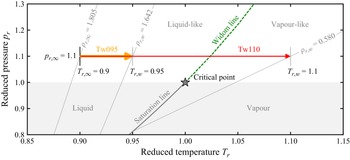


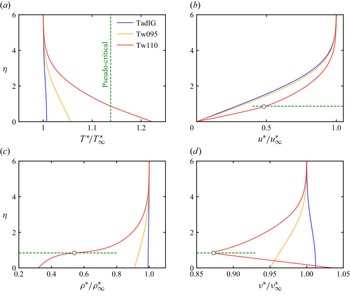


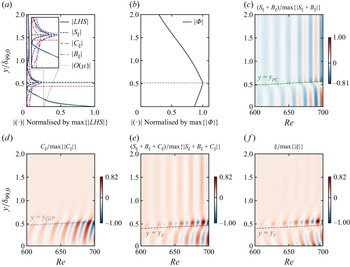


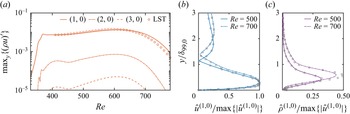


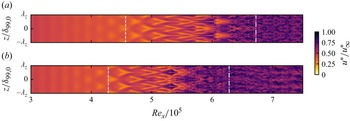


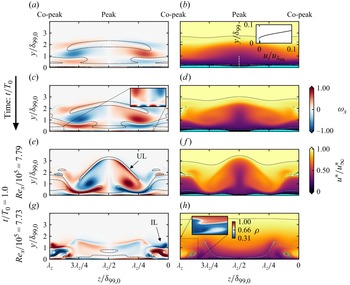


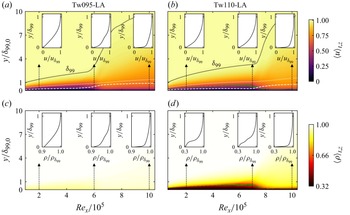


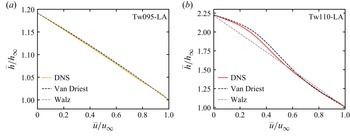


 Open access

