


1. INTRODUCTION
The hypothesis that English must be classified genealogically as a North Germanic language on syntactic grounds, and that West Germanic English died out in England in the Middle Ages and was replaced by Norse, so that Middle English is in fact Norse, was first presented to the wider world in November 2012, when Jan Terje Faarlund was interviewed by the University of Oslo research magazine Apollon. Footnote 1 This extraordinary claim soon found its way to the global media and sparked a good deal of debate. Unfortunately, the authors had not at that time published anything together on the topic, either in peer-reviewed channels or elsewhere, and thus the discussion soon abated. Then, at the end of 2014, English: The Language of the Vikings was published as the third volume in the series Olomouc Modern Language Monographs at Palacký University, Olomouc, Czech Republic. The book is freely available in electronic version at http://anglistika.upol.cz/vikings2014.
This is not the first time it has been proposed that English after the Middle Ages is a cuckoo in the nest: Bailey & Maroldt (Reference Bailey, Maroldt and Meisel1977) claimed that Middle English was a creole derived from admixture of Old English and Norman French, and Poussa (Reference Poussa1982) also argued for a creole origin, albeit one involving Old Norse rather than French. To our knowledge, Joseph Embley Emonds and Jan Terje Faarlund (henceforth E&F) are, however, the first to propose that Middle English descended, essentially directly, from Old Norse – and that Old English, like Gothic, simply died out.
Challenges to received wisdom often come from out of left field, so it should not be surprising or problematic in itself that neither of the authors has any background in the historical linguistics of English, though both are well known: Emonds as a theoretical syntactician, and Faarlund as a historical syntactician specializing in the languages of Scandinavia. A large part of their book focuses on morphosyntactic features of Middle English that they argue are best explained by direct inheritance from the Scandinavian language spoken in the north of England and Scotland (henceforth simply Norse). The proposal, like any other, should be evaluated on the basis of the evidence and argumentation provided. As will become clear, we think that E&F's claim does not stand up to scrutiny. There are two main reasons for this. First, the syntactic evidence that they adduce to support their proposal is problematic: In some cases it is based on an incomplete or misleading presentation of the facts, and in others it is plain wrong. Secondly, and more importantly, even if it were the case that the syntactic facts were consistently as E&F present them, this evidence would not be sufficient to conclude that English is a North Germanic language under standard assumptions about what constitutes a demonstration of genealogical relationship in historical linguistics.
In this review article, we will argue against E&F's hypothesis, and we will do so on the basis of three aspects: method, data, and theory. The article is organized as follows: Section 2 introduces some methodological issues. Section 3, the bulk of the paper, is concerned with empirical and theoretical issues, but comments on method are included there as well. We discuss a selection of the specific linguistic features that E&F bring up as evidence that English is North Germanic, and for ease of reference, our headings reflect E&F chapter headings. Section 4 offers some concluding remarks.
2. METHOD, PREMISES
2.1 What does it mean for languages to be related?
Languages can be classified in (at least) two ways: genealogically, and typologically. Typological classifications are based on linguistic features that languages synchronically have in common, without reference to the languages’ histories, while genealogical (or genetic) classifications are based on the origins and descent of the languages in question. Crucially, similarities between languages can occur for at least five reasons (Campbell & Poser Reference Campbell and Poser2008:10):
1. Accident (chance, coincidence)
2. Language contact
3. Onomatopoeia, sound symbolism, and nursery forms
4. Universals or near-universals
5. Genealogical relationship (inheritance)
In our view, E&F make a strong case for typological similarity between Present-day English and the Mainland Scandinavian languages as regards their syntax. This is not a new observation; Gianollo, Guardiano & Longobardi (Reference Gianollo, Guardiano, Longobardi and Biberauer2008:133) classify English with Norwegian, and separate from Old English, German and Gothic, on the basis of microparameters in the domain of nominal syntax. However, more than this is needed in order to demonstrate that we are dealing with genealogical relationshipFootnote 2 rather than accident, contact, or universals.Footnote 3
What sort of evidence is needed to demonstrate genealogical relatedness? In a recent and authoritative survey of methods for language classification, Campbell & Poser (Reference Campbell and Poser2008:4) show that three sources have traditionally been considered key: basic vocabulary, grammatical evidence, and sound correspondences. Of these, basic vocabulary is the least reliable, since contact-induced transfer in this domain is robustly attested (Campbell & Poser Reference Campbell and Poser2008:166–167, 174). E&F agree that the latter two sources are crucial: ‘A language's genealogy is properly determined by its grammar, including its morphosyntactic system, and patterns of regular sound change’ (p. 57). However, E&F base their argument solely on grammatical evidence, leaving sound correspondences entirely out of consideration. In the remainder of this subsection, we outline why this is problematic.
In order to argue for historical relationship, alternative explanations, e.g. language contact, must be sufficiently implausible that they can be ruled out. The unique properties of regular sound change mean that there is essentially no way for systematic sound correspondences to arise through anything other than genealogical relationship. As one of the authors puts it, ‘The lexical item is a historical constant, an etymon, which constitutes a context that makes it possible to identify a phoneme at one stage with a phonetically different phoneme at another stage’ (Faarlund Reference Faarlund1990:8). It is debatable whether any such historical constant can be found in the domain of syntax. Faarlund (Reference Faarlund1990:8) goes on to state that there is ‘no syntactic unit corresponding to the etymon or lexical item’. Not all agree; Harris & Campbell (Reference Harris and Campbell1995:344ff.) argue that it is possible to establish syntactic correspondences between successive stages of a single language, among related languages, or among dialects, on the basis of the notion of a syntactic pattern. However, even if systematic syntactic correspondences can in principle exist, the methodological problem of actually identifying them remains (Walkden Reference Walkden2013, Reference Walkden2014:47–53). As a result, syntactic evidence for relatedness is only admissible in ‘instances so distinctive they could not easily be explained by borrowing or accident’ (Campbell & Poser Reference Campbell and Poser2008:177). As we will argue in Section 3, most of the properties considered by E&F do not meet this criterion.
Most importantly, after acknowledging the importance of sound correspondences for genealogical relatedness, E&F do not mention them at all. This omission is significant, since the traditional histories of English they cite contain long lists of regular sound changes, each one constituting prima facie evidence for a West Germanic origin for Middle English (see e.g. Lass Reference Lass1992:42–67). Engagement with this material is surely a necessity for anyone seeking to challenge the traditional view and reassess the genealogical classification of English.
At a number of points, E&F seem to equivocate between systematic sound correspondences and mere phonological similarity. For instance, in a section attempting to justify their method, they mention that many languages are similar phonologically but that their morphosyntax clearly places them in different genealogical sub-families; thus, ‘Maltese and Tagalog (Philippines) and Haitian Creole are not taken as Romance languages, no matter what their phonologies suggest’ (p. 19). But it is regular sound change that is crucial, not surface similarity, and E&F present no evidence that we are dealing with the former and not the latter. E&F thus join a long line of historical linguists who have illicitly conflated the two; see Campbell & Poser (Reference Campbell and Poser2008:172–176).
E&F also disregard the evidence from sound change in their treatment of the lexicon, both open-class (Chapter 2) and grammatical (Chapter 7). They state (p. 18) that where a language contains a large number of cognates, these are ‘irrelevant’ for subgrouping. More concretely, they estimate (p. 52, fn. 32) that 99 of the 147 words mentioned in the Collins dictionary as being derived from Old English have Norse cognates, and that therefore only 48 words have ‘a sure Old English source’. But this does not follow. The fact that an Old English word has a Norse cognate does not mean that it could equally well be derived from Norse; the sound changes must be inspected in order to find out. Thus, for instance, the modern English word need can safely be said to descend from Old English nēod and not from Old Norse nauð(r), because there is a plausible pathway of regular sound change deriving it from the former but not the latter. The case could in principle be made for a given word (though in this case it seems unlikely), but E&F do no such thing; instead, they assert that any word in modern (or Middle) English with Old English and Norse cognates could just as well be derived from either, which is simply a misunderstanding of historical-comparative methodology.
2.2 The language contact situation
In claiming that Middle English is Norse, E&F take as a premise that a language generally does not borrow (morpho)syntactic structures from another language (p. 60). However, there are numerous examples in the languages of the world of borrowed structures; Pereltsvaig (Reference Pereltsvaig2012:171, 246) mentions examples from Papuan languages and Yiddish. North Sami is presently undergoing syntactic changes due to contact with Scandinavian (Marit Julien, p.c.). Closer to home, we need look no further than Somerset-Wiltshire, where it is thought that the do-construction in English arose, through contact with Celtic (Filppula, Klemola & Paulasto Reference Filppula, Klemola and Paulasto2008). Since the premise of non-borrowing of morphosyntax is essential to E&F's reasoning, we would have expected them to engage with the vast literature on language contact and its various consequences in more than a footnote (p. 60 fn. 41).
Another premise for E&F is that Scandinavians ‘settled extensively’ in parts of England (p. 35), that there was ‘complete social integration’ (p. 52) between the English and Scandinavian population after the Norman conquest, to the extent that ‘the two cultures fused’ (p. 53), and that the Scandinavians enjoyed social prestige (p. 155). A recent article from Nature provides evidence against this view. Leslie et al. (Reference Leslie2015) study the fine-scale genetic structure of the British population, and find that there is surprisingly little Viking DNA:
we see no clear genetic evidence of the Danish Viking occupation and control of a large part of England, either in separate UK clusters in that region, or in estimated ancestry profiles, suggesting a relatively limited input of DNA from the Danish Vikings and subsequent mixing with nearby regions. (Leslie et al. Reference Leslie2015:313)
The Vikings apparently came in relatively small numbers, conquered, ruled, but otherwise kept to themselves, and left, with the few that remained eventually shifting to English. This is consistent with the conclusion reached by traditional historical and archaeological scholarship on the extent of Scandinavian immigration (Sawyer Reference Sawyer1971:166–174).
But how does this tally with the late lexical transfers from Norse? E&F accuse ‘traditional historians of English’ of being mystified by the late transfer of Norse words (p. 27). However, instead of looking to traditional historians, E&F might consider newer scholarship on the matter, in which it becomes clear that there is no real mystery. Townend (Reference Townend2002), whose main concern is to establish the nature of the linguistic relations between the Anglo-Saxons and the Vikings, suggests that English society at the time was bilingual, but that individuals were not (Reference Townend2002:185). The speech communities were separate, and did not as a rule have active competence in the language of the other, but there was adequate mutual intelligibility between them (Reference Townend2002:182). As regards the late lexical transfers from Norse, Townend notes that in contrast to earlier borrowings these words usually kept their phonological form. On the basis of a theoretical framework originally developed by van Coetsem (Reference van Coetsem1988), he then assumes that there is a difference between ‘borrowing’, under recipient-language agentivity, and ‘imposition’, under source-language agentivity (see also Winford Reference Winford2005). In the early stages, Norse words were borrowed by native speakers of English, and thus adapted to the English phonological system, whereas the late words kept their form because they were ‘imposed’ by Norse speakers who shifted to English as Norse died out (Townend Reference Townend2002:201–210). This imposition was possible because, during language shift, adult speakers of Norse began to learn English as an L2, a situation which is likely to lead to (subconscious) transfer of basic vocabulary without phonological assimilation. Hence, the late Norse lexical transfers, including the fact that they were daily life words, may be plausibly accounted for.
2.3 The lexical evidence
A chapter of E&F is devoted to the evidence from the Middle English lexicon. They argue that Middle English was a ‘lexical amalgam’ of Norse and Old English (p. 47), but conclude that ‘detailed study of the Middle English open class vocabulary has no bearing’ on whether their hypothesis is correct (p. 57). Here they are in agreement with the majority of historical linguists: Campbell & Poser (Reference Campbell and Poser2008:165), for instance, emphasize that lexical comparisons alone cannot be taken as evidence for genealogical relationship without support from other criteria such as sound correspondences. The point of this chapter is therefore not entirely clear.
Moreover, the case that Middle English is a lexical amalgam is not convincingly made. This is because E&F's claims are based not on the research literature, but on a handful of textbook sources. Baugh & Cable (Reference Baugh and Cable2002), a volume most often seen prescribed as introductory reading for first-year History of English courses, takes pride of place, but percentages of Old English-derived words are also taken from Denham & Lobeck's (Reference Denham and Lobeck2010) Linguistics for Everyone: An Introduction, and from Wikipedia. Given that there is a flourishing literature on Anglo-Scandinavian interaction and its lexical effects (see e.g. Townend Reference Townend2002; Dance Reference Dance2003; Pons-Sanz Reference Pons-Sanz2007, Reference Pons-Sanz2013), there is little excuse for such an omission.
3. EMPIRICAL AND THEORETICAL ISSUES
In this section we deal with the syntactic evidence which is the mainstay of E&F's argument (Chapters 3–6). E&F adduce an admirably wide range of syntactic properties in support of their proposal, though often give little detail on specific points. Due to space limitations, we cannot address all of these properties in this review; indeed, doing so would require a book in itself. In what follows, then, we discuss a selection of these properties, the ones that we feel are most representative of E&F's methodology and most revealing with regard to its drawbacks.
The subsections in this section reflect E&F's chapter headings. In Section 3.1 we discuss properties of Middle English that are alleged to have been present in Norse but not in OE; in each case, we find that Old English and Old Norse were in fact more similar than E&F suggest. Section 3.2 deals with the to-infinitive, which receives its own chapter in E&F. Section 3.3 addresses properties of Old English that E&F claim were not found in Middle English/Norse, and Section 3.4 deals with an example of a shared innovation, the s-genitive. In Sections 3.5 and 3.6, we briefly discuss the properties of the grammatical lexicon, and the sparse inflection of Middle English.
3.1 Norse properties of Middle English syntax lacking in Old English
3.1.1 Change of word order in verb phrases
The first Middle English feature that E&F cite as an inheritance from Norse is head-initial word order in the VP: ‘OE word order in the VP did not “change” in ME; it simply died out with West Saxon’ (p. 65). Citing data from Pintzuk & Taylor (Reference Pintzuk, Taylor, Ans van Kemenade and Los2006), they observe that 28.4% of examples from 1150–1250 (253 of 892) display OV order, whereas only 3.1% of examples from 1250–1350 (26 of 834) do. This, they claim, is consonant with their hypothesis that the Norman conquest catalyzed a full-scale abandoning of the Old English language.
However, there are a number of empirical problems with this proposal. First is the fact that a substantial proportion of Old English examples display VO order from the time of the earliest texts, with OV order being by no means ‘dominant’ (p. 61). Pintzuk & Taylor (Reference Pintzuk, Taylor, Ans van Kemenade and Los2006:255) also provide quantitative data for Old English, which E&F do not reproduce. For Old English prose before 950, 803 of 1,416 examples (56.7%) are OV, and for Old English prose after 950 the figure is 1,165 of 2,310 examples (only 50.4%).Footnote 4 This is hardly a ‘small number’ (E&F:66); see also Taylor & Pintzuk (Reference Taylor, Pintzuk, Biberauer and Walkden2015) for robust evidence that underlying VO must have been relatively common in OE. Examples of VO are given in (1)–(3); note that these involve postverbal pronominal objects, and therefore cannot be treated as instances of focalization, nor of verb projection raising (Wurmbrand Reference Wurmbrand, Everaert and van Riemsdijk2005). (3), moreover, is from an early (Alfredian) West Saxon text.
(1)

(2)
(3)

If half of all relevant clauses are already VO before 950, then the argument for VO being an inheritance from Scandinavian at least loses some of its force. Furthermore, the majority of the YCOE corpus (Taylor et al. Reference Taylor, Warner, Pintzuk and Beths2003), from which the above data is taken, is in West Saxon dialect, which is unlikely in any case to exhibit evidence of syntactic transfer from Norse.
Even more striking is the fact that the head-directionality parameter in the VP in attested Old Norse was by no means fixed at VO. E&F (p. 62) cite Faarlund (Reference Faarlund, Bandle, Braunmüller, Jahr, Karker, Naumann, Telemann, Elmevik and Widmark2002, Reference Faarlund2004) in support of their claim that Norse was VO by the 9th century; however, the evidence does not clearly support this. Early, though non-quantitative, work by Rögnvaldsson (Reference Rögnvaldsson1996) on Old Icelandic concluded that ‘it is not feasible to assume that the VP in Old Icelandic was uniformly either head-initial or head-final’ (Reference Rögnvaldsson1996:82).Footnote 5 Sundquist (Reference Sundquist and Lightfoot2002:343–346) also argues for mixed underlying OV and VO in Middle Norwegian up to and including the 15th century, with reference to quantitative data. (4) and (5) are examples of OV and VO in early Middle Norwegian; the fact that negation precedes the object in both examples rules out an analysis in which the object has left the VP.
(4)
(5)


The data does not indicate, then, that Norse is likely to have been a consistent VO language at the time that it was spoken in the British Isles; Svenonius (Reference Svenonius2005), in a careful review of Trips (Reference Trips2002), comes to the same conclusion. The hypothesis of Norse continuity into Middle English finds no support here; nor, therefore, does the weaker view that the development of VO is in any sense a borrowing from Norse. Kiparsky (Reference Kiparsky, Thráinsson, Epstein and Peter1996:141f.) makes the same observation.
Finally, it should be emphasized that as a typological feature dividing North Germanic from West Germanic the VO vs. OV divide fails, as is well known. North Germanic languages are not uniformly VO; even abstracting away from Object Shift (see Holmberg Reference Holmberg1986), modern Icelandic permits OV with negative and quantified objects (Hróarsdóttir Reference Hróarsdóttir2000:56f.).Footnote 6 The other modern West Germanic languages are not uniformly OV either, pace E&F (p. 66); for instance, Yiddish has shifted from OV to VO in its history (Santorini Reference Santorini1992:598 fn. 6; Kiparsky Reference Kiparsky, Thráinsson, Epstein and Peter1996), and Mòcheno, a modern Tyrolean dialect of German, displays mixed OV/VO (Cognola Reference Cognola2008, Reference Cognola2013). A change from OV to VO also takes place in Classical Greek (Taylor Reference Taylor1994), Western Finno-Ugric (Kiparsky Reference Kiparsky, Thráinsson, Epstein and Peter1996:172), and across Romance (e.g. Zaring Reference Zaring2010); this casts doubt on E&F's claim that the change from OV to VO is ‘extremely rare’ (p. 66).
The shift from OV to VO in the history of English, then, provides no support for the thesis that Middle English is a direct descendant of Norse.
3.1.2 From Old English prefixes to Middle English postverbal particles
A further feature of modern English that E&F (pp. 66–72) attribute to direct inheritance from Norse is the modern system of verbs used with postverbal particles which have directional and/or aspectual meaning. E&F contrast this with the typical West Germanic way of expressing this content, namely through verbal prefixes (separable or inseparable), which can be found productively in Old English. Observing that after the Middle English period this system has been lost in favour of phrasal verbs, E&F state that, since phrasal verbs were already dominant in Old Norse, the proposed change from prefixal to particle-based aspect marking ‘is essentially a non-event’ (p. 72).
Like many of the other developments discussed by E&F, this one has been the subject of substantial work in the English philological tradition. In this case, at least three monographs have been written on the topic (Hiltunen Reference Hiltunen1983, Elenbaas Reference Elenbaas2007, Thim Reference Thim2012), and of these three only Hiltunen is cited – indirectly – by E&F (p. 68). Hiltunen (Reference Hiltunen1983) in fact acknowledges that the change appears drastic: ‘one cannot avoid the impression of the prefixes having been swept away almost overnight’ (Reference Hiltunen1983:92). However, Norse is only mentioned in passing in his study: Hiltunen suggests that language contact in this case can only have accelerated an existing change, rather than triggering it (Reference Hiltunen1983:97–98). This suggestion is based on his finding that already in late Old English the productivity of the prefixal system had declined, and combinations of prefix and verb were increasingly semantically opaque and lexically idiosyncratic: The verbs hatan and behatan ‘to order/command’, for instance, appear entirely synonymous, and the prefix be- could serve to mark perfectivity, intensification, and/or locative meanings.
Elenbaas (Reference Elenbaas2007:269–279) is more positive about the possible effects of language contact, showing that north-eastern Middle English texts from the period 1150–1250 show substantially more verb–particle order than south-western texts, though the effect is not apparent for the period 1250–1350. Though she makes clear that the paucity of the data makes it difficult to draw any firm conclusions, Elenbaas considers a contact effect likely. Finally, Thim (Reference Thim2012) is the most sceptical of the three (see also Thim Reference Thim and Stierstorfer2008): ‘it remains quite unclear whether the Scandinavian influence caused the development [of phrasal verbs – KB/GW] or whether it only contributed to it’ (Reference Thim2012:130), and, more firmly:
there is no reason for the assumption that language contact may have had any impact on the development of the verb-particle construction in English . . . verb-particle constructions are a common phenomenon in all Germanic languages, while there is nothing in that development which cannot be explained as language-internal. (Thim Reference Thim2012:184–185)
E&F's proposal finds scant support in the literature, then. Furthermore, it is not obvious from E&F's account to what extent the phrasal verb construction was common in Old Norse – whether it was more common than in Old English, where we easily find constructions such as (6) and (7), which are very similar to the examples E&F cite from Old Norwegian (pp. 71–72).
(6)
(7)


In other words, the English system is not ‘a straightforward continuation of the Norse system’ (p. 71), and one reason why it is difficult to argue for Norse sources of Middle and Modern English constructions is that Old English was a language that showed great variation.
3.1.3 Stranded prepositions
Another feature that E&F attribute to direct inheritance from Norse is the possibility of preposition stranding. E&F (pp. 84–96) observe, accurately, that the frequency of preposition stranding and the contexts in which it was possible both increased dramatically during the Middle English period. However, their account is marred by other factual inadequacies and misinterpretations that call the hypothesis of direct inheritance into question.
E&F do not do the Old English facts justice. They (pp. 86–87) cite van Kemenade (Reference van Kemenade1987:153) as arguing that the correct generalization is that ‘the objects of a stranded preposition must be personal or locative pronouns on the left periphery of a PP, VP, or CP’ (emphasis theirs). However, as van Kemenade (Reference van Kemenade1987:152–153) makes clear, this generalization only holds when there is an overt element in COMP (SpecCP in modern terms). In relative clauses introduced by the indeclinable particle þe, stranding is not only possible but obligatory, as in (8).
(8)

The same holds for zero-marked relatives and to-infinitive constructions – as E&F note on their previous page (p. 86).Footnote 7 In contrast, in topicalizations, questions and se (þe) relatives, preposition stranding was not available.
E&F mention three conditions for the emergence of preposition stranding (pp. 91–92), claiming that ‘at least’ two of these were absent from West Germanic. These are (i) invariant complementizers in relative clauses, (ii) locative adverbial relatives, and (iii) preposition fronting. In fact, the first two of these are robustly attested in Old English. We have already seen that condition (i) is met; relative clauses introduced by invariant þe, as in (8), are the most common type in Old English, and increase in frequency during the Old English period (Zimmermann Reference Zimmermann2012). Condition (ii) is also met, as shown by example (9) and many others like it (see Vat Reference Vat1978).
(9)

Only condition (iii), preposition fronting, is absent from Old English (Pintzuk & Haeberli Reference Pintzuk and Haeberli2008:381).Footnote 8
That E&F misrepresent the data in this way is surprising in view of the extensive literature on stranding on Old English in the last forty years (e.g. Allen Reference Allen1977, Reference Allen1980; Maling Reference Maling1978; van Riemsdijk Reference van Riemsdijk1978:286–297; Vat Reference Vat1978; van Kemenade Reference van Kemenade, de Haan, Trommelen and Zonneveld1984, Reference van Kemenade1987:144–172; Fischer Reference Fischer1992; Denison Reference Denison1993; Fischer et al. Reference Fischer, van Kemenade, Koopman and van der Wurff2000:64–67; Castillo Reference Castillo2005). These facts indicate that there is no need to assume that preposition stranding originated wholesale with Norse.
E&F also provide no evidence that Norse was likely to have had extensive preposition stranding, instead stating that it appeared mostly in relative clauses and ‘was not widespread at first’ (p. 89). We have been unable to find a systematic study of the phenomenon in Old Norse, but Delsing (Reference Delsing, Delsing, Falk, Josefsson and Sigurðsson2003) states for Old Swedish that the first examples of stranding with a fronted full nominal appear in the 15th century, and Jónsson (Reference Jónsson, Barbiers, Koeneman, Lekakou and van der Ham2008:407) states that Old Icelandic was like Old Swedish in this respect. Faarlund (Reference Faarlund2004:227, 258) states that no example of stranding in interrogatives in Old Norse has been found, and offers a single example of stranding in topicalization (Reference Faarlund2004:233), stating that this is ‘very rare’. E&F offer three additional examples involving topicalization (pp. 90–91). A quick search for stranded prepositions in the IcePaHC 0.9 corpus (Wallenberg et al. Reference Wallenberg, Ingason, Sigurðsson and Rögnvaldsson2011) finds 111 examples from pre-1250 texts. However, these occur only in comparatives and relative clauses introduced by the indeclinable particles sem and er, exactly the contexts in which we commonly find them in Old English. (10) is one example. In contrast, questions are inevitably found with pied-piping, as in (11), and prepositional passives are not found.Footnote 9
(10)
(11)
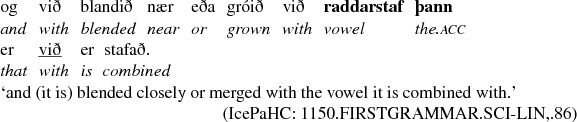

The Middle English period did indeed witness substantial changes with regard to the availability of preposition stranding: It emerges in questions, topicalizations and passives in the 13th century (Fischer Reference Fischer1992:389–391), and in relative clauses introduced by which, though it does not become common until the 14th century. Tough-movement examples, and examples of stranding from an adjunct (e.g. What train did Shelagh arrive by?), do not emerge until later. In light of the evidence that Old English and Old Norse share the same properties, however, there is nothing to be gained by explaining stranding as a direct inheritance from Norse.
This does not mean that language contact could not have played a role in the development; Poussa (Reference Poussa, Nevalainen, Klemola and Laitinen2006:323–324) shows that the geographic distribution of stranding in wh-interrogative clauses in present-day English dialects corresponds roughly to the borders of the Danelaw in 886, and attributes the rise of stranding to the loss of morphological case catalyzed by this contact, following Delsing's (Reference Delsing, Delsing, Falk, Josefsson and Sigurðsson2003) hypothesis that stranding and case are not compatible. More detailed work on the dialectal distribution of stranding in Middle English would be necessary to test the hypothesis of contact influence, however.
3.1.4 Exemption of the preposition from sluicing
E&F (p. 93) point out that in both English and Mainland Scandinavian, but not other Germanic languages, prepositions may be omitted or postposed in cases of clausal ellipsis with question words (‘sluicing’). Thus, (12) is grammatical in English, as is its Mainland Scandinavian equivalent, but not its equivalent in other Germanic languages.
(12) She was waiting for someone, but I don't know who (for).
E&F state that this is a natural consequence of the combination of stranding and sluicing, following Merchant (Reference Merchant2001). If this is right, then this property is epiphenomenal and does not provide independent evidence for either contact or inheritance.Footnote 10 This proposed correlation also predicts that examples like (12) above should be grammatical from the Middle English period onward, as is stranding. E&F present no actual historical data in this section; however, in Nykiel's (Reference Nykiel2015) study of the diachrony of sluicing in English, she finds no examples of preposition omission under sluicing from the Middle English period, as opposed to twenty-three examples in which the preposition is overt, such as (13).
(13) We be of this other contrey of the partyes of Gaule.
And ofwhat parties of Gaule, quod Agrauadain.
(c. 1450–1460 Merlin XXX.606; Nykiel Reference Nykiel2015:238)
Nykiel (Reference Nykiel2015:238) concludes on this basis that ‘[t]he introduction of preposition stranding into wh-interrogative clauses does not correlate with attested examples of NP remnants’. This demonstrates that simply comparing the present-day syntax of English and Mainland Scandinavian, as E&F do here and in many other instances, is not a reliable basis for making inferences about historical development.
3.2 Split infinitives and the category of to
E&F devote some considerable space to split infinitives. They do so in a separate chapter, since split infinitives can neither be regarded as a Norse property of Middle English syntax lacking in Old English, nor as a property of Old English lacking in Middle English. This is because split infinitives are not attested in Old English, and they are practically non-existent in Old Norse. E&F (p. 102) point out that a few instances of Old Norse split infinitives can be found, and provide two examples. We have searched in the IcePaHC corpus for Old Icelandic (1,100 infinitives with infinitive marker), and in the Menotec corpus for Old Norwegian (1,662 infinitives with infinitive marker). In IcePaHC, we find no examples of split infinitives, and in Menotec there is one example in addition to the two mentioned by E&F: at retlega væra i norege ‘to lawfully be in Norway’.Footnote 11 This is scant evidence for a substantial difference between Old Norse and Old English in this respect.
So, if the split infinitive in English is caused by English being Norse, how could that plausibly have happened if Old Norse did not split the infinitive?
Apparently, the split infinitive has a somewhat unstable history in English. It occurred sporadically in Early Middle English, and the element that split the infinitive was normally a negative adverb or a personal pronoun (Fischer Reference Fischer1992:329), the latter being ungrammatical today. As the Middle English period drew on, adverbs of manner and degree could split the infinitive as well, but it is not until Reginald Pecock's writings in the fifteenth century that other types of adverbials were used as splitters (Fischer Reference Fischer1992:329, but see the chronology in Calle-Martin (Reference Calle-Martin2015), who finds that manner and degree adverbs occurred earlier than negative adverbs in this construction). However, Mustanoja (Reference Mustanoja1960:515) comments that Pecock was the only writer who used the split infinitive to any extent, so the development of this construction may not be so unstable after all, because split infinitives are rare in the Early Modern English period as well, and did not gain ground until the end of the eighteenth century (Rissanen Reference Rissanen and Lass1999:290). In other words, this construction, which according to E&F exists in English because Middle English equalled Norse in the early Middle English period, did not become common until some 500–600 years later.
As we have seen, split infinitives were exceedingly rare in Old Norse, and they are unattested in Middle Norwegian as well, though Mørck (to appear (a)) presents two possible but marginal exceptions from Late Middle Norwegian. Faarlund (Reference Faarlund and Faarlund2003:57) does not find a single instance of a split infinitive in the Early Modern Norwegian period (from mid-1500s to mid-1800s), but Mørck (Reference Mørck, Sandøy and Jahr2011:171, and references therein) points out that the Norwegian writer Johan Herman Wessel (mid-eighteenth century) split the infinitive by means of the negation, and that this construction is also found in the nineteenth century. These studies only mention the negation as a splitter, and to our knowledge, there are no studies that chart the development of the split infinitive with other types of elements, notably adverbs, occurring between the infinitive marker and the verb. But what we can safely conclude is that, in Norwegian at least, the split infinitive was a late development.
Despite this, E&F claim that Old Norse must be the source of the Middle English split infinitive, for the following reason: In Old Norse, and in Middle English, the infinitive marker is in C as a complementizer, whereas Old English to is inside the VP, as a bound verbal prefix, and hence infinitive splitting is impossible. However, if the Old Norse infinitive marker is as high up in the tree as C, we would, as E&F also admit (p. 100), expect to find more instances of split infinitives, i.e. there is room in the tree for elements occurring between the infinitive marker in C and the verb that is in a lower position. Nevertheless, E&F maintain that the infinitive marker in Old Norse is not a prefix, and in addition to the two examples of a split infinitive they provide, they list the following three arguments against a prefix status for at (pp. 100–102, see also Faarlund Reference Faarlund and Faarlund2003, Reference Faarlund2007): (i) Orthographic practice. The infinitive marker is never joined to the verb. We assume that this is the case for the Old English infinitive marker to as well, since Old English features numerous verbs with the verbal particle to-, like toberan ‘carry off’ and todælan ‘divide’. Hence this is not good evidence for C status. (ii) Coordination. The infinitive marker is not repeated when two infinitives are coordinated, which is an argument against its status as a prefix. Examples of that can be found in Old English as well (see Mitchell Reference Mitchell1985 I:390, 403), though it is indeed much more common to repeat the infinitive marker (Los Reference Los2005:212, and see also Los Reference Los2005:211–213 for a discussion of infinitive coordination). The third argument E&F mention is that after en ‘than’ and nema ‘except, unless’, the infinitive marker is not expressed, because en and nema are also complementizers and thus occupy the C-position. However, already on the next page (p. 102), an example is given (69a) in which both en and at occur: en on at vera ‘than without to be – than to be without’. If both en and at are in C, that kind of clause should be impossible. Hence both the analysis of the infinitive marker as occurring under C in Old Norse and the claim that it was a verbal prefix in Old English encounter some obstacles according to the criteria set up by E&F. That said, Old English to was probably indeed a bound prefix; see Los's (Reference Los2005:191ff.) extensive argumentation.
As regards the reason for the lack of split infinitives in Old Norse, E&F suggest that it may be an epiphenomenon due to other circumstances such as the lack of a structural position, or covert elements. However, they end up suggesting that the infinitive in fact moves to I in Old Norse, so that there is only one position between the infinitive marker in C and the infinitive in I, namely SpecIP, occupied by the phonologically null PRO subject. In the present-day Scandinavian languages, the infinitive marker is in I, which leaves space for split infinitives. At this point, dating really becomes crucial, because: If the infinitive marker was in C and the verb moved to I in Old Norse, how would E&F explain the fact that split infinitives occur in Middle English, which is supposed to be Norse? They state that Anglicized Norse (Middle English) lost V-to-I earlier than Scandinavian, so that the infinitive marker could in fact be in I (p. 106), but it is not stated what the mechanism behind that early loss might have been, when it happened, and what other syntactic features would support this claim.
Another point regarding dating is that Faarlund (Reference Faarlund and Faarlund2003:76) tentatively dates the development of the infinitive marker in Norwegian as follows: Around 1500, the infinitive marker grammaticalized from a subordinator to a clitic, and then it degrammaticalized back to a subordinator around 1900. However, Mørck (in press; to appear (b)) comments that the different infinitive structures do not follow in chronological succession, but exist side by side to a considerable extent, so that the development cannot be as neat as all that. But if Faarlund's scenario for Norwegian is approximately right, it means that the structural development of English and Norwegian is very different, even from the earliest stages, which would be unexpected if English were Norse.
In short, although the similarity between Present-day English and Scandinavian as regards the possibility for split infinitives is interesting, E&F do not succeed in accounting for it in a plausible manner. The facts do not lend support to their analysis, and here it must be pointed out that E&F do not discuss chronology from a comparative point of view, which is essential. Although they do not wish to be ‘mired in empiricist methodology’ (p. 67), it is after all not advisable to talk about language change without considering the data carefully. Furthermore, their syntactic account runs into problems, since the lack of split infinitives in Old Norse forces them to propose that the infinitive verb must move to I, whereas the emergence of split infinitives in Middle English forces them to propose that it is the infinitive marker that must be in I. This means that their Anglicized Norse (Middle English) is structurally very different from its immediate ‘ancestor’ Old Norse.
In a book-length study of the rise of the to-infinitive in the history of English, Los (Reference Los2005) argues that degrammaticalization, which is generally a rare linguistic phenomenon, has taken place in English as well. However, her scenario is different: To started out as a preposition in prehistoric Old English, and then grammaticalized to a prefix in Old English, before it degrammaticalized to a free morpheme in Early Middle English. In other words, where E&F claim that the behaviour of to in Middle English must mean that Middle English is Norse, Los suggests that degrammaticalization has taken place, which is exactly the (unusual) development that Faarlund (Reference Faarlund and Faarlund2003) proposes for Norwegian at a much later stage. As regards its syntactic position, Los argues that to has always been in T0, and that the only thing that has changed is its morphological status: The to-infinitive was a non-finite subjunctive clause already in Old English, but with to as a bound morpheme. As to became an independent form in Middle English, it raised to T0 to check the subjunctive feature overtly rather than covertly (Los Reference Los2005:191–220).
3.3 Morphosyntactic properties of Old English lacking in Old Scandinavian and Middle English
3.3.1 The Norse character of Middle English ‘verb second’
One of the crucial differences between Present-day English and present-day Scandinavian languages is the uniformly SV (also referred to as verb-thirdFootnote 12) nature of the former and the verb-second nature of the latter. In English, a sentence such as (14a) must have the subject in preverbal position, whereas in Scandinavian, the subject must be placed postverbally when another constituent is in initial position, as in the Norwegian sentence in (14b). English is unique among the Germanic languages in having this type of word order, and thus neither patterns with West nor with North Germanic.
(14)
a. Last week Iwent to London.
b. Forrige uke drojeg til London.
If English is Norse, we would expect Present-day English to be a verb-second language, like Scandinavian. But it is not. On the scenario proposed by E&F, then, English was first replaced by the consistent verb-second language Norse. Then, at a later stage, this new English changed syntactically from a consistent verb-second language to a consistent SV language. However, this scenario faces one insurmountable obstacle: English has always, from the time of the earliest Old English records, had SV, or verb-third, sentences. In other words, this type of word order is continuous in the history of English, whereas it does not exist in Old Norse and its Scandinavian descendants.Footnote 13
With reference to van Kemenade (Reference van Kemenade1987), E&F make the following descriptive generalization: ‘in all Germanic languages prior to ca. 1450, subject phrases with lexical nouns follow sequences of initial XP – finite verb, but in Old English pronoun subjects need not’ (p. 110, emphasis theirs). This generalization does not hold, as is clear from Kroch, Taylor & Ringe's (Reference Kroch, Taylor, Ringe, Herring, van Reenen and Schøsler2000) data (see below), and as has been shown by Bech (Reference Bech2001), Haeberli (Reference Haeberli and Lightfoot2002), and endorsed by others since, including van Kemenade herself (see e.g. Biberauer & van Kemenade Reference Biberauer and van Kemenade2011). The facts can also easily be ascertained through simple queries in the YCOE corpus for Old English and the PPCME2 corpus for Middle English (Kroch & Taylor Reference Kroch and Taylor2000). In Old English, pronoun subjects occur in preverbal position in these structures more frequently than NP subjects do, but NP subjects are by no means rare, see (15). Such structures are also amply attested in Middle English texts, see (16), along with pronoun subjects, see (17). E&F's descriptive generalization is thus faulty on all accounts.
(15)
(16) þerefter þe biscop of Wincestre, Henri þe kinges brother Stephnes, spac wid Rodbert eorl.
‘Thereafter the bishop of Winchester, Henry, king Stephen's brother, spoke with earl Robert.’
(PPCME2: CMPETERB,58.548)
(17) Ɖurh his mannisnesse heþolede deað.
‘Through his manhood he suffered death.’ (PPCME2: CMVICES1,25.283)

With these preliminary facts in mind, let us now consider E&F's arguments. Citing Kroch et al. (Reference Kroch, Taylor, Ringe, Herring, van Reenen and Schøsler2000), E&F claim that the East Midlands and northern Middle English dialects pattern with North Germanic in displaying consistent verb-second, so that there is ‘an unbroken continuity between Norse and Middle English’ (p. 109). However, the rendering is not precise. Kroch et al. (Reference Kroch, Taylor, Ringe, Herring, van Reenen and Schøsler2000:370ff.) compare a Kentish text, Ayenbite of Inwit, seven early texts from the Midlands, and one northern text, The Northern Prose Rule of Saint Benet, finding different patterns of inversion, especially with respect to inversion of finite verb and pronoun subject. In the Midlands texts, NP subjects usually invert, but with lower frequencies when the initial constituent is a PP complement, a PP adjunct, or an adverb. Pronoun subjects, on the other hand, invert much less frequently, except when the initial element is þa/then. By contrast, in the northern text, NP subjects invert categorically, except after PP adjuncts, and pronoun subjects usually invert. Kroch et al. thus conclude that the northern syntax is different from the southern/Midlands syntax, and that this is due to influence from Norse. More specifically, northern Middle English is claimed to have a CP–V2 syntax, with the finite verb moving higher than in southern Middle English, which has an IP–V2 syntax, like Old English. Note that though Kroch et al. (Reference Kroch, Taylor, Ringe, Herring, van Reenen and Schøsler2000:368) mention the Northeast Midlands dialect as being similar to the northern dialect, they do not actually provide data which shows this. And nowhere do Kroch et al. say that the northern and the East Midlands dialects are the same with respect to verb-second order, as E&F claim (p. 109).
Due to the paucity of northern texts from the early Middle English period, Kroch et al. are able to consider only one northern text from c. 1425, in the late Middle English period. There is, however, another northern text for which the manuscript date (c. 1440) is slightly later than for Benet, but which must have been written before 1349, namely Richard Rolle's Prose Treatises. Rolle was a hermit from Yorkshire, who died in 1349, and whose religious writings were widely distributed and read. If the northern dialect had a consistent V2 syntax due to influence from Norse, or because it was indeed Norse, Rolle is an exception. Van Kemenade (Reference van Kemenade1987:220) calls him ‘a very progressive innovator’, because he both inverts and non-inverts both pronoun and NP subjects. Apparently, then, this northern writer does not have the northern syntax, i.e. he is not a writer of ‘Anglicized Norse’. Rolle was educated at Oxford, so it could be that he had changed his syntax to the southern variety, and thus was a writer of the language that was a descendant of Old English, to use E&F's terms. It could also be that there is some influence from Latin in his writings. Nevertheless, it is a text by a northern writer which shows a very different pattern than Benet. Though Kroch et al.’s findings may well show a linguistic difference between the north and the south, we must keep in mind that data is extremely scarce (one text!). Furthermore, even in this one text of northern Middle English, inversion is not as categorical as in Norse and Scandinavian. But what is important is that even these possible dialect differences constitute no proof that the distribution was due to a language shift rather than language contact.
E&F refer extensively to van Kemenade (Reference van Kemenade1987). Though her Ph.D. dissertation was an important contribution to the study of historical English syntax when it appeared, much research has taken place in the almost thirty years since, including by van Kemenade herself (see e.g. van Kemenade Reference van Kemenade, Hinterhölzl and Petrova2009; Biberauer & van Kemenade Reference Biberauer and van Kemenade2011; van Kemenade & Milićev Reference van Kemenade, Milićev, Jonas, Whitman and Garrett2012; van Kemenade & Westergaard Reference van Kemenade and Westergaard2012). The syntactic models have been refined, and we now have a much better understanding of the facts due to the large electronic corpora that have been made available. As mentioned above, it is not the case that preverbal subjects in XP–S–V sentences must be pronouns, although pronouns are more frequent in that position than NPs are. Van Kemenade (Reference van Kemenade1987) does not study empirical data systematically, and hence her claims are often somewhat coarse-grained. Concerning subject pronouns, van Kemenade (Reference van Kemenade1987:110) says that ‘it is striking that when the subject is a personal pronoun or an R-pronoun, “subject-verb inversion” is usually lacking’. The exception is when the first constituent is wh-, þa, or ne, in which case subject pronouns, too, must occur after the verb (Reference van Kemenade1987:111). She proposes that such preverbal subject pronouns are clitics, and thus that XP–Spron–V sentences are V2 sentences because clitics do not count as clause constituents (Reference van Kemenade1987:127). In that way, she is able to suggest that the V2 constraint disappeared around 1400: When NP subjects became more frequent in preverbal position, subject pronouns ceased to be interpreted as clitics, and became interpreted as NPs instead (Reference van Kemenade1987:219ff.). However, as we saw in examples (15)–(16), full subject NPs can appear preverbally in both Old English and early Middle English, which makes the notion of subject clitics difficult to sustain. Instead, in the decades since 1987, research on the history of English word order has come to realize that the distribution is probably rather due to information-structural features, placing given subjects in a clause-early position (e.g. Bech Reference Bech1998, Reference Bech2001, Reference Bech2012; Los Reference Los2009, Reference Los2012; Petrova & Speyer Reference Petrova and Speyer2011; Taylor & Pintzuk Reference Taylor and Pintzuk2012, Reference Taylor, Pintzuk, Biberauer and Walkden2015; Komen et al. Reference Komen, Hebing, van Kemenade, Los, Bech and Eide2014; and work by van Kemenade and collaborators (see references above)). Notably, however, English word order has such an unruly history that agreement has still not been reached on the matter of exactly how to account for it in syntactic terms.
Ignoring all these developments, E&F (p. 110) state that Middle English was a V2 language, and therefore Norse. They say that ‘Old English must have had some special property not shared with Norse or Middle English’ and that ‘its surface patterns are very different from Norse/Middle English, so that the same grammars cannot be responsible for both’ (p. 110). This is demonstrably wrong. Old English shared its word order properties with early Middle English, and then the word order gradually changed, so that generalized subject–verb inversion in main declarative clauses was eventually lost. This could not have come about if the language was Norse, which had, and still has, consistent V2, unless this new Norse-English language somehow borrowed this particular syntactic structure from the southern descendants of Old English. But according to E&F, languages usually do not borrow syntactic structures from each other – that is precisely their reason for proposing that English must be Norse. Their basic premise for the hypothesis hence precludes that argument.
In short, a hypothesis that seeks to establish English as stemming from the V2 language Norse must be able to explain how it can be that Old English, Middle English, and Present-day English all have XP–S–V structures. Although the basic word order of English has changed throughout its history, this type of word order is continuous in the history of English, and it bears no relation to Norse or Scandinavian. Thus, from a word order perspective, there is no evidence that English could ever have been Norse.
3.3.2 Middle English relativizers: Overt and caseless
Another feature which E&F take to support their claim that Middle English is Norse is relative clauses, the argument being that Middle English relativizers are overt and caseless, like Old Norse, but unlike Old English. But in order to be able to account for the fact that the Middle English relativizer was þat rather than the Old Norse er, they propose that er was ‘relexified’ to þat in Anglicized Norse (p. 111). We shall return to this claim, but let us first look at some facts concerning Old Norse and Old English relative clauses.
According to E&F (p. 111), the only wayFootnote 14 to form relative clauses in Old Norse is by means of the invariant complementizer er (not to be confused with the present tense verb form of vera ‘be’), as in (18).
(18)

Old English has a more complex relative clause system, and here we will mention those types which are relevant to the present discussion (see Haugland Reference Haugland2007:305–312 for an overview; Mitchell Reference Mitchell1985: vol. II for an extensive discussion; Traugott Reference Traugott and Hogg1992:223–233). The most common relativizer in Old English is the indeclinable relative particle þe (compare the Old Norse relative particle er), glossed as rel below.
(19)
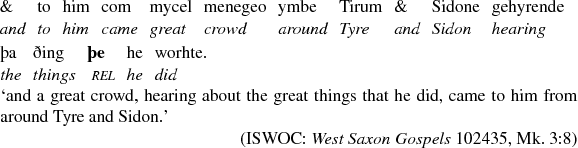
In addition, relative clauses could be constructed with the demonstrative se as the relative pronoun, or with a combination of the demonstrative and the relative particle: se þe.Footnote 15 (20) is an example of a sentence containing both a se-relative and a se þe-relative.
(20)
It is more common for the demonstrative se to get case from its function in the relative clause than for it to get case from the main clause, though there is frequently ambiguity, since in a sentence like (20) the case (nominative) would be the same whether it was taken from the main clause or the subclause (see Mitchell Reference Mitchell1985 II:122 for some tentative numbers).
E&F's point is that Old Norse, like Middle English, does not have this type of case-marked relativizer, so therefore Middle English must be Norse. However, E&F do not quite do justice to the Old Norse data here, because Old Norse in fact has a determiner that behaves in a particular manner in relative clause contexts. Faarlund (Reference Faarlund2004:259, his (34a)) provides the following example:
(21)

According to Faarlund (Reference Faarlund2004:264), this is a common construction. In such clauses, the demonstrative has the case of the antecedent, but there are exceptions in so-called ‘learned style’, where the demonstrative has the case of the relativized element. In his Ph.D. dissertation,Footnote 17 Wagener (Reference Wagener2013) considers this type of clause in some detail, and discusses whether Old Norse sá is a relative pronoun or not. His conclusion is that it is not (Reference Wagener2013:136–144), but he distinguishes between non-relative and relative sá, since the demonstrative behaves differently in non-relative and relative contexts (Reference Wagener2013:134–136). For example, relative sá can form an extraposed syntactic unit with the relative clause, as in (22) where the antecedent is maðr.
(22)
This is at first glance very similar to Old English se þe constructions, as in (20) above. However, the two languages are different in that the demonstrative gets case from the main clause in Old Norse (except in learned style), whereas it may get case from its function in the relative clause in Old English. Hence, Old English se and Old Norse sá must be structurally different in these instances. Although Wagener for various reasons concludes that sá cannot be a relative pronoun, he nevertheless points out that this kind of extraposition is a challenge to the analysis.
As regards the absence of zero subject relatives in Middle English, another argument for Middle English being Norse, according to E&F (p. 112), such constructions are rare in Old English as well (Mitchell Reference Mitchell1985 II:184–199), and they may not be completely absent from Old Norse; see examples in Wagener (Reference Wagener2013:276) and ensuing discussion.
Our reason for devoting some space to a discussion of data is to point out that Old Norse and Old English are not as categorically different as E&F would have us believe, and it is particularly worth noting that Old Norse, too, has a demonstrative which behaves in a special way in relative clause contexts, though its status is unclear. Hence, the claim that Middle English must be Norse since it is different from Old English loses whatever force it may have had, because Middle English is in fact also very different from Old Norse.
In order to be able to account for the fact that the Middle English relativizer is þat, E&F turn to the concept of relexification. They say that Anglicized Norse had generally undergone extensive relexification in the direction of Old English (p. 30), and one of the relexified words was the Old Norse relativizer er, which became þat. However, a scenario whereby the Middle English relativizer descended directly from Old English is, in our opinion, considerably more likely. In Old English, þæt is the neuter nominative and accusative form of the demonstrative, and it is used as a relativizer, as seen in (23) and (24) (and compare (24) with (25)).
(23)
(24)
(25)

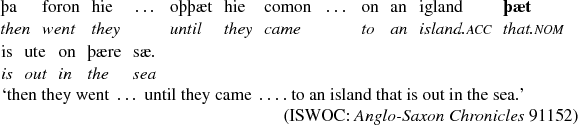

Even more to the point, Old English also features clauses with a double þæt, as in (26), where the second þæt is clearly a relativizer:‘that which’.
(26)

The reasons for the change might be that as English lost case, the se paradigm was dismantled, and therefore the se- and se þe-relatives went out of use. At the same time, and related to the loss of case, the definite article þe arose, and thus the most distinct form (þat) came to be used as a relativizer.
3.3.3 Disappearance of Old English correlative adverbs
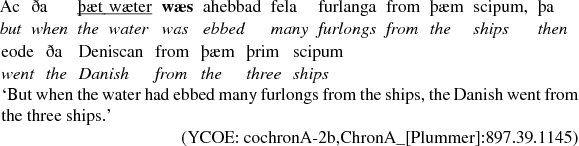
Correlative constructions are constructions in which the subordinate clause and the main clause are introduced by polysemous elements (E&F's ‘paired adverbs’). In Old English, þa ‘then, when’ is the most commonly used correlative, as in (27). The distinction between the main clause and the subordinate clause is signalled by word order: In main clauses, the verb appears immediately after þa.
(27)

In Old Norse, such constructions did not exist, according to E&F (p. 115); temporal and locative subordinate clauses would be introduced by þá er, i.e. an adverb plus the relative marker er.
In Middle English, the correlative construction with polysemous elements went out of use, but apart from a short section in Fischer (Reference Fischer1992:285–287), exactly how and when is a hitherto understudied topic in the history of English.Footnote 18 Instead, some form of the subordinator when (from Old English hwonne) came to be used to introduce the subordinate clause, and the adverb was optional in the main clause. This development can probably be seen in connection with the change of word order in English: As main clause and subordinate clause word order became the same, a need for lexically distinguishable subordinators arose.
So much for some brief linguistic facts, which do not presume to do justice to this complex field. However, our aim here is to evaluate E&F's claim that the change in the correlative construction between Old and Middle English is due to English being Norse. E&F's argument in favour of this claim is simply that Middle English is not like Old English. They say that the Old English correlative constructions are ‘replaced by simple adverbs inside two clauses of clearly distinct syntactic status, exactly as in Old Scandinavian’ (p. 116). But Old Scandinavian has þá er . . . whereas Middle English has some form of when in the subordinate clause, and an optional adverb in the main clause. It is not clear how that makes Old Scandinavian and Middle English identical. Furthermore, E&F present an example ((85), p. 116) from early Middle English taken from Fischer (Reference Fischer1992:286), which is supposed to underpin their argument. The example is repeated as (28) below (misglossed in E&F, correct gloss here):
(28)

We do not see how this example supports the claim that Middle English is Norse, unless it is the point that E&F make about the word order of the subordinate clause being ‘the word order of Anglicized Norse’ (p. 116). But Old English subordinate clauses very frequently had this word order, too, as (29) and (30) show; it is not the case that Old English subordinate clauses were always verb-final (see Heggelund Reference Heggelund2009:77). As far as we are concerned, then, there is nothing special about (28) – it is an early Middle English sentence which shows continuity from Old English, both as regards correlative adverbs and as regards word order.
(29)
(30)

Once again, the facts fail to support E&F's narrative.
3.4 Innovations shared between English and Mainland Scandinavian
Chapter 6 of E&F deals with properties that were demonstrably innovated in the recorded histories of both English and the Mainland Scandinavian languages. Their claim is that these properties were innovated in the shared prehistory of these languages; however, they do not exclude language contact as an alternative explanation (pp. 117–118). As a result, these properties are less central to their argument than the ones discussed above, and hence we will focus on only one of these: the s-genitive.
3.4.1 The phrasal host of the genitive suffix
E&F (pp. 118–119) briefly mention the typological similarity between Modern English and the mainland Scandinavian languages with regard to the s-genitive, stating that in these languages the former genitive inflection -s has developed into a phrasal clitic.Footnote 19 Contrasting this with ‘West Germanic’, where the inflection has been retained, E&F suggest that this is another argument for the Norseness of English syntax.Footnote 20
More than this is needed to argue that the modern English s-genitive is a direct inheritance from Norse, however. At the very least, the diachronies of English and Scandinavian need to be compared in order to establish relative chronology, geographic distribution, etc. E&F are content, on this point, merely to observe the typological similarity and to present a few isolated examples.
In a comprehensive study of genitives in the history of English, Allen (Reference Allen2008) presents certain facts that may prove problematic for the proposal that the Middle English s-genitive was directly inherited from Norse. Firstly, between Early and Late West Saxon there is already evidence for a move towards prenominal genitives (Reference Allen2008:112–118): For Early West Saxon, 47% of two-element examples (283 of 597) are prenominal, rising to 83% (869 of 1050) in Late West Saxon. The development continues in Middle English, and ‘by the end of the twelfth century the postnominal genitive was a thing of the past’ (Allen Reference Allen2008:162).
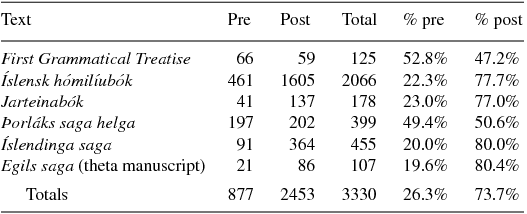
What of Norse? Allen (Reference Allen2008:38) states that in Old Icelandic, genitives are typically postnominal, and this is corroborated by a quick search of the pre-1250 texts in IcePaHC. The results are presented in Table 1, and indicate that in early Old Icelandic texts the typical position for genitives is indeed postnominal. If Middle English syntax is inherited from Norse, the switch from postnominal to prenominal position requires an explanation. If Middle English is descended from Old English, the development is straightforward.
Prenominal (pre) vs. postnominal (post) genitives in IcePaHC.

A second problem for E&F relates to the development of the ‘group genitive’, in which the -s ending follows an element other than the possessor noun, as in the king of England's hat or the man I met's dog. Allen (Reference Allen1997, Reference Allen2003, Reference Allen2008:152–158) finds that group genitives in English are first found in the last quarter of the 14th century – too late to be plausibly attributed to inheritance from Norse, since E&F (pp. 43–44) argue that the crucial developments that caused the fusion of Norse-speaking and Old English-speaking populations occurred in the 12th century.Footnote 21
Among the Scandinavian languages, the development of group genitives has been best studied in Swedish, a development outlined in Delsing (Reference Delsing, Malmgren and Ralph1991) and Norde (Reference Norde1997).Footnote 22 Norde (Reference Norde1997, Reference Norde2001), cited by E&F, dates the first uses of -s as a ‘phrase marker’ to the Middle Swedish period (1375 onwards), roughly contemporaneous with their emergence in English according to Allen, and certainly too late to be influential on the English development. Delsing (Reference Delsing1999) and Börjars (Reference Börjars2003) point out that Norde's examples are not classic cases of group genitives, as they do not involve noun-phrase-internal postmodification by a phrase where -s occurs to the right of the postmodifying phrase. ‘True’ group genitives, as Norde (Reference Norde2006) acknowledges, following Delsing (Reference Delsing, Malmgren and Ralph1991:28), do not appear until the late 15th century, as in (31).
(31)

The group genitive cannot be attributed to Norse inheritance, then.
To summarize this section: There is evidence from genitive positioning against the view that the English s-genitive is an inheritance from Norse, and in the case of group genitives we are demonstrably dealing with parallel innovation. We do not wish to downplay the possible role of language contact; however, attributing the typological similarities between modern English and the modern Scandinavian languages to inheritance creates more problems than it solves. As mentioned, E&F (p. 118) do not themselves exclude contact as a factor here, and so we rest our case.
3.5 The hybrid grammatical lexicon of Middle English
E&F devote a separate chapter to the ‘hybrid grammatical lexicon of Middle English’, the idea being that the existence of a hybrid grammatical lexicon strengthens the claim that English was Norse. However, they conclude that since it is difficult to disentangle the sources of the grammatical lexicon, it can say nothing about the genealogy of English and the source of Middle English, and that the factor that proves that Middle English is Norse is syntax (p. 147). We have shown in previous sections that E&F's arguments concerning syntax do not hold, so therefore we will not consider their claims concerning the grammatical lexicon in any detail; we shall restrict ourselves to making a few comments related to method.
According to E&F (p. 134), there are two separate components in a natural language lexicon: an open class dictionary, and a grammatical lexicon, which consists of such elements as affixes and closed subsets of word classes. The grammatical lexicon is defined as ‘the set of lexical items in a language that lack purely semantic features’, and exhibits ‘Unique Syntactic Behavior’ (p. 136, emphasis theirs). E&F claim that (i) living languages do not borrow such grammatical items (p. 136), and (ii) that ‘a majority of Middle (and Modern) English grammatical morphemes are either of Scandinavian origin or have close Scandinavian cognates’ (p. 137, emphasis theirs).
As we pointed out in Section 2.1 above, the fact that an English word, whether grammatical or open class, has a Norse cognate does not mean that the word could equally well have been derived from Norse. Regular sound correspondences must be taken into consideration, and a telling example of E&F's method occurs in the discussion of the third person plural pronouns they, their, them. These are usually considered to be borrowed from Norse, but E&F naturally turn it around and say that since English was Norse, these were retained rather than borrowed. This leaves the issue of the form of the other pronouns, and here E&F argue that the Middle English first and second person pronouns were common Germanic, and that they may have been derived from Old Norse by some kind of ‘cooperative rule’ of dropping a final stop consonant (p. 141), which mysteriously only applies in first and second person pronouns. So instead of considering regular sound correspondences, E&F simply invent this implausible phonological rule. In this way, Middle English me can just as well derive from Old Norse mik as from Old English me, and Middle English we is as likely to derive from Old Norse vér as from Old English we (although /r/ is not a stop consonant). E&F thus claim a ‘dual heritage’ (p. 139) for grammatical verbs, modals, pronouns and demonstratives, and prepositions, and they speculate that ‘there seems to have been a sort of mutual understanding that both pre-existing grammatical lexicons should contribute roughly equal shares of words’ (p. 141, emphasis theirs).
3.6 The sparse inflection of Middle and Modern English
E&F also include a chapter on the sparse inflection of English after the Old English stage. Since Middle English does not derive from Old English, this is no surprise to them, but they are forced to admit that English also lost inflections for which Norse had inflectional paradigms (p. 148), and thus they do not consider the sparse inflection of the present-day languages as an argument for the hypothesis that Middle English developed from Norse (p. 153). What we would have expected them to comment on in some detail in this chapter is the fact that the Scandinavian languages have a very distinctive feature, namely a postposed article. There is not a single trace in any Middle English text of this kind of construction, which is surprising if English really was Norse. E&F do not attempt to account for the absence of the postposed article, or of the distinctively Scandinavian middle voice verbal ending; they content themselves with stating that loss of inflection was a general trend involving language contact and phonological reductions (p. 153). A major concern of science is to actively search for observations and arguments that may falsify a hypothesis. We think that the authors would have done well to be more concerned with what the series editor dismissively calls a ‘fetish for counter-examples’ (p. 14), which is in fact a hallmark of responsible science.
4 SUMMARY AND CONCLUSION
In this review article we have presented a number of problems which, we believe, when taken together render E&F's claim that English descends from Norse impossible to uphold. In particular, E&F's failure to discuss the accumulated wealth of evidence from regular sound change means that their challenge to a West Germanic origin cannot be taken seriously, even if the syntactic evidence they adduce were to hold up to scrutiny. On the whole, though, the syntactic evidence does not stand up to scrutiny, since there are a number of omissions and misrepresentations, and since E&F are often content to observe typological similarity between modern English and Mainland Scandinavian without considering the diachronies of the languages in detail. In addition, the book consistently lacks reference to crucial works from the literature on the history of English. Given these shortcomings, a tad more modesty would not have gone amiss.
In sum, the claim that English is Norse is a bold one, but E&F's manifesto fails to convince on methodological, empirical, and theoretical grounds. The traditional view that English is a West Germanic language thus stands intact.
ACKNOWLEDGEMENTS
For their helpful insights and observations we would like to thank Ivar Berg, Fredrik Heinat, Klaus Johan Myrvoll, and three anonymous reviewers for Nordic Journal of Linguistics.