




Non-technical Summary
Living members of the dog family, including wolves, foxes, and our own household pets, are well-adapted for running fast and far, with long legs and stabilized joints. These skeletal adaptations appear in many fossil relatives of dogs, especially in the last 15 million years when grasslands became more dominant on the landscape. But what did the earliest members of the dog family look like? Mesocyon coryphaeus is an early relative of modern dogs that lived in the Pacific Northwest of North America approximately 30 million years ago. Although this species has been known from skulls and teeth for over a century, the skeleton of Mesocyon has been essentially unknown through this time. A spectacular fossil of Mesocyon was discovered by John Day Fossil Beds National Monument staff in the late 1980s. After over 500 hours of preparation work on and off throughout the following decades, the near-complete skeleton of this animal was fully uncovered in 2022. This skeleton is close to a coyote in size but has short, robust limbs and relatively flexible joints, lacking the running adaptations seen in modern dogs. The shape of the skeleton suggests that Mesocyon was an ambush predator, hunting more like modern cats than modern dogs. The habitat in which Mesocyon lived would have had enough vegetation to hide and get close to potential prey. Although larger than earlier dog-relatives, Mesocyon was small enough to survive off of small mammals, like the rodents and mouse deer that lived alongside it.
Introduction
Canidae is a diverse clade with species ranging in size from the fennec fox to the wolf, occurring on every continent except Antarctica (Macdonald and Sillero-Zubiri, Reference Macdonald, Sillero-Zubiri, Macdonald and Sillero-Zubiri2004). Despite occurring across a wide range of biomes, most extant canids tend to retain cursorial adaptations well-suited for running and walking across long distances (Van Valkenburgh, Reference Van Valkenburgh1987; Taylor, Reference Taylor and Gittleman1989; Janis and Wilhelm, Reference Janis and Wilhelm1993). These adaptations include a digitigrade posture with elongated metapodials (Van Valkenburgh, Reference Van Valkenburgh1987), a stabilized elbow joint (Figueirido et al., Reference Figueirido, Martín-Serra, Tseng and Janis2015), and blocky lumbar vertebrae (Figueirido et al., Reference Figueirido, Martín-Serra, Pérez-Ramos, Velasco, Pastor and Benson2021). Fossil canids show a general trend towards increased cursoriality through the latter half of the Cenozoic, as more open grassland environments spread throughout North America (Andersson and Werdelin, Reference Andersson and Werdelin2003; Figueirido et al., Reference Figueirido, Martín-Serra, Tseng and Janis2015). The first radiation of canids, primarily comprised of the stem-group Hesperocyoninae, occurred in the middle Oligocene, early in the transition from forest to open canopy habitats (Wang and Tedford, Reference Wang and Tedford2008). Here we present the first postcranial description of Mesocyon coryphaeus (Cope, Reference Cope1879a), a hesperocyonine from the middle Oligocene, filling a critical gap in the transition from small scansorial carnivores to highly cursorial pursuit predators.
Canidae originated in North America with the first appearance of Hesperocyon gregarius (Cope, Reference Cope1873) in the late Eocene (Munthe, Reference Munthe, Janis, Scott and Jacobs1998; Wang and Tedford, Reference Wang and Tedford2008). This small, scansorial carnivore is abundant in late Eocene to early Oligocene deposits and the likely ancestor to all later canids (Munthe, Reference Munthe, Janis, Scott and Jacobs1998; Wang and Tedford, Reference Wang and Tedford2008; Spaulding and Flynn, Reference Spaulding and Flynn2012). By the middle Oligocene, canids had rapidly diversified both ecologically and taxonomically, despite remaining geographically restricted to North America (Munthe, Reference Munthe, Janis, Scott and Jacobs1998; Widrig et al., Reference Widrig, Famoso and Reuter2017). All three subfamilies of Canidae (Borophaginae, Caninae, and Hesperocyoninae) were established by this time (Wang and Tedford, Reference Wang and Tedford2008).
Both Borophaginae and Caninae are monophyletic clades with derived traits relative to the more basal hesperocyonines. Borophagines, the bone-cracking dogs, form a monophyletic clade best known for the large hyaena-like species that evolved in the Miocene (Wang and Tedford, Reference Wang and Tedford2008). However, in the middle Oligocene, borophagines were represented by small raccoon-like genera, such as Phlaocyon (Wang et al., Reference Wang, Tedford and Taylor1999). Likewise, Caninae encompasses high ecological diversity, as this clade includes all extant canids, but only one genus, the small, fox-like Leptocyon, is known from the middle Oligocene (Tedford et al., Reference Tedford, Wang and Taylor2009). Canines only began to diversify in the middle Miocene, coinciding with and possibly driving the decline in borophagine diversity (Munthe, Reference Munthe, Janis, Scott and Jacobs1998; Tedford et al., Reference Tedford, Wang and Taylor2009; Silvestro et al., Reference Silvestro, Antonelli, Salamin and Quental2015). Most middle Oligocene canid diversity instead comes from Hesperocyoninae, a paraphyletic group that forms the stem to other canids (Munthe, Reference Munthe, Janis, Scott and Jacobs1998; Wang, Reference Wang1994).
Middle Oligocene hesperocyonines represent the first major radiation of Canidae (Wang and Tedford, Reference Wang and Tedford2008). Like the later borophagines and canine radiations, the hesperocyonine radiation included small hypocarnivores, medium-sized mesocarnivores, and larger hypercarnivores (Slater, Reference Slater2015). The small Hesperocyon gregarius is the best studied and described of the hesperocyonines as its ubiquitous occurrence in the North American fossil record from the late Eocene to the late Oligocene has provided ample skeletal material for study (Wang, Reference Wang1993; Wang and Tedford, Reference Wang and Tedford2008). Later hesperocyonines, Enhydrocyon crassidens Matthew, Reference Matthew1907 (ca. 29–21 Ma), Paraenydrocyon wallovianus Cope, Reference Cope1881 (ca. 24–21 Ma), and Osbornodon fricki Wang, Reference Wang1994 (ca. 21 Ma) achieved larger, hypercarnivorous forms with shorter, stockier limbs than extant canines (Wang and Tedford, Reference Wang and Tedford2008). Postcrania are known from these species, although more fragmentary than H. gregarious and only P. wallovianus has been formally described (Stevens, Reference Stevens1991; Wang, Reference Wang1994; Wang and Tedford, Reference Wang and Tedford2008). Mesocyon coryphaeus (34–21 Ma), an earlier, coyote-sized species, was an intermediate form between the smaller Hesperocyon and the later, larger hesperocyonines (Munthe, Reference Munthe, Janis, Scott and Jacobs1998). Mesocyon coryphaeus was a hypercarnivore, inferred to have acted as a medium-sized predator (Wang and Tedford, Reference Wang and Tedford2008; Slater, Reference Slater2015; Widrig et al., Reference Widrig, Famoso and Reuter2017). Although the genus Mesocyon represents an important milestone in early canid evolution, its postcrania has essentially remained unknown (Wang and Tedford, Reference Wang and Tedford2008). We present an exceptionally preserved skeleton of M. coryphaeus that fills in this critical gap in canid evolution and illuminates the relationship between size and locomotor evolution in the earliest canid radiation.
Previous work
Mesocyon coryphaeus was first distinguished as a species from material collected on E. D. Cope’s 1878 expedition to the John Day region (Cope, Reference Cope1879a, Reference Cope1883). Cope (Reference Cope1879a) identified M. coryphaeus as a canid, but initially placed the species in the genus Temnocyon, based on similarities in the lower carnassial shape between T. altigenis Cope, Reference Cope1878, and M. coryphaeus. However, M. coryphaeus was later elevated to its own genus, Mesocyon, because re-examination of T. altigenis placed it outside of Canidae with M. coryphaeus remaining recognized as a true canid (Scott, Reference Scott1890). Thus, M. coryphaeus became the type species for the genus Mesocyon. Subsequently, several species were named to Mesocyon, which became somewhat of a waste basket for earlier hesperocyonines (Wang, Reference Wang1994). All but three species, M. coryphaeus, M. brachyops Merriam, Reference Merriam1906, and “M.” temnodon Wortman and Matthew, Reference Wortman and Matthew1899, have been moved to other genera of canids or amphicyonids, although the generic assignment of “M.” temnodon remains uncertain (Wang, Reference Wang1994; Munthe, Reference Munthe, Janis, Scott and Jacobs1998).
Mesocyon coryphaeus is the most abundant canid in the Turtle Cove Member of the John Day Formation (Cope, Reference Cope1879a; Wang, Reference Wang1994). Cope (Reference Cope1883) claimed to have collected “seven crania [and] several of them with mandibles and more or less complete skeletons…” in addition to many other fragmentary specimens (Cope, Reference Cope1883, p. 906–907). Although the cranial material collected by Cope is now part of the American Museum of Natural History collections, it is unclear what happened to the majority of the skeletal material or if it remained properly associated with the crania (Cope, Reference Cope1883; Wang, Reference Wang1994; Wang and Tedford, Reference Wang and Tedford2008). To this point, no postcrania from M. coryphaeus has been described, although broader studies of carnivoran locomotion have incorporated postcrania from specimens identified as M. coryphaeus (Samuels et al., Reference Samuels, Meachen and Sakai2013; Figueirido et al., Reference Figueirido, Martín-Serra, Tseng and Janis2015). Samuels et al. (Reference Samuels, Meachen and Sakai2013) did not specify the specimen used, but it was likely JODA 3366, the specimen described herein, given Samuel’s affiliation with John Day Fossil Beds National Monument at the time of publication. Figueirido et al. (Reference Figueirido, Martín-Serra, Tseng and Janis2015) used only the distal humerus, referred to AMNH 6920. Both studies used a discriminant function analysis with extant specimens to place M. coryphaeus into a functional group, with Samuels et al. (Reference Samuels, Meachen and Sakai2013) placing M. coryphaeus in a terrestrial locomotor category and Figueirido et al. (Reference Figueirido, Martín-Serra, Tseng and Janis2015) categorizing it as an ambush hunter.
Geologic setting
Mesocyon coryphaeus is exclusively found in the John Day Formation of eastern Oregon (Wang et al., Reference Wang1994). The John Day Formation sits west of the Rocky Mountains, near the Pacific coast of North America in an environment distinct from contemporaneous deposits of the Great Plains (Albright et al., Reference Albright, Woodburne, Fremd, Swisher, MacFadden and Scott2008). The formation consists of a series of basin-fill deposits produced by Cascade volcanism starting in the late Eocene and continuing into the early Miocene (Robinson et al., Reference Robinson, Brem and McKee1984; Albright et al., Reference Albright, Woodburne, Fremd, Swisher, MacFadden and Scott2008). The John Day Formation is split into seven members, with the second lowest, the Turtle Cove Member, producing most of the vertebrate fossils in the area (Hunt and Stepleton, Reference Hunt and Stepleton2004; Kort and Famoso, Reference Kort and Famoso2020).
Mesocyon coryphaeus occurs only within the Turtle Cove Member (32.7–26.6 Ma) (Mohr et al., Reference Mohr, Famoso, Samuels, Laib and Schmitz2025). The Turtle Cove Member is an exceptionally fossiliferous series of tuffaceous claystones interspersed with air-fall tuffs, often characterized by a blue-green hue resulting from the presence of zeolite (Robinson et al., Reference Robinson, Brem and McKee1984; Albright et al., Reference Albright, Woodburne, Fremd, Swisher, MacFadden and Scott2008; Kort and Famoso, Reference Kort and Famoso2020). The air-fall tuffs have been used to split this member into subunits, lettered A–K (Albright et al., Reference Albright, Woodburne, Fremd, Swisher, MacFadden and Scott2008). The Picture Gorge Ignimbrite, a massive deposit formed by pyroclastic flow, sits in the middle of the Turtle Cove Member, separating the lower, A–F subunits from the upper, G–K subunits. U–Pb zircon geochronology has been used to precisely date each of these volcanic marker beds (Mohr et al., Reference Mohr, Famoso, Samuels, Laib and Schmitz2025).
Paleosols from the Turtle Cove Member indicate a cooling, drying climate relative to the wet, warm climate of the Eocene (Bestland et al., Reference Bestland, Retallack and Swisher1997). The paleoenvironment alternated between subhumid woodland and semiarid shrubland on Milankovitch obliquity (41 ka) time scales (Retallack and Samuels, Reference Retallack and Samuels2020). Trace fossils of termites and ants indicate the presence of bare ground during semiarid intervals, while earthworm burrow traces dominate the subhumid intervals (Retallack and Samuels, Reference Retallack and Samuels2020). The mammalian fauna included many ungulates, such as horses (Famoso, Reference Famoso2017), rodents (Korth and Samuels, Reference Korth and Samuels2015), and a highly diverse group of carnivores, including nimravids, amphicyonids, and numerous canid species (Paterson et al., Reference Paterson, Samuels, Rybczynski, Ryan and Maddin2020; Famoso and Orcutt, Reference Famoso and Orcutt2022), with larger ungulates and arboreal species more abundant in subhumid intervals and smaller burrowers more abundant in semiarid intervals (Retallack and Samuels, Reference Retallack and Samuels2020).
JODA 3366 was collected from land in Grant County, Oregon, administered by the Bureau of Land Management (BLM) in the 1980s and cataloged into the John Day Fossil Beds National Monument collection in 1992 by Camile Evans. Records indicate that the specimen was collected by Kim Sikoryak, Interpretive Ranger, before John Day Fossil Beds National Monument had a permanent paleontologist on staff. The accession record for JODA 3366 lists JDNM-43 Sugarloaf (V6649, Weatherford Site), alternatively known as Little Blue Basin, as the collection site. The precise stratigraphic location of the fossil was not recorded upon collection, but later fieldwork has shown that this site covers Turtle Cove C–F. This portion of the lower Turtle Cove Member corresponds with the early early Arikareean (Ar1) North American Land Mammal Age (NALMA) (Woodburne, Reference Woodburne2004; Albright et al., Reference Albright, Woodburne, Fremd, Swisher, MacFadden and Scott2008). U–Pb dating of the section places the fossil’s age as 31.4–29.0 Ma (Mohr et al., Reference Mohr, Famoso, Samuels, Laib and Schmitz2025). The rock matrix surrounding the specimen was a hard, green siltstone interspersed with a softer, tan siltstone. This mottled coloration may relate to alteration of the surrounding rock through diagenesis of the fossil, but no analysis of the matrix was performed to test for a specific cause. Researchers interested in the precise location of this site should contact John Day Fossil Beds National Monument.
Materials and methods
Fossil preparation
Initial preparation of JODA 3366 was done in the 1990s (Figs. S1–S4). Hindfoot and limb bones were exposed using an air scribe and dental tool. After 58 hours of manual preparation, a support structure was made to hold all the blocks of matrix in place. Clay was used around the blocks of matrix, silicone rubber was poured over the specimen, and a hard mother mold made of fiberglass and resin was added for stability. The skull was partially prepared separately for display in the John Day Fossil Bed National Monument exhibits.
Preparation resumed in 2010 with the aim of exposing the JODA 3366 skeleton further out of the matrix (Figs. S5–S7). A Micro Jack number 5 from Paleo Tools was used to remove matrix from around the bones and thin B-15 McGean was used as a consolidant when bone was exposed. If any breakage occurred to the bone, thick B-15 was used as an adhesive to glue the bones back together. After 191 hours, most of the first side of the jacket was exposed and stabilized. A plaster lab jacket was then made for the exposed side of the skeleton, and the specimen was flipped for continued preparation on the opposite side. The fiberglass and resin shell was cut off using a diamond wheel bit in a Dremel tool. An Exacto knife was employed to cut the silicone away from the specimen in small pieces. A heat lamp was used to soften the silicone where it was adhering and causing some damage to the underlying bone. After the second side was exposed, 46 more hours of matrix removal, once again with a Micro Jack 5 and B-15 consolidant, occurred between November of 2011 and January of 2012. The skull was further prepared from July to December of 2011 with a total of 45 hours of matrix removal with a MicroJack 5 airscribe.
In 2022, the decision was made to remove all bones from the jacket for ease of description and research. A jacket map was created first to record the position of the bones in articulation (Fig. S8). An additional 297 hours of work was done using a Micro Jack 5 with a sharp, pointed stylus to remove matrix from the bones and allow them to be separated. B-15 was again applied to bone as it was uncovered. Many of the bones were highly fractured and came out in multiple pieces that were then glued using B-15. Preparation was completed in April of 2022 with all the bones mapped and removed from the jacket (Figs. S9 and S10).
Photography and measurement
JODA 3366 was photographed with a Nikon D810 camera and 60 mm lens (Supplemental Data 1). Linear measurements were taken on JODA 3366 with Mitutoyo CD-12” CP digital calipers. A comparative dataset of tooth lengths from other M. coryphaeus specimens was compiled for size comparison with JODA 3366. Only upper canine, P4, and M1 measurements were made due to the difficulty of accessing the lower toothrow with the skull in articulation.
Body length and shoulder height were estimated from a skeletal reconstruction created in Photoshop (Fig. 1). This reconstruction was created by first resizing photographs of individual elements to match the same scale and then placing the elements in an estimated life position based on anatomical interpretations discussed herein. Missing bones, primarily the ribs, sternum, and distal tail were approximated based on the skeletal reconstruction of Hesperocyon gregarius found in Wang and Tedford (Reference Wang and Tedford2008). Body weight estimates were calculated from dorsal length of the skull and length of the posterior skull from orbit to occipital condyle using regressions developed from extant canids (Van Valkenburgh, Reference Van Valkenburgh, Damuth and MacFadden1990). Comparative measurements of extant species were taken from specimens in the University of Michigan Zoology (UMMZ) mammalogy collections: a coyote, Canis latrans Say in James, Reference Say and James1823 (UMMZ 59896), and a bush dog, Speothos venaticus Lund, Reference Lund1842 (UMMZ 115806) (Tables 1–3, S1).
(1) Left lateral skeletal outline of Mesocyon coryphaeus reconstructed from JODA 3366. The black outline is a rough approximation of the soft tissue extent drawn directly from the skeletal and has not been generated from precise musculature reconstruction. (2) Left lateral view of cranial material from JODA 3366. The cranium and mandible remain in articulation. The auditory bullae are ossified, visible just posterior to the mandibular joint. Note the atlas and anterior half of the axis in the block of matrix posterior to the skull. Abbreviations: NS, neural spine; TP, transverse process.

Comparative axial measurements taken for JODA 3366 and modern specimens of a bush dog, Speothos venaticus (UMMZ 115806), and a coyote, Canis latrans (UMMZ 59896). Vertebral lengths were measured along the ventral side of the centrum. All measurements are in millimeters

A block containing the pelvis, sacrum, and proximal caudal vertebrae was scanned by X-ray computed tomography (CT) at the University of Michigan CT in Earth & Environmental Sciences (CTEES) Facility (Supplemental Data 2). CT scanning was performed with a Nikon XT H 225 ST industrial μCT scanner with a Perkin Elmer 1620 X-ray detector panel and a tungsten reflection target. The final scan parameters were 170 kV, 180 μA, copper filter of 0.25mm, and an effective pixel size of 89.33μm.
Repositories and institutional abbreviations
AMNH FM, Fossil Mammal Collection, American Museum of Natural History, New York, NY, USA; JODA, John Day Fossil Beds National Monument, Kimberly, OR, USA; UMMZ, University of Michigan Museum of Zoology, Ann Arbor, MI, USA.
Systematic paleontology
Order Carnivora Bowdich, Reference Bowdich1821
Family Canidae Gray, Reference Gray1821
Subfamily Hesperocyoninae Tedford, Reference Tedford1978
Genus Mesocyon Scott, Reference Scott1890
Type species
Mesocyon coryphaeus (Cope, Reference Cope1879a). From the Rupelian of eastern Oregon, United States.
Mesocyon coryphaeus (Cope, Reference Cope1879a)
Reference Cope1879a Temnocyon coryphaeus Cope, p. 180.
Reference Cope1879b Canis hartshornianus, Cope, p. 58 (in part).
Reference Eyerman1894 Hypotemnodon coryphaeus Eyerman, p. 321.
Reference Thorpe1922 Philotrox condoni Thorpe, p. 165 (in part).
Reference Thorpe1922 Mesocyon josephi secundus Thorpe, p. 170–171, figs. 1, 2.
Holotype
Cranium with dentition, partial left scapula, and one cervical vertebra (AMNH FM 6859) from the John Day Formation, eastern Oregon, USA (Cope, Reference Cope1883, pl. LXXI).
Description
JODA 3366 includes exceptional cranial and postcranial material, including a complete skull and mandibles, all long bones intact, most of the presacral spine, and representative elements of both manus and pes.
Cranial material
JODA 3366 includes a complete skull in articulation with the mandible, both of which are minimally distorted (Figs. 1, S11, S12). The skull was used to identify the specimen as M. coryphaeus. The ossified bullae and the upper dental formula of I/3, C/1, P/4, M/2 are both characteristic of Canidae. Plesiomorphic traits indicate the specimen is a hesperocyonine, a paraphyletic group forming the stem to borophagines and canines. The premaxilla does not touch the frontals, indicating JODA 3366 is not a borophagine (Munthe, Reference Munthe, Janis, Scott and Jacobs1998). Dentally, hesperocyonines are easily distinguished from all borophagines and canines in their relatively hypercarnivorous cheek teeth, including such characters as upper molars short relative to their width, absence of a metaconule on M1, a trenchant m1 talonid, and reduced m2. Unfortunately, the skull and lower jaws of JODA 3366 are tightly articulated and do not permit manual disarticulation without damage to the specimen. Based on what is visible in lateral views, JODA 3366 has a relatively short M2 relative to the M1 and lacks I3 lateral cuspules, which are characters consistent with hesperocyonines (Wang, Reference Wang1994).
The skull is approximately coyote-sized and robust paraoccipital processes are ventrally downturned, placing JODA 3366 in Mesocyon (Table S1). The rostrum is relatively long, and the postorbital processes are small, indicating the species is M. coryphaeus rather than M. brachyops (Wang, Reference Wang1994). As stated above, the tightly articulated skull and jaws prevent a detailed comparison of the dental features. Finally, Mesocyon is one of the most common mid-sized canids in the John Day Formation, and JODA 3366 matches well with known skulls of Mesocyon coryphaeus (Wang, Reference Wang1994, figs. 16,17). Further description of M. coryphaeus cranial anatomy can be found in Cope (Reference Cope1883) and Wang (Reference Wang1994).
Axial skeleton
The axial skeleton of JODA 3366 is remarkably complete. Most of the presacral vertebrae are preserved with processes intact, including all seven cervical vertebrae (C), ten thoracic vertebrae (T), and all seven lumbar vertebrae (L), as well as the sacrum (S) and the four most proximal caudal vertebrae. We can confirm that no cervical, lumbar, or sacral vertebrae are missing, but the true number of thoracic vertebrae is not certain. Additionally, seven ribs are preserved with heads intact, as well as 11 long rib segments, the anterior-most segment of the sternum (the manubrium), and a baculum.
For clarity of description, we assume a vertebral formula of C7/T13/L7/S3, as is found in extant canids (Narita and Kuratani, Reference Narita and Kuratani2005). The atlas and the anterior half of the axis remain in association with the skull partially covered by matrix (Fig. 1). The posterior half of the axis, C3, and C4 are preserved in articulation, and C5–T1 are preserved in a separate section (Fig. 2). The diaphragmatic vertebra, which we assume to be T11, through the anterior half of L4 are preserved in one articulated section (Fig. 3). The posterior half of L4 through L7 forms the end of the presacral spine. The sacrum is preserved in matrix between the ilia, along with the four proximal-most caudal vertebrae between the ischia. All other axial elements have been isolated from the matrix.
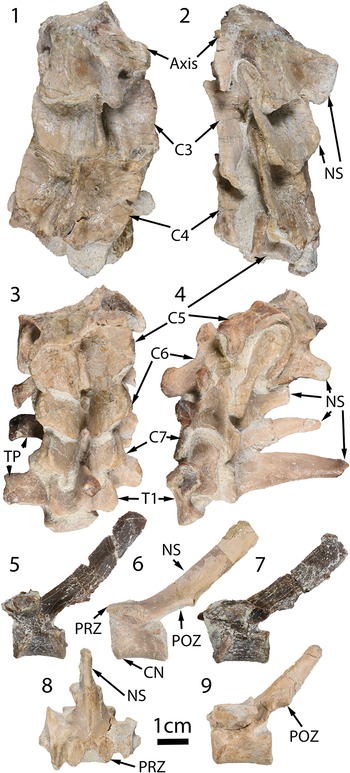
Cervical and pre-diaphragmatic thoracic vertebrae from JODA 3366 (Mesocyon coryphaeus). (1) Dorsal and (2) left lateral views of the posterior half of the axis (top), C3, and C4 (bottom); note the anterior portion of C5 remains articulated with C4 but is only visible in lateral view. (3) Dorsal and (4) left lateral views of the posterior half of C5 (top), C6, C7, and T1 (bottom). (5–7) Left lateral views of isolated pre-diaphragmatic thoracic vertebra of indeterminate position. (8) Dorsal and (9) left lateral view of T10, the last pre-diaphragmatic vertebra. Abbreviations: C, cervical vertebra; CN, centrum; NS, neural spine; POZ, postzygapophysis; PRZ, prezygapophysis; T, thoracic vertebra; TP, transverse process.

Post-diaphragmatic vertebrae of JODA 3366 (Mesocyon coryphaeus). (1) Left lateral view of articulated section of the vertebral column from the diaphragmatic vertebra (bottom left) to the anterior half of L4 (top right). (2) Left lateral view of posterior half of L4 through L7. (3) Left lateral and (4) dorsal view of sacrum, rendered from CT scan. (5) Dorsal view of proximal-most caudal vertebrae, with more anterior oriented toward the top of the page. (6) Left lateral and (7) dorsal view of the distal-most caudal vertebra preserved with the specimen with zygapophyses intact. Abbreviations: AN, anapophysis; CA, caudal vertebra; CN, centrum; L, lumbar vertebra; NS, neural spine; POZ, postzygapophysis; PRZ, prezygapophyses; RF, rib facet; S, sacral vertebra; SF, sacral foramina; SW, sacral wing; T, thoracic vertebra; TP, transverse process.

The atlas remains partially embedded in matrix alongside the skull, although twisted out of articulation so that the right transverse process is pointed dorsally relative to the skull and frontal plane of the atlas is now in line with the transverse plane of the skull. The transverse process of the atlas is slender in comparison with C. latrans, forming a narrow, rectangular blade. A bifid dorsal tubercle is evident on the neural arch. The axis is split into two pieces, with the anterior half in association with the atlas, but rotated such that the ventral side of the axis is pointed in the same direction as the lateral side of the atlas and the dorsal side of the skull. The posterior half is articulated with C3. The axis is similar in length to C3 and C4, with a strong keel running along the ventral side of the centrum. The transverse processes are relatively small, not projecting past the posterior face of the centrum, and have small muscle scars at the tips for the m. intertransversarii cervis. The neural spine is long and gently sloped coming down to overhang the anterior end. The posterior border of the neural spine is rectangular with a hook that overhangs the centrum. Unlike in Caninae, M. coryphaeus has no attachment for the nuchal ligament on the neural spine of the axis (Wang and Tedford, Reference Wang and Tedford2008).
C3 and C4 are in articulation with the posterior half of the axis (Fig. 2). The neural spines are broken, but narrow roots suggest that they were low and thin. The zygapophyses are flat and flush with the neural canal, which creates a rectangular profile for the vertebrae in dorsal view. Shallow grooves between the postzygapophyses and base of the neural spine may be the origin site of the m. multifidus cervicis. The transverse processes align with the frontal plane, with distal edges bent ventrally. Both anterior and posterior ends of the transverse processes come to a point with the posterior tips being more laterally expanded, forming a triangular profile in ventral view. As in the axis, clear scars from m. intertransversarii cervis are present on the posterior tips of the transverse processes. Centra are intermediate in length between C. latrans and S. venaticus (Table 1). A low keel is present on the ventral side of the centrum of C3, as in the axis, but a keel is absent on C4.
C5 and C6 are in articulation with C7 and T1, although the anterior tip of C5 is broken off and remains in articulation with C4 (Fig. 2). The neural spines of these vertebrae are short and tapered, reaching less than a centimeter in height in C5 and just over a centimeter in C6. The transverse process of C5 has a large, bifurcated posterior tip. In C6, the dorsal head of this posterior tip separates from the transverse process, becoming a separate rod-like structure. The transverse process of C6 is downturned, lying in the sagittal plane, rather than the frontal plane as in the more anterior cervical vertebrae. Transverse foramina are visible in C5 and C6. The centra of both C5 and C6 have a ventral keel, with the keel in C6 more strongly pinched towards the anterior face. The centra of these vertebrae are somewhat shorter than the more anterior cervical vertebrae, although still elongated relative to the thoracic vertebrae.
As in other mammals, C7 and T1 have intermediate morphology between the thoracic and cervical vertebrae (Fig. 2). The neural spines of C7 and T1 are tall, vertically oriented, and slightly curved, unlike the shorter, straighter neural spines of C5 and C6. The wing-like transverse processes of the more anterior cervical vertebrae are gone, with only the rod-like structure found in C6 remaining. In T1, this rod-like transverse process has costal facets. Both C7 and T1 lack transverse foramina. The zygapophyses of both are obliquely inclined and project off the neural canal rather than the neural spine as in later thoracic vertebrae. The centra of C7 and T1 are much shorter than those of the other cervical vertebrae but slightly longer than other thoracic vertebrae. The centra of both lack a ventral keel, as in most of the cervical vertebrae, but do have a spool-like shape, with wide faces and a narrower middle.
Ten thoracic vertebrae are preserved, including T1. Seven of these are pre-diaphragmatic vertebrae, one is the diaphragmatic vertebra, and the remaining two are post-diaphragmatic vertebrae. All of the pre-diaphragmatic vertebrae, except T1, are isolated (Fig. 2). These include a centrum missing all processes, a complete vertebra embedded in matrix between the mandibles, and four vertebrae that have been isolated from the matrix with all processes intact. Of these isolated, intact vertebrae, only one can be confidently identified to a position, T10, while the others are of unknown position somewhere between T2–T9 (Fig. S13). The diaphragmatic vertebra (T11), T12, and T13 are preserved in sequence with the lumbar vertebrae (Fig. 3).
The pre-diaphragmatic thoracic vertebrae are small in comparison with other regions of the spine and relatively conserved in shape, as in extant carnivores (Figueirido et al., Reference Figueirido, Martín-Serra, Pérez-Ramos, Velasco, Pastor and Benson2021). Three of the isolated thoracic vertebrae with processes intact are highly similar in shape and cannot be placed in exact sequence (Fig. 2). The centra of these vertebrae are narrower than T1 but retain the same spool-like shape. The zygapophyses face horizontally, with the prezygapophyses forming small ovular facets on the dorsal side of the neural canal and the postzygapophyses as matching ovular facets on the ventral side of the neural spine, projecting well posterior of the centrum. The posteriorly inclined neural spines have an elongated, rectangular shape, indicating that that they are likely posterior to T3. Anterior costal fossae remain on the transverse processes, which are antero-posteriorly expanded relative to T1. Posterior costal fossae are more prominent than in T1 and sit just lateral to the posterior faces of the centra. The fourth isolated vertebra, T10, retains the same general configuration of processes as the other pre-diaphragmatic vertebra, but subtle differences indicate its position as the last pre-diaphragmatic vertebra. The neural spine of T10 is short compared to more anterior thoracic vertebrae, with a distal end that comes to a point rather than a wide, rectangular end. The postzygapophyses still project off the neural spine but are more rounded and have spacing that matches the prezygapophyses in T11. The transverse processes are antero-posteriorly expanded, such that they are the length of the centrum. The transverse processes retain anterior costal fossae, but no obvious posterior costal fossae are present lateral to the posterior centrum face.
T11, the diaphragmatic vertebra, is preserved in articulation with T12–L4 (Fig. 3). The neural spine is triangular, shortened, and pointed vertically, marking it as the anticlinal vertebra as well. The anterior costal fossae are now on the centrum lateral and posterior to the anterior face, rather than on transverse processes. The centrum is longer and larger than the pre-diaphragmatic vertebrae. The transverse processes sit flush with the neural canal, with the anterior projection forming the prezygapophyses. These prezygapophyses are vertical projections, as opposed to the horizontal facets of the pre-diaphragmatic vertebrae, and cup around the peg-like postzygapophyses of T10. Metapophyses are present on the prezygapophyses, providing attachment sites for the m. multifidus thoracis. The posterior projections of the transverse process now overlap the prezyapophyses of T12, equivalent to the anapophyses of the lumbar vertebrae. Small posterior costal fossae are apparent just anterior to the posterior centrum face. T12 and T13, the post-diaphragmatic thoracic vertebrae, more closely resemble the lumbar vertebrae than the pre-diaphragmatic thoracic vertebrae. Anterior and posterior costal fossae are present lateral to the faces of the centra, marking these as thoracic vertebrae. These vertebrae have short, anteriorly inclined neural spines with a rectangular distal end. Large, posteriorly projecting anapophyses overlap with the prezygapophyses of the next posterior vertebra. The zygapophyses are vertically oriented, projecting off the neural canal. A broad keel appears on the ventral side of T12 and continues through the lumbar vertebrae.
Seven lumbar vertebrae are preserved in sequence, matching the number found in extant canids (Fig. 3) (Narita and Kuratani, Reference Narita and Kuratani2005). L1–L3 are preserved intact and in articulation with T11–T13. L4 is broken into two pieces, with the anterior half remaining in articulation with T11 to L3 and the posterior half in articulation with L5–L7. The centra are large and elongated relative to the post-diaphragmatic thoracic vertebrae, increasing in length in sequence through L6 (Table 1). L7 has a shorter centrum with a broad face, characteristic of the last lumbar vertebra (Figueirido et al., Reference Figueirido, Martín-Serra, Pérez-Ramos, Velasco, Pastor and Benson2021). A ventral keel runs along the centra, more distinct in the more anterior lumbar vertebrae. Rugosity between this keel and the roots of the transverse processes likely marks the attachment area for the m. quadratus lumborum on the more anterior lumbar vertebrae and the m. psoas major and m. iliacus on the more posterior lumbar vertebrae (Evans, Reference Evans1993). The neural spines of the lumbar vertebrae are anteriorly inclined and roughly triangular. The bases of the neural spines span the length of the neural canal, narrowing distally to a flat, rugose apex. The neural spine of L1 is short, only just projecting past the tips of the metapophyses on the prezygapophyses, while neural spines of L2 to L4 increase in height, retaining the anterior inclination. The transverse processes of all lumbar project off the anterior half of the centra, in place of the anterior costal fossae in the post-diaphragmatic thoracic vertebrae. In L1, the transverse processes are small and antero-ventrally inclined, not projecting past the anterior centrum face. The transverse processes progressively increase in size in the more posterior lumbar vertebrae, becoming long and blade-like with a slight curve. They remain antero-ventrally inclined and start to project past the centrum in L3. The rugose tips of the transverse processes in L2 through L7 likely provided attachment for the m. iliocostalis lumborum (Evans, Reference Evans1993). The zygapophyses of the lumbar vertebrae have a near-vertical orientation, similar to that of C. latrans. The prezygapophyses of L1 and L2 have prominent metapophyses, providing attachment for the m. multifidus lumborum. L3 through L7 retain metapophyses, but they decrease in size posteriorly in sequence, until on L7 they are nearly absent. Robust anapophyses are present on L1, decreasing posteriorly in sequence to L7, which retains a small nub in place of the anapophyses.
The sacrum is preserved intact in the matrix between the ilia of the pelvis (Fig. 3). The sacrum is composed of three fully fused sacral vertebrae, indicated by the presence of three neural spines and two pairs of dorsal sacral foramina. The neural spine of S1 forms a low ridge, while the neural spines of S2 and S3 are tall with little space between. Visual examination of the specimen confirms the neural spines of S2 and S3 are not fused as it appears on the CT scan. The sacrum of M. coryphaeus is long and tapers posteriorly, contrary to the short, boxy sacrum of C. latrans and S. venaticus (Table 1) (Esteban et al., Reference Esteban, Martín-Serra, Varón-González, Pérez-Ramos, Velasco, Pastor and Figueirido2020). The wings are primarily derived from the transverse processes of S1, although S2 appears to contribute with the anterior portion of its transverse process merging into the wing and the posterior portion forming a thin blade. The transverse processes of S3 are distinct from the wing and run the length of the centrum. The prezygapophyses are wide and obliquely oriented, while the postzygapophyses are smaller and close together, projecting off the neural spine of S3.
The four most proximal caudal vertebrae are preserved in the matrix between the ischia of the pelvis (Fig. 3). All four possess zygapophyses, though these are only faintly visible on the CT scan for the three proximal-most vertebrae. The prezygapophyses on the fourth caudal vertebra are well separated and obliquely oriented, while the postzygapophyses are a single bifid process projecting off the neural spine. Interestingly, the transverse processes of the three proximal-most vertebrae are asymmetric, with broad, almost sacrum-like processes on the left and more narrow processes, typical of caudal vertebrae on the right. The fourth caudal vertebra has shorter, symmetric transverse processes.
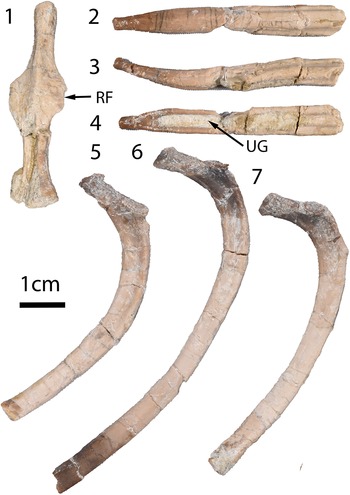
Of the sternum, only the manubrium, the anterior-most element, was recovered with this specimen (Fig. 4). A distinct keel runs along its ventral side. Rib facets are present around half-way along the manubrium, with the anterior tip more pronounced and pointed than in C. latrans or S. venaticus. No facets for clavicles are present, suggesting that the clavicles were either significantly reduced, as in Hesperocyon (Wang, Reference Wang1993), or entirely absent. Seven ribs are preserved with double-head intact, and there are many more fragments of varying lengths. No ribs are complete, making it difficult to estimate lengths. The preserved portions are shallowly curved.
Axial elements from JODA 3366 (Mesocyon coryphaeus). (1) Manubrium in ventral view with anterior end pointed to the top of the page. (2) Dorsal, (3) lateral, and (4) ventral views of baculum. (5–7) Representative ribs with heads intact. Abbreviations: RF, rib facet; UG, urethral groove.

Presence of a baculum indicates that this specimen was male. The distal portion of the baculum was recovered between the femora and anterior to the pelvis (Fig. S8). Although the total length cannot be inferred from this portion, it appears relatively slender in comparison with borophagines, more similar to Hesperocyon and extant canids (Varajão de Latorre, Reference Varajão de Latorre2023). Shallow lateral grooves run along the more proximal end of the segment. A deep urethral groove runs along the ventral side, ending in a tapered point at the distal end. Unlike in extant canids, the baculum does not continue far past the end of the urethral groove (Varajão de Latorre, Reference Varajão de Latorre2023). The baculum is dorsally convex up to the distal end where the tip is upturned, matching the profile seen in Hesperocyon (Wang, Reference Wang1994).
Forelimb
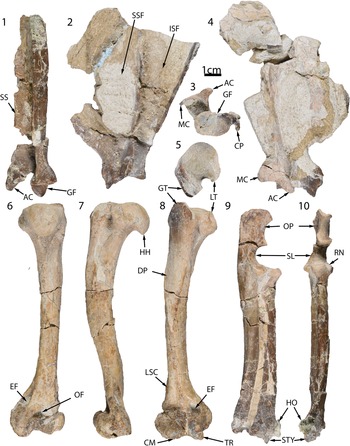
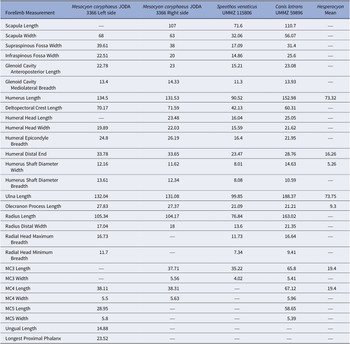
Both scapulae are relatively intact (Fig. 5). The right scapula is more complete, with part of the distal end of the blade preserved and the acromion fully intact, although the left scapula has a more complete spine. The scapula of M. coryphaeus is anteroposteriorly wide relative to C. latrans and S. venaticus with a somewhat lower spine (Table 2). The supraspinous fossa is broad and curved, while the infraspinous fossa is narrow with a straight border, similar to scapulae known from borophagines (Munthe, Reference Munthe1989). The acromion just overhangs the glenoid fossa. This may indicate the presence of a small clavicle, such as is found in Hesperocyon (Wang, Reference Wang1993). A large metacromion projects posteriorly from the acromion, providing a large attachment point for the m. deltoidus and m. omotransversarius muscles, which flex and extend the limb (Evans, Reference Evans1993). The glenoid fossa is shallow, with a well-developed supraglenoid tubercle, the origin for the m. biceps brachii. A small coracoid process sits in line with the glenoid fossa, only evident on the right scapula.
Forelimb elements of JODA 3366 (Mesocyon coryphaeus). (1) Posterior and (2) lateral views of the left scapula, highlighting overall shape of the scapula and height of the spine. (3) Distal and (4) lateral views of the right scapula, highlighting the shape and size of the glenoid fossa and acromion. Right humerus from a (5) proximal, (6) posterior, (7) medial, and (8) anterior view. (9) Medial and (10) anterior views of left ulna and radius. Abbreviations: AC, acromion; CM, capitulum; CP, coracoid process; DP, deltopectoral crest; EF, epicondylar foramen; GF, glenoid fossa; GT, greater tubercle; HH, humeral head; HO, hereditary osteochondroma, ISF, infraspinous fossa; LSC, lateral supracondylar crest; LT, lesser tubercle; MC, metacromion; OF, olecranon fossa; OP, olecranon process; RN, radial notch; SL, semilunar notch; SS, scapular spine; SSF, supraspinous fossa; STY, styloid process; TR, trochlea.

Comparative forelimb measurements taken for JODA 3366, modern specimens of a bush dog, Speothos venaticus (UMMZ 115806), and a coyote, Canis latrans (UMMZ 59896), and the fossil canid Hesperocyon. Measurements for JODA 3366 were taken for both sides, while measurements for modern specimens were taken from the left side. Hesperocyon measurements were taken from Wang (Reference Wang1994) with a mean calculated when multiple specimens had been measured. Descriptions and references for measurements provided in Table S2. All measurements are in millimeters

Both humeri are intact and isolated from the matrix (Fig. 5). The head is well rounded and more mediolaterally convex than in C. latrans. The greater tubercle rises just above the humeral head, with a clearly defined bicipital groove, as in Hesperocyon (Wang, Reference Wang1993). A medially protruding lesser tubercle is present. The shaft is robust and curved in profile in contrast with the straighter, more gracile shaft of C. latrans. The deltopectoral crest is a distinctly triangular rugose surface, running just over half-way down the shaft. While it is shallow, not protruding far off the shaft, the portion of the shaft covered by the deltopectoral crest bows anteriorly. The lateral supracondylar crest forms a sharp, thin ridge, without significant lateral expansion, that runs from the distal end of the humerus to about one-fourth the way up the shaft. This portion of the shaft has a slight posterior curve. The capitulum is broad and the trochlea dips distally, more similar in shape to mustelids or felids, contrary to the boxy shape found in extant canids (Figueirido et al., Reference Figueirido, Martín-Serra, Tseng and Janis2015). Mesocyon coryphaeus also retains an epicondylar foramen, a primitive trait found in hesperocyonines and borophagines but not canines (Munthe, Reference Munthe1989). Unlike borophagines, however, no supratrochlear foramen is present (Munthe, Reference Munthe1989), although the olecranon fossa is deep.
Both ulnae are preserved intact (Figs. 5, S14). The ulna of Mesocyon is robust, comparable to Hesperocyon (Wang, Reference Wang1993), and similar in thickness to the radius. The proximal portion of the shaft bows posteriorly but the distal half bows anteriorly, forming a profile that is distinct from the more posteriorly bowed shaft of Hesperocyon (Wang, Reference Wang1993) or the more anteriorly bowed shafts of the borophagines (Munthe, Reference Munthe1989). The proximal shaft is mediolaterally compressed with a gradual taper towards a more rounded distal end. The olecranon process is long in comparison with other canids, including Hesperocyon (Wang, Reference Wang1993), borophagines (Munthe, Reference Munthe1989), and extant canids (Table 2) (Evans, Reference Evans1993). A shallow groove is present along the proximal end of the olecranon, contained by asymmetrical tubercles, with the higher tubercle on the medial side. The semilunar notch is deep and well-defined, and the radial notch is a long, anterolaterally oriented curve along the distal rim.
Both radii were preserved in close articulation with their respective ulnae (Figs. 5, S14). The radial head is ovular, fitting into the curved radial notch of the ulna. The head of the radius is wider than the neck, although the neck and shaft are robust. The shaft bows anteriorly, although not to the same extent as in arboreal mammals (Taylor, Reference Taylor and Gittleman1989). The styloid process at the distal end of the radius is well developed, as well as a secondary process separating shallow grooves for the extensor muscles of the manus, a primitive feature of carnivorans that has been lost in extant canids (Wang, Reference Wang1993). The left radius also has a distinct mushroom-like pathology on the medial side of the distal end, known as hereditary osteochondroma (Fig. S15) (Wang and Rothschild, Reference Wang and Rothschild1992). This pathology, which occurred in 60% of Oligocene Hesperocyon, is also found in Daphoenus and Cynodictis (Wang and Rothschild, Reference Wang and Rothschild1992).
The left scapholunar, pisiform, unciform, and cuneiform were preserved, while only the pisiform from the right manus remains (Fig. 6). The scapholunar is roughly trapezoidal in shape with a smooth, ovate proximal surface and a prominent tubercle on the plantar-medial corner. Compared with C. latrans, M. coryphaeus has a flatter scapholunar, with less proximodistal depth. The cuneiform has an ovular shape, with a prominent ridge on the lateral surface, and a facet on the medial surface for articulation with the unciform. A small tubercle points distally. The unciform has a blocky, triangular shape with a broad distal facet for articulation with metacarpals IV and V. This articulation faces distodorsally, forming an angle with the metacarpals. The pisiform has a dumbbell shape, with a large head grooved for the m. flexor carpi ulnaris. A broad concave face for articulation with the cuneiform sits on the more distal head.
Manus elements from JODA 3366 (Mesocyon coryphaeus). Proximal views of carpal elements: (1) left cuneiform, (2) left unciform, (3) left scapholunar, and (4) right pisiform. Dorsal views of carpal elements: (5) left cuneiform, (6) left unciform, (7) left scapholunar, and (8) right pisiform. Dorsal views of metacarpals with proximal to the left of the page: (9) left V, (10) left IV, and (11) right III. (12) Lateral view of ungual with break at distal end, dashed lines indicate missing portion of ungual. (13) Dorsal view of a proximal phalanx.

Metacarpals IV and V of the left manus and III and IV of the right manus are preserved with the specimen (Fig. 6). The metacarpals are short and robust relative to C. latrans, similar in width but nearly half the length. Ridges and other evidence of articulation are absent between metacarpal shafts and facets on the proximal ends of the metacarpals, indicating possible spread while in articulation. The proximal articular surface continues onto the dorsal surface forming an oblique, rounded facet. Likewise, a distinct crest on the plantar side of the distal heads of the metacarpals wraps around onto the distal end. Metacarpal V is reduced in length relative to IV and III.
Most phalanges associated with the specimen were found in association with the manus, although the precise position of each was not recorded (Figs. 6, S16). Because the phalanges are close to symmetrical, re-identifying specific position is not possible. The proximal phalanges are relatively straight with little bowing. The longest proximal phalanges are approximately two-thirds the length of the longest metacarpals. The intermediate phalanges are not as dorsopalmarly deep as in Hesperocyon and more resemble Tomarctus (Wang, Reference Wang1993). The distal articular surfaces of the intermediate phalanges are not much broader than the shafts, with little asymmetry, indicating a lack of retractile claws. The single ungual is relatively straight and longer than in Hesperocyon (Wang, Reference Wang1993).
Hindlimb
The pelvis is mostly intact, preserved in a block of matrix with the sacrum and proximal caudal vertebrae (Figs. 7, S17, S18). The ilium and ischium are nearly equal in length, unlike in canines, which have an elongated ilium (Evans, Reference Evans1993). The ilium of M. coryphaeus is more narrow than in C. latrans, with a groove forming the gluteal fossa, rather than the broader fossa seen in canines (Evans, Reference Evans1993) or borophagines (Munthe, Reference Munthe1989). The caudal dorsal iliac spine is large and rugose, providing the origin site for deep gluteal muscles (Evans, Reference Evans1993). Breaks on the ventral borders of the ilia make the ventral iliac spine difficult to place. The acetabulum points nearly laterally, unlike the more ventral facing acetabulum found in C. latrans. However, much of the lunate surface faces ventrally, forming a relatively deep cup. The ischia face ventrolaterally with a steep angle formed at the pubic symphysis, in contrast to the broad, nearly continuous, ventrally pointed surface found in canines (Evans, Reference Evans1993) and borophagines (Munthe, Reference Munthe1989). An ischiatic spine is prominent on the dorsal edge of the ischium just posterior to the acetabulum, and the ischial tuberosity, the origin for the m. biceps femoris, is well developed (Evans, Reference Evans1993). The obturator foramen is larger than in C. latrans, and the distal end of the ischium is less broadly expanded.
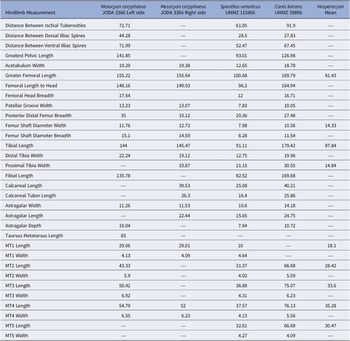
Both femora are preserved intact (Figs. 7, S19). The femur of M. coryphaeus is short and robust (Table 3). The femoral head sticks just above the greater trochanter off a short wide neck, angled more proximally than medially. The smooth articular surface of the head continues onto the neck on the proximolateral side. The fovea capis is posteroproximally oriented, intermediate between a wolf and raccoon (Jenkins and Camazine, Reference Jenkins and Camazine1977). The rugose surface of the greater trochanter extends distally off its lateral side, similar to the condition seen in borophagines (Munthe, Reference Munthe1989). The trochanteric fossa is deep, nearly on par with C. latrans. The trochanteric crest is visible along the medial edge of the fossa, extending down the shaft. The lesser trochanter projects posteriorly off the medial side of the shaft just under the femoral neck. A third trochanter is also evident, although small, on the lateral side of the shaft, just beyond the rugose surface of the greater trochanter, providing the insertion site for the m. gluteus superficialis (Evans, Reference Evans1993). On the distal end of the femur, the patellar groove is shallow and relatively symmetrical. The medial condyle is bulbous and shorter proximodistally than the lateral condyle, which is taller and narrower. Both condyles are posteriorly extended. A small tuberosity sits proximal to the lateral condyle, the attachment site of the m. gastronemis. The shaft is slightly ovular, wider mediolaterally than anteroposteriorly.
Comparative hindlimb measurements taken for JODA 3366 (Mesocyon coryphaeus), modern specimens of a bush dog, Speothos venaticus (UMMZ 115806), and a coyote, Canis latrans (UMMZ 59896), and the fossil canid Hesperocyon. Measurements for JODA 3366 were taken for both sides, while measurements for modern specimens were taken from the left side. Hesperocyon measurements were taken from Wang (Reference Wang1994) with a mean calculated when multiple specimens had been measured. Descriptions and references for measurements provided in Table S2. All measurements are in millimeters

A single patella is preserved intact, though the side is unclear (Fig. 7). The patella is just longer proximodistally than it is mediolaterally. The anterior surface is striated, with a deep pit at the proximal end. Both the proximal and distal ends come to a point, although the distal end can be determined by the acute angle of the apex. The posterior side is mostly covered by a smooth, triangular articular surface, with the exception of a rugose proximal point.
Hindlimb elements from JODA 3366 (Mesocyon coryphaeus). (1) Lateral view of left pelvis rendered from CT scan. (2) Patella from anterior view. Right femur from (3) distal, (4) anterior, (5) lateral, and (6) medial views. (7) Lateral view of proximal right fibula. (8) Lateral view of distal right fibula. Right tibia from (9) anterior and (10) lateral views. Abbreviations: AT, acetabulum; CDS, caudal dorsal iliac spine; FH, femoral head; GL, gluteal fossa; GTR, greater trochanter; ISS, ischiatic spine; IST, ischiatic tuberosity; LCD, lateral condyle; LTR, lesser trochanter; MCD, medial condyle; MM, medial malleolus; OB, obturator foramen; PG, patellar groove; TC, tibial crest; TF, trochanteric fossa; TTR, third trochanter.

Both tibiae are preserved intact, along with a complete left fibula and the proximal and distal ends of the right fibula (Fig. 7). The lateral condyle of the tibia is slightly higher and less concave than the medial, lacking a distinct intercondyle eminence. No grooves for the tendon of the m. extensor digitorum longus are evident alongside the lateral condyle. The popliteal notch posterior to the condyles is not deep, as is described in Hesperocyon, appearing more similar to C. latrans and S. venaticus (Wang, Reference Wang1993). However, the tibial crest appears similar to Hesperocyon, sloping gently off the condyles and not extending far anteriorly, as well as lacking a tuberosity at the distal end of the crest (Wang, Reference Wang1993). The tibiae are shorter than the femur, contrary to the condition seen in most modern canids. The medial surface of the shaft is almost convex, while the lateral side is quite concave, giving the appearance that the shaft is bowed slightly medially. The ridge dividing the m. flexor hallucis (lateral) and m. digitorum longus (medial) is faint but visible on the right tibia crossing to about two-thirds of the way down the shaft, as in Hesperocyon or Cormocyon (Wang, Reference Wang1993). The distal articular surface of the tibia is fairly deep, particularly the medial groove, and in line with the sagittal plane. The fibula is robust in comparison with C. latrans or S. venaticus, although not quite as robust as in the carnivoramorphan Miacis uintensis (Osborn, Reference Osborn1895) (Figs. 7, S20) (Spaulding et al., Reference Spaulding, Flynn and Stucky2010). The shaft is straight, with good separation from the tibia when in articulation. A prominent tubercle sits on the lateral malleolus of the right fibula, extending distally.
Most tarsals of the left pes are preserved in articulation, with breaks at the posterior end of the segment (Fig. 8). Elements of the right pes are preserved in isolation. Both astragali remain associated with the specimens, but both are broken on the posterior end. The astragalus has a somewhat deeper groove than Hesperocyon (Wang, Reference Wang1993), and the trochlea has a larger lateral ridge, creating a slight medial tilt in the joint relative to the sagittal plane. No astragalar foramen is visible on either astragalus but breaks and matrix infill could be obscuring this feature. Only the ectal facet is visible on the ventral side of the right astragalus. The ectal facet is concave ventrally, with little to no lateral aspect. The distal extent of the ectal facet reaches beyond the anterior margin of the trochlea. The neck of the astragalus is narrow relative to the large, rounded head. The head is broad mediolaterally and oriented more or less horizontally, sitting in the frontal plane with the long axis of the head perpendicular to the trochlear groove. The astragalar head and neck shape of m. coryphaeus is similar to Hesperocyon (Wang, Reference Wang1993), while digitigrade canines have mediolaterally broader astragalar necks and astragalar heads rotated relative to the trochela (Evans, Reference Evans1993).
Pes elements from JODA 3366 (Mesocyon coryphaeus). (1) Ventral view of right astragalus; note the broken sustentacular facet of the calcaneum remains articulated with the sustentacular facet of the astragalus. (2) Dorsal view of left tarsals and metatarsals; the labeled diagram of the tarsals is not to scale. (3) Lateral view of left tarsals in block with plantar towards the right of the page; the labeled diagram is not to scale. (4) Right calcaneum in dorsal view with distal towards the bottom of the page. Abbreviations: AEF, astragalar ectal facet; AS, astragalus; ASH, astragalar head; CEF, calcaneal ectal facet; CL, calcaneum; CT, calcaneal tuber; CU, cuboid; CUF, calcaneal cuboid facet; IC, intermediate cuneiform; LCN, lateral cuneiform; MCN, medial cuneiform; NV, navicular; PT, peroneal tubercle.

The articular surface of the left calcaneum is obscured by the left astragalus and matrix and the tuber is broken. The right calcaneum is isolated with tuber intact, but the sustentacular process is broken off. The calcaneal tuber is proportionally similar in length to C. latrans and S. venaticus but appears to be slightly more robust (Table 3). The sustentacular process remains in articulation with the right astragalus. The sustentacular process is not as mediolaterally narrow as in extant canines, but does show some proximodistal elongation (Stains, Reference Stains1975). The ectal facet is convex and proximodistally elongated. The more proximal aspect faces dorsally, while the distal end curves to face distally, matching the strong concavity of the astragalar ectal facet. The peroneal tubercle is present along the lateral edge of the distal calcaneum, although it does not project far laterally. A small plantar tubercle seems to be present as well, although the break between the sustentacular process and the rest of the calcaneum makes it difficult to determine. The cuboid facet appears to have been squarish in shape, but a break runs through the distal end, with only half of the facet remaining.
The left distal tarsals are preserved in articulation (Fig. 8). Of these, only the cuboid is clearly visible from a medial, lateral, distal, and ventral view. The cuboid is proximodistally elongated relative to its mediolateral width. The distal articular surface has a U-shape and is slightly concave. The center of the cuboid is pinched, forming a spool-like shape. The navicular articulates proximally with the astragalar head and distally with the three cuneiforms. It is not proximodistally lengthened as in extant canids (Evans, Reference Evans1993). The intermediate cuneiform is shorter than the lateral or medial cuneiform, with the proximal end of metatarsal II preserved between the two (Fig. 8). These are compactly articulated.
Metatarsals I through IV from the left pes are preserved in isolation (Fig. 8). Metatarsal I, is approximately half the length of III and IV, longer than the much-reduced metatarsal I found in canines or borophagines (Table 3) (Munthe, Reference Munthe1989). The proximal ends of the metatarsals are slightly convex but more blocky than the metacarpals. The shafts are more robust and rounded than C. latrans and spread somewhat in articulation. They show a greater degree of spread than that described for Hesperocyon, lacking clear articular surfaces between metatarsals (Wang, Reference Wang1993). The distal ends of the metatarsals have a ridge along the plantar aspect. Two proximal phalanges were associated with the pes, although the position of these is unclear (Fig. S21).
Remarks
Prior to this study, no postcranial material was formerly described for M. coryphaeus. Because JODA 3366 includes a nearly complete skeleton with exceptional cranial preservation, it can now act as an important point of comparison for identifying isolated postcranial material from Mesocyon. Additionally, this specimen can be incorporated into broader studies of canid and carnivoran paleobiology, with confident identification of the species and age.
Discussion
Body size and shape
This new skeletal material indicates M. coryphaeus was similar in size to a coyote with a shorter, stockier build. Body weight estimates were 14.25 kg (95% confidence interval of 8.41–24.17 kg) for dorsal skull length and 15.15 kg (95% confidence interval of 9.06–25.34 kg) for length of the posterior skull (Van Valkenburgh, Reference Van Valkenburgh, Damuth and MacFadden1990). We estimate a body length from rostrum to base of tail of around 80 centimeters and shoulder height of around 40 centimeters (Fig. 1). The long body and short limbs of M. coryphaeus are most similar in proportion to the extinct early canid Hesperocyon and the extant bush dog, S. venaticus, although M. coryphaeus is larger than either taxon. Additionally, the relative lengths of bones within each limb, such as the femur and tibia or humerus and radius, are similar between these species. Although the length of the tail cannot be determined from the material preserved, we reconstruct a relatively long tail, as in Hesperocyon (Wang, Reference Wang1993).
In comparison with other M. coryphaeus specimens, JODA 3366 appears to have been on the large end but not outside the known size range (Table S3). The P4 and M1 lengths of JODA 3366 of 15.3 mm and 11.6 mm, respectively, are above the means for our dataset of 15.0 mm and 10.9 mm, respectively, but just below the maximum values measured of 16.0 mm and 11.7 mm, respectively (Table S3). Likewise, the upper canine of JODA 3366, with a length of 9.8 mm, is just above the dataset mean of 9.6 mm. The larger size of JODA 3366 could indicate some sexual dimorphism in M. coryphaeus, as in many extant canid species in which the males are slightly larger than the females (Wang and Tedford, Reference Wang and Tedford2008). However, JODA 3366 does not appear to have notably larger canines, which is a male feature in other canid species (Wang and Tedford, Reference Wang and Tedford2008).
Mesocyon coryphaeus likely had a semidigitigrade posture, similar to Hesperocyon (Wang, Reference Wang1993; Wang and Tedford, Reference Wang and Tedford2008). The overall proportions of the hindlimb, with a short metatarsus and longer femur, generally indicate a plantigrade to semidigitigrade posture (Van Valkenburgh, Reference Van Valkenburgh1987), although the digitigrade bush dog has similar proportions. In the forelimb, asymmetrical tubercles on the ulna indicate plantigrady (Wang, Reference Wang1993). The more laterally facing ischia in the pelvis suggest limbs positioned outside the sagittal plane, more similar to the posture of a raccoon than a dog or cat (Jenkins and Camazine, Reference Jenkins and Camazine1977). Both the metacarpals and the metatarsals had rounded shafts, lacking any evidence of close articulation, indicating that they were spread to some extent (Argot, Reference Argot2010). The metatarsals are longer than the metacarpals, as in more digitigrade taxa, but metatarsal I does not show the significant reduction found in highly digitigrade canids and felids (Argot, Reference Argot2010). In the manus, the carpals articulated with the metacarpals at an angle, rather than in a continuous line suggesting a neutral position of a bent wrist. A shorter tuber of the calcaneum, as well as the plantar tubercle indicate plantigrady (Polly, Reference Polly, Goswami and Friscia2010). Taken together, these anatomical markers indicate a more plantigrade than digitigrade posture in M. coryphaeus. However, as in Hesperocyon, some features like the longer metatarsals suggest a more intermediate condition (Wang and Tedford, Reference Wang and Tedford2008), so we infer a semidigitigrade posture, where M. coryphaeus was capable of switching to a digitigrade stance on occasion (Polly, Reference Polly, Goswami and Friscia2010).
Paleoecology
Mesocyon coryphaeus was likely a generalized, terrestrial locomotor, in agreement with previous findings (Samuels et al., Reference Samuels, Meachen and Sakai2013). The distal limb elements are not lengthened as in cursorial mammals adapted for running (Stein and Casinos, Reference Stein and Casinos1997). The ischium is not lengthened as seen in semi-aquatic taxa (Stein, Reference Stein1988). No indicators of semi-fossoriality, such as an elongated olecranon or well-developed supinator crest of the humerus, are present in M. coryphaeus (Noonan et al., Reference Noonan, Newman, Buesching and Macdonald2015). The ulna and radius lack the bowed shaft seen in more arboreal mammals, and the grooved astragalus would have restricted significant pronation and supination of the ankle (Taylor, Reference Taylor and Gittleman1989; Wang, Reference Wang1993; Henderson et al., Reference Henderson, Pantinople, McCabe, Richards and Milne2017). Inversion at the subastragalar joint would have been restricted, given the lack of a helically shaped ectal facet found in more arboreal mammals, but the broad horizontally oriented astragalar head may have allowed some inversion at the transverse tarsal joint (Heinrich and Rose, Reference Heinrich and Rose1997). The broad capitulum of the humerus, as well as the ovular radial head, indicates some ability to pronate and supinate the forearm, more so than in extant canids (Figueirido et al., Reference Figueirido, Martín-Serra, Tseng and Janis2015). Thus, M. coryphaeus may have been an occasional clumsy climber, similar to the wolverine (Van Valkenburgh, Reference Van Valkenburgh1987). The lumbar vertebrae are relatively elongate and generally resemble those of extant carnivorans with more mobile spines (Kort and Polly, Reference Kort and Polly2023). The mobile lumbar region may have allowed M. coryphaeus to run quickly for short periods, as in mustelids (Gambaryan, Reference Gambaryan and Hardin1974). Given this combination of features, M. coryphaeus likely would have primarily remained on the ground, walking or running in short bursts.
Within the Turtle Cove ecosystem, M. coryphaeus likely acted as a medium-sized ambush predator. The relative carnassial blade length of this species indicates it was hypercarnivorous (Van Valkenburgh, Reference Van Valkenburgh1988; Slater, Reference Slater2015). Although M. coryphaeus does not have the cursorial adaptations found in pursuit or pounce–pursuit hunters for sustained running, it may have effectively ambushed prey by running in short bursts, in alignment with the findings of Figueirido et al. (Reference Figueirido, Martín-Serra, Tseng and Janis2015). The long, mobile lumbar region may have allowed M. coryphaeus to reach high speeds for short periods (Gambaryan, Reference Gambaryan and Hardin1974; Álvarez et al., Reference Álvarez, Ercoli and Prevosti2013; Kort and Polly, Reference Kort and Polly2023). Additionally, large shoulder and arm muscles, alongside rotational ability in the forearm, could have functioned for grappling prey (Figueirido et al., Reference Figueirido, Martín-Serra, Tseng and Janis2015). The neck of M. coryphaeus lacks the S-shaped curve found in felids and advanced borophagines, suggesting limited strength for grappling larger prey but a longer reach for catching smaller prey (Wang and Tedford, Reference Wang and Tedford2008).
Based on the body size estimates, M. coryphaeus likely specialized on smaller prey. Predators above 21 kg tend to hunt prey of the same size or larger, because it becomes more energetically efficient at this threshold (Carbone et al., Reference Carbone, Mace, Roberts and Macdonald1999). Although the upper end of the body mass estimates for M. coryphaeus crosses the 21-kg threshold, it is more likely that the species fell below this threshold. Assuming a body mass of < 21 kg, M. coryphaeus would have been able to survive on small prey (Carbone et al., Reference Carbone, Mace, Roberts and Macdonald1999), such as hypertragulids, rodents, and lagomorphs, which co-occur in the Turtle Cove Member. Because M. coryphaeus lacks clear climbing adaptations, it may have preferentially preyed on more terrestrial taxa. Hypertragulids, basal ruminants that were morphologically similar to extant mouse deer, may have been a particularly important prey item for M. coryphaeus given their small size and restriction to the forest floor (Webb, Reference Webb, Janis, Scott and Jacobs1998). Additionally, larger predators, known from the Turtle Cove ecosystem, such as Nimravus, likely would have dominated predation on larger species such as horses and oreodonts (Widrig et al., Reference Widrig, Famoso and Reuter2017).
Mesocyon coryphaeus is found in both the subhumid woodland and subarid shrubland intervals of the Turtle Cove Member (Retallack and Samuels, Reference Retallack and Samuels2020). Although shrubland intervals would have had less vegetation cover than woodland, both paleoenvironments likely would have provided enough cover for ambush hunting strategy to be an effective strategy. Estimates of tree height from paleosol depth indicate an average of 14 meters for woodland intervals and 3 meters for shrubland intervals (Retallack and Samuels, Reference Retallack and Samuels2020). Small terrestrial mammals, especially hypertragulids, occur in both paleoenvironments (Retallack and Samuels, Reference Retallack and Samuels2020). These conditions would have supported a mid-sized terrestrial ambush predator, such as M. coryphaeus.
Evolution of cursoriality in canids
Canids experienced multiple radiations through the Cenozoic, beginning with hesperocyonines in the middle Oligocene, into the Miocene with borophagines, and into the Holocene with extant canines (Wang and Tedford, Reference Wang and Tedford2008). Within each of these radiations, major canid lineages trended towards larger body size and hypercarnivory (Van Valkenburgh et al., Reference Van Valkenburgh, Wang and Damuth2004; Slater, Reference Slater2015). The trend towards a larger body size, referred to as “Cope’s rule”, has been observed across many groups, suggesting an increase in fitness with increasing body size (Hone and Benton, Reference Hone and Benton2005). In predators, this phenomenon likely occurs because a larger size increases a predator’s hunting success and ability to defend kills (Van Valkenburgh et al., Reference Van Valkenburgh, Wang and Damuth2004). Mesocyon coryphaeus followed this trend, and although not large in comparison with later canids, M. coryphaeus was substantially larger than the preceding Hesperocyon. However, unlike in later canid radiations, M. coryphaeus shows no increase in cursoriality relative to earlier hesperocyonines. Instead, M. coryphaeus retains similar morphology to Hesperocyon, with an even shorter hindfoot relative to femur length, opposite the condition typically seen in cursorial mammals (Van Valkenburgh, Reference Van Valkenburgh1987).
Generally, in mammals, cursoriality, and particularly digitigrade posture, evolves as body size increases, but M. coryphaeus does not show this change (Kubo et al., Reference Kubo, Sakamoto, Meade and Venditti2019). Because cursorial adaptations are linked to both body size and specialized adaptation for running, the drivers, or lack thereof, towards cursoriality can be difficult to parse out. Although M. coryphaeus is larger than the most basal canids, it did not reach the considerably larger sizes of later borophagines or even the extant wolf (Munthe, Reference Munthe1989; Wang and Tedford, Reference Wang and Tedford2008). Therefore, supporting increased body weight may not have had a substantial effect on M. coryphaeus postcranial morphology. It is also unlikely that M. coryphaeus was under significant selective pressure for increased long-distance running performance. The middle Oligocene habitats of the John Day Formation were more open than the dense forests of the Eocene, but considerable vegetation cover would still have been present (Janis, Reference Janis1993; Albright et al., Reference Albright, Woodburne, Fremd, Swisher, MacFadden and Scott2008; Retallack and Samuels, Reference Retallack and Samuels2020). The presence of enough vegetation would have both provided enough cover for ambush hunting to be a successful survival strategy, as well as keeping the productivity of the ecosystem high enough so that long searches for prey may not have been necessary (Janis and Wilhelm, Reference Janis and Wilhelm1993).
Mesocyon coryphaeus went extinct around 21 Ma (Munthe, Reference Munthe, Janis, Scott and Jacobs1998). Previous work has shown that the decline of hesperocyonines at the beginning of the Miocene was likely driven by competition with other carnivores, particularly borophagines, and not changes in climate (Silvestro et al., Reference Silvestro, Antonelli, Salamin and Quental2015). The mid-sized borophagine Desmocyon thomsoni (Matthew, Reference Matthew1907) appears in the upper strata of the John Day Formation, near the end of M. coryphaeus’s stratigraphic range, so direct competition between these taxa was possible (Wang et al., Reference Wang, Tedford and Taylor1999). The evolution of cursoriality in canids may be best described therefore as a family-level phenomenon, with the terrestrial hesperocyonines replaced by subcursorial borophagines that were then in turn replaced by cursorial canines.
Canids did not immediately trend towards cursoriality, as demonstrated by M. coryphaeus. Instead, the near-complete skeleton of JODA 3366 shows that early canids retained a more mustelid-like locomotor mode. Although canids are fairly conserved in their postcranial morphology (Wang and Tedford, Reference Wang and Tedford2008), an impressive range of locomotor adaptations have evolved within this clade. Even some extant canines have deviated from purely cursorial locomotion, despite retaining cursorial traits plesiomorphic to Caninae (Macdonald and Sillero-Zubiri, Reference Macdonald, Sillero-Zubiri, Macdonald and Sillero-Zubiri2004). Through a subtle change to elbow morphology, grey foxes are able to rotate their forelimbs and climb (Figueirido et al., Reference Figueirido, Martín-Serra, Tseng and Janis2015), and the short-limbed bush dogs appear to be near semi-aquatic, frequently swimming (Besiegel and Ades, Reference Beisiegel and Ades2004). Mesocyon coryphaeus shows that early canid diversity was not immediately tied to increasing cursoriality and instead cursorial adaptations became successful in subsequent canid radiations.
Acknowledgments
Thank you to N. Famoso for encouraging the study and publication of this specimen and for acting as the editor for this article. We thank S. Zack and two anonymous reviewers, for providing highly constructive feedback on the initial submission and revision. Thank you to K. Sikoryak and T. Fremd for finding the fossil and ensuring its recovery and accession into the John Day Fossil Beds collections. Thanks to park paleontologists J. Samuels and N. Famoso for prioritizing preparation of this specimen. Thanks to C. Schierup for assistance with access to the John Day Fossil Beds National Monument collections and organizing the prepared material of JODA 3366. Thanks to the University of Michigan Museum of Zoology and mammalogy collections manager, C. Thompson, for access to modern specimens. Thanks to A. Rountrey and L. Weaver with the University of Michigan Museum of Paleontology for facilitating the loan of the pelvis for CT-scanning. Thank you to the Bureau of Land Management, which allowed access to this specimen from BLM-administered lands. Finally, thank you to A. Lees for helping the authors visualize extant canid locomotion. This study includes data produced in the CTEES facility at University of Michigan, supported by the Department of Earth & Environmental Sciences and College of Literature, Science, and the Arts. Funding for preparation work was provided by the National Park Service and funding for travel to collections was provided by the Turner Award through the Department of Earth & Environmental Sciences at University of Michigan. Additional funding was provided by the Michigan Society of Fellows at University of Michigan.
Competing interests
The authors declare none.
Data availability statement
Supplemental Data 1, Supplementary tables and figures, along with extra photographs of the specimen are available on Data Dryad at https://doi.org/10.5061/dryad.t76hdr8fm.
Supplemental Data 2, the pelvis CT scan, is available on Morphosource at https://doi.org/10.17602/M2/M769436.






 Open access

