
Skip to main content Accessibility help
×
  • Cited by 40
    • Show more authors
    • You may already have access via personal or institutional login
    • Select format
    • Publisher:
      Cambridge University Press
      Publication date:
      22 September 2009
      27 May 2004
      ISBN:
      9780511484018
      9780521830867
      9780521037686
      Dimensions:
      (228 x 152 mm)
      Weight & Pages:
      0.524kg, 230 Pages
      Dimensions:
      (228 x 152 mm)
      Weight & Pages:
      0.344kg, 232 Pages
    You may already have access via personal or institutional login
  • Selected: Digital
    Add to cart View cart Buy from Cambridge.org

    Book description

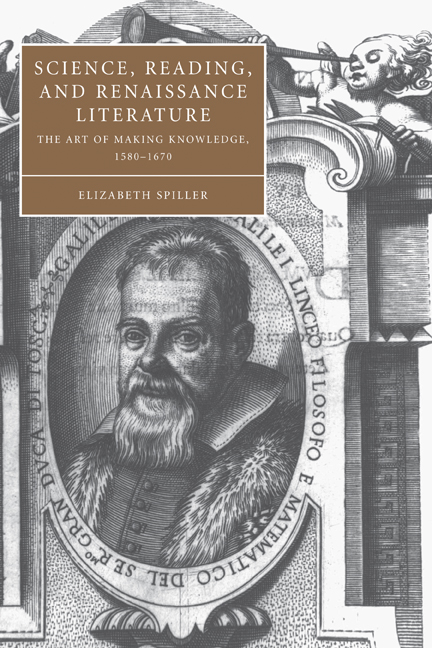
    Science, Reading, and Renaissance Literature brings together key works in early modern science and imaginative literature (from the anatomy of William Harvey and the experimentalism of William Gilbert to the fictions of Philip Sidney, Edmund Spenser and Margaret Cavendish). The book documents how what have become our two cultures of belief define themselves through a shared aesthetics that understands knowledge as an act of making. Within this framework, literary texts gain substance and intelligibility by being considered as instances of early modern knowledge production. At the same time, early modern science maintains strong affiliations with poetry because it understands art as a basis for producing knowledge. In identifying these interconnections between literature and science, this book contributes to scholarship in literary history, history of reading and the book, science studies and the history of academic disciplines.

    Reviews

    ‘Nowadays, we tend to think of science and literature as two cultures which have little in common, but Elizabeth Spiller's excellent study, Science, Reading, and Renaissance Literature, explores an age when these disciplines were united by a ‘shared aesthetics of knowledge’. Spiller skilfully dismantles our current assumption that ‘literature is fiction and science is fact’, arguing that early modern writers understood that ‘knowledge involves form as well as content … Spiller's perceptive parallel readings of texts usually kept separate is a valuable addition to scholarship on the early modern period, as well as to the study of science and literature.’

    Source: The Times Literary Supplement

    ‘Original, learned and compelling. Spiller's superb discussion of Cavendish places her appropriately in very serious company.‘

    Source: Studies in English Literature

    ‘… richly-documented pages, written in a clear and pleasant style …'

    Source: Cahiers Élisabéthains

    ‘… a rewarding contribution to the intersections between literature and natural philosophy. … powerful and rewarding, in large part thanks to her striking combinations of authors within chapters and her vigorous readings of a wide range of texts.‘

    Source: Minerva

    '… she has opened the door to a complicated and complex area of study. Her linking of these radically different writers in seemingly disparate disciplines, her focus on sensory perception, and her discussion of the generation of knowledge are perceptive and illuminating … the book is well worth the read.'

    Dr John Holmes - Lecturer in English, University of Reading

    Refine List

    Actions for selected content:

    Select all | Deselect all
    • View selected items
    • Export citations
    • Download PDF (zip)
    • Save to Kindle
    • Save to Dropbox
    • Save to Google Drive

    Save Search

    You can save your searches here and later view and run them again in "My saved searches".

    Please provide a title, maximum of 40 characters.
    ×

    Contents

    Metrics

    Full text views

    Total number of HTML views: 0
    Total number of PDF views: 0 *
    Loading metrics...

    Book summary page views

    Total views: 0 *
    Loading metrics...

    * Views captured on Cambridge Core between #date#. This data will be updated every 24 hours.

    Usage data cannot currently be displayed.

    Accessibility standard: Unknown

    Why this information is here

    This section outlines the accessibility features of this content - including support for screen readers, full keyboard navigation and high-contrast display options. This may not be relevant for you.

    Accessibility Information

    Accessibility compliance for the PDF of this book is currently unknown and may be updated in the future.
