
Skip to main content Accessibility help
×
  • Cited by 61
    • Show more authors
    • You may already have access via personal or institutional login
    • Select format
    • Publisher:
      Cambridge University Press
      Publication date:
      28 August 2009
      15 November 2007
      ISBN:
      9780511551062
      9780521859691
      9780521296939
      Dimensions:
      (228 x 152 mm)
      Weight & Pages:
      0.64kg, 320 Pages
      Dimensions:
      (229 x 152 mm)
      Weight & Pages:
      0.43kg, 320 Pages
    You may already have access via personal or institutional login
  • Selected: Digital
    Add to cart View cart Buy from Cambridge.org

    Book description

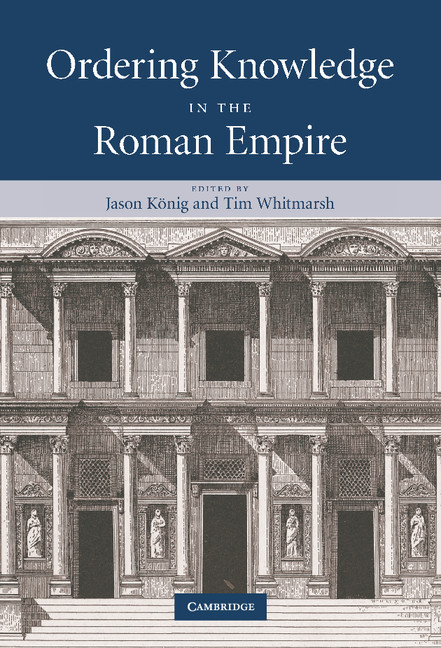
    The Romans commanded the largest and most complex empire the world had ever seen, or would see until modern times. The challenges, however, were not just political, economic and military: Rome was also the hub of a vast information network, drawing in worldwide expertise and refashioning it for its own purposes. This fascinating collection of essays considers the dialogue between technical literature and imperial society, drawing on, developing and critiquing a range of modern cultural theories (including those of Michel Foucault and Edward Said). How was knowledge shaped into textual forms, and how did those forms encode relationships between emperor and subjects, theory and practice, Roman and Greek, centre and periphery? Ordering Knowledge in the Roman Empire will be required reading for those concerned with the intellectual and cultural history of the Roman Empire, and its lasting legacy in the medieval world and beyond.

    Reviews

    Review of the hardback:'König and Whitmarsh's collection of eleven essays, whose origins can be traced to a 2001 conference held at St John's College, Cambridge, is a welcome edition for what might be called the emerging field of the history of information science … this volume comes highly recommended on account of the wide range of authors it considers, the variety of analytical methods it employs and its nuanced understanding of the relationship between compilations of knowledge and their contexts.'

    Source: Bryn Mawr Classical Review

    Refine List

    Actions for selected content:

    Select all | Deselect all
    • View selected items
    • Export citations
    • Download PDF (zip)
    • Save to Kindle
    • Save to Dropbox
    • Save to Google Drive

    Save Search

    You can save your searches here and later view and run them again in "My saved searches".

    Please provide a title, maximum of 40 characters.
    ×

    Contents

    • 11 - Galen's imperial order of knowledge
      pp 241-277

    Metrics

    Altmetric attention score

    Full text views

    Total number of HTML views: 0
    Total number of PDF views: 0 *
    Loading metrics...

    Book summary page views

    Total views: 0 *
    Loading metrics...

    * Views captured on Cambridge Core between #date#. This data will be updated every 24 hours.

    Usage data cannot currently be displayed.

    Accessibility standard: Unknown

    Why this information is here

    This section outlines the accessibility features of this content - including support for screen readers, full keyboard navigation and high-contrast display options. This may not be relevant for you.

    Accessibility Information

    Accessibility compliance for the PDF of this book is currently unknown and may be updated in the future.
