

Part 2 Phonology and orthography
Chapter II Phonology: introductory remarks
1 Aims
In this Part there is a full discussion of most, if not quite all, of the major phonological changes that took place in the history of recorded Latin and left a mark on the Romance languages. Most of these developments show up in misspellings and metalinguistic comments mainly in the imperial and later periods, but that is partly a consequence of the character of the evidence that happens to survive. Inscriptions, for example, are overwhelmingly of imperial date. It would be a mistake to imply that the history of Latin can be divided neatly into periods (see the discussion of Wright Reference Wright2002: 36–48 and Adams Reference Adams2011: 257). Wherever possible republican antecedents of phenomena that are mainly late will be cited. There are, however, hazards associated even with this latter practice, because something that may look like an early republican anticipation of a phenomenon found again much later and reflected in Romance languages may turn out to have no direct connection with the (proto-)Romance feature (see xxxiii.4). Each possible anticipation must be assessed on its own merits.
Given the theme of the book, an attempt will be made to determine whether any of the changes discussed were tied to particular sociolects. It has commonly been assumed, as we saw at i.3, that so-called Vulgar Latin changed over time much faster than the fossilised standard language, and that the Romance languages were the product not of the Latin of Cicero and Virgil but of that spoken by the masses. It is indeed true that the Romance languages, spread as they are over a vast area of Western Europe, must have evolved from the Latin spoken by the majority of the population in those various regions. But what is not clear is to what extent the phonology of these popular varieties might have differed from that of the varieties spoken by the tiny elite represented by such as Cicero. It is futile to try and deal with the phonology of lower sociolects in isolation (a fault of some handbooks of Vulgar Latin), because that is a sure way to exaggerate the distinctiveness of the varieties that have traditionally been called vulgar or the like. One must look at the entirety of the evidence for particular phonological changes of Romance significance, and allow the evidence itself to suggest any differences related to social or educational class. The vowel system, diphthongs and various vocalic phenomena (syncope, hiatus) will be dealt with first, and then various consonantal features.
2 The interpretation of misspellings
Phonological change is evidenced almost entirely by aberrant spellings, which may point to changes in pronunciation. But the interpretation of misspellings is problematic. It is necessary to say something here about the causes of misspellings, which are numerous and often unrelated to the current sounds of the language, and also about the significance to be attached to the variable frequency of different types of misspellings.
2.1 Special factors
Misspellings may have nothing to reveal about the state of the language at a particular time, for a variety of reasons. A few factors will be listed here, but no attempt is made to be comprehensive.
Old deviant spellings linger on, sometimes for centuries, and may be picked up by anyone who is literate, and used to confer respectability on writing without having any basis in speech. If the poet Manilius spelt nisi in one place with e in the second syllable (see iii.7.1.1), he would not have been attempting to represent the sound of speech but using an old form. If the writer of an informal letter on papyrus in Egypt adopted the same spelling, we need not assume that he, by contrast with Manilius, did so because that is how he heard the second vowel. He, like Manilius, might have seen the old spelling somewhere and assumed it was particularly correct. Substandard texts often contain deviations from a norm that are not literacy errors but quite the opposite: they may be determined by the recollection of a rule imbibed by the writer from instruction he had received. For example, in the letters of Terentianus there are signs of the grammarians’ rule that [k] should be represented by q before u, k before a and c before other vowels (see Adams Reference Adams1977a: 32–3).
Mechanical writing errors are common. Compiling a typology of these would be an undertaking in itself, and we can only cite a few instances here.
Geminated consonants may cause a problem. A writer may be aware that the written form of a word should contain a geminate but double the wrong consonant (e.g. tyrrany for tyranny; cf. Turranium at Terentianus 468.54).
Writers may be influenced by a form that they have just written or one that they are about to write. A sequence of accusatives in -m may cause an -m to be attached to a following term that should be in the ablative. In inscriptions the expected -s of a third declension name in the genitive is often omitted in the neighbourhood of a second declension genitive in -i.
There may be a physical reason for a misspelling, such as lack of space at the edge of a stone as the inscriber reaches the end of a line. This factor often effects the omission of a final consonant as the stonemason runs out of space (for details see viii). Since some final consonants were lost in the transition from Latin to the Romance languages, there may be a temptation to treat an omission as linguistically significant when it is due to this extraneous factor.
2.2 Varying frequencies of misspellings
Phonetic misspellings are variable in frequency from type to type, and difficult to interpret if they are not numerous. Also difficult to interpret is the absence, or virtual absence, of a misspelling that would be taken, if it had occurred, to represent a known development of the language. Should we conclude from the non-appearance of a misspelling in the inscriptions and documents of a particular period that the phonetic change that would have inspired it had not yet taken place, or alternatively that writers were aware of the change and careful to avoid representing it in writing? Some different patterns will be illustrated here, and the methodology of assessing such evidence discussed. A detailed account of the evidence will be found in the appropriate chapters later in this Part.
(i) Certain misspellings are so frequent that there can be no doubt that they reflect the state of the language. Cases in point are the omission of -m (viii) and the writing of ae as e (iv.2.2). But the state of what varieties of the language? Those spoken by a restricted educational/social class, or those spoken by the majority of the population? This is a question that cannot be answered merely from an examination of texts and their misspellings or absence thereof, because good spellers will stick to traditional spellings whether they are an accurate reflection of their own speech or not. If, roughly speaking, we are to place the pronunciation lying behind a misspelling in a particular social class, we need additional evidence, such as remarks by grammarians or other speakers. There is such evidence for -m that is clear-cut (viii.1.1). The information about e/ae is less straightforward, but there are indications that for a while grammarians attempted to preserve the diphthongal pronunciation (that is, among their clients, the highly educated) (iv.2.3). That would seem to imply the coexistence of two different pronunciations, with the monophthong presumably the norm down the social scale but the diphthong preserved by some purists. However, this duality may be idealised. Although grammarians might have been ‘guardians of the language’, their resistance to change in a particular case might have had limited aims. Were they always setting out to uphold the old ways in the speech, even informal, of their pupils, or sometimes simply trying to preserve a traditional articulation of the poetry that was the medium of their instruction? It will be suggested later that their efforts to maintain a quantitative vowel system related particularly to the recitation of poetry, and that even in their own speech the quantitative system was under threat (iii.6). When ae was monophthongised it soon became a form of short e, as early hypercorrect spellings show, and again the preservation of the diphthong might mainly have been for the sake of the reading of poetry.
(ii) Some misspellings are very infrequent, and raise the question whether they reflect a phonetic reality or are mere slips. Certain types of contact assimilation, for example (kt > t(t), ks > s(s), pt > t(t), ps > s(s)), are rarely attested (ix), and then not until the imperial period (if problematic cases are left out). If all misspellings of these types were combined and put alongside omissions of -m, their frequency would appear small in comparison, yet no one, it seems, has questioned the reality of the sound changes behind the misspellings. There are good reasons for this. Misspellings presented as mere statistics are not enough to provide reliable information about linguistic developments. There are, however, various telling facts about these assimilations and their attestation. First, structurally all of them are identical, as we will see, and of a type long avoided in the history of Latin. They form a system, and therefore attestations of the four categories may be treated as a unity. Their collective frequency may not come near to that of the omission of -m, but is rather more substantial than that of each of the categories considered in isolation. Second, the pattern of attestations is interesting. Republican examples have been adduced but are problematic. The first certain instances, and in some numbers, are in the graffiti of Pompeii, which provide the first real evidence that we have for non-standard varieties of Latin. The accumulation of examples in such documents almost certainly allows us to glimpse a feature of ordinary spoken Latin, albeit in an area where there was possible substrate influence. This impression is confirmed by continuing attestations in low-register documents during the Empire. Third, most of the assimilations have some sort of outcome in the Romance languages. The facts are consistent with a conclusion along these lines. The structural type represented by the four assimilations left no mark on the lexicon inherited from the prehistoric period (unlike many other types). It was long resisted but became influential at lower social levels by the early Empire, and probably earlier in submerged varieties of the language. It then influenced many of the Romance languages, although during the Empire it must have been kept at bay by many educated speakers, to judge from the limited attestations.
We may conclude that infrequent occurrences of a misspelling may hide the linguistic reality, and that the pattern of those occurrences must always be considered, along with extraneous evidence such as that of the Romance languages and metalinguistic comments (though of the latter there are none in this case).
(iii) Some misspellings may appear to be frequent but a lot of the evidence collapses when special factors are taken into account. This is particularly the case with the omission of final -s. Several scholars who have considered its omission in inscriptions with some care have observed that a majority of cases can be explained away as abbreviations or as due to lack of space at the edge of a stone or as determined by the presence of s at the start of the next word (viii.2.5.1). Not infrequently the omission of final -t is due to the same factors (viii.3.4, p. 155), but there are also omissions that seem to be determined by the phonetic context (sandhi phenomena), and these point to an early stage in the loss of the phoneme in final position.
(iv) The phenomena referred to in (iii) may be used to raise a methodological point. In interpreting the significance of a misspelling or its frequency a comparison of the treatment of related phenomena in a text may be revealing. As ‘interrelated phenomena’ we might cite e.g. different consonants in final position, or different diphthongs. If one final consonant (-m) is omitted repeatedly in a group of texts but another (-s) rarely or never (once special cases of the types alluded to above have been eliminated), it may be reasonable to conclude that there was a difference in the speech of the writers between the treatment of -m on the one hand and -s on the other, with the first dropped but the other stable. If however both were regularly written, we would not know whether either or both were pronounced by the writers in final position, since the regularity of spelling might reflect not their speech but their level of literacy. Variable treatment of the consonants is more revealing because the presence of errors of one type would suggest that the writers were not good spellers, and the absence of the other potential error might be taken to show that such a misspelling had no basis in speech.
This comparative method (for which see Adams Reference Adams2007: 635–6) works particularly well in the assessment of the history of the diphthongs ae and au. The spelling e for ae is far more common than o for au: there are many texts in which the former is well represented but the latter non-existent (see iv.3). That the different treatment of the two related phenomena reflects the state of the spoken language is confirmed by the universal monophthongisation of ae in the Romance languages alongside the partial survival of au.
Such comparisons may be particularly useful in assessing negative evidence, that is the absence of a particular misspelling. If the misspelling is never committed in a text that also lacks misspellings of comparable types, the writer might have been a good speller. If he was in other respects a bad speller, the absence of the misspelling may be significant.
Chapter III Vowel system
1 Vocalic misspellings and their interpretation
The vowel system of Classical Latin (based on distinctions of vowel quantity) differed in a fundamental way from vowel systems of the Romance languages (based on distinctions of vowel quality), but finding evidence for change in the Latin period itself is beset with difficulty. Vocalic misspellings or spelling variations occur throughout Latin. Some imperial spellings can be traced back into the Republic, and by definition these cannot securely be used to argue for developments in the imperial vowel system. A misspelling possibly reflecting, say, a vowel merger that shows up in Romance could in a late Latin text have a more mundane explanation; it might, for example, be old and archaising, and unrelated to recent developments. Worse, it might be open to more than one explanation. Though old, it might have been adopted by some writers in the imperial period not simply as an archaism but because it happened to represent a current pronunciation.
Mere statistics showing the incidence of a misspelling cannot be accepted on their own as evidence for a vowel change. The individual tokens must be examined, and those that might be explained in other ways eliminated. Several books that present statistics from inscriptions seemingly showing the state of the vowel system have less value than might be thought, because alternative explanations of the misspellings have not been taken into account.
There is a view that the qualitative system of the Romance languages did not develop out of the quantitative system of Classical Latin at all, but out of a different system of ‘Spoken Latin’, which went back a long way and coexisted with conservative Classical Latin, ‘until the latter simply faded out for lack of native or sufficiently schooled non-native users’ (Pulgram 1975: 249; see the whole discussion at 249–56). It is pointed out (250) that if Latin texts had not survived and we had to reconstruct a proto-language from the Romance survivals, ‘we should have no inkling of a Latin with vocalic quantities’ (cf. e.g. Väänänen Reference Väänänen1981a: 29). It is impossible to prove that this dual model is correct for the early period, but there is evidence in the later period of an attempt by grammarians to preserve the quantitative system, and at that time there might possibly have been two systems coexisting (but for reservations see below, 6, pp. 50–1). The history of vocalic misspellings is consistent with a gradual change from one system to another, and there will be no speculation in this chapter about the early existence of an alternative vowel system for which we have no evidence (on the inadequacy of Pulgram's claims see also Loporcaro Reference Loporcaro2011a: 57 and the whole section, and Loporcaro Reference Loporcaro2011b: 112).
The literature on the question how and why the Latin quantitative system changed into one based on vowel quality is vast, particularly in Romance philology. No review of the bibliography or theories that have been advanced will be offered here. For a recent account of the different Romance systems and their relation to Latin see Loporcaro (Reference Loporcaro2011b: 110–19). For Latinists Janson (Reference Janson1979: 11–45) provides an overview of the question, and there are some remarks by Pulgram (Reference Pulgram1975: 257–63); see also Herman ([Reference Herman1982] 1990: 218 with n. 1); for attempts in structural terms to explain the change see Spence (Reference Spence1965), with bibliography at 1 n. 1. There is no straightforward solution to the problems, because evidence is lacking, and it would be pointless here to go on speculating. The aim of this chapter will be to present what evidence there is, particularly from grammarians and from new non-literary texts.
2 The Classical Latin vowel system
The classical vowel system is represented by Allen (Reference Allen1978: 47) and others (e.g. Pulgram Reference Pulgram1975: 250, Vincent Reference Vincent1988a: 31) as follows:
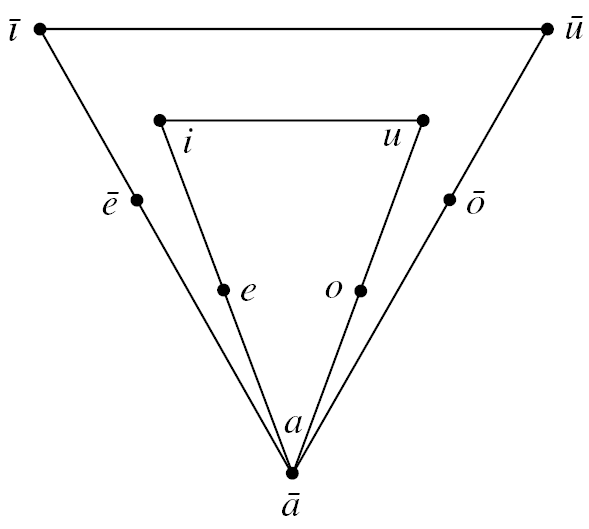
Allen remarks that in the case of the close (i, u) and mid (e, o) vowels the long vowels seem to have been closer than the corresponding short vowels (i.e. those represented by the same graphemes) (cf. e.g. Sturtevant Reference Sturtevant1940: 108, Spence Reference Spence1965: 11, Pulgram Reference Pulgram1975: 250, Janson Reference Janson1979: 40, Herman Reference Herman and Wright2000: 28, Clackson and Horrocks Reference Clackson2007: 273). Some evidence is cited to support this contention, which need not be repeated. There is also evidence that in languages with a length distinction short vowels are more centralised (Janson Reference Janson1979: 40), and that further favours the diagram presented by Allen.
3 Vowel systems of the Romance languages
In most Romance languages, along with the loss of phonemic distinctions of vowel length (see below), certain vowel mergers took place (see e.g. Allen Reference Allen1978: 48, Väänänen Reference Väänänen1981a: 30, Vincent Reference Vincent1988a: 32–4, Herman Reference Herman and Wright2000: 31–4, Loporcaro Reference Loporcaro2011b: 115). Long and short a, which must have had much the same position of articulation, merged. Long e merged with short i as a close e [ẹ] (in the vowel diagram above it will be seen that these two phonemes are adjacent, and there must have been an opening of the short i towards the position of articulation of long e), and a corresponding merger occurred in the back vowels, of long o and short u as a close o [ọ]. The original short e was retained as an open e [ę] and short o was retained as an open o [ǫ]. There were thus two forms of e with different degrees of aperture, and two forms of o. This system has seven vowels:

There are regional variations.1 Sardinia merged each of the classical long–short pairs, ā/ă, ē/ĕ etc. A five-vowel system is the result (for more detail see Jones Reference Jones1988: 317–18; also Loporcaro Reference Loporcaro2011b: 112–13):

Balkan Romance (Romanian) combines features of the main Romance system and the Sardinian system.2 On the front-vowel axis the same mergers occurred as in most Romance languages. On the back-vowel axis long and short o and long and short u merged, as in Sardinian. The ‘Balkan’ and ‘Sardinian’ systems are also found in residual dialect areas of southern Italy.3
The changes above apply to vowels in stressed syllables. Note Herman (Reference Herman and Wright2000: 34) on unstressed syllables: ‘Developments are not so clear in the unstressed vowels; in these the loss of the length distinctions happened before it did in the stressed vowels, and the confusion of vowel quality then went further than it did in the stressed vowels.’ He cites as an illustration the fact that most Romance regions have /e/ in unstressed final syllables deriving from all of long e, short e and short i. Also, in ‘proparoxytone words (where the stressed syllable is the third from the end) the unstressed vowel in the penultimate syllable is particularly weak and liable to disappear entirely’ (syncope: see v).
The loss of phonemic distinctions of vowel quantity was universal in the Romance-speaking world. If there had only occurred this loss of vowel quantity (on the evidence for which in the Latin period see below, 6) the result would have been a vowel system of the Sardinian type everywhere (see Janson Reference Janson1979: 16). But that was far from the whole story, and one cannot simply assume for the whole Empire a relative chronology that has loss of quantity preceding mergers of vowels. Janson (Reference Janson1979: 16) puts it thus:
In the other areas [i.e. other than Sardinia], there have been mergers between vowels that were different with regard both to quality and to quantity in the classical system, e.g. between /ĭ/ and /ē/. On the other hand, there are qualitative distinctions between vowels that were originally distinguished by quantity, e.g. between /ē/ and /ĕ/. In these areas, changes of vowel quality must of course have taken place. Further, these changes ought to have preceded the loss of quantity. Otherwise, there could occur no differences between vowels that were originally distinguished by quantity.
There do indeed seem to be signs of changes of vowel quality at an early period, well before the loss of vowel quantity could have occurred (on the chronology of change see also Spence 1965: 8, R. Coleman Reference Coleman1971b: 175). These signs will be discussed below in sections 5 and 7; see too 9.
4 Republican and imperial Latin
Much of the work on changes in the Latin vowel system has been devoted to finding signs of the vowel mergers noted above as occurring in most of the Romance languages, notably that of ē and ĭ. There is a widespread view that the corresponding back-vowel merger occurred later (see below, 10).
How would these mergers manifest themselves in a written text? In theory they would show up in the form of two misspellings in particular, first the writing of e where ĭ might have been expected, and second the writing of o where ŭ might have been expected. The e- and o-spellings might be taken to represent /ẹ/ and /ọ/. Inverse spellings (i.e. i written for ē and u for ō) are far less easy to interpret, and perhaps should not be used to argue that a vowel change of proto-Romance type is in evidence. Here more attention will be given to the primary misspellings.
But even these are not straightforward. There are many reasons why e might have been written for ĭ, and cases must be assessed individually (see above, 1 and further below). The difficulty of interpretation comes up in the republican period, when early inscriptions not infrequently have e where ĭ is expected. This evidence is discussed in the next section.
5 Vowel confusions in early Latin
In early inscriptions e is sometimes written where ĭ is expected, as in aidiles nominative singular (CILi2.8), tempestatebus (9), trebibos (398), semol (1531), soledas (1529), oppedis (583.31) and in the forms dedet (see CILi2 index, p. 771 s.v. do) and mereto (1848, 2440; see the material cited in the index to CILi2, pp. 813–14, and also Campanile [1971] Reference Campanile and Poccetti2008: i.362–3). Quintilian (1.4.17) cites as spellings from the past Menerua, leber (‘book’) and magester, and the first is found frequently in early inscriptions (see the index to CILi2, p. 810).4 Wachter (Reference Wachter1987: 305–6, 445), drawing attention for example to inconsistencies in the writing of ĕ and ĭ in the Scipionic elogia numbered 8–9 (aidiles/aidilis, hic/hec, fuet/cepit/dedet) and the Faliscan cooks’ inscription (364; Mineruai rather than Men-, juxtaposed with Falesce rather than Falisc-), argues that the two vowels were articulated closely together in the early period, and that there was consequent uncertainty about the grapheme to be used (see further Wachter Reference Wachter1987: 258, 266–7, 487–8). The variations would have nothing to do with dialectal variation (after all, such variations are found in single texts, and at Rome – as in the Scipionic inscription – as well as outside), but would reflect a ‘general instability’ of ĭ and ĕ.5 Transliterations into Greek such as Λεπεδος for Lepidus suggest that the Latin ĭ was a ‘peculiarly open one’ (Allen Reference Allen1987: 63),6 and more open than the Greek correspondent. There is evidence for a comparable openness of ĭ in Faliscan (Bakkum Reference Bakkum2009: i.95, 97). The above misspellings are found in stressed syllables (trebibos, semol, Falesce, magester, hec, leber), in unstressed syllables after the accent (tempestatebus, soledas, oppedis, mereto) and before the accent (Menerua), and in final syllables. The position of the vowel in the word and in relation to the accent is not a determinant of the confusion.
Some of these forms are special cases. In perfect verb endings the e was early (cf. e.g. Osc. deded; also Sihler 1995: 461), and the spelling -et was very persistent, even in the imperial period.7 In some other cases the e-spelling is also old, going back for example to the time before vowel weakening had occurred (mereto, perhaps soledas: see Leumann Reference Leumann1977: 84; de Vaan Reference de Vaan2008: 571 considers i to have been the original vowel of solidus). But there remain some cases where the e must represent a passing stage in the articulation of original short i.
The question arises whether such spellings (i.e. those that are not special cases) reflect the same phenomenon as that seen in imperial inscriptions in forms such as tetolo for titulum (CILxiii.7645; see below, 9 for such late spellings). This last would traditionally be taken to show proto-Romance developments (the mergers of ē and ĭ and ō and ŭ). Allen (Reference Allen1978: 49) interprets the form trebibos as showing the qualitative similarity of ē and ĭ in republican Latin. In one sense or another he must be right. If ĭ was particularly open it might have been articulated anywhere along the ĭ–ĕ axis as it appears in Allen's diagram set out above. Perhaps it was sometimes not far removed from ĕ itself, or alternatively (the view, it seems, of Allen; cf. Spence Reference Spence1965: 12, Wachter Reference Wachter1987: 258) it might have been articulated close to ē. But it is impossible to determine from the evidence where an e as written in a republican inscription for an expected ĭ might have been located on the ĭ–ĕ axis, and it cannot be stated with any confidence that the handful of republican e-misspellings reflects exactly the position of articulation that ĭ had at the time when it merged with ē, a merger that was not possible in Classical Latin of the Republic, when there were still oppositions of vowel length that would have kept ē and ĭ distinct. On this last point see Loporcaro (Reference Loporcaro2011b: 111): ‘It is…unwarranted to take the changes in quality undergone by short vowels…as sufficient evidence for the collapse of Latin VQ,8 as suggested by most reference works on the Latin-Romance transition.’
The republican evidence will be alluded to again, but little can be made of it, not least because the misspellings are so few. The imperial evidence will be examined chronologically, to see if any trends emerge. The misspellings found in more than a dozen relatively early corpora (from about the first to the third centuries) will be considered (below, 7), and then reference will be made (9) to some later inscriptions (those from Gaul and Spain).
A crucial event in the transition from the Classical Latin vowel system to the Romance systems was the undermining of phonemic oppositions of vowel length (cf. Spence Reference Spence1965: 10–17, R. Coleman Reference Coleman1971b: 181). As was just noted, ē, for example, could not have merged with ĭ, nor ē with ĕ (in Sardinia) if the old quantitative distinctions had been maintained. There is some evidence for the background to the loss of phonemic oppositions of length, which is presented in the next section.
6 The stress accent and its effect on the vowel system
Latin had a stress accent, as is revealed by the frequency of syncope at all periods (see v). In the imperial period there are signs that the stress accent was undermining a feature of the vowel system. In Classical Latin there are phonemic oppositions of vowel length both in stressed and unstressed syllables. Thus lēuis ‘smooth’ is distinguished semantically from lĕuis ‘light’ by the length of the first vowel, which in both words is in an accented open syllable. Ōs ‘mouth’ is distinguished from ŏs ‘bone’ in a monosyllabic word, in a syllable that is closed. The case of feminā (ablative) as compared with femină (nominative) is marked by the length of the vowel in a final syllable. Oppositions of length in final syllables, as in the example just cited, are, however, rare: on this point see Janson (Reference Janson1979: 43 with n. 14). What seems to have been lost in later Latin is not distinctions of vowel length, but phonemic, or meaningful, distinctions. Some of the evidence comes from Africa, but it is not exclusive to there. The evidence is first set out below, and then discussed. There is now a bibliographical overview of the collapse of distinctive vowel quantity by Loporcaro (Reference Loporcaro2011a: 53–7), in which, however, there is disregard of the substantial (and growing) evidence from outside Africa.
Augustine has the following remark about a hypothetical pronunciation of the verb cano:
De musica 2.1.1 itaque uerbi gratia cum dixeris ‘cano’ uel in uersu forte posueris, ita ut uel tu pronuntians producas huius uerbi syllabam primam, uel in uersu eo loco ponas, ubi esse productam oportebat, reprehendet grammaticus, custos ille uidelicet historiae, nihil aliud asserens cur hanc corripi oporteat, nisi quod hi qui ante nos fuerunt, et quorum libri exstant tractanturque a grammaticis, ea correpta non producta usi fuerint.
And so, for example, when you say cano or happen to use it in verse, such that you either lengthen in pronunciation the first syllable of this word or place it in verse in a position where it should be long, the grammarian, that guardian of tradition, will find fault with you, giving no other reason why it should be shortened except that those who have come before us and whose books survive and are handled by the grammarians have treated it as short not long.
The a of cano was subject to lengthening, and anyone who so lengthened it would be taken to task by grammarians, the ‘guardians of tradition’. Grammarians are portrayed as trying to resist changes in the vowel system. The tendency hinted at here is for the stress accent to effect lengthening of short stressed vowels, or at least those in open syllables (open syllable lengthening, OSL, in the terminology of Loporcaro, e.g. Reference Loporcaro2011a: 53). There is a suggestion that two different pronunciations of the verb might have been heard, the purist one advocated by grammarians, and a modern one determined (see further below) by the stress accent.
Not unlike the passage of Augustine above are two remarks by Consentius, the second of which complements Augustine's remark:9GLv.392.3 = p. 11.8–9 Niedermann ut quidam dicunt ‘piper’ producta priore syllaba, cum sit breuis, quod uitium Afrorum familiare est (‘as some people say piper with a long first syllable, when it is short, a vice which is characteristic of Africans’), 392.11 = p. 11.18–20 Niedermann ut si quis dicat ‘orator’ correpta priore syllaba, quod ipsum uitium Afrorum speciale est (‘as if someone were to say orator with a short first syllable, a vice which is particular to Africans’). The remark about piper is in line with that of Augustine quoted above. In the second passage Consentius says that Africans also shortened the first vowel of orator. The stress falls on the second syllable, and Consentius suggests that CL long vowels in open syllables that were not stressed were shortened. Two complementary developments are revealed, both related to the accent position. Vowels that were originally short were lengthened if they were in an open syllable bearing the accent, and vowels that were originally long were shortened if they were in an open syllable that was unaccented. Long vowels according to this information would only have been consistently maintained under the accent; those originally in unstressed syllables must have been weakly articulated such that they were no longer heard as long. In areas or social dialects in which the stress accent was having these effects vowel length could no longer be functional. Lēuis ‘smooth’ would no longer be distinguished from lĕuis ‘light’ by the length of the vowel alone, because in both words the vowel was accented and therefore long. Feminā could no longer be distinguished from femină, because in both the final vowel was unaccented and short.
These and related consequences of a stress accent are well attested for other languages too: see Allen (Reference Allen1973: 80) for examples from different languages.
The two phenomena discussed here tend to be attributed by the sources to Africa, but though they may have been prominent there they were not exclusively features of African Latin. Errors of versification marked by the lengthening of short vowels in stressed syllables and the shortening of long vowels in unstressed syllables turn up not only in African carmina epigraphica,10 but also in poems from Rome, Gaul, Spain and Moesia (see Adams Reference Adams1999a: 116 n. 39). A chant of boys playing soldiers, not specifically of African origin, in which certain short vowels have to be lengthened in places under the accent, can be found at SHAAurel. 6 (see Leumann Reference Leumann1977: 56, 252–3). There may even be cases of lengthening under the accent in an epigraphic poem from Pompeii.11
Also significant is the grammarian Sacerdos’ treatment of perspicere possit as a hexameter ending (GLvi.493.24). Sacerdos (a Roman grammarian, it seems: see Kaster Reference Kaster1988: 352–3) lengthened the i of perspicere under the accent:12
GLvi.493.20–6 disyllaba structura, quae non ualde quibusdam placet, antiquos uiros uehementissime delectabat. est enim fortis admodum uitansque etiam nostri temporis barbarismum, si non fuerit spondeo uel trochaeo post dactylum finita, ut ‘primus ab oris’ et ‘in quo meam uoluntatem p. R. perspicere possit’. sic enim uersum heroicum hexametrum faciunt, quae sola uersificatio est oratoribus deuitanda.
The disyllabic structure [i.e. a clausula ending with a word of two syllables], which is not particularly pleasing to certain persons, greatly delighted the ancients. For it is very strong and also avoids (what is considered) a barbarism of our age,13 as long as it is not concluded with a spondee or trochee after a dactyl, as is the case in primus ab oris and…perspicere possit. For these (patterns) produce a heroic hexameter (ending), which is the only metrical pattern that must be avoided by orators.
Even a Roman grammarian at some time in the third century14 was capable of treating a (short) stressed vowel in an open syllable as long (for errors of prosody in Sacerdos see Keil's introduction, GLvi.423; also Holmes Reference Holmes2007: 671 n. 17).
For evidence in Sacerdos of the complementary tendency, that is for a long unstressed vowel to be shortened, see GLvi.494.7–12 (cited by Mancini Reference Mancini2001: 314):
ergo si nos ad eius modi structuram aliqua necessitas detulerit, poterimus reprehendentes inperitissimos comprobare, si nosmet nostrum officium fecerimus, corripientes syllabas breues, longas producentes, ut est ‘causa laboro’, sa producentes, et ‘capsas admisero’, sas producentes. in istis enim tantum modo syllabis, si correptae fuerint, erit barbarismus.
Therefore if necessity brings us to a structure of this kind, we will be able, if we do our duty, in finding fault with the ignorant to demonstrate the truth by shortening short syllables and lengthening long ones, as for example in causa laboro by lengthening -sa and in capsas admisero by lengthening -sas. In those syllables only there will be a barbarism if they are shortened.
The grammarian will (by implication) correct imperitissimi if they shorten the long vowels in the final syllables of causa and capsas. There is an implied contrast here between the practice of the educated and uneducated, which at least suggests the possibility that two vowel systems coexisted at this time; the term imperiti will come up again in this context (see the passage of Augustine Doctr. Christ. 4.10.24 below; cf. imperitum uulgus, above, i.1).
Consentius sometimes illustrated these phenomena without ascribing them to Africa: see GLv.392.18 = p. 12.2–3 Niedermann (pices with first syllable lengthened), GLv.392.25–6 = p. 12.13–14 Niedermann (pices with first syllable lengthened and second shortened), GLv.396.32–3 = p. 20.4–5 Niedermann (ossua with first syllable lengthened), GLv.397.20–1 = p. 21.8–9 Niedermann (Fidenam with the first syllable shortened). Note too Sacerdos GLvi.451.14 on the pronunciation of Ceres with a long first vowel under the accent when it should be short, and a short vowel in the final, unstressed, syllable, when it should be long: ac si dicas ‘Ceres’ ce longa cum breuis sit, et res breui cum sit longa. Alongside this note Donatus GLiv.392.21 temporis, ut siquis ‘deos’ producta priore syllaba et correpta posteriore pronuntiet, on lengthening the first vowel and shortening the second of deos. The treatment of the long vowel of the accusative plural ending here should be compared with that of capsas referred to in the previous paragraph. Mancini (Reference Mancini2001: 314) also cites Consentius GLv.393.27–9 = p. 14.11–14 Niedermann on a hypothetical case of nummos with a short vowel in the final syllable.
Consentius’ remark about ossua just referred to is worth quoting in full: GLv.396.32–5 = p. 20.4–7 Niedermann ut si quis hoc ipsum quod diximus ‘ossua’ producta priore syllaba pronuntiet. erit enim barbarismus per adiectionem temporis in prima syllaba et per adiectionem litterae in secunda syllaba. There are two barbarisms in the form ossua, one by the addition of a letter (u) in the second syllable (ossua for ossa), the other by the addition of ‘time’ if the (vowel of the) first syllable under the accent is lengthened. Here Consentius envisages lengthening of a stressed vowel in a closed syllable, and this suggests that at this period grammarians were conscious of a tendency of some speakers to lengthen stressed vowels, whether they were in open or closed syllables.
At Doctr. Christ. 4.10.24 Augustine mentions Africans much as Consentius does in some of the passages quoted above (see also above, i.7 (ii)):
cur pietatis doctorem pigeat imperitis loquentem ‘ossum’ potius quam ‘os’ dicere, ne ista syllaba non ab eo, quod sunt ‘ossa’, sed ab eo, quod sunt ‘ora’, intellegatur, ubi Afrae aures de correptione uocalium uel productione non iudicant?
Why should a teacher of piety when speaking to the uneducated have regrets about saying ossum (‘bone’) rather than os in order to prevent that monosyllable [i.e. ŏs ‘bone’] from being interpreted as the word whose plural is ora [i.e. ōs ‘mouth’] rather than the word whose plural is ossa [i.e. ŏs], given that African ears show no judgment in the matter of the shortening of vowels or their lengthening?15
CL ōs and ŏs are distinguished (in the nominative and accusative singular) by the length of the vowel. Augustine suggests that uneducated Africans (imperitis) would not be able to differentiate the two terms because they cannot distinguish short and long vowels. The argument seems to be as follows. In both terms the o is under the accent. If the stress accent lengthened a short stressed vowel, ŏs ‘bone’ would be indistinguishable from ōs ‘mouth’ (with both having a long vowel). For that reason the Christian teacher in addressing the uneducated should use the substandard form ossum ‘bone’ (a back-formation from the plural ossa) to avoid confusion.
Are we to assume for the fourth or fifth century already a system of lengthening/shortening that was inevitably tied to the openness or otherwise of the syllable concerned, i.e. (Mancini Reference Mancini2001: 312) a system whereby in unaccented syllables all vowels were shortened, in accented closed syllables all vowels were shortened,16 and in accented open syllables all vowels were lengthened (OSL: see above, 44)? On this view the confusion of os ‘bone’ and os ‘mouth’ referred to by Augustine might be explained (since the vowel is in a closed syllable) from a single pronunciation of the two terms with a short vowel (see Mancini Reference Mancini2001: 314). This view would be out of line with the remark by Consentius (above) about the barbarism ossua, pronounced with lengthening of the vowel in the first syllable, which is accented and closed. It is uncertain whether in a monosyllable, before a single consonant, shortening would have taken place at the time of Augustine.
A few other items of evidence may be cited related to aspects of the decline of the quantitative system.
First, the grammarian ‘Sergius’ (Explan. in Don.) (see Kaster Reference Kaster1988: 429–30) makes a striking generalisation suggestive of the true state of affairs: GLiv.522.24–6 syllabas natura longas difficile est scire. sed hanc ambiguitatem sola probant auctoritatis exempla, cum uersus poetae scandere coeperis (‘It is difficult to know syllables that are long by nature. This ambiguity only examples drawn from authority resolve, when you have proceeded to scan the verses of poets’). He has just distinguished between vowels (using by convention the term ‘syllable’ rather than ‘vowel’) that are long by nature and those that are scanned long by position. He admits in the passage quoted that it is difficult to know those that are long by nature, otherwise than by scanning verses of the poets. Here is evidence that change had progressed so far that even grammarians were unsure of themselves, and that uncertainty has been illustrated from Sacerdos above. The passage suggests that the authority for determining the correct length comes not from educated speech but from analysis of the poets.
Second, in final syllables of certain types there is a tendency to shortening from relatively early. In first person singular verb forms even in verbs that are not of iambic structure the final o increasingly appears as short in the early Empire (see e.g. Leumann Reference Leumann1977: 110, Fitch Reference Fitch1981: 303–5, the latter showing that the phenomenon increases in the later plays of Seneca; see too R. Coleman Reference Coleman1971b: 179). Nominatives in -ō in n-stem nouns (e.g. mentio, Pollio) also sometimes show shortening of the o (Leumann Reference Leumann1977: 110).
Third, relevant evidence has been uncovered by Holmes (Reference Holmes2007) from an examination of clausulae in Vegetius’ Epitoma rei militaris. For example, he identifies ‘instances of clausulae which differ from the clausulae that Vegetius favoured only in having the last syllable of the penultimate word long instead of short (e.g. victos accepit instead of parte tractetur)’ (671). This phenomenon is found predominantly in syllables with a vowel that is long by nature rather than by position. Again, Holmes shows (673) that when a clausula demanded a long syllable at word end (e.g. a cretic–trochee militi restat) Vegetius avoided almost completely vowels that were long by nature in this final position and confined himself to syllables that were long by position. Here is a hint that ‘Vegetius’ ear for quantity was liable to fail him with final syllables’ (673), or, as Holmes puts it at 674, ‘for Vegetius (or for his readers) a long vowel was not sufficient to decide the quantity of a final syllable’. Holmes also notes (675) that ‘Vegetius does not seem prone to the error of treating long syllables other than the final syllable as short’, and makes the generalisation (682) that ‘the final syllable of a word was likely to be heard as short in late antiquity’. Here is evidence to be added to that seen already that in final syllables vowels originally long were particularly prone to shortening.
We may conclude that the evidence of Sacerdos, the SHA (probably fourth century) and the scattered epigraphic poems referred to above shows that to place the origin of lengthening under the accent in Africa, of about the fifth century (on the basis of the testimonia of Augustine and Consentius), and to assume that it spread from there,17 is mistaken. The phenomenon was far more widespread and of an earlier date. As for chronology, in Africa itself it is attested (along with shortening of long vowels in unaccented syllables) in an epigraphic poem dated precisely to 222.18 We may further conclude that shortening of long vowels in unstressed syllables, particularly but not exclusively at the end of the word, was not confined to Africa either.
Augustine's reference in the first passage cited in this section (De musica 2.1.1) to grammarians trying to maintain the old quantitative system against change suggests that the changes were considered substandard by the educated (though even grammarians themselves, such as Sacerdos, were prone to mistakes). It was also seen that Sacerdos alluded to finding fault with the imperitissimi if they shortened long vowels in final syllables, and the same term imperiti is used by Augustine (Doctr. Christ. 4.10.24 above) of those who were uncertain in their judgment of long versus short vowels. The verb reprehendo is twice used above (Aug. De musica 2.1.1, Sacerdos GLvi.494.8) of the grammarian ‘finding fault’ with those who got vowel quantities wrong. Errors of quantity deriving from the effects of the stress accent seem in these passages to be associated with the uneducated. For a while some careful speakers might have attempted to preserve the old vowel quantities, and if that were so there might in theory have been two systems side by side (cf. Spence Reference Spence1965: 10, 13 on the possibility of old and new systems coexisting over a period), one of them regarded as vulgar by purists. It is important, however, to keep in mind the remark of ‘Sergius’ cited above, which suggests that any attempt by grammarians to preserve the quantitative distinctions would have been artificial, ad hoc and probably unsuccessful, such that to speak of an alternative vowel ‘system’ would be misleading. It is worth quoting the reservations of Janson (Reference Janson1979: 27–8):
[R]ules for quantity, important for the comprehension and writing of metrical Latin poetry, were taught in schools throughout late antiquity (and up to this day, incidentally). Thus, it was certainly prestigious to know the rules for quantity even long after the disappearance of phonological quantitative distinctions in normal speech. This does not mean, however, that we can take for granted that it was characteristic of the educated upper classes to retain a pronunciation with quantitative distinctions. That is possible, of course, but it is equally possible that the changes in vowel system were not socially stratified.
Herman (Reference Herman1991: 37) similarly comments on the ‘desperate rearguard fight’ of grammarians to condemn neglect of the classical system, motivated as they were to preserve an understanding of classical metrical verse, and also by the fact that they ‘constructed some rules of inflectional morphology…on the inherited distinction of long and short vowels’.
7 Early imperial evidence for changes in the front-vowel system
In this section various non-literary corpora from the first three centuries ad are examined to see if there is any sign of the merger of ē and ĭ as close e [ẹ]. The merger might in theory show up in misspellings of the type e for CL ĭ. It has, however, been seen from the republican evidence that a misspelling of this type need not mean that the proto-Romance vowel merger had taken place. The misspelling turns up in the Republic at a time when a merger is out of the question, because the quantitative system was still in place. Likewise, if in the early imperial period ĭ had opened, say, to  , it would still have been distinct from ē if phonemic differences of vowel length had not yet been lost. The interpretation of the e-spellings is constantly problematic. Further discussion will be postponed until the evidence has been set out, in the hope that it may have something to reveal. Inscriptional misspellings have often been collected (see e.g. Sturtevant Reference Sturtevant1940: 108–9; older presentations of inscriptional evidence for one particular development (the merger of long e and short i) are assessed by Adams Reference Adams2007 Chapter x), but in this chapter we confine ourselves to more coherent corpora, for the most part written on materials other than stone. Such early corpora are included even if they provide no misspellings, because the absence of examples may itself be revealing.
The question must always be asked whether a particular misspelling might not be a special case, determined not by the new quality of original ĭ but by a non-phonetic factor (see above, 1). This question comes up in the first corpus below.
7.1 Letters of Terentianus (Youtie and Winter 1951)
There are twelve cases of e for CL short i (see Adams Reference Adams1977a: 8) (two in nese):
These examples fall into a number of categories.
7.1.1 nese
The two syllables of this word must be considered separately.
The first e of nese may be archaising, as the first element may derive from nĕ-.19 The first vowel is always short in Plautus (Walde and Hofmann Reference Walde and Hofmann1938–54: ii.170). A form with e (nesi) is itself at Plaut. Poen. 839 and also Fest. p. 164.1 Lindsay, and it will be seen above that the same form nesi is in Terentianus (468.40).
The second e is more complicated. The form nesei occurs in the early inscription CILi2.366 (Spoletium). There are also cases of nisei in republican inscriptions (e.g. CILi2.583.37). The second vowel-grapheme in Terentianus might reflect the early Latin long close e [ ] deriving from the original diphthong ei (see below, next section), and if that is allowed the e would be old-fashioned rather than a phonetic spelling. Nise is printed by Housman (Reference Housman1937a) at Manilius 1.471 (see also his note ad loc. (Reference Housman1937a: 110) advocating nise at Cic. Leg. 1.25, where manuscripts have inse), no doubt as an archaising form. The e of nise in Manilius is scanned short (from iambic shortening of the long close e).
There are other misspellings in non-literary texts that might be explained in this way. The issues are set out in the following section.
7.1.2 e deriving from original ei
The original diphthong ei changed in Latin to an ī (e.g. deico > dico), but from about 150 bc there turns up an intermediate form represented by the letter e, which must stand in this case for [].20 The spelling occurs, for example, in the Senatus consultum de Bacchanalibus (conpromesise). Eventually [] gave way to ī, though there are signs that it lingered on in country dialects longer than in urban Latin (see Varro Rust. 1.2.14, 1.48.2 and Leumann Reference Leumann1977: 64, Adams Reference Adams2007: 52, 62). Once the change to ī was complete the e spelling had a tendency to turn up as archaic orthography. This is nowhere clearer than in an Egyptian letter of Augustan (?) date published at P. Oxy. 44.3208 = CEL 10 (on which see Adams Reference Adams2007: 138 n. 69, 442). The letter contains the old formula deuom atque hominum (fidem), in which the first word is itself archaic (diuus = deus). The genitive plural ending is the archaic form (for CL -orum). In such a context the e-spelling can only be an archaic relic, perhaps remembered from some old text dating from the time when there was still a long close e in speech, and used here in keeping with the tone of the old phrase.
The change ei > becomes relevant to the interpretation of our e-spellings under particular circumstances. The spelling e for ĭ is not uncommon in later texts in disyllabic words such as tibe, sibe, ube (see below for details). In all these words the second syllable originally contained the diphthong ei. That changed by the normal process to ī (see above), and the ī for its part was shortened by iambic shortening to ĭ (see Leumann Reference Leumann1977: 108–9). If a term such as sibĭ is written with e in the second syllable in an imperial text or inscription, it may be tempting to see the e as representing the close e [ẹ] which was the outcome in Romance of CL ĭ. But it follows from what has been said above that there is another way of interpreting such e-spellings. An intermediate (second) stage in the development (e.g.) sibei > sibī (> sibĭ) would have been sib. Thus a spelling sibe need not reflect the late vowel merger at all, or even an open quality of ĭ of the type commented on above, 5 in early Latin. It might rather be an old-fashioned spelling identical in type to that seen in deuom, a remembered form lingering on from the time when was still current. If in a form such as Manilius’ nise the e were short, the length would derive from iambic shortening of , not from a new proto-Romance value of CL ĭ caused by a vowel merger.
There is some evidence favouring the interpretation of sibe (and other such forms in iambic words) as old orthography, whatever the length of the e (see further Adams Reference Adams1977a: 149–50). According to Quintilian (1.7.24), Asconius Pedianus said that Livy wrote sibe and quase rather than sibi and quasi: ‘sibe’ et ‘quase’ scriptum in multorum libris est, sed an hoc uoluerint auctores nescio: T. Liuium ita his usum ex Pediano comperi, qui et ipse eum sequebatur. haec nos i littera finimus (‘[s]ibe and quase are found in texts of many writers, but whether the authors intended them, or not, I do not know; I learn the fact that Livy used these forms from Pedianus, who himself followed the example. We spell these words with a final i’, Russell, Loeb). Quintilian is not talking about speech but about spellings in manuscripts. Livy and many others wrote sibe and quase, and Asconius Pedianus, having seen such forms in Livy, followed the auctoritas of the respected author. It is inconceivable that Livy and other literary figures used such spellings as a reflection of a proto-Romance vowel merger that was taking place in speech. They must have been using orthography with an old-fashioned flavour to it.
When an e-spelling for CL ĭ is found in a later text in a position in which in early Latin had once occurred, it is unsafe to conclude that the e reflects a recent development in the vowel system; the possibility must be allowed that it is archaising. The spelling even of the less well educated retains conservative features, and certain old or artificial forms may have a vogue.
In this small group of twelve e-spellings in Terentianus there are five (in nese/nesi) that can be interpreted as old-fashioned. The CL form nisi occurs twice in letter 467 (10, 15), whereas the forms with at least one e are in letter 468 and the fragment of that same letter (CEL 143). It is likely that one scribe had a taste for the old forms.
7.1.3 The remainder of the evidence in Terentianus
There must also be a doubt about the credentials of sene for sine as a phonetic spelling in the letter just mentioned (468.38). Sine is attested with the form seine in republican Latin (CILi2.583.54), presumably a false archaism based on observation of the interchange of ei and i (= ĭ) in such forms as tibei/tibi, sibei/sibi etc. (see Leuman 1977: 64). If seine had the status of an ‘archaism’, so sene might have been taken as an archaic variant showing the early e-spelling originally representing .
Of the remaining six e-spellings, four are in the final syllable of verb forms (uolueret, aiutaueret, dicet twice or possibly three times). Such forms will come up constantly below. The spelling lentiamina for linteamina occurs twice. In a bilingual glossary linteamen is written in Greek letters in the form λεντιαμεν.21 But even this form may be a special case. The word in its correct form has a sequence of the letters e and i. Once the closing of e in hiatus (in the second syllable) (see vi.2) had occurred, those writers dimly aware that there was such a sequence in the correct form might have got the order wrong. In a Vindolanda letter (Tab. Vindol. 643) the form benifeciario also seems to have a misordering of the sequence of the same letters.
7.2 O. Faw. 1–7, CEL 73–80, Cugusi (Reference Cugusi1981)
1.8 tibe
2.12 tibe
4.4 tibe
5a.3 tibe
2.3 scribes
2.3 mittes (may be future)
3.2 scribes
3.11 mittes
4.10 scribes
2.13 entro
There are ten cases of e for CL ī. Four of these are in tibe, where there was an original ei. For tibei see the letter of Suneros, P.Oxy. 44.3208 = CEL 10, line 5, a text which also has deuom (see above). Though tibe might be old-fashioned, these letters are very badly spelt, with no sign of hypercorrection or other old spellings, and there is an outside chance that tibe here is a phonetic spelling. Tibe alternates with tibi in the corpus. The spelling entro may show Greek influence (since Gk ἐν- corresponds to Lat. in-); there is one other definite case of Greek interference in the corpus (see Adams Reference Adams2006). The remaining five examples are all in verb endings (present), in second person forms. Apart from entro all instances are in final syllable.
7.3 Archive of the Sulpicii (Camodeca Reference Camodeca1999)
The only such spelling is ube at TPSulp. 45 (ad 37). This looks like old orthography (ubei is an attested spelling).
7.4 Vindolanda (Tab. Vindol.)
At 250 there is a spelling debetorem = debitorem. This may be a special case, influenced by debet (see Adams Reference Adams1995a: 91). The spelling is in an unstressed syllable. Ṿbe is at 642 (see 7.3). At 617 ịḅe may be of the same type (see the editors ad loc.). Two letters by a certain Florus (643) have an accumulation of misspellings in the final syllable of verb forms, none of them perfects (dabes three times, dabet and signabet once each: Adams Reference Adams2003b: 533–4). The same letter has the spelling benifeciario (on which see above, 7.1.3). In a new tablet (861; see Bowman, Thomas and Tomlin Reference Bowman, Thomas and Tomlin2010) a spelling uexellarius is found (possibly a vocalic assimilation, or influenced by the diminutive suffix -ellus). There are only ten possible examples in the Vindolanda tablets, five of them in verb forms and two possibly reflecting old orthography (ube, ibe). Three of the remaining examples (debetorem, benifeciario, uexellarius) may be special cases.
7.5 Vindonissa tablets (Speidel 1996)
Dabes occurs three times (15, 31, 53): cf. above on Vindolanda.
7.6 La Graufesenque (Marichal Reference Marichal1988)
Marichal (Reference Marichal1988: 59) cites tesanares (76.8) < ptisanarium (which is found in Horace: see Marichal Reference Marichal1988: 91). There are several examples of tisanares in the corpus. The only other fairly certain example is magedes (163.3). The word, apparently an archaic equivalent of lanx (see Marichal Reference Marichal1988: 88, citing Plin. Nat. 33.146 lances, quas antiqui magides uocauerant), is of Greek origin (< μαγίς) and ought to have an i in the second syllable. Varro (Ling. 5.120) presents a popular form magidam, which is derived from the Greek accusative.
The relevance of these forms to real popular Latin is open to question, because in Gaulish short i is attested as opening to e in final or unstressed syllables (see Lambert Reference Lambert1995: 41). Since both words are technical terms, they had perhaps taken on a Gallicised form first when borrowed into Gaulish and then in the Latin of the potters.
7.7 Four Latin letters from Mons Claudianus (O. Claud. 2, 131, 135, 367)
These letters, all dated to the second century ad (131 and 135 c. 107), are without misspellings of this type.
7.8 Second-century legal document transliterated into Greek letters (SB iii.1.6304, CPL 193)
In this text, which has numerous cases of ĭ written with an iota, there are two instances of epsilon instead. One of these is a grecism (εντερρογατιωνε, with the Greek prefix corresponding to Lat. in-), and the other is in βιγεντι for uiginti. Is this the same as those republican transliterations (see above, 5) showing epsilon for Lat. ĭ, motivated by the relative openness of the Latin i to Greek ears?
7.9 Bu Njem ostraca (Marichal 1992)
In this corpus of the mid-third century there are no examples, but many cases of (short) i correctly written (about 183). It is possible that the absence of misspellings of this type is a reflection of a feature of the African vowel system (see below, 13).
7.10 Spanish curse tablet (Corell Reference Corell1993)
A curse tablet from Carmona (Seville) has two front-vowel misspellings, one in the final syllable of a verb form (recipiates), the other old-fashioned (meretis: see above, 5 for mereto in early Latin).
7.11 Five early letters on papyrus (Cugusi Reference Cugusi1973)
In the five letters collected and discussed by Cugusi (Reference Cugusi1973) there are no such misspellings.
7.12 Two early letters from Myos Hormos (Cuvigny Reference Cuvigny2003)
In the letters M689 and M1107 (Cuvigny Reference Cuvigny2003: 409, 405), dated between the end of the first century and the time of Hadrian, there are no examples.
7.13 P. Rainer Cent. 164
In this text (late first century bc) there are no examples.
7.14 Graffiti del Palatino (Väänänen 1966–70)
These graffiti are of uncertain date, but may belong roughly to the second/third centuries.22 The only misspellings (see the linguistic appendices at i.253, ii.255) are i.304 dicet, ii.283 futuet, 289 omnes (nominative singular).
7.15 Some statistics
Forty-five (or forty-six) misspellings showing e for CL ĭ were considered from the fourteen corpora. About twenty-three were dismissed as special cases of one type or another. A further twenty (or twenty-one) were in the final syllable of verb forms.
7.16 Pompeian graffiti
The relevant misspellings, which are numerous, have been analysed by Väänänen (Reference Väänänen1966: 21–2). He divides the material into three categories: cases (a) under the accent or pretonic, (b) after the accent but in non-final syllables, and (c) in final syllables. This last category is divided into spellings in nominal endings and those in verbal endings. Much of the material in the first two categories is problematic or open to special explanations, and there would be no point in counting or listing the examples again. But from (a) there remains prauessimus (CILiv.8259) and from (b) domene (iv. 1871), muli<e>rebu (iv.4137) and munerebu (iv.6900).23 The last two examples are identical in type to tempestatebus in an early Latin inscription (above, 5). Väänänen (Reference Väänänen1966: 21) refers to ‘le timbre indécis que devait avoir toute voyelle dans cette syllabe, qui était aussi la plus sujette à la syncope’.
Under (c), first section (‘désinences nominales’), Väänänen lists eight examples of the type omnes for omnis (nominative), and one example of aled for alid. Here again there is an exact parallel in an early Latin misspelling (aidiles). Väänänen (Reference Väänänen1966: 84) categorises the e as indicating ‘une prononciation ouverte de i’. One of the spellings in the Palatine graffiti seen above is of the same type.
Finally Väänänen lists (c, β) numerous examples of e for ĭ in verb endings of the third conjugation, first and second person singular (-es, -et), in both the present and perfect tenses, and also the future. In this list there are about forty-three examples in the present tense (which include three instances of dicet, a spelling found in a letter of Terentianus), and ten in the perfect.
The instances in the perfect (which include e.g. fecet) are easy to account for. The e-spelling in the third person is early (both with a following -d and -t), and was very persistent into the imperial period, particularly in certain verbs, most notably fecet. Numerous examples from early Latin can be found in the index to CILi2 (p. 820), and from later Latin at Adams (Reference Adams2003a: 51). The latter material, for example, includes fourteen instances of fecet from CILvi, and also cases of the transliterated form φηκετ. The regularity of this transliterated form would not favour the view that there had been a merger of CL ē and ĭ in the early Empire, since the two vowels are rendered by different letters in Greek.
It follows that in the perfect the spellings with e at Pompeii may simply be old-fashioned. It would not be convincing to put them down at Pompeii of this period to Oscan influence (Oscan retained the ending -ed, as in deded),24 because the e-forms go back in Latin itself to a period much earlier than that of the Pompeian graffiti in the first century ad, and they clearly had a traditional character by the time when they were written at Pompeii.
In the present tense the e-forms are more problematic. In early inscriptions third person singular verbs tend to be in the perfect rather than the present, and there is not the textual evidence to determine whether an e-spelling in a verb form such as dicet (for CL dicit) was established in early Latin (though it can be reconstructed as original: < *deik-e-ti). In Oscan proper e is not attested in the third person present of the third conjugation (see Buck Reference Buck1904: 59). Väänänen (Reference Väänänen1966: 22, 130) is nevertheless inclined to see the influence of Oscan at Pompeii in the present tense e-forms. However, e-spellings are found at Pompeii in the final syllable of futures as well, in which Oscan could not have been influential (for the futures ibet and pugnabet see Väänänen Reference Väänänen1966: 22; an Oscan future is didest, i.e. dide-s-t, with syncope of the vowel in the ending).25 In the material presented from elsewhere in the Empire in this chapter there are both futures (dabes, dabet) and future perfects with e (aiuataueret, uolueret; the Oscan future perfect is quite unlike the Latin).26 There are at least four ways of explaining a form such as dicet at Pompeii: (i) it might be a traditional spelling which merely happens not to be attested in early texts; (ii) the e might have spread from the perfect (dedet) to other tenses; (iii) it might show Oscan influence; (iv) it might reflect weak articulation of the vowel in a final syllable. It is not obviously justifiable to latch onto (iii) amid all the possibilities. The simplest explanation of the e-forms in tenses other than the perfect (including the subjunctive recipiates in the Spanish defixio) is that they all reflect the same phonetic feature, namely an openness of ĭ in verb endings (in final syllable). Certainly our material above from non-Oscan areas cannot be explained from Oscan influence, and it is preferable to account for the evidence by a single hypothesis.
7.17 Further statistics
If the Pompeian forms considered in the previous section are added to the statistics given from the other corpora, the number of e-spellings for ĭ rises to about 111, and of these a very high number (seventy-three) are in verb endings.27 A further twenty or so cases (some of them classified above as special in some way) are in final syllables in other types of words, nominal, adjectival or adverbial. More than ninety of the 111 spellings considered above are in final syllables. That statistic suggests the manner in which readjustment to the front-vowel system must have been getting under way in the early centuries of the Empire. Final syllables never bore a stress accent, and for that reason vowels in this position were historically subject to modifications, such as loss (*homce > hunc, face > fac: see e.g. Meiser Reference Meiser1998: 73–4), opening (facili > facile) and shortening. Some of the testimonia from grammarians collected in section 6 refer to shortening of a long vowel in final syllable, and we also saw other evidence for the phenomenon, some of it quite early. We therefore have at roughly the same period (the early centuries ad) evidence both for shortening in final syllables, and for a change in the quality of short i in such syllables. It is likely that in a verb form such as dabis the final front vowel was articulated with reduced tension, and that it tended to open slightly. As ĭ opened it will have moved close to ē without merging with it.
The proto-Romance vowel merger of ē and ĭ would only have occurred once phonemic distinctions of vowel length were lost across a wider spectrum, and evidence for the part played by the stress accent in undermining the quantitative system only appears in abundance from the third century. The transliterated form φηκετ shows that, though the final short vowel had an open quality, it had not merged with ē. Similarly the mid second-century transliterated text mentioned above (7.8), which, given that the Greek alphabet distinguishes better than the Latin between long and short vowels, is virtually a phonetic transcription, shows no sign of a breakdown in the quantitative system. Long e (η) and short e (ε), and long o (ω) and short o (ο) are consistently (and correctly) distinguished throughout, sometimes in the same word (οκτωβρης). In κωνσουλιβους ō and ŭ are correctly distinguished. Iota is used repeatedly for ĭ, and the one departure from classical norms in this respect is consistent with a tendency to opening in the short-vowel system, as distinct from a merger across the short- and long-vowel systems. Yet this text has numerous errors of other types, and there are signs that it was partly taken down from dictation.28 It could only be concluded that the proto-Romance merger was fully in progress if misspellings were more widely distributed within the word than they are in our early imperial documents, and if there was evidence for a disturbance to the quantitative system.
8 The Latin and Oscan vowel systems
The development in the Latin vowel system that has been the subject of this section was partially anticipated centuries earlier in Oscan (and possibly Umbrian),29 in which long vowels had become closer and short vowels more open, with the consequence that the inherited ē and ĭ moved together and achieved the same timbre (though a full merger will not have taken place because oppositions of quantity were largely retained).30 Thus líkítud = lĭcētōd has the same vowel grapheme in each of the first two syllables, in the first representing original ĭ and in the second ē.
Scholars have not been lacking who have attributed the Latin (or proto-Romance) development to Italic influence.31 This idea would be hard to prove, particularly for the later and proto-Romance periods. The tendency for Latin ĭ to open particularly in final syllables in the material just seen is a restricted adjustment which would not need an external cause, and it is attested mainly in the Empire when Oscan was in decline and is not confined to areas where Oscan had been spoken. Vowels in final syllables were subject to various forms of weakening in Latin. The open character of ĭ in early Latin such that it was sometimes apparently heard by Greeks as indeterminate between ĭ and ĕ might have been a widespread feature of languages or dialects in parts of Italy, as it is attested too in Faliscan (see above, 5), but whether one should speak of a Sprachbund it is difficult to say.
9 Later Latin and front vowels
Later inscriptions from some parts of the Empire present a different picture from the earlier documents. Material here is taken from Pirson (Reference Pirson1901) and Carnoy (Reference Carnoy1906), who quote examples instead of merely providing undifferentiated statistics. There is also a vast amount of evidence in Schuchardt (Reference Schuchardt1866–8: ii.1–67).
Many instances of e written for CL ĭ in later inscriptions from Gaul are quoted and classified by Pirson (Reference Pirson1901), and these contrast sharply in their diversity with the restricted character of the early imperial misspellings discussed above. In Pirson's classification the misspellings fall into the following categories: (1) examples in accented syllables, open and closed (Reference Pirson1901: 8–10): e.g. baselica, menus, meser, nemis, precepuus, princepibus, tetolus, uteletas, ancella, claressimus, dulcessemus, minester; (2) examples in initial pretonic syllables (Reference Pirson1901: 32): e.g. menister, megrauit, fegura, menores, fedelis, trebunus; (3) examples in non-initial pretonic syllables (Reference Pirson1901: 33): e.g. degnetatem, admenestrator, dedecauit, disceplina and many others: (4) examples in post-tonic syllables (Reference Pirson1901: 33–4): e.g. maxemus, nobelis, ordene, and a large number of others; and (5) examples in final syllables, of nouns, adjectives and particularly verbs, in the present, future and perfect tenses (Reference Pirson1901: 34–6); this is by far the largest category. The frequency of such spellings in verb endings at an earlier period would appear to represent the start of a process. For misspellings in verb endings see also Gaeng (Reference Gaeng1968: 167–74).
Carnoy offers a similar collection from the Spanish inscriptions (Reference Carnoy1906: 18–26), classified in much the same way. Again the phenomenon turns up in syllables of all types, with misspellings prominent in final syllables (Reference Carnoy1906: 18–20). Carnoy gives a separate list of examples from Christian inscriptions (Reference Carnoy1906: 25–6).
It is impossible to dismiss the Gallic and Spanish evidence en masse as comprising old spellings and special cases of one sort or another. Since that is clear from the way in which Pirson and Carnoy have presented the evidence, more trust can be placed in Gaeng's (Reference Gaeng1968) statistics from the same regions of the Empire, which are not accompanied by much illustration.
Many inscriptions are not dated, but the majority from Gaul and Spain are probably quite late. Gaeng (Reference Gaeng1968) divides his vocalic data from these provinces into two chronological groups, ss. iv–vi and vii. The greater variety of these later misspellings compared with those in the earlier corpora suggests that there had been a step forward in the passage from the CL vowel system to the Romance. The effects of the stress accent on the quantitative system, which, it has been seen, become particularly apparent between the third and fifth centuries, must have been responsible for this new stage.
In the next section the back-vowel system is considered.
10 The back-vowel merger
The conventional view is that the merger of the back vowels ō and ŭ as close o (/ọ/) was later than the corresponding merger on the front-vowel axis. For remarks on the chronology see B. Löfstedt (Reference Löfstedt1961: 90), Gaeng (Reference Gaeng1968: 98 with n. 59), Väänänen (Reference Väänänen1966: 27), (Reference Väänänen1981a: 36–7), Adams (Reference Adams1977a: 11), (Reference Adams2007: 588).32 Nor did the merger take place everywhere. In Romanian, as was seen (3), ŭ did not shift to a close o [ọ], though the standard change took place in the front-vowel system. In Latin texts the frequency of misspellings affecting the front vowels relative to that affecting the back vowels may be misleading. It has been pointed out that the phonemes / / and /
 / are twice as numerous in the language as /
 / and /
 /, and a lower incidence of back-vowel confusions is to be expected.33 That said, there are texts in which spelling confusion in the back-vowel system is non-existent. The relative infrequency of that confusion compared with spelling confusion in the front-vowel system cannot be explained away as a statistical freak.
Any statistical account of spellings showing o for ŭ which does not cite the evidence must also be treated with suspicion (so that of Gaeng Reference Gaeng1968), because many such spellings turn out to be special cases irrelevant to developments in the later vowel system.34 Some old spellings were very persistent. Most notable among these is the writing of uo rather than uu, where the first letter represents a semivowel ([w]) and the second a short vowel. There was a reluctance to repeat the letter with a different phonetic value, and for that reason old spellings such as seruos persisted. Prinz (Reference Prinz1932: 50–4) has a detailed discussion of the matter, along with statistical tables showing the incidence in inscriptions at different periods of uo versus uu. There is also a good discussion by Carnoy (Reference Carnoy1906: 51–4).
There follow some statistics from non-literary corpora. The evidence is set out in detail so that the special cases are eliminated.
10.1 Letters of Terentianus (Youtie and Winter 1951)
There are seventeen examples of o for ŭ, but almost every one is a special case.35 There are four instances of uo (as in saluom, nouom, fugitiuom), eleven of con (which may either retain the old Latin vowel spelling, or reflect the influence of compound forms such as confido), one of the old-fashioned quominos, and finally sopera (471.21). Only the last is difficult to classify. It would not do to argue that here is a sign of the late back-vowel merger, because the non-syncopated form is suggestive of early Latin (supera for supra is in Livius Andronicus), and the o too may have been conceived of by the scribe as old-fashioned.
10.2 O. Faw. 1–7
For con (3.12) see above.
10.3 Archive of the Sulpicii (Camodeca Reference Camodeca1999)
There are no examples (though many cases of short u), apart from the uo-spelling fugitiuom (with uncertainties of reading but the ending is clear) at TPSulp. 43.ii.3.1.
10.4 Vindolanda (Tab. Vindol.)
No examples.36
10.5 Vindonissa tablets (Speidel 1996)
No examples.
10.6 La Graufesenque (Marichal Reference Marichal1988)
No examples.37
10.7 Four Latin letters from Mons Claudianus (O. Claud. 2, 131, 135, 367)
No examples.
10.8 Second-century legal document transliterated into Greek letters (SB iii.1.6304, CPL 193)
No examples.
10.9 Bu Njem ostraca (Marichal 1992)
No examples (see Adams Reference Adams1994b: 103–4). Fornus for furnus is a special case (see Adams Reference Adams1994b: 104).
10.10 Spanish curse tablet (Corell Reference Corell1993)
This contains morbo(s), which, if it has been correctly interpreted, is another old spelling.
10.11 Five early letters on papyrus (Cugusi Reference Cugusi1973)
No examples.
10.12 Two early letters from Myos Hormos (Cuvigny Reference Cuvigny2003)
No examples.
10.13 P. Rainer cent. 164
No examples.
10.14 Graffiti del Palatino (Väänänen Reference Väänänen1966–70)
No examples.
10.15 Pompeian graffiti
The evidence is treated comprehensively by Väänänen (Reference Väänänen1966: 26–9). The vast majority of spellings showing o where ŭ might have been expected are placed under the heading (28) ‘o pour u classique = o archaïque’, and are old spellings mainly of the types seen above in Terentianus. At 27 just four instances are cited of ‘o pour ŭ originaire’, but all of these are special cases, or of doubtful interpretation. At Pompeii there is no sign of a back-vowel merger.
10.16 Conclusion
There is not a single case in this material of an o-spelling that might be interpreted as showing opening of short u in anticipation of a vowel merger. In the same material in the front vowels there are cases of opening. The usual view of the relative chronology of these vowel changes must be correct.
11 Later Latin and back vowels
Even in late inscriptions it is not easy to find examples of o for ŭ that can be put down to a change in the back-vowel system. More often than not such spellings fall into special categories. There is a careful treatment of the evidence from Spain by Carnoy (Reference Carnoy1906). He has a separate section (51–6) dealing with the old spelling uo for uu. Apart from that he classifies the material chronologically.
Examples from ‘une époque ancienne’ are at 49. Annoro (CILii.3679) for annorum is possibly due to a tendency to opening, but it could be explained otherwise, for example as showing vocalic assimilation to the stressed vowel. The few other cases cited by Carnoy are slips or can be accounted for as case confusions (the writing of ablative forms instead of accusative, either mechanically or because of a sense that the ablative was appropriate: see CILii.5144 misolio for mausoleum, 6288 uoto, possibly intended as an ablative).
Carnoy's examples from the Christian period (Reference Carnoy1906: 49–50) are also unrevealing. There are just eight. Arcos and porticos might be pseudo-archaising. Viscunos, Secouesos and Caisaros are all taken to be Celtic forms (Reference Carnoy1906: 50), as is the genitive plural (?) Argailo. There remains the phrase isto monumento (Inscriptiones Hispaniae Christianae 403: Carnoy Reference Carnoy1906: 49), which Carnoy equates with istud monumentum. It may be a genuine example, though there is again the possibility of a mechanical case confusion, and it is noticeable that the u in the second syllable of the noun is retained.
Finally Carnoy (Reference Carnoy1906: 57) cites examples from the fourth to the eighth centuries. These are more convincing as suggesting that a back-vowel merger had occurred. The examples are Cesaracosta for Caesaraugusta, colomba, sobitus and tomolo.
The Spanish evidence is consistent with a back-vowel change at a very late period. Carnoy's setting out of the evidence allows one to identify spellings that have nothing to do with changes in the vowel system. These, if presented as statistics, might have given a false impression of the chronology of the change.
In the inscriptions of Gaul discussed by Pirson (Reference Pirson1901) there are numerous misspellings showing o for ŭ that cannot be explained away as special cases. Pirson too is careful to give the special cases separately, as for example uo for uu in words such as uiuos (Reference Pirson1901: 46). He interprets (Reference Pirson1901: 47) various nominatives in -os (e.g. Annios, Lupos) as displaying the merger of ō and ŭ, given the late date of the inscriptions, but it is not impossible that the archaic form was remembered. Once these and a few other special cases are discarded there remain many misspellings that must reflect a back-vowel merger (e.g. forms such as tomolo, tetolo (also with the change in the front-vowel system represented), consoles, secolares, famola, regola, popoli). These are at 44–5; see also 16 for examples in stressed syllables. Most of the evidence is Christian (and marked as such) or otherwise late, but Pirson does not classify it chronologically.
Evidence from the Lombard laws (roughly seventh century) of o written for CL ŭ is provided by B. Löfstedt (Reference Löfstedt1961: 89–90). He notes (Reference Löfstedt1961: 90) that the misspelling is less common than the corresponding one on the front-vowel axis, but it remains true that most examples are consistent with a vowel merger. Löfstedt treats uo for uu as a special case (Reference Löfstedt1961: 91–2), and he discusses some other instances that cannot be put down to phonetic developments (93).
12 Conclusions
Adjustments to the vowel system must have taken place in several stages (the following account is very similar to that of Spence Reference Spence1965: 10–17; cf. R. Coleman Reference Coleman1971b: 175). In the early Republic there are already signs that ĭ had an open quality that caused it to be written sometimes as an e. It might have had some such value as , but would have remained distinct from ē as long as the system of quantitative oppositions was in place. The tendency to opening of ĭ shows up in non-literary documents of the first three centuries ad mainly in the final syllable of verb endings. Throughout this period there is no trace of comparable opening of the mid back vowel. In the next stage (as evidenced by later inscriptions particularly from Gaul and Spain) opening of ĭ appears more extensively in different parts of the word, both in accented and unaccented syllables (including, still, verb endings). At about the same time (between the third and fifth centuries) the stress accent can be seen to have affected the quantitative system, and the open quality of CL ĭ would now have made it vulnerable to a merger with the original ē. Also in the late period signs appear of a comparable adjustment in the back vowels.
13 Regional variation
The question has often been asked whether there is evidence that the vowel system varied in different parts of the Empire, given that the outcomes of the classical system were not uniform in Romance. The most detailed statistical comparisons of inscriptional spellings in different regions have been made by Gaeng (Reference Gaeng1968) and Omeltchenko (Reference Omeltchenko1977).38 But statistics are difficult to interpret, and apparent regional variations may merely reflect variations in literacy among e.g. stonemasons.39 Nevertheless one striking contrast shows up. Vocalic misspellings of the types considered here are extremely common in the later inscriptions of Gaul, but almost non-existent in Africa.40 For Africa the inscriptional corpora can now be supplemented by two collections of non-literary documents, the Bu Njem ostraca and the Albertini tablets (see further Adams Reference Adams2007: 644–7).
It was seen above (7.9, 10.9) that in the Bu Njem ostraca there are no cases of either the front- or back-vowel misspellings. Given the relatively early date of this corpus the absence of misspellings need not be indicative of an African peculiarity. But the Albertini tablets are much later (late fifth century), and very extensive. They are replete with every type of misspelling, yet the two vocalic misspellings are virtually non-existent. Vänänänen (Reference Väänänen1965: 30) notes no instance of o for ŭ, other than one in the expression omnem pretio (xxvi.10), which may be morphologically determined, in that accusative and ablative forms are often confused. There are only two certain cases of e for ĭ, in aurecularis and inutelem.41 Väänänen also includes thirteen instances of lateretis = latericiis in this category, but this interpretation of lateretis is no longer accepted (see TLLvii.2.1002.47ff.).
Here are some further statistics (see Adams Reference Adams2007: 646). In some Albertini tablets chosen at random (ii.2b, iii.3b, vi.12b, vii.14b, xi, xxii, xxv) i representing ĭ is correctly written about 182 times, compared with just one case of e for ĭ, and that is a special case (vi.12b sibe, an old spelling: see above, 7.1.2). In tablet xi there are half a dozen singular verb forms ending in -it of the sort in which the e-spelling often turns up elsewhere (see above, 7, passim), and in xxv such verb forms are even more numerous.
It was seen earlier (6) that Augustine says that Africans could not distinguish between ōs and ŏs, which suggests that under the accent they pronounced the original ō and ŏ in the same way. The two words would not have been confused in most parts of the Empire, where, though phonemic oppositions of vowel length might have been lost, differences of quality between the long and short mid vowels persisted. Augustine may be describing a different type of vowel system, one in which long and short o merged. Such, as has been noted (3), is the vowel system of Sardinian, where all the classical pairs of long and short vowels merged. The inscriptional evidence from Africa is consistent with a vowel system of the Sardinian type,42 though certainty is impossible. The sharp contrast between the evidence from Africa and that from Gaul suggests a distinction between the vowel systems of the two places in about the fifth century.
14 Final conclusions; social variation and vowels
Signs of opening of ĭ are already to be found in the republican period. In the early Empire the tendency is most marked in final syllables. From about the third century ad evidence accumulates for shortening of long unstressed vowels (and for a complementary lengthening of stressed vowels, and not only in open syllables), not least in final syllables. The two developments that were a sine qua non for the emergence of the vowel system of most of the Romance languages, namely (i) opening of ĭ towards the position of articulation of ē and a corresponding opening of ŭ towards ō, and (ii) the loss of phonemic distinctions of vowel quantity, may have started in final syllables, or have been more advanced there early on. By the later period (notably of about the fifth century) we find numerous misspellings suggestive of (i) in other parts of the word, and evidence in grammarians and others for the loss of distinctions of quantity, and not only in final syllables. The evidence to do with the vowel system is consistent with gradual change, starting from opening of the front high vowel ĭ in the Republic and moving on to the undermining of the system of quantity and the opening of ŭ much later. The view advanced by Pulgram (Reference Pulgram1975) that there had long been a submerged vowel system of Romance type alongside that of Classical Latin receives no support from the evidence.
It is appropriate to conclude with a few remarks about social variation and the vowel system. It would be unjustifiable to refer to a distinct and separate ‘vowel system of Vulgar Latin’ in reference to most of the phenomena that have been described in this chapter. A distinction must as always be made between substandard spellings, and the status of the phonetic features that lie behind them. There would have been purists who felt that the writing of e where historically (short) i was expected was substandard, but that is not to say that the educated classes who always wrote i correctly did not themselves pronounce short i with a position of articulation close to that of short ẹ. There is evidence to that effect in a grammarian (Terentianus Maurus ap. Pompeius GLv.102.10–11; see Allen Reference Allen1978: 48), and in the early Republic, when spelling had not been standardised to the extent that was later to be the case, there are e-spellings even in learned compositions (the Scipionic elogia), which testify to the openness of the vowel i in educated speech. The shortening of long vowels in unstressed final syllables is another phenomenon that is attested in learned varieties of the language, and from quite early. It was only when grammarians became aware of a widespread breakdown in the quantitative system that some effort was made to preserve the old quantities, and at that time there might have been some stigmatising of ‘false quantities’. The information that we have about grammarians picking up educated speakers, say, for lengthening a short stressed vowel, suggests that in careful speech there would have been some attempt to retain the old quantity known from classical verse, but errors of the same type were made by grammarians themselves, and that demonstrates that consistency was not achieved. Some educated speakers must have aspired some of the time to use prestige features such as classical long vowels in unstressed syllables, but they did not succeed all the time. The evidence is consistent with the findings of Labov for New York City. There even highly educated speakers in their most careful speech did not achieve complete success when trying to use a prestige variable (see e.g. Labov Reference Labov2006: 80–1). At Rome of about the fourth century we cannot set up two different vowel systems, an educated one based on vowel quantity of the classical type and an uneducated one in which phonemic distinctions of vowel length had been lost. The latter system was now widely current across the social classes, but some educated speakers were trying to retain old vowel lengths when they thought of it (i.e. in careful speech), and when they knew what the original length might have been. The evidence of Vegetius’ clausulae and of a remark by the grammarian ‘Sergius’ shows that they were often unaware of the classical length, and therefore correct classical vowel quantities were no longer current as part of a system but imposed on the new system haphazardly from time to time.
1 The facts are conveniently set out by Vincent (Reference Vincent1988a: 32–4) and Herman (Reference Herman and Wright2000: 32–3) but may be found in any general book on Romance philology.
2 See e.g. Vincent (Reference Vincent1988a: 33), Herman (Reference Herman and Wright2000: 33), Mallinson (Reference Mallinson1988: 392–3), Loporcaro (Reference Loporcaro2011b: 113–14).
3 See Vincent (Reference Vincent1988a: 33) and map viii in Harris and Vincent (Reference Harris1988: 484), and also Loporcaro (Reference Loporcaro2011b: 112–13).
4 Ax (Reference Ax2011: 119) takes leber to stand for the god's name Liber (with long vowel), but without saying why in this context (between Menerua and magester) it is not the word for ‘book’.
5 The phrase is Vine's (1993: 162), discussing Wachter's views.
6 For such transliterations see also e.g. R. Coleman (Reference Coleman1971b: 175), Allen (Reference Allen1978: 49), and particularly the extensive material collected by Sturtevant (Reference Sturtevant1940: 110).
7 See e.g. the material cited by Adams (Reference Adams2003a: 51).
8 In this context VQ must mean ‘vowel quantity’.
9 These passages have often been discussed, for example in recent times by Herman ([Reference Herman1982] 1990: 219), Loporcaro (Reference Loporcaro1997: 56), Vainio (Reference Vainio1999: 31, 119), Adams (Reference Adams1999: 115), (Reference Adams2007: 263–5), Mancini (Reference Mancini2001: 311–13).
10 See the material discussed by Adams (Reference Adams1999a: 113–17).
11 CLE 44 = CILiv.5092 (Vēnerem, ūbi). See R. Coleman (Reference Coleman1971b: 177), Väänänen (Reference Väänänen1966: 19), Leumann (Reference Leumann1977: 56), and in general on Pompeii Väänänen (Reference Väänänen1981a: 31).
12 On this passage see Adams (Reference Adams2007: 264 n. 244); also Nicolau (Reference Nicolau1930: 72). For a general discussion of Sacerdos and his ideas see Nicolau (Reference Nicolau1930: 101–22).
13 The reference is to a clausula ending with a monosyllable, which is now considered a fault (see 493.11–20).
14 On his date see Kaster (Reference Kaster1988: 352–3).
15 On this passage see e.g. Herman (Reference Herman1991: 33 with n. 4), Adams (Reference Adams1999a: 115), (Reference Adams2007: 261–3).
16 Such a development can be illustrated in the transition of Latin to the Romance languages (see e.g. Väänänen Reference Väänänen1981a: 30 on evidence for shortening of the first vowel of frigidus once syncope had occurred (frigdus, *friddus) and the vowel was now in a closed syllable), but is a topic beyond the scope of the present chapter.
17 See e.g. Loporcaro (Reference Loporcaro1997: 55–6), with bibliography.
18 The poem of Iasucthan: see Adams (Reference Adams1999a: 113–14).
19 See Ernout and Meillet (Reference Ernout and Meillet1959: 441–2), Leumann (Reference Leumann1977: 387; also 101); contrast Walde and Hofmann (Reference Walde and Hofmann1938–54: ii.170), de Vaan (Reference de Vaan2008: 408).
20 See e.g. Leumann (Reference Leumann1977: 63–4), Allen (Reference Allen1978: 53–5), Adams (Reference Adams2007: 52–62).
21 See Kramer (Reference Kramer2001), 6.17 and Kramer's note (72–3) with further evidence.
22 Discussions of dating are at Väänänen (Reference Väänänen1966–70: i.46–8, ii.80–2).
23 From this section I exclude Hiredem (for Iridem) because it is a non-Latin proper name, and supstenet because it is an obvious recomposition.
24 A view to which Väänänen (Reference Väänänen1966: 22) inclines.
25 See Buck (Reference Buck1904: 169, 157), Meiser (Reference Meiser1998: 182), Untermann (Reference Untermann2000: 175).
26 See Buck (Reference Buck1904: 173) on the formation.
27 For a large collection of such misspellings in verb endings of different tenses from inscriptions and manuscripts see Schuchardt (Reference Schuchardt1866–8: ii.45–9).
28 For a discussion see Adams (Reference Adams2003a: 53–63).
29 The parallelism is noted e.g. by Lejeune (Reference Lejeune1975: 249) and discussed by Seidl (Reference Seidl, Dunkel, Meyer, Scarlata and Seidl1994) and R. Coleman (Reference Coleman2000).
30 See Lejeune (Reference Lejeune1975: 245, 247), Meiser (Reference Meiser1986: 42), Seidl (Reference Seidl, Dunkel, Meyer, Scarlata and Seidl1994: 351).
31 See e.g. Blaylock (Reference Blaylock1964–5: 21 with n. 19), Solta (Reference Solta1974: 50–1), Vincent (Reference Vincent1988a: 33), Petersmann (Reference Petersmann1995: 537, 1998: 130). Väänänen (Reference Väänänen1966: 130), however, expresses scepticism, and draws attention to various parallel developments in popular Latin and Oscan that need not reflect the influence of the one language on the other. See also Spence (Reference Spence1965: 1), R. Coleman (Reference Coleman1971b: 182 n. 22), Pulgram (Reference Pulgram1975: 257–8), Janson (Reference Janson1979: 28).
32 Herman ([Reference Herman1971] Reference Herman1990: 143) suggests a modification of the usual view that the back-vowel merger was late: it was earlier in some areas than others.
33 See Herman ([Reference Herman1968] 1990: 118–19), ([Reference Herman1971] 1990: 139), ([1985] 1990: 75).
34 This point is several times made by Herman: e.g. ([Reference Herman1968] 1990: 110), ([Reference Herman1971] 1990: 138–9).
35 Details may be found in Adams (Reference Adams1977a: 10–11).
36 See Adams (Reference Adams1995a: 91–2), (Reference Adams2003a: 533–5) for vocalic deviations from the norm, none of them of the type in question.
37 See the material at Marichal (Reference Marichal1988: 59), none of it of this type.
38 The countless examples of e for short i assembled by Schuchardt (Reference Schuchardt1866–8: ii.1–67) are unclassified in this respect.
39 See Adams (Reference Adams2007) Chapter x, especially 629–35.
40 I am referring here primarily to the findings of Omeltchenko (Reference Omeltchenko1977): see e.g. 204–8, 465–7. For Omeltchenko's inscriptional sources see 49–51. On the methodology of such studies and for an assessment of the evidence see Adams (Reference Adams2007: 637–8, 640–2, 643–9).
41 See Väänänen (Reference Väänänen1965: 26), Adams (Reference Adams2007: 644–7).
42 For a discussion of this question see Fanciullo (Reference Fanciullo and Kremer1992: 177–8 with 177 n. 45 for earlier bibliography); also Omeltchenko (Reference Omeltchenko1977: 196, 207, 466–7), Adams (Reference Adams2007: 647–8).
Chapter IV Diphthongs
1 Introduction
The history of Latin shows the elimination of inherited diphthongs (see e.g. Leumann Reference Leumann1977: 60–73, Meiser Reference Meiser1998: 57–62). The two main diphthongs surviving into Classical Latin, ae and au, were converted into monophthongs within the period of recorded Latin, the first completely and the second partially. The developments raise questions to do with social variation.
2 AE
2.1 The Republic
The diphthong ai developed to a monophthong represented by e in a number of the languages of Italy in the Republican period, and also in the Latin of areas outside Rome.1 At Rome itself the diphthong was narrowed to ae,2 but full monophthongisation seems to have been resisted for some time (at least in educated varieties of the language), though eventually monophthongisation became general and the outcome of ai > ae in most words in Romance languages was an open e identical to the outcome of CL short e (see however below, n. 10).3
To take first Italic languages rather than Latin dialects. In Oscan ai remained as a diphthong (Buck Reference Buck1904: 43–54), if the texts are anything to go by (though spelling is not a reliable guide). In Umbrian ai developed to a long open e (see Buck Reference Buck1904: 44 on the evidence for its open quality). In Faliscan texts (if Faliscan is to be regarded as a language rather than a dialect of Latin) there are three spellings, ai, ei and e (see Bakkum Reference Bakkum2009: i.110, and for the instances of the three forms, 111); for interpretation of the data see Bakkum (Reference Bakkum2009: i.112–14). There are also apparent cases of monophthong-isation in non-Latin inscriptions from the territory of the Marsi and Aequiculi, such as Vetter (Reference Vetter1953) no. 223 = Rix (Reference Rix2002: 66) VM 3 pa.ui.pacuies.medis | uesun .dunom.ded(e) | ca.cumnios.cetur (Antinum), 225 = Rix (Reference Rix2002: 66) VM 5 sos (Marruvium, S. Benedetto dei Marsi)4 and 226 = Rix (Reference Rix2002: 67) VM 8 stat (dat.) (Collemaggiore).5
As for Latin, in republican inscriptions from outside Rome e-spellings are attested at Praeneste and Tusculum in Latium, at Falerii Novi (the region of Faliscan), around the Lacus Fucinus in the territory of the Marsi, and in Umbria and the ager Gallicus (a collection of material may be found in Adams Reference Adams2007: 82–7). On the question whether there is any sign of monophthongisation in the inscriptions of Rome itself at this period see Adams (Reference Adams2007: 81–2). There is an absence of clear-cut evidence.
There is some literary evidence that throws light on the situation at Rome (see e.g. Lindsay Reference Lindsay1894: 42): Varro Ling. 5.97 hircus, quod Sabini fircus; quod illic fedus, in Latio rure hedus, qui in urbe ut in multis A addito haedus; Lucilius 1130 (Varro Ling. 7.96) Cecilius <pretor> ne rusticus fiat. In the first passage Varro makes a contrast between the city of Rome, where haedus was current, and rural Latium, where hedus was the corresponding form. To a city dweller in the late first century bc the monophthong was rustic. The other passage belongs to the second century bc. A certain Caecilius is ridiculed as rustic, and his rusticity is brought out by the use of the monophthongal spelling in reference to him. The two pieces of evidence suggest that the lack of definite inscriptional evidence for the monophthong at Rome in the last two centuries of the Republic does not give a false impression. The monophthongisation started outside the city but was retarded within, and was stigmatised by the urban upper classes. Dating the change at Rome itself is impossible, as evidence is not available. Since there was always movement of people from the countryside to Rome, the monophthongal pronunciation might have been heard at some social levels in the city, but Ferri and Probert (Reference Ferri and Probert2010: 21) are rightly cautious in stating that it ‘is not very clear…whether -e- for -ae-…already belongs to a low sociolect in the first century bc’. When it caught on among the educated is anyone's guess (see below).
The next evidence to turn up, a good deal of it new, belongs to scattered places, mainly outside Italy, dated to the first and the early second century. There are also some problematic statements in later grammarians, which raise the question whether the educated attempted to preserve the diphthong in speech over several centuries; they certainly preserved the digraph in writing.
In what follows these two categories of evidence are discussed in that order.
2.2 Non-literary texts of the early Empire
The earliest evidence in the first category raises again the question of usage in provincial Italy compared with that at Rome. In a coherent part of the archive of the Sulpicii from Pompeii, that is the documents written in the hand of the freedman C. Novius Eunus and dated to the first half of the first century ad (TPSulp. 51, 52, 67, 68), e is already the norm (see Adams Reference Adams1990a: 230). The e-spelling occurs seventeen times in what is only a small corpus, against just one case of ae, and that hypercorrect (51 petiaerit). The name Caesar is constantly spelt Cessar, and that is striking because a particular effort was made to get the spelling of personal names right; signs of this effort will be seen below (this section) in the ostraca from Bu Njem. It is possible that Eunus was taking the texts down from, or with the aid of, dictation. The correct versions of the same tablets (written on the exterior by scribes) always have ae. Here is a sign of the distinction between speech and writing. In the speech that Eunus heard around him the monophthongal pronunciation was well established, but well-trained scribes wrote the digraph.
It has been stated on the evidence of this archive (Adams Reference Adams1990a: 230) that ‘ae had been monophthongised in ordinary speech by the early first century ad’, but this is a misleading way of describing the situation revealed by the tablets. It is likely that the spelling reflects not a recent change but a long-standing feature of the speech of this Campanian region, distinguishing Campanian Latin still at this date from the speech of the city. The evidence of the archive is supported by a literary testimonium. According to Varro (Ling. 7.96) rustics (in Atellan farce) called the character Pappus/pappus Mesius not Maesius (see Adams Reference Adams2007: 154–5 with n. 100 on the passage and its difficulties), and these rustic characters can only have been Campanians. Since Oscan, unlike Umbrian, seems to have preserved the diphthong ai (see above, 2.1), such a monophthong in Campania cannot with any confidence be put down to the influence of the substrate (Adams Reference Adams2007: 154–5). The Pompeian graffiti, also of the first century, show up the same characteristic as the archive of Eunus. In these the e-spelling abounds (Väänänen Reference Väänänen1966: 23–4 for the evidence).
The non-literary evidence that next turns up is about a century later, and from places well beyond Italy.
In the Vindolanda tablets of the early second century ad the digraph is usually used correctly, but there are several documents with clusters of e-spellings, which hint at developments in speech that have been obscured by the literacy of the military scribes. In a letter by an entrepreneur Octavius (Tab. Vindol. 343) there are four cases of e and a hypercorrect case of ae for long e (see Adams Reference Adams1995a: 87). There is only one correct instance of ae in this text. In the account 186 there are three instances of e and none of ae. Fragmentary letters by a certain Florus in the third volume (643) contain one case of e and one of ae, and an abundance of errors of other types (Adams Reference Adams2003b: 534). These various texts might not have been written by the usual scribes. The material is not extensive, but extensive enough to suggest that in the Latin speech of the camp the monophthong was the norm. There were Batavians and Tungrians at Vindolanda, but nothing is known about the background to their acquisition and use of Latin.
In the letters of Terentianus from Egypt of much the same date e and ae occur with about the same frequency (see Adams Reference Adams1977a: 12), but there are variations from letter to letter that must reflect the practices of different scribes (on this phenomenon see Halla-aho Reference Halla-aho2003), or the influence of different lexical items. In letters 467 and 468 only ae is written, fourteen times. By contrast in 469 e occurs seven times, and the only instance of ae is hypercorrect, for short e (reṣ ṛeibae). In letter 471 ae occurs seven times and e eight. Here the influence of particular word forms is apparent. Aes is three times spelt correctly, presumably because the phonetic spelling es would have lacked distinctiveness,6 and twice the prefix prae- has the correct digraph; evidence will be seen below (2.5) from a later period suggesting that writers were taught to use ae after pr-. On the other hand the locatival–directional Alexandrie is six times spelt with e (never ae). Syntactically the locative expressing the goal of a verb of motion must have been slangy and idiomatic (see xv.4), and the scribe for that reason was happy with the non-standard spelling.7 The only example of the correct Alexandriae in the archive is in a letter of Tiberianus (472), the ‘father’ of Terentianus. In the circles in which Terentianus moved monophthongisation had taken place. The origin of Terentianus and of his scribes is obscure.
Somewhat later the Bu Njem ostraca from Africa (dated to the middle of the third century) show a marked predominance of e over the digraph (see Adams Reference Adams1994b: 103; the figures given here are corrected slightly). E is written about fifty-five times, compared with sixteen examples of ae. One of the latter is hypercorrect (O. Bu Njem 133 aegregia), and twelve of the others are in proper names (Caecilius twice, Aemilius four times, Aemilianus five times, Aelius once). It is possible that even bad spellers made an effort to use the ‘correct’ form of personal names (see also x.1 for this point; contrast the remarks above about Eunus’ spelling of Caesar). The remaining three correct cases of ae are in praepositus (O. Bu Njem 13, 15, 34); on the significance of this form see the last paragraph and below, 2.5.
These various corpora show provincials in the first three centuries of the Empire writing e for ae with such regularity that monophthongisation must have been widespread across the Empire. Evidence of the same (non-literary) type is lacking for Rome for this period.8 Some remarks by grammarians must now be considered. It may be assumed that at Rome at the social and educational levels represented in the above corpora from outside the city monophthongisation was also the norm,9 but the question arises whether careful or educated speakers under the influence of grammarians tried to maintain not only the digraph but the diphthong.
2.3 Grammarians on ae
Bakkum (Reference Bakkum2009: i.110) includes Quint. 1.7.18 among imperial testimonia suggesting that ae was still (?) a diphthong in Roman or upper-class Roman Latin (see too Lindsay Reference Lindsay1894: 43): ae syllabam, cuius secundam nunc e litteram ponimus, uarie per a et i efferebant (‘[t]he syllable ae, which now has e as second letter, was formerly expressed by a and i’, Russell, Loeb). The passage is carelessly expressed, with ponimus suggestive of writing and efferebant more suggestive of speech, but overall the impression given is that Quintilian is commenting on varieties of spelling, and he certainly tells us nothing specific about speech at his time.
Next, there is Terentius Scaurus De orthographia GLvii.16.6–10 a igitur littera praeposita est u et e litteris, ae au…et apud antiquos i littera pro ea (e littera) scribebatur, ut testantur μεταπλασμοί, in quibus est eius modi syllabarum diductio, ut ‘pictaï uestis’ et ‘aulaï medio’ pro pictae et aulae. sed magis in illis e nouissima sonat, ‘well then, the letter a is prefixed to u and e, as in ae and au…and among the ancients i was written for e, as is shown by alterations of sound, among them the separation of syllables as pictaï uestis and aulaï medio for pictae and aulae. But in those words it is rather an e that sounds in final position’ (translation of Sturtevant Reference Sturtevant1940: 124 n. 55 with modifications). Terentius (attributed to the second century ad, if the De orthographia is genuinely his) seems to be saying that in pictae and aulae a diphthong was heard, with e as its second element. The passage is taken thus by Sturtevant (Reference Sturtevant1940: 124).
Another passage that might be read in the same way, though its interpretation is problematic, is Diom. GLi.452.17–19 (detractione) litterae, ut si detracta a littera pretor dicamus, ut Lucilius ‘pretor ne rusticus fiat’, cum debeat ae pronuntiari, praetor (‘(by the omission) of a letter, for example if we were to say pretor with the a omitted, as Lucilius (wrote) pretor ne rusticus fiat, when ae should be pronounced, i.e. praetor’). Diomedes may be dated loosely to the late fourth/early fifth century (Kaster Reference Kaster1988: 270–1). He does not make it clear whether he is distinguishing satisfactorily between writing and speech. He illustrates the detractio of the a in pretor from a written text, but then says that the word should be ‘pronounced’ praetor. If the latter remark could be taken at its face value it would constitute evidence that grammarians were trying to preserve the diphthong, but it is possible that he was using pronuntiari loosely.
Marius Victorinus GLvi.32.4–6 also on the face of it refers to the pronunciation of the sound represented by ae as a diphthong: rursus duae inter se uocales iugatae ac sub unius uocis enuntiatione prolatae syllabam faciunt natura longam, quam Graeci diphthongon uocant, ueluti geminae uocis unum sonum, ut ae oe au.
Servius GLiv.421.19–21 is not in line with the (possible) interpretation of the above three passages: e quando producitur, uicinum est ad sonum i litterae, ut meta; quando autem correptum, uicinum est ad sonum diphthongi, ut equus (see Kramer Reference Kramer1976: 22), ‘when e is long, it is near the sound of the “letter” i, as in the word meta; but when it is short, it is near the sound of the diphthong, as in equus’. This sentence means that long e was closer than short e. The openness of the short e in equus is likened to that of the ‘diphthong’, presumably in this context that of aequus. By ‘diphthong’ Servius must mean in modern terminology ‘digraph’. It would appear that aequus had an open vowel, not a diphthong, in the first syllable, represented in traditional orthography by the digraph ae. It is hard to believe that Servius would have compared the vowel sound in the first syllable of equus with a genuine diphthong (or just the second part of a diphthong), but since in the passage to the Romance languages the original ae diphthong merged with original short e, it is plausible that in the late Empire the sound of equus should have been likened to that of aequus. Servius might even have been suggesting that the pronunciation of the two words was identical, which would have been the case if the long open e that may be assumed to have been an intermediate stage in the monophthongisation of original ai/ae had by now been shortened (on this question see below, 2.4). An alternative possibility is that aequus still had a long open e, which could be likened to the e of equus in its degree of aperture if not its length.
This second possibility is perhaps supported by Pompeius GLv.285.8–9 si uelit dicere aequus pro eo quod est equus, in pronuntiatione hoc fit (‘if [anyone] were to say aequus instead of equus, this represents [a barbarism] of pronunciation’). The passage is about barbarisms of vowel length, consisting either of the lengthening of a short vowel or the shortening of a long. The example given represents the first type. Pompeius must be saying that, though the two words sounded much the same, the vowels in the first syllable should differ in length.
The evidence of these two passages suggests that in the fourth and fifth centuries grammarians felt that a monophthongal pronunciation of the ae was the norm and correct, though (in the eyes of Pompeius) the e of aequus was long.
‘Sergius’ Explan. in Don. (GLiv.520.28–9) is much the same as the passage of Servius above.
The evidence of the seven passages from grammatical works (including that of ‘Sergius’) is a mixed bag. Terentius Scaurus seems to be referring to a diphthongal pronunciation, as does Marius Victorinus. Diomedes possibly is, but there is another way of taking his remarks. Quintilian seems to talking about writing. The last three passages show grammarians accepting the monophthongal pronunciation. It may tentatively be concluded that grammarians for a while tried to keep the diphthong going in educated speech, but that by the fourth century they had given up the attempt. There is, finally, a slight disagreement between Servius and Pompeius, as the passages have been interpreted here. Pompeius, who possibly was writing anachronistically, found a difference of length between the vowels of equus and aequus, whereas there is no hint of a distinction in Servius.
For some further testimonia from grammarians, which do not affect the conclusions above, see Lindsay (Reference Lindsay1894: 42–3).
Another piece of evidence has been brought to bear on the question whether the diphthong lasted into the Empire in educated speech. Flobert (Reference Flobert1990: 105) notes cases of the digraph ae marked with an apex in the Laudatio Turiae (praéferam, patriáe), Res Gestae, and particularly in inscriptions from Vienne and Lyons. There are no errors in the last two corpora. Flobert concludes: ‘Cette insistance sans faute montre que ae, comme au, est encore une diphtongue sous le Haut-Empire.’ The evidence is not decisive. The apex might have been an artificial appendage of the digraph, acknowledging the original length of the diphthong, whatever the pronunciation that lay behind it. The absence of errors is interesting but might reflect not pronunciation but the practice of good spellers.
2.4 Long versus short open e
When ae was monophthongised it is assumed that there was a stage during which the resultant vowel was long, given that diphthongs regularly developed to long vowels in the history of Latin. It is also assumed that this long e was open, rather than a closer e equivalent to the inherited long e of Classical Latin. The reasoning behind the second assumption is that the Romance reflex (in most words)10 of original ae was the same as that of CL short (i.e. open) e rather than of CL long (i.e. close) e. The hypothetical long open e (< ae) must have disturbed the vowel system, in that there would for a time have been a long close e, a long open e and a short open e, contrasting with the usual long/short pairs. Symmetry was restored by the shortening of the new long open e, such that it merged with the CL short e.
The (temporary) existence of the new long (open) e seems to be confirmed by the hypercorrect use of the digraph to represent original long e (see R. Coleman Reference Coleman1971b: 186–90; also e.g. Pirson Reference Pirson1901: 19, Gaeng Reference Gaeng1968: 251–2). The hypercorrect use of ae for short e for its part is a sign that the long open e had undergone shortening. This second hypercorrection turns up quite early. Petiaerit for petierit is attested as early as June ad 37, in the part of the archive of the Sulpicii bearing the name of C. Novius Eunus (TPSulp. 51) (see above, 2.2, p. 73). There is a similar example elsewhere in the archive, in a document of a certain Diognetus, slave of C. Novius Cypaerus (TPSulp. 45 aeodem = eodem). The same, short monophthongal, outcome of ae is also attested to by Greek transliterations of Latin employing epsilon to represent the sound of the original ae. There is a case in the second century in a document of Aeschines Flavianus of Miletus (SBiii.1.6304 = CPL 193), who writes βετρανε for the genitive of ueteranae, a spelling that is phonetic in three different ways (see the discussion of the text at Adams Reference Adams2003a: 53–62). The witness to this same document, Domitius Theophilus, writing Latin in Latin script, has aeadem for eadem; cf. e.g. aeorum for eorum at O. Faw. 1.12. The earliest inverse spelling (ae for short e) in the Spanish inscriptions according to Carnoy (Reference Carnoy1906: 77) is Naerua in an inscription from the end of the first century ad. He notes (75, 76) that inverse spellings in Spain both in inscriptions before the fifth century and in Christian inscriptions always show ae for short rather than long e, and seeks to set up a regional distinction between Spain and other provinces in this respect, arguing that material in Schuchardt (Reference Schuchardt1866–8: i.223–460) from elsewhere in the Empire shows a large number of cases of ae for long e. The argument is unsafe. R. Coleman (Reference Coleman1971b: 186) offers examples of ae for short e from various regions, and we saw early inverse spellings from Italy above; see also above, 2.2, p. 74 on the letters of Terentianus. The Spanish attestations are not many, and it will not do to argue for regional variations from limited evidence.
2.5 Spelling
For centuries most writers aspiring to correctness attempted to go on using the digraph ae, long after it had ceased to be representative of speech. In the manuscripts of Gregory of Tours the hypercorrect substitution of ae for e is more common than the phonetic spelling e for ae (Bonnet Reference Bonnet1890: 97), and that betrays the importance still attached to correct spelling at a time by which the ae-spelling had no basis in pronunciation. In the late period in Italy (in the Edictus Rothari, Ravenna papyri and Jordanes) there are signs that writers resorted to mechanical rules to get the digraph right at least some of the time. In these texts ae predominates over e in case endings (feminine) and in the prefix prae-, whereas in other positions in the word e outnumbers ae (Adams Reference Adams1976a: 43–4). A writer could be taught to write ae in case endings and after pr-, but no rule could instruct him when to use the digraph in other positions. A mechanical rule offered some help but might sometimes lead a writer astray. Bonnet (Reference Bonnet1890: 97–9) notes that in the manuscripts of Gregory of Tours after pr- ae is often written instead of the correct e (e.g. in praece, praecor, praemo, praetium and praesbiter). See too Adams (Reference Adams1976a: 44) on praetium. Vielliard (Reference Vielliard1927: 38) observed that in the Merovingian documents which she examined ae was most often preserved in the prefix prae-. Jeanneret (Reference Jeanneret1918: 26) notes in curse tablets several inverse examples (for short e) after pr- (repraeensionem, praecatio). The latter is at Audollent (Reference Audollent1904) no. 222.b.9, from Carthage. On the spelling prae- for pre- see also B. Löfstedt (Reference Löfstedt1961: 103). The confusion that had set in is revealed by a fifth-century grammatical passage cited by Löfstedt: Agroecius GLvii.114.21–115.1 praemium cum diphthongo scribendum; pretium, precor sine diphthongo.
There are by contrast other late texts in which all attempts to preserve the digraph had been abandoned, such as the Tablettes Albertini (Väänänen Reference Väänänen1965: 27–8, Adams Reference Adams1976a: 43).
2.6 Conclusions
The writing of e for ae was probably considered a vulgarism of spelling for many centuries. ‘Correct’ texts, such as the exterior versions of legal documents written by professional scribes (so the documents in the archive of Eunus), regularly have the digraph. In speech in the Republic the monophthong (probably representing an open e, long or short) was a feature of some regional varieties of Latin outside Rome, in rural Latium and further afield. It was also found in some Italic languages, such as Umbrian, Faliscan and Marsian. To urban observers in the last two centuries bc it was rustic if heard in Latin, and stigmatised, as is clear from the line of Lucilius directed at a Caecilius (above, 2.1). The Romance evidence shows that eventually the monophthong spread across the whole Latin-speaking world, including Rome. Its spread seems to be a case of a ‘wave effect’, with the wave originating in rural parts of Italy rather than in the city. What remains unclear is whether the monophthong had reached Rome from fairly early on in lower social dialects. It had rural associations, but was that all? We do not know. The spelling pedagogus (learned Latin paedagogus) in a specimen of the simple style at Rhet. Her. 4.14 is unrevealing, because in Koine Greek the ai- diphthong had long since turned into a monophthong represented by epsilon (in anticipation of Modern Greek), and the interchange of the two is common in the papyri (Gignac Reference Gignac1976: 191–3, Biville Reference Biville1995: 40–2). Popular Latin, in contrast to the learned language, might have borrowed the koine form.
What little evidence there is in grammarians suggests that in the early centuries of the Empire there was an attempt to maintain the diphthong, but that by about the fourth century the monophthong was so established that it was acceptable even to grammarians. Attitudes had changed since the Republic, when it was stigmatised in the eyes of educated Romans. e for ae was more a mark of poor literacy than of substandard speech by the later imperial period. If there were genuinely efforts to preserve the diphthong earlier in the Empire in educated speech, the consequence might have been similar to that seen above (iii.14) in the vowel system: inconsistent use of ae in careful speech.
3 AV
The diphthongal spelling au persisted throughout Latin, though there are certain words in which it was often changed to o from an early date (e.g. olla, coda, plostrum, sodes, oricula).11 This long o must have been the long (close) o of the CL vowel system rather than a more open variant. There is a good reason for this view. A number of words that occur already with an o-spelling in Latin are reflected in Romance with a close not an open o (see e.g. Sommer and Pfister Reference Sommer and Pfister1977: 68, citing coda, codex, foces and olla as surviving in Romance with the reflex of Latin long close o [ ]).12 The usual outcomes of original au in Romance were different (see further below), and these few lexical items must reflect in Romance the form that they had already achieved in early Latin.
It is no surprise that the au spelling in most words was very persistent throughout Latin,13 as the diphthong lived on extensively in Romance. It survived in Romanian, the south of Italy and Sicily with some variations, to the east and west of Raetia, and in southern Gaul (see e.g. Bourciez Reference Bourciez1946: 155, Weiss Reference Weiss2009: 511; on its developments in Italo-Romance dialects see Rohlfs Reference Rohlfs1966: 65–8, Maiden Reference Maiden1995: 41, Ledgeway Reference Ledgeway2009: 52–3). Note e.g. aurum > Rom. aur, OProv. aur, but Fr. or, It., Sp. oro (for the o of which see the next paragraph). Portuguese retained a diphthong but with narrowing. On au > ou in Portuguese see Williams (Reference Williams1962: 30); Parkinson (Reference Parkinson1988: 136): ‘A conservative feature of Portuguese is its preservation of Lat. /au/ as a diphthong /ou/. (In Standard European Portuguese this has monophthongised to /o/ in tonic syllables, but betrays its diphthongal origin by being exempt, like the diphthongs, from reduction in atonic syllables.)’
In those regions where au was monophthongised to o, the o was usually open (Richter Reference Richter1934: 211–14, Bourciez Reference Bourciez1946: 155, Rohlfs Reference Rohlfs1966: 64–5 on Italian, citing from the standard language t ro, pco, ro, Maiden Reference Maiden1995: 41 on Italian; cf. too B. Löfstedt Reference Löfstedt1961: 106). This monophthongisation was therefore not the same as that found in the lexical items in Latin showing an o-spelling (see above), some of which survived not with an open but a close o. The distinction is important, as it shows that the monophthongisation that turns up quite early in Latin in a small set of words has nothing to do with the later monophthongisation that shows up in Romance. On the chronological independence of the monophthongisation in standard Italian from that in ancient Latin see e.g. Rohlfs (Reference Rohlfs1966: 64), and on its relative lateness in Italian see Maiden (Reference Maiden1995: 41). Hence it is not correct to say (see Meiser Reference Meiser1998: 62) that (e.g.) It. oro (CL aurum) shows the Vulgar Latin form, since the Italian reflex has an open o. It is true that a ‘rustic’ form orum for aurum is attested in Latin (Festus p. 196.27–8 Lindsay: see Adams Reference Adams2007: 181), but the o of that form would have differed in quality (being close) from that of (e.g.) the Italian word. The Latin form orum and the Italian oro derive from independent monophthongisations.
There is a general point that arises from the history of au. Sometimes a superficial similarity between a Latin and a Romance feature may reflect not continuity but two separate developments (see further xxxiii.4).
The lexical items in which the o-spelling tends to occur throughout much of the Latin period usually have a slangy or rustic feel, and are in texts or contexts with a conversational tone (see below).14 There are no texts extant in which o for au is general or commonplace; by contrast, e for ae is often widespread in texts not containing o. Various new corpora of non-literary texts show the different treatment of the two diphthongs, and bring out the persistence of au. In the Bu Njem ostraca there are twenty instances of au but none of o < au. On the other hand there are fifty-five instances of e < ae but only sixteen of ae, one of them hypercorrect (above, 2.2). In the letters of Terentianus there are twenty-six cases of au but none of o < au (Adams Reference Adams1977a: 11). For the frequency of the spelling e < ae in this corpus see above, 2.2. In the legal documents of C. Novius Eunus au is always written correctly (Adams Reference Adams1990a: 231) but the displacement of ae by e is almost total (see 2.2). At Vindolanda there are instances of e < ae but none of o < au (2.2). In inscriptions on stone too there is the same distinction. From the vast corpus of Roman inscriptions Gordon et al. (Reference Gordon, Gordon, Jansen and Krummrey2006: 281) list just a dozen cases of o for au, most of them in names or familiar lexical items. They cite (257–8) more than two columns of examples of e for ae (see above, 2.2 n. 9).
au developed to a long o in Umbrian but was retained in Oscan (Buck Reference Buck1904: 46, Väänänen Reference Väänänen1966: 30). The monophthongisation also seems to have occurred in Faliscan, though the only clear instance of the spelling o for au is in late Faliscan pola, the feminine praenomen (for the interpretation of the Faliscan evidence, such as it is, see Bakkum Reference Bakkum2009: i.106). In Latin the earliest instance of o for au in an inscription seems to be Pola at CILi2.379 (Pisaurum), of the first half of the second century (see Bakkum Reference Bakkum2009: i.106), but there are also signs of the o-spelling in Plautus (see below, 3.1.1). The limited cases of o for au, which as noted above tend to be in rustic words, may reflect contact in some sense between Latin speakers and speakers of Italic languages in which the change had occurred (see e.g. Väänänen Reference Väänänen1966: 30). But since the o-spelling is so tied to particular lexical items it would not do to suggest that in rural Latin a general monophthongisation had occurred. A few of these special cases are discussed below.
3.1 Special Cases
3.1.1 Sodes
Sodes ‘please’, a modifier of requests (< si + *odes), is a term restricted to conversational contexts. By definition it must have been used mainly in speech, or if in writing in texts of conversational type. The original form of the expression, si audes ‘if you please’ (showing audeo in its original meaning; cf. auidus), still occurs sometimes in Plautus, in solemn or pathetic style (e.g. Mil. 799, Poen. 757: see Hofmann Reference Hofmann1951: 133, Hofmann and Ricottilli Reference Hofmann and Ricottilli2003: 289), whereas by the time of Cicero si audes shows the later meaning of the verb (‘if you dare’: Cic. Pis. 37 and Hofmann loc. cit.), and sodes is the only form used as the modifier. Sodes is found in comedy (e.g. Plaut. Trin. 562, Ter. Heaut. 459) and Cicero's letters and several other texts that admit low-register items.
3.1.2 Oricula
Festus p. 196.27–8 Lindsay, as was seen above, notes orum = aurum as a form once used by rustics,15 and adds oricula as a parallel: orata genus piscis appellatur a colore auri, quod rustici orum dicebant, ut auriculas, oriculas. Oricula also occurs at Rhet. Her. 4.14, in a specimen of ‘low everyday language’ (infimus et cotidianus sermo): nec mirum, cui etiam nunc pedagogi lites ad oriculas uersarentur inperito huiusmodi conuiciorum (note too the spelling pedagogi, on which see above, 2.6). Cicero admits the form oricula in a proverbial expression in a letter, oricula infima molliorem (Q. fr. 2.14(13).4); cf. too Catull. 25.2 (mollior…|…imula oricilla). In the last two passages the reference is to the lobe of the ear (the diminutive designates part of the whole, a familiar function of diminutives,16 though here with a defining epithet that makes the specialisation clear), whereas in the Johns Hopkins defixiones, Avonia 24 oricula[s], Vesonia 25 oriclas, the reference is to the ears as a whole. The case of oricula (and of sodes) shows that monophthongised forms tended not only to recur in certain lexemes but also to be admitted by the educated in casual style. For the close o of orecchia in Italian see Maiden (Reference Maiden1995: 41). He puts down this aberrant treatment of the original diphthong (compared with the Italian norm) to the fact that it is in an unstressed syllable (the outcomes of unstressed o in Italian, whether deriving from au, long o or short o or u, are realised as close), but it is possible in this case that the Italian form continues the early Latin oricula, with long o.
3.1.3 Coda
This spelling is well attested in manuscripts (of writers such as Varro, Petronius and the Mulomedicina Chironis), glosses and grammarians; also P. Amh. ii.26 (for details see TLLiii.624.82ff.).
3.1.4 Pollulus
Found in a republican letter, of Cassius (Cic. Fam. 12.12.2 habui pollulum morae). The form also occurs at Cato Agr. 10.2, 21.3 (see TLLx.1.827.12).
3.1.5 Colis, coliculus
Caulis ‘stem, stalk of a plant such as a cabbage’, then ‘cabbage’, and its diminutive cauliculus are cases of ‘rustic’ terms. The o-spellings are established already in early republican literature, if manuscripts are to be trusted (for colis see TLLiii.652.20ff., and for coliculus, 651.27ff.). They occur particularly in agricultural writers. Both Cato (Agr.) and Varro (Rust.) prefer coliculus to cauliculus (by 2:0 in both cases). Cato has caulis four times and colis once, whereas Varro has only colis (four times). Columella also has only coliculus as the diminutive form (ten times), but prefers caulis to colisby 25:7. If the figures may be taken at face value there is a distinction in the three agricultural writers between the base form and its diminutive. All three have only the o-form of the diminutive, but caulis outnumbers colis in two of the three. It was not only the semantics of the terms that influenced their spellings; the slanginess of the diminutive seems particularly to have favoured the o-form.17 Several of the terms discussed above are also diminutives (see also below).
In the medical work of Celsus, a noted linguistic purist, caulis is used metaphorically of the penis, apparently in imitation of the Greek καυλός (Adams Reference Adams1982a: 26–7). The manuscripts in every case have colis (TLLiii.652.25f., Adams Reference Adams1982a: 27). If Celsus himself wrote colis he might have been giving the metaphor an overtly rustic flavour instead of associating it with the Greek term. Alternatively, if the usage were taken from ordinary speech rather than based on Greek (it is used earlier by Lucilius, 281, but with the form caulis), it might have originated or become established in a social/regional dialect in which the monophthongised form was the norm.
3.1.6 Plostrum, plostellum
Plostrum occurs in a republican inscription (CILi2.593.57). In texts there is a pattern to the distribution of the o- versus au-forms. In the literary language plaustrum is preferred. In poetry it occurs four times in Horace, seven times in Virgil (six times in the Georgics) and twelve times in Ovid. None of these has plostrum. In prose Cicero has plaustrum four times, Livy seventeen times and Tacitus twice (no examples of plostrum in any of the three). In the Caesarian corpus there are three examples of plaustrum (none of plostrum), all in the Bellum Africum. More mundane, practical texts on the other hand provide cases of plostrum. Cato (De agricultura) prefers plostrum by 9:2, and also has the adjective plostrarius twice. Vitruvius prefers plostrum by 2:0. Varro and Columella both have plaustrum twice and plostrum once. It was not only the rustic character of the object denoted that motivated the o-spelling; again the context – in this case the literary genre – is an influence. In the terms of Labov the o-form was at home in more casual style.
The diminutive is not common (two examples only, one in Varro (Rust. 1.52.1) and one in Horace (Sat. 2.3.247), in the period covered by the OLD), but both cases have the form plostellum. Here is a further sign of the appropriateness of the monophthongised form in diminutives.
Plostrum is the subject of an anecdote at Suet. Vesp. 22: Mestrium Florum consularem, admonitus ab eo plaustra potius quam plostra dicenda, postero die Flaurum salutauit. Vespasian, having been picked up by Mestrius Florus for saying plostra rather than plaustra, on the next day greeted Florus as Flaurus. Vespasian made the point that Florus was a pedant. But the anecdote also shows that plaustra had not been ousted by plostra: there were those who advocated the diphthongal pronunciation, and that provides a background to the preference for the digraph in high literary texts. The anecdote is interesting because it is about speech and not simply spelling: plostrum was to be expected in casual conversation.
3.1.7 Olla
Found at Cic. Fam. 9.18.4 in a proverbial-type expression, and at Catull. 94.2 in a proverb, where a play on words confirms the o-spelling (hoc est quod dicunt, ipsa olera olla legit). The OLD records the word under olla not aul(l)a, listing some early instances (Plautus, Naevius, Cato) where the diphthong seems to have been preserved (so always in Plautus).
3.1.8 Names
Leumann (Reference Leumann1977: 72) shows that in personal names o-forms from original au are particularly common: e.g. Olus, Clodius, Pol(l)a, Plotus, Plotia (see also above, 3.1.2, n. 15 on the nickname Orata). Names (and titles) belong loosely in the category of address terms, and such terms may be susceptible to popular phonetic developments (see v.2.4 on domnus/-a), though we saw above (2.2) signs of a tendency to preserve ae in the written form of names. Campanile ([Reference Campanile1971] 2008: i.357–8) draws attention to two interesting cases of oscillation in the forms of the name of single persons. In the verse text of the funerary inscription CILi2.1210 (= CLE 53, ILLRP 808) the deceased is named Oli Grani, whereas in the prose subscriptio he becomes A. Granius M. l. Stabilio (i.e. Aulus). And at CILi2.2055 on the lid of an urn there is the naming formula L. Pomponius L. f. Arsniae gnatus Plautus, whereas the side of the urn has L. Pomponius L. f. Plotus. Both forms of a name could be used of the same person, with the monophthongal form probably suited to casual speech (see Campanile 358).
3.2 Dissimilation
Forms such as Agustus for Augustus (e.g. CILiv.2124 Agusto) display a dissimilatory loss of part of the diphthong before u in the next syllable (see Schuchardt Reference Schuchardt1866–8: ii.308–13, 316 for numerous examples, Lindsay Reference Lindsay1894: 41–2, Väänänen Reference Väänänen1966: 32, Reference Väänänen1981a: 39–40, Leumann Reference Leumann1977: 73), which continued in most Romance reflexes (It., Sp. agosto, OFr. aost; the diphthong was retained in Romanian). The dissimilation is seen too in ausculto > asculto, a process resisted by at least one grammarian: Caper GLvii.108.6 ausculta non asculta. The dissimilated form lies behind e.g. It. ascoltare. The start of the word was reinterpreted as a prefix, and a change of prefix occurred (*excultare), which lies behind Fr. écouter.
3.3 Conclusions
The anecdote from Suetonius shows that there were speakers who attempted to preserve the diphthongal pronunciation au even in the lexical items in which the monophthong was widely established. Note too Servius on Virg. Georg. 2.30: ‘quin et caudicibus sectis’ pro codicibus, sicut caulem pro colem, sauricem pro soricem dicimus;18 clearly the commentator was struck by the abnormality of au for o in this term, but dicimus suggests that some used the au-form even in this special set of words. Such evidence, along with that of the Romance languages, shows that au was no mere grapheme concealing a monophthongal pronunciation. Even in non-literary texts such as writing tablets, ostraca and papyri, texts in which every type of phonetic spelling recurs, au is well preserved, except in significant lexical items. There could not have been a submerged variety of Latin in which long o < au was a general feature. The o-variant (whether in speech or in writing) was associated with certain words, but attitudes to the o-forms were complex, as the anecdote in Suetonius and generic variations in written texts show. There were purists who thought that they should be avoided even in the terms with which they were associated, and others clearly allowed them only in appropriate contexts. These might include letters, proverbs and practical as distinct from high literary genres. The o-forms must have had a conversational flavour suited to casual style. They had a limited acceptability even among the educated classes, but only in the appropriate style or context.
4 Final conclusions: diphthongs and social variation
A question that will often come up in this book is whether there are non-standard usages attested in early Latin that surface a millennium or so later in the Romance languages (see i.4, xxxiii.4). If so there might have been a continuity in the spoken language, such that certain usages, though rejected by purists, persisted at a subliterary level for centuries. The history of the term for ‘gold’ discussed above provides a salutary warning against jumping to the conclusion that two superficially similar forms, one found in republican Latin the other in a Romance language, must be connected. We are told by a source that rustics (in the Republic) gave aurum the form orum, which seems to resemble Romance reflexes such as It. oro. But the quality of the vowel of orum differed from that of oro, and the two terms reflect two different monophthongisations, one of them early and the other late. There are undoubtedly some continuities between early Latin and Romance, but caution is needed in assessing the evidence.
A point often neglected is that a misspelling and the pronunciation that lies behind it must be distinguished (see i.6). A misspelling does not constitute evidence for a non-standard variety of spoken Latin unless the pronunciation that it represents can itself be established as restricted to a low social dialect. Under the Empire there is evidence that writers with stylistic aspirations tried to use the digraph ae correctly whereas the less well educated constantly wrote e. It is however likely that during the Empire the monophthongised pronunciation became the norm across all classes. We have seen evidence for grammarians coming to treat it as acceptable. e written for ae therefore may be termed a vulgarism of spelling, but the open e pronunciation of the original diphthong had become widespread socially. A monophthongal pronunciation of the CL diphthong ae was stigmatised for a time during the Republic, but it was considered regional (rustic), not, it seems, lower-class urban.
The history of au in the earlier period shows that a phonetic change (in this case > ō) may be restricted to certain lexical items rather than operating generally (see e.g. Janson Reference Janson1979: 55–6, and below, v.2.7, ix.7.1, xi.4). At least some of the terms in which o is attested in the Republic or early Empire might have been borrowed in that form from early non-city Latin (e.g. plostrum, olla, coda, coliculus), and on that assumption the phonetic change need not have been operative at all in city Latin. If such forms were stigmatised in some quarters, it is nevertheless clear that the educated were happy to admit them in special contexts, as for example proverbial expressions (notably oricula), or casual style.
Any purist movement that there might have been to preserve au concerned its preservation in the lexical items referred to above (see above on plostrum/plaustrum), and tells us nothing about the existence of a more widespread monophthongisation against which purists were contending. The humiliation of Vespasian's critic in the anecdote also implies that such purism was considered pretentious. We should not therefore try to set up a dual linguistic system even in the matter of these special lexical items, with purists/the educated sticking consistently to the au-forms and lower sociolects favouring the o-forms. The fact is that the latter were admitted, perhaps inconsistently, even at the top of the educational scale. We have no evidence in the sphere of diphthongs for any clear-cut social variation, unless we take the sketchy remarks of grammarians on ae as an indication that there was a period during which the diphthong was preserved by the upper classes.
1 On the diphthong and issues in its development in early Italy see now Bakkum (Reference Bakkum2009: i.109–14).
2 The old ai-spelling enjoyed something of a revival in inscriptions in the imperial period, particularly in the reign of Claudius (see Lindsay Reference Lindsay1894: 43, Pirson Reference Pirson1901: 18).
3 Romance developments are discussed in all handbooks on the history of Latin and Romance. See e.g. Lloyd (Reference Lloyd1987: 105–6).
4 For aisos ‘god’ see Untermann (Reference Untermann2000: 68–9).
5 This is a female divine name (Untermann Reference Untermann2000: 701).
6 Aes is also found in a letter of Rustius Barbarus (O. Faw. 1).
7 Another recurrent form is the substandard feminine dative illei (< illaei) (see xx.3), which occurs five times in letter 469. For the ae-spelling see Pirson (Reference Pirson1901: 20).
8 Gaeng's survey (Reference Gaeng1968: 240–51) of ae versus e in inscriptions deals only with the fifth to seventh centuries, and the Roman material used, which does show orthographic confusions, is not very extensive anyway.
9 Many cases of e for ae from the inscriptions of Rome (CILvi) are listed by Gordon et al. (Reference Gordon, Gordon, Jansen and Krummrey2006: 257–8), but these are not classified by date. It would be worthwhile to undertake such a classification.
10 See Adams (Reference Adams2007: 79–80) with bibliography on a small group of words in which the original ae is reflected in Romance as a close e (deriving therefore from CL long e).
11 For collections of material see e.g. Lindsay (Reference Lindsay1894: 40–1), Ernout (Reference Ernout1928: 139–41, 161–2, 206–8), Brüch (Reference Brüch1938) and below, 3.1.
12 See further Brüch (Reference Brüch1938: 171–2), listing nine Latin terms with Romance reflexes deriving from the long o of Latin; also Richter (Reference Richter1934: 39), Battisti (Reference Battisti1949: 106), B. Löfstedt (Reference Löfstedt1961: 106), Leumann (Reference Leumann1977: 72). See also e.g. FEWii.1.532 (cauda/coda), iii.439 (faux/fox, i.e. CL fauces), vii.350 (aul(l)a/ol(l)a) for Romance reflexes going back to Latin forms with ō.
13 The language also picked up some secondary au-diphthongs from phonetic developments. Note the form cauculus for calculus (see e.g. Oder Reference Oder1901: 335 for examples in the Mulomedicina Chironis), which originated from the conversion of dark l into the high back vowel u.
14 See also Väänänen (Reference Väänänen1966: 30–2), (Reference Väänänen1981a: 39).
15 The same passage (28–31) refers to a very rich man who was nicknamed Orata because he wore two huge gold rings.
16 See e.g. Adams (Reference Adams1995b: 544 with n. 322, 550–1), with further bibliography and details about the semantics of auricula.
17 For the diminutive (with o) in a non-literary text see O. Faw. 2.11.
18 Kramer (Reference Kramer1976: 18–20) cites this passage and others from grammarians commenting on au/o.
Chapter V Syncope
1 Introduction
Syncope is the loss of short unaccented vowels in a language with a stress accent. Syncope is a feature of Latin throughout its history, affecting, with hardly any exceptions, only short vowels in open syllables before a single consonant (on this point see Rix Reference Rix1966: 156–7). There are accounts of the phenomenon in Latin by, most notably, Leumann (Reference Leumann1977: 95–9, with additional bibliography at 99), and also e.g. Lindsay (Reference Lindsay1894: 170–85), Niedermann (Reference Niedermann1931: 47–53), Kieckers (Reference Kieckers1960: 59–61), Rix (Reference Rix1966), Kiss (Reference Kiss1972: 99–102) (on syncope in relation to epenthesis), Monteil (Reference Monteil1974: 99–101), Meiser (Reference Meiser1998: 66–7), Weiss (Reference Weiss2009: 122–4), Loporcaro (Reference Loporcaro2011a: 61–3) and, for the later period, Baehrens (Reference Baehrens1922: 12–24), Väänänen (Reference Väänänen1981a: 40–4) and particularly Stotz (Reference Stotz1996: 109–18); on the problematic evidence of early loan-words from Greek into Latin see Biville (Reference Biville1995: 141–54), who also deals (155–9) briefly with imperial loan-words, on which see Binder (Reference Binder2000), cited below, 2.7. Syncope of short vowels in medial syllables is very extensive in Oscan and Umbrian (Buck Reference Buck1904: 57 and particularly Benediktsson Reference Benediktsson1960).1 It is also more marked in final syllables in these two languages than in Latin (Buck Reference Buck1904: 59, Benediktsson Reference Benediktsson1960, who suggests (see 280) that syncope in final syllables was of a different type and older than that in medial syllables). On syncope in Paelignian inscriptions see Zamudio (Reference Zamudio1986: 139–43), and on Faliscan see Bakkum (Reference Bakkum2009: i.102–3).
In Latin the vowels most commonly affected are the close vowels i and u and the mid front vowel e; a and o are far less commonly lost (Baehrens Reference Baehrens1922: 13, Väänänen Reference Väänänen1981a: 40). Certain phonetic environments favour syncope, notably the contiguity of the unstressed short vowel to r, l, m, n (Baehrens Reference Baehrens1922: 13, Leumann Reference Leumann1977: 96–7, Väänänen Reference Väänänen1981a: 40–1).
In the Romance languages the effects of syncope, particularly in original proparoxytones, are widespread, but there is a distinction between the West and the East, with the phenomenon far more frequent in the former (particularly Gallo-Romance: see Loporcaro Reference Loporcaro2011a: 64); Italy and Sardinia are in between the two extremes (see e.g. Cross Reference Cross1937: 625, Väänänen Reference Väänänen1981a: 41, Harris-Northall Reference Harris-Northall1990, Weiss Reference Weiss2009: 511, Loporcaro Reference Loporcaro2011a: 59; on the complexities of Italian see Rohlfs Reference Rohlfs1966: 169–75, Maiden Reference Maiden1995: 45–6; on supposed stages in the transition from Latin to French see Richter Reference Richter1934: 34–6, 89–93, 96–7, 137, 144–8, 171–5, 201–5).2 On the whole question of syncope in Romance see now Loporcaro (Reference Loporcaro2011a: 58–70).
There is a widespread view that syncope was particularly a feature of Vulgar Latin. This is nowhere clearer than in Anderson's paper (Reference Anderson1965), entitled ‘A study of syncope in Vulgar Latin’ and containing a section (75–85) headed ‘Vulgar Latin’, which begins with the sentence ‘The application of these theoretical concepts is now demonstrated with regard to VL.’ Cross (Reference Cross1937: 625) twice uses the expression ‘popular Latin speech’ of the location of syncope. Väänänen's account of syncope (Reference Väänänen1981a: 40–4) is wide-ranging, but does contain the following statement (41): ‘La syncope est un phénomène d'aspect éminemment populaire ou familier.’ Grandgent's discussion of unaccented vowels and their loss is full of allusions to Vulgar Latin and the ‘Vulgar Latin period’ (1907: 91, 92, 98, 99, 99–100, 102). Harris-Northall's survey (Reference Harris-Northall1990: 138) of earlier literature on the subject cites three Romance scholars who ascribe syncope specifically to Vulgar Latin. Harris-Northall himself (Reference Harris-Northall1990: 140–1) is more circumspect, and his remarks are worth quoting:
[S]yncope has often been looked upon as a phenomenon that took place, or at least began, in Vulgar Latin, but this is only one aspect of the widespread though rarely explicit practice of designating Latin as a sort of fixed chronological starting-point from which the Romance languages, often in their standard form, derive. The term ‘Vulgar Latin’ cannot be taken to denote any chronologically defined period, and thus it is difficult to accept statements such as the following: ‘Although cases of syncope are recorded earlier [than in Vulgar Latin], they alternate with the unreduced form, and are therefore not treated as a general occurrence until the period when syncope occurred as a regular event’ (Anderson Reference Anderson1965: 75–6)…Surely it is the case thatall syncopated forms initially go through a period of variability, according to style and speaker (emphasis of the last sentence added; see further below).
In many words a syncope was so ancient that the unsyncopated form is unattested, as in pergo < *per-rego, pono < *posno < *posino, cautus < *cauitus, audeo < *auideo (with the accent originally on the first syllable; cf. for absence of syncope auidus), sestertius < *semistertius, miscellus < *minuscellus, mens, mors < *mentis, *mortis (for details see the works cited in the first paragraph above, particularly Leumann). A determining factor in many of these cases must have been the strong initial accent of the early period (see Meiser Reference Meiser1998: 66). In other words syncope was resisted much longer. The loss of a vowel is a phenomenon of which some speakers may be conscious, and an effort made to resist the loss, until eventually the resistance ends. Speakers may be more successful in monitoring (and resisting) syncope in some lexical items than in others, and views about the acceptability of a syncopated form may vary, and that is why the language presents such a confused picture. There was a tendency to syncope in certain environments from the beginning, but awareness of that tendency impeded its working in many lexemes for many centuries, and even in the Romance languages there are some phonetic environments which display syncope in some lexemes but not others.
The variability of the operation of syncope can be illustrated from dexter, -(e)ra, -(e)rum. Greek has δεξιτερός, whereas Oscan (destrst, nominative feminine singular + íst) and Umbrian (e.g. testru) have syncope (see Untermann Reference Untermann2000: 169–70 for attested forms). Throughout the history of literary Latin, by contrast, the syncopated and unsyncopated forms alternate. There is a very full treatment of the forms, with tables, at TLLv.1.916–17. On the variations in Plautus and Terence see Questa (Reference Questa2007: 51, 53–4). The tendency to syncope must have been countered on the one hand by the analogy of the nominative masculine dexter, and on the other hand by the influence of the Greek equivalent, without syncope.
Syncope was thus a feature of the Latin language in general, not specifically of a variety Vulgar Latin. It is well attested, for example, in high poetry (on Virgil see Bonaria Reference Bonaria1988, though not all of the phenomena listed strictly constitute syncope, and on poetry in general see R. Coleman Reference Coleman1999b: 38–40; on early Latin verse see Lindsay Reference Lindsay1922: 145–6, Questa Reference Questa2007: 51–4). Nevertheless, some syncopated forms might have been stigmatised for a time. No attempt will be made here to give a comprehensive account of syncope and its types, of the phonetic environments in which it occurs or of the chronology of its attestations, but instead we will keep the theme of the book to the fore. In the selective case studies that follow several issues will come up. Is there ever evidence that a syncopated form was a feature of non-standard varieties of the language or lower sociolects, rather than of the language as a whole? How obvious is the conflict between the tendency of the language to lose unstressed short close vowels, and the desire of careful speakers to maintain features that they saw as correct? In the case of lexemes that had both a syncopated and unsyncopated form current at much the same time, is it possible to identify factors that might have caused a speaker to select one form rather than the other? The data discussed below are in random order.
2 Case studies
2.1 Some perfect verb forms
Between /w/ and /t/ a post-tonic short i tended to be lost. Thus the past participle of caueo is cautus < *cauitus. The types of words most frequently producing this phonetic environment (though not following word-initial stress) are perfect verb forms such as amauit, exiuit (see also vi.6 (iv)). Since -it was a morpheme and the u here is a marker of the perfect, syncope was resisted, at least in the educated language or by careful speakers. But in badly spelt texts of the Empire syncope turns up even in this position. For exiut see O. Faw. 2.9. In first-conjugation verbs note CILiii.12700 curaut, iv.2047 pedicaud, vi.24481 donaut (Väänänen Reference Väänänen1966: 45, Reference Väänänen1981a: 44, Cugusi Reference Cugusi1981: 744). The question arises whether the persistence of the correct spelling in literary Latin masks a development that had occurred in educated speech. This, however, is not a type of syncope that shows up in classical versification (for cases of syncope determined by metre see e.g. some of the material collected by Kramer Reference Kramer1976: 38–40), and it may tentatively be interpreted as substandard in speech, at least for a period. It is reasonable to suggest that the -it perfect ending was long preserved as correct by many speakers, supported by the analogy of the -i- in other parts of the paradigm. But there were clearly varieties of the language, such as those represented in the graffiti at Pompeii, in which the ending was not kept intact, and here we see some evidence for social variation.
The syncopated form did eventually catch on in an extensive part of the Romance world. See Väänänen (Reference Väänänen1981a: 143) on cantau(i)t > OIt. cantao (mod. cantò), Sp. cantó, Pg. cantou.
One of the factors inhibiting syncope must have been the morphological system: there was pressure to preserve a functional morpheme.
2.2 Cal(i)dus
Quintilian has a note on cal(i)dus: 1.6.19sed Augustus quoque in epistulis ad C. Caesarem scriptis emendat quod is ‘calidam’ dicere quam ‘caldam’ malit, non quia id non sit Latinum, sed quia sit odiosum (‘Augustus also, in his letter to Gaius Caesar [his grandson], corrects him for saying calidam rather than caldam, not on the ground that it is not Latin, but as being repulsive’, Russell, Loeb).3 On this passage see now Ax (Reference Ax2011: 259–61).
Caldam and calidam are emendations (Keil) for the transmitted caldum and calidum, and are not accepted by all editors. The point is that syncope is particularly common in the feminine calda, which means ‘hot water’ (sc. aqua) (see e.g. Baehrens Reference Baehrens1922: 14–15). For a list of examples of calda see TLLiii.151.82ff. In this sense calida is not invariably syncopated, common as the syncopated form is; there are as many examples of calida quoted by TLLiii.151.75ff. as of calda. In other applications calidus is rarely syncopated in manuscripts (see the material collected at TLLiii.151.44ff., with Baehrens Reference Baehrens1922: 14–15). As Colson (Reference Colson1924: 81) puts it, the emendation to cal(i)dam is therefore tempting, but not necessarily right, ‘in view of the possibility that A.'s view on these words may not have been the normal view’.
Whichever text is adopted, some general points emerge from the case of calda. Syncope might have become acceptable, even to the educated, in an idiomatic or specialised use of a term without being acceptable in other uses of that same term. The idiomatic/specialised usage might have been so familiar that the original form was considered pedantic or pretentious. The adjective ‘hot’ is perhaps applied more often to water than to anything else, and frequent usage favours phonetic reduction. The alternation between calda and calidus also suggests that speakers must have been conscious of the coexistence of the syncopated and unsyncopated forms, and as long as there was such consciousness different speakers would have had different views about the acceptability of the syncopated versus the unsyncopated. Debate was possible, and a ‘sound change’ could not be said to have fully occurred while it was being monitored by speakers.
Two further observations may be based on the data provided by the TLL about calidus versus caldus (see Baehrens Reference Baehrens1922: 14 for these points). First, the syncopated form is rare in poetry (twelve examples, according to TLL lines 32–4), but there is a significance to the genres in which it does turn up (mainly satire and epigram: Lucilius, Horace, and particularly Martial, who prefers caldus by 7:3). Second, in the manuscripts of prose writers it is mainly in mundane or technical genres that caldus occurs. There is a hint here (particularly in the evidence from metrical texts) that in the Republic and early Empire caldus was still considered non-standard or at least casual in tone. But caldus eventually became the norm, because it is the form surviving in the Romance languages: any purist movement, such as it was, eventually failed.
2.3 Audac(i)ter
A similar case is the syncopated adverb audacter alongside audaciter. Quintilian tells us (1.6.17) that there were certain pedants (he makes his views clear on this point) who insisted on saying the full form, whereas the orators all use the syncopated form: inhaerent tamen ei quidam molestissima diligentiae peruersitate, ut ‘audaciter’ potius dicant quam ‘audacter’, licet omnes oratores aliud sequantur (‘some however cling to it [analogy] with such perverse and irritating pedantry that they say audaciter rather than audacter, even though all the orators follow another course’). A few cases of audaciter appear in the manuscripts of Cicero (see Landgraf Reference Landgraf1914: 203 on S. Rosc. 104). Niedermann (Reference Niedermann1931: 48) points out that in an adverb of parallel structure (tenaciter < tenax) the unsyncopated form is the norm, and there are many other words of the same type without syncope (see Gradenwitz Reference Gradenwitz1904: 418, citing e.g. contumaciter, efficaciter, fallaciter, mendicaciter, minaciter, mordaciter, procaciter).4 Clearly syncope was up to a point lexically determined: it caught on in some words but not others. We would not hear of anyone accused of molestissima diligentiae peruersitas for using tenaciter. Quintilian's testimony shows that syncope in some lexical items might be something of a battle ground among the educated, with some insisting on preservation of the old form but others regarding it as pretentious. A distinction between educated and Vulgar Latin is simply not an issue in this case.
2.4 Dom(i)nus
The influence of idiom on syncope (see above), and the ability of speakers to monitor the phenomenon and either resist or accept its working, are also shown by the case of dominus/domina, as discussed by Väänänen (Reference Väänänen1981a: 42; cf. Reference Väänänen1966: 43), following the treatment of the word in TLL and some other works. In inscriptions the syncopated form domnus/domna is found mainly as a title (TLLv.1.1907.34ff.; cf. Carnoy Reference Carnoy1906: 114, Väänänen Reference Väänänen1966: 43, the last citing a number of examples in the Pompeian inscriptions). The referents include emperors (TLLv.1.1907.49ff.) and also clerics and saints (40ff.). By contrast in reference to the Christian God the syncopated form is rarely used (TLLv.1.1907.76ff.). The full form must have been felt to have a particular dignity; Christians had a habit of reviving archaic usages in creating a technical terminology.5 The fact that as a title domnus/domna was respectful did not inhibit its syncopation.6 We cannot conclude that the syncopated form had a substandard flavour, even if the full form was felt to be on a higher plane. On this evidence dominus and domnus coexisted for a while, though it was the syncopated form only that survived into Romance languages (Väänänen Reference Väänänen1981a: 42). The material provided by literary manuscripts cannot be trusted (TLLv.1.1907.68f.), and is not dealt with systematically by the TLL.
2.5 Ualde
Also revealing is the case of ualde (< ualide), alongside ualidus, which remains unsyncopated. Validus in Classical Latin was a high-register word, a synonym often of the more mundane firmus (see Adams Reference Adams1974: 59–60). It possibly had little place in speech. Valde on the other hand was a familiar term, used particularly in Cicero's letters (about 250 times) but much more sparingly in the speeches (about twenty-five times: see Pinkster Reference Pinkster2010: 192 for statistics; cf. Wölfflin Reference Wölfflin and Meyer1933: 134–5, Hofmann and Ricottilli Reference Hofmann and Ricottilli2003: 202–3). In Plautus the unsyncopated form ualide is still preferred (by 10:4) but thereafter ualde is the norm. On the other hand ualidius and ualidissime had some currency as the comparative and superlative forms of ualde, to judge from the material assembled by Pinkster (Reference Pinkster2010: 192–3). This then is a complex case. Syncopation was avoided in the high literary term ualidus but was the norm in the intensifier ualde, which is ten times more numerous in Cicero's letters than his speeches; but there seems to have been some resistance to the forms ualdius and ualdissime. The latter pair do occur (Neue and Wagener Reference Neue and Wagener1892–1905: ii.759), and it would be interesting to have full statistics for the reduced versus unsyncopated comparative and superlative forms of the adverb.
2.6 New evidence
The frequency of syncope in speech is confirmed by new subliterary texts, which were in at least some cases taken down from dictation. For examples in the letters of Terentianus see Adams (Reference Adams1977a: 21), adding now 468.11 sṭṛ[a]glum and the same form straglum in the fragment of the same letter (Rodgers Reference Rodgers1970 = CEL 143). For the numerous examples in the legal documents in the name of C. Novius Eunus (TPSulp. 51, 52, 67, 68; see Camodeca Reference Camodeca1999) of the first half of the first century ad, texts that have a version in the hand of Eunus himself, probably written from dictation, see Adams (Reference Adams1990a: 231–2). In the exterior, scribal, versions of the same documents these syncopes do not occur. There is a distinction hinted at between writing and speech. The scribes knew how to spell, but they might well have dictated the texts to Eunus, and if so he was presumably recording their pronunciation as he heard it. For syncope in the ostraca of Wâdi Fawâkhir (including the unusual and surely substandard type exiut) see Cugusi (Reference Cugusi1981: 744). Syncope is now well attested in Vindolanda tablets (Adams Reference Adams2003b: 536–7, 539–40; also Reference Adams1995a: 92), most notably in the form pestlus for pessulus (597b), which not only shows omission of u but also the insertion of t to render acceptable the non-Latin consonant cluster -sl- (Adams Reference Adams2003b: 539–40). Pestlus is transitional between the form of CL (pessulus) and that reflected in Romance (pesclus, with a further change tl > kl, for which phenomenon see e.g. Adams Reference Adams1977a: 33–4, Reference Adams2003b: 540, Cuzzolin Reference Cuzzolin2010, and below, 2.7). A high proportion of the syncopations in the Vindolanda tablets (nine of the fifteen) show loss of u between c/g and l (such as euericlum for euerriculum at Tab. Vindol. 593), which was clearly a favoured environment for syncope (Väänänen Reference Väänänen1981a: 42–3); in some cases the full form was itself secondary, an original cluster -tl- having been modified by an epenthetic vowel as well as by change of the first consonant to k. In the Bu Njem ostraca there are ten occurrences of speclis (Adams Reference Adams1994b: 106). This type of syncope is so banal in written texts that it must be doubtful whether there were many speakers who resisted it.
The same (sometimes unusual) syncopated form turning up in different corpora may suggest that the syncopation had become standard in ordinary speech. A pewter tablet from London (Hassall and Tomlin Reference Hassall and Tomlin1999: 375) with (accusative) list of valuables has the form Alxadri (pastellos auri viii sabanum Al ạḍṛị | mappam…). Whether this is an abbreviation remains unclear (see the editors ad loc.; the text has many uncertainties). But the form of the second syllable can be paralleled, in the Pompeian tablets associated with Eunus. Twice the form Alxadrini occurs (TPSulp. 51, 52). The loss of the nasal before a stop (-ad- for -and-) is commonplace, and can be paralleled in this name (see Adams Reference Adams1990a: 241). One might be tempted to treat the syncope in the second syllable as a slip, but the pair of examples suggests that the spelling does reflect a common pronunciation.
A new Vindolanda text (Tab. Vindol. 596) has uirdem for uiridem, a form (= ‘green’) that was to pass into Romance (see Baehrens Reference Baehrens1922: 14, 16, discussing the term in the Appendix Probi). Three times the same syncopated form has turned up in military contexts from the eastern desert of Egypt, as a neuter plural noun uirdia ‘greens’ = CL holera: O. Max. inv. 80, O. Faw. 2, text published by Bülow-Jacobsen et al. (1994: 35; with discussion of the meaning). The second vowel of uiridia is under the accent and would not usually be subject to syncope, but syncope must have occurred in the base form uíridis and then spread to other forms.
Vetranus for ueteranus occurs in a letter of Terentianus (468.6; see Adams Reference Adams1978: 21). Similarly a transliterated text (in Greek letters) in the hand of a slave trader Aeschines Flavianus of Miletus (SBiii.1.6304 = CPL 193) has the phonetic spelling βετρανε (feminine genitive singular). There are signs that an element of dictation went into the composing of this text (see Adams Reference Adams2003a: 60).
Two other spellings in Terentianus are postae (467.23) and singlare (468.14–15). Both can be paralleled in classical verse (Lucr. 1.1059, 6.1067, Sil. 13.553),7 and must have been widespread.
2.7 Latin loan-words in Greek
Some idea of the extent of syncopated forms in imperial Latin may be obtained from Binder's account (Reference Binder2000: 153–214) of syncope in Latin loan-words into Greek, in which the phenomena are classified according to the phonetic environment (e.g. on cul-/-cl- see 156–172; a notable section (176–84) concerns -tul-/-tl-/-cl, for which see above, 2.6). In many cases it is only the syncopated form of a word that turns up in Greek, as Binder's classifications make clear: there are separate sections for terms attested only in a syncopated form, and for those that are attested in both a syncopated and unsyncopated form. Of particular interest here is Binder's observation (210) that sometimes an official title is found in unsyncopated form whereas the base term has a syncopated form, as in the pairs τάβλα but ταβουλάριος, κουβούκλιον but κουβικουλάριος, κορνίκλιον but κορνικουλάριος. Official titles occur mainly in writing and retain their original form whereas the base terms are part of everyday speech and the syncopated form becomes established even in the written language. There is manifested in the distinction a sense that there was a greater formality to the unsyncopated forms, and that sense may sometimes have had consequences in the spoken language, with speakers aspiring to use the full form when they thought that formality was required. The contrasting case of dominus above (2.4), however, which even as a respectful title was often syncopated (except in its Christian use), shows the impossibility of generalising about the status of syncopated versus unsyncopated forms. An individual lexical item may have its own distinctive history (on change tied to particular lexical items, referred to here as ‘lexical restriction’, see xi.4).
3 Conclusions: social variation and other factors
Syncope was deep rooted in Latin (and other Italic languages), and had left its mark before written texts started to appear, in that there are syncopated forms already established as standard in the first texts. It was not confined to a lower social variety of the language. Because of the ability of speakers, up to a point, to resist the process, it took many centuries to work its influence extensively, and then unevenly in different parts of the Romance world. During this long intermediate period some unsyncopated forms were maintained as correct, and as a consequence their syncopated equivalents might sometimes acquire the status of being substandard (e.g. exiut and the like) or acceptable only in certain idioms. However, generalisations along the lines, say, that a full form was always the educated norm and the syncopated form substandard cannot be upheld. There was, for example, an element of variability related not to sociolect but to the degree of formality aspired to, as in the case of dom(i)nus/-a, applied on the one hand to intimates and on the other to the Christian God. Syncope caught on unpredictably in some words in high social levels of the language but not in others (audacter versus tenaciter), and that is a manifestation of lexical restriction (see 2.7). Sometimes meaning comes into it, as in the cases of calidus/calda and ualidus/ualde/ualidissime. The educated could not always agree about the form that was preferable (see on plostrum (iv.3.1.6), audac(i)ter). There must have been particular forms that were considered unacceptable (see 2.1), but what emerges from the (admittedly highly selective) data considered here is that syncopated forms should be seen as a mass of individual cases of variable standing and not as uniformly belonging to a single social level of the language. The determinants of syncope or its avoidance in the historical period were thus several and competing: lexical restrictions, meaning, function and idiom, and style, casual or formal. Class variations are occasionally found, but are a small part of the story.
Lloyd (Reference Lloyd1987: 199–200) summarises the history of syncope thus:
Syncope can…be conceived of as a variable rule of Latin which gradually expanded to more and more words and to more and more phonological conditions until finally it became a categorical rule of the language…With the increasing separation of the various parts of the Empire, resistance to syncope seems to have weakened in western Romance, most notably in Gallo-Romance. In most of Ibero-Romance the result was the elimination of all pre- and posttonic vowels which were neither initial nor final, with the exception of /a/…The force of syncope was weaker the farther west one goes, so that the results in Galician-Portuguese differ notably from those in central and eastern Ibero-Romance.
1 Note Benediktsson (Reference Benediktsson1960: 279–80): ‘In medial syllables any short vowel was syncopated, beginning with the second syllable of the word, provided that the syllable in question was open or the vowel followed by s + consonant, and provided, further, that the vowel was not immediately preceded by another vowel.’
2 Lindsay (Reference Lindsay1894: 170) unconvincingly saw Celtic influence at work in the frequency of the phenomenon in the West: ‘in countries under Celtic influence, such as France or the northern parts of Italy…Latin words have been curtailed much more than in other parts of the Romance-speaking world’.
3 Odiosum is perhaps rather ‘tasteless, in bad taste’: see Fraenkel (Reference Fraenkel1957: 263).
4 Weiss (Reference Weiss2009: 123) says that syncope ‘between k and a dental stop seems to have been regular’, citing audacter, but this is to impose regularity without regard to lexical diffusion. He also cites *doketos > doctus, but on the other hand we may note a new substandard form uiciturum for uicturum in a letter of Terentianus (468.37; cf. Adams Reference Adams1977a: 49–50).
5 See E. Löfstedt (Reference Löfstedt1959: 72–4, especially 74) on the revival of oro in the sense ‘pray’.
6 Indeed in some Romance languages drastically reduced forms have become honorific titles: e.g. Sp. Don/Doña used before forenames of the monarchy and religious figureheads (cf. also Fr. Dom Perignon) (information from Adam Ledgeway).
7 See Kramer (Reference Kramer1976: 40); also Baehrens (Reference Baehrens1922: 17–18) on singlariter.
Chapter VI Hiatus
1 Definition
Classical Latin had many vowels in hiatus, but most of these were lost in Romance.1 Badly spelt Latin texts such as some inscriptions of the imperial period provide some information about the stages of that loss.2i in hiatus after certain consonants shifted to yod and then often effected palatalisation of the preceding consonant (particularly certain stops). Yodisation is reflected in the written language in several ways. The incidence of i in hiatus (and yod) was increased by a tendency for short e to close to i. Yod itself in other environments (at the start of words and between vowels) was not stable. Passing attempts were made to preserve vowels in hiatus by the insertion of glides. These developments will be described below.
A vowel is in hiatus if it is followed by another vowel but belongs to a different syllable, as for example the i in fo-li-um. The vowel in hiatus may be in initial position (eo) or after a consonant within the word. The adjacent vowels may be of the same quality (petiit) or differ in their position of articulation (deus, cloaca). The developments that took place were dependent on such factors as the character of the consonant preceding the vowel in hiatus, and the relative positions of articulation of the adjacent vowels. Speakers might be conscious of phonetic tendencies (such as the contraction of two vowels of the same or similar quality) and adopt strategies to counter them. There were not necessarily therefore regular sound changes, which, once they had occurred, affected the shape of the language permanently. Changes that were in progress were sometimes reversed, at least by some speakers, and the language came full circle. An early form of suus, for example, was souos (Walde and Hofmann Reference Walde and Hofmann1938–54: ii.626, de Vaan Reference de Vaan2008: 549, OLD s.v. suus; cf. Osc. suveís genitive singular: Untermann Reference Untermann2000: 724). When [w] was lost before the back vowel (see below, 5.1) the first u was now in hiatus (suus). The possibility of contraction or reduction to sus (see 5.1) was at a later period sometimes countered by the insertion of a glide (suuus) (see below, 6(ii)), an insertion which re-established the early form of the word. But there was no uniformity: the contracted form sus and that with glide coexisted.
Departures from correct spelling, such as lintium for linteum, des for dies or Zodorus for Diodorus, should not be assumed to represent pronunciations that were considered substandard. The status of the pronunciations, as distinct from the spellings, will come up below.
Syllables in the interior of a word that do not have a consonant as their initial element comprise only about five per cent of all syllables in classical Latin (Kiss Reference Kiss1972: 93). The elimination of these syllables, which resulted from changes affecting vowels in hiatus, may be seen as part of a movement towards a preferred syllable type CV(C) (see Kiss Reference Kiss1972: 96–7). Thus fo-li-um might have become fol-jum, but with the possibility of a further development showing lengthening of the internal consonant (fol-ljum), described by Maiden (Reference Maiden1995: 69), with examples from the history of Italian, as ‘projection (lengthening) of the preceding consonant into the onset of the following syllable’.
2 I for e in hiatus
The most obvious development in hiatus to be seen in Latin texts consists in the writing of i where an e was original. The development is usually described as ‘closing’ in hiatus. But although e might first have closed to a high front vowel,3 that was only the start of a series of developments.
It must be mentioned in passing that in a small group of inscriptions from outside Rome there is evidence for a trend that goes against the normal development of Latin, that is the opening of i to e in hiatus, as for example in filea at Praeneste (CILi2.60) (see Adams Reference Adams2007: 68–72 on this material). Such forms must represent a non-urban regional feature. There are two significant literary manifestations of the phenomenon, conea for ciconia, attributed by a speaker in Plautus (Truc. 691) to Praenestines (Adams Reference Adams2007: 71), and labeae ‘lips’, which also has dialect associations in that it is found mainly in Atellan farce (see xix.4.1 (12)).
An early example of closing is in the Lex Latina tabulae Bantinae 10 pariat = pareat.4 The text is dated to some time towards the end of the second century bc (see Crawford Reference Crawford1996: 197, and for the text 200). It has been suggested that the form may be an Oscanism (see Sommer and Pfister Reference Sommer and Pfister1977: 92, Väänänen Reference Väänänen1981a: 45); for Oscan see Buck (Reference Buck1904: 32). There is also a Latin coin legend Tiano, from Teanum Sidicinum (see CILi2, p. 744 and particularly Rutter Reference Rutter2001: 61, no. 453). Other issues have the legend in Oscan characters, tíanud = Teano (see Rutter Reference Rutter2001 nos. 451, 454, 455, 456).5 Another possible republican case (first century bc?) is in the Johns Hopkins defixiones (polliciarus).6 For nocias (= noceas) see CILi2.1589, from near Capua. Three of these possible or certain early cases are in verb forms.7 Several are from Oscan areas. See also CILi2.1680 = ILLRP 1122 aenia (for aenea), a painted inscription from Pompeii. A republican topographical inscription from Amiternum (CILi2.1853, ILS 5792, ILLRP 487) has uinias and af uinieis. Its date seems to be uncertain.
Two slightly later, precisely dated, examples (July ad 37) are in the scriptura interior of a tablet from the archive of the Sulpicii (TPSulp. 45 Putiolanorum, Putiolis) (see Adams Reference Adams1990a: 233); the scriptura exterior (by a professional scribe) has the usual e-spelling for the first (and an abbreviation for the second). But whereas the earliest example above may represent a close vowel, in the archive of the Sulpicii the spelling probably represents yod. That is suggested by an alternative spelling found in the same environment (and indeed in the same words: see below, 4).
Spellings showing i for e in hiatus proliferate in the first and second centuries ad.8 Väänänen (Reference Väänänen1966: 36–8) cites numerous examples from Pompeian inscriptions of the first century ad. In the early second century there are cases in Vindolanda tablets (Adams Reference Adams1995a: 93, listing seven examples), and at much the same date there are five examples in the letters of Terentianus (Adams Reference Adams1977a: 18–19). Another example from Britain is adpertiniat at RIB 659, on an altar from York, before ad 120 (see C. Smith Reference Smith1983: 904). The i-spelling is particularly well represented in the small corpus of second-century letters on ostraca from Wâdi Fawâkhir bearing the name of Rustius Barbarus: 1 Thiadicem, 2 debio, habio, casium, lintiolo, 3 betacium, oliarium (see Cugusi Reference Cugusi1981: 743). In the next century the Bu Njem ostraca are heavily marked by developments affecting vowels in hiatus (see Adams Reference Adams1994b: 105), among them that manifested by the spelling i for e after a stop (99 ualias).
3 Yod in hiatus: the significance of I longa
It cannot be assumed that an i-spelling in hiatus by the imperial period represents a short vowel, though that must have been its value originally (see above). It is becoming clear in some corpora of non-literary texts, such as the archive of the Sulpicii (Camodeca Reference Camodeca1999) and particularly the graffiti of La Graufesenque (Marichal Reference Marichal1988), that the use of I longa is relevant to the phonetic value of the i that turns up in hiatus. I longa is perhaps generally seen as a correspondent to the apex and as used to mark a long vowel. An examination of certain corpora shows that the use of the form is more varied and complicated. There is a comprehensive discussion of eight corpora by Marichal (Reference Marichal1988: 60–5), with special reference to the graffiti of La Graufesenque. Since then the archive of the Sulpicii has been fully published. That archive makes a useful starting point. The use of I longa there corresponds to that in Marichal's corpora iv–vi.
The most striking pattern in the archive is the frequency with which I longa is used for long i in final syllables, usually as the last letter of the word. Here is a selection of examples (Camodeca's method of marking I longa is used here):9
1 Hermerotì
2 darì (5 etc.)
4 Zenobì
5 Augustì
14 Sentì Saturninì
18 stetìt (originally long)
23 Marcì
24 Castricì
25 Flaccì
Celadì
Herennì
Antonì Faustì
nonìs
27 eì (several times)
soluì
spopondì
mihì (originally long).
This might seem to be a conventional use of the letter to mark the length of the vowel,10 but there is another way of explaining it. In Latin almost every i in final position in a word is long, and there is no need to mark its length. Therefore the symbol may be merely decorative at the ends of words. Similarly in the Vindolanda tablets an apex is placed with particular frequency over a long o and a at the ends of words (see Adams Reference Adams2003b: 531).
There is a reason to opt for this second possibility. I longa is also frequently used in the archive as the first letter of words, even when the vowel is short. For example, in is constantly given an I longa. It seems to be the position of the letter, not the length of the vowel, that determines the use of I longa. If it were considered appropriate at the beginning of words as a decorative device, so it might have been appropriate in final position. In initial position it often, but not exclusively, marks the semi-vowel yod rather than a vowel, long or short. Here is a selection of examples of the three types, representing short i (i), long i (ii) and yod (iii):
(i) 1 ìn (frequent, e.g. 8, 10, 11, 13)
22 ìnter (twice)
24 ìnterrog(atio)
25
 bique
bique27 ìd
27 ìdeó
(ii) 4 ìdus (frequent: e.g. 22)
(iii) 2 Ìul(ias)
3 ìudicium
4 Ìuniaṣ
22 ìudex
23 ìure
25 Ìulìo
27 ìudicatum
36 ìussit.
 bique
biqueFar less often there are cases of I longa in different parts of the word, sometimes standing for a long vowel, but sometimes too for a short. The inconsistency must reflect carelessness. A few examples are given below, the first group marking long i, the other short:
4
rìmaṣ14 Alexandrìn[us]
26 [Va?]ḷentìno
27 scrì[psi]
2 Sulpì[cius] (cf. 18)
25 [ho]mìnes
cognìtìoneṃ (note too the case in hiatus)
pertìnere
exhìberet
- ẹṛṃanìco.
 rìmaṣ
rìmaṣ ẹṛṃanìco.
There remains one category of examples, which are considerably more numerous than the last, that is those representing yod or standing in hiatus (after a consonant and before a vowel). Some examples representing yod came up above (i at the start of words, as in ìudex). These could be explained as the decorative use marking the beginning of a word, but I longa for yod also occurs elsewhere in the word, as e.g. in maìor (see the list that follows). The question arises whether scribes did indeed feel that the distinctive letter-form was suitable for marking the secondary phonetic value of the letter, or whether such examples, like those in the list immediately above, should be explained as haphazard orthography rather than as phonetically significant. The question is an important one, because, if we could be sure that the not infrequent use of I longa in hiatus (as in e.g. Clodìum) was intentional and reflected the identity of the sound rendered to that in ìudex or maìor, then we would have orthographic evidence that an original short i in hiatus had been converted in speech to yod, and that a misspelling such as lintium for linteum reflected a stage that might be represented as lintjum. The question must be left open for the moment. Examples (mainly in hiatus) are found in the following list:
3 maìoris
22 actìonibus
maìor(em)
maìor
23 Maìas
25 Ìulìo
eìus (cf. 48, 51)
denuntìauit
Clodìum
27 uadimonìum
32 Cocceìus
33 dìe (cf. 63, 68, 71)
36 audìendum
40 Pactumeìa (twice)
Attìolenus
45 Ḍ
ọgnetus48 cuìus (twice)
51 Pontìo
66 Plotìo
68 peìurio
Geṇ
um70 Pompeìus
77 Quártìónis
80 accipìes
87 mulìerem
91 Petronì[o].
The evidence from La Graufesenque throws further light on the matter. From a detailed analysis of I longa in the corpus Marichal (Reference Marichal1988: 63) concludes that its use at La Graufesenque is ‘sensiblement différente’ from that in the other corpora that he has assessed. In particular (1988: 64), with very few exceptions (as in ìdus, a form which also occurs in the archive of the Sulpicii above), I longa is no longer used to represent a vowel (long or short), but it either stands unequivocally for yod, as at the start of words such as Ìucundus and Ìulianus, or is inserted as a glide between vowels in hiatus, as in Pontiìus and atramentariìi, or can be taken to stand for yod, namely in hiatus after a stop, as in Dìomedes (full details in Marichal Reference Marichal1988: 64). The letter-form is so consistently used in these ways, to the exclusion of its usual functions of either marking a long vowel or decoratively demarcating the beginning or end of a word, that it may be concluded that in a word such as Diomedes the i was not pronounced as a vowel but represented the semi-vowel. It becomes likely that in the archive of the Sulpicii too scribes were sometimes consciously employing I longa to mark yod.11 The spelling mulìerem above (TPSulp. 87) interpreted in this way fits in with Romance evidence. The Romance outcomes of CL mulier reflect muljére, with yodisation of the original accented i and a shift of accent to the following syllable (here the acute is used to indicate accent position).12 Traces of yod in some environments persisted until quite late and survive in some Romance forms (see e.g. Väänänen Reference Väänänen1981a: 46, Lloyd Reference Lloyd1987: 134).
In hexameter verse from Ennius onwards original short i after a consonant is sometimes treated as yod (see Leumann Reference Leumann1977: 129–30). For details of Ennian usage see Skutsch (Reference Skutsch1985: 587); for example, at Ann. 286 Skutsch Seruilius may be scanned as Seruiljus,13 a scansion which falls into line with the frequent use of I longa in this position in the archive of the Sulpicii. There are several examples in epigraphic verses from Pompeii of i in hiatus that may be scanned with the phonetic value [j] (e.g. otiosis at CLE 333) (see Väänänen Reference Väänänen1966: 34).
The spelling Cocceìus above (in the archive of the Sulpicii) may be compared with Cocceiio at Vindolanda (Tab. Vindol. 645 back), where the doubling of the letter indicates the presence of the glide (or its gemination).
4 Omission of i in hiatus
Frequently after a stop, liquid (l, r) or labiovelar the letter is omitted in non-literary texts.14 The omission in any one case is open to at least two explanations. Either the original vowel had been lost entirely, or it had combined with the preceding consonant in such a way that the resultant sound could not be readily represented in writing and the letter was simply left out.15 It is usually difficult or impossible to determine which was the case, though in several environments omission probably occurred (see below on tra).
The fullest evidence in a single Latin corpus is from the archive of the Sulpicii (particularly the documents in the name of the freedman C. Novius Eunus) (see Adams Reference Adams1990a: 233–5). A feature of the examples there is that they sometimes occur in words cited above from the same corpus as showing not omission but either I longa or the spelling i instead of an original e (or both).
It was noted above (2) that in TPSulp. 45 Putiolanorum and Putiolis are written in the scriptura interior for Pute-, whereas the scribe of the exterior version used the correct spelling. By contrast the interior versions of 51 and 52 (both in the hand of Novius Eunus) have Putolanorum and Putolis. The exterior versions do not survive in their entirety, but that of 51 has the correct Puteolis. The interior versions of tablets 67 and 68, again in the hand of Eunus, also have Putolis, and again in one case (68) the extant exterior has Puteolis.
It seems unlikely that (e.g.) Putiolis and Putolis represent different pronunciations. The vowel in hiatus had probably turned into yod, with a shift of accent to the o (Putjólis), and the letter left out in reflection of the loss of a syllable.16 This explanation is supported by the alternative spelling Putìolis in tablet 25, showing the I longa that may represent yod (see above).
In tablet 68 (Eunus) de is written for dies (with the final -s omitted before another s). It was seen above (3) that dies is also often written with an I longa in the same corpus (Camodeca Reference Camodeca1999: i.413 cites seven such spellings), and the explanation of de(s) (= djés) may be the same as that for Putolis.17 On de(s) for die(s) see Svennung (Reference Svennung1936: 10), with further examples and bibliography; also B. Löfstedt (Reference Löfstedt1962: 90), Adams (Reference Adams1990a: 234).
Also in the hand of Eunus there are examples of debo (TPSulp. 52), fator (52), mila (52) and tra = tria (52, twice). The omissions in the two verbs in -eo may be compared with the early i-spellings in verbs of the same conjugation seen above, 2. An earlier closing of the vowel in hiatus had presumably given way to yodisation. On the other hand it is possible that no yod was heard in tra as it was pronounced by Eunus but the vowel dropped.18 The same spelling seems to occur in one of the Bu Njem ostraca (O. Bu Njem 83 uiginti tra), but the text is fragmentary. Again, variability of treatment is likely. There is evidence, both from inscriptional spellings and from the Romance languages, that in tria the first vowel tended to open to e, giving the spelling trea (see B. Löfstedt Reference Löfstedt1962: 83–4 for inscriptional evidence, citing also OFr. treie); in some Romance forms on the other hand the original i was maintained (e.g. Calabrian tria). Since tra is an unlikely spelling for trea Eunus must be attesting an alternative treatment.
Another of the Bu Njem ostraca (O. Bu Njem 81) has facent for facient.
5 Contraction in hiatus
When two vowels of the same or similar quality stand together in hiatus they contract into a long vowel, as in the Vindolanda examples gladis (Tab. Vindol. 164), petiṭ = petiit (250) and propiti (349) (see Niedermann Reference Niedermann1931: 100–4, Leumann Reference Leumann1977: 119–20, and also below n. 31). Some idea of how commonplace this development must have been can be gained from the Vindolanda tablets, which are in many ways correctly spelt. In the second volume, if the special case of mi/mihi (where the traditional h in the written form often reminded scribes to write two vowel graphemes) is left aside, contracted forms outnumber uncontracted by 22: 2 (see Adams Reference Adams1995a: 92). Earlier, in the archive of the Sulpicii, such contractions are common (see Adams Reference Adams1990a: 235), and they are found too in the contemporary Pompeian inscriptions (see Väänänen Reference Väänänen1966: 40). There are numerous cases in the Bu Njem ostraca (Adams Reference Adams1994b: 105). For examples in poetry see Niedermann (Reference Niedermann1931: 101–2).
5.1 U before u in final syllable
Already in Pompeian graffiti forms such as fatus for fatuus, ingenus for ingenuus and mortus for mortuus are common (Väänänen Reference Väänänen1966: 41; cf. TPSulp. 68 (dated 15 Sept. ad 39) mutos = mutuos; for later examples see e.g. Niedermann [Reference Niedermann1944] Reference Niedermann1954b: 100, Stotz Reference Stotz1996: 71), and these anticipate Romance forms (It. morto, Sp. muerto etc.). Caesar in his De analogia (frg. 27 Funaioli) argued that the form mortus not mortuus was correct for the past participle, because forms with -uu- were nomina (adjectives) not participles: mortuus ex qua parte orationis declinetur incertum est. nam sicut ait Caesar, ab eo quod est morior, in participio praeteriti temporis in tus exire debuit, per unum scilicet u, non per duo. nam ubi geminata est littera, nomen est, non participium, ut fatuus arduus. Here is possibly a sign that the reduced form was already current in educated speech at the time of Caesar (cf. Willi Reference Willi2010: 232, 242 with n. 26), and that an attempt was made to draw a distinction between the functions of two competing forms, -uu- and -u-. However, the tense of debuit stands against such an interpretation. If the citation is correct, Caesar must have meant that the participle should have had (in theory) the form -tus (but did not).
Note too battunt for battuunt, attributed by Fronto to Marcus, p. 50.6–7 van den Hout, on which see Holford-Strevens (Reference Holford-Strevens2010: 337–8). Väänänen refers to the loss (chute) of u before u or o (i.e. another back vowel: cf. quattor at e.g. TPSulp. 51, 52, CILvi.13302), and adds in brackets with a question mark ‘ou contraction des deux voyelles’. His hesitancy in speaking about contraction is understandable, as the contraction of two identical vowels would normally produce a long vowel (see e.g. Leumann Reference Leumann1977: 119–20, Väänänen Reference Väänänen1981a: 44). But if a contraction parallel to that of ii did occur the vowel in a morphologically significant ending would have been shortened to bring the ending into line with the nominative -us. The mechanism of the ‘loss’ in this case is thus problematic,19 but the loss itself was well established early.
Superficially different are spellings such as tus and sus for tuus and suus, because here the loss is under the accent, and Romance scholars have tended to give the forms special significance. Such reduced forms are reflected in the modern period, above all in Gallo-Romance (mon, ma, son, ton etc.), and there is sometimes found in the Romance literature a view that they derive from an atonic use of the possessives, as if some sort of ‘clitic reduction’20 had taken place in the Latin period in unstressed uses of the possessives (see e.g. Elcock Reference Elcock1960: 84, C. Lyons Reference Lyons1986). Certainly, in the semantic sense, in Classical Latin there was both an emphatic and an unemphatic use of possessive adjectives, marked to some extent by their placement in relation to that of the nouns qualified: when the possessive was emphatic, contrastive or the like it tended to be placed before the noun, but its unmarked position was after.21 If, therefore, in the phonetic sense as well, there was an unstressed (clitic) use, obviously the unstressed forms would be expected to be located after the nouns qualified. In an unpublished ostracon from Carthage22 containing a number of possessive adjectives the one reduced form (tus (benefic[iu])) is placed in the emphatic position, and it is emphatic in the context, in that there is a contrast between the favour conferred by the addressee on the writer, and the failure of a ‘father’ to be of any assistance. By contrast three of the five full forms (tua, meu, tuo, meus, tuis) of the possessives in the letter are found in the unemphatic, postponed position. On the evidence of this letter clitic reduction in unstressed possessives should not be invoked as the determinant of reduction in the early (Latin) period.
Similarly in a letter of Terentianus (471), while there is one case of tus in the supposed ‘clitic’ position (17 quo pater tus mi mandauit), there is also an example of sus which is both preposed and emphatic in the context (30 non magis qurauit me pro xylesphongium sed sum negotium et circa res suas). Notable in this second passage is the fact that in the next phrase suas, apparently in the unemphatic position, is given the full form.
A different determinant from a vague clitic reduction must be sought, and it is obvious what that determinant was. In the letters referred to the reduced forms are found when u is followed by another u, whether or not the possessive is emphatic and regardless of its position in relation to the noun. ‘Reduction’ thus seems to have had its starting point (at least in the imperial period: early Latin is possibly another matter)23 as a form of loss or contraction (see above for these categories) when the u in hiatus was followed by another u. In the African ostracon when u is followed by a vowel of different quality the original form of the word is retained. Once sus and tus were established in this way analogy might have caused the emergence of sa, ta etc.; there is already an example of ma in Terentianus (471.34) and another, possibly, at Vindolanda (Adams Reference Adams1995b: 120). It is not clear whether the reduced forms of meus (see e.g. CILxi.746 and Svennung Reference Svennung1936: 16) had a different origin from those of tuus and suus (on ‘synizesis’ in forms of meus in Plautus see Lindsay Reference Lindsay1922: 61, Questa Reference Questa2007: 175).
The above conclusion is confirmed by practice in another African corpus, the Tablettes Albertini of the late fifth century (493–6). Suus retains its full form when the second vowel is other than u, but suum and suus are regularly contracted. Sum occurs seventeen times24 and sus once (x.4); suum is found just once (vii.20) and suus not at all. By contrast suis (forty-six times), sui (four times), suoru(m) (six times), suo (three times), suam (eleven times), sue (once), sua (twice) and suos (four times) regularly have the full form and are never reduced. Compare, for example, xxxi.5 emtorem sum with xxxii.4 emtore suo, and xxxi.7 sum esse dixerit with xxxii.5 suam esse dixerit. The variable spelling of the forms of suus is exactly paralleled by that of the forms of perpetuus in the same corpus. uu is regularly contracted (in the expression in perpetum),25 whereas the u is retained in the form perpetuo (see xii.12, xv.24).26
The reduction of the possessives tuus, suus noted above as showing up particularly in Gallo-Romance was not universal in the Romance languages. Note for example OSp. súe, túe (feminine), which fall into the class described by Lloyd (Reference Lloyd1987: 191; see above, n. 1) as showing a high vowel under the accent which remained in hiatus.
6 Glides in hiatus
When two vowels in hiatus are articulated separately there is likely to be a trace of a glide between them. The presence of the glide may be more marked in some idiolects, social dialects or regional forms of a language than in others, or in different styles of speech. In Latin glides are sometimes represented in written texts, usually of non-standard character. Two letters are used, i representing [j] and u representing [w]. The first occurs after a front vowel, usually i but occasionally e, the second mainly after a back vowel (o or u).27 When the glide is written it may be assumed that the writer was in the habit of articulating it markedly enough in the particular environment to hear its presence. Other, more careful, speakers might have avoided giving it prominence as far as they could (see the next paragraph). Careful writers would not have written it even if they sometimes articulated it, and the absence of a glide from a written text is not a reliable guide to the pronunciation of the writer. Glides in Latin had two clear functions. First, they were used between vowels of different positions of articulation to facilitate pronunciation (so clouaca for cloaca; articulating cloaca without any trace of a glide might have been artificial). Second, they were inserted between vowels of the same quality to counter the tendency to contraction. There must have been considerable variation from speaker to speaker. Some might have uttered two identical vowels in hiatus carefully such that the glide was not heard. Some might have contracted the vowels. Others might have inserted a noticeable glide. The practice of individual speakers would almost certainly have varied according to the style of speech that they were adopting, casual or careful.
A notable testimonium concerning variability of practice and attitudes to glides is at Aug. Serm. 37.14 (CC 41, 459):28
uidete quemadmodum neat, immo uidete quemadmodum neiat – dum omnes instruantur, grammatici non timeantur.
See how she spins (neat), or rather see how she spins (neiat) – as long as everyone is being instructed, grammarians should not be feared.
The dum-clause alludes to a common theme of Augustine's, that when addressing ‘everyone’, i.e. the masses, ordinary people, one should adapt one's speech to that of the addressees (see i.7 (ii)). There is an implication that such people would have inserted a glide between the two vowels of different degrees of aperture, and that grammarians would have disapproved of the insertion. In the text of a sermon Augustine must have been referring to pronunciation not spelling. This is a rare piece of evidence about attitudes to developments in hiatus. There must have been grammarians who advocated the careful articulation of two different vowels in hiatus without a glide, and there were probably at least some careful speakers who attempted to follow their recommendation. Augustine was indifferent to it, and there is unlikely to have been a clear-cut sociolectal division, between the practice of the masses on the one hand and that of the educated classes trained by grammarians on the other.
The distinction stated above between the environments determining the different glides [j] and [w] admits of a few exceptions. One of these is morphologically determined (for a second see below, (v)). A glide inserted in a verb form such as petiit might have been expected from what was said above to be [j]. It is possible that petijit was heard in speech, but that would be unlikely to become clear in writing because most writers would have been resistant to writing i three times in succession. There is reason to think that forms such as petiuit represented a late morphological revival, in which the [w] had the same function as an inserted [j] might have had: that is, the [w] preserved the -ĭt ending intact. But in this case [w] was not merely a phonetically motivated glide. -i-uit was an old perfect ending, and that ending seems to have been brought back into use (by grammarians?) to counter the usual contraction (see below, (iv)).
Some evidence for glides is set out below according to the glide inserted.
(i) after a front vowel (i or e)
RIB 326 Saliienus (for Salienus: see Smith Reference Smith1983: 904).
1498 Aeliiani (genitive) (C. Smith Reference Smith1983: 904).
Tab. Vindol. 646 ḅraciiario.
O. Bu Njem 7 ḅạlneii.
CIL III.7702 piientissimae (for pientissimae).
ILCV 604 diies.
Further examples of this type may be found at ILSiii.2, p. 822 and Mihăescu (Reference Mihăescu1978: 188).
(ii) after a back vowel (o or u)
See TLLiii.1358.37ff. for inscriptional examples of this form.29 Sommer and Pfister (Reference Sommer and Pfister1977: 91) describe clouaca as the older form, on the basis of CILi2.590.39 and 1537. But the former is the Lex Tarentina, which ‘presumably belongs to the decade or so after the Social War’ (Crawford Reference Crawford1996: i.302), i.e. towards the middle of the first century bc, whereas cloaca is Plautine, and there is no clear etymological argument to establish the original form (see Ernout and Meillet Reference Ernout and Meillet1959: 128, de Vaan Reference de Vaan2008: 122 with bibliography). The other inscription (1537) may not be much older than the Ciceronian period; it names a member of a family from Arpinum several times mentioned by Cicero (see ILLRP 546).
O. Bu Njem 86 tuuos, duua (for dua, at 79, 81).
Petron. 44.18 plouebat (= pluebat).
CGLiii.347.39 pluuit βρέχει.
P. Strasb. Inv. g 1175 (Kramer Reference Kramer2001: 45–9) line 31 βρέχεις
λοουες (see Kramer Reference Kramer2001: 51).Tab. Vindol. 186 Februuar- (three examples, for Februar-: see Adams Reference Adams1995a: 93).
197.1 a Gauuone (alongside ratio Gauonis later in the same document; the same alternation is found at 207).
CILiii.8719 = Diehl (Reference Diehl1910), 453 posuuerunt.
iv.3730 poueri (= pueri).
xi.6289 = ILCV 531 puuer (= puer).
Tab. Herc.xxiii.pag.2.5–6 (Carratelli Reference Carratelli1948: 177) fuuisse (= fuisse).
Tab. Sulis 31.5 suua (= sua: see Adams Reference Adams1992: 10).
AE 1963, 182 (Sacidava) cum filibus suuos (see Brennan Reference Brennan1979).
 λοουες (see Kramer
 The forms puuer and puuella both occur in a curse tablet from the Hamble Estuary (see Tomlin Reference Tomlin1997: 455–7, no. 1), and tuui for tui is in a curse tablet from Uley (see Hassall and Tomlin Reference Hassall and Tomlin1992: 311, no. 5).
A copper-alloy finger-ring found in 2006 at Broomfield, Essex has the inscription ueni futuue (for futue) (see Tomlin and Hassall Reference Tomlin and Hassall2007: 351, no. 8).
One of the Rhineland ‘motto beakers’ (CILxiii.10018.95) has futuui (h)ospita(m). There might have been influence from the perfect ending -ui in this case.
*struuo > Welsh ystrw and *destruuo > Welsh distryw (see Jackson Reference Jackson1953: 365, C. Smith Reference Smith1983: 940). There are a few other such cases of loan-words in Welsh with the glide (see Jackson Reference Jackson1953: 366).
At Edictus Rothari 317 an accusative form groua(m) is written for gruem ‘crane’. The form with the glide is reflected in an Italian dialect (see B. Löfstedt Reference Löfstedt1961: 93).
Boa, a word of uncertain etymology (see Walde and Hofmann Reference Walde and Hofmann1938–54: i.110), designating either a type of snake or a skin condition, occurs in that form relatively early (Lucil. 1195, from Festus p. 494.33 Lindsay) but frequently thereafter with a glide (boua).30 The form with glide is reflected in northern Italian dialects and Franco-Provençal = ‘snake’ (REW 1243, FEWi.473, LEIvi.347). The word was in use, according to Jerome (Vita Hilarionis 28.3siquidem draco mirae magnitudinis, quos gentili sermone boas uocant, eo quod tam grandes sint ut boues glutire soleant, omnem late uastabat prouinciam), in Dalmatia. Despite the manuscripts and editors, who print boas, the etymology offered by Jerome (the creatures were so big that they could swallow boues) makes it attractive to suggest that in his pronunciation a glide was inserted, even if he wrote boas.
Longao, originally designating a kind of sausage but transferred to the intestinum rectum, particularly in veterinary texts, is attested in the form longauo in Varro (Ling. 5.111). But the origin of the term is unclear and its earliest form uncertain (on the variants and their distribution see TLLvii.2.1622.33ff., André Reference André1991: 146–7). It was probably a loan-word or a hybrid formation.
(iv) Verbs in -iui
Between vowels of the same or similar quality an original [w] tended to be lost (e.g. lauatrina > latrina, diuinus > dinus, obliuiscor > obliscor), though speakers were capable of resisting such loss; dinus, for example, never became the standard form. This tendency affected the verb system: the ending -iui was reduced to -ii, and contraction then was prone to occur.31 But contractions introduced uncertainties of meaning. In verse petit before a consonant might be either present or perfect. Peti might be either first person perfect or a passive infinitive, and audi either first person perfect or imperative. There is evidence in late substandard documents for the restoration of the intervocalic u. The evidence is of two types. There are spellings with u, and also reduced forms which show that the u had been restored.
For the first type see P. Amh.ii.26.5 rediuit, Terentianus 471.13 ibi = iui, 471.34 abiui, 472.3 (Tiberianus) exiuerim, O. Bu Njem 67 exiuimus.
These forms are out of line with the literary language (but for some instances in Apuleius’ Metamorphoses and their possible motivation see Callebat Reference Callebat1968: 127). A search of the full Pandora corpus turned up 347 cases of rediit but only one of rediuit, and (leaving aside the Vulgate), twenty-three of exiit and three of exiuit. In the Vulgate both forms are common, with that in -iuit mainly in the OT and Apocr. and the other mainly in the NT (see TLLv.2.1352.27). In the same Pandora corpus there are only five cases of iui. It has to be assumed that grammarians or instructors in literacy at a fairly humble level were advocating the insertion of u.
The success of this advocacy shows up in the second type of evidence. Substandard verb forms in -iut (-iuit, with syncope in the final syllable) imply the recreation in popular Latin of the full forms (see further v.2.1). See O. Faw. 2 exiut (also ILCV 3053a), CILxi.3541 seruiut (Väänänen Reference Väänänen1981a: 142). Cf. CILiii.12700 curaut; -aut > OIt. -ao (mod. Italian ò); also forms in Spanish and Portuguese: see Väänänen (Reference Väänänen1981a: 143).
After i a glide pure and simple would have been j; the w is morphologically motivated, but it had the same function as a conventional glide.
(v) euum and related forms
Welsh pydew, a borrowing from Lat. puteus, derives from a form *puteuus (Jackson Reference Jackson1953: 87, 367). In *puteuus the glide is inserted after a front not a back vowel. Usually if the first vowel in hiatus is a front vowel the glide inserted is not u but i ([j]), as for example in braciiario for braciario at Vindolanda and balneii (see above (i)). The well-attested spelling Pompeus for Pompeius, found for example at Pompeii and in Africa (see Adams Reference Adams1994b: 105, with bibliography), appears to be an inverse one in reaction against the presence of a [j] in the environment in which Jackson reports [w].
There is now a parallel for *puteuus, in a British Latin curse tablet with Celtic associations from Leicester (see Tomlin Reference Tomlin2008, Reference Tomlin2009: 327, no. 21). This document has several Celtic names and also the form euum for eum, which seems to be unique.32 Two examples of deuo for deo in British texts (RIB 306, curse tablet from Ratcliffe-on-Soar, Notts: Hassall and Tomlin Reference Hassall and Tomlin1993: 312, no. 2) look like parallels, but the Celtic word for ‘god’ was deuos, and both British texts have Celtic associations (Adams Reference Adams2007: 302–3).
It is possible that there was something distinctively British about [w] in this position (see Adams Reference Adams2007: 590), but the evidence is not extensive enough to justify firm conclusions.
7 Palatalisation
Evidence has been seen above (3) for the emergence of yod ([j]) in positions in which there had originally been a vowel (short i or e, the latter of which in hiatus closed to i), notably after consonants of various types. But this was only the first stage in developments that affected the consonant structure of the Romance languages. Yod, whether original or secondary, participated with consonants that preceded it in palatalisations. Various spelling confusions in inscriptions of the imperial period hint at changes in progress that were to leave their mark in the Romance languages (see Lloyd Reference Lloyd1987: 132–4, Herman Reference Herman and Wright2000: 42–5, Loporcaro Reference Loporcaro2011b: 143–50 for Latin to Romance, Weiss Reference Weiss2009: 512–13, and particularly Mras Reference Mras1948 for a full collection of relevant Latin misspellings and grammatical testimonia; for the very late period see Stotz Reference Stotz1996: 183–90, 204–8, 219–23). But the level of spelling variation in Latin is such that it is impossible to reduce early developments to any system, or to relate the data to social or regional variations.
Palatal consonants ‘are those articulated by making contact between the body of the tongue and the hard palate; affricate consonants are those produced by completely blocking the flow of air through the mouth, then gradually releasing the air, so that friction, or “turbulence” is produced’ (Maiden Reference Maiden1995: 32). ‘Palatal’ refers to a position of articulation and ‘affricate’ to a manner of articulation. Classical Latin had neither type of consonant, but Romance languages have a variety of palatal and affricate consonants.
It was primarily Latin yod (a palatal glide [j]) that triggered an assimilatory palatalisation of immediately preceding consonants, and ‘thereby gave rise to a series of new, palatally articulated, consonants’ (Maiden Reference Maiden1995: 48). Yod also ‘produced an affricate articulation of preceding [t], and sometimes also [d]’ (Maiden Reference Maiden1995: 48). Yod was not the only palatalising segment, but its effects were the most far-reaching (Vincent Reference Vincent1988a: 40). Among the stops, t, d, k and g were affected widely across the Romance world by a following yod (Vincent Reference Vincent1988a: 40), though developments were variable in different Romance regions and in some ways remain problematic.33 Other types of palatalisation are not dealt with here.
Spelling is a poor guide to pronunciation, and spelling is all that we have to go on for Latin. There are misspellings that are suggestive of palatal and affricate consonants, but the precise phonetic details for Latin itself cannot be established. Some idea of the complexities may be obtained from a few remarks about the reflexes in Italian of certain stops originally followed by yod.34
The outcomes of Latin kj, tj and dj in Italian are set out in a table by Vincent (Reference Vincent1988b: 287). It is a problem that there are frequent dual outcomes (see Vincent Reference Vincent1988b: 288, Maiden Reference Maiden1995: 52). Aberrant forms are usually put down to ‘interdialectal borrowing and/or hypercorrection’ (Vincent Reference Vincent1988b: 288). There is a discussion of Italian by Maiden (Reference Maiden1995: 32–3, 48–54). The consonants ultimately produced in Italian by the effects of yod on a preceding stop are divided into the alveolar affricates [ts] and [dz], and the palato-(or dental-)alveolar affricates [tʃ] and [dʒ].35 Latin tj gave [ts] in fortia > forza and [tts] in puteus > pozzo (these and the following examples may be found at Maiden Reference Maiden1995: 49). Latin dj gave [dz] in hordeum > orzo and [ddz] in medium > mezzo. On the other hand in initial position Latin dj gave [dʒ] in diurnum > giorno, and intervocalic dj gave [dʒ] in hodie > oggi. Latin kj gave [tʃ] in lancea > lancia and [ttʃ] in facio > faccio. The problems are discussed by Maiden (Reference Maiden1995: 50–4). On the dual development of [dj] see Maiden (Reference Maiden1995: 53): ‘[T]he result is always [dz] after a consonant…always [dʒ] in word-initial position, and usually [dʒ] intervocalically, beside a number of cases of intervocalic [dz].’ But ‘[n]o such differentiation exists in northern Italian dialects’ (Maiden Reference Maiden1995: 54).
Some Latin misspellings anticipatory of these developments are set out below. First it is necessary to say something about yod itself, which seems to have been subject to change even at the start of a word before a vowel, or between vowels.
7.1 Yod in initial position before a vowel or in intervocalic position
The yod of Classical Latin found at the start of words before vowels or intervocalically within words seems to have developed, at least in some varieties of the language, to an affricate that might be tentatively represented dz. The posited development was j > dj > dz.36 The suggested final stage is represented by spellings of the type Zanuario (CILx.2466), Zouiano (xiv.1033), huzus (vi.37200) and Zerax = Ἱέραξ (x.3699.16), the intermediate stage by Diauolenus = Iauolenus (cited by Leumann Reference Leumann1977: 130 without a reference).
7.2 Yod after certain stops
The first signs of palatalisations are to be seen in misspellings showing s(i) or z(i) for di or ti, e.g.:
CILviii.8424 oze (= hodie, Africa).
Isid. Etym. 20.9.4 sicut solent Itali dicere ‘ozie’ pro ‘hodie’.
CILxiv.2325 Zodorus (= Diodorus).
xiv.1137 zebus (= diebus; cf. v.1667 z. = zes).
875 b Gazosa (= Gaudiosa, Rome).
Ravenna Papyri 24.13, 17 Γαυζιουσο (= Gaudioso).
CILviii.9927 Terensus (= Terentius).
viii.21751 Inocensa (= Innocentia).
xii.5250 Tersia (= Tertia).
Audollent (Reference Audollent1904) no. 253 ampiζatru (= amphitheatro).
Tabl. Alb.vii.24 Monsius (= Montius).
Further examples may be found in Svennung (Reference Svennung1936: 9), Sturtevant (Reference Sturtevant1940: 172),37 Mras (Reference Mras1948: 92–5), Battisti (Reference Battisti1949: 147), Bonioli (Reference Bonioli1962: 116, 119), Kiss (Reference Kiss1972: 55–6), Väänänen (Reference Väänänen1981a: 53–4), Biville (Reference Biville1990: 277–8). These developments were so entrenched by the time of the African grammarian Pompeius (fifth century) that he presents the palatalised pronunciations of Titius, Auentius, Amantius, meridies and dies as correct (GLv.286.6–33; see the text as it is printed by Kramer Reference Kramer1976: 70); the spelling pronunciations were by then considered a uitium.38 Nor was Pompeius the only grammarian who alluded to the changes and was tolerant of them (see too Servius GLiv.445.8–12, Papirianus ap. Cassiod. GLvii.216.8–9, Servius on Virg. Georg. 2.126, and Mras Reference Mras1948: 87–9).
The combination [dj] seems to show varying treatments in the same words in texts and inscriptions. For example, the frequentative adiuto appears in Terentianus in the form aiuto (468.41, 471.28) (cf. CILvi.37748 aiutori), but at (e.g.) CILviii.18224 there is a spelling azutoribus for adiutoribus. A parallel for aiuto is the form ios(s)um for deorsum (found e.g. in the Mulomedicina Chironis: TLLv.1.559.27ff.). Likewise on the one hand there are spellings such as zebus = diebus (CILxiv.1137) and on the other ies = dies (iii.2225).39
There are various ways of explaining the variation. First, dj might have had two phonetic outcomes current in different social or regional dialects, which we might represent loosely as j and dz. As a variant on this view Grandgent (Reference Grandgent1907: 114–15) favoured a chronological explanation. In the ‘latter part of the Empire’ dy was reduced to y, but ‘towards the end of the Empire’ it ‘had another – doubtless more elegant – pronunciation, which was probably dz’. This is mere guesswork. A second possibility is to interpret the different symbols as representing the same sound, perhaps some sort of affricate (dz or the like). It was seen above (7.1) that the original intervocalic (and initial) yod developed (sometimes) to such an affricate, represented in texts as z. The letter i (originally representing j) when correctly written intervocalically in the traditional manner might have been seen by some to stand for (d)z in speech, and thus might sometimes have been used to represent the dz that developed from original dj: thus aiuto might simply be a spelling for a(d)zuto.
This second explanation does not ring true for the form aiuto in Terentianus, in the early second century ad. It was noted above (see n. 37) that assibilated misspellings do not seem to occur before the third century, and it is hard to believe in the absence of explicit evidence that the affricate had emerged by the time of Terentianus. It seems likely that an early outcome of dj was j. Its relationship to dz is uncertain.40
According to Bonfante (Reference Bonfante and Bonfante1999: 29) the ‘assibilation of the cluster -dy- in intervocalic position…is observed only in the inscriptions of the imperial period of Italy and Africa’. Certainly most of the evidence comes from those places, but it is problematic on this basis to set up a regional variation in the Latin period. Even Bonfante's presentation of the matter raises doubts. The inverse spelling di for z is cited by Bonfante (Reference Bonfante and Bonfante1999: 30) as further evidence of the development, but (among other sources) from the Peregrinatio Aetheriae (baptidio for baptizo, five times), and that is a north-western text (from Spain or southern Gaul: Adams Reference Adams2007: 342–53). Correct spellings do not tell us what was happening in speech, and it may merely be the lower cultural level of a good deal of the writing that survives from Africa and parts of Italy that betrays the developments in speech there. The Romance outcomes of the cluster in areas other than Italy (Gallo-Romance, Ibero-Romance) can be derived from later evolutions of the same type of change as that attested by Italian and African misspellings (see Herman Reference Herman and Wright2000: 44).
Spellings of the type terciae for tertiae (CILxv.4376, a fragmentary text; see the material in Mras Reference Mras1948: 91–2, Bonioli Reference Bonioli1962: 113–14, Stotz Reference Stotz1996: 220–1) suggest that the combinations kj and tj were approaching each other in pronunciation, without necessarily becoming identical,41 though the interpretation of the evidence is problematic (see Carnoy Reference Carnoy1916: 146–7 and B. Löfstedt Reference Löfstedt1961: 172 for attempts to explain the significance of the misspellings). Indeed in parts of Romance original kj and tj were kept apart (B. Löfstedt Reference Löfstedt1961: 170, Väänänen Reference Väänänen1981a: 54, Lloyd Reference Lloyd1987: 259). The spelling ti for ci is rarer and later than the reverse spelling (B. Löfstedt Reference Löfstedt1961: 171, Stotz Reference Stotz1996: 188), and some cases (and indeed some cases of ci for ti) reflect not phonetic developments but popular etymologies or changes of suffix (B. Löfstedt Reference Löfstedt1961: 171).
8 Hiatus and social variation
Developments in hiatus by tradition have found a place in books and papers on Vulgar Latin (see e.g. Pensado Reference Pensado1988, who often uses ‘Vulgar’ or ‘Vulgar Latin’ in reference to yodisation in hiatus and the resultant syllabification), but in reality there is little sign of clear-cut distinctions between the practice of the educated classes and that of the rest. The main elements of the evidence presented in this chapter that might be labelled substandard are not pronunciations, but misspellings reflecting the changes that were in progress in speech or had already taken place. Correct spellers retained the classical forms of the written language, but the pronunciation changes lying behind the misspellings became standard in the language. For example, yodisation of i after stops is permitted in versification from the earliest times. The writing of I longa in hiatus by competent scribes in some corpora must reflect the instruction that they had received, and suggests that yod in that position was now regarded as standard. By the time of the grammarians of the fourth and fifth centuries palatalised pronunciations were accepted as correct, and spelling pronunciations considered a vice.
We did see interesting evidence (6) for resistance by grammarians to the insertion of glides between vowels of different quality, but it is hard to believe that in such cases the different articulations correlated precisely with educational level. Some spellings reflecting glide insertion became accepted in literary or official Latin, such as clouaca, and there is also the evidence that Jerome pronounced boa with a glide [w]. Augustine is disparaging of the grammarians who insisted on avoidance of the glide, and that implies that the educated would not have taken much notice of such recommendations. Rather than strict social differentiation marked by presence versus absence of the glide there are more likely to have been inconsistencies from speaker to speaker and in the performance of individuals, with some in careful speech attempting to avoid glides when they remembered to do so and others, of whatever social class, not bothering to make the attempt. Grammarians must have been promoting glide avoidance as a prestige pronunciation, but the attitude of Augustine suggests that the prestige of the practice was not particularly high.
The evidence of this chapter has brought out very variable treatment of vowels in hiatus in the same environments, for example a tendency to contraction of like vowels on the one hand versus a desire to maintain the vowel in hiatus. There must have been considerable differences between careful and casual speech, and that is to say nothing of chronological change.
1 On this point see Lloyd (Reference Lloyd1987: 190–1). It was only in a few words in which the first of the vowels was a high vowel and was accented that that vowel persisted in hiatus in Romance (Lloyd Reference Lloyd1987: 191).
2 There is a summary of developments affecting vowels in hiatus by Lloyd (Reference Lloyd1987: 132–4). On Latin developments see the account of Kiss (Reference Kiss1972: 93–9); also Väänänen (Reference Väänänen1981a: 44–7), and particularly Väänänen and Limentani (Reference Väänänen, Limentani and Silvestri2003: 94–9), with additional bibliography.
3 There is some evidence from certain types of words in Romance (those such as pius and dies in which in Latin the vowel was under the accent) that i in hiatus would have been particularly close, i.e. equivalent in position of articulation to CL long rather than short i (see Meadows Reference Meadows1946: 227–8, and below n. 17).
4 For a collection of early attestations see Leumann (Reference Leumann1977: 46), Campanile ([Reference Campanile1971] 2008: i.365).
5 See Buck (Reference Buck1904: 32), Sommer and Pfister (Reference Sommer and Pfister1977: 92).
6 For these see Sherwood Fox (Reference Sherwood Fox1912), CILi2.2520, and below, xii.5.2 n. 28. For views about the date see Petersmann (Reference Petersmann1973a: 79 with notes).
7 Such verb forms are common at Pompeii: see Väänänen (Reference Väänänen1981a: 45), (Reference Väänänen1966: 37–8 with 38 n. 2).
8 See Sturtevant (Reference Sturtevant1940: 112–13), with a good discussion. For some examples, mainly from inscriptions, see Kiss (Reference Kiss1972: 52–3).
9 Camodeca (Reference Camodeca1999: i.412–20) gives a complete alphabetical list of words in the archive containing I longa.
10 There are certainly some cases where that is so. Sometimes in final syllables I longa is used alongside the conventional i marking the short vowel where the long and the short vowels are juxtaposed: e.g. 45 iìsdem, sestertiìs, 51 iìs séstertiìs.
11 In the Pompeian graffiti there are numerous cases of I longa in the same environments as in the archive of the Sulpicii: see Väänänen (Reference Väänänen1966: 35). For example GENJO at CILx.861 (Väänänen's orthography) is paralleled in the archive (TPSulp. 68), and there are examples in nomina (CILiv.3995 JVLJVS), as too in the archive. Väänänen asks whether it is legitimate to deduce from such spellings that i in hiatus was pronounced as a semi-vowel, and concludes: ‘Nous pensons que oui.’
12 See REW 5730.2; also Baehrens (Reference Baehrens1922: 10–12), Svennung (Reference Svennung1936: 59), Leumann (Reference Leumann1977: 242, 130), Stotz (Reference Stotz1996: 125); the same is true of pariéte (see also Svennung Reference Svennung1936: 19) and filiólu (see Stotz Reference Stotz1996: 125, who also cites linteolum). Cf. too abíete > abéte in the Compositiones Lucenses (Svennung Reference Svennung1936: 17). On mulierem see also the material collected from grammarians by Kramer (Reference Kramer1976: 36; also 37 with footnotes), which acknowledges the accent shift.
13 See Skutsch (Reference Skutsch1985: 462) for this example and parallels in Ennius and elsewhere, though literary scholars prefer to talk of synizesis rather than of yodisation (see also Skutsch Reference Skutsch1985: 587). See the comprehensive account of synizesis in Virgil by Timpanaro (Reference Timpanaro1988), especially 881 on yodisation (e.g. Aen. 9.674 abietibus).
14 The fullest collection of material is by Svennung (Reference Svennung1936: 9–29). Examples of omission may also be found in Väänänen (Reference Väänänen1965: 27), (Reference Väänänen1966: 40), Kiss (Reference Kiss1972: 53–4), Leumann (Reference Leumann1977: 130), Adams (Reference Adams1977a: 19–20), (Reference Adams1990a: 233–5), (Reference Adams1994b: 105). Many of the examples cited by Mihăescu (Reference Mihăescu1978: 187–92) show such omissions, but Mihăescu has imposed some odd classifications on the material.
15 The distinction is well made by Svennung (Reference Svennung1936: 7–8).
16 For explanations of such examples along these lines see Kiss (Reference Kiss1972: 53 n. 108), Adams (Reference Adams1977a: 19–20), (Reference Adams1990a: 233), (Reference Adams1994b: 105).
17 However, in the Romance languages the outcomes of dies (e.g. It. di, Sp. día, Fr. di, as in midi, lundi etc., Rom. zi: see further REW 2632) reflect a close variety of i, equivalent to the normal reflex of CL long i (Lindsay Reference Lindsay1894: 133, Sturtevant Reference Sturtevant1940: 113, Meadows Reference Meadows1946: 228, B. Löfstedt Reference Löfstedt1962: 83), and the treatment of the word may have been variable. Lindsay commented on the pronunciation of die(s) in different ways at different times. Referring to the presence of I longa in inscriptions in words such as die and to the Romance reflexes he states (1894: 133): ‘it is unlikely that a short vowel was lengthened in this position; all that the Romance forms and the spelling with tall I need imply is that the i had the quality (not necessarily the quantity) of long ī, in other words, had the close and not the open sound’. The term would thus be disyllabic but with a very close first vowel. The same view may be found in B. Löfstedt (Reference Löfstedt1962: 83). On the other hand, commenting on the monosyllabic scansion of die in early Latin verse (‘synizesis’), Lindsay (Reference Lindsay1922: 141) says that this form of die ‘seems…to represent dje (pronounced “dye” as in our “d'ye hear?”’. It might be said that dIe in inscriptions could be explained in exactly the same way. However, variability of treatment at different times and in different idiolects is highly likely, given the general lack of uniformity of the outcomes of original short vowels in hiatus that emerges from the Latin evidence.
18 Svennung (Reference Svennung1936: 17–23) deals at length with the omission of the vowel after r, an omission he takes to reflect loss of the vowel in pronunciation (see also Leumann Reference Leumann1977: 130). However, his material is not strictly comparable, because the vowel that is omitted is not under the accent.
19 For another possibility, at least as an early stage of the process, see Adams (Reference Adams1990a: 235 n. 36).
20 By this is meant the sort of phonetic reduction that occurs in a language such as English when (e.g.) a personal pronoun is unemphatic (e.g. in a sentence such as ‘let him do it’, in contexts in which ‘him’ is not contrastive, the aspirate is dropped, whereas a contrastive case would retain the aspirate).
21 The definitive treatment of this subject is now De Melo (Reference De Melo2010). He shows with detailed statistics from Plautus that the marked and unmarked placements are merely tendencies. See further Marouzeau (Reference Marouzeau1922: 133) and the whole of his chapter that follows.
22 This is a sherd from the Musée National de Carthage (introductory gallery on the first floor, vitrine b-5, no. 1). It was read by Roger Tomlin and Benet Salway, but remains unpublished.
23 See Skutsch (Reference Skutsch1985: 293–4) on Enn. Ann. 137 on the problem of sis = suis.
24 Usually in the expression signum sum (e.g. iii.45, iv.34, v.41 etc.). Cf. xxxi.5 emtorem sum, xxxi.7 sum esse dixerit. The figures given by Väänänen (Reference Väänänen1965: 27) are not complete.
25 See Väänänen (Reference Väänänen1965: 27).
26 According to B. Löfstedt (Reference Löfstedt1962: 89) spellings such as sus and mus imply an accent shift, suús for súus etc., but that there was more to it than that is shown by the loss of u in suus only when u follows, and by the fact that in perpetuus the same loss occurs in a post-tonic syllable.
27 A few examples of the two types were long ago listed by Schuchardt (Reference Schuchardt1866–8: ii.520–1).
28 Cited by B. Löfstedt (Reference Löfstedt1972: 321). On the text and interpretation of Augustine's gloss see Lambot (Reference Lambot1955: 215–17).
29 See also Kohlstedt (Reference Kohlstedt1917: 57–8) on couacla = cloaca in Consentius.
30 Examples with this spelling are listed at TLLii.2055.46ff.
31 For an extensive collection of evidence see Neue and Wagener (Reference Neue and Wagener1892–1905: iii.434, 446–7).
32 For misspellings of eum see TLLvii.2.457.77ff.
33 As an example of the oddities that have to be contended with by anyone attempting to reduce Romance developments to a system it is worth mentioning the outcome of dj in a group of words in Spanish (ardeo, audio, hordeolum, uiridia). The problem is discussed by Malkiel (Reference Malkiel1984), with earlier bibliography.
34 For developments in Spanish see Lloyd (Reference Lloyd1987: 247–55, 259–63).
35 For the terminology see Vincent (Reference Vincent1988b: 280), Maiden (Reference Maiden1995: 33) (with minor discrepancies).
36 See Leumann (Reference Leumann1977: 130); also Bonioli (Reference Bonioli1962: 44), Väänänen (Reference Väänänen1981a: 52). Lloyd (Reference Lloyd1987: 132) puts it thus: ‘The palatal semiconsonant [j]…strengthened its articulation…so that it…became clearly consonantal and developed a strongly fricative pronunciation in word- and syllable-initial position.’ He suggests that in the form Zanuarius the z may represent ‘something like’ a palatal fricative or an affricate.
37 Citing as the earliest example of the phenomenon CILxv.2612 Marsia(nenses), said to be of the third century. Two examples in curse tablets from Carthage may belong to the second or third century (Jeanneret Reference Jeanneret1918: 48–9, B. Löfstedt Reference Löfstedt1961: 170). According to Loporcaro (Reference Loporcaro2011b: 144) the earliest example is CILxiv.246 Crescentsianus, dated to ad 140, but the stone has been lost and the reading is uncertain (see B. Löfstedt Reference Löfstedt1961: 170).
38 This point has often been made. See e.g. Carnoy (Reference Carnoy1916: 145–6), Sturtevant (Reference Sturtevant1940: 171–2), Wright (Reference Wright1982: 60–1).
39 See Leumann (Reference Leumann1977: 130); also B. Löfstedt (Reference Löfstedt1962: 90), with bibliography.
40 For some speculations see Carnoy (Reference Carnoy1916: 149–50). Lloyd (Reference Lloyd1987: 133) suggests that intervocalically the realisation of [dj] could be either fricative [j:] or affricate [d:j], ‘depending both on the position of the sound in the spoken chain and on the general force of the articulation’.
41 See Lloyd (Reference Lloyd1987: 133, 259).
Chapter VII The aspirate
Incorrect use of the aspirate, whether by dropping or adding it hypercorrectly (see Catull. 84), was stigmatised in the classical period, to judge from a fragment of Nigidius Figulus’ Commentarii grammatici cited by Gellius 13.6.3: rusticus fit sermo, si adspires perperam (for an interpretation see e.g. Adams Reference Adams2007: 174, and for further details of the history of aspiration in Latin see Leumann Reference Leumann1977: 173–4). The aspirate leaves no trace in the Romance languages, and is already constantly omitted or written where it does not belong in Pompeian graffiti (see Väänänen Reference Väänänen1966: 57–8), but Augustine provides evidence that at his time centuries later there were still some purists and grammarians attempting to maintain it in initial position:
Serm. 1.18.29 uide quomodo diligenter obseruent filii hominum pacta litterarum et syllabarum accepta a prioribus locutoribus et a te accepta aeterna pacta perpetuae salutis neglegant, ut qui illa sonorum uetera placita teneat aut doceat, si contra disciplinam grammaticam sine adspiratione primae syllabae ‘hominem’ dixerit, magis displiceat hominibus, quam si contra tua praecepta hominem oderit, cum sit homo.
See how carefully the sons of men observe the rules of letters and syllables received from former speakers, and neglect the eternal rules of everlasting salvation received from you, with the result that he who holds to or teaches the ancient observances governing the sounds of the language may displease men more if, contrary to grammatical teaching, he should say hominem without aspiration of the first syllable, than if, contrary to your teaching, he should hate a man though he is a man.
Väänänen (Reference Väänänen1981a: 55) speaks reasonably of ‘an affectation of rhetors and pedants’. Augustine is referring here exclusively to the educated class, and more specifically those members of it who had an obsession with maintaining the aspirate. They will cause displeasure (among the like-minded) if they make a mistake of aspiration. The passage is unusually revealing. It tells us not only that there were such pedants, but also that they were not consistently successful in their use of the aspirate. Not only that, but Augustine was disapproving of this pedantry. He states clearly that these persons were following the practice of ‘former speakers’, a remark which shows that they were trying to reproduce the speech of a bygone era, and implies that Augustine himself would not have gone to such lengths to preserve the aspirate in his own speech. What emerges from the passage is an implication of variable usage among the educated class. Some but not all tried to aspirate in initial position, but even these were prone to mistakes. Given that further down the social scale it is unlikely that there would have been any such effort to use the aspirate, we have confirmation of the model of social variation presented earlier from Chambers (Reference Chambers2002) (see above, i.2): the omission of the original initial aspirate was a feature of speech across the social spectrum, but not as markedly at higher levels.
An item of evidence for educated usage has turned up in a new source. In a Vindolanda tablet (Tab. Vindol. 234) in a letter dictated by the commanding officer Cerialis (a man of some education, to judge from the Latin of the corpus of letters bearing his name) to a scribe there is a dictation error (the scribe first wrote et hiem and then corrected himself to the intended etiam) of the type which implies that Cerialis would not have pronounced h in initial position, at least in hiems (see Adams Reference Adams2007: 634–5).
Between vowels of like quality there had been a tendency for h to be lost since the prehistoric period (e.g. nemo < ne hemo: see particularly Leumann Reference Leumann1977: 174; also Sturtevant Reference Sturtevant1940: 156), but a few doublets such as nihil/nil (see Catull. 64.146 for both in the same line) and cohors/chors (both are found in verse and confirmed by the metre: TLLiii.1549.81ff.) testify to some attempt to preserve it. Velius Longus (GLvii.68.15–17) refers to the ‘insertion’ of h in uehemens and reprehendit, but he meant in the written forms, because he adds (though with textual variants): cum elegantiores et uementem dicant et reprendit, ‘though more elegant speakers say both uementem and reprendit’. There thus seems to have been a distinction between educated writing and educated speech. Of note here is the comparative elegantiores, which might imply that there were ‘less elegant’ speakers (in the eyes of Velius) who inserted the aspirate (in speech) in these words, presumably as a sort of spelling pronunciation. There is a suggestion here again that sound changes if they can be monitored by speakers will be resisted by some for centuries, and also that an older, historically ‘correct’ spoken form (uehemens) will not necessarily be granted higher status than an evolved form by all educated speakers (cf. v.2.2, 2.3). There is a hint of conflicting attitudes to the insertion of h between vowels in speech, and that is why there can never be a clear-cut distinction between an educated (Classical) and a lower (Vulgar) variety of the language.
Chapter VIII Final consonants
1 -M
In this chapter final -m is first dealt with, and then -s and -t/d. In inscriptions and other documents omissions of these letters in final position, particularly of -m, are attested, and the three phenomena are well entrenched in handbooks of Vulgar Latin. We will have to determine among other things whether omissions in a poorly spelt text reflect non-standard pronunciations or the state of the spoken language across all social/educational classes. If the latter, an omission will merely be a vulgarism of spelling. Another question that will come up concerns possible continuity in the loss of one or other of these phonemes in final position between earlier Latin and the Romance languages.
1.1 ‘Omission’ of final -m and Vulgar Latin
According to Quintilian final -m before a following vowel was ‘obscured’ rather than dropped without trace, such that it became a sound that would need a ‘new letter’ to represent it. It is a reasonable guess that the vowel was nasalised, and possibly lengthened as well (see Allen Reference Allen1978: 30–1):
Quint. 9.4.40 atqui eadem illa littera [m], quotiens ultima est et uocalem uerbi sequentis ita contingit ut in eam transire possit, etiam si scribitur, tamen parum exprimitur, ut ‘multum ille’ et ‘quantum erat’, adeo ut paene cuiusdam nouae litterae sonum reddat. neque enim eximitur, sed obscuratur.
Yet the same letter m, when it is in final position and is in close contact with the initial vowel of the following word in such a way that it can pass over into it, is not pronounced, even if it is written: thus multum ille and quantum erat. It comes almost to produce the sound of a new letter, for it is not elided, but muffled (Russell, Loeb).
Quintilian was speaking of standard educated pronunciation, not that of the uneducated. So in classical verse elision occurs when a final syllable ending with -m precedes a vowel at the start of the next word.
See too Velius Longus GLvii.54.2–6, and particularly 54.13–15 (on the interpretation of which see Allen Reference Allen1978: 30 with 96):
54.13–15 nam quibusdam litteris deficimus, quas tamen sonus enuntiationis arcessit, ut cum dicimus ‘uirtutem’ et ‘uirum fortem consulem Scipionem’, peruenisse fere ad aures peregrinam litteram inuenies.
For we lack certain letters, which are demanded by the pronunciation. For example, when we say uirtutem and uirum fortem consulem Scipionem you will generally find that an alien sound has reached your ears.
The peregrina littera corresponds to Quintilian's noua littera. Velius likewise was not talking of lower-class speech. There is a new element in this passage. The examples show that Velius thought that final -m had been reduced not only before vowels but also before consonants. A feature of pronunciation that first emerged before vowels must have spread to pre-consonantal position.
Quintilian's ‘muffled’ articulation can be traced well back into the Republic, because the letter is sometimes left out in early inscriptions, as in two of the Scipionic elogia (CILi2.7, 9) (see Leumann Reference Leumann1977: 223–6). In the first of these there are four omissions, none of them before a following vowel. In the second there are eight omissions, only two of them before a vowel.
The omission of -m in writing is not to be classified as a feature of lower sociolects, because it is a reflection of educated (indeed all) speech. Nevertheless the phenomenon is given a prominent place in handbooks of Vulgar Latin.1 Omissions reflect rather poor literacy, at least in the imperial period; in earlier Latin there was a more relaxed attitude to spelling, and the phonetic spelling might not yet have been stigmatised. There is a certain interest to the mechanisms of omission in written texts, though this is a subject to do with literacy practices not language use.
1.2 Final -m in monosyllables and ‘grammatical’ words
A distinction must be made between final -m in general and that in monosyllables or ‘grammatical’ words. In the latter it was assimilated to a following consonant.2 Cicero twice (Orat. 154, Fam. 9.22.2) says that the combination cum nobis should be avoided because it is open to an obscene interpretation (cunno…). The m of cum was assimilated to the following n (and in educated speech). At Fam. 9.22.2 he also suggests that the combination illam dicam once uttered in the senate (probably by Cicero himself) might have been taken as obscene (= landicam ‘clitoris’). Misspellings in inscriptions and writing tablets imply assimilations, such as tan durum (CILiv.1895), where the nasal was presumably alveolar under the influence of the alveolar stop. Cf. O. Faw. 2.3, 6 tan leuem, tan leuis. In tan cito at O. Faw. 2.4 the final consonant of tan must represent a velar nasal before the following velar consonant. There are traces of the nasal in a few monosyllables of the Romance languages (e.g. Fr. rien and mon before vowels, but with change to n: see Väänänen Reference Väänänen1981a: 67).
Like final -m, final -n was also assimilated thus in proclitic monosyllables. Terentianus writes im mensem (468.26), im perpetuo (468.65) and im bia (470.26). At Pompeii im balneum (CILiv.2410) showing n > m before b contrasts with tan durum (see Väänänen Reference Väänänen1966: 66). Assimilation affected not only nasals at the end of monosyllables, but stops such as t and d (see below, 3.5).
Spelling was not consistent. Once assimilation had undermined spelling regularity a scribe might sometimes mechanically write tan or con even when the -n was not determined by a following consonant.
The Ciceronian evidence shows that this phenomenon too was a feature of the language in general, not of a lower sociolect.
1.3 Orthographic tendencies
B. Löfstedt (Reference Löfstedt1961: 226–8) showed that in the Sangallensis of the Edictus Rothari (seventh century) -a was far more often written for -am than were -u/-o for -um and -e for -em. This orthographic tendency shows up in other late texts as well, such as the Anonymus Valesianusii (Adams Reference Adams1976: 51–2). It can now be confirmed for a much earlier period, from the Bu Njem ostraca of the mid third century ad (see Adams Reference Adams1994b: 106–7). There the -a ending predominates over -am by 18:3, whereas the -em ending is preferred to -e by 19:2. These latter figures may be misleading, because eighteen of the examples of -em are in the greeting salutem, but the abnormal frequency of -a for -am is nevertheless upheld by the figures for -u versus -um: these two forms are equally common (22 against 19). In the letters of Terentianus in accusative singular endings -m is omitted about once in every five instances (of 149 accusatives, including those in participles, twenty-nine are written without -m: see Adams Reference Adams1977a: 22), but there are variations of frequency according to the declension. -a is outnumbered by -am by about 2:1, -e by -em by 3:1 but -u by -um by more than 7:1 (see Adams Reference Adams1977a: 23). Scribes were more likely to drop the -m in first declension feminines than in the second and third declension accusative singular, and from quite an early period.
It is unlikely that there is a phonetic significance to this tendency. Löfstedt (Reference Löfstedt1961: 228) relates the frequency of -a to the passage of neuter plurals into the feminine singular. Those conscious of this development were perhaps more tolerant of -a in the accusative because of a sense that it might be an original neuter. The relative rarity of -u may have something to do with the fact that it did not look like a second declension form.
There is a full account of omissions in inscriptions by Diehl (1899). He deals with non-linguistic determinants (190–242), such as abbreviation (211–20), lack of space at the edge of a stone (220–31), a following -m (231–2) and slips by stonemasons (232–5), but once these are allowed for there remain large numbers of omissions that cannot be explained away (243–86). Apart from inscriptions, in those documentary texts on materials other than stone in which omissions are common there seems to be little or no sign of such mechanical determinants. In later sections (2.5.1–4) it will be seen, for example, that the omission of -s in inscriptions is predominantly due to lack of space at the end of a line, and other factors come into it too (such as abbreviation), but -m by contrast is often left out in sentence-internal or phrase-internal positions where extraneous factors cannot be invoked as the cause. Nor are there restrictions on the phonetic environments in which omission is found or on the lexical classes. Letter 468 of Terentianus is revealing in these respects. The degree of spelling error in this corpus varies from letter to letter in reflection of the practices of the different scribes (see Halla-aho Reference Halla-aho2003). Letter 468, in contrast to 467, is full of mistakes (Halla-aho Reference Halla-aho2003: 248), and here omissions occur not only in accusatives but also in particles (aute) and verbs (iacuisse, speraba). Phrase-internal omissions in accusatives occur freely before consonants (e.g. in 22, 51, 52, 59, 60–1) as well as vowels, and it could not be convincingly argued that the weakness (whatever its phonetic details) of the phoneme in final position was conditioned by the phoneme that followed.
1.4 Conclusions
The evidence concerning the treatment of m in final position is clear-cut, the one uncertainty being the phonetic character of the ‘new’ or ‘foreign letter’ that replaced it. There is one point on which grammarians are unequivocal. Developments affecting -m were a feature of the speech of the class to which the grammarians themselves belonged and not restricted to uneducated varieties. There was no advocating of spelling pronunciations. The occasional omission of -m goes well back in the Republic and is found in high-style inscriptions, and that hints at the state of elite speech at an early period. The omission of final m has found its way into handbooks of Vulgar Latin because of a tendency to confuse writing with speech. It was by the classical period merely a vulgarism of writing.
2 -S
2.1 The Romance languages
In the Romance languages there is a split between the West and the East in the treatment of final -s (see e.g. Rohlfs Reference Rohlfs1966: 431; cf. Bourciez Reference Bourciez1946: 51, B. Löfstedt Reference Löfstedt1961: 129, Väänänen Reference Väänänen1981a: 68, Weiss Reference Weiss2009: 514). In the West (France, Spain, Sardinia and part of Raetia) -s was retained up to a point (Fr. le fils, Sp. tres libros), though with a good deal of regional and diachronic variation. In the East (Romanian, Italian and dialects) it was lost (e.g. It. meno, peggio, meglio, credi, lodiamo, foste, fuori < minus, peius, melius, credis, laudamus, fuistis, foris; on the other hand after an original long vowel in the monosyllables nos and uos it was vocalised as [j], noi, voi). There are signs that in parts of Italy it was retained into the medieval period, and in some northern dialects it was retained under certain circumstances, but the general tendency was towards loss (details in Rohlfs Reference Rohlfs1966: 431–4).
2.2 Early Latin
In early Latin inscriptions final -s after a short vowel is often omitted, and in early verse it often does not make position after a short vowel and before a consonant, a feature that points to its omission in speech in a restricted phonetic environment (for details with bibliography see Adams Reference Adams2007: 51–2, 74–5, 104 n. 319, 140–1 with n. 74; add Niedermann 1931: 131–2, E. P. Hamp 1959).3 In twenty plays of Plautus 1,058 cases of omission have been identified, compared with 770 cases where the s is present, a rate of deletion of 57.9 per cent (see Wallace 1984a: 217; also 1982), though the -s was retained in orthography (see Questa Reference Questa2007: 32–5). By the end of the Republic the evidence of verse suggests that its restoration was widespread, though a passage of Quintilian (9.4.38), which cites various republican authorities, shows that there was some controversy in the late Republic about whether and under what circumstances -s should be articulated in final position (for this passage see below, 2.5.5). On the relatively low number of omissions in Lucretius (forty-four cases in 7,400 verses, or one every 169 lines, compared with one every five lines in Ennius) and the limited environments in which they occur (mostly in the fifth foot, with exceptions found mainly before forms of esse beginning with s) see Butterfield (2008: e.g. 194, 198 with n. 36). The sole instance in Catullus (116.8dabi’ supplicium) precedes an s at the start of the next word (a phenomenon that will be seen repeatedly in this chapter: see also above, previous sentence, and below, 2.4), and may contain an allusion to a passage of Ennius (see Timpanaro 1978: 179 n. 45). In late republican and Augustan poetry there are a number of verses in which every word ends with an s (see Housman Reference Housman1937b: 106 on Manil. 4.780, Courtney 1980: 305 on Juv. 6.O3), and that is an effect that may depend on the articulation of the sound in final position. Further investigation is needed, as there may be many more lines of this type, and if so cases would have to be classified according to the length of the preceding vowel and the phoneme following.
It is in theory possible that by the late Republic deletion of -s before a consonant was still taking place in speech, but that poets had come to eliminate from verse any sign of this tendency. There is, however, further evidence suggesting that -s was now articulated, both testimonia in literary sources (see the next paragraph) and the constant writing of the letter in otherwise badly spelt non-literary documents (see 2.4). Late republican poetic practice is likely to reflect the restoration of -s in all environments in speech.
This restoration of final -s between the time of early republican literature and the late Republic looks like the product of a standardisation movement.4 Indeed Messala wrote a book on the letter s (Quint. 1.7.23), and the other passage of Quintilian (9.4.38: see above) shows that the ‘letter’ in this position was actively discussed. According to Cicero (Orat. 161) the omission of -s was by his time ‘rather rustic’ (subrusticum). Did he mean that he had noticed the phoneme dropped in rural dialects, or was he simply disparaging those educated late republican scholars who went on omitting -s? It would be going too far to attach a regional significance to his remark. He probably meant that the omission was now out of keeping with educated practice (see Adams Reference Adams2007: 140–1, 146).
In Plautus some evidence has been found that deletion is less common in cantica than in spoken metres and recitative (see Wallace 1982: 123, Reference Wallace1984a: 221–3). Since the sung parts of Plautine comedy are considered to be more formal in style than the other parts it is possible that in careful speech there was some effort made to maintain -s, and the later restoration of the consonant in final position would represent a movement to impose the prestige variant across all stylistic levels (as distinct from a movement to reintroduce a phoneme that had been completely lost in a particular environment). Statistically, however, the distinction between cantica and the other parts is not striking (Wallace 1982: 123 notes a deletion rate of 60.2 per cent in spoken verses and recitative, and 43.9 per cent in cantica), and it would not do to place too much reliance on it in making generalisations about the nature of the later change. The scansion of cantica is notoriously problematic, and any figures to do with deletion of -s must be subject to considerable scepticism. Ideally the evidence should have been set out in detail and not in the form of raw figures.
Drexler (1973: 132) observed in early inscriptions a similar stylistic distinction between presence and absence of -s to that argued for Plautus by Wallace. He undertook a rough survey of the sacral and funerary inscriptions in Diehl's (Reference Diehl1930) selection of early inscriptions and found that 119 sacral inscriptions had complete preservation of -s and only twenty-three showed some omissions. By contrast of the funerary inscriptions considered only seven had complete preservation but thirty-two had some omissions. Funerary inscriptions often aspire to an intimate tone. Drexler also noted that in the laws and decrees assembled by Diehl he had found just one case of an omission. These figures are suggestive of a different treatment of -s in formal versus informal discourse, though one would like to see an exhaustive survey of all the inscriptions down to about 150 bc. There is also the question whether the variations of spelling are relevant to the spoken language. Drexler's evidence would be consistent with a conclusion that there was widespread loss of -s in speech, which was obscured more carefully in formal writing than in less formal.
A finding of Wallace's second paper on Plautus is that deletion was to a considerable extent lexically determined, i.e. that it is far more common in some lexical items than others (Wallace 1984a: 218, 223–5). This is the phenomenon again of lexical restriction (see above, iv.4): a sound change will not suddenly occur in all terms in which it is possible but will begin in some words and spread gradually (see Wallace 1984a: 223–5 for discussion). The change may stop and fail to affect all lexical items. In our case it seems to have been reversed.
2.3 Questions
Was there any continuity between usage in the earlier Republic, when -s was often left out in inscriptions from Italy, and Romance, where it was lost in Italy? If -s was restored in educated speech by the late Republic (except perhaps in that of eccentrics who preferred to follow the auctoritas of the ancients), was the restoration also widespread in non-educated usage, as revealed perhaps by imperial documents that are otherwise badly spelt? Or was Cicero right in the strict sense to say that the omission was ‘rather rustic’? Was there a distinction between educated and non-educated practice?
The case can be made that there is only one conclusion fully justified by the evidence. Final -s was restored right across the social spectrum and in all areas by the early Empire, and it was maintained for centuries. The loss that shows up in Italian and some other Romance languages must have occurred very late, and was not a direct continuation of the situation obtaining in the archaic period.
In the following sections we will consider, first (2.4), non-literary documents (some of them of relatively recent publication) excluding inscriptions on stone, which raise special problems of interpretation; then inscriptions themselves (2.5), drawing on discussions of -s that go back more than a hundred years; and finally (2.5.5, 2.7.2) the view that there was indeed a direct link between the early period and late Latin/Romance.
2.4 The evidence of non-literary documents other than epigraphic
The stability of -s during the Empire is suggested by the rarity of its omission in non-literary texts that by contrast omit -m constantly (for this methodological point see Väänänen Reference Väänänen1966: 81: it is the contrast that is important), and display many other phonetically inspired spelling errors.5 These texts are spread over about four centuries, and all present the same picture. They have tended to be disregarded by those discussing -s even in recent times.
In the Bu Njem ostraca there are about 363 cases of -s written against no cases of its omission. By contrast -m is in effect more often omitted than written (Adams Reference Adams1994b: 106–7, and above, 1.3). It is left out forty-four times and written fifty-four, but eighteen of the latter cases are accounted for by the formulaic greeting salutem, which scribes knew how to spell. It may be left aside.
In a much later African corpus, the Tablettes Albertini (of the 490s), the contrast is similar. The omission of -m is ‘très fréquente’ (Väänänen Reference Väänänen1965: 29; cf. Courtois et al. 1952: 68), but Väänänen (Reference Väänänen1965: 30) lists only four cases of the omission of -s in the nominative masculine ending -us, all of them in names, three in a long list of names (Tabl. Alb.xxx.9) of which most have the correct spelling. The omissions must be slips. A few other apparent omissions, such as eiusdem gemioni (xv.17) and ponderi plenum (vii.16), reflect confusions of case or declension rather than a phonetic development (ponderi is obviously an ablative: see further Väänänen Reference Väänänen1965: 30, 35).
In the letters of Terentianus, in which -m is constantly omitted (see above, 1.3), there are forty cases of -s written after a short vowel (it is written correctly even more often after long vowels: see further below) against just one omission. That is a special case (Terentianus 471.21 pater meu sopera), with an s following; for this type of omission see above, 2.2 and Carnoy (Reference Carnoy1906: 183), Proskauer (1910: 108), Väänänen (Reference Väänänen1966: 77, 79), Adams (Reference Adams1977a: 30 with n. 112), Butterfield (2008: 194), and particularly Quint. 9.4.37 (below, 2.5.5). There is a second omission at 468.25 subtalare ed udones. Here the preceding vowel is long, and in that position final -s is preserved to an overwhelming extent throughout Latin (see e.g. Väänänen Reference Väänänen1966: 77, Adams Reference Adams2003b: 538). It is not clear what lies behind occasional omissions after a long vowel: a regional variety of Latin, a social dialect or a mere slip? The last possibility is not unlikely, given the infrequency of the phenomenon. Also worth noting is the use of si qui for the expected si quis at 468.41, before sibi. This is not a mere omission, because qui, with a long vowel, is a different word from quis, with a short, but the switch from the one word to the other was from the early period (Plautus) often motivated by a feeling against s + s at a word boundary (see E. Löfstedt Reference Löfstedt1956: ii.82–3 on si quis versus si qui).
In the ostraca of Wâdi Fawâkhir (letters bearing the name of Rustius Barbarus) of about the second century -s is written fifteen times after a short vowel and thirty-one times after a long vowel, and never omitted (see however Cugusi Reference Cugusi1981: 743 on the interpretation of fasco coliclos at 2.11). On the omission of -m in this small corpus see Cugusi (Reference Cugusi1981: 743).
In the Vindonissa tablets there are fifty-six cases of -s correctly written after a short vowel (often in personal names in -us), with no omissions.
In the Bath curse tablets there are about 123 instances of -s correctly written after a short vowel. These are often in personal names in -us. Tomlin (Reference Tomlin and Cunliffe1988: 76) notes two omissions, Suli for Sulis alongside deae at 94.5 (but here there is probably confusion with the dative), and sua alongside mentes at 5.5 (but here the omission is after a long vowel).
In the Vindolanda tablets there is just one omission found to date (Tab. Vindol. 643 (ii) habea), and that too is after a long vowel (Adams Reference Adams2003b: 538).
In the Carlisle writing tablets (see Tomlin 1998) there is an omission in a nominative name in -us (Tab. Luguval. 18.1 Primu et Anoncletus). In this small corpus there are about thirty-six instances of -s correctly written, and not infrequently in the nominative of personal names (as in Anoncletus above alongside Primu; cf. e.g. Tab. Luguval. 16, a long text with a number of such names; also 17, 38).
In the documents of C. Novius Eunus (TPSulp.) -s is written eighty-three times and omitted twice (see Adams Reference Adams1990a: 237). Both omissions are after a long vowel. In one case (TPSulp. 68.3.3 de singulos for dies singulos) an s begins the next word. In the other (68.3.4 nummo obligatum) there might have been a confusion of case in a syntactically difficult legal formula (cf. 68.5.14 HS xx nummos obligatum iri). On the omission of -m see Adams (Reference Adams1990a: 236–7).
It is also worth observing the practice of the curse tablets that had been published by the second decade of the twentieth century (notably by Audollent 1904). Jeanneret (Reference Jeanneret1918: 58–60) collects and discusses omissions in these tablets. Eighteen omissions are noted, compared with 650 omissions of -m (59), and the omissions of -s can mostly be explained away (60), because the letter would be at the end of a line (on the significance of this factor, see below, 2.5.1), or because s follows, or because the interpretation of the tablet is not certain.
The evidence of this substantial group of documents suggests that after short vowels there had been a restoration of -s. The stray examples after long vowels are so infrequent that no linguistic theory can be based on them.
It is, however, worthwhile to raise at this point another methodological question. It is in theory possible that a single misspelling or small cluster of misspellings in a corpus that otherwise spells the form in question correctly may reveal the true state of the spoken language, which had otherwise been concealed by scribal correctness (on this point see Adams Reference Adams1995a: 87, Reference Adams2007: 44, and below, 3.4, p. 154). One might therefore suggest that (e.g.) the spelling Primu in the Carlisle tablet above betrays the deletion of -s that had taken place in speech. There is an argument that can be advanced against such a conclusion in the case of -s. Much depends on whether there are other texts in which the misspelling is common. A tiny handful of cases of e for ae in one or two Vindolanda tablets can with confidence be taken to represent a feature of speech intruding for once into the written language, because we know from a host of other misspelt texts that ae had been monophthongised. The instance of -s omitted at Carlisle is rather different. We do not know from a host of other texts of the period that -s had been deleted at all. Omissions are consistently very few or non-existent in corpus after corpus, or subject to mechanical explanations, and that despite the fact that in the same corpora phonetic spellings of other types are commonplace. To undermine the view that is being put forward here about the generalised restoration of -s in the imperial period one would need to find at least one text in which instances of deletion were frequent and not readily explained away.
The most remarkable evidence to do with final -s comes from the graffiti of La Graufesenque in southern Gaul, of the first century ad, as described by Marichal (Reference Marichal1988: 68–70); see also Flobert (1992: 108–9). In this archive there are texts in Gaulish and texts in Latin. Personal (masculine) names either have the Celtic ending -os or the Latin -us. The incidence of reduction by omission of the final consonant varies strikingly between the two types. Marichal (Reference Marichal1988: 69) summarises as follows. If Latin personal names or names that have been Latinised with the ending -us, and common nouns in Latin texts with an s-ending, are considered together, there are 126 occurrences of -s, with only a single omission. On the other hand if Gaulish personal names or names that have been Gallicised with the ending -os, and common nouns in Gaulish texts that ought to have an s-ending, are considered together, there are 349 occurrences of -s, with fifty-eight omissions, a proportion of 17 per cent. Marichal convincingly rules out the possibility that the omissions may reflect abbreviation. There seems to be a difference between the state of the two languages, with Gaulish showing a marked tendency to drop the final consonant but Latin showing no such tendency. However the language situation is to be interpreted in the pottery, the contrast between the two languages must be significant. There are various ways of explaining it. Final -s might have been so entrenched in Latin speech (ordinary speech, it should be stressed, given the humble social level of the potters) that it was resilient even when under pressure from the tendency to omission in the other language spoken by the same potters. Alternatively Gaulish potters learning Latin and Latin literacy might have had it drummed into them that they had to write s in final position in that language. But it is hard to accept that a mere spelling rule could have had the effect of preserving -s in Latin written by such imperfect literates if they had not had Latin pronunciation to guide them.
We may mention finally the Visigothic slate tablets edited by Velázquez Soriano (2004). These are so late (sixth to eighth centuries) that arguably they might be treated as evidence for early Ibero-Romance rather than for practices of the Roman period, but they are worthy of comment because of conclusions that have been based on their apparent treatment of -s. Velázquez Soriano (2004: 503) notes that in this corpus -s is for the most part preserved, which is in line both with the survival of the consonant in this position in Ibero-Romance (see above, 2.1), and with the practice of the other non-standard Latin documents above. Herman (1995: 71) finds six ‘sure cases’ of omission, five of them in masculine nominative singulars supposedly written with -u. The number is described as remarkable, given the small size of the corpus, and Herman goes on (72) to offer a morphological explanation, arguing that there had been in Spain a neutralisation of nominative and accusative singular in the second declension, causing orthographic uncertainty. An examination of the five cases reveals that none will stand up to scrutiny. At 65.6 the editor prints Paulus, not Herman's Paulu, and at 40.iii.4 rogitus not rogitu. At 48.4 Valeriu is taken by Velázquez Soriano (Reference Velázquez Soriano2004: 274) to show omission of -m not -s. Vitellu at 46.15 precedes a word beginning with s. Finally, at 6.7 the incomplete -egiusnu is certainly a personal name with -s omitted, but the document contains a list of twenty masculine names, nineteen of which are correctly given the -us ending, and it follows that the one exception can only be a careless slip. Omission of -s is virtually non-existent in this corpus (which is far from small), and the data do not support deductions about the case system.
It would not do to argue on the evidence of the above corpora that there was a continuing loss of -s throughout the Empire in rustic (the word of Cicero) or lower-class speech, as all texts are well down the educational scale and from outlying places and -s is regularly written. The evidence for the stability of -s in African Latin provided by two of the above corpora may be supported from Latin loan-words into Berber dialects (see Bonioli 1962: 109). In Tashelhiyt (the Berber dialect of southern Morocco) the word for ‘donkey’, asnus, retains the -us ending, which is lost in Romance reflexes (see Adams Reference Adams2007: 572 with bibliography). There is no sign of continuity between the early Republic, where the omission was after short vowels, and the above imperial corpora, in which the occasional examples are as often as not after long vowels.
It is unfortunate that all the texts extant of this type are from provincial regions, and that we have nothing to go on but inscriptions for Rome. Inscriptions raise particular problems of interpretation.
2.5 Inscriptions
2.5.1 Mainly Rome
According to Bourciez (1946: 51), from about the second century in Italy forms without s become dominant again (i.e. after the late republican restoration). This is a generalisation that is not supported by the evidence. The most comprehensive treatment of the inscriptional material is by Proskauer (1910), who deals with the different parts of the Empire, including Rome. The Roman evidence is also set out by Gordon et al. (Reference Gordon, Gordon, Jansen and Krummrey2006: 286–7), with some classifications.
Proskauer (1910) discusses the omission of -s in inscriptions in an exemplary manner. She has a long chapter (50–109) in which she identifies reasons for the omission of the letter that are purely technical and nothing to do with pronunciation. Frequently -s is left out at the end of a line for lack of space, a factor which causes the omission of other letters as well (51–3). Of particular interest are Proskauer's collections of omissions from CILvi found at the ends of lines in inscriptions that otherwise have final -s correctly written. There are more than fifty such cases cited at 54–5 after u, most of them in the masculine nominative singular ending (a few are in the form -ibu; Gordon et al. 2006: 287 section l cite about five instances of -ibu).
Proskauer (1910: 94–106) also discusses the abbreviation of frequently recurring words (by the omission of final -s). Expressions of time in funerary inscriptions (of the type uixit annis/menses/dies and variants, with differing cases) are particularly susceptible to such abbreviation: see Proskauer (1910: 95–103). Many instances are listed from CILvi. Another formula subject to abbreviation is dis manibus (Proskauer 1910: 105–6, citing several examples from CILvi).
On the omission of -s before another s see Proskauer (1910: 108). This phenomenon came up above (2.2, 4), and it was recognised as a euphonic practice by educated Latin speakers themselves (Quint. 9.4.37).
In the nominative of certain Greek personal names (-a for -as; category h in the list of Gordon et al. 2006: 287) the omission represents a morphological change, and is as old as Naevius (who has Aenea for Aeneas) and found in Cicero (see Adams Reference Adams2003a: 372 with n. 138; also Quint. 1.5.61). The phenomenon in inscriptions is discussed by Proskauer (1910: 110–17), who cites a large number of examples, including many from Rome.
Probably the largest category of examples cited by Gordon et al. (Reference Gordon, Gordon, Jansen and Krummrey2006: 286) from Rome (section f) consists of supposed genitive singulars of the third declension (benemerenti for benemerentis; often in names, quite a few of them Greek). These may reflect a conflation of cases or constructions, with a switch into the dative from the genitive or vice versa (see Proskauer 1910: 132–40 (‘Kasuswechsel’), citing quite a few examples from Rome). Frequently the -s of the genitive singular of a third declension name is omitted immediately after a second declension name ending in -i (e.g. CILxv.56 L. Geli Prudenti): the ending of the first influences the writing of the second (see Proskauer 1910: 120–1, with about ten examples from Rome).
For -s omitted at Rome where there is no obvious reason for the omission see Proskauer (1910: 162–6), listing about forty-four examples, but ten of these follow long not short vowels (165), and are thus not easy to relate to the early Latin omissions after short vowels. These examples do not amount to much, given the vast size of the corpus (some 40,000 inscriptions), and often do not look significant. For example, at 163 Proskauer cites vi.34627Aureliu Gaius et Esfesia Retorice Aurelio Gaio filio qui uixit anni [= ann. i ? Proskauer] mesibus ix, where the next name (Gaius) has an s and the omission may be simply careless.
Proskauer offers conclusions (about the whole Empire, not merely Rome) at 187, which may be summarised. There is no evidence for a weak articulation of final -s in popular speech throughout the whole of Latinity. Traces of weakness turn up very late in inscriptions, and only rarely. There was a successful restoration of the s during the Republic, and the loss of the phoneme was very late, as the Romance languages started to emerge. There is no evidence for a loss by the fourth century. Proskauer (1910: 187–8) tests her conclusions by looking at curse tablets, which are the worst-spelt documents from the Latin period. In these she finds hardly any evidence for omission of -s but constant omission of -m (for further details see above, 2.4), and concludes that the evidence does not support the idea that there was a general vulgar loss of s in final position.
2.5.2 Pompeii
Väänänen (Reference Väänänen1966: 77–81) made a similar classification of the types of omissions of -s in the Pompeian inscriptions, which are earlier than most of the material assessed by Proskauer. He identified absences determined by material obstacles, abbreviation, a following s, metrical necessity and morphological factors, and also some cases of doubtful interpretation. He concluded (81) that in the first century ‘en latin vulgaire, l’m final était caduc en toute position et…l’s final était stable en toute position’.
2.5.3 Spain
Carnoy (Reference Carnoy1906: 179–99) has a comprehensive discussion of omissions of -s in Spanish inscriptions. He notes a variety of mechanical factors, such as omissions at the ends of lines, abbreviations, omissions before s, obvious errors by stone cutters, and an alternative genitive form -i for -is. He concludes (194) that his survey has not revealed any example from which one might argue with any probability for the loss of final -s in the Latin of Spain.
2.5.4 Eastern provinces
On final -s in the inscriptions of the eastern provinces see Galdi (2004: 79–84). In his corpus there are 125 omissions in the second declension nominative singular, of which sixty-eight are on the edge of the stone. Another twelve are in lists of names arranged in columns, and subject to abbreviation. A further six are on instrumenta domestica, where abbreviation again is likely. Five precede s. There remain (Reference Galdi2004: 81) thirty-four cases which do not have an obvious external cause: thus three quarters of the omissions are mechanical. By contrast he found 137 cases of omission of -m in the second declension accusative singular (2004: 118, 123).
On the omission of -s in the nominative singular of third declension nouns see Galdi (2004: 176–7), citing only about a dozen cases that are not attributable to a technical cause. Apparent genitive forms without -s in Galdi's material are largely special cases, which can be put down to the conflation of two overlapping formulae, the one with a genitive, the other with a dative, for example pro salute + genitive on the one hand and dative of the honorand on the other (see 2004: 187–92). Finally, for dative and ablative plurals in -ibus without the s see Galdi (2004: 145, 252), but citing hardly any examples.
The great majority (90.5 per cent) of the omissions (113 out of 125) in the second declension are in personal names (Galdi 2004: 84) (though, as we saw in the last paragraph but one, many second declension omissions can be eliminated as special cases). The same tendency has been found in other corpora (see Gaeng 1984: 58, Herman 1987b: 101). There may be a significance to this fact that it is not so much the nominative singular -us in general that is affected, but names in -us. Herman (1987b), after drawing attention to the frequency of omission in the nominative of -us nouns (100–1) and especially names, goes on (102–3) to make some observations about this and other features of the data. He notes that the frequency of omissions is rather less than that expected when a phonetic development lies behind a misspelling (as for example the loss of final -m), and suggests that, rather than a phonetic motivation, the dropping of -s in the later period (as distinct, one might add, from early Latin, where a phonetic factor definitely comes into it) may have a morpho-syntactic background. He puts it thus (102), with an imprecision which he calls deliberate: ‘la mobilité de -s pouvait correspondre, éventuellement, à un trouble fonctionnel dans l'emploi des formes casuelles en -s, avant tout sans doute du nominatif’. More precisely he refers (102–3) to the hypothesis of Carnoy (Reference Carnoy1906: 199), ‘selon laquelle les cas de chute de -s doivent être reliés au remplacement du nominatif par l'accusatif dans un certain nombre de provinces’. There may be something in this idea, though we saw above (2.4, p. 139) that it is not to be applied to the Visigothic slate tablets.
Galdi (2004: 82–3) refers with approval to Proskauer's view (Reference Proskauer1910: 187 with Galdi 2004: 82 n. 36), offered on the basis of her examination of late inscriptions, that final -s was re-established in pronunciation, such that any continuity between early Latin and eastern Romance may be ruled out. On the other hand there are more signs of omission in this material than in other corpora, and some might be inclined either to agree with Herman (above) or to conclude that in the very late period in the East -s was becoming unstable again, particularly in personal names.
2.5.5 Some further views
On final -s and -t Kiss (Reference Kiss1972: 85) says that their tendency to disappear is not spectacular but is apparent nevertheless, and he states that it is manifested particularly at Rome and in Africa (something not borne out by the Bu Njem ostraca or the Albertini tablets). It is also said (85) to be particularly apparent in Dacia. The figures at 85 are meaningless, partly because the percentages for all areas are so low, and partly because Kiss makes no attempt to exclude special cases. His remark about Dacia is at variance with the findings of Galdi. Galdi (2004: 83–4) observes that, of the endings in -u in his material that cannot be put down to mechanical causes, most are in the more western of the provinces examined (Noricum, Pannonia and Dalmatia), and hardly any in the more eastern provinces, including Dacia (for a full list of the provinces studied see Galdi's introduction, xv).
B. Löfstedt (Reference Löfstedt1961: 130), while acknowledging the merits of Proskauer's study, expressed the view that she went too far in her scepticism. After special cases are left aside, he felt that there remained evidence for omission, and he refers (131) to a weak tendency for the weakening of -s in Vulgar Latin during the Empire. But Löfstedt did not examine any of the corpora considered in the previous section (some of which were not available to him), which undermine such a conclusion, and did not attach sufficient weight to the minuscule proportion of omissions of -s when compared with that of omissions of -m.
Wallace (Reference Wallace and Baldi1984b: 570), after referring to the restoration of -s in the late Republic, states: ‘the reintroduction of s in formal styles of speech among higher status groups did not affect all varieties of Latin in Central Italy, and hence did not affect the tendency to lose final s. Some evidence exists to show that s was being deleted in Central Italy during the Classical period even though there was an overwhelming tendency for s to be present on inscriptions’. The evidence offered to support the first part of the last sentence is not convincing.
First, Wallace (Reference Wallace and Baldi1984: 570) says that ‘there are a few examples of inscriptions in Rome with final s missing during this period’, but does not provide the evidence. In any case it is not enough to refer to a few examples without, first, looking at them in context to see if there are special determinants of the omission (see above, 2.5.1), and, second, providing comparative statistics to show the extent of the omission.
It is also stated (1984b: 570) that ‘some metrical inscriptions exist which show that although s is present orthographically it must be deleted in order to insure metrical regularity’. One example is cited, CILi2.1603 (= CLE 362 = ILLRP 984), an inscription, according to CLE, of the period of Lucretius. It was seen above that in Lucretius the incidence of the phenomenon had declined to about one example every 169 lines, compared with the one example per five lines in Ennius. Since the inscription cited is contemporary with Lucretius, one may quote Butterfield's conclusions (Reference Butterfield2008: 204) about the status of the usage in Lucretius: ‘We have seen that Lucretius employs sigmatic ecthlipsis at most on 44 occasions, perhaps as few as 39…It is primarily by force of metre that he occasionally allows the licence, secondarily in passages of a deliberately more archaic and lofty tone. He very rarely employs it outside the fifth foot, and there with very important restrictions.’ In the epigraphic poem referred to above there are indeed three instances of ecthlipsis in the fifth foot (deditus fato, traditus morti, maioribus matrem). By this period occasional omissions in metrical texts are part of the tradition of poetic writing and are archaising. They cannot legitimately be used to argue for a continuity in speech between the archaic and Romance periods.
Wallace (Reference Wallace and Baldi1984b: 570) says that ‘the statements of Cicero and Quintilian indicate that some speakers were deleting s during the Classical period’. Quintilian (9.4.38) tells us that Servius Sulpicius dropped final -s whenever it was followed by another consonant. He then says that a certain Luranius criticised Servius for his practice, but that Messala (who wrote a book about s) stood up for him. Quintilian was talking about a restricted phonetic environment, about which there was controversy.
The passage of Cicero is that referred to above, 2.2, in which Cicero calls the omission of -s subrusticum. It is possible that he was making an observation about rustic, dialectal or non-elite practice, but if so it remains true that provincial non-literary texts from later centuries that are otherwise badly spelt show no sign of the deletion of -s, and this suggests that, even if deletion had lingered on to Cicero's day in lower sociolects, -s must have been largely restored after that even among ordinary speakers.
Wallace (Reference Wallace and Baldi1984b: 570) is also inclined to bring in the Pompeian inscriptions, which ‘show a fair number of cases of s-deletion’, but then admits that these have been interpreted in other ways. The reference is to Väänänen, though Wallace cites an earlier edition (1937) of the work cited here as Väänänen (Reference Väänänen1966). Väänänen's painstaking account of the special factors determining omission in these inscriptions (see above, 2.5.2) cannot be dismissed. Also we now have from the same location (roughly the central Italy to which Wallace refers) and same period (first half of the first century ad) the archive of Eunus from TPSulp., and the conspicuously bad speller Eunus, though often leaving out -m, only once definitely omits -s, and then before another s (and after a long not a short vowel) (see above, 2.4).
Finally, Wallace refers to ‘the fact that cases of s-deletion become frequent in the second and third centuries ad’ as necessitating ‘the recognition of continued s-deletion during the Classical period in some varieties of Latin’. Evidence for this frequency is not presented. Only the antiquated books of Mohl (1899: 185) and Grandgent (1907: 126), both of whom refer to tiny handfuls of examples, are cited. The studies discussed in 2.5 have shown that when -s is left out in inscriptions there are more often than not mechanical determinants at work.
It is incumbent on those who would maintain that there was an ongoing tendency to loss of -s to produce a corpus of examples that cannot be explained in any other way. The most systematic attempts to do so are those of Carnoy, Proskauer, Väänänen and Galdi, and all concluded from detailed studies that -s was stable in the period from about the first to the fourth century. The new evidence above (2.4) confirms their conclusions.
There is no evidence here for a submerged feature of what might be called Vulgar Latin in the imperial period. Early medieval manuscripts contain abundant omissions, but are by definition very late (see below, 2.6).
2.6 Manuscripts
Neither non-literary documents nor inscriptions of the Empire support the idea of continuity between the early and late periods, but it would not do to imply that there was never much evidence for the weakening of -s in Latin writing. Evidence is to be found in some early medieval manuscripts, particularly from Italy (see B. Löfstedt Reference Löfstedt1961: 130, 132), and if this has been correctly reported we see here the beginning (albeit very late) of the Romance development. In the Compositiones Lucenses, for example, a work which survives in a single manuscript copied in about 800 at Lucca, omissions are frequent, and there are also hypercorrect additions of -s (see Svennung 1941: 116). The argument is sometimes advanced that frequent omissions in a manuscript imply an Italian origin (see B. Löfstedt Reference Löfstedt1961: 132; cf. Josephson 1940: 82–3).
2.7 Conclusions
2.7.1 Final -s and social variation
The possible evidence that there might have been a social distinction at some time between the expression and omission of -s is threefold. First, omission is said to be less frequent in cantica than in other types of Plautine verse. Second, omission is said to be more common in funerary inscriptions than sacral inscriptions in the early Republic. Third, Cicero refers to the omission as subrusticum. These three categories of evidence are all republican. None is entirely convincing.
The distinction that has been suggested between Plautine cantica, and spoken and recited verses, is not striking. If the figures are accepted at face value it remains true that omission was frequent in cantica, with a deletion rate of 43 per cent. This rate is so high that one would not be justified in arguing that there was anything low-register or non-standard about -s deletion. Since the scansion of cantica is notoriously problematic, a proper account of the evidence would require discussion of the individual cases.
The early inscriptional evidence was not presented comprehensively by Drexler (1973). Not only would all inscriptions down to about 150 bc have to be examined, but the instances ought to be classified, and special cases of the types that have come up so often in this chapter eliminated. Omissions in the early period are most frequent in masculine names in -(i)os, and that fact alone might account for the distinction found by Drexler between funerary and sacral inscriptions. Personal names are an inevitable element of funerary inscriptions, but not of sacral inscriptions.
Cicero's remark is difficult to interpret. Even if he were referring to rural varieties of Latin of which he had knowledge, any such deletion could hardly have persisted, given the later evidence. The most striking finding of this chapter is the consistent writing of -s during the Empire in badly spelt documents from scattered provincial places, and this feature suggests that for centuries non-standard, including regional, speech did not differ in this respect from any educated standard.
2.7.2 Archaic Latin and the Romance languages
Whatever the status of the omission of -s in the archaic period, -s was restored in the educated language by the late Republic. Any attempt to argue that there was a continuity between deletion in the early Republic, and loss in part of the Romance-speaking world a thousand years later, would have to be based on indications that in the intervening period educated varieties differed from lower sociolects in this matter. The badly spelt non-literary corpora discussed earlier are in favour of the view that in uneducated speech of the first three or four centuries ad-s was not deleted at all. On the lack of continuity between early Latin and Romance the paper of E. P. Hamp (Reference Hamp1959) is worthy of note, with his conclusion at 172.
The evidence of inscriptions concerning -s is problematic. In writing on stone several mechanical factors often caused -s to be left out, and raw figures for its absence tell us nothing. It has been repeatedly shown that when special cases are put aside omission turns out to be rare in inscriptions.
It is not unusual for linguistic history to repeat itself, but the determinants may differ. It has been suggested that in the very late period apparent omissions may be related to a morphological development, i.e. the assumption by accusative forms of nominative functions.
3 -T/D
3.1 Introduction
The discussion of t in final position may be split into two topics. The first concerns the omission of final -t (or -d in the early period: see below, 3.2) mainly in third person verb forms, singular (uixi for uixit, dede for deded) or plural (curauerun). The second concerns the replacement of -t by -d or of -d by -t in certain other types of words, particularly monosyllables and grammatical words (see 3.5). Various questions are raised by the first phenomenon. Is an omission in writing necessarily a reflection of a speech habit? Did those who wrote -t correctly necessarily pronounce it? Can any continuity in the dropping of -t be established between either the republican or the imperial period, and the Romance languages? Are there regional variations to be found either in inscriptions or manuscripts? Were omissions in speech ever socially stigmatised?
3.2 Omission of final -t/-d in early Latin and at Pompeii
In early Latin the original secondary ending of the third person singular, -t, became -d (see e.g. Sihler Reference Sihler1995: 461), and in inscriptions is sometimes omitted (though it may be unclear in a given case whether it is -d or -t that has been omitted: see Bakkum Reference Bakkum2009: i.93). Omissions are also found in other Italic languages. The same voiced form -d was retained in Oscan but lost in Umbrian (Oscan deded but Umbrian dede: Buck Reference Buck1904: 80). In Early and Middle Faliscan -d is usual, but -t also occurs in both Middle and Late Faliscan (Bakkum Reference Bakkum2009: i.93). -t from earlier -ti, the original primary ending, is retained in Latin, Oscan and Umbrian, though sometimes left out in Umbrian, as in habe = habet (Buck Reference Buck1904: 80).
In Faliscan there is sometimes omission of -t (the primary ending) in the third person singular of the present tense, as cupa = Lat. cubat ‘lies’ at Bakkum (Reference Bakkum2009) no. 305 (see Joseph and Wallace Reference Joseph and Wallace1991: 166, Bakkum Reference Bakkum2009: i.93, 310 (on the formula in which the verb occurs)).
The early Latin examples of omissions in the secondary ending of the third person singular, with provenance, are as follows (references are to CILi2 unless otherwise indicated):
In the Forum inscription CILi2.1 the form kapia may be equivalent to CL capiat (i.e. = kapiad), but the next word starts with d and there may have been a false word division.
-t was also sometimes omitted after n in the third person plural of the perfect tense:
ILLRP 107a c]oirauerun (Praeneste).6
In the perfect third person plural the complete consonant cluster -nt was also sometimes dropped:
These last two phenomena are also a feature of Faliscan (Bakkum Reference Bakkum2009: i.93).
The inscriptional material from early Italy is not extensive, and the above examples represent a suggestive corpus. In the perfect tense there seems to have been some tendency in different parts of Italy for final -t/d not to be heard.
In the first century ad there are further Italian cases of omission, most notably in the Pompeian inscriptions, but these are not restricted to the perfect tense: the examples cited by Väänänen (Reference Väänänen1966: 70) are mainly in the present tense, singular and plural, of both the indicative and subjunctive. They include the following: CILiv.1173 add. p. 204quisquis ama ualia, peria qui nosci ama(re) (= quisquis amat, ualeat, pereat qui no(n)scit amare), 4434 fela, 8314 habitan = habitant.7 See also below, 3.4, for further possible evidence from the same place and period (the archive of the Sulpicii), and 3.5.2 for -d for -t in present tense forms at Pompeii. It must be asked whether these omissions (and others not yet mentioned) may be related to developments in the Romance languages.8
3.3 Romance
In most Romance languages final -t was lost, for example in the present tense; the loss seems at least superficially to be related to the nature of the omissions just seen at Pompeii (found also in the present tense), which, as was noted, differ from those in early Latin (found in the perfect). It was mainly in the Romance of France (also Sardinia) that -t was preserved, into the medieval period (see e.g. Rohlfs Reference Rohlfs1966: 434–5 (on Italy), Vincent Reference Vincent1988a: 37, Harris 1988: 213 (on Old French), Jones Reference Jones1988: 326 (on Sardinian), Väänänen Reference Väänänen1981a: 69, Weiss Reference Weiss2009: 515). Thus cantat > OFr. chantet, but It., Sp., Pg., Prov. canta; cantant > OFr. chantent, but Prov., Cat., Sp. cantan, Pg. cantam (see Väänänen Reference Väänänen1981a: 69). According to Elcock (1960: 342–3) final -t in Old French was ‘presumably still pronounced during the ninth and tenth centuries, but the evidence of scansion confirms that it had ceased to be articulated by the end of the eleventh’ (see too B. Löfstedt Reference Löfstedt1961: 136). Opinions differ about the date of its loss in France (contrast Väänänen Reference Väänänen1981a: 69), but there seems to be agreement that it was maintained until quite late.
Given the signs that in the Latin of Italy from quite early onwards -t was prone to be dropped, and given that it was lost for the most part in Italo-Romance, there has been a tendency to argue for a continuity between usage in the Vulgar Latin of the Roman period in Italy, and that in the later Romance dialects of the peninsula, and also to imply that there might have been regional differences in Latin, between Italy and France.
3.4 The imperial Latin evidence and possible continuity
B. Löfstedt (Reference Löfstedt1961: 135) notes that the omission of -t in verb endings is attested very early in Italy, at least since the Pompeian inscriptions. The phenomenon goes back rather further, as was seen above (3.2), to republican inscriptions. Löfstedt says that omission is common in Italian inscriptions and in Italian manuscripts, and he relates this to later Romance developments, in that the loss of -t was standard in Italian. Rohlfs (Reference Rohlfs1966: 434) is cited with approval as tracing the Italian feature back to Vulgar Latin.9 Löfstedt did not go so far as to suggest that there might have been regional variation in the Roman period. On the contrary, he stated that the weakening of -t must have been a general feature of Vulgar Latin, and went on to observe that omissions are found in the inscriptions of Africa and Spain,10 and also Gaul (1961: 136). Similarly Pirson (Reference Pirson1901) lists omissions from Gallic inscriptions (101), and makes the general point (102) that in this respect (and in the omission of final -s, which is treated alongside that of -t) the epigraphic language of Gaul is not distinguished from that of other provinces. Löfstedt also cites some evidence of omission in manuscripts from Gaul, though noting that it is rare in these (1961: 136), in contrast to those from Italy (135).11 Battisti too (Reference Battisti1949: 139) mentions examples in early medieval Gallic texts (the Formulae Andecauenses and Fredegar). Önnerfors (Reference Önnerfors1975: 9), writing of the Physica Plinii Bambergensis, was incautious in using omissions in a manuscript as evidence for its Italian origin (see Adams Reference Adams2007: 504–5). The evidence from Italian versus Gallic texts has not been presented in statistical form, and in any case medieval manuscripts are not a good guide to the state of the language, because scribes tried to get things right, and variations in educational level, rather than the regional origins of writers and their patterns of speech, might be the determinant of the varying frequency of an error. Indeed a medical text might just as well have been written in Africa (a significant source of Latin medical works) as in Italy, and Löfstedt cites evidence from Africa for the omission of -t (see above). The manuscript of the Physica may have been written in Italy, but the case is hardly to be proved on this evidence.
There is no clear-cut inscriptional evidence from an earlier imperial period for any regional variations across Spain, Gaul, Italy and Africa in the treatment of final -t. In the inscriptions of Britain too, which are generally well spelt and also less numerous than those from some other parts of the Empire, omissions are found (C. Smith Reference Smith1983: 926). Regional variation, if it existed, cannot be established. Something further must now be said about the possibility that there might have been continuity between republican/imperial Latin and Romance, whether in Italy or elsewhere.
What should be stressed about the omission of -t in inscriptions is its relative infrequency, compared again with the omission of -m. A list of instances cited in isolation may be misleading, given that the corpora from some areas (notably Rome) are vast. Comparative statistics are needed, or at least an indication of the size of the corpus. In inscriptions there are also extra-linguistic or special factors that could cause the letter to be left out (see below), and lists may take no account of these. The problem of interpreting omissions of -t is much the same as that of interpreting omissions of -s, though it is probably true to say that more attention has been given to -s.
Another question that must be addressed, as we will see, is whether omissions, if not due to practical causes, may sometimes be a sandhi phenomenon, in the sense of reflecting assimilation within a consonant cluster across a word boundary. There is a fundamental difference between this type of omission, and the generalised, unconditioned, loss of a phoneme in a particular position.
Documentary evidence, largely non-epigraphic, is assembled here from Rome, Africa,12 Egypt, Gaul, Britain, Spain and Pompeii. Africa, as we saw, was mentioned by Löfstedt as a region in which omission occurs, and there is good non-literary evidence from there.
Cases of the omission of -t in verb forms (singular and plural) in the Roman inscriptions published in CILvi are collected by Gordon et al. (Reference Gordon, Gordon, Jansen and Krummrey2006: 288). A quick count turns up about eighty-eight examples. This may seem a high figure, but there are, as we have noted, about 40,000 Roman inscriptions, many of which have third person verb forms, and the eighty-eight represent a minute proportion. Many of the examples are in two verb forms, fecerun and uixi, and extra-linguistic factors (such as convention, limitations of space, syntactic conflations, stonemasons’ errors, the last alluded to by Gordon et al.) may have played a part. By contrast the omission of final -m is so constant that Gordon et al. (Reference Gordon, Gordon, Jansen and Krummrey2006: 279) are unable to list occurrences: they state that it occurs passim in the nominative singular neuter, the accusative singular and the genitive plural. A desideratum would be a contextual analysis of the Roman omissions of -t.
In the Bu Njem ostraca from Africa there are twenty-nine cases of the plural ending -nt and twenty of the singular ending -t, and no certain omissions of the final -t. At 94 the letters ]bun occur in a line otherwise containing nothing. At 110 accepi is certainly first person. There are thus forty-nine cases of -t written and no certain case of its omission. The figures contrast with those for the omission of -m, which is in effect more often left out than written (see above, 2.4).
Several centuries later in the African corpus the Tablettes Albertini the situation is much the same. The omission of -m is described by Väänänen (Reference Väänänen1965: 29) as very frequent (cf. 2.4), but he cites (30) just five cases of the omission of -t in what is a large corpus (cf. Courtois et al. 1952: 70, citing three examples). Four of Väänänen's instances are in monosyllables (au, es three times; for the latter form see below), and the other in a compound with es as its second part (abes). Final -t in monosyllables has its own tendencies (see below, 3.5), but what is most striking about this small group of examples is that in three of the five cases the -t would have been in a three- or fourfold consonant cluster across a word boundary (vii.5 es primo, vii.21 au questionem, xxviii.6 es Felix). There seems to have been simplification of a consonant cluster of much the same type as that seen in Cicero's posmeridianas for postmeridianas: Orat. 157et posmeridianas quadrigas quam postmeridianas quadriiugas lubentius dixerim (Cicero would himself rather say posmeridianas than postmeridianas). Simplification (contact assimilation) is not the same as a generalised loss of a final consonant (see further below, 3.4.1). There is hardly any evidence in this large, badly spelt corpus for the loss of final -t. It is obvious that in a comprehensive discussion of -t all examples should be quoted in context so that the possible influence of a following consonant may be assessed. Jeanneret (Reference Jeanneret1918: 63), dealing with another corpus, aptly remarks that the treatment of final -t ‘était sans doute subordonné à l'initiale du mot suivant, mais l'orthographe, dans la majorité des cas, maintenait -t’. See further below on his corpus.
In the letters of Terentianus there are fifty-one verb forms with final -t (forty-five singulars in -t and six plurals in -nt). The only example of an omission is at 469.3 si potes<t> fieri, but this may be a conflation of (si) potest fieri with si potes (which occurs later in the letter) (see however below on Audollent Reference Audollent1904 no. 272.a.7). Again the consistency with which -t is written in final position contrasts with the frequency with which -m is omitted (see above, 1.3). At 471.19 the -t of post is dropped before paucos, another simplification of a threefold consonant cluster. Pos, the etymon of Romance forms (see TLLx.2.158.25ff.), is well attested in low-register Latin texts (see Adams Reference Adams1977a: 29 with n. 109), including Pompeian graffiti (see Väänänen Reference Väänänen1966: 71, citing e.g. CILiv.6820 pos fata, 4966 posquam). See now the full treatment of the form at TLLx.2.156.60ff., from which it emerges that the vast majority of omissions are before a word starting with a consonant (particularly t), though the loss must eventually have spread to the pre-vocalic position, as there are some instances of pos obitum and one or two other such combinations (TLLx.2.157.38ff.).
The above three corpora cover the period c. ad 100–496. All are badly spelt, not least in the frequency with which another final consonant is left out. Together they display no trace of a general loss of final -t. The few examples seen are special cases, with sandhi phenomena notable.
There are no omissions in the documents of Rustius Barbarus in O. Faw., but that means nothing because t is rarely found in final position in the corpus.
In the curse tablets considered by Jeanneret (Reference Jeanneret1918: 63–4) omission is noticeable in third person verb forms, especially in the plural. Jeanneret cites instances of potes for potest, one of which (Audollent Reference Audollent1904 no. 221.7) is before a vowel (potes ilos), and cannot be explained as reflecting consonantal simplification. In the plural he lists eleven instances, including three in a single sentence (Audollent Reference Audollent1904, no. 272.a.11–12 cadan frangan disiungantur male guren palma). The same document also has possin (13, at the end of a sentence), but on the other hand cadant, Blandus (9). Almost all omissions are before a consonant (indeed in the first word of cadan frangan before a double consonant), but at 111.3 a compound of esse shows an omission before a vowel (adsin ad Plutonem).
Marichal (Reference Marichal1988: 67–70) deals with final consonants in the graffiti of La Graufesenque. The special case of -s came up earlier (2.4). For the dropping of -m see Marichal (Reference Marichal1988: 67). No omission of -t is noted.
In Vindolanda tablets no omissions have been noted.
Tomlin (Reference Tomlin and Cunliffe1988: 76) lists five omissions in the Bath curse tablets. One (38.11 pertuleri) is put down tentatively to lack of room at the end of the tablet, and another (97.6 habe apparently for habeat) is said to be due possibly to an oversight. It is not a straightforward omission, and may reflect a conflation of two verb forms, imperative for jussive subjunctive. The remaining three instances are all in the same tablet (5.2, 5.4, 5.9), a text which has no sure case of a verb form that keeps -t: at 5.6 perd[at] has a reconstructed ending. Two of the omissions are at the end of a line, but that is not so with [p]ẹrdidi mani(cilia) at 5.2. There is, however, a doubt hanging over this example, because a first person verb would suit the context: indeed perdidi in the next tablet is taken by the editor to be in the first person. A cluster of omissions in a single text might in theory hint at a feature of the spoken language that is otherwise obscured by the spelling system (see above, 2.4, p. 138), but in this tablet every instance is open to a special explanation.
In the Visigothic slate tablets from Spain Velázquez Soriano (2004: 501) notes that omissions are few (and one of them, aiute at 103, precedes a word beginning with t). There is one text (104: see also Herman 1995: 70) in which they are more common than usual, but it is extremely late (ninth or tenth century).
In the final line of the scriptura interior of TPSulp. 51, in the hand of C. Novius Eunus, there is an odd error that might just be explicable if Eunus (perhaps taking the text down from dictation) was not accustomed to hearing a final -t in verb forms: que ab omini ui periculo meo est, [[dico]] fateor. The correct formula has esse not est. Est is wrong also because the subject que (= quae) is plural. If the person assumed to be dictating tended to drop the final short vowel of esse or to articulate it weakly Eunus might have interpreted ess as = est, but only if the -t of est was regularly lost in pronunciation. Twice (52, 67) Eunus writes ets for est and once et, alongside several correct spellings of the term. He also wrote non{t} at 68 (see Adams Reference Adams1990a: 238). Could these various misspellings indicate that t was not heard in est or after n (in verb forms)? If Eunus heard est as es(s) but was aware that there was a t in the written form he might sometimes have put t in the wrong place. Similarly if he habitually wrote -t after n in third person plural verb forms without hearing the -t, he might mechanically have added -t to non. But it would not do to base a theory on evidence as problematic as this.
Omissions in the verb ‘to be’ are, however, not infrequent. Es = est was seen above three times in the Albertini tablets, and it also occurs in inscriptions from Dalmatia (see Mihăescu 1978: 211 §182); on its Romance outcomes see Väänänen (Reference Väänänen1981a: 69) and Wright (2011: 67). We also saw above potes for potest in Terentianus and in curse tablets, abes for abest in the Albertini tablets, and adsin and possin in curse tablets. Kiss (Reference Kiss1972: 46–7) cites two examples of es for est from inscriptions, another from the Ravenna papyri along with an instance of abes for abest from the same corpus, and es for abest from a bilingual Virgilian glossary (see CPL 8.945 effata es). His list also contains sun for sunt from an inscription. Gordon et al. (Reference Gordon, Gordon, Jansen and Krummrey2006: 288) list examples both of es and sun from Roman inscriptions.
A feature of lists of omissions from corpora of inscriptions on stone (see e.g. B. Löfstedt Reference Löfstedt1961: 127 for references to the indexes of volumes of CIL; also Diehl 1910: 163) is just how short they usually are in relation to the size of the corpora. Pirson (Reference Pirson1901: 101) lists from the inscriptions of Gaul instances that occupy just nine lines. Carnoy's Spanish examples (Reference Carnoy1906: 175–6) number scarcely more than a dozen. Kiss (Reference Kiss1972: 46–7) cites about a page of examples, but they are from all over the Empire. The instances cited by Hoffmann (1907: 23–4) from African inscriptions are not extensive.
There are also special factors that have to be allowed as possible determinants of omission. Carnoy (Reference Carnoy1906: 176) notes that omissions are sometimes made on the edge of an inscription. The same goes for omissions on instrumenta domestica. Other ‘omissions’ (or additions of -t where it does not belong) may be due to the conflation of two interchangeable constructions. In funerary inscriptions and some legal documents the agent of the action described (the one setting up the funerary monument or, say, acknowledging a debt) may use either the third or the first person of himself, and if the two constructions are conflated a verb form that is first person may look like a third person without final t (see Adams Reference Adams2003a: 59, and above on perdidi in a Bath curse tablet). A possible case of syntactic conflation in a letter of Terentianus was noted above.
Another factor came up above in relation to the Albertini tablets. A systematic account of the omission of final t in inscriptions and non-literary documents would record the following word. In environments in which the t would follow a consonant (as in est or curauerunt) and precede another its omission might represent not an unconditioned loss but the reduction of a consonant cluster across word boundaries (cf. Battisti 1949: 140, and above). That such reductions occurred even in educated speech is confirmed by the remark of Cicero at Orat. 157 quoted above. For comparable omissions across a word boundary see Terentianus 471.19 quoted above, and CILxiii.1791 pos templ(um). Much of the material cited by Jeanneret (Reference Jeanneret1918: 63–4) from curse tablets in Audollent (Reference Audollent1904) might be explained in the same way: e.g. (in addition to the sequence of omissions in a single sentence quoted above) 112.7 ommutuerun nec, 112.8 possun nec, 273.a13 cadan, precor. Note too CILiv.4966 tabificanque (Väänänen Reference Väänänen1966: 70). In this last inscription there is also a case of posquam (see above), and if we take the latter as a simplification of the cluster we should take the other in the same way. Hoffmann (1907: 23) found a tendency in African inscriptions for -t to be omitted before a consonant, as distinct from a vowel. The reduction of consonant clusters is admittedly only a partial explanation of the omission of -t; not all examples can be explained thus (see the full collection offered by Kiss Reference Kiss1972).
3.4.1 Conclusions
The evidence concerning the omission of -t particularly in verb forms is difficult to interpret, perhaps more so than that to do with omissions of -s, because scholars have not been so systematic in identifying special factors that might have caused it. It would be unconvincing to maintain that the striking accumulation of omissions in a single curse tablet (see above, 3.4, p. 154) did not represent phonetic spellings, given that there are no obvious mechanical factors to invoke, such as lack of space. But the question must be faced in what sense these are phonetic spellings. It would not be justifiable to speak of an unconditioned or generalised loss of the final stop in third person verb forms, because omissions seem to occur mainly before consonants, and not infrequently in the third person plural, where they can be explained as reflecting assimilation within threefold or even fourfold consonant clusters. Väänänen (Reference Väänänen1966: 70–1), discussing the examples at Pompeii, states that pre-consonantal position was the initial condition generating the loss (‘La condition initiale est encore ici la position devant consonne, comme par exemple dans tabificanqvii’). We may perhaps see here the beginnings of the development that was to lead to a generalised loss in many Romance languages, but the Latin examples, which appear to be mainly in a particular environment (before consonants), and the Romance loss, which is unconditioned, are not strictly comparable. It is, however, possible that the persistent omissions in forms of the verb ‘to be’, particularly es for est (and in compounds), reflect a more widespread weakening in that lexical item. And as for the question whether this conditioned loss might be described as a characteristic of lower sociolects, loosely Vulgar Latin, we have the explicit testimony of Cicero himself that he would prefer to say posmeridianas rather than postmeridianas, and that suggests that if there is a vulgarism to be seen here it is purely one of spelling.
A definitive account of omissions in inscriptions is lacking. Scholars (e.g. Carnoy, Pirson and Gordon et al.) have tended to list examples out of context, without indicating what follows, whether the omission is at the end of a line,13 and whether it is in a formula that occurs as well in a first person variant with which it might have been conflated (the list provided by Kiss 1972: 46–7 is better in this respect). What is needed is a more systematic presentation of the evidence, with statistics as well, and a separate treatment of omissions in plural verb forms (where assimilation of a consonant cluster is more likely to be a determinant) and of those in the third person singular. In the absence of such an account we may tentatively say that direct continuity between the Latin evidence and the Romance omission is unproven, but that the first steps along a long path had been taken, in the form of loss in particular phonetic environments.
3.5 Monosyllables and grammatical words
A common misspelling in inscriptions and non-literary documents consists in the writing of -d for -t in final position, or conversely -t for -d. The d-spelling is sometimes interpreted as a form of weakening prior to loss, a view that may owe something to developments in Oscan and Umbrian. The secondary ending -t in the third person singular was voiced to -d in Oscan (deded) but lost in Umbrian (dede) (see above, 3.2). So Carnoy (Reference Carnoy1906: 175), after listing some misspellings from Spanish inscriptions showing interchange of -d and -t, cites Lindsay (Reference Lindsay1894: 123) as seeing in the use of -d for -t in final position ‘un indice d'un affaiblissement de cette consonne, précurseur de sa disparition’. However, the misspelling -d for -t does not occur haphazardly but is restricted in distribution (early Latin verb forms are not relevant here). There is hardly any such alternation, for example, in verb forms (but see below, 3.5.2, and n. 14). The misspellings can be put into one or both of two overlapping categories. First, many are in monosyllables or grammatical words, or alternatively in what might be seen, rightly or wrongly, as compounds containing such monosyllables or grammatical words (e.g. adque for atque or quoat for quoad). The final consonant of such grammatical words is regularly assimilated in some way to the following phoneme, even when that final consonant is not -t or -d (see e.g. 1.2 on final -m and -n). Second, misspelling was generated particularly when there existed a pair of words differing only in their final stop; the two were conflated orthographically by careless spellers (e.g. ad/at, quod/quot, id/it, reliquit/reliquid;14 into this category also fall the spellings idem for item and vice versa, though the confusion is not word-final). Thus for example in speech the stop of ad would have been assimilated in voice to t before, say, te (at te: see below, 3.5.2), but misspelling was further prompted by the existence of a form at.
There are testimonia in grammarians and others that throw light on these phenomena. Other evidence lies in misspellings in texts. The two sources are considered in turn.
3.5.1 Grammarians
Quintilian (1.7.5) observes that many (scholars) have sought to preserve a distinction between ad with a d, used as a preposition, and at with a t, used as a conjunction: illa quoque seruata est a multis differentia, ut ‘ad’, cum esset praepositio, D litteram, cum autem coniunctio, T acciperet. One such, from a later period (second century, if the work in question is genuinely his), was Terentius Scaurus (GLvii.11.8–9). Colson (1924: 93) ad loc. notes Quintilian's apparent indifference to the distinction and describes it as surprising and not paralleled in the grammarians. The point must be that in speech even of the educated the final consonant was assimilated in voice to what followed, and that the attempt to preserve a distinction between the forms of the two words was futile. If some grammarians were resistant to the merging of ad and at, their resistance probably reflects a concern with the written rather than the spoken language. Quintilian's indifference to the rule provides indirectly one of those rare pieces of information about educated speech, which must have been no different in this respect from that of speakers down the educational scale. A ‘vulgarism’ such as at for ad is a vulgarism only of spelling. Quintilian's evidence ties in with that of Cicero in a slightly different connection: Cicero reveals, again indirectly, that in educated speech final -m in monosyllables and grammatical words was assimilated to a following consonant (see above, 1.2).
The second-century grammarian Velius Longus was more prescriptive than Quintilian, in a remark about apud: GLvii.70.6non dubitatur uero quin ‘apud’ per d scribi <debeat>, quia nulla praepositio t littera finitur. It is obvious that Velius is talking about spelling not speech. For aput te see e.g. P. Mich. viii.472.10 (letter of Tiberianus). For other examples of aput see e.g. Sommer and Pfister (Reference Sommer and Pfister1977: 203), citing CILi2.593.15 (Lex Iulia municipalis), a text in which apud and aput alternate.
Another passage of Velius is on the same subject but is less straightforward (GLvii.70.8–14):
‘sed’ uero coniunctio, quamuis lex grammaticorum per t litteram dicat, quoniam d littera nulla coniunctio terminatur, nescio quo modo tamen obrepsit auribus nostris et d litteram sonat, cum dicimus ‘progeniem sed enim Troiano a sanguine duci audierat.’ ubi quaerendum erat, contrane ac loquimur scribendum sit, an secundum scriptionem loquendum.
The conjunction sed according to a law of grammarians should have the letter t, because no conjunction is terminated with d. Nevertheless it has forced itself somehow on our ears, and it has the sound of d when we say…sed enim…In this case it would have to be asked whether we should write it differently from the way we pronounce it or pronounce it as we write it.
The passage brings out the problems that grammarians sometimes faced in reconciling spelling rules with pronunciation. The grammarians’ rule in the case of sed is entirely artificial. Instead of supporting the better-attested form, Velius and others were using analogy to support the abnormal form (set). The Virgilian illustration (Aen. 1.19) chosen by Velius is a revealing one. He heard in the line a voiced stop before a following vowel, but presumably would have heard a voiceless stop before a voiceless consonant. His remarks are an acknowledgment that even a speaker aware of a grammarians’ rule, as he was, might find that actual speech was at variance with that rule. The rule cited applied to spelling not pronunciation, but it bothered a grammarian who had taken the trouble to listen to the sounds of speech. One must be cautious about taking remarks by grammarians at their face value. If they recommend X the reality may be that X was not the norm but something that they were trying to impose.
The above passages suggest that the attitudes of grammarians were not uniform, and individuals not consistent. Quintilian's apparent acceptance of confusion between ad and at as something that he could do nothing about implies that assimilation of voice was commonplace among educated speakers (his treatise is not for the uneducated). Velius is more prescriptive, but his remarks about apud concern spelling not speech, and, in the case of set, though he states a rule, he then acknowledges that the rule is broken in speech, including his own (to judge by the inclusive dicimus). On this evidence it would not be justifiable to treat such assimilations of voice as vulgarisms.
3.5.2 Texts
The evidence of non-literary texts and inscriptions shows that the writing of -d for -t was not a symptom of a general ‘weakening’ of final t but a phenomenon almost confined to the classes of words identified above. Nor was there a falling together of the two stops in final position. Various corpora are here considered in turn.
In the letters of Terentianus final t and d often interchange in monosyllables and grammatical words (see Adams Reference Adams1977a: 27–8). There is some variation from letter to letter, reflecting the practices of different scribes (see Halla-aho Reference Halla-aho2003: 248). Here are some figures for et versus ed.15 In letter 467 there are twenty-nine cases of et but none of ed. In some other respects too the letter is well spelt (Halla-aho Reference Halla-aho2003: 247–8). By contrast in 468 there are ten cases of ed against twenty-eight of et. In line 2 ed (domino) seems to show an assimilation of voice to the following voiced stop, but there is otherwise little sign of any system in the variation between d and t. Ed is written before voiceless consonants six times, and conversely et is written before vowels or voiced consonants eleven times. Nevertheless the variation may be put down indirectly to the effects of assimilation of voice. In speech the final stop was assimilated in voice to the following phoneme, and an awareness of that development (particularly, one assumes, before a following d) brought the spelling ed into existence. The simplicity of a single spelling was thereby lost, and some careless spellers oscillated haphazardly between the two forms, indifferent to the sounds of speech. Sometimes they were probably conscious of an assimilation and motivated to write ed (as in ed domino and ed dabo in letter 471, and before vowels), but on other occasions they must have slipped into the second of the two written forms that they knew to exist, even though it was not justified by the sound pattern of the phrase.
Another letter showing variations is 471. There ed occurs three times, always before a vowel or voiced consonant, and et eight times, it too mainly (six times) before voiced phonemes.
In the first half of the first century ad typical confusions are represented in the small corpus of documents in the hand of C. Novius Eunus (TPSulp. 52 quot, 68 quotsi, set: see Adams Reference Adams1990a: 237).
There are clusters of such misspellings in Vindolanda tablets (Adams Reference Adams1995a: 91). At te is found twice in letter 292. 248 has both it and quot, and a letter of Octavius (343) has both quit and aliquit twice.
Assimilation affecting ad in non-educated speech is nicely revealed by the Bu Njem ostraca. At te for ad te occurs six times in the ostraca, and in all there are ten cases of at for ad, nine of them before a voiceless stop (see Adams Reference Adams1994b: 107). In some other corpora, as we have just seen, misspellings are not so readily related to their phonetic environments.
The cases of -d for -t and -t for -d listed by Gordon et al. (Reference Gordon, Gordon, Jansen and Krummrey2006: 256–7, 287) from the inscriptions of Rome fall into the categories identified at 3.5. First, there is -d for -t in adque, aliquod, deded, ed, quod (quodannis), reliquid (and idem). The verb form deded is a special case, as this was the early form of the verb, and it lingered on as an old-fashioned spelling. Reliquid is also a special case (see n. 14).
Second, there is -t for -d in aliquit, aliut, cot (= quod), haut, illut, it, quit (also quitquit), quoat, quot.
Carnoy (Reference Carnoy1906: 175), after reviewing the two misspellings -t for -d and -d for -t in Spanish inscriptions, concludes that it is doubtful whether the Romans (by which he meant nothing more specific than Latin speakers, in this case in Spain) distinguished -t and -d in final position. But a glance at the misspellings assembled (173–4) shows that they fall into the categories seen above in the Roman inscriptions: it was only in certain classes of words that the confusion occurred. Most of the examples are listed below:
at, atiutorium, atnatus, atuersus, aliutue, aput, haut, it, quit, quitni, quoat, quot, reliquid, set.
Three other verb forms are listed (174), but dated from the seventh to eleventh centuries. As Carnoy notes himself (175), these examples are from a time when the language was dead. Similarly in the Visigothic slate tablets four verb forms in -d are in texts of the sixth and seventh centuries (39, 92: see Velázquez Soriano Reference Velázquez Soriano2004: 502); the corpus also has typical misspellings in grammatical words (Velázquez Soriano ibid.).
Abundant material (in grammatical words) from curse tablets is collected by Jeanneret (Reference Jeanneret1918: 56). On the Lombard laws see B. Löfstedt (Reference Löfstedt1961: 138).
Finally, there is a typical set of misspellings in Pompeian graffiti (Väänänen Reference Väänänen1966: 70): at several times, quit several times, quot and cot, set several times.
But at Pompeii there are also three verb forms with -d, which cannot be dismissed as readily as the medieval cases from Spain just noted: CILiv.1700diced = dicit, 2048pedicaud = pedicauit, 2388rogad (Väänänen Reference Väänänen1966: 70). If these were all perfects they might be regarded as relics of old spellings such as feced in Latin and deded in Oscan, but two are present indicatives not perfects. Nor can they be explained from assimilation to the following phoneme (see Fanciullo 1997: 193): while diced is followed by nobis (with an initial voiced nasal), both pedicaud and rogad are followed by words beginning with the voiceless stop p. A tiny group of examples such as this is difficult to interpret, particularly since the inscriptions are short and puzzling. Was final -t weakly articulated in this region in the first century, and subject to loss via voicing? It was seen earlier (3.2) that there are quite a few omissions of -t in Pompeian graffiti, notably in present tense verbs, and it is tempting to associate the instances above with those showing an omission. There might have been a peculiarity of Pompeian Latin at this time, but the evidence is not sufficient to be conclusive. See further Väänänen (Reference Väänänen1966: 70).
4 Some general conclusions: final consonants and social variation
Most of the phenomena discussed in this chapter cannot be put exclusively into a low sociolect.
-m was not articulated in final position in educated speech in any environment by the early Empire, and its omission in badly written texts shows that it would not have been heard in lower sociolects either.
-s was often deleted in a particular phonetic environment in the educated language of the early Republic (after short vowels and before a consonant). It has been suggested that at the time dropping of the consonant in this position was more a mark of informal than formal speech, though the Plautine evidence has not been fully presented and it needs to be reassessed metrically. Moreover in the Annals of Ennius dropping of -s was almost universal (see Skutsch 1985: 56: 112 instances, with only one certain exception), and if the phenomenon was so acceptable in the high-style genre epic it is hard to believe that it had a low-register or informal status in the early period. Later, deletion was stigmatised by Cicero as rustic. Since there had obviously been to a considerable extent a restoration of -s in the educated language of the late Republic (as evidenced both by Cicero's remark and by changes in verse, with deletion of -s largely disappearing), and since from not much later than that -s was so consistently written in badly spelt non-literary texts, we would appear to have a linguistic change that worked its way down the social scale, with the prestige attached by most educated speakers to the articulation of -s after short vowels and before consonants eventually affecting speakers of lower social dialects. We say ‘most educated speakers’, because a testimonium of Quintilian shows that there were some educated purists in the late Republic who still insisted on dropping -s before consonants.
After the early period there are indications that the omission of -t was to some extent (at least) a sandhi phenomenon, not an unconditioned loss, and a remark by Cicero suggests that even in his speech it would have been dropped in certain consonant clusters. Thus comparable omissions found, for example, in curse tablets should not simply be assigned to lower social dialects.
Perhaps the most intriguing, albeit indecisive, evidence relating to variation seen in this chapter comes from Pompeian graffiti. There we find some third person verbs in the present tense without -t, and also cases of -d for -t, which might be indicative of a lack of tension in the stop in final position such that it was weakened and subject to loss. The Pompeian graffiti, from well down the social scale, may possibly in this respect display a feature of lower sociolects. However, the truth might be that it is a regional, and not strictly a social, variant that is revealed. Whether these Pompeian phenomena are directly related to the loss of -t in Italo-Romance (see 3.2, p. 149 for this question) it is impossible to say.
1 Grandgent (1907: 127) refers reasonably to final -m as being ‘obscure and weak in Classic Latin’, but adds (128) that in the ‘vulgar speech of the Empire’ the sound was indistinct in certain environments.
2 For such phenomena see Lindsay (Reference Lindsay1894: 121).
3 The frequency of omission of -s in early Latin is matched or outdone by that in Faliscan (for details of which see Bakkum Reference Bakkum2009: i.93–4). In Early Faliscan -s is always written. In Middle Faliscan on the other hand there are 107 inscriptions with omissions after a short vowel, yielding a total of 175 instances in all, most of them (164) in the second declension nominative singular ending -o(s). Against this Bakkum notes just three to six instances from two to five inscriptions of -s written. He also lists (Reference Bakkum2009: 94) a few cases of omission after a long vowel. Whether Faliscan was a form of Latin or a separate language, there is a phonetic tendency at work here in a part of Italy where Latin was spoken. On the frequency of omission in Ennius see below, 4.
4 It has usually, but not always, been taken that way. Kiss (Reference Kiss1972: 86) thought that the re-establishment of -s was not due to ‘une influence savante’ but was motivated by the morphological confusion that would have been caused by the loss.
5 On the necessity of examining misspellings in inscriptions comparatively see Adams (Reference Adams2007: 635–6 and the whole of Chapter x); also above, ii.2 (iv).
6 ILLRP prints this example as follows: c]oirauerun[t …]. See Wachter (Reference Wachter1987: 246, 252).
7 But on the uncertainty of the reading here see Fanciullo (1997: 192).
8 Fanciullo (1997: 187–9) believes that in e.g. the first example just cited there is an anticipation of the Italian phenomenon known as RS (rafforzamento sintattico), and he interprets the first line as: quisquis ama [uu]alia [pp]eria [kk]ui nosci amare. The case is unproven.
9 Rohlfs notes that the -t survives in the third person singular of verbs in more northern parts of Calabria and more southern parts of Lucania.
10 For Spanish evidence see Carnoy (Reference Carnoy1906: 175–6).
11 According to Svennung (1941: 115) omissions are found very often in the Compositiones Lucenses, the manuscript of which, as we saw, was copied around 800 at Lucca; cf. Geyer (1885: 42–3). That may be a reflection of a feature of the language spoken locally at that time, but need not of course represent a regional peculiarity.
12 A good deal of the material collected by Kiss (Reference Kiss1972: 46) is from Africa. See also Hoffmann (1907: 23–4).
13 Battisti (Reference Battisti1949: 140) lists quite a few inscriptional examples of third person plural verb forms of the types -un -um or -u for -unt without giving any context, and a quick glance at these suggests that they are often at the end of a line. Leumann (Reference Leumann1977: 221) also cites numerous instances of such forms without context, referring to ‘Vulgärlatein’. Iliescu and Slusanski (Reference Iliescu and Slusanski1991: 38 n. 131) by contrast are careful to note that in the phrase posuerun paretenes (sic), which occurs in a Spanish inscription in their anthology, -t is omitted before p. The material cited by Diehl (Reference Diehl1899: 286–7) and also Leumann (above) might be worth further investigation.
14 Reliquid was influenced by quid: see Adams (Reference Adams1977a: 29). Reliquid (and inquid) cannot be used to justify any conclusions about developments in third person verb endings in general, as one would need cases of misspellings in verbs of different phonetic structures.
15 For the form ed elsewhere see Svennung (1932: 75), with bibliography.
Chapter IX Contact assimilation
1 Introduction
In the history of Latin contact assimilations, whether of voice, place or manner of articulation, were widespread and influenced the shape of the language in all its varieties, literary as well as non-literary. In compound verbs recomposition sometimes reversed an assimilation (e.g. ad-gero became aggero, but the verb was occasionally recomposed to adgero, though probably only in writing),1 but there are many other assimilations that were no longer noticed because they had long been established even in educated Latin. For example, summus ‘highest’ derives from *sup-mo (or *supamo, with syncope). The assimilation of pm to mm predates the earliest literature. It follows that to describe contact assimilation in general as a Vulgar Latin feature would be wrong.
However, there are four assimilations that had not left a mark on Latin as it appears in written form in the classical period. The assimilations are kt > t(t), ks > s(s), pt > t(t) and ps > s(s). Whereas (e.g.) summus is an invariant form in classical written Latin, the assimilations above do not lie behind established forms of classical words (except in some uncertain cases: see below), nor do they generate occasional variant forms of words in literary Latin. Their attestations are largely in substandard texts of the Empire. Some of them were standard by the time of the Romance languages (e.g. ps > s(s)), whereas others did not become universal, at least in a straightforward form. The evidence is consistent with a conclusion along the following lines. The four assimilations had not taken place in the prehistoric period, such that they were responsible for certain spellings that were current from the time when Latin was first written. They started to operate later, first in low social varieties. In some cases they came to affect the language as a whole (and hence all the Romance languages), but in others never caught on universally. These are assimilations that can with justification be called features of lower sociolects, at least in the early centuries of the imperial period. They also form a system. That system is first described below, and then evidence for the assimilations in Latin and for their Romance survival is set out. Finally something will be said about possible parallels in other Italic languages. There is an old view that such assimilations in Latin, or some of them, were determined by Italic influence.
2 Non-standard assimilations forming a system
It is a rule of standard Latin down to the imperial period that velar and labial stops are not assimilated in place of articulation to a following alveolar/dental consonant. If the plosives, fricatives and nasals are arranged in series according to the place of articulation (from the back to the front of the mouth), the direction of assimilation that is avoided can be indicated by a dotted arrow:

This rule covers all four of the consonant clusters listed above: in educated republican Latin kt, ks, pt and ps are not assimilated.
These are all clusters of voiceless stops, but the rule applies also to clusters with at least one voiced stop or nasal. It is only in low-register (imperial) sources that such assimilations occur. A substandard form showing gd > d is fridam = frigidam ‘cold water’ at Pompeii (CILiv.1291: see Väänänen Reference Väänänen1966: 44). Gk ἀμυγδάλη produced amygdala in learned language, without assimilation, but there was a stigmatised form ammidula (Appendix Probi 140amycdala non ammidula (Powell Reference Powell2007: 698 ammidola)) (see Baehrens Reference Baehrens1922: 36–7).
In compounds where ob, with voiced stop, is followed by voiceless t (e.g. obtero, obtestor, obticeo, obtineo) the first stop is sometimes devoiced under the influence of the second (optineo etc.), but assimilation of place of articulation (of the type ottineo) was resisted. Ab is sometimes kept apart from t by the use of the form abs in that environment (abstuli, abs te).
In cognatus (cognosco etc.) the voiced velar stop g (or, better, the velar nasal [ŋ]) is not assimilated to the alveolar/dental nasal n, except in non-standard inscriptions and other low-register texts, where there are a few cases of con(n)atus and the like (for statistics from inscriptions see García González Reference García González, Bammesberger and Heberlein1996: 100; also Jeanneret Reference Jeanneret1918: 47 for examples in curse tablets, and Prinz Reference Prinz1953: 36 n. 4, citing instances with both n and nn, conoui and connato).
m is not as a rule assimilated to n (note e.g. amnis, damno, damnum and the overwhelming frequency of the syncopated forms domnus and domna without assimilation: see TLL s.vv.). Only occasionally are assimilations attested in low-register inscriptions, as danna at CLE 1339.19, onibus for omnibus at CILx.477 (cited by Herman Reference Herman and Wright2000: 47) and donne < dominae at ILCV 4714b, though they show up in different forms in the Romance languages (It. donna but Fr. dame; contrast however Rom. Doamnă ‘lady’, where the cluster is retained). -m was however assimilated to n when it was in a monosyllabic proclitic, as in cum nobis (see viii.1.2). The assimilation of the type seen in Fr. dame above (for which in Latin see Adams Reference Adams2007: 455–6) is castigated as a barbarism by Pompeius GLv.283.11–13.
In educated Latin assimilation of place of articulation occurs in the direction of the peripheral series of consonants from the central series (e.g. *siticus > siccus(?), adgero > aggero, adcipio > accipio, quidpe > quippe), or from one periphery to the other (e.g. ecfero > effero, *obcaedo > occido, *subcado > succido, subcedo > succedo), or within a series (adseuero > asseuero, adsiduus > assiduus; a pun at Plaut. Poen. 279 shows that adsum was pronounced assum, ‘roasted’ in opposition to elixus ‘boiled’),2 but not from either of the peripheral series to the central series.
When this last type starts to appear it is in substandard texts. The persistence of the unassimilated forms well into the Empire (we are not able to cite many cases of assimilation in Latin itself: see the next section) suggests that the educated language long resisted the development.
3 The four assimilations
3.1 Kt > t(t)
3.1.1 Classical unassimilated forms
Some examples are: octo, uictor(ia), factus, iactus, uectus, specto (and many perfect participles).
3.1.2 Assimilated forms
The attempt to push this (and other) assimilations back into the Republic has caused some dubious items to be advanced. Lindsay (Reference Lindsay1894: 314) derives blatta in Laberius (94 Ribbeck, 68 Panayotakis) from *blacta (cf. e.g. Ernout Reference Ernout1928: 123, Bonfante 1987: 543, 544, and for further bibliography Mancini Reference Mancini2000b: 130–1 n. 87), but the etymology is uncertain (see Panayotakis 2010: 400) and the word is best kept out of discussions of assimilation. The etymology of brattea alongside bractea, which sometimes gets into discussions of the phenomenon (see Leumann Reference Leumann1977: 196, Ernout Reference Ernout1928: 85, 125–6; for further bibliography see Mancini Reference Mancini2000b: 131–2 n. 87), is also uncertain. The usual literary form is brattea, but bractea occurs twice in Apuleius (Met. 10.30, 11.16: see OLD). No conclusions can be drawn from such evidence.
The form cocturnix for the usual coturnix is attested in part of the manuscript tradition of Lucr. 4.641 (see Mancini Reference Mancini2000b: 131), and at Caper GLvii.108.17 coturnices non cocturnices. In Plautus the form coturnix is scanned with a long first vowel (Asin. 666, Capt. 1003), whereas from Ovid onwards the o is short (see Walde and Hofmann Reference Walde and Hofmann1938–54: i.282, Leumann Reference Leumann1977: 116, Bonfante 1987: 543). It is commonly stated that cocturnix is the older form (e.g. by Walde and Hofmann loc. cit., Bonfante loc. cit., André 1967: 63, Sommer and Pfister Reference Sommer and Pfister1977: 180, Mancini Reference Mancini2000b: 131), though Ernout and Meillet (Reference Ernout and Meillet1959: 130) are more cautious. They record the word under the form cocturnix but state: ‘On n'est pas au clair sur le rapport de cocturnīx et coturnīx’. They put down the shortening of the vowel to the influence of cothurnus. Bonfante (Reference Bonfante and Gendre1987: 543) explained the Plautine scansion from a supposed Plautine form cott-, reflecting an assimilation of kt, though such a reading has no support from manuscripts. Mancini (Reference Mancini2000b: 131–2), on the other hand, who is sceptical about geminated assimilated forms in -tt- in the early period, refers rather to a dialectal development [Vkt] > [V:t]. The word was recognised correctly by the ancients as onomatopoeic, and of such formations it is unsatisfactory to be too precise about their ‘etymology’. There is no certainty that the earliest form was cocturnix, which is only attested fairly late. The form of the word might have varied along with views about the sound of the bird, not because of a phonetic development. The pair cocturnix/coturnix do not provide reliable information about either the chronology or nature of the assimilation of kt.
There are collections of inscriptional evidence for assimilation by Mancini (Reference Mancini2000a: 50, Reference Mancini2000b: 128), who states that in Latin the development kt > t is well represented epigraphically from the first century bc, or from the period of the Pompeian inscriptions, and that it is distributed over different regions of the Latin territory ‘con un addensamento nell’Italia centrale’. Twenty-three examples are cited, a minute number in relation to the vast Latin inscriptional corpus and inadequate for justifying implied generalisations about any regional character. No dates are assigned to the examples, many of which, such as those from Africa and Thrace (teto for tectum in an inscription at Iliescu and Slusanski Reference Iliescu and Slusanski1991: 30), are bound to be late. None is obviously republican. All of Mancini's examples show t rather than tt, and that spelling certainly predominates. So the inscriptional examples listed by Kiss (Reference Kiss1972: 28) have a single t. Leumann, however (Reference Leumann1977: 196–7), cites CILxi.2537Ottobres, to which can be added ILCV 2999c and 3041 adn. At TLLix.2.429.50 just two instances of this word with a single t are listed. Lattucae for lactucae occurs in a fragment of Diocletian's Prices Edict 6.7 (see the apparatus at Lauffer Reference Lauffer1971: 110). Ottabu (for octauum) is at ILCV 4036 and otto at ILCV 4002a (and also in literary manuscripts: see TLLix.2.426.27ff.). At CILvi.17213 there is Aepittetus for Epictetus (Gordon et al. Reference Gordon, Gordon, Jansen and Krummrey2006: 287 col. 2).
Väänänen (Reference Väänänen1966: 63) lists ten instances of such assimilations at Pompeii (e.g. Otaus = Octauus at CILiv.4870), all of them showing one t. He says that the assimilation of kt to t(t) is scarcely attested in Latin outside examples from Pompeii. This remark is slightly misleading, as is already clear from the material that has been cited (see further below). The same form Otaus, for example, is quoted by Kiss (Reference Kiss1972: 28) from a papyrus list (first century ad) of soldiers of the legions iii Cyrenaica and xxii Deioteriana (CPL 110 col. ii.4; cf. CILix.154 Otauio). Väänänen gave a fuller account of the phenomenon later (Reference Väänänen1981a: 65). It is, however, true that the first clear-cut evidence for the assimilation is that at Pompeii, either because in Pompeian graffiti we catch a glimpse for the first time of real substandard Latin, or because of Oscan influence in the area (see below, 5). An early example of Vitoria from Praeneste (CILi2.550), possibly of the third century bc, has been taken as an error (Wachter Reference Wachter1987: 146), a local form,3 or as due to interference from Etruscan (Mancini Reference Mancini2000a: 49, Reference Mancini2000b: 126). Usually at Praeneste the name has the form Victoria.4
A few other bits and pieces of evidence might be cited. At Tab. Vindol. 600.ii ueturae is for uecturae, of a wagon (see Adams Reference Adams2003b: 559). There is another example of the same form in a new tablet (862; see Bowman, Thomas and Tomlin Reference Bowman, Thomas and Tomlin2010). For inuito = inuicto see CILxii.5561. Note too Tabl. Alb. xxvii.12 Vitoris (see further Väänänen Reference Väänänen1965: 31) along with Bitorius for Victorius in one of the Visigothic slate tablets (1.3). Another tablet (29.16) has deletacio[n]es for delectationes (see Velázquez Soriano Reference Velázquez Soriano2004: 505). Mihăescu (Reference Mihăescu1978: 201) has some further examples. For cases in Gallic inscriptions see Pirson (Reference Pirson1901: 91). Autor and autoritas are forms castigated in the Appendix Probi (154, 155). See also Baehrens (Reference Baehrens1922: 85–6), Battisti (Reference Battisti1949: 163–4), Bonioli (Reference Bonioli1962: 120), Leumann (Reference Leumann1977: 196), Sommer and Pfister (Reference Sommer and Pfister1977: 180).
3.1.3 Romance outcome
The assimilation was not total in Romance. It occurred in Italy, though with a resultant geminate that does not seem to correspond precisely to the single t (on this subject see below, 5) that was often seen above (notte, otto, tetto < nocte, octo, tectum). In Romania kt was replaced by pt (noapte < nocte), but probably via assimilation (kt > tt) followed by dissimilation (tt > pt). In Gaul (and some parts of Iberia, e.g. Catalonia and Portugal) the first stop was replaced by a fricative (perhaps χ, a velar spirant),5 then the cluster by y: nuit, fait), and in Spain there was palatalisation (noche) following earlier fricativisation of the French type.6
3.1.4 An aberrant treatment of kt: pt
There might seem to be parallels for the Romanian treatment of the cluster (kt > pt) in the forms of certain terms to do with vomiting in the translations of Oribasius and Dioscorides: ruptatio, ruptus and ruptare are all attested for ructatio, ructus and ructare (see Niedermann [Reference Niedermann1912] Reference Niedermann1954b: 58). In French rot and roter (‘belch’) are interpreted as deriving from ructus and ructare via ruptus and ruptare (see Bloch and von Wartburg Reference Bloch and von Wartburg1968: 562). A conventional phonetic explanation of such forms would be that kt was assimilated to tt and then the consonant cluster reconstructed by hypercorrection to pt, given that pt too was subject to assimilation to tt (see below, 3.3).7 But it is far more likely that a popular etymology has been at work, with the forms influenced by ruptus, the past participle of rumpo.8
A clearer case of such false reconstruction through hypercorrection is to be seen in the history of the word lactuca. It is attested in the assimilated form lattuca, as was noted above, 3.1.2 (see further TLLvii.2.856.9f.), but also in the hypercorrect form lapt-, in the manuscripts of the translations of Soranus and Dioscorides (a number of times) and in glosses (e.g. CGLv.321.12; see TLLvii.2.856.10ff.). This is the form that is found in Romanian (REW 4833; contrast It. lattuga), though the Romanian form could also be explained from the (much later) processes seen at 3.1.3 above rather than from direct survival of the Latin hypercorrection.
Similarly in a Visigothic slate tablet (41.7) there is op[tauo] for octauo (see Velázquez Soriano Reference Velázquez Soriano2004: 505).
3.2 X [ks] > s(s)
3.2.1 Classical unassimilated forms
Some examples are: duxi, uixi, dixi, faxo, faxim, coxa, saxum (also the suffix -trix).
3.2.2 Assimilated forms
uixit is often spelt uissit or uisit in inscriptions (for examples see ILCViii index, p. 609, Kiss Reference Kiss1972: 28, Leumann Reference Leumann1977: 204, Sommer and Pfister Reference Sommer and Pfister1977: 185, Gordon et al. Reference Gordon, Gordon, Jansen and Krummrey2006: 286 col. 1, 287 col. 2). Gordon et al. list other examples of the assimilation from Roman inscriptions, such as amplesast for amplexast (CILvi.13528.10) and Al[e]ssanro for Alexandro (vi.3069). Αυδας is at Audollent (Reference Audollent1904) no. 160.81 for Audax (Kiss Reference Kiss1972: 28). Jeanneret (Reference Jeanneret1918: 47) cites two examples of usore/usure for uxorem; for ussore see Tabl. Alb. iv.33 (Väänänen Reference Väänänen1965: 31). In the Visigothic slate tablets (Velázquez Soriano Reference Velázquez Soriano2004) note 29.3 disi, 29.13 essul[tabit], 39.7 essenplo. On the other hand at 59.ii.2 rex tuas is hypercorrect for res tuas (Velázquez Soriano Reference Velázquez Soriano2004: 303). For further examples from various sources see Lindsay (Reference Lindsay1894: 107–8), Battisti (Reference Battisti1949: 164–5). The form conius would belong here only if derived from coniux rather than coniunx (which has a threefold cluster rather than ks).
Felatris at Pompeii (CILiv.1388, 2292) for felatrix and a few other terms with s for x in final position are taken by Väänänen (Reference Väänänen1966: 65) to be Oscanisms, comparing meddíss, meddís = meddix (see Untermann Reference Untermann2000: 456–8), though the Oscan situation itself is not straightforward (see further below, 5).
Kramer (Reference Kramer2001: 70), commenting on a bilingual glossary (text 6 in his collection) in which at line 5 mers has to be read for merx, describes mers as a ‘vulgäre Nebenform’ and states that the assimilation ks > s(s) was a frequent phenomenon. Lindsay (Reference Lindsay1894: 107), Battisti (Reference Battisti1949: 164) and Bonioli (Reference Bonioli1962: 122–3) also take mers as showing the assimilation ks > ss. Similarly Campanile ([Reference Campanile1971] Reference Campanile and Poccetti2008: 373) compares mers with felatris. For mers see Novius 28 Frassinetti omnes capiunt ficitatem, mers est sine molestia. According to the OLD s.v. merx the usual form in Plautus is mers; an instance at Mil. 728, for example, is further supported by Nonius’ citation of the passage (670 Lindsay). But mers does not belong here at all. The consonant cluster that was reduced in e.g. felatris was ks, but that in mers was rks. The typical (prehistoric) development word-internally of liquid + ks was to liquid + s, as in mersi (< *merksi < *mergsi), and the same was probably true originally of the cluster in word-final position. Mers would therefore be an archaic form, with merx a recomposition (on the root merk- see de Vaan Reference de Vaan2008: 376). Similarly sescenti and Sestius, cited by Landgraf (Reference Landgraf1898: 225) as showing the assimilation of ks, in reality show the reduction of a threefold consonant cluster.
Nugas in a letter of Caelius (Cic. Fam. 8.15.1) and at Varro Men. 513 is more likely to reflect a fossilising of the exclamatory accusative nugas than to represent nugas < nugax (see Väänänen Reference Väänänen1966: 116).
Cossim (Pomponius 128 Frassinetti sciunt hoc omnes, quantum est qui cossim cacant; also Varro Men. 471) if it derives from coxim would be a republican example of assimilation (see Sommer and Pfister Reference Sommer and Pfister1977: 185). On the (problematic) etymology see Walde and Hofmann Reference Walde and Hofmann1938–54: i.283, de Vaan Reference de Vaan2008: 140 (defending a derivation from coxa). The genre Atellan farce was of Oscan origin, but it is facile automatically to explain oddities in its Latin fragments as Oscanisms (see Adams Reference Adams2007: 110, 154–5). Cossim is another of the relatively early possible instances of an assimilation that are not decisive because of uncertainties about their etymology.
The learned spelling xs for x (for which see e.g. Väänänen Reference Väänänen1966: 64, Adams Reference Adams1995a: 90–1) might conceivably have been taught in the schools as a strategy for countering an assimilation taking place in speech. Two letters on the page prompt the articulating of two consonants.
A notable inverse spelling is oxa for ossa at CILvi.3446 (Leumann Reference Leumann1977: 204).
3.2.3 Romance outcome
In Romance the treatment of [ks] runs parallel to that of kt, showing e.g. ss in Italian (tasso < taxum) and ps in Romanian (coapsă) (but with a different outcome before the accent in these two languages, as It. mascella; in Romanian ps also tends to be reduced to s: e.g. laxare > *lapsare > lăsa ‘to let, leave’) and ys in Gaul (e.g. Fr. cuisse) (see Bourciez Reference Bourciez1946: 178).
3.3 Pt > t(t)
3.3.1 Classical unassimilated forms
Some examples are: septem, optimus, opto, aptus, scriptus.
3.3.2 Assimilated forms
When the cluster was in initial position (in loan-words) the first element was dropped (tisana is from Gk πτισάνη; cf. tisanarium). For internal assimilation see e.g. CILviii.466otimi and otimo, ILCV 4580 set(em), CILix.2827.26 (ad 19) scritus, CILxi.2885 Settembris, CILvi.10246 Setimio, Tabl. Alb. xvi.5–6 Egitia = Aegyptia, xxix.8 sutter = subter (via supter), xxiv.3 subbiscrituris = subscripturis. Cattat at Isid. Etym. 12.2.38, which anticipates Ibero-Romance forms, almost certainly derives from captat (see Adams Reference Adams2007: 427 with bibliography). See further Battisti (Reference Battisti1949: 165), Bonioli (Reference Bonioli1962: 128–9), Väänänen (Reference Väänänen1965: 31), Kiss (Reference Kiss1972: 28), Leumann (Reference Leumann1977: 197), Sommer and Pfister (Reference Sommer and Pfister1977: 180).
3.3.3 Romance outcome
Assimilation to t(t) was standard in Romance, as in the reflexes of septem (e.g. It. sette, Sp. siete, OFr. set), except that Romanian (cf. above, 3.1.3) keeps pt (see e.g. REW 7830 for the reflexes of septem, which include Vegliote sapto, showing the same treatment as Romanian) (see Bourciez Reference Bourciez1946: 178).
3.4 Ps > s(s)
3.4.1 Classical unassimilated forms
Some examples are: ipse, scripsi, capsa, gypsum.
3.4.2 Assimilated forms
Astbury (2002) prints sussilimus at Varro Men. 521 following Nonius 151 Lindsay, which would derive from supsilio < subsilio (see Lindsay Reference Lindsay1894: 79). Twice elsewhere Astbury prints subsil- (206, 451). There is an instance of scrisi in the witness statement at the end of a transliterated Latin receipt in the name of Aeschines Flavianus, dated to the middle of the second century (SBiii.1.6304 = CPL 193). Cf. CILvi.22579scriserunt. There are cases in the Albertini tablets, e.g. xiv.21 suscrissi, ix.30 scrisi.9Iscrisi is at ILCV 2714 and 2800a (both from Rome). The name Vipsanius has the form Vissanius at CILvi.29050. See further Bonioli (Reference Bonioli1962: 130), Kiss (Reference Kiss1972: 28), Leumann (Reference Leumann1977: 204), Sommer and Pfister (Reference Sommer and Pfister1977: 185), Väänänen (Reference Väänänen1965: 31, Reference Väänänen1981a: 64).
At Pompeii there are assimilations in the term ipse (and in the feminine): isse, issus, issa. It is only in this word that the assimilation is attested at Pompeii (Väänänen Reference Väänänen1966: 65). These, however, are not simply unmarked uses of the pronoun. The form is attached, for example, as a pronomen honoris to the name of the actor Paris (Väänänen Reference Väänänen1966: 65). Cf. TLLvii.2.493.69ff., where isse is given a separate lemma, and it is remarked ‘fere de dominis uel honorifice uel in rebus amatoriis blande dictum’. Cf. possibly <i>ssula at Plaut. Cist. 450,10 and particularly CILvi.12156 issulo et delicio suo, ‘fere i.q. dominulus (de infante)’, TLLvii.2.494.6f. See also Solin (Reference Solin2008b: 67) for a new reading of CILiv.2178a, supposedly with a vocative issime (see also Ferri Reference Ferri2011b: 166). These are special terms, used in affectionate reference and probably address, and phonetic weakening is particularly likely to occur in frequently used idiomatic and affectionate address terms and the like. Issulus -a must derive as a diminutive from isse (see Ernout and Meillet Reference Ernout and Meillet1959: 322). Issa is used repeatedly at Mart. 1.109 as the name of a dog (see Citroni Reference Citroni1975: 335–6 for a discussion of the term).
Issu for ipsum is now in a Visigothic slate tablet (104.10: see Velázquez Soriano Reference Velázquez Soriano2004: 379).
3.4.3 Romance outcome
The assimilation to s(s) is reflected in all Romance languages: e.g. scripsit > It. scrisse, Rom. scrise, OSp. escriso, OFr. escrist; see Väänänen Reference Väänänen1981a: 64. The Romance reflexes of ipse derive from the assimilated isse (TLLvii.2.297.29ff.), but in Latin itself that form is completely submerged except in the special uses seen above (and the slate tablet); TLLvii.2.293.50 can quote no other examples.
4 Some conclusions
The Latin evidence, we have stressed, offers us a system. Assimilation towards the central set of consonants identified above, from either of the peripheral sets, was avoided until well into the historical period and for longer in the educated language, to judge from writing. In the standard language it is impossible to find clear-cut manifestations of these assimilations. In badly written texts there is a certain uniformity to the representations of all four types, in that the assimilated form is usually written with a single consonant rather than a geminate. However, some geminated spellings are attested in all four cases (not least in forms such as isse), and one cannot justifiably generalise from such evidence that the phonetic outcome of any one assimilation was a single consonant. Bad writers were lax in representing geminates.
Definite instances of these assimilations in the republican period are hard to come by. There are doubts hanging over blatta, brattea and cossim. Issula in Plautus is not absolutely certain. There must also be a doubt about Varro's sussilimus, given that elsewhere in the same work the non-assimilated form is attested. The assimilations are not common at any time, but are found definitely only in the imperial period, in substandard sources.
Whether or not we accept issula with editors of Plautus, the assimilated forms isse, issa etc. are particularly well represented and revealing. These are affective terms, attested from relatively early on, and they suggest that the assimilation might have been lexically determined in casual varieties of speech, affectionate and emotive. Assimilation in such a distinctive lexical group in intimate discourse must be regarded as generated from within the language itself, and not passed off as determined by outside influence.
5 Latin and Italic
There is a long-standing view that at least some of these non-standard assimilations were due to substrate (Osco-Umbrian) influence. For an account of the extensive bibliography on the idea that the substrate determined the assimilation kt > tt as seen in Italo-Romance and Sardinian (with the single t that usually appears in inscriptions and the like treated merely as a simplification), see Mancini (Reference Mancini2000a: 43–5, Reference Mancini2000b: 111–18). There is a non-committal discussion by Eska (Reference Eska1987: 156–7). Devine and Stephens (Reference Devine and Stephens1977: 121) are unequivocal about Italic influence, and they go beyond the cluster kt:
It is clear that the (often areally restricted) Vulgar Latin and Romance assimilation of clusters of unlike stops and stop + sibilant (VL isse, Otaus, It. scritto, scrisse, destra etc.) are due to Osco-Umbrian (especially) substratum influences, in that these languages had a rule modifying such clusters.
They refer here to ps, kt, pt and also ks, but in the last case in a fourfold cluster -kstr-, which is a different matter. If ‘areally restricted’ is meant to refer to Latin attestations of the assimilations, it is misleading, because examples are scattered and few, as we saw, and it would be impossible to set up regional variations on the basis of them.
Since non-standard Latin displays four assimilations that are structurally identical and part of a system, it is hardly satisfactory in a discussion of possible Italic influence to fasten onto just one of them. The question must be posed whether the four consonant clusters are treated in the same way in other Italic languages.
There is not a straightforward parallelism between the four Latin assimilations and what is found in Oscan and Umbrian. Each cluster will be considered in turn.
(1) In the case of kt the k became h, after, it is said, developing into a spirant, ‘so that the combination kt appears as ht in both Oscan and Umbrian. In Umbrian, however, the h was weakly sounded or wholly lost, as is evident from its frequent omission in the writing’ (Buck Reference Buck1904: 89; for the evidence see Mancini Reference Mancini2000a: 46–7, Reference Mancini2000b: 119–21).11 There is no reason in principle why the t-spelling that is quite common in Latin inscriptions and the like (see above, 3.1.2), and rather more common than tt, should not correspond to Italic ht or t, and should not have reflected early on, in the terminology of Mancini, a feature of some sort of Italic Sprachbund (Mancini Reference Mancini2000a: 49, Reference Mancini2000b: 126). Similarly Väänänen (Reference Väänänen1981a: 65) says that ‘[à] Pompéi, une prononciation osquisante n'est pas exclue dans O(c)tavus…’ A spelling ht does occur (CILxiii.8481 ohtuberes), but in a western province (see Adams Reference Adams2003a: 439), where it must be an attempt to represent the local Gallic pronunciation (with spirant) referred to above, 3.1.3, due possibly to Celtic interference. Mancini (Reference Mancini2000a: 46–7, 49, Reference Mancini2000b: 119, 132–3) proposes a three-stage development of Italic, which is expressed as follows:
I. -Vkt- > -Vxt-
II. -Vxt- > -Vht-
III. -Vht- > -V:t-.
On the other hand in Oscan the secondary group kt resulting from syncope, or found in loan-words from Latin, was maintained (see Mancini Reference Mancini2000a: 47–8, Reference Mancini2000b: 124 for the evidence), which would appear to confine the assimilation to a very early period.
(2) ks is not so clear-cut. Intervocalic ks is found in Oscan eksuk (= hoc) and exac (= hac), but to these correspond such Umbrian forms as essu, esu, esuku and esa (Buck Reference Buck1904: 91, Untermann Reference Untermann2000: 216, also 217–18 on the problematic etymological questions). In final position in Oscan the cluster becomes ss or s, as in meddíss, meddís, meddis (< meddix) (Buck Reference Buck1904: 91, Untermann Reference Untermann2000: 456–7).
(3) pt fits the Latin pattern even less. It became ft, which remained in Oscan. In Umbrian this in turn became ht and also t (Buck Reference Buck1904: 78). There is not a standard Italic development.
(4) Nor is ps straightforward. Buck (Reference Buck1904: 79) says that original intervocalic ps was assimilated to ss and cites Oscan osii[ns] (sic). Untermann (Reference Untermann2000: 248) cites alongside osins (third person plural present subjunctive) Oscan úpsim, tentatively interpreted as a first person singular present subjunctive. Assimilation is also possibly reflected in Osc. essuf, but the etymology is uncertain (Untermann Reference Untermann2000: 236). On the other hand, according to Buck, secondary intervocalic ps remains unchanged in Oscan but is assimilated in Umbrian. Oscan úpsannúm (which is attested in numerous different verb forms: see Untermann Reference Untermann2000: 801–2; < *op-es-ā) is cited alongside Umbrian osatu and oseto (for which see Untermann Reference Untermann2000: 801, 802). However, Untermann (Reference Untermann2000: 802) also notes Umbrian opset(a est). If the assimilation did not affect secondary forms in Oscan it must have stopped working at some stage, and it is unclear how the influence might have operated on Latin, where assimilations tend to be late.
Mancini's two papers (Reference Mancini2000a, Reference Mancini2000b) are mainly about kt and its outcomes, and he is particularly concerned to establish that there was not a direct connection between earlier Latin and Italo-Romance. In these Romance varieties the outcome of kt was a geminate tt (e.g. notte), whereas in Latin and Italic the spelling with a single t is the norm. It is suggested that the later Italian development was a separate phenomenon from that in Italic. As was remarked (above (1)), Mancini speaks of an early Italic Sprachbund in this respect. Some other scholars have got around the problem of the relative lack of geminated spellings in Latin by suggesting that these were merely allographs of tt (Mancini Reference Mancini2000a: 44, Reference Mancini2000b: 114), a view that is not accepted by Mancini. Mancini does not, however, cite the forms with -tt- seen above, 3.1.2.
Mancini makes an interesting case that there was not a direct connection between, say, the Pompeian single t misspellings in Latin, and the consonant group tt seen in Italo-Romance. Scholars have been all too ready to find continuities between early Latin and Romance. Continuities do exist, but there are also chance correspondences (see e.g. above, iv.3), and the evidence must always be assessed carefully (see xxxiii.4). However, some reservations must be expressed about Mancini's argument. It is not particularly convincing to attach such importance to single-letter spellings versus geminates. As we have seen, some geminated spellings are attested in all four cases, even if single-letter spellings predominate. One possible interpretation of the evidence is that geminates were the outcome in speech, but that, as these were new environments for geminates in the written language and there was no written tradition to guide writers, there was an indifference to marking the geminate consistently among writers who were prone to simplify geminates in any case.
The more generalised claim of various scholars that these non-standard assimilations, or some of them, in Latin were determined by outside influence (from other Italic languages) is difficult to assess, as there are arguments than can be made on both sides.
On the negative side, the best-attested assimilation, that in the lexical group isse, issa, issus, issula, is suggestive of a language-internal development occurring in particular styles of speech. These are emotive terms with a personal referent, and the assimilation might readily have taken place in affectionate discourse. If the speech style could determine the assimilation, it is superfluous to appeal to bilingual interference, and the Oscan evidence is not unequivocal in any case.
Also, the four assimilations in non-standard Latin are parallel in structure, and if there were Italic influence it ought to be identifiable across the whole group. If the full set of assimilations is considered the correspondences between Latin and particularly Oscan are far from neat.
On the other hand, the first definite attestations in Latin of any of the four assimilations are in the Pompeian graffiti, and Oscan had once been spoken in the town. In the inventory of Latin assimilations above (3), if we leave aside ps (see on isse above), there remain two assimilations (kt > t(t) and ks > s(s) in final syllable) that are attested both in Pompeian graffiti and in Oscan, and the possibility should be left open that in this one place at a low social level there had been some input into Latin from the local Oscan at some time. However, the remaining two Latin assimilations, pt > ps and ps > s(s), are not so straightforwardly to be linked to Oscan, and they look to be language-internal developments. It seems likely that in lower sociolects of Latin during the Empire there was a general change causing four assimilations of the same structural types, with the possibility that in some Oscan areas in the earlier period there was some enhancement of two of the assimilations from the substrate. There is, however, a chronological problem in pushing Italic influence too far, and that is to say nothing of the lack of a complete match between Oscan and the Latin developments. It is impossible to find convincing assimilated spellings before the Empire. All of the proposed earlier instances are open to doubts of one kind or another, and much of the evidence is late, from a period when Oscan had ceased to be spoken. We also saw signs that certain of our assimilations do not show up in secondary forms in Oscan, and that suggests that the assimilations had ceased to work by what might be called the Latin period.
6 The assimilations and social variation
Many types of assimilations had taken place in the prehistoric period and were embedded in the standard language. The four assimilations discussed above had been resisted and have left virtually no mark on the republican or indeed imperial written language. At some time in the historical period, and certainly by the Empire, the assimilations started to operate, but they are attested only in a few low-register sources or special contexts. If the Plautine issula is accepted, it would be a term of intimate discourse. That is certainly so of isse etc. in Pompeian graffiti. Felatris at Pompeii is an obscene and abusive term. If cossim is accepted it too occurs in a coarse excretory context in Pomponius. Whereas (e.g.) the phonetic development marked by omission of -m shows up constantly from an early period even in formal inscriptions, it is very hard to find attestations of the four assimilations except in a small number of scattered and badly written inscriptions. There are no testimonia to suggest that the educated might have used the pronunciations behind such forms while resisting phonetic spellings with never a slip. In this case it seems reasonable to set up an admittedly rather vague distinction between the speech of the educated and varieties of submerged, lower-class speech (see further below, xxxiii.1.2). Also, the case of issus suggests that there was perhaps an interaction between social class and style of speech as determinants of the assimilation: a stigmatised feature might have been admitted sometimes in casual speech even by the educated. It is possible that some of the assimilations were more prominent in some bilingual communities, and if so any Italic influence is likely to have occurred below the level of the elite.
7 A different case: NS > S
7.1 The assimilation and educated speech
The Romance languages universally show the loss of the nasal n before s, as illustrated by a form such as cosul < consul (see Väänänen Reference Väänänen1981a: 64). The vowel (o) would first have been nasalised and then compensatory lengthening occurred (see Allen Reference Allen1978: 28). The secondary long vowel shows up in loan-words into Greek or transliterations into Greek script, such as καστρήσιος (Gignac Reference Gignac1976: 117) and κωνσουλιβους (SBiii.1.6304 = CPL193). The n is left out largely in substandard documents (Väänänen Reference Väänänen1981a: 64 for examples; also Väänänen Reference Väänänen1966: 68 for the many examples at Pompeii), but that does not mean that the phenomenon constituted a distinctive feature of lower-class speech. It was the spelling that was substandard, not necessarily the pronunciation that lay behind it (see also the remarks of Powell Reference Powell2011: 108).
There is some evidence to show that the cluster ns lost the nasal in the speech of the educated in the classical period, but it is not entirely consistent.
Note first Velius Longus GLvii.78.21–79.4:
sequenda est uero non numquam elegantia eruditorum uirorum, qui quasdam litteras lenitatis causa omiserunt, sicut Cicero, qui ‘foresia’ et ‘Megalesia’ et ‘hortesia’ sine n littera dicebat et, ut uerbis ipsius utamur, ‘posmeridianas quoque quadrigas’ inquit ‘libentius dixerim quam postmeridianas’.
Sometimes we should follow the good taste of learned men, who have omitted certain letters to achieve a smoothness, as for example Cicero, who used to say foresia and Megalesia and hortesia without the letter n, and (to borrow his own words) said that he would more willingly say posmeridianas…than postmeridianas [Orat. 157].
Quint. 1.7.29, however, is at variance with the remark of Velius Longus. The passage is about words that are written otherwise than they are pronounced (28 quae scribuntur aliter quam enuntiantur). One example is consules, which ‘we read [i.e. find in writing] without an n [but pronounce otherwise, i.e. with an n]’: ‘consules’ exempta n littera legimus. See Colson (1924: 101) ad loc. for the correct interpretation of this remark.12
Thus Cicero (if Velius Longus is to be believed) pronounced certain words of this type without the n, but Quintilian would have it that consules was pronounced with the n. The inconsistency can be explained in at least two ways, which are not mutually exclusive. First, the direction of the language was towards the elimination of the nasal in this position in speech, but there will have been purists who favoured the etymological/spelling pronunciation. Here was a development that could be observed and monitored, and there are always speakers who are resistant to change if they are aware of it. Second, the loss may have been lexically determined for a period, that is permitted in some lexical items but rejected in others. Latin loan-words in Greek favour the view that lexical restrictions affected the spread of the phenomenon, in the sense that deletion caught on earlier in some words than in others (on this phenomenon see xi.4 with cross references). Gignac (1976: 117) remarks that (in Greek papyri of the Roman and Byzantine periods) ‘ν is normally omitted before σ in Latin loanwords’, and cites omissions attested in about eight lexical items (including derivatives of mensa: see further below). He then observes (118) that in census (κῆνσος) and defensor(δηφήνσωρ) the ν is usually retained.
An indication that the nasal, even if it were intrusive, might become strongly associated with a particular lexeme is provided by the adjective form formonsus. Formosus, unlike other adjectives in -osus, had an alternative form with n, the existence of which is confirmed by the condemnations of grammarians (Appendix Probi 75 formosus non formunsus, Caper GLvii.95.18, Cassiod. ex Papiriano GLvii.160.12), documentary evidence (e.g. Tab. Vindol. 302.3), and by massive attestations in manuscripts. For example, fifteen of the sixteen instances of formosus in Virgil's Eclogues have as a variant the n-form. On manuscripts see Schönwerth and Weyman (Reference Schönwerth and Weyman1888: 195–7), TLLvi.1.1110.84ff., and on documentary examples, TLLvi.1.1110.81ff. Väänänen (Reference Väänänen1966: 69) must be right to say that the n-form can hardly be a mere inverse or hypercorrect spelling, given its considerable attestations. Nor is the influence of sponsa a compelling explanation (cf. Väänänen loc. cit.), since this word was prone to lose its n (see e.g. CILviii.3485 ispose). However the form is to be explained, it must have existed alongside formosus. As the word is a commonplace one expressing ideas that come up in everyday discourse, the n-form is likely to have had some basis in speech rather than being a purely written phenomenon.
A further hint of variation between presence and absence of the nasal determined by the lexical item is provided by Cassiod. ex Papiriano GLvii.160.12–15 formosus sine n secunda syllaba scribendum est, ut arenosus frondosus aquosus herbosus. participia uero habent n, ut tonsus tunsus mensus pensus. antiquorum nulla obseruantia fuit, cum n an sine n scriberent: illi enim tosus tusus prasus plerumque scribebant. Here is a statement that past participles such as tonsus retain the nasal (whereas by implication adjectives do not). This remark should not be taken too literally. It has a familiar look about it. If two forms were attested grammarians liked to make up rules about when each should be used (see the remarks of Devine and Stephens Reference Devine and Stephens1977: 148). We may disregard the details, but the remark suggests that omission and retention coexisted, thereby generating a grammarian's sense that a systematic distinction should be set up. For another artificial rule (on which see Allen Reference Allen1978: 29) see Caper GLvii.95.8–9 omnia aduerbia numeri sine n scribenda sunt, ut milies centies decies; quotiens totiens per n scribenda sunt.
There are some other testimonia suggesting that omission occurred in educated speech, at least in some lexical items.
Varro Ling. 5.4 (cited by Bonioli Reference Bonioli1962: 131) states that the etymology of a term may be clearer from derivatives or oblique-case forms than from the nominative. The origin of pos (from potentia, Varro thinks) is clearer from the accusative impotem than from impos (or pos), because pos might be thought to signify ‘bridge’: et eo obscurius fit, si dicas pos quam inpos: uidetur enim pos significare potius pontem quam potentem. The vowel of pos was short whereas that of pons > pos would have been long, but grammarians did not bother about vowel length when discussing etymology.
Another passage of Varro (Ling. 5.118) possibly suggests the currency of a pronunciation (in educated speech) mesa for mensa (alongside an alternative with the nasal retained), but editors have not agreed about the text of the remark.
Charisius’ interpretation of the passage is, however, straightforward: Char. p. 73.1–5 Barwick mensam sine n littera dictam Varro ait, quod media poneretur; sed auctores cum n littera protulerunt, Vergilius saepe. sed et mensam cum n posse dici idem Varro ait, quod et mensa edulia βρωτά in escolenta ponerentur. Varro, according to Charisius, said that mensa was pronounced without an n, though he also said that it could be pronounced with an n, given that it might be derived from the past participle mensus ‘measured out’ (note here the indication that the participle might retain the nasal, and see above).
Goetz and Schoell (Reference Goetz and Schoell1910) and Kent (Reference Kent1958) print the first part of Varro's own text as follows, with mensa rather than mesa: postea rutunda facta, et quod a nobis media et a Graecis μέσα mensa dict<a> potest (‘[a]fterwards it was made round, and the fact that it was media “central” with us and μέσα “central” with the Greeks, is the probable reason for its being called a mensa “table”’, Kent). Kent (Reference Kent1958: i.112) does allow in a footnote that mesa may be right. Collart (Reference Collart1954) prints mesa, and at 221 observes that the comparison with μέσα is explained by the weakness of n before s in Latin. Varro then, as Charisius notes, offers an alternative etymology that would justify the presence of n: many foodstuffs might have been put on the table ‘measured out’ (mensa): nisi etiam quod ponebant pleraque in cibo mensa (‘unless indeed they used to put on, amongst the victuals, many that were mensa “measured out”’, Kent). To some this second etymology might have justified the form with n, given the doctrine that participles should keep the n before s.
It is not unlikely that Varro was basing his two etymologies on different forms of the word, but we cannot be certain that he did not merely see μέσα in the form mensa itself.
At Ter. Eun. 729 (postquam surrexi neque pes neque mens satis suom officium facit) there is possibly a rhyming contrast intended in pes/mens, which would depend on omission of the nasal in mens (Grandgent Reference Grandgent1907: 131).
7.2 Conclusions
There are indications that the nasal tended to be omitted even by the educated before s in the classical period, but there was some discussion about the appropriateness of the omission, with an effort to preserve it at least in some words. Many linguistic changes were monitored by the educated, and some attempt made for a time to resist them. The omission of the letter in writing has nothing to do with lower sociolects but is a literacy error.
1 On assimilation of prefixes see Prinz (1949–50, 1953), García González (1996).
2 Two exceptions to the tolerance of assimilations within series are provided by the combinations nd and mb, which generally resist assimilation, except occasionally in non-standard sources (see Adams Reference Adams2007: 409–16).
3 Both Leumann (Reference Leumann1977: 196) and Sommer and Pfister (Reference Sommer and Pfister1977: 180) apparently accept the form as no mere mistake, referring to Praeneste or Praenestine.
4 See Wachter (Reference Wachter1987: 119), and also Leumann (Reference Leumann1977: 196).
5 On the possibility of substrate (Celtic) influence see Adams (Reference Adams2003a: 439, 2007: 287).
6 See Bourciez (Reference Bourciez1946: 177–8) for details, which are not as straightforward as they have been presented here; also Väänänen (Reference Väänänen1966: 63).
7 A parallel for this type of development might be seen in the form ixi for ipsi attributed to a legatus consularis in an anecdote at Suet. Aug. 88. There might first have been an assimilation ps > ss (for which assimilation see below, 3.4), then a hypercorrect reconstruction ss > ks (see in general Adams Reference Adams2003a: 439–40).
8 See e.g. Ernout ([Reference Ernout1946] 1957: 229–30); also FEWx.539.
9 See Väänänen (Reference Väänänen1965: 31). Kiss (Reference Kiss1972: 28) cites a much later example from the Ravenna papyri.
10 Note that this form only appears in the palimpsest, and it may be a modernised spelling rather than the original (information from Wolfgang de Melo).
11 For bibliography on the problematic Umbrian form tettom, which has been associated with Lat. tectum and would show an aberrant development for Umbrian, see Untermann (Reference Untermann2000: 750).
12 By contrast note Ax (Reference Ax2011: 341) ad loc.: ‘Beide Wörter wurden also mit n geschrieben, aber ohne n gesprochen.’
Chapter X B and V
1 Introduction
Classical Latin had a semivowel [w], represented in writing by u. When the Germans took over wine from the Romans during the Republic (?) they borrowed the Latin word as well, and the loan-word wein (< uinum) in Gothic shows the original [w]. But misspellings start to appear quite early, suggesting that the original [w] had changed its phonetic value, at least in some dialects or sociolects. V representing original [w] comes to be replaced sometimes by B. There are definite examples of B for V in the early first century ad in the archive of the Sulpicii from Pompeii (Camodeca Reference Camodeca1999), in a text precisely dated to 15 September 39: TPSulp. 68, scriptura interior 12 Iobe, 13 dibi. There also seem to be examples of B for V in Pompeian graffiti (first century ad) (see Väänänen Reference Väänänen1966: 50), e.g. CILiv.4380 Berus = Verus, but there are uncertainties about the interpretation of at least some of them (as Väänänen's treatment makes clear). The inverse change V for B is attested there in the names Viuia = Vibia (CILiv.5924a) and Viui = Vibii (2953), but these are mere assimilations or dittographies (Väänänen Reference Väänänen1966: 51). Various handbooks refer to confusions from this period. Sommer and Pfister (Reference Sommer and Pfister1977: 129) cite CILiii.7251 (Tegea ad 49–50) lebare. The earliest examples of the misspelling B for V cited by Sturtevant (Reference Sturtevant1940: 142) are from the first century ad (much the same examples as those above). A little later, in the first decade of the second century, the letters of Claudius Terentianus have fourteen cases of B for V (Adams Reference Adams1977a: 31). In the middle of the second century there is a Latin legal text written in Greek letters by a Greek, Aeschines Flavianus of Miletus (SBiii.1.6304 = CPL 193), in which the semivowel u is represented by β both initially and intervocalically: βιγεντι, βετρανε = ueteranae, βενδιδιτ, Ραβεννατους. The only exception is in the writer's name, Φλαουιανός, of which he had probably been taught a traditional spelling. He also uses β to represent CL /b/, and there is thus a hint that u and b had fallen together. But in Latin as he heard it pronounced by native speakers, or in Latin as he pronounced it himself, as a Greek? There are uncertainties about the phonetic value of β in Greek itself at different periods (despite Gignac Reference Gignac1976: 68, on this period; cf. Allen Reference Allen1987: 29–32).
There are earlier cases of this transcription by means of β of the Latin semivowel. Campanile ([Reference Campanile1971] Reference Campanile and Poccetti2008: 367) draws attention to various republican inscriptions in which u (< [w]) in the Latin version appears as β in the Greek (e.g. CILi2.2650 = ILLRP 962, where the Latin has D. Leiuei, repeated, and the Greek Δέκιος Λείβιος). He therefore proposes (367–8) that the confusion of b and u was not merely an imperial phenomenon but had ancient beginnings. The usual doctrine is that Latin consonantal u, whether representing [w], [v] or [β], came to be transcribed in Greek by β rather than ου or υ increasingly from the first century ad onwards (see Gignac Reference Gignac1976: 68 with n. 3, Allen Reference Allen1987: 31, and note the document discussed in the previous paragraph), but Campanile's little corpus of examples is earlier. However, it is not decisive in establishing the phonetic value of Lat. u at the time, because, if β were still a voiced plosive in Greek, it might still have been pressed into service occasionally to represent Lat. [w].
In a Lex libitinaria from Puteoli (AE 1971 no. 88, but see now Bodel 1994: 72–80 for an edition with introduction) at ii.20 there is an instance of aceruom for acerbum (nisi si funus decurion(is) funusue aceruom denuntiat(um) erit). Such a confusion implies a similarity of pronunciation between the sounds represented by u and b, but the spelling is not decisive because there was a separate word aceruus, and the stonemason might have lapsed mechanically into a malapropism. The date of the inscription is disputed, with both the late Republic and Augustan period advocated. Bodel leans towards the time of Sulla (Bodel 1994: 74–5).
The spelling confusion is usually explained (speculatively) as due to a merger of /b/ and /w/ as a bilabial fricative [β], which could not be represented precisely in Latin script and was consequently rendered now with the one letter now with the other.1 But the spelling B for V is far more common than V for B, as has often been noted;2 and this continues to be so in new corpora.3 It may be mistaken to speak of a full merger of CL /w/ and /b/. If [w] changed for argument's sake to a bilabial fricative, some speakers might have felt that the representation with V was unsatisfactory and switched sometimes to B because they heard the new sound as close, if not necessarily identical, to that of B. The articulation of [b] need not have changed, nor need a merger have occurred. There is slight, albeit indecisive, orthographic evidence for a phonetic value [β] for original [w]. In the Bu Njem ostraca (see Marichal Reference Marichal1992), from Africa, a corpus in which B for V is common (see below), there is also a form (17) Ṇobuemḅ(res), where bu may be an attempt to render [β].4
At any period the spelling B for V may be regarded as a literacy error, because the educated attempted to preserve the correct old orthography. The question arises whether the pronunciation underlying the writing of B for V was a characteristic specifically of substandard speech or established in educated speech as well. Quintilian (1.4.8) refers to the absence of an ‘Aeolic digamma’ in the Latin alphabet that might have been used in words such as seruus and uulgus, and that may tentatively be taken to mean that the educated still said [w], but some evidence from later grammarians is more revealing.
Velius Longus in the second century says that the ‘digamma u’ in some words (he lists ualens, uitulus, primitiuus, genetiuus, i.e. words in which it is in either initial or intervocalic position) is pronounced cum aliqua adspiratione, which may possibly be taken to mean that it was a fricative of some sort (so Allen Reference Allen1978: 41, who associates the remark with the sound heard in e.g. Fr. vin): GLvii.58.17–19 u litteram digamma esse interdum non tantum in his debemus animaduertere, in quibus sonat cum aliqua adspiratione, ut in ualente…He goes on to contrast the sound heard in quis. If this interpretation of adspiratio is accepted it is clear that to Velius the fricative pronunciation was the norm, and acceptable; it was not a substandard phenomenon to be avoided by the educated.
Allen (Reference Allen1978: 41; cf. Sturtevant Reference Sturtevant1940: 143) states that as ‘late as the fifth century the semivocalic [w] pronunciation evidently survived in some quarters, since Consentius [GLv.395.15–17 = p. 17.16–17 Niedermann] observes: “V quoque litteram aliqui exilius ecferunt, ut cum dicunt ueni putes trisyllabum incipere”’. But this passage comes from a section on linguistic ‘vices’ of particular peoples (GLv.395.2–3 sunt generalia quaedam quarundam uitia nationum; p. 17.1–2 Niedermann sunt gentilia quaedam quorundam uitia), and Greeks are the subject of the previous sentence, who were seen as having peculiarities of pronunciation when speaking Latin. Graeci is the subject of ecferunt in that sentence, and ‘some Greeks’ may be the subject of the same verb in the sentence quoted by Allen. Immediately afterwards Consentius stresses again that he is dealing with vices quarundam nationum. Thus the pronunciation referred to by Consentius is likely to have been a foreign peculiarity, not a pronunciation preserved, for example, by some careful native speakers. Moreover it is by no means certain that Consentius had in mind the semivocalic pronunciation [w] suggested by Allen. That would have made the word disyllabic rather than trisyllabic. Consentius’ trisyllabum suggests rather that Greeks pronounced the u as a back vowel, and that would mean that they were using an artificial spelling pronunciation. This passage provides information of sorts about Greeks, but tells us nothing about the practice of native speakers, other than that (by implication) their articulation of the word would have been disyllabic.
2 The Romance languages
There was a degree of falling together of the original /b/ and /w/ but there are variations across the former Empire. The treatment of the two phonemes also varied according to their position in the word. In general the reflexes of /b/ and /w/ remained distinct in initial position, but merged intervocalically. There are some regional differences, but this is the overall pattern.5 First /b/ and then /w/ are considered.
In initial position /b/ remained largely intact: e.g. bene > It. bene, Rom. bine, Fr. bien. In Spain, however, initial /b/ tended (depending on the phonetic environment) to become a bilabial fricative /β/ and fall together with /w/ in this position, which developed the same phonetic value, though old orthography has been retained. Thus verde (< uir(i)dis) and beso (< basium) have the same initial phoneme despite the spelling.6 It is usually stated that in initial position the convergence in Spain was a late (post-Roman) one,7 in view of the rarity of spelling confusion in Spanish inscriptions.8 There is regional variation in Italy. Whereas in northern Italy /b/ was kept in initial position, in southern Italy it passed to the fricative /v/ (see Rohlfs Reference Rohlfs1966: 194),9 thereby merging with the /v/ arising from original /w/ (for which see below).10 There is also an area in the south (southern Lucania) where initial /b/ developed not to /v/ but to /β/ (see Rohlfs Reference Rohlfs1966: 196).
Between vowels /b/ became a fricative almost everywhere (see e.g. Herman Reference Herman and Wright2000: 46), though the character of the fricative varies. It is labiodental (/v/) in e.g. French and Italian (caballus > cheval, cavallo) but bilabial in Spanish (caballo) (see further e.g. B. Löfstedt Reference Löfstedt1961: 151).
In initial position /w/ became for the most part a fricative, labiodental (uacca > Fr. vache, It. vacca) or bilabial.
In intervocalic position /w/ also became a fricative of the same types: e.g. lauare > It. lavare, Fr. laver, Sp. lavar. In some areas of southern Italy /w/ became not a labiodental fricative but the bilabial /β/ (see Rohlfs Reference Rohlfs1966: 294).
3 Misspellings in different positions in the word in Latin
There are Latin texts and inscriptions in which the confusion of B and V is more pronounced in intervocalic/internal positions in the word than in initial position. This may be seen loosely as an anticipation of Romance, in which the merger was the norm intervocalically but not at the start of words. Distributions in various corpora according to word position are set out below.
In the Bu Njem letters (74–117 on Marichal's (Reference Marichal1988), classification), written in bad Latin with errors of spelling, syntax and morphology, there are twenty-eight cases of V correctly written compared with eleven cases of B for V (in all positions).11 The misspelling occurs in 28 per cent of cases in a coherent corpus from a single milieu in the mid third century. These figures can be broken down further. Most of the correct cases of V are in initial position (twenty of the twenty-eight).12 By contrast most of the errors (i.e. B written for V) are in intervocalic position, i.e. seven out of eleven. In intervocalic position V is written correctly seven times (the eighth correct case of V that is not word-initial is post-consonantal, namely Silluanus at 95), but replaced (as just noted) with B seven times. The rate of error intervocalically is 50 per cent. Though the number of tokens is small, it cannot but be concluded that intervocalic /w/ had undergone a change in Africa by the third century.
Barbarino's (Reference Barbarino1978) statistics showing B for V in a corpus of inscriptions from Africa are presented century by century from the third to the seventh, with figures for undated inscriptions given separately. If the figures for the different centuries and those for the undated material are combined the results are as follows. In intervocalic position B is written for V thirty-seven times and V correctly written 119 times, a rate of error of 23.7 per cent (Barbarino 1978: 60). In post-consonantal position (Reference Barbarino1978: 63–4) B is written for V nineteen times and V correctly written forty-three times. The rate of error is about 30.6 per cent. In verb endings of the type requiebit for requieuit (Reference Barbarino1978: 67) B is written for V thirty-eight times and V correctly written thirty-five times, a rate of error of 52.1 per cent. In other verb endings (Reference Barbarino1978: 68) B is written for V five times and V correctly written eleven times. The rate of error is 31.3 per cent. Finally, in initial position (Reference Barbarino1978: 71) B is written for V seventy-six times and V correctly written 532 times, a rate of error of 12.5 per cent. It is obvious from the above figures that the B/V confusion was widespread in Africa, but the figures may be broken down further.
In the four internal positions listed above (intervocalic, post-consonantal, and two types of verb endings) V is correctly written 208 times and replaced by B ninety-nine times, a rate of error of 32.2 per cent. There is a higher incidence of misspelling internally than in initial position (12.5 per cent: see above). In intervocalic position on its own the rate of error (23.7 per cent: see above) is about twice that in initial. The figures do not yield much if separated century by century.
Barbarino's table (Reference Barbarino1978: 76) showing the frequency of B for V in intervocalic position in Spain has several errors. There is no heading to indicate that the table concerns the intervocalic position, and in the column listing numbers of errors B and V have been reversed. The figures for B replacing V in intervocalic and initial positions (for the latter see Barbarino Reference Barbarino1978: 83) are as follows. In intervocalic position V is written correctly fifty-six times and replaced by B eleven times, a rate of error of about 16 per cent. In initial position there are hardly any errors (278 correct examples of V against two of B).
In the inscriptions of northern Italy examined by Barbarino (Reference Barbarino1978: 106–15), in intervocalic and post-consonantal positions and in verb endings V occurs 123 times and B for V thirty times, a rate of error of almost 20 per cent. In initial position (Barbarino Reference Barbarino1978: 122) V is written correctly 490 times and replaced by B twenty times, a rate of error of 3.9 per cent.
In southern Italy, in intervocalic (Barbarino Reference Barbarino1978: 106) and post-consonantal (Reference Barbarino1978: 111–12) positions and in verb endings (Reference Barbarino1978: 115), V occurs seventy times and B is written for V seventy-four times, a deviation of more than 50 per cent. In initial position V is written correctly 228 times and replaced by B ninety-six times, a rate of error of 29.6 per cent (Reference Barbarino1978: 123). Overall in all positions the rate of error is 36 per cent.
There is a distinction between northern and southern Italy. The B/V confusion is rare in initial position in the north, whereas it is common in that position in the south. In the Romance dialects of Italy the merger of original /b/ and /w/ was general in the south, in that it affected initial position as well as the intervocalic, whereas in the north it took place only intervocalically (see the previous section). A bridge between the inscriptions referred to here and the evidence of the later Romance dialects can be found in the early medieval period in Italian legal documents. B. Löfstedt (Reference Löfstedt1961: 151–2) points out that in the Edictus Rothari (vii.11.7), written in northern Italy in the seventh century, confusion is only found between vowels. It has been shown by Politzer (Reference Politzer1954: 96–7; cf. B. Löfstedt Reference Löfstedt1961: 155) that in documents of the eighth and ninth centuries from southern Italy the confusion of B and V is not only intervocalic but found also in initial position and after liquids. His examination of documents both from the north and the south led him to this conclusion (Reference Politzer1954: 97): ‘This statistical picture of the eighth and ninth century documents shows quite definitely that the central Italian lv,rv > lb,rb development is part of a b/v merger which is general to the South, intervocalic only to the North of the Central Italian area.’ The figures seem to establish the existence of a proto-Romance distinction in about the eighth century between the south and the north of Italy; and if Barbarino's figures are to be trusted that distinction is foreshadowed in earlier Latin inscriptions.
The inscriptions of central Italy considered by Barbarino (1978) seem to align themselves with those from the north. In intervocalic and post-consonantal positions and in verb endings V occurs ninety-two times and B is written for V twenty-two times, a rate of error of 19.3 per cent (for the page references to Barbarino see above). In initial position V is written correctly 258 times and replaced by B eleven times, a rate of error of only 4 per cent.
4 Regional variation in Latin (?)
Attempts have been made to establish that the merger of b and u occurred earlier in some regions than others. A full discussion of the question, with bibliography, is found in Adams (Reference Adams2007: 626–66), and the details will not be repeated here. In inscriptions B for V seems to be more common in e.g. Africa and parts of Italy, including Rome, than in Gaul and Spain, and particularly Britain, where it is hardly attested. But it is not acceptable without good reason to argue from the absence of a phonetic misspelling from a written text that the underlying phonetic feature was also absent from the speech of the writer. A good speller will conceal by his mastery of the traditional written language phonetic features of his speech. The variations in the incidence of misspellings in the inscriptions of one area compared with another may simply reflect variations in the literacy skills of those composing and engraving the inscriptions. Misspellings may be rare in Gallic and Spanish inscriptions, but it must be remembered that in those areas too mergers did occur by the time of the Romance languages. The lower incidence of misspellings would at best reveal that change was resisted longer there, but even that conclusion may be unsafe, because nothing is known about the drafters of the inscriptions and of their educational level. The available statistics are also incomplete. The British corpus for its part is limited in extent, and partly composed by outsiders to Britain, and cannot be used to establish much in the way of ‘British Latin’.
5 Conclusions
The phoneme /w/ was changing character in some sociolects by the early first century ad, and possibly earlier. Whatever the nature of the change, it was felt appropriate by some to represent the new sound by B, particularly when it was in intervocalic rather than initial position in the word. It would be a mere guess to suggest that in the early days the change was located down the social scale and stigmatised by the educated. By the second century we find a grammarian commenting on what appears to be a fricative pronunciation of intervocalic u (i.e. original [w]), and treating it as the norm (by implication among his own educational class). B for V has no proper place in an account of Vulgar Latin, if one wishes to suggest by that term that there existed social dialects distinguishable from educated speech. There were undoubtedly such social dialects, but a special value for original /w/ cannot on the evidence available be regarded as a defining feature of them. The use of B for V is a mark of poor literacy.
1 See e.g. Väänänen (Reference Väänänen1981a: 50), Herman (Reference Herman and Wright2000: 45–6), and in particular, on the complexity of the problem, Herman ([Reference Herman1965] Reference Herman1990: 20–1). Väänänen (Reference Väänänen1966: 52) has a review of the various explanations of the phenomenon, with bibliography.
2 For a possible reason why the one misspelling is more common than the other see B. Löfstedt (Reference Löfstedt1961: 153–4), Adams (Reference Adams1977a: 31). For reservations see Gratwick (1982: 23).
3 On two of which see Adams (Reference Adams1990a: 235, Reference Adams1994b: 106).
4 See Adams (1994b: 106). Note too the form buotun (= uotum) in an inscription from Moesia Inferior, discussed by Galdi (2004: 126).
5 For summaries see e.g. Politzer (1952), B. Löfstedt (Reference Löfstedt1961: 151), Herman (Reference Herman and Wright2000: 46). For the areas in which /b/ and /w/ have merged in all positions (southern Italy, Sardinia, Spain and southern France (Gascony)) see Politzer (1952: 212).
6 See Bourciez (Reference Bourciez1946: 407), Väänänen (Reference Väänänen1966: 51), (Reference Väänänen1981a: 50–1), and for the considerable complexities, Lloyd (Reference Lloyd1987: 239–40).
7 See e.g. Carnoy (Reference Carnoy1906: 135–6), Grandgent (Reference Grandgent1907: 133), Politzer (Reference Politzer1952: 212), Barbarino (Reference Barbarino1978: 87), Herman (Reference Herman and Wright2000: 46).
8 For the lack of evidence of confusion in initial position in Spanish inscriptions see the tables of Barbarino (Reference Barbarino1978: 82–3).
9 At least in some environments: the complications need not be elaborated here.
10 See Rohlfs (Reference Rohlfs1966: 227). For convergence in Gascony also see Herman (Reference Herman and Wright2000: 46).
11 The eleven errors are in 84 (twice), 85 (twice), 89, 97, 101 (twice), 108, 110 (twice). The twenty-eight correct cases of V are in 76, 77 (twice), 79 (twice), 82, 83 (twice), 88, 89 (twice), 95 (three times), 97 (three times), 99 (twice), 104 (three times), 105, 106, 109 (twice), 110, 116.
12 Several cases are classed as ‘initial’ here where V is the first letter of the verbal root of a prepositional compound, as in super-uenerunt.
Chapter XI Phonology: conclusions
1 Phonological variables and social class
It was noted earlier (i.2) that research into the connection between phonological variation and social class in modern languages has shown that variables tend to be distributed across all social classes but with different frequencies, such that stigmatised variants are used less often among higher classes. This finding is relevant to a good deal of the data presented in preceding chapters.
In the matter of the vowel system evidence was cited (iii.6) to show that grammarians resisted the lengthening of short vowels under the accent in open syllables, which was one of the symptoms of the decline of the classical quantitative vowel system in progress in the Empire. Yet we also saw that grammarians themselves were prone to this same fault. The apparent inconsistency may be easily explained from Chambers’ remarks (Reference Chambers2002: 350) (see i.2). By about the fourth century there must have been a widespread tendency for short vowels in open syllables to undergo lengthening under the accent, but that tendency might have been more marked in the speech of the uneducated classes, particularly (if we are to believe various grammarians) in Africa. Chambers (Reference Chambers2002: 350) notes that teachers in Glasgow single out the glottal stop as the most characteristic feature of the Glasgow accent and that people complain about it (but go on using it with a frequency determined by their class). Vowel lengthening in the later Roman world elicited the same response from the educated, but they were unable to eliminate it entirely even from their own usage. Much the same could be said of the complementary tendency, for long vowels in unstressed syllables (particularly final) to be shortened.
We saw further signs that in the case of phonological variables it is not possible to set up an exact distinction between educated and uneducated practice. Educated purists are known to have found fault with some syncopated forms, as Quintilian tells us in a remark about audac(i)ter (see above, v.2.3). But that is only part of the story. Other educated commentators, such as Quintilian himself (not to mention the orators to whom he refers as using audacter) and the emperor Augustus, upheld the correctness of certain syncopated forms, and some were admitted into high poetry (see the passages cited by Kramer Reference Kramer1976: 38, 40). Lexical restrictions also must be taken into account (see below, 4), and also variations according to the formality or otherwise of the speech being used (see below).
Another case in point was the aspirate in initial position (see above, vii). At the time of Augustine there were still pedants and grammarians who were ‘displeased’ by those of their class who omitted it, but Augustine dismisses them as copiers of earlier speakers, and it is likely that he (along with other educated speakers not given to such pedantry) would often have omitted it himself, like Cerialis, the commanding officer at Vindolanda. Omissions must have occurred across all social classes, but perhaps with reduced frequency at the top of the educational/social scale, with some self-appointed purists aspirating as often as they remembered to. The passage of Augustine alluded to shows that these same purists might make mistakes themselves. An absolute distinction – consistent aspiration among the educated classes versus lack of aspiration among the lower classes – cannot be sustained. Velius Longus’ attitude to the maintenance of an aspirate intervocalically in words such as uehemens seems to have been at least as hostile as that of Augustine to its use in initial position. He says that it was more elegant to omit it in speech, but the comparative implies that there were others who went on inserting it, and he must have had in mind members of the educated classes.
Upper-class observers of speech could not agree among themselves (cf. above, this section, on syncope). According to Quintilian (9.4.38), Servius Sulpicius (cos. 51 bc) dropped final -s when it was followed by a consonant, but was criticised for this by a certain Luranius yet defended by Messala (see viii.2.5.5). Such variability of attitude among the educated is illustrated by another passage of Quintilian (1.7.5), in which he implies his own indifference to the distinction between ad and at, while allowing that seruata est a multis differentia ‘a distinction is maintained by many’ (see viii.3.5.1). He himself did not mind the assimilation of -t/-d in monosyllables, but many others did. One assumes that the multi came mainly from the highest educational/social class, and that there would have been a variation in the frequency of the assimilation from higher to lower social groups of the type discussed by Chambers. Cicero Orat. 157 also points to variations in educated practice. He says that he would more willingly say ‘posmeridianas than postmeridianas’ (see viii.3.4). His is only a preference, and others must have had a different one.
Augustine is a good informant on these matters, because he refers on the one hand to advocacy by purists of pronunciations that they saw as time-honoured, yet expresses disapproval of their pedantry and leads us to think that he would himself have admitted the stigmatised pronunciations sometimes. We have seen him doing that deliberately in a sermon, where he first uses the verb neat and then repeats it with a glide inserted (neiat), sneering at grammarians, who resisted glide insertion (vi.6). There might have been some with a purist turn of mind who avoided glides if they could, but grammarians had not convinced all educated speakers.
These various pieces of evidence are in line with the model discussed by Chambers. Pronunciations that were stigmatised by some were admitted right across the social spectrum, but with variable frequency, because many ordinary speakers would have used them all the time but in higher sociolects there was some effort to avoid them.
The grammarian who makes an error of vowel length is unlikely to have done so deliberately. But in other cases the stigmatised variant may be used consciously for stylistic purposes. All speakers engage in style shifts, determined for example by the casualness or formality of the situation, and also by their own creativity (see above, i.2, and below, this section, and also e.g. Schilling-Estes 2002: 376, 378). It has been observed that stylistic variation is closely intertwined with social class variation (see i.2 for Labov Reference Labov2006 on this subject). Note Schilling-Estes (Reference Schilling-Estes2002: 379; cf. too 382):
The same variants used in more casual styles are also used with greater frequency in lower social groups, while those that are used in more formal styles are those associated with higher class groups. In other words, stylistic variation parallels social class variation.
It has also been suggested that ‘stylistic variation seems to be derivative of social class variation’ (Schilling-Estes Reference Schilling-Estes2002: 379).
Roman commentators made similar points, as we saw above, i.7 (vi). Cicero (Fam. 9.21.1) remarked that he used ‘plebeian language’ in informal letters, and thus recognised that an upper-class Roman in casual discourse would adopt usages associated especially with a lower social class. Similarly Quintilian (12.10.40–3) appears to equate the ‘everyday language’ (sermo cotidianus) that an upper-class Roman might use with his slaves, wife and children with sermo uulgaris.
These remarks interpreted in the light of research into variation in living languages underline the inappropriateness of a capitalised technical term Vulgar Latin, with its implication that there was a ‘Latin of the people’ rigidly distinct from Classical Latin. There are indeed class or social variations, but they do not take the form of neat distinctions in the distribution of phonological variables, with one class always using one and another class another. A stigmatised variable may be disapproved of by all social classes, but what may set off one class from another is the frequency with which it is admitted. And then there is stylistic variation, which is universal. The educated classes may be more willing to use stigmatised features in casual contexts than they would when speaking or writing formally. Finally we must allow for individual creativity, which prompted some individuals to disregard rules and conventions when it suited them.
2 Speech and writing
It was remarked in the introduction (i.6) that there has been a tendency to confuse spelling and writing, with the result that misspellings are sometimes called ‘vulgar’ without consideration of whether the underlying pronunciations were restricted to lower sociolects or widespread, even standard, across the social classes. Sometimes the misspelling was rejected by the educated but the pronunciation that it reflects was considered the norm and correct. Such terms as ‘substandard, non-standard, vulgar’ may reasonably be used in these cases, but only if they are applied rigorously to the spelling and not the pronunciation; there tends to be slippage from one application to the other.
The most misleading spelling of all in this sense is the omission of -m, as there is good evidence that final -m was dropped in upper-class speech during both the Republic and Empire (probably with nasalisation of the preceding vowel), at first before vowels but later before consonants as well (viii.1.1). We do not find advocates of the spelling pronunciation, and grammarians treat the phonetic phenomenon as natural and make no effort to stigmatise it.
When the nasals m or n were at the end of monosyllables or grammatical words they were assimilated in place/manner of articulation to certain following consonants, with some resultant misspellings. But the misspellings when found in pieces of substandard writing do not reflect stigmatised pronunciations. Two testimonia about the assimilation of -m in such words to a following consonant (in the cacemphata cum nobis and illam dicam) are from the hand of Cicero himself, and he treats the assimilation as inevitable in educated, indeed his own, speech (viii.1.2).
We know from a different source (the grammarian Velius Longus) that Cicero did not pronounce the n in the cluster ns in certain words (see above, ix.7.1), and it follows that, while a form such as foresis for forensis might be described as a substandard spelling, the pronunciation that it reflects did not have lower-class associations at all. The assimilation of ns to s is, however, complicated, because there is evidence that the n was better preserved (one assumes in speech as well as writing) in some words than in others (see above, ix.7.1, and below, 4). Phonological change in Latin not infrequently shows up more in some lexical items than in others (see below, 4).
Syncope is another phenomenon that is entrenched in the scholarly literature as a feature of Vulgar Latin, but we have quoted members of the upper or literary classes defending syncopated pronunciations (audacter, caldus: see also above, 1). A complicating factor was again lexical restriction.
Assibilation and palatalisation in words such as hodie and diebus bring out with particular clarity the need to distinguish between writing and speech. Spellings such as oze and zebus are rare and located in poorly spelt texts and would not have been tolerated by the educated (though in a few words in Christian texts such spellings are so well attested in manuscripts that they are likely to have had some written currency: for e.g. zabulus/zabolus = diabolus see TLLv.1.940.71ff.; diaconus is another), but there is unequivocal evidence in several late grammarians that the pronunciations which these spellings represent were considered correct (vi.7.2). The (apparent) acceptability in educated writing of zabulus may exemplify a sort of orthographic lexical diffusion: such written forms (with e.g. z for di) were usually rejected, but caught on in a few terms.
The digraph ae that had originally represented a diphthong continued to be used well into late antiquity, and there are signs that writers learnt mechanical rules in an effort to use it correctly when it had no basis in speech (iv.2.5). In so doing they were treating the spelling e, which represented the monophthongal outcome of the original diphthong, as substandard and to be avoided if possible. But what was the status of the monophthong itself? In the late Republic it was stigmatised (as rustic: iv.2.1). Later we find some grammatical evidence, first, for an attempt to preserve the diphthong in speech, but then for an acceptance of the monophthong (iv.2.3). The views of grammarians on the matter are not straightforward, but there are at least signs of a change in attitudes. The spelling ae was always considered more correct than e, but the monophthongal pronunciation seems to have become acceptable.
3 Vulgar and Classical Latin
These two terms present social variation in Latin in stark terms, implying a sharp distinction between two forms of the language (see above, i.2–3). The reality, as we have just seen, is that social distinctions in Latin speech were more blurred, with different social/educational classes (in relation to Latin we are only in a position to contrast high and low) differing in the frequency with which they admitted stigmatised variants. The question may be asked whether in the areas of phonology considered in the preceding chapters there are any phenomena that can be placed exclusively in the traditional category ‘vulgar’. The answer is that we have seen hardly anything. In the late Republic there seems to have been a clear-cut distinction of distribution between the diphthong ae and a monophthongised variant represented in writing by e, but that distinction was regional (Roman versus country) rather than straightforwardly social. It is possible that ae and e were variables related to social class within the city of Rome at this time, but there is no evidence to this effect. The phonological phenomena most likely to have belonged specifically to lower social dialects in the classical period are the four structurally parallel contact assimilations (see above, ix), although even the interpretation of these is not straightforward (see ii.2.2 (ii), xxxiii.1.2). For a few other possible items see below, xxxiii.1.2.
All other phenomena considered in the preceding chapters fall into one or more of the following four categories:
(1) The non-standard form was one of spelling only, with the pronunciation that motivated it standard even among the highly educated (omission of final -m, assimilation of nasals in monosyllables to a following consonant, loss of n before s).
(2) The stigmatised speech form was not rigorously avoided by all members of the upper/educated classes but elicited conflicting reactions, with some in favour of it and others against (neutralisation of final -t/-d in certain monosyllables or grammatical words, omission of initial aspirate, insertion of a glide between vowels of different quality in hiatus, syncopations in certain words), or it was used for particular purposes (assimilation in issula as a mark of intimacy (?) (ix.3.4.2), use of an o-variant in personal names usually with au, again as a mark of intimacy (iv.3.1.8), use of an o-variant in some common nouns to impart a rustic flavour or familiar or casual tone, for example in proverbs (iv.3.1.2)).
(3) A stigmatised speech form was sometimes admitted by the highly educated without their being aware that they had done so (lengthening of short vowels under the accent in open syllables, shortening of long vowels in final syllables).
(4) A phenomenon of speech that was otherwise stigmatised had become acceptable to the educated in certain lexical items (various terms with o for au (iv.3.1), various syncopated forms).
4 Lexical restriction
Sometimes phonological developments within Latin seem to be connected, for a while at least, to particular lexical items. A sound change may start in a few items before becoming general much later. It may even fail to operate on other items.
Such restriction is clear in the case of the monophthongisation of au. The o-form is restricted mainly to particular words. Sodes (< si audes) has the o-spelling when it means ‘please’, but in Classical Latin the au-form is written (si audes) when the verb has its secondary meaning ‘dare’ (iv.3.1.1). Syncope between k and t in adverbs with the suffix -iter is restricted to audacter, with many other adverbs (e.g. tenaciter) retaining the full form (v.2.3). Syncope is standard in the adverb ualde, but only in the positive: the full forms of the comparative (ualidius) and superlative (ualidissime) are well attested. The corresponding adjective ualidus retains its full form (v.2.5). In the term calidus the syncopated form is particularly common in the elliptical feminine use calda meaning ‘hot water’ (v.2.2), though not excluded in other uses of the adjective. Syncope in dominus was resisted when the term was applied to the Christian God, but not necessarily when it was applied to a Roman emperor (v.2.4). When a first conjugation locative form (original -ae) is used with a substandard directional meaning the -e spelling is commonplace (e.g. Alexandrie), but in the monosyllable aes the monophthongisation seems to have been resisted for a time (iv.2.2). Some words containing the combination ns show an assimilation to s (cosul), but in census the cluster remained unassimilated, to judge from the Greek loan-word (ix.7.1). It has been observed that in Plautus the dropping of final s is far more common in some words than in others (viii.2.2).
5 Monitoring
Instances of lexical restriction show that we cannot simply talk in terms of general sound changes that systematically alter the structure of the language. Speakers may be aware of changes in progress (letters are written to newspapers lamenting the decline of English) and adopt different attitudes to them, whether of rejection or acceptance. There is rarely a standard reaction to change among the educated, and that is a reason why a neat distinction between Vulgar Latin (in this context lower-class forms that are stigmatised and largely avoided by the educated) and Classical Latin (forms accepted by the educated) cannot be sustained. The educated cannot agree among themselves, and what to one person is correct to another is pretentious. As we have observed (v.2.2), Augustus thought the unsyncopated form of calidus tiresome. It would therefore be unjustifiable to assign caldus to Vulgar Latin as if it had a fixed status, and unacceptable to treat syncope unequivocally as a substandard feature. Phonetic changes that were perceptible provided a battle ground, with classifications such as ‘correct’ or ‘vulgar’ controversial. If there was a sermo uulgaris in some speakers’ view, its features were not precise but negotiable. The result of the ability of speakers to monitor changes in progress was that in the case of a single term there might be a variety of forms in use, reflecting acceptance of a change or an attempt to counter it, with little agreement among purists. Suus, for example, had at least two variants (vi.5.1, 6 (ii)), a contracted form sus and a form with a glide to counter the contraction (suuus), and on the analogy of the oblique case forms such as suo there was possibly a disyllabic spelling pronunciation without glide among purists. The status of the three variants is bound to have been controversial or at least uncertain.
Schilling-Estes (Reference Schilling-Estes2002: 382) notes that casual, unmonitored speech seems more regular than monitored. Note too 381: ‘features of which speakers are highly conscious often show erratic behavior in style shifting’.
