Book contents
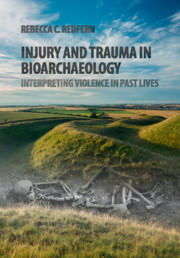
- Injury and Trauma in BioarchaeologyInterpreting Violence in Past Lives
- Injury and Trauma in Bioarchaeology
- Copyright page
- Dedication
- Contents
- Foreword
- Acknowledgements
- 1 Introduction
- 2 Approaches to Understanding and Interpreting Violence in the Past
- 3 Violent Behaviour in Humans and Human Societies
- 4 Environmental Factors and Violence
- 5 Injury in Life Course Perspective
- 6 Violent Happenings: Intentional Injury Patterns
- 7 Living with the Consequences of Injury
- 8 Conclusions
- References
- Index
- References
References
Published online by Cambridge University Press: 28 March 2017

Book contents
- Injury and Trauma in BioarchaeologyInterpreting Violence in Past Lives
- Injury and Trauma in Bioarchaeology
- Copyright page
- Dedication
- Contents
- Foreword
- Acknowledgements
- 1 Introduction
- 2 Approaches to Understanding and Interpreting Violence in the Past
- 3 Violent Behaviour in Humans and Human Societies
- 4 Environmental Factors and Violence
- 5 Injury in Life Course Perspective
- 6 Violent Happenings: Intentional Injury Patterns
- 7 Living with the Consequences of Injury
- 8 Conclusions
- References
- Index
- References
Summary
A summary is not available for this content so a preview has been provided. Please use the Get access link above for information on how to access this content.
Information
- Type
- Chapter
- Information
- Injury and Trauma in BioarchaeologyInterpreting Violence in Past Lives, pp. 209 - 323Publisher: Cambridge University PressPrint publication year: 2016
References
AALAND, M. O. & HLAING, T. 2004. Amish buggy injuries in the 21st century: A retrospective review from a rural level II trauma center. The American Surgeon, 70, 228–34; discussion 234.10.1177/000313480407000308CrossRefGoogle ScholarPubMed
ABBINK, J. 1999. Violence, ritual and reproduction: culture and context in Surma duelling. Ethnology, 38, 227–42.10.2307/3773815CrossRefGoogle Scholar
ABBINK, J. 2000. Preface: violation and violence as cultural phenomena. In: AIJMER, G. & ABBINK, J. (eds.) Meanings of violence. A cross cultural perspective. London: Berg.Google Scholar
ABDULHAYOGLU, E. 2004. Birth trauma. In: CLOHERTY, J. P., EICHENWALD, E. C. & STARK, A. R. (eds.) Manual of neonatal care. 6th edn. Philadelphia, PA: Lippencott Williams & Wilkins.Google Scholar
ABEL, E. L. 1984. Fetal alcohol syndrome and fetal alcohol effects. New York: Plenum Press.CrossRefGoogle Scholar
ABEL, E. L. 1997. Was the fetal alcohol syndrome recognized in the ancient Near East? Alcohol Alcohol, 32, 3–7.CrossRefGoogle ScholarPubMed
ABEL, E. L. 1999. Was the fetal alcohol syndrome recognized by the Greeks and Romans? Alcohol Alcohol, 34, 868–72.10.1093/alcalc/34.6.868CrossRefGoogle ScholarPubMed
ABEL, E. L. 2001. Gin Lane: did Hogarth know about fetal alcohol syndrome? Alcohol Alcohol, 36, 131–4.CrossRefGoogle ScholarPubMed
ABRAHAMS, N. & JEWKES, R. 2005. Effects of South African men’s having witnessed abuse of their mothers during childhood on their levels of violence in adulthood. American Journal of Public Health, 95, 1811–6.CrossRefGoogle ScholarPubMed
ABRAMSKY, T., WATTS, C. H., GARCIA-MORENO, C., et al. 2011. What factors are associated with recent intimate partner violence? Findings from the WHO multi-country study on women’s health and domestic violence. BMC Public Health, 11, 109.10.1186/1471-2458-11-109CrossRefGoogle Scholar
ABU-MANDIL HASSAN, N., BROWN, K. A., EYERS, J., BROWN, T. A. & MAYS, S. 2014. Ancient DNA study of the remains of putative infanticide victims from the Yewden Roman villa site at Hambleden, England. Journal of Archaeological Science, 43, 192–7.CrossRefGoogle Scholar
ADAMEC, J., MAI, V., GRAW, M., SCHNEIDER, K., HEMPEL, J. M. & SCHOPFER, J. 2013. Biomechanics and injury risk of a headbutt. International Journal of Legal Medicine, 127, 103–10.CrossRefGoogle ScholarPubMed
ADELSTEIN, A. M. 1952. Accident proneness: a criticism of the concept based upon an analysis of shunter’s accidents. Journal of the Royal Statistical Society A, 115, 354–410.CrossRefGoogle Scholar
ADESUNKANMI, A. R. K., OGINNI, L. M., OYELAMI, A. O. & BADRU, O. S. 1998. Epidemiology of childhood injury. Journal of Trauma – Injury, Infection and Critical Care, 44, 506–12.CrossRefGoogle ScholarPubMed
ADGER, W. N., PULHIN, J. M., BARNETT, J., et al. 2014. Human security. In: FIELD, C. B., BARROS, V. R., DOKKEN, D. J., et al. (eds.) Climate change 2014: impacts, adaptations, and vulnerability. Part A: Global and sectoral aspects. Contribution of Working Group II to the fifth assessment report of the intergovernmental panel on climate change. Cambridge: Cambridge University Press.Google Scholar
ADINKRAH, M. 2003. Men who kill their own children: paternal filicide incidents in contemporary Fiji. Child Abuse and Neglect, 27, 557–68.10.1016/S0145-2134(03)00041-3CrossRefGoogle ScholarPubMed
AGARWAL, S. C. & STOUT, S. D. (eds.) 2003. Bone loss and osteoporosis. An anthropological perspective. London: Springer.10.1007/978-1-4419-8891-1CrossRefGoogle Scholar
AGRAN, P. F., ANDERSON, C., WINN, D., TRENT, R., WALTON-HAYNES, L. & THAYER, S. 2003. Rates of pediatric injuries by 3-month intervals for children 0 to 3 years of age. Pediatrics, 111, e683–e692.CrossRefGoogle Scholar
AGRAN, P. F., WINN, D., ANDERSON, C., TRENT, R. & WALTON-HAYNES, L. 2001. Rates of pediatric and adolescent injuries by year of age. Pediatrics, 108, e45.10.1542/peds.108.3.e45CrossRefGoogle ScholarPubMed
AGRAWAL, S., GOPALAKRISHNAN, T., GOROKHOVICH, Y. & DOOCY, S. 2013a. Risk factors for injuries in landslide- and flood-affected populations in Uganda. Prehospital and Disaster Medicine, 28, 314–21.CrossRefGoogle ScholarPubMed
AGRARWAL, S., GOROKHOVICH, Y. & DOOCY, S. 2013b. Risk factors for mortality in landslide- and flood-affected populations in Uganda. American Journal of Disaster Medicine, 8, 113–22.Google Scholar
AHMED, A. M. & ELMARDI, A. E. 2005. A study of domestic violence among women attending a medical centre in Sudan. East Mediterranean Health Journal, 11, 164–74.Google ScholarPubMed
AHMED, N. & ANDERSSON, R. 2002. Differences in cause-specific patterns of unintentional injury mortality among 15–44-year-olds in income-based country groups. Accidental Analysis & Prevention, 34, 541–551.CrossRefGoogle ScholarPubMed
AIJMER, G. 2000. Introduction: the idiom of violence in imagery and discourse. In: AIJMER, G. & ABBINK, J. (eds.) Meanings of violence. A cross cultural perspective. London: Berg.Google Scholar
AIJMER, G. & ABBINK, J. 2000. Meanings of violence. A cross cultural perspective. Oxford: Berg.Google Scholar
AITKEN, S. C. 2001. Global crises of childhood: rights, justice and the unchildlike child. Area, 33, 119–27.CrossRefGoogle Scholar
AJAYI, M. D., DENLOVE, O. & ABIODUN SOLANKE, F. I. 2010. The unmet treatment need of traumatized anterior teeth in selected secondary school children in Ibadan, Nigeria. Dental Traumatology, 26, 60–3.10.1111/j.1600-9657.2009.00783.xCrossRefGoogle ScholarPubMed
ALBRECHT, G. L. & DEVLIEGER, P. J. 1999. The disability paradox: high quality of life against all odds. Social Science and Medicine, 48, 977–88.10.1016/S0277-9536(98)00411-0CrossRefGoogle ScholarPubMed
ALDRETE, G. S. 2007. Floods of the Tiber in Ancient Rome. Baltimore, MD: The Johns Hopkins University Press.CrossRefGoogle Scholar
ALINK, L. R., MESMAN, J., VAN ZEJI, J., et al. 2006. The early childhood aggression curve: development of physical aggression in 10- to 50-month-old children. Child Development, 77, 954–66.CrossRefGoogle ScholarPubMed
ALLAN, B. J., DAVIS, J. S., PANDYA, R. K., et al. 2013. Exploring trauma recidivism in an elderly cohort. Journal of Surgical Research, 184, 582–5.CrossRefGoogle Scholar
ALLAREDDY, V., ALLAREDDY, V. & NALLIAH, R. P. 2011. Epidemiology of facial fracture injuries. Journal of Oral and Maxillofacial Surgery, 69, 2613–18.10.1016/j.joms.2011.02.057CrossRefGoogle ScholarPubMed
ALLASIO, D. & FISCHER, H. 1998. Torture versus child abuse: what’s the difference? Clinical Pediatrics (Phila), 37, 269–71.10.1177/000992289803700410CrossRefGoogle ScholarPubMed
ALLEN, M. W. 2012. A land of violence. In: JONES, T. L. & PERRY, J. E. (eds.) Contemporary issues in Californian Archaeology. Walnut Creek, CA: Left Coast Press.Google Scholar
ALLEN, M. W. 2014. Conflict: the last bastion of the pacified past? In: ALLEN, M. W. & JONES, T. L. (eds.) Violence and warfare among hunter-gatherers. Walnut Creek, CA: Left Coast Press.Google Scholar
ALLEN, M. W. & JONES, T. L. (eds.) 2014. Violence and warfare among hunter-gatherers. Walnut Creek, CA: Left Coast Press.Google Scholar
ALLEN, T., NOVAK, S. A. & BENCH, L. L. 2007. Patterns of injuries: accident or abuse. Violence Against Women, 13, 802–16.CrossRefGoogle ScholarPubMed
ALLINGTON, N. 2008. Child abuse. In: SHERRY, E., TRIEU, L. & TEMPLETON, J. (eds.) Trauma. Oxford: Oxford University Press.Google Scholar
ALLINGTON, N. & TEMPLETON, P. 2008. Paediatric orthopaedics. In: SHERRY, E., TRIEU, L. & TEMPLETON, J. (eds.) Trauma. Oxford: Oxford University Press.Google Scholar
ALMGREN, G. 2005. The ecological context of interpersonal violence: from culture to collective efficacy. Journal of Interpersonal Violence, 20, 218–24.CrossRefGoogle ScholarPubMed
ALSOBROOK, J. P. II & PAULS, D. L. 2000. Genetics and violence. Child Adolesc Psychiatric Clinics of North America, 9, 765–76.Google ScholarPubMed
ALT, K. W. & PICHER, S. 1998. Artificial modifications of human teeth. In: ALT, K. W., RÖSING, F. W. & TESCHLER-NICOLA, M. (eds.) Dental anthropology: fundamentals, limits, and prospects. Berlin: Springer.CrossRefGoogle Scholar
ALVRUS, A. 1997. Trauma to the teeth and jaws: three Nubian examples. Journal of Paleopathology, 9, 5–14.Google Scholar
AMBERT, A.-M. 1994. An international perspective on parenting: social change and social constructs. Journal of Marriage and Family, 56, 529–43.10.2307/352865CrossRefGoogle Scholar
AMNESTY INTERNATIONAL. 2010. Charges against Spanish investigative judge must be dropped. Available: www.amnesty.org/en/for-media/press-releases/charges-against-spanish-investigative-judge-must-be-dropped-2010-04-22 (accessed 15 December 2010).Google Scholar
AMONE P’OLAK, K. 2009. Torture against children in rebel captivity in Northern Uganda: physical and psychological effects and implications for clinical practice. Torture, 19, 102–17.Google ScholarPubMed
ANAKWE, R. E., AITKEN, S. A., COWIE, J. G., MIDDLETON, S. D. & COURT-BROWN, C. M. 2011. The epidemiology of fractures of the hand and the influence of social deprivation. Journal of Hand Surgery: European Volume, 36, 62–5.Google ScholarPubMed
ANAYA, S. J. 2004. Indigenous peoples in international law. Oxford: Oxford University Press.CrossRefGoogle Scholar
ANDERSON, J. R. 2011. A primatological perspective on death. American Journal of Primatology, 73, 410–4.CrossRefGoogle ScholarPubMed
ANDERSON, J. R., GILLIES, A. & LOCK, L. C. 2010. Pan thanatology. Current Biology, 20, R349–51.10.1016/j.cub.2010.02.010CrossRefGoogle ScholarPubMed
ANDERSON, K. E. & SILVER, J. M. 2002. Violence and the brain. In: RAMACHANDRAN, V. S. (ed.) Encycopedia of the human brain. London: Elsevier Science.Google Scholar
ANDERSON, P. J. 1995. Fractures of the facial skeleton in children Injury, 26, 47–50.10.1016/0020-1383(95)90552-9CrossRefGoogle ScholarPubMed
ANDERSON, T. 2001. The human remains. In: HICKS, M. & HICKS, A. (eds.) St Gregory’s Priory, Northgate, Canterbury excavations 1988–1991. The archaeology of Canterbury volume II. Canterbury: Canterbury Archaeological Trust.Google Scholar
ANDREASEN, F. M. 2003. Transient root resorption after dental trauma: the clinician’s dilemma. Journal of Esthetic and Restorative Dentistry, 15, 80–92.CrossRefGoogle ScholarPubMed
ANDREASEN, J. O., BAKLAND, L. K., FLORES, M. T., ANDREASEN, F. M. & ANDERSSON, L. 2011. Traumatic dental injuries–a manual. Oxford: Wiley-Blackwell.Google Scholar
ANDRUSHKO, V. A., BUZON, M. R., GIBAJA, A. M., MCEWAN, G. F., SIMONETTI, A. & CREASER, R. A. 2011. Investigating a child sacrifice event from the Inca heartland. Journal of Archaeological Science, 38, 323–33.Google Scholar
ANETZBERGER, G. J. & TEASTER, P. B. 2010. Future directions for social policy and elder abuse: through the looking glass of generational characteristics. Journal of Elder Abuse & Neglect, 22, 207–15.CrossRefGoogle ScholarPubMed
ANSARI, M. H. 2005. Blindness after facial fractures: a 19-year retrospective study. Journal of Oral and Maxillofacial Surgery, 63, 229–237.CrossRefGoogle ScholarPubMed
ANTABAK, A., LUETIC, T., IVO, S., et al. 2013. Treatment outcomes of both-bone diaphyseal paediatric forearm fractures. Injury, 44 Suppl 3, S11–5.CrossRefGoogle ScholarPubMed
ANTOINE, D. & HILLSON, S. 2005. The Great Famine, Black Death and health in 14th-century London. Archaeology International 8, 26–8.Google Scholar
APLEY, A. G. & SOLOMON, L. 2000. Concise system of orthopaedics and fractures. London: Arnold.Google Scholar
APPLEBY, J. 2010a. Ageing as fragmentation and dis-integration. In: REBAY-SALISBURY, K., STIG SØRENSEN, M. L. & HUGHES, J. (eds.) Body parts and bodies whole. Oxford: Oxbow Books.Google Scholar
APPLEBY, J. E. P. 2010b. Why we need an archaeology of old age, and a suggested approach. Norwegian Archaeological Review, 43, 145–68.10.1080/00293652.2010.531582CrossRefGoogle Scholar
ARABION, H., TABRIZI, R., ALIABADI, E., GHOLAMI, M. & ZAREI, K. 2014. A retrospective analysis of maxillofacial trauma in Shiraz, Iran: a 6-year study of 768 patients (2004–2010). Journal of Dentistry (Shīrāz, Iran), 15, 15–21.Google ScholarPubMed
ARBER, S. & GINN, J. (eds.) 1995. Connecting gender and ageing: a sociological approach. Buckingham: Open University Press.Google Scholar
ARBER, S., DAVIDSON, K. & GINN, J. 2003. Changing approaches to gender and later life. In: ARBER, S., DAVIDSON, K. & GINN, J. (eds.) Gender and ageing. Changing roles and relationships. Maidenhead: Open University Press.Google Scholar
ARBOUS, A. G. & KERRICH, J. E. 1953. The phenomenon of accident proneness. Industrial Medicine and Surgery, 22, 141–8.Google ScholarPubMed
ARCHER, J. & LATHAM, M. 2004. Variation in beliefs about aggression as a function of relationship to the opponent Personality and Individual Differences, 37, 33–41.10.1016/j.paid.2003.08.025CrossRefGoogle Scholar
ARCHER, J. 2000. Sex differences in aggression between heterosexual partners: a meta-analytic review. Psychological Bulletin, 126, 651–80.CrossRefGoogle ScholarPubMed
ARCHER, J. 2004. Sex differences in aggression in real-world settings: a meta-analytic review. Review of General Psychology, 8, 291–322.10.1037/1089-2680.8.4.291CrossRefGoogle Scholar
ARCHER, J. 2006. Testerone and human behaviour: an evaluation of the challenge hypothesis. Neuroscience and Biobehavioral Reviews, 30, 319–45.CrossRefGoogle Scholar
ARCHER, J. 2009. Does sexual selection explain human sex differences in aggression? Behavioral and Brain Sciences, 32, 249–266.CrossRefGoogle ScholarPubMed
ARENDT, H. 2008. On violence. In: SCHEPER-HUGHES, N. & BOURGOIS, P. (eds.) Violence in war and peace, an anthology. Oxford: Blackwell Publishing.Google Scholar
ARIKOSKI, P. M. & BISHOP, N. J. 2002. Establishing good bone health. Current Paediatrics, 12, 125–9.10.1054/cupe.2001.0263CrossRefGoogle Scholar
ARKUSH, E. 2009 Warfare, space, and identity in the south-central Andes: Constraints and choices. In NIELSEN, A. E. & WALKER, W. H. (eds.) Warfare in cultural context: practice, agency, and the archaeology of violence. Tucson: University of Arizona Press.Google Scholar
ARKUSH, E. & TUNG, T. A. 2013. Patterns of war in the Andes from the Archaic to the Late Horizon: insights from settlement patterns and cranial trauma. Journal of Archaeological Research, 21.4, 307–69.10.1007/s10814-013-9065-1CrossRefGoogle Scholar
ARKUSH, E. N. & ALLEN, M. W. (eds.) 2008. The archaeology of warfare. Prehistories of raiding and conquest. Gainesville, FL: University Press of Florida.Google Scholar
ARMIT, I. 2010. Violence and society in the deep human past. British Journal of Criminology.Google Scholar
ARMIT, I., KNÜSEL, C., ROBB, J. & SCHULTING, R. 2007. Warfare and violence in prehistoric Europe: an introduction. In: POLLARD, T. & BANKS, I. (eds.) War and Sacrifice. Studies in the Archaeology of Conflict. Leiden: Brill.Google Scholar
ARMIT, I., SCHULTING, R., KNÜSEL, C. J. & SHEPHERD, I. A. G. 2011. Death, decapitation and display: the Bronze and Iron Age human remains from the Sculptor’s Cave, Covesea, North-east Scotland. Proceedings of the Prehistoric Society, 77, 251–78.10.1017/S0079497X00000694CrossRefGoogle Scholar
ARNAUD, B. 2003. Amputee art. Archaeology 56. Available: http://archive.archaeology.org/0311/newsbriefs/amputee.html (accessed 30 August 2016).Google Scholar
ARNOLD, J. 2002. From boys to men: formations of masculinity in late Medieval Europe. Philadelphia, PA: University of Pennsylvania Press.Google Scholar
ARNOLD, K., GILCHRIST, R., GRAVES, P. & TAYLOR, S. (eds.) 1988. Women and Archaeology. Archaeological Review from Cambridge, 7(1 entire issue).Google Scholar
ARNOLD SCHAM, S. 2001. The archaeology of the disinfranchised. Journal of Archaeological Method and Theory, 8, 183–213.10.1023/A:1011353202603CrossRefGoogle Scholar
ARRUDA, L. R. P., DE CAMPOS SILVA, M. A., MALERBA, F. G., et al. 2009. Open fractures: prospective and epidemiological study. Acta Ortopédica Brasileira, 17, 326–30.Google Scholar
ARSENEAULT, L., CANNON, M., MURRAY, R., POULTON, R., CASPI, A. & MOFFITT, T. E. 2003. Childhood origins of violent behaviour in adults with schizophreniform disorder. British Journal of Psychiatry, 183, 520–5.10.1192/02-485CrossRefGoogle ScholarPubMed
ARSENEAULT, L., TREMBLAY, R. E., BOULERICE, B., SEGUIN, J. R. & SAUCIER, J. F. 2000. Minor physical anomalies and family adversity as risk factors for violent delinquency in adolescence. American Journal of Psychiatry, 157, 917–23.10.1176/appi.ajp.157.6.917CrossRefGoogle ScholarPubMed
ARSENEAULT, L., TREMBLAY, R. E., BOULERICE, B. & SAUCIER, J. F. 2002. Obstetrical complications and violent delinquency: testing two developmental pathways. Child Development, 73, 496–508.CrossRefGoogle ScholarPubMed
ASHTON, V. 2004. The effect of personal characteristics on reporting child maltreatment. Child Abuse and Neglect, 28, 985–97.10.1016/j.chiabu.2004.03.012CrossRefGoogle ScholarPubMed
ATHERTON, W. G., HARPER, W. M. & ABRAMS, K. R. 2005. A year’s trauma admissions and the effect of the weather. Injury, 36, 40–6.CrossRefGoogle ScholarPubMed
ATKIN, A. 2012. Profiling the dead. A re-interpretation of the ‘executioner’s trench’. Sheffield: University of Sheffield.Google Scholar
ATKINS, J. 2002. Trauma trails, recreating song lines: the transgenerational effects of trauma in Indigenous Australia. Victoria: Spinifex Press Pty.Google Scholar
AUFDERHEIDE, A. 2010. The scientific studies of mummies. Cambridge: Cambridge University Press.Google Scholar
AUFDERHEIDE, A. C. & RODRIQUEZ-MARTIN, C. 1998. The Cambridge encyclopedia of human paleopathology. Cambridge: Cambridge University Press.Google Scholar
AULER, J. 2007. Richtstättenarchäologie in der Schweiz – ein Überblick. Archäologisches Korrespondenzblatt, 37, 297–312.Google Scholar
AVAKAME, E. F. 1998. Intergenerational transmission of violence, self-control, and conjugal violence: a comparative analysis of physical violence and psychological aggression. Violence and Victims, 13, 301–16.10.1891/0886-6708.13.3.301CrossRefGoogle ScholarPubMed
BAADSGAARD, A., MONGE, J., COX, S. & ZETTLER, R. L. 2011. Human sacrifice and intentional corpse preservation in the Royal Cemetery of Ur. Antiquity, 85, 27–42.CrossRefGoogle Scholar
BACCINO, E., UBELAKER, D. H., HAYEK, L.-A. & ZERILLI, A. 1999. Evaluation of seven methods of estimating age at death from mature human skeletal remains. Journal of Forensic Sciences, 4, 931–6.Google Scholar
BACHRACH, L. K. 2001. Acquistion of optimal bone mass in childhood and adolescence. Trends in Endocrinology Metabolism, 12, 22–8.CrossRefGoogle Scholar
BÄCK, A. 2004. Thinking clearly about violence. Philosophical Studies: an International Journal for Philosophy in the Analytic Tradition, 117, 219–30.10.1023/B:PHIL.0000014534.75890.daCrossRefGoogle Scholar
BAGHURST, P., OLDFIELD, R., WIGG, N., MCMICHAEL, A., ROBERTSON, E. & VIMPANI, G. 1985. Some characteristics and correlates of blood lead in early childhood: preliminary results from the Port Pirie Study. Environmental Research, 38, 24–30.10.1016/0013-9351(85)90069-6CrossRefGoogle ScholarPubMed
BAILEY, A. A. & HURD, P. L. 2004. Finger length ratio (2D:4D) correlates with physical aggression in men but not in women. Biological Psychology, 68, 215–22.Google Scholar
BAKULA, M. A., KOVACEVIC, D., SARILAR, M., PALIJAN, T. Z. & KOVAC, M. 2011. Quality of life in people with physical disabilities. Collegium Antropologicum, 35 Suppl 2, 247–53.Google ScholarPubMed
BALAN, B. & LINGAM, L. 2012. Unintentional injuries among children in resource poor settings: where do the fingers point? Archive of Disease in Childhood, 97, 35–8.CrossRefGoogle Scholar
BALKE, Z., RAMMELSBERG, P., LECKEL, M. & SCHMITTER, M. 2010. Prevalence of temporomandibular disorders: samples taken from attendees of medical health-care centers in the Islamic Republic of Iran. Journal of Orofacial Pain, 24, 361–6.Google ScholarPubMed
BALLBÉ, E. G. & STEADMAN, D. W. 2008. The political, social and scientific contexts of archaeological investigations of mass graves in Spain. Archaeologies, 4, 429–44.Google Scholar
BALME, J. & BOWDLER, S. 2006. Spear and digging stick. The origins of gender and its implications for the colonization of new continents. Journal of Social Archaeology, 6, 379–401.10.1177/1469605306067845CrossRefGoogle Scholar
BANCEJ, C. & ARBUCKLE, T. 2000. Injuries in Ontario farm children: a population based study. Injury Prevention, 6, 135–40.10.1136/ip.6.2.135CrossRefGoogle ScholarPubMed
BAND-WINTERSTEIN, T. & EISIKOVITS, Z. 2009. ‘Aging out’ of violence: the multiple faces of intimate violence over the life span. Qualitative Health Research, 19, 164–80.10.1177/1049732308329305CrossRefGoogle ScholarPubMed
BANJA, J. D. 1996. Ethics, values, and world culture: the impact of rehabiliation. Disability and Rehabilitation, 18, 279–84.10.3109/09638289609165881CrossRefGoogle Scholar
BARKER, B. C. W. 1975. Periodontal disease and tooth dislocation in Aboriginal remains from Lake Nitchie (N.S.W.),West Point (Tasmania) and Limestone Creek (Victoria). Archaeology & Physical Anthropology in Oceania, 10, 185–217.Google Scholar
BARKOVA, L. L. & PANKOVA, S. V. 2005. Tattooed mummies from the large Pazyryk mounds: new findings. Archaeology, Ethnology & Anthropology of Eurasia 2, 48–59.Google Scholar
BARNES, C. & MERCER, G. 1997. Breaking the mould? An introduction to doing disability research. In BARNES, C. & MERCER, G. (eds.) Doing disability research. Leeds: The Disability Press.Google Scholar
BARON-COHEN, S. 2005. Understanding impairment and disability: towards an international perspective. In BARNES, C. & MERCER, G. (eds.) The social model of disability and the majority world. Leeds: The Disability Press.Google Scholar
BARNES, E. 1994. Developmental defects of the axial skeleton in paleopathology. Niwat, CO: University Press of Colorado.Google Scholar
BARNESS, K. A., CHA, E. S., BENSARD, D. D., et al. 2003. The positive predictive value of rib fractures as an indicator of non-accidental trauma in children. Journal of Trauma, 54, 1107–10.Google Scholar
BARNETT, J. & ADGER, W. N. 2007. Climate change, human security and violent conflict. Political Geography, 26, 639–55.10.1016/j.polgeo.2007.03.003CrossRefGoogle Scholar
BAR-ON, E., LEBEL, E., BLUMBERG, N., SAGI, R. & KREISS, Y. 2013. Pediatric orthopedic injuries following an earthquake: experience in an acute-phase field hospital. Journal of Trauma and Acute Care Surgery, 74, 617–21.CrossRefGoogle Scholar
BARON, J. A., KARAGAS, M., BARRETT, J., et al. 1996. Basic epidemiology of fractures of the upper and lower limb among Americans over 65. Epidemiology, 7, 612–18.10.1097/00001648-199611000-00008CrossRefGoogle ScholarPubMed
BARON-COHEN, S. 2006. Sex differences in mind. In JONES, M. & FABIAN, A. C. (eds.) Conflict. Cambridge: Cambridge University Press.Google Scholar
BARON-COHEN, S. 2011. Zero degrees of empathy. A new theory of human cruelty. London: Allen Lane.Google Scholar
BARRIER, P. A. 1998. Domestic violence. Mayo Clinic Proceedings, 73, 271–4.10.4065/73.3.271CrossRefGoogle ScholarPubMed
BARSS, P. 1985. Fractured hips in rural Melanesians: A non-epidemic. Tropical and Geographical Medicine, 37, 156–9.Google Scholar
BARSS, P., DAKULALA, P. & DOOLAN, M. 1984. Falls from trees and tree associated injuries in rural Melanesians. British Medical Journal, 289, 1717–20.10.1136/bmj.289.6460.1717CrossRefGoogle ScholarPubMed
BARTEL, B. 1982. A historical review of ethnological and archaeological analyses of mortuary practice. Journal of Anthropological Archaeology, 1, 32–58.CrossRefGoogle Scholar
BARTONICEK, J., DZUPA, V., FRIC, V., PACOVSKY, V., SKALA-ROSENBAUM, J. & SVATOS, F. 2008. [Epidemiology and economic implications of fractures of proximal femur, proximal humerus, distal radius and fracture-dislocation of ankle]. Rozhledy v chirurgii: měsíčník Československé chirurgické společnosti, 87, 213–9.Google ScholarPubMed
BARTSIOKAS, A. 2000. The eye injury of King Philip II and the skeletal evidence from the royal tomb II at Vergina. Science, 288, 511–14.10.1126/science.288.5465.511CrossRefGoogle Scholar
BASTARRACHEA, G. B. 2008. The museum as a forum giving voice to the ‘Disappeared’: a case study of the Museum of Memory in Buenos Aires, Argentina. International Journal of the Inclusive Museum, 1, 127–34.Google Scholar
BASTONE, E. B., FREER, T. J. & MCNAMARA, J. R. 2000. Epidemiology of dental trauma: a review of the literature. Australian Dental Journal, 45, 2–9.CrossRefGoogle Scholar
BATISTA, A. M., MARQUES, L. S., BATISTA, A. E., FALCI, S. G. & RAMOS-JORGE, M. L. 2012. Urban–rural differences in oral and maxillofacial trauma. Brazilian Oral Research, 26, 132–8.10.1590/S1806-83242012000200008CrossRefGoogle ScholarPubMed
BAUER-CLAPP, H. J. & PÉREZ, V. R. 2014. Violence in life, violence in death, resiliency through repatriation: bioarchaeological analysis and heritage value of Yaqui skeletal remains from Sonora, Mexico. In MARTIN, D. L. & ANDERSON, C. P. (eds.) Bioarchaeological and forensic perspectives on violence: how violent death is interpreted from skeletal remains. Cambridge: Cambridge University Press.Google Scholar
BAUMHOVER, L. A., BEALL, S. C. & PIERONI, R. E. 1990. Elder abuse: an overview of social and medical indicators. Journal of Health and Human Resources Administration, 12, 414–33.Google ScholarPubMed
BAXTER, M. P. & WILEY, J. J. 1986. Fractures of the proximal humeral epiphysis. Their influence on humeral growth. The Journal of Bone and Joint Surgery. British volume, 68, 570–3.Google ScholarPubMed
BEATY, J. H. & KASSER, J. R. (eds.) 2005. Rockwood and Wilkin’s fractures in children. Philadelphia, PA: Lippincott, Williams and Wilkins.Google Scholar
BEATY, J. H., KASSER, J. R., FLYNN, J. M., SKAGGS, D. L. & WATERS, P. M. (eds.) 2010. Rockwood and Wilkins’ fractures in children. Philadelphia, PA: Lippincott Williams & Wilkins.Google Scholar
BEAULAURIER, R. L., SEFF, L. R. & NEWMAN, F. L. 2008. Barriers to help-seeking for older women who experience intimate partner violence: a descriptive model. J Women Aging, 20, 231–48.10.1080/08952840801984543CrossRefGoogle ScholarPubMed
BEAUMONT, J., GEBER, J., POWERS, N., WILSON, A., LEE-THORP, J. & MONTGOMERY, J. 2013. Victims and survivors: Stable isotopes used to identify migrants from the Great Irish Famine to 19th century London. American Journal of Physical Anthropology, 150, 87–98.10.1002/ajpa.22179CrossRefGoogle ScholarPubMed
BEAUMONT, J., MONTGOMERY, J., BUCKBERRY, J. & JAY, M. 2015. Infant mortality and isotopic complexity: new approaches to stress, maternal health, and weaning. American Journal of Physical Anthropology, 157, 441–57.10.1002/ajpa.22736CrossRefGoogle ScholarPubMed
BEAUSANG, E. 2000. Childbirth in prehistory: an introduction. European Journal of Archaeology, 3, 69–87.10.1179/eja.2000.3.1.69CrossRefGoogle Scholar
BECHTEL, K., STOESSEL, K., LEVENTHAL, J. M., et al. 2004. Characteristics that distinguish accidental from abusive injury in hospitalized young children with head trauma. Pediatrics, 114, 165–8.CrossRefGoogle ScholarPubMed
BECKER, J. B. (ed.) 2008. Sex differences in the brain, from genes to behavior. Oxford: Oxford University Press.Google Scholar
BEDNAREK, S., ABSIL, G., VANDOORNE, C., LACHAUSSEE, S. & VANMEERBEEK, M. 2009. Enfants negliges: ils naissent, ils vivent, mais surtout ils survivent. La Presse Médicale, 38, 377–83.CrossRefGoogle Scholar
BELL, M. & WALKER, M. J. C. 2005. Late Quarternary Environmental Change: physical and human perspectives. Harlow: Pearson Education.Google Scholar
BELL, N., SCHUURMAN, N. & HAMEED, S. M. 2009. A multilevel analysis of the socio-spatial pattern of assault injuries in greater Vancouver, British Columbia. Canadian Journal of Public Health, 100, 73–7.10.1007/BF03405498CrossRefGoogle ScholarPubMed
BELLINGER, D. C. 2008. Lead neurotoxicity and socioeconomic status: conceptual and analytical issues. Neurotoxicology, 29, 828–32.10.1016/j.neuro.2008.04.005CrossRefGoogle ScholarPubMed
BELLO, S. M. & ANDREWS, P. 2006. The intrinsic pattern of preservation of human skeletons and its influence on the interpretation of funerary behaviours. In GOWLAND, R. L. & KNÜSEL, C. J. (eds.) Social archaeology of funerary remains. Oxford: Oxbow Books.Google Scholar
BELLO, S. M. & SOLIGO, C. 2008. A new method for the quantitative analysis of cutmark micromorphology. Journal of Archaeological Science, 35, 1542–52.10.1016/j.jas.2007.10.018CrossRefGoogle Scholar
BELLO, S. M., PARFITT, S. A. & STRINGER, C. B. 2011. Earliest directly-dated human skull-caps. Public Library of Science One, 6, e17026.Google Scholar
BELLO, S. M., THOMANN, A., SIGNOLI, M., DUTOUR, O. & ANDREWS, P. 2006. Age and sex biases in the reconstruction of past population structures. American Journal of Physical Anthropology, 129, 24–38.10.1002/ajpa.20243CrossRefGoogle ScholarPubMed
BENBENISHTY, R. & CHEN, W. 2003. Decision making by the child protection team of a medical center. Health & Social Work, 28, 284–92.10.1093/hsw/28.4.284CrossRefGoogle ScholarPubMed
BENDEZU-SARMIENTO, J., FRANCFORT, H.-P., ISMAGULOVA, A. & SAMASHEV, Z. 2008. Post-mortem mutilations of human bodies in Early Iron Age Kazakhstan and their possible meaning for rites of burial. Antiquity, 82, 73–86.CrossRefGoogle Scholar
BEN-EZRA, M. 2004. Trauma in antiquity: 4000 year old post-traumatic reactions? Stress and Health, 20, 121–5.CrossRefGoogle Scholar
BEN-EZRA, M. 2011. Traumatic reactions from antiquity to the 16th century: was there a common denominator? Stress and Health, 27, 223–40.10.1002/smi.1338CrossRefGoogle Scholar
BENJAMIN, B. & KHAN, M. R. 1993. Pattern of external birth trauma in southwestern Saudi Arabia. The Journal of Trauma 35, 737–41.10.1097/00005373-199311000-00015CrossRefGoogle ScholarPubMed
BENNETT, G. B. & HOGAN, C. 2008. The injured elderly patient. In SHERRY, E., TRIEU, L. & TEMPLETON, J. (eds.) Trauma. Oxford: Oxford University Press.Google ScholarPubMed
BENNIKE, P., BRO-RASMUSSEN, F. & BRO-RASMUSSEN, P. 1987. Dislocation and/or congenital malformation of the shoulder joint. Observations on a Medieval skeleton from Denmark. Anthropologischer Anzeiger, 45, 117–29.CrossRefGoogle ScholarPubMed
BENTON, D. 2007. The impact of diet on anti-social, violent and criminal behaviour. Neuroscience and Biobehavioral Reviews, 31, 752–74.CrossRefGoogle ScholarPubMed
BENTON, D. 2008. Sucrose and behavioral problems. Critical Reviews in Food Science and Nutrition, 48, 385–401.CrossRefGoogle ScholarPubMed
BERENSON, A. B., WIEMANN, C. M., WILKINSON, G. S., JONES, W. A. & ANDERSON, G. D. 1994. Perinatal morbidity associated with violence experienced by pregnant women. Am J Obstetrics & Gynecology, 170, 1760–9.CrossRefGoogle ScholarPubMed
BERGER, L. M. 2005. Income, family characteristics, and physical violence toward children. Child Abuse & Neglect, 29, 107–33.10.1016/j.chiabu.2004.02.006CrossRefGoogle ScholarPubMed
BERGER, L. M. 2006. Predatory bird damage to the Taung type-skull of Australopithecus africanus Dart 1925. American Journal of Physical Anthropology, 131, 166–8.10.1002/ajpa.20415CrossRefGoogle Scholar
BERGER, L. M., PAXSON, C. & WALDFOGEL, J. 2009. Mothers, men, and child protective services involvement. Child Maltreat, 14, 263–76.CrossRefGoogle ScholarPubMed
BERGER, L. R. & CLARKE, R. J. 1995. Eagle involvement in accumulation of the Taung child fauna. Journal of Human Evolution, 29, 275–99.CrossRefGoogle Scholar
BERGER, L. R.& MCGRAW, W. S. 2007. Further evidence for eagle predator of, and feeding damage on, the Taung child. South African Journal of Science 103, 496–8.Google Scholar
BERGER, L. R., WALLACE, L. J. & BILL, N. M. 2009. Injuries and injury prevention among indigenous children and young people. Pediatric Clinics of North America, 56, 1519–37.CrossRefGoogle ScholarPubMed
BERGER, T. D. & TRINKAUS, E. 1995. Patterns of trauma among the Neandertals. Journal of Archaeological Science, 22, 841–52.CrossRefGoogle Scholar
BERKSON, G. 2004. Intellectual and physical disabilities in prehistory and early civilization. Mental Retardation, 42, 195–208.10.1352/0047-6765(2004)42<195:IAPDIP>2.0.CO;22.0.CO;2>CrossRefGoogle ScholarPubMed
BERNAUER, T., BÖHMELT, T. & KOUBI, V. 2012. Environmental changes and violent conflict. Environmental Research Letters, 7. Available: http://iopscience.iop.org/article/10.1088/1748-9326/7/1/015601 (accessed 30 August 2016).10.1088/1748-9326/7/1/015601CrossRefGoogle Scholar
BERNBECK, R. 2008. Structural violence in archaeology. Archaeologies, 4, 390–413.CrossRefGoogle Scholar
BERNDT, R. M. & BERNDT, C. H. 1988. The world of the first Australians: Aboriginal traditional life past and present. Canberra: Aboriginal Studies Press.Google Scholar
BERNSTEIN, M. P. & RIZZO, A. G. 2010. Imaging trauma in pregnancy. In KING, L. J. & WHERRY, D. C. (eds.) ABC of imaging in trauma. Chichester: Wiley-Blackwell.Google Scholar
BERRY, S. D. & MILLER, R. R. 2008. Falls: epidemiology, pathophysiology, and relationship to fracture. Current Osteoporosis Reports, 6, 149–54.10.1007/s11914-008-0026-4CrossRefGoogle ScholarPubMed
BETHEA, L. 2005. Linear parietal skull fracture in a three-month-old without a history of injury – abuse or not? The issue of a corroborated history. Journal of the South Carolina Medical Association, 101, 369–72.Google ScholarPubMed
BETTENCOURT, B. A. & KERNAHAN, C. 1997. A meta-analysis of aggression in the presence of violent cues: effects of gender differences and aversive provocation. Aggressive Behaviour, 23, 447–56.3.0.CO;2-D>CrossRefGoogle Scholar
BETZ, J. 1977. Violence: Garver’s definition and a Deweyan correction. Ethics 87, 339–51.10.1086/292046CrossRefGoogle Scholar
BHANDARI, M., SPRAGUE, S., TORNETTA, P. III, et al. 2008. (Mis)perceptions about intimate partner violence in women presenting for orthopaedic care: a survey of Canadian orthopaedic surgeons. The Journal of Bone and Joint Surgery. American volume, 90, 1590–7.Google Scholar
BHATTACHARYA, S. K. 1967. A result on accident proneness. Biometrika, 54, 324–5.10.1093/biomet/54.1-2.324CrossRefGoogle ScholarPubMed
BHATTACHARYYA, T. & MILLHAM, F. H. 2001. Relationship between weather and seasonal factors and trauma admission volume at a Level I trauma center. The Journal of Trauma 51, 118–22.CrossRefGoogle ScholarPubMed
BHENDE, M. S., DANDREA, L. A. & DAVIS, H. W. 1993. Hand injuries in children presenting to a pediatric emergency department. Annals of Emergency Medicine, 22, 1519–23.10.1016/S0196-0644(05)81251-XCrossRefGoogle ScholarPubMed
BHOLA, S., CHEN, J., FUSCO, J., et al. 2011. Variation in childhood skeletal robustness is an important determinant of cortical area in young adults. Bone, 49, 799–809.CrossRefGoogle Scholar
BICH, T. H., QUANG, L. N., HA LE, T. T., HANH, T. T. & GUHA-SAPIR, D. 2011. Impacts of flood on health: epidemiologic evidence from Hanoi, Vietnam. Global Health Action, 4. DOI: http://10.3402/gha.v4i0.6356.CrossRefGoogle ScholarPubMed
BIGGERSTAFF, M. A., MORRIS, P. M. & NICHOLS-CASEBOLT, A. 2002. Living on the edge: examination of people attending food pantries and soup kitchens. Journal of Social Work, 47, 267–77.Google ScholarPubMed
BILLMAN, B. R., LAMBERT, P. M. & LEONARD, B. L. 2000. Cannibalism, warfare, and drought in the Mesa Verde Region during the twelfth century A.D. American Antiquity, 65, 145–78.CrossRefGoogle ScholarPubMed
BILLMIRE, M. E. & MYERS, P. A. 1985. Serious head injury in infants: accident or abuse? Pediatrics, 75, 340–2.CrossRefGoogle ScholarPubMed
BINDER, M., EITLER, J., DEUTSCHMANN, J., LADSTÄTTER, S., GLASER, F. & FIEDLER, D. 2016. Prosthetics in antiquity – an early medieval wearer of a foot prosthesis (6th century AD) from Hemmaberg/Austria. International Journal of Paleopathology, 12, 29–40.10.1016/j.ijpp.2015.11.003CrossRefGoogle Scholar
BINSTOCK, R. H. & GEORGE, L. K. (eds.) 2001. Handbook of aging and the social sciences London: Academic Press.Google Scholar
BIRKBY, W. H. 1973. Human skeletal remains from the Dobell Site. Kiva, 39, 69–73.10.1080/00231940.1973.11757784CrossRefGoogle Scholar
BIRKE, L. 2005. Determined women. Feminism and biological determinism. In INGLIS, D., BONE, J. & WILKIE, R. (eds.) Nature. Critical concepts in the social sciences. Oxford: Oxford University Press.Google Scholar
BIRMES, P. J., BUI, E., KLEIN, R., et al. 2010. Psychotraumatology in antiquity. Stress and Health, 26, 21–31.CrossRefGoogle Scholar
BIRMES, P., HATTON, L., BRUNET, A. & SCHMITT, L. 2003. Early historical literature for post-traumatic symptomatology. Stress and Health, 19, 17–26.CrossRefGoogle Scholar
BISHOP, K. 2011. Thule palaeopathology: the health concerns of an Arctic lifestyle. Totem: The University of Western Ontario Journal of Anthropology, 19, 4.Google Scholar
BITHER, S., MAHINDRA, U., HALLI, R. & KINI, Y. 2008. Incidence and pattern of mandibular fractures in rural population: a review of 324 patients at a tertiary hospital in Loni, Maharashtra, India. Dental Traumatology, 24, 468–70.CrossRefGoogle Scholar
BJÖRKQVIST, K. 1994. Sex differences in physical, verbal, and indirect aggression: a review of recent research. Sex Roles, 30, 177–88.10.1007/BF01420988CrossRefGoogle Scholar
BJÖRKQVIST, K., LAGERSPETZ, K. M. J. & KAUKIAINEN, A. 1991. Do girls manipulate and boys fight? Developmental trends in regard to direct and indirect aggression. Aggressive Behavior, 18, 117–27.Google Scholar
BLACK, D. M. & COOPER, C. 2000. Epidemiology of fractures and assessment of fracture risk. Clinics in Laboratory Medicine, 20, 439–53.CrossRefGoogle ScholarPubMed
BLACKWOOD, B. & DANBY, P. M. 1955. A study of artificial cranial deformation in New Britain. The Journal of the Royal Anthropological Institute of Great Britain and Ireland, 85, 173–91.CrossRefGoogle Scholar
BLANE, D. 2006. The life course, the social gradient, and health. In MARMOT, M. G. & WILKINSON, R. G. (eds.) Social determinants of health. 2nd edn. Oxford: Oxford University Press.Google Scholar
BLIQUEZ, L. J. 1996. Prosthetics in classical antiquity: Greek, Etruscan and Roman prosthetics. In HAASE, W. & TEMPORINI, H. (eds.) Aufsteig und Niedergang der Römischen Welt II. Berlin and New York: Walter de Gruyter.Google Scholar
BLOCK, R. W. & KREBS, N. F. 2005. Failure to thrive as a manifestation of child neglect. Pediatrics, 116, 1234–7.10.1542/peds.2005-2032CrossRefGoogle ScholarPubMed
BLOK, A. 2000. The enigma of senseless violence. In AIJMER, G. & ABBINK, J. (eds.) Meanings of violence. A cross cultural perspective. Oxford: Berg.Google Scholar
BLOM, D. E. & KNUDSON, K. J. 2014. Tracing Tiwanaku childhoods. A bioarchaeological study of age and social identities in Tiwanaku society. In THOMPSON, J. L., ALFONSO-DURRATY, M. P. & CRANDALL, J. J. (eds.) Tracing childhood. Bioarchaeological investigations of early lives in antiquity. Gainesville, FL: University of Florida Press.Google Scholar
BLONDIAUX, G., BLONDIAUX, J., SECOUSSE, F., COTTEN, A., DANZE, P.-M. & FILIPO, R.-M. 2002. Rickets and child abuse: the case of a two year old girl from the 4th century Lisieux (Normandy). International Journal of Osteoarchaeology, 12, 209–15.10.1002/oa.616CrossRefGoogle Scholar
BLOOM, J. S., ANSELL, P. & BLOOM, M. N. 1989. Detecting elder abuse: a guide for physicians. Geriatrics, 44, 40–4, 56.Google ScholarPubMed
BLUEBOND-LANGNER, M. & KORBIN, J. (eds.) 2007. In focus: children, childhood, and childhood studies: American Anthropologist 109.2.Google Scholar
BOCCONE, S., CHILLERI, F., PACCIANI, E., MOGGI CECCHI, J. & SALVINI, M. 2011. The skeleton of a medieval male with multiple traumatic fractures from Piazza della Signoria, Florence, Italy. International Journal of Osteoarchaeology, 21, 602–12.10.1002/oa.1167CrossRefGoogle Scholar
BOCQUET-APPEL, J.-P. & BAR-YOSEF, O. (eds.) 2008. The Neolithic demographic transition and its consequences. London: Springer.10.1007/978-1-4020-8539-0CrossRefGoogle Scholar
BODE-JÄNISCH, S., HAVERMANN, R., GERMEROTT, T. & FIEGUTH, A. 2010. Examination results and autopsy findings in assaults on elderly people. Archiv für Kriminologie, 226, 176–86.Google ScholarPubMed
BOGIN, B. 1998. Evolutionary and biological aspects of childhood. In PANTER-BRICK, C. (ed.) Biosocial perspectives on children. Cambridge: Cambridge University Press.Google Scholar
BOLAND, M. C., DALY, L. & STAINES, A. 2009. Self-rated health and quality of life in adults attending regional disability services in Ireland. Disability and Health Journal, 2, 95–103.10.1016/j.dhjo.2008.11.005CrossRefGoogle ScholarPubMed
BOLDSEN, J. L., MILNER, G. R. & WEISE, S. 2015. Cranial vault trauma and selective mortality in medieval and early modern Denmark. Proceedings of the National Academy of Sciences, 112.6, 1721–6.Google Scholar
BOLLFRASS, A. & SHAVER, A. 2015. The effects of temperature on political violence: global evidence at the subnational level. Public Library of Science One, 10, e0123505.Google ScholarPubMed
BOMBA, P. A. 2006. Use of a single page elder abuse assessment and management tool: a practical clinician’s approach to identifying elder mistreatment. Journal of Gerontological Social Work, 46, 103–22.CrossRefGoogle Scholar
BONFIGLIOLI, B., MARIOTTI, V., FACCHINI, F., BELCASTRO, M. G. & CONDEMI, S. 2004. Masticatory and non-masticatory dental modifications in the epipalaeolithic necropolis of Taforalt (Morocco). International Journal of Osteoarchaeology, 14, 448–56.CrossRefGoogle Scholar
BONNEY, H. & CLEGG, M. 2011. Heads as memorials and status symbols: the collection and use of skulls in the Torres Strait Islands. In BONOGOFSKY, M. (ed.) The bioarchaeology of the human head: decapitation, deformation and decoration. Gainesville, FL: University Press of Florida.Google Scholar
BONOGOFSKY, M. (ed.) 2011. The bioarchaeology of the human head: decapitation, decoration and deformation. Gainesville, FL: University of Florida Press.CrossRefGoogle Scholar
BONSALL, C., MACKLIN, M. G., ANDERSON, D. E. & PAYTON, R. W. 2002. Climate change and the adoption of agriculture in North-west Europe. European Journal of Archaeology, 5, 9–23.CrossRefGoogle Scholar
BONSALL, L. 2013. Infanticide in Roman Britain: a critical review of the osteological evidence. Childhood in the Past: An International Journal, 6, 73–88.CrossRefGoogle Scholar
BOOKWALA, J., SOBIN, J. & ZDANIUK, B. 2005. Gender and aggression in marital relationships: A life-span perspective. Sex Roles, 52, 797–806.CrossRefGoogle Scholar
BORIĆ, D. & ROBB, J. 2008. Body theory in archaeology. In BORIC, D. & ROBB, J. (eds.) Past bodies. Body-centred research in archaeology. Oxford: Oxbow Books.Google Scholar
BORNA, H., RAD, S. M., BORNA, S. & MOHSENI, S. M. 2010. Incidence of and risk factors for birth trauma in Iran. Taiwan Journal of Obstetrics & Gynecology, 49, 170–3.CrossRefGoogle ScholarPubMed
BOSTON, C. 2014. Lobsters and tars: an osteological analysis of the origins, lifestyles and health of late 18th– early 19th-century seamen and marines of the Royal Navy, with particular reference to patterns of trauma and medical care. Unpublished DPhil thesis, University of Oxford.Google Scholar
BOSTON, C., WITKIN, A., BOYLE, A. & WILKINSON, D. R. P. 2008. ‘Safe moor’d in Greenwich tier’. A study of the skeletons of Royal Navy sailors and marines excavated from the Royal Hospital Greenwich. Oxford: Oxford Archaeology Monograph.Google Scholar
BOULESTIN, B., ZEEB-LANZ, A., JEUNESSE, C., HAACK, F., ARBOGAST, R.-M. & DENAIRE, A. 2009. Mass cannibalism in the Linear Pottery Culture at Herxheim (Palatinate, Germany). Antiquity, 83, 968–82.10.1017/S0003598X00099282CrossRefGoogle Scholar
BOURBOU, C. 2009. To live and die in a turbulent era: bioarchaeological analysis of the Early Byzantine (6th–7th centuries AD) population from Sourtara Galaniou Kozanis (Northern Greece). Dumbarton Oaks Papers, 63, 221–34.Google Scholar
BOURGET, D. & LABELLE, A. 1992. Homicide, infanticide, and filicide. Psychiatric Clinics of North America, 15, 661–73.CrossRefGoogle ScholarPubMed
BOUXSEIN, M. L., MELTON, L. J. III, et al. 2006. Age- and sex-specific differences in the factor of risk for vertebral fracture: a population-based study using QCT. Journal of Bone and Mineral Research, 21, 1475–82.CrossRefGoogle ScholarPubMed
BOWDLER, N. 2010. Neanderthal family found cannibalised in cave in Spain. Available: www.bbc.co.uk/news/science-environment-12049854 (accessed 13 March 2010).Google Scholar
BOWER, N. W., MCCANTS, S. A., CUSTODIO, J. M., KETTERER, M. E., GETTY, S. R. & HOFFMAN, J. M. 2007. Human lead exposure in a late 19th century mental asylum population. Science of the Total Environment, 372, 463–73.10.1016/j.scitotenv.2006.10.019CrossRefGoogle Scholar
BOWLING, A. 2005. Mode of questionnaire administration can have serious effects on data quality. Journal of Public Health, 27, 281–91.CrossRefGoogle ScholarPubMed
BOWMAN, G. 2001. The violence of identity. In SCHMIDT, B. E. & SCHRODER, I.W. (eds.) Anthropology of violence and conflict. London: Routledge.Google Scholar
BOYLE, D. J. & HASSETT-WALKER, C. 2008. Individual-level and socio-structural characteristics of violence: an Emergency Department study. Journal of Interpersonal Violence, 23, 1011–26.CrossRefGoogle ScholarPubMed
BRADBURY-JONES, C., INNES, N., EVANS, D., BALLANTYNE, F. & TAYLOR, J. 2013. Dental neglect as a marker of broader neglect: a qualitative investigation of public health nurses’ assessments of oral health in preschool children. BMC Public Health, 13, 370.CrossRefGoogle ScholarPubMed
BRAGA, L. L., FIKS, J. P., MARI, J. J. & MELLO, M. F. 2008. The importance of the concepts of disaster, catastrophe, violence, trauma and barabarism in defining posttraumatic stress disorder in clinical practice. BMC Psychiatry, 8(68). DOI: http://10.1186/1471-244x-8-68.CrossRefGoogle ScholarPubMed
BRAMANTI, B., THOMAS, M. G., HAAK, W., et al. 2009. Genetic discontinuity between local hunter-gatherers and central Europe’s first farmers. Science, 326, 137–40.10.1126/science.1176869CrossRefGoogle ScholarPubMed
BRENDGEN, M., BOIVIN, M., VITARO, F., et al. 2008. Linkages between children’s and their friends’ social and physical aggression: evidence for a gene-environment interaction? Child Development, 79, 13–29.10.1111/j.1467-8624.2007.01108.xCrossRefGoogle ScholarPubMed
BRIBIESCAS, R. G. 2006. Men: evolutionary and life history. Cambridge, MA: Harvard University Press.Google Scholar
BRICKLEY, M. 2006. Rib fractures in the archaeological record: a useful source of sociocultural information? International Journal of Osteoarchaeology, 16, 61–75.CrossRefGoogle Scholar
BRICKLEY, M. & IVES, R. 2008. The bioarchaeology of metabolic bone disease. London: Academic Press.10.1016/B978-0-12-370486-3.00002-0CrossRefGoogle Scholar
BRICKLEY, M. & SMITH, M. 2006. Culturally determined patterns of violence: biological anthropological investigations at a historic urban cemetery. American Anthropologist, 108, 163–77.CrossRefGoogle Scholar
BRIDGES, P. S., JACOBI, K. P. & POWELL, M. L. 2000. Warfare-related trauma in the late prehistory of Alabama. In LAMBERT, P. M. (ed.) Bioarchaeological studies of life in the age of agriculture: a view from the southeast. Tuscaloosa, AL: University of Alabama Press.Google Scholar
BRIGGS, A., GOOD, J. M., GREEN, R. E., et al. 2009. Targeted retrieval and analysis of five Neanderthal mtDNA genomes. Science, 325, 318–21.CrossRefGoogle Scholar
BRIGGS, A. M., VAN DIEEN, J. H., WRIGLEY, T. V., et al. 2007. Thoracic kyphosis affects spinal loads and trunk muscle force. Journal of Physical Therapy, 87, 595–607.10.2522/ptj.20060119CrossRefGoogle ScholarPubMed
BRINK, O. 2009. When violence strikes the head, neck, and face. Journal of Trauma, 67, 147–51.Google ScholarPubMed
BRINK, O., VESTERBY, A. & JENSEN, J. 1998. Patterns of injuries due to interpersonal violence. Injury, 29, 705–9.CrossRefGoogle ScholarPubMed
BRISENDEN, S. 1986. Independent living and the medical model of disability. Disability, Handicap and Society, 1, 173–8.CrossRefGoogle Scholar
BROCHU, C. A., NJAU, J., BLUMENSCHINE, R. J. & DENSMORE, L. D. 2010. A new horned crocodile from the Plio-Pleistocene hominid sites at Olduvai Gorge, Tanzania. Public Library of Science One 5, e9333.Google ScholarPubMed
BROCK, M., NORTHCRAFT-BAXTER, L., ESCOFFERY, C. & GREENE, B. L. 2012. Musculoskeletal health in South Georgia farmworkers: a mixed methods study. Work, 43, 223–36.Google ScholarPubMed
BROCKLISS, L. & MONTGOMERY, H. (eds.) 2010. Childhood and violence in the western tradition. Childhood in the Past Monograph Series Volume 1. Oxford: Oxbow Books.Google Scholar
BRØDHOLT, E. T. & HOLCK, P. 2012. Skeletal trauma in the burials from the royal church of St. Mary in medieval Oslo. International Journal of Osteoarchaeology, 22, 201–18.CrossRefGoogle Scholar
BROGDON, B. G., VOGEL, H. & MCDOWELL, J. D. (eds.) 2003. A radiologic atlas of abuse, torture, terrorism and inflicted trauma. Boca Raton, FL: CRC Press.CrossRefGoogle Scholar
BRONSTEIN, J. 2007. Caught in the machinery: workplace accidents and injured workers in Nineteenth-Century Britain, Stanford, CA: Stanford University Press.10.1515/9781503626867CrossRefGoogle Scholar
BROPHY, M., ZHANG, X. & XIANG, H. 2008. Injuries among US adults with disabilities Epidemiology, 19, 465–71.CrossRefGoogle ScholarPubMed
BROTHWELL, D. R. 1961. Cannibalism in Early Britain. Antiquity, 35, 304–7.10.1017/S0003598X00036383CrossRefGoogle Scholar
BROTHWELL, D. R. 2004. Biosocial and bioarchaeological aspects of conflict and warfare. In CARMAN, J. & HARDING, A. (eds.) Ancient warfare. Archaeological perspectives. Stroud: Sutton Publishing.Google Scholar
BROTHWELL, D. R. & MØLLER-CHRISTENSEN, V. 1963. Medico-historical aspects of a very early case of mutilation. Danish Medical Bulletin, 10, 21–5.Google Scholar
BROUWER, K. J. 1981. Torsional deformities after fractures of the femoral shaft in childhood. A retrospective study, 27–32 years after trauma. Acta Orthopaedica Scandinavica. Supplementum, 195, 1–167.Google ScholarPubMed
BROUWER, K. J., MOLENAAR, J. C. & VAN LINGE, B. 1981. Rotational deformities after femoral shaft fractures in childhood. A retrospective study 27–32 years after the accident. Acta Orthopaedica Scandinavica, 52, 81–9.Google ScholarPubMed
BROWN, J. K. 1963. A cross-cultural study of female initiation rites. American Anthropologist, 65, 837–53.10.1525/aa.1963.65.4.02a00040CrossRefGoogle Scholar
BROWN, J. K. 1999. Introduction: definitions, assumptions, themes, and issues. In COUNTS, D. A., BROWN, J. K. & CAMPBELL, J. C. (eds.) To have and to hit: Cultural perspectives on wife beating. Champaign, IL: University of Illnois Press.Google Scholar
BRUDVIK, C. & HOVE, L. M. 2003. Childhood fractures in Bergen, Norway: identifying high-risk groups and activities. Journal of Pediatric Orthopedics, 23, 629–34.10.1097/01241398-200309000-00010CrossRefGoogle ScholarPubMed
BRUNNER, F., KRASTL, G. & FILIPPI, A. 2009. Dental trauma in adults in Switzerland. Dental Traumatology, 25, 181–4.CrossRefGoogle ScholarPubMed
BRUNNER, H. G., NELEN, M., BREAKEFIELD, X. O., ROPERS, H. H. & VAN OOST, B. A. 1993. Abnormal behavior associated with a point mutation in the structural gene for monoamine oxidase A. Science, 22, 578–80.Google Scholar
BRUNO, A. G., ANDERSON, D. E., D’AGOSTINO, J. & BOUXSEIN, M. L. 2012. The effect of thoracic kyphosis and sagittal plane alignment on vertebral compressive loading. Journal of Bone and Mineral Research, 27, 2144–51.10.1002/jbmr.1658CrossRefGoogle ScholarPubMed
BRUSA, A. E., ALPINI, D., CORTI, A., MONTEMAGNO, M. & SCADUTO, S. 1987. [Deviation of the septum in the neonate: the role of birth trauma]. Minerva Ginecol, 39, 257–60.Google ScholarPubMed
BUCKBERRY, J. L. 2010. Off with their heads: the Anglo-Saxon execution cemetery at Walkington Wold, east Yorkshire. In MURPHY, E. M. (ed.) Deviant burial in the archaeological record. Oxford: Oxbow Books.Google Scholar
BUCKBERRY, J. L. 2014. Osteological evidence of corporal and capital punishment in Later Anglo-Saxon England. In GATES, J. P. & MARAFIOTI, N. (eds.) Capital and corporal punishment in Anglo-Saxon England. Woodbridge: The Boydell Press.Google Scholar
BUCKBERRY, J. L. & CHERRYSON, A. K. (eds.) 2010. Burial in later Anglo-Saxon England, c. 650–1100 AD. Oxford: Oxbow Books.Google Scholar
BUCKBERRY, J. L. & HADLEY, D. M. 2007. An Anglo-Saxon execution cemetery at Walkington Wold, Yorkshire. Oxford Journal of Archaeology, 26, 309–29.CrossRefGoogle Scholar
BUCKHOLTZ, J. W. & MEYER-LINDENBERG, A. 2009. Gene-brain associations: the example of MAOA. In HODGINS, S., VIDING, E. & PLODOWSKI, A. (eds.) The neurobiological basis of violence: science and rehabilitation. Oxford: Oxford University Press.Google Scholar
BUCKINGHAM, J. 2011. Writing histories of disability in India: strategies of inclusion. Disability and Society, 26, 419–31.10.1080/09687599.2011.567792CrossRefGoogle Scholar
BUCKLEY, T. & GOTTLIEB, A. (eds.) 1988. Blood magic: the anthropology of menstruation, Berkeley, CA: University of California Press.CrossRefGoogle Scholar
BUDD, P., MONTGOMERY, J., EVANS, J. & CHENERY, C. 2001. Combined Pb-, Sr-and O-isotope analysis of human dental tissue for the reconstruction of archaeological residential mobility. Special Publications of the Royal Society of Chemistry, 267, 311–26.Google Scholar
BUFACCHI, V. 2005. Two concepts of violence. Political Studies Review, 3, 193–204.CrossRefGoogle Scholar
BUIKSTRA, J. & ROBERTS, C. (eds.) 2012. The global history of paleopathology: pioneers and prospects. Oxford: Oxford University Press.CrossRefGoogle Scholar
BUIKSTRA, J. E. & BECK, L. A. (eds.) 2006. Bioarchaeology: the contextual analysis of human remains. London: Academic Press.Google Scholar
BUIKSTRA, J. E. & SCOTT, R. E. 2009. Key concepts in identity studies. In KNUDSON, K. J. & STOJANOWSKI, C. M. (eds.) Bioarchaeology and identity in the Americas. Gainesville, FL: University Press of Florida.Google Scholar
BUKA, S. L., STICHICK, T. L., BIRDTHISTLE, I. & EARLS, F. J. 2001. Youth exposure to violence: prevalence, risks, and consequences. American Journal of Orthopsychiatry, 71, 298–310.CrossRefGoogle ScholarPubMed
BULAJIC-KOPJAR, M. 2000. Seasonal variations in incidence of fractures among elderly people. Injury Prevention, 6, 16–9.CrossRefGoogle ScholarPubMed
BULLOCH, B., SCHUBERT, C. J., BROPHY, P. D., JOHNSON, N., REED, M. H. & SHAPIRO, R. A. 2000. Cause and clinical characteristics of rib fractures in infants. Pediatrics, 105, e48.10.1542/peds.105.4.e48CrossRefGoogle ScholarPubMed
BURBANK, V. 1990. Sex, gender and difference. Dimensions of aggression in an Australian Aboriginal community. Human Nature, 31, 251–78.Google Scholar
BURBANK, V. K. 1987. Female aggression in cross-cultural perspective. Cross Cultural Research, 21, 70–100.Google Scholar
BURBANK, V. K. 1994. Fighting women:anger and aggression in Aboriginal Australia, London: University of California Press.10.1525/9780520377684CrossRefGoogle Scholar
BURKET, W. 1988. The problem of ritual killing. In HAMERTON-KELLY, R. (ed.) Violent origins. Walter Burket, Rene Girard, and Jonathan Z. Smith on ritual killing and cultural formation. Stanford, CA: Stanford University Press.Google Scholar
BURNHAM, J. C. 2008. Accident proneness (Unfallneigung): a classic case of simultaneous discovery/construction in psychology. Science in Context, 21, 99–118.CrossRefGoogle ScholarPubMed
BURNHAM, J. C. 2009. Accident prone: a history of technology, psychology, and the misfits of the machine age, Chicago, IL: University of Chicago Press.CrossRefGoogle Scholar
BURRISS, R. P., LITTLE, A. C. & NELSON, E. C. 2006. 2D:4D and sexually dimorphic facial characteristics. Archives of Sexual Behavior, 36, 377–84.Google Scholar
BURTON, J. W. 2001. Culture and the human body. An anthropological perspective. Prospect Heights, IL: Waveland Press.Google Scholar
BURY, D., LANGLOIS, N. & BYARD, R. W. 2012. Animal-related fatalities–part I: characteristic autopsy findings and variable causes of death associated with blunt and sharp trauma. Journal of Forensic Sciences, 57, 370–4.Google ScholarPubMed
BUSBY, G. B., BRISIGHELLI, F., SANCHEZ-DIZ, P., et al. 2012. The peopling of Europe and the cautionary tale of Y chromosome lineage R-M269. Proceedings of the Royal Society. Biological Sciences, 279, 884–92.Google ScholarPubMed
BUSCH, H. M., COGBILL, T. H., LANDERCASPER, J. & LANDERCASPER, B. O. 1986. Blunt bovine and equine trauma. Journal of Trauma, 26, 559–60.10.1097/00005373-198606000-00013CrossRefGoogle ScholarPubMed
BUTCHART, A. & ENGSTROM, K. 2002. Sex- and age-specific relations between economic development, economic inequality and homicide rates in people aged 0–24 years: a cross-sectional analysis. Bulletin of the World Health Organization, 80, 797–805.Google ScholarPubMed
BUTLER, J. 1990. Gender trouble. Feminism and the subversion of identity, London: Routledge.Google Scholar
BUTLER, J. 2004. Advancing the inclusion of persons with disabilities: executive summary, Ottawa: Human Resources and Social Development.Google Scholar
BUTOVSKAYA, M. L. 2013. Aggression and conflict resolution among the nomadic Hadza of Tanzania as compared with their pastoralist neighbors. In FRY, D. P. (ed.) War, peace, and human nature: the convergence of evolutionary and cultural views. Oxford: Oxford University Press.Google Scholar
BUZON, M. R., ENG, J. T., LAMBERT, P. M. & WALKER, P. L. 2005. Bioarchaeological methods. In MASCHNER, H. & CHIPPINDALE, C. (eds.) Handbook of archaeological methods, volume II. Lanham, MD: AltaMira Press.Google Scholar
BUZON, M. R., WALKER, P. L., VERHAGEN, F. D. & KERR, S. L. 2005. Health and disease in nineteenth-century San Francisco: skeletal evidence from a forgotten cemetery. Historical Archaeology, 39, 1–15.10.1007/BF03376683CrossRefGoogle Scholar
BYARD, R. W. & SIMPSON, E. 2005. Characteristics acquired features of Indigenous Australians that may be observed in forensic practice. Forensic Science, Medicine, and Pathology, 1, 207–13.10.1385/FSMP:1:3:207CrossRefGoogle ScholarPubMed
BYARD, R. W., GILBERT, J. D. & JAMES, R. A. 2001. Traditional punishment and unexpected death in Central Australia. American Journal of Forensic Medicine and Pathology, 22, 92–5.CrossRefGoogle ScholarPubMed
CADORET, R. J., LEVE, L. D. & DEVOR, E. 1997. Genetics of aggressive and violent behavior. Psychiatric Clinics of North America, 20, 301–22.10.1016/S0193-953X(05)70314-2CrossRefGoogle ScholarPubMed
CADZOW, S. P. & ARMSTRONG, K. L. 2000. Rib fractures in infants: red alert! The clinical features, investigations and child protection outcomes. Journal of Pediatric Child Health, 36, 322–6.10.1046/j.1440-1754.2000.00515.xCrossRefGoogle ScholarPubMed
CAIN, L. P. & PATERSON, D. G. 2012. The children of Eve: population and well-being in history, London: Wiley-Blackwell.Google Scholar
CAINE, N. G. & REITE, M. 1983. Infant abuse in captive pig-tailed macaques: relevance to human child abuse. In REITE, M. & CAINE, N. G. (eds.) Child abuse: the nonhuman primate data. New York: Alan R Liss.Google Scholar
CALCE, S. E. & ROGERS, T. L. 2007. Taphonomic changes to blunt force trauma: a preliminary study. Journal of Forensic Sciences, 52, 519–27.CrossRefGoogle ScholarPubMed
CALDAS, A. F., JR. & BURGOS, M. E. 2001. A retrospective study of traumatic dental injuries in a Brazilian dental trauma clinic. Dental Traumatology, 17, 250–3.Google Scholar
CALDAS, I. M., MAGALHAES, T., AFONSO, A. & MATOS, E. 2010. The consequences of orofacial trauma resulting from violence: a study in Porto. Dental Traumatology, 26, 484–9.10.1111/j.1600-9657.2010.00936.xCrossRefGoogle ScholarPubMed
CAMARÓS, E., CUETO, M., LORENZO, C., VILLAVERDE, V. & RIVALS, F. 2016. Large carnivore attacks on hominins during the Pleisocene: a forensic approach with a Neanderthal example. Archaeological and Anthropological Sciences, 8.635. DOI: 10.1007512520-015-0248-1.CrossRefGoogle Scholar
CAMPBELL, A. 2006. Sex differences in direct aggression: what are the psychological mediators? Aggression and Violent Behavior, 11, 237–64.10.1016/j.avb.2005.09.002CrossRefGoogle Scholar
CAMPBELL, A. 2007. Sex differences in aggression. In DUNBAR, R. I. M. & BARRETT, L. (eds.) The Oxford handbook of evolutionary psychology. Oxford: Oxford University Press.Google Scholar
CAMPBELL, A., MUNCER, S. & BIBEL, D. 2001. Women and crime: an evolutionary approach. Aggression and Violent Behavior, 6, 481–97.10.1016/S1359-1789(00)00019-7CrossRefGoogle Scholar
CAMPBELL, A. H. 1981. Tooth avulsion in Victorian Aboriginal skulls. Archaeology in Oceania, 16, 116–18.10.1002/j.1834-4453.1981.tb00016.xCrossRefGoogle Scholar
CAMPBELL, A. W. 1895a. The breaking strain of the ribs of the insane: an analysis of a series of fifty-eight cases tested with an instrument specially devised by Dr C.H. Mercier. Journal of Mental Science, 41, 254–74.10.1192/bjp.41.173.254CrossRefGoogle Scholar
CAMPBELL, A. W. 1895b. A comparison between the breaking strain of the ribs of the sane and insane. British Medical Journal, 2, 776–7.Google Scholar
CAMPBELL, J., JONES, A. S., DIENEMANN, J., et al. 2002. Intimate partner violence and physical health consequences. Archives of Internal Medicine, 162, 1157–63.CrossRefGoogle ScholarPubMed
CANALE, S. T. 1998. Fractures and dislocations in children. In CANALE, S. T. (ed.) Campbell’s operative orthopaedics. St Louis,MO: Mosby.Google Scholar
CANNATA, L. K., PAN, P., CASEY, B. M., MCINTIRE, D. D., SHAFI, S. & LEVENO, K. J. 2010. Pregnancy outcomes after orthopedic trauma. The Journal of Trauma 69, 694–8.Google Scholar
CANNON, A. 1989. The historical dimension in mortuary expressions of status and sentiment. Current Anthropology, 30, 437–58.CrossRefGoogle Scholar
CANNON, A. 2014. Historical and humanist perspectives on Hunter-Gatherers. In CUMMINGS, V., JORDAN, P. & ZVELEBIL, M. (eds.) The Oxford handbook of the archaeology and anthropology of hunter-gatherers. Oxford: Oxford University Press.Google Scholar
CAPPELLA, A., AMADASI, A., CASTOLDI, E., MAZZARELLI, D., GAUDIO, D. & CATTANEO, C. 2014. The difficult task of assessing perimortem and postmortem fractures on the skeleton: a blind text on 210 fractures of known origin. Journal of Forensic Sciences, 59, 1598–601.10.1111/1556-4029.12539CrossRefGoogle ScholarPubMed
CARDONA, M., JOSHI, R., IVERS, R. Q., et al. 2008. The burden of fatal and non-fatal injury in rural India. Injury Prevention, 14, 232–7.10.1136/ip.2007.018259CrossRefGoogle ScholarPubMed
CARDOSO, F. A. & HENDERSON, C. 2013. The categorisation of occupation in identified skeletal collections: a source of bias? International Journal of Osteoarchaeology, 23, 186–96.10.1002/oa.2285CrossRefGoogle Scholar
CARLSON, K. F., LANGNER, D., ALEXANDER, B. H., et al. 2006. The association between parents’ past agricultural injuries and their children’s risk of injury. Analyses from the regional rural injury study-II. Archives of Pediatrics and Adolescent Medicine, 160, 1137–42.CrossRefGoogle ScholarPubMed
CARMAN, J. 1993. The P is silent – as in archaeology. Archaeological Review from Cambridge, 12, 29–38.Google Scholar
CARMAN, J. & CARMAN, P. 2006. Bloody Meadows: investigating landscapes of battle. Stroud: The History Press.Google Scholar
CARMAN, J. & HARDING, A. 2004a. Epilogue: the future study of ancient warfare. In CARMAN, J. & HARDING, A. (eds.) Ancient warfare. Archaeological perspectives. Stroud: Sutton Publishing.Google Scholar
CARMAN, J. & HARDING, A. 2004b. Introduction. In CARMAN, J. & HARDING, A. (eds.) Ancient warfare. Archaeological perspectives. Stroud: Sutton Publishing.Google Scholar
CARMO, R., GRAMS, A. & MAGALHAES, T. 2011. Men as victims of intimate partner violence. Journal of Forensic and Legal Medicine, 18, 355–9.10.1016/j.jflm.2011.07.006CrossRefGoogle ScholarPubMed
CARNEGIE COMMISSION ON PREVENTING DEADLY CONFLICT 1998. Preventing deadly conflict. New York: Carnegie Corporation.Google Scholar
CARPENTER, D. O. & NEVIN, R. 2010. Environmental causes of violence. Physiology Behavior, 99, 260–8.10.1016/j.physbeh.2009.09.001CrossRefGoogle ScholarPubMed
CARREON, L. Y., GLASSMAN, S. D. & CAMPBELL, M. J. 2004. Pediatric spine fractures: a review of 137 hospital admissions. Journal of Spinal Disorders & Techniques, 17, 477–82.CrossRefGoogle ScholarPubMed
CARTER WOOD, J. 2006. Locating violence: the spatial production and construction of physical aggression. In WATSON, K. D. (ed.) Assaulting the past. Violence and civilization in historical context. Newcastle: Cambridge Scholars Publishing.Google Scholar
CASE, M. E. 2008. Accidental traumatic head injury in infants and young children. Brain Pathology, 18, 583–9.Google ScholarPubMed
CASELLA, E. C. & FOWLER, C. (eds.) 2005. The archaeology of pleural and changing identities: beyond identification. London: Springer.10.1007/b109969CrossRefGoogle Scholar
CASHDAN, E. 2003. Hormones and competitive aggression in women. Aggressive Behavior, 29, 107–15.10.1002/ab.10041CrossRefGoogle Scholar
CASSELL, E. J. 2011. Compassion. In LOPEZ, S. J. & SNYDER, C. R. (eds.) Oxford handbook of positive psychology. 2nd edn. Oxford: Oxford University Press.Google Scholar
CASTRO, J. C., POI, W. R., MANFRIN, T. M. & ZINA, L. G. 2005. Analysis of the crown fractures and crown-root fractures due to dental trauma assisted by the Integrated Clinic from 1992 to 2002. Dental Traumatology, 21, 121–6.10.1111/j.1600-9657.2005.00276.xCrossRefGoogle ScholarPubMed
CATANZARITI, J. F., SALOMEZ, E., BRUANDET, J. M. & THEVENON, A. 2001. Visual deficiency and scoliosis. Spine (Phila Pa 1976), 26, 48–52.10.1097/00007632-200101010-00010CrossRefGoogle ScholarPubMed
CATTANEO, L. B. & DELOVEH, H. L. 2008. The role of socioeconomic status in helpseeking from hotlines, shelters, and police among a national sample of women experiencing intimate partner violence. American Journal of Orthopsychiatry, 78, 413–22.10.1037/a0014558CrossRefGoogle ScholarPubMed
CAUFEILD, J., SINGHAL, A., MOULTON, R., BRENNEMAN, F., REDELMEIER, D. & BAKER, A. J. 2004. Trauma recidivism in a large urban Canadian population. The Journal of Trauma, 57, 872–6.10.1097/01.TA.0000135350.06670.60CrossRefGoogle Scholar
CAVALCANTI, A. L. & MELO, T. R. 2008. Facial and oral injuries in Brazilian children aged 5–17 years: a 5-year review. European Archives of Paediatric Dentistry, 9, 102–4.10.1007/BF03262619CrossRefGoogle Scholar
CEJKA, M. A. & EAGLY, A. H. 1999. Gender-stereotypic images of occupations correspond to the sex segregation of employment. Personality and Social Psychology Bulletin, 25, 413–23.CrossRefGoogle Scholar
CENTRE FOR HUMAN BIOARCHAEOLOGY, M. O. L. 2011. Cemetery summaries. Available: www.museumoflondon.org.uk/English/Collections/OnlineResources/CHB/Database/CemeterySum.htm (accessed 25 January 2011).Google Scholar
CENTERS FOR DISEASE CONTROL AND PREVENTION 2011. Post-earthquake injuries treated at a field hospital – Haiti, 2010. Morbidity and Mortality Weekly Report, 59, 1673–7.Google Scholar
CERUTI, C. 2004. Human bodies as objects of dedication at Inca Mountain Shrines (North-Western Argentina). World Archaeology, 36, 103–22.10.1080/0043824042000192632CrossRefGoogle Scholar
CHACON, R. J. & DYE, D. H. 2008a. Introduction to human trophy taking. An ancient and widespread practice. In CHACON, R. J. & DYE, D. H. (eds.) The taking and displaying of human body parts as trophies by Amerindians. New York: Springer.Google Scholar
CHACON, R. J. & DYE, D. H. (eds.) 2008b. The taking and displaying of human body parts as trophies by Amerindians. New York: Springer.Google Scholar
CHACON, R. J. & MENDOZA, F. 2007a. Latin American Indigenous warfare and ritual violence, Tucson, AZ: University of Arizona Press.10.2307/j.ctv1jf2cq3CrossRefGoogle Scholar
CHACON, R. J. & MENDOZA, R. 2007b. North American Indigenous warfare and ritual violence, Tuscon, AZ: University of Arizona Press.10.2307/j.ctv1n3x1fbCrossRefGoogle Scholar
CHALMERS, D. J., FANSLOW, J. L. & LANGLEY, J. D. 1995. Injury from assault in New Zealand: an increasing public health problem. Australian Journal of Public Health, 19, 149–54.10.1111/j.1753-6405.1995.tb00365.xCrossRefGoogle ScholarPubMed
CHAMAY, A. 1970. Mechanical and morphological aspects of experimental overload and fatigue in bone. Journal of Biomechanics, 3, 262–70.CrossRefGoogle ScholarPubMed
CHAMBERLAIN, A. 2006. Demography in archaeology, Cambridge: Cambridge University Press.CrossRefGoogle Scholar
CHAN, D. 2009. Statistical and methodological myths and urban legends: Doctrine, verity and fable in the organizational and social sciences. New York: Routledge.Google Scholar
CHAN, K. L. 2012. Gender symmetry in the self-reporting of intimate partner violence. Journal of Interpersonal Violence, 27, 263–86.10.1177/0886260511416463CrossRefGoogle ScholarPubMed
CHAPMAN, J. 1999. The origins of warfare in the prehistory of central and eastern Europe. In CARMAN, J. & HARDING, A. (eds.) Ancient warfare: archaeological perspectives. Stroud: Sutton Publishing.Google Scholar
CHAPMAN, S. 1992. The radiological dating of injuries. Archive of Disease in Childhood, 67, 1063–5.10.1136/adc.67.9.1063CrossRefGoogle ScholarPubMed
CHAPPELL HODGE, S. & BERRYMAN, H. E. 2008. Evidence of prehistoric violent trauma from a cave in Middle Tennessee. Tennessee Archaeology, 3, 139–56.Google Scholar
CHARLIER, P. 2006. Did social assistance for handicapped subjects exist in Prehistory? Medicina nei Secoli, 18, 399–419.Google ScholarPubMed
CHARLTON, J. I. 2000. Nothing about us without us: disability oppression and empowerment, London: University of California Press.Google Scholar
CHAU, N., PREDINE, R., BENAMGHAR, L., MICHAELY, J. P., CHOQUET, M. & PREDINE, E. 2008. Determinants of school injury proneness in adolescents: a prospective study. Public Health, 122, 801–8.10.1016/j.puhe.2007.08.020CrossRefGoogle ScholarPubMed
CHENG, J. C. Y., NG, B. K. W., YING, S. Y. & LAM, P. K. W. 1999. A 10-year study of the changes in the pattern and treatment of 6,493 fractures. Journal of Pediatric Orthopaedics, 19, 344–50.10.1097/01241398-199905000-00011CrossRefGoogle ScholarPubMed
CHENG, T. L., JOHNSON, S., WRIGHT, J. L., et al. 2006. Assault-injured adolescents presenting to the emergency department: causes and circumstances. Academic Emergency Medicine, 13, 610–6.Google Scholar
CHERRY, D. C., HUGGINS, B. & GILMORE, K. 2007. Children’s health in the rural environment. Pediatric Clinics of North America, 54, 121–33.10.1016/j.pcl.2006.11.008CrossRefGoogle ScholarPubMed
CHERRY, N., CHOWDHURY, M., HAGUE, R., MCDONALD, C. & CHOWDHURY, Z. 2012. Disability among elderly rural villagers: report of a survey from Gonoshasthaya Kendra, Bangladesh. BMC Public Health, 25, 379.10.1186/1471-2458-12-379CrossRefGoogle Scholar
CHERRYSON, A. K. 2010. Normal, deviant and atypical: burial variation in late Saxon Wessex, c. AD 700–1100. In MURPHY, E. M. (ed.) Deviant burial in the archaeological record. Oxford: Oxbow Books.Google Scholar
CHEW, D. J. & EDMONDSON, H. D. 1996. A study of maxillofacial injuries in the elderly resulting from falls. Journal of Oral Rehabilitation, 23, 505–9.CrossRefGoogle ScholarPubMed
CHILD WELFARE INFORMATION GATEWAY. 2016. Child abuse and neglect fatalities 2014: statistics and interventions. Washington DC.Google Scholar
CHIODO, L. M., JACOBSON, S. W. & JACOBSON, J. L. 2004. Neurodevelopmental effects of postnatal lead exposure at very low levels. Neurotoxicology and Teratology, 26, 359–71.10.1016/j.ntt.2004.01.010CrossRefGoogle ScholarPubMed
CHO, H. 2012. Examining gender differences in the nature and context of intimate partner violence. Journal of Interpersonal Violence, 27, 2665–84.CrossRefGoogle ScholarPubMed
CHRONISTER, K. M. 2006. Social class, race, and ethnicity: career interventions for women domestic violence survivors. American Journal of Community Psychology, 37, 175–82.10.1007/s10464-006-9017-8CrossRefGoogle ScholarPubMed
CHRONISTER, K. M. 2007. Contextualizing women domestic violence survivors’ economic and emotional dependencies. The American Psychologist, 62, 706–8.10.1037/0003-066X.62.7.706CrossRefGoogle ScholarPubMed
CHU, Z. G., YANG, Z. G., DONG, Z. H., et al. 2011. Features of cranio-maxillofacial trauma in the massive Sichuan earthquake: analysis of 221 cases with multi-detector row CT. Journal of Cranio-Maxillo-Facial Surgery, 39, 503–8.CrossRefGoogle ScholarPubMed
CHUNG, E. K., MATHEW, L., ROTHKOPF, A. C., et al. 2009. Parenting attitudes and infant spanking: the influence of childhood experiences. Pediatrics, 124, e278–86.CrossRefGoogle ScholarPubMed
CHURCHILL, S. E., FRANCISCUS, R. G., MCKEAN-PERAZA, H. A., DANIEL, J. A. & WARREN, B. R. 2009. Shanidar 3 Neandertal rib puncture wound and paleolithic weaponry. Journal of Human Evolution, 57, 163–78.10.1016/j.jhevol.2009.05.010CrossRefGoogle ScholarPubMed
CIL, Y. & KAHRAMAN, E. 2013. An analysis of 45 patients with pure nasal fractures. Ulus Travma Acil Cerrahi Derg, 19, 152–6.10.5505/tjtes.2013.43966CrossRefGoogle ScholarPubMed
CIRAK, B., ZIEGFELD, S., KNIGHT, V. M., CHANG, D., AVELLINO, A. M. & PAIDAS, C. N. 2004. Spinal injuries in children. Journal of Pediatric Surgery, 39, 607–12.10.1016/j.jpedsurg.2003.12.011CrossRefGoogle ScholarPubMed
CLAASSEN, C. (ed.) 1992. Exploring gender through archaeology. Selected papers from the 1991 Boone Conference. Madison, WI: Prehistory Press.Google Scholar
CLAESSEN, H. J. M. 2006. War and state formation: what is the connection? In OTTO, T., THRANE, H. & VANDKILDE, H. (eds.) Warfare and society. Archaeological and social anthropological perspectives. Aarhus: Aarhus University Press.Google Scholar
CLAESSEN, H. J. M. 2010. On early states – structure, development, and fall. Social Evolution and History, 9, 3–51.Google Scholar
CLARK, E. M., NESS, A. R. & TOBIAS, J. H. 2008. Bone fragility contributes to the risk of fracture in children, even after moderate and severe trauma. Journal of Bone and Mineral Research, 23, 173–9.10.1359/jbmr.071010CrossRefGoogle Scholar
CLARK, E. M., NESS, A. R., BISHOP, N. J. & TOBIAS, J. H. T. 2006b. Association between bone mass and fractures in children: a prospective cohort study. Journal of Bone and Mineral Research, 21, 1489–95.10.1359/jbmr.060601CrossRefGoogle ScholarPubMed
CLARKE, N. G. & HIRSCH, R. S. 1991. Tooth dislocation: the relationship with tooth wear and dental abscesses. American Journal of Physical Anthropology, 85, 293–8.CrossRefGoogle ScholarPubMed
CLARKE, S. 2012. Accident proneness: back in vogue? In BURKE, R. J., CLARKE, S. & COOPER, C. L. (eds.) Occupational health and safety. Aldershot: Gower Publishing.Google Scholar
CLASSEN, A. 2007. Old Age in the Middle Ages and the Renaissance: Interdisciplinary Approaches to a Neglected Topic. Berlin and New York: Walter de Gruyter.CrossRefGoogle Scholar
CLEGG, M., REDFERN, R. C., BEKVALAC, J. & BONNEY, H. (eds.) 2013. Global ancestors: global perspectives on human remains and museum repatriation, Oxford: Oxbow Books.CrossRefGoogle Scholar
CLEMENT, D. A. & COLTON, C. L. 1986. Overgrowth of the femur after fracture in childhood. An increased effect in boys. The Journal of Bone and Joint Surgery. British volume, 68, 534–6.Google ScholarPubMed
CLEVELAND, T. 2010. Minors in name only: child laborers on the diamond mines of the ‘Companhia de Diamantes de Angola’ (Diamang), 1917–1975. Journal of Family History, 35, 91–110.10.1177/0363199009348373CrossRefGoogle Scholar
CLINTON, M., FIBIGER, L. & SHIELS, D. 2007. Archaeology of massacre: the Carrickmines mass grave and the siege of March 1642. In EDWARDS, D., LENIHAM, P. & TAIT, C. (eds.) Age of atrocity: violent death and political conflict in Ireland 1547–1650. Dublin: Four Courts Press.Google Scholar
COADY, C. A. J. 1986. The idea of violence. Journal of Applied Philosophy, 3, 3–19.10.1111/j.1468-5930.1986.tb00361.xCrossRefGoogle Scholar
COCCARCO, E., BERGEMAN, C., KAVOUSSI, R. & SEROCZYNSKI, A. 1997. Heritability of aggression and irritability: a twin study of the Buss-Durkee aggression scales in adult male subjects. Biological Psychiatry, 41, 273–84.Google Scholar
COCO, A. P. 2010. Diseased, maimed, mutilated: categorizations of disability and an ugly law in late Nineteenth-century Chicago. Journal of Social History, 44, 23–37.10.1353/jsh.2010.0025CrossRefGoogle Scholar
COGBILL, T. H. & BUSCH, H. M. 1985. The spectrum of agricultural trauma. The Journal of Emergency Medicine, 3, 205–10.CrossRefGoogle ScholarPubMed
COHEN, D., NISBETT, R. E., BOWDLE, B. F. & SCHWARCZ, N. 1996. Insult, aggression, and the southern culture of honor: an ‘experimental ethnography’. Journal of Personality and Social Psychology, 70, 945–60.10.1037/0022-3514.70.5.945CrossRefGoogle ScholarPubMed
COHEN, H., SLON, V., BARASH, A., MAY, H., MEDLEJ, B. & HERSHKOVITZ, I. 2015. Assyrian attitude towards captive enemies: a 2700 year old paleo-forensic study. International Journal of Osteoarchaeology, 25, 265–80.CrossRefGoogle Scholar
COHEN, M. N. & BENNETT, S. 1993. Skeletal evidence for sex roles and gender hierarchies in prehistory. In MILLER, B. D. (ed.) Sex and gender hierarchies. Cambridge: Cambridge University Press.Google Scholar
COHEN-BENDAHAN, C. C., BUITELAAR, J. K., VAN GOOZEN, S. H., ORLEBEKE, J. F. & COHEN-KETTENIS, P. T. 2005. Is there an effect of prenatal testosterone on aggression and other behavioral traits? A study comparing same-sex and opposite-sex twin girls. Hormones and Behavior, 47, 230–7.10.1016/j.yhbeh.2004.10.006CrossRefGoogle ScholarPubMed
COLLINS, K. A. & PRESNELL, S. E. 2007. Elder neglect and the pathophysiology of aging. American Journal of Forensic Medicine and Pathology, 28, 157–62.CrossRefGoogle ScholarPubMed
COLLINS, R. L., QUIGLEY, B. & LEONARD, K. E. 2007. Women’s physical aggression in bars: an event-based examination of precipitants and predictors of severity. Aggressive Behavior, 33, 304–13.Google Scholar
COLORADO-YOHAR, S., TORMO, M. J., SALMERÓ, D., DIOS, S., BALLESTA, M. & NAVARRO, C. 2012. Violence reported by the immigrant population is high as compared with the native population in southeast Spain. Journal of Interpersonal Violence, 27, 3322–40.CrossRefGoogle Scholar
CONDON, J. T. 1986. The spectrum of fetal abuse in pregnant women. The Journal of Nervous and Mental Disease, 174, 509–16.10.1097/00005053-198609000-00001CrossRefGoogle ScholarPubMed
CONDON, J. T. 1987. ‘The battered fetus syndrome’. Preliminary data on the incidence of the urge to physically abuse the unborn child. The Journal of Nervous and Mental Disease, 175, 722–5.Google ScholarPubMed
CONNELL, B., GRAY JONES, A., REDFERN, R. C. & WALKER, D. 2012. Spitalfields: a bioarchaeological study of health and disease from a medieval London cemetery. Archaeological excavations at Spitalfields Market 1991–2007. MoLA Monograph 60. London: Museum of London Archaeology Monograph.Google Scholar
CONNELL, R. W. 2002. The history of masculinity. In ADAMS, R. & SAVRAN, D. (eds.) The masculinity studies reader. Oxford: Blackwells Publishers.Google Scholar
CONNELL-CARRICK, K. & SCANNAPIECO, M. 2006. Ecological correlates of neglect in infants and toddlers. Journal of Interpersonal Violence, 21, 299–316.10.1177/0886260505282884CrossRefGoogle ScholarPubMed
CONNOR, M. 2012. Mass grave investigation. In JAMIESON, A. & MOENSSENS, A. (eds.) Wiley encyclopedia of forensic science. Chichester: Wiley-Blackwells.Google Scholar
COOK, D. C. 1981. Koniag Eskimo tooth ablation: was Hrdlička right after all? Current Anthropology, 22, 159–63.10.1086/202633CrossRefGoogle Scholar
COOK, D. C., THOMPSON, A. R. & ROLLINS, A. A. 2014. Death and the special child. Three examples from the ancient midwest. In THOMPSON, J. L., ALFONSO-DURRUTY, M. P. & CRANDALL, J. J. (eds.) Tracing childhood. Bioarchaeological investigations of early lives in antiquity. Gainesville, FL: University Press of Florida.Google Scholar
COOLEY, H. M. & JONES, G. 2002. Symptomatic fracture incidence in southern Tasmania: does living in the country reduce your fracture risk? Osteoporosis International, 13, 317–22.10.1007/s001980200032CrossRefGoogle ScholarPubMed
COOLS, S., FLATØ, M. & KOTSADAM, A. 2015. Weather shocks and violence against women in Sub-Saharan Africa. Available: http://cega.berkeley.edu/assets/miscellaneous_files/128_-_Cools_-_Weather_Shocks_and_Violence_Against_Women_-_ABCA.pdf (accessed 30 August 2016).Google Scholar
COOPER, C., DENNISON, E. M., LEUFKENS, H. G., BISHOP, N. & VAN STAA, T. P. 2004. Epidemiology of childhood fractures in Britain: a study using the general practice research database. Journal of Bone and Mineral Research, 19, 1976–81.10.1359/jbmr.040902CrossRefGoogle Scholar
COOPER, C., ESLINGER, D., NASH, D., AL-ZAWAHRI, J. & STOLLEY, P. 2000. Repeat victims of violence: report of a large concurrent case-control study. Archives of Surgery, 135, 837–43.10.1001/archsurg.135.7.837CrossRefGoogle ScholarPubMed
COOPER, C., KATONA, C., FINNE-SOVERI, H., TOPINKOVA, E., CARPENTER, G. I. & LIVINGSTON, G. 2006. Indicators of elder abuse: a crossnational comparison of psychiatric morbidity and other determinants in the Ad-HOC study. American Journal of Geriatric Psychiatry, 14, 489–97.10.1097/01.JGP.0000192498.18316.b6CrossRefGoogle Scholar
COOPER, C., MANELA, M., KATONA, C. & LIVINGSTON, G. 2008. Screening for elder abuse in dementia in the LASER-AD study: prevalence, correlates and validation of instruments. International Journal of Geriatric Psychiatry, 23, 283–8.10.1002/gps.1875CrossRefGoogle ScholarPubMed
COOPER, C., MAXMIN, K., SELWOOD, A., BLANCHARD, M. & LIVINGSTON, G. 2009. The sensitivity and specificity of the Modified Conflict Tactics Scale for detecting clinically significant elder abuse. International Psychogeriatrics, 21, 774–8.10.1017/S1041610209009387CrossRefGoogle ScholarPubMed
CORNISH, B., SOLOMON, J. & WALSHE, K. 2010. Surviving multi-trauma in the past. ANZ Journal of Surgery, 80, 912–16.10.1111/j.1445-2197.2010.05527.xCrossRefGoogle ScholarPubMed
CORRUCCINI, R. S., HANDLER, J. S., MUTLAW, R. J. & LANGE, F. W. 1982. Osteology of a slave burial population from Barbados, West Indies. American Journal of Physical Anthropology, 59, 443–359.CrossRefGoogle ScholarPubMed
COSTA, D., HATZIDIMITRIADOU, E., IOANNIDI-KAPOLOU, E., et al. 2014. Intimate partner violence and health-related quality of life in European men and women: findings from the DOVE study. Quality of Life Research, 24, 463–71.Google ScholarPubMed
CÔTE, S. M., VAILLANCOURT, T., LEBLANC, J. C., NAGIN, D. S. & TREMBLAY, R. E. 2006. The development of physical aggression from toddlerhood to pre-adolescence: a nation wide longitudinal study of Canadian children. Journal of Abnormal Child Psychology, 34, 71–85.10.1007/s10802-005-9001-zCrossRefGoogle ScholarPubMed
COULTHARD, P., YONG, S., ADAMSON, L., WARBURTON, A., WORTHINGTON, H. V. & ESPOSITO, M. 2004. Domestic violence screening and intervention programmes for adults with dental or facial injury. Cochrane Database of Systematic Reviews, CD004486.CrossRefGoogle ScholarPubMed
COULTHARD, P., YONG, S. L., ADAMSON, L., et al. 2010. Domestic violence screening and intervention programmes for adults with dental or facial injury. Cochrane Database of Systematic Reviews, CD004486.10.1002/14651858.CD004486.pub3CrossRefGoogle ScholarPubMed
COURT-BROWN, C. M. & BRYDONE, A. 2007. Social deprivation and adult tibial diaphyseal fractures. Injury, 38, 750–4.10.1016/j.injury.2006.12.008CrossRefGoogle ScholarPubMed
COURT-BROWN, C. M. & CAESAR, B. 2006. Epidemiology of adult fractures: a review. Injury, 37, 691–7.10.1016/j.injury.2006.04.130CrossRefGoogle ScholarPubMed
COURT-BROWN, C. M., AITKEN, S. A., RALSTON, S. H. & MCQUEEN, M. M. 2011. The relationship of fall-related fractures to social deprivation. Osteoporosis International, 22, 1211–18.10.1007/s00198-010-1315-1CrossRefGoogle ScholarPubMed
COURT-BROWN, C. M., BUGLER, K. E., CLEMENT, N. D., DUCKWORTH, A. D. & MCQUEEN, M. M. 2012. The epidemiology of open fractures in adults. A 15-year review. Injury, 43, 891–7.10.1016/j.injury.2011.12.007CrossRefGoogle ScholarPubMed
COURT-BROWN, C. M., RIMMER, S., PRAKASH, U. & MCQUEEN, M. M. 1998. The epidemiology of open long bone fractures. Injury, 29, 529–34.10.1016/S0020-1383(98)00125-9CrossRefGoogle ScholarPubMed
COURTENAY, W. 2002. Behavioral factors associated with disease, injury and death. International Journal of Men’s Health, 1, 281–342.10.3149/jmh.0103.281CrossRefGoogle Scholar
COURTENAY, W. 2003. Key determinants of the health and well-being of men and boys. International Journal of Men’s Health, 2, 1–30.10.3149/jmh.0201.1CrossRefGoogle Scholar
COVEY, H. C. 1998. Social perceptions of people with disabilities in history, Springfield, IL: Charles C Thomas.Google Scholar
COWEN, P. S. 1999. Child neglect: injuries of omission. Journal of Pediatric Nursing, 25, 401–5, 409–18.Google ScholarPubMed
COWIE, R., BEKVALAC, J. & KAUSMALLY, T. 2008. Late 17th to 19th century burial and earlier occupation at All Saints, Chelsea Old Church, Royal Borough of Kensington and Chelsea. London: Museum of London, MoLAS Archaeology Studies 18.Google Scholar
COX, C. & MARLAND, H. (eds.) 2013. Migration, health and ethnicity in the modern world, Basingstoke: Palgrave Macmillan.10.1057/9781137303233CrossRefGoogle Scholar
CRAIG, R., KNÜSEL, C. J. & CARR, G. 2005. Fragmentation, mutilation and dismemberment: an interpretation of human remains on Iron Age sites. In PARKER PEARSON, M. & THORPE, I. J. N. (eds.) Warfare, violence and slavery in prehistory. Oxford: British Archaeological Reports International Series 1374.Google Scholar
CRANDELL, M. L., NATHENS, A. B. & RIVARA, F. P. 2004. Injury patterns among female trauma patients: recognizing intentional injury. Journal of Trauma, 57, 42–5.Google Scholar
CRASS, B. L. 2001. Gender and mortuary analysis: what can grave goods really tell us? In ARNOLD, B. & WICKER, N. L. (eds.) Gender and the archaeology of death. Oxford: AltaMira Press.Google Scholar
CRAWFORD, J. R. 1967. Monk’s Kop ossuary. Journal of African History, 8, 373–82.10.1017/S002185370000791XCrossRefGoogle Scholar
CRAWFORD, S. 2010. Infanticide, abandonment and abortion in the Graeco-Roman and early Medieval world: archaeological perspectives. In BROCKLISS, L. & MONTGOMERY, H. (eds.) Childhood, violence and the western tradition. SCIIP Monograph 1. Oxford: Oxbow Books.Google Scholar
CREWS, D. E. 2004. Human senescence. Evolutionary and biocultural perpsectives, Cambridge: Cambridge University Press.Google Scholar
CRIST, T. A. 2005. Babies in the privy: prostitution, infanticide, and abortion in New York City’s Five Points District. Historical Archaeology, 39, 19–46.10.1007/BF03376675CrossRefGoogle Scholar
CRIST, T. A. 2006. The Good, the Bad, and the Ugly: bioarchaeology and the modern gun culture debate. Historical Archaeology, 40, 109–30.CrossRefGoogle Scholar
CRISTIANI, E. & BORIĆ, D. 2012. 8500-year-old Late Mesolithic garment embroidery from Vlasac (Serbia): technological, use-wear and residue analyses. Journal of Archaeological Science, 39, 3450–69.10.1016/j.jas.2012.05.016CrossRefGoogle Scholar
CROSS, M. 1999. Accessing the inaccessible: disability and archaeology. Archaeological Review from Cambridge, 15, 7–29.Google Scholar
CROWHURST, J. A., MOREHEAD, D. & GUDAS, C. J. 1983. Foot trauma in a rural hospital. Journal of Foot Surgery, 22, 12–4.Google Scholar
CRUZ, C. B. & CODINHA, S. 2010. Death of a mother and child due to dystocia in 19th century Portugal. International Journal of Osteoarchaeology, 20, 491–6.CrossRefGoogle Scholar
CSILLAG, I. & HEDRI, E., JR. 1949. Personal factors of accident proneness. Industrial Medicine and Surgery, 18, 29.Google ScholarPubMed
CSORDAS, T. J. 2003. Introduction: the body as representation and being-in-the-world. In CSORDAS, T. J. (ed.) Embodiment and experience: the existential ground of culture and self. Cambridge: Cambridge University Press.Google Scholar
CUBBIN, C., LECLERE, F. B. & SMITH, G. S. 2000. Socioeconomic status and the occurrence of fatal and nonfatal injury in the United States. American Journal of Public Health, 90, 70–7.Google ScholarPubMed
CUMMING, W. A. 1979. Neonatal skeletal fractures. Birth trauma or child abuse? Journal of the Canadian Association of Radiologists, 30, 30–3.Google ScholarPubMed
CUMMINGS, V., JORDAN, P. & ZVELEBIL, M. (eds.) 2014. The Oxford Handbook of the archaeology and anthropology of hunter-gatherers. Oxford: Oxford University Press.10.1093/oxfordhb/9780199551224.001.0001CrossRefGoogle Scholar
CUNHA, E. & PINHEIRO, J. 2009. Antemortem trauma. In BLAU, S. & UBELAKER, D. H. (eds.) Handbook of forensic anthropology and archaeology. Walnut Creek, CA: Left Coast Press.Google Scholar
CUNHA, E., BACCINO, E., MARTRILLE, L., et al. 2009. The problem of aging human remains and living individuals: a review. Forensic Science International, 153, 1–13.10.1016/j.forsciint.2009.09.008CrossRefGoogle Scholar
CUNHA, F. M., BRAGA, G. F., ABRAHAO, L. C., VILELA, J. C. S. & LAS CASAS SILVA, C. E. 1998a. Fraturas expostas em crianças e adolescentes. Acta Ortopédica Brasileira, 33, 431–35.Google Scholar
CUNHA, F. M., BRAGA, G. F., DRUMOND JUNIOR, S. N. & FIGUEIREDO, C. T. O. 1998b. Epidemiology of 1,212 open fractures. Acta Ortopédica Brasileira, 33, 451–6.Google Scholar
CUNHA, E., UMBELINO, C., SILVA, A. M. & CARDOSO, F. date unknown. What can pathology say about the Mesolithic and Late Neolithic/Chalcolithic communities? The Portuguese case. University of Plattsburgh. Available: http://faculty.plattsburgh.edu/mark.cohen/Cunha%20et%20al.htm (accessed 31 May 2011).Google Scholar
CUNLIFFE, B. 2006. The roots of warfare. In JONES, M. & FABIAN, A. C. (eds.) Conflict. Cambridge: Cambridge University Press.Google Scholar
CUNLIFFE, B. W. (ed.) 2001. The Oxford illustrated prehistory of Europe, Oxford: Oxford University Press.Google Scholar
CURREY, J. D. & BUTLER, G. 1975. The mechanical properties of bone tissue in children. The Journal of Bone and Joint Surgery, 57, 810–14.Google ScholarPubMed
CUTTS, S., PREMPEH, M. & DREW, S. 2009. Anterior shoulder dislocation. Annals of the Royal College of Surgeons of England, 91, 2–7.10.1308/003588409X359123CrossRefGoogle ScholarPubMed
CWINN, A. A. & CANTRILL, S. V. 1985. Lightning injuries. Journal of Emergency Medicine, 2, 379–88.Google ScholarPubMed
DABBS, G. R. 2011. Health status among prehistoric Eskimos from Point Hope, Alaska. American Journal of Physical Anthropology, 146, 94–103.10.1002/ajpa.21556CrossRefGoogle ScholarPubMed
DABBS, J. M. & HARGROVE, M. F. 1997. Age, testosterone, and behavior among female prison inmates. Psychosomatic Medicine, 59, 477–80.10.1097/00006842-199709000-00003CrossRefGoogle ScholarPubMed
DAHER, M. 2007. La violence contre les enfants. Le Journal Médical Libanais, 55, 117–20.Google Scholar
DAI, Z. Y., LI, Y., LU, M. P., CHEN, L. & JIANG, D. M. 2010. Clinical profile of musculoskeletal injuries associated with the 2008 Wenchuan earthquake in China. Ulus Travma Acil Cerrahi Derg, 16, 503–7.Google ScholarPubMed
DAMASIO, A. 2005. Descartes’ error: emotion, reason, and the human brain, London: Penguin Books.Google Scholar
DAMASIO, H., GRABOWSKI, T., FRANK, R., GALABURDA, A. M. & DAMASIO, A. R. 1994. The return of Phineas Gage: clues about the brain from the skull of a famous patient. Science, 20, 1102–5.Google Scholar
DANESE, A., MOFFITT, T. E., PARIANTE, C. M., AMBLER, A., POULTON, R. & CASPI, A. 2008. Elevated inflammation levels in depressed adults with a history of childhood maltreatment. Archives of General Psychiatry, 65, 409–15.10.1001/archpsyc.65.4.409CrossRefGoogle ScholarPubMed
DANESE, A., MOFFITT, T. E., HARRINGTON, H., et al. 2009. Adverse childhood experiences and adult risk factors for age-related disease: depression, inflammation, and clustering of metabolic risk markers. Archives of Pediatrics & Adolescent Medicine, 163, 1135–43.10.1001/archpediatrics.2009.214CrossRefGoogle ScholarPubMed
DANFORTH, M. E., COOK, D. C. & KNICK III, S. G. 1994. The human remains from Carter Ranch Pueblo, Arizona: health in isolation. American Antiquity, 59, 88–101.10.2307/3085504CrossRefGoogle Scholar
DANGOR, Z., HOFF, L. A. & SCOTT, R. 1998. Woman abuse in South Africa: an exploratory study. Violence Against Women, 4, 125–52.10.1177/1077801298004002002CrossRefGoogle ScholarPubMed
DANIELS, R. S., BAUMHOVER, L. A. & CLARK-DANIELS, C. L. 1989. Physicians’ mandatory reporting of elder abuse. Gerontologist, 29, 321–7.10.1093/geront/29.3.321CrossRefGoogle ScholarPubMed
DAPLING, A. C. 2010. Juvenile mortality ratios in Anglo-Saxon and Medieval England: a contextual discussion of osteoarchaeological evidence for infanticide and child neglect. PhD, University of Bradford.Google Scholar
DARLING, J. A. 1999. Mass inhumation and the execution of witches in the American southwest. American Anthropologist, 100, 732–52.Google Scholar
DARTON, Y. 2010. Scapular stress fracture: a palaeopathological case consistent with crutch use. International Journal of Osteoarchaeology, 20, 113–21.10.1002/oa.1002CrossRefGoogle Scholar
DARWIN AWARDS. 2014a. History & rules. Available: www.darwinawards.com/rules/ (accessed 14 December 2014).Google Scholar
DARWIN AWARDS. 2014b. Selfie with elephant. Available: darwinawards.com/darwin/darwin2014-01.html (accessed 14 December 2014).Google Scholar
DAS, V. 2006. Life and words. Violence and the descent into the ordinary, London: University of California Press.10.1525/9780520939530CrossRefGoogle Scholar
DASGUPTA, S. & CHARON, R. 2004. Personal illness narratives: using reflective writing to teach empathy. Academic Medicine, 79, 351–56.10.1097/00001888-200404000-00013CrossRefGoogle ScholarPubMed
DASKALAKI, E., ANDERUNG, C., HUMPHREY, L. & GÖTHERSTRÖM, A. 2011. Further developments in molecular sex assignment: a blind test of 18th and 19th century human skeletons. Journal of Archaeological Science, 38, 1326–30.10.1016/j.jas.2011.01.009CrossRefGoogle Scholar
DAVIS, B. E., MOON, R. Y., SACHS, H. C. & OTTOLINI, M. C. 1998. Effects of sleep position on infant motor development. Pediatrics, 102, 1135–40.10.1542/peds.102.5.1135CrossRefGoogle ScholarPubMed
DAVIS, J. S., PANDYA, R. K., SOLA, J. E., PEREZ, E. A., NEVILLE, H. L. & SCHULMAN, C. I. 2013. Pediatric trauma recidivism in an urban cohort. Journal of Surgical Research, 182, 326–30.10.1016/j.jss.2012.12.007CrossRefGoogle Scholar
DAVIS, K., TAYLOR, B. & FURNISS, D. 2001. Narrative accounts of tracking the rural domestic violence survivors’ journey: a feminist approach. Health Care for Women International, 22, 333–47.10.1080/07399330152398882CrossRefGoogle Scholar
DAYAL, M. R., KEGLEY, A. D. T., ŠTRKALJ, G., BIDMOS, M. A. & KUYKENDALL, K. L. 2009. The history and composition of the Raymond A. Dart Collection of human skeletons at the University of Witwatersran, Johannesburg, South Africa. American Journal of Physical Anthropology, 140, 324–35.10.1002/ajpa.21072CrossRefGoogle Scholar
DE BRITO ABATH, M., LEAL, M. C. C., DE MELO FIHO, D. A. & DE OLIVEIRA MARQUES, A. P. 2010. Physical abuse of older people reported at the Institute of Forensic Medicine in Recife, Pernambuco State, Brazil. Cadernos de Saúde Pública, 26, 1797–806.Google Scholar
DE JESUS, M. 2009. The importance of social context in understanding and promoting low-income immigrant women’s health. Journal of Health Care for the Poor and Underserved, 20, 90–7.10.1353/hpu.0.0126CrossRefGoogle ScholarPubMed
DE LA COVA, C. 2010. Cultural patterns of trauma among 19th-century-born males in cadaver collections. American Anthropologist, 112, 589–606.10.1111/j.1548-1433.2010.01278.xCrossRefGoogle ScholarPubMed
DE LA COVA, C. 2012. Patterns of trauma and violence in 19th-century-born African American and Euro-American females. International Journal of Paleopathology, 2, 61–8.10.1016/j.ijpp.2012.09.009CrossRefGoogle ScholarPubMed
DE LAGUNA, F. 1934. The archaeology of Cook Inlet, Alaska. Philadelphia, PA: University of Pennsylvania.10.9783/9781512815474CrossRefGoogle Scholar
DE LA ROCHE, R. S. 2001. Why is collective violence collective? Sociological Theory, 19, 126–44.10.1111/0735-2751.00133CrossRefGoogle Scholar
DE LUCA, S., VICIANO, J., IRURITA, J., LÓPEZ-LÁZARO, S., CAMERIERE, R. & BOTELLA, D. 2013. Mandibular fracture and dislocation in a case study from the Jewish cemetery of Lucena (Córdoba), in South Iberian Peninsula (8th–12th AD). International Journal of Osteoarchaeology, 23, 485–504.10.1002/oa.1267CrossRefGoogle Scholar
DE PUTTER, C. E., VAN BEECK, E. F., LOOMAN, C. W. N., TOET, H., HOVIUS, S. E. R. & SELLES, R. W. 2011. Trends in wrist fractures in children and adolescents, 1997–2009. Journal of Hand Surgery, 36A, 1810–815.10.1016/j.jhsa.2011.08.006CrossRefGoogle ScholarPubMed
DE SOUSA PETERSBURGO, D., KEYES, C. E., MACLEOD, J. B. A. & SASSER, S. M. 2010. The epidemiology of childhood injury in Maputo, Mozambique. International Journal of Emergency Medicine, 3, 157–63.10.1007/s12245-010-0182-zCrossRefGoogle ScholarPubMed
DE VRIES, H. 1997. Violence and testimony: on sacrificing sacrifice. In DE VRIES, H. & WEBER, S. (eds.) Violence, identity, and self-determination. Stanford, CA: Stanford University Press.10.1515/9781503616660CrossRefGoogle Scholar
DEAL, M. 2003. Disabled people’s attitudes toward other impairment groups: a hierarchy of impairments. Disability and Society, 18, 897–910.CrossRefGoogle Scholar
DEFLEUR, A., WHITE, T., VALENSI, P., SLIMAK, L. & CREGUT-BONNOURE, E. 1999. Neanderthal cannibalism at Moula-Guercy, Ardeche, France. Science, 286, 128–31.10.1126/science.286.5437.128CrossRefGoogle ScholarPubMed
DEGUSTA, D. 2002. Comparative skeletal pathology and the case for conspecific care in Middle Pleistocene hominids. Journal of Archaeological Science, 29, 1435–8.CrossRefGoogle Scholar
DELATTRE, J. P., RESMOND-RICHARD, F., ALLANCHE, C., PERRIN, M., MICHEL, J. F. & LE BERRE, A. 1995. Dental injuries among schoolchildren aged from 6 to 15, in Rennes (France). Endodontics & Dental Traumatology, 11, 186–8.CrossRefGoogle ScholarPubMed
DELL, M., JONES, B. F. & OLKEN, B. A. 2013. What do we learn from the weather? The new climate-economy literature. NBER Working Paper No. 19578. The National Bureau of Economic Research. Cambridge, MA: National Bureau of Economic Research.Google Scholar
DEMURI, G. P. & PURSCHWITZ, M. A. 2000. Farm injuries in children: a review. Wisconsin Medical Journal, 99, 51–5.Google ScholarPubMed
DENHAM, A. R. 2008. Rethinking historical trauma: narratives of resilience. Transcultural Psychiatry, 45, 391–414.10.1177/1363461508094673CrossRefGoogle ScholarPubMed
DENT, J. A. & PATERSON, C. R. 1991. Fractures in early childhood: osteogenesis imperfecta or child abuse? Journal of Pediatric Orthopaedics, 11, 184–6.CrossRefGoogle ScholarPubMed
DEPARTMENT FOR CULTURE MEDIA AND SPORT 2005. Guidance for the care of human remains in museums. London: Department for Culture, Media and Sport.Google Scholar
DEPARTMENT OF COMMUNICATIONS, DEPARTMENT OF THE ENVIRONMENT, DEPARTMENT OF INDIAN AFFAIRS & TRANSPORT, D. O. 1988. Federal archaeological heritage: protection and management. Ottawa: National Capital Commission (Canada).Google Scholar
DEPARTMENT OF HEALTH 2000. No secrets: guidance on developing and implementing multi-agency policies and procedures to protect vulnerable adults from abuse. London: Home Office.Google Scholar
DETTWYLER, K. 1991. Can paleopathology provide evidence for ‘compassion’? American Journal of Physical Anthropology, 375–84.10.1002/ajpa.1330840402CrossRefGoogle ScholarPubMed
DEWITTE, S. N. 2010. Sex differentials in frailty in medieval England. American Journal of Physical Anthropology, 143, 285–97.10.1002/ajpa.21316CrossRefGoogle ScholarPubMed
DEY, A. N., HICKS, P., BENOIT, S. & TOKARS, J. I. 2010. Automated monitoring of clusters of falls associated with severe winter weather using the BioSense system. Injury Prevention, 16, 403–7.10.1136/ip.2009.025841CrossRefGoogle ScholarPubMed
DIAS, S., FRAGA, S. & BARROS, H. 2013. Interpersonal violence among immigrants in Portugal Journal of Immigrant and Minority Health, 15, 119–24.10.1007/s10903-012-9644-0CrossRefGoogle ScholarPubMed
DICKSON, D. B. 2006. Public transcripts expressed in theatres of cruelty: the royal graves at Ur in Mesopotamia. Cambridge Archaeological Journal, 16, 123–44.10.1017/S0959774306000084CrossRefGoogle Scholar
DIOP-SIDIBE, N., CAMPBELL, J. C. & BECKER, S. 2006. Domestic violence against women in Egypt–wife beating and health outcomes. Social Science and Medicine, 62, 1260–77.10.1016/j.socscimed.2005.07.022CrossRefGoogle ScholarPubMed
DIXON, K. J., SCHABLISTKSY, J. M. & NOVAK, S. (eds.) 2011. An archaeology of desperation: exploring the Donner Party’s Alder Creek Camp, Norman, OK: University of Oklahoma Press.Google Scholar
DIXON, T. L. & LINZ, D. 2000. Overrepresentation and underrepresentation of African Americans and Latinos as lawbreakers on television news. Journal of Communication, 50, 131–54.10.1111/j.1460-2466.2000.tb02845.xCrossRefGoogle Scholar
DJURIĆ, M. P., ROBERTS, C. A., RAKOČEVIĆ, Z. B., DJONIĆ, D. D. & LEŠIĆ, A. R. 2006. Fractures in late medieval skeletal populations from Serbia. American Journal of Physical Anthropology, 130, 167–78.10.1002/ajpa.20270CrossRefGoogle ScholarPubMed
DOBASH, R. E. & DOBASH, R. P. 1979. Violence against wives: a case against the patriarchy. New York: The Free Press.Google Scholar
DOBASH, R. P. & DOBASH, R. E. 2004. Women’s violence to men in intimate relationships. Working on a puzzle. British Journal of Criminology, 44, 324–49.CrossRefGoogle Scholar
DOBERENTZ, E., MADEA, B. & MULLER, A. M. 2014. Coronal clefts in infants – rare differential diagnosis of traumatic injuries of vertebral bodies in battered children. Legal Medicine/Japanese Society of Legal Medicine, 16, 333–6.Google ScholarPubMed
DOBSON, J. 1951. The College Criminals 1. Jonathan Wild. Annals of the Royal College of Surgeons, England, 9, 339–46.Google Scholar
DOBSON, J. 1952a. The College criminals 2. Eugene Aram. Annals of the Royal College of Surgeons, England, 9, 339–46.Google Scholar
DOBSON, J. 1952b. The College criminals 3. John Thurtell. Annals of the Royal College of Surgeons, England, 10, 324–31.Google ScholarPubMed
DOBSON, J. 1952c. The College criminals 4. William Corder. Annals of the Royal College of Surgeons, England, 11, 249–55.Google ScholarPubMed
DOCKER, J. 2012. The origins of massacres. In DWYER, P. G. & RYAN, L. (eds.) Theatres of violence. Massacre, mass killing and atrocity throughout history. Oxford: Berghahn Books.Google Scholar
DODD, J., SANDELL, R., DELIN, A. & GAY, J. 2004. Buried in the footnotes: the representation of disabled people in museum and gallery collections. Phase 1 report. Leicester: Research Centre for Museum and Galleries.Google Scholar
DODDS, C. 2007. Female dismemberment and decapitation: gendered understandings of power in Aztec ritual violence. In CARROLL, S. (ed.) Cultures of violence. Interpersonal violence in historical perspective. London: Palgrave Macmillan.Google Scholar
DODWELL, E. R. & KELLEY, S. P. 2011. Physeal fractures: basic science, assessment and acute management. Orthopaedics and Trauma, 25, 377–91.CrossRefGoogle Scholar
DOMETT, K. M. & TAYLES, N. 2006. Adult fracture patterns in prehistoric Thailand: a biocultural interpretation. International Journal of Osteoarchaeology, 16, 185–99.10.1002/oa.815CrossRefGoogle Scholar
DOMETT, K. M., NEWTON, J., O’REILLY, D. J. W., TAYLES, N., SHEWAN, L. & BEAVAN, N. 2013. Cultural modification of the dentition in prehistoric Cambodia. International Journal of Osteoarchaeology, 23, 274–86.10.1002/oa.1245CrossRefGoogle Scholar
DOMURAT DREGER, A. 1998. Hermaphrodites and the medical invention of sex. Cambridge, MA: Harvard University Press.Google Scholar
DONALDSON, L. J., COOK, A. & THOMSON, R. G. 1990. Incidence of fractures in a geographically defined population. Journal of Epidemiology and Community Health, 44, 241–5.CrossRefGoogle Scholar
DONALDSON, M., HIBBINS, R., HOWSON, R. & PEASE, B. (eds.) 2009. Migrant Men. Critical studies of masculinities and the migration experience. Abingdon: Routledge.CrossRefGoogle Scholar
DONG, X., MENDES DE LEON, C. F. & EVANS, D. A. 2009. Is greater self-neglect severity associated with lower levels of physical function? Journal of Aging and Health, 21, 596–610.CrossRefGoogle ScholarPubMed
DONG, X., SIMON, M. & EVANS, D. 2012. Decline in physical function and risk of elder abuse reported to social services in a community-dwelling population of older adults. Journal of the American Geriatrics Society, 60, 1922–88.10.1111/j.1532-5415.2012.04147.xCrossRefGoogle Scholar
DONG, Z. H., YANG, Z. G., CHU, Z. G., et al. 2012. Earthquake-related injuries: evaluation with multidetector computed tomography and digital radiography of 1491 patients. Journal of Critical Care, 27, 103 e1–6.10.1016/j.jcrc.2011.03.007CrossRefGoogle ScholarPubMed
DONGOSKE, K. E., MARTIN, D. L. & FERGUSON, T. J. 2000. Critique of the claim of cannibalism at Cowboy Wash. American Antiquity, 65, 179–90.10.2307/2694813CrossRefGoogle ScholarPubMed
DORAN, J. L. 2002. Agency and archaeology: past, present, and future directions. Journal of Archaeological Method and Theory, 9, 303–29.Google Scholar
DOUKI, S., NACEF, F., BELHADJ, A., BOUASKER, A. & GHACHEM, R. 2003. Violence against women in Arab and Islamic countries. Archives of Women’s Mental Health, 6, 165–71.10.1007/s00737-003-0170-xCrossRefGoogle ScholarPubMed
DOUMI, B. A., AHMED, M. E., HASSAN, R., ELNOUR, S. H. & KASHAN, A. 1994. Fractures in childhood in Khartoum. East African Medical Journal, 71, 354–7.Google ScholarPubMed
DOWNING, A., COTTERILL, S. & WILSON, R. 2003. The epidemiology of assault across the West Midlands. Emergency Medicine Journal, 20, 434–7.10.1136/emj.20.5.434CrossRefGoogle ScholarPubMed
DRAPER, P. 1978. The learning environment for aggression and anti-social behavior among the !Kung. In MONTAGU, A. (ed.) Learning non-aggression: the experience of non-literate societies. New York: Oxford University Press.Google Scholar
DRAPER, P. 1999. Room to maneuver: !Kung women cope with men. In COUNTS, D. A., BROWN, J. K. & CAMPBELL, J. (eds.) To have and to hit: Cultural perspectives on wife beating. Champaign, IL: University of Illinois Press.Google Scholar
DREIER, F. G. 1992. The palaeopathology of a finger dislocation. International Journal of Osteoarchaeology, 2, 31–5.10.1002/oa.1390020106CrossRefGoogle Scholar
DU, W., FITZGERALD, G. J., CLARK, M. & HOU, X. Y. 2010. Health impacts of floods. Prehospital Disaster Medicine, 25, 265–72.CrossRefGoogle ScholarPubMed
DU BOIS, P. 2003. Slaves and other objects. Chicago, IL: The University of Chicago Press.Google Scholar
DUDAY, H. 2009. The archaeology of the dead. Lectures in archaeothanatology, Oxford: Oxbow Books.CrossRefGoogle Scholar
DUHAIME, A. C., ALARIO, A. J., LEWANDER, W. J., et al. 1992. Head injury in very young children: mechanisms, injury types, and ophthalmologic findings in 100 hospitalized patients younger than 2 years of age. Pediatrics, 90, 179–85.CrossRefGoogle ScholarPubMed
DUNCAN, W. N. & HOFLING, C. A. 2011. Why the head? Cranial modification as protection and ensoulment among the Maya. Ancient Mesoamerica, 22, 199–210.10.1017/S0956536111000162CrossRefGoogle Scholar
DUPRAS, T. L., WILLIAMS, L. J., PEETERS, D., DEPRAETERE, D., VANTHUYNE, B. & WILLEMS, H. 2010. Evidence of amputation as medical treatment in Ancient Egypt. International Journal of Osteoarchaeology, 20, 405–23.Google Scholar
DURANI, Y. & DEPIERO, A. D. 2006. Images in emergency medicine. Fracture of left clavicle and left posterior rib due to birth trauma. Annals of Emergency Medicine, 47, 210, 215.Google Scholar
DUREN, D. L., BLANGERO, J., SHERWOOD, R. J., et al. 2011. Cortical bone health shows significant linkage to chromosomes 2p, 3p, and 17q in 10-year-old children. Bone, 49, 1213–218.10.1016/j.bone.2011.08.024CrossRefGoogle ScholarPubMed
DURING, E. M. 1997. Specific skeletal injuries observed on the human skeletal remains from the Swedish Seventeenth century man-of-war, Kronan. International Journal of Osteoarchaeology, 7, 591–94.10.1002/(SICI)1099-1212(199711/12)7:6<591::AID-OA341>3.0.CO;2-J3.0.CO;2-J>CrossRefGoogle Scholar
DWYER, P. G. & RYAN, L. 2012. Introduction. The massacre and history. In DWYER, P. G. & RYAN, L. (eds.) Theatres of violence. Massacre, mass killing and atrocity throughout history. Oxford: Berghahn Books.Google Scholar
DWYER, P. G. 2009. ‘It still makes me shudder’. Memories of massacres and atrocities during the Revolutionary and Napoleonic wars. War in History, 16, 381–405.10.1177/0968344509341681CrossRefGoogle Scholar
DYE, D. H. 2013. Trends in cooperation and conflict in Native Eastern North America. In FRY, D. P. (ed.) War, peace, and human nature: the convergence of evolutionary and cultural views. Oxford: Oxford University Press.Google Scholar
DYER, C. 2009. Making a living in the Middle Ages: the people of Britain, 850–1520, Hong Kong: Yale University Press.Google Scholar
EAGLY, A. H. & STEFFEN, V. J. 1986. Gender and aggressive behavior: a meta-analytic review of the social psychological literature. Psychological Bulletin, 100, 309–30.Google ScholarPubMed
EASTERBROOK, P. J., GOPALAN, R., BERLIN, J. A. & MATTHEWS, D. R. 1991. Publication bias in clinical research. The Lancet, 337, 867–72.10.1016/0140-6736(91)90201-YCrossRefGoogle ScholarPubMed
EASTMAN, B. J. & BUNCH, S. G. 2007. Providing services to survivors of domestic violence: a comparison of rural and urban service provider perceptions. Journal of Interpersonal Violence, 22, 465–73.CrossRefGoogle Scholar
EDMONDS, M. R. 1995. Stone tools and society: working stone in Neolithic and Bronze Age Britain. London: Routledge.Google Scholar
EDWARDS, D. A. 2006. Competition and testosterone. Hormones and Behavior, 50, 681–83.10.1016/j.yhbeh.2006.09.005CrossRefGoogle ScholarPubMed
EGGENSPERGER, N. M., DANZ, J., HEINZ, Z. & LIZUKA, T. 2006. Occupational maxillofacial fractures: a 3-year survey in central Switzerland. Journal of Oral and Maxillofacial Surgery, 64, 270–76.10.1016/j.joms.2005.10.016CrossRefGoogle ScholarPubMed
EGGENSPERGER, N., SMOLKA, K., SCHEIDEGGER, B., ZIMMERMANN, H. & LIZUKA, T. 2007. A 3-year survey of assault-related maxillofacial fractures in central Switzerland. Journal of Cranio-Maxillo-Facial Surgery, 35, 161–71.10.1016/j.jcms.2007.01.002CrossRefGoogle ScholarPubMed
EGGENSPERGER WYMANN, N. M., HÖLZLE, A., ZACHARIOU, Z. & IIZUKA, T. 2008. Pediatric craniofacial trauma. Journal of Oral and Maxillofacial Surgery, 66, 58–64.10.1016/j.joms.2007.04.023CrossRefGoogle ScholarPubMed
EISENEGGER, C., NAEF, M., SNOZZI, R., HEINRICHS, M. & FEHR, E. 2010. Prejudice and truth about the effect of testosterone on human bargaining behaviour. Nature, 463, 356–9.10.1038/nature08711CrossRefGoogle ScholarPubMed
EL KADY, D., GILBERT, W. M., ANDERSON, J., DANIELSEN, B., TOWNER, D. & SMITH, J. H. 2004. Trauma during pregnancy: an analysis of maternal and fetal outcomes in a large population. American Journal of Obstetrics and Gynecology, 190, 1661–8.CrossRefGoogle ScholarPubMed
EL KADY, D., GILBERT, W. M., XING, G. & SMITH, L. H. 2006. Association of maternal fractures with adverse perinatal outcomes. American Journal of Obstetrics and Gynecology, 195, 711–16.10.1016/j.ajog.2006.06.067CrossRefGoogle ScholarPubMed
ELDER, G. H. & GIELE, J. Z. 2009. The craft of life course research. New York: Guilford Press.Google Scholar
ELLIOT-SMITH, G. & JONES, F. W. 1910. The archaeological survey of Nubia report from 1907–1908, Vol II. Report on the human remains. Cairo: National Printing Department.Google Scholar
ELLSBERG, M., JANSEN, H. A., HEISE, L., WATTS, C. H. & GARCIA-MORENO, C. 2008. Intimate partner violence and women’s physical and mental health in the WHO multi-country study on women’s health and domestic violence: an observational study. The Lancet, 371, 1165–72.CrossRefGoogle Scholar
ELMER, E. 1977. A follow-up study of traumatized children. Pediatrics, 59, 273–9.10.1542/peds.59.2.273CrossRefGoogle ScholarPubMed
ELMI, A., GANJPOUR SALES, J., TABRIZI, A., SOLEIMANPOUR, J. & MOHSENI, M. A. 2013. Orthopedic injuries following the East Azerbaijan earthquake. Trauma Monthly, 18, 3–7.10.5812/traumamon.8322CrossRefGoogle ScholarPubMed
ELY, G. E., DULMUS, C. N. & WODARSKI, J. S. 2004. Domestic violence: a literature review reflecting an international crisis. Stress, Trauma, and Crisis, 7, 77–91.10.1080/15434610490450860CrossRefGoogle Scholar
EMBER, C. R. 1978. Myths about hunter-gatherers. Ethnology, 17, 439–48.10.2307/3773193CrossRefGoogle Scholar
EMBER, C. R. & EMBER, M. 1993. Issues in cross-cultural studies of interpersonal violence. Violence and Victims, 8, 217–33.10.1891/0886-6708.8.3.217CrossRefGoogle ScholarPubMed
EMBER, C. R. & EMBER, M. 1994. War, socialization and interpersonal violence. A cross-cultural study. Journal of Conflict Resolution, 38, 620–46.10.1177/0022002794038004002CrossRefGoogle Scholar
EMBER, C. R. & EMBER, M. 1997. Violence in the ethnographic record: results of cross-cultural research on war and aggression. In MARTIN, D. L. & FRAYER, D. W. (eds.) Troubled times. Violence and warfare in the past. Amsterdam: Gordon and Breach.Google Scholar
EMERICH, K. & WYSZKOWSKI, J. 2010. Clinical practice: Dental trauma. European Journal of Pediatrics.10.1007/s00431-009-1130-xCrossRefGoogle ScholarPubMed
e-NABLE. 2015. Enabling the future. A global network of passionate volunteers using 3D printing to give the world a ‘helping hand’. Available: www.enablingthefuture.org (accessed 11 December 2015).Google Scholar
ENG, J. T. 2007. Nomadic pastoralists and the Chinese Empire: a bioarchaeological study of China’s northern frontier. Unpublished PhD thesis, University of California.Google Scholar
ENGLE MERRY, S. 2009. Gender violence: a cultural perspective. Chichester: Wiley-Blackwell.Google Scholar
ENGSTROM, K., DIDERICHSEN, F. & LAFLAMME, L. 2002. Socioeconomic differences in injury risks in childhood and adolescence: a nation-wide study of intentional and unintentional injuries in Sweden. Injury Prevention, 8, 137–42.10.1136/ip.8.2.137CrossRefGoogle ScholarPubMed
ENOCH, J. M. 2009. A Mesolithic (Middle Stone Age!) Spanish artificial eye: please realize this technology is circa 7000-years-old! Hindsight, 40, 47–62.Google ScholarPubMed
ERDAL, Ö. D. 2012. A possible massacre at Early Bronze Age Titriş Höyük, Anatolia. International Journal of Osteoarchaeology, 22, 1–21.CrossRefGoogle Scholar
EREZ, E. 2002. Domestic violence and the criminal justice system: an overview. Online Journal of Issues in Nursing, 7, 4. Available: www.nursingworld.org/MainMenuCategories/ANAMarketplace/ANAPeriodicals/OJIN/TableofContents/Volume72002/No1Jan2002/DomesticViolenceandCriminalJustice.html (accessed 14 July 2014).Google ScholarPubMed
ERIKSEN, T. H. 2001. Small places, large issues. An introduction to social and cultural anthropology. London: Pluto Press.Google Scholar
ERNST, J. S. 2000. Mapping child maltreatment: looking at neighborhoods in a suburban county. Child Welfare, 79, 555–72.Google Scholar
ERNST, J. S., MEYER, M. & DEPANFILIS, D. 2004. Housing characteristics and adequacy of the physical care of children: an exploratory analysis. Child Welfare, 83, 437–52.Google ScholarPubMed
ESKITASCIOGLU, T., OZYAZGAN, I., CORUH, A., GUNAY, G. K. & YUKSEL, E. 2009. Retrospective analysis of two hundred thirty-five pediatric mandibular fracture cases. Annals of Plastic Surgery, 63, 522–30.CrossRefGoogle ScholarPubMed
ESTABROOK, V. H. 2007. Is trauma at Krapina like all other Neanderthal trauma? A statistical comparison of trauma patterns in Neanderthal skeletal remains. Periodicum Biologorum, 109, 393–400.Google Scholar
ESTHER, R. J. 1997. Use of physical restraints in a nineteenth-century state hospital. History of Psychiatry, 8, 88–93.10.1177/0957154X9700802906CrossRefGoogle Scholar
EVANS GRUBBS, J. 2013. Infant exposure and infanticide. In EVANS GRUBB, J., PARKIN, T. & BELL, R. (eds.) The Oxford handbook of childhood and education in the classical world. Oxford: Oxford University Press.10.1093/oxfordhb/9780199781546.001.0001CrossRefGoogle Scholar
EYLER, J. R. 2010. Introduction: breaking boundaries, building bridges. In EYLER, J. (ed.) Disability in the Middle Ages: reconsiderations and reverberations. Farnham: Ashgate Publishing.Google Scholar
EYUBOGLU, O., YILMAZ, Y., ZEHIR, C. & SAHIN, H. 2009. A 6-year investigation into types of dental trauma treated in a paediatric dentistry clinic in Eastern Anatolia region, Turkey. Dental Traumatology, 25, 110–4.10.1111/j.1600-9657.2008.00668.xCrossRefGoogle Scholar
FÁBREGA, H. 1999. Evolution of sickness and healing. London: University of California Press.Google Scholar
FAHLANDER, F. & OESTIGAARD, T. 2008. The materiality of death: bodies, burials, beliefs. In FAHLANDER, F. & OESTIGAARD, T. (eds.) The materiality of death. Bodies, burials, beliefs. Oxford: BAR International Series S1768.CrossRefGoogle Scholar
FALCAO DE OLIVEIRA, S., RIBEIRO DE LIMA CARDOSO, K., POSSANTE DE ALMEIDA, C. A., CARDOSO, L. R. & GUTFILEN, B. 2014. Violence against women: profile of the aggressors and victims and characterization of the injuries. A forensic study. Journal of Forensic and Legal Medicine, 23, 49–54.10.1016/j.jflm.2014.01.011CrossRefGoogle ScholarPubMed
FALYS, C. G. & LEWIS, M. E. 2011. Proposing a way forward: a review of standardisation in the use of age categories and ageing techniques in osteological analysis (2004–2009). International Journal of Osteoarchaeology, 21, 704–16.CrossRefGoogle Scholar
FARMER, E. & CHAMBERS, E. G. 1926. A psychological study of individual differences in accident liability. Industrial Fatigue Research Board Report no. 28. London.Google Scholar
FARMER, P. 2003. Pathologies of power. Health, human rights, and the new war on the poor, Berkeley, CA: University of California Press.Google Scholar
FARMER, P. 2004a. An anthropology of structural violence. Current Anthropology, 45, 305–25.10.1086/382250CrossRefGoogle Scholar
FARMER, P. 2004b. On suffering and structural violence: a view from below. In SCHEPER-HUGHES, N. & BOURGOIS, P. (eds.) Violence in war and peace: an anthology. Oxford: Blackwell Publishing.Google Scholar
FARMER, P. E., NIZEYE, B., STULAC, S. & KESHAVJEE, S. 2006a. Structural violence and clinical medicine. PLoS Medicine, 3, e449.CrossRefGoogle ScholarPubMed
FARMER, P. E., NIZEYE, B., STULAC, S. & KESHAVJEE, S. 2006b. Structural violence and clinical medicine. PLoS Medicine, 3, 1686–91.CrossRefGoogle ScholarPubMed
FASHING, P. J. & NGUYEN, N. 2012. Behavior toward the dying, diseased, or disabled among animals and its relevance to paleopathology. International Journal of Paleopathology, 1, 128–9.Google Scholar
FASHING, P. J., NGUYEN, N., BARRY, T. S., et al. 2011. Death among geladas (Theropithecus gelada): a broader perspective on mummified infants and primate thanatology. American Journal of Primatology, 73, 405–9.10.1002/ajp.20902CrossRefGoogle ScholarPubMed
FAWOLE, O. I. 2008. Economic violence to women and girls: is it receiving the necessary attention? Trauma Violence and Abuse, 9, 167–77.CrossRefGoogle ScholarPubMed
FEHRINGER, J. A. & HINDIN, M. J. 2009. Like parent, like child: intergenerational transmission of partner violence in Cebu, the Philippines. Journal of Adolescent Health, 44, 363–71.10.1016/j.jadohealth.2008.08.012CrossRefGoogle ScholarPubMed
FELDMAN, R., EIDELMAN, A. L., SIROTA, L. & WELLER, A. 2002. Comparison of skin-to-skin (kangaroo) and traditional care: parenting outcomes and preterm infant development. Pediatrics, 110, 16–26.10.1542/peds.110.1.16CrossRefGoogle ScholarPubMed
FELDMANN, H. 1990. Forensic evaluation of physical damage in the early Middle Ages – a comparison with current occupational disability guidelines. Laryngorhinootologie, 69, 166–70.Google ScholarPubMed
FELDMEYER, B. 2009. Immigration and violence: the offsetting effects of immigrant concentration on Latino violence. Social Science Research, 38, 717–31.10.1016/j.ssresearch.2009.03.003CrossRefGoogle ScholarPubMed
FENSKE, J. & KALA, N. 2015. Climate and the slave trade. Journal of Development Economics, 112, 19–32.10.1016/j.jdeveco.2014.10.001CrossRefGoogle Scholar
FERGUSON, C. J. 2008. An evolutionary approach to understanding violent antisocial behavior: diagnostic implications for a dual-process etiology. Journal of Forensic Psychology Practice, 8, 321–43.10.1080/15228930802199168CrossRefGoogle Scholar
FERGUSON, C. J. & BEAVER, K. M. 2009. Natural born killers: the genetic origins of extreme violence. Aggression and Violent Behavior, 14, 286–94.10.1016/j.avb.2009.03.005CrossRefGoogle Scholar
FERGUSON, D. & BECK, C. 1983. H.A.L.F.–a tool to assess elder abuse within the family. Geriatric Nursing, 4, 301–4.CrossRefGoogle ScholarPubMed
FERGUSON, L. P., WILKINSON, A. G. & BEATTIE, T. F. 2003. Fracture of the sternum in children Emergency Medicine Journal 20, 518–20.CrossRefGoogle ScholarPubMed
FERGUSON, R. B. 1990. Explaining war. In HAAS, J. (ed.) The anthropology of war. Cambridge: Cambridge University Press.Google Scholar
FERGUSON, R. B. 1997. Violence and war in prehistory. In MARTIN, D. L. & FRAYER, D. W. (eds.) Troubled Times. Violence and warfare in the past. Amsterdam: Gordon and Breach.Google Scholar
FERGUSON, R. B. 1999. A paradigm of the study of war and society. In RAAFLAUB, K. & ROSENSTEIN, N. (eds.) War and society in the Ancient and Medieval worlds. Asia, the Mediterranean, Europe, and Mesoamerica. Washington DC: Harvard University Press.Google Scholar
FERGUSON, R. B. 2000. The causes and origins of ‘primitive warfare’: on evolved motivations for war. Anthropological Quarterly, 73, 159–64.CrossRefGoogle Scholar
FERGUSON, R. B. 2006. Archaeology, cultural anthropology, and the origins and intensification of war. In ARKUSH, E. N. & ALLEN, M. W. (eds.) The archaeology of warfare. Prehistories of raiding and conquest. Gainesvile, FL: University Press of Florida.Google Scholar
FERGUSON, R. B. 2008. War before history. In DE SOUZA, P. (ed.) The ancient world at war. London: Thames and Hudson.Google Scholar
FERGUSON, R. B. & WHITEHEAD, N. L. (eds.) 2000. War in the tribal zone. Expanding states and indigenous warfare. Oxford: James Currey.Google Scholar
FERGUSON, S. L. 2009. Once were warriors, or warriors still? MAI Review: A Journal of Māori and Indigenous Development, 2, 1–3.Google Scholar
FERGUSSON, D. M., BODEN, J. M. & HORWOOD, L. J. 2008. Dentine lead levels in childhood and criminal behaviour in late adolescence and early adulthood. Journal of Epidemiology & Community Health, 62, 1045–50.10.1136/jech.2007.072827CrossRefGoogle ScholarPubMed
FERNANDA FEHLBERG, M., DOS SANTOS, I. S. & TOMASI, E. 2001. Rural work-related accidents in Pelotas, Rio Grande Do Su State, Brazil: a population-based cross-sectional study. Cadernos de Saúde Pública, 17, 1375–81.Google Scholar
FERRARA, M. S. & PETERSON, C. L. 2000. Injuries to athletes with disabilities: identifying injury patterns. Sports Medicine, 30, 137–43.CrossRefGoogle ScholarPubMed
FERRARI, S. L., CHEVALLEY, T., BONJOUR, J. P. & RIZZOLI, R. 2006. Childhood fractures are associated with decreased bone mass gain during puberty: an early marker of persistent bone fragility? Journal of Bone and Mineral Research, 21, 501–7.10.1359/jbmr.051215CrossRefGoogle Scholar
FERREIRA, J. M., FERNANDES DE ANDRADE, E. M., KATZ, C. R. & ROSENBLATT, A. 2009. Prevalence of dental trauma in deciduous teeth of Brazilian children. Dental Traumatology, 25, 219–23.CrossRefGoogle ScholarPubMed
FERTIG, A. R. & REINGOLD, D. A. 2007. Public housing, health and health behaviors: is there a connection? Journal of Policy Analysis and Management, 26, 831–59.CrossRefGoogle ScholarPubMed
FFORDE, C. 2004. Collecting the dead. Archaeology and the reburial issue. London: Gerald Duckworth & Co.Google Scholar
FFORDE, C., HUBERT, J. & TURNBULL, P. (eds.) 2002. The dead and their possessions. Repatriation in principle, policy and practice. London: Routledge.Google Scholar
FIBIGER, L. 2009. Heading for trouble: skeletal evidence for interpersonal violence in Neolithic Northwest Europe. PhD thesis, University of Oxford.Google Scholar
FIBIGER, L. 2014. Misplaced childhood? Interpersonal violence and children in Neolithic Europe. In SMITH, M. J. & KNUSEL, C. (eds.) The Routledge handbook of the bioarchaeology of human conflict. London: Routledge.Google Scholar
FIELD, T. 1983. Child abuse in monkeys and humans: a comparative perspective. In REITE, M. & CAINE, N. G. (eds.) Child abuse: the nonhuman primate data. New York: Alan R Liss.Google Scholar
FIGUERAS COLL, G., TORREDEDIA DEL RIO, L., GARCIA NUÑO, L., BURNIOL, J. R. & HUGUET CAROL, R. 2010. Traumatic hip dislocation in childhood. Hip International, 20, 524–8.Google ScholarPubMed
FILLEY, C. M., PRICE, B. H., NELL, V., et al. 2001. Toward an understanding of violence: neurobehavioral aspects of unwarranted physical aggression: Aspen Neurobehavioral Conference consensus statement. Neuropsychiatry, Neuropsychology, and Behavioral Neurology, 14, 1–14.Google Scholar
FILLINGIM, R. B., KING, C. D., RIBEIRO-DASILVA, M. C., RAHIM-WILLIAMS, B. & RILEY, J. L., 3RD 2009. Sex, gender, and pain: a review of recent clinical and experimental findings. Journal of Pain, 10, 447–85.10.1016/j.jpain.2008.12.001CrossRefGoogle Scholar
FINLAY, E. P. 2011. Fields of combat: understanding PTSD among veterans of Iraq and Afghanistan. London: ILR Press.Google Scholar
FINLAY, N. (ed.) 1999. Disability and archaeology. Issue of Archaeological Review from Cambridge, 15(2).Google Scholar
FINLAY, N. 2013. Archaeologies of the beginnings of life. World Archaeology, 45, 207–14.10.1080/00438243.2013.822321CrossRefGoogle Scholar
FINNSTROM, S. & WHITEHEAD, N. L. (eds.) forthcoming. Virtual war and magical death: technologies and imaginaries for terror and killing. Durham, NC: Duke University Press.Google Scholar
FISCHER, M. D. & MCELFRESH, E. C. 1994. Physeal and periphyseal injuries of the hand. Patterns of injury and results of treatment. Hand Clinics, 10, 287–301.10.1016/S0749-0712(21)01291-9CrossRefGoogle ScholarPubMed
FISHER, K. M., HUPCEY, J. E. & RHODES, D. A. 2001. Childhood farm injuries in Old-Order Amish families. Journal of Pediatric Nursing, 16, 97–101.10.1053/jpdn.2001.23152CrossRefGoogle ScholarPubMed
FITZGERALD, S., CHEN, X., QU, H. & SHEFF, M. G. 2013. Occupational injury among migrant workers in China: a systematic review. Injury Prevention, 19, 348–54.CrossRefGoogle Scholar
FITZPATRICK, R. M. 1987. Social concepts of disease and illness. In PATRICK, D. L. & SCAMBLER, G. (eds.) Sociology as applied to medicine. London: Baillère Tindall.Google Scholar
FITZSIMMONS, J. L., SCHERER, A., HOUSTON, S. D. & ESCOBEDO, H. L. 2003. Guardian of the acropolis: the sacred space of a royal burial at Piedras Negras, Guatemala. Latin American Antiquity, 14, 449–68.10.2307/3557578CrossRefGoogle Scholar
FLETCHER, A., PEARSON, J. & AMBERS, J. 2008. The manipulation of social and physical identity in the Pre-Pottery Neolithic. Radiographic evidence for cranial modification at Jericho and its implications for the plastering of skulls. Cambridge Archaeological Journal, 18, 309–25.10.1017/S0959774308000383CrossRefGoogle Scholar
FLOWERS, R. B. 1987. Violent women: are they catching up to violent men or have they surpassed them? www.files.eric.ed.gov/fulltext/ED301496.pdf (accessed 15 August 2014).Google Scholar
FLOYD, F. J. & BAKEMAN, R. 2006. Coming-out across the life course: implications of age and historical context. Archives of Sexual Behavior, 35, 287–96.CrossRefGoogle ScholarPubMed
FOLLAND, J. P., MCCAULEY, T. M., PHYPERS, C., HANSON, B. & MASTANA, S. S. 2012. Relationship of 2D:4D finger ratio with muscle strength, testosterone, and androgen receptor CAG repeat genotype. American Journal of Physical Anthropology, 148, 81–7.10.1002/ajpa.22044CrossRefGoogle ScholarPubMed
FONER, A. & KERTZER, D. 1978. Transitions over the life course: lessons from age-set societies. The American Journal of Sociology, 83, 1081–104.CrossRefGoogle Scholar
FONTEIN, J. 2010. Between tortured bodies and resurfacing bones: the politics of the dead in Zimbabwe. Journal of Material Culture, 423–48.10.1177/1359183510383105CrossRefGoogle Scholar
FORBES, G., ZHANG, X., DOROSZEWICZ, K. & HAAS, K. 2008. Relationships between individualism-collectivism, gender, and direct or indirect aggression: a study in China, Poland, and the US. Aggressive Behavior, 35, 24–30.10.1002/ab.20292CrossRefGoogle Scholar
FOTHERGILL, N. J. & HASHEMI, K. 1990. A prospective study of assault victims attending a suburban A&E department. Archives of Emergency Medicine, 7, 172–77.Google ScholarPubMed
FOWLER, C. 2004. The archaeology of personhood. An anthropological approach. London: Routledge.10.4324/9780203583210CrossRefGoogle Scholar
FOWLER, L. & POWERS, N. 2012. Doctors, dissection and resurrection men: excavations in the 19th century burial ground of the London Hospital, 2006. MoLA Monograph 62. London: Museum of London Archaeology.Google Scholar
FRANKEL, H. L., HASKELL, R., DIGIACOMO, J. C. & ROTONDO, M. 1998. Recidivism in equestrian trauma. The American Surgeon, 64, 151–4.Google ScholarPubMed
FRASER, A. H. & BROWN, M. 2007. Mud, blood and missing men: excavations at Serre, Somme, France. Journal of Conflict Archaeology, 3, 147–71.10.1163/157407807X257412CrossRefGoogle Scholar
FREEMAN, M. M. 1971. A social and ecologic analysis of systematic female infanticide among the Netsilik Eskimo. American Anthropologist, 73, 1011–18.10.1525/aa.1971.73.5.02a00020CrossRefGoogle Scholar
FRENCH, R. 1999. Dissection and vivisection in the European Renaissance. Aldershot: Ashgate.Google Scholar
FRIAS-ARMENTA, M. & MCCLOSKEY, L. A. 1998. Determinants of harsh parenting in Mexico. Journal of Abnormal Child Psychology, 26, 129–39.10.1023/A:1022621922331CrossRefGoogle ScholarPubMed
FRIEDE, K. A., OSBORNE, M. C., ERICKSON, D. J., et al. 2009. Predicting trauma admissions: the effect of weather, weekday, and other variables. Minnesota Medicine, 92, 47–9.Google ScholarPubMed
FRIEDMANN, L. W. 1972. Amputations and prostheses in primitive cultures. Bulletin of Prosthetics Research 10–17, 105–38.Google Scholar
FRODI, A., MACAULAY, J. & THOME, P. R. 1977. Are women always less aggressive than men? A review of the experimental literature. Psychological Bulletin, 84, 634–60.10.1037/0033-2909.84.4.634CrossRefGoogle Scholar
FRY, D. P. 1998. Anthropological perspectives on aggression: sex differences and cultural variation. Aggressive Behavior, 24, 81–95.10.1002/(SICI)1098-2337(1998)24:2<81::AID-AB1>3.0.CO;2-V3.0.CO;2-V>CrossRefGoogle Scholar
FUCHS, R. G. & PAGE MOCH, L. 1990. Pregnant, single, and far from home: migrant women in nineteenth-century Paris. The American Historical Review, 95, 1007–31.10.1086/ahr/95.4.1007CrossRefGoogle Scholar
FULMER, T. & WETLE, T. 1986. Elder abuse screening and intervention. The Nurse Practitioner, 11, 33–8.10.1097/00006205-198605000-00005CrossRefGoogle ScholarPubMed
FULMER, T., GUADAGNO, L., BITONDO DYER, C. & CONNOLLY, M. T. 2004. Progress in elder abuse screening and assessment instruments. Journal of the American Geriatrics Society, 52, 297–304.CrossRefGoogle ScholarPubMed
FULMER, T., STRAUSS, S., RUSSELL, S. L., et al. 2012. Screening for elder mistreatment in dental and medical clinics. Gerodontology, 29, 96–105.10.1111/j.1741-2358.2010.00405.xCrossRefGoogle ScholarPubMed
GABRIS, K., TARJAN, I. & ROZSA, N. 2001. Dental trauma in children presenting for treatment at the Department of Dentistry for Children and Orthodontics, Budapest, 1985–1999. Dental Traumatology, 17, 103–8.10.1034/j.1600-9657.2001.017003103.xCrossRefGoogle ScholarPubMed
GAITHER, C. 2012. Cultural conflict and the impact on non-adults at Puruchuco-Huaquerones in Peru: the case for refinement of the methods used to analyze violence against children in the archaeological record. International Journal of Paleopathology, 2, 69–77.10.1016/j.ijpp.2012.09.010CrossRefGoogle Scholar
GAITHER, C. M. & MURPHY, M. S. 2012. Consequences of conquest? The analysis and interpretation of subadult trauma at Puruchuco-Huaquerones, Peru. Journal of Archaeological Science, 39, 467–78.CrossRefGoogle Scholar
GALE, T. 1993. An archaeology of the body. In TILLEY, C. (ed.) Interpretative archaeology. Oxford: Berg.Google Scholar
GALLOWAY, A. (ed.) 1999. Broken bones: anthropological analysis of blunt force trauma. Springfield, IL: Charles C Thomas.Google Scholar
GALLOWAY, A. 2014. Living on the sidelines of death: anthropologists and violence. In MARTIN, D. L. & ANDERSON, C. P. (eds.) Bioarchaeological and forensic perspectives on violence: how violent death is interpreted from skeletal remains. Cambridge: Cambridge University Press.Google Scholar
GALLOWAY, A., ZEPHRO, L. & WEDEL, V. L. 2014. Diagnostic criteria for the determination of timing and fracture mechanism. In WEDEL, V. L. & GALLOWAY, A. (eds.) Broken bones. Anthropological analysis of blunt force trauma. 2nd. edn. Springfield, IL: Charles C Thomas.Google Scholar
GALTUNG, J. 1969. Violence, peace, and peace research. Journal of Peace Research, 6, 167–91.10.1177/002234336900600301CrossRefGoogle Scholar
GALTUNG, J. 1990. Cultural violence. Journal of Peace Research, 27, 291–305.10.1177/0022343390027003005CrossRefGoogle Scholar
GANS, D. A. 1991. Sucrose and delinquent behavior: coincidence or consequence? Critical Reviews in Food Science and Nutrition, 30, 23–48.10.1080/10408399109527540CrossRefGoogle ScholarPubMed
GARCIA, V. & MCMANIMON, P. 2011. Gendered justice: intimate partner violence and the criminal justice system. Plymouth: Rowman & Littlefield Publishers.10.5040/9798216384755CrossRefGoogle Scholar
GARCIA-GODOY, F., SANCHEZ, R. & SANCHEZ, J. R. 1981. Traumatic dental injuries in a sample of Dominican schoolchildren. Community Dentistry and Oral Epidemiology, 9, 193–7.10.1111/j.1600-0528.1981.tb01054.xCrossRefGoogle Scholar
GARDSELL, P., JOHNELL, O., NILSSON, B. E. & SERNBO, I. 1991. Bone mass in an urban and a rural population: a comparative, population-based study in southern Sweden. Journal of Bone and Mineral Research, 6, 67–75.CrossRefGoogle Scholar
GARŁOWSKA, E. 2001. Disease in the Neolithic population of the Lengyel Culture (4300–4000 BC) from the Kujawy region in north-central Poland. Zeitschrift für Morphologie und Anthropologie, 83, 43–57.10.1127/zma/83/2001/43CrossRefGoogle ScholarPubMed
GARNSEY, P. 1993. Famine and food supply in the Graeco-Roman world. Responses to risk and crisis. Cambridge: Cambridge University Press.Google Scholar
GASSNER, R., BOSCH, R., TULI, T. & EMSHOFF, R. 1999. Prevalence of dental trauma in 6000 patients with facial injuries: implications for prevention. Oral Surgery, Oral Medicine, Oral Pathology, Oralradiology, and Endodontics, 87, 27–33.10.1016/S1079-2104(99)70290-8CrossRefGoogle ScholarPubMed
GASSNER, R., TULI, T., HACHL, O., RUDISCH, A. & ULMER, H. 2003. Cranio-maxillofacial trauma: a 10 year review of 9543 cases with 21,067 injuries. Journal of Cranio-Maxillofacial Surgery, 31, 51–61.10.1016/S1010-5182(02)00168-3CrossRefGoogle Scholar
GASSNER, R., TULI, T., HACHL, O., MOREIRA, R. & ULMER, H. 2004. Craniomaxillofacial trauma in children: a review of 3,385 cases with 6,060 injuries in 10 years. Journal of Oral and Maxillofacial Surgery, 62, 399–407.CrossRefGoogle Scholar
GAT, A. 1999. The pattern of fighting in simple, small-scale, prestate societies. Journal of Anthropological Research, 55, 563–83.10.1086/jar.55.4.3631615CrossRefGoogle Scholar
GAUCHARD, G. C., MUR, J. M., TOURON, C., et al. 2006. Determinants of accident proneness: a case-control study in railway workers. Occupational Medicine, 56, 187–90.10.1093/occmed/kqj016CrossRefGoogle ScholarPubMed
GAWDIAK, I., ISWASKIW, W., SNYDER, H. & WORDEN, R. 1991. Veterans benefits and judicial review: historical antecedents and the development of the American systems. Washington DC: United States Court of Veteran Appeals.Google Scholar
GEAKE, H. 1992. Burial practice in 7th and 8th century England. In CARVER, M. (ed.) The age of Sutton Hoo. Woodbridge: The Boydell Press.Google Scholar
GEBER, J. 2013. Painful ailments, trauma and violent deaths at Owenbristy, Co. Galway: physical pain interpreted from human skeletal remains. In KELLY, B., RAYCROFT, N. & STANLEY, E. (eds.) Futures and pasts: proceedings of a public seminar on archaeological discoveries on national road schemes, August 2012. Dublin: National Roads Authority.Google Scholar
GEBER, J. 2014. Skeletal manifestations of stress in child victims of the Great Irish Famine (1845–1852): Prevalence of enamel hypoplasia, Harris lines, and growth retardation. American Journal of Physical Anthropology, 155, 149–61.10.1002/ajpa.22567CrossRefGoogle Scholar
GEBER, J. 2015. Victim’s of Ireland’s Great Famine: the bioarchaeology of mass burials at Kilkenny Union Workhouse, Gainsville, FL: University Press of Florida.Google Scholar
GEEN, R. G. 1998. Processes and personal variables in affective aggression. Human Aggression, 1–21.Google Scholar
GELIS, J. 1996. History of childbirth: fertility, pregnancy and birth in early modern Europe. Cambridge: Polity Press.Google Scholar
GELLER, P. L. 2005. Skeletal analysis and theoretical complications. World Archaeology, 37, 597–609.10.1080/00438240500404391CrossRefGoogle Scholar
GELLER, P. L. 2006. Altering identities: body modifications and the Pre-Columbian Maya. In GOWLAND, R. & KNUSEL, C. J. (eds.) Social archaeology of funerary remains. Oxford: Oxbow Books.Google Scholar
GELLES, R. J. 1987. What to learn from cross-cultural and historical research on child abuse and neglect: an overview. In GELLES, R. J. & LANCASTER, J. B. (eds.) Child abuse and neglect. Biosocial dimensions. Chicago, IL: Aldine.Google Scholar
GELLES, R. J. 2005. What to learn from cross-cultural and historical research on child abuse and neglect: an overview. In GELLES, R. J. & LANCASTER, J. B. (eds.) Child abuse and neglect. Biosocial dimensions. New Jersey: Social Science Research Council.Google Scholar
GENTRY, A. 2010. Preventing and healing infant birth trauma. Midwifery Today with International Midwife, 48–9.Google ScholarPubMed
GEORGE, H. L., UNNIKRISHNAN, P. N., BASS, A., WASEEM, M. & BROWNSON, P. 2011. Transverse divergent dislocation of elbow in a child: a case report and review of current literature. Pediatric Emergency Care, 27, 411–13.10.1097/PEC.0b013e3182187438CrossRefGoogle Scholar
GERLACH, C. 2010. Extremely violent societies. Mass violence in the Twentieth-Century world. Cambridge: Cambridge University Press.CrossRefGoogle Scholar
GERO, J. M. & CONKEY, M. W. (eds.) 1995. Engendering archaeology. Women and prehistory. Oxford: Blackwell Publishers.Google Scholar
GERSTENBERGER, C. B. & WILLIAMS, K. R. 2013. Gender and intimate partner violence: does dual arrest reveal gender symmetry or asymmetry? Journal of Interpersonal Violence, 28, 1561–78.CrossRefGoogle ScholarPubMed
GESCH, C. B., HAMMOND, S. M., HAMPSON, S. E., EVES, A. & CROWDER, M. J. 2003. Influence of supplementary vitamins, minerals and essential fatty acids on the antisocial behaviour of young adult prisoners. Randomised, placebo-controlled trial. Evidence Based Mental Health, 6, 41.Google Scholar
GHALIB, D. E. 1999. Subadult health in a northeastern Arkansas Middle Mississippian site. The Arkansas Archeologist, 38, 69–99.Google Scholar
GHEGGI, M. S. 2014. Conflict in pre-Hispanic Northwest Argentina: implications arising from human bone trauma patterns. International Journal of Osteoarchaeology.Google Scholar
GHIGLIERI, M. P. 1999. The dark side of man. Tracing the origins of male violence. New York: Basic Books.Google Scholar
GIBBON, V. & GRIMOUD, A.-M. 2014. Dental pathology, trauma and attrition in a Zambian Iron Age sample: A Macroscopic and Radiographic Investigation. International Journal of Osteoarchaeology, 24, 439–58.10.1002/oa.2228CrossRefGoogle Scholar
GIBBONS, A. 2004. American Association of Physical Anthropologists meeting: tracking the evolutionary history of a ‘warrior’ gene. Science, 304, 818–19.10.1126/science.304.5672.818aCrossRefGoogle Scholar
GIBBS, I. 2002. Identifying gender representation in the archaeological record: a contextual study. In HAYS-GILPIN, K. & WHITELY, D. S. (eds.) Reader in gender archaeology. London: Routledge.Google Scholar
GIBBS, L. M. & MOSQUEDA, L. 2014. Medical implications of elder abuse and neglect. Clinics Review Articles. Clinics in Geriatic Medicine, 30 (entire issue).Google ScholarPubMed
GIEDD, J. N., BLUMENTHAL, J., JEFFRIES, N. O., et al. 1999. Brain development during childhood and adolescence: a longitudinal MRI study. Nature Neuroscience, 2, 861–63.10.1038/13158CrossRefGoogle ScholarPubMed
GILADI, A. M., SHAUVER, M. J., HO, A., ZHONG, L., KIM, H. M. & CHUNG, K. C. 2014. Variation in the incidence of distal radius fractures in the U.S. elderly as related to slippery weather conditions. Plastic and Reconstructive Surgery, 133, 321–32.CrossRefGoogle ScholarPubMed
GILCHRIST, R. 2003. Introduction: towards a social archaeology of warfare. World Archaeology, 35, 1–6.10.1080/0043824032000078045aCrossRefGoogle Scholar
GILCHRIST, R. 2008. Archaeology and the life course: a time and age for gender. In MESKELL, L. & PREUCEL, R. W. (eds.) A companion to social archaeology. Oxford: Blackwell Publishing.Google Scholar
GILCHRIST, R. & SLOANE, B. (eds.) 2005. Requiem: the medieval monastic cemetery in Britain. London: Museum of London Archaeology.Google Scholar
GILES, S. M. & SHEA, S. 2003. Head injuries in nursery rhymes: evidence of a dangerous subtext in children’s literature. CMA Journal, 169, 1294–6.Google ScholarPubMed
GILLESPIE, C. F., PHIFER, J., BRADLEY, B. & RESSLER, K. J. 2009. Risk and resilience: genetic and environmental influences on development of the stress response. Depression and Anxiety, 26, 984–92.10.1002/da.20605CrossRefGoogle ScholarPubMed
GILLIAM, J. M., JONES, P. J., FIELD, W. E., KRAYBILL, D. B. & SCOTT, S. E. 2007. Farm-related injuries among Old Order Anabaptist children: developing a baseline from which to formulate and assess future prevention strategies. Journal of Agromedicine, 12, 11–23.10.1080/10599240701885855CrossRefGoogle ScholarPubMed
GILLILAND, M. G., SPENCE, P. R. & SPENCE, R. L. 2000. Lethal domestic violence in eastern North Carolina. North Carolina Medical Journal, 61, 287–90.Google ScholarPubMed
GILLIS, J. R., DIAMOND, S. L., JEBELY, P., et al. 2006. Systemic obstacles to battered women’s participation in the judicial system: when will the status quo change? Violence Against Women, 12, 1150–68.10.1177/1077801206293500CrossRefGoogle ScholarPubMed
GILLMAN, M. W. 2002. Epidemiological challenges in studying the fetal origins of adult chronic disease. International Journal of Epidemiology, 31, 294–9.10.1093/ije/31.2.294CrossRefGoogle ScholarPubMed
GILLMAN, M. W. 2005a. Developmental origins of health and disease. New England Journal of Medicine, 353, 1848–50.CrossRefGoogle Scholar
GILLMAN, M. W. 2005b. Epidemiological challenges in studying the fetal origins of adult disease. Paediatric and Perinatal Epidemiology, 19 Suppl 1, 1.10.1111/j.1365-3016.2005.00607.xCrossRefGoogle ScholarPubMed
GILMORE, D. D. 2005. The manhood puzzle. In BRETTELL, C. B. & SARGENT, C. F. (eds.) Gender in cross-cultural perspective. 4th edn. London: Pearson Education.Google Scholar
GIUFFRA, V., PEJRANI BARICCO, L., SUBBRIZIO, M. & FORNACIARI, G. 2013. Weapon-related cranial lesions from medieval and Renaissance Turin, Italy. International Journal of Osteoarchaeology, 25, 690–700..10.1002/oa.2334CrossRefGoogle Scholar
GLADE, A. M. 2001. A study of long bone fracture patterns in the Robert J. Terry anatomical skeletal collection: Smithsonian Institution, National Museum of Natural History. Washington DC. Unpublished MSc thesis, University of Durham.Google Scholar
GLADUE, B. A. & BAILEY, J. M. 1995. Aggressiveness, competitiveness, and human sexual orientation. Psychoneuroendocrinology, 20, 475–85.10.1016/0306-4530(94)00073-JCrossRefGoogle ScholarPubMed
GLEADLE, K. 2001. British women in the nineteenth century. London: Palgrave Macmillan.CrossRefGoogle Scholar
GLEESON, B. 1999. Geographies of disability. London: Routledge.10.4324/9780203266182CrossRefGoogle Scholar
GLENCROSS, B. 2011. Skeletal injury across the life course: towards understanding social agency. In AGARWAL, S. C. & GLENCROSS, B. (eds.) Social bioarchaeology. London: Wiley-Blackwell.Google Scholar
GLENCROSS, B. & AGARWAL, S. C. 2011. An investigation of cortical bone loss and fracture patterns in the Neolithic community of Çatalhöyük, Turkey using metacarpal radiogrammetry. Journal of Archaeological Science, 38, 513–21.10.1016/j.jas.2010.10.004CrossRefGoogle Scholar
GLENCROSS, B. & SAWCHUK, L. 2003. The person-years construct: ageing and the prevalence of health related phenomena from skeletal samples. International Journal of Osteoarchaeology, 13, 369–74.10.1002/oa.698CrossRefGoogle Scholar
GLENCROSS, B. & STUART-MACADAM, P. 2000. Childhood trauma in the archaeological record. International Journal of Osteoarchaeology, 10, 198–209.10.1002/1099-1212(200005/06)10:3<198::AID-OA522>3.0.CO;2-B3.0.CO;2-B>CrossRefGoogle Scholar
GLENCROSS, B. & STUART-MACADAM, P. 2001. Radiographic clues to fractures of distal humerus in archaeological remains. International Journal of Osteoarchaeology, 11, 298–310.10.1002/oa.565CrossRefGoogle Scholar
GLENDOR, U., KOUCHEKI, B. & HALLING, A. 2000. Risk evaluation and type of treatment of multiple dental trauma episodes to permanent teeth. Endodontics & Dental Traumatology, 16, 205–10.10.1034/j.1600-9657.2000.016005205.xCrossRefGoogle ScholarPubMed
GODFREY, B. & DUNSTALL, G. 2006. Violence and disorder, 1880–1914: similar trends, similar offences and similar explanations? In WATSON, K. D. (ed.) Assaulting the past. Violence and civilisation in historical context. Newcastle: Cambridge Scholars Publishing.Google Scholar
GOETZ, J. L., KELTNER, D. & SIMON-THOMAS, E. 2010. Compassion: an evolutionary analysis and empirical review. Psychological Bulletin, 136, 351–74.CrossRefGoogle ScholarPubMed
GOINS, W. A., THOMPSON, J. & SIMPKINS, C. 1992. Recurrent intentional injury. Journal of the National Medical Association, 84, 431–35.Google ScholarPubMed
GOLDMAN, A., EGGEN, B., GOLDING, B. & MURRAY, V. 2014. The health impacts of windstorms: a systematic literature review. Public Health, 128, 3–28.10.1016/j.puhe.2013.09.022CrossRefGoogle ScholarPubMed
GOLDSTEIN, L. 2006. Mortuary analysis and bioarchaeology. In BUIKSTRA, J. E. & BECK, L. A. (eds.) Bioarchaeology: the contextual analysis of human remains. New York: Academic Press.Google Scholar
GOLITKO, M. & KEELEY, L. H. 2007. Beating ploughshares back into swords: warfare in the Linearbandkeramik. Antiquity, 81, 332–42.CrossRefGoogle Scholar
GOODHAND, J. 2003. Enduring disorder and persistent poverty: a review of the linkages between war and chronic poverty. World Development, 31, 629–46.10.1016/S0305-750X(03)00009-3CrossRefGoogle Scholar
GOODMAN, L. A., SMYTH, K. F., BORGES, A. M. & SINGER, R. 2009. When crises collide: how intimate partner violence and poverty intersect to shape women’s mental health and coping? Trauma Violence and Abuse, 10, 306–29.CrossRefGoogle ScholarPubMed
GOODWIN, M. P. & ROSCOE, B. 1990. Sibling violence and agonistic interactions among middle adolescents. Adolescence, 25, 451–67.Google ScholarPubMed
GORDÓN, F. & BOSIO, L. A. 2012. An experimental approach to the study of interpersonal violence in Northeastern Patagonia (Argentina), during the late Holocene. Journal of Archaeological Science, 39, 640–7.CrossRefGoogle Scholar
GOSDEN, C. 2006. Archaeology and colonialism. Cultural contact from 5000 BC to the present. Cambridge: Cambridge University Press.Google Scholar
GOSDEN, C. & MARSHALL, Y. 1999. The cultural biography of objects. World Archaeology, 31, 169–78.CrossRefGoogle Scholar
GOSLING, S. D., VAZIRE, S., SRIVASTAVA, S. & JOHN, O. P. 2004. Should we trust web-based studies? A comparative analysis of six preconceptions about internet questionnaires. American Psychologist, 59, 93.10.1037/0003-066X.59.2.93CrossRefGoogle ScholarPubMed
GOWLAND, R. 2001. Playing dead: implications of mortuary evidence for the social construction of childhood in Roman Britain. In DAVIES, G., GARDNER, A. & LOCKYEAR, K. (eds.) TRAC 2000. Proceedings of the Tenth Annual Theoretical Roman Archaeology Conference, London 2000. Oxford: Oxbow Books.Google Scholar
GOWLAND, R. 2006. Ageing the past: examining age identity from funerary evidence. In GOWLAND, R. & KNÜSEL, C. J. (eds.) Social archaeology of funerary remains. Oxford: Oxbow Books.Google Scholar
GOWLAND, R. 2007. Age, ageism and osteological bias: the evidence from late Roman Britain. Journal of Roman Archaeology Supplementary Series, 65, 153–69.Google Scholar
GOWLAND, R. & THOMPSON, T. 2013. Human identity and identification. Cambridge: Cambridge University Press.CrossRefGoogle Scholar
GOWLAND, R. L. 2015. Elder abuse: evaluating the potentials and problems of diagnosis in the archaeological record. International Journal of Osteoarchaeology, 26, 514–23.Google Scholar
GOWLAND, R. L. & CHAMBERLAIN, A. T. 2002. A Bayesian approach to ageing perinatal skeletal material from archaeological sites: implications for the evidence for infanticide in Roman Britain. Journal of Archaeological Science, 29, 677–85.CrossRefGoogle Scholar
GOWLAND, R., CHAMBERLAIN, A. T. & REDFERN, R. 2014. On the brink of being: re-evaluating infanticide and infant burial in Roman Britain. In CARROLL, M. & GRAHAM, E.-J. (eds.) Infant health and death in Roman Italy and beyond. Journal of Roman Archaeology, supplementary series 96.Google Scholar
GRABURN, N. H. 1987. Severe child abuse among the Canadian Inuit. In SCHEPER-HUGHES, N. (ed.) Child survival. Dordrecht: Reidel.Google Scholar
GRACIA, E., GARCIA, F. & LILA, M. 2009. Public responses to intimate partner violence against women: the influence of perceived severity and personal responsibility. The Spanish Journal of Psychology, 12, 648–56.CrossRefGoogle ScholarPubMed
GRATZ, R. R. 1979. Accidental injury in childhood: a literature review on pediatric trauma. The Journal of Trauma, 19, 551–5.CrossRefGoogle ScholarPubMed
GRAUER, A. L. (ed.) 1995. Bodies of evidence. Reconstructing history through skeletal analysis. New York: Wiley-Liss.Google Scholar
GRAUER, A. L. 2012. Introduction: the scope of paleopathology. In GRAUER, A. L. (ed.) A companion to paleopathology. Blackwell companions to anthropology. Oxford: Wiley-Blackwells.Google Scholar
GRAUER, A. L. & ROBERTS, C. A. 1996. Paleoepidemiology, healing, and possible treatment of trauma in the medieval cemetery population of St. Helen-on-the-Walls,York, England. American Journal of Physical Anthropology, 100, 531–44.10.1002/(SICI)1096-8644(199608)100:4<531::AID-AJPA7>3.0.CO;2-T3.0.CO;2-T>CrossRefGoogle ScholarPubMed
GRAUNT, J., PETTY, W., MORRIS, C. & , J.P. 1759. A collection of the yearly bills of mortality, from 1657 to 1758 inclusive. London: A. Millar in the Strand.Google Scholar
GRAVES, B. M. 2010. Ritualized combat as an indicator of intrasexual selection effects on male life history evolution. American Journal of Human Biology, 22, 45–9.10.1002/ajhb.20933CrossRefGoogle Scholar
GRAY, D. 2006. Settling their differences: the nature of assault and its prosecution in the City of London in the late eighteenth and early nineteenth centuries. In WATSON, K. D. (ed.) Assaulting the past. Violence and civilisation in historical context. Newcastle: Cambridge Scholars Publishing.Google Scholar
GRAY JONES, A., REDFERN, R. & WALKER, D. 2012. Osteoarthritis. In CONNELL, B., GRAY JONES, A., REDFERN, R. & WALKER, D. (eds.) Spitalfields: a bioarchaeological study of health and disease from a medieval London cemetery. Archaeological excavations at Spitalfields Market, 1991–2007 MoLA Monograph 60. London: Museum of London Archaeology.Google Scholar
GREEN, R. E., BRIGGS, A. W., KRAUSE, J., et al. 2009. The Neandertal genome and ancient DNA authenticity. The EMBO Journal, 2, 2494–502.Google Scholar
GREEN, R. E., MALASPINAS, A.-S., KRAUSE, J., et al. 2008. A complete Neanderthal mitochondrial genome sequence determined by high-throughput sequencing. Cell, 134, 416–26.10.1016/j.cell.2008.06.021CrossRefGoogle Scholar
GREENE, A. F., LYNCH, T. F., DECKER, B. & COLES, C. J. 1997. A psychobiological theoretical characterization of interpersonal violence offenders Aggression and Violent Behavior, 2, 273–84.10.1016/S1359-1789(96)00031-6CrossRefGoogle Scholar
GREENWALD, M. J., BOSTON, D., PENSLER, J. M. & RADKOWSKI, M. A. 1989. Orbital roof fractures in childhood. Ophthalmology, 96, 491–6; discussion 496–7.CrossRefGoogle ScholarPubMed
GREENWOOD, M. & WOODS, H. M. 1919. The incidence of industrial accidents upon individuals with special reference to multiple accidents. Industrial Fatigue Research Board, Medical Research Committee, Report No. 4. London.Google Scholar
GRISKEVICIUS, V., TYBUR, J. M., GANGESTAD, S. W., PEREA, E. F., SHAPIRO, J. R. & KENRICK, D. T. 2009. Aggress to impress: hostility as an evolved context-dependent strategy. Journal of Personality and Social Psychology, 96, 980–94.10.1037/a0013907CrossRefGoogle Scholar
GROSSMAN, D. 1996. On killing. The psychological cost of learning to kill in war and society. London: Back Bay Books.Google Scholar
GRUBER, R., KOCH, H., DOLL, B. A., TEGTMEIER, F., EINHORN, T. A. & HOLLINGER, J. O. 2006. Fracture healing in the elderly patient. Experimental Gerontology, 41, 1080–93.10.1016/j.exger.2006.09.008CrossRefGoogle ScholarPubMed
GUARDIAN. n.d. www.theguardian.com/tv-and-radio/2014/nov/02/jamie-dornan-the-fall-fifty-shades-of-grey (accessed August 2016).Google Scholar
GUBLER, K. D., MAIER, R. V., DAVIS, R., KOEPSELL, T., SODERBERG, R. & RIVARA, F. P. 1996. Trauma recidivism in the elderly. The Journal of Trauma 41, 952–6.10.1097/00005373-199612000-00002CrossRefGoogle ScholarPubMed
GUILAINE, J., ZAMMIT, J. 2005. The origins of war. Violence in prehistory. Oxford: Blackwell Publishing.10.1002/9780470773819CrossRefGoogle Scholar
GULATI, D., AGGARWAL, A. N., KUMAR, S. & AGARWAL, A. 2012. Skeletal injuries following unintentional fall from height. Ulusal Travma ve Acil Cerrahi Derneği, 18, 141–46.Google ScholarPubMed
GULLIVER, P. J. & DIXON, R. S. 2014. Immediate and long-term outcomes of assault in pregnancy. Australian and New Zealand Journal of Obstetrics and Gynaecology, 54, 256–62.10.1111/ajo.12175CrossRefGoogle ScholarPubMed
GUPTA, A. & REEVES, B. 2009. Fijian seasonal scourge of mango tree falls. ANZ Journal of Surgery, 79, 898–900.CrossRefGoogle ScholarPubMed
GUPTA, P. N., KAUSHAL, R., GUPTA, R., GARG, S. & BAHADUR, R. 2006. Monteggia fracture dislocation in a neonate resulting from birth trauma: a case report. Journal of Orthopaedic Trauma, 20, 150–2.10.1097/01.bot.0000174705.65238.11CrossRefGoogle Scholar
GURVEN, M., STIEGLITZ, J., HOOPER, P. L., GOMES, C. & KAPLAN, H. 2012. From the womb to the tomb: The role of transfers in shaping the evolved human life history. Experimental Gerontology, 47, 807–13.CrossRefGoogle Scholar
GÜVEN, O. 1992. Fractures of the maxillofacial region in children. Journal of Cranio-Maxillo-Facial Surgery, 20, 244–7.10.1016/S1010-5182(05)80435-4CrossRefGoogle ScholarPubMed
GUY, H., MASSET, C. & BAUD, C.-A. 1997. Infant taphonomy. International Journal of Osteoarchaeology, 7, 221–9.10.1002/(SICI)1099-1212(199705)7:3<221::AID-OA338>3.0.CO;2-Z3.0.CO;2-Z>CrossRefGoogle Scholar
GUY, K. M. 2009a. Child soldiers as zones of violence in The Democratic Republic of Congo: three cases of medico-legal evidence of torture. Torture, 19, 137–44.Google ScholarPubMed
GUY, K. M. 2009b. The political and cultural background for using child soldiers. Torture, 19, 132–6.Google ScholarPubMed
GUZZETTI, F., STARK, C. P. & SALVATI, P. 2005. Evaluation of flood and landslide risk to the population of Italy. Environmental Management, 36, 15–36.CrossRefGoogle Scholar
GYUSE, A. N., USHIE, A. P. & ETUKIDEM, A. 2009. Prevalence of domestic violence among antenatal women attending a Nigerian hospital. Nigerian Journal of Medicine, 18, 375–9.Google ScholarPubMed
HAAS, J. 2001. Warfare and the evolution of culture. In FEINMAN, G. M. & PRICE, T. D. (eds.) Archaeology at the millennium, a sourcebook. New York: Springer-LinkGoogle Scholar
HAAS, J. 2004. The origins of war and ethnic violence. In CARMAN, J. & HARDING, A. (eds.) Ancient warfare. Archaeological perspectives. Stroud: Sutton Publishing.Google Scholar
HÄCHL, O., TULI, T., SCHWABEGGER, A. & GASSNER, R. 2002. Maxillofacial trauma due to work-related accidents. International Journal of Oral and Maxillofacial Surgery, 31, 90–3.10.1054/ijom.2001.0166CrossRefGoogle ScholarPubMed
HADI, A. 2000. Child abuse among working children in rural Bangladesh: prevalence and determinants. Public Health, 114, 380–4.Google ScholarPubMed
HAGESTAD, G. O. & DANNEFER, D. 2001. Concepts and theories of aging. Beyond microfication in social science approaches. In BINSTOCK, R. H. & GEORGE, L. K. (eds.) Handbook of aging and the social sciences. 5th Edition ed. London: Academic Press.Google Scholar
HAGLUND, W. D. & SORG, M. H. (eds.) 2002. Advances in forensic taphonomy: method, theory and archaeological perspectives. London: CRC Press.Google Scholar
HAGLUND, W. D., CONNOR, M. & SCOTT, D. D. 2001. The archaeology of contemporary mass graves. Historical Archaeology, 35, 57–69.CrossRefGoogle ScholarPubMed
HAHM, H. C. & GUTERMAN, N. B. 2001. The emerging problem of physical child abuse in South Korea. Child Maltreatment, 6, 169–79.10.1177/1077559501006002009CrossRefGoogle ScholarPubMed
HALCROW, S. E. & TAYLES, N. 2008. The bioarchaeological investigation of childhood and social age: problems and prospects. Journal of Archaeological Method and Theory, 15, 190–215.10.1007/s10816-008-9052-xCrossRefGoogle Scholar
HALCROW, S. E. & TAYLES, N. 2011. The bioarchaeological investigation of children and childhood. In AGARWAL, S. C. & GLENCROSS, B. A. (eds.) Social bioarchaeology. London: Routledge.Google Scholar
HALLAL, P. C., SIQUEIRA, F. V., MENEZES, A. M. B., ARAÚJO, C. L. P., NORRIS, S. A. & VICTORA, C. G. 2009. The role of early life variables on the risk of fractures from birth to early adolescence: a prospective birth cohort study. Osteoporosis International, 20, 1873–9.10.1007/s00198-009-0889-yCrossRefGoogle ScholarPubMed
HALLIDAY, K. E., BRODERICK, N. J., SOMERS, J. M. & HAWKES, R. 2011. Dating fractures in infants. Clinical Radiology, 66, 1049–54.10.1016/j.crad.2011.06.001CrossRefGoogle ScholarPubMed
HALPERN, L. R., PARRY, B. A., HAYWARD, G., PEAK, D. & DODSON, T. B. 2009. A comparison of 2 protocols to detect intimate partner violence. Journal of Oral and Maxillofacial Surgery, 67, 1453–9.10.1016/j.joms.2009.03.003CrossRefGoogle ScholarPubMed
HALPERN, L. R., SUSARLA, S. M. & DODSON, T. B. 2005. Injury location and screening questionnaires as markers for intimate partner violence. Journal of Oral and Maxillofacial Surgery, 63, 1255–61.10.1016/j.joms.2005.05.295CrossRefGoogle ScholarPubMed
HAMBY, S. & GRYCH, J. 2013. The web of violence. Exploring connections among different forms of interpersonal violence and abuse. Amsterdam: Springer.CrossRefGoogle Scholar
HAMDAN, M. A. & ROCK, W. P. 1995. A study comparing the prevalence and distribution of traumatic dental injuries among 10–12-year-old children in an urban and in a rural area of Jordan. International Journal of Paediatric Dentistry, 5, 237–41.CrossRefGoogle Scholar
HAMILAKIS, Y., PLUCIENNIK, M. & TARLOW, S. 2002. Introduction: thinking through the body. In HAMILAKIS, Y., PLUCIENNIK, M. & TARLOW, S. (eds.) Thinking through the body. Archaeologies of corporeality. London: Kluwer Academic/Plenum.10.1007/978-1-4615-0693-5CrossRefGoogle Scholar
HAMPSON, E., ELLIS, C. L. & TENK, C. M. 2008. On the relation between 2D:4D and sex-dimorphic personality traits. Archives of Sexual Behavior, 37, 133–44.10.1007/s10508-007-9263-3CrossRefGoogle ScholarPubMed
HANAK, V., HARTMAN, T. E. & RYU, J. H. 2005. Cough-induced rib fractures. Mayo Clinic Proceedings, 80, 879–82.CrossRefGoogle ScholarPubMed
HANAWALT, B. A. 1995. Growing up in medieval London: the experience of childhood in history. Oxford: Oxford University Press.Google Scholar
HANDEL, N. 1995. Surgical alteration of appearance among primitive societies in New Guinea. Plastic & Reconstructive Surgery, 95, 181–91.10.1097/00006534-199501000-00033CrossRefGoogle ScholarPubMed
HANDLER, J. S. 2009. Diseases and medical disabilities of enslaved Barbadians, from the seventeenth century to around 1838 part II. West Indian Medical Journal, 58, 33–49.Google ScholarPubMed
HANLON, N. 2012. Masculinities, care and equality: identity and nurture in men’s lives. Basingstoke: Palgrave Macmillan.CrossRefGoogle Scholar
HANSEN, K. K., KEESHIN, B. R., FLAHERTY, E., et al. 2014. Sensitivity of the limited view follow-up skeletal survey. Pediatrics, 134, 242–8.CrossRefGoogle ScholarPubMed
HARDING, A. 2004. Warfare: a defining characteristic of Bronze Age Europe. In CARMAN, J. & HARDING, A. (eds.) Ancient warfare. Archaeological perspectives. Stroud: Sutton Publishing.Google Scholar
HARDT, J. & HOFFMANN, S. O. 2006. Kindheit im Wandel–Teil I: Antike bis zur Neuzeit. Praxis der Kinderpsychologie und Kinderpsychiatrie, 55, 271–9.Google Scholar
HAREVEN, T. K. 2001. Historical perspectives on aging and family relations. In BINSTOCK, R. H. & GEORGE, L. K. (eds.) Handbook of aging and the social sciences. 5th edn. London: Academic Press.Google Scholar
HARLAN, S. R., NIXON, G. W., CAMPBELL, K. A., HANSEN, K. & PRINCE, J. S. 2009. Follow-up skeletal surveys for nonaccidental trauma: can a more limited survey be performed? Pediatric radiology, 39, 962–8.10.1007/s00247-009-1313-7CrossRefGoogle ScholarPubMed
HARLOW, M. & LAURENCE, R. 2002. Growing up and growing old in ancient Rome: a life course approach. London: Routledge.10.4324/9780203457627CrossRefGoogle Scholar
HARPER, N. S., FELDMAN, K. W., SUGAR, N. F., ANDERST, J. D. & LINDBERG, D. M. 2014. Additional injuries in young infants with concern for abuse and apparently isolated bruises. Journal of Pediatrics, 165, 383–8 e1.10.1016/j.jpeds.2014.04.004CrossRefGoogle Scholar
HARRELL, R., TORONJO, C. H., MCLAUGHLIN, J., PAVLIK, V. N., HYMAN, D. J. & DYER, C. B. 2002. How geriatricians identify elder abuse and neglect. American Journal of the Medical Sciences, 323, 34–8.CrossRefGoogle ScholarPubMed
HARROD, R. P. & CRANDALL, J. J. 2015. Rails built on the ancestor’s bones: the bioarchaeology of the overseas Chinese experience. Historical Archaeology, 49, 148–61.10.1007/BF03376965CrossRefGoogle Scholar
HARROD, R. P. & MARTIN, D. L. 2014a. Bioarchaeology of climate change and violence: ethical considerations. New York: Springer.CrossRefGoogle Scholar
HARROD, R. P. & MARTIN, D. L. 2014b. Signatures of captivity and suborbdination of skeletonized human remains: a bioarchaeological case study from the ancient Southwest. In MARTIN, D. L. & ANDERSON, C. P. (eds.) Bioarchaeological and forensic perspectives on violence. How violent death is interpreted from skeletal remains. Cambridge: Cambridge University Press.Google Scholar
HART, E. S. 2011. Congenital kyphoscoliosis. Orthopedic Nursing, 30, 143–4.10.1097/NOR.0b013e31820f5174CrossRefGoogle ScholarPubMed
HART, R. A., DIAMANDAKIS, V., EL-KHOURY, G. & BUCKWALTER, J. A. 1995. A stress fracture of the scapular body in a child. The Iowa Orthopaedic Journal, 15, 228–32.Google ScholarPubMed
HASLER, R. M., EXADAKTYLOS, A. K., BOUAMRA, O., et al. 2011. Epidemiology and predictors of spinal injury in adult major trauma patients: European cohort study. European Spinal Journal, 20, 2174–80.Google ScholarPubMed
HASSAN, N. A., KELANY, R. S., EMARA, A. M. & AMER, M. 2010. Pattern of craniofacial injuries in patients admitted to Tanta University Hospital – Egypt. Journal of Forensic and Legal Medicine, 17, 26–32.10.1016/j.jflm.2009.07.008CrossRefGoogle ScholarPubMed
HASSELMANN, M. H. & REICHENHEIM, M. E. 2006. Parental violence and the occurrence of severe and acute malnutrition in childhood. Paediatric and Perinatal Epidemiology, 20, 299–311.CrossRefGoogle ScholarPubMed
HASTINGS, H. & SIMMONS, B. P. 1984. Hand fractures in children. A statistical analysis. Clinical Orthopaedics and Related Research, 188, 120–30.10.1097/00003086-198409000-00015CrossRefGoogle Scholar
HATTERY, A. 2009. Intimate partner violence. Lanham, MD: Rowman & Littlefield Publishers.Google Scholar
HAUG, R. H. & FOSS, J. 2000. Maxillofacial injuries in the pediatric patient. Oral Surgery, Oral Medicine, Oral Pathology, Oralradiology, and Endodontics, 90, 126–34.Google ScholarPubMed
HAUTZINGER, S. 2007. Violence in the City of Women. Police and batterers in Bahia, Brazil. Berkeley, CA: University of California Press.10.1525/9780520941151CrossRefGoogle Scholar
HAYATI, E. N., EMMELIN, M. & ERIKSSON, M. 2014. ‘We no longer live in the old days’: a qualitative study on the role of masculinity and religion for men’s views on violence within marriage in rural Java, Indonesia. BMC Womens Health, 14, 58.10.1186/1472-6874-14-58CrossRefGoogle Scholar
HAYS-GILPIN, K. & WHITLEY, D. S. (eds.) 2002. Reader in gender archaeology. London: Routledge.Google Scholar
HEADS, D., AHN, J., PETROSYAN, V., PETERSEN, H., IRELAND, A. & SANDY, J. 2013. Dental caries in children: a sign of maltreatment or abuse? Nursing Children and Young People, 25, 22–4.CrossRefGoogle ScholarPubMed
HEALD, S. 2000. Tolerating the intolerable: cattle raiding among the Kuria of Kenya. In AIJMER, G. & ABBINK, J. (eds.) Meanings of violence. A cross cultural perspective. Oxford: Berg.Google Scholar
HEALTH AND SAFETY EXECUTIVE 2014. Health and safety statistics. Annual Report for Great Britain 2013/14. Available: http://www.hse.gov.uk/statistics/overall/hssh1314.pdf (accessed 30 August 2016).Google Scholar
HEDGES, B. E., DINSDALE, J. E., HOYT, D. B., BERRY, C. & LEITZ, K. 1995. Characteristics of repeat trauma patients, San Diego County. American Journal of Public Health, 85, 1009–10.CrossRefGoogle ScholarPubMed
HEDSTRÖM, E. M., SVENSSON, O., BERGSTRÖM, U. & MICHNO, P. 2010. Epidemiology of fractures in children and adolescents. Acta Orthopaedica, 81, 148–53.CrossRefGoogle ScholarPubMed
HEGENBARTH, R. & EBEL, K. D. 1976. Roentgen findings in fractures of the vertebral column in childhood examination of 35 patients and its results. Pediatric radiology, 5, 34–9.10.1007/BF00988660CrossRefGoogle ScholarPubMed
HEILEN, M. 2012. Uncovering identity in mortuary analysis: community-sensitive methods for identifying group affiliation in historical cemeteries. Walnut Creek, CA: Left Coast Press.Google Scholar
HELBING, J. 2006. War and peace in societies without central power: theories and perspectives. In OTTO, T., THRANE, H. & VANDKILDE, H. (eds.) Warfare and society. Archaeological and social anthropological perspectives. Aarhus: Aarhus University Press.Google Scholar
HELLIER, C. & CONNOLLY, R. 2009. Cause of death in judicial hanging: a review and case study. Medicine, Science, and the Law, 49, 18–26.10.1258/rsmmsl.49.1.18CrossRefGoogle ScholarPubMed
HENDERSON, C. Y. & ALVES CARDOSO, F. 2013. Special issue entheseal changes and occupation: technical and theoretical advances and their applications. International Journal of Osteoarchaeology, 23, 127–34.10.1002/oa.2298CrossRefGoogle Scholar
HENDERSON, C. Y., MARIOTTI, V., PANY-KUCERA, D., VILLOTTE, S. & WILCZAK, C. 2013. Recording specific entheseal changes of fibrocartilaginous entheses: initial tests using the Coimbra Method. International Journal of Osteoarchaeology, 23, 152–62.10.1002/oa.2287CrossRefGoogle Scholar
HENRICH, J., HEINE, S. J. & NORENZAYAN, A. 2010. The weirdest people in the world? Behavioral and Brain Sciences, 33, 62–135.Google Scholar
HENRIKSSON, L., HENRIKSON, B. & BLOMBERG, T. 1983. Torsion in femoral fractures in childhood. A longitudinal investigation. Acta Radiologica Diagn (Stockh), 24, 213–16.Google ScholarPubMed
HERGENROEDER, A. C., TAYLOR, P. M., ROGERS, K. D. & TAYLOR, F. H. 1985. Neonatal characteristics of maltreated infants and children. American Journal of Diseases of Children, 139, 295–8.Google ScholarPubMed
HERMAN, D., PHELAN, J., RABINOWITZ, P. J., RICHARDSON, B. & WARHOL, R. (eds.) 2012. Narrative theory. Core concepts and critical debates. Columbus, OH: The Ohio State University Press.Google Scholar
HERNIGOU, P. 2013. Ambroise Pare IV: The early history of artificial limbs (from robotic to prostheses). International Orthopaedics, 37, 1195–7.10.1007/s00264-013-1884-7CrossRefGoogle Scholar
HERRENKOHL, T. I., AISENBERG, E., WILLIAMS, J. H. & JENSON, J. M. 2010. Violence in context. Current evidence on risk, protection, and prevention. Oxford: Oxford University Press.CrossRefGoogle Scholar
HERRENKOHL, T. I., HUANG, B., TAJIMA, E. A. & WHITNEY, S. D. 2003. Examining the link between child abuse and youth violence: an analysis of mediating mechanisms. Journal of Interpersonal Violence, 18, 1189–208.10.1177/0886260503255558CrossRefGoogle ScholarPubMed
HERRENKOHL, T. I., KOSTERMAN, R., MASON, W. A. & HAWKINS, J. D. 2007. Youth violence trajectories and proximal characteristics of intimate partner violence. Violence and Victims, 22, 259–74.CrossRefGoogle ScholarPubMed
HERRENKOHL, T. I., MASON, W. A., KOSTERMAN, R., LENGUA, L. J., HAWKINS, J. D. & ABBOTT, R. D. 2004. Pathways from physical childhood abuse to partner violence in young adulthood. Violence and Victims, 19, 123–36.10.1891/vivi.19.2.123.64099CrossRefGoogle ScholarPubMed
HERRERA-SOTO, J. A. & PRICE, C. T. 2009. Traumatic hip dislocation in children and adolescents: pitfalls and complications. Journal of the American Academy of Orthopaedic Surgeons, 17, 15–21.CrossRefGoogle ScholarPubMed
HESS, N. H. & HAGEN, E. H. 2006. Sex differences in indirect aggression. Psychological evidence from young adults. Evolution and Human Behavior, 27, 231–45.10.1016/j.evolhumbehav.2005.11.001CrossRefGoogle Scholar
HESTER, M. 2009. Who does what to whom? Gender and domestic violence perpetrators. Bristol: University of Bristol in association with the Northern Rock Foundation.Google Scholar
HESTER, M., KELLY, L. & RADFORD, J. (eds.) 1997. Women, violence and male power. Buckingham: Open University Press.Google Scholar
HET DORP. 2013. Het Dorp 50 jaar. Available: www.hetdorp50.nl/ (accessed 11 July 2013).Google Scholar
HEWITT, G. & WRIGHT, R. 2004. Identification and historical truth: The Russell Street Police Garage burials. Australasian Historical Archaeology, 22, 57–70.Google Scholar
HEWLETT, B. S. 1991. Demography and childcare in preindustrial societies. Journal of Anthropological Research, 47, 1–37.10.1086/jar.47.1.3630579CrossRefGoogle ScholarPubMed
HEWLETT, B. S. & LAMB, M. E. (eds.) 2009. Hunter-gatherer childhoods. Evolutionary, developmental, and cultural perspectives. New Brunswick, NJ: Transaction Publishers.Google Scholar
HEYZER, N. 1998. Working towards a world free from violence against women: UNIFEM’s contribution. Gender and Development, 6, 17–26.10.1080/741922830CrossRefGoogle ScholarPubMed
HIBBELN, J. R., FERGUSON, T. A. & BLASBALG, T. L. 2006. Omega-3 fatty acid deficiencies in neurodevelopment, aggression and autonomic dysregulation: opportunities for intervention. International Review of Psychiatry, 18, 107–18.10.1080/09540260600582967CrossRefGoogle ScholarPubMed
HILBERT, J. C. & KRISHNAN, S. P. 2000. Addressing barriers to community care of battered women in rural environments: creating a policy of social inclusion. Journal of Health & Social Policy, 12, 41–52.CrossRefGoogle ScholarPubMed
HILDEBRANDT, S. 2008. Capital punishment and anatomy: history and ethics of an ongoing association. Clinical Anatomy, 21, 5–14.10.1002/ca.20571CrossRefGoogle ScholarPubMed
HILL, K., HURTADO, A. M. & WALKER, R. S. 2007. High adult mortality among Hiwi hunter-gatherers: implications for human evolution. Journal of Human Evolution, 52, 443–54.10.1016/j.jhevol.2006.11.003CrossRefGoogle ScholarPubMed
HOBAN, S. & KEARNEY, K. 2000. Elder abuse and neglect. It takes many forms – if you’re not looking, you may miss it. American Journal of Nursing, 100, 49–50.Google ScholarPubMed
HOCKEY, J. & JAMES, A. 2002. Social identities across the life course. London: Palgrave Macmillian.Google Scholar
HODGINS, M., MILLAR, M. & BARRY, M. M. 2006. ‘…it’s all the same no matter how much fruit or vegetables or fresh air we get’: traveller women’s perceptions of illness causation and health inequalities. Social Science & Medicine, 62, 1978–90.CrossRefGoogle ScholarPubMed
HODGINS, S., DE BRITO, S., SIMONOFF, E., VLOET, T. & VIDING, E. 2009. Getting the phenotypes right: an essential ingredient for understanding aetiological mechanisms underlying persistent violence and developing effective treatments. Frontiers in Behavioral Neuroscience, 3. DOI: http://10.3389/neuro.08.044.2009.ecollection2009.10.3389/neuro.08.044.2009CrossRefGoogle ScholarPubMed
HOFNER, M. C., BURQUIER, R., HUISSOUD, T., ROMAIN, N., GRAZ, B. & MANGIN, P. 2009. Characteristics of victims of violence admitted to a specialized medico-legal unit in Switzerland. Journal of Forensic and Legal Medicine, 16, 269–72.CrossRefGoogle ScholarPubMed
HOGGART, K., BULLER, H. & BLACK, R. 2014. Rural Europe. Identity and change. Oxford: Routledge.CrossRefGoogle Scholar
HØIVIK, T. 1977. The demography of structural violence. Journal of Peace Research, 14, 59–73.CrossRefGoogle Scholar
HOLDEN, C. 2000. Cannibalism. Molecule shows Anasazi ate their enemies. Science, 289, 1663.10.1126/science.289.5485.1663aCrossRefGoogle ScholarPubMed
HOLKUP, P. A., SALOIS, E. M., TRIPP-REIMER, T. & WEINERT, C. 2007. Drawing on wisdom from the past: an elder abuse intervention with tribal communities. Gerontologist, 47, 248–54.CrossRefGoogle Scholar
HOLLAND, T. J., O’MULLANE, D. M. & WHELTON, H. P. 1994. Accidental damage to incisors amongst Irish adults. Endodontics & Dental Traumatology, 10, 191–4.CrossRefGoogle ScholarPubMed
HOLLAR, D. W. 2009. Risk for intentional violent death associated with HLA genotypes: a preliminary survey of deceased American organ donors. Genetica, 137, 253–64.CrossRefGoogle ScholarPubMed
HOLLIMON, S. E. 2011. Sex and gender in bioarchaeological research: theory, method, and interpretation. In AGARWAL, S. C. & GLENCROSS, B. (eds.) Social bioarchaeology. Oxford: Wiley-Blackwell.Google Scholar
HOLMES, S. M. 2006. An ethnographic study of the social context of migrant health in the United States. PLoS Med, 3, e448.10.1371/journal.pmed.0030448CrossRefGoogle ScholarPubMed
HOLST, M. 2005a. Fishergate House artefacts and environmental evidence: the human bone. Archaeological Planning Consultancy Ltd. Available: www.archaeologicalplanningconsultancy.co.uk/mono/001/rep_bone_hum1a.html (accessed 10 June 2011).Google Scholar
HOLST, M. 2005b. Human remains from sites of conflict. In SUTHERLAND, T. L. (ed.) Battlefield archaeology – a guide to the archaeology of conflict. British Archaeological Jobs Resource.Google Scholar
HOLSTEIN, J. A. & SUBRIUM, J. F. 2000. Constructing the life course. 2nd edn. New York: General Hall.Google Scholar
HOLT, B. M. & FORMICOLA, V. 2008. Hunters of the Ice Age: the biology of Upper Paleolithic people. Yearbook of Physical Anthropology, 51, 70–99.CrossRefGoogle Scholar
HOLT, S., BUCKLEY, H. & WHELAN, S. 2008. The impact of exposure to domestic violence on children and young people: a review of the literature. Child Abuse and Neglect, 32, 797–810.CrossRefGoogle Scholar
HOOK, G. R. 2009a. ‘Warrior genes’ and the disease of being Māori. MAI Review: A Journal of Māori and Indigenous Development, 2. Available: www.review.mai.ac.nz/index.php/MR/article/view/263/278 (accessed August 2016).Google Scholar
HOOK, G. R. 2009b. ‘Warrior genes’. A response to peer commentaries. MAI Review: A Journal of Māori and Indigenous Development, 2. Available: www.review.mai.ac.nz/index.php/MR/article/view/222/243 (accessed August 2016).Google Scholar
HOPPA, R. D. & VAUPEL, J. W. (eds.) 2002. Paleodemography. Age distributions from skeletal samples. Cambridge: Cambridge University Press.10.1017/CBO9780511542428CrossRefGoogle Scholar
HOPPE, C. M. 1979. Interpersonal aggression as a function of subject’s sex, subject’s sex role identification, opponent’s sex, and degree of provocation. Journal of Personality, 47, 317–29.10.1111/j.1467-6494.1979.tb00205.xCrossRefGoogle ScholarPubMed
HORDEN, P. 2008. Hospitals and healing from Antiquity to the Later Middle Ages. Farnham: Ashgate Publishing.Google Scholar
HOUSHIAN, S., MEHDI, B. & LARSEN, M. S. 2001. The epidemiology of elbow fracture in children: analysis of 355 fractures, with special reference to supracondylar humerus fractures. Journal of Orthopaedic Science, 6, 312–15.CrossRefGoogle ScholarPubMed
HOWE, G. M. 1997. People, environment, disease and death. A medical geography of Britain throughout the ages. Cardiff: University of Wales Press.Google Scholar
HOWE, L. D., HUTTLY, S. R. A. & ABRAMSKY, T. 2006. Risk factors for injuries in young children in four developing countries: the Young Lives Study. Tropical Medicine and International Health, 11, 1557–66.10.1111/j.1365-3156.2006.01708.xCrossRefGoogle Scholar
HRDLIČKA, A. 1898. Marked human bones from a prehistoric Tarasco Indian burial place in the State of Michoacan, Mexico. Bulletin of the American Museum of Natural History, 10, 61–79.Google Scholar
HRDLIČKA, A. 1932. Anthropological work in Alaska. Explorations and fieldwork of the Smithsonian Institution in 1931. Washington DC: Smithsonian Institution Press.Google Scholar
HRDLIČKA, A. 1944. The anthropology of Kodiak Island. Philadelphia, PA: Wistar Institute of Anatomy and Biology.Google Scholar
HSIANG, S. M., BURKE, M. & MIGUEL, E. 2013. Quantifying the influence of climate on human conflict. Science, 341, 1235367.10.1126/science.1235367CrossRefGoogle ScholarPubMed
HU, J., GUO, Y. Q., ZHANG, E. Y., TAN, J. & SHI, Y. K. 2010. Chest injuries associated with earthquakes: an analysis of injuries sustained during the 2008 Wen-Chuan earthquake in China. Surgery Today, 40, 729–33.10.1007/s00595-009-4130-6CrossRefGoogle ScholarPubMed
HU, R., MUSTARD, C. A. & BURNS, C. 1996. Epidemiology of incident spinal fracture in a complete population. Spine, 21, 492–9.10.1097/00007632-199602150-00016CrossRefGoogle Scholar
HUBERT, J. 2000. Introduction: the complexity of boundedness and exclusion. In HUBERT, J. (ed.) Madness, disability and social exclusion. The archaeology and anthropology of ‘difference’. London: Routledge.Google Scholar
HUBLER, C. L. & HUPCEY, J. E. 2002. Incidence and nature of farm-related injuries among Pennsylvania Amish children: implications for education. Journal of Emergency Nursing, 28, 284–8.CrossRefGoogle ScholarPubMed
HUBLIN, J.-J. 2009. The prehistory of compassion. Proceedings of the National Academy of Sciences of the USA, 106, 6429–30.Google ScholarPubMed
HUDSON, M. F., ARMACHAIN, W. D., BEASLEY, C. M. & CARLSON, J. R. 1998. Elder abuse: two Native American views. Gerontologist, 38, 538–48.10.1093/geront/38.5.538CrossRefGoogle ScholarPubMed
HULSHOFF POL, H. E., COHEN-KETTENIS, P. T., VAN HAREN, N. E. M., et al. 2006. Changing your sex changes your brain: influences of testosterone and estrogen on adult human brain structure European Journal of Endocrinology, 155, S107–S114.Google Scholar
HUMPHREY, L. T. & BOCAGE, E. 2008. Tooth evulsion in the Maghreb: chronological and geographical patterns. African Archaeological Review, 25, 109–23.10.1007/s10437-008-9022-4CrossRefGoogle Scholar
HUMPHREYS, C. 2007. A health inequalities perspective on violence against women. Health and Social Care in the Community, 15, 120–7.CrossRefGoogle ScholarPubMed
HUNNICUTT, G. 2009. Varieties of patriarchy and violence against women: resurrecting ‘patriarchy’ as a theoretical tool. Violence Against Women, 15, 553–73.10.1177/1077801208331246CrossRefGoogle ScholarPubMed
HUNT, D. R. & ALBANESE, J. 2005. History and demographic composition of the Robert J. Terry Anatomical Collection. American Journal of Anthropology, 127, 406–17.Google ScholarPubMed
HUNT, S. 2005. The life course. A sociological introduction. Basingstoke: Palgrave Macmillan.Google Scholar
HURL, J. 1999. ‘She being bigg with child is likely to miscarry’: pregnant victims prosecuting assault in Westminster, 1685–1720. London Journal, 24, 18–33.CrossRefGoogle Scholar
HURLBUT, S. A. 2000. The taphonomy of cannibalism: a review of anthropogenic bone modification in the American Southwest. International Journal of Osteoarchaeology, 10, 4–26.3.0.CO;2-Q>CrossRefGoogle Scholar
HURL-EAMON, J. 2001. Domestic violence prosecuted: women binding over their husbands for assault at Westminster Quarter Sessions, 1685–1720. Journal of Family History, 26, 435–54.10.1177/036319900102600401CrossRefGoogle Scholar
HURL-EAMON, J. 2005. Insights into Plebeian marriage: soldiers, sailors, and their wives in the Old Bailey Proceedings. The London Journal, 30, 22–38.10.1179/ldn.2005.30.1.22CrossRefGoogle Scholar
HURL-EAMON, J. 2010. Women’s roles in eighteenth-century Europe. Santa Barbara, CA: Greenwood.10.5040/9798216038054CrossRefGoogle Scholar
HURL-EAMON, J. & LIPSETT-RIVERA, S. 2006. Spiralling out of control? Female violence in eighteenth century London and Mexico. In WATSON, K. D. (ed.) Assaulting the past. Violence and civilisation in historical context. Newcastle: Cambridge Scholars Publishing.Google Scholar
HURREN, E. T. 2008. Whose body is it anyway? Trading the dead poor, coroner’s disputes, and the business of anatomy at Oxford University, 1885–1929. Bulletin of the History of Medicine, 82, 775–818.10.1353/bhm.0.0151CrossRefGoogle Scholar
HURTADO, A. M., HAWKES, K., HILL, K. & KAPLAN, H. 1985. Female subsistence strategies among Ache hunter-gatherers of Eastern Paraguay. Human Ecology, 13, 1–28.10.1007/BF01531086CrossRefGoogle Scholar
HUSSAIN, K., WIJETUNGE, D. B., GRUBNIC, S. & JACKSON, L. T. 1994. A comprehensive analysis of craniofacial trauma. The Journal of Trauma, 36, 34–47.CrossRefGoogle ScholarPubMed
HUTCHINSON, D. L. 2006. Tatham Mound and the bioarchaeology of European Contact. Disease and depopulation in the Central Gulf Coast Florida. Gainesville, FL: University Press of Florida.Google Scholar
HUTCHINSON, E. D. 2008. A life course perspective. In HUTCHINSON, E. D. (ed.) Dimensions of human behavior. 3rd edn. London: SAGE Publications.Google Scholar
HUTTON ESTABROOK, V. 2009. Sampling biases and new ways of addressing the significance of trauma in Neanderthals. PhD thesis, The University of Michigan.Google Scholar
HUTTON ESTABROOK, V. 2014. Violence and warfare in the European Mesolithic and Paleolithic. In ALLEN, M. W. & JONES, T. L. (eds.) Violence and warfare among hunter-gatherers. Walnut Creek, CA: Left Coast Press.Google Scholar
HWANG, H. C., STALLONES, L. & KEEFE, T. J. 1997. Childhood injury deaths: rural and urban differences, Colorado 1980–8. Injury Prevention, 3, 35–7.10.1136/ip.3.1.35CrossRefGoogle Scholar
HWANG, K. & YOU, S. H. 2010. Analysis of facial bone fractures: an 11-year study of 2,094 patients. Indian Journal of Plastic Surgery, 43, 42–8.10.4103/0970-0358.63959CrossRefGoogle ScholarPubMed
IBRAHIM, N. G. & MARGULIES, S. S. 2010. Biomechanics of the toddler head during low-height falls: an anthropomorphic dummy analysis. Journal of Neurosurgery. Pediatrics, 6, 57–68.10.3171/2010.3.PEDS09357CrossRefGoogle ScholarPubMed
IKELS, C. & BEALL, C. M. 2001. Age, aging, and anthropology. In BINSTOCK, R. H. & GEORGE, L. K. (eds.) Handbook of aging and the social sciences. 5th edn. London: Academic Press.Google Scholar
IMAHARA, S. D., HOPPER, R. A., WANG, J., RIVARA, F. P. & KLEIN, M. B. 2008. Patterns and outcomes of pediatric facial fractures in the United States: a survey of National Trauma Data Bank. Journal of the American College of Surgeons, 207, 710–16.CrossRefGoogle ScholarPubMed
INDEPENDENT. n.d. www.independent.co.uk/arts-entertainment/tv/features/fifty-shades-of-grey-star-jamie-dornan-playing-the-falls-serial-killer-left-me-scarred-9842229.html (accessed August 2016).Google Scholar
INGELMARK, B. O. 1939. The skeletons. In THORDEMAN, B. (ed.) Armour from the Battle of Wisby 1361. Union City, CA: Chivalry Bookshelf.Google Scholar
INGLEBY, D., KRASNIK, A. & LORANT, V. (eds.) 2012. Health inequalities and risk factors among migrants and ethnic minorities. Antwerp: Garant Publishers.Google Scholar
INSOLL, T. (ed.) 2007. The archaeology of identities, a reader. London: Routledge.CrossRefGoogle Scholar
IRIE, F., LANG, J., KALTNER, M., LE BROCQUE, R. & KENARDY, J. 2012. Effects of gender, indigenous status and remoteness to health services on the occurrence of assault-related injuries in children and adolescents. Injury, 43, 1873–80.CrossRefGoogle ScholarPubMed
ISO-KUNGAS, P., TÖRNWALL, J., SUMOMINEN, A. L., LINDQVIST, C. & THORÉN, H. 2012. Dental injuries in pediatric patients with facial fractures are frequent and severe. Journal of Oral Maxillofacial Surgery, 70, 396–400.10.1016/j.joms.2011.08.035CrossRefGoogle ScholarPubMed
IZANT, R. J. & HUBAY, C. A. 1966. The annual injury of 15,000,000 children: a limited study of childhood accidental injury and death. The Journal of Trauma, 6, 65–74.10.1097/00005373-196601000-00008CrossRefGoogle Scholar
JACKES, M. K. 2004. Osteological evidence for Mesolithic and Neolithic violence: problems of interpretation. In ROKSANDIC, M. (ed.) Evidence and meaning of violent interactions in Mesolithic Europe. Oxford: BAR International Series S1237.Google Scholar
JACKSON, A. M., DEYE, K. P., HALLEY, T., et al. 2015. Curiosity and critical thinking: identifying child abuse before it is too late. Clinical Pediatrics (Phila), 54, 54–61.CrossRefGoogle ScholarPubMed
JACKSON, N. A. (ed.) 2007. Encyclopedia of domestic violence. London: Routledge, Taylor & Francis Group.10.4324/9780203942215CrossRefGoogle Scholar
JACOB, A. O., BOSETO, F. & OLLAPALLIL, J. 2007. Epidemic of stab injuries: an Alice Springs dilemma. ANZ Journal of Surgery, 77, 621–5.10.1111/j.1445-2197.2007.04174.xCrossRefGoogle Scholar
JACOBS, H. H. 1956. Mathematical, psychological, and engineering aspects of accident phenomena. I. Operational aspects of the accident proneness concept. Transactions of the New York Academy of Sciences, 18, 261–5.CrossRefGoogle ScholarPubMed
JACOBS, J. 2009. Repatriation and the reconstruction of identity. Museum Anthropology, 32, 83–98.CrossRefGoogle Scholar
JACOBSEN, S. J., SARGENT, D. J., ATKINSON, E. J., O’FALLON, W. M. & MELTON, L. J. III. 1999. Contribution of weather to the seasonality of distal forearm fractures: a population-based study in Rochester, Minnesota. Osteoporosis International, 9, 254–9.10.1007/s001980050145CrossRefGoogle Scholar
JACOBSON, N. A. & LEE, C. L. 2012. Fracture through a Harris growth arrest line: a case report. Journal of Pediatric Orthopedics B, 21, 611–4.Google Scholar
JAMES, A. 1998. From the child’s point of view: issues in the social construction of childhood. In PANTER-BRICK, C. (ed.) Biosocial perspectives on children. Cambridge: Cambridge University Press.Google Scholar
JAMES, R. & NASMYTH-JONES, R. 1992. The occurrence of cervical fractures in victims of judicial hanging. Forensic Science International, 54, 81–91.10.1016/0379-0738(92)90083-9CrossRefGoogle ScholarPubMed
JAMES, S. 2007. A bloodless past: the pacification of early Iron Age Britain. In HASELGROVE, C. C. & POPE, R. E. (eds.) The earlier Iron Age in Britain and the near Continent. Oxford: Oxbow Books.Google Scholar
JAMES, S. E., JOHNSON, J., RAGHAVAN, C., LEMOS, T., BARAKETT, M. & WOOLIS, D. 2003. The violent matrix: a study of structural, interpersonal, and intrapersonal violence among a sample of poor women. American Journal of Community Psychology, 31, 129–41.CrossRefGoogle ScholarPubMed
JAMIESON, L. M. & ROBERTS-THOMSON, K. F. 2007. Hospitalized head injuries among older people in Australia, 1998/1999 to 2004/2005. Injury Prevention, 3, 243–7.Google Scholar
JANKAUSKAS, R. 2012. Violence in the Stone Age from an eastern Baltic perspective. In SCHULTING, R. & FIBIGER, L. (eds.) Sticks, stones, and broken bones: neolithic violence in a European perspective. Oxford: Oxford University Press.Google Scholar
JANKAUSKAS, R., BARKUS, A., URBANAVIÈIUS, V. & GARMUS, A. 2005. Forensic archaeology in Lithuania: the Tuskulënai mass grave. Acta Medica Lituanica, 12, 70–4.Google Scholar
JANTZEN, D., BRINKER, U., ORSCHIEDT, J., et al. 2011. A Bronze Age battlefield? Weapons and trauma in the Tollense Vally, north-eastern Germany. Antiquity, 85, 417–33.CrossRefGoogle Scholar
JARRELL, H. M. 2011. Associations between skeletal fractures and locomotor behavior, habitat use, and body mass in nonhuman primates. PhD thesis, University of Ohio.Google Scholar
JARRETT, S. 2009. Violence: an inseparable part of traditional Aboriginal culture. Occasional Paper.Google Scholar
JASINSKI, J. L. & KANTOR, G. K. 2001. Pregnancy, stress and wife assault: ethnic differences in prevalence, severity, and onset in a national sample. Violence and Victims, 16, 219–32.10.1891/0886-6708.16.3.219CrossRefGoogle ScholarPubMed
JASINSKI, J., BLUMENSTEIN, L. & MORGAN, R. 2014. Testing Johnson’s typology: is there gender symmetry in intimate terrorism? Violence and Victims, 29, 73–88.10.1891/0886-6708.VV-D-12-00146CrossRefGoogle ScholarPubMed
JAVAID, M. K., ERIKSSON, J. G., KAJANTIE, E., et al. 2011. Growth in childhood predicts hip fracture risk in later life. Osteoporosis International, 22, 69–73.10.1007/s00198-010-1224-3CrossRefGoogle ScholarPubMed
JEE, W. S. & FROST, H. M. 1992. Skeletal adaptations during growth. Triangle, 31, 77–88.Google ScholarPubMed
JENKINS, T. 2011. Contesting human remains in museum collections. The crisis of cultural authority. London: Routledge.Google Scholar
JEYASEELAN, L., SADOWSKI, L. S., KUMAR, S., HASSAN, F., RAMIRO, L. & VIZCARRA, B. 2004. World studies of abuse in the family environment – risk factors for physical intimate partner violence. International Journal of Injury Control and Safety Promotion, 11, 117–24.Google ScholarPubMed
JIAN, H. S., LU, Z. M. & LI, Y. Y. 2010. Epidemiological investigation on Wenchuan earthquake-struck trauma patients admitted to two hospitals of Chongqing. Chinese Journal of Traumatology, 13, 101–2.Google ScholarPubMed
JIANG, X., XIANG, B., LIU, L. J., et al. 2013. [Clinical characteristics of pediatric victims in the Lushan and Wenchuan earthquakes and experience of medical rescue]. Zhongguo Dang Dai Er Ke Za Zhi, 15, 419–22.Google ScholarPubMed
JIMÉNEZ-BROBEIL, S. A. & OUMAOUI, I. A. 2007. Childhood trauma in several populations from the Iberian Peninsula. International Journal of Osteoarchaeology, 17, 189–98.10.1002/oa.869CrossRefGoogle Scholar
JOHANSEN, V. A., WAHL, A. K. & WEISAETH, L. 2008. Assaulted victims of nondomestic violence in Norway – injury, crime characteristics and emotions during the assault. Scandinavian Journal of Caring Sciences, 22, 445–54.10.1111/j.1471-6712.2007.00550.xCrossRefGoogle ScholarPubMed
JOHNSON, E. A. & MONKKONEN, E. H. 1996. The civilization of crime: Violence in town and country since the Middle Ages. Champaign, IL: University of Illinois Press.Google Scholar
JOHNSON, K. 2009. Skeletal aspects of non-accidental injury. Endocrine Development, 16, 233–45.CrossRefGoogle ScholarPubMed
JOHNSON, K., FISCHER, T., CHAPMAN, S. & WILSON, B. 2005. Accidental head injuries in children under 5 years of age. Clinical Radiology, 60, 464–68.10.1016/j.crad.2004.09.013CrossRefGoogle ScholarPubMed
JOHNSON, M. P. 1995. Patriarchal terrorism and common couple violence: two forms of violence against women Journal of Marriage and Family, 57, 283–94.10.2307/353683CrossRefGoogle Scholar
JOHNSON, M. P. 2006. Conflict and control: gender symmetry and asymmetry in domestic violence. Violence Against Women, 12, 1003–18.CrossRefGoogle ScholarPubMed
JOHNSON, M. P. 2008. A typology of domestic violence. Intimate terrorism, violent resistance, and situational couple violence. Boston, MA: Northeastern University Press.Google Scholar
JOHNSON, M. P.& FERRARO, K. J. 2000. Research on domestic violence in the 1990s: making distinctions. Journal of Marriage and Family, 62, 948–63.10.1111/j.1741-3737.2000.00948.xCrossRefGoogle Scholar
JOHNSON, M. P. & LEONE, J. M. 2005. The differential effects of intimate terrorism and situational couple violence. Findings from the National Violence Against Women Survey. Journal of Family Issues, 26, 322–49.10.1177/0192513X04270345CrossRefGoogle Scholar
JOHNSON, M. P., LEONE, J. M. & XU, Y. 2014. Intimate Terrorism and Situational Couple Violence in General Surveys Ex-Spouses Required. Violence Against Women, 20, 186–207.CrossRefGoogle ScholarPubMed
JOHNSON, R. T., BURK, J. A. & KIRKPATRICK, L. A. 2007. Dominance and prestige as differential predictors of aggression and testosterone levels in men. Evolution and Human Behavior, 28, 345–51.10.1016/j.evolhumbehav.2007.04.003CrossRefGoogle Scholar
JOHNSON, T. E., BOCCIA, A. D. & STRAYER, M. S. 2001. Elder abuse and neglect: detection, reporting, and intervention. Special Care in Dentistry, 21, 141–6.10.1111/j.1754-4505.2001.tb00243.xCrossRefGoogle ScholarPubMed
JOHNSTONE, A. J., ZUBERI, S. H. & SCOBIE, W. G. 1996. Skull fractures in children: a population study. Journal of Accident & Emergency Medicine, 13, 386–9.10.1136/emj.13.6.386CrossRefGoogle ScholarPubMed
JOHNSTONE, D. 2005. An introduction to disability studies. London: David Fulton Publishers.Google Scholar
JOHODA, G. 1999. Images of savages. Ancient roots of modern prejudice in western culture. London: Routledge.Google Scholar
JONA, J. Z. 1995. Posterior cervical torticollis caused by birth trauma. Journal of Pediatric Surgery, 30, 1526–7.CrossRefGoogle ScholarPubMed
JONES, E. E. 2010. An analysis of factors influencing Sixteenth- and Seventeenth-Century Haudenosaunee (Iroquois) settlement locations. Journal of Anthropological Archaeology, 29, 1–14.10.1016/j.jaa.2009.09.002CrossRefGoogle Scholar
JONES, E., HODGINS VERMAAS, R., MCCARTNEY, H., et al. 2003. Flashbacks and post-traumatic stress disorder: the genesis of a 20th century diagnosis. British Journal of Psychiatry, 182, 158–63.10.1192/bjp.182.2.158CrossRefGoogle ScholarPubMed
JONES, F. W. 1908. The examination of the bodies of 100 men executed in Nubia in Roman times. The British Medical Journal, 1, 736–7.10.1136/bmj.1.2465.736CrossRefGoogle ScholarPubMed
JONES, G. & MA, D. 2005. Skeletal age deviation assessed by the Tanner-Whitehouse 2 method is associated with bone mass and fracture risk in children. Bone, 36, 352–7.10.1016/j.bone.2004.11.001CrossRefGoogle ScholarPubMed
JONES, I. E., WILLIAMS, S. M. & GOULDING, A. 2004. Associations of birth weight and length, childhood size, and smoking with bone fractures during growth: evidence from a birth cohort study. American Journal of Epidemiology, 159, 343–50.10.1093/aje/kwh052CrossRefGoogle ScholarPubMed
JONES, J. C. H., FERGUSON, D. G. & STEWART, K. G. 1993. Blood sports and cherry pie: some economics of violence in the National Hockey League. American Journal of Economics and Sociology, 52, 63–78.10.1111/j.1536-7150.1993.tb02742.xCrossRefGoogle Scholar
JONES, M. W. 1990. A study of trauma in an Amish community. The Journal of Trauma, 30, 899–902.10.1097/00005373-199007000-00023CrossRefGoogle Scholar
JONES, T. L. & SCHWITALLA, A. 2008. Archaeological perspectives on the effects of medieval drought in prehistoric California. Quaternary International, 188, 41–8.CrossRefGoogle Scholar
JONES, T. L., BROWN, G. M., RAAB, L. M., et al. 1999. Environmental imperatives reconsidered. Demographic crises in western North America during the Medieval Climatic Anomaly. Current Anthropology, 40, 137–70.CrossRefGoogle ScholarPubMed
JONES, V. (ed.) 1990. Women in the eighteenth century. Constructions of femininity. London: Routledge.Google Scholar
JORDAN, W. C. 2004. Famine and popular resistance: Northern Europe, 1315–22. In CANNING, J., LEHMANN, H. & WINTER, J. (eds.) Power, violence and mass death in pre-modern and modern times. Aldershot: Ashgate Publishing Limited.Google Scholar
JORDANA, X., GALTES, I., TURBAT, T., et al. 2009. The warriors of the steppes: osteological evidence of warfare and violence from Pazyryk tumuli in the Mongolian Altai. Journal of Archaeological Science, 36, 1319–27.CrossRefGoogle Scholar
JORGENSEN, J. E. 1992. A dentist’s social responsibility to diagnose elder abuse. Special Care in Dentistry, 12, 112–15.10.1111/j.1754-4505.1992.tb00425.xCrossRefGoogle ScholarPubMed
JOYCE, R. A. 2000a. Gender and power in Prehispanic Mesoamerica. Austin, TX: University of Texas Press.Google Scholar
JOYCE, R. A. 2000b. Girling the girl and boying the boy: the production of adulthood in Ancient Mesoamerica. World Archaeology, 31, 473–83.CrossRefGoogle ScholarPubMed
JOYCE, R. A. 2008. Ancient bodies, ancient lives. Sex, gender, and archaeology. London: Thames & Hudson.Google Scholar
JÓZSA, L. & FARKAS, G. 2006. Egy magyarországi középkori isopotály (Bátmonostor) beteganyaga az ásatási leltek tükrében. Orvosi Hetilap, 147, 2379–84.Google Scholar
JUAREZ, C. A. & HUGHES, C. E. 2014. Intimate partner violence (IPV): demographics, skeletal injury patterns, and the limitations. In WEDEL, V. L. & GALLOWAY, A. (eds.) Broken bones. Anthropological analysis of blunt force trauma. Springfield, IL: Charles C Thomas.Google Scholar
JUDD, M. A. 2002a. Ancient injury recidivism: an example from the Kerma period of Ancient Nubia. International Journal of Osteoarchaeology, 12, 89–106.10.1002/oa.587CrossRefGoogle Scholar
JUDD, M. A. 2002b. Comparison of long bone trauma recording methods. Journal of Archaeological Science, 29, 1255–65.10.1006/jasc.2001.0763CrossRefGoogle Scholar
JUDD, M. A. 2004. Trauma in the city of Kerma: ancient versus modern injury patterns. International Journal of Osteoarchaeology, 14, 34–51.10.1002/oa.711CrossRefGoogle Scholar
JUDD, M. A. & REDFERN, R. 2012. Trauma. In GRAUER, A. L. (ed.) Encyclopedia of paleopathology. Oxford: Blackwells Wiley-Liss.Google Scholar
JUDD, M. A. & ROBERTS, C. A. 1999. Fracture trauma in a Medieval British farming village. American Journal of Physical Anthropology, 109, 229–43.3.0.CO;2-Y>CrossRefGoogle Scholar
JUHL, K. 2005. The contribution by (forensic) archaeologists to Human Rights investigations of mass graves. AmS-NETT 5 Arkeologisk Museum (Stavanger) e-journal.Google Scholar
JURMAIN, R. 1991. Paleoepidemiology of trauma in a prehistoric central California population. In ORTNER, D. & AUFDERHEIDE, A. (eds.) Human paleopathology: current syntheses and future options. Washington DC: Smithsonian Institution Press.Google Scholar
JURMAIN, R. 2001. Paleoepidemiolgical patterns of trauma in a prehistoric population from central California. American Journal of Physical Anthropology, 115, 13–23.10.1002/ajpa.1052CrossRefGoogle Scholar
JURMAIN, R. 2005. Stories from the skeleton: behavioral reconstruction in human osteology. London, Taylor and Francis.Google Scholar
KAHABUKA, F. K., PLASSCHAERT, A. & VAN’T HOF, M. 2001. Prevalence of teeth with untreated dental trauma among nursery and primary school pupils in Dar es Salaam, Tanzania. Dental Traumatology, 17, 109–13.CrossRefGoogle ScholarPubMed
KAHAN, F. S. & PARIS, B. B. 2003. Why elder abuse continues to elude the health care system. Mt Sinai Journal of Medicine, 70, 62–8.Google ScholarPubMed
KAHRAMANSOY, N., ERKOL, H., KURT, F., GURBUZ, N., BOZGEYIK, M. & KIYAN, A. 2011. Analysis of trauma patients in a rural hospital in Turkey. Ulus Travma Acil Cerrahi Derg, 17, 231–7.10.5505/tjtes.2011.60938CrossRefGoogle Scholar
KAIM KHANI, G. M., BAIG, A., HUMAIL, M., MEMON, M. & QUARASHI, M. A. 2012. Musculoskeletal injuries among victims of the Battagram, Pakistan earthquake in October 2005. Prehospital and Disaster Medicine, 27, 489–91.10.1017/S1049023X12001161CrossRefGoogle ScholarPubMed
KALKWARF, H. J., GILSANZ, V., LAPPE, J. M., et al. 2010. Tracking bone mass and density during childhood and adolescence. The Journal of Clinical Endocrinology and Metabolism, 95, 1690–8.CrossRefGoogle ScholarPubMed
KALLAY, J. 1951. Healed tooth fractures in a Kraprina Neanderthal. American Journal of Physical Anthropology, 9, 369–71.10.1002/ajpa.1330090312CrossRefGoogle Scholar
KALOF, L. & BYNUM, W. (eds.) 2010. A cultural history of the human body in the medieval age. Oxford: Berg Publishers.CrossRefGoogle Scholar
KAMIMURA, A., CHRISTENSEN, N., TABLER, J., ASHBY, J. & OLSON, L. M. 2014. Prevalence of intimate partner violence and its impact on health: female and male patients using a free clinic. Journal of Health Care for the Poor and Underserved, 25, 731–45.CrossRefGoogle ScholarPubMed
KAMP, K. A. (ed.) 2002. Children in the prehistoric Puebloan Southwest. Salt Lake City: The University of Utah Press.Google Scholar
KAMP, M. A., SLOTTY, P., SARIKAYA-SEIWERT, S., STEIGER, H. J. & HÄNQQI, D. 2011. Traumatic brain injuries in illustrated literature: experience from a series of over 700 head injuries in the Asterix comic books. Acta Neurochirugica (Wien).Google ScholarPubMed
KANE, E. W. 2006. ‘No way my boys are going to be like that!’ Parents’ responses to children’s gender nonconformity. Gender and Society, 20, 149–76.10.1177/0891243205284276CrossRefGoogle Scholar
KAPLAN, J. R., MANUCK, S. B. & SHIVELY, C. 1991. The effects of fat and cholesterol on social behavior in monkeys. Psychosomatic Medicine, 53, 634–42.10.1097/00006842-199111000-00005CrossRefGoogle ScholarPubMed
KAPLAN, J. R., SHIVELY, C. A., FONTENOT, M. B., et al. 1994. Demonstration of an association among dietary cholesterol, central serotonergic activity, and social behavior in monkeys. Psychosomatic Medicine, 56, 479–84.10.1097/00006842-199411000-00001CrossRefGoogle ScholarPubMed
KASTE, L. M., GIFT, H. C., BHAT, M. & SWANGO, P. A. 1996. Prevalence of incisor trauma in persons 6–50 years of age: United States, 1988–1991. Journal of Dental Research, 75, 696–705.10.1177/002203459607502S09CrossRefGoogle ScholarPubMed
KASTURIRANGAN, A., KRISHNAN, S. & RIGER, S. 2004. The impact of culture and minority status on women’s experience of domestic violence. Trauma Violence and Abuse, 5, 318–32.CrossRefGoogle ScholarPubMed
KATERNDAHL, D., BURGE, S., FERRER, R., BECHO, J. & WOOD, R. 2014. Do violence dynamics matter? Journal of Evaluation in Clinical Practice.Google ScholarPubMed
KAUFMAN, C. R., BRANAS, C. C. & BRAWLEY, M. L. 1998. A population-based study of trauma recidivism. Journal of Trauma, 45, 325–32.Google Scholar
KAY, R. M. & MATTHYS, G. A. 2001. Pediatric ankle fractures: evaluation and treatment. Journal of the American Academy of Orthopaedic Surgeons, 9, 268–78.Google ScholarPubMed
KAYE, D. K., MIREMBE, F., MIA EKSTROM, A., BANTEBYA, G. & JOHANSSON, A. 2005. The social construction and context of domestic violence in Wakiso district, Uganda. Culture, Health & Sexuality, 7, 625–35.CrossRefGoogle ScholarPubMed
KAYE, J. A. & JICK, H. 2004. Epidemiology of lower limb fractures in general practice in the United Kingdom. Injury Prevention, 10, 368–74.CrossRefGoogle ScholarPubMed
KEELEY, L. H. 1996. War before civilization: the myth of the peaceful savage. Oxford: Oxford University Press.Google Scholar
KEENLEYSIDE, A. 1998. Skeletal evidence of health and disease in pre-contact Alaskan Eskimos and Aleuts. American Journal of Physical Anthropology, 107, 51–70.3.0.CO;2-G>CrossRefGoogle ScholarPubMed
KEENLEYSIDE, A. 2003a. An unreduced dislocated mandible in an Alaskan Eskimo: a case of altruism or adaptation? International Journal of Osteoarchaeology, 13, 384–89.10.1002/oa.707CrossRefGoogle Scholar
KEENLEYSIDE, A. 2003b. Changing patterns of health disease among the Aleuts. Arctic Anthropology, 40, 48–69.10.1353/arc.2011.0069CrossRefGoogle ScholarPubMed
KELAHER, M., PAUL, S., LAMBERT, H., AHMAD, W., PARADIES, Y. & DAVEY SMITH, G. 2008. Discrimination and health in an English study. Social Science and Medicine, 66, 1627–36.10.1016/j.socscimed.2007.12.005CrossRefGoogle Scholar
KELLY, L. 1997. When does the speaking profit us? Reflections on the challenges of developing feminist perspectives on abuse and violence by women. In HESTER, M., KELLY, L. & RADFORD, J. (eds.) Women, violence, and male power. Buckingham: Open University Press.Google Scholar
KELLY, R. C. 2005. The evolution of lethal intergroup violence. Proceedings of the National Academy of Sciences of the United States of America, 102, 15294–8.Google ScholarPubMed
KELLY, R. C. 2007. Warless societies and the origin of war. Ann Arbor, MI: The University of Michigan Press.Google Scholar
KELLY, R. L. 2013. The lifeways of hunter-gatherers. The forager spectrum. Cambridge: Cambridge University Press.CrossRefGoogle Scholar
KELLY, Y., SACKER, A., SCHOON, I. & NAZROO, J. 2006. Ethnic differences in achievement of developmental milestones by 9 months of age: the Millennium Cohort Study. Developmental Medicine and Child Neurology, 48, 825–30.CrossRefGoogle ScholarPubMed
KEMP, A. M., DUNSTAN, F., HARRISON, S., et al. 2008. Patterns of skeletal fractures in child abuse: systematic review. British Medical Journal, 337, a1518.CrossRefGoogle ScholarPubMed
KEMPE, C. H., SILVERMAN, F. N., STEELE, B. F., DROEGEMUELLER, W. & SILVER, H. K. 1962. The battered-child syndrome. Journal of the American Medical Association, 181, 17–24.CrossRefGoogle ScholarPubMed
KENDALL, E. J., MONTGOMERY, J., EVANS, J. A., STANTIS, C. & MUELLER, V. 2013. Mobility, mortality, and the middle ages: identification of migrant individuals in a 14th century black death cemetery population. American Journal of Physical Anthropology, 150, 210–22.10.1002/ajpa.22194CrossRefGoogle Scholar
KENNEDY, J. 1971. Ritual and intergroup murder: comments on war, primitive and modern. In WALSH, M. N. (ed.) War and the human race. Amsterdam: Elsevier.Google Scholar
KENSINGER, D. R., GUILLE, J. T., HORN, B. D. & HERMAN, M. J. 2001. The stubbed great toe: importance of early recognition and treatment of open fractures of the distal phalanx. Journal of Pediatric Orthopedics, 21, 31–4.10.1097/01241398-200101000-00008CrossRefGoogle ScholarPubMed
KENT, G. 2006. Children as victims of structural violence. Societies without Borders, 1, 53–67.10.1163/187219106777304269CrossRefGoogle Scholar
KĘPA, M., SZOSTEK, K., WRĘBIAK, A., et al. 2013. A case of the execution of Swedish soldiers at the Market Square in Cracow (17th c.). International Journal of Osteoarchaeology, 23, 730–6.10.1002/oa.1291CrossRefGoogle Scholar
KERR, W. A. 1950. Accident proneness of factory departments. Journal of Applied Psychology, 34, 167–70.CrossRefGoogle ScholarPubMed
KERSEL, M. M. 2008. Imperial intersections: archaeologists, war and violence-comments. Archaeologies, 4, 506–16.10.1007/s11759-008-9079-3CrossRefGoogle Scholar
KERTZNER, R. M. 2001. The adult life course and homosexual identity in midlife gay men. Annual Review of Sex Research, 12, 75–92.CrossRefGoogle ScholarPubMed
KHAN, M. M. R. 1963. The concept of cumulative trauma. The Psychoanalytic Study of the Child, 18, 286–306.10.1080/00797308.1963.11822932CrossRefGoogle ScholarPubMed
KHOSLA, S., MELTON, L. J. III, DEKUTOSKI, M. B., ACHENBACH, S. J., OBERG, A. L. & RIGGS, B. L. 2003. Incidence of childhood distal forearm fractures over 30 years: a population-based study. Journal of the American Medical Association, 290, 1479–85.Google ScholarPubMed
KIERNAN, B. 2007. Blood and soil. A world history of genocide and extermination from Sparta to Darfur. New Haven, CT: Yale University Press.Google Scholar
KIM, Y., KIM, H., SHIN, S. D. & HONG, Y. C. 2012. Different influence of outdoor temperature on traumatic and nontraumatic injuries. Journal of Trauma and Acute Care Surgery, 73, 944–9.10.1097/TA.0b013e318256de02CrossRefGoogle ScholarPubMed
KIMMERLE, E. H. & BARAYBAR, J. P. 2008. Skeletal trauma. Identification of injuries resulting from human rights abuse and armed conflict. London: CRC Press.10.1201/9781420009118CrossRefGoogle Scholar
KINCH, K. J. & CLASPER, J. C. 2011. A brief history of war amputation. Journal of the Royal Army Medical Corps, 157, 374–80.10.1136/jramc-157-04-05CrossRefGoogle ScholarPubMed
KING, W. D. 1991. Pediatric injury surveillance: use of a hospital discharge data base. Southern Medical Journal, 84, 342–8.10.1097/00007611-199103000-00010CrossRefGoogle ScholarPubMed
KIRMAYER, L. J., LEMELSON, R. & BARAD, M. 2008. Introduction: Inscribing trauma in culture, brain, and body. In KIRMAYER, L. J., LEMELSON, R. & BARAD, M. (eds.) Understanding trauma. Integrating biological, clinical, and cultural perspectives. Cambridge: Cambridge University Press.Google Scholar
KISER, M., ESCAMILLA, V., SAMUEL, J., et al. 2013. Sex differences in interpersonal violence in Malawi: analysis of a hospital-based trauma registry. World Journal of Surgery, 37, 2972–8.CrossRefGoogle ScholarPubMed
KJAERULFF, H., JACOBSEN, J., AALAND, O., et al. 1989. Injuries due to deliberate violence in areas of Denmark. III. Lesions. The Copenhagen Study Group. Forensic Science International, 41, 169–80.10.1016/0379-0738(89)90248-XCrossRefGoogle ScholarPubMed
KJELLSTRÖM, A. 2009. Domestic violence in the Middle Ages. An anthropological analysis of sex-specific trauma in five Scandinavian skeletal assemblages. In REGNER, E., VON HEIJNE, C., KITZLER ÅHFELDT, L. & KJELLSTRÖM, A. (eds.) From Ephesos to Dalecarlia. Reflections on body, space and time in Medieval and Early Modern Europe. Stockholm: The Museum of National Antiquities, Stockholm. Studies 11. Stockholm Studies in Archaeology 48.Google Scholar
KJELLSTRÖM, A. 2010. Tracing pain: identifying suffering in skeletal remains. In FAHLANDER, F. & KJELLSTÖM, A. (eds.) Making sense of things. Archaeologies of sensory perception. Stockholm: Stockholm Studies in Archaeology 53.Google Scholar
KLASEN, S. & WINK, C. 2002. A turning point in gender bias in mortality? An update on the number of missing women. Population and Development Review, 28, 285–312.10.1111/j.1728-4457.2002.00285.xCrossRefGoogle Scholar
KLAUBER, M. R., BARRETT-CONNOR, E., HOFSTETTER, C. R. & MICIK, S. H. 1986. A population-based study of nonfatal childhood injuries. Preventative Medicine, 15, 139–49.10.1016/0091-7435(86)90084-8CrossRefGoogle ScholarPubMed
KLAUS, H. D. 2012. The bioarchaeology of structural violence: a theoretical model and a case study. In MARTIN, D. L., HARROD, R. P. & PÉREZ, V. R. (eds.) The bioarchaeology of violence. Gainesville, FL: University Press of Florida.Google Scholar
KLAUS, H. D., CENTURIÓN, J. & CURO, M. 2011. Bioarchaeology of human sacrifice: violence, identity and the evolution of ritual killing at Cerro Cerrillos, Peru. Antiquity, 84, 1102–22.Google Scholar
KLEINMAN, A. 2000. The violences of everyday life. The multiple forms and dynamics of social violence. In DAS, V., KLEINMAN, A., RAMPHELE, M. & REYNOLDS, P. (eds.) Violence and subjectivity. London: University of California Press.Google Scholar
KLEINMAN, P. K., MARKS, S. C., JR., RICHMOND, J. M. & BLACKBOURNE, B. D. 1995. Inflicted skeletal injury: a postmortem radiologic-histopathologic study in 31 infants. American Journal of Roentgenology, 165, 647–50.10.2214/ajr.165.3.7645487CrossRefGoogle ScholarPubMed
KLEINMAN, P. K., MARKS, S. C., JR., NIMKIN, K., RAYDER, S. M. & KESSLER, S. C. 1996a. Rib fractures in 31 abused infants: postmortem radiologic-histopathologic study. Radiology, 200, 807–10.10.1148/radiology.200.3.8756936CrossRefGoogle ScholarPubMed
KLEINMAN, P. K., NIMKIN, K., SPEVAK, M. R., et al. 1996b. Follow-up skeletal surveys in suspected child abuse. American Journal of Roentgenology, 167, 893–6.Google Scholar
KLIEWER, W. 2006. Violence exposure and cortisol responses in urban youth. International Journal of Behavioral Medicine, 13, 109–20.10.1207/s15327558ijbm1302_2CrossRefGoogle ScholarPubMed
KLONOFF, H. & ROBINSON, G. C. 1967. Epidemiology of head injuries in children: a pilot study. Canadian Medical Association Journal, 13, 1308–11.Google Scholar
KLOSS, F. R., TULI, T., HÄCHL, O., et al. 2007. The impact of ageing on cranio-maxillofacial trauma – a comparative investigation. International Journal of Oral and Maxillofacial Surgery, 36, 1158–63.10.1016/j.ijom.2007.07.009CrossRefGoogle Scholar
KLOTZBACH, H., DELLING, G., RICHTER, E., SPERHAKE, J. P. & PUSCHEL, K. 2003. Post-mortem diagnosis and age estimation of infants’ fractures. International Journal of Legal Medicine, 117, 82–9.CrossRefGoogle ScholarPubMed
KMIETOWICZ, Z. 2014. Bad experiences in early childhood can lead to ‘health harming life course,’ study shows. British Medical Journal, 348, g3097.10.1136/bmj.g3097CrossRefGoogle ScholarPubMed
KNAUFT, B. M. 1986. Good company and violence. Sorcery and social action in a lowland New Guinea society. London: University of California Press.Google Scholar
KNAUFT, B. M. 1987. Reconsidering violence in simple human societies. Homicide among the Gebusi of New Guinea. Current Anthropology, 28, 457–81.10.1086/203549CrossRefGoogle Scholar
KNOTTNERUS, J. D. & BERRY, P. E. 2002. Spartan society: structural ritualization in an ancient social system. Humboldt Journal of Social Relations, 27, 1–41.Google Scholar
KNUDSON, K. J. & STOJANOWSKI, C. M. 2008. New directions in bioarchaeology: recent contributions to the study of human social identities. Journal of Archaeological Research, 16, 397–432.10.1007/s10814-008-9024-4CrossRefGoogle Scholar
KNUDSON, K. J. & STOJANOWSKI, C. M. 2009. The bioarchaeology of identity. In KNUDSON, K. J. & STOJANOWSKI, C. M. (eds.) Bioarchaeology of identity in the Americas. Gainesville, FL: University Press of Florida.Google Scholar
KNUDSON, K. J., PESTLE, W. J., TORRES-ROUFF, C. & PIMENTEL, G. 2012. Assessing the life history of an Andean traveller through biogeochemistry: stable and radiogenic isotope analyses of archaeological human remains from Northern Chile. International Journal of Osteoarchaeology, 22, 435–51.10.1002/oa.1217CrossRefGoogle Scholar
KNUDSON, K. J., TORRES-ROUFF, C. & STOJANOWSKI, C. M. 2015. Investigating human responses to political and environmental change through paleodiet and paleomobility. American Journal of Physical Anthropology, 157, 179–201.10.1002/ajpa.22694CrossRefGoogle ScholarPubMed
KNÜSEL, C. J. 2005. The physical evidence for warfare: a subtle stigmata? In PARKER PEARSON, M. & THORPE, I. J. N. (eds.) Warfare, violence and slavery in prehistory. Oxford: British Archaeological Reports, International Series S1374.Google Scholar
KNÜSEL, C. J. 2010. Bioarchaeology: a synthetic approach. Bulletins et Mémoires de la Société d'Anthropologie de Paris, 22, 62–73.10.1007/s13219-010-0003-1CrossRefGoogle Scholar
KNÜSEL, C. J. & GOGGEL, S. 1993. A cripple from the medieval hospital of St James and Mary Magdalen, Chichester. International Journal of Osteoarchaeology, 3, 155–65.10.1002/oa.1390030302CrossRefGoogle Scholar
KNÜSEL, C. J. & SMITH, M. J. (eds.) 2013. The Routledge handbook of the bioarchaeology of human conflict. London: Routledge.10.4324/9781315883366CrossRefGoogle Scholar
KNÜSEL, C. J., KEMP, R. L. & BUDD, P. 1995. Evidence for remedial medical treatment of a severe knee injury from the Fishergate Gilbertine Monasry in the City of York. Journal of Archaeological Science, 22, 369–84.10.1006/jasc.1994.0038CrossRefGoogle Scholar
KNÜSEL, C., OUTRAM, A. K., KNIGHT, S. & HARDING, A. F. 2005. Understanding complex fragmented assemblages of human and animal remains: a fully integrated approach. Journal of Archaeological Science, 32, 1699–710.Google Scholar
KOENIG, W. R., OLSSON, A. B. & PENSLER, J. M. 1994. The fate of developing teeth in facial trauma: tooth buds in the line of mandibular fractures in children. Annals of Plastic Surgery, 32, 503–5.10.1097/00000637-199405000-00011CrossRefGoogle ScholarPubMed
KÖHLER, G. & ALCOCK, N. 1976. An empirical table of structural violence. Journal of Peace Research, 13, 343–56.10.1177/002234337601300405CrossRefGoogle Scholar
KOHLER, T. A., VARIEN, M. C., WRIGHT, A. & KUCKELMAN, K. A. 2008. Mesa Verde migrations. New Scientist, 96, 146–53.Google Scholar
KOLB, B., GIBB, R. & ROBINSON, T. E. 2003. Brain plasticity and behavior. Current Directions in Psychological Science, 12, 1–5.10.1111/1467-8721.01210CrossRefGoogle Scholar
KOLHATKAR, G. & BERKOWITZ, C. 2014. Cultural considerations and child maltreatment: in search of universal principles. Pediatric Clinics of North America, 61, 1007–22.CrossRefGoogle ScholarPubMed
KOMAR, D. 2008. Patterns of mortuary practice associated with genocide. Implications for archaeological research. Current Anthropology, 49, 123–33.10.1086/524761CrossRefGoogle Scholar
KOMAR, D. & GRIVAS, C. 2008. Manufactured populations: what do contemporary reference skeletal collections represent? A comparative study using the Maxwell Museum documented collection. American Journal of Physical Anthropology, 137, 224–33.10.1002/ajpa.20858CrossRefGoogle ScholarPubMed
KOMEN, M. 2003. Physical child abuse and social change. Judicial intervention in families in The Netherlands, 1960–1995. Child Abuse and Neglect, 27, 951–65.Google Scholar
KOOREY, A. J., MARSHALL, S. W., TREASURE, E. T. & LANGLEY, J. D. 1992. Incidence of facial fractures resulting in hospitalisation in New Zealand from 1979 to 1988. International Journal of Oral and Maxillofacial Surgery, 21, 77–9.10.1016/S0901-5027(05)80535-1CrossRefGoogle ScholarPubMed
KORBIN, J. E. 1987. Child maltreatment in cross cultural perspective: vulnerable children and circumstances. In GELLES, R. & LANCASTER, J. (eds.) Child abuse and neglect: biosocial dimensions. Chicago, IL: Aldine.Google Scholar
KORBIN, J. E. 2003. Children, childhoods, and violence. Annual Review of Anthropology, 32, 431–46.CrossRefGoogle Scholar
KOSTERMAN, R., GRAHAM, J. W., HAWKINS, J. D., CATALANO, R. F. & HERRENKOHL, T. I. 2001. Childhood risk factors for persistence of violence in the transition to adulthood: a social development perspective. Violence and Victims, 16, 355–69.10.1891/0886-6708.16.4.355CrossRefGoogle ScholarPubMed
KOTELES, G., WEIN, G. & SZIRMAY, Z. 1962. [Sternum fractures in childhood]. Der Chirurgiae, 33, 373–4.Google ScholarPubMed
KOTHARI, C. L. & RHODES, K. V. 2006. Missed opportunities: emergency department visits by police-identified victims of intimate partner violence. Annals of Emergency Medicine, 47, 190–9.10.1016/j.annemergmed.2005.10.016CrossRefGoogle ScholarPubMed
KOTTWITZ, D. & BOWLING, S. 2003. A pilot study of the elder abuse questionnaire. The Kansas Nurse, 78, 4–6.Google ScholarPubMed
KOWAL-VERN, A., PAXTON, T. P., ROS, S. P., LIETZ, H., FITZGERALD, M. & GAMELLI, R. L. 1992. Fractures in the under-3-year-old age cohort. Clinical Pediatrics, 31, 653–9.10.1177/000992289203101103CrossRefGoogle ScholarPubMed
KOZIOL, K. M. 2012. Performances of imposed status. In MARTIN, D. L., HARROD, R. P. & PÉREZ, V. R. (eds.) The bioarchaeology of violence. Gainesville, FL: University Press of Florida.Google Scholar
KRAMERS-DE QUERVAIN, I. A., MULLER, R., STACOFF, A., GROB, D. & STUSSI, E. 2004. Gait analysis in patients with idiopathic scoliosis. European Spine Journal, 13, 449–56.10.1007/s00586-003-0588-xCrossRefGoogle ScholarPubMed
KRAMHOFT, M. & BODTKER, S. 1988. Epidemiology of distal forearm fractures in Danish children. Acta Orthopaedica Scandinavica, 59, 557–9.10.3109/17453678809148784CrossRefGoogle ScholarPubMed
KRAVITZ, H., DRIESSEN, G., GOMBERG, R. & KORACH, A. 1969. Accidental falls from elevated surfaces in infants from birth to one year of age. Pediatrics, 44, Suppl: 869–76.10.1542/peds.44.5.869CrossRefGoogle ScholarPubMed
KRAYBILL, D. B. 2010. Concise encyclopedia of Amish, Brethren, Hutterites, and Mennonites. Baltimore, MD: The Johns Hopkins University Press.10.56021/9780801896576CrossRefGoogle Scholar
KRIEGER, N. 2003. Genders, sexes, and health: what are the connections- and why does it matter? International Journal of Epidemiology, 32, 652–7.10.1093/ije/dyg156CrossRefGoogle ScholarPubMed
KRIEGER, N. & DAVEY SMITH, G. 2004. ‘Bodies count,’ and body counts: social epidemiology and embodying inequality. Epidemiologic Reviews, 26, 92–103.10.1093/epirev/mxh009CrossRefGoogle ScholarPubMed
KRISHNAN, S. P., HILBERT, J. C. & VANLEEUWEN, D. 2001. Domestic violence and help-seeking behaviors among rural women: results from a shelter-based study. Family and Community Health, 24, 28–38.10.1097/00003727-200104000-00006CrossRefGoogle ScholarPubMed
KRUGMAN, R. D. & KORBIN, J. E. (eds.) 2013. C. Henry Kempe: a 50 year legacy to the field of child abuse and neglect. London: Springer.CrossRefGoogle Scholar
KUCKELMAN, K. A. 2010. The depopulation of Sand Canyon Pueblo. A large ancestral Pueblo village in Southwestern Colorado. American Antiquity, 75, 497–525.10.7183/0002-7316.75.3.497CrossRefGoogle Scholar
KUCKELMAN, K. A., LIGHTFOOT, R. R. & MARTIN, D. L. 2002. The bioarchaeology and taphonomy of violence at Castle Rock and Sand Canyon Pueblos, Southwest Colorado. American Antiquity, 67, 486–513.10.2307/1593823CrossRefGoogle Scholar
KUDLOVA, E. 2004. Life cycle approach to child and adolescent health. Central European Journal of Public Health, 12, 166–70.Google ScholarPubMed
KUEPPER, Y. & HENNING, J. 2007. Behavioral aggression is associated with 2D:4D ratio in men but not in women. Journal of Individual Differences, 28, 64–72.10.1027/1614-0001.28.2.64CrossRefGoogle Scholar
KURIN, D. S., LOFARO, E. M., GÓMEZ CHOQUE, D. E. & KRIGBAUM, J. 2016. A bioarchaeological and biogeochemical study of warfare and mobility in Andahuaylas, Peru (ca. AD 1160–1260). International Journal of Osteoarchaeology, 26, 93–103.CrossRefGoogle Scholar
KURTZ, L. R. & TURPIN, J. 1997. Conclusion: untangling the web of violence. In TURPIN, J. & KURTZ, L. R. (eds.) The web of violence. From interpersonal to global. Urbana and Chicago, IL: University of Illnois Press.Google Scholar
KUZ, J. E. & BENGTSON, B. P. 1996. Orthopaedic injuries of the Civil War. An atlas of orthopaedic injuries and treatments during the Civil War. Georgia: Kennesaw Mountain Press.Google Scholar
KYRIACOU, D. N., ANGLIN, D., TALIAFERRO, E., et al. 1999. Risk factors for injury to women from domestic violence. The New England Journal of Medicine, 341, 1892–8.10.1056/NEJM199912163412505CrossRefGoogle ScholarPubMed
L’ABBÉ, E. N., LOOTS, M. & MEIRING, J. H. 2005. The Pretoria Bone Collection: a modern South African skeletal sample. Homo, 56.10.1016/j.jchb.2004.10.004CrossRefGoogle ScholarPubMed
LACHS, M. S. & FULMER, T. 1993. Recognizing elder abuse and neglect. Clinical medicine. Geriatrics, 9, 665–81.Google ScholarPubMed
LAES, C. 2011. How does one do the history of disability in antiquity? One thousand years of case studies. Medical Secoli, 23, 915–46.Google Scholar
LALAND, K. N. & BROWN, G. R. 2011. Sense and nonsense. Evolutionary perspectives on human behaviour. Oxford: Oxford University Press.Google Scholar
LALUEZA-FOX, C., ROSAS, A., ESTALRRICH, A., et al. 2010. Genetic evidence for patrilocal mating behavior among Neandertal groups. Proceedings of the National Academy of Sciences of the USA, 10. DOI: 10.1073pnas.1011553108.Google Scholar
LAMB, M. E., STERNBERG, K. J., HWANG, C.-P. & BROBERG, A. G. (eds.) 1992. Child care in context: cross-cultural perspectives. USA: Psychology Press.Google Scholar
LAMBERT, P. M. 1993. Health in prehistoric populations of the Santa Barbara Channel Islands. American Antiquity, 58.3, 509–22.CrossRefGoogle Scholar
LAMBERT, P. M. 1997. Patterns of violence in prehistoric hunter-gatherer societies of coastal southern California. In MARTIN, D. L. & FRAYER, D. W. (eds.) Troubled times. Violence and warfare in the past. Amsterdam: Gordon and Breach.Google Scholar
LAMBERT, P. M. (ed.) 2000. Bioarchaeological studies of life in the age of agriculture. A view from the southeast. Tuscaloosa, AL: The University of Alabama Press.Google Scholar
LAMBERT, P. M. 2002. The archaeology of war: a North American perspective. Journal of Archaeological Research, 10, 207–41.10.1023/A:1016063710831CrossRefGoogle Scholar
LANDIN, L. A. 1983. Fracture patterns in children. Analysis of 8,682 fractures with special reference to incidence, etiology and secular changes in a Swedish urban population 1950–1979. Acta Orthopaedica Scandinavica. Supplementum, 202, 1–109.Google Scholar
LANDIN, L. A. 1997. Epidemiology of children’s fractures. Journal of Pediatric Orthopedics B., 6, 79–83.10.1097/01202412-199704000-00002CrossRefGoogle ScholarPubMed
LARGE, J. 1997. Disintegrating conflicts and the restructuring of masculinity. Gender and Development, 5, 23–30.CrossRefGoogle ScholarPubMed
LARME, A. C. 1997. Health care allocation and selective neglect in rural Peru. Social Science and Medicine, 44, 1711–23.CrossRefGoogle ScholarPubMed
LARSEN, C. S. 1995. Biological changes in human populations with agriculture. Annual Review of Anthropology, 24, 185–213.CrossRefGoogle Scholar
LASCARATOS, J. & POULAKOU-REBELAKOU, E. 2000. Child sexual abuse: historical cases in the Byzantine empire (324–1453 A.D.). Child Abuse and Neglect, 24, 1085–90.CrossRefGoogle ScholarPubMed
LATA, H. & ALIA, L. W. 2007. Ageing: physiological aspects. JK Science, Journal of Medical Education and Research, 9, 111–15.Google Scholar
LAU, C. L., CHING, W. M., TONG, W. L., CHAN, K. L., TSUI, K. L. & KAM, C. W. 2008. 1700 Victims of intimate partner violence: characteristics and clinical outcomes. Hong Kong Medical Journal, 14, 451–7.Google ScholarPubMed
LAW REFORM COMMISSION OF WESTERN AUSTRALIA 2006. Aboriginal Customary Laws. Project 94. Discussion paper and overview. In AUSTRALIA, L. R. C. O. W. (ed.). Perth: Law Reform Commission of Western Australia.Google Scholar
LAWSON, T. 2014. The last man. A British genocide in Tasmania. Cambridge: Cambridge University Press.CrossRefGoogle Scholar
LAYTON, R. 2005. Sociobiology, cultural anthropology and the causes of warfare. In PARKER PEARSON, M. & THORPE, I. J. N. (eds.) Warfare, violence and slavery in prehistory. Oxford: BAR International Series S955.Google Scholar
LAYTON, R. & BARTON, R. 2001. Warfare and human social evolution. In FEWSTER, K. J. & ZVELEBIL, M. (eds.) Ethnoarchaeology and hunter-gatherers: pictures at an exhibition. Oxford: BAR International Series.Google Scholar
LE FRANC, E., SAMMS-VAUGHAN, M., HAMBLETON, I., FOX, K. & BROWN, D. 2008. Interpersonal violence in three Caribbean countries: Barbados, Jamaica, and Trinidad and Tobago. Revista Panamericana de Salud Pública, 24, 409–21.CrossRefGoogle ScholarPubMed
LEA, R. & CHAMBERS, G. 2007. Monoamine oxidase, addiction, and the ‘warrior’ gene hypothesis. The New Zealand Medical Journal 120. Available: www.nzma.org.nz/journal/120-1250/ (accessed August 2016).Google ScholarPubMed
LEACH, S. 2008. Odd one out? Earlier Neolithic depositions of human remains in caves and rock shelters in the Yorkshire Dales. In MURPHY, E. M. (ed.) Deviant burial in the archaeological record. Oxford: Oxbow Books.Google Scholar
LEBEL, S., TRINKAUS, E., FAURE, M., et al. 2001. Comparative morphology and paleobiology of Middle Pleistocene human remains from the Bau de l’Aubesier, Vaucluse, France. Proceedings of the National Academy of Sciences of the USA, 98, 11097–102.Google ScholarPubMed
LEBLANC, S. A. & REGISTER, K. 2004. Constant battles: why we fight. New York: Saint Martin’s Press.Google Scholar
LEBLANC, S. A. 2014. Forager warfare and our evolutionary past. In ALLEN, M. W. & JONES, T. L. (eds.) Violence and warfare among hunter-gatherers. Walnut Creek, CA: Left Coast Press.Google Scholar
LEE, Y. 2009. Early motherhood and harsh parenting: the role of human, social, and cultural capital. Child Abuse and Neglect, 33, 625–37.CrossRefGoogle ScholarPubMed
LEFF, M., STALLONES, L., KEEFE, T. J., ROSENBLATT, R. & REEDS, M. 2003. Comparison of urban and rural non-fatal injury: the results of a statewide survey. Injury Prevention, 9, 332–7.CrossRefGoogle Scholar
LEGOOD, R., SCUFFHAM, P. & CRYER, C. 2002. Are we blind to injuries in the visually impaired? A review of the literature. Injury Prevention, 8, 155–60.10.1136/ip.8.2.155CrossRefGoogle Scholar
LEHRNER, A. & ALLEN, N. E. 2009. Still a movement after all these years? Current tensions in the domestic violence movement. Violence Against Women, 15, 656–77.CrossRefGoogle Scholar
LEKKA, C., WEBSTER, J. & CORBETT, E. 2010. A literature review of the health and safety risks associated with major sporting events. Learning lessons for the London 2012 Olympic and Paralympic games. Norwich: Health and Safety Executive.Google Scholar
LELONG, O. & ROBERTS, J. A. 2003. St Trolla’s Chapel, Kintradwell, Sutherland: the occupants of the Medieval burial ground and their patron saint. Scottish Archaeological Journal, 25, 147–63.10.3366/saj.2003.25.2.147CrossRefGoogle Scholar
LENDREM, B. A. D., LENDREM, D. W., GRAY, A. & ISAACS, J. D. 2014. The Darwin Awards: sex differences in idiotic behaviour. The British Medical Journal, 349. DOI: http://10.1136bmj.g7094.10.1136/bmj.g7094CrossRefGoogle ScholarPubMed
LEONETTI, D. L., NATH, D. C. & HEMAM, N. S. 2007. In-law conflict. Women’s reproductive lives and the roles of their mothers and husbands among the matrilineal Khasi. Current Anthropology, 48, 861–90.CrossRefGoogle Scholar
LESSA, A. 2011. Daily risks: a biocultural approach to acute trauma in pre-colonial coastal populations from Brazil. International Journal of Osteoarchaeology, 21, 159–72.10.1002/oa.1118CrossRefGoogle Scholar
LESSA, A. & DE SOUZA, S. M. 2006. Broken noses for the gods: ritual battles in the Atacama Desert during the Tiwanaku period. Memórias do Instituto Oswaldo Cruz, 101, 133–8.CrossRefGoogle ScholarPubMed
LEUCHT, P., FISCHER, K., MUHR, G. & MUELLER, E. J. 2009. Epidemiology of traumatic spine fractures. Injury, 40, 166–72.CrossRefGoogle ScholarPubMed
LEVENE, M. & ROBERTS, P. (eds.) 1999. The massacre in history. Oxford: Berghahn Books.Google Scholar
LEVENTHAL, J. M. & GAITHER, J. R. 2012. Incidence of serious injuries due to physical abuse in the United States: 1997 to 2009. Pediatrics, 130, e847–52.CrossRefGoogle ScholarPubMed
LEVENTHAL, J. M., LARSON, I. A., ABDOO, D., et al. 2007. Are abusive fractures in young children becoming less common? Changes over 24 years. Child Abuse and Neglect, 31, 311–22.CrossRefGoogle Scholar
LEVENTHAL, J. M., MARTIN, K. D. & ASNES, A. G. 2010. Fractures and traumatic brain injuries: abuse versus accidents in a US database of hospitalized children. Pediatrics, 126, e104–15.10.1542/peds.2009-1076CrossRefGoogle Scholar
LEVENTHAL, J. M., THOMAS, S. A., ROSENFIELD, N. S. & MARKOWITZ, R. I. 1993. Fractures in young children. Distinguishing child abuse from unintentional injuries. American Journal of Diseases of Children, 147, 87–92.CrossRefGoogle Scholar
LEVINE, M. & LEVINE, A. G. 2012. Coming full circle: a social context for Henry Kempe’s work. American Journal of Orthopsychiatry, 82, 167–73.10.1111/j.1939-0025.2012.01155.xCrossRefGoogle Scholar
LEVINE, M. G., HOLROYDE, J., WOODS, J. R. Jr., SIDDIQI, T. A., SCOTT, M. & MIODOVNIK, M. 1984. Birth trauma: incidence and predisposing factors. Obstetrics & Gynecology, 63, 792–5.Google ScholarPubMed
LEVINE, R. A. 1980. A cross-cultural perspective on parenting. In FANTINI, M. D. & CARDENAS, R. (eds.) Parenting in a multicultural society. New York: Longman.Google Scholar
LEVINE, S. 1987. The changing terrains in medical sociology: emergent concern with quality of life. Journal of Health and Social Behavior, 28, 1–6.10.2307/2137136CrossRefGoogle ScholarPubMed
LEVINE, S. 1995. Time for creative integration in medical sociology. Journal of Health and Social Behavior, Extra Issue, 1–5.CrossRefGoogle ScholarPubMed
LEVY, A. R., BENSIMON, D. R., MAYO, N. E. & LEIGHTON, H. G. 1998. Inclement weather and the risk of hip fracture. Epidemiology, 9, 172–7.10.1097/00001648-199803000-00012CrossRefGoogle ScholarPubMed
LEVY, B. S. & SIDEL, V. W. 2014. Collective violence caused by climate change and how it threatens health and human rights. Health and Human Rights, 16, 32–40.Google ScholarPubMed
LEWIS, M. E. 2006. Nonadult palaeopathology: current status and future potential. In COX, M. & MAYS, S. (eds.) Human osteology in archaeology and forensic science. Cambridge: Cambridge University Press.Google Scholar
LEWIS, M. E. 2007. The bioarchaeology of children, Cambridge: Cambridge University Press.Google Scholar
LEWIS, M. E. 2008. A traitor’s death? The identity of a drawn, hanged and quartered man from Hulton Abbey, Staffordshire. Antiquity, 82, 113–24.CrossRefGoogle Scholar
LEWIS, M. E. 2014. Sticks and stones: exploring the nature and significance of child trauma in the past. In SMITH, M. J. & KNUSEL, C. (eds.) The Routledge handbook of the bioarchaeology of human conflict. London: Routledge.Google Scholar
LEYSER, H. 2005. Medieval women: social history of women in England, 450–1500. London: Phoenix.Google Scholar
LI, X., WAGNER, M., WU, X., et al. 2013. Archaeological and palaeopathological study on the third/second century BC grave from Turfan, China: individual health history and regional implications. Quarternary International, 290–1, 335–43.Google Scholar
LIANG, B. A. 2006. Elder abuse detection in nursing facilities: using paid clinical competence to address the nation’s shame. Journal of Health Law, 39, 527–50.Google ScholarPubMed
LIEBEL, M. 2004. A will of their own: cross-cultural perspectives on working children. New York: Palgrave Macmillan.CrossRefGoogle Scholar
LIEBER, J. & SOMMERFELDT, D. W. 2011. [Diametaphyseal forearm fracture in childhood: pitfalls and recommendations for treatment.]. Unfallchirurgie, 114.4, 292–9.Google ScholarPubMed
LIEGER, O., ZIX, J., KRUSE, A. & LIZUKA, T. 2009. Dental injuries in association with facial fractures. Journal of Oral and Maxillofacial Surgery, 67, 1680–4.CrossRefGoogle ScholarPubMed
LIEVERSE, A. R., PRATT, I. V., SCHULTING, R. J., COOPER, D. M. L., BAZALIISKII, V. I. & WEBER, A. W. 2014. Point taken: An unusual case of incisor agenesis and mandibular trauma in Early Bronze Age Siberia. International Journal of Paleopathology, 6, 53–9.10.1016/j.ijpp.2014.04.004CrossRefGoogle ScholarPubMed
LINDBERG, D. M., BERGER, R. P., REYNOLDS, M. S., ALWAN, R. M. & HARPER, N. S. 2014. Yield of skeletal survey by age in children referred to abuse specialists. Journal of Pediatrics, 164, 1268–73 e1.10.1016/j.jpeds.2014.01.068CrossRefGoogle ScholarPubMed
LINDHORST, T., OXFORD, M. & GILLMORE, M. R. 2007. Longitudinal effects of domestic violence on employment and welfare outcomes. Journal of Interpersonal Violence, 22, 812–28.10.1177/0886260507301477CrossRefGoogle ScholarPubMed
LINDUFF, K. M. & RUBINSON, K. S. (eds.) 2008. Are all warriors male? Gender roles on the Ancient Eurasian Steppe. Plymouth: Alta Mira.Google Scholar
LINTOTT, A. W. 1999. Violence in Republican Rome. Oxford: Oxford University Press.CrossRefGoogle Scholar
LISTON, M. A. & BAKER, B. 1996. Reconstructing the massacre at Fort William Henry, New York. International Journal of Osteoarchaeology, 6, 28–44.3.0.CO;2-W>CrossRefGoogle Scholar
LITTLE, K. J. 2000. Screening for domestic violence. Identifying, assisting, and empowering adult victims of abuse. Postgraduate Medicine, 108, 135–41; quiz 11.10.3810/pgm.2000.08.1186CrossRefGoogle ScholarPubMed
LIU, J. & WUERKER, A. 2005. Biosocial bases of aggressive and violent behavior – implications for nursing studies. International Journal of Nursing Studies, 42, 229–41.10.1016/j.ijnurstu.2004.06.007CrossRefGoogle ScholarPubMed
LIU, P., LIU, M. Y., FAN, W. L., et al. 2012. Spinal trauma in mainland China from 2001–2007: an epidemiological study based on a nationwide database. Spine, 13, 1310–15.Google Scholar
LOCKAU, L., DRAGOMIR, A., GILMOUR, R., MANT, M., and BRICKLEY, M. 2013. Bioarchaeological investigation of sharp force injuries to the ribs and lower leg from the battle of Stoney Creek in the War of 1812. Anthropological Science, 121(3), 217–27.10.1537/ase.130913CrossRefGoogle Scholar
LOCKER, D. 2006. Prevalence and causes of oral injuries in a population of Canadian adults aged 18 to 50 years – a brief communication. Journal of Public Health Dentistry, 66, 144–6.10.1111/j.1752-7325.2006.tb02570.xCrossRefGoogle Scholar
LOCKER, D. 2007. Self-reported dental and oral injuries in a population of adults aged 18–50 years. Dental Traumatology, 23, 291–3.CrossRefGoogle Scholar
LOE, L. 2008. Peri-mortem trauma. In BLAU, S. & UBELAKER, D. H. (eds.) Handbook of forensic archaeology and anthropology. Walnut Creek, CA: Left Coast Press.Google Scholar
LOE, L. K. 2003. Health and socio-economic status in early medieval Wales: an analysis of health indicators and their socio-economic implications in an early medieval skeletal population from the cemetery site at Llandough, Glamorgan. Unpublished PhD thesis, University of Bristol.Google Scholar
LOE, L., BOYLE, A., WEBB, H. & SCORE, D. (eds.) 2014. ‘Given to the Ground’. A Viking Age mass grave on Ridgeway Hill, Weymouth. Dorset Natural History and Archaeological Society Monograph Series No 22. Oxford: Berforts Information Press.Google Scholar
LOEBER, R. & PARDINI, D. 2009. Neurobiology and the development of violence: common assumptions and controversies. In HODGINS, S., VIDING, E. & PLODOWSKI, A. (eds.) The neurobiological basis of violence: science and rehabilitation. Oxford: Oxford University Press.Google Scholar
LOUE, S. & SAJATOVIC, M. (eds.) 2012. Encyclopedia of immigrant health. London: Springer.CrossRefGoogle Scholar
LOUNAVAARA, K. I. 1949. Forward subluxation of the atlas following birth trauma. Acta Paediatrica, 37, 341–8.10.1111/j.1651-2227.1949.tb16489.xCrossRefGoogle ScholarPubMed
LOURENCO, C. B., SAINTRAIN, M. V. & VIEIRA, A. P. 2013. Child, neglect and oral health. BioMed Central Pediatrics, 13, 188.Google ScholarPubMed
LOVE, J. C. 2014. Postcranial fractures in child abuse: illustrated with a case study. In WEDEL, V. L. & GALLOWAY, A. (eds.) Broken bones. Anthropological analysis of blunt force trauma. Springfield, IL: Charles C Thomas.Google Scholar
LOVEJOY, C. O. & HEIPLE, K. G. 1981. The analysis of fractures in skeletal populations with an example from the Libben site, Ottowa County, Ohio. American Journal of Physical Anthropology, 55, 529–41.10.1002/ajpa.1330550414CrossRefGoogle Scholar
LOVELL, N. C. 1990a. Patterns of injury and illness in Great Apes: a skeletal analysis. Washington DC: Smithsonian Institution Press.Google Scholar
LOVELL, N. C. 1990b. Skeletal and dental pathology of free-ranging mountain gorillas. American Journal of Physical Anthropology, 81, 399–412.10.1002/ajpa.1330810309CrossRefGoogle ScholarPubMed
LOVELL, N. C. 1997. Trauma analysis in paleopathology. Yearbook of Physical Anthropology, 40, 139–70.Google Scholar
LOVELL, N. C. 2000. Paleopathological description and diagnosis. In KATZENBERG, M. A. & SAUNDERS, S. R. (eds.) Biological anthropology of the human skeleton. 1st edn. New York: Wiley-Liss.Google Scholar
LOVELL, N. C. 2008. Analysis and interpretation of trauma. In KATZENBERG, M. A. & SAUNDERS, S. R. (eds.) Biological anthropology of the human skeleton. 2nd edn. Hoboken, NJ: Wiley-Liss.Google Scholar
LOWELL, J. C. 2007. Women and men in warfare and migration: implications of gender imbalance in the Grasshopper Region of Arizona. American Antiquity, 72, 95–123.10.2307/40035300CrossRefGoogle Scholar
LOWN, E. A., SCHMIDT, L. A. & WILEY, J. 2006. Interpersonal violence among women seeking welfare: unraveling lives. American Journal of Public Health, 96, 1409–15.10.2105/AJPH.2004.057786CrossRefGoogle ScholarPubMed
LU, Q., ZELTZER, L. & TSAO, J. 2013. Multiethnic differences in responses to laboratory pain stimuli among children. Health Psychology, 32.8, 905–14.10.1037/a0032428CrossRefGoogle ScholarPubMed
LUCY, S. 2005. The archaeology of age. In DÍAS-ANDREU, M., LUCY, S., BABIĆ, S. & EDWARDS, D. N. (eds.) The archaeology of identity. Approaches to gender, age, status, ethnicity and religion. London: Routledge.Google Scholar
LUKACS, J. R. 2007. Dental trauma and antemortem tooth loss in prehistoric Canary Islanders: prevalence and contributing factors. International Journal of Osteoarchaeology, 17, 157–73.10.1002/oa.864CrossRefGoogle Scholar
LUKACS, J. R. & HEMPHILL, B. E. 1990. Traumatic injuries of prehistoric teeth: new evidence from Baluchistan and Punjab Provinces, Pakistan. Anthropologischer Anzeiger, 48, 351–63.10.1127/anthranz/48/1990/351CrossRefGoogle ScholarPubMed
LU-PING, Z., RODRIGUEZ-LLANES, J. M., QI, W., et al. 2012. Multiple injuries after earthquakes: a retrospective analysis on 1,871 injured patients from the 2008 Wenchuan earthquake. Critical Care, 16, R87.10.1186/cc11349CrossRefGoogle Scholar
LYNCH, M. A. 1985. Child abuse before Kempe: an historical literature review. Child Abuse and Neglect, 9, 7–15.CrossRefGoogle ScholarPubMed
LYONS, D. 2007. A critical appraisal of gender research in African archaeology. In NELSON, S. M. (ed.) Worlds of gender: the archaeology of women’s lives around the globe. Oxford: AltaMira.Google Scholar
LYONS, R. A., DELAHUNTY, A. M., KRAUS, D., et al. 1999. Children’s fractures: a population based study. Injury Prevention, 5, 129–32.CrossRefGoogle ScholarPubMed
LYONS, R. A., JONES, S. J., DEACON, T. & HEAVEN, M. 2003. Socioeconomic variation in injury in children and older people: a population based study. Injury Prevention, 9, 33–7.CrossRefGoogle ScholarPubMed
LYONS, R. A., SELLSTROM, E., DELAHUNTY, A. M., LOEB, M. & VARILO, S. 2000. Incidence and cause of fractures in European districts. Archive of Disease in Childhood, 82, 452–5.10.1136/adc.82.6.452CrossRefGoogle ScholarPubMed
LYSTAD, M. H. 1975. Violence at home: A review of the literature. American Journal of Orthopsychiatry, 45, 328–45.10.1111/j.1939-0025.1975.tb02544.xCrossRefGoogle Scholar
MAAS, C., HERRENKOHL, T. I. & SOUSA, C. 2008. Review of research on child maltreatment and violence in youth. Trauma Violence and Abuse, 9, 56–67.10.1177/1524838007311105CrossRefGoogle ScholarPubMed
MAAT, G. J. R. & HULS, N. 2009. Histological fracture dating of fresh and dried bone tissue. In BILO, R. A. C., ROBBEN, S. G. F. & VAN RIJN, R. R. (eds.) Forensic aspects of pediatric fractures. London: Springer.Google Scholar
MACHAN, F. G. & VINZ, H. 1993. [Humeral shaft fracture in childhood]. Unfallchirurgie, 19, 166–74.Google ScholarPubMed
MACINTOSH, D. J. & PEARSON, J. B. 2003. Patterns of injury in indigenous Australians admitted to Cairns Base Hospital. Australian Journal of Rural Health, 11, 99–106.10.1046/j.1440-1584.2003.00462.xCrossRefGoogle ScholarPubMed
MACK, B. 1987. Introduction: religion and ritual. In BURKERT, W., GIRARD, R. & SMITH, J. Z. (eds.) Violent origins: Walter Burket, Rene Girard and Jonathan Z. Smith on ritual killing and cultural formation. Stanford, CA: Stanford University Press.Google Scholar
MACK, M. E. & BLAKEY, M. L. 2004. The New York African burial ground project: past biases, current dilemmas, and future research opportunities. Historical Archaeology, 38, 10–17.10.1007/BF03376629CrossRefGoogle Scholar
MACKIE, I. C. & BLINKHORN, A. S. 1996. Dental trauma: 4. Avulsion and replantation of immature incisor teeth. Dental Update, 23, 201–3, 208.Google ScholarPubMed
MACKINNON, C. A., DAVID, D. J. & COOTER, R. D. 2002. Blindness and severe visual impairment in facial fractures: an 11 year review. British Journal of Plastic Surgery, 55, 1–7.10.1054/bjps.2001.3728CrossRefGoogle ScholarPubMed
MAGARAKIS, M., MUNDINGER, G. S., KELAMIS, J. A., DORAFSHAR, A. H., BOJOVIC, B. & RODRIQUEZ, E. D. 2012. Ocular injury, visual impairment, and blindness associated with facial fractures: a systemetic literature review. Plastic & Reconstructive Surgery, 129, 227–33.10.1097/PRS.0b013e3182362a6dCrossRefGoogle Scholar
MAGEE, R. 2000. Duels, doctors and death. Australian and New Zealand Journal of Surgery, 70, 616–20.10.1046/j.1440-1622.2000.01909.xCrossRefGoogle ScholarPubMed
MAGEE, R. 2001. Art macabre: resurrectionists and anatomists. ANZ Journal of Surgery, 71, 377–80.10.1046/j.1440-1622.2001.02127.xCrossRefGoogle ScholarPubMed
MAHABIR, R. C., KAZEMI, A. R., CANNON, W. G. & COURTEMANCHE, D. J. 2001. Pediatric hand fractures: a review. Pediatric Emergency Care, 17, 153–6.10.1097/00006565-200106000-00001CrossRefGoogle ScholarPubMed
MAIER, T. & STRAUB, M. 2011. ‘My head is like a bag full of rubbish’: concepts of illness and treatment expectations in traumatized migrants. Qualitative Health Research, 21, 233–48.10.1177/1049732310383867CrossRefGoogle Scholar
MAJORANA, A., BARDELLINI, E., CONTI, G., KELLER, E. & PASINI, S. 2003. Root resorption in dental trauma: 45 cases followed for 5 years. Dental Traumatology, 19, 262–5.10.1034/j.1600-9657.2003.00205.xCrossRefGoogle ScholarPubMed
MALGOSA, A., ALESAN, A., SAFONT, S., BALBÉ, M. & AYALA, M. 2004. A dystocic childbirth in the Spanish Bronze Age. International Journal of Osteoarchaeology, 14, 98–103.10.1002/oa.714CrossRefGoogle Scholar
MANCINI, F., POSTACCHINI, R. & CATERINI, R. 2008. Asymptomatic anterior shoulder dislocation of 24-year duration. Journal of Orthopaedics and Traumatology, 9, 213–16.10.1007/s10195-008-0011-9CrossRefGoogle ScholarPubMed
MANGUM, T. 2014. Growing old: age. In TUCKER, H. F. (ed.) A companion to Victorian literature and culture. Oxford: Wiley-Blackwell.Google Scholar
MANHEIMER, D. I., DEWEY, J., MELLINGER, G. D. & CORSA, L., JR. 1966. 50,000 child-years of accidental injuries. Public Health Reports, 81, 519–33.Google ScholarPubMed
MANN, A. & MONGE, J. 2006. A Neanderthal parietal fragment from Krapina (Croatia) with a serious cranial trauma. Periodicum Biologorum, 108, 495–502.Google Scholar
MANSON, S. M., BEALS, J., KLEIN, S., CROY, C. D. & TEAM, A.-S. 2005. Social epidemiology of trauma among 2 American Indian Reservation populations. American Journal of Public Health, 95, 851–9.10.2105/AJPH.2004.054171CrossRefGoogle ScholarPubMed
MANT, M. (forthcoming). ‘Readmitted under urgent circumstance’: uniting archives and bioarchaeology at the Royal London Hospital. In MANT, M. & HOLLAND, A. (eds.) Beyond the bones: engaging with disparate datasets. San Diego, CA: Elsevier Academic.Google Scholar
MANT, M. & LOVELL, N. C. 2012. Individual and group identity in WWII commemorative sites. Mortality, 17, 18–35.10.1080/13576275.2012.651831CrossRefGoogle Scholar
MARANS, H. J., ANGEL, K. R., SCHEMITSCH, E. H. & WEDGE, J. H. 1992. The fate of traumatic anterior dislocation of the shoulder in children. The Journal of Bone and Joint Surgery. American volume, 74, 1242–8.Google ScholarPubMed
MARBE, K. 1926. Praktische psychologie der unfälle and betriebsschäden. Munich: R. Oldenbourg.10.1515/9783486752502CrossRefGoogle Scholar
MARES, D. 2013. Climate change and levels of violence in socially disadvantaged neighborhood groups. Journal of Urban Health, 90, 768–83.10.1007/s11524-013-9791-1CrossRefGoogle ScholarPubMed
MARICIC, T. & PÄÄBO, S. 2009. Optimization of 454 sequencing library preparation from small amounts of DNA permits sequence determination of both DNA strands. Biotechniques, 46, 51–7.CrossRefGoogle ScholarPubMed
MARKS, R. 2010. Hip fracture epidemiological trends, outcomes, and risk factors, 1970–2009. International Journal of General Medicine, 8, 1–17.Google Scholar
MARLAR, R. A., LEONARD, B. L., BILLMAN, B. R., LAMBERT, P. M. & MARLAR, J. E. 2000. Biochemical evidence of cannibalism at a prehistoric Puebloan site in southwestern Colorado. Nature, 407, 74–8.CrossRefGoogle Scholar
MARLENGA, B., BRISON, R. J., BERG, R. L., ZENTNER, J., LINNEMAN, J. & PICKETT, W. 2004. Evaluation of the North American guidelines for children’s agricultural tasks using a case series of injuries. Injury Prevention, 10, 350–7.10.1136/ip.2004.005298CrossRefGoogle ScholarPubMed
MARTIN, D. L. 1997. Violence against women in the La Plata River Valley (A.D. 1000–1300). In MARTIN, D. L. & FRAYER, D. W. (eds.) Troubled times. Violence and warfare in the past. War and Society volume 3. Amsterdam: Gordon and Breach Publishers.Google Scholar
MARTIN, D. L.& ANDERSON, C. P. 2014. Introduction: interpreting violence in the ancient and modern world when skeletonized bodies are all you have. In MARTIN, D. L. & ANDERSON, C. P. (eds.) Bioarchaeological and forensic perspectives on violence. How violent death is interpreted from skeletal remains. Cambridge: Cambridge University Press.CrossRefGoogle Scholar
MARTIN, D. L. & HARROD, R. P. 2014. Bioarchaeological contributions to the study of violence. American Journal of Physical Anthropology.Google Scholar
MARTIN, D. L. & OSTERHOLTZ, A. 2012. A bioarchaeology of captivity, slavery, bondage and torture. The SAA Archaeological Record, 12, 32–5.Google Scholar
MARTIN, D. L., AKINS, N. J., GOODMAN, A. H., TOLL, W. & SWEDLUND, A. C. 2001. Harmony and discord: bioarchaeology of the La Plata Valley. Santa Fe, NM: Museum of New Mexico Press.Google Scholar
MARTIN, D. L., ARMELAGOS, G. J. & HENDERSON, K. A. 1989. The persistence of nutritional stress in northeastern African (Sudanese Nubian) populations. In HUSS-ASHMORE, R. & KATZ, S. (eds.) Famine in Africa: microperspectives. Volume I. London: Gordon and Breach.Google Scholar
MARTIN, D. L., HARROD, R. P. & FIELDS, M. 2010. Beaten down and worked to the bone: bioarchaeological investigations of women and violence in the ancient southwest. Landscapes of Violence, 1. Available: http://scholarworks.umass.edu/cgi/viewcontent.cgi?article=1006&context=lov (accessed 15 August 2013).Google Scholar
MARTIN, D., HARROD, R. P. & PÉREZ, V. R. (eds.) 2012a. The bioarchaeology of violence. Gainesville: University Press of Florida.10.5744/florida/9780813041506.001.0001CrossRefGoogle Scholar
MARTIN, D. L., HARROD, R. P. & PÉREZ, V. R. 2012b. Introduction: bioarchaeology and the study of violence. In MARTIN, D. L., HARROD, R. P. & PÉREZ, V. R. (eds.) The bioarchaeology of violence. Gainesville, FL: University Press of Florida.CrossRefGoogle Scholar
MARTIN, D. L., HARROD, R. P. & PÉREZ, V. R. 2014. Bioarchaeology. An integrated approach to working with human remains. Amsterdan: Springer.Google Scholar
MARTIN, I. G., DALY, C. G. & LIEW, V. P. 1990. After-hours treatment of anterior dental trauma in Newcastle and western Sydney: a four-year study. Australian Dental Journal, 35, 27–31.10.1111/j.1834-7819.1990.tb03023.xCrossRefGoogle Scholar
MARTIN, R. B. 1991. Determinants of the mechanical properties of bones. Journal of Biomechanics, 24, 79–88.CrossRefGoogle ScholarPubMed
MARTIN, S. E. & BACHMAN, R. 1997. The relationship of alcohol to injury in assault cases. Recent Developments in Alcoholism, 13, 41–56.Google ScholarPubMed
MARTIN, S. L., MORACCO, K. E., GARRO, J., et al. 2002. Domestic violence across generations: findings from northern India. International Journal of Epidemiology, 31, 560–72.CrossRefGoogle ScholarPubMed
MARTIN-FRANCÉS, L., MARTINON-TORRES, M., GRACIA-TÉLLEZ, A. & BERMÚDEZ DE CASTRO, J. M. 2013. Evidence of stress fracture in a homo antecessor metatarsal from Gran Dolina site (Atapuerca, Spain). International Journal of Osteoarchaeology, 25, 564–73.Google Scholar
MARTINIANO, R., COELHO, C., FERREIRA, M. T., NEVES, M. J., PINHASI, R. & BRADLEY, D. G. 2014. Genetic evidence of African slavery at the beginning of the Trans-Atlantic slave trade. Scientific Reports, 4, 5994.10.1038/srep05994CrossRefGoogle ScholarPubMed
MARTRILLE, L., UBELAKER, D. H., CATTANEO, C., SEGURET, F., TREMBLAY, M. & BACCINO, E. 2007. Comparison of four skeletal methods for the estimation of age at death on white and black adults. Journal of Forensic Sciences, 52, 302–7.10.1111/j.1556-4029.2006.00367.xCrossRefGoogle Scholar
MARUSIC, A., MUSEK, J. & GUDJONSSON, G. 2001. Injury proneness and personality. Nordic Journal of Psychiatry, 55, 157–61.CrossRefGoogle ScholarPubMed
MASLEN, M. W. & MITCHELL, P. D. 2006. Medical theories on the cause of death in crucifixion. Journal of the Royal Society of Medicine, 99, 185–8.10.1177/014107680609900416CrossRefGoogle ScholarPubMed
MATHEW, P. K. 1996. Changing trends in tribal fights in the highlands of Papua New Guinea: a five-year review. Papua New Guinea Medical Journal, 39, 117–20.Google ScholarPubMed
MATHEW, S. & BOYD, R. 2011. Punishment sustains large-scale cooperation in prestate warfare. Proceedings of the National Academy of Sciences, 108, 11375–80.10.1073/pnas.1105604108CrossRefGoogle ScholarPubMed
MATKOVIC, V., KLISOVIC, D. & ILICH, J. Z. 1995. Epidemiology of fractures during growth and aging. Physical Medicine and Rehabilitation Clinics of North America, 6, 415–39.10.1016/S1047-9651(18)30448-0CrossRefGoogle Scholar
MATOS, V. 2009. Broken ribs: paleopathological analysis of costal fractures in the human identified skeletal collection from the Museu Bocage, Lisbon, Portugal (late 19th to middle 20th centuries). American Journal of Physical Anthropology, 140, 25–38.CrossRefGoogle ScholarPubMed
MATTHEW, P. K., KAPUA, F., SOAKI, P. J. & WATTERS, D. A. 1996. Trauma admissions in the southern highlands of Papua New Guinea. Australian and New Zealand Journal of Surgery, 66, 659–63.10.1111/j.1445-2197.1996.tb00712.xCrossRefGoogle ScholarPubMed
MATTHEWS, G., DAVIES, D. R., WESTERMAN, S. J. & STAMMERS, R. B. 2008. Human performance. Cognition, stress and individual differences. Hove: Psychology Press.Google Scholar
MATTICK, A. & WYATT, J. P. 2000. From Hippocrates to the Eskimo – a history of techniques used to reduce anterior dislocation of the shoulder. Journal of the Royal College of Physicians Edinburgh, 45, 312–16.Google Scholar
MATUSZEWSKI, L. & OKONSKI, M. 2013. Retrospective epidemiological study of supracondylar fractures of the humeral bone in children from urban and rural areas of the Lublin region in eastern Poland. Annals of Agricultural and Environmental Medicine, 20, 401–4.Google Scholar
MAULE SMITH, W. 1903. On the nature of fragilitas ossium in the insane. British Medical Journal, 2, 825–8.Google Scholar
MAYER, L. & GALAN, D. 1993. Elder abuse and the dentists’ awareness and knowledge of the problem–a national survey. Journal of the Canadian Dental Association, 59, 921–6.Google ScholarPubMed
MÄYRÄNPÄÄ, M. K., MÄKITIE, O. & KALLIO, P. E. 2010. Decreasing incidence and changing pattern of childhood fractures: A population-based study. Journal of Bone Mineral Research, 25, 2476–83.CrossRefGoogle ScholarPubMed
MAYS, S. 1993. Infanticide in Roman Britain Antiquity, 67, 883–8.10.1017/S0003598X00063900CrossRefGoogle Scholar
MAYS, S. 1996. Healed limb amputations in human osteoarchaeology and their causes: a case study from Ipswich, UK. International Journal of Osteoarchaeology, 16, 415–28.Google Scholar
MAYS, S. 2000. The archaeology and history of infanticide, and its occurrence in earlier British populations. In SOFAER DEREVENSKI, J. (ed.) Children and material culture. London: Routledge.Google Scholar
MAYS, S. 2003. Comment on ‘A Bayesian approach to ageing perinatal skeletal material from archaeological sites: implications for the evidence for infanticide in Roman Britain’ by R. L. Gowland and A. T. Chamberlain. Journal of Archaeological Science, 30, 1695–1700.CrossRefGoogle Scholar
MAYS, S. 2007. The human remains. In MAYS, S., HARDING, C. & HEIGHWAY, C. (eds.) The churchyard. Wharram. A study of settlement on the Yorkshire Wolds, XI. York: York University Archaeological Publications 13.Google Scholar
MAYS, S. 2014. The bioarchaeology of homicide of infants and children. In THOMPSON, J. L., ALFONSO-DURRUTY, M. P. & CRANDALL, J. J. (eds.) Tracing childhood. Bioarchaeological investigations of early lives in antiquity. Gainesville, FL: University Press of Florida.Google Scholar
MAYS, S. & EYERS, J. 2011. Perinatal infant death at the Roman villa site at Hambleden, Buckinghamshire, England. Journal of Archaeological Science, 38, 1931–8.CrossRefGoogle Scholar
MAYS, S. & FAERMAN, M. 2001. Sex identification in some putative infanticide victims from Roman Britain using ancient DNA. Journal of Archaeological Science, 28, 555–9.CrossRefGoogle Scholar
MAYS, S. A. 2009. A scapula deformity in two burials from medieval England. International Journal of Osteoarchaeology, 19, 642–51.10.1002/oa.985CrossRefGoogle Scholar
MAZON, V. S., HOHENSTEIN, U. T. & GUALDI-RUSSO, E. 2012. Injuries on a skull from the Ancient Bronze Age (Ballabio, Lecco, Italy): a natural or an anthropic origin? Journal of Archaeological Science, 39, 3428–35.Google Scholar
MAZURANA, D. & MCKAY, S. 2001. Women, girls, and structural violence: a global analysis. In CHRISTIE, D. J., WAGNER, R. V. & WINTER, D. A. (eds.) Peace, conflict, and violence: peace psychology for the 21st Century. Englewood Cliffs, NJ: Prentice-Hall.Google Scholar
MCALISTER, A., SANDSTROM, P., PUSKA, P., VEIJO, A., CHERECHES, R. & HEIDMETS, L.-T. 2001. Attitudes towards war, killing, and punishment of children among young people in Estonia, Finland, Romania, the Russian Federation, and the USA. Bulletin of the World Health Organization, 79, 382–7.Google ScholarPubMed
MCANDREW, M. & MARIN, M. Z. 2012. Role of dental professional identification and referral of victims of domestic violence. The New York State Dental Journal, 78, 16–20.Google ScholarPubMed
MCCAULEY, J., KERN, D. E., KOLODNER, K., et al. 1995. The ‘battering syndrome’: prevalence and clinical characteristics of domestic violence in primary care internal medicine practices. Annals of Internal Medicine, 123, 737–46.10.7326/0003-4819-123-10-199511150-00001CrossRefGoogle ScholarPubMed
MCCLOSKEY, L. A. 2001. The ‘Medea complex’ among men: the instrumental abuse of children to injure wives. Violence and Victims, 16, 19–37.10.1891/0886-6708.16.1.19CrossRefGoogle ScholarPubMed
MCCLOSKEY, L. A. & STUEWIG, J. 2001. The quality of peer relationships among children exposed to family violence. Development and Psychopathology, 13, 83–96.CrossRefGoogle ScholarPubMed
MCCLUSKEY, J. J., SWINNEN, J. & VANDEMOORTELE, T. 2015. You get what you want: A note on the economics of bad news. Information Economics and Policy, 30, 1–5.CrossRefGoogle Scholar
MCCOY, A. M., COMO, J. J., GREENE, G., LASKEY, S. L. & CLARIDGE, J. A. 2013. A novel prospective approach to evaluate trauma recidivism: the concept of the past trauma history. Journal of Trauma and Acute Care Surgery, 75, 116–21.CrossRefGoogle ScholarPubMed
MCCURDY, S. A., SAMUELS, S. J., CARROLL, D. J., BEAUMONT, J. J. & MORRIN, L. A. 2003. Agricultural injury in California migrant Hispanic farm workers. American Journal of Industrial Medicine, 44, 225–35.10.1002/ajim.10272CrossRefGoogle ScholarPubMed
MCDERMOTT, R., TINGLEY, D., COWDEN, J., FRAZZETTO, G. & JOHNSON, D. D. P. 2009. Monoamine oxidase A gene (MAOA) predicts behavioral aggression following provocation. Proceedings of the National Academy of Sciences of the United States of America, 106, e51.Google ScholarPubMed
MCDONALD, J., DONLON, D., FIELD, J. H., et al. 2007. The first archaeological evidence for death by spearing in Australia. Antiquity, 81, 877–85.10.1017/S0003598X00095971CrossRefGoogle Scholar
MCELROY, A. & TOWNSEND, P. K. 2015. Medical anthropology in ecological perspective. Boulder, CO: Westview Press.Google Scholar
MCGRAW, W. S., COOKE, C. & SHULTZ, S. 2006. Primate remains from African crowned eagle (Stephanoaetus coronatus) nests in Ivory Coast’s Tai Forest: Implications for primate predation and early hominid taphonomy in South Africa. American Journal of Physical Anthropology, 131, 151–65.CrossRefGoogle ScholarPubMed
MCINTYRE, L., HUNT, K. & SWEETING, H. 1996. Gender differences in health: are things really as simple as they seem? Social Science and Medicine, 42, 617–24.Google Scholar
MCKEOWN, N. 2011. Greek and Roman slavery. In HEUMAN, G. & BURNARD, T. (eds.) The Routledge history of slavery. Oxford: Routledge.Google Scholar
MCLEAN, A. A. 1955. Accident proneness: a clinical approach to injury-liability. Industrial Medicine and Surgery, 24, 122–6.Google ScholarPubMed
MCMAHON, A., ARKADIUSZ, S. & WEBER, J. 2011. Late Chalcolithic mass graves at Tell Brak, Syria, and violent conflict during the growth of early city-states. Journal of Field Archaeology, 36, 201–20.CrossRefGoogle Scholar
MCMICHAEL, A. J. 2012. Insights from past millennia into climatic impacts of human health and survival. Proceedings of the National Academy of Sciences, 109, 4730–7.10.1073/pnas.1120177109CrossRefGoogle ScholarPubMed
MCNEILL, J. R. 2005. Putting the dead to work: an examination of the use of human bone in prehistoric Guam. In RAKITA, G. F. M., BUIKSTRA, J. E., BECK, L. A. & WILLIAMS, S. R. (eds.) Interacting with the dead. Perspectives on mortuary archaeology for the new millennium. Gainesville, FL: University Press of Florida.Google Scholar
MEAD, H. K., BEAUCHAINE, T. P. & SHANNON, K. E. 2010. Neurobiological adaptations to violence across development. Development and Psychopathology, 22, 1–22.CrossRefGoogle ScholarPubMed
MEHRA, V. 2004. Culturally competent responses for identifying and responding to domestic violence in dental care settings. Journal of the California Dental Association, 32, 387–95.Google ScholarPubMed
MEHTA, P. H. & JOSEPHS, R. A. 2007. Testosterone. In BAUMEISTER, R. & VOHS, K. D. (eds.) Encyclopedia of social psychology. Thousand Oaks, CA: SAGE Publications.Google Scholar
MEIER, R. H. 2004. History of arm amputation, prosthetic restoration, and arm amputation. In MEIER, R. H. & ATKINS, D. J. (eds.) Functional restitution of adults and children with upper extremity amputation. New York: Demos Medical Publishing.Google Scholar
MEIERS, S. & BAERG, J. 2001. Farm accidents in children: eleven years of experience. Journal of Pediatric Surgery, 36, 726–9.10.1053/jpsu.2001.22946CrossRefGoogle ScholarPubMed
MELBYE, J. & FAIRGRIEVE, S. I. 1994. A massacre and possible cannibalism in the Canadian Arctic: new evidence from the Saunaktuk site (NgTn-1). Arctic Archaeology, 31, 57–77.Google Scholar
MELLOR, J. & BROWNELL, P. 2013. Elder abuse and mistreatment. London: Routledge.CrossRefGoogle Scholar
MELTON, H. C. & SILLITO, C. L. 2012. The role of gender in officially reported intimate partner abuse. Journal of Interpersonal Violence, 27, 1090–111.CrossRefGoogle ScholarPubMed
MELTON, L. J. III, CROWSON, C. S. & O’FALLON, W. M. 1999. Fracture incidence in Olmsted County, Minnesota: comparison of urban with rural rates and changes in urban rates over time. Osteoporosis International, 9, 29–37.10.1007/s001980050113CrossRefGoogle Scholar
MERRY, S. E. 1994. Narrating domestic violence: producing the ‘truth’ of violence in 19th and 20th century Hawaiian courts. Law & Social Inquiry, 19, 967–93.Google Scholar
MESERVY, C. J., TOWBIN, R., MCLAURIN, R. L., MYERS, P. A. & BALL, W. 1987. Radiographic characteristics of skull fractures resulting from child abuse. American Journal of Roentgenology, 149, 173–5.10.2214/ajr.149.1.173CrossRefGoogle ScholarPubMed
MESKELL, L. 1998. An archaeology of social relations in an Egyptian village. Journal of Archaeological Method and Theory, 5, 209–43.CrossRefGoogle Scholar
MESKELL, L. 2007. Archaeologies of identity. In INSOLL, T. (ed.) The archaeology of identities. A reader. London: Routledge.Google Scholar
MESKELL, L. M. 1999. Writing the body in archaeology. In RAUTMAN, A. E. (ed.) Reading the body. Representations and remains in the archaeological record. Philadelphia, PA: University of Pennsylvania Press.Google Scholar
MESSINGER, A. M. 2014. Marking 35 years of research on same-sex intimate partner violence: lessons and new directions. Handbook of LGBT Communities, Crime, and Justice. Springer.10.1007/978-1-4614-9188-0_4CrossRefGoogle Scholar
MESSNER, M. A. 2000. Barbie girls versus sea monsters: children constructing gender. Gender and Society, 14, 765–84.CrossRefGoogle Scholar
METZLER, I. 2006. Disability in medieval Europe: thinking about physical impairment during the High Middle Ages c.1100–1400. London: Routledge.CrossRefGoogle Scholar
METZLER, I. 2010. Hermaphroditism in the western Middle Ages: physicians, lawyers and the intersexed person. In CRAWFORD, S. & LEE, C. (eds.) Bodies of knowledge: cultural interpretations of illness and medicine in medieval Europe. Oxford: BAR International Series 2170.Google Scholar
METZLER, I. 2011. Disability in the Middle Ages: impairment at the intersection of historical inquiry and disability studies. History Compass, 9, 45–60.CrossRefGoogle Scholar
MEYER, C., BRANDT, G., HAAK, W., GANSLMEIER, R. A., MELLER, H. & ALT, K. W. 2009. The Eulau eulogy: bioarchaeological interpretation of lethal violence in Corded Ware multiple burials from Saxony-Anhalt, Germany. Journal of Anthropological Archaeology, 28, 412–23.10.1016/j.jaa.2009.07.002CrossRefGoogle Scholar
MEYERS, J. E. B. 1998. Legal issues in child abuse and neglect practice. Second edition. New York: SAGE Publications.CrossRefGoogle Scholar
MIGUEL, E. 2005. Poverty and witch killing. Review of Economic Studies, 72, 1153–72.CrossRefGoogle Scholar
MILES, A. E. W. 1989. An early Christian chapel and burial ground on the Isle of Ensay, Outer Hebrides, Scotland, with a study of the skeletal remains. Oxford: BAR 212.CrossRefGoogle Scholar
MILGRAM, A. 1963. Behavioral study of obedience. Journal of Abnormal and Social Psychology, 67, 371–8.CrossRefGoogle ScholarPubMed
MILLAR, J. & GLENDINNING, C. 1989. Gender and poverty. Journal of Social Policy, 18, 363–81.10.1017/S004727940001761XCrossRefGoogle Scholar
MILLARD, A., MONTGOMERY, J., TRICKETT, M., BEAUMONT, J., EVANS, J. & CHENERY, S. 2014. Childhood lead exposure in the British Isles during the Industrial Revolution. In Zuckerman, M. K. (ed.) Modern Environments and Human Health: revisiting the second epidemiological transition. Hoboken, NJ: John Wiley & Sons.Google Scholar
MILLEDGE NELSON, S. 1997. Gender in archaeology. Analyzing power and prestige. London: AltaMira Press.Google Scholar
MILLER, B. D. 1987. Female infanticide and child neglect in rural North India. Child Survival, 11, 95–112.CrossRefGoogle Scholar
MILLER, T. R., STEINBEIGLE, R., WICKS, A., LAWRENCE, B. A., BARR, M. & BARR, R. G. 2014. Disability-adjusted life-year burden of abusive head trauma at ages 0–4. Pediatrics, 134, e1545–50.10.1542/peds.2014-1385CrossRefGoogle ScholarPubMed
MILNER, G. R. 1995. An osteological perspective on prehistoric warfare. In BECK, L. A. (ed.) Regional approaches to mortuary analysis. New York: Plenum Press.Google Scholar
MILNER, G. R. 2013. Trauma in the medieval to early modern Sortebrødre skeletons. In LOZADA, M. C. & O’DONNABHAIN, B. (eds.) The dead tell tales: essays in honor of Jane E Buikstra. Monograph 76. Los Angeles, CA: Cotsen Institute of Archaeology Press, University of California.Google Scholar
MILNER, G. R. & FERRELL, R. J. 2011. Conflict and death in a late prehistoric community in the American Midwest. Anthropologischer Anzeiger, 68, 415–36.10.1127/0003-5548/2011/0152CrossRefGoogle Scholar
MINAMISAVA, R., NOUER, S. S., NETO, O. L., MELO, L. K. & ANDRADE, A. L. 2009. Spatial clusters of violent deaths in a newly urbanized region of Brazil: highlighting the social disparities. International Journal of Health Geographics, 8, 66.CrossRefGoogle Scholar
MINHAS, M. S. 2010. Traumatic hip dislocations in children. Journal of the Pakistan Medical Association, 60, 1019–22.Google ScholarPubMed
MIRZA, F. G., DEVINE, P. C. & GADDIPATI, S. 2010. Trauma in pregnancy: a systematic approach. American Journal of Perinatology, 27, 579–86.CrossRefGoogle ScholarPubMed
MIRZAEI, S., KNOLL, P., LIPP, R. W., WENZEL, T., KORISKA, K. & KOHN, H. 1998. Bone scintigraphy in screening of torture survivors. The Lancet, 352, 949–51.CrossRefGoogle ScholarPubMed
MITCHELL, P. 2012. Anatomical dissection in Enlightenment England and beyond. Autopsy, pathology and display. Farnham: Ashgate.Google Scholar
MITCHELL, P. D. 2011. Retrospective diagnosis, and the use of historical texts for investigating disease in the past. International Journal of Paleopathology, 1, 81–8.CrossRefGoogle ScholarPubMed
MITCHELL, P. D. & REDFERN, R. C. 2008. Diagnostic criteria for developmental dislocation of the hip in human skeletal remains. International Journal of Osteoarchaeology, 18, 61–71.CrossRefGoogle Scholar
MITCHELL, P. D. & REDFERN, R. C. 2011. Brief communication: developmental dysplasia of the hip in medieval London. American Journal of Physical Anthropology, 144, 479–84.CrossRefGoogle ScholarPubMed
MITCHELL, P. D., NAGAR, Y. & ELLENBLUM, R. 2006. Weapon injuries in the 12th century Crusader garrison of Vadum Iacob castle, Galilee. International Journal of Osteoarchaeology, 16, 145–55.10.1002/oa.814CrossRefGoogle Scholar
MITCHELL, R. J. & CHONG, S. 2010. Comparison of injury-related hospitalised morbidity and mortality in urban and rural areas in Australia. Rural Remote Health, 10, 1326.Google Scholar
MITCHELL, S. J., LEWIN, A., HORN, I. B., VALENTINE, D., SANDERS-PHILLIPS, K. & JOSEPH, J. G. 2010. How does violence exposure affect the psychological health and parenting of young African-American mothers? Social Science and Medicine, 70, 526–33.CrossRefGoogle ScholarPubMed
MOEN, P. 2001. The gendered life course. In BINSTOCK, R. H. & GEORGE, L. K. (eds.) Handbook of aging and the social sciences. 5th edn. London: Academic Press.Google Scholar
MOHANTY, M. K., PANIGRAHI, M. K., MOHANTY, S., DASH, J. K. & DASH, S. K. 2007. Self-defense injuries in homicidal deaths. Journal of Forensic and Legal Medicine 14, 213–15.CrossRefGoogle ScholarPubMed
MOHR, W. K. & MOHR, B. D. 2000. Mechanisms of injury and death proximal to restraint use. Archives of Psychiatric Nursing, 14, 285–95.10.1053/apnu.2000.19091CrossRefGoogle ScholarPubMed
MOISANDER, P. A. & EDSTON, E. 2003. Torture and its sequel – a comparison between victims from six countries. Forensic Science International, 137, 133–40.CrossRefGoogle ScholarPubMed
MOLCHO, M., HAREL, Y., PICKETT, W., et al. 2006. The epidemiology of non-fatal injuries among 11-, 13- and 15-year old youth in 11 countries: findings from the 1998 WHO-HBSC cross national survey. International Journal of Injury Control and Safety Promotion, 13, 205–11.10.1080/17457300600864421CrossRefGoogle ScholarPubMed
MOLES, R. L. & ASNES, A. G. 2014. Has this child been abused? Exploring uncertainty in the diagnosis of maltreatment. Pediatric Clinics of North America, 61, 1023–36.CrossRefGoogle ScholarPubMed
MOLLEN, C. J., FEIN, J. A., VU, T. N., SHOFER, F. S. & DATNER, E. M. 2003. Characterization of nonfatal events and injuries resulting from youth violence in patients presenting to an emergency department. Pediatric Emergency Care, 19, 379–84.CrossRefGoogle ScholarPubMed
MØLLER-CHRISTENSEN, V. 1958. Bogen om Æbelholt kloster. København: Dansk Videnskabs Forlag.Google Scholar
MOLNAR, P. 2008. Dental wear and oral pathology: Possible evidence and consequences of habitual use of teeth in a Swedish Neolithic sample. American Journal of Physical Anthropology, 136, 423–31.CrossRefGoogle Scholar
MOLNAR, P. 2011. Extramasticatory dental wear reflecting habitual behavior and health in past populations. Clinical Oral Investigations, 15, 681–9.CrossRefGoogle ScholarPubMed
MOLTO, J. 2000. Humerus varus deformity in Roman period burials from Kellis 2, Dakhleh, Egypt. American Journal of Physical Anthropology, 113, 103–9.3.0.CO;2-A>CrossRefGoogle Scholar
MONTGOMERY, J. E. 2000. Ibn Fadlan and the Rusiyyah. Journal of Arabic and Islamic Studies, 3, 1–25.10.5617/jais.4553CrossRefGoogle Scholar
MOORE, J. & SCOTT, E. (eds.) 1997. Invisible people and processes: writing gender and childhood into European archaeology. Leicester: Leicester University Press.Google Scholar
MOORE, L. & CLARK, D. E. 2008. The value of trauma registries. Injury, 39, 686–95.CrossRefGoogle ScholarPubMed
MOORE, S. C., CARTER, L. M. & VAN GOOZEN, S. 2009. Confectionery consumption in childhood and adult violence. British Journal of Psychiatry, 195, 366–7.10.1192/bjp.bp.108.061820CrossRefGoogle ScholarPubMed
MORGAN, K. O. (ed.) 2000. The Oxford illustrated history of Britain. Oxford: Oxford University Press.Google Scholar
MORRIS, A. G. 2012. Trauma and violence in the later Stone Age of southern Africa. South African Medical Journal, 102, 568–70.CrossRefGoogle ScholarPubMed
MORRISSY, R. T. & WILKINS, K. E. 1984. Deformity following distal humeral fracture in childhood. The Journal of Bone and Joint Surgery. American Volume, 66, 557–62.Google ScholarPubMed
MORRONGIELLO, B. A. & RENNIE, H. 1998. Why do boys engage in more risk taking than girls? The role of attributions, beliefs, and risk appraisals. Journal of Pediatric Psychology, 23, 33–43.CrossRefGoogle ScholarPubMed
MORSE, J. M. & O’BRIEN, B. 1995. Preserving self: from victim, to patient, to disabled person. Journal of Advanced Nursing, 21, 886–96.10.1046/j.1365-2648.1995.21050886.xCrossRefGoogle ScholarPubMed
MOSES, A. D. (ed.) 2008. Empire, colony and genocide. Conquest, occupation, and subaltern resistance in world history. Oxford: Berghahn Books.Google Scholar
MOSHIRO, C., HEUCH, I., ASTROM, A. N., SETEL, P., HEMED, Y. & KVALE, G. 2005. Injury morbidity in an urban and a rural area in Tanzania: an epidemiological survey. BMC Public Health, 5, 11.CrossRefGoogle Scholar
MOSKOWITZ, E. S. 2001. In therapy we trust: America’s obsession with self-fulfillment. Baltimore, MD: The Johns Hopkins University Press.Google Scholar
MOURA, A. T. & REICHENHEIM, M. E. 2005. Estamos realmente detectando violencia familiar contra a crianca em servicos de saude? A experiencia de um servico publico do Rio de Janeiro, Brasil. Cadernos de Saúde Pública, 21, 1124–33.CrossRefGoogle Scholar
MUELLEMAN, R. L., LENAGHAN, P. A. & PAKIESER, R. A. 1996. Battered women: injury locations and types. Annals of Emergency Medicine, 28, 486–92.CrossRefGoogle ScholarPubMed
MULDOON, K., CHU, P., PATHRIA, M. & RESNICK, D. 1999. Association of posterior rib fractures with exaggerated kyphosis and sternal collapse Clinical Imaging, 223, 311–13.Google Scholar
MUÑANTE-CÁRDENAS, J. L., ASPRINO, L., DE MORAES, M., ALBERGARIA-BARBOSA, J. R. & MOREIRA, R. W. 2010. Mandibular fractures in a group of Brazilian subjects under 18 years of age: an epidemiological analysis. International Journal of Pediatric Otorhinolaryngology, 74, 1276–80.CrossRefGoogle Scholar
MURPHY, E. M. 2003. Iron Age archaeology and trauma from Aymyrlyg, South Siberia. Oxford: BAR International Series 1152, Archaeopress.Google Scholar
MURPHY, E. M. (ed.) 2008. Deviant burial in the archaeological record. Oxford: Oxbow Books.Google Scholar
MURPHY, K., WAA, S., JAFFER, H., SAUTER, A. & CHAN, A. 2013. A literature review of findings in physical elder abuse. Canadian Association of Radiologists, 64, 10–14.CrossRefGoogle ScholarPubMed
MURPHY, M. S., GIATHER, C., GOYCOCHEA, E., VERANO, J. W. & COCK, G. 2010. Violence and weapon-related trauma at Puruchuco-Huaquerones, Peru. American Journal of Physical Anthropology, 142, 636–49.CrossRefGoogle ScholarPubMed
MURRAY, I. R., HOWIE, C. R. & BIANT, L. C. 2011. Severe weather warnings predict fracture epidemics. Injury, 42, 687–90.10.1016/j.injury.2010.12.012CrossRefGoogle ScholarPubMed
MURRAY, S. & POWELL, A. 2009. ‘What's the problem?’: Australian public policy constructions of domestic and family violence. Violence Against Women, 15, 532–52.CrossRefGoogle ScholarPubMed
MURTY, O. P. 2009. Maid abuse. Journal of Forensic and Legal Medicine, 16, 290–6.10.1016/j.jflm.2008.12.020CrossRefGoogle ScholarPubMed
MUSGRAVE, J. H., NEAVE, R. A. & PRAG, A. J. 1984. The skull from tomb II at Vergina: King Philip II of Macedon. Journal of Hellenic Studies, 104, 60–78.10.2307/630280CrossRefGoogle Scholar
MUSTAKALLIO, K. & LAES, C. (eds.) 2011. The dark side of childhood in late Antiquity and the Middle Ages. Oxford: Childhood in the Past Monograph Series: Volume 2.CrossRefGoogle Scholar
MYHRE, M. C., GROGAARD, J. B., DYB, G. A., SANDVIK, L. & NORDHOV, M. 2007. Traumatic head injury in infants and toddlers. Acta Paediatrica, 96, 1159–63.10.1111/j.1651-2227.2007.00356.xCrossRefGoogle ScholarPubMed
NAG, M., WHITE, N. & PEET, R. 1978. An anthropological approach to the study of the economic value of children in Java and Nepal. Current Anthropology, 19, 293–306.CrossRefGoogle Scholar
NAG, P. K. & NAG, A. 2004. Drudgery, accidents and injuries in Indian agriculture. Industrial Health, 42, 149–62.CrossRefGoogle ScholarPubMed
NAGIN, D. S. & TREMBLAY, R. E. 2003. Trajectories of boys’ physical aggression, opposition, and hyperactivity on the path to physically violent and nonviolent juvenile delinquency. Child Development, 70, 1181–96.Google Scholar
NAKAYAMA, D. K., RAMENOFSKY, M. L. & ROWE, M. I. 1989. Chest injuries in childhood. Annals of Surgery, 210, 770–5.CrossRefGoogle ScholarPubMed
NANNINI, A., LAZAR, J., BERG, C., et al. 2008. Physical injuries reported on hospital visits for assault during the pregnancy-associated period. Journal of Nursing Research, 57, 144–9.Google ScholarPubMed
NANNINI, A., LAZAR, J., BERG, C., 2011. Rates of hospital visits for assault during pregnancy and the year postpartum: timing matters. Public Health Reports, 126, 664–8.CrossRefGoogle ScholarPubMed
NASS, G. G. & BELLANTONI, N. F. 1982. A prehistoric multiple burial from Monumental Valley evidencing trauma and possible cannibalism. Kiva, 47, 257–71.CrossRefGoogle Scholar
NAUTH, A., GIANNOUDIS, P. V., EIHORN, T. A., et al. 2010. Growth factors: beyond bone morphogenetic proteins. Journal of Orthopaedic Trauma, 24, 543–6.10.1097/BOT.0b013e3181ec4833CrossRefGoogle ScholarPubMed
NELSON, R. J. & TRAINOR, B. C. 2007. Neural mechanisms of aggression. Nature, 8, 536–546.Google ScholarPubMed
NEMUTANDANI, M. S., ADEDOJA, D. & NEMUTANDANI, V. 2012. Orofacial injuries among traditional bare-fisted fighters. Journal of the South African Dental Association, 67, 164–7.Google ScholarPubMed
NEVES, W. A., BARROS, A. M. & COSTA, M. A. 1999. Incidence and distribution of postcranial fractures in the prehistoric population of San Pedro de Atacama, northern Chile. American Journal of Physical Anthropology, 109, 253–8.3.0.CO;2-P>CrossRefGoogle Scholar
NEVIN, R. 2000. How lead exposure relates to temporal changes in IQ, violent crime, and unwed pregnancy. Environment Research Journal, 83, 1–22.CrossRefGoogle ScholarPubMed
NG-MAK, D. S., SALZINGER, S., FELDMAN, R. S. & STUEVE, C. A. 2004. Pathologic adaptation to community violence among inner-city youth. American Journal of Orthopsychiatry, 74, 196–208.10.1037/0002-9432.74.2.196CrossRefGoogle ScholarPubMed
NICHOLS, D. L. & CROWN, P. L. (eds.) 2008. Social violence in the Prehispanic American southwest. Tuscon, AZ: The University of Arizona Press.Google Scholar
NICOLAISEN, I. 1995. Persons and nonpersons: disability and personhood among the Punan Bah of Central Borneo. In INGSTAD, B. & WHYTE, S. R. (eds.) Disability and culture. Berkeley, CA: University of California Press.Google Scholar
NIKSIC, D. & KURSPAHIC-MUJCIC, A. 2007. The presence of health-risk behaviour in Roma family. Bosnian Journal of Basic Medical Sciences, 7, 144–9.10.17305/bjbms.2007.3070CrossRefGoogle ScholarPubMed
NILCHIAN, F., SADRI, L., JABBARIFAR, S. E., SAEIDI, A. & ARBAB, L. 2012. Evaluation of orofacial lesions relating child abuse, Esfahan, Iran: A quantitative approach. Dental Research Journal (Isfahan), 9, 748–51.CrossRefGoogle ScholarPubMed
NITKITOVIC, D., JANKOVIĆ, I. & MIHELIĆ, S. 2012. Juvenile elbow dislocation from the prehistoric site of Josipovac-Gravinjak, Croatia. International Journal of Paleopathology, 2, 36–41.CrossRefGoogle Scholar
NJAU, J. K. & BLUMENSCHINE, R. J. 2006. A diagnosis of crocodile feeding traces on larger mammal bone, with fossil examples from the Plio-Pleistocene Olduvai Basin, Tanzania. Journal of Human Evolution, 50, 142–62.CrossRefGoogle ScholarPubMed
NJAU, J. K. & BLUMENSCHINE, R. J. 2012. Crocodilian and mammalian carnivore feeding traces on hominin fossils from FLK Zinjanthropus and FLK NN Level 3, Late Pliocene, Olduvai gorge, Tanzania. Journal of Human Evolution, 63, 408–17.CrossRefGoogle Scholar
NOLTE, C. 2009. Versehft durch arbeit, krieg and strafe. Ursachen und folgen körperlicher beeintächtigung im Mittelalter. Medizin, Gesellschaft, und Geschichte: Jahrbuch des Instituts für Geschichte der Medizin der Robert Bosch Stiftung, 28, 9–20.Google Scholar
NONATO, E. R. & BORGES, M. A. 2011. Oral and maxillofacial trauma in patients with epilepsy: prospective study based on an outpatient population. Arquivos de neuro-psiquiatria., 69, 491–5.CrossRefGoogle Scholar
NORDSTROM, C. 2004. Girls and warzones: troubling questions. Swedeb: Life & Peace Institute.Google Scholar
NORREDAM, M., OLSBJERG, M., PETERSEN, J. H., LAURSEN, B. & KRASNIK, A. 2013. Are there differences in injury mortality among refugees and immigrants compared with native-born? Injury Prevention, 19, 100–5.CrossRefGoogle ScholarPubMed
NORTH, D. C., WALLIS, J. J. & WEINGAST, B. R. 2009. Violence and social orders. A conceptual framework for interpreting recorded human history. Cambridge: Cambridge University Press.CrossRefGoogle Scholar
NORTON, E. & O'CONNELL, A. C. 2012. Traumatic dental injuries and their association with malocclusion in the primary dentition of Irish children. Dental Traumatology, 28, 81–6.CrossRefGoogle ScholarPubMed
NOVAK, S. 2008. House of mourning: a biocultural history of Mountain Meadows Massacre. Salt Lake City, UT: University of Utah Press.Google Scholar
NOVAK, S. A. 2006. Beneath the façade: a skeletal model of domestic violence. In GOWLAND, R. L. & KNÜSEL, C. (eds.) Social archaeology of funerary remains. Oxford: Oxbow Books.Google Scholar
NOWAK, M. & MCARTHUR, E. 2006. The distinction between torture and cruel, inhuman or degrading treatment. Torture, 16, 147–51.Google ScholarPubMed
NRIUAGU, J. O. 1983. Lead and lead poisoning in Antiquity. New York: John Wiley and Sons.Google Scholar
NUWAYHID, I., FAYAD, R., TAMIM, H., KASSAK, K. & KHOGALI, M. 2003. Work-related injuries in Lebanon: does nationality make a difference? American Journal of Industrial Medicine, 44, 172–81.10.1002/ajim.10246CrossRefGoogle ScholarPubMed
NWADINIGWE, C. U., IHEZIE, C. O. & IYIDIOBI, E. C. 2006. Fractures in children. Nigerian Journal of Medicine, 15, 81–84.10.4314/njm.v15i1.37124CrossRefGoogle ScholarPubMed
NYSTROM, K. C. & BUIKSTRA, J. E. 2005. Trauma-induced changes in diaphyseal cross-sectional geometry in two elites from Copan, Honduras. American Journal of Physical Anthropology, 128, 791–800.CrossRefGoogle ScholarPubMed
O’BRIEN, M. E. 1994. Elder abuse. How to spot it – how to help. North Carolina Medica Journal, 55, 409–11.Google ScholarPubMed
O’DWYER, C. & O’NEILL, D. 2008. Developing strategies for the prevention, detection and management of elder abuse: the Irish experience. Journal of Elder Abuse and Neglect, 20, 169–80.Google Scholar
O’HALLORAN, R. L. 2000. Asphyxial death during prone restraint revisited: a report of 21 cases. American Journal of Forensic and Medical Pathology, 21, 39–52.CrossRefGoogle ScholarPubMed
O’LOUGHLIN, J., LINKE, A. M. & WITMER, F. D. 2014. Effects of temperature and precipitation variability on the risk of violence in sub-Saharan Africa, 1980–2012. Proceedings of the National Academy of Sciences of the USA, 111, 16712–7.Google ScholarPubMed
O’LOUGHLIN, J., WITMER, F. D., LINKE, A. M., LAING, A., GETTELMAN, A. & DUDHIA, J. 2012. Climate variability and conflict risk in East Africa, 1990–2009. Proceedings of the National Academy of Sciences of the USA, 109, 18344–9.Google ScholarPubMed
O’NEILL, B. J., KELLY, E. G., BREATHNACH, O. C., KEOGH, P., KENNY, P. J. & O’FLANAGAN, S. J. 2013. The effect of inclement weather on ankle fracture management in an Irish trauma unit. The Irish Journal of Medical Science, 182, 397–401.CrossRefGoogle Scholar
OATES, R. K. & DONNELLY, A. C. 1997. Influential papers in child abuse. Child Abuse and Neglect, 21, 319–26.10.1016/S0145-2134(96)00169-XCrossRefGoogle ScholarPubMed
OBIMAKINDE, O. S., OKOJE, V. N. & FASOLA, A. O. 2012. Pattern of assault-induced oral and maxillofacial injuries in Ado-Ekiti, Nigeria. Nigerian Journal of Surgery, 18, 88–91.CrossRefGoogle ScholarPubMed
ODERO, W., POLSKY, S., URBANE, D., CAREL, R. & TIERNEY, W. M. 2007. Characteristics of injuries presenting to a rural health centre in western Kenya. East African Medical Jouranl, 84, 367–73.Google ScholarPubMed
OESTIGAARD, T. 2000. Sacrifices of raw, cooked and burnt humans. Norwegian Archaeological Review, 33, 41–58.10.1080/00293650050202619CrossRefGoogle Scholar
OESTIGAARD, T. 2004. Death and ambivalent materiality – human flesh as culture and cosmology. In OESTIGAARD, T., ANFINSET, N. & SAETERSDAL, T. (eds.) Combining the past and the present: archaeological perspectives on society. Oxford: BAR International Series S1210.Google Scholar
OETZEL, J. & DURAN, B. 2004. Intimate partner violence in American Indian and/or Alaska Native communities: a social ecological framework of determinants and interventions. American Indian and Alaskan Native Mental Health Research, 11, 49–68.CrossRefGoogle ScholarPubMed
OGDEN, J. A. 1982. Skeletal injury in the child. Volume 20. Philadelphia, PA: Lea and Febiger.Google Scholar
OGILVIE, M. D. & HILTON, C. E. 2000. Ritualized violence in the prehistoric American southwest. International Journal of Osteoarchaeology, 10, 27–48.3.0.CO;2-M>CrossRefGoogle Scholar
OJO, P., O’CONNOR, J., KIM, D., CIARDIELLO, K. & BONADIES, J. 2009. Patterns of injury in geriatic falls. Connecticut Medicine, 73, 139–45.Google Scholar
OKEN, E., ØSTERDAL, M. L., GILLMAN, M. W., et al. 2008. Associations of maternal fish intake during pregnancy and breastfeeding duration with attainment of developmental milestones in early childhood: a study from the Danish National Birth Cohort. American Journal of Clinical Nutrition, 88, 789–96.CrossRefGoogle ScholarPubMed
OKUMURA, M. 2011. The end of slavery: disease patterns and cultural behaviours of African Americans in Suriname. International Journal of Osteoarchaeology, 21, 631–42.CrossRefGoogle Scholar
OLATUNYA, O. S., OSENI, S., OGINNI, L., OYELAMI, O. A. & IBIDAPO, T. 2013. Multiple injuries in a 3-year-old Nigerian girl: an extreme form of physical abuse. Paediatrics and International Child Health, 33, 334–6.CrossRefGoogle Scholar
OLAWALE, O. A. & OWOAJE, E. T. 2007. Incidence and pattern of injuries among residents of a rural area in south-western Nigeria: a community-based study. BMC Public Health, 7, 246.CrossRefGoogle ScholarPubMed
OLIVER, M. 1996. Defining impairment and disability: issues at stake. In BARNES, C. & MERCER, G. (eds.) Exploring the divide. Leeds: The Disability Press.Google Scholar
OLSEN KELLEY, J. & ANGEL, L. 1987. Life stresses of slavery. American Journal of Physical Anthropology, 74, 199–211.CrossRefGoogle Scholar
OLYMPIO, K. P., GONCALVES, C., GUNTHER, W. M. & BECHARA, E. J. 2009. Neurotoxicity and aggressiveness triggered by low-level lead in children: a review. Revista Panamericana de Salud Pública, 26, 266–75.CrossRefGoogle ScholarPubMed
OMSLAND, T. K., AHMED, L. A., GRONSKAG, A., et al. 2011. More forearm fractures among urban than rural women: the NOREPOS study based on the Tromso study and the HUNT study. Journal of Bone and Mineral Research, 26, 850–6.CrossRefGoogle ScholarPubMed
ONDERSMA, S. J., CHAFFIN, M. J., MULLINS, S. M. & LEBRETON, J. M. 2005. A brief form of the child abuse potential inventory: development and validation. Journal of Clinical Child and Adolescent Psychology, 34, 301–11.CrossRefGoogle ScholarPubMed
OPPONG, C. 2006. Familial roles and social transformations: older men and women in sub-Saharan Africa. Research on Aging, 28, 654–68.CrossRefGoogle Scholar
ORMOND, A. 2009. At war with the warrior gene controversy. MAI Review: A Journal of Māori and Indigenous Development 2.Google Scholar
ORSCHIEDT, J. & HAIDLE, M. N. 2006. The LBK enclosure of Herxheim. Theatre of war or ritual centre? References from osteoarchaeological investigations. Journal of Conflict Archaeology, 2, 153–167.CrossRefGoogle Scholar
ORSCHIEDT, J., HÄUßER, A., HAIDLE, M. N., ALT, K. W. & BUITRAGO-TÉLLEZ, C. H. 2003. Survival of a multiple skull trauma: the case of an Early Neolithic individual from the LBK Enclosure at Herxheim (southwest Germany). International Journal of Osteoarchaeology, 13, 375–83.CrossRefGoogle Scholar
ORTNER, D. J. 2003. Identification of pathological conditions in human skeletal remains. London: Academic Press.Google Scholar
ORTNER, D. J. 2011. Human skeletal paleopathology. International Journal of Paleopathology, 1, 4–11.CrossRefGoogle ScholarPubMed
ORTNER, D. J. & PUTSCHAR, W. J. 1981. Identification of pathological conditions in human skeletal remains. Washington DC: Smithsonian Institution Press.Google Scholar
OSEI, A. D. 2009. An approach to assessing elder abuse and neglect in the dental office. Texas Dental Journal, 126, 592–4.Google ScholarPubMed
OSMAN, O. T., ABBAS, A. K., EID, H. O., SALEM, M. O. & ABU-ZIDAN, F. M. 2014. Interpersonal violence in the United Arab Emirates. International Journal of Injury Control and Safety Promotion, 21, 260–5.CrossRefGoogle ScholarPubMed
OSTENDORF SMITH, M. 1997. Osteological indications of warfare in the Archaic period of the Western Tennessee Valley. In FRAYER, D. W. & MARTIN, D. L. (eds.) Troubled Times. Warfare and violence in the past. Amsterdam: Gordon and Breach.Google Scholar
OSTERHOLTZ, A. 2012. The social role of hobbling and torture: violence in the prehistoric Southwest. International Journal of Paleopathology, 2, 148–55.10.1016/j.ijpp.2012.09.011CrossRefGoogle ScholarPubMed
OTIENO, T., WOODFIELD, J. C., BIRD, P. & HILL, A. G. 2004. Trauma in rural Kenya. Injury, 35, 1228–33.CrossRefGoogle ScholarPubMed
OTTERBEIN, K. F. 1997a. Feuding and warfare. Selected works of KeithF. Otterbein. Reading: Gordon and Breach.Google Scholar
OTTERBEIN, K. F. 2004. How war began. College Station, TX: Texas A&M University Press.Google Scholar
OTTERBEIN, K. F. 2012. Epilogue. In RALPH, S. (ed.) The archaeology of violence. Interdisciplinary approaches. Albany, NY: State University of New York Press.Google Scholar
OTTERBEIN, K. F. & OTTERBEIN, C. S. 1965. An eye for an eye, a tooth for a tooth: a cross-cultural study of feuding. American Anthropologist, 67, 1470–82.Google Scholar
OWSLEY, D. W., BRUWELHEIDE, L., BRUNDIGE, J., HUNT, D., CLARK, C. & REDMOND, R. 1997. Preliminary report: osteology and palaeopathology of the Carlin Chinese Cemetery. Unpublished report.Google Scholar
OWSLEY, D. W., ORSER, C. E., MANN, R. W., MOORE-JANSEN, P. H. & MONTGOMERY, R. L. 1987. Demography and pathology of an urban slave population from New Orleans. American Journal of Physical Anthropology, 74, 185–97.CrossRefGoogle Scholar
OXENHAM, M. F., TILLEY, L., MATSUMURA, S., et al. 2009. Paralysis and severe disability requiring intensive care in Neolithic Asia. Anthropological Science, 117, 107–12.10.1537/ase.081114CrossRefGoogle Scholar
OXFORD CONCISE MEDICAL DICTIONARY 2000. In MARTIN, E. A. (ed.) Concise medical dictionary. 5th edn. Oxford: Oxford University Press.Google Scholar
OYUNBILEG, S., SUMBERZUL, N., UDVAL, N., WANG, J. D. & JANES, C. R. 2009. Prevalence and risk factors of domestic violence among Mongolian Women. Journal of Womens Health (Larchmt), 18, 1873–80.CrossRefGoogle ScholarPubMed
PADULA, P. A. & FRIEDMAN, L. W. 1987. Acquired amputation and prostheses before the sixteenth century. Angiology, 38, 133–41.CrossRefGoogle ScholarPubMed
PANG, H. N., LIM, W., CHUA, W. C. & SEET, B. 2011. Management of musculoskeletal injuries after the 2009 western Sumatra earthquake. Journal of Orthopaedic Surgery (Hong Kong), 19, 3–7.CrossRefGoogle ScholarPubMed
PANTER-BRICK, C. (ed.) 1998. Biosocial perspectives on children. Cambridge: Cambridge University Press.Google Scholar
PANTER-BRICK, C., LAYTON, R. H. & ROWLEY-CONWY, P. (eds.) 2002. Hunter-Gatherers. An interdisciplinary perspectives. Cambridge: Cambridge University Press.Google Scholar
PAPAVASILIOU, V. A. & BESLIKAS, T. A. 1986. T-condylar fractures of the distal humeral condyles during childhood: an analysis of six cases. Journal of Pediatric Orthopedics, 6, 302–5.10.1097/01241398-198605000-00008CrossRefGoogle ScholarPubMed
PAPAVASILIOU, V., NENOPOULOS, S. & VENTURIS, T. 1987. Fractures of the medial condyle of the humerus in childhood. Journal of Pediatric Orthopedics, 7, 421–3.10.1097/01241398-198707000-00008CrossRefGoogle ScholarPubMed
PARDOE, C. 2003. Return of the Ngarrindjeri skeletal remains: expert assessment and documentation of Ngarrindjeri skeletal remains, collected by W.R. Smith, and held by the National Museum of Australia, Canberra. Canberra: National Museum of Australia.Google Scholar
PARDOE, C. 2004. Speared – justice and retribution in South Australia. Unpublished report to the Ngarrindjeri People.Google Scholar
PARIS, R. 2008. ‘For the dream of being here, one sacrifices…’: voices of immigrant mothers in a home visiting program. American Journal of Orthopsychiatry, 78, 141–51.CrossRefGoogle Scholar
PARK, M. S. 2001. The factors of child physical abuse in Korean immigrant families. Child Abuse and Neglect, 25, 945–58.CrossRefGoogle ScholarPubMed
PARKER, G. 2000. The Cambridge illustrated history of warfare: the triumph of the west. Cambridge: Cambridge University Press.Google Scholar
PARKER, L. A. 2005. Part 1: early recognition and treatment of birth trauma: injuries to the head and face. Advances in Neonatal Care, 5, 288–97; quiz 298–300.CrossRefGoogle Scholar
PARKER, L. A. 2006. Part 2: Birth trauma: injuries to the intraabdominal organs, peripheral nerves, and skeletal system. Advances in Neonatal Care, 6, 7–14.CrossRefGoogle Scholar
PARKER PEARSON, M. 2005. Warfare, violence and slavery in later prehistory: an introduction. In PARKER PEARSON, M. & THORPE, I. J. N. (eds.) Warfare, violence and slavery in prehistory. Oxford: BAR International Series S1374.Google Scholar
PARKIN, T. G. 2003. Old age in the Roman world. A cultural and social history. London: The Johns Hopkins University Press.Google Scholar
PARSONS, N., ODUMENYA, M., EDWARDS, A., LECKY, F. & PATTISON, G. 2011. Modelling the effects of the weather on admissions to UK trauma units: a cross-sectional study. Emergency Medicine Journal 28, 851–5.CrossRefGoogle Scholar
PATONAY, B. C. & OLIVER, W. R. 2010. Can birth trauma be confused for abuse? Journal of Forensic Science, 55, 1123–5.CrossRefGoogle ScholarPubMed
PATRICK, C. J. & BERNAT, E. M. 2009. From markers to mechanisms: using psychophysiological measures to elucidate basic processes underlying aggressive externalizing behaviour. In HODGINS, S., VIDING, E. & PLODOWSKI, A. (eds.) The neurobiological basis of violence: science and rehabilitation. Oxford: Oxford University Press.Google Scholar
PEACH, L. J. 2005. Gender and war: are women tough enough for military combat? In BRETTELL, C. B. & SERGENT, C. F. (eds.) Gender in cross-cultural perspective. 4th edn. Englewood Cliffs, NJ: Pearson, Prentice Hall.Google Scholar
PEACOCK, J. ongoing. Disability and traumatic brain injury (TBI) in Britain AD 1066–AD 1600. Durham: Durham University.Google Scholar
PEARSON, A., JEFFS, B., WITKIN, A. & MACQUARRIE, H. (eds.) 2011. Infernal traffic: excavation of a liberated African graveyard in Rupert’s valley, St Helena. CBA Research Report 169. London: Council for British Archaeology.Google Scholar
PECHENKINA, E., XIAOLIN, M., ENG, J., et al. 2009. Reconstructing behavior in ancient China from human skeletal remains. The SAA Archaeological Record, 36–40.Google Scholar
PEDEN, M., MCGEE, K. & SHARMA, G. 2002. The injury chart book. A graphical overview of the global burden of injuries. Geneva: World Health Organization.Google Scholar
PEDERSEN, C. A. 2004. Biological aspects of social bonding and the roots of human violence. Annals of the New York Academy of Sciences, 1036, 106–27.CrossRefGoogle ScholarPubMed
PEERS, L. 2009. On the treatment of dead enemies: indigenous human remains in Britain in the Early Twenty-first century. In LAMBERT, H. & MCDONALD, M. (eds.) Social bodies. Oxford: Berghahn Books.Google Scholar
PELTIER, L. F. 1990. Fractures. A history and iconography of their treatment. San Francisco, CA: Norman Publishing.Google Scholar
PELTONEN, M. 2001. Francis Bacon, the Earl of Northampton, and the Jacobean anti-duelling campaign. The Historical Journal, 44, 1–28.CrossRefGoogle Scholar
PENTON-VOAK, I. S. & CHEN, J. Y. 2004. High salivary testosterone is linked to masculine male facial appearance in humans. Evolution and Human Behavior, 25, 229–41.10.1016/j.evolhumbehav.2004.04.003CrossRefGoogle Scholar
PENTON-VOAK, I. S., JONES, B. C., LITTLE, A. C., et al. 2001. Symmetry, sexual dimorphism in facial proportions and male facial attractiveness. Proceedings of the Royal Society B., 268, 1617–25.10.1098/rspb.2001.1703CrossRefGoogle ScholarPubMed
PERCIACCANTE, V. J., CAREY, J. W., SUSARLA, S. M. & DODSON, T. B. 2010. Markers for intimate partner violence in the emergency department setting. Journal of Oral and Maxillofacial Surgery, 68, 1219–24.Google ScholarPubMed
PERCIACCANTE, V. J., OCHS, H. A. & DODSON, T. B. 1999. Head, neck, and facial injuries as markers of domestic violence in women. Journal of Oral and Maxillofacial Surgery, 57, 760–2; discussion 762–3.10.1016/S0278-2391(99)90808-XCrossRefGoogle ScholarPubMed
PERERIA, B. M., MORALES, W., CARDOSO, R. G., FIORELLI, R., FRAGA, G. P. & BRIGGS, S. M. 2013. Lessons learned from a landslide catastrophe in Rio de Janeiro, Brazil. American Journal of Disaster Medicine, 8, 253–8.Google Scholar
PEREZ, R., BERKOWITZ, R., MCILVEEN, L. & FORRESTER, D. 1991. Dental trauma in children: a survey. Endodontics & Dental Traumatology, 7, 212–13.10.1111/j.1600-9657.1991.tb00438.xCrossRefGoogle ScholarPubMed
PÉREZ, V. R. 2012. The taphonomy of violence: recognizing variation in disarticulated skeletal assemblages. International Journal of Paleopathology, 2, 156–65.10.1016/j.ijpp.2012.09.015CrossRefGoogle ScholarPubMed
PERLMAN, A., RADOMISLENSKY, I. & PELEG, K. 2014. Injury patterns among illegal migrants from Africa in Israel. Journal of Immigrant and Minority Health.Google Scholar
PERRY, B. D. 2001. The neurodevelopmental impact of violence in childhood. In SCHETKY, D. & BENEDEK, E. (eds.) Textbook of child and adolescent forensic psychiatry. Washington DC: American Psychiatric Press.Google Scholar
PERRY, M. A. 2005. Redefining childhood through bioarchaeology: toward an archaeological and biological understanding of children in Antiquity. Archaeological Papers of the American Anthropological Association, 15, 89–111.Google Scholar
PETERS, K., KASHIMA, Y. & CLARK, A. 2009. Talking about others: Emotionality and the dissemination of social information. European Journal of Social Psychology, 39, 207–22.CrossRefGoogle Scholar
PETERSEN, H. D. & WANDALL, J. H. 1995. Evidence of physical torture in a series of children. Forensic Science International, 75, 45–55.10.1016/0379-0738(95)01766-CCrossRefGoogle Scholar
PETROVIĆ-ŠTEGER, M. 2009. Anatomizing conflict – accommodating human remains. In LAMBERT, H. & MCDONALD, M. (eds.) Social bodies. Oxford: Berghahn Books.Google Scholar
PETSKA, H. W. & SHEETS, L. K. 2014. Sentinel injuries: subtle findings of physical abuse. Pediatric Clinics of North America, 61, 923–35.CrossRefGoogle ScholarPubMed
PHALKEY, R., REINHARDT, J. D. & MARX, M. 2011. Injury epidemiology after the 2001 Gujarat earthquake in India: a retrospective analysis of injuries treated at a rural hospital in the Kutch district immediately after the disaster. Global Health Action, 4, 7196.10.3402/gha.v4i0.7196CrossRefGoogle Scholar
PHILLIPS, D. A., PHILLIPS, K. H., GRUPP, K. & TRIGG, L. J. 2009. Sibling violence silenced: rivalry, competition, wrestling, playing, roughhousing, benign. Advances in Nursing Science, 32, E1–E16.10.1097/ANS.0b013e3181a3b2cbCrossRefGoogle ScholarPubMed
PHILLIPS, L. R. & REMPUSHESKI, V. F. 1985. A decision-making model for diagnosing and intervening in elder abuse and neglect. Journal of Nursing Research, 34, 134–9.Google ScholarPubMed
PICKERING, T. R., WHITE, T. D. & TOTH, N. 2000. Brief communication: Cutmarks on a Plio-Pleistocene hominid from Sterkfontein, South Africa. American Journal of Physical Anthropology, 111, 579–84.3.0.CO;2-Y>CrossRefGoogle ScholarPubMed
PICKETT, W., IANNOTTI, R. J., SIMONS-MORTON, B. & DOSTALER, S. 2009. Social environments and physical aggression among 21,107 students in the United States and Canada. Journal of School Health, 79, 160–8.CrossRefGoogle Scholar
PICKETT, W., MOLCHO, M., SIMPSON, K., et al. 2005. Cross national study of injury and social determinants in adolescents. Injury Prevention, 11, 213–8.CrossRefGoogle ScholarPubMed
PICKETT, W., STREIGHT, S., SIMPSON, K. & BRISON, R. J. 2003. Injuries experienced by infant children: a population-based epidemiological analysis. Pediatrics, 111, e365–370.CrossRefGoogle ScholarPubMed
PINHASI, R. & STOCK, J. T. (eds.) 2011. Human bioarchaeology of the transition to agriculture. London: Wiley-Blackwell.10.1002/9780470670170CrossRefGoogle Scholar
PITTS, M., BAYLISS, A., MCKINLEY, J., et al. 2002. An Anglo-Saxon decapitation and burial at Stonehenge. Wiltshire Archaeological and Natural History Magazine, 95, 131–46.Google Scholar
PLECK, E. 1989. Criminal approaches to family violence, 1640–1980. Crime and Justice, 11, 19–57.10.1086/449151CrossRefGoogle Scholar
PODNIEKS, E., ANETZBERGER, G. J., WILSON, S. J., TEASTER, P. B. & WANGMO, T. 2010. WorldView environmental scan on elder abuse. Journal of Elder Abuse and Neglect, 22, 164–79.CrossRefGoogle ScholarPubMed
PODSAKOFF, P. M., MACKENZIE, S. B., LEE, J.-Y. & PODSAKOFF, N. P. 2003. Common method biases in behavioral research: a critical review of the literature and recommended remedies. Journal of Applied Psychology, 88, 879.CrossRefGoogle ScholarPubMed
POLINDER, S., MEERDING, W. J., MULDER, S., PETRIDOU, E. & VAN BEECK, E. 2007. Assessing the burden of injury in six European countries. Bulletin of the World Health Organization, 85, 27–34.10.2471/BLT.06.030973CrossRefGoogle ScholarPubMed
POLLANEN, M. S., CHIASSON, D. A., CAIRNS, J. T. & YOUNG, J. G. 1998. Unexpected death related to restraint for excited delirium: a retrospective study of deaths in police custody and in the community. Canadian Medical Association Journal, 16, 1603–8.Google Scholar
POLLARD, A. M., DITCHFIELD, P., PIVA, E., WALLIS, S., FALYS, C. & FORD, S. 2012. ‘Sprouting like cockle amongst the wheat’: the St Brice’s Day massacre and the isotopic analysis of human bones from St John’s College, Oxford. Oxford Journal of Archaeology, 31, 83–102.10.1111/j.1468-0092.2011.00380.xCrossRefGoogle Scholar
POLLOCK, S. 1991. Of priestesses, princes and poor relations: the dead in the royal cemetery of Ur. Cambridge Archaeological Journal, 1, 171–89.10.1017/S0959774300000342CrossRefGoogle Scholar
POLLOCK, S. 2008. Archaeology as a means for peace or a source of violence? An introduction. Archaeologies, 4, 356–68.10.1007/s11759-008-9077-5CrossRefGoogle Scholar
PORTER, C. S. & CORLETT, E. N. 1989. Performance differences of individuals classified by questionnaire as accident prone or non-accident prone. Ergnomics, 32, 317–33.Google Scholar
PORTER, R. 1993. Disease, medicine and society in England, 1550–1860. London: Macmillan Press.10.1007/978-1-349-13271-3CrossRefGoogle Scholar
PORTER, R. 1997. The greatest benefit to mankind: a medical history of humanity from antiquity to the present. London: Harper Collins Publishers.Google Scholar
PORTER, R. 2001. The Penguin social history of Britain. English society in the eighteenth century. London: Penguin Books.Google Scholar
POUND, N., PENTON-VOAK, I. S. & SURRIDGE, A. K. 2009. Testosterone responses to competition in men are related to facial masculinity. Proceedings of the Royal Society B., 276, 153–9.Google ScholarPubMed
POWELL, C. 2007. What do genocides kill? A relational conception of genocide. Journal of Genocide Research, 9, 527–47.10.1080/14623520701643285CrossRefGoogle Scholar
POWELL, E. C. & TANZ, R. R. 2004. Incidence and description of scooter-related injuries among children. Ambulatory Pediatric Association, 4, 495–6.Google ScholarPubMed
POWELL, J. F. & ROSE, J. C. 2007. Report on the osteological assessment of the ‘Kennewick Man’ skeleton. National Park Service, U.S. Department of the Interior, Archaeology Program.Google Scholar
POWELL, M. L. 1988. Status and health in prehistory. A case study of the Moundville chiefdom. London: Smithsonian Institution Press.Google Scholar
PRATT, D. S., MARVEL, L. H., DARROW, D., STALLONES, L., MAY, J. J. & JENKINS, P. 1992. The dangers of dairy farming: the injury experience of 600 workers followed for two years. American Journal of Industrial Medicine, 21, 637–50.CrossRefGoogle ScholarPubMed
PRICE, D. D., MILLING, L. S., KIRSCH, I., DUFF, A., MONTGOMERY, G. H. & NICHOLLS, S. S. 1999. An analysis of factors that contribute to the magnitude of placebo analgesia in an experimental paradigm. Pain, 83, 147–56.10.1016/S0304-3959(99)00081-0CrossRefGoogle Scholar
PRICE, T. D. 2014. Lightning strike. (Online) emedicine health. Available: www.emedicinehealth.com/lightning_strike/page2_em.htm (accessed 11 August 2014).Google Scholar
PROSSER, I., MAGUIRE, S., HARRISON, S. K., MANN, M., SIBERT, J. R. & KEMP, A. M. 2005. How old is this fracture? Radiologic dating of fractures in children: a systematic review. American Journal of Roentgenology, 184, 1282–6.10.2214/ajr.184.4.01841282CrossRefGoogle ScholarPubMed
PRÜSS-ÜSTÜN, A. & CORVALÁN, C. 2006. Preventing disease through healthy environments. Towards an estimate of the environmental burden of disease. Geneva: World Health Organization.Google Scholar
PSYCHOLOGY TODAY. 2014. Accident Proneness Test. Available: www.psychologytoday.tests.psychtests.com/take_test.php?idRegTest=3194 (accessed 21 August 2014).Google Scholar
PYE, S. R., TOBIAS, J., SILMAN, A. J., REEVE, J. & O’NEILL, T. W. 2009. Childhood fractures do not predict future fractures: results from the European Prospective Osteoporosis Study. Journal of Bone and Mineral Research, 24, 1314–8.10.1359/jbmr.090220CrossRefGoogle Scholar
QIU, J., LIU, G. D., WANG, S. X., et al. 2010. Analysis of injuries and treatment of 3,401 inpatients in 2008 Wenchuan earthquake–based on Chinese Trauma Databank. Chinese Journal of Traumatology, 13, 297–303.Google Scholar
QOUTA, S., PUNAMAKI, R. L., MILLER, T. & EL-SARRAJ, E. 2008. Does war beget child aggression? Military violence, gender, age and aggressive behavior in two Palestinian samples. Aggressive Behaviour, 34, 231–44.10.1002/ab.20236CrossRefGoogle ScholarPubMed
QUANTE, M., FRANZEN, G. & STRAUSS, P. 1976. The correlation between permanent septal deformities and nasal trauma during birth. Rhinology, 14, 141–6.Google ScholarPubMed
QUINT, D. 1997. Duelling and civility in sixteenth century Italy. I Tatti Studies: Essays in the Renaissance, 231–78.CrossRefGoogle Scholar
RACIOPPI, F. & SETHI, D. 2009. Shaping comprehensive policies for injury prevention in Europe. International Journal of Injury Control and Safety Promotion, 16, 65–71.10.1080/17457300902836598CrossRefGoogle ScholarPubMed
RADFORD, J. & STANKO, E. A. 1997. Violence against women and children: the contradictions of crime control under patriarchy. In HESTER, M., KELLY, L. & RADFORD, J. (eds.) Women, violence and male power. Buckingham: Open University Press.Google Scholar
RAGHAVAN, C., MENNERICH, A., SEXTON, E. & JAMES, S. E. 2006. Community violence and its direct, indirect, and mediating effects on intimate partner violence. Violence Against Women, 12, 1132–49.CrossRefGoogle ScholarPubMed
RAHIM-WILLIAMS, B., RILEY, J. L. III, WILLIAMS, A. K. & FILLINGIM, R. B. 2012. A quantitative review of ethnic group differences in experimental pain response: do biology, psychology, and culture matter? Pain Medicine, 13, 522–40.10.1111/j.1526-4637.2012.01336.xCrossRefGoogle ScholarPubMed
RAHMAN, M., NAKAMURA, K., SEINO, K. & KIZUKI, M. 2013. Intimate partner violence and chronic undernutrition among married Bangladeshi women of reproductive age: are the poor uniquely disadvantaged? European Journal of Clinical Nutrition, 67, 301–7.10.1038/ejcn.2012.202CrossRefGoogle ScholarPubMed
RAINE, A. 2002. Annotation: the role of prefrontal deficits, low autonomic arousal, and early health factors in the development of antisocial and aggressive behavior in children. Journal of Child Psychology and Psychiatry, 43, 417–34.10.1111/1469-7610.00034CrossRefGoogle ScholarPubMed
RAJESH, A., BASU, A. K., VAIDHYANATH, R. & FINLAY, D. 2001. Hand fractures: a study of their site and type of childhood. Clinical Radiology, 56, 667–9.10.1053/crad.2001.0753CrossRefGoogle ScholarPubMed
RAMAN, S. R., BOYCE, W. & PICKETT, W. 2007. Injury among 1107 Canadian students with self-identified disabilities. Disability and Rehabilitation, 29, 1727–35.10.1080/09638280601129231CrossRefGoogle ScholarPubMed
RAMIREZ, J. M., ANDREU, J. M., FUJIHARA, T., MUSAZADEH, Z. & SAINI, S. 2007. Justification of aggression in several Asian and European countries with different religious and cultural background. International Journal of Behavioral Development, 31, 9–15.Google Scholar
RAMIREZ, M., FILLMORE, E., CHEN, A. & PEEK-ASA, C. 2010. A comparison of school injuries between children with and without disabilities. Academic Pediatrics, 10, 317–22.CrossRefGoogle ScholarPubMed
RANDO, C. & WALDRON, T. 2012. TMJ osteoarthritis: a new approach to diagnosis. American Journal of Physical Anthropology, 148, 45–53.10.1002/ajpa.22039CrossRefGoogle ScholarPubMed
RANDO, C., HILLSON, S. & ANTOINE, D. 2014. Changes in mandibular dimensions during the mediaeval to post-medieaval transition in London: a possible response to decreased masticatory load. Archives of Oral Biology, 59, 73–81.10.1016/j.archoralbio.2013.10.001CrossRefGoogle Scholar
RANI, M. & BONU, S. 2009. Attitudes toward wife beating: a cross-country study in Asia. Journal of Interpersonal Violence, 24, 1371–97.10.1177/0886260508322182CrossRefGoogle ScholarPubMed
RANNEY, M. L., ODERO, W., MELLO, M. J., WAXMAN, M. & FIFE, R. S. 2009. Injuries from interpersonal violence presenting to a rural health center in Western Kenya: characteristics and correlates. Injury Prevention, 15, 36–40.10.1136/ip.2008.019547CrossRefGoogle ScholarPubMed
RAPHAEL, J. 2002. Keeping battered women safe during welfare reform: new challenges. Journal of the American Medical Women's Association, 57, 32–5.Google ScholarPubMed
RASOOL, M. N. 2004. Dislocation of the elbow in children. Journal of Bone and Joint Surgery, 86-B, 1050–8.Google ScholarPubMed
RATH, G. & GARG, K. 2006. Inception of cadaver dissection and its relevance in present day scenario of medical education. Journal of the Indian Medical Association, 104, 331–3.Google ScholarPubMed
RATHBURN, T. A. 1987. Health and disease at a South Carolina plantation: 1840–1870. American Journal of Physical Anthropology, 74, 239–53.Google Scholar
RAYMAN, S., DINCER, E. & ALMAS, K. 2013. Child abuse: concerns for oral health practitioners. The New York State Dental Journal, 79, 30–4.Google ScholarPubMed
RAZZAK, J. A., LUBY, S. P., LAFLAMME, L. & CHOTANI, H. 2004. Injuries among children in Karachi, Pakistan – what, where and how. Public Health, 118, 114–20.CrossRefGoogle ScholarPubMed
REA, E. 1980. Fracture of the neck of femur in childhood. Medical Journal of Zambia, 14, 89–90.Google ScholarPubMed
READING, R., JONES, A., HAYNES, R., DARAS, K. & EMOND, A. 2008. Individual factors explain neighbourhood variations in accidents to children under 5 years of age. Social Science and Medicine, 67, 915–27.10.1016/j.socscimed.2008.05.018CrossRefGoogle ScholarPubMed
RECHEL, J. A., YARD, E. E. & COMSTOCK, R. D. 2008. An epidemiologic comparison of high school sports injuries sustained in practice and competition. Journal of Athletic Training, 43, 197–204.10.4085/1062-6050-43.2.197CrossRefGoogle ScholarPubMed
REDFERN, R. 2012a. St Mary Spital in a national and European perspective. In CONNELL, B., GRAY JONES, A., REDFERN, R. & WALKER, D. (eds.) Spitalfields: a bioarchaeological study of health and disease from a medieval London cemetery. Archaeological excavations at Spitalfields Market, 1991–2007. MoLA Monograph 60. London: Museum of London Archaeology.Google Scholar
REDFERN, R. 2012b. A subadult perspective on medieval London. In CONNELL, B., GRAY JONES, A., REDFERN, R. & WALKER, D. (eds.) Spitalfields: a bioarchaeological study of health and disease from a medieval London cemetery. Archaeological excavations at Spitalfields Market, 1991–2007. MoLA Monograph 60. London: Museum of London Archaeology.Google Scholar
REDFERN, R. C. 2012c. Circulatory disorders. In CONNELL, B., GRAY JONES, A., REDFERN, R. & WALKER, D. (eds.) Spitalfields: a bioarchaeological study of health and disease from a medieval London cemetery. Archaeological excavations at Spitalfields Market 1991–2007. MoLA Monograph 60. London: Museum of London Archaeology.Google Scholar
REDFERN, R. C. 2013. Violence in the Roman World. In KNÜSEL, C. & SMITH, M. (eds.) A history of human conflict. Osteology and ‘traumatized bodies’ from earliest prehistory to the present. London: Routledge.Google Scholar
REDFERN, R. C. 2015, early view. Identifying and interpreting domestic violence in archaeological human remains: a critical review of the evidence. International Journal of Osteoarchaeology.Google Scholar
REDFERN, R. C. & DEWITTE, S. 2011. A new approach to the study of Romanization in Britain: a regional perspective of cultural change in late Iron Age and Roman Dorset using the Siler and Gompertz-Makeham models of mortality. American Journal of Physical Anthropology, 144, 269–285.10.1002/ajpa.21400CrossRefGoogle Scholar
REDFERN, R. C. & WALKER, D. 2009. A life course perspective of growing up in medieval London: evidence of subadult health from St Mary Spital (London). In LEWIS, M. E. & CLEGG, M. (eds.) Proceedings of the 9th Annual Conference of the British Association for Biological Anthropology and Osteoarchaeology. Oxford: British Archaeological Reports.Google Scholar
REDFERN, R. C., JUDD, M. A. & DEWITTE, S. N. early view. Injury recidivism revisited:the relationship between multiple injury and poor health. International Journal of Osteoarchaeology. DOI: 10.1002/oa.2565.Google Scholar
REDFORD, D. B. & LANG, C. 1996. Crucified! The Akhenaten Temple Project Newsletter, 1, 1–2.Google Scholar
REDMOND, E. M. 1994. Tribal and chiefly warfare in South America, Ann Arbor, MI: Museum of Anthropology, University of Michigan.10.3998/mpub.11396048CrossRefGoogle Scholar
REEDY-MASCHNER, K. L. & MASCHNER, H. D. G. 1999. Marauding middlemen: western expansion and violent conflict in the Subarctic. Ethnohistory, 46, 703–43.Google Scholar
REIBER, G. D. 1993. Fatal falls in childhood: How far must children fall to sustain fatal head injury? Report of cases and review of the literature. American Journal of Forensic Medicine and Pathology, 14, 201–7.10.1097/00000433-199309000-00005CrossRefGoogle ScholarPubMed
REIF, A., ROSLER, M., FREITAG, C. M., et al. 2007. Nature and nurture predispose to violent behavior: serotonergic genes and adverse childhood environment. Neuropsychopharmacology, 32, 2375–83.CrossRefGoogle ScholarPubMed
REIJNDERS, U. J. & CEELEN, M. 2014. 7208 Victims of domestic and public violence; an exploratory study based on the reports of assaulted individuals reporting to the police. Journal of Forensic and Legal Medicine, 24, 18–23.CrossRefGoogle ScholarPubMed
REIJNDERS, U. J., VAN DER LEDEN, M. E. & DE BRUIN, K. H. 2006. Letsels door huiselijk geweld tegen vrouwen: locaties op het lichaam, soorten letsel en wijzen van toebrengen. Nederlands Tijdschrift voor Geneeskunde, 150, 429–35.Google Scholar
REINER, D. S., PASTENA, J. A., SWAN, K. G., LINDENTHAL, J. J. & TISCHLER, C. D. 1990. Trauma recidivism. American Surgeon, 5, 556–60.Google Scholar
REINISCH, J. M., ROSENBLUM, L. A., RUBIN, D. B. & SCHULSINGER, M. F. 1991. Sex differences in developmental milestones during the first year of life. Journal of Psychology and Human Sexuality, 4, 19–36.10.1300/J056v04n02_03CrossRefGoogle Scholar
REISNER, S. 2003. Trauma: the seductive hypothesis. Journal of the American Psychoanalytic Association, 51, 381–414.10.1177/00030651030510021701CrossRefGoogle ScholarPubMed
REISS, A. J. & ROTH, J. A. (eds.) 1993. Understanding and preventing violence. Washington DC: National Academy Press.Google Scholar
REITSEMA, L. J. & MCILVAINE, B. K. 2014. Reconciling ‘stress’ and ‘health’ in physical anthropology: what can bioarchaeologists learn from the other subdisciplines? American Journal of Physical Anthropology, 155, 181–5.CrossRefGoogle ScholarPubMed
RENKER, P. R. 2002. ‘Keep a blank face. I need to tell you what has been happening to me’. The American Journal of Maternal Child Nursing, 27, 109–16.10.1097/00005721-200203000-00011CrossRefGoogle Scholar
RENSHAW, L. 2011. Exhuming loss. Memory, materiality and mass graves of the Spanish Civil War. Walnut Creek, CA: Left Coast Press.Google Scholar
RESNICK, D. 2002a. Diagnosis of bone and joint disorders. 4th edn. Philadelphia, PA: WB Saunders.Google Scholar
RESNICK, D. 2002b. Physical injury: extraspinal sites. In RESNICK, D. (ed.) Diagnosis of bone and joint disorders. 4th edn. Philadelphia, PA: WB Saunders.Google Scholar
RESNICK, D. & GOERGEN, T. G. 2002. Physical injury: concepts and terminology. In RESNICK, D. (ed.) Diagnosis of bone and joint disorders. 4th edn. Philadelphia, PA: WB Saunders.Google Scholar
RETIEF, F. P. & CILLIERS, L. 2003. The history and pathology of crucifixion. South African Medical Journal, 93, 938–41.Google ScholarPubMed
RETZ, W., RETZ-JUNGINGER, P., SUPPRIAN, T., THOME, J. & ROSLER, M. 2004. Association of serotonin transporter promoter gene polymorphism with violence: relation with personality disorders, impulsivity, and childhood ADHD psychopathology. Behavioral Sciences & the Law, 22, 415–25.10.1002/bsl.589CrossRefGoogle ScholarPubMed
REUVENY, R. 2007. Climate change-induced migration and violent conflict. Political Geography, 26, 656–73.10.1016/j.polgeo.2007.05.001CrossRefGoogle Scholar
REWERS, A., HEDEGAARD, H., LEZOTTE, D., et al. 2005. Childhood femur fractures, associated injuries, and sociodemographic risk factors: a population-based study. Pediatrics, 115, e543–52.CrossRefGoogle ScholarPubMed
REYNOLDS, A. 1997. The definition and ideology of Anglo-Saxon execution sites and cemeteries. In DE BOE, G. & VERHAEGE, F. (eds.) Death and burial in medieval Europe. Zellick: I.A.P. Rapporten.Google Scholar
REYNOLDS, A. 2009. Anglo-Saxon deviant burial customs. Oxford: Oxford University Press.10.1093/acprof:oso/9780199544554.001.0001CrossRefGoogle Scholar
REYNOLDS, D. A. 1981. Growth changes in fractured long-bones: a study of 126 children. Journal of Bone and Joint Surgery, 63, 83–88.Google ScholarPubMed
RHEE, S. H. & WALDMAN, I. D. 2009. Genetic analysis of conduct disorder and antisocial behavior. In KIM, Y.-K. (ed.) Handbook of behavior genetics. New York: SpringerLink.Google Scholar
RIBE, J. K., TEGGATZ, J. R. & HARVEY, C. M. 1993. Blows to the maternal abdomen causing fetal demise: report of three cases and a review of the literature. Journal of Forensic Science, 38, 1092–6.10.1520/JFS13512JCrossRefGoogle Scholar
RICH, J. 2001. ‘Leopard men’, slaves, and social conflict in Libreville (Gabon), c. 1860–1879. The International Journal of African Historical Studies, 34, 619–38.CrossRefGoogle Scholar
RICHARDS, G. D., OJEDA, H. M., JABBOUR, R. S., IBARRA, C. L. & HORTON, C. F. 2013. Bear phalanx traumatically introduced into a living human: prehistoric evidence. International Journal of Paleopathology, 3, 48–53.10.1016/j.ijpp.2013.01.001CrossRefGoogle ScholarPubMed
RICHARDSON, M. E. J. 2004. Hammurabi’s laws: text, translation and glossary. London: T&T Clark International.Google Scholar
RICHARDSON, R. 1980. A dissection of the Anatomy Act. The Society for the Social History of Medicine Bulletin, 26, 38–9.Google ScholarPubMed
RICHARDSON, R. 2001. Death, dissection and the destitute. Chicago, IL: University of Chicago Press.Google Scholar
RICHES, D. 1991. Aggression, war, violence: space/time and paradigm. Manushi, 26, 281–97.Google Scholar
RICHTER, L., DAWES, A. & DE KADT, J. 2010. Early childhood. In PETERSEN, I., BHANA, A., FLISHER, A. J., SWARTZ, L. & RICHTER, L. (eds.) Promoting mental health in scarce-resource contexts. Cape Town: HSRC Press.Google Scholar
RIGINOS, A. S. 1994. The wounding of Philip II of Macedon: fact and fabrication. Journal of Hellenic Studies, 114, 103–19.10.2307/632736CrossRefGoogle ScholarPubMed
RISSECH, C. & STEADMAN, D. W. 2011. The demographic, socio-economic and temporal contextualisation of the Universitat Autònoma de Barcelona collection of identified human skeletons (UAB collection). International Journal of Osteoarchaeology 21: 313–22.CrossRefGoogle Scholar
RISTOCK, J. 2002. No more secrets: violence in lesbian relationships. New York: Routledge.Google Scholar
RIVARA, F. P. 1982. Epidemiology of childhood injuries. American Journal of Diseases of Children, 136, 399–405.10.1001/archpedi.1982.03970410017003CrossRefGoogle ScholarPubMed
RIVARA, F. P. 1984. Childhood injuries. III. Epidemiology of non-motor vehicle head trauma. Developmental Medicine and Child Neurology, 26, 81–7.10.1111/j.1469-8749.1984.tb04410.xCrossRefGoogle ScholarPubMed
RIVARA, F. P. 1985. Fatal and nonfatal farm injuries to children and adolescents in the United States. Pediatrics, 76, 567–73.CrossRefGoogle ScholarPubMed
RIVARA, F. P., BERGMAN, A. B., LOGERFO, J. P. & WEISS, N. S. 1982. Epidemiology of childhood injuries. II. Sex differences in injury rates. American Journal of Diseases of Children, 136, 502–6.Google ScholarPubMed
RIZZOLI, R., BIANCHI, M. L., GARABÉDIAN, M., MCKAY, H. A. & MERENO, L. A. 2010. Maximizing bone mineral mass gain during growth for the prevention of fractures in the adolescents and the elderly. Bone, 46, 294–305.10.1016/j.bone.2009.10.005CrossRefGoogle ScholarPubMed
RIZZOLO, P. J. & COLEMAN, P. R. 1989. Neonatal rib fracture: birth trauma or child abuse? The Journal of Family Practice, 29, 561–3.Google ScholarPubMed
ROBB, J. 2008. Meaningless violence and the lived body: the Huron-Jesuit collision of world orders. In BORIC, D. & ROBB, J. (eds.) Past bodies. Body-centred research in archaeology. Oxford: Oxbow Books.Google Scholar
ROBB, J. 2009. Towards a critical Ötziography: inventing prehistoric bodies. In LAMBERT, H. & MCDONALD, M. (eds.) Social bodies. Providence, RI: Berghahn Books.Google Scholar
ROBB, J. 2013. Material culture, landscapes of action, and emergent causation. A new model for the origins of the European Neolithic. Current Anthropology, 54, 657–83.10.1086/673859CrossRefGoogle Scholar
ROBB, J., BIGAZZI, R., LAZZARINI, L., SCARSINI, C. & SONEGO, F. 2001. Social ‘status’ and biological ‘status’: a comparison of grave goods and skeletal indicators from Pontecagnano. American Journal of Physical Anthropology, 115, 213–22.10.1002/ajpa.1076CrossRefGoogle ScholarPubMed
ROBBINS SCHUG, G., BLEVINS, K. E., COX, B., GRAY, K. & MUSHRIF-TRIPATHY, V. 2013. Infection, disease, and biosocial processes at the end of the Indus Civilization. Public Library of Science One, 8, e84814.Google ScholarPubMed
ROBBINS SHUG, G., GRAY, K., MUSHRIF-TRIPATHY, V. & SANKHYAN, A. R. 2012. A peaceful realm? Trauma and social differentiation at Harappa. International Journal of Paleopathology, 2, 136–47.Google Scholar
ROBERTS, C. A. 1991. Trauma and treatment in the British Isles in the historic period: a design for multidisciplinary research. In ORTNER, D. J. & AUFDERHEIDE, A. C. (eds.) Human paleopathology: current syntheses and future options. Washington DC: Smithsonian Institution Press.Google Scholar
ROBERTS, C. A. 1999. Disability in the skeletal record: assumptions, problems and some examples. Archaeological Review from Cambridge, 15, 79–97.Google Scholar
ROBERTS, C. 2000. Did they take sugar? The use of skeletal evidence in the study of disability in past populations. In HUBERT, J. (ed.) Madness, disability and social exclusion: the archaeology and anthropology of ‘difference’. London: Routledge.Google Scholar
ROBERTS, C. 2006. Trauma in biocultural perspective: past, present and future work in Britain. In COX, M. & MAYS, S. (eds.) Human osteology in archaeology and forensic science. Cambridge: Cambridge University Press.Google Scholar
ROBERTS, C. A. 2013. Bioarchaeology and ‘disability’: using the present to inform interpretations of past impairment. American Association of Physical Anthropology, 150, 233–4.Google Scholar
ROBERTS, C. & COX, M. 2003. Health and disease in Britain from prehistory to the present day. Stroud: Sutton Publishing.Google Scholar
ROBERTS, C. & MANCHESTER, K. 2005. The archaeology of disease. Stroud: Sutton Publishing.Google Scholar
ROBERTS, C. & MANCHESTER, K. 2010. The archaeology of disease. 3rd edn. Stroud: Sutton Publishing.Google Scholar
ROBERTS, C. A. & MAYS, S. 2011. Study and restudy of curated skeletal collections in bioarchaeology: a perspective on the UK and the implications for future curation of human remains. International Journal of Osteoarchaeology, 21, 626–30.CrossRefGoogle Scholar
ROBERTS, S. 1998. Commentary: what about the children? Environment and Planning, A 30, 3–11.CrossRefGoogle Scholar
ROBINETT, J. 2007. The narrative shape of traumatic experience. Literature and Medicine, 26, 290–311.10.1353/lm.0.0003CrossRefGoogle Scholar
ROCA, M. G., JIMÉNEZ MENDOZA, G., OUMAOUI, I. A., TRISTÁN, J. M. & MOLINA, F. 2012. Approach to disability in a population from the Argar Culture. Trabajos de Prehistoria, 69, 162–70.Google Scholar
RODDY, P., WEATHERILL, D., JEFFS, B., et al. 2007. The Medecins Sans Frontieres intervention in the Marburg hemorrhagic fever epidemic, Uige, Angola, 2005. II. lessons learned in the community. Journal of Infectious Diseases, 196, S162–S167.CrossRefGoogle ScholarPubMed
RODRÍQUEZ-MARTÍN, C. 2006. Identification and differential diagnosis of traumatic lesions of the skeleton. In SCHMITT, A., CUNHA, E. & PINHEIRO, J. (eds.) Forensic anthropology and medicine: complementary sciences from recovery to cause of death. Totowa, NJ: Humana Press.Google Scholar
ROGERS, A., HORST, M., ROGERS, F., LEE, J. & REIHART, M. 2013. From the barn to the operating room and back: the Amish way of life leads to improved throughput and outcomes following trauma. Journal of Trauma and Acute Care Surgery, 75, 916–18.CrossRefGoogle Scholar
ROGOFF, B. 2003. The cultural nature of human development. Oxford: Oxford University Press.Google Scholar
ROKSANDIC, M. 2004. Introduction: How violent was the Mesolithic, or is there a common pattern of violent interactions specific to sedentary hunter-gatherers? In ROSKANDIC, M. (ed.) Violent interactions in the Mesolithic: evidence and meaning. Oxford: BAR International Series S1237.Google Scholar
ROKSANDIC, M. & ARMSTRONG, S. D. 2011. Using the life history model to set the stage(s) of growth and senescence in bioarchaeology and paleodemography. American Journal of Physical Anthropology, 145, 337–47.10.1002/ajpa.21508CrossRefGoogle ScholarPubMed
ROKSANDIC, M., DJURI, M., CACUTE, , RAKO, Z., CCARON, EVI & SEGUIN, K. 2006. Interpersonal violence at Lepenski Vir Mesolithic/Neolithic complex of the Iron Gates Gorge (Serbia-Romania). American Journal of Physical Anthropology, 129, 339–48.10.1002/ajpa.20286CrossRefGoogle Scholar
ROMERO, V. C. & PEARLMAN, M. 2012. Maternal mortality due to trauma. Seminars in Perinatology, 36, 60–7.10.1053/j.semperi.2011.09.012CrossRefGoogle ScholarPubMed
ROPER, M. K. 1969. A survey of the evidence for intrahuman killing in the Pleistocene. Current Anthropology, 10, 427–59.10.1086/201038CrossRefGoogle Scholar
ROSENBAUM, A. & HOGE, S. K. 1989. Head injury and marital aggression. American Journal of Psychiatry, 146, 1048–51.Google ScholarPubMed
ROSENBERG, M. L., BUTCHART, A., MERCY, J., NARASIMHAN, V. & MARSHALL, M. S. 2006a. Interpersonal violence. In JAMISON, D. T., BREMAN, J. G., MEASHAM, A. R., ALLEYNE, G., et al. (eds.) Disease control priorities in developing countries. 2nd edn. Washington DC: World Bank.Google Scholar
ROSENBERG, M. L., BUTCHART, A., MERCY, J., NARASIMHAN, V., WATERS, H. & MARSHALL, M. S. 2006b. Disease control priorities in developing countries. New York: Oxford University Press.Google Scholar
ROSS, A. H. & ABEL, S. M. 2011. The juvenile skeleton in forensic abuse investigations. London: Springer.10.1007/978-1-61779-255-7CrossRefGoogle Scholar
ROSS, M. H. 1985. Internal and external conflict and violence. Journal of Conflict Resolution, 29, 547–79.10.1177/0022002785029004001CrossRefGoogle Scholar
ROTH, G. & STRUBER, D. 2009. Neurobiological aspects of reactive and proactive violence in antisocial personality disorder and ‘psychopathy’. Praxis der Kinderpsychologie und Kinderpsychiatrie, 58, 587–609.10.13109/prkk.2009.58.8.587CrossRefGoogle ScholarPubMed
ROTH, M. 1968. Cerebral disease and mental disorders of old age as causes of antisocial behaviour. International Psychiatry Clinics, 5, 35–58.Google ScholarPubMed
ROTH, M. 1972. Human violence as viewed from the psychiatric clinic. American Journal of Psychiatry, 128, 1043–56.CrossRefGoogle ScholarPubMed
ROTHERAY, K. R., AITKEN, P., GOGGINS, W. B., RAINER, T. H. & GRAHAM, C. A. 2012. Epidemiology of injuries due to tropical cyclones in Hong Kong: a retrospective observational study. Injury, 43, 2055–9.10.1016/j.injury.2011.10.033CrossRefGoogle Scholar
ROUGE-MAILLART, C., JOUSSET, N., GAUDIN, A., BOUJU, B. & PENNEAU, M. 2005. Women who kill their children. The American Journal of Forensic Medicine and Pathology, 26, 320–6.10.1097/01.paf.0000188085.11961.b2CrossRefGoogle ScholarPubMed
ROUSHAM, E. K. 1999. Gender bias in South Asia: effects on child growth and nutritional status. In POLLARD, T. M. & HYATT, S. B. (eds.) Sex, gender and health. Cambridge: Cambridge University Press.Google Scholar
ROWELL, D., CONNELLY, L., WEBBER, J., TIPPETT, V., THIELE, D. & SCHUETZ, M. 2011. What are the true costs of major trauma? The Journal of Trauma 70, 1086–95.Google ScholarPubMed
ROWNTREE, G. 1950. Accidents among children under two years of age in Great Britain. Journal of Hygiene, 48, 323–37.CrossRefGoogle ScholarPubMed
ROY, P. 1998. Sanctioned violence: development and the persecution of women as witches in south Bihar. Development in Practice, 8, 136–47.10.1080/09614529853765CrossRefGoogle ScholarPubMed
ROYAL ACADEMY OF ARTS. 2012. Anatomical Crucifixion (James Legg), 1801. Available: www.racollection.org.uk/ixbin/indexplus?record=ART13544 (accessed 30 August 2016).Google Scholar
RUCHKIN, V., HENRICH, C. C., JONES, S. M., VERMEIREN, R. & SCHWAB-STONE, M. 2007. Violence exposure and psychopathology in urban youth: the mediating role of posttraumatic stress. Journal of Abnormal Child Psychology, 35, 578–93.10.1007/s10802-007-9114-7CrossRefGoogle Scholar
RUFF, J. R. 2001. Violence in early modern Europe 1500–1800. Cambridge: Cambridge University Press.Google Scholar
RUIZ-CASARES, M. & HEYMANN, J. 2009. Children home alone unsupervised: modeling parental decisions and associated factors in Botswana, Mexico, and Vietnam. Child Abuse and Neglect, 33, 312–23.10.1016/j.chiabu.2008.09.010CrossRefGoogle ScholarPubMed
RUIZ-PEREZ, I., PLAZAOLA-CASTANO, J., ALVAREZ-KINDELAN, M., et al. 2006. Sociodemographic associations of physical, emotional, and sexual intimate partner violence in Spanish women. Annals of Epidemiology, 16, 357–63.10.1016/j.annepidem.2005.03.007CrossRefGoogle ScholarPubMed
RUPP, J. D. & SCHEIDER, L. W. 2004. Injuries to the hip joint in frontal motor-vehicle crashes: biomechanical and real-world perspectives. Orthopedic Clinics of North America, 35, 493–504.CrossRefGoogle Scholar
RUSSELL, M. D. 1987. Bone breakage in the Krapina hominid collection. American Journal of Physical Anthropology, 72, 373–9.10.1002/ajpa.1330720310CrossRefGoogle ScholarPubMed
RUTHERFORD, A., ZWI, A. B., GROVE, N. J. & BUTCHART, A. 2007. Violence: a glossary. Journal of Epidemiological Community Health, 61, 676–80.10.1136/jech.2005.043711CrossRefGoogle ScholarPubMed
SABO, D. 2004. Masculinities and men’s health: moving toward post-superman era prevention. In KIMMEL, M. S. & MESSNER, M. A. (eds.) Men’s lives. 6th edn. London: Pearson Education.Google Scholar
SABO, D. & GORDON, D. F. 1995. Rethinking men’s health and illness. The relevance of gender studies. In SABO, D. & GORDON, D. F. (eds.) Men’s health and illness. Gender, power, and the body. London: SAGE Publications.10.4135/9781452243757CrossRefGoogle Scholar
SABOL, W., COULTON, C. & POLOUSKY, E. 2004. Measuring child maltreatment risk in communities: a life table approach. Child Abuse and Neglect, 28, 967–83.10.1016/j.chiabu.2004.03.014CrossRefGoogle ScholarPubMed
SACKER, A., QUIGLEY, M. A. & KELLY, Y. J. 2006. Breastfeeding from developmental delay: findings from the Millennium Cohort Study. Pediatrics, 118, e682–e689.CrossRefGoogle ScholarPubMed
SAGGESE, G., BARONCELLI, G. I. & BERTELLONI, S. 2002. Puberty and bone development. Best Practice & Research Clinical Endocrinology and Metabolism, 16, 53–64.10.1053/beem.2001.0180CrossRefGoogle ScholarPubMed
SAILE, R., NEUNER, F., ERTL, V. & CATANI, C. 2013. Prevalence and predictors of partner violence against women in the aftermath of war: a survey among couples in northern Uganda. Social Science and Medicine, 86, 17–25.10.1016/j.socscimed.2013.02.046CrossRefGoogle Scholar
SAIM, L. & SAID, H. 1992. Birth trauma and nasal septal deformity in neonates. Journal of the Singapore Paediatric Society, 34, 199–204.Google ScholarPubMed
SAKELLARAKIS, Y. & SAPOUNA-SAKELLARAKIS, E. 1981. Drama of death in a Minoan temple. National Geographic. 2 edn.Google Scholar
SALA, N., ARSUAGA, J. L., PANTOJA-PÉREZ, A., et al. 2015. Lethal interpersonal violence in the Middle Pleistocene. Public Library of Science One, 10, e0126589.Google ScholarPubMed
SALAMOUN, M. M., KIZIRIAN, A. S., TANNOUS, R. I., et al. 2005. Low calcium and vitamin D intake in healthy children and adolescents and their correlates. European Journal of Clinical Nutrition, 59, 177–84.10.1038/sj.ejcn.1602056CrossRefGoogle ScholarPubMed
SALISBURY, E. J., HENNING, K. & HOLDFORD, R. 2009. Fathering by partner-abusive men: attitudes on children’s exposure to interparental conflict and risk factors for child abuse. Child Maltreatment, 14, 232–42.10.1177/1077559509338407CrossRefGoogle ScholarPubMed
SALMI, L. R., WEISS, H. B., PETERSON, P. L., SPENGLER, R. F., SATTIN, R. W. & ANDERSON, H. A. 1989. Fatal farm injuries among young children. Pediatrics, 83, 267–71.CrossRefGoogle ScholarPubMed
SALMINEN, S. 2005. Relationships between injuries at work and during leisure time. Accidental Analysis & Prevention, 37, 373–6.Google ScholarPubMed
SALMIVALLI, C. & KAUKIANINEN, A. 2002. ‘Female aggression’ revisited: variable- and person-centered approaches to studying gender differences in different types of aggression. Aggressive Behaviour, 30, 158–63.Google Scholar
SALOMON, J. A., VOS, T., HOGAN, D. R., et al. 2012. Common values in assessing health outcomes from disease and injury: disability weights measurement study for the Global Burden of Disease Study 2010. The Lancet, 380, 2129–43.10.1016/S0140-6736(12)61680-8CrossRefGoogle Scholar
SAMI, F., ALI, F., ZAIDI, S. H., REHMAN, H., AHMAD, T. & SIDDIQUI, M. I. 2009. The October 2005 earthquake in Northern Pakistan: patterns of injuries in victims brought to the Emergency Relief Hospital, Doraha, Mansehra. Prehospital and Disaster Medicine, 24, 535–9.10.1017/S1049023X00007470CrossRefGoogle Scholar
SAMWORTH, R. & GOWLAND, R. L. 2007. Estimation of adult skeletal age-at-death: statistical assumptions and applications. International Journal of Osteoarchaeology, 17, 174–88.10.1002/oa.867CrossRefGoogle Scholar
SANCHEZ, G. M. & MELTZER, E. S. 2012. The Edwin Smith Papyrus: updated translation of the trauma treatise and modern medical commentaries. Atlanta, GA: Lockwood Press.10.5913/2012017CrossRefGoogle Scholar
SANDERS, J. L. 2009. Were our forebears aware of prenatal alcohol exposure and its effects? A review of the history of fetal alcohol spectrum disorder. Canadian Journal of Clinical Pharmacology, 16, e288–95.Google ScholarPubMed
SANTANA, J., VELASCO, J., IBÁÑEZ, J. J. & BRAEMER, F. 2012. Crania with mutilated facial skeletons: a new ritual treatment in an early Pre-Pottery Neolithic B cranial cache at Tell Qarassa North (South Syria). American Journal of Physical Anthropology, 149, 205–16.CrossRefGoogle Scholar
SANTOS, C. M., DE MARCHI, R. J., MARTINS, A. B., HUGO, F. N., PADILHA, D. M. & HILGERT, J. B. 2013. The prevalence of elder abuse in the Porto Alegre metropolitan area. Brazilian Oral Research, 27, 197–202.10.1590/S1806-83242013005000011CrossRefGoogle Scholar
SANWALKA, N. J., KHADILKAR, A. V., MUGHAL, M. Z., et al. 2010. A study of calcium intake and sources of calcium in adolescent boys and girls from two socioeconomic strata, in Pune, India. Asia Pacific Journal of Clinical Nutrition, 19, 324–9.Google ScholarPubMed
SARCHE, M. & SPICER, P. 2008. Poverty and health disparities for American Indian and Alaska Native children: current knowledge and future prospects. Annals of the New York Academy of Sciences, 1136, 126–36.CrossRefGoogle ScholarPubMed
SAUBER-SCHATZ, E. K., MARKOVIC, N., WEISS, H. B., BODNAR, L. M., WILSON, J. W. & PEARLMAN, M. D. 2010. Descriptive epidemiology of birth trauma in the United States in 2003. Paediatric Perinatal Epidemiology, 24, 116–24.10.1111/j.1365-3016.2009.01077.xCrossRefGoogle ScholarPubMed
SAUNDERS, S. R. & HERRING, A. (eds.) 1995. Grave reflections: portraying the past through cemetery studies. Toronto: Canadian Scholars’ Press.Google Scholar
SAW, A., SALLEHUDDIN, A. Y., CHUAH, U. C., ISMAIL, M. S., YOGA, R. & HOSSAIN, M. G. 2010. Comparison of fracture patterns between rural and urban populations in a developing country. Singapore Medical Journal, 51, 702–8.Google Scholar
SAYFAN, J. & BERLIN, Y. 1997. Previous trauma as a risk factor for recurrent trauma in rural northern Isreal. Journal of Trauma, Infection and Critical Care, 43, 123–5.Google Scholar
SCARRY, E. 1988. The body in pain. The making and unmaking of the world. Oxford: Oxford Paperbacks.Google Scholar
SCHAAL, B., TREMBLAY, R. E., SOUSSIGNAN, R. & SUSMAN, E. J. 1996. Male testosterone linked to high social dominance but low physical aggression in early adolescence. Journal of the American Academy of Child & Adolescent Psychiatry, 35, 1322–30.Google ScholarPubMed
SCHECHTER, D. S. & WILLHEIM, E. 2009. When parenting becomes unthinkable: intervening with traumatized parents and their toddlers. Journal of the American Academy of Child & Adolescent Psychiatry, 48, 249–53.Google ScholarPubMed
SCHEER, J. & GROCE, N. 1988. Impairment as a human constant: cross-cultural and historical perspectives on variation. Journal of Social Issues, 44, 23–37.10.1111/j.1540-4560.1988.tb02046.xCrossRefGoogle Scholar
SCHEPER-HUGHES, N. 1987a. Child survival: Anthropological perspectives on the treatment and maltreatment of children. Amsterdam: Springer.10.1007/978-94-009-3393-4CrossRefGoogle Scholar
SCHEPER-HUGHES, N. 1987b. Culture, scarcity, and maternal thinking: mother love and child death in northeast Brazil. In SCHEPER-HUGHES, N. (ed.) Child Survival: Anthropological perspectives on the treatment and maltreatment of children. Amsterdam: Springer.10.1007/978-94-009-3393-4CrossRefGoogle Scholar
SCHEPER-HUGHES, N. 1993. Death without weeping. Has poverty ravaged mother love in the shantytowns of Brazil? Berkeley, CA: University of California Press.Google Scholar
SCHEPER-HUGHES, N. 2004. Bodies, death and silence. In SCHEPER-HUGHES, N. & BOURGOIS, P. (eds.) Violence in war and peace: an anthology. Oxford: Blackwell Publishing.Google Scholar
SCHEPER-HUGHES, N. & BOURGOIS, P. (eds.) 2004a. Violence in war and peace: an anthology. Oxford: Wiley-Blackwell.Google Scholar
SCHEPER-HUGHES, N. & BOURGOIS, P. 2004b. Introduction: making sense of violence. In SCHEPER-HUGHES, N. & BOURGOIS, P. (eds.) Violence in war and peace: an anthology. Oxford: Blackwell Publishing.Google Scholar
SCHERER, M., SULLIVAN, W. G., SMITH, D. J., PHILIPS, L. G. & ROBSON, M. C. 1989. An analysis of 1,423 facial fractures in 788 patients at an urban trauma center. The Journal of Trauma, 29, 388–90.CrossRefGoogle Scholar
SCHEUER, L. & BLACK, S. 2000. Developmental juvenile osteology. London: Academic Press.Google Scholar
SCHLACK, R. & HOLLING, H. 2007. Children’s and adolescents’ experiences of violence based on subjective self-reporting. First results of the German Health Interview and Examination Survey for Children and Adolescents (KiGGS). Bundesgesundheitsblatt Gesundheitsforschung Gesundheitsschutz, 50, 819–26.Google ScholarPubMed
SCHMALHOLZ, A. 1988. Epidemiology of distal radius fracture in Stockholm 1981–82. Acta Orthopaedica Scandinavica, 59, 701–3.CrossRefGoogle ScholarPubMed
SCHMIDT, B. E. & SCHRÖDER, I. W. 2001. Anthropology of violence and conflict. London: Routledge.Google Scholar
SCHMIDT, C. W. & LOCKHART SHARKEY, R. A. 2012. Ethical and political ramifications of the reporting/non-reporting of Native American ritualized violence. In CHACON, R. J. & MENDOZA, R. G. (eds.) The ethics of anthropology and Amerindian research: reporting on environmental degradation and warfare. New York: Springer.Google Scholar
SCHMIDT, R. W. 2001. The forgotten Chinese cemetery of Carlin Nevada: a bioanthropological assessment. BA dissertation, University of Toledo.Google Scholar
SCHMITT, A., MURAIL, P., CUNHA, E. & ROUGÉ, D. 2002. Variability of the pattern of aging on the human skeleton: evidence from bone indicators and implications on age at death estimation. Journal of Forensic Sciences, 47, 1203–9.CrossRefGoogle ScholarPubMed
SCHMITTENBECHER, P. P., DIETZ, H. G. & UHL, S. 1991. Late results of forearm fractures in childhood. Unfallchirurgie, 94, 186–90.Google ScholarPubMed
SCHOENAU, E. & FRICKE, O. 2009. Mechnical influences on bone development in children. European Journal of Endocrinology, 159, S27–31.10.1530/EJE-08-0312CrossRefGoogle Scholar
SCHOENTHALER, S. J. & BIER, I. D. 2000. The effect of vitamin-mineral supplementation on juvenile delinquency among American schoolchildren: a randomized, double-blind placebo-controlled trial. Journal of Alternative and Complementary Medicine, 6, 7–17.10.1089/acm.2000.6.7CrossRefGoogle ScholarPubMed
SCHOFIELD, M. J. & MISHRA, G. D. 2003. Validity of self-report screening scale for elder abuse: Women’s Health Australia Study. Gerontologist, 43, 110–20.10.1093/geront/43.1.110CrossRefGoogle ScholarPubMed
SCHÖNAU, E. 2004. The peak bone mass concept: is it still relevant? Pediatric Nephrology, 19, 825–831.10.1007/s00467-004-1465-5CrossRefGoogle ScholarPubMed
SCHRAIBER, L. B., D’OLIVEIRA, A. F. P. L. & COUTO, M. T. 2006. Violence and health: recent scientific studies. Revista de Saúde Pública, 40, 1–9.Google ScholarPubMed
SCHRIRE, C. (ed.) 2009. Past and present in hunter gatherer studies. Walnut Creek, CA: Left Coast Press.Google Scholar
SCHRÖDER, I. W. & SCHMIDT, B. E. 2001. Violent imaginaries and violent practices. In SCHMIDT, B. E. & SCHRÖDER, I. W. (eds.) Anthropology of violence and conflict. London: Routledge.Google Scholar
SCHROEDER, H., HAVISER, J. B. & PRICE, T. D. 2014. The Zousteeg Three: three new cases of African types of dental modification from Saint Martin, Dutch Caribbean. International Journal of Osteoarchaeology, 24, 688–96.10.1002/oa.2253CrossRefGoogle Scholar
SCHUG, G. M. 2011. Bioarchaeology and climate change: a view from South Asian prehistory, Gainesville, FL: University of Florida Press.10.5744/florida/9780813036670.001.0001CrossRefGoogle Scholar
SCHULTING, R. 2010. Holocene environmental change and the Mesolithic-Neolithic transition in north-west Europe: revisiting two models. Environmental Archaeology, 15, 160–72.CrossRefGoogle Scholar
SCHULTING, R. & FIBIGER, L. (eds.) 2012. Sticks, stones and broken bones. Neolithic violence in European perspective. Oxford: Oxford University Press.10.1093/acprof:osobl/9780199573066.001.0001CrossRefGoogle Scholar
SCHURZ, M., BINDER, H., PLATZER, P., SCHULZ, M., HAJDU, S. & , V., V. 2010. Physeal injuries of the distal tibia: long term results in 376 patients. International Orthopaedics, 34, 547–52.10.1007/s00264-009-0851-9CrossRefGoogle ScholarPubMed
SCHUSTER, I. 1983. Women’s aggression: an African case-study. Aggressive Behavior, 9, 319–31.10.1002/1098-2337(1983)9:4<319::AID-AB2480090407>3.0.CO;2-E3.0.CO;2-E>CrossRefGoogle Scholar
SCHWARTZ, J. H., HOUGHTON, F., MACCHIARELLI, R. & BONDIOLI, L. 2010. Skeletal remains from Punic Carthage do not support systematic sacrifice of infants. Public Library of Science One 5, e9177.Google Scholar
SCHWARZ, N. 1999. Self-reports: how the questions shape the answers. American Psychologist, 54, 93.10.1037/0003-066X.54.2.93CrossRefGoogle Scholar
SCHWEBEL, M. & CHRISTIE, D. J. 2001. Children and structural violence. In CHRISTIE, D. J., WAGNER, R. V. & WINTER, D. A. (eds.) Peace, conflict, and violence: peace psychology for the 21st century. Englewood Cliffs, NJ: Prentice-Hall.Google Scholar
SCHWENDTNER, P., SCHNEIDER, K. & DIETZ, H. G. 1996. Stress fractures in children and adolescents. Streßfrakturen im kindes- und jugendalter, 10, 19–21.Google Scholar
SCOTT, D. D. & MCFEATERS, A. P. 2011. The archaeology of historic battlefields: a history and theoretical development in conflict archaeology. Journal of Archaeological Research, 19, 103–32.10.1007/s10814-010-9044-8CrossRefGoogle Scholar
SCOTT, D. D., FOX, R. A., CONNOR, M. A. & HARMON, D. 2000. Archaeological perspectives on the Battle of the Little Bighorn. Norman, OK: University of Oklahoma Press.Google Scholar
SCOTT, G. R. & WINN, J. R. 2011. Dental chipping: contrasting patterns of microtrauma in Inuit and European populations. International Journal of Osteoarchaeology, 21, 723–31.10.1002/oa.1184CrossRefGoogle Scholar
SCOTT, J. & LAURIE, R. 2007. Colonialism on display: Indigenous people and artefacts at an Australian agricultural show. Aboriginal History, 31, 45–62.Google Scholar
SCRIBANI, M., WYCKOFF, S., JENKINS, P., BAUER, H. & EARLE-RICHARDSON, G. 2013. Migrant and seasonal crop worker injury and illness across the northeast. American Journal of Industrial Medicine, 56, 845–55.10.1002/ajim.22150CrossRefGoogle ScholarPubMed
SEEMAN, E. 2008. Structural basis of growth-related gain and age-related loss of bone strength. Rheumatology (Oxford), 47, iv2–8.Google ScholarPubMed
SEIFERT, D., HEINEMANN, A., ANDERS, S., et al. 2007. A forensic medicine perspective on recurring episodes of intimate partner violence. Archiv für Kriminologie, 219, 23–32.Google ScholarPubMed
SEKHRI, S. & STOREYGUARD, A. 2014. Dowry deaths: response to weather variability in India. Journal of Development Economics, 1, 212–23.Google Scholar
SELLAR, C., FERGUSON, J. A. & GOLDACRE, M. J. 1991. Occurrence and repetition of hospital admissions for accidents in preschool children. British Medical Journal, 5, 16–19.10.1136/bmj.302.6767.16CrossRefGoogle Scholar
SELWOOD, A., COOPER, C. & LIVINGSTON, G. 2007. What is elder abuse – who decides? International Journal of Geriatric Psychiatry, 22, 1009–12.10.1002/gps.1781CrossRefGoogle ScholarPubMed
SENN, D. R. & STIMSON, P. G. 2010. Forensic dentistry. Boca Raton, FL: CRC Press.10.4324/9780429292767CrossRefGoogle Scholar
SERGEANT, M. J. T., DICKINS, T. E., DAVIES, M. N. O. & GRIFFITHS, M. D. 2006. Aggression, empathy and sexual orientation in males. Personality and Individual Differences, 40, 475–86.10.1016/j.paid.2005.07.002CrossRefGoogle Scholar
SHAKESPEARE, T. 1996. Disability, identity and difference. In BARNES, C. & MERCER, G. (eds.) Exploring the divide. Leeds: The Disability Press.Google Scholar
SHANNON, E. G., HART, E. S. & GROTTKAU, B. E. 2009. Clavicle fractures in children: the essentials. Orthopaedic Nursing, 28, 210–14.10.1097/NOR.0b013e3181b57a27CrossRefGoogle ScholarPubMed
SHAPIRO, J. 2008. Walking a mile in their patients’ shoes: empathy and othering in medical students’ education. Philosophy, Ethics, and Humanities in Medicine, 3, 10.10.1186/1747-5341-3-10CrossRefGoogle ScholarPubMed
SHARMA, S., FRASER, M., LOVELL, F., REECE, A. & MCLELLAN, A. R. 2008. Characteristics of males over 50 years who present with a fracture: epidemiology and underlying risk factors. The Journal of Bone and Joint Surgery. British volume, 90, 72–7.Google ScholarPubMed
SHARP, P. T. 1981. ‘Pierced by the arrows of this ghostly world’ – a review of arrow wounds in Enga Province. Papua and New Guinea Medical Journal, 24, 150–63.Google ScholarPubMed
SHARPLEY, R. & JEPSON, D. 2011. Rural tourism: a spiritual experience? Annals of Tourism Research, 38, 52–71.10.1016/j.annals.2010.05.002CrossRefGoogle Scholar
SHAW, D. S. 2003. Commentary on papers regarding ‘aggression as an outcome of early childhood development’. In TREMBLAY, R. E., BARR, R. G. & PETERS, R. D. (eds.) Encyclopedia on early childhood development. Quebec: Montreal, Quebec Centre of Excellence for Early Childhood Development.Google Scholar
SHEETS, L. K., LEACH, M. E., KOSZEWSKI, I. J., LESSMEIER, A. M., NUGENT, M. & SIMPSON, P. 2013. Sentinel injuries in infants evaluated for child physical abuse. Pediatrics, 131, 701–7.10.1542/peds.2012-2780CrossRefGoogle ScholarPubMed
SHEETS, P. D. 2003. Warfare in ancient Mesoamerica: a summary view. In BROWN, K. M. & STANTON, T. W. (eds.) Ancient Mesoamerican warfare. Oxford: AltaMira.Google Scholar
SHEPHERD, J. P., SHAPLAND, M., PEARCE, N. X. & SCULLY, C. 1990. Pattern, severity and aetiology of injuries in victims of assault. Journal of the Royal Society of Medicine, 83, 75–8.10.1177/014107689008300206CrossRefGoogle ScholarPubMed
SHEPS, D. M., HILDBRAND, K. A. & BOORMAN, R. S. 2004. Simple dislocations of the elbow: evaluation and treatment. Hand Clinics, 20, 389–404.10.1016/j.hcl.2004.07.002CrossRefGoogle ScholarPubMed
SHERICK, D. G., BUCHMAN, S. R. & PATEL, P. 1997. Pediatric facial fractures: A demographic analysis outside an urban environment. Annals of Plastic Surgery, 38, 578–85.10.1097/00000637-199706000-00003CrossRefGoogle ScholarPubMed
SHERIDAN, L. M. 2009. ‘I know it’s dangerous’: why Mexicans risk their lives to cross the border. Tucson, AZ: The University of Arizona Press.Google Scholar
SHIELDS, B. J. & SMITH, G. A. 2009. Cheerleading-related injuries in the United States: a prospective surveillance study. Journal of Athletic Training, 44, 567–77.Google ScholarPubMed
SHIELDS, N., NADASEN, K. & PIERCE, L. 2009. Posttraumatic stress symptoms as a mediating factor on the effects of exposure to community violence among children in Cape Town, South Africa. Violence and Victims, 24, 786–99.10.1891/0886-6708.24.6.786CrossRefGoogle ScholarPubMed
SHILLING, C. 1997. The body and difference. In WOODWARD, K. (ed.) Identity and difference. London: SAGE Publications.Google Scholar
SHIN, C. S., KIM, M. J., SHIM, S. M., et al. 2012. The prevalence and risk factors of vertebral fractures in Korea. Journal of Bone and Mineral Metabolism, 30, 183–92.CrossRefGoogle ScholarPubMed
SHIPP, E. M., COOPER, S. P., DEL JUNCO, D. J., COOPER, C. J. & WHITWORTH, R. E. 2013. Acute occupational injury among adolescent farmworkers from South Texas. Injury Prevention, 19, 264–70.10.1136/injuryprev-2012-040538CrossRefGoogle ScholarPubMed
SHKRUM, M. J. & RAMSEY, D. A. 2007. Forensic pathology of trauma: common problems for the pathologist. Totowa, NJ: Humana Press.10.1007/978-1-59745-138-3CrossRefGoogle Scholar
SHOEMAKER, R. 2001. Male honour and the decline of public violence in eighteenth-century London. Social History, 26, 190–208.CrossRefGoogle ScholarPubMed
SHOEMAKER, R. 2002. The taming of the duel: masculinity, honour and ritual violence in London, 1660–1800. The Historical Journal, 45, 525–45.10.1017/S0018246X02002534CrossRefGoogle Scholar
SHOR, R. 1999. Inappropriate child rearing practices as perceived by Jewish immmigrant parents from the former Soviet Union. Child Abuse and Neglect, 23, 487–99.10.1016/S0145-2134(99)00024-1CrossRefGoogle ScholarPubMed
SHOREY, R. C., BRASFIELD, H., FEBRES, J. & STUART, G. L. 2011. The association between impulsivity, trait anger, and the perpetration of intimate partner and general violence among women arrested for domestic violence. Journal of Interpersonal Violence, 26, 2681–97.10.1177/0886260510388289CrossRefGoogle ScholarPubMed
SHORTLAND, A. J., MASTERS, P., HARRISON, K., WILLIAMS, A. & BOSTON, C. 2007. Burials of eighteenth-century Naval personnel: preliminary results from excavations at the Royal Hospital Haslar, Gosport (Hants). Antiquity Project Gallery 82.317.Google Scholar
SHULER, K. A. 2011. Life and death on a Barbadian sugar plantation: historic and bioarchaeological view of infection and mortality at Newton Plantation. International Journal of Osteoarchaeology, 21, 66–81.10.1002/oa.1108CrossRefGoogle Scholar
SHULER, K. A. & SCHROEDER, H. 2013. Evaluating alcohol related birth defects in the past: skeletal and biochemical evidence from a colonial rum producing community in Barbados, West Indies. International Journal of Paleopathology, 3, 235–42.10.1016/j.ijpp.2013.08.005CrossRefGoogle ScholarPubMed
SIBERS, T. 2003. The return to ritual: violence and art in the media age. Journal for Cultural and Religious Theory, 5, 9–33.Google Scholar
SIDEBOTHAM, P., FRASER, J., COVINGTON, T., et al. 2014. Understanding why children die in high-income countries. The Lancet, 384, 915–27.10.1016/S0140-6736(14)60581-XCrossRefGoogle ScholarPubMed
SIDEBOTHAM, P., HERON, J. & GOLDING, J. 2002. Child maltreatment in the ‘Children of the Nineties’: deprivation, class, and social networks in a UK sample. Child Abuse and Neglect, 26, 1243–59.10.1016/S0145-2134(02)00415-5CrossRefGoogle Scholar
SIEGEL, E. H., STOLTZFUS, R. J., KARIGER, P. K., et al. 2005. Growth indices, anemia, and diet independently predict motor milestone acquisition of infants in South Central Nepal. The Journal of Nutrition, 135, 2840–2844.10.1093/jn/135.12.2840CrossRefGoogle ScholarPubMed
SIEVERT, L. L. 2006. Menopause: a biocultural perspective. New Brunswick, NJ: Rutgers University Press.Google Scholar
SILK, J. B. 1992. The origins of caregiving American Journal of Physical Anthropology, 87, 227–9.10.1002/ajpa.1330870209CrossRefGoogle ScholarPubMed
SIMON, J. J. K. 1992. Mortuary practices of the Late Kachemak Tradition in Southcentral Alaska: a perspective from the Crag Point site, Kodiak Island. Arctic Anthropology, 29, 130–49.Google Scholar
SIMONS, A. 1999. War: back to the future. Annual Review of Anthropology, 28, 73–108.CrossRefGoogle Scholar
SINAMATI, A., TAHIRI, A., YMAJ, B., ISMAILI, Z., VYSHKA, G. & CIPI, B. 2011. Osteological proofs of torture and cruelty: forensic findings from a secret cemetery in Tirana, Albania. Torture, 21, 197–207.Google ScholarPubMed
SINCLAIR, S. A. & XIANG, H. 2008. Injuries among US children with different types of disabilities. American Journal of Public Health, 98, 1510–16.10.2105/AJPH.2006.097097CrossRefGoogle ScholarPubMed
SINGER, B. R., MCLAUCHLAN, G. J., ROBINSON, C. M. & CHRISTIE, J. 1998. Epidemiology of fractures in 15,000 adults. The influence of age and gender. Journal of Bone and Joint Surgery, 80-B, 243–6.CrossRefGoogle ScholarPubMed
SINGER, M. & BAER, H. 2012. Introducing medical anthropology: a discipline in action. Oxford: AltaMira Press.Google Scholar
SINIKUMPU, J. J., POKKA, T., SIRNIO, K., RUUHELA, R. & SERLO, W. 2013. Population-based research on the relationship between summer weather and paediatric forearm shaft fractures. Injury, 44, 1569–73.10.1016/j.injury.2013.04.021CrossRefGoogle ScholarPubMed
SKUJA, K. & HALFORD, W. K. 2004. Repeating the errors of our parents? Parental violence in men’s family of origin and conflict management in dating couples. Journal of Interpersonal Violence, 19, 623–38.CrossRefGoogle ScholarPubMed
ŠLAUS, M., NOVAK, M., VYROUBAL, V. & BEDIC, Z. 2010. The harsh life on the 15th century Croatia-Ottoman Empire military border: Analyzing and identifying the reasons for the massacre in Cepin. American Journal of Physical Anthropology, 141, 358–72.10.1002/ajpa.21152CrossRefGoogle ScholarPubMed
ŠLAUS, M., NOVAK, M., BEDIĆ, Ž. & STRINOVIĆ, D. 2012. Bone fractures as indicators of intentional violence in the eastern Adriatic from the antique to the late medieval period (2nd–16th century AD). American Journal of Physical Anthropology, 149, 26–38.10.1002/ajpa.22083CrossRefGoogle Scholar
ŠLAUS, M., STRINOVIC, D., PETROVEČKI, V. & VYROUBAL, V. 2007. Contribution of forensic anthropology to identification process in Croatia: examples of victims recovered in wells. Croatian Medical Journal, 48, 503–12.Google ScholarPubMed
SMILEY, J. A. 1955. A clinical study of a group of accident-prone workers. British Journal of Industrial Medicine, 12, 263–78.Google ScholarPubMed
SMITH, A. 2001. Domestic violence laws: the voices of battered women. Violence and Victims, 16, 91–111.10.1891/0886-6708.16.1.91CrossRefGoogle ScholarPubMed
SMITH, G. A., SCHERZER, D. J., BUCKLEY, J. W., HALEY, K. J. & SHIELDS, B. J. 2004. Pediatric farm-related injuries: a series of 96 hospitalized patients. Clinical Pediatrics, 43, 335–42.10.1177/000992280404300404CrossRefGoogle ScholarPubMed
SMITH, G. E. & JONES, F. W. 1910. The archaeological survey of Nubia. Report for 1907–1908: report on the human remains (volume 2). Cairo: National Printing Department.Google Scholar
SMITH, J. 2011. Losing the plot: archaeological investigations of prisoner burials at the Old Melbourne Gaol and Pentridge Prison. The Journal of Public Records Office Victoria, 10. Available: http://prov.vic.gov.au/publications/provenance/provenance2011/losing-the-plot (accessed 31 August 2016).Google Scholar
SMITH, M. J., BRICKLEY, M.B., LEACH, S.L. 2007. Experimental evidence for lithic projectile injuries: improving identification of an under-recognised phenomenon. Journal of Archaeological Science, 34, 540–53.10.1016/j.jas.2006.06.008CrossRefGoogle Scholar
SMITH, M. O. 1996. ‘Parry’ fractures and female-directed interpersonal violence: implications from the Late Archaic period of west Tennessee. International Journal of Osteoarchaeology, 6, 84–91.3.0.CO;2-G>CrossRefGoogle Scholar
SMITH, P. & KAHILA, G. 1992. Identification of infanticide in archaeological sites: a case study from the late Roman–early Byzantine periods at Ashkelon, Isreal. Journal of Archaeological Science, 19, 667–75.10.1016/0305-4403(92)90036-3CrossRefGoogle Scholar
SMITH, R. W. & NELSON, D. R. 1998. Fractures and other injuries from falls after an ice storm. American Journal of Emergency Medicine, 16, 52–5.10.1016/S0735-6757(98)90065-1CrossRefGoogle ScholarPubMed
SMITH, W. & ROBERTS, J. M. 1954. Zuni law: a field of values. Cambridge, MA: The Peabody Museum.Google Scholar
SMITS, N. J. 2008. Roots entwined: archaeology of an urban Chinese American cemetery. Historical Archaeology, 42, 111–22.10.1007/BF03377103CrossRefGoogle Scholar
SNEAD, J. E. 2012. Teaching the archaeology of war. In ROCKMAN, M. & FLATMAN, J. (eds.) Archaeology in Society. New York: Springer.Google Scholar
SOFAER, J. R. 2006. The body as material culture. A theoretical osteoarchaeology. Cambridge: Cambridge University Press.10.1017/CBO9780511816666CrossRefGoogle Scholar
SOGAARD, A. J., GUSTAD, T. K., BJERTNESS, E., et al. 2007. Urban–rural differences in distal forearm fractures: Cohort Norway. Osteoporosis International, 18, 1063–72.10.1007/s00198-007-0353-9CrossRefGoogle ScholarPubMed
SOHAIL, S., MIRZA, F. H. & KHAN, Q. S. 2010. Postmortem computed tomography for diagnosis of cause of death in male prisoners. Journal of the Pakistan Medical Association, 60, 4–8.Google ScholarPubMed
SOKIRANSKI, R., PIRSIG, W., RICHTER, H. P. & NERLICH, A. G. 2011. Unique paleopathology in a pre-Columbian mummy remnant from southern Peru – severe cervical rotation trauma with subluxation of the axis as cause of death. Acta Neurochirugica (Wien), 153, 609–16.Google Scholar
SOKOL, P. 2003. Šibenice v Bečově nad Teplou a archeologie popravišť. Archeologické Rozhledy, 55, 736–66.Google Scholar
SOROCK, G. S., LOMBARDI, D. A., HAUSER, R. B., EISEN, E. A., HERRICK, R. F. & MITTLEMAN, M. A. 2001. A case-crossover study of occupational traumatic hand injury: methods and initial findings. American Journal of Industrial Medicine, 39, 171–9.10.1002/1097-0274(200102)39:2<171::AID-AJIM1004>3.0.CO;2-03.0.CO;2-0>CrossRefGoogle ScholarPubMed
SOSNOWSKA, S. & KOSTKA, T. 2007. Incidence and nature of farm-related injuries among children aged 6–15 during a 10-year period in one region in Poland. Central European Journal of Public Health, 15, 33–7.10.21101/cejph.a3400CrossRefGoogle ScholarPubMed
SOUTH AFRICAN MEDICAL JOURNAL 1953. Accident proneness: a contribution to social medicine. South African Medical Journal, 27, 321–2.Google Scholar
SPEDDING, R. L., MCWILLIAMS, M., MCNICHOLL, B. P. & DEARDEN, C. H. 1999. Markers for domestic violence in women. Journal of Accidental and Emergency Medicine, 16, 400–2.Google ScholarPubMed
SPENCE, M. W., SHKRUM, M. J., ARISS, A. & REGAN, J. 1999. Craniocervical injuries in judicial hangings: an anthropologic analysis of six cases. American Journal of Forensic Medicine and Pathology, 20, 309–22.10.1097/00000433-199912000-00001CrossRefGoogle ScholarPubMed
SPENCE, M. W., WHITE, C. D., LONGSTAFFE, F. J. & LAW, K. R. 2004. Victims of the victims. Human trophies worn by sacrificed soldiers from the Feathered Serpent Pyramid, Teotihuacan. Ancient Mesoamerica, 15, 1–15.10.1017/S0956536104151018CrossRefGoogle Scholar
SPERATI, G. 2009. Amputation of the nose throughout history. Acta Otorhinolaryngologica Italica, 29, 44–50.Google ScholarPubMed
SPIERENBURG, P. 1994. Faces of violence: homicide trends and cultural meanings: Amsterdam, 1431–1816. Journal of Social History, 27, 701–16.10.1353/jsh/27.4.701CrossRefGoogle Scholar
SPURRETT, B. & MURRAY, H. 2008. The injured pregnant woman. In SHERRY, E., TRIEU, L. & TEMPLETON, J. (eds.) Trauma. Oxford: Oxford University Press.Google Scholar
STANTON, T. W. & BROWN, M. K. 2003. Studying warfare in ancient Mesoamerica. In STANTON, T. W. & BROWN, M. K. (eds.) Ancient Mesoamerican warfare. Oxford: AltaMira Press.Google Scholar
STAPLES, J. 2012. Culture and carelessness: constituting disability in South India. Medical Anthropology Quarterly, 26, 557–74.CrossRefGoogle ScholarPubMed
STARK, E. 1996. Coercive control. How men entrap women in personal life. Oxford: Oxford University Press.Google Scholar
STARK, E. 2006. Commentary on Johnson’s ‘conflict and control: gender symmetry and asymmetry in domestic violence’. Violence Against Women, 12, 1019–25; discussion 1003–18.10.1177/1077801206293329CrossRefGoogle ScholarPubMed
STARKE, W. 1988. Isolated fractures of the shoulder blade in childhood and adolescence. Aktuelle Traumatologie, 18, 73–5.Google ScholarPubMed
STARKHAMMER, H. & OLOFSSON, J. 1982. Facial fractures: a review of 922 cases with special reference to incidence and aetiology. Clinical Otolaryngology and Allied Sciences, 7, 405–9.Google Scholar
STARR, M., KLEIN, E. J. & SUGAR, N. 2014. A perplexing case of child abuse: oral injuries in abuse and physician reporting responsibilities. Pediatric Emergency Care.Google Scholar
STAUFFER, U. G. 1978. Indications for operative treatment of fractures in childhood. Progress in Pediatric Surgery, 12, 187–208.Google ScholarPubMed
STAYNER, L. R., CUMMINGS, J., ANDERSEN, J. & JOBE, C. M. 2000. Shoulder dislocations in patients older than 40 years of age. Orthopedic Clinics of North America, 31, 231–9.10.1016/S0030-5898(05)70143-7CrossRefGoogle ScholarPubMed
STECKEL, R. H. & ROSE, J. C. (eds.) 2002. The backbone of history. Health and nutrition in the western hemisphere. Cambridge: Cambridge University Press.10.1017/CBO9780511549953CrossRefGoogle Scholar
STEELE, C. 2008. Archaeology and the forensic investigation of recent mass graves: ethical issues for a new practice of archaeology. Archaeologies, 4, 414–28.10.1007/s11759-008-9080-xCrossRefGoogle Scholar
STEEN, K. & HUNSKAAR, S. 2004. Gender and physical violence. Social Science and Medicine, 59, 567–71.10.1016/j.socscimed.2003.11.024CrossRefGoogle ScholarPubMed
STEIN, M. T., DRAHOTA, A. & CHAVIRA, D. A. 2008. Ian: a 7-year old with prenatal drug exposure and early exposure to family violence. Journal of Developmental and Behavioral Pediatrics, 29, 512–5.10.1097/DBP.0b013e3181903153CrossRefGoogle Scholar
STEINBOCK, R. T. 1976. Paleopathological diagnosis and interpretation. Springfield, IL: Charles C Thomas.Google Scholar
STEPIEN, K. A. & BAERNSTEIN, A. 2006. Educating for empathy. A review. Journal of General Internal Medicine, 21, 524–30.10.1111/j.1525-1497.2006.00443.xCrossRefGoogle ScholarPubMed
STERNBACH, G. & PORTER SUMCHAI, A. 1989. Frederic Wood-Jones: the ideal lesion produced by hanging. Journal of Emergency Medicine, 7, 517–20.10.1016/0736-4679(89)90156-XCrossRefGoogle ScholarPubMed
STEVENS, W. D. & LEADER, J. M. 2006. Skeletal remains from the Confederate Naval Sailor and Marines’ cemetery, Charleston, SC. Historical Archaeology, 40, 74–88.CrossRefGoogle Scholar
STEVENSON, T. R., GOODALL, E. A. & MOORE, C. B. 2008. A retrospective audit of the extent and nature of domestic violence cases identified over a three year period in the two district command units of the police service of Northern Ireland. Journal of Forensic and Legal Medicine, 15, 430–6.10.1016/j.jflm.2008.02.012CrossRefGoogle Scholar
STEWART, P. J. & STRATHERN, A. 2002. Violence. Theory and ethnography. London: Continuum.Google Scholar
STEYN, M., BINNEMAN, J. & LOOTS, M. 2007. The Kouga mummified human remains. South African Archaeological Bulletin, 62, 3–8.Google Scholar
STEYN, M., İSÇAN, M. Y., DE KOCK, M., KRANIOTI, E. F., MICHALODIMITRAKIS, M. & L’ABBÉ, E. N. 2010. Analysis of ante mortem trauma in three modern skeletal populations. International Journal of Osteoarchaeology, 20, 561–71.10.1002/oa.1096CrossRefGoogle Scholar
STILLION, J. M. 1995. Premature death among males. Extending the bottom line of men’s health. In SABO, D. & FREDERICK GORDON, D. (eds.) Men’s health and illness. Gender, power, and the body. London: SAGE Publications.Google Scholar
STINI, W. A. 2000. Skeletal development. In ULIJASZEK, S. J., JOHNSTON, F. E. & PREECE, M. A. (eds.) The Cambridge encyclopedia of human growth and development. Cambridge: Cambridge University Press.Google Scholar
STOCKL, H., MARCH, L., PALLITTO, C. & GARCIA-MORENO, C. 2014. Intimate partner violence among adolescents and young women: prevalence and associated factors in nine countries: a cross-sectional study. BMC Public Health, 14, 751.10.1186/1471-2458-14-751CrossRefGoogle Scholar
STODDER, A. L. W. 2008. Taphonomy and the nature of archaeological assemblages. In KATZENBERG, M. A. & SAUNDERS, S. R. (eds.) Biological anthropology of the human skeleton. London: John Wiley & Sons.Google Scholar
STOJANOWSKI, C. M., CARVER, C. L. & MILLER, K. A. 2014. Incisor avulsion, social identity and Saharan population history: new data from the Early Holocene southern Sahara. Journal of Anthropological Archaeology, 35, 79–91.CrossRefGoogle Scholar
STONE, J. L. 1999. Transcranial brain injuries caused by metal rods or pipes over the past 150 years. Journal of the History of the Neurosciences, 8, 227–34.10.1076/jhin.8.3.227.1820CrossRefGoogle ScholarPubMed
STONE, K. E., BURRELL, L., HIGMAN, S. M., et al. 2006. Agreement of injury reporting between primary care medical record and maternal interview for children aged 0–3 years: implications for research and clinical care. Ambulatory Pediatric Association, 6, 91–5.Google ScholarPubMed
STOODLEY, N. 2011. Childhood to old age. In HAMEROW, H., HINTON, D. A. & CRAWFORD, S. (eds.) The Oxford handbook of Anglo-Saxon archaeology. Oxford: Oxford University Press.Google Scholar
STRATHERN, A. J. & STEWART, P. J. 1999. Anthropology of violence and conflict. In KURTZ, L. (ed.) Violence, peace, and conflict. London: Academic Press.Google Scholar
STRAUS, M. A. & RAMIREZ, I. L. 2007. Gender symmetry in prevalence, severity, and chronicity of physical aggression against dating partners by university students in Mexico and USA. Aggressive Behaviour, 33, 281–90.10.1002/ab.20199CrossRefGoogle ScholarPubMed
STRETESKY, P. B. & LYNCH, M. J. 2004. The relationship between lead and crime. Journal of Health and Social Behavior, 45, 214–29.10.1177/002214650404500207CrossRefGoogle ScholarPubMed
STROUSE, P. J. & OWINGS, C. L. 1995. Fractures of the first rib in child abuse. Radiology, 197, 763–5.10.1148/radiology.197.3.7480753CrossRefGoogle ScholarPubMed
STRYKER, S. & BURKE, P. J. 2000. The past, present, and future of an identity theory. Social Psychology Quarterly 63, 284–97.10.2307/2695840CrossRefGoogle Scholar
STUART-MACADAM, P., GLENCROSS, B. & KRICUN, M. 1998. Traumatic bowing deformities in tubular bones. International Journal of Osteoarchaeology, 8, 252–62.3.0.CO;2-Z>CrossRefGoogle Scholar
STULÍK, J., PESL, T., KRYL, J., VYSKOCIL, T., SEBESTA, P. & HAVRÁNEK, P. 2006. Spinal injuries in children and adolescents. Acta Chirurgiae Orthopaedicae et Traumatologie Cechoslovaca, 73, 313–20.Google ScholarPubMed
SUAREZ-OROZCO, M. 1987. The treatment of children in the ‘Dirty War’: ideology, state terrorism and the abuse of children in Argentina. In SCHEPER-HUGHES, N. (ed.) Child Survival. Amsterdam: Springer.Google Scholar
SUEI, Y., MALLICK, P. C., NAGASAKI, T., TAGUCHI, A., FUJITA, M. & TANIMOTO, K. 2006. Radiographic evaluation of the fate of developing tooth buds on the fracture line of mandibular fractures. Journal of Oral and Maxillofacial Surgery, 64, 94–9.10.1016/j.joms.2005.10.005CrossRefGoogle ScholarPubMed
SUGARMAN, D. B. & FRANKEL, S. L. 1996. Patriarchal ideology and wife-assault: a meta-analytic review. Journal of Family Violence, 11, 13–40.CrossRefGoogle Scholar
SUGIYAMA, K. 2004a. Patterns of Shiwiar health insults indicate that provisioning during health crises reduces juvenile mortality. In ALVARD, M. (ed.) Socioeconomic aspects of human behavioral ecology. Research in Economic Anthropology. Bingley: Emerald.Google Scholar
SUGIYAMA, L. S. 2004b. Illness, injury, and disability among Shiwiar forager-horticulturalists: Implications of health-risk buffering for the evolution of human life history. American Journal of Physical Anthropology, 123, 371–89.10.1002/ajpa.10325CrossRefGoogle ScholarPubMed
SULLIVAN, M., SENTURIA, K., NEGASH, T., SHIU-THORNTON, S. & GIDAY, B. 2005. ‘For us it is like living in the dark’: Ethiopian women’s experiences with domestic violence. Journal of Interpersonal Violence, 20, 922–40.CrossRefGoogle ScholarPubMed
SUMMERFIELD, D. 2004. Cross cultural perspectives on the medicalisation of human suffering. In ROSEN, G. (ed.) Posttraumatic stress disorder. Issues and controversies. London: John Wiley.Google Scholar
SUTHERLAND, T. L. 2005. Battlefield archaeology – a guide to the archaeology of conflict. British Archaeological Jobs Resource. Available: http://www.bajr.org/BAJRGuides/8.%20Battlefield%20Archaeology%20%20A%20Guide%20to%20the%20Archaeology%20of%20Conflict/BAJRBattleGuide.pdf (accessed 30 August 2016).Google Scholar
SZÉCSÉNYI-NAGY, A., BRANDT, G., HAAK, W., et al. 2015. Tracing the genetic origin of Europe’s first farmers reveals insights into their social organization. Proceedings of the Royal Society B, 282.CrossRefGoogle ScholarPubMed
TA’ALA, S. C., BERG, G. E. & HADEN, K. 2006. Blunt force cranial trauma in the Cambodian Killing Fields. Journal of Forensic Sciences, 51, 996–1001.10.1111/j.1556-4029.2006.00219.xCrossRefGoogle ScholarPubMed
TA’ALA, S. C., BERG, G. E. & HADEN, K. 2008. Case study 4.2: a Khmer Rouge execution method: evidence from Choeung Ek. In KIMMERLE, E. H. & BARAYBAR, J. P. (eds.) Skeletal trauma. Identification of injuries resulting from human rights abuse and armed conflict. London: CRC Press.Google Scholar
TAES, Y., LAPAUW, B., GRIET, V., et al. 2010. Prevalent fractures are related to cortical bone geometry in young healthy men at age of peak bone mass. American Society for Bone and Mineral Research, 25, 1433–40.Google Scholar
TAKAGI, M., SASAKI, K., KIYOSHIGE, Y., IDA, H. & OGINO, T. 1999. Fracture and dislocation of snowboarder’s elbow. Journal of Trauma, 47, 77–81.10.1097/00005373-199907000-00018CrossRefGoogle ScholarPubMed
TALEPOROS, G. & MCCABE, M. P. 2002. Body image and physical disability – personal perspectives. Social Science and Medicine, 54, 971–80.10.1016/S0277-9536(01)00069-7CrossRefGoogle ScholarPubMed
TAM, S. & NEYSMITH, S. 2006. Disrespect and isolation: elder abuse in Chinese communities. Canadian Journal on Aging, 25, 141–51.10.1353/cja.2006.0043CrossRefGoogle ScholarPubMed
TAM, S., JOYCE, D., GERBER, M. R. & TAN, A. 2010. Head and neck injuries in adult victims of intimate-partner violence. Journal of Otolaryngology – Head & Neck Surgery, 39, 737–43.Google ScholarPubMed
TARLOW, S. 2011. Ritual, belief and the dead in early modern Britain and Ireland. Cambridge: Cambridge University Press.Google Scholar
TAYLES, N. 1996. Tooth ablation in prehistoric Southeast Asia. International Journal of Osteoarchaeology, 6, 333–45.10.1002/(SICI)1099-1212(199609)6:4<333::AID-OA280>3.0.CO;2-B3.0.CO;2-B>CrossRefGoogle Scholar
TAYLOR, B. J., KILLICK, C., O’BRIEN, M., BEGLEY, E. & CARTER-ANAND, J. 2014. Older people’s conceptualization of elder abuse and neglect. Journal of Elder Abuse and Neglect. 26, 223–43.Google ScholarPubMed
TAYLOR, S. E., KLEIN, L. C., LEWIS, B. P., GRUENEWALD, T. L., GURUNG, R. A. R. & UPDEGRAFF, J. A. 2000. Biobehavioral responses to stress in females: tend-and-befriend, not fight-or-flight. Psychological Review, 107, 411–29.10.1037/0033-295X.107.3.411CrossRefGoogle Scholar
TEMPLE, D. H., KUSAJA, S. & SCIULLI, P. W. 2011. Patterns of social identity in relation to tooth ablation among prehistoric Jomon foragers from the Yoshigo site, Aichi prefecture, Japan. International Journal of Osteoarchaeology, 21, 323–35.10.1002/oa.1146CrossRefGoogle Scholar
TER HAAR, B. J. 2000. Rethinking ‘violence’ in Chinese culture. In AIJMER, G. & ABBINK, J. (eds.) Meanings of violence: a cross cultural perspective. Oxford: Berg.Google Scholar
TESCHLER-NICOLA, M., GEROLD, F., BUJATTI-NARBESHUBER, M., et al. 1999. Evidence of genocide 7000 BP – Neolithic paradigm and geo-climatic reality. Collegium Antropologicum, 23, 437–50.Google ScholarPubMed
THACKERAY, J., STELZNER, S., DOWNS, S. M. & MILLER, C. 2007. Screening for intimate partner violence: the impact of screener and screening environment on victim comfort. Journal of Interpersonal Violence, 22, 659–70.CrossRefGoogle ScholarPubMed
THE CANADIAN MEDICAL ASSOCIATION. 1964. Accident proneness. The Canadian Medical Association Journal, 7, 646–7.Google Scholar
THE PENGUIN DICTIONARY 2004. ALLEN, E. (ed.) English dictionary. London: Penguin Books.Google Scholar
THERMANN, H., SCHERATT, H. E., HÜFNER, T. & TSCHERNE, H. 1998. Fractures of the pediatric foot. Unfallchirurgie, 101, 2–11.10.1007/s001130050225CrossRefGoogle ScholarPubMed
THING, J., WADE, D. & CLARK, H. 2008. ‘Heely’-related injuries in children Emergency Medicine Journal 25, 572–4.10.1136/emj.2007.051110CrossRefGoogle ScholarPubMed
THOMAS, C., SLOANE, B. & PHILLPOTTS, C. 1997. Excavations at the Priory and Hospital of St Mary Spital, London. MoLAS Monograph 1. London: Museum of London Archaeology.Google Scholar
THOMAS, P., KULISIEWICZ, G., HUTABARAT, S. R., ROONEY, J. & SHERRY, E. 2008. Elbow injuries. In SHERRY, E., TRIEU, L. & TEMPLETON, J. (eds.) Trauma. Oxford: Oxford University Press.Google ScholarPubMed
THOMAS, S. P. 1995. Shifting meanings of time, productivity and social worth in the life course in Meru, Kenya. Journal of Cross-Cultural Gerontology, 10, 233–56.10.1007/BF00972242CrossRefGoogle ScholarPubMed
THOMPSON, L. A., TAVARES, M., FERGUSON-YOUNG, D., OGLE, O. & HALPERN, L. R. 2013. Violence and abuse: core competencies for identification and access to care. Dental Clinics of North America, 57, 281–99.10.1016/j.cden.2013.01.003CrossRefGoogle ScholarPubMed
THOMPSON, R. 2007. Mothers’ violence victimization and child behavior problems: examining the link. American Journal of Orthopsychiatry, 77, 306–15.10.1037/0002-9432.77.2.306CrossRefGoogle ScholarPubMed
THOMPSON, T. 2001. Legal and ethical considerations of forensic anthropological research. Science & Justice, 41, 261–70.10.1016/S1355-0306(01)71909-0CrossRefGoogle ScholarPubMed
THORÉN, H., ISO-KUNGAS, P., IIZUKA, T., LINDQVIST, C. & TÖRNWALL, J. 2008. Changing trends in causes and patterns of facial fractures in children. Oral Surgery, Oral Medicine, Oral Pathology, Oralradiology, and Endodontics, 107, 318–24.Google ScholarPubMed
THORPE, E. L., ZUCKERBRAUN, N. S., WOLFORD, J. E. & BERGER, R. P. 2014. Missed opportunities to diagnose child physical abuse. Pediatric Emergency Care, 30, 771–6.10.1097/PEC.0000000000000257CrossRefGoogle ScholarPubMed
THORPE, I. J. N. 2005. The ancient origins of warfare and violence. In PARKER PEARSON, M. & THORPE, I. J. N. (eds.) Warfare, violence and slavery in prehistory. Oxford: BAR International Series S1374.Google Scholar
THRANE, H. 2006. Warfare and the state: an introduction. In OTTO, T., THRANE, H. & VANDKILDE, H. (eds.) Warfare and society. Archaeological and social anthropological perspectives. Aarhus: Aarhus University Press.Google Scholar
THÜR, G. 2005. The role of the witness in Athenian law. In GAGARIN, M. & COHEN, D. J. (eds.) The Cambridge companion to Ancient Greek law. Cambridge: Cambridge University Press.Google Scholar
THURSTON, W. E., PATTEN, S. & LAGENDYK, L. E. 2006. Prevalence of violence against women reported in a rural health region. Canadian Journal of Rural Medicine, 11, 259–67.Google Scholar
TIESER, V. & CUCINA, A. 2006. Procedures in human heart extraction and ritual meaning: a taphonomic assessment of anthropogenic marks in Classic Maya skeletons. Latin American Antiquity, 17, 493–510.10.2307/25063069CrossRefGoogle Scholar
TIESMAN, H., ZWERLING, C., PEEK-ASA, C., SPRINCE, N. & CAVANAUGH, J. E. 2007. Non-fatal injuries among urban and rural residents: the National Health Interview Survey, 1997–2001. Injury Prevention, 13, 115–9.10.1136/ip.2006.013201CrossRefGoogle Scholar
TILLEY, L. & CAMERON, T. 2014. Introducing the Index of Care: a web-based application supporting archaeological research into health-related care. International Journal of Paleopathology, 6, 5–9.10.1016/j.ijpp.2014.01.003CrossRefGoogle Scholar
TILLEY, L. & OXENHAM, M. F. 2011. Survival against the odds: modeling the social implications of care provision to seriously disabled individuals. International Journal of Paleopathology, 1, 35–42.CrossRefGoogle ScholarPubMed
TILLEY, L. 2012. The bioarchaeology of care. The SAA Archaeological Record, 12, 39–42.Google Scholar
TILLEY, L. 2015. Theory and practice in the bioarchaeology of care. London: Springer.10.1007/978-3-319-18860-7CrossRefGoogle Scholar
TITCHKOSKY, T. 2007. Reading and writing disability differently. The textured life of embodiment. Canada: University of Toronto Press.10.3138/9781442683839CrossRefGoogle Scholar
TJADEN, P. 2004. What is violence against women? Defining and measuring the problem; A response to Dean Kilpatrick. Journal of Interpersonal Violence, 19(11), 1244–51.CrossRefGoogle ScholarPubMed
TJADEN, P. & THOENNES, N. 1998. Prevalence, incidence, and consequences of violence against women: findings from the National Violence Against Women Survey. National Institute of Justice, Centers for Disease Control and Prevention, 1–16.Google Scholar
TJADEN, P., THOENNES, N. & ALLISON, C. J. 1999. Comparing violence over the life span in samples of same-sex and opposite cohabitants. Violence and Victims, 14, 413–25.10.1891/0886-6708.14.4.413CrossRefGoogle ScholarPubMed
TORRES ROUFF, C. 2012. Hiding inequality beneath prosperity: patterns of cranial injury in Middle Period San Pedro de Atacama, Northern Chile. American Journal of Physical Anthropology, 146, 28–37.CrossRefGoogle Scholar
TOWNER, E. & TOWNER, J. 2008. The hazards of daily life: an historical perspective on adult unintentional injuries. Journal of Epidemiological Community Health, 62, 952–6.10.1136/jech.2007.067918CrossRefGoogle ScholarPubMed
TRAUTMAN, D. E., MCCARTHY, M. L., MILLER, N., CAMPBELL, J. C. & KELEN, G. D. 2007. Intimate partner violence and emergency department screening: computerized screening versus usual care. Annals of Emergency Medicine, 49, 526–34.CrossRefGoogle ScholarPubMed
TREMBLAY, R. E. 2008. Development of physical aggression from early childhood to adulthood. In TREMBLAY, R. E., BARR, R. G., PETERS, R. D. & BOIVIN, M. (eds.) Encyclopedia on early childhood development. Montreal: Centre of Excellence for Early Childhood Development.Google Scholar
TRINKAUS, E. 2012. Neanderthals, early modern humans, and rodeo riders. Journal of Archaeological Science, 39, 3691–3.10.1016/j.jas.2012.05.039CrossRefGoogle Scholar
TRINKAUS, E. & BUZHILOVA, A. P. 2012. The death and burial of Sunghir 1. International Journal of Osteoarchaeology, 22, 655–66.CrossRefGoogle Scholar
TRINKAUS, E. & ZIMMERMAN, M. R. 1982. Trauma among the Shanidar Neandertals. American Journal of Physical Anthropology, 57, 61–76.CrossRefGoogle ScholarPubMed
TRINKAUS, E., MALEY, B. & BUZHILOVA, A. P. 2008. Brief communication: Paleopathology of the Kiik-Koba 1 Neandertal. American Journal of Physical Anthropology, 137, 106–12.10.1002/ajpa.20833CrossRefGoogle ScholarPubMed
TROGAN, I., DESSYPRIS, N., MOUSTAKI, M. & PETRIDOU, E. 2001. How common is abuse in Greece? Studying cases with femoral fractures. Archive of Disease in Childhood, 85, 289–92.CrossRefGoogle ScholarPubMed
TUBB, J. N. 2000. Two examples of disability in the Levant. In HUBERT, J. (ed.) Madness, disability and social exclusion. The archaeology and anthropology of ‘difference’. London: Routledge.Google Scholar
TULLER, H. H. 2012. Mass graves and human rights: latest developments, methods, and lessons learned. In DIRKMAAT, D. C. (ed.) A companion to forensic anthropology. Oxford: Blackwells Publishing.Google Scholar
TUNG, T. A. & KNUDSON, K. J. 2010. Childhood lost: abductions, sacrifice, and trophy heads of children in the Wari Empire of the ancient Andes. Latin American Antiquity, 21, 44–66.10.7183/1045-6635.21.1.44CrossRefGoogle Scholar
TUNG, T. A. & OWEN, B. 2006. Violence and rural lifeways at two peripheral Wari sites in the Majes Valley of southern Peru. Andean Archaeology III. Springer.CrossRefGoogle Scholar
TURNER, C. G. II. 1993. Cannibalism in Chaco Canyon: the charnel pit excavated in 1926 at Small House ruin by Frank H. H. Roberts Jr. American Journal of Physical Anthropology, 91, 421–39.CrossRefGoogle Scholar
TURNER, C. G. II & CADIEN, J. D. 1969. Dental chipping in Aleuts, Eskimos and Indians. American Journal of Physical Anthropology, 31, 303–10.CrossRefGoogle ScholarPubMed
TURNER, C. G. II& TURNER, J. 1998. Man corn. Cannibalism and violence in the prehistoric American Southwest. Salt Lake City, UT: University of Utah Press.Google Scholar
TURNER, D. M. 2012. Disability and crime in eighteenth-century England: physical impairment at the Old Bailey. Cultural and Social History, 9, 47–64.CrossRefGoogle Scholar
TURNER, T. R. (ed.) 2005. Biological anthropology and ethics. From repatriation to genetic identity. New York: State University of New York Press.10.1353/book4877CrossRefGoogle Scholar
TURPIN, J. & KURTZ, L. R. 1997a. Introduction: violence – the micro/macro link. In TURPIN, J. & KURTZ, L. R. (eds.) The web of violence. From interpersonal to global. Chicago: University of Illinois Press.Google Scholar
TURPIN, J. & KURTZ, L. R. (eds.) 1997b. The web of violence. From interpersonal to global. Chicago: University of Illinois Press.Google Scholar
TURSZ, A., LELONG, N. & CROST, M. 1990. Home accidents to children under 2 years of age. Paediatric and Perinatal Epidemiology, 4, 408–21.10.1111/j.1365-3016.1990.tb00668.xCrossRefGoogle ScholarPubMed
UBELAKER, D. H. & ADAMS, B. J. 1995. Differentiation of perimortem and postmortem trauma using taphonomic indicators. Journal of Forensic Sciences, 40, 509–12.CrossRefGoogle ScholarPubMed
UNDERDOWN, S. 2006. A comparative approach to understanding Neanderthal trauma. Periodicum Biologorum, 108, 485–93.Google Scholar
UNITED KINGDOM HOME OFFICE. 2012. Cross-government definition of domestic violence – a consultation. Summary of responses. Available: www.gov.uk/government/uploads/system/uploads/attachment_data/file/157800/domestic-violence-definition.pdf (accessed 6 April 2015).Google Scholar
UNITED NATIONS. 1984 [in force 1987]. UN Security Council Resolution 39/46. Convention against torture and other cruel, inhuman or degrading treatment or punishment.Google Scholar
UNITED NATIONS. 2006. Violence against women: forms, consequences and costs. Available: http://www.un.org/womenwatch/daw/vaw/launch/english/v.a.w-consequenceE-use.pdf (accessed 30 August 2016).Google Scholar
UNITED NATIONS CHILDREN’S FUND. 2000. Half of world’s women are victims of domestic abuse. Reprowatch, 23, 6.Google Scholar
UNITED NATIONS INTER-AGENCY TASK FORCE ON RURAL WOMEN. 2012. Facts & figures: rural women and the millennium development goals. United Nations. Available: www.un.org/womenwatch/feature/ruralwomen/facts-figures.html (accessed 31 August 2016).Google Scholar
UNITED STATES GEOLOGICAL SURVEY. 2014. Earthquake Hazards Program. USGS. Available: www.earthquake.usgs.gov (accessed 11 August 2014).Google Scholar
UNITED STATES GOVERNMENT. 1990. Native American Graves Protection and Repatriation Act (as amended). Available: www.nps.gov/nagpra/mandates/ 25usc3001etseq.htm (accessed 30 August 2016).Google Scholar
USHER, B. M. 2002. Reference samples: the first step in linking biology and age in the human skeleton. In HOPPA, R. D. & VAUPEL, J. W. (eds.) Paleodemography. Age distributions from skeletal samples. Cambridge: Cambridge University Press.Google Scholar
VALERIO, G., GALLÈ, F., MANCUSI, C., et al. 2010. Pattern of fractures across pediatric age groups: analysis of individual and lifestyle factors. BMC Public Health, 30, 656.CrossRefGoogle Scholar
VALLIER, H. A., PATTERSON, B. M., MEEHAN, C. J. & LOMBARDO, T. 2008. Orthopaedic traumatology: the hospital side of the ledger, defining the financial relationship between physicians and hospital. Journal of Orthopaedic Trauma, 22, 221–6.CrossRefGoogle Scholar
VAN DER DENNEN, J. M. G. 1980. On the concept of violence. Internal Publication of the Polemological Institute, Groningen. University Groningen, the Netherlands: Center for Peace and Conflict Studies.Google Scholar
VAN DER DENNEN, J. M. G. 1995. The origin of war: the evolution of a male-coalition reproductive strategy. Groningen: Origin Press.Google Scholar
VAN DER MERWE, A. E., STEYN, M. & L’ABBÉ, E. N. 2010. Trauma and amputations in 19th century miners from Kimberley, South Africa. International Journal of Osteoarchaeology, 20, 291–306.CrossRefGoogle Scholar
VAN GOOZEN, S. H. M. 2005. Hormones and the developmental origins of aggression. In TREMBLAY, R. E., HARTUP, W. W. & ARCHERS, J. (eds.) Developmental origins of aggression. New York: Guilford Press.Google Scholar
VAN GOOZEN, S. H. M., COHEN-KETTENIS, P. T., FRIJDA, N. H. & VAN DE POLL, N. E. 1995. Gender differences in behaviour: activating effects of cross-sex hormones. Psychoneuroendocrinology, 20, 343–63.CrossRefGoogle ScholarPubMed
VAN GOOZEN, S. H. M., FRIJDA, N. H. & VAN DE POLL, N. E. 1994a. Anger and aggression during role-playing: gender differences between hormonally treated male and female transsexuals and controls. Aggressive Behavior, 21, 257–73.Google Scholar
VAN GOOZEN, S. H. M., FRIJDA, N. H. & VAN DE POLL, N. E. 1994b. Anger and aggression in women: influence of sports choice and testosterone administration. Aggressive Behavior, 20, 213–22.10.1002/1098-2337(1994)20:3<213::AID-AB2480200308>3.0.CO;2-43.0.CO;2-4>CrossRefGoogle Scholar
VAN GURP, G., HUTCHINSON, T. J. & ALTO, W. A. 1990. Arrow wound management in Papua New Guinea. Journal of Trauma, 30, 183–8.Google ScholarPubMed
VAN HORN, J. D., IRIMIA, A., TORGERSON, C. M., CHAMBERS, M. C., KIKINIS, R. & TOGA, A. W. 2012. Mapping connectivity damage in the case of Phineas Gage. Public Library of Science One, 7, e37454.Google ScholarPubMed
VANDKILDE, H. 2003. Commemorative tales: archaeological responses to modern myth, politics, and war. World Archaeology, 35, 126–44.CrossRefGoogle Scholar
VANDKILDE, H. 2006. Archaeology and war: presentations of warriors and peasants in archaeological interpretations. In OTTO, T. T. H. & VANDKILDE, H. (eds.) Warfare and society. Archaeological and social anthropological perspectives. Aarhus: Aarhus University Press.Google Scholar
VARIA, N. 2005. Maid to order: Ending abuses against migrant domestic workers in Singapore. Human Rights Watch. Available: www.hrw.org/report/2005/12/06/maid-order/ending-abuses-against-migrant-domestic-workers-singapore (accessed 30 August 2016).Google Scholar
VEALE, A. & DONÀ, G. 2014. Complex migrations, migrant child and family life trajectories and globalization. In VEALE, A. & DONÀ, G. (eds.) Child and youth migration: mobility-in-migration in an era of globalization. London: Palgraveconnect.10.1057/9781137280671CrossRefGoogle Scholar
VELA, L. I. & DENEGAR, C. 2010. Transient disablement in the physically active with musculoskeletal injuries part 1: a descriptive model. Journal of Athletic Training, 45, 615–29.Google Scholar
VENCL, S. 2004. Stone Age warfare. In CARMAN, J. & HARDING, A. (eds.) Ancient warfare. Archaeological perspectives. Stroud: Sutton Publishing.Google Scholar
VENCL, S. L. 1984. War and warfare in archaeology. Journal of Anthropological Archaeology, 3, 116–32.CrossRefGoogle Scholar
VERANO, J. W. 2000. Paleopathological analysis of sacrificial victims at the Pyramid of the Moon, Moche River Valley, Northern Peru. Chungará (Arica), 32, 61–70.10.4067/S0717-73562000000100011CrossRefGoogle Scholar
VERANO, J. W. 2001. The physical evidence of human sacrifice in ancient Peru. In BENSON, E. P. & COOK, A. G. (eds.) Ritual sacrifice in ancient Peru. Austin, TX: University of Texas Press.Google Scholar
VERANO, J. W. 2005. Human sacrifice and postmortem modification at the Pyramid of the Moon, Moche Valley, Peru. In RAKITA, G. F. M., BUIKSTRA, J. E., BECK, L. A. & WILLIAMS, S. R. (eds.) Interacting with the dead. Perspectives on mortuary archaeology for the new millennium. Gainesville, FL: University Press of Florida.Google Scholar
VERANO, J. W. 2007. Conflict and conquest in Pre-Hispanic Andean South America. Archaeological evidence from northern coastal Peru. In CHACON, R. J. & MENDOZA, R. G. (eds.) Latin American indigenous warfare and ritual violence. Tucson, AZ: The University of Arizona Press.Google Scholar
VERANO, J. W. 2008. Trophy head-taking and human sacrifice in Andean South America. In SILVERMAN, M. & ISBELL, W. H. (eds.) Handbook of South American archaeology. New York: Springer.Google Scholar
VERANO, J. W., ANDERSON, L. S. & FRANCO, R. 2000. Foot amputation by the Moche of Ancient Peru: osteological evidence and archaeological context. International Journal of Osteoarchaeology, 10, 177–88.3.0.CO;2-O>CrossRefGoogle Scholar
VERDERY, K. 1999. The political lives of dead bodies: reburial and postsocialist change. New York: Columbia University Press.Google Scholar
VESTERGAARD, M., OBEL, C., HENRIKSEN, T. B., SØRENSEN, H. T., SKAJAA, E. & ØSTERGAARD, J. 1999. Duration of breastfeeding and developmental milestones during the latter half of infancy. Acta Paediatrica, 88, 1327–32.10.1111/j.1651-2227.1999.tb01045.xCrossRefGoogle ScholarPubMed
VESTERGAARD, P., REIJNMARK, L. & MOSEKILDE, L. 2006. Socioeconomic aspects of fractures within universal public healthcare: a nationwide case-control study from Denmark. Scandinavian Journal of Public Health, 34, 371–7.CrossRefGoogle Scholar
VICIANO, J., D’ANASTASIO, R. & CAPASSO, L. 2015. Timing of maxillofacial-oral injuries in an individual of the ancient city of Herculaneum (79 AD, Naples, Italy): a case report. Dental Traumatology, 31, 215–27.CrossRefGoogle Scholar
VICIANO, J., LÓPEZ-LÁZARO, S., CESANA, D. T., D’ANASTASIO, R. & CAPASSO, L. 2012. Multiple traumatic dental injuries: a case report in a young individual from the Samnitic necropolis of Opi Val Fondillo (VI-V century BC; Central Italy). Journal of Archaeological Science, 39, 566–72.CrossRefGoogle Scholar
VIDALE, M. 2011. PG 1237, Royal cemetery of Ur: patterns in death. Cambridge Archaeological Journal, 21, 427–51.CrossRefGoogle Scholar
VIDING, E., LARSSON, H. & JONES, A. P. 2009. Quantitative genetic studies of antisocial behaviour. In HODGINS, S., VIDING, E. & PLODOWSKI, A. (eds.) The neurobiological basis of violence: science and rehabilitation. Oxford: Oxford University Press.Google Scholar
VIEMERO, V. & KRAUSE, C. 1998. Quality of life in individuals with physical disabilities. Psychotherapy and Psychosomatics, 67, 317–22.CrossRefGoogle ScholarPubMed
VILLOTTE, S. & KNÜSEL, C. J. 2013. Understanding entheseal changes: definition and life course changes. International Journal of Osteoarchaeology, 23, 135–46.CrossRefGoogle Scholar
VIOLI, P. 2012. Trauma site museums and politics of memory: Tuol Sleng, Villa Grimaldi and the Bologna Ustica Museum. Theory, Culture and Society, 29, 36–75.10.1177/0263276411423035CrossRefGoogle Scholar
VITALE, M. A., RZUCIDLO, S., SHAFFER, M. L., CENEVIVA, G. D. & THOMAS, N. J. 2006. The impact of pediatric trauma in the Amish community. The Journal of Pediatrics, 148, 359–65.10.1016/j.jpeds.2005.10.036CrossRefGoogle ScholarPubMed
VITELLI, K. D. & COLWELL-CHANTHAPHONH, C. (eds.) 2006. Archaeological ethics. Walnut Creek, CA: AltaMira Press.CrossRefGoogle Scholar
VOGEL, H., SCHMITZ-ENGELS, F. & GRILLO, C. 2007. Radiology of torture. European Journal of Radiology, 63, 187–204.CrossRefGoogle ScholarPubMed
WAKELY, J. 1996. Limits to interpretation of skeletal trauma – two case studies from medieval Abingdon, England. International Journal of Osteoarchaeology, 6, 76–83.10.1002/(SICI)1099-1212(199601)6:1<76::AID-OA233>3.0.CO;2-H3.0.CO;2-H>CrossRefGoogle Scholar
WALDRON, T. 1996. Legalized trauma. International Journal of Osteoarchaeology, 6, 114–18.3.0.CO;2-J>CrossRefGoogle Scholar
WALDRON, T. 2007. St Peter’s, Barton-on-Humber, Lincolnshire. A parish church and its community. Volume 2 the human remains. Oxford: Oxbow Books.Google Scholar
WALKER, D. 2009. The treatment of leprosy in 19th century London: a case study from St Marylebone cemetery. International Journal of Osteoarchaeology, 19, 364–74.CrossRefGoogle Scholar
WALKER, D. 2012a. Violence and risk of injury or death. In CONNELL, B., GRAY JONES, A., REDFERN, R. & WALKER, D. (eds.) Spitalfields: a bioarchaeological study of health and disease from a medieval London cemetery. Archaeological excavations at Spitalfields Market, 1991–2007. MoLA Monograph 60. London: Museum of London Archaeology.Google Scholar
WALKER, D. 2012b. Trauma. In CONNELL, B., GRAY JONES, A., REDFERN, R. & WALKER, D. (eds.) Spitalfields: a bioarchaeological study of health and disease from a medieval London cemetery. Archaeological excavations at Spitalfields Market 1991–2007. MoLA Monograph 60. London: Museum of London.Google Scholar
WALKER, D. 2012c. Hospitals, well-being and treatment. In CONNELL, B., GRAY JONES, A., REDFERN, R. & WALKER, D. (eds.) Spitalfields: a bioarchaeological study of health and disease in a medieval London cemetery. Archaeological excavations at Spitalfields Market 1991–2007. MoLA Monograph 60. London: Museum of London Archaeology.Google Scholar
WALKER, K. L. & CHESTNUT, D. 2003. The role of ethnocultural variables in response to terrorism. Cultural Diversity & Ethnic Minority Psychology, 9, 251–62.CrossRefGoogle ScholarPubMed
WALKER, P. L. 1997. Wife beating, boxing, and broken noses: skeletal evidence for the cultural patterning of violence. In MARTIN, D. L. & FRAYER, D. W. (eds.) Troubled Times. Violence and warfare in the past. Amsterdam: Gordon and Breach.Google Scholar
WALKER, P. L. 2001. A bioarchaeological perspective on the history of violence. Annual Review of Anthropology, 30, 573–96.10.1146/annurev.anthro.30.1.573CrossRefGoogle Scholar
WALKER, P. L. 2008. Bioarchaeological ethics: a historical perspective on the value of human remains. In KATZENBERG, M. A. & SAUNDERS, S. R. (eds.) Biological anthropology of the human skeleton. 2nd edn. New York: Wiley Liss.Google Scholar
WALKER, P. L., COOK, D. C. & LAMBERT, P. M. 1997. Skeletal evidence for child abuse: a physical anthropological perspective. Journal of Forensic Sciences, 42, 196–207.CrossRefGoogle ScholarPubMed
WALKER, P. L., JOHNSON, J. R. & LAMBERT, P. M. 1988. Age and sex biases in the preservation of human skeletal remains. American Journal of Physical Anthropology, 76, 183–8.10.1002/ajpa.1330760206CrossRefGoogle ScholarPubMed
WALL, S. M., MUSGRAVE, J. H. & WARREN, P. M. 1986. Human bones from a late Minoan IB house at Knossos. The Annual of the British School at Athens, 81, 333–88.10.1017/S0068245400020207CrossRefGoogle Scholar
WALLACE, S. K., COHEN, W. A., STERN, E. J. & REAY, D. T. 1994. Judicial hanging: postmortem radiographic, CT, and MR imaging features with autopsy confirmation. Radiology, 193, 263–7.10.1148/radiology.193.1.8090904CrossRefGoogle Scholar
WALLIS, J. 2013. The bones of the insane. History of Psychiatry, 24, 196–211.CrossRefGoogle ScholarPubMed
WALSH, C. A., OLSON, J. L., PLOEG, J., LOHFELD, L. & MACMILLAN, H. L. 2011. Elder abuse and oppression: voices of marginalized elders. Journal of Elder Abuse and Neglect, 23, 17–42.10.1080/08946566.2011.534705CrossRefGoogle ScholarPubMed
WALTER, N., BOURGOIS, P., MARGARITA LOINAZ, H. & SCHILLINGER, D. 2002. Social context of work injury among undocumented day laborers in San Francisco. Journal of General Internal Medicine, 17, 221–9.CrossRefGoogle ScholarPubMed
WALTER, N., BOURGOIS, P. & MARGARITA LOINAZ, H. 2004. Masculinity and undocumented labor migration: injured Latino day laborers in San Francisco. Social Science and Medicine, 59, 1159–68.10.1016/j.socscimed.2003.12.013CrossRefGoogle ScholarPubMed
WANDNER, L. D., SCIPIO, C. D., HIRSH, A. T., TORRES, C. A. & ROBINSON, M. E. 2012. The perception of pain in others: how gender, race, and age influence pain expectations. Journal of Pain, 13, 220–7.CrossRefGoogle ScholarPubMed
WANG, H., SMITH, G. A., STALLONES, L. & XIANG, H. 2010. Injury-related childhood mortality in migrant households in a southern city of China. Injury Prevention, 16, 161–5.CrossRefGoogle Scholar
WANG, Q., CHENG, S., ALÉN, M., SEEMAN, E. & FINNISH CALEX STUDY GROUP 2009. Bone’s structural diversity in adult females is established before puberty. The Journal of Clinical Endocrinology and Metabolism, 94, 1555–61.10.1210/jc.2008-2339CrossRefGoogle ScholarPubMed
WANG, Q., WANG, X. F., IULIANO-BURNS, S., GHASEM-ZADEH, A., ZEBAZE, R. & SEEMAN, E. 2010. Rapid growth produces transient cortical weakness: a risk factor for metaphyseal fractures during puberty. Journal of Bone and Mineral Research, 25, 1521–6.10.1002/jbmr.46CrossRefGoogle ScholarPubMed
WANG, S., MYERS, J. R. & LAYNE, L. A. 2011. Injuries to hired crop workers in the United States: a descriptive analysis of a national probability survey. American Journal of Industrial Medicine, 54, 734–47.10.1002/ajim.20980CrossRefGoogle ScholarPubMed
WARBURTON, D. 2006. Aspects of war and warfare in western philosophy and history. In OTTO, T., THRANE, H. & VANDKILDE, H. (eds.) Warfare and society. Archaeological and social anthropological perspectives. Aarhus: Aarhus University Press.Google Scholar
WAREHAM, K., JOHANSEN, A., STONE, M. D., SAUNDERS, J., JONES, S. & LYONS, R. A. 2003. Seasonal variation in the incidence of wrist and forearm fractures, and its consequences. Injury, 34, 219–22.CrossRefGoogle ScholarPubMed
WARREN ANATOMICAL MUSEUM. 2012. The Phineas Gage Case. Available: www.countway.harvard.edu/menuNavigation/chom/warren/exhibits.html (accessed 20 May 2012).Google Scholar
WARRINER, A. H., PATKAR, N. M., CURTIS, J. R., et al. 2011. Which fractures are most attributable to osteoporosis? Journal of Clinical Epidemiology, 64, 46–53.CrossRefGoogle ScholarPubMed
WARRINGTON, S. A. & WRIGHT, C. M. 2001. Accidents and resulting injuries in premobile infants: data from the ALSPAC study. Archives of Disease in Childhood, 85, 104–7.CrossRefGoogle ScholarPubMed
WASTERLAIN, S. N., NEVES, M. J. & FERREIRA, M. T. 2016. Dental modifications in a skeletal sample of enslaved Africans found at Lagos (Portugal). International Journal of Osteoarchaeology, 26, 621–32.CrossRefGoogle Scholar
WATERS, H., HYDER, A., RAJKOTIA, Y., BASU, S., REHWINKEL, J. A. & BUTCHART, A. 2004. The economic dimensions of interpersonal violence. Geneva: World Health Organisation,.Google Scholar
WATERS-RIST, A., BAZALIISKII, V. I., WEBER, A., GORIUNOVA, O. I. & KATZENBERG, M. A. 2010. Activity-induced dental modification in Holocene Siberian hunter-fisher-gatherers. American Journal of Physical Anthropology, 143, 266–78.10.1002/ajpa.21313CrossRefGoogle Scholar
WATSON, D. S., SHIELDS, B. J. & SMITH, G. A. 2011. Snow shovel-related injuries and medical emergencies treated in US EDs, 1990 to 2006. American Journal of Emergency Medicine, 29, 11–7.CrossRefGoogle ScholarPubMed
WATSON, K. D. (ed.) 2007. Assaulting the past: violence and civilization in historical context. Newcastle: Cambridge Scholars Publishing.Google Scholar
WATTERS, D. A. & DYKE, T. 1996. Trauma in Papua New Guinea: what do we know and where do we go? Papua New Guinea Medical Journal, 39, 121–5.Google ScholarPubMed
WATTERS, E. 2010. Crazy like us: The globalization of the American psyche. New York: Simon and Schuster.Google Scholar
WATTS, C. & ZIMMERMAN, C. 2002. Violence against women: global scope and magnitude. The Lancet, 359, 1232–7.10.1016/S0140-6736(02)08221-1CrossRefGoogle ScholarPubMed
WEAVER, C. M. 2008. The role of nutrition on optimizing peak bone mass. Asia Pacific Journal of Clinical Nutrition, 17, 135–7.Google ScholarPubMed
WEBB, S. 1995. Paleopathology of Aboriginal Australians. Cambridge: Cambridge University Press.CrossRefGoogle Scholar
WEBB, S. 2009. Palaeopathology of Aboriginal Australians: health and disease across a hunter-gatherer continent. Cambridge: Cambridge University Press.Google Scholar
WEBB, W. B. 1955. The illusive phenomena in accident proneness. Public Health Reports, 70, 951–6.Google ScholarPubMed
WEDEL, V. L. & GALLOWAY, A. (eds.) 2014. Broken bones. Anthropological analysis of blunt force trauma. 2nd edn. Springfield, IL: Charles C Thomas.Google Scholar
WEINERMAN, E. R. 1949. Accident-proneness; a critique. American Journal of Public Health and the Nation’s Health, 39, 1527–30.Google ScholarPubMed
WEISBESKI SIMS, D., BIVINS, B. A., OBEID, F. N., HORST, H. M., SORENSEN, V. J. & FATH, J. J. 1989. Urban trauma: a chronic recurrent disease. The Journal of Trauma, 29, 940–7.Google Scholar
WEISFELD, G. 1997. Puberty rites as clues to the nature of human adolescence. Cross Cultural Research, 31, 27–54.CrossRefGoogle Scholar
WEISS, H. B., LAWRENCE, B. A. & MILLER, T. R. 2002. Pregnancy-associated assault hospitalizations. Obstetrics & Gynecology, 100, 773–80.Google ScholarPubMed
WELLINGTON, P. & BENNET, G. C. 1987. Fractures of the femur in childhood. Injury, 18, 103–4.CrossRefGoogle ScholarPubMed
WESSEL, L. & SEYFRIEDT, C. 1996. Leg length inequality after childhood femoral fractures – permanent or temporary phenomenon? Unfallchirurgie, 99, 275–82.Google ScholarPubMed
WESSELLS, M. 2006. Child soldiers. From violence to protection. Cambridge, MA: Harvard University Press.Google Scholar
WHEATLEY, B. P. 2008. Perimortem or postmortem bone fractures? An experimental study of fracture patterns in deer femora. Journal of Forensic Sciences, 53, 69–72.CrossRefGoogle ScholarPubMed
WHEELER, S. 2009. Bioarchaeology of infancy and childhood at the Kellis 2 cemetery. PhD thesis, University of Western Ontario.Google Scholar
WHEELER, S. M., WILLIAMS, L., BEAUCHESNE, P. & MOLTO, J. E. 2007. Fractured childhood: a case of probable child abuse from ancient Egypt. Society for Archaeological Sciences Bulletin, 30, 6–9.Google Scholar
WHEELER, S. M., WILLIAMS, L., BEAUCHESNE, P. & DUPRAS, T. L. 2013. Shattered lives and broken childhoods: evidence of physical child abuse in ancient Egypt. International Journal of Paleopathology, 3, 71–82.CrossRefGoogle ScholarPubMed
WHELEHAN, I. 1999. Modern feminist thought. From the second wave to ‘post-feminism’. Edinburgh: Edinburgh University Press.Google Scholar
WHITE, C. L. & BEAUDRY, M. C. 2009. Artifacts and personal identity. In MAJEWSKI, T. & GAIMSTER, D. (eds.) The international handbook of historical archaeology. New York: Springer.Google Scholar
WHITE, J. 2009. Pain and degradation in Georgian London: life in Marshalsea prison. History Workshop Journal 68, 69–98.CrossRefGoogle Scholar
WHITE, J. W. & KOWALSKI, R. M. 1994. Deconstructing the myth of the nonaggressive woman. A feminist analysis. Psychology of Women Quarterly, 18, 487–508.CrossRefGoogle Scholar
WHITE, T. D. 1992. Prehistoric cannibalism at Mancos 5Mtumr-2346. Princeton, NJ: Princeton University Press.CrossRefGoogle Scholar
WHITE, T. D. & TOTH, N. 1990. The question of ritual cannibalism at Grotta Guattari. Current Anthropology, 32, 118–138.CrossRefGoogle Scholar
WHITEHEAD, N. L. 2004. On the poetics of violence. In WHITEHEAD, N. L. (ed.) Violence. Michigan: School of American Research.Google Scholar
WHITEHEAD, N. L. 2009. Ethnography, torture and the human terrain/terror systems. Fast Capitalism, 5. Available: www.uta.edu/huma/agger/fastcapitalism/5_2/Whitehead5_2.html (accessed 30 August 2016).10.32855/fcapital.200902.002CrossRefGoogle Scholar
WHITFIELD, J. W. 1955. Personal factors in accident proneness. Nature, 175, 1112.10.1038/1751112a0CrossRefGoogle ScholarPubMed
WHITING, S. J., VATANPARAST, H., BAXTER-JONES, A., FAULKNER, R. A., MIRWALD, R. & BAILEY, D. A. 2004. Factors that affect bone mineral accural in the adolescent growth spurt. Journal of Nutrition, 134 696S–700S.CrossRefGoogle Scholar
WICKER, N. L. & ARNOLD, B. (eds.) 1999. From the ground up: beyond gender theory in archaeology. Proceedings of the fifth gender and archaeology conference. University of Wisconsin-Milwaukee, October 1998. Oxford: BAR International Series S812.Google Scholar
WIKIPEDIA. 2014. List of unusual deaths. Available: http://en.wikipedia.org/wiki/List_of_unusual_deaths (accessed 14 December 2014).Google Scholar
WILCZAK, C., NULL, C. C., WATKINS, R. & BLAKEY, M. L. 2004. New York African burial ground skeletal biology final report, volume 1. Chapter 11. Skeletal indicators of work: musculoskeletal, arthritic and traumatic effects. Available: www.core.tdar.org/document/365641 (accessed 15 December 2014).Google Scholar
WILEY, A. S. & ALLEN, J. S. 2012. Medical anthropology: a biocultural approach. Oxford: Oxford University Press.Google Scholar
WILKINSON, R. & MARMOT, M. 2003. Social determinants of health: the solid facts. In WORLD HEALTH ORGANIZATION, (ed.). Copenhagen: World Health Organization.Google Scholar
WILLIAMS, C. (ed.) 2004. A companion to nineteenth-century Britain 1815–1900. Oxford: Blackwell Publishing.Google Scholar
WILLIAMS, J. M., FURBEE, P. M., HUNGERFORD, D. W. & PRESCOTT, J. E. 1997. Injury recidivism in a rural ED. Annals of Emergency Medicine, 30, 176–80.CrossRefGoogle Scholar
WILLIAMS, Q. L., ALEXANDER, B. H., GERBERICH, S. G., NACHREINER, N. M., CHURCH, T. R. & RYAN, A. 2010. Child bystanding: A risk factor for injury and identifying its determinants on midwestern agricultural operations. Accidental Analysis & Prevention, 42, 10–18.CrossRefGoogle ScholarPubMed
WILLIAMSON, L. 1978. Infanticide: an anthropological analysis. Infanticide and the Value of Life, 61–75.Google Scholar
WILSON, A., TAYLOR, T., CERUTI, M. C., et al. 2007. Stable isotope and DNA evidence for ritual sequences in Inca child sacrifice. Proceedings of the National Academy of Sciences, 104, 16456–61.CrossRefGoogle ScholarPubMed
WILSON, J. C., JR. 1967. Fractures and dislocations in childhood. Pediatric Clinics of North America, 14, 659–82.CrossRefGoogle ScholarPubMed
WILSON, J. P., BURGESS, G., WINFIELD, R. D. & LOTTENBERG, L. 2009. Sturgeons versus surgeons: leaping fish injuries at a level I trauma center. The American Surgeon, 75, 220–2.10.1177/000313480907500306CrossRefGoogle ScholarPubMed
WILSON, M. & DALY, M. 1985. Competitiveness, risk taking, and violence: the young male syndrome. Ethnology and Socio-biology, 6, 59–73.CrossRefGoogle Scholar
WILSON, S., SMITH, G. A., PREISCH, J. & CASAMASSIMO, P. S. 1997. Epidemiology of dental trauma treated in an urban pediatric emergency department. Pediatric Emergency Care, 13, 12–15.CrossRefGoogle Scholar
WILTSCHKE-SCHROTTA, K. 2004–5. Manipulierter körper- gedanken zur künstlichen schädeldeformation. Mitteilungen der Anthropologischen Gesellschaft in Wien 134–5, 11–27.Google Scholar
WISEMAN, M. 2008. The role of the dentist in recognizing elder abuse. Journal of the Canadian Dental Association, 74, 715–20.Google ScholarPubMed
WITTWER-BACKOFEN, U., BUCKBERRY, J., CZARNETZKI, A., et al. 2008. Basics in paleodemography: a comparison of age indicators applied to the early medieval skeletal sample of Lauchheim. American Journal of Physical Anthropology, 137, 384–96.10.1002/ajpa.20881CrossRefGoogle Scholar
WOLFE, P. 2006. Settler colonisation and the elmination of the native. Journal of Genocide Research, 8, 387–409.CrossRefGoogle Scholar
WOLFF, E. 1950. Accident proneness; a serious industrial problem. What can the industrial physician do about it? Industrial Medicine and Surgery, 19, 419–26.Google Scholar
WOLFF, E. 1951. Accident proneness: A serious industrial problem. Medicina del deporte y del trabaj, 15, 3953–5; concl.Google ScholarPubMed
WOLFGANG, M. E. 1965. Victim compensation in crimes of personal violence. Minnesota Law Review., 50, 223.Google Scholar
WONG, W. A. & HOBBS, G. E. 1949. Personal factors in industrial accidents; a study of accident proneness in an industrial group. Industrial Medicine and Surgery, 18, 291–4.Google Scholar
WOOD, J. W., HOLMAN, D. J., O’CONNOR, K. A. & FERRELL, R. J. 2002. Mortality models for paleodemography. In HOPPA, R. D. & VAUPEL, J. W. (eds.) Paleodemography. Age distributions from skeletal samples. Cambridge: Cambridge University Press.Google Scholar
WOOD, J. W., MILNER, G. R., HARPENDING, H. C. & WEISS, K. M. 1992. The osteological paradox. Problems of inferring prehistoric health from skeletal samples. Current Anthropology, 33, 343–70.10.1086/204084CrossRefGoogle Scholar
WOOD, S. & STEPHENS, M. 2003. Vulnerability to elder abuse and neglect in assisted living facilities. Gerontologist, 43, 753–7.10.1093/geront/43.5.753CrossRefGoogle ScholarPubMed
WOOD-JONES, F. 1913. The ideal lesion produced by judicial hanging. The Lancet, 181, 53.10.1016/S0140-6736(01)47782-8CrossRefGoogle Scholar
WOOLF, A. & FUNK, S. G. 1985. Epidemiology of trauma in a population of incarcerated youth. Pediatrics, 75, 463–8.10.1542/peds.75.3.463CrossRefGoogle Scholar
WORD DATABASE. 2014. Post-medieval data downloads. Wellcome Osteology Research Database. Museum of London. Available: www.museumoflondon.org.uk/Collections-Research/LAARC/Centre-for-Human-Bioarchaeology/Resources/Post-medievaldatadownloads.htm (accessed 23 October 2014).Google Scholar
WORLD ARCHAEOLOGY CONGRESS. 1989. The Vermillion Accord on human remains Available: http://worldarch.org/code-of-ethics/ (accessed 30 August 2016).Google Scholar
WORLD HEALTH ORGANIZATION. 1997. Violence against women. Definition and scope of the problem. Geneva: World Health Organization.Google Scholar
WORLD HEALTH ORGANIZATION. 2001. Men, ageing and health. Achieving health across the life span. Geneva: World Health Organization.Google Scholar
WORLD HEALTH ORGANIZATION. 2002a. World report on violence and health: a summary. Geneva: World Health Organization.Google Scholar
WORLD HEALTH ORGANIZATION. 2002b. Abuse of the elderly. In WORLD HEALTH ORGANIZATION (ed.) World report on violence and injury. Geneva: World Health Organization.Google Scholar
WORLD HEALTH ORGANIZATION. 2002c. The Toronto declaration on the global prevention of elder abuse. Geneva: World Health Organization.Google Scholar
WORLD HEALTH ORGANIZATION. 2004. The economic dimensions of interpersonal violence. Geneva: World Health Organization.Google Scholar
WORLD HEALTH ORGANIZATION. 2006. Report on disability and impairment. Geneva: World Health Organization.Google Scholar
WORLD HEALTH ORGANIZATION. 2007a. International classification of diseases and related health problems. Available: www.who.int/whosis/icd10/ (accessed 15 August 2016).Google Scholar
WORLD HEALTH ORGANIZATION. 2007b. Preventing child maltreatment: a guide to taking action and generating evidence. Geneva: World Health Organization and International Society for Prevention of Child Abuse and Neglect.Google Scholar
WORLD HEALTH ORGANIZATION. 2007c. Health of indigenous peoples. Fact Sheet No. 326. Available: www.who.int/mediacentre/factsheets/fs326/en/ (accessed 17 August 2012).Google Scholar
WORLD HEALTH ORGANIZATION. 2008. The global burden of disease: 2004 update. Geneva: World Health Organization.Google Scholar
WORLD HEALTH ORGANIZATION. 2010. Global campaign for violence prevention. Definition and typology of violence. Available: www.who.int/violenceprevention/approach/definition/en/index.html (accessed 29 December 2010).Google Scholar
WORLD HEALTH ORGANIZATION. 2013. Metrics: Disability-adjusted life year (DALY). Available: www.who.int/healthinfo/global_burden_disease/metrics_daly/en/ (accessed 10 August 2016).Google Scholar
WORLD HEALTH ORGANIZATION. 2014a. Lead poisoning and health. Fact sheet No 379. Available: www.who.int/mediacentre/factsheets/fs379/en/ (accessed 9 December 2014).Google Scholar
WORLD HEALTH ORGANIZATION. 2014b. Landslides. Technical hazard sheet – natural disaster profiles. Available: www.who.int/hac/techguidance/ems/landslides/en/ (accessed 11 August 2014).Google Scholar
WORLD HEALTH ORGANIZATION. 2015. Vulnerable groups. Available: www.who.int/environmental_health_emergencies/vulnerable_groups/en/ (accessed 25 June 2015).Google Scholar
WORLD HEALTH ORGANIZATION & INTERNATIONAL NETWORK FOR THE PREVENTION OF ELDER ABUSE. 2002. Missing voices: views of older persons on elder abuse. Geneva: World Health Organization.Google Scholar
WORLD HEALTH ORGANIZATION, UNICEF, UNFPA & THE WORLD BANK. 2010. Trends in maternal mortality: 1990–2008. Geneva: World Health Organization.Google Scholar
WORLOCK, P. & STOWER, M. 1986. Fracture patterns in Nottingham children. Journal of Pediatric Orthopedics, 6, 656–60.CrossRefGoogle ScholarPubMed
WORLOCK, P., STOWER, M. & BARBOR, P. 1986. Patterns of fractures in accidental and non-accidental injury in children: a comparative study. British Medical Journal (Clinical research ed.), 293, 100–2.10.1136/bmj.293.6539.100CrossRefGoogle ScholarPubMed
WRIGHT, L. E. & YODER, C. J. 2003. Recent progress in bioarchaeology: approaches to the osteological paradox. Journal of Archaeological Research, 11, 43–70.CrossRefGoogle Scholar
WU, T. N., LIOU, S. H., HSU, C. C., et al. 1997. Epidemiologic study of occupational injuries among foreign and native workers in Taiwan. American Journal of Industrial Medicine, 31, 623–30.3.0.CO;2-0>CrossRefGoogle ScholarPubMed
WU, X. J., SCHEPARTZ, L. A., LIU, W. & TRINKAUS, E. 2011. Antemortem trauma and survival in the late Middle Pleistocene human cranium from Maba, South China. Proceedings of the National Academy of Sciences, 108, 19558–62.CrossRefGoogle ScholarPubMed
WYMER, J. J. 1996. The excavation of a ring ditch at South Acre. In WYMER, J. J. (ed.) Barrow excavations in Norfolk, 1984–88. Dereham: East Anglian Archaeology.Google Scholar
WYNN, A., WISE, M., WRIGHT, M. J., et al. 2001. Accuracy of administrative and trauma registry databases. Journal of Trauma, 51, 464–8.Google ScholarPubMed
XIANG, J., BI, P., PISANIELLO, D., HANSEN, A. & SULLIVAN, T. 2014. Association between high temperature and work-related injuries in Adelaide, South Australia, 2001–2010. Occupational and Environmental Medicine, 71, 246–52.10.1136/oemed-2013-101584CrossRefGoogle ScholarPubMed
YAFFE, M. J. 2010. Detection and reporting of elder abuse. Journal of Family Medicine, 42, 83.Google ScholarPubMed
YAMAMOTO, K., MATSUSUE, Y., MURAKAMI, K., et al. 2010. Fate of developing tooth buds located in relation to mandibular fractures in three infancy cases. Dental Traumatology, 26, 353–6.CrossRefGoogle ScholarPubMed
YATES, A., CHAPMAN, A., INSKIPP, S., SHERIDAN, A. & O’NEIL, M. 2012. Crouched inhumations from Norton Subcourse Quarry, Norfolk. Past, 70, 2–4.Google Scholar
YEATES, G. N., GRACEY, F. & MCGRATH, J. C. 2008. A biopsychosocial deconstruction of ‘personality change’ following acquired brain injury. Neuropsychological Rehabilitation, 18, 566–89.10.1080/09602010802151532CrossRefGoogle ScholarPubMed
YEH, P. C. & DODDS, S. D. 2009. Pediatric hand fractures. Journal of Chromesthesia, 24, 150–62.Google Scholar
YOUNGER, S. M. 2014. Violence and warfare in Precontact Melanesia. Journal of Anthropology. DOI: http://dx.doi.org/10.1155/2014/658597.CrossRefGoogle Scholar
YU, Y., SHI, J., HUANG, Y. & WANG, J. 2006. Relationship between family characteristics and aggressive behaviors of children and adolescents. Journal of Huazhong University of Science and Technology. Medical Sciences, 26, 380–3.Google ScholarPubMed
YUT-LIN, W. & OTHMAN, S. 2008. Early detection and prevention of domestic violence using the Women Abuse Screening Tool (WAST) in primary health care clinics in Malaysia. Asia Pacific Journal of Public Health, 20, 102–16.CrossRefGoogle ScholarPubMed
ZABELL, J., NASHELSKY, M., THOMSEN, T., ALPEN, M. A., KEALEY, G. P. & LIGHT, T. D. 2009. Rural versus urban trauma: demographic influences on autopsy rates. Journal of Surgical Research, 155, 132–5.CrossRefGoogle ScholarPubMed
ZAHARIA, C., NICULESCU, M., DESPA, N., SIMIONESCU, M., JINGA, V. & FLESERIU, I. 2010. Growth factors in orthopedic surgery. Journal of Medicine and Life, 3, 36–51.Google ScholarPubMed
ZARAGOZA, A. A., CATALA, M., COLMENA, M. L. & VALDEMORO, C. 1998. Dental trauma in schoolchildren six to twelve years of age. ASDC Journal of Dentistry for Children, 65, 492–4, 439.Google ScholarPubMed
ZBINDEN, B. & KAISER, G. 1989. Specific aspects of depressed skull fractures in childhood. Zeitschrift für Kinderchirurgie, 44, 3–7.Google ScholarPubMed
ZERFOWSKI, M. & BREMERICH, A. 1998. Facial trauma in children and adolescents. Clinical Oral Investigations, 2, 120–4.CrossRefGoogle ScholarPubMed
ZHANG, B.-Q., ZHANG, B., ZHANG, Z.-Q. & CHEN, Q. 2011. The epidemiology of cranio-facial injuries caused by animals in southern-central China. Journal of Cranio-Maxillo-Facial Surgery.Google ScholarPubMed
ZHANG, D. D., BRECKE, P., LEE, H. F., HE, Y.-Q. & ZHANG, J. 2007. Global climate change, war, and population decline in recent human history. Proceedings of National Academy of Sciences, 104, 19214–19.10.1073/pnas.0703073104CrossRefGoogle ScholarPubMed
ZHANG, D. D., LEE, H. F., WANG, C., et al. 2011. The causality analysis of climate change and large-scale human crisis. Proceedings of National Academy of Sciences, 108, 17296–301.CrossRefGoogle ScholarPubMed
ZHANG, L., LI, H., CARLTON, J. R. & URSANO, R. 2009. The injury profile after the 2008 earthquakes in China. Injury, 40, 84–6.CrossRefGoogle ScholarPubMed
ZHU, M., LI, L., LIU, X., ZHAO, D. & LIN, W. 2009. Injury-related hospitalisations in a rural county of southern China, 1994–2005. Injury Prevention, 15, 421–4.CrossRefGoogle Scholar
ZIAS, J. 1991. Current archaeological research in Israel: death and disease in Ancient Israel. The Biblical Archaeologist, 54, 146–59.CrossRefGoogle Scholar
ZIAS, J. & SEKELES, E. 1985. The crucified man from Giv’ at ha-Mivtar: a reappraisal Israel Explore Journal, 35, 22–7.Google Scholar
ZIGLER, E. & LANG, M. E. 1991. Child care choices: balancing the needs of children, families, and society. New York: The Free Press.Google Scholar
ZOLLIKOFER, C. P. E., PONCE DE LEON, M. S., VANDERMEERSCH, B. & LEVEQUE, F. 2002. Evidence for interpersonal violence in the St. Cesaire Neanderthal. Proceedings of the National Academy of Sciences, 99, 6444–8.CrossRefGoogle ScholarPubMed
ZOLLINGER GIELE, J. & HOLST, E. (eds.) 2004. Changing life patterns in western industrial societies. Advances in life course research volume 8. London: Elsevier.Google Scholar
ZOLOTOR, A. J. & RUNYAN, D. K. 2006. Social capital, family violence, and neglect. Pediatrics, 117, e1124–31.10.1542/peds.2005-1913CrossRefGoogle ScholarPubMed
ZUCKERMAN, M. K., HARPER, K. N. & ARMELAGOS, G. J. 2016. Adapt or die: three case studies in which the failure to adopt advances from other fields has compromised paleopathology. International Journal of Osteoarchaeology, 26, 375–83.CrossRefGoogle Scholar
ZUCKERMAN, M. K., KAMNIKAR, K. R. & MATHENA, S. A. 2014. Recovering the ‘Body Politic’: a relational ethics of meaning for bioarchaeology. Cambridge Archaeological Journal, 24, 513–22.10.1017/S0959774314000766CrossRefGoogle Scholar
ZUMBROICH, T. J. 2009. ‘When black teeth were beautiful’ – the history and ethnography of dental modification in Luzon, Phillipines. Studia Asiatica, 125–69.Google Scholar
ZVELEBIL, M. (ed.) 1986. Hunters in transition. Mesolithic societies of temperate Eurasia and their transition to farming. Cambridge: Cambridge University Press.Google Scholar
ZVELEBIL, M. & PETTITT, P. 2012. Biosocial archaeology of the Early Neolithic: synthetic analyses of a human skeletal population from the LBK cemetery of Verovice, Czech Republic. Journal of Anthropological Archaeology, 32, 313–29.Google Scholar
ZVELEBIL, M. & WEBER, A. J. 2012. Human bioarchaeology: group identity and individual life histories – introduction. Journal of Anthropological Archaeology, 32, 275–9.Google Scholar
Accessibility standard: Unknown
Why this information is here
This section outlines the accessibility features of this content - including support for screen readers, full keyboard navigation and high-contrast display options. This may not be relevant for you.Accessibility Information
Accessibility compliance for the HTML of this chapter is currently unknown
and may be updated in the future.