

This book rewrites the history of the ritual performed by early Chinese kings of the Western Zhou period (c. 1045–771 BCE).Footnote 1 The Western Zhou era began in earnest when a group called the Zhou and their allies conquered Shang, formerly the dominant power in north China, and ended as the Zhou royal faction was driven out of its homeland in the Wei River valley of modern Shaanxi. In the interim, the Western Zhou saw the spread of a single politico-religious system over most of north China; the widespread adoption of a shared script; and, in all likelihood, the writing of the earliest parts of the received Chinese textual tradition.Footnote 2 Recent work confirms the emergence of bureaucratic governance during this period, and a cursory glance at early Chinese sources testifies to the strong continuity of official titles between the Western Zhou and later periods.Footnote 3
Over the next several centuries, the Western Zhou came to be remembered as the cradle of vital assumptions about the proper organization of society. The vision of the Sky/Heaven (tian 天) as a moral force, for example, and its Mandate (tian ming 天命) as political legitimation – key concepts in later Chinese imperial ideology – emerged from the Zhou royal house’s efforts to hold together its new state, and the temple-based kinship system known as zongfa 宗法 was traditionally thought to have done so.Footnote 4 The rulers of the Western Zhou thus came to occupy a special place in the cultural-historical consciousness of premodern China. The paired names of Kings Wen and Wu became synonymous with the carrot and the stick of governance; the Duke of Zhou, the classic archetype of the virtuous and accomplished minister, was later said to have systematized the ritual tradition; and King Mu’s adventures in the far West provided the fodder for what may have been China’s first fantasy novella.Footnote 5 The accomplishments of the Zhou kings came to be seen as no less than the creation of a shared Chinese civilization as a meaningful frame of reference.
This book rediscovers how ritual enabled that act of creation. It gazes through the clearest window into contemporary practices of the Western Zhou kings – the inscriptions of bronze vessels. Through their roles as devotional objects, status markers, and records of interactions between superiors and subordinates, inscribed bronzes forged points of connection between state, lineage, religious, and economic spheres of interaction. The book approaches the royal activities described in the inscriptions of these remarkable objects through the modern frames of ritual and material-culture studies, developing an interpretive lens that stands independent from the legacy of the Confucian classics. Through this lens, it reads Western Zhou ritual as a vehicle for ideological arguments about the nature of kingship and the relationship of the royal house to other stakeholders in the early Chinese political scene.
Zhou elite ritual underwent substantial and observable changes over the course of the Western Zhou period, especially with respect to its portrayal of the king. The book ties these changes as closely as possible to the historical fortunes of the royal house. It shows how royal ritual events of the early Western Zhou period fused kinship and allegiance into a flexible and reproducible model of belonging, helping the Zhou realm hang together across great distances in both space and time.Footnote 6 As the unprecedentedly rapid expansion of the Zhou state reached its limits, the royal deployment of ritual changed to suit the new geopolitical environment. A brief diversification was followed by consolidation and a systematic effort to naturalize royal authority, setting the standard for later remembrances of Western Zhou ritual.
Throughout, the book offers glimpses of how the evolving rubric of Zhou elite ritual could serve varying and potentially opposed interests. It thereby recaptures the ideological and practical diversity of the ritual of kingship during this formative era of Chinese civilization.
The Origins of the Zhou
Historical texts record that the Zhou people originated in the western parts of Shaanxi, around the region now known as “the Zhou Plain” (Zhouyuan 周原), but moved to the vicinity of Mount Qi during the late Shang period. There they are said to have been at least nominal subjects of the Shang, with prominent Zhou leaders serving at the Shang court in central Henan. Eventually, the depredations of the tyrannical last Shang king forced King Wen of Zhou to assemble an alliance of “men of the West” in opposition to Shang.Footnote 7 This insurrection culminated in the sacking of the Shang capital by a coalition under King Wu of Zhou, King Wen’s successor. The Zhou royal faction then established a new regime with the blessing of the Sky/Heaven (tian 天), the closest thing to a supreme deity known from the records of the Zhou.Footnote 8
Archaeological materials support this narrative to a certain extent. Scholars still debate the origins and antiquity of the Zhou as a people, however, some favoring a western origin and others looking to the Fen River valley of modern Shanxi.Footnote 9 Excavations at Mount Qi have uncovered ceramic and bronze remains, including Anyang-style bronzes, suggesting that the local population was in extensive contact with the Shang and other groups; this population cannot, however, be definitively identified as “Zhou” based on inscriptions. Much excitement emerged about the recent discovery of a cemetery at a location traditionally called Zhougongmiao, or “Temple of the Duke of Zhou,” over the possibility that it contained the tombs of the Zhou kings; however, the modest size and structure of the tombs has led some scholars to question this identification.Footnote 10 Generally speaking, Shaanxi ceramics that date to before the Shang conquest, though they conform to a few specific overall types, show formal variation from place to place, suggesting that the area was not yet dominated by a single, hegemonic culture. There is still no consensus on precisely which elements of local archaeological cultures, if any, might represent a pre-conquest “Zhou” culture in its least adulterated form. It remains possible that the Zhou cultural identity took shape along with the convergence of western forces that supposedly came together to sack the Shang capital.Footnote 11
The Historical Construct of Zhou Royal Ritual
The kings of the early Western Zhou, whose example carried outsized rhetorical power in later constructs of authority, purportedly excelled at the proper use of ritual.Footnote 12 Whether this idea was present from the beginning of Zhou history or developed later, under the expanding influence of the “Confucian” or “ritualist” (ru 儒) strain in early Chinese thought, is hard to say given the complexities of dating early Chinese sources.Footnote 13 Undoubtedly, however, the growing strength of the ru tradition, which saw proper ritual performance as the ultimate moral cultivator and the key to successful governance, supported ongoing interest in the history of Zhou royal ritual as the power of the Zhou kings faded.
A model of early Zhou history in which ritual plays a vital role appears across a wide range of pre-Qin and Han-era texts, but its most thorough, systematic, and detailed portrayal is the “Zhou ben ji” (“Basic Record of the Zhou”) chapter of the Shiji (“Historical Records”), composed during the Former Han Dynasty (206 BCE-9 CE). Therein we learn that the royal house of Zhou descended from Hou Ji 后稷, the Millet Lord, who was conceived when the lady Jiang Yuan 姜元 stepped on the footprint of the Shang supreme spirit Shang Di. The Zhou once lived in the distant West, we are told, but were settled at the foot of Mount Qi by the royal ancestor Taiwang 太王, or “Great King.” Later, as the bonds between Zhou and the central states grew, the mother of King Wen, Tai Ren 太任, came to Zhou from among the Shang.Footnote 14 Thus, the Zhou enjoyed a divine origin but were long confined to the fringes of civilization. Eventually, however, they found their way into both the favor and the family tree of the hegemonic Shang elite.
Given this close relationship with the Shang, one might naturally expect the Zhou to have been concerned with the proper performance of ancestral rites, which occupied a great deal of the time and resources of the Shang rulers and were vital to their network of power.Footnote 15 The “Basic Annals of Zhou” makes the political implications of this concern explicit. By all accounts, the last king of Shang was an irredeemable tyrant, at whose hands many suffered horribly. Despite the depths of his maliciousness, however, his failure to properly carry out customary ancestral offerings appears as the greatest of his crimes, an existential threat to the well-being of state and people, and a primary motivator behind the Zhou rebellion.Footnote 16 Hence the Shiji records the following invocation, supposedly offered on the day after the defeat of Shang:
殷之末孫季紂,殄廢先王明德,侮蔑神祇不祀,昏暴商邑、百姓,其章顯聞于天皇、上帝。
Ji Zhou, last of the line of Yin [i.e., Shang], cast aside once and for all the brilliant virtue of the former kings, insulted the spirits by failing to make offerings, and imposed dark tyranny upon the city of Shang and the Hundred Surnames. May this be clearly known by August Heaven and the High Lord!Footnote 17
The subsequent military and political success of the Zhou was thus chalked up to their ability to fulfill sacred responsibilities where the last Shang king had failed.Footnote 18
Per this historical construct, the ritual of the Zhou kings was part and parcel of their temporal achievements, which lasted only as long as they adhered to the ritual norms their forebears had established.Footnote 19 In reality, the eventual failure of Zhou royal power resulted from a complex interplay of specific interpersonal relationships and systemic crises in the patronage relations through which the kings secured their followers’ loyalty.Footnote 20 However, the understanding that rituals were crucial to the Zhou kings’ success retained traction, and various works of the Warring States and Han eras concerned themselves with how to restore Zhou royal ritual as a component of effective rule.
Intellectual interest in Zhou royal ritual culminated in the compilation of the Sanli 三禮, or “Three [Works on] Rites,” during the Han Dynasty.Footnote 21 Between them, the Sanli purport to encapsulate the entirety of the Zhou ritual tradition, from the infrastructural, theoretical, and practical standpoints. Their canonization created a fixed point of reference for considerations of Western Zhou ritual and, by extension, of the ideology of rule in the orthodox strain of Confucian thought. The text known as the Zhouli 周禮, or “Rites of Zhou,” in particular became an authoritative statement on the governmental and ritual infrastructure of the Zhou kings, a perspective expressed in its traditional attribution to the Duke of Zhou himself.Footnote 22
The explosion of modern archaeology in China, along with concomitant advances in the field of paleography, have since furnished a rich body of evidence to support the reinterpretation of the textual tradition of Western Zhou culture. However, the assertions of the ritual classics about Zhou practice still carry much weight. Far from disingenuous, this habit of thought likely relates to the fact that classical texts and modern archaeology have tended to confirm each other in vital ways – concerning the generations of the Shang kings, to cite just one famous example. The usefulness of the ritual canon in this regard is, however, limited, as the early Western Zhou kings and their Warring States- and Han-era admirers had profoundly different experiences of the nature of human society and the place of ritual in it. Key concrete elements of the framing of royal ritual practice in the Sanli have already been shown to differ factually from the situation on the ground during the Western Zhou.Footnote 23 The deeper thematic analysis in this book reveals fundamental differences between ritual as a social phenomenon in early Western Zhou materials versus the ritual classics.
The Projection of li 禮 into the Western Zhou
Studying premodern Chinese ritual practices entails constant confrontation of the charged term li 禮, often translated as “ritual(s).”Footnote 24 In the earliest strata of the received textual record, li 禮 refers mostly to the conduct of ceremonies, though hints of its later philosophicization appear in portions of the Book of Songs and Book of Documents.Footnote 25 Over time, li comes to refer not just to what we might call “rituals” – though it does encompass these – but to the sum total of customary rules governing the appropriate way to act around other people. Li is most studied in conjunction with the Analects, the classic work purporting to record the sayings of Confucius and his followers.Footnote 26 There and in certain subsequent works – namely the Mencius and the Xunzi – li functions as both cultivator and indicator of personal morality.Footnote 27 Proper education in li lets one function as a morally enlightened individual, while the absence of li in an official or religious setting indicates that its participants will not act morally and so are best avoided.
In Warring States and Han discourse, li thus encompassed activities ranging from momentary contact between elites to grand, multiday feasts and sacrifices, as well as the general idea that all scales of human interaction should follow precise models to promote optimal moral development.Footnote 28 The “ritual canon” assembled over the course of the Han includes materials addressing all of these levels of meaning, from detailed instructions for visiting colleagues, to lists of the seasonal rituals required of the Son of Heaven, to mytho-historical accounts of li as a phenomenon.Footnote 29 The enduring sense that proper governance was closely connected to li perhaps facilitated the inclusion of the Zhouli, or “Rites of Zhou” (formerly called the Zhouguan [“Offices of Zhou”]), in the ritual canon, expanding the potential semantic range of li to include all aspects of governmental organization.Footnote 30 The Western Zhou period thus came to exemplify the category of li in its broadest formulation.
The problems with applying these later constructs of li to the period of its supposed heyday, however, are manifold. Philologically, it is far from clear that li referred generally to “rites” or “ceremonies” in Western Zhou paleographical sources, much less to a broader idea of rules for conducting human relationships.Footnote 31 It thus cannot serve as a marker for identifying source material on ritual practices. Further, the term li carries anachronistic philosophical baggage about the role of certain behavior in the functioning of society and state. Contemporary sources from Western Zhou give little hint of a unifying principle regulating human behavior, focusing instead on the imitation of prior individuals whose actions proved effective.Footnote 32 The extension of the philosophicized li to include most areas of elite endeavor contrasts with contemporary Western Zhou records, which record a concerted effort to deploy ritual in a manner distinct from regular elite activities.
To understand the royal ritual of the Western Zhou period, then, demands a frame of inquiry independent of the Warring States–Han formulation of li. The modern field of ritual studies offers just such a frame. The category of ritual is notoriously difficult to define, but it provides added explanatory value for an analysis of Western Zhou royal activities as portrayed in the contemporary sources.
Ritual and Western Zhou Royal Ideology
This book reads the ritual of the Western Zhou period as a window into the political and ideological strategies of the Zhou royal house. The approach entails certain basic questions: What sort of behavior qualifies as “ritual”? How can one find it in the available sources? And why does it provide a useful window into the history of the Western Zhou kings? The former two questions, since they define the scope of the work, must be addressed briefly here. As for the latter, the comparative study of kingship offers voluminous evidence on the role of ritual in creating and maintaining royal authority, and it can hardly surprise that the same held true in Western Zhou China.Footnote 33 The details of how it did so comprise the substance of this work’s arguments and appear throughout.
This work identifies ritual as actions regularized beyond the constraints imposed by physical requirements in a manner that imbues them with additional communicative power.Footnote 34 Such regularization may include formalized language, movement, dress, and consumption behaviors; or it may call for an enforced form of spontaneity, as Catherine Bell identifies in certain anti-formalistic modes of devotion.Footnote 35 Either way, it creates strong criteria of participation and rejection, both of which play important roles in ritual’s role as a vehicle of ideology. When conducted openly, regularization can force negotiated participation of the sort that Foucault considers the necessary manifestation of power, as participants express their perceptions of authority by enforcing or conforming to formal expectations in different degrees.Footnote 36 Through the capacity of embodied action to shape the unconscious dispositions of actors, regularization can cultivate specific ways of acting, thinking, and seeing, thereby encouraging the further framing of actions in terms of its rule set.Footnote 37 Each of these functions appears in the accounts of royal ritual found herein.
The work thus considers as potential source material any action mentioned in the narratives of Western Zhou bronze inscriptions with formal aspects not evidently, physically necessary for its effective performance. It identifies some ritual actions based on their continuity with a broader lexicon of early Chinese practice. In particular, the vocabulary of Shang ancestral offerings contributes many items to the Western Zhou inscriptions, most of which continue to signify ritual actions in Western Zhou usage. In all such cases, however, the work considers the Western Zhou instances of a ritual term together before recontextualizing them in terms of earlier and later usage. Other ritual actions are evident from their descriptions on the bronzes. These include both acts designated with individual vocabulary items and longer narrative sequences, both religious devotions and political activities with no explicit connection to the ancestral cult. An advantage of the modern category of ritual, in fact, is its ability to smoothly accommodate an analysis that ranges across these continua as freely as the Zhou kings themselves did. The formal aspects through which the work diagnoses ritual fall generally into two categories: repetitive, as when an action is performed in a more regular fashion than strictly necessary, and symbolic, as when the physical circumstances of an action communicate an argument beyond the simple desire to accomplish it. In Western Zhou ritual, both types of actions conveyed royal ideology – the former through their habituating power and sense of heightened effectiveness, the latter directly, via representational arguments.
The appointment ceremony of the mid-late Western Zhou, an example of the first approach, adhered to certain physical parameters that were not strictly necessary for investing someone with an office. The relative position of the participants, the order of entry into the hall, and the customary reading of the command by royal scribes, for example, could all have been altered or left out without affecting the basic nature of the process. I thus approach this customary, codified ceremony as a ritual act, without assuming that earlier official appointments recorded in the inscriptions were necessarily ritual in nature (though I have considered the latter as components of greater events that may as a whole be considered ritual).
The act referred to throughout as the “Great Rite” is a handy example of the second variety. Roughly speaking, it involved the king traveling around a body of water and shooting animals. This would not necessarily be a ritual act in its own right, especially in a time and place when hunting was a common aristocratic pastime. However, the apparent cosmological associations of the venue, along with the selection of animals used in at least one case, suggest that this practice was meant to convey a symbolic argument about the nature of the king and his relationship to the world. I thus approach it as ritual in this work, regardless of the relative paucity of occurrences recorded in the inscriptions.
One advantage of this approach is to sidestep the problematic conflation of ritual and religious action. Consider the act of offering food to an ancestor, a common one during the period under examination. Accepting the general premise that deceased ancestors might be held to consume food, one can imagine such an offering taking place in a non-ritual context. A descendant might be moved by sudden concern for an ancestor and leave foodstuffs somewhere that seemed convenient (e.g., beside his or her grave). This action might be “religious,” in that it expressed belief in phenomena beyond direct perception and in their moral implications, but not necessarily “ritual,” as it would carry no additional communicative content beyond the basic assumptions driving its performance. Nor would making such an offering in a group necessarily be “ritual” in the respect meant here – especially if the group shared kinship connections with the target, since eating in groups is a regular facet of family existence. Once one suggests, however, that ancestors should be fed not just regularly, but on designated days or at specific times during the meal, in specific places, with specific types of food prepared or killed in specific ways,Footnote 38 and once one accepts the need for special vessels in order to accomplish that feeding, one has departed from regular human eating habits and entered the symbolically charged realm of ritual practice. It is for this reason that the items supplying source material for this study are often referred to as “ritual implements,” or liqi 禮器.Footnote 39
At heart, this way of recognizing ritual applies modern standards to ancient records of ancient people. In both the diagnostic and analytical phases, it relies unabashedly on the modern observer’s subjective judgment about what is necessary to achieve a goal. The inclusion of royal ploughing of fields as a ritual technique, for example, is based not on the famous, anachronistic discussion of that phenomenon in the historical text Guoyu, but on my personal assessment – informed by comparative cases from other cultures – that the Western Zhou kings’ participation in agriculture had no special power to ensure a rich crop.Footnote 40 This does not mean that some contemporary participants may not have thought that it did. If so, then the forces supporting that perception in the face of empirical evidence to the contrary were part of the royal ideology that this project seeks to understand. If not, then the fact that the king still conducted the ploughing of the fields betrays an interest in producing a different, socially definable effect through the rite. The details of that effect and of the interests seeking it were likewise part of how ritual helped produce and reproduce kingship, and thus they fall within the purview of this project.
Two broader points are to be made here: First, this study does not pretend to assess the beliefs of individual Zhou elites. That would be an impractical exercise in cognitive history, and, at any rate, belief is not indispensable in ritual. It describes instead the operation of royal ideology through ritual, in which belief, persuasion, and coercion could all play their part. Second, I am convinced that studying ancient phenomena through modern frames of reference is not intrinsically problematic. Whether or not the Zhou conceived of grand abstractions such as “ritual,” “ideology,” “kingship,” “state,” and so on does not prevent us from examining their actions fruitfully through these lenses. Applying modern intellectual categories in this work is an effort not to impose them anachronistically on Zhou thought, but to analyze the behavior of the ancients in order to answer questions of modern relevance about the common nature of humanity.
Bronzes As a Source on Western Zhou Ritual
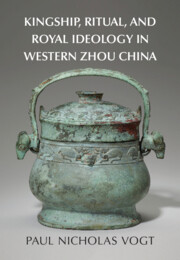
In China, the Western Zhou is remembered as a time of sage kings and virtuous ministers. Outside China, it is perhaps best known for the extraordinary bronzes that were the acme of its elite craft production (Figure 0.1). The tradition of casting elaborate food and liquor vessels in bronze for devotions to ancestral spirits already enjoyed a thousand years of history in North China by the time the Zhou came to power.Footnote 41 The Zhou inherited this tradition from the Shang, and in some ways, the late Shang was the apogee of bronze craft, in that the most massive, ornate early Chinese bronzes generally date from that period.Footnote 42 Inscriptions also appear on bronzes for the first time during the late Shang; though many of these consist only of the so-called clan emblems (zuhui 族徽), a few commemorate awards given to their commissioners, typically for service to the Shang king or other aristocrats.Footnote 43 The Western Zhou, however, saw great elaboration of these commemorative inscriptions, in terms of both length and variety of content. Though the scale of individual bronzes may have peaked during the late Shang, the Western Zhou period was the “golden age” of inscribed bronze vessels.

Figure 0.1 A Western Zhou bronze vessel. Unknown artist, 11th c. BCE, bronze. Minneapolis Institute of Art: bequest of Alfred F. Pillsbury, 50.46.8.
The impact of these inscriptions, which appear on only some bronzes, was a function not just of their content, but of the special material qualities of the bronzes themselves. Composed of one of the most valuable materials, and definitely the most permanent, available to the early Chinese elite, bronze vessels must have made an outsized visual impression during ancestral ritual.Footnote 44 Shining in the ceremonial space, bronzes would have evoked the language of brilliance and luminosity with which the Zhou customarily described ancestors and accomplished peers.Footnote 45 As the source of life-giving food and intoxicating liquor, they would naturally have attracted the attention of attendees, thereby becoming a valuable indicator of status; a common line from the closing of bronze inscriptions, yong zuo bao zun yi 用作寶尊彝 (“thereby [i.e., as a result of the honors commemorated in the inscription] making a precious offering vessel”), attests to how much the creation and possession of these items were seen as privileges. Though much ink has been spilled over the unresolved issue of what the decoration on late Shang and early Western Zhou bronzes meant, it is difficult to deny that the eyelike aspect of the taotie mask motif, and the complex geometric patterns filling the background register of the most complex bronze décor, draw the eye in, producing what Gell has referred to as “interiority” and “unfinished business,” respectively.Footnote 46 As the decoration of bronzes evolved over the Western Zhou period, size, quantity, and geometric boldness emerged as distinguishing qualities with which bronzes competed to draw attention.Footnote 47 Whether early or late, however, the extremes of Western Zhou bronze décor consistently show a concern with maximizing visual impact, suggesting that they remained a visual focus in the context of ancestral-ritual ceremony. It is precisely this that made them both effective markers of status and an attractive vehicle for disseminating royal ideology in the context of lineage activities.
This book writes the history of Western Zhou royal ritual based as exclusively as possible on these bronzes and their inscriptions. Bronze vessels were used largely, though not only, as ritual objects, and both their material qualities and the content of their inscriptions are immediately germane to the topic. Moreover, bronze inscriptions are the most verifiably contemporary textual sources on the Western Zhou period, suffering from few of the doubts about transmission and editing associated with received texts. A central corpus of standard “dating bronzes,” bearing inscriptions with contents that can be correlated with later texts, provides an overall framework for reading the inscriptional record historically, and extensive comparison of this corpus with both other vessels and other archaeological materials has enabled fine-grained dating of Western Zhou bronzes.Footnote 48 Bronze inscriptions thus offer a uniquely direct yet multifaceted window into the conduct of royal ritual during the period. Throughout the book, my approach to all questions is therefore first to reach a detailed understanding based on the Western Zhou bronzes themselves, turning to the received textual record only later and secondarily. This approach creates a basis for a richer and more critical evaluation of the later histories and the ritual canon, letting us see more clearly how their creation and canonization reflected changing perceptions of ritual, kingship, and the state.
Bronzes and Zhou Ideology
Creating the Western Zhou kingdom entailed forging a shared group identity. The precise preexisting components that went into that identity are, as noted, still unclear. Contemporary sources cannot yet substantiate the nature of the “Zhou” identity before the conquest, though the Shang paleographical sources suggest that the idea had existed for some time. Beyond a doubt, however, Shang authority in north China formed the backdrop against which the Zhou state project, and likely the Zhou group identity itself, coalesced. In its absence – that is, after the conquest of Shang was complete – special effort must have been needed to maintain the coherence of the Zhou group identity and state project.
In considering the motivations behind Western Zhou royal ritual, this work has been much influenced by actor-network theory, which concerns itself especially with the creation and maintenance of group identities. Actor-network theorist Michel Callon put forth the concepts of interessement and “enrollment,” describing how one interest group convinces another to share a particular way of producing and organizing knowledge.Footnote 49 I see much of early Western Zhou ritual as such an effort, seeking to strengthen the rhetorical power of royal authority by encouraging adherents to view themselves and their families in terms favorable to the Zhou kings. Through ritual narratives in bronze inscriptions, I suggest, the Zhou kings strove to establish themselves as the “obligatory passage point” of Zhou elite identity, such that status of elites within lineage cults would depend on contact with the royal house.Footnote 50
Simple “enrollment” of numerous elite interests in a certain vision of a group will not, however, guarantee its continued relevance. Human beings can rapidly change their minds and allegiances, and even if specific individuals remain “enrolled,” the march of generations guarantees that new individuals with new outlooks will continually replace these core constituents. To maintain a group identity, one must constantly work to recreate it anew, defining and redefining its bounds to encourage a sense of coherence while also accommodating changes that might otherwise cause systemic failure. Bruno Latour is an influential proponent of this renewal-focused view of group identity. His concept of the figuration of both group and individual agencies informs this book’s take on both the social role of ancestral ritual in the Zhou state and the specific measures taken throughout the Western Zhou to characterize the person of the king in a ritual context.Footnote 51
As Latour portrays it, the vagaries of human memory and the fleeting nature of interpersonal interactions complicate the ongoing work of figuring a group identity. To produce some semblance of permanence, he suggests, human actors engage with nonhumans – that is, material objects – in a “zigzag” pattern, relying on the superior durability and portability of nonhumans to perpetuate the results of interactions across distance in time and space. For Latour, this means that nonhumans themselves have agency in producing and reproducing group identities. They are indispensable components and therefore, in a certain respect, equal members of groups, and they must be accounted for thoroughly in the study of the connections holding those groups together, or what Latour refers to as the “sociology of associations.”Footnote 52
This work is agnostic with respect to the time-worn debate about the agency of objects. However, the active role of bronzes, and in particular inscribed bronzes, in constructing and maintaining a Zhou identity is difficult to deny. Interrogating the relationship between the lineage-based ancestral rites that devotional bronzes supported, royally sponsored ritual events combining multiple ritual techniques, and general displays of hospitality, one finds quite quickly that bronzes played just the sort of role that Latour describes, helping extend the relevance of individual instances of interpersonal relationships – and especially ritual instantiations of such – across generations and between interaction spheres. The bronze inscriptions themselves specify this much.
The interest of this work, however, lies not in the simple fact that bronzes played a role in Zhou identity, but in the details of that role. Inscribed bronze vessels occupied a special place at the juncture of religious practice, kinship organization, and state political activity. The customary composition of their inscriptions helped them carry royal interests into the local context of the lineage and its cult, encouraging Zhou elites to see themselves in terms of their relationship to the king and his ancestors (or descendants). The utility of bronzes in this regard epitomizes “materialized ideology,” a collective phrase referring to the physical accoutrements (including objects, buildings, movements, etc.) through which power-holders encourage acceptance of their authority without resorting to physical force.Footnote 53 One may understand not just bronzes and their inscriptions, but also the ritual events and techniques recorded therein, as forms of “materialized ideology” in this sense.
Much of the work of this book thus lies in reading back through the bronzes, and the rites they record, into the emergence and evolution of royal ideology under the Western Zhou. I have approached their role in the “zigzag” of human–nonhuman interaction with this basic goal. The individual chapters propose different sizes and shapes of frame through which to view multiple facets of the effectiveness of Western Zhou ritual, and ritual bronzes, as vehicles of royal ideology.
Structure of the Book
The first part of this work conducts a comprehensive survey and analysis of the ritual techniques that the Zhou kings employed. Individual chapters categorize these techniques based on their roles in building and maintaining the Zhou political network and the model of elite identity on which it relied. Chapter 1, “The Politics of Shang Ritual under the Zhou,” explores how the early Zhou repurposed ancestral-ritual techniques of Shang provenance to support their quest for legitimacy and lend focus to their efforts at building a new, shared identity. Chapter 2, “The Ritual Figuration of the Zhou Kings,” examines the surviving records of a few rare but important ritual techniques that posed symbolic arguments about the relationship of the Zhou king to the social order and the natural world. The details of their implementation, the chapter shows, reveal an effort to refigure the Zhou kings as qualitatively different from their contemporaries, with a special relationship to the natural world and its products. Chapter 3, “Ritual Recognition, Reward, and Patronage under the Zhou Kings,” offers a deep analysis of three ritual techniques that provided a framework for soliciting and maintaining support through the distribution of rewards and prestige. It shows how changes in these ritual manifestations of patronage reframed the ideology of membership in the Zhou state, de-emphasizing personal allegiance to the Zhou king as individual warrior in favor of a vision of service to the royal house qua state in all its aspects.
Building on this foundation, the second part offers a diachronic and re-integrative analysis of Western Zhou royal ritual and its relationship to contemporary affairs. The early Zhou kings conducted several major, state-level events that combined individual ritual techniques into narrative sequences depicting various potential ways of relating to their political project. Chapter 4, “Ritual Assemblies and the Geopolitics of Zhou Expansion,” examines how the royal house deployed such events as part of an integrative strategy of ritual suited to the geopolitical environment of the early Western Zhou period. Chapter 5, “Reading the ‘Ritual Reform,’” shows that the period of ultimate diversity in Zhou royal ritual gave way to a systematic effort to naturalize royal authority and create a new identity for the king. In the process, the chapter tests one of the most influential theories about Western Zhou ritual against the records of ritual in the bronze inscriptions. Synthesizing the fine-grained analysis of the previous chapters with a broad-based, quantitative study of royal depictions, Chapter 6, “The Ethic of Presence: Royal Ideology through Bronze Inscriptions,” provides a general theory of the role of inscribed bronze vessels in the formation of the Zhou state. Drawing on theories of subject–object entanglement in the work of Gell, Latour, and others, the chapter captures how the ancestral cult and its accoutrements facilitated both the dissemination and the appropriation of royal ideology, helping to balance interests within a shared “Zhou” interaction sphere.
The Conclusion to the work summarizes the new perspectives on Zhou ritual that emerge from this analysis. It argues that early Western Zhou royal ritual betrays a sophisticated consciousness of the rhetorical power of ritual in group identity formation; this adds a new dimension to the traditional idea that the Zhou carried on the cultural legacy of the Shang.Footnote 54 It points out how flexibly early kings deployed ritual techniques prior to the “ritual reform” – a vital point of contrast with the formulations of Zhou ritual in the Confucian canon. And it highlights the historical contingency of the changes in Zhou ritual visible in the inscriptional corpus. The Conclusion addresses the implications of this vision of Zhou ritual for the theory of presence, an ongoing discourse at the juncture of art history, media studies, and religious studies.Footnote 55 Powered by the “ethic of presence,” the Zhou deployment of the tradition of bronze craft helped overcome the ephemerality of royal ritual events, maximizing their effectiveness as a vehicle of ideology. Western Zhou royal ritual, the chapter argues, offers a case study of how ritual continues to shape ideas of self and belonging long after its performance. The book thus stands as an argument for the indispensable role of material-cultural theory in ritual studies.

