

10.1 Introduction
Construction Grammar emerged in the 1980s as a response to the increasingly problematic core–periphery distinction in mainstream linguistics (Fillmore Reference Fillmore1988; Fillmore et al. Reference Fillmore, Kay and O’Connor1988; Kay & Fillmore Reference Kay and Fillmore1999). Linguists were only supposed to care about a ‘core’ of systematic rules, while condemning a large ‘periphery’ of linguistic misfits to scientific purgatory. Construction Grammar proposed a road to salvation by abolishing this distinction and to represent all of linguistic knowledge as conventionalized mappings between form and function called constructions, hypothesizing that “a grammatical formalism can be constructed … which is built exclusively on grammatical constructions” (Fillmore Reference Fillmore1988: 54).
As can be gleaned from the wealth of contributions to the present book, the concept of a ‘construction’ struck such a vein in the linguistics community that the principles of the constructional analysis became rapidly adopted by a wide variety of subdisciplines. Inevitably, Construction Grammar soon became the victim of its own success, and “it is nowadays more accurate to speak of Construction Grammars – plural – than of Construction Grammar” (Van de Velde Reference Van de Velde, Boogaert, Colleman and Gijsbert2014: 143). The original Construction Grammar (CxG; Fillmore Reference Fillmore, Hoffmann and Trousdale2013), written with capitals C and G, is therefore often called ‘Berkeley Construction Grammar’ (BCxG), using an epithet to distinguish it more clearly from other constructional approaches that emerged later. These younger approaches are not meant to supplant CxG in the same vein as the Minimalist Program (Chomsky Reference Chomsky1995) revised and replaced the theory of Government and Binding (Chomsky Reference Chomsky1981) in transformational syntax; they are rather considered as complementary frameworks that emphasize different directions.
While this diversity of constructional approaches is a clear sign of a thriving community, it also means that newcomers to the field can easily get lost. Moreover, when exploring new directions, the community is at risk of losing consensus about what it actually means to engage in a constructional analysis. The goal of this chapter is, therefore, to provide a comparative guide for navigating the constructional landscape. Along the way, this chapter also argues that the existence of different constructional flavors is in fact a healthy and necessary response to the problem of analyzing complex linguistic structures, which requires input from different perspectives. We will first provide some terminological foundations needed for our comparative guide (Section 10.2), after which we will consider how construction grammars handle empirical data (Section 10.3), the connection between meaning and form (Section 10.4), and how constructions can be formalized (Section 10.5). Given the conflict between the richness of the construction grammar community and practical space limitations, this chapter will exclusively focus on the following flavors of construction grammar:
(1) (Berkeley) Construction Grammar (CxG; Fillmore Reference Fillmore1988; Kay & Fillmore Reference Kay and Fillmore1999; Fillmore Reference Fillmore, Hoffmann and Trousdale2013) primarily aims at describing a language user’s knowledge about their language, but its toolbox has turned out to be very versatile, which makes CxG an excellent foundation for any kind of constructional research.
(2) Cognitive Construction Grammar (CCG; Goldberg Reference Goldberg1995, Reference Goldberg2006, Reference Goldberg2019), or the ‘Goldbergian’ flavor of CxG, heavily focuses on psychological plausibility, language usage, and language learning. Whereas CxG offers detailed analyses of constructions, Cognitive Construction Grammar uses informal diagrams for ease-of-exposition and puts more emphasis on the design of psycholinguistic experiments and corpus studies.
(3) Radical Construction Grammar (RCG; Croft Reference Croft2001) focuses on typological adequacy and language evolution. Its epithet ‘radical’ comes from the fact that RCG takes the foundational assumption of Construction Grammar to its logical conclusion: If constructions are the basic units of language, then all linguistic categories must be defined relative to the constructions they occur in (as opposed to forming a global set). Moreover, RCG adopts strict empirical methods in order to treat every language in its own right and as unbiased as possible (Croft Reference Croft, Boye and Engberg-Pedersen2010), which makes RCG suitable for both descriptive linguistics as well as for modeling linguistic competence.
(4) Sign-Based Construction Grammar (SBCG; Michaelis Reference Michaelis, Heine and Narrog2009; Sag Reference Sag, Boas and Sag2012) is a constructional reconceptualization of Head-Driven Phrase Structure Grammar (Pollard & Sag Reference Pollard and Sag1994) which aims at developing with mathematical precision a processing-neutral model of a language user’s linguistic knowledge (Sag & Wasow Reference Sag, Wasow, Borsley and Börjars2011). SBCG is especially useful for estimating degrees of well-formedness of constructs.
(5) Fluid Construction Grammar (Steels Reference Steels, Daelemans and Walker2004, Reference Steels2017) is not a theory but an open-source platform for implementing computational construction grammars and models of constructional language processing (van Trijp et al. Reference van Trijp, Beuls and Van Eecke2022). Besides its use for operationalizing constructional analyses, FCG also offers the necessary tools for scaling construction grammars to handle large corpora.
10.2 A Babelesque Confusion
The evolutionary biologist Eörs Száthmary once jokingly said that linguists would rather share each other’s toothbrush than each other’s terminology (p.c.). Unfortunately, construction grammarians are no exception, and the definition of what a ‘construction’ is may vary over time and from approach to approach, and each construction grammarian may use different terminology. This section therefore presents a definition of some concepts, summarized in Table 10.1, that are needed for our comparative guide in order to avoid a Babelesque confusion.
Table 10.1 Basic terminology used in this chapter
| Concept name | Collection name | Status |
|---|---|---|
| Construct | Corpus | Empirically observable |
| Constructional analysis | Analysis bank | Theoretical |
| Construction | Constructicon | Theoretical |
10.2.1 Constructs and Corpora
First of all, we need to maintain a distinction between empirical ‘constructs’ on the one hand and theoretical notions such as ‘constructions’ on the other. An (empirical) construct is an actual linguistic expression, such as a word, phrase, or sentence. Constructs can be observed and collected in a ‘corpus’. Example (1) offers a small corpus of constructs from Franz Kafka’s Metamorphosis (translated by Edwin and Milla Muir).
(1) As Gregor Samsa awoke one morning from uneasy dreams he found himself transformed in his bed into a gigantic insect. He was lying on his hard, as it were armor-plated, back and when he lifted his head a little he could see his dome-like brown belly divided into stiff arched segments on top of which the bed quilt could hardly keep in position and was about to slide off completely. His numerous legs, which were pitifully thin compared to the rest of his bulk, waved helplessly before his eyes.
10.2.2 Constructional Analyses and Analysis Banks
Everything beyond constructs “is part of a theory, invented by a linguist” (Dowty Reference Dowty, Bunt and van Horck1996: 12). A first theoretical concept is that of a ‘constructional analysis’ (of a construct), which represents a linguist’s model of a construct similar to how phonemes represent a linguist’s analysis of actual sound patterns in vocal languages or actual signs in signed languages. For instance, while example (1) contains the actual construct a gigantic insect, a linguist may ‘model’ that construct in a more abstract way in order to identify generalizations about a language, such as using a phrase structure tree (example [2]). A widely used representation in the constructional literature is the ‘boxes-within-boxes’ notation (Fried & Östman Reference Fried, Östman, Fried and Östman2004) of example (3), in which the tree structure of example (2) is represented as nested boxes, with the outer box representing a parent node (also called a ‘Mother’ node) and with the inner boxes representing its children nodes (also called ‘Daughters’). Each box also has a ‘feature structure’ (consisting of pairs of features and values) for adding more fine-grained linguistic information, such as the features ‘cat’ (category) and ‘lxm’ (lexeme), and values such as ‘np’ (noun phrase) or the lexeme gigantic. As we will see later in this chapter, constructional analyses are often more complex than tree structures, so instead of collecting tree structures in a treebank, constructional analyses can be stored in a ‘constructional analysis bank’.
(2)


(3)

By far most of the constructional analyses in the literature are ‘pen-and-paper’ insights performed by linguists themselves. These analyses are almost never presented with all of their details, either because the construction grammarian is using informal diagrams, or because the full analysis involves too much information to fit within the space limits of a publication. Alternatively, an analysis can also be constructed by a computational construction grammar. In this case, a linguist typically uses a computational tool for operationalizing constructional knowledge, which is then applied for automatically analyzing or producing constructs. The linguist can then verify whether the analysis corresponds to their expectations, which they can use either to validate their theory or for identifying which parts need further refinement. The computational model can then be shared as supplementary materials to a publication, allowing other researchers to verify and reproduce its analyses, or be made available as a web demonstration.
The term ‘constructional analysis’ does not really occur in the literature in the same sense as used in this chapter. In fact, many construction grammarians never clearly distinguish between what they call a ‘construction’ and what is called here a ‘constructional analysis’ and what we defined earlier as a ‘construct’. It is therefore common to find statements such as that the constructional analysis of example (3) is ‘an instance of a Determiner-Adjective-Noun construction’, or that the construct she gave her son a present is ‘an instance of the Ditransitive construction’. As we will see later, such phrasing is confusing and it would be more precise to say that a constructional analysis such as example (3) is accounted for by a combination of several constructions, including not only the Determiner-Adjective-Noun construction, but also lexical constructions that contribute information about the words a, gigantic, and insect.
Unsurprisingly, the more formal constructional approaches make the distinction clear between constructions and constructional analyses. In CxG and Sign-Based Construction Grammar (SBCG), a constructional analysis is called a ‘modeling-domain object’ (Kay Reference Kay2002), or a ‘linguistic object’ (Sag Reference Sag, Boas and Sag2012). In Fluid Construction Grammar, a constructional analysis is called a ‘(final) transient structure’ (Steels Reference Steels2017).
10.2.3 Constructions and Constructicons
Obviously, it is impossible to establish an exhaustive corpus of all the constructs of a language “because all languages allow an indefinitely large number of sentences” (Haspelmath Reference Haspelmath, Heine and Narrog2009: 290), hence it is equally impossible to develop an exhaustive constructional analysis bank. Descriptive linguistic theories therefore try to describe recurrent patterns of language usage in a way that accurately predicts the linguistic behavior of the members of a linguistic community. Traditionally, such recurrent patterns have been called ‘constructions’. When used in this sense, a linguist might say for instance that the English language employs the ‘Progressive Construction’ for expressing ongoing events using the pattern ‘Auxiliary-BE + V-ing’ as exemplified in the sentence I am learning how to develop computer games.
Since the Chomskyan revolution in the 1950s–1960s (Chomsky Reference Chomsky1957, Reference Chomsky1965), cognitive linguistic theories have emerged that aim to account for the linguistic knowledge that a language user needs for producing and comprehending novel constructs. Chomskyans assume that such knowledge takes the form of a generative device that applies a small set of abstract rules (Chomsky Reference Chomsky1981, Reference Chomsky1995). In this view, constructions exist only as the ephemeral side-effects of more fundamental operations and are therefore inconsequential for linguistic theorizing. As a result, there has been a wide gap between descriptive and cognitive linguistic theories. Indeed, the linguist Norbert Hornstein has attempted to rebrand descriptive linguistics as ‘languistics’, keeping the term ‘linguistics’ exclusively for theories that focus on mental models of linguistic competence (Leivada Reference Leivada2014). The major innovation of Construction Grammar, then, was to reconceptualize the traditional notion of a construction as the basic unit of linguistic knowledge (Fillmore et al. Reference Fillmore, Kay and O’Connor1988). In other words, for a language user to ‘know their language’, they simply have to know its constructions (Fried & Östman Reference Fried, Östman, Fried and Östman2004), which could finally bridge the gap between descriptive and cognitive linguistic theories.
All flavors of construction grammar, except for SBCG, therefore assume that a language user’s linguistic inventory is a structured network that exclusively consists of constructions (Diessel Reference Diessel2019). Since the construction inventory does not sharply distinguish between lexical and grammatical constructions, it is called a ‘constructicon’. SBCG is the odd one out by distinguishing between ‘listemes’ (which roughly corresponds to the ‘lexicon’) and phrasal constructions, though it still offers a uniform way to model the syntax–lexicon continuum (Michaelis Reference Michaelis, Busse and Moehlig-Falke2019). Fluid Construction Grammar, which supports any kind of constructional analysis, assumes a single constructicon by default but allows its users to distinguish lexical from grammatical constructions if they wish to do so.
10.2.4 The Relation between Constructions and Constructional Analyses
The relation between constructions on the one hand, and constructional analyses of constructs on the other, is different depending on the constructional flavor. As a rule of thumb, constructions can be thought of as (partially) schematic pieces of conventionalized linguistic information (or ‘linguistic patterns’), while a constructional analysis is always specific to the construct it represents. For example, the English Determiner-Adjective-Noun pattern in example (4) abstracts away from the specific analysis of example (3) by leaving the lexemes of the inner boxes unspecified. This pattern is therefore not only compatible with the construct a gigantic insect, but also with any other construct that follows the same pattern, such as his numerous legs.
(4)

Most construction grammarians will say that constructions can be combined with each other for producing or comprehending utterances, but it is almost never spelled out exactly how constructions combine. In fact, most constructional flavors, including those that subscribe to the tenets of usage-based linguistics (Diessel Reference Diessel and Aronoff2017), uphold some distinction between competence and performance (Chomsky Reference Chomsky1965) in practice and only focus on constructions as pieces of linguistic knowledge without modeling how that knowledge should be processed.
The strongest competence-performance distinction is found in the so-called ‘constraint-based’ construction grammars, particularly SBCG, which aims at processing-neutral competence models (Sag & Wasow Reference Sag, Wasow, Borsley and Börjars2011; Sag Reference Sag, Boas and Sag2012). In a constraint-based grammar, constructions are defined as ‘partial descriptions’ of well-formed structures or, put more precisely, as ‘constraints’ on what the grammar will accept as well-formed structures. An intuitive way to think about an SBCG grammar is to compare it to the list of building regulations that a safety inspector must check in order to approve a house, without having to build the house themselves (which is the job of the contractor). Likewise, SBCG constructions are formulated as constraints that can be checked independently from each other in order to estimate the degree of well-formedness of a construct, without having to be combined to actually form the construct (which is the job of the processor).
A second kind of construction grammars are ‘usage-based’ (Diessel Reference Diessel and Aronoff2017), which includes, among others, Radical Construction Grammar (Croft Reference Croft2001), Cognitive Construction Grammar (Goldberg Reference Goldberg2006, Reference Goldberg2019), and a lot of work in Berkeley Construction Grammar (see further below). Usage-based construction grammarians assume that language learning and usage have a profound impact on linguistic structure and therefore typically address their attention to questions of language acquisition (Diessel Reference Diessel2004; Goldberg et al. Reference Goldberg, Casenhiser and Sethuraman2004; Lieven Reference Lieven2009), language change (Croft Reference Croft2000; Fried Reference Fried2009), and language processing (Goldberg Reference Goldberg2019). However, such studies will typically use verbal explanations for the role of constructions in production and comprehension but rarely offer an explicit processing model of how constructions can be combined with each other, as lamented by Bod (Reference Bod2009).
(Berkeley) Construction Grammar offers a versatile approach that can be classified as constraint-based, but which has also been fruitfully applied for usage-based studies (e.g., Fried Reference Fried2009), contrary to the common misunderstanding that CxG is non-usage-based (see, e.g., Goldberg Reference Goldberg2006; Hoffmann Reference Hoffmann2022). In fact, CxG is the only theoretical approach in our comparison that proposes a detailed model of how two constructions can be combined with each other: ‘Kay unification’ (Kay & Fillmore Reference Kay and Fillmore1999; Kay Reference Kay2002).Footnote 1 Unification is a complex concept that has many different instantiations (Knight Reference Knight1989), but for our purposes it suffices to understand it as a way to combine two constructions with each other as long as they do not contain conflicting information. In CxG, a construct is therefore said to be licensed if there exists a set of constructions that can be unified with each other to form the constructional analysis of the construct. However, just like the other constructional flavors, CxG does not propose a processing model for actually computing a constructional analysis.
Linguists who are nevertheless interested in developing models of constructional language processing can do so using Fluid Construction Grammar (Steels Reference Steels, Daelemans and Walker2004, Reference Steels2017), which is a special-purpose programming language for implementing construction grammars.Footnote 2 FCG can be downloaded both as open-source software, or as part of the FCG Editor, an integrated development environment for construction grammars (van Trijp et al. Reference van Trijp, Beuls and Van Eecke2022). In FCG, constructions are used for mapping meanings onto constructs (‘production’, or ‘formulation’ in FCG terminology), or vice versa, for decoding a construct into its underlying meaning (‘comprehension’). Details of processing can be inspected through an interactive web interface and modified with the help of a grammar configurator. In FCG, constructions are not combined directly with each other but operate on a structure called a ‘transient structure’, which contains all the information about a construct, starting from the meaning to express in production or the form to analyze in comprehension. The word ‘transient’ highlights the fact that this structure changes over time as more constructions contribute information, until a ‘final transient structure’ is achieved, which corresponds to what I call ‘constructional analysis’ in this chapter. We will return to these matters in Section 10.5.
10.3 Getting the Empirical Facts Straight
While the earliest work in Construction Grammar in the 1980s–1990s set out an ambitious research agenda and laid the field’s theoretical foundations, most constructional research in the twenty-first century has been concerned with getting the empirical facts straight.
10.3.1 The Distributional Method Revisited
One of construction grammar’s oldest problems has been how to identify a construction based on a corpus of empirical evidence. For a long time, it was popular to posit the existence of a construction as soon as a pattern could be found whose form or meaning could not be reduced to the sum of its parts, or which could not be formed through the composition of other constructions. Goldberg formulated this view as follows:
C is a construction iffdef C is a form–meaning pair <Fi, Si> such that some aspect of Fi or some aspect of Si is not strictly predictable from C’s component parts or from any other previously established constructions. (Goldberg Reference Goldberg1995: 4)
Such a definition implies that there is no room for redundancy in the constructicon, which was indeed the prevalent view in early Construction Grammar and which is still true for SBCG. Nowadays, however, most construction grammarians argue that any pattern that is frequent enough can be stored as a construction, even if doing so would be redundant. That brings us back to the question how a construction can be identified.
The constructional theory that has been most explicit about how constructions can be identified is Radical Construction Grammar, which grew out of a thorough re-examination of what kind of syntactic argumentation is warranted for describing linguistic structures (Croft Reference Croft2001, Reference Croft, Östman and Fried2005, Reference Croft, Boye and Engberg-Pedersen2010). Most importantly, Croft formulates his methodological arguments in a way that does not presuppose a constructional approach, but in a way that approaches the empirical data as neutrally as possible (outlined in more detail in Chapter 17). Too often in the past, linguists have wittingly or unwittingly described languages from the viewpoint of well-studied languages such as Latin or English, or they have applied unwarranted assumptions from a linguistic framework (Haspelmath Reference Haspelmath, Heine and Narrog2009). To avoid such pitfalls, Croft (Reference Croft, Boye and Engberg-Pedersen2010: 314) argues that the ‘distributional analysis’ remains “the most important and soundest methodology in syntactic analysis,” provided that it is modified to relate utterances to actual usage events. Let us first look at how the distributional analysis can be used for examining the occurrence or non-occurrence of items in the ‘slots’ of a construction before addressing the question of how to identify the constructions themselves, using a couple of simple examples from Croft (Reference Croft2001: 12), repeated here in examples (5)–(8).
(5)
a. Jack is cold. b. *Jack colds.
(6)
a. Jack is happy. b. *Jack happies.
(7)
a. *Jack is dance. b. Jack dances.
(8)
a. *Jack is sing. b. Jack sings.
In the (a) sentences in examples (5)–(8), the words cold, happy, dance, and sing follow the inflected copula be. This is acceptable for cold and happy, but not for dance and sing. In the (b) sentences, there is no copula and the four words appear with the suffix -s. These sentences are acceptable for dance and sing, but not for cold and happy. Cold and happy therefore have the same distribution, while dance and sing share a different distribution.
Now consider examples (9)–(10) in which happy and cold appear after a determiner and before a noun, which again confirms their shared distribution pattern.
(9) a cold winter
(10) a happy person
Again, cold and happy have the same distribution pattern. Traditionally, such data have been used as evidence for the existence of the part-of-speech adjective as an abstract category. However, a group of words that Boyd and Goldberg (Reference Boyd and Goldberg2011) call a-adjectives resist occurring in a prenominal position, as shown in examples (11)–(12).
(11)
a. the boy is afraid b. ??the afraid boy
(12)
a. the man is asleep b. ??the asleep man
The empirical record thus shows that words such as afraid and asleep do not share the exact same distribution pattern as cold and happy, which is problematic for traditional approaches that classify all four words as adjectives. As noted by Croft (Reference Croft2001), a common ‘solution’ to such problems is methodological opportunism whereby the linguist decides in an ad hoc manner to ignore certain data or criteria to fit their analysis, even if it means positing abstract categories that are not borne out by the evidence. Another common way to handle these problems is to introduce additional theoretical apparatus for saving the analysis (also see the discussion on Active vs. Passive in Section 10.3.2), for which no empirical grounds exist either.
Croft (Reference Croft2001) argues that the problems of the distributional analysis stem from the fact that most linguistic theories are ‘reductionist’. That is, most linguistic theories try to reduce complex phenomena to ‘atomic’ (i.e., irreducible) building blocks such as parts of speech that are more manageable. Construction grammarians, on the other hand, assume that the ‘primitive’ units of language (constructions) are inherently complex themselves. ‘Primitive’ here means that constructions cannot be explained in terms of their components because the whole construction is greater than the sum of its parts. RCG takes this constructions-as-the-primitives-of-language assumption to its logical conclusion and, therefore, argues that a construction’s components are construction-specific and should be defined in terms of their role within a specific construction.
From a theoretical perspective, it may seem counterintuitive to give up atomic categories for more complex primitives. However, it is well known from other fields that more sophisticated building blocks ultimately lead to simpler solutions for complex and large-scale problems. A good example is architecture: You can easily build a dog house using basic materials such as a sheet of plywood, clams, and screws, but those materials would never scale to support the size of a house for humans. Likewise, it is easy to account for declarative sentences in English using simple rules such as phrase structure rules, but trying to apply them to more complex structures or typologically different languages rapidly leads to convoluted analyses that require additional mechanisms such as transformations, lexical rules, or global principles – all of which can be discarded when constructions are used (van Trijp Reference van Trijp2014, Reference van Trijp2015). Indeed, the constructional approach “provides a uniform model of grammatical representation and at the same time captures a broader range of empirical phenomena” (Croft Reference Croft2001: 17) – all the while using a simpler scientific metalanguage than other approaches.
RCG has the simplest scientific metalanguage of all constructional flavors. All that is needed for describing a language is a taxonomy of constructions and all that is needed for describing the internal structure of constructions is part–whole relations: “The syntactic structure of constructions consists only of their elements (which may also be complex …) and the roles that they fulfill in the construction” (Croft Reference Croft2001: 5). Categories are therefore not global pieces of knowledge but construction-specific, so every construction can be described in its own (often quirky) way, which avoids problems such as leaky abstractions. Returning to examples (5)–(12), RCG would therefore not introduce an abstract category such as ‘adjective’, but simply posit separate constructions for constructs such as John is happy and for constructs such as a happy person. Both constructions have their unique slot for elements that can play a modifier role and both have their own conditions on which elements may fill that slot. While the first construction happily allows the so-called a-adjectives to play the modifier role, the second one is more restrictive.
So far we have only focused on the occurrence and non-occurrence of elements in the slots of a construction but we haven’t answered the question yet how constructions themselves can be identified. Croft (Reference Croft2001: 236f.) writes that constructions have a “structural Gestalt” that can be recognized as a pattern by language users. For example, the English Passive has several unique cues that set it apart from other constructions, such as the combination of auxiliary-be and the past participle, and a by-phrase with the Agent or Source of the action.
Since RCG is a cognitive theory of language just like the other flavors, it offers a theory about the linguistic knowledge that language users need to have for producing and comprehending constructs. However, its careful treatment of data and simple scientific metalanguage also makes RCG a good starting point for a descriptive theory of a language without making claims about cognitive plausibility, and Croft (Reference Croft2001: 59–61) provides a brief overview of how a reference grammar in RCG would look like.
10.3.2 The Collostructional Analysis and Its Extensions
While RCG caters for linguists who need to approach an undescribed language and therefore need to discover in an unbiased way which constructions exist, most empirical studies in the construction grammar community typically start by already positing a construction, and then use the ‘collostructional analysis’ for characterizing its meaning in a more precise and objective way (Stefanowitsch & Gries Reference Stefanowitsch and Gries2003; see also Chapters 6 and 7). The name ‘collostructional’ is a combination of ‘construction’ and ‘collocational’, the latter being a term from corpus linguistics that designates a series of forms that co-occur more frequently than would be expected by chance. The collostructional analysis can thus be seen as a kind of collocational analysis that assumes the existence of a construction and then identifies which forms are associated with the slots of the construction. The underlying assumption is that a construction will attract semantically compatible lexemes, while repelling others. The collostructional analysis is in principle compatible with any constructional flavor, but has in practice mostly been carried out within the framework of Cognitive Construction Grammar (Goldberg Reference Goldberg2006, Reference Goldberg2019). Just like RCG, CCG is usage-based but with a stronger focus on the psychological aspects of language learning (Tomasello Reference Tomasello2003; Diessel Reference Diessel2004; Lieven Reference Lieven2009) and processing (Boyd & Goldberg Reference Boyd and Goldberg2011; Goldberg Reference Goldberg2019).
The collostructional analysis has been extended in several areas. For instance, diachronic collostructional analysis (Hilpert Reference Hilpert, Allan and Robinson2012) tracks changes in collocational patterns over time using temporally ordered corpora. Another popular extension, called ‘distinctive-collexeme analysis’, is geared towards the investigation of pairs of semantically similar constructions, also known as ‘alternations’ (Gries & Stefanowitsch Reference Gries and Stefanowitsch2004). One of the most famous ‘alternating’ pairs in English is the Active versus Passive voice, as illustrated in examples (13)–(14).
(13)
The boy kicked the ball. SUBJ Verb OBJ
(14)
The ball was kicked (by the boy). SUBJ Aux-be Verb-ed byAgent
A distinctive-collexeme analysis can help refine an analysis of both constructions, or compare competing theories. Here we can contrast a ‘lexicalist’ versus a ‘constructional’ approach. In lexicalist and other mainstream approaches, the English Passive has typically been treated as a derivational rule, which is essentially a syntactic operation that turns an active verb into a passive one. In a constructional approach, the Passive Construction is a first-class citizen just like the Active Construction, and therefore has its own semantics.
Gries and Stefanowitsch (Reference Gries and Stefanowitsch2004: 108) note that only a few studies exist that have attempted to characterize the meaning of the Passive construction independently from the Active, but find a proposal by Pinker (Reference Pinker1989: 91), who defines the meaning of the Passive as “X is in the circumstance … for which Y is responsible,” with X referring to the Passive subject and Y to the agentive by-phrase. Gries and Stefanowitsch (Reference Gries and Stefanowitsch2004: 108) argue that if the Passive is essentially a syntactic derivation (as hypothesized in the lexicalist approach), one would not expect to find any strong differences in which verbs would fit the Active or Passive sentence types. If, on the other hand, the Passive Construction has its own semantics (as hypothesized by the constructional approach), one would expect to find many distinctive collexemes.
The results of their study show that the constructional approach makes the correct prediction. The most distinctive collexemes for the Active Construction (e.g., have, think, get) are verbs whose direct objects are not easily construed as patients (e.g., stative verbs). The most distinctive collexemes for the Passive Construction (e.g., base, concern, involve) confirm the definition of Pinker (Reference Pinker1989: 91) and “overwhelmingly encode processes that cause the patient to come to be in a relatively permanent end state” (Gries & Stefanowitsch Reference Gries and Stefanowitsch2004: 109). They conclude that “the distinctive-collexeme analysis shows that passive voice is a construction in its own right with its own specific semantics.”
10.4 Constructions and Frames
We now turn from empirically observable forms to the question how constructions handle the expression of meaning. All flavors of construction grammar assume a Frame Semantics approach to lexical meaning (Fillmore Reference Fillmore1976, Reference Fillmore1982; Petruck Reference Petruck2011), which is widely considered to be construction grammar’s ‘sister theory’ (see Chapter 1 in this volume). Unfortunately, the phrase ‘Frame Semantics is assumed’ is often repeated as a sort of mantra in the constructional literature without further investigation of how semantics and grammar interact with each other, so it is worthwhile to briefly investigate this relation.
10.4.1 Scenes and Frames
The central slogan of Frame Semantics is that meanings are relativized to scenes (Fillmore Reference Fillmore and Zampolli1977; see also Chapter 1). Scenes can be grounded in the real world through our sensorimotor apparatus, or they can be cognitive scenes that are evoked by constructs. For instance, a verb such as to cook activates an entire cooking scene such as the one depicted in Figure 10.1. Cooking is an extremely rich experience, but people can learn to construct and use a ‘semantic frame’ to make sense of what is happening. A semantic frame is a skeletal representation of recurrent experiences with open slots (called ‘frame elements’) that need to be filled in. According to the English FrameNet database (Baker et al. Reference Baker, Fillmore and Lowe1998), the Cooking_Creation frame involves at least twelve frame elements, including prominent ones such as Cook and Produced_food, but also roles such as Container, Ingredients, Place, and Recipient. Example (15) provides some constructs that evoke the frame.
(15)
a. [Shecook] is preparing [vegetable soupproduced_food] in [an orange potcontainer]. b. [Shecook] loves cooking in [her new kitchenplace]. c. [Shecook] loves cooking for [her guestsrecipient]. d. [The vegetable soup produced_food] is [slowlymanner] cooking.

Figure 10.1 How a Cooking-frame can be used for making sense of the activity in the picture
As can be seen, the relation between a semantic frame and its morphosyntactic encoding in language is indirect: Only a handful of frame elements are actually realized in a construct, none of them is guaranteed to appear, and the same frame element may play a different grammatical role depending on the construction in which it occurs. Semantic frames are also not tied to a single lexical unit (e.g., both preparing and cooking may evoke the cooking frame in example [15]), and vice versa, a lexical item may evoke different frames (e.g., one can also prepare a presentation, which usually involves little to no cooking).
Different constructional flavors provide different solutions for handling the indirect relation between meanings and constructs, which to a large extent depends on how strongly the flavor is embedded in a broader theory of cognition. To compare the different flavors to each other, we will take the diagram in Figure 10.2 as a starting point. This figure, based on Fried (Reference Fried2005), shows the different steps that an analysis (potentially) has to address in order to explain the different ways in which semantic frames can be expressed and understood. The figure comprises four mapping processes, with each mapping adding a layer of abstraction: (i) between scenes and semantic frames, (ii) between the frame elements (FEs) of semantic frames and semantic roles (SRs), (iii) between semantic roles and grammatical functions (GFs), and (iv) between grammatical functions and their surface forms. As stated before, all constructional flavors assume a Frame Semantics approach so they agree on the first step in which scenes are conceptualized in terms of semantic frames. We will now go through the different steps for each constructional flavor.

10.4.2 Berkeley Construction Grammar
Mapping between Frame Elements and Semantic Roles
Semantic frames are rich representations of human experiences that are impossible to pass through the filter of language in their entirety. In Construction Grammar, frame elements are therefore mapped onto semantic roles, which can be considered as linguistic abstractions over event-specific roles. For instance, an agent is an abstraction of frame elements such as the Cook of a Cooking_Creation frame, or the Wearer of a Wearing frame. Semantic roles (also called case-, theta-, argument-, or thematic-roles) have a longstanding history which dates back to Pāṇini’s grammar of Sanskrit, but only resurfaced in modern linguistics under the influence of Gruber (Reference Gruber1965) and especially Charles Fillmore’s seminal paper “The case for case” (Fillmore Reference Fillmore and Fillmore2003, orig. publ. in 1968).
More specifically, CxG stores entire semantic frames in what I will call ‘frame-evoking constructions’, a practice that has been adopted by all of the other constructional flavors as well. Typically, these are lexical constructions, but idiomatic constructions such as the kick the bucket-construction or partially schematic constructions can also store information about the frames they evoke. Besides storing a frame, frame-evoking constructions will also provide information about their ‘minimal valence’, which selects the most salient frame elements from a large set of FEs and maps them onto more abstract semantic roles, as illustrated in example (16), which is a partial representation of the lexical construction cook. The Cooking_Creation frame is listed in the sem-feature (semantics) of the construction. For convenience’s sake, I only list three instead of all twelve frame elements. Each frame element is indexed with a number such as #1 for the FE Cook and #2 for the FE Produced_food. These indices can now be used as pointers in other parts of the construction, as is done here in the val-feature (valence). The val-feature is a set of relations (rel). For example, ‘rel #1’ relates information to the FE with the index #1 (the Cook). This information is a feature structure that specifies the semantic role (using the theta-symbol θ). As can be seen, the FE Cook is mapped onto ‘agt’ (agent) and the FE Produced_food is mapped onto ‘pat’ (patient).
(16)

Besides specifying semantic roles, the valence feature also indicates which of the semantic roles has privileged status and is therefore more likely to become the subject. In Fillmore’s Case Grammar, a predecessor of CxG, semantic roles would be ranked in a ‘thematic hierarchy’ from most agent-like to most patient-like (Fillmore Reference Fillmore and Fillmore2003). A language such as English is said to take the most agent-like semantic role as the subject of an Active construction. However, thematic hierarchies have turned out to be incompatible with empirical evidence (Croft Reference Croft, Butt and Geuder1998; Levin & Rappaport Hovav Reference Levin and Rappaport Hovav2005), since every verb may behave in an idiosyncratic way. CxG, therefore, specifies which semantic role should be considered as the ‘distinguished argument’ (DA) for each predicate. The feature–value pair [DA+] thus indicates which semantic role is in position for becoming the subject, while [DA−] indicates which semantic role does not have privileged status.
Mapping between Semantic Roles and Grammatical Functions
In the next step, semantic roles (if posited) are mapped onto grammatical functions such as subject and object. In (Berkeley) Construction Grammar, this mapping is done by ‘linking constructions’ (Fried & Östman Reference Fried, Östman, Fried and Östman2004). Linking constructions are functional constructions that do not involve constituent structures but simply connect semantic roles to grammatical functions. Example (17), adapted from Fried and Östman (Reference Fried, Östman, Fried and Östman2004: figure 14), illustrates the Transitive Object Construction, which unifies with active verbs and which specifies that the verb’s non-distinguished argument maps onto the object.
(17)

Linking constructions provide a flexible explanation for the fact that verbs may occur in numerous different patterns, also known as ‘the problem of multiple argument realization’. Multiple argument realization is a ‘problem’ for lexicalist analyses (see Section 10.4.5) that assume that a verb’s argument realization pattern is already specified in the lexicon. In order to handle all of the other patterns in which a verb may occur, lexicalist accounts therefore need mechanisms such as lexical rules or transformations that override the verb’s default constraints. Construction Grammar avoids this problem by letting linking constructions rather than lexical constructions decide on the mapping between semantic roles and grammatical functions. As already discussed in Section 10.3.2, this implies for instance that the English passive is not derived from an active construction but that it exists on a par with other linking constructions and that it has its own semantics and pragmatics, as shown in example (18), adapted from Fried and Östman (Reference Fried, Östman, Fried and Östman2004: figure 17). This linking construction maps the distinguished argument (which would be the subject in an active construction) onto a by-phrase.
(18)

Besides providing different linking relations, linking constructions may also add valence elements to compatible predicates (called ‘valence augmentation’). Typical examples are Adjunct Constructions (Kay & Fillmore Reference Kay and Fillmore1999). For instance, in the construct She prepared vegetable soup in an orange pot, the phrase in an orange pot is not part of the verb’s minimal valence but is added by an Adjunct Construction.
10.4.3 Cognitive Construction Grammar
Mapping between Frame Elements and Semantic Roles
The most popular constructional approach to argument structure is proposed by Cognitive Construction Grammar (Goldberg Reference Goldberg1995; Goldberg et al. Reference Goldberg, Casenhiser and Sethuraman2004), which borrows many insights from CxG and is therefore very similar in spirit. Just like CxG, CCG assumes a frame-semantic approach to lexical meaning. A lexical construction such as cook, therefore, evokes the Cooking_Creation frame and its frame elements (or ‘participant roles’ in Goldberg’s terminology). Goldberg uses a more informal representation that includes the most salient frame elements in boldface, as shown in example (19).
(19)
COOK < Cook Recipient Processed_food … >
One important difference between CCG and CxG is that CCG does not include a valence feature in lexical constructions. Instead, CCG posits the existence of more abstract ‘argument structure constructions’ such as the Ditransitive Construction. Crucially, an argument structure construction expresses argument structures in very much the same way as lexical constructions express semantic frames. Goldberg (Reference Goldberg1995: 51) writes that the semantics of the English ditransitive construction is ‘X CAUSES Y TO RECEIVE Z’, which is expressed as an argument structure frame in example (20). This pattern is also repeated in the diagrammatic representation of the Ditransitive Construction in Figure 10.3.
(20) CAUSE-RECEIVE < agt rec pat >

Figure 10.3 The English Ditransitive Construction
As can be seen in example (20) and on top of Figure 10.3, the CAUSE-RECEIVE frame has three semantic roles (or ‘argument roles’ in Goldberg’s terminology): agent (agt), recipient (rec), and patient (pat). Verbs can combine with argument structure constructions if they can, at a minimum, provide frame elements that can be ‘fused’ with the semantic roles of the Argument Structure Construction that are printed in boldface (Goldberg Reference Goldberg1995: 51). Fusion can be compared to the notion of ‘thematic fit’: The FE Cook best fits the agent role, the FE Processed_food best fits the patient role, and so on. The verb may optionally supply frame elements for the other semantic roles in regular font, or the argument structure construction can supply the semantic role itself and thereby augment the verb’s argument realization pattern. This process is called ‘coercion’ (Goldberg Reference Goldberg1995) or ‘type shifting’ (Michaelis Reference Michaelis2004).
The choice for specifying semantic roles in argument structure constructions rather than in the valence of lexical constructions is more than simply a notational variant. First of all, CCG’s argument structures are ‘Gestalt structures’ just like constructions are. That is, semantic roles can only be understood in terms of the argument structure patterns they occur in. This means that the fusion of verb-specific frame elements with more abstract semantic roles is only possible if (part of) the verb’s semantic frame can be construed as an instance of the more abstract argument structure frame, which ensures a close semantic alignment between the verb and the argument structure constructions that it may combine with. In Berkeley CxG, on the other hand, semantic roles are somewhat disconnected from actual semantic frames so they could easily be replaced by any formal symbol for linking frame elements to grammatical functions, which makes them almost meaningless. Secondly, CCG’s argument structure constructions and the fusion process make it in principle possible to have construction-specific semantic roles and grammatical functions, while the CxG approach always implies the existence of categories that are shared across multiple constructions. CCG thus incorporates many CxG insights, while its Gestalt structures and possibility for construction-specific categories align it more with RCG.
Mapping between Semantic Roles and Grammatical Functions
The mapping between semantic roles and grammatical functions in CCG is quite straightforwardly a one-to-one mapping that is specified within an argument structure construction. As illustrated in Figure 10.3, the English Ditransitive Construction always maps an agent onto subject, recipient onto indirect object (OBJ1), and patient onto direct object (OBJ2). Just like CxG, different mappings are therefore taken care of by different constructions such as the Passive Construction. In fact, one of the central claims of CCG is that it is more insightful to treat every construction in its own right rather than as ‘alternations’ of each other. This claim is formulated by Goldberg (Reference Goldberg2002: 329) as the Surface Generalization Hypothesis: “There are typically broader syntactic and semantic generalizations associated with a surface argument structure form than exist between the same surface form and a distinct form that it is hypothesized to be syntactically or semantically derived from.”
Just like the linking constructions of CxG, CCG’s argument structure constructions “do not specify phrase structure trees or word order directly” but “other constructions that they combine with do” (Goldberg Reference Goldberg2013: 453). Unfortunately, CCG does not propose an explicit model for the internal structure of argument structure constructions, which has left the analysis vulnerable to criticism (e.g., Müller & Wechsler Reference Müller and Wechsler2014) and various interpretations. For example, Müller and Wechsler (Reference Müller and Wechsler2014) assume that argument structure constructions resemble the functional structures of Lexical-Functional Grammar (Kaplan & Zaenen Reference Kaplan, Zaenen, Dalrymple, Kaplan, Maxwell and Zaenen1995); Osborne and Gross (Reference Osborne and Gross.2012) propose to model them as head-dependency trees; and van Trijp (Reference van Trijp2015) operationalizes them as multi-dimensional structures.
10.4.4 Radical Construction Grammar
RCG is close in spirit to CCG because it involves argument structure constructions as well. However, the RCG approach does not involve abstract semantic roles (or argument roles). Instead, Croft (Reference Croft, Butt and Geuder1998: 31) argues that generalizations across different semantic frames should be based on a ‘causal chain of force-dynamics’. A force-dynamic analysis focuses on the transmission of force relationships between frame elements. Example (21) illustrates the force-dynamic relations between the participants in the construct Bill cut the vegetables with a knife for Carol. This construct describes a scene with the following causal chain of subevents: (i) Bill acts on a knife (he takes it); (ii) the knife acts on the vegetables; and (iii) the vegetables cause an effect in Carol in the sense that she benefits from them being cut for her. As can be seen, the transmission of force (indicated by an arrow) is an asymmetric relation between an ‘initiator’ and an ‘endpoint’.
(21)

The mapping from a causal chain to a construct can be described using a small set of universal (in the Greenbergian sense) linking rules (Croft Reference Croft2012: 221), which I will explain here in a simplified manner for convenience’s sake. First, verb meaning is represented as ‘profiling a segment’ of the causal chain, which is indicated in example (22) by solid arrows. The initiator of this segment maps onto the subject, while the endpoint (if different from the initiator) maps onto the object. This segment is called the ‘verbal profile’.
(22)

Besides subject and object, there are two types of ‘oblique’ participants: those that precede the object in the causal chain (called ‘antecedent oblique’; knife in the current example) and those that follow the object (called a subsequent oblique; Carol in the current example). Most languages tend to treat each kind of obliques differently. For instance, the English preposition with only introduces antecedent obliques, while prepositions such as for and to only occur with subsequent obliques.
As stated before, argument structure constructions in RCG do not involve semantic roles but, instead, they indicate how the verbal profile should be construed. For instance, when the verb cut combines with the Active Transitive Construction, the verbal profile delimits the segment going from Bill to vegetables in example (22). The English Passive Construction, on the other hand, implies a different construal, where the initiator of the verb profile is vegetables (and therefore maps onto subject), hence Bill becomes an antecedent oblique, leading to constructs such as The vegetables were cut by Bill. The profiled causal chain for the Passive Construction is shown in example (23).
(23)

In sum, RCG shares several assumptions with CxG and CCG. It assumes a Frame Semantics approach, and argument realization is handled through constructions that exist on an equal footing instead of treating one kind of construction (such as the Passive) as a derivation of another one (such as the Active). RCG also shares with CCG the existence of argument structure constructions that express argument realization patterns in a more holistic way than CxG’s linking constructions do. One important difference, however, is that argument structure constructions do not express more abstract argument structure frames but, rather, the causal chains and verb profiles as construed by language users.
10.4.5 Sign-Based Construction Grammar
Sign-Based Construction Grammar (SBCG) is considered to be the most remote from the other flavors of construction grammar because it proposes a lexicalist rather than a constructional approach to argument realization, which means that argument realization is mostly handled through constraints in the lexicon rather than through the combination of lexical and grammatical constructions. For educational purposes (and for constraints of space), I will explain the SBCG account of Sag (Reference Sag, Boas and Sag2012) in a simplified way that does not reflect all of the technical details but instead focuses on the essence of the approach.
Just like the other constructional flavors, SBCG includes event-specific frame elements in the definition of lexical constructions. However, frame elements are not mapped onto semantic roles or event profiles but are directly associated with a syntactic structure. For instance, a verb such as to cook is typed as a transitive verb whose default argument realization pattern is directly specified in a feature called ARG-ST (argument structure), as shown in example (24). In other words, this feature states that the verb needs to be combined with two noun phrases to make a well-formed sentence. Just like we saw for CxG before, each argument is indexed (here: the subscript letters i and j) for linking the argument to a frame element (which here would link the index i to Cook and the index j to Produced_food).
(24)
[ARG-ST < NPi, NPj >]
The arguments in the feature ARG-ST are ordered according to their rank in the Accessibility Hierarchy of Keenan and Comrie (Reference Keenan and Comrie1977). The first argument therefore maps onto subject, the second onto direct object, and so on. In order to handle multiple argument realization, SBCG must therefore modify the ARG-ST list, which is achieved through ‘lexical rules’ (called ‘lexical constructions’ in SBCG terminology). Lexical rules are templates that take a lexical entry or lexeme as ‘input’ and that create a new lexeme as ‘output’. For instance, the Passive Lexical Rule – illustrated in example (25) – modifies the ARG-ST list of a lexeme by turning the object into the subject and by turning the subject into a by-phrase (or omitting it). Additionally, it changes the morphology of the verb. The newly formed passive lexeme thus requires an NP and optionally a by-phrase in order to make a well-formed sentence.
(25)

10.5 Handling the Multi-Dimensionality of Constructions
Many empirical and experimental studies in the constructional literature start with a ‘low resolution’ image of a construction by using informal diagrams and verbal exposition. This strategy is justified when the primary concern is analyzing the data in an as unbiased way as possible. However, informal analyses are vulnerable to misinterpretation and may therefore lead to debates in which everyone keeps talking past each other, which may hinder future progress in the field. Secondly, constructions are ‘multi-dimensional structures’ (Fried & Östman Reference Fried, Östman, Fried and Östman2004; van Trijp Reference van Trijp2020) that are too complex to adequately describe without proper formalization, simply because there is only so much that the human mind can handle without the help of adequate tools. This section discusses the most important options that construction grammarians have for formalizing their work, and how to choose between them. But first we must dispel some common myths about formalization.
10.5.1 Common Myths about Formalizing Construction Grammars
Myth 1: Usage-Based Analyses Cannot Be Formalized
The most common myth about formalizing construction grammars is rooted in the harmful ‘functional-versus-formal linguistics’ trope: Since formalization is so strongly associated with Chomskyan linguistics, many cognitive-functional linguists believe that formal approaches are incompatible with the goals of usage-based studies (e.g., Goldberg Reference Goldberg2006: 216–217). This trope stems from a failure to make a difference between a theory and the tools used for formalizing the theory, which started with Chomskyan linguists for whom a formal grammar is a theory of universal grammar. That is, the formal grammar is the generative device that should be capable of generating all (and only) the well-formed constructs of all of the possible human languages. This misconception then spilled over to other linguistic disciplines, and in the construction grammar community this has unfortunately led to the incorrect branding of Berkeley CxG as ‘non-usage-based’ simply because it uses formally precise notations and despite the existence of empirical studies that are compatible with the usage-based perspective (e.g., Michaelis Reference Michaelis2004; Fried Reference Fried2009).
In reality, the same formal tools can be used for different purposes. For instance, SBCG uses feature–value pairs as constraints on well-formed structures. It does so by defining a hierarchy of feature structure types that may occur in a grammar and which feature–value pairs are appropriate for those types (Michaelis Reference Michaelis, Heine and Narrog2009; Sag Reference Sag, Boas and Sag2012). FCG, on the other hand, uses feature–value pairs for computing constructional analyses in production and comprehension. Features do not need to be defined globally, possible values for features are dynamically computed during processing, and new features can emerge on the fly (Steels Reference Steels, Daelemans and Walker2004, Reference Steels2017). Both constructional flavors therefore use feature–value pairs but SBCG employs them in a way that is more suitable for concise mathematical descriptions of a state of a language (though it can be amended for usage-based analyses), while the FCG approach is more adapted for usage-based accounts (though it can also be used for describing the state of a language).
Myth 2: A Theory Is Either Formalized or Not Formalized
A second common myth is that formalization is a binary concept. That is, either something is formalized or it is not. Formalization is actually a matter of degree, which in the construction grammar community ranges from hand-drawn diagrams and verbal exposition to mathematical descriptions and computational implementations. Proper formalization is a process that requires continuous revisions and improvements by numerous people, who must often adapt the formalism in support of ever-evolving theories.
Again, it is CxG that has been harmed the most by this myth. CxG’s innovative theoretical ideas required the development of an equally innovative formalism, which is what Paul Kay and colleagues set out to do (Kay & Fillmore Reference Kay and Fillmore1999; Kay Reference Kay2002). These efforts were accompanied by discussions with other experts in formalization from the Head-Driven Phrase Structure Grammar community (HPSG; Pollard & Sag Reference Pollard and Sag1994), which inspired the HPSG scholar Ivan Sag to work on a ‘constructional’ version of HPSG (e.g., Ginzburg & Sag Reference Ginzburg and Sag2000) but which also led to the identification of some inconsistencies in the CxG formalism (e.g., Müller Reference Müller2006). Unfortunately, rather than ironing out these inconsistencies, the development of the CxG formalism came to a halt with no one to pick up the mantle. Instead, Paul Kay and others moved on to develop SBCG (Boas & Sag Reference Sag, Boas and Sag2012), which is mostly built on the formal foundations of constructional HPSG.
Ivan Sag (Reference Sag, Boas and Sag2012: 70) acknowledged the close resemblance between SBCG and HPSG but also expressed his “hope that construction grammarians of all stripes will find that SBCG is recognizable as a formalized version of BCG” (emphasis added, RvT). However, calling SBCG a ‘formalized version’ of Berkeley CxG is a fine example of the myth in action because it implies that CxG is not formalized. To use the ‘There is X, and then there is X’-construction: There is formalization, and then there is formalization. Both CxG and SBCG can be considered ‘formal’ because they use highly detailed notations, which we will explore in more detail further down. However, these notations still require some verbal explanation to know how they should be interpreted, so from a purely mathematical perspective, neither CxG nor SBCG are fully formalized. In the case of CxG, a mathematical formalism was designed by Paul Kay (Reference Kay2002) but never completely finished. As for SBCG, one could argue that it is further advanced in its formalization because it builds on the theoretical foundations of HPSG, for which a mathematical formalism called RSRL has been developed (Richter Reference Richter2004). However, since SBCG introduces concepts that stray away from what is considered to be HPSG’s standard model theory, the RSRL formalism cannot simply be used for SBCG, so the mathematical formalization of SBCG remains an open research question (Richter, p.c.).
In sum, both CxG and SBCG can safely be classified as formally explicit flavors of construction grammar since they use notations that are sufficiently precise to allow other linguists to interpret them correctly in most cases. The development of SBCG offers an important contribution to the construction grammar community by proposing a so-called ‘model-theoretic’ or ‘constraint-based’ approach. However, CxG puts forward novel ideas that are sometimes difficult or even impossible to express in SBCG, which makes it worth while to further explore its mathematical formalization as well, and its boxes-within-boxes notation may play an important role in the future development of construction grammars (see Section 10.5.2).
Myth 3: A Formal Analysis Is Automatically Computer-Interpretable
Related to the second myth is the false belief that a formally explicit analysis can simply be entered in a computer program and then be used for processing. In reality, however, only analyses that are directly expressed in a computational tool (e.g., Beuls Reference Beuls2012; van Trijp Reference van Trijp2014) can be shown to work, and even then it is not a trivial matter to get the intended analysis correct. Other analyses are amenable for implementation, but this requires interpreting and translating the analysis into a computational platform (e.g., Gromov Reference Gromov2010; Van Eecke & Beuls Reference Van Eecke and Beuls2018).
SBCG analyses are the most straightforward to translate into a computer-interpretable expression because they can be reformulated using tools that were developed for implementing HPSG grammars such as LKB (Copestake Reference Copestake2002) and TRALE (Meurers et al. Reference Meurers, Penn and Richter2002), or using a computational construction grammar platform such as FCG. Among all options, the TRALE platform most faithfully resembles SBCG/HPSG and therefore requires less interpretation and translation efforts (Gromov Reference Gromov2010).
Berkeley CxG is probably best translated into FCG because FCG is able to perform the kind of ‘set unification’ that CxG analyses require but which never worked properly in the CxG formalism (Müller Reference Müller2006), and because FCG supports multi-dimensional constructional analyses (van Trijp Reference van Trijp2014). CxG analyses that only appeal to constituent structures could also be operationalized in tree-based approaches such as Tree-Adjoining Grammar (Lichte & Kallmeyer Reference Lichte and Kallmeyer2017) or Data-Oriented Parsing (Bod Reference Bod2009).
Informal constructional accounts can also be implemented but this requires more interpretation efforts on the part of the computational linguist because the theory leaves more of its parts unspecified. For RCG, “the computational model of construction grammar that comes closest … is Fluid Construction Grammar” (Croft Reference Croft2013: 5). The reason for this affinity between RCG and FCG is that RCG is couched within a broader theory of evolutionary linguistics (Croft Reference Croft2000), while FCG was originally developed for supporting experiments on cultural language evolution (Steels Reference Steels2012a) before it became generalized as a platform for any kind of construction grammar (Steels Reference Steels2017). There is a similar affinity between CCG and FCG because of FCG’s support for usage-based linguistics and language learning, but also because the FCG formalism makes it straightforward to operationalize CCG’s analysis of ‘coercion’ or ‘constructional mismatches’ (Goldberg Reference Goldberg1995), as shown for, among others, argument structure (van Trijp Reference van Trijp2015) and linguistic creativity (Van Eecke & Beuls Reference Van Eecke and Beuls2018).
10.5.2 The Boxes-within-Boxes Notation
The most recognizable formalization of constructions is the ‘boxes-within-boxes’ notation of Construction Grammar (Fried & Östman Reference Fried, Östman, Fried and Östman2004), which was briefly introduced in Section 10.2.2. In early CxG, constructions were considered to be similar to the (sub)trees generated by phrase structure grammars but spanning wider ranges than local tree configurations and specifying detailed linguistic information through feature structures. Example (26) shows a constituent tree on the left and the boxes-within-boxes notation on the right.
(26)

Due to this original conception of constructions as (sub)trees and Paul Kay’s work on the CxG formalism (Kay Reference Kay2002), there exists a common misunderstanding – even among construction grammarians – that CxG’s boxes-within-boxes notation always represents phrase-structural relations. In reality, CxG has developed a much more sophisticated notion of a construction as a multi-dimensional structure that does not need to involve phrase-structural relations. As explained by Fried and Östman:
Constructions can represent very simple configurations that could be almost equally well captured by phrase-structure trees. But constructions can also be quite complex, representing much larger and more intricate patterns containing several layers of information … It is particularly the latter kind of constructions that emphasizes the unique character of Construction Grammar as a multi-dimensional framework in which none of the layers is seen as ‘more basic’ than any other; constructions only differ in the extent to which they make use of these resources.
An example of both the versatility of the boxes-within-boxes notation, as well as the misunderstanding of what it is used for, can be found in Osborne and Gross (Reference Osborne and Gross.2012) who have proposed to repurpose the notation for representing a sentence’s ‘dependency structure’. As illustrated in a simplified way on the right in example (27), the outer box now represents a syntactic head and the inner boxes represent its dependents. The example also illustrates how each box can be enriched with feature–value pairs. The left of example (27) shows a traditional dependency graph representation.
(27)

Osborne and Gross (Reference Osborne and Gross.2012) present dependency structures as an alternative to constituent structures but that misses the point of constructions as multi-dimensional structures (Fried & Östman Reference Fried, Östman, Fried and Östman2004; van Trijp Reference van Trijp2020). Instead of arguing that one structure should be preferred over the other, both constituent and dependency structures can be considered as alternative views on the same structure. Indeed, when Charles J. Fillmore was awarded the ACL Lifetime Achievement Award, he said that “anyone who looks closely at syntax knows that … you can never represent everything about a sentence in a single diagram” (Fillmore Reference Fillmore2012: 708).
The boxes-within-boxes notation can therefore be used for highlighting different views, and different languages may require different views. For instance, it is common practice to describe word order in languages such as Dutch and German in terms of ‘field topology’ rather than phrase-structural relations (Haspelmath Reference Haspelmath, Heine and Narrog2009). As illustrated by Fried & Östman (Reference Fried, Östman, Fried and Östman2004) and van Trijp (Reference van Trijp2020), such an analysis can be captured using ‘ordering constructions’, which here would use the same boxes-within-boxes notation for emphasizing the part–whole relations between a clause and its topological fields. The same notation is also amenable to representing morphological part–whole relations (Booij Reference Booij2010), and so on. The boxes-within-boxes notation is therefore a general way to represent any kind of part–whole structure, which Croft (Reference Croft2001: 5) calls a construction’s ‘meronomic structure’. Any analysis formulated in RCG can therefore be straightforwardly expressed in a more precise way using CxG’s boxes-within-boxes notation and the feature structures within those boxes (Croft Reference Croft2001: 48f.).
10.5.3 Fluid Construction Grammar and Its Interactive Web Interface
One inconvenience of the boxes-within-boxes notation is that we can only see one view at a time and that each view treats a particular dimension (e.g., phrase structure) as more basic than other linguistic information, which is represented using feature–value pairs. Fortunately, a solution to this inconvenience exists in the formal approach of FCG (van Trijp Reference van Trijp2020). Let us illustrate the approach using the construct a gigantic insect and assume for the sake of exposition that our constructional analysis involves two overlapping dimensions: constituent structure and head-dependency structure. Example (28) shows the head-dependency structure on top and the constituent structure below.
(28)

Example (29) shows a first but inadequate attempt at representing this multi-dimensional structure using the boxes-within-boxes notation. Here, constituent structure is represented using boxes, while the head-dependency structure is described as a feature–value pair. More specifically, the constituents a and gigantic are indexed as #1 and #2, respectively. These indices are then used in the feature ‘dependents’ in the insect box in order to ‘point to’ the noun’s dependents.
(29)

Even though the notation in example (29) succeeds in simultaneously representing the construct’s constituent structure and head-dependent structure, it has opted for a nested feature geometry in which constituent structure is seen as the most basic structure. That is, all information that is represented as feature–value pairs can only be accessed through the constituent structure. This goes against the principle of CxG that “none of the layers is seen as ‘more basic’ than any other” (Fried & Östman Reference Fried, Östman, Fried and Östman2004: 19). The solution in FCG is to describe all dimensions as feature–value pairs and to organize features as a flat list of units, as shown in example (30).
(30)

A ‘unit’ can be considered as a region in the multi-dimensional space, similar to identifying city names on a map. The names of the units do not matter (they might as well have been indices such as #1, #2, #3) as long as they are unique, and here I used names that are easier to remember and interpret for a human linguist. Each unit is represented as a box of feature–value pairs, and unit names can be used for pointing to other units. The NP-unit therefore contains a feature called ‘constituents’ that points to the units that represent information about these constituents, while the insect-unit contains a feature called ‘dependents’, which points to the units that represent information about the unit’s dependents. Of course, a flat list of units with feature–value pairs is extremely difficult for human readers to interpret. FCG, therefore, has an interactive web interface (van Trijp et al. Reference van Trijp, Beuls and Van Eecke2022) that allows its users to switch between different views by specifying which features represent a view, as illustrated in Figure 10.4.

Figure 10.4 The same constructional analysis (‘transient structure’ in FCG terminology) shown from the viewpoint of its constituent structure on the left and its head-dependency structure on the right
One important distinction between FCG and other constructional flavors is that in the latter, there is no real difference between the representation of a construction and a constructional analysis: A construction is simply more schematic than the analysis. However, this implies a relatively sharp separation of competence (the inventory of constructions) and performance (a processing model that needs to ‘know’ how to use the constructions efficiently for producing and comprehending constructs). In FCG, on the other hand, constructions are informative as to how they should be processed. More specifically, FCG constructions divide their units of feature–value pairs into a ‘conditional pole’ and a ‘contributing pole’. The conditional pole specifies the conditions under which it is appropriate for a construction to apply in either production or comprehension. For instance, the Insect-Construction will require the lexeme insect to be present in a construct during comprehension, while a Goldbergian Ditransitive Construction (cf. Figure 10.3) requires a predicate that can at least supply two frame elements that can be fused with the semantic roles agent and patient in production. If these conditions are satisfied, the information of the construction’s contributing pole is released. This information is then either contributed by the construction itself, or unified with information that was already contributed by other constructions. For instance, the Insect-Construction may add the meaning of the word insect in comprehension, or the Ditransitive construction may merge its recipient role with one of the predicate’s frame elements and map it onto the grammatical function indirect object in production. Successful application of a construction leads to a new transient structure that, in turn, may trigger other constructions to apply, until the final constructional analysis is achieved (for more detailed explication, see Chapter 21).
FCG’s web interface allows researchers to inspect the interaction between constructions in great detail. The open-source version of FCG is part of a larger software suite called Babel (Loetzsch et al. Reference Loetzsch, Wellens, De Beule, Bleys and van Trijp2008), which includes a system of monitors that allow the behavior of construction grammars to be traced at larger scales, a multi-agent framework for modeling language as a complex adaptive system (Steels Reference Steels, Schoenauer, Deb, Rudolph, Yao, Lutton, Merelo and Schwefel2000; Beckner et al. Reference Beckner, Blythe, Bybee, Christiansen, Croft, Ellis, Holland, Ke, Larsen-Freeman and Schoenemann2009), and a learning module for implementing language learning strategies (Van Eecke & Beuls Reference Van Eecke and Beuls2017). These modules make FCG the most appropriate computational tool for the study of usage-based approaches to construction grammar.
10.5.4 Static Constraints in Sign-Based Construction Grammar
SBCG shows the greatest promise for studying construction grammars from a purely mathematical perspective: Whereas FCG is strongly concerned with how constructions are processed, SBCG tries to describe construction grammars as process-neutral as possible through the form of static constraints (Sag & Wasow Reference Sag, Wasow, Borsley and Börjars2011). The influence of Ivan Sag and construction-based HPSG have resulted in a formal toolset that is finetuned for generative construction grammars that aim to describe all and only the well-formed structures of a language (van Trijp Reference van Trijp2013, Reference van Trijp2015), but an important research avenue would be to investigate how the SBCG approach can be generalized to also handle usage-based models.
SBCG uses ‘typed’ feature structures, which means that every SBCG grammar has a centralized ‘signature’ in which a ‘type declaration’ must be provided for the kinds of feature structures that are recognized by the grammar. For instance, a constructional analysis is modeled as a feature structure of type ‘sign’, whose type declaration is shown in example (31). The declaration states that the type sign has to be mapped onto a set of features such as phon, syn, and sem, which are typed themselves (and hence each feature is in turn mapped onto the feature structures that are declared to be appropriate for those types). Types are organized in a multiple inheritance type hierarchy, so typed feature structures inherit the type declarations of their parents.
(31)

The grammar signature allows grammar descriptions to remain concise. Example (32) shows a listeme for the verb cook, which only specifies the information that is specific to this verb. This feature structure is typed as trans-verb-lxm (transitive verb lexeme), so it inherits all constraints imposed on its parents.
(32)

Constructions are defined in SBCG as constraints on typed feature structures. Example (33) shows a ‘lexical class construction’ that can be read as follows: A feature structure of type main-v-lxm (main verb lexeme) should not be an auxiliary and should not occur in subject-verb-inversion constructs.
(33)


Even though feature structures could be used for representing all kinds of linguistic information, as shown in the previous section, SBCG has so far only used them for describing phrase-structural relations, so all other kinds of information are tied to a phrase-structural backbone. Moreover, Sag (Reference Sag, Boas and Sag2012) restricts the expressive power of constructions to only constrain local relations between a parent node and its immediate children, which effectively reduces SBCG to an ‘extended phrase structure grammar’ and which goes against the foundational principle that a construction should be able to access linguistic information at any level of depth (Fillmore Reference Fillmore1988). Fortunately, there are conceivable solutions for both issues. First, it is relatively easy to circumvent the locality restriction (Müller Reference Müller, Müller, Abeillé, Borsley and Koenig2021) in order to restore the expressive power of constructions. Secondly, related work on ‘linearization’ exists in HPSG (Kathol Reference Kathol2000; Daniels & Meurers Reference Daniels and Meurers2004) that shows how word order can be separated from phrase-structural relations. The same approach could be explored to investigate how SBCG could represent multiple dimensions on an equal footing instead of granting privileged status to constituent structure (see also Manning Reference Manning1995).
An open research question is how well SBCG’s formal approach could be used for usage-based models of construction grammar. At first sight, SBCG’s grammar signature seems incompatible with emergent grammars or with the assumptions of RCG. However, as demonstrated by Van Eecke (Reference Van Eecke2018) in FCG, it is entirely possible to develop a dynamically adaptive type hierarchy in which type declarations can evolve over time and be construction-specific. Constructionists may also have reservations about SBCG’s distinction between lexemes and phrasal constructions, but Michaelis (Reference Michaelis, Busse and Moehlig-Falke2019) has demonstrated how SBCG can nevertheless provide a uniform account of the syntax–lexicon continuum.
10.6 From Generative to Usage-Based Construction Grammars
Members of the construction grammar community tend to see a split between generative construction grammars on the one hand and usage-based construction grammars on the other (van Trijp Reference van Trijp2015). The reality is slightly more complex, as we will discuss in this section.
10.6.1 Generative Construction Grammars
Construction Grammar originated as an innovative stream in generative linguistics, and a significant amount of constructional research is still carried out within the assumptions of generative grammar. To repeat, a generative grammar is a formal and process-neutral description of a language that aims to account for all (and only) the well-formed structures of that language (Chomsky Reference Chomsky1965; Sag & Wasow Reference Sag, Wasow, Borsley and Börjars2011).
Generative construction grammars always take an ‘aggregate perspective’ on language. That is, they describe the linguistic knowledge of an idealized language user (Chomsky Reference Chomsky1965) based on acceptability judgments and corpus and experimental studies. Besides an idealized language user, the aggregate perspective also idealizes the temporal dimension by treating the diachrony of a language as a series of discrete states.
The constructional flavors that are most suited for generative studies are SBCG and CxG because these flavors tend to treat language more as a self-contained system than the other flavors do (see Section 10.6.3). To illustrate what that means, let us take a look at examples (34)–(35), taken from Goldberg (Reference Goldberg2019).
(34) ?? Explain me this.
(35) Explain this to me.
Speakers of English overwhelmingly prefer to use the verb to explain with a prepositional phrase over using it in a ditransitive pattern. Generative construction grammarians would qualify example (34) as an error of ‘overgeneration’ if the grammar would license such a construct and would, therefore, make the grammar more restrictive. For instance, in the lexicalist approach of SBCG, this could be reflected in the ARG-ST feature of the verb to explain. Usage-based construction grammars, on the other hand, will often appeal to other cognitive systems or processing preferences for explaining the same phenomena, as we will discuss further below.
As stated before, both CxG and SBCG can be considered to be ‘constraint-based’ approaches because constructions represent a number of constraints on what the grammar accepts as well-formed structures. One advantage of such approaches is that they are convenient for measuring the degree of acceptability simply by verifying how many constraints of the grammar have been satisfied or violated by a construct. This makes it possible to predict for instance that a construct such as ??explain me this may sound awkward to the ear for many speakers of English, but that it is still more acceptable than *this me explain.
10.6.2 Construction Grammars in the Middle
So far, we have treated the term ‘usage-based’ as a binary label that we can use to decide whether a construction grammar is usage-based or not. In reality, however, usage-based approaches vary a lot in terms of how dynamic they are and how many concepts they still inherit from generative linguistics. The term ‘usage-based’ was coined by Ronald Langacker (Reference Langacker1987, Reference Langacker and Rudzska-Ostyn1988) to emphasize that a language user’s linguistic inventory is not optimized for parsimony of storage (as assumed in Chomskyan linguistics) but, rather, for efficient language use. This means that instead of computing linguistic structures from scratch, language users may store and reuse many ‘lower-level’ constructions as ready-made chunks or exemplars. Besides storage of ‘redundant’ constructions, a usage-based model also typically reflects the frequency of constructions and their degree of entrenchment (Bybee & Hopper Reference Bybee and Hopper2001), which are all assumed to play a role in language change and productivity.
If the term ‘usage-based’ is used in this sense, any constructional flavor will do: CCG and RCG are outspokenly usage-based, while Berkeley CxG is equally appropriate with the added bonus of more formal precision. SBCG could be amended to incorporate usage-based storage effects as well. It is therefore possible for a generative construction grammar to be usage-based if it allows redundant storage and if it loosens the all-or-nothing grammaticality judgments in favor of acceptability judgments that take different degrees of entrenchment into account.
10.6.3 Dynamic Usage-Based Construction Grammars
The label ‘usage-based’ can also be understood in a broader sense of taking the situated communicative interactions or usage events into account (Clark Reference Clark1996), in which language users must establish joint attention and try to achieve their communicative intentions. In this sense, ‘usage-based’ means that language is embedded in other cognitive processes such as perception or construal operations. Such usage-based analyses are more difficult (but not impossible) to model in CxG and SBCG, while flavors such as CCG and RCG explicitly appeal to construal operations as part of language processing, as discussed in Sections 10.4.3 and 10.4.4.
Most usage-based accounts still take the aggregate perspective on language in the sense that they, too, abstract away from differences between individual language users. However, the distinction between synchronic and diachronic linguistics is blurred: Languages are treated as dynamic systems that are forever emergent (Hopper Reference Hopper, Aske, Beery, Michaelis and Filip1987). Dynamic usage-based models therefore do not consider utterances such as ??explain me this as a problem of overgeneration, because innovations are bound to happen (van Trijp Reference van Trijp2015). Instead, the preference for the construct explain this to me of example (35) is explained as a result of language usage. For instance, Goldberg (Reference Goldberg2019) argues that semantically similar constructions are competing with each other for attracting other constructions. In what she calls ‘statistical preemption’ (also known as ‘lateral inhibition’, Steels Reference Steels, Steels and Hild2012b), every observation of the verb explain with a prepositional phrase will not only strengthen their co-occurrence relation, but at the same time weaken the co-occurrence relation between explain and the competing Ditransitive construction. As such, language users will learn what not to say.
With the advent of more powerful computational technologies and the availability of more corpora, dynamic usage-based construction grammars can now also take a population perspective on language, which focuses on how language users interact with each other and how these local interactions may have global effects on the community language. In this view, the community language is effectively a ‘complex adaptive system’ (Steels Reference Steels, Schoenauer, Deb, Rudolph, Yao, Lutton, Merelo and Schwefel2000; Beckner et al. Reference Beckner, Blythe, Bybee, Christiansen, Croft, Ellis, Holland, Ke, Larsen-Freeman and Schoenemann2009) and can therefore be studied using tools from complex systems science such as multi-agent simulations. Particularly Luc Steels, together with his colleagues, has developed a multi-agent framework that operationalizes situated communicative interactions as ‘language games’ (Steels Reference Steels1995, Reference Steels2001, Reference Steels, Steels and Hild2012b), and he has designed FCG for supporting such simulations (Steels Reference Steels, Daelemans and Walker2004). More recently, novel experimental paradigms (Galantucci & Garrod Reference Galantucci and Garrod2010) and close examination of individual language user’s corpora (Petré & Van de Velde Reference Petré and Van de Velde2018) have taken the population perspective as well.
10.7 Conclusions
Construction Grammar has evolved from a reaction to mainstream Chomskyan linguistics in the 1970s–1980s to a family of related approaches that all share a base recipe. The first ingredient of this recipe is the hypothesis that constructions are the primitives of linguistic knowledge. That is, in order to know a language, a language user must learn the constructions of that language (Fried & Östman Reference Fried, Östman, Fried and Östman2004). This makes construction grammar a non-reductionist approach to linguistic analysis (Croft Reference Croft2001), whose basic unit of representation is inherently complex and irreducible. A second ingredient of the constructional base recipe is Frame Semantics, or the assumption that the meanings expressed by constructions are relativized to scenes (Fillmore Reference Fillmore and Zampolli1977).
Building on this base recipe, different flavors of construction grammar have been and continue to be developed. None of these flavors are competing with each other for becoming the Construction Grammar; rather, they emphasize different research questions that often lead to complementary insights, which is a healthy sign of a thriving research community. Of course, just like in actual food recipes some ingredients go better together than others, some constructional flavors are easier to mix with each other, and some disagreements between members of the community are inevitable. The objective of this chapter was to offer a comparative guide to some prominent constructional flavors that may help newcomers to the field find their way amidst an outgrowth of terminological differences, or that may remind more seasoned construction grammarians how their work relates to other approaches.
Based on a common terminological foundation, this chapter surveyed how construction grammarians handle empirical data, how they operationalize the syntax–semantics interaction, how they formalize constructions, and how they implement more generative or more usage-based research goals. This survey has shown that every flavor has its own niche but remains amenable for different purposes. (Berkeley) Construction Grammar is perhaps the most versatile theoretical flavor which can be applied both as a constraint-based and usage-based approach and which can be mixed with other flavors for offering more formal precision, especially for handling the multi-dimensional nature of constructions. Sign-Based Construction Grammar shows greatest potential for the mathematical study of construction grammars, which it is already realizing as a generative construction grammar but which is worth exploring for usage-based accounts as well. Radical Construction Grammar and Cognitive Construction Grammar are both dynamic usage-based approaches, with RCG offering strict methodological guidelines and a cross-language perspective, while CCG focuses more on the impact of language learning and processing. Fluid Construction Grammar is a special-purpose programming language that can be used for operationalizing these flavors in a computational processing model and for conducting multi-agent simulations that investigate the effect of locally situated communicative interactions on the global community language.
11.1 Introduction
Since the advent of transformational generative grammar in the 1950s, the term ‘linguistic creativity’ has been used to refer not to a human faculty but to a property of the so-called generative engine, a mechanism that can produce an infinite set of sentences using a finite set of symbols (words) and a finite set of rules of combination—that is, syntax (Sag et al. Reference Sag, Wasow and Bender2003). Cognitive-functional syntacticians try to put humans back into the picture by focusing on what they do best: exploiting the expressive potentials of linguistic forms, including syntactic constructions (Hoffmann Reference Hoffmann2018). This project requires a revised view of what kind of linguistic units bear meaning. Bearing meaning is generally viewed as something that only words can do. In the prevailing view of meaning composition, syntactic rules do no more than determine what symbol sequences function as units for syntactic purposes, like deletion or movement. So while syntactic rules assemble words and their dependent elements into phrases, and the phrases denote complex concepts like predicates and propositions, the rules cannot add conceptual content to that contributed by the word, nor can they alter the combinatoric properties of the words. But as Construction Grammar proponents have observed (Goldberg Reference Goldberg1995; Michaelis Reference Michaelis2004, inter alia), word meaning is malleable. The kind of event, action, property, or entity a word denotes can shift according to sentence context – not because word meaning is intrinsically unstable, but because writers can exploit the interpreter’s ability to perform word-construction conflict resolution, as in (1).Footnote 1
(1) … laughed so violently at your WD40 anecdote that [I] Jackson Pollocked my wall with espresso.
Sentence (1) illustrates the novel use of a personal name (Jackson Pollock) to express coverage of a surface by a substance, as in, for example, I sprayed my wall with espresso. Although the verb itself is new, the pattern that it represents – denominal-verb formation – is well entrenched in English. A denominal verb is the product of a syntactic category shift (from noun to verb). It refers to a state, event, or process that involves an instance of the class of entities denoted by the source noun (Clark & Clark Reference Clark and Clark1979). The derived word’s status as a verb is signaled indirectly – by its inflectional and combinatory behavior rather than by its internal make up (Van Goethem & Koutsoukos Reference Van Goethem and Koutsoukos2022). For example, in the sentence Colin watered his neighbors’ plants we know that watered is a verb both because it contains the past-tense ending -ed and occupies the head-word slot in the VP watered his neighbors’ plants. The pattern of coinage illustrated in (1) is referred to by Clark and Clark (Reference Clark and Clark1979) as an agent verb, and means something like “do to x [the direct object] the act one would expect of that actant” (Clark & Clark Reference Clark and Clark1979: 773). But this interpretation is unavailable except in a specific syntactic configuration. Unlike, say, the verbs cover, spatter, and spray, the expression Jackson Pollock has no semantic dependents; it does not express an act of covering, or even an act at all; it denotes a historic person. According to the prevailing framework, a syntactic pattern like x VERB y with z (sometimes referred to as the applicative pattern) comes along for the ride: It is selected by a verb that requires it, but it is not otherwise present in a sentence. This framework cannot easily accommodate example (1). In (1), the writer has placed a word in an inappropriate syntactic context, but the result is meaningful rather than nonsensical. How can we explain this? According to Construction Grammar, patterns like the applicative denote in the same way that verbs do: They refer to types of states, actions, and events and have specialized communicative functions (Goldberg Reference Goldberg1995, Reference Goldberg2006; Michaelis & Ruppenhofer Reference Michaelis and Ruppenhofer2001; Kay & Michaelis Reference Kay, Michaelis, Maienborn, von Heusinger and Portner2012). For this reason, sentence patterns can change both what a word denotes and the word’s combinatory potential. By combining with the Applicative construction, the proper name Jackson Pollock comes to denote an action involving an agent, a transferred substance, and a surface. These participant roles are identified with entities in our frame-semantic conception of this historic person: the artist himself, his paint, his canvas, and his style of painting.
Examples like (1) illustrate lexical innovations, which, as far as we know, do nothing more than subserve wit and language play. Lexical innovations, whether they are nonce-formations like (1) or established coinages like the denominal verbs gaslight and stan (Michaelis & Hsiao Reference Michaelis and Hsiao2021), are not ‘solutions’ to any communicative problem that we know of, and they don’t change grammar (i.e., the repertoire of grammatical constructions).Footnote 2 The same can be said of syntactic blends like those described by Coppock (Reference Coppock2010: 44). A selection of these blends is shown in examples (2)–(4).
(2) I checked base with David about …
(3) Let’s list down all the options.
(4) It doesn’t meet up to his standards.
Syntactic blends like those in (2)–(4) occur when there are two viable options for expressing a given predication and the speaker vacillates between them. Rather than selecting one or the other possible encodings of a message, the speaker produces a chimerical version of the two patterns. For example, in (2), the speaker blends two nearly synonymous idiomatic expressions, touch base with x and check with x. Blends are subject to a constraint that Coppock (Reference Coppock2010) refers to as ‘syntactic alignment’: The initial signs of each target, which typically head the phrasal units to which they belong, have the same syntactic category (e.g., verb). While syntactic blends may appear novel, they do not qualify as syntactic innovations, for the simple reason that they are speech errors, albeit interpretable ones. They do not represent patterns that speakers intended to produce. Even if a blend like check base with x, list down x, or meet up to x does become entrenched through use, this would not affect much beyond the particular verbal head to which the pattern is applied. Therefore, blends do not affect grammar, although they may provide insight into the organization of grammatical knowledge. Unlike a denominal verb (e.g., sideline), arguably a more succinct way to describe an action than a phrasal, verb-headed alternative (e.g., place on the sidelines), a blended verb frame is not a ‘better way’ to say something.
When we look at usage practice, however, we can see instances of linguistic innovations that do expand the repertoire of rules of combination, and these can often be characterized as solutions to encoding problems – problems created by grammar itself. Encoding problems arise because language evolution produces workable but flawed solutions to common communicative problems. As Pinker and Jackendoff put it, “functional systems must trade off conflicting demands” (Reference Pinker and Jackendoff2005: 26). There is perhaps no more notorious example of conflicting demands than the competing halves of the Gricean quantity maxim: the hearer-based Q(uantity) principle (‘Make your contribution sufficient’, ‘Say enough’) and the speaker-based R(elevance) principle (‘Make your contribution necessary’, ‘Don’t say too much’) (Horn Reference Horn and Schiffrin1984). While the Q-principle favors linguistic elaboration in the interest of greater comprehensibility, the R-principle favors abbreviation and effort conservation. It is in the crucible of this conflict that many grammar innovations are forged; language users seek compromise strategies that don’t entirely satisfy either imperative. One such compromise strategy is the method of referent introduction that Michaelis and Francis (Reference Michaelis, Francis, Hedberg and Zacharski2007) call the ‘conflation strategy’: mention of a new referent in grammatical-subject position, in the very clause in which a property or action is predicated of that referent. About 9 percent of the declarative sentences in Switchboard, the corpus of conversational English examined in the study, were found to contain lexical NP subjects (e.g., proper names or definite NPs) that corresponded to new mentions, for example, My sister is a nurse. Placing a new mention in the grammaticized topic position (subject) is an a priori violation of the Q-principle’s comprehensibility imperative, which would seem to require that the speaker anticipate the hearer’s processing costs, and thus allow the hearer time to absorb a new participant into the cast of conversational characters before saying something about that entity (Lambrecht Reference Lambrecht1994). If minimizing hearer processing effort is the only concern, an explicit presentational construction (e.g., I have a sister who is a nurse) is clearly the better structural choice. At the same time, Michaelis and Francis note that the actually encountered instances of Q-principle violations were not egregious violations. They found that discourse-new entities introduced in subject position tended very strongly to have recoverable identities. The majority of lexical-subject NPs in their corpus were headed by relational nouns (e.g., kin terms), and contained pronominal possessors as specifiers (e.g., my sister, your car, their dog). These nominal references were thus ‘anchored’ in the discourse, through inferential connections to either the conversational participants or an already topical participant, thereby facilitating recovery of the nominal referent. The lesson here is that although there are no perfect solutions to the referent-introduction problem, there are solutions that strike a tolerable balance between the Q- and R-imperatives.
Encoding solutions like the conflation strategy for referent introduction give us the opportunity to explore the problem-solving abilities that speakers use during production. But while we could characterize the conflation strategy as resourceful (it uses the existing Subject-Predication construction), it is not innovative. An innovative solution to an encoding problem – which can but need not involve conformity to the Q- and R-principles – involves creating a new structure – that is, a grammar ‘fix’. Example (5), an inquiry sometimes used by US baristas, provides a simple illustration:
(5) Can I help who’s next?
Sentence (5) appears to be a blend of two interrogative patterns: ‘Who is next?’ and ‘Can I help you?’Footnote 3 I have observed divergent responses to (5) in the café setting: Some customers respond with a form of self-identification (I’m next or That’s me), followed by a drink order, and some simply give their drink orders. In other words, customers seem to recognize (5) as a blend of two speech acts, one an inquiry and one an indirect offer. We could view this blended pattern as a discourse-pragmatic trade-off like the conflation strategy; it is terse (in adherence to the R-principle), but it is difficult to unpack syntactically (in violation of the Q-principle). The pattern in (5) is a communicative compromise made manifest: Language users solved a communicative problem by creating a new construction, rather than expanding the range of a known construction. Syntactic innovation expands the speaker’s repertoire of choices and the grammar’s repertoire of syntactic templates, thus driving grammar change. Following Slobin (Reference Slobin and Pagliuca1994), I assume that the primary agents of syntactic change are not children but adults. As skilled users of the grammar, adults know best how to extend its potential. This is not to say that adults’ solutions will be perfect or even elegant: Speakers, like Lévi-Strauss’ (Reference Lévi-Strauss1966) ‘bricoleur’, make do with materials ready to hand. Because this is so, we expect language users to develop divergent solutions, thereby creating inter- or intra-personal grammatical variants, that is, two ways to say the same thing, as well as ‘non-standard’ grammatical patterns that may run afoul of language sensibilities or ideologies.
This chapter examines a class of grammar ‘fixes’ called functional amalgams. Functional amalgams are distinct both from syntactic amalgams as originally described by Lakoff (Reference Lakoff and La Galy1974), and pleonastic structures like the ‘ample negative’ constructions described by Lawler (Reference Lawler and La Galy1974). In the following section, Section 11.2, we will examine these distinctions and explore the syntactic, semantic, and discourse-pragmatic features that define functional amalgams, using an array of English sentence patterns as illustrations. In the course of this discussion, we will ask why syntactic (including functional) amalgams qualify as constructions in the sense of Construction Grammar. In Section 11.3, we will extend this conception of functional amalgams to complex words. Section 11.4 offers brief concluding remarks.
11.2 Syntactic Amalgams and Functional Amalgams
11.2.1 Syntactic Amalgams
Lakoff (Reference Lakoff and La Galy1974) introduces the term ‘syntactic amalgam’ as a label for sentential structures containing what we will refer to, following Fillmore (Reference Fillmore and Niepokuj1985), as ‘syntactic intrusions’. Discussing constructed examples like (6)–(8) below, taken from Matsuyama (Reference Matsuyama2015: 78), Lakoff defines a syntactic amalgam as “a sentence which has within it chunks of lexical material that do not correspond to anything in the logical structure of the sentence” (Lakoff Reference Lakoff and La Galy1974: 321). Assuming a set of implicational rules that he dubbed ‘transderivational constraints’ (Potts Reference Potts2001), Lakoff observes that the chunks in question “must be copied in from other derivations under specifiable semantic and pragmatic conditions” (Lakoff Reference Lakoff and La Galy1974: 321).
(6) John made [I don’t know how many mistakes].
(7) We ate [I don’t know what].
(8) John invited [you’ll never guess how many people] to his party.
Lakoff’s proposed transformational analysis of these structures, labeled ‘wh-syntactic amalgams’ by Matsuyama (Reference Matsuyama2015), involves the insertion of one sentence marker into another. This analysis is difficult to translate into Construction Grammar, a framework that does not use procedures to represent syntactic patterns. But Lakoff’s analysis offers several insights about use conditions – in particular, that the ‘inserted’ sentence (e.g., I don’t know how many mistakes) must have exclamatory force. Sentences like (6)–(8) function not only as assertions about some state of affairs (e.g., John’s making some number of mistakes) but also as commentary about the extreme value of some variable achieved by the entity under discussion. Sentence (6), for example, might be used to assert that John made a remarkably high number of mistakes. The wh-syntactic amalgam therefore seems to have something in common with the conflation pattern mentioned in Section 11.1: It expresses in one finite clause what might otherwise be expressed by two, for example, ‘John made some number of mistakes’ and ‘That number is remarkable’. There is, however, some reason to doubt that examples (6)–(8) in fact represent ‘compressed’ conjoined structures.
Matsuyama (Reference Matsuyama2015) takes issue with the ‘sluicing’ (ellipsis) analysis of wh-syntactic amalgams offered in Guimarães (Reference Guimarães2004), according to which, for example, the bracketed sentence in (6) is appropriately reconstructed as I don’t know how many mistakes John made. Matsuyama’s arguments include the observation that omission of the elided portion in a standard sluiced clause like (9) is optional, but is obligatory in the case of wh-syntactic amalgams, as shown in (10). We add to this point the observation that, in a wh-syntactic amalgam, the nominal head of the quantified wh-expression (in this case, how many letters) cannot be elided – a difference we might attribute to the fact that letters are under discussion (topical) in the context of (9) but discourse-new in the context of (10).
(9) She wrote several letters, but I can’t guess how many (letters she wrote).
(10) She wrote [you will never guess how many letters (*she wrote)].
Following Huddleston and Pullum (Reference Huddleston and Pullum2002), Matsuyama postulates that wh-syntactic amalgams are in fact ordinary predications containing a nominal argument that is a certain type of headless relative clause. In this type, the wh-word expresses a free variable. Under this analysis, (10), She wrote you’ll never guess how many letters, means something like (11), and the bracketed portion of (11) is similar in structure to the boldfaced bracketed portions of the attested sentences in (12) and (13), respectively.
(11) She wrote [some number of letters that you will never guess].
(12) He stopped at [what they called the guest room], though he couldn’t remember ever having any guests.
(13) It did not occur to me that […] [the stickler for details I knew Starr to be] might be grossly undercounting the victims in question.
In (11)–(13), the NP head of the relative clause (some number of letters, the room, the stickler for details) is also an argument of the main verb: In (11) it is the direct object of the verb wrote, in (12) it is the object of the preposition at, and in (13) it is the subject of the VP might be grossly undercounting. Matsuyama assumes a derivation in which the head of the relative clause (e.g., how many letters, which contains a wh-degree marker) moves to its in situ position, as in (10), becoming the direct object of guess. While this account does represent some aspects of the meaning of such sentences, the monostratal, construction-based framework does not use syntactic derivations to capture interpretive facts. In a construction-based account, the wh-syntactic amalgam would be a construction that contains a syntactic intrusion – a piece of structure corresponding to you will never guess sequence in the bracketed portion of (10). Both Huddleston and Pullum (Reference Huddleston and Pullum2002) and Matsuyama (Reference Matsuyama2015) treat this sequence as a parenthetical expression. This analysis captures the intuition that the intrusive portion in (10), as in (12)–(13), provides commentary on the fit of words to world. So, (10) could be paraphrased as ‘She wrote a number of letters – a number that is impressively high’, (12) could be paraphrased as ‘He stopped at the guest room, or at least what some called the guest room’, and (13) as ‘The stickler for details – which is a term I once applied to Starr – was undercounting’. There are, however, at least two considerations that undermine the parenthetical analysis of wh-amalgams: (a) sequences like you will never guess in (8) lack the prosodic properties of parenthetical expressions (they do not constitute distinct intonation units when spoken), and (b) the wh-expression how many letters is not a possible complement of the main verb (write), as the ungrammaticality of (14) shows:
(14) *She wrote how many letters, you’ll never guess.
Construction Grammar, however, allows us to posit sign combinations in which one or more of the daughter signs are themselves daughters of daughter signs (non-locality). We can also posit mother signs whose syntactic category does not reflect the syntactic category of a head daughter (Michaelis Reference Michaelis, Francis and Michaelis2003). The reason is that sign combination is licensed by the construction rather than by a given lexical head or class of lexical heads. This makes Construction Grammar an ideal tool for describing the assembly of disparate classes of signs that amalgams appear to involve. Whatever the formal details (and we won’t pursue them further here), the Wh-Syntactic Amalgam construction must license a type of nominal sign (e.g., you’ll never guess how many letters) that can then serve as subject or object in any clause that contains it. One option is to treat that nominal expression as an internally headed relative clause. In this case, the licensed nominal expression in (10) would be you’ll never guess how many letters. The complex nominal sign licensed by the construction would consist of an epistemic clause, for example, you’ll never guess, and its wh-complement, for example, how many letters. It would have a nominal denotation roughly paraphrased as ‘letters so numerous that you would not guess their quantity’. The lesson here is that what appears to be a syntactic intrusion (e.g., you’ll never guess or you’ll never guess how many) might instead be licensed as part of a hierarchically structured rule of sign combination. The ‘non-local’ nature of this type of construction is astutely described by Fillmore (Reference Fillmore and Niepokuj1985) in the following passage:
It has been common [in works within the generative tradition] to abandon the use of the phrase structural apparatus for providing the subcategorizational environment for lexical items, calling instead on structures linked to particular lexical items capable of serving as some such category as VP. The rejected batteries of phrase structure rules stand instead as a set of generalizations over the contents of subcategorization frames. Typically, the pretense is maintained that such structures are shallow, consisting solely of the lexical item in question and its co-constituents – its structural sisters. … If new-style lexical entries for content words were to be seen instead as constructions capable of occupying particular higher-phrase positions in sentences and included both the needed semantic role and the needed specification of structural requirements (where sometimes nieces and grand-nieces are as important as sisters), we could see such structures as providing expansions of their containing categories. Structures of this sort with multiple occurrences of content-words would be the language’s idioms. Structures of this sort lacking content words would be the language’s major and minor grammatical constructions.
If the phrasal sign licensed by the Wh-Syntactic Amalgam construction is in fact an internally headed relative clause, it is likely not a syntactic amalgam at all. The construction nonetheless features ‘niece licensing’ of a kind that is needed to capture syntactic and functional amalgams. To see this, we can reconsider the direct-object sign from (10): You will never guess how many letters. If we proposed that the Wh-Syntactic Amalgam construction licenses the two sister signs you’ll never guess and how many letters, respectively, we still must constrain the daughters of the latter constituent – it must consist of a nominal head sign and a wh-specifier sign.
It is an irony that the linguistic pattern to which the label ‘syntactic amalgam’ was first applied appears on closer inspection to be a ‘mere’ nominal sign. The two clauses said by Lakoff (Reference Lakoff and La Galy1974) to be combined by the Wh-Syntactic Amalgam construction are not in fact combined by that construction. Instead, sentences like (10), She wrote you’ll never guess how many letters, are composed by standard constructions in combination: the Subject-Predicate construction, which licenses the entire finite clause, and the Head-Complement construction, which licenses the VP headed by wrote. The direct object of wrote is the idiomatic nominal constituent you’ll never guess how many letters. As discussed, this constituent is not an amalgam, although it is a complex nominal structure that resembles an internally headed relative clause, as described by Cole (Reference Cole1987).
So how do we know a syntactic amalgam when we see one? Can we find more generalizable and intuitive criteria than those Lakoff (Reference Lakoff and La Galy1974) offers? Lambrecht’s (Reference Lambrecht, Axmaker, Jaisser and Singmaster1988) study of a non-standard English presentational construction (“There was a farmer had a dog”) is perhaps the most widely cited case study of a syntactic amalgam. But it offers little more than a general characterization of syntactic amalgams (in a footnote): “[In syntactic amalgams], pieces of structure are fitted together in a construction which are not expected to go together, given a compositional derivational model of generative syntax” (Lambrecht Reference Lambrecht, Axmaker, Jaisser and Singmaster1988: 338). In the spirit of Lambrecht’s intuitive definition, I offer that in (15):
(15) Syntactic amalgams are combinations of phrasal signs that pair two contiguous or overlapping syntactic sequences that are found elsewhere in the grammar but cannot otherwise be combined.
The intuition captured here is that syntactic amalgams combine familiar pieces in unfamiliar ways. These combinations are licensed by idiomatic (partially productive or partially lexically fixed) constructions. As it happens, a clear illustration of such a construction is found in the very same Chicago Linguistics Society volume that features Lakoff’s “Syntactic Amalgams” paper. John Lawler’s “Ample Negatives” (Reference Lakoff and La Galy1974) provides, among many other idiomatic expressions of negation, a good example of a syntactic amalgam involving double negation, which I will refer to, following Lawler’s terminology, as the Neg Dislocation construction. Examples (16)–(21) illustrate the Neg Dislocation construction. Lawler notes special intonational properties of Neg Dislocation that align with what is sometimes referred to as contrastive focus. I use small caps in rendering these examples, to indicate my intuition about where a point of prosodic prominence would likely fall in a spoken version:
(16) “You do the courageous thing, a small one, and you like yourself. And then you do another two, three, and you like yourself better. And before you know it, you are able to say: ‘Excuse me, not in my house you don’t. You don’t paint my walls with poison and vulgarity. You will not do it in my house. Out.’ …”
(17) Rachel: Abby, I told you … My personal life is personal. Abby: Not this time, it isn’t. It’s political.
(18) COURIC: Have you talked to Sen. Clinton, Sen. McCain, lately? SEN. McCAIN: Not recently, I haven’t, Katie. I just haven’t had the chance to run into her.
(20) Not in France they don’t.
(21) Not good ones we haven’t
We know that Neg Dislocation is not the product of a ‘fronting’ rule, because there is no possible in situ position for the initial negated constituent. This is shown, for example, by the impossibility of *You don’t not in my house. Instead, we should assume that the Neg Dislocation configuration is licensed by a construction – one that is pragmatically specialized. Lawler says that Neg Dislocation “cannot introduce new information” and that it “typically requires that the lexical item isolated with the initial negative be present in the context of the discourse, either verbally or in some situational way” (Reference Lawler and La Galy1974: 365). Neither of these claims is quite true. Neg Dislocation sentences do in fact introduce new (focal) information – in the pre-clausal constituent following not. This focal expression is the contextually active value of a variable (over entities, times, places, etc.) within a contextually restricted range. The speaker uses constituent negation to contrast the contextually active or proffered value of the variable, which the speaker thereby rejects, with other possible values of the relevant variable. For example, McCain’s Neg Dislocation response in (18) contrasts the interval recently with earlier times at which meeting with Clinton took place, apparently preserving the contextually active open proposition ‘You (McCain) talked with Senator Clinton at some point’. Attested examples like those in (16)–(19) suggest that the Neg Dislocation pattern is used to rebut a contextually active proposition by asserting it is invalid in one of its potential applications. For example, if I am asked whether I have sampled Colorado wines, I could respond with a version of (21): Not good ones I haven’t. R-based implicature strengthens this statement to a general denial: If I say that I have not sampled any good Colorado wines, it could also be true that I have not sampled any at all. This pairing of two (compatible) scopes of denial is achieved through the combination of two independently motivated constructions: a form of constituent negation that I will call the Negative Fragment construction, for example, Not in my house, Not without my daughter, and (negated) VP Ellipsis, for example, I don’t/won’t/haven’t. While the Negative Fragment portion denies the particular, the VP Ellipsis portion denies the more general proposition. Negative dislocation, as a syntactic amalgam, is well suited to perform its specialized discourse function, but it is not a functional amalgam. In Section 11.2.2 we will ask what makes an amalgam a functional amalgam.
11.2.2 Functional Amalgams
Functional amalgams are syntactic amalgams that provide (imperfect) solutions to encoding problems. Functional amalgams are important to investigators of language production because they reveal what kinds of adaptive strategies speakers use when they encounter problems mapping functional representations to morphosyntactic representations. One such problem is that of adhering to the discourse-pragmatic constraint described by Lambrecht (Reference Lambrecht1994: 185) as the Principle of Separation of Reference and Role, which he states in the form of a maxim: “Do not introduce a referent and talk about it in the same clause.” Speakers’ attempts to obey this mapping principle, founded on the Q-principle discussed in Section 11.1, while avoiding undue prolixity (an R-principle violation, as described in Section 11.1), give rise to what Prince has called “a conspiracy of syntactic constructions resulting in the nonoccurrence of NPs low on the [familiarity] scale in subject position” (Prince Reference Prince and Cole1981: 247). Several members of this conspiracy are amalgams, including the non-standard presentational construction exemplified in the boldfaced portions of (22)–(23).
(22) The artist’s name is Laurie Kalb. She is from Morristown. I have one of my friends is a designer also and she found her [Kalb’s] artwork and then I went to her studio and I just, I love it.
(23) “[B]ut at the very end of the day, if he makes you happy, then do that, sweetheart. That would be my advice, but that’s it. And then it is what it is. I mean, I know a lot of girls that’s gotten cheated on is still with the dudes. So I don’t know. Whatever makes her happy.”
This construction qualifies as an amalgam because it contains two finite verbs that are related neither by subordination nor coordination. It could be regarded as an instance of the zero-subject relative construction in which the second finite VP belongs to a non-restrictive relative clause, and is therefore subordinate. Under this analysis (22), for example, would express two distinct propositions: ‘I have one of my friends’ and ‘She is a designer also’. However, the speaker of (22) cannot reasonably be viewed as asserting both of these propositions, because there is no context in which the first (‘I have one of my friends’) is an informative statement. Further, (22) does not contain two grammatically complete clauses: Either the second ‘clause’ is just a VP (is a designer) or one of my friends is the subject of the second clause, and the finite verb preceding it (have) lacks a direct object. It appears, therefore, that (22) has two mutually incompatible syntactic representations: The NP one of my friends is the complement of the verb have, and at the same time it is the subject of the VP is a designer also. Lambrecht argues that the presentational amalgam is in fact biclausal, consisting of two S constituents, the latter of which lacks an overt subject. He postulates that the two clauses share an argument in the manner of an object-control structure, with the shared argument bearing a focus relation to the first predication and a topic relation to the second (Lambrecht Reference Lambrecht, Axmaker, Jaisser and Singmaster1988: 335). But it is unclear whether what is proposed is a type of coordinate structure or some other form of paratactic combination. In such cases, adherence to the Principle of Separation of Reference and Role, through the partitioning of the referent-introduction and predication functions, comes at the expense of the syntax.
In other cases, the syntax itself is the source of the problem. For example, as Zwicky (Reference Zwicky and Dowty1995) observes, the modification construction exemplified in (24)–(26), in which an adjective modified by an anaphoric degree word (e.g., so, how, too) precedes an indefinite NP whose head it modifies, is incompatible with NPs that have plural and mass-noun heads, as shown by (27)–(29).
(24) I’m not sure how long a drive it is. I think it’s, like, nine hours.
(25) Experts tell us that they’re just so big a problem that any resources you really pour into controlling cane toads is sort of wasted money.
(26) I was too nice a kid to set my grandmother straight.
(27) *How thick (a) foliage is it?
(28) *They had so good responses that they added another date.
(29) ??I didn’t pay too close (an) attention.
This construction, sometimes referred to as the Big Mess construction (Kay & Sag Reference Kay, Sag, Boas and Sag2012), may have triggered the development of the non-standard alternative illustrated in examples (30)–(33).
(30) Example: You have a friend living in city C and want to know how long of a drive it is.
(31) But I’m out sick today so don’t expect too fast of responses.
(32) After graduating from MIT, Diffie had too low of grades to continue onto graduate school, but wanted to avoid the Vietnam draft.
(33) We get the impression that Lorelai has never really had to pay too close of attention to Rory’s school work.
The partitive preposition of in (30) seems extraneous, because removing it would create a standard Big Mess token like that in (24), how long a drive. This is because drive is a count noun, and as such compatible with the indefinite article a, which the standard version of the Big Mess construction requires. Partitive of seems to play a different, more vital role in (31)–(33): In each of these cases, the nominal expression that the adjective (fast, good, close) is modifying, respectively (responses, grades, attention), is a plural or mass noun. Such nouns are not candidates for indefinite determination, but the use of the partitive pattern, for example, too fast of responses, allows the writer or speaker to evade the Big Mess construction’s indefinite NP constraint. This adapted version of Big Mess is more flexible, inasmuch as it accommodates more noun classes. It combines the Big Mess construction with a Partitive construction whose head is the nominal quantifier much or many and whose complement is a PP, for example (too) much of a difference. The resulting amalgam inverts the syntactic relationship of the modifier to its nominal sister, making the adjective the head and the nominal (or rather its NP projection) the complement of that adjective. The requirement that the modified nominal be indefinite applies only when the NP containing that nominal is a sister to the adjective, as it is in the Big Mess construction, so that constraint is eliminated when the NP becomes a daughter of a partitive PP complement, as in (31)–(33). However, elimination of the indefiniteness constraint comes at some cost to the grammar at large, and in particular to lexical selection, since non-relational adjectives do not otherwise license PP complements. If we view the partitive version of Big Mess as a grammar ‘fix’ – an imperfect solution to a morphosyntactic encoding problem – then the existence of these two formally and functionally similar grammatical patterns makes sense. Functional amalgams are imperfect solutions to encoding problems created by grammar.
What causes language change may be the most important question in the social science of language. While much research targets pronunciation and vocabulary changes, we don’t yet understand why grammar changes happen – particularly, rapid changes. Current models don’t give language users much credit for reasoning. Grammar changes are often viewed as the result of misapprehension or overgeneralization. Let us assume, by contrast, that grammar change is a form of innovation. Instead of asking how language users violate grammar rules, we can ask what they gain by doing so. For example, why do speakers say is twice, as in the attested example (34)?
(34) Right but the thing is is that power involves controlling the resources for other people …
I suggest that the answer to this seemingly small mystery sheds light on language evolution. Example (34) shows one of several strategies that speakers use to announce a forthcoming proposition (e.g., power involves controlling the resources …) by means of a ‘setup’ clause containing a low referentiality definite NP expressing a variable (e.g., the issue, my question, the thing, the problem). Brenier and Michaelis (Reference Brenier and Michaelis2005) refer to this kind of specificational copular clause as ISIS. ISIS contains two adjacent tensed forms of the verb be, the first of which bears stress. Why use one more verb than one has to? The answer given by Brenier and Michaelis (Reference Brenier and Michaelis2005) is that ISIS is a workaround. It allows the speaker to execute the ‘setup’ gambit without incurring intonation problems associated with the standard alternative, that is, Simplex (e.g., The thing is</sc> [pause] I always carry it with my checkbook). Simplex violates the tendency for pauses to align with the edges of syntactic constituents (Croft Reference Croft1995): The Simplex ‘setup’ (the thing is</sc>) is an intonation unit but not a syntactic unit, and its verb phrase is intonationally broken (is [pause] I always carry my checkbook). In addition, Simplex contains an accented function word, be. These anomalies come from the dual function that be is forced to perform in Simplex: a syntactic function (taking a clausal complement) and a discourse function (marking the forthcoming content as new). The ISIS solution distributes these functions across the two be verbs: ISIS contains a prosodically prominent be that flags forthcoming focal content, followed by an unbroken verb phrase with an unaccented is. But the ISIS solution also creates a syntactic paradox: What is the syntactic category of the ‘setup’? The moral of the story is that syntactic fixes aren’t perfect. The Q-based drive toward transparency, which might lead language users to disaggregate functions that would otherwise coalesce in a single copular-verb token, is countered by the R-based drive to fall back on entrenched routines wherever possible. It is relatively easy to find the more established appositive construction on which ISIS is based. Brenier and Michaelis (Reference Brenier and Michaelis2005) refer to it as Hypotactic Apposition; it is illustrated in the boldfaced portion of (35), an example from the Switchboard corpus.
(35) You’ll go to a department store and try on three different sizes in three different manufacturers and they all fit you know differently, but uh that’s the main thing is that I can’t tell.
In Hypotactic Apposition (HA), the ‘setup’ clause contains a cataphoric use of the demonstrative pronoun that and the low referentiality specificational NP (e.g., the main thing) that would ordinarily be a subject NP in post-verbal position (e.g., is the main thing). In a paratactic appositive clause, there would be nothing more than an intonational break between the set up clause (e.g., That’s the main thing) and the ‘payoff’ clause (e.g., I can’t tell). But the HA strategy is to ‘infill’ that space between setup and payoff with a finite form of the copula and, typically, a following that complementizer, resulting in a setup clause like That’s the main thing is (that). To offer a somewhat strained analogy, the HA construction is a poorly coordinated two-person horse costume: The front end doesn’t seem to know what the back end is doing. In this case, the back end is a VP (e.g., is that you can’t tell), but here it is not being predicated of a specificational nominal subject like the main thing. Just as in the presentational amalgam described earlier in this section, a single NP (in this case the main thing) does double duty, as both the complement of the setup clause’s presentational be and the subject of the payoff clause’s specificational be. Like many functional amalgams, including Lambrecht’s (Reference Lambrecht, Axmaker, Jaisser and Singmaster1988) presentational amalgam, HA is biclausal, but there is no standard syntactic rule providing for the combination of those two clauses. This is why a construction-based view of syntax is indicated in such cases: A construction-based grammar has many syntactic rules – as many as there are idiomatic patterns in the grammar – and the commitment to describe all such patterns is combined with the functionalist principle that patterns of sign combination are devised by language users to meet expressive needs. This is no less true at the level of lexical derivation, as we will see in the next section.
11.3 Word-Level Amalgams
Koutsoukos and Michaelis (Reference Koutsoukos and Michaelis2020) describe pleonastic formations like flavorize in English as functional amalgams at the word level. Analyzing such cases through the lens of construction-based grammar, they argue that once we see derivational morphemes as signs, and sign combination as construction-driven rather than head-driven, we can describe such complex words as coercive combinations that serve a variety of communicative functions. Based on the locus of realization of multiple exponence, they distinguish between explicit multiple exponence, in which pleonastic information is encoded by two distinct affixes (e.g., geographical, as against geographic), and implicit multiple exponence, in which pleonastic information is both encoded on the stem (as an inherent feature) and by an affix, as in judger vs. judge. They revisit cases of implicit multiple exponence in English and Modern Greek – those in which a derivational suffix that reassigns a syntactic category (as when a verbal suffix derives a verb from a noun) is attached to a base that already belongs to ‘target’ category. They ask what the semiotic function of these pleonastic structures is. For example, in English we find verbal formations like color-ize ‘cause to appear in color’, with a nearly synonymous variant form color ‘change the color of something by using paint or a dye’ and flavor-ize ‘add flavor to’, with a nearly synonymous variant form flavor ‘give a particular taste to food or drink’.
A central tenet of Construction Grammar is that constructions are the means by which simpler signs are combined into more complex signs, whether these constructed signs are derived lexemes (like denominal verbs) or syntactic phrases (like various kinds of noun phrases). Koutsoukos and Michaelis (Reference Koutsoukos and Michaelis2020), following Riehemann (Reference Riehemann1998) and Booij (Reference Booij2010), assume that the repertoire of signs includes not only lexical and phrasal signs but also derivational affixes, which, as signs, can constrain semantic features of their selectees. In this view of morpheme combination, derivational affixes are not only signs but also daughter nodes within branching constructions (see also Chapter 4).
To be a selector is to be a potential coercion trigger (Michaelis Reference Michaelis, Francis and Michaelis2003; Audring & Booij Reference Audring and Booij2016). Koutsoukos and Michaelis (Reference Koutsoukos and Michaelis2020) apply this insight to implicit multiple exponence in the following way. In the pleonastic word flavorize, a non-standard version of the causative denominal verb flavor ‘impart flavor’, the -ize suffix belongs to the same class as that in colorize, glamorize, etc. Because this suffixal sign typically combines with nominal bases, the combination of flavor, otherwise a verb, with -ize creates a mismatch whose resolution requires the interpreter to recategorize the denominal verb stem as a noun even when it is not. In interpreting the pleonastic verb flavorize, for example, we would parse the base form flavor as a noun rather than a verb. Why would flavorize exist alongside the denominal verb flavor? We assume that Gricean quantity-based implicature is part of the answer. While the denominal option is the more succinct, the suffixed option is more transparent (adheres to the Q-principle), since it embeds the source word, enabling it to retain its original category. At the same time, the R-principle, which bars the ‘purposeless variety’ of synonymous forms, would require that the pleonastic form contrast in meaning with the original form. An example is the pleonastic verb scarify, which contrasts with the zero-derived denominal verb scar. While the latter refers to an unintentional action and is frequently used metaphorically (to refer to an indelible impression on one’s psyche), the former refers to an intentional action (of making superficial skin incisions for ritual or medical purposes), and is almost uniformly literal.
Is this analysis of implicit multiple exponence amalgam-based or coercion-based? It is both. Amalgams are cases of inappropriate daughters yoked together by a construction that builds a complex sign. They are non-standard variants of standard constructions. Coercion is a case in which a standard construction (e.g., Determination) is combined with a daughter that is of the right formal type but the wrong semantic type, resulting in semantic readjustment. An example is the NP an oat milk. Since the indefinite article selects for a count noun, the pairing of a with the mass noun oat milk is a case of semantic conflict – one that is resolved in favor of the selectional restrictions of the indefinite article. The mass noun receives an individuated reading in this context (e.g., it is interpreted as meaning ‘a container of oat milk’). This reading does not come from the lexicon, since we presume there is no lexeme that means ‘portion, type, or variety of oat milk’. Instead, the bounded reading is a by-product of semantic-conflict resolution. But while instances of implicit multiple exponence have coerced (contextually enriched) interpretations, they are not merely cases of coercion.
To see this, let us briefly examine the pleonastic adjective bestest. The structure of bestest is presumably ADJECTIVE.SUPERLATIVE-SUPERLATIVE. Here the addition of a superlative suffix to an inherently superlative word invites a reinterpretation of best as an extreme but not terminal degree. This reading can be considered a coercion effect. The use of bestest also conveys social affiliation or social meaning. Because this pleonastic form is associated with the speech of children, it appears to convey affection, humor and other qualities associated with childhood, as suggested in the following Quora post.
(36) Use of the “word” bestest should be confined to teenage girls, texting, or at sleepovers, or texting at sleepovers.
But bestest is not only a semantic anomaly; it is also a case of mismatched daughter signs. The adjectival head daughter, as a superlative stem, is of the wrong formal type to combine with the superlative suffix, and there is no (word-level) construction combining a superlative adjective with a superlative suffix. We are therefore justified in calling bestest a lexeme-level amalgam.
11.4 Conclusion
Mutual selection of signs in complex structures is the foundation of construction-based theories, particularly those that see sign combination as construction-driven rather than head-driven. In morphological amalgams, just as in syntactic amalgams, we see combinations of daughter elements that are not permitted by the concatenative schemas of the language. Like syntactic amalgams, morphological amalgams fulfill a communicative need: to trigger a revised categorization of the selectee – whether the shift is a shift in inflectional class or a shift in syntactic category.
At both the level of word combination (syntax) and the level of morpheme combination (derivation), the concatenative schema is an exercise in optimization – solving a semantic mapping problem in a way that creates certain unlicensed sign combinations. Amalgams are important to investigators of language use because they show what kinds of adaptive strategies speakers use when they face grammatical restrictions on what can be meant. Crucially for us, amalgams provide evidence for a construction-based model of syntax, because the structures that amalgams contain could not be described except as ‘borrowed’ pieces of preexisting constructions. Some theorists of grammar change reject the idea that grammar change (expansion of the repertoire of grammatical patterns) is the result of conscious design effort or innovation (Heine & Kuteva Reference Heine, Kuteva and Wray2002). Let us disrupt this consensus by treating syntactic constructions, including functional amalgams, as evidence of human agency and resourcefulness.
12.1 Introduction
It is one of the foundational principles of Construction Grammar that grammar is best understood as a reflection of the speaker’s experience with using language, and that grammar itself, then, is based on usage, rather than a result of theoretically driven deduction. As regards spoken interaction, conversation analysts have considered mundane, face-to-face conversation to be the natural context for experiencing and using language, a setting where the normative social principles of interacting with others are at work and observable for the analyst (e.g., Schegloff Reference Schegloff2007). Many structures of interaction also have a bearing on the linguistic form, an insight which is central for Interactional Linguistics, which in a basic Conversation Analysis (CA) approach focuses on how speakers use linguistic units to implement specific actions in talk-in-interaction (Couper-Kuhlen & Selting Reference Couper-Kuhlen and Selting2018). This interest in what is ‘grammatical’ about interactive talk has further spurred the application of Construction Grammar in various guises in research on spoken, conversational language (for some examples see Günthner & Imo Reference Günthner and Imo2006). The presentation in this chapter aligns with this interactionally attuned work on constructions, providing a number of examples from conversational language use.
When trying to capture the regularities of conversational, dialogically organized language, we accept that grammatical constructions are housed in speaker turns which appear in interactional sequences, and it is the constructions’ positions in certain sequential locations that motivates their use and constrains their form. Aspects of sequence and discourse organization become potential systematic features that need to be included in constructional accounts of form/meaning/function complexes, because they provide information about context and specify characteristics in a construction’s pragmatic domain (cf. Fried & Östman Reference Fried, Östman, Fried and Östman2004). This is particularly the case when we examine responding actions, such as answers to a question. We can observe that responses are typically shorter than the initiating action, building on different variations and combinations of response tokens, repetition of prior speech, and structurally reduced grammatical units, for example, Oh you won’t? as a response to a statement like I won’t be there (Thompson et al. Reference Thompson, Fox and Couper-Kuhlen2015: 110; also Helasvuo et al. Reference Helasvuo, Endo and Kärkkäinen2017).
To accommodate interactionally sensitive information in constructional analyses means that we align with the premise that constructions are complex signs, representing “intricate patterns containing several layers of information” (Fried & Östman Reference Fried, Östman, Fried and Östman2004: 19). Such analytic layers in much constructional work have been concerned with syntax and semantics, but also several pragmatic aspects have been accounted for, such as features related to information structure (Michaelis & Lambrecht Reference Michaelis and Lambrecht1996; Lambrecht Reference Lambrecht2001) or register and genre (Fischer & Nikiforidou Reference Fischer and Nikiforidou2015). As Fried and Östman (Reference Östman, Östman and Fried2005) in their analysis of pragmatic particles point out, there are certainly aspects of spoken language which call for an analysis that is both communicatively and grammatically adequate. A communicatively attuned analysis can include information on interpersonal dimensions of conversational coherence, politeness, and involvement (Fried & Östman Reference Östman, Östman and Fried2005), or it can address aspects of sequence organization and prosody (Persson Reference Persson2018) and discourse patterns that go beyond the level of a single utterance or turn exchange (Östman Reference Östman, Östman and Fried2005; Wide Reference Wide, Bergs and Diewald2009; Enghels & Sansiñena Reference Enghels and Sansiñena2021; for detailed exposition concerning the notion of discourse patterns see Chapter 20). This extended constructional perspective resonates well with the view of grammar as a “structured inventory of a speaker’s knowledge of the conventions of their language” (Croft Reference Croft2001: 25).
The constructional accounts in this chapter highlight two kinds of interactional and linguistic phenomena: (1) constructions that are characterized by their sensitivity to a responsive sequential position, and (2) constructions that are devoted to redirecting interactional trajectories. The actual linguistic examples discussed under these rubrics illustrate both the potential of and need for an interactionally sensitive constructional approach. The goal is to show that abstracted information of the constructions’ dialogical resonance is a prerequisite for a fuller understanding of what is ‘grammatical’ about a construction: What makes up its regularities and makes it usable and recognizable for a certain kind of action? At the same time, we can begin to appreciate how an interactional account can enrich constructional specifications and discover how constructions – abstracted from their recurrent instantiations – are molded by their interactional context of use. Ultimately, a constructional approach is vital for teasing out the essential regularities of forms of talk and how they could be generalized beyond their concrete instantiations in social interaction.
Following the interactionist tradition, constructions are exemplified here by their instantiations in real conversational contexts and presented in transcribed excerpts. The data come from Swedish and German interactions, but the interactional phenomena, like that of responding or assessing, have a universal resonance. Even the constructs themselves, that is, linguistic instantiations, that surface in the sequential and grammatical analyses have in many cases recognizable counterparts in several other languages. Constructional information is represented in a fairly transparent manner, avoiding over-abstract formalisms, which may be necessary as interactional work on constructions is still very much work in progress.
12.2 Talk-in-Interaction: Sensitivity to Position and Temporal Emergence
Many of the social and interactional regularities identified in conversation analysis are profoundly structuralistic and include a rather strong sensitivity to the organization of talk. For example, the basic systematics for turn-taking not only specify the norms that govern the allocation of turns but also contain the component called “turn construction” (Sacks et al. Reference Sacks, Schegloff and Jefferson1974). Each conversationalist who has gained a turn to speak is entitled to produce at least one turn-constructional unit (TCU). A TCU in itself is recognizable as a pragmatically meaningful action in the actual utterance location and is constituted of a structurally completed grammatical unit (lexical or sentential), including a completed prosodic trajectory. Such defining features of a TCU offer the participants an orientation to the unit’s possible completion point, which in turn opens up a place for turn transition, that is, a space where speaker change can be foreseen to occur (Ford & Thompson Reference Ford, Thompson, Ochs, Schegloff and Thompson1996; De Ruiter et al. Reference De Ruiter, Mitterer and Enfield2006).
The fact that speaker change recurs in conversation means that speakers’ turns come in ordered sequences. For one thing, there are typical first actions that anticipate a subsequent action of a certain kind: For example, a question makes an answer relevant. Moreover, the first action can posit certain social preference conditions for the next action. For example, affiliating with an assessment is preferred to disagreeing with the co-participant (e.g., Stivers Reference Stivers2008). These pragmatic aspects of sequence and preference organization are linguistically meaningful in that subsequent, responding actions usually come in grammatical formats that are sensitive to their sequential ‘next’ position. Responses tend to be more condensed than initiating actions, and preferred responses are usually structurally simpler than dispreferred responses (which, again, can be overly wordy; see Pomerantz Reference Pomerantz, Atkinson and Heritage1984). This means that the grammar of responding is positionally and socially sensitive, and it is something that shapes the form of responsive constructions (Thompson et al. Reference Thompson, Fox and Couper-Kuhlen2015).
There is also sequentiality, or organized linearity, within turns and turn-constructional units. If a turn consists of more than one TCU, say, two separate clauses, it is commonplace that the subsequent unit is formatted specifically as a unit of that kind (Schegloff Reference Schegloff, Ochs, Schegloff and Thompson1996). This has a bearing on the word order or other constructional features of the subsequent contribution, which, then, is recognizably responsive, for example, as a specification or qualification of what the first unit has brought up (e.g., Linell & Mertzlufft Reference Linell, Mertzlufft, Günthner, Imo and Bücker2014). One example is multi-unit questions, often posed by doctors to patients, in which a first question can be open-ended and the following one a polar question that narrows down the spectrum of possible answers, for example, What about the tension in the back of your neck; has that feeling of cramp got any easier? (Linell et al. Reference Linell, Hofvendahl and Lindholm2003). A first turn-unit can also be specifically projecting in nature, for example, in the case of preliminaries to a question: Can I ask you a question? (Schegloff Reference Schegloff1980). At the level of the TCU, projection consists of even smaller turn parts, like turn-prefacing discourse markers (e.g., well, you know) or grammatical items that foreshadow a certain kind of clause and action to come (Pekarek Doehler Reference Pekarek Doehler, Laury and Suzuki2011). For example, the why don’t you format in English projects a positive suggestion, for example, Why don’t you come down here (Thompson & Couper-Kuhlen Reference Thompson, Couper-Kuhlen, Laury and Ono2020; also Fried & Östman Reference Fried, Östman, Fried and Östman2004: 21).
Such facets of sequentiality and directionality of turn construction reflect the basic temporality of spoken discourse (Deppermann & Günthner Reference Deppermann and Günthner2015). It is transitory, projectable in its unfolding, and orientable as regards points of possible completion (Auer Reference Auer2005). Speaking is also dynamic. The grammatical units that are produced are created and patched together in an emergent process which seeks an equilibrium between regular productivity and fixity of form (Hopper Reference Hopper, Auer and Pfänder2011; also Laury & Ono Reference Laury and Ono2020). That is, even many basically regular clausal constructions, like the why don’t you suggestions, consist at the same time of prefabs (why don’t you) and parts that are relative to the specific context of use (formulation of the suggested action). Lastly, what is produced in talk is irreversible in that any mistakes and editing are hearable and cannot be erased once uttered (Auer Reference Auer2005). This is consequential for the linguistic output, since problems of production, hearing, and understanding recur in the temporal dynamics of talking and interacting. However, such hitches can be put right with practices of repair, which redirect the course of talk (Schegloff et al. Reference Schegloff, Jefferson and Sacks1977; Schegloff Reference Schegloff and Givón1979): halting the progress of speaking, making a new start, marking a reformulation (e.g., I mean), asking for a clarification (What do you mean by … ?), etc. Some such practices can develop into constructions of their own with special functional profiles in the negotiation of intersubjectivity in interaction, for example, different concessive discourse practices (Couper-Kuhlen & Thompson Reference Couper-Kuhlen, Thompson, Hakulinen and Selting2005; Lindström & Londen Reference Lindström and Londen2014).
The presentation below provides examples of how cumulative knowledge of the regularities of talk-in-interaction and its linguistic underpinnings can be dealt with in a construction grammatical approach. The focus will be on enriching the pragmatic domain in the model and how that layer of information specifies the use of certain constructions.
12.3 Analyzing Constructions in an Interactionally Resonant Manner
This section presents analyses of constructions which in different ways function in the service of talk-in-interaction and are sensitive to sequential and pragmatic organization in their ‘natural habitat’ of conversing. The examples come from two categories of which the first is represented by constructions that are especially sensitive to the sequential position: receipt questions and second assessments. Another set of examples concerns constructions that are devoted to redirecting interactional trajectories, that is, sophisticated practices of repair, as it were: constructions applied in meaning negotiation and stance shifts. These types of constructions also display positional sensitivity in that their character is generally responsive: Redirecting is done as a reaction to something that causes, say, a shift in speaker stance.
The analytic account extends the pragmatic domain of the CxG model presented by Fried and Östman (Reference Fried, Östman, Fried and Östman2004), which then includes attributes adapted to interactional phenomena like ‘sequence’ and values like ‘turn position’. The notation builds on a listing of regularities rather than a rigid formalism (like the boxes-within-boxes diagrams familiar from many CxG accounts). The emphasis is on the micro-social, interactional level, while the information in the syntactic domain is kept at a basic level. The most essential attributes and their values that recur in the constructional analyses are listed in Table 12.1.
The attribute ‘sequence’ can be specified with the values ‘turn in position1/2/3’, depending on the contribution’s sequential position, for example, an initiating action or a responding action, or a (re)confirming action. The attribute ‘affiliation’ refers to the degree of interpersonal involvement and agreement which can be specified with the values high or low, or even ‘disaffiliation’ in the case of plain disagreement with the other. The degree of the speaker’s ‘agency’, that is, how independently from the other a contribution is made (cf. Enfield Reference Enfield, Stivers, Mondada and Steensig2011), can be specified as high or low. ‘Epistemic’ relations between the participants, that is, who knows what, play a role concerning the possibility of issuing certain kinds of action. For example, a questioner displays lack of knowledge (K−), whereas an assessor can claim epistemic authority (K+) relative to the co-participants (Heritage & Raymond Reference Heritage and Raymond2005). More pronounced speaker stances can characterize a construction’s discourse organizing function, specified with the values ‘negative’ (i.e., non-favorable) and ‘positive’ (favorable) stance. Finally, a construction is used in order to carry out certain typical actions, among which we can note, for example, ‘assessment’. The concrete applicability of these attribute–value matrices can be seen in the analyses and diagrammatic representations below.
12.3.1 Constructions Sensitive to Sequential Position
Receipt Questions
To illustrate the potential of notating sequential information and its necessity for the appreciation of the dialogical nature of constructions, we will at the outset scrutinize a very distinct type of responsive construction, receipt questions (cf. ‘pro-repeats’ in Schegloff Reference Schegloff2007: 155). These are short, structurally minimal clausal interrogatives that respond to an informing from the co-participant and treat the new information as something that runs counter to the recipient’s expectations (see Norén Reference Norén, Lindholm and Lindström2010 on Swedish; Jørgensen Reference Jørgensen, Goldshtein, Hansen and Hougaard2021 on Danish; Thompson et al. Reference Thompson, Fox and Couper-Kuhlen2015: 90 on English; also ‘newsmarks’ in Couper-Kuhlen & Selting Reference Couper-Kuhlen and Selting2018: 279). We consider the phenomenon in Swedish interaction by concentrating on Excerpt (1), where we can find a receipt question in line 8. Speakers A and B play in amateur football teams, and they are discussing the teams’ success on the telephone. Speaker A names Hönnsta as the favorite team in an upcoming match (line 1), while B in line 7 informs A about his team’s latest victory. This is received by A with the minimal interrogative gjorde ni? ‘did you?’
| 01 | A: | Hönnsta ä ju favori:t laget, | |||||||||||||||
| ‘Hönnsta is of course the favorite team,’ | |||||||||||||||||
| 02 | (0.3) | ||||||||||||||||
| 03 | mm: pt.h[h- | ||||||||||||||||
| 04 | B: | [spöa: | |||||||||||||||
| ‘beat’ | |||||||||||||||||
| 05 | (0.2) | ||||||||||||||||
| 06 | A: | va¿ | |||||||||||||||
| ‘what¿’ | |||||||||||||||||
| 07 | B: | spöa | Kimmelby | me | tie | noll | ida, | ||||||||||
| beat.PST | NAME | with | ten | nil | today | ||||||||||||
| ‘(we) beat Kimmelby ten nil today,’ | |||||||||||||||||
| 08 → | A: | gjorde | ni? | ||||||||||||||
| do.PST | you.PL | ||||||||||||||||
| ‘did you?’ | |||||||||||||||||
| 09 | (0.5) | ||||||||||||||||
| 10 | A: | nä: | e | re | säkert? | ||||||||||||
| ‘no: | is | that | right?’ | ||||||||||||||
| 11 | B: | j(h)a | |||||||||||||||
| ‘yeah’ | |||||||||||||||||
The receipt question at line 8 mirrors the tense in B’s previous turn, using the past tense form of the verb göra, which is a ‘pro-verb’ in the same sense as the English do. By using the receipt question format, A treats the information B has given as new. No confirmation ensues, and A then continues by producing a follow-up question that indicates (ritual) disbelief nä:e re säkert? ‘no: is that right?’ B responds to this in the positive in line 11.
Depending on the polarity of the sequence, the negating operator inte ‘not’ may be present in a receipt question, as seen in Excerpt (2). Speaker A asks here whether B has got new eyeglasses, which B bluntly denies in line 3. The denial runs counter to A’s expectations, which she marks with the negatively polarized receipt question har du inte ‘have you not’ in line 4. The contrast between A’s expectation, which is publicly available in the initial question, and B’s denial is apparently so great that A’s response bears tokens of embarrassment: The receipt question is produced with a smile voice, ending in laughter, and it signals generally ritualized disbelief. B also continues by explaining that her glasses, in fact, are quite old (line 5), which increases the gap with A’s expectation of the state of affairs. The explanation then is received with the conventional newsmark jaså du ‘I see’, which B reconfirms in line 7 (for an extended analysis of the extract, see Norén Reference Norén, Lindholm and Lindström2010: 60).
| 01 | A: | har_u fått nya glasögon | ||||||||
| ‘have you got new glasses?’ | ||||||||||
| 02 | (.) | |||||||||
| 03 | B: | näe. | ||||||||
| ‘no.’ | ||||||||||
| 04 → | A: | *har | du | inte* ((laughs)) | ||||||
| have-PRS | you | NEG | ||||||||
| ‘*haven’t you*’ | ||||||||||
| 05 | B: | dom e:: så rom börja bli för gamla nu. | ||||||||
| ‘they’re getting to be too old now.’ | ||||||||||
| 06 | A: | jaså [du¿] | ||||||||
| ‘I see’ | ||||||||||
| 07 | B: | [.ja:] | ||||||||
| ‘yes’ | ||||||||||
From a morphosyntactic point of view, receipt questions consist of a (minimal) polar interrogative clause which includes a finite, tense-inflected ‘pro-verb’ (an auxiliary, a copula or a ‘do’-verb) and a pronominal NP in the second-person singular functioning as the subject. The tense of the verb is sensitive to the tense used in the preceding target turn, and a negating adverb is present depending on the polarity of the target turn, that is, a negated target receives a negated response (because it is the negated content that becomes topical). This general format could be described as a clausal construction (V+) in a morphosyntactic analysis as follows; for the sake of clarity, material from the constructional instantiation in Excerpt (2) is used.Footnote 1
| har | du | (inte) | |
| [V+ | [Vfin | NPsubj | (Adv)]] |
| cat=pro | cat=pro2 | cat=neg | |
| tense=copy T1 | |||
It should be noted that the normally mandatory object complement to the verb ha ‘have, possess’ is most often absent in receipt questions (cf. a general interrogative: Har du inte nya glasögon? ‘Have you not (got) new glasses?’). Sometimes, though, such a complement can be pronominalized like the other items in the construction: Har du inte det? ‘Have you not (got) it/that?’
Receipt questions are characterized by their occurrence in second-position turns, that is, in responsive positions typical of many kinds of newsmarks, like oh, really, is that so. They thus work in the service of intersubjectivity and the management of epistemic relations: The speaker who uses a receipt question is clearly less knowledgeable than the co-participant. Hence, the questioner’s epistemic (knowledge) status is K− while the knowing participant is K+. The semantics of the construction is basically that of a question, but receipt questions do not necessarily make an answer conditionally relevant (as a bona fide question seeking information does). In both instantiations seen in the excerpts above, an immediate, simple token of confirmation is absent. However, a third position confirmation can be considered optional, and is also actively sought after in cases like in Excerpt (1), or the third turn slot can be occupied with an explanation, like in Excerpt (2). This then indicates that a pragmatically more specific function – that of marking the receipt of news – is derived from the general interrogative functional pattern associated with the clausal construction [V+ [Vfinite NPsubject (NPobject)]].
Taking together the constructional information accounting for grammatical form, function, and sequential context, we can establish regularities for Swedish receipt questions as shown in Figure 12.1.

Figure 12.1 The attribute–value matrix for a Swedish receipt question
In sum, the sequential second position, the speakers’ epistemic relations, sparsity of clausal form, and its pronominal shape strongly mark the responsive quality of receipt questions and their status as a distinct construction in the language. A prosodic dimension could be added to the matrix, as receipt questions are often delivered with some form of vivid prosody involving stress or pitch rise to high in the speaker’s range, which generally indicates the recipient’s surprised state.
Second Assessments
To cite another example of a sequentially dependent type of construction, we can consider the formatting of second assessments in interaction. These are evaluating utterances that follow up a first evaluating utterance by another speaker, for example, responding to a first assessment like It’s going to be a tough winter with a second assessment like I think so, too. Such an interactional and sequential position is intricate for the second assessor in that the possibility of saying something independently from the speaker in the first position is limited (Enfield Reference Enfield, Stivers, Mondada and Steensig2011). At the same time, there is a general social preference for expressing agreement with a preceding evaluation (Pomerantz Reference Pomerantz, Atkinson and Heritage1984). That is, assessing in second position means in effect dealing with the limits of the speaker’s social agency – saying something original and different from the first speaker on the one hand and willingness to display affiliation with the assessment put forward by the first-position speaker on the other. For a second assessor, it may be individually important to say something that is not heard as simply concurring with the first speaker (Heritage Reference Heritage, Ford, Fox and Thompson2002); but to say something that is overtly independent from the first assessment risks being heard as a disaffiliating, socially loaded move (Thompson et al. Reference Thompson, Fox and Couper-Kuhlen2015).
We can examine these intricacies in German exchanges in which assessments are formulated with the stance-taking verb finden ‘think, find’ (Auer & Lindström Reference Auer, Lindström, Lindström, Laury, Peräkylä and Sorjonen2021), beginning with Excerpt (3) taken from a dialogue in the Big Brother TV reality show. Interactants A and B take care of chickens, and people have been giving names to the chickens on postcards, which A considers to be a cute and funny idea (lines 1 and 2).
| 01 1a → | A: | ich find_s voll süss dass die die hühner taufen; | |||||||
| ‘I find it so cute that they give names to the chickens;’ | |||||||||
| 02 1b → | des find ich ne total lustige [idee. | ||||||||
| ‘that I find a totally funny idea.’ | |||||||||
| 03 2 → | B: | [ja | |||||||
| ‘yes’ | |||||||||
| 04 | find | ich | auch. | ||||||
| find | I | too | |||||||
| ‘I think so too.’ | |||||||||
The first assessment comes in two parts (1a and 1b at the arrowed lines):Footnote 2 the first part is in a full clausal form with straight word order, ich find’s voll süss …, and the second part that comments on the previous evaluation is a full clause as well, starting with an anaphoric pronoun des find ich ’ne total lustige idee. In contrast, the second-position assessment by B in line 4 is delivered in a syntactically reduced form, starting with the affirmative particle ja (line 3) and continuing with a clausal unit that includes only the stance-taking verb, the first-person subject pronoun and the additive adverb auch, which underscores that the assessment is a consequent to the preceding one. The prototypical clausal construction in such lowly affiliating German second assessments, seen in the instantiation in Excerpt (3), could thus be described as follows in the morphosyntactic domain; the initial affirmative particle (PAR) is considered optional and is rendered in parentheses:
| (ja) | find | ich | auch |
| [(Par)] | [V+ [Vfin | NPsubj | Adv]] |
| cat=aff | cat=stance | cat=pro1 | cat=add |
Though less usual in second assessments, the actual construction may be filled in all principal clausal positions, including the pronominal object pronoun in topic position (i.e., as the first clausal constituent), which is the case in the latter part of the first assessment in line 2 (the word order of this TCU reflects thus its consequent position in A’s multi-unit turn). On the other hand, the second assessment format can be radically ellipted, just leaving the subject pronoun and the additive adverb present (ich auch ‘me too’). Relations between the first assessment and potentially elided (and understood) items in the second assessment can be illustrated as follows.
| Turn in position 1 | Das finde ich | eine total lustige Idee |
| Turn in position 2 | ( ) ( ) ich auch | ( ) |
No explicit evaluative term is recycled or introduced in any of these second assessment formats; instead, such terms are referred to with the anaphoric pronoun das, or just implied by the fact that what is elided is in agreement. To account for all this surface variation in the morphosyntax (of the constructs), the second assessment construction should be described as follows, where optional (or ellipsis-prone) items are represented in parentheses:
| (ja) | (das) | (find) | ich | auch |
| [(PAR)] | [V+ [NPobj | Vfin | NPsubj | Adv]] |
| cat=affirm | cat=pro3 | cat=stance | cat=pro1 | cat=add |
| anaphoric | ||||
As in the case of Swedish receipt questions, the second assessment’s more condensed form is a reflection of its consequent position, but it also implies less agency from the assessor’s part. The speaker does not introduce an evaluative term of his/her own or even reuse evaluative terms from the first assessment. Nonetheless, the speaker concurs and displays affiliation with the previous turn but, due to the lack of an explicit evaluative item, to a somewhat lower degree. The above features constitute a recurrent pattern for weakly affiliating second assessments with the verb finden in German interaction and are represented in the constructional account in Figure 12.2.

Figure 12.2 The attribute–value matrix for weakly affiliating German second assessments
Second assessments of this kind are constructed in a way that reflects their responsivity (and second position): A full clausal form can be used when placing an anaphoric pronoun (das) in the topic position, but this topic item is frequently dropped, as in Excerpt (3), in which case the assessing verb, finden, initiates the clause and ties the turn structurally even closer to the first assessment. Sequential dependency is strongest in the non-clausal, maximally elliptic structure ich auch. It is a typical sequential consequence of low-affiliating second assessments that they are closing implicative, that is, the sparse but agreeing response seems to signify that there is not much to say about the topic (or the assessable) anymore.
The constructional format differs somewhat in second assessments where the speaker displays a higher degree of affiliation with the first assessment. An example of this is seen in Excerpt (4), taken from an informal face-to-face conversation. Ann assesses Sandra’s mascara positively (which is the reference of the pronoun die ‘it’ in lines 1 and 2). Sandra in turn concurs by producing a second assessment in a full clausal form with the same straight word order as in the first assessment.
| 01 1 → ANN: | aber ich find die voll gut. | ||||||
| ‘but I think it’s really great.’ | |||||||
| 02 2 → SAN: | ja ich find die auch voll (.) gut; | ||||||
| yes I find.PRS it also really good | |||||||
| ‘yes I also think it’s really (.) great;’ | |||||||
| 03 | und die war auch gar net so teuer; | ||||||
| ‘and it wasn’t even very expensive;’ | |||||||
Although the second assessment does not introduce a new evaluative term but recycles what is said in the first position (the adjective gut ‘great’ intensified by voll ‘really’), this move is explicitly agreeing (and perhaps even more so in a context where Ann’s assessment could be heard as complimenting Sandra’s possessions). It is significant that the syntax of the second-position turn mirrors the one in the first position; that is, it is constructed as if it was an original contribution and not so much a response that goes along with the previous speaker (Auer & Lindström Reference Auer, Lindström, Lindström, Laury, Peräkylä and Sorjonen2021). The word-order pattern and the presence of all clausal constituents strike a difference from the inherently responsive assessment in Excerpt (3). The sequential position, however, is lexically marked with the additive adverb auch. These constructional choices signify a high degree of affiliation and a claim to higher speaker agency, which is also evident in Sandra’s self-authored follow-up commentary, that is, line 3 on the price of the mascara (possibly also an orientation to the complimentary nature of the first assessment). This assessment format is not implicative of sequence closing either; on the contrary, the ongoing topic is naturally pursued further when a stronger interpersonal affiliation and speaker agency is displayed. The constructional schema for a highly affiliating second assessment of the kind in Excerpt (4) is presented in Figure 12.3.

By comparing the two constructional formats for German second assessments (Figures 12.2 and 12.3), we can conclude that speakers seem to claim less agency in second assessments by using reduced and markedly responsive clausal formats, while full formats with straight word order are used to claim higher agency and also to display a higher degree of affiliation.
12.3.2 Constructions Embodying Redirecting Moves
Meaning Negotiation Constructions
As noted in conversation analytic research, there are many general practices for carrying out repair (Schegloff Reference Schegloff and Givón1979), that is, correcting the course of talk and interaction. For example, self-repair can be done by cutting off the production of a problematic item and adding the adequate one (she was des- depressed) or by offering a substitute, flagged with, for example, I mean in English (she was desperate, I mean, depressed). Because talk is produced on the fly, it is not surprising that even more specific needs for repairing and revising what has been said occur, and one pragmatic environment for such redirecting moves is meaning negotiation (e.g., Norén & Linell Reference Norén and Linell2007; Deppermann & Schmidt Reference Deppermann and Schmidt2021). As these kinds of practices recur in language use, it is to be expected that they in some respects evolve into routinized patterns with constructional, templatic properties. One such example is ‘concessive repair’, which has been described by Couper-Kuhlen and Thompson (Reference Couper-Kuhlen, Thompson, Hakulinen and Selting2005) as a device for retracting from overstatements.
Another pattern of a related kind is the meaning-negotiating x-and-x construction in Swedish (see Linell & Lindström Reference Linell and Lindström2016). The construction’s focus on word meaning is easy to identify in contexts of self-repair, as in Excerpt (5). It comes from a parent/teacher meeting at a school. Here, the teacher (T) tells the parent (P) that the pupils do not get so much homework because they get things done and get along well in a small class. To underscore this, the teacher says in line 7 that nobody ever needs to “fix/sort out a fight” (fixa bråk). The parent then produces a continuer (näeh ‘no’), sensitive to the negative polarity in the teacher’s preceding contribution, after which the teacher starts a retrospective self-negotiation of meaning by repeating the verb fixa from her prior talk, i.e., fixa å fixa ‘fix and fix’ (line 9).
| 01 | T: | men vi hinner ju läsa på här, |
| ‘but we manage to read a bit here,’ | ||
| 02 | P: | mm |
| 03 | T: | man kanske inte behöver ha så mycke hemläxor. |
| ‘one does not perhaps need to have so much homework.’ | ||
| 04 | P: | nä-eh (.) precis |
| ‘no-eh (.) right’ | ||
| 05 | T: | utan vi har lugn å ro, å liten klass, |
| ‘so we’ve got peace and quiet, and a small class,’ | ||
| 06 | T: | å duktia elever, å eh trevlit, å ingen eh (.) |
| ‘and good pupils, and em nice, and nobody um (.)’ | ||
| 07 → | behöver aldri fixa nån bråk eller nåt sånt där | |
| ‘needs ever to fix a fight or something like that’ | ||
| 08 | P: | näeh |
| ‘noeh’ | ||
| 09 → | T: | eller fixa å fixa, ORDNA UPP. (.) de gör vi aldri. |
| ‘or fix and fix, SETTLE. (.) we never do that.’ | ||
| 10 | P: | nä |
| ‘no’ | ||
| 11 | (0.3) | |
| 12 | T: | så vi har de bra. |
| ‘so we are doing great.’ |
The meaning negotiation seems to address the colloquial value of the verb fixa, which the teacher then revises to the more serious ordna upp ‘settle’ in line 9, perhaps a lexical choice that is more appropriate in her professional role. The coordinated pattern fixa å fixa ‘fix and fix’ focuses the problem source by repeating and reduplicating it,Footnote 3 which is then followed by a revised version of the problematic item. The sequential progression can thus be described as follows.
The coordination of these two identical items communicates a distributive meaning (‘is fixa correct or not?’) that is pragmatically understood as questioning. We can note that the disjunctive conjunction eller ‘or’ precedes the coordination in line 9, a use which recurs in self-repairs that introduce an alternative to a prior formulation. From the point of view of turn construction, the latter two sequential steps noted above form a one-turn constructional unit and together make the full reactive construction in a dialogical sense, that is, both utterance parts are needed in order to make meaning. In a morphosyntactic analysis, we could therefore say that x å x is a discourse-pragmatic, templatic frame occupying the ‘pre-front field’ in initial extraposition, and it projects a subsequent phrasal or clausal expansion:
| (eller) | fixa å fixa, | ordna upp |
| [(PAR)] | [V+ [x å x], | [revised version of x] |
| cat=disj | cat=coord | cat=P/V+ |
| sem=distr | prag=relativization | |
| prag=questioning | ||
Besides self-repairs, the construction is used in next-speaker-initiated meaning negotiations, whereby they appear as other-repairs. An example can be seen in Excerpt (6), from a Swedish TV talk show. The interactants are a political journalist (J) and a veteran politician (P), the latter being interviewed about his professional and personal life. The participants have talked about the many activities that P is constantly involved in. At the beginning of the excerpt, the journalist presents yet another example of P’s many interests: “and then you can speak a host of languages,” presuming them to be as many as eight. P reacts to this by repeating the verb tala ‘speak’ in line 3.
| 01 → | J: | å så kan du tala massa språk, |
| ‘and then you speak a host of languages,’ | ||
| 02 | va e de? åtta? | |
| ‘how many is it? eight?’ | ||
| 03 → | P: | tala å tala (.) ja kan nj- an:vända en ett så där |
| ‘speak and speak (.) I can use about’ | ||
| 04 | åtta tietal språk ja. | |
| ‘eight or ten languages yeah.’ | ||
| 05 | J: | vikket håller du på å lära dej nu? |
| ‘which one are you learning now?’ | ||
| 06 | P: | ja håller faktist på me kinesika (…) |
| ‘actually I’m busy with Chinese (…)’ |
The repetition of the verb tala ‘speak’ in the turn-initial coordinated X å X pattern signals some contestation about its appropriateness in the context. As we can see in the expansion of P’s contribution in lines 3–4, he says that he can “use” (använda) a number of languages corresponding to the number suggested by the journalist. The indirect message of this meaning negotiation is that speaking may imply the ability to master the languages fluently, which might be an overstatement in P’s case. P is thus relativizing the semantic intension of the verb tala, suggesting a lower level of proficiency which can involve the ability to speak and understand to some degree. The interactive constructional pattern for these kinds of meaning negotiations is summarized in Figure 12.4.

The central sequential property of the construction is that it occurs in second-position utterances. That is, the construction is responsive – it picks up and repeats something specific (the term x) from the immediately preceding talk. As such, meaning negotiations suggest some concerns about the acceptability of the item that is picked up, the interactional move is disaffiliating and at the same time reflects the speaker’s high agency in the exchange. It is also true of most instances that the speaker in second position is more knowledgeable (K+) about the subject matter, although the first speaker must also have some knowledge in order to be able to say something (possibly controversial) in the first place. For example, the journalist in Excerpt (6) is fairly familiar with P’s career and interests, but she cannot have first-hand access to how well P masters different languages. When the terms for further talk have been negotiated, the speakers can continue to develop the topic at hand.
Meaning-negotiating constructions are a vehicle for promoting intersubjectivity in interaction. By focusing on an item that has surfaced in talk and elaborating on its appropriateness in the actual context of use, the speaker lays the ground for an acceptable degree of shared understanding between the participants (Linell & Lindström Reference Linell and Lindström2016). From a constructional point of view, we could say that the Swedish meaning-negotiating practice is a functionally specific grammatical construction (Fried & Östman Reference Östman, Östman and Fried2005) and is idiomatic in that the meaning of the coordinated pattern X å X is not transparent from its constituent parts. The construction could therefore be recognized as a ‘formal’ or ‘templatic’ idiom in a manner comparable to the English let alone and the X-er, the Y-er constructions, for example, the sooner, the better (Fillmore et al. Reference Fillmore, Kay and O’Connor1988).
Pseudo-clefts in Stance Shifts
The expression of speaker stance is a central interpersonal dimension of dialogic interaction (DuBois Reference DuBois and Englebretson2007), and there are various constructional resources to explicitly communicate a personal, subjective standpoint, for example, through finite clauses such as the English I think (e.g., Kärkkäinen Reference Kärkkäinen2003) or the German ich finde ‘I think, I find’ (e.g., Auer & Lindström Reference Auer and Lindström2016). Interestingly, there are also other, more generic grammatical constructions that are noticeably often recruited for the sequential organization of stance-taking in discourse and this should be recorded as one important facet of their functional potential and properties. One contender for this category of constructions is pseudo-clefts (or wh-clefts). Symptomatically, they are often exemplified with stance-taking predicates in the literature, like the English sentence What I like is champagne (Lambrecht Reference Lambrecht2001).
Pseudo-clefts have been described as one type of complex sentence which expresses a single proposition (e.g., I like champagne) in two clauses and with an informational structure that lays the focus on the element in the latter clause (see Lambrecht Reference Lambrecht2001). Studies of spoken interaction have further identified that pseudo-clefts recur in shifts of speaker orientation (e.g., Kim Reference Kim, Downing and Noonan1995), and moreover, the nature of such shifts tends to have to do with speaker stance (Günthner Reference Günthner, Günthner and Imo2006; Maschler & Pekarek Doehler Reference Maschler and Pekarek Doehler2022). We can see this happening in Excerpt (7), taken from a Swedish interaction (also analyzed in Lindström & Henricson Reference Lindström and Henricson2022). In the actual sequence, two high-school students discuss a pop song by a female artist. Before the excerpt, the participants have agreed that the song is good, and speaker A continues to evaluate details of the production and instrumentation in positive terms (lines 1–4). Then there is a gap of 0.9 seconds after which he makes a stance shift with the pseudo-cleft vad ja inte gillar e hennes nasala röst ‘what I don’t like is her nasal voice’, thus evaluating negatively the singer’s voice quality (which B bluntly objects to in line 8).
Importantly, the pseudo-cleft construction offers an initial stance-taking frame for the upcoming action (Hopper & Thompson Reference Hopper, Thompson and Laury2008: 107), both delaying the gist of a negative, possibly risky evaluation, and alerting the other participant to such a shift of orientation. As in English, the initial alert is placed in the cleft clause, which is then linked to the subsequent cleft constituent with the finite copula verb (Figure 12.5).

Figure 12.5 The constituent parts of a pseudo-cleft
It is because of this argumentative property that pseudo-clefts tend to occur in different kinds of consultative talk (Hopper & Thompson Reference Hopper, Thompson and Laury2008). A telling example of this is seen in Excerpt (8) from an essay-writing tutorial in which a teacher (T) and a university student (S) participate. The teacher at first states that the student has produced a generally good text (line 1). After a continuer from the student and a gap, the teacher picks up a problem (line 6), which has to do with the student’s inconsistent use of pronouns with generic reference (du ‘you’, man ‘one’, vi ‘we’) and which the student recognizes in line 9 and following lines (for a further interactional analysis see Lindström & Henricson Reference Lindström and Henricson2022).
| 01 | T: | å här har ja då skrivi att de e en bra text. | |||||||||||
| and I’ve written here that it’s a good text. | |||||||||||||
| 02 | (0.3) | ||||||||||||
| 03 | S: | mm | |||||||||||
| 04 | (0.3) | ||||||||||||
| 05 → | T: | .h de | som | e | problem | här | språkligt | ||||||
| that | which | cop | problem | here | linguistically | ||||||||
| .h the | thing | that | is problematic | here | linguistically | ||||||||
| 06 → | så | de | e | pronomenbruke(.) | |||||||||
| PRT | it | be.PRS | pronoun.use-DEF | ||||||||||
| it’s the pronoun use (.) | |||||||||||||
| 07 | [du har du] å du har man du har vi. | ||||||||||||
| you’ve got you and you’ve got one and you’ve got we. | |||||||||||||
| 08 | S: | [just de] | |||||||||||
| right | |||||||||||||
| 09 | S: | *jå | just de* | ((laughing)) .h | |||||||||
| *yes | exactly* | .h | |||||||||||
| 10 | T: | mm | |||||||||||
| 11 | S: | ja | ja | blandar. | |||||||||
| yeah | I’m | mixing. | |||||||||||
In an analogous manner to Excerpt (7), the teacher’s stance shift from positive to negative is introduced with the pseudo-cleft: de som e problem här språkligt så de e pronomenbruke ‘the thing that is problematic here linguistically is the pronoun use’. It allows the speaker to flag a problem in the initial cleft clause and to state its specification in the following cleft constituent.
The overarching interactional properties of the pseudo-cleft construction are represented in Figure 12.6. Pseudo-clefts can also be considered a positionally subsequent phenomenon in that they occur in an argumentative context in which they respond to and alter trajectories in the preceding discourse. The general pragmatic operation is that of making a shift in the speaker’s orientation, more specifically the speaker’s stance shift in cases like (7) and (8). The responsive nature of clefts is displayed in the presence of an initial discourse particle that can be additive (e.g., ‘and’) or adversative (e.g., ‘but’) in meaning. The syntactic core of the construction is made of the cleft clause that introduces an assessment, which remarkably often is disaffiliative with what has been discussed before. The cleft constituent specifies and focuses the target of this evaluative and disaffiliative move.
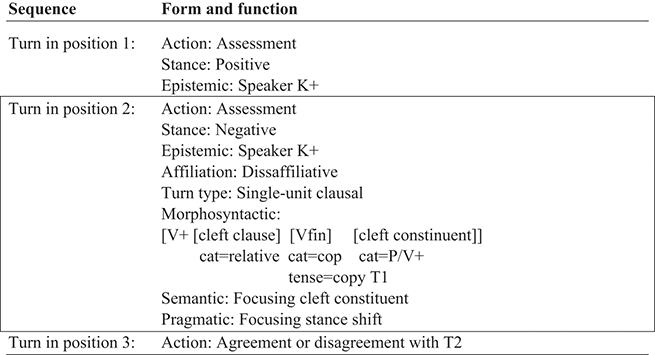
Note that this interactionally sensitive constructional analysis does not contradict the way in which pseudo-clefts have been analyzed earlier from an information-structural point of view. Rather, it shows what the argumentative and interpersonal niche of the construction is: Yes, it places special focus on the cleft constituent (and semi-focus on the cleft clause), but that is done for good interactional reason. In the context of stance negotiation, the action implemented by the pseudo-cleft may be socially delicate, contrasting with what the speaker and other participants have said in prior talk. The verbally elaborate nature of the construction is on a par with such navigations in interpersonal waters. We can also note that stance negotiation is not the only, albeit a very characteristic, functional potential of pseudo-clefts in social interaction. Especially in English, its transitional function has been generalized to the degree that it is most typical with predicates like do, happen, and say (Hopper & Thompson Reference Hopper, Thompson and Laury2008; also Koops & Hilpert Reference Koops, Hilpert, Givón and Shibatani2009), that is, verbs that have to do with planning and narrating activities and the shifts in stages and events in them.
12.4 Conclusion
This chapter has illustrated the usefulness of incorporating an extended, interactionally resonant analytic layer in Construction Grammar accounts. Such an approach is vital when we want to understand what kind of interactional contingencies generate constructs of a certain kind, which, through repeated use, emerge as regular patterns, that is, constructions that are characteristic of talk-in-interaction. There are regularities related to turn, sequence, and discourse organization which are clearly defining, or indeed, distinctive features of such constructions and they can be teased out in generalizable blueprints as suggested in the example analyses above. This is very concretely present in responding actions, of which we have discussed receipt questions and second assessments. Their distinctive grammatical formatting can be considered dependent on, or molded by, the subsequent speaker turn position. Another set of examples, meaning-negotiating and stance-shifting constructions, showed how constructions can be designated for very specific purposes of repair and transitions in interpersonal orientation, which may run counter to the general preference for agreement in conversation. The delicate pragmatic import of such micro-social moves may thus also have to be recorded in the constructional ‘script’, involving the degree of speaker affiliation (or disaffiliation) and the speaker’s agency, that is, whether the speaker is merely going along with the interlocutor or putting forward a self-authored message. Moreover, epistemic relations between the interactants, that is, who is more or less knowledgeable, is another important interpersonal dimension licensing the use of certain constructions: Receipt questions, for example, signal the recipient’s K− position, while someone who embarks on redirecting and correcting the course of interaction in meaning negotiations does this more naturally from a K+ position.
In conclusion, the approach proposed here brings the social into grammatical accounts (see also Chapters 19 and 20), an endeavor which the inherent non-modularity (or holism) of Construction Grammar usefully allows. Indeed, the meaning-negotiating constructions and pseudo-clefts analyzed above bear witness to the claim that constructions, and not only the words that appear in them, can be carriers of meaning (Goldberg Reference Goldberg1995), like that of contesting and shifting a stance polarity.
When working with spoken interaction, we must start with an appreciation of real conversational data and the discovery of interactional trajectories and regularities therein. The temporal and irreversible emergence of linguistic structures calls for a systematic scrutiny of the adaptability of form/meaning/function complexes to specific turn and sequence positions. That is, meanings and functions cannot be simply attributed to certain forms but need to be anchored in interactional information, which strikes a constructional difference between forms that may look superficially quite similar, for example, general polar questions and receipt questions. This means that instead of establishing that a certain linguistic form is multi-functional, applicable to a variety of contexts, we can state that the form probably has multiple functional potentials, but some details of its structure or usability are constrained by the interactional context. Speakers encounter these potentials and constraints in their experience with learning and using language in dialogue with others, and they are something that the analyst can break down to distinctive constructional features in a layered account of complex social signs.


