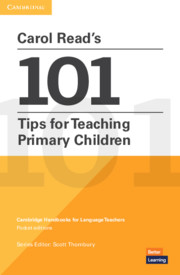
Book contents
- Frontmatter
- Contents
- Acknowledgements
- Why I Wrote this Book
- A Getting Started
- B Core Skills
- C Classroom Management
- D Lesson Planning
- E Learning how to Learn
- F Storytelling
- G Playing Games
- H Values Education
- I Songs, Rhymes, Chants and Raps
- J Working with Projects
- K Intercultural Competence
- L Content-Based Learning (CLIL)
- M Thinking Skills
- N Vocabulary
- O Life Skills
- P Art, Craft and Design
- Q Mime and Drama
- R Inclusion and Diversity
- S Creativity
- T Adapting or Writing Materials
- U Listening and Speaking
- V Reading and Writing
- W Multiliteracies
- X Grammar
- Y Assessment
- Z The Last Word
- Glossary
- Selected Further Reading
- Index
Book contents
- Frontmatter
- Contents
- Acknowledgements
- Why I Wrote this Book
- A Getting Started
- B Core Skills
- C Classroom Management
- D Lesson Planning
- E Learning how to Learn
- F Storytelling
- G Playing Games
- H Values Education
- I Songs, Rhymes, Chants and Raps
- J Working with Projects
- K Intercultural Competence
- L Content-Based Learning (CLIL)
- M Thinking Skills
- N Vocabulary
- O Life Skills
- P Art, Craft and Design
- Q Mime and Drama
- R Inclusion and Diversity
- S Creativity
- T Adapting or Writing Materials
- U Listening and Speaking
- V Reading and Writing
- W Multiliteracies
- X Grammar
- Y Assessment
- Z The Last Word
- Glossary
- Selected Further Reading
- Index

HTML view is not available for this content. However, as you have access to this content, a full PDF is available via the 'Save PDF' action button.
Summary
Life skills is an umbrella term that covers a wide range of personal, social and thinking skills. The overarching life skill addressed in this book is developing children's ability to communicate in a foreign language. Other life skills which relate to this include social and emotional learning (see, e.g. G, J, 60, 66, 75), autonomy and responsible decision-making (see, e.g. 8, J, 83), learning how to learn (E), values education (H), intercultural competence (K) and thinking skills (M).
The aim of teaching life skills to children is to develop their awareness, understanding and practical ability to handle everyday life at home and school. Life skills help children to deal with the pressure of exams, and parents’ expectations, develop positive self-esteem before the challenges of adolescence and develop soft skills such as the ability to work as part of a team.
Children learn life skills as appropriate to different ages. For example, life skills in lower primary might include learning to share with other children, whereas in upper primary, life skills might include learning how to stay safe on social media. The development of life skills is best integrated with other work in an active and experiential way. Classroom activities you can use for this include stories, songs, games, role play, problem-solving and cooperative learning activities.
My key tips for life skills are:
57 Promote children's wellbeing
58 Ensure safe and responsible use of technology
59 Raise awareness of social justice
60 Teach children presentation skills
57 Promote children's wellbeing
Children's wellbeing impacts their learning, behaviour and ability to cope with life. You can contribute to this in many ways.
Wellbeing is a physical and mental state that enables children to feel good about themselves. Children with a high level of wellbeing feel safe, cared for, listened to and understood. They accomplish goals and get positive feedback and praise. They eat well, sleep well, drink lots of water and have frequent opportunities for play and exercise.
Although children's families are the main source of their wellbeing, you have a significant role to play. This is reflected in your ability to develop positive relationships (see 5), cooperative learning (see, e.g 75), effort, resilience (see 32) and autonomy in decision-making (see 8 and 37) and reflected in the way you manage children (see 10, 11 and 12).
Information
- Type
- Chapter
- Information
- Carol Read’s 101 Tips for Teaching Primary Children , pp. 71 - 75Publisher: Cambridge University PressPrint publication year: 2020
Accessibility standard: Unknown
Why this information is here
This section outlines the accessibility features of this content - including support for screen readers, full keyboard navigation and high-contrast display options. This may not be relevant for you.Accessibility Information
Accessibility compliance for the PDF of this chapter is currently unknown
and may be updated in the future.
 You have
Access
You have
Access