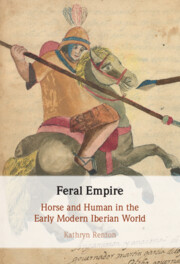


The horse is one of the most enduring images of the flourishing Spanish empire in the Americas. This animal simultaneously symbolizes the military conquest and domination of a new continent by Spanish conquistadors, and the spirited resistance of Indigenous inhabitants to incursions into their homelands and a desire for liberty beyond the reach of empire. The many cultural traditions surrounding the horse – the American cowboy, the charro of Mexico, the gaucho of Argentina, the huaso of Chile, the chalan of Peru – can be viewed as a palimpsest of imperial ambitions stretching from North to South America. These traditions have so permeated national consciousness that the less-historically inclined are surprised to learn that the modern, domesticated horse only arrived on the second voyage of Christopher Columbus.Footnote 1
In 1493, Columbus’s ships landed at the abandoned Fort la Navidad on the island of La Española (island of Haiti and the Dominican Republic) to bring new supplies for a permanent settlement, including the first equine specimens brought to the Americas. Although twenty-five horses had been sent on the expedition, just sixteen disembarked after the rigors of the Atlantic crossing. From this inauspicious beginning, horses multiplied and migrated to the far corners of the American continents over the next two centuries, reestablishing – to an extent, unimaginable since their presumed extinction at the end of the last Ice Age 10,000 years earlier – a species that had, according to zooarchaeologists, originally evolved in the grasslands of the Americas.Footnote 2 One of just a handful of domesticated quadrupeds around the world that is strong enough to carry a fully grown man on its back, the horse also has a responsive, social temperament and the ability to travel at speeds of forty miles per hour over short distances. These traits made horses a novel addition to endemic flora and fauna.
The introduction of the horse to new parts of the world was one of the many profound consequences set in motion by Spain’s expansion overseas between the fifteenth and nineteenth centuries, yet the historical presence of horses in the first century of the Spanish Atlantic is poorly understood. Horses, like other nonhuman animals, do not leave their own written records. Moreover, even though horses were of great importance in early modern Europe, they were also so common as to go largely unremarked in the organization of colonial archives, and collecting these disparate threads across regions presents a major challenge. For the same reason, scholars studying the adoption of the horse in Indigenous American communities generally tread lightly over the fifteenth and sixteenth centuries, as an ethnic and regional focus turns up fewer sources to work from.Footnote 3 As a result, this pivotal moment of introduction is often glossed over with broad gestures to the equine specimens brought by the Spanish, many of which were lost or stolen, and roamed feral and free. Generalizations and myths abound, such as in contemporary national breed histories that, despite the passing of centuries, draw a direct line of descent between these first Iberian horses and the American mustang or the creole horses of the pampas of Argentina.Footnote 4 Few have attempted to explain the first arrival and subsequent dispersal of horses during the first decades of the conquest period.Footnote 5
This book analyzes a rich collection of archival evidence found scattered across dozens of colonial and municipal Spanish archives in Spain and the Viceroyalties of New Spain and Peru, alongside early modern chronicles and information gleaned from historians, ethnohistorians, anthropologists, and archaeologists about the horse in these first hundred years. In piecing together this web of sources, many individually bureaucratic or inconsequential in nature, small clues build up to an understanding of a “culture of the horse” – a specific set of practices, ideals, and institutional hierarchies that shaped relations between the horse and rider – in Spain, and an appreciation of the deep influence of the horse on Iberian colonialism.Footnote 6
Tracing the dramatic movement of the horse from the Iberian Peninsula to the Americas in the fifteenth century provides a unique view into the social logic of empire. When compared to other domesticated animals, the horse had a prominent role in symbolizing and embodying social distinctions and in enacting and enforcing colonial violence. Concerns about purity and hybridity intersected with these uses of the horse and the formation of colonial racial identities. The historical contours of the human–equine relationship underpinned core elements of Iberian colonialism as they shaped Spanish, Indigenous, and other colonial communities. Approaching these topics using evidence gleaned from colonial-era archives introduces localized landscapes and reveals negotiations that influenced how the horse mediated colonial hierarchies and imperial power.
Bringing to light the interlinked social, political, and environmental histories surrounding human–equine relations offers important interventions in the history of the global Iberian world. First, this study makes visible new patterns in colonization across Iberia, the Caribbean, New Spain, Peru, and other parts of South America tied to human–equine relations. Strategies of conquest and settlement, such as the distribution of land, followed Iberian human–equine precedents in social and legal realms. Colonial husbandry practices influenced land use and territorial claims, while Indigenous people’s adoption and development of equestrianism within the growing empire contributed to the negotiation of colonial identities. Second, this study proposes that the interdependence of social and political relationships with ecological change in the Americas shaped the perception of and exercise of Spanish imperial power. The changing dynamics of scarcity and abundance in horse populations impacted social hierarchies and challenged notions of control over land, people, and animals, generating opportunities to negotiate localized and regional interests in an “equine political ecology.” Third, this research intervenes in the history of imperial ideologies of race by looking in detail at practices of horse breeding and their role in controlling, domesticating, and differentiating colonial populations. The Iberian husbandry practices that resulted in large feral horse populations, and the specific uses of casta and raza in legislation around horse breeding regulations, draw attention to the multiple and even contradictory concepts of breed and race that circulated in Spain’s expanding empire. Classifications of casta and raza had clear limitations and complications in the realm of horse breeding that are also relevant for their potential use in colonial social hierarchies. Ultimately, despite the biopolitical implications of introducing horses to conquer and control new territory or in the power dynamics within human–equine relations, this history reveals the horse to be a carrier of dynamic tensions running throughout Spanish colonization – between social mobility and social division, intervention and control, and theories of improvement and boundaries of taxonomy – that challenge the framing of domestication and horse breeding as technologies of empire.
With its archival focus, this book makes use of current arguments in animal and environmental studies to examine human–equine interspecies relations from a historical perspective. Archival records document aspects of material practices with historical animals; they do not record an animal’s subjective experiences of those practices.Footnote 7 To better understand animal agency, scholars in animal studies have emphasized disaggregating “the” animal as a category to consider species-specific interactions, an approach I have used here by focusing on the horse.Footnote 8 Post-humanist scholars have decentered the human perspective of interspecies interactions to appreciate parallel processes of “becoming” – the mutual co-construction of actants or individuals.Footnote 9 Agency, in this sense, is developed in response to other beings within a materialist epistemology, such as bodily practices or even an extended materialism that is not confined to a distinct body.Footnote 10 Here, ecological history provides a necessary and complementary approach that similarly makes visible the important reality that both human and nonhuman animals impact and respond to the environments they live in, shaping each other’s existence.Footnote 11 These approaches offer new opportunities to explore animal agency in written historical records.Footnote 12 I identify surprising slippages between general discourses about horses and practices with horses in the archives that challenge the notion that nonhuman animals are primarily objects or instruments of biopolitical power. This archival approach makes it possible to trace the equine influence on Iberian structures of power, making visible an “animal imprint” in governance structures and the numerous ways that animals constituted and participated in early modern social relations and imperial ecologies.
I rely on the concept of embodiment to address both frameworks of agency and biopolitics in a specific premodern context. The process of becoming and the entanglements it engenders postulates a physical body, potentially extended by the types of interactions considered, that impacts the inner subjecthood of historical animals, human or not. Embodiment, a concept used variously in fields of literature, anthropology, philosophy, psychology, and neuroscience, offers a way to ask how historical equine bodies were both shaped by and shaped the systems and structures around them.Footnote 13 I posit that the embodied experiences of historical horses created real-world entanglements within the political and social structures that aimed to define or control them. The historical cases examined here illustrate the horse’s broad-reaching influence through its embodied imprint and delineate a soft form of equine agency that is embedded in social and political networks – one that may not capture the direct material agency of individual horses, but nonetheless presents itself noticeably in extant archives. Thus, while I discuss the biopolitical nature of relations between the horse and the state in the medieval and early modern Iberian world, I also highlight concurrent tensions generated by the horse that created a dynamic instability that instigated historical change. Such tensions in the social and political constructs that developed around the horse permeate Spain’s transition from a medieval kingdom to a centralizing, early modern empire.
Iberian Horse Culture, from “Reconquest” to “New World Conquest”
The first section of this book, Chapters 1 and 2, defines an Iberian culture of the horse, tracing its development on the medieval Iberian frontier and its deployment in the early stages of conquest and colonization in the Caribbean. Beyond the military function of the knight on horseback, the horse was deeply embedded in Iberian frontier institutions for governing. This far-reaching cultural and military apparatus shaped strategies of conquest and colonization in the Americas. Horse riding and horse breeding comprised important elements of Spanish governance in Iberia, and these practices and social ideals underwent a dynamic process of transfer, adaptation, and change in colonial landscapes.
Chapter 1 examines the iconic image of the knight on horseback in relation to biopolitical concepts of power, looking back to the medieval origins of the “Reconquest” of the Iberian Peninsula. Bridging medieval and early modern practices, it outlines the horse’s imprint in the legal, political, and social systems that developed in Iberian frontier society. On the one hand, the control of horses’ bodies, ridden by knights and bred in conquest settlements, fashioned social distinctions and ideals of nobility. On the other hand, the horse served as an engine of social mobility on the stage of military and political conquest. The duality of this interspecies relationship engendered surprising influences, allowing the horse to serve as a force for negotiating with royal power and as a contested symbol of nobility. Horses became the measure, quite literally, of frontier governance, encompassing legal terms for social status, units of measurement, and requirements for participating in municipal governance. Because of this influence, horses were also a source of important challenges to these same arenas of control. This chapter argues that the “embodied entanglements” of historical horses represent a type of equine agency with real effects on the world they inhabited.
Chapter 2 traces the imprint of the horse in Iberian governance as it shaped early stages of Spanish colonialism in the “New World,” during the first settlements in the Caribbean islands and in the early expeditions and wars against Indigenous kingdoms in Mexico and Peru, against a new backdrop of an absolute scarcity of horses. I argue that despite the environmental and logistic challenges presented by the horse, the Spanish insisted on using horses in early campaigns and settlements because of their central function in imposing order on conquered territory through the distribution of land and political office. Efforts by the medieval Castilian kings to encourage horse ownership among unruly knights and nobles had generated a specific legal language and significance for horses in newly conquered territories in Iberia. This legal language was reflected in the accounts Spanish conquistadors wrote in an effort to secure their status. By making the management of horse populations a municipal responsibility, the crown cultivated political figures’ interest in breeding horses and managing their movement. More than technological or environmental factors, these cultural imperatives motivated the Spanish to transfer their governance practices with horses from Iberia to colonial settlements.
A Political Ecology of the Horse in the Americas
The next section, Chapters 3 and 4, attends to horse–human relations and their physical entanglements with surrounding environments, foregrounding the dependencies and relationships between people, animals, and landscapes that made up a unique political ecology. Spanish colonizers imported cultural expectations about the role horses would play in establishing social order; yet, these expectations faced challenges in the reality of new environmental conditions and complex colonial reliance on Indigenous populations. As the horse population grew, it became evident that the horse was not simply a dominating force, but also a force of disruption and negotiation. Visions of imperial control were undermined by the volatile dynamics of scarcity and abundance related to feral horse populations and the rise of Indigenous allies’ new interspecies relationship with horses. Viewing Spanish conquest and expansion beyond the Iberian Peninsula from an ecohistorical perspective reframes these domesticated animals from agents of conquest (a core perspective of the “Columbian Exchange”) to ecological players responding to multiple, regional environments.Footnote 14
Chapter 3 considers factors that contributed to the growth of the horse population and the horse’s role in Spanish colonialism. From a place of original scarcity, the horse population increased due to both environmental conditions and the application of traditional husbandry methods used to seed populations of horses in the Greater Antilles, Mexico, and Central America. The practices of loose herd management and protection of the commons, both of which were embedded in colonial settlement strategies, contributed to the state of growing feral horse herds, particularly in New Spain. Livestock encroached on Indigenous settlements and agricultural plots, entered colonial cities, and took over pastures, demonstrating that abundance created strains on colonial regulations and governance. Gaps between the colonial aims of breeding horses and the realities of those practices generated both conflicts and opportunities for colonial subjects. Domestication is generally understood as a powerful force of human intervention, but the tensions raised by Spanish animal husbandry practices that are documented in the municipal records of colonial settlements illustrate limits to that control.
Chapter 4 focuses on Indigenous actors within this colonial equine political ecology and their responses to the growing horse population. Ethnohistorians and anthropologists have drawn attention to alternative models for interspecies interactions across a range of Indigenous cultures. One avenue for Indigenous engagement with domesticated animals such as horses came through Spanish colonialism. Indigenous allies gained access to horses according to Spanish customs that rewarded service to the crown on the frontier, emphasizing the powerful imprint of the horse in the logic of Spanish governance, even while contradicting the biopolitical imperative to use horses to enforce colonial hierarchies. Indigenous responses to the growing abundance of horses illustrate a form of social and ecological “boundary work” that involved navigating and producing new forms of knowledge. In this sense, native adoption of equestrianism in the Spanish colonial context became both a means to claim noble lineage and a powerful tool of resistance.
Breeding the Horse: Limits of Domestication and Race
The third section of the book, Chapters 5 and 6, returns to questions about horse breeding’s influence on social hierarchies and colonial identity. More particularly, it examines how classifications of equine difference (such as cimarrón, criollo, and other castas and razas of horses) were used alongside contemporary practices of horse breeding to elucidate their biopolitical implications in imperial ideologies. As a tool of governing conquest territories, horse breeding developed both a taxonomy of difference and a legal regulatory framework. Scholars interested in the biopolitics and history of racial ideas have drawn on the development of such terminology in horse and other animal breeding contexts to demonstrate a premodern racial logic transferrable to imperial hierarchies.Footnote 15 However, considering horse breeding as a site of knowledge production and looking at specific use-contexts for early modern horse breeding terminology demonstrates limits to the control implied by domesticated animal breeding and a more nuanced reading of animal “race.”Footnote 16
Chapter 5 examines typologies for horses that developed in Spanish colonies, noting the difficulties that emerged in differentiating between “domesticated” and “feral” populations. Although the Spanish populated the Americas with horses, control was tenuous and feral animals transgressed this fragile sense of order. More importantly, these feral horses were themselves a direct product of Spanish husbandry methods that used both controlled and uncontrolled breeding. The new category of the cimarrón, or “wild” horse, did not derive from a fundamental behavior or physical type in the animal, but rather indicated human social concerns. Conversely, because colonial municipalities were responsible for sustaining horse populations against the threat of scarcity, specific regulations for breeding horses were applied in municipalities from New Spain to Peru and generated the criollo horse. Centered on the terminology of casta, these policies supported breeding methods that used hybrid crosses rather than inbred lineages to maintain the quality of a region’s horses as an antidote to population decline in both quantity and quality. In other words, these practices denote casta as a constructed rather than a naturalized product of land or lineage. In this sense, both the free-ranging horses that populated the Americas and the types of horses that were bred there can be characterized as feral, with feral understood as a “counter-intentional form” that adapts and evolves despite human efforts to intervene and control.Footnote 17 Regulations for practices of horse breeding illustrated an early modern understanding of breeding as something in between the natural and the wild, both requiring intervention and acknowledging forces beyond human control.
Chapter 6 returns to the Iberian Peninsula to consider how colonial experiences influenced or altered the imprint of horses on governance by examining the use of the terminology of casta and raza in regulations for horse breeding. In the sixteenth century, the king’s efforts to exert control over urban elites produced a shift towards more active regulation of horse breeding throughout Spain. This program to improve the Spanish horse includes the first use of raza in legal documentation, employed in conjunction with the notion of casta. However, these regulations and the king’s development of a new “race” of horses focused on the needs of hybrid health and demonstrated the drawbacks of intensive inbreeding for the sake of purity. Indeed, the practical and codified knowledge gained from horse breeding often contradicted ideals of genealogical purity, painting an early modern understanding of the constructed nature of horse types, in direct contrast to the notion of horse “race” as a synonym for a natural and essentialized intergenerational transfer of traits. Debates sparked by this program included new arguments in favor of the purity of horse breeds from advocates among the nobility, which began to coalesce in the 1600s. Together, these contrasting interpretations of race in horse breeding suggest that racial implications in the use of horse breeding terminology came from new discourses of nobility focused on blood purity, and not from experiential knowledge gained from horse breeding or its regulation.
Feral Empire: Horse and Human in the Early Modern Iberian World
Horse–human relations were central rather than peripheral to the history of the Spanish empire. In Iberian governance and strategies of conquest and colonization, the horse came to mediate the social lives of subjects in colonial society. Pursuing a history of the horse in the early modern Iberian world contributes to better defining the powerful but abstract construct of empire and draws out the complexities of its various, regional realities.Footnote 18 It offers a model for recovering and understanding human–equine relationships, one in which the horse can be both a tool of colonization and a source of resistance, a tension fundamentally connected to the horse’s embodied and relational entanglements with the world.
Drawing on early modern Iberian archives and practices, this book makes a place for the material agency of historical human and equine actors in these tensions, limitations, and complications of colonization. More than a mere tool of imperial domination, the horse’s imprint on forms of governance and social hierarchy was central to the language of political and social negotiation. To establish its colonial presence in the Americas, Spanish conquistadors and colonial officials cultivated new horse populations. Even though they were shaped by Spanish methods of animal husbandry for governance purposes, these growing horse populations challenged Spanish control in a new equine political ecology. In colonial hierarchies and in horse breeding endeavors, the evident tensions between intervention and control influenced the taxonomies of difference deployed to describe these new horse populations.
The framework of ferality illustrates the limits of domestication in diverse colonial environments, where the horse was not only an extension of empire but also a challenge to it. The feral horse of the Americas is the most literal example, but this potential for the feral within the domesticating impulse of empire also applies to ideas of breed and race in Latin America, and more broadly to other notions of control in multispecies relations. These “lively assemblages” of human and nonhuman animals share cultural and political landscapes that are both local and formative. This book contributes to understanding “the great variety of conditions in which humans relate, transform, and are themselves shaped by their other-than-human surroundings,” for which the horse is one example.Footnote 19
The history of the horse links social, political, and environmental histories relevant to comparative, transregional, and interdisciplinary interest in the animal as a means of writing history. The narratives that follow are drawn from dozens of Spanish-language archives, published documentary sources, and scholarship incorporating Portuguese and other Indigenous language sources; yet, they only scratch the surface of a deeply fascinating and multifaceted subject. This work provides a foundation for studying the horse in ways that are truly global in scope and impact.

 Open access